


 Скачать презентацию Reading Fluency What is it and How Do
2db4418208e01abcd553ddea92938a71.ppt
- Количество слайдов: 41
 Reading Fluency What is it and How Do We Help Develop Fluency in Children?
 Outline of Workshop I. Survey the audience II. Definitions of Fluency III. What a Fluency Intervention Program Should Include IV. What Parents Should Do at Home
 Oral language is natural; we are wired for oral language development Reading does not develop naturally, and for many children, specific decoding, word-recognition, and reading comprehension skills must be taught directly and systematically. G. Reid Lyon Let’s look at the graphic of the Reading Framework
 Chall’s Stage 2 of Reading “Confirmation, Fluency, Ungluing from Print” Grades 2 -3, Ages 7 -8. Once the child has become successful at the aspect of decoding it is time to progress forward. No teacher desires a child to be a word caller, or a reader who glues to text. A good reader is a fluid reader, who automatically decodes words, thus freeing up attention for higher levels of comprehension and meaning. As the child progresses through stage 1 they acquire orthographic knowledge of words. They recognize patterns of words and reach a level of automaticity in word recognition. This new found ability enables the reader to become more fluent. Chall often refers to this stage as "more of the same". In other words the learner needs the opportunity to hone the skills of reading in comfortable text and comfortable reading situations. (cont)
 Recreational reading encourages safe fluent reading. This stage is not for gaining new information or using reading to learn, but it is used to gain control of reading so that when they become stage 3 readers they will be able to use the tool of reading to successfully gain knowledge. Once again the reading emphasis switches to a more whole language approach. The learner should be given the opportunity to read many familiar texts. The greater the amount of practice and the greater the immersion, the greater the chance of developing the fluency with print that is necessary for the more complex nature of reading to learn.
 Five Key Areas of Early Reading Development • phonemic awareness • phonics • fluency • vocabulary • text comprehension Alphabet recognition…letter name and corresponding sound Phonemic awareness…esp. blending and segmenting Phonics…………………. . systematic and explicit instruction of letter-sound relationships A good reading program should include: Phonemic Awareness Fluency Comprehension Grammar and Writing Phonics Vocabulary Spelling Age-appropriate materials
 What is fluency? Tami Katzir’s and Maryanne Wolf’s working definition for fluency is that “fluency is a developmental process and that many linguistic areas contribute to it. These areas are phonology, (knowledge of sounds) orthography (knowledge of letter patterns), vocabulary, syntax (knowledge of grammar functions) and morphology (knowledge of word roots, prefixes and affixes). ” “In its beginnings, reading fluency is the product of the initial development of accuracy and the subsequent development of automaticity in underlying sublexical processes, and their integration in single-word reading and connected text. These include perceptual, phonological, orthographic, and morphological processes at the letter, letter-pattern, and word levels, as well as semantic and syntactic processes at the word level and connected-text level.
 Other definitions According to A Dictionary of Reading and Related Terms (Harris and Hodges 1981), fluency is the ability to read smoothly, easily and readily with freedom from word recognition problems that might hinder comprehension. Meyer and Felton define fluency as the ability to read text rapidly, smoothly, effortlessly, and automatically with little conscious attention to the mechanics of reading such as decoding. According to The National Reading Panel, (2000) fluency is the ability to read text quickly, accurately and with proper expression. According to Put Reading First (Armbruster, Lehr, & Osborne 2001) fluency is the ability to read text quickly and accurately. When fluent readers read silently, they recognize words automatically. They group words in ways that help them gain meaning from what they read. Fluent readers read aloud effortlessly and with expression. Their reading sounds natural, as if they are speaking,
 FLUENCY =AUTOMATIC WORD RECOGNITION + COMPREHENSION The end goal of fluency is effortless reading with good comprehension In the Dec’ 04/Jan’ 05 edition of Reading Today at least 75% of the respondents agreed that fluency is and should be a hot topic.
 Important Dimensions of Fluent Reading 1. Accurate word decoding (via explicit teaching of phonics and word analysis skills) 2. Automatic processing (effortless decoding so reader can use cognitive resources) 3. Read with proper expression aka. prosody (syntax and semantics) which allow the reader to allocate effort to gain meaning from text i. e. comprehension
 More fluent readers do not need to focus on decoding words; they focus their attention on making connections among the ideas presented in the text and their background knowledge. Therefore, they are able to focus on comprehension. Less fluent readers must focus their attention primarily on decoding individual words. Therefore, they have little attention or effort left for comprehension.
 According to Wolf, “Fluency should be part and parcel of how we teach reading and how we teachers of reading. In other words, we should be as explicit in how we help a child learn to read fluently, as we are in teaching a child to decode a word accurately. ” After it is fully developed, reading fluency refers to a level of accuracy and rate where decoding is relatively effortless; where oral reading is smooth and accurate with correct prosody; and where attention can be allocated to comprehension. Wolf does not view fluency as an outcome of processes; she and her colleagues suggest that fluency is a developmental
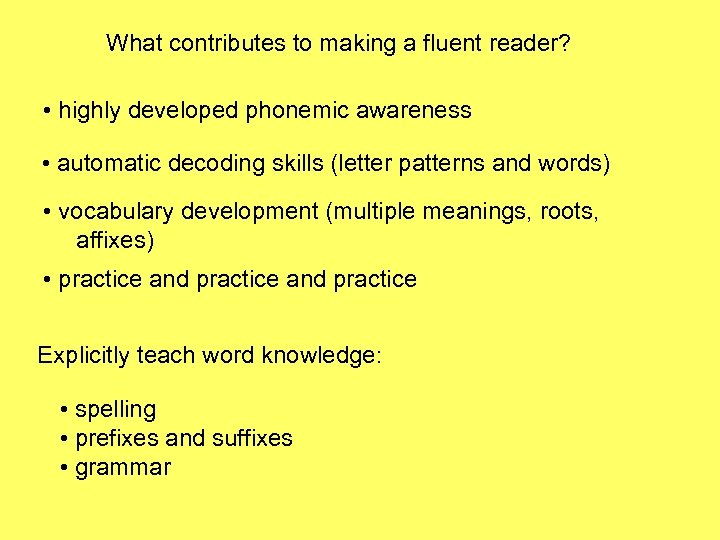 What contributes to making a fluent reader? • highly developed phonemic awareness • automatic decoding skills (letter patterns and words) • vocabulary development (multiple meanings, roots, affixes) • practice and practice Explicitly teach word knowledge: • spelling • prefixes and suffixes • grammar
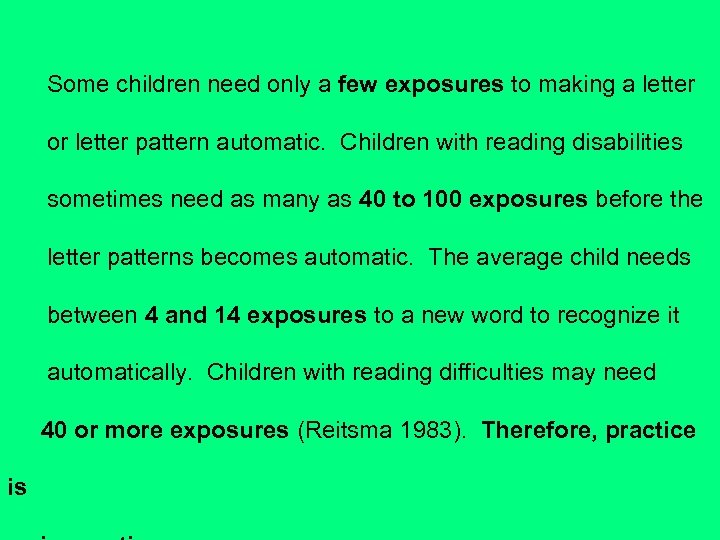 Some children need only a few exposures to making a letter or letter pattern automatic. Children with reading disabilities sometimes need as many as 40 to 100 exposures before the letter patterns becomes automatic. The average child needs between 4 and 14 exposures to a new word to recognize it automatically. Children with reading difficulties may need 40 or more exposures (Reitsma 1983). Therefore, practice is
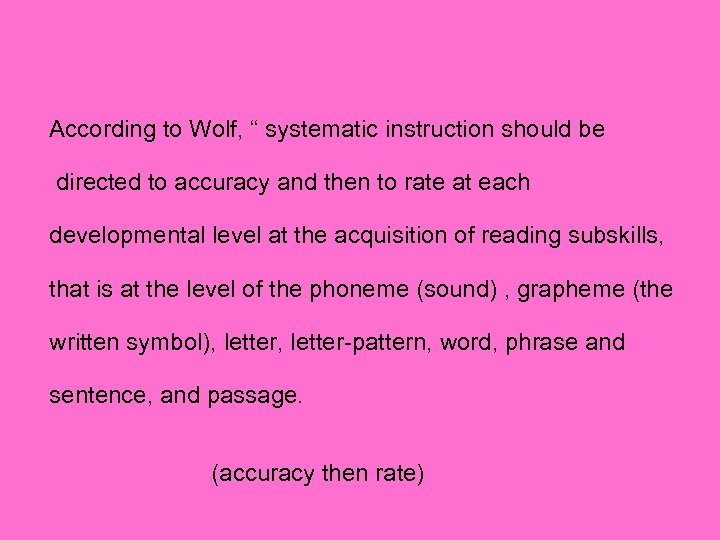 According to Wolf, “ systematic instruction should be directed to accuracy and then to rate at each developmental level at the acquisition of reading subskills, that is at the level of the phoneme (sound) , grapheme (the written symbol), letter-pattern, word, phrase and sentence, and passage. (accuracy then rate)
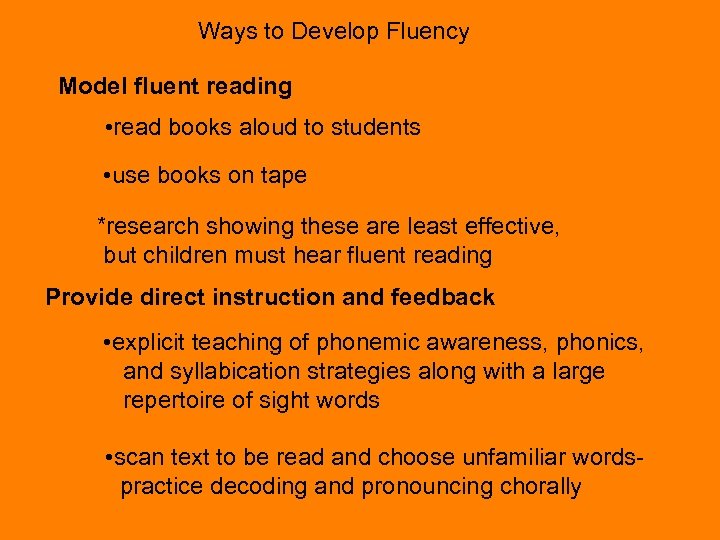 Ways to Develop Fluency Model fluent reading • read books aloud to students • use books on tape *research showing these are least effective, but children must hear fluent reading Provide direct instruction and feedback • explicit teaching of phonemic awareness, phonics, and syllabication strategies along with a large repertoire of sight words • scan text to be read and choose unfamiliar wordspractice decoding and pronouncing chorally
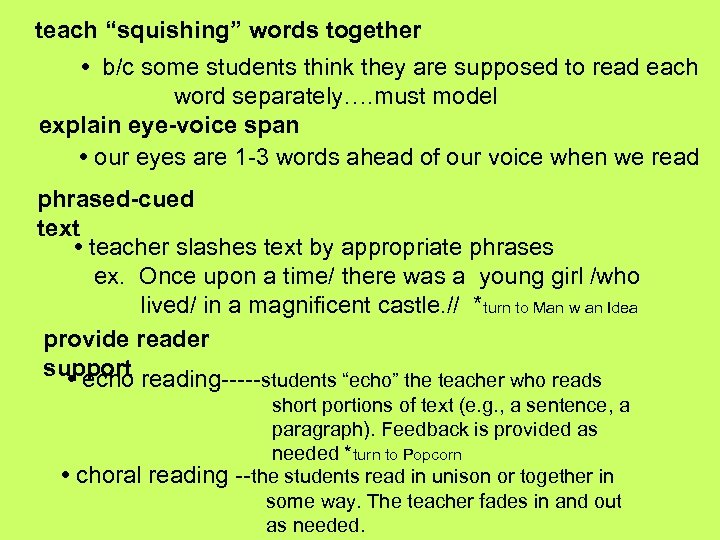 teach “squishing” words together • b/c some students think they are supposed to read each word separately…. must model explain eye-voice span • our eyes are 1 -3 words ahead of our voice when we read phrased-cued text • teacher slashes text by appropriate phrases ex. Once upon a time/ there was a young girl /who lived/ in a magnificent castle. // *turn to Man w an Idea provide reader support reading-----students “echo” the teacher who reads • echo • choral reading short portions of text (e. g. , a sentence, a paragraph). Feedback is provided as needed * turn to Popcorn --the students read in unison or together in some way. The teacher fades in and out as needed.
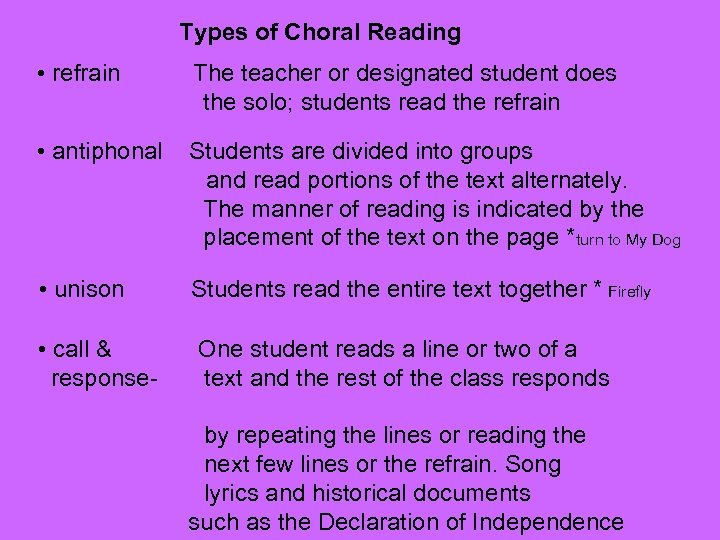 Types of Choral Reading • refrain The teacher or designated student does the solo; students read the refrain • antiphonal Students are divided into groups and read portions of the text alternately. The manner of reading is indicated by the placement of the text on the page * turn to My Dog • unison Students read the entire text together * Firefly • call & response- One student reads a line or two of a text and the rest of the class responds by repeating the lines or reading the next few lines or the refrain. Song lyrics and historical documents such as the Declaration of Independence
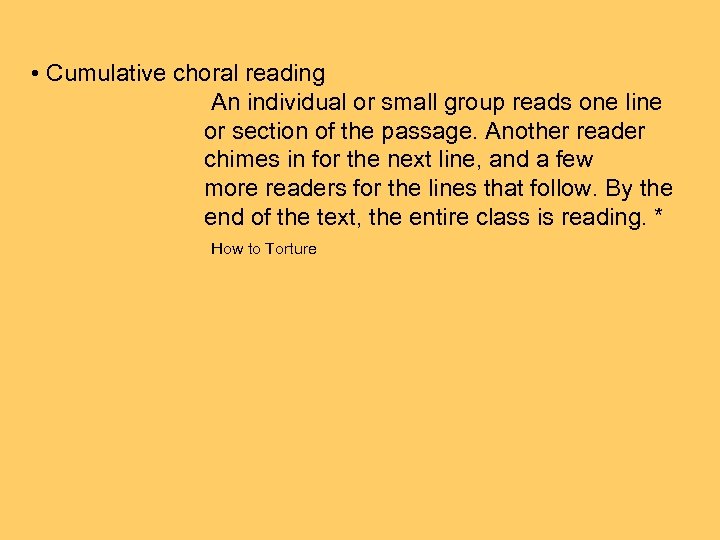 • Cumulative choral reading An individual or small group reads one line or section of the passage. Another reader chimes in for the next line, and a few more readers for the lines that follow. By the end of the text, the entire class is reading. * How to Torture
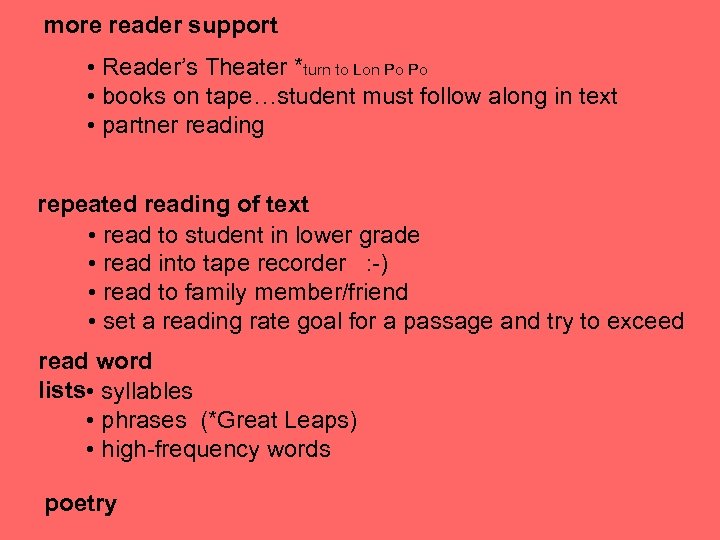 more reader support • Reader’s Theater *turn to Lon Po Po • books on tape…student must follow along in text • partner reading repeated reading of text • read to student in lower grade • read into tape recorder : -) • read to family member/friend • set a reading rate goal for a passage and try to exceed read word lists • syllables • phrases (*Great Leaps) • high-frequency words poetry
 Published materials • Great Leaps @ Great. Leaps. com • Read. Naturally • Rav-o (not yet published) • Fluency Formula @ Scholastic. com
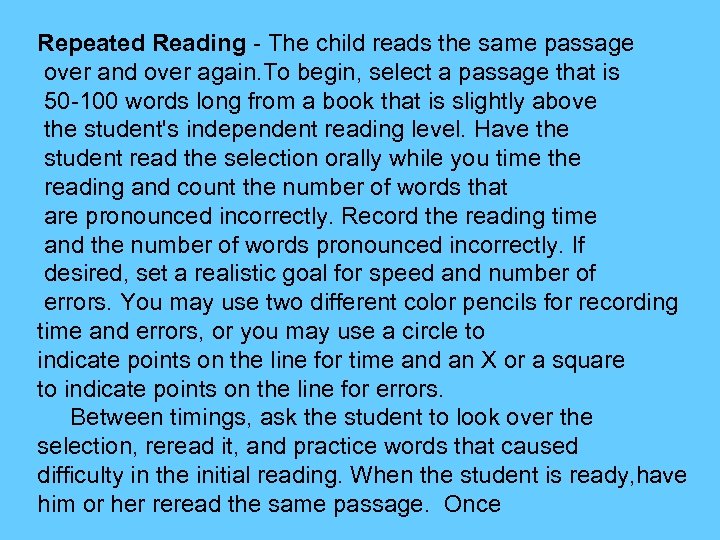 Repeated Reading - The child reads the same passage over and over again. To begin, select a passage that is 50 -100 words long from a book that is slightly above the student's independent reading level. Have the student read the selection orally while you time the reading and count the number of words that are pronounced incorrectly. Record the reading time and the number of words pronounced incorrectly. If desired, set a realistic goal for speed and number of errors. You may use two different color pencils for recording time and errors, or you may use a circle to indicate points on the line for time and an X or a square to indicate points on the line for errors. Between timings, ask the student to look over the selection, reread it, and practice words that caused difficulty in the initial reading. When the student is ready, have him or her reread the same passage. Once
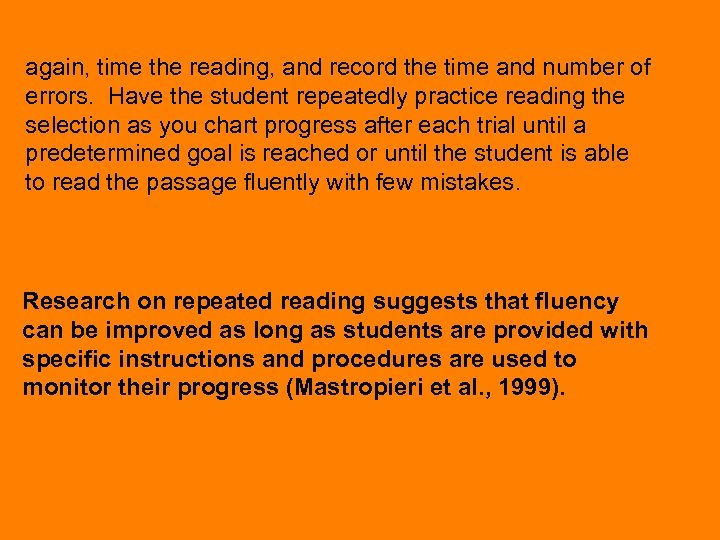 again, time the reading, and record the time and number of errors. Have the student repeatedly practice reading the selection as you chart progress after each trial until a predetermined goal is reached or until the student is able to read the passage fluently with few mistakes. Research on repeated reading suggests that fluency can be improved as long as students are provided with specific instructions and procedures are used to monitor their progress (Mastropieri et al. , 1999).
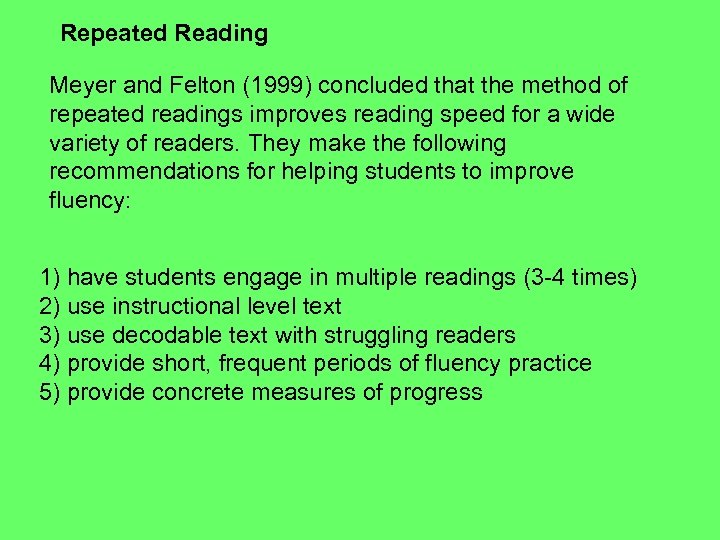 Repeated Reading Meyer and Felton (1999) concluded that the method of repeated readings improves reading speed for a wide variety of readers. They make the following recommendations for helping students to improve fluency: 1) have students engage in multiple readings (3 -4 times) 2) use instructional level text 3) use decodable text with struggling readers 4) provide short, frequent periods of fluency practice 5) provide concrete measures of progress
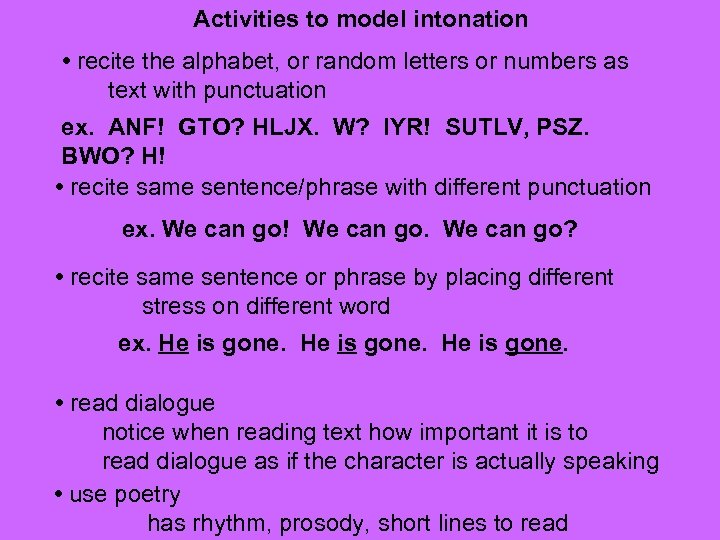 Activities to model intonation • recite the alphabet, or random letters or numbers as text with punctuation ex. ANF! GTO? HLJX. W? IYR! SUTLV, PSZ. BWO? H! • recite same sentence/phrase with different punctuation ex. We can go! We can go? • recite same sentence or phrase by placing different stress on different word ex. He is gone. • read dialogue notice when reading text how important it is to read dialogue as if the character is actually speaking • use poetry has rhythm, prosody, short lines to read
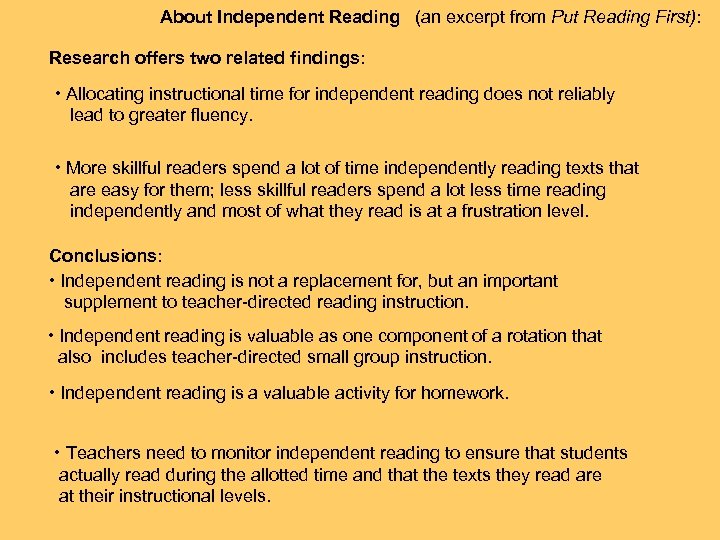 About Independent Reading (an excerpt from Put Reading First): Research offers two related findings: • Allocating instructional time for independent reading does not reliably lead to greater fluency. • More skillful readers spend a lot of time independently reading texts that are easy for them; less skillful readers spend a lot less time reading independently and most of what they read is at a frustration level. Conclusions: • Independent reading is not a replacement for, but an important supplement to teacher-directed reading instruction. • Independent reading is valuable as one component of a rotation that also includes teacher-directed small group instruction. • Independent reading is a valuable activity for homework. • Teachers need to monitor independent reading to ensure that students actually read during the allotted time and that the texts they read are at their instructional levels.
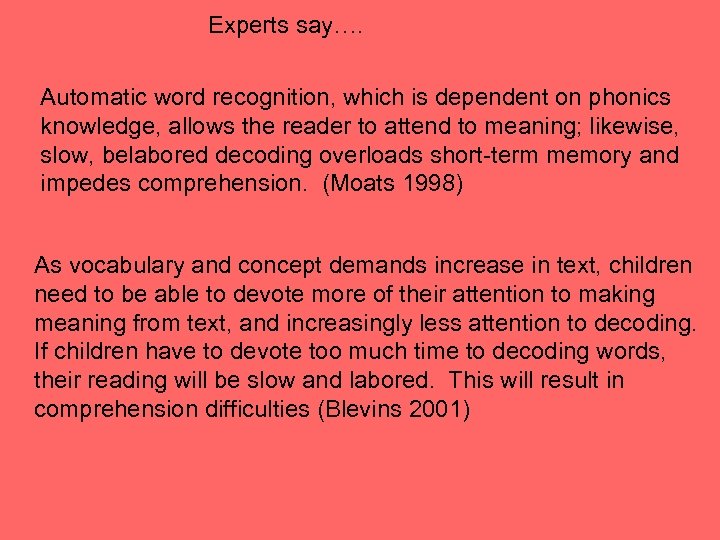 Experts say…. Automatic word recognition, which is dependent on phonics knowledge, allows the reader to attend to meaning; likewise, slow, belabored decoding overloads short-term memory and impedes comprehension. (Moats 1998) As vocabulary and concept demands increase in text, children need to be able to devote more of their attention to making meaning from text, and increasingly less attention to decoding. If children have to devote too much time to decoding words, their reading will be slow and labored. This will result in comprehension difficulties (Blevins 2001)
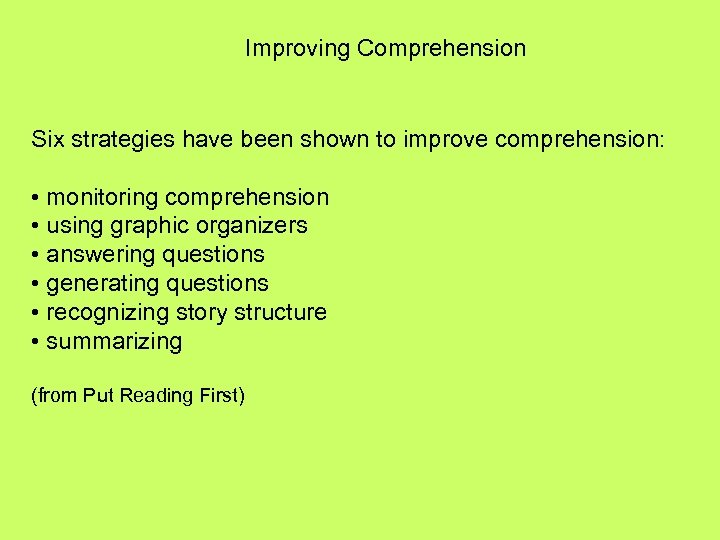 Improving Comprehension Six strategies have been shown to improve comprehension: • monitoring comprehension • using graphic organizers • answering questions • generating questions • recognizing story structure • summarizing (from Put Reading First)
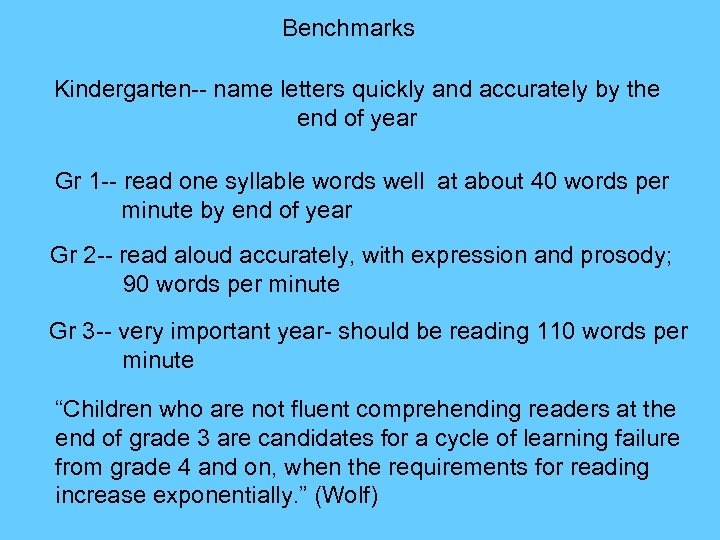 Benchmarks Kindergarten-- name letters quickly and accurately by the end of year Gr 1 -- read one syllable words well at about 40 words per minute by end of year Gr 2 -- read aloud accurately, with expression and prosody; 90 words per minute Gr 3 -- very important year- should be reading 110 words per minute “Children who are not fluent comprehending readers at the end of grade 3 are candidates for a cycle of learning failure from grade 4 and on, when the requirements for reading increase exponentially. ” (Wolf)
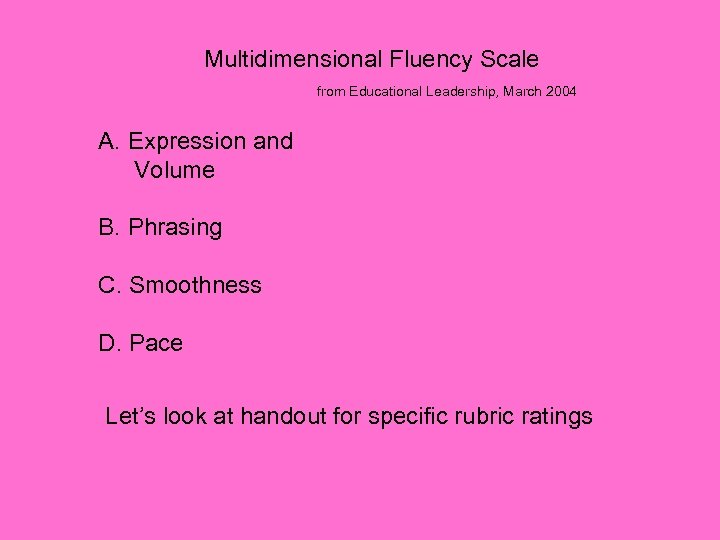 Multidimensional Fluency Scale from Educational Leadership, March 2004 A. Expression and Volume B. Phrasing C. Smoothness D. Pace Let’s look at handout for specific rubric ratings
 School’s Role in Fluency The school, especially at the elementary level, has some responsibility for developing automaticity (fluency) in the basic skills and processes that students need for more complex learning at later levels. (Bloom 1986) From Ted Hasselbring; The Importance of Mathematical Fluency: A Focus on Assessment and Intervention Let’s not forget that there is computational fluency as well as reading fluency.
 What a Parent Should Do at Home • read everyday with your child shared reading-one paragraph each or 1/2 page each, read aloud student should read aloud for at least 10 minutes each day use poetry and have student practice reading to “perform” /read a poem at a family dinner Great Leaps-do at least the phrases and stories 4 times a week; takes 5 minutes at most and keep a log
 Tips for Parents from Top Researchers by Ed Kame'enui, Marilyn Adams, & G. Reid Lyon http: //www. readingrockets. org/article. php? ID=31 1. create appreciation of the written word • find time to read aloud with your child every day. 2. develop awareness of printed language • teach about books. 3. learn the alphabet • play alphabet games; sing the alphabet song as you play with alphabet books, blocks, and magnetic letters; recite letters as you go up and down stairs or give pushes on a swing; use A-B-C, dot-to-dot and letter-play workbooks, games, and puzzles • watch Sesame Street with your child.
 • make writing materials available to your child and encourage their use. 4. understand that language is made of words, syllables, and phonemes • sing songs and read rhyming books. • play word games 5. learn letter sounds • sound out letters; point out other words that begin with the same letter as your child's name; use alphabet books, computer games, or car games such as, "I'm thinking of something that starts with /b/" to engage the child in alliterative and letter-sound play
 6. sound out new words • point out new words; as you encounter them, say the sound while touching each letter in a new word. • play spelling games with your child • independent writing; encourage your child to use inventive or independent spelling. 7. identify words in print accurately and easily 8. When reading stories • pause to explore the meanings of new words, using them in other sentences and contrasting what they mean with words that have similar meanings; make an effort to revisit new words and concepts later; pause to discuss the various characters, problems, events in the story, and invite your child to think about how the problems might be solved or to wonder about what might happen next. when resuming a story, ask your child to review what has happened so far
 Points to Remember FLUENCY =AUTOMATIC WORD RECOGNITION + COMPREHENSION TEACHERS NEED TO GIVE DIRECT INSTRUCTION FOR FLUENCY PRACTICE, PRACTICE READING ALOUD The end goal of fluency is effortless reading with good comprehension
 RESOURCES FOR FLUENCY MATERIALS READER'S THEATER SCRIPT SOURCES http: //www. aaronshep. com/rt/ http: //www. readers-theatre. com http: //www. geocities. com/Enchanted. Forest/Tower/3235 http: //www. storycart. com http: //loiswalker. com/catalog/guidesamples. html http: //www. readinglady. com http: //www. lisablau. com http: //www. teachingheart. net/readerstheater. htm http: //www. readinglady. com/Readers_Theater/Scripts/scripts. html TRADE BOOKS Blume - The Pain and the Great One Brown - Arthur Babysits Byars – The Golly Sisters Go West Ciardi - You Read to Me, I'll Read to You Fleischman - Bull Run Fox - Hattie and the Fox Lobel - Fables Mazer - The Salamander Room Naylor - King of the Playground Raschka - Yo! Yes? Zion – Harry the Dirty Dog **Books in the I Can Read Series, Amelia Bedelia Series, Cat in the Hat +
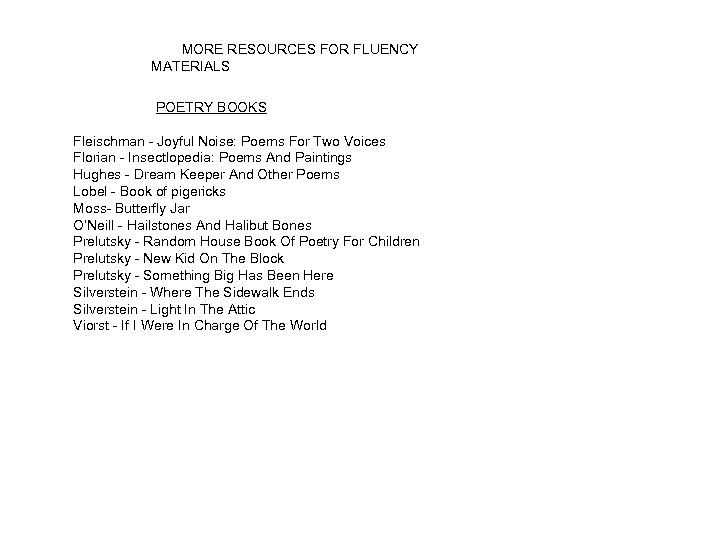 MORE RESOURCES FOR FLUENCY MATERIALS POETRY BOOKS Fleischman - Joyful Noise: Poems For Two Voices Florian - Insectlopedia: Poems And Paintings Hughes - Dream Keeper And Other Poems Lobel - Book of pigericks Moss- Butterfly Jar O’Neill - Hailstones And Halibut Bones Prelutsky - Random House Book Of Poetry For Children Prelutsky - New Kid On The Block Prelutsky - Something Big Has Been Here Silverstein - Where The Sidewalk Ends Silverstein - Light In The Attic Viorst - If I Were In Charge Of The World
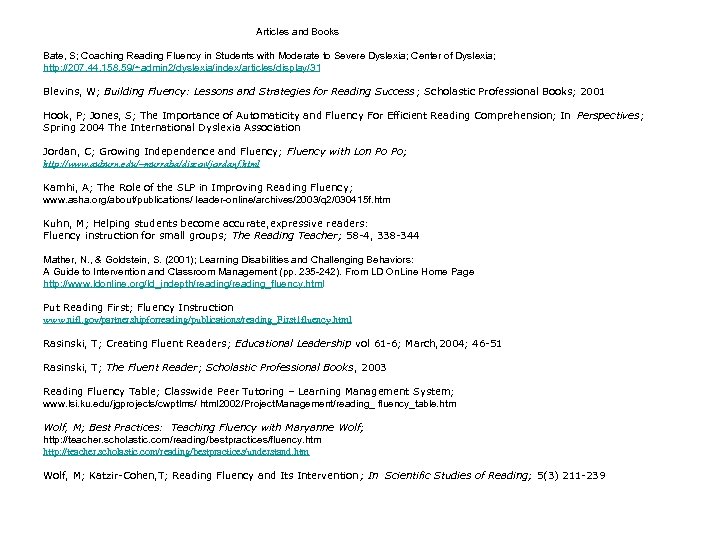 Articles and Books Bate, S; Coaching Reading Fluency in Students with Moderate to Severe Dyslexia; Center of Dyslexia; http: //207. 44. 158. 59/~admin 2/dyslexia/index/articles/display/31 Blevins, W; Building Fluency: Lessons and Strategies for Reading Success ; Scholastic Professional Books; 2001 Hook, P; Jones, S; The Importance of Automaticity and Fluency For Efficient Reading Comprehension; In Perspectives; Spring 2004 The International Dyslexia Association Jordan, C; Growing Independence and Fluency; Fluency with Lon Po Po; http: //www. auburn. edu/~murraba/discov/jordanf. html Kamhi, A; The Role of the SLP in Improving Reading Fluency; www. asha. org/about/publications/ leader-online/archives/2003/q 2/030415 f. htm Kuhn, M; Helping students become accurate, expressive readers: Fluency instruction for small groups; The Reading Teacher; 58 -4, 338 -344 Mather, N. , & Goldstein, S. (2001); Learning Disabilities and Challenging Behaviors: A Guide to Intervention and Classroom Management (pp. 235 -242). From LD On. Line Home Page http: //www. ldonline. org/ld_indepth/reading_fluency. html Put Reading First; Fluency Instruction www. nifl. gov/partnershipforreading/publications/reading_First 1 fluency. html Rasinski, T; Creating Fluent Readers; Educational Leadership vol 61 -6; March, 2004; 46 -51 Rasinski, T; The Fluent Reader; Scholastic Professional Books, 2003 Reading Fluency Table; Classwide Peer Tutoring – Learning Management System; www. lsi. ku. edu/jgprojects/cwptlms/ html 2002/Project. Management/reading_ fluency_table. htm Wolf, M; Best Practices: Teaching Fluency with Maryanne Wolf; http: //teacher. scholastic. com/reading/bestpractices/fluency. htm http: //teacher. scholastic. com/reading/bestpractices/understand. htm Wolf, M; Katzir-Cohen, T; Reading Fluency and Its Intervention ; In Scientific Studies of Reading; 5(3) 211 -239
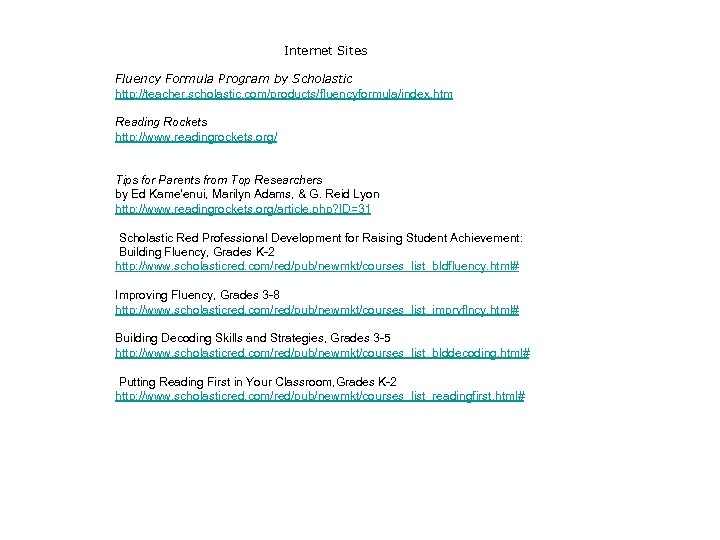 Internet Sites Fluency Formula Program by Scholastic http: //teacher. scholastic. com/products/fluencyformula/index. htm Reading Rockets http: //www. readingrockets. org/ Tips for Parents from Top Researchers by Ed Kame'enui, Marilyn Adams, & G. Reid Lyon http: //www. readingrockets. org/article. php? ID=31 Scholastic Red Professional Development for Raising Student Achievement: Building Fluency, Grades K-2 http: //www. scholasticred. com/red/pub/newmkt/courses_list_bldfluency. html# Improving Fluency, Grades 3 -8 http: //www. scholasticred. com/red/pub/newmkt/courses_list_imprvflncy. html# Building Decoding Skills and Strategies, Grades 3 -5 http: //www. scholasticred. com/red/pub/newmkt/courses_list_blddecoding. html# Putting Reading First in Your Classroom, Grades K-2 http: //www. scholasticred. com/red/pub/newmkt/courses_list_readingfirst. html#
 1. Please make out the evaluation form 2. Pick up your professional development credit certificate On the cover of your handout is the web site address to view this presentation. And, if you have any questions my personal email address is on the cover as well. Thank you for attending this workshop To view this presentation go to: http: //www. wheelerschool. org/ls/Paule/teacherwebpages. html To email me: joyceball@wheelerschool. org