


 Скачать презентацию Reading assessment and techniques OVERVIEW WHY
UNIT4_READING_P&T.pptx
- Количество слайдов: 25
 Reading: assessment and techniques • OVERVIEW • WHY DO WE READ • WHAT DOES READING INVOLVE • TASK DEVELOPMENT ISSUES: Construct, Texts, Test methods
 WHY DO WE READ • Information gathering to gain knowledge, insights. • Pleasure – novels, magazines, poetry • Assessment/criticism – to check the validity of sth • Why we read (and what we read) has an important influence on HOW we read
 WHAT DOES READING INVOLVE • • The type of reading we employ varies according to a number of factors: our purpose for R Pleasure vs work Main ideas comprehension vs. Identification of specific information Our reading ability (different approaches) The type of text we are engaged with (narrative vs. argumentattive) (eye movement is different and processing is different) The text topic (our familiarity with it regardless of yr ability ) The difficulty level of grammar and syntax and vocabulary
 WHAT DOES READING INVOLVE • • • Bottom-up processes: the reader is operating from the visual data in the text Top-down processes : readers call upon their background knowledge and /or use contextual info Interactive processes: a mixture of the above two A fluent reader manages the following at the same time: Rapid recognition of words Analysis of the structure of sentences Builds up a main idea model of text comprehension Monitors what has been comprehended • Call in appropriate schemata from long-term memory • •
 WHAT DOES READING INVOLVE • Eye movement – linear fashion vs. zigzagging through a text • Different levels of coverage – grazing vs. detailed • Fluent reading comprehension involves automatic word recognition • Fluent L 1 readers can recognize almost all the words they encounter (98 – 100%); 4 -5 words per seconds • The working memory keeps new information active 1 -2 seconds while it carries out the appropriate process • Automatic vs. controlled reading
 AUTOMATIC VS. CONTROLLED READING • When sth is new, a learner pays it conscious attention, therefore processing is slow • As the input becomes more and more familiar, processing becomes faster and eventually automatic • Processing periodically breaks down causing the reader to have to re-read, employ guessing strategies etc.
 CONTROLLED VS. AUTOMATIC PROCESSING • …automatic processing requires little/no attention and as such is less likely to interfere with other processes at work; controlled processes require attention and it is difficult to deal with more than one source of info at a time» (Nagle, S. J. , & Sanders, S. L. (1986). ) • «automatic procesissing is critical 2 comprehesion bcs 2 much controlled processing may lead 2 overload and breakdown'(Nagle, S. J. , & Sanders, S. L. (1986). )
 READING SPEED According to Pressley (2006) • Readers who are engaged in R to learn at approximately 200 wpm • R for pleasure can b btw 250 – 300—wpm (Pressley, Michael (2006). ) According to Nuttal (Nuttall, C. (1996). Secondary school students – English as a 2 L 120 - 150 wpm before training • University students in similar areas – about 200 wpm but cld be as slow as 60 wpm • An L 1 speaker of English, of about average education and intelligence , reads at abt 300 wpm; however rates of up to 800 wpm and down to 140 wpm are not uncommon
 WHAT MAKES READING DIFFICULT? • • • Grammar and syntax Vocab Topic Background knowledge The length of text
 WHAT MAKES READING DIFFICULT? • • Lack of textual discourse structure Unknown vocabulary Complex syntax Cultural references needed Accessibility of the topic Number of references a reader has to make (reader responsible writing) Reader –powers of concentration, age, health, interest, fatigue, appropriate schema Total number of words is to be part of Reading SPECS
 Reading: assessment and techniques • What is the purpose of a reading test? • a measure of foreign language proficiency in reading comprehension
 Reading: process vs product • Goal-driven reading: the goal of reading affects the process of reading • С. К. Фоломкина: «Процессуальная сторона чтения обеспечивается перцептивными, мнемическими (связанными с работой памяти) и мыслительными процессами» .
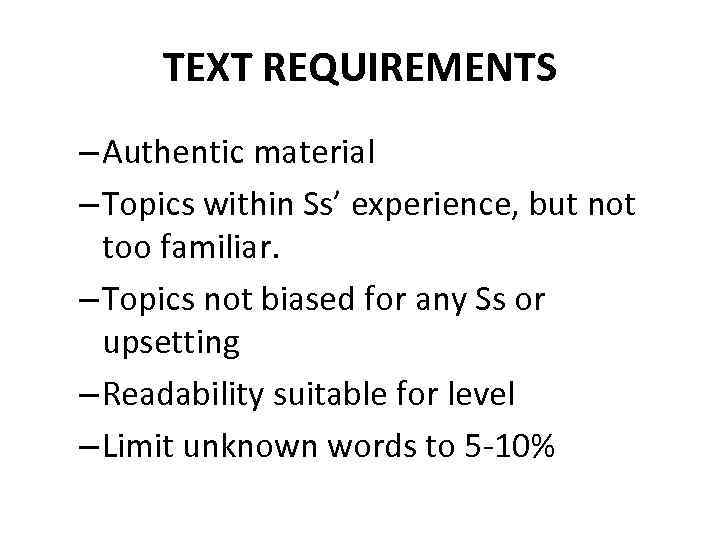 TEXT REQUIREMENTS – Authentic material – Topics within Ss’ experience, but not too familiar. – Topics not biased for any Ss or upsetting – Readability suitable for level – Limit unknown words to 5 -10%
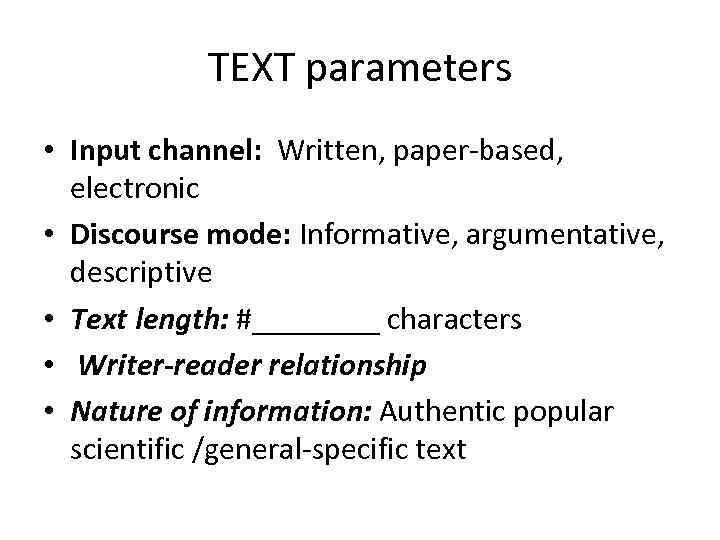 TEXT parameters • Input channel: Written, paper-based, electronic • Discourse mode: Informative, argumentative, descriptive • Text length: #____ characters • Writer-reader relationship • Nature of information: Authentic popular scientific /general-specific text
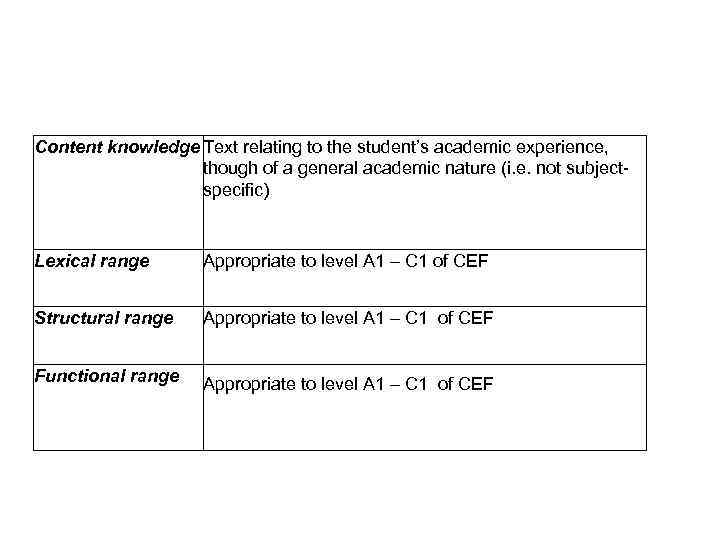 Content knowledge Text relating to the student’s academic experience, though of a general academic nature (i. e. not subjectspecific) Lexical range Appropriate to level A 1 – C 1 of CEF Structural range Appropriate to level A 1 – C 1 of CEF Functional range Appropriate to level A 1 – C 1 of CEF
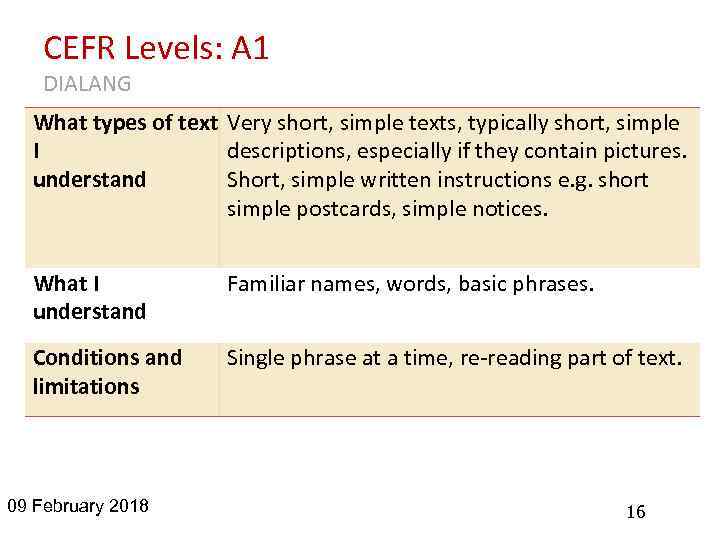 CEFR Levels: A 1 DIALANG What types of text Very short, simple texts, typically short, simple I descriptions, especially if they contain pictures. understand Short, simple written instructions e. g. short simple postcards, simple notices. What I understand Familiar names, words, basic phrases. Conditions and limitations Single phrase at a time, re-reading part of text. 09 February 2018 16
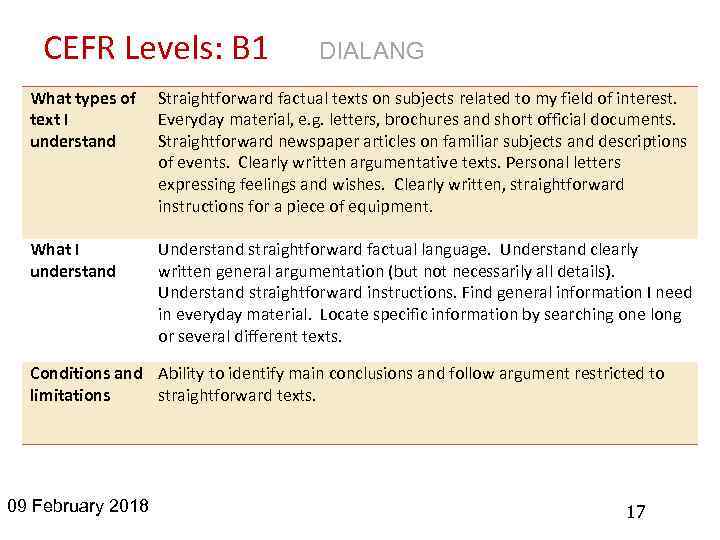 CEFR Levels: B 1 DIALANG What types of text I understand Straightforward factual texts on subjects related to my field of interest. Everyday material, e. g. letters, brochures and short official documents. Straightforward newspaper articles on familiar subjects and descriptions of events. Clearly written argumentative texts. Personal letters expressing feelings and wishes. Clearly written, straightforward instructions for a piece of equipment. What I understand Understand straightforward factual language. Understand clearly written general argumentation (but not necessarily all details). Understand straightforward instructions. Find general information I need in everyday material. Locate specific information by searching one long or several different texts. Conditions and Ability to identify main conclusions and follow argument restricted to limitations straightforward texts. 09 February 2018 17
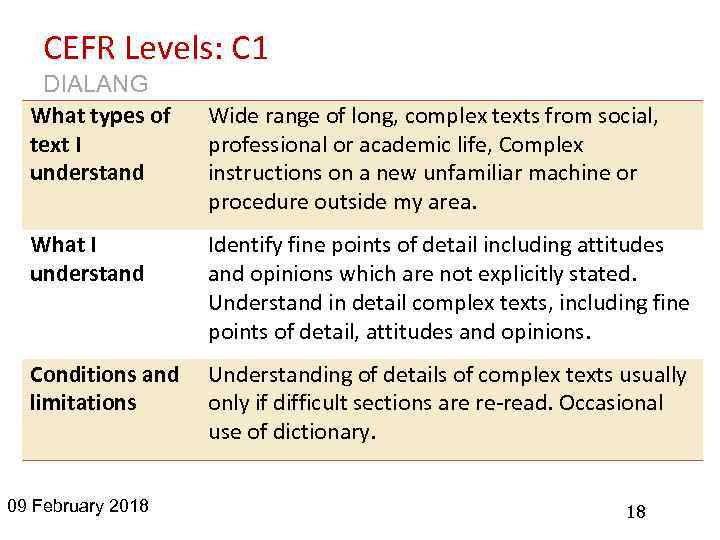 CEFR Levels: C 1 DIALANG What types of text I understand Wide range of long, complex texts from social, professional or academic life, Complex instructions on a new unfamiliar machine or procedure outside my area. What I understand Identify fine points of detail including attitudes and opinions which are not explicitly stated. Understand in detail complex texts, including fine points of detail, attitudes and opinions. Conditions and limitations Understanding of details of complex texts usually only if difficult sections are re-read. Occasional use of dictionary. 09 February 2018 18
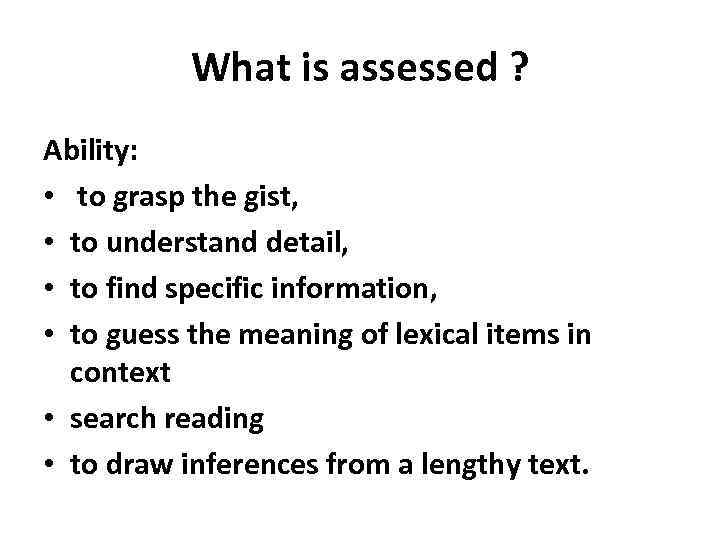 What is assessed ? Ability: • to grasp the gist, • to understand detail, • to find specific information, • to guess the meaning of lexical items in context • search reading • to draw inferences from a lengthy text.
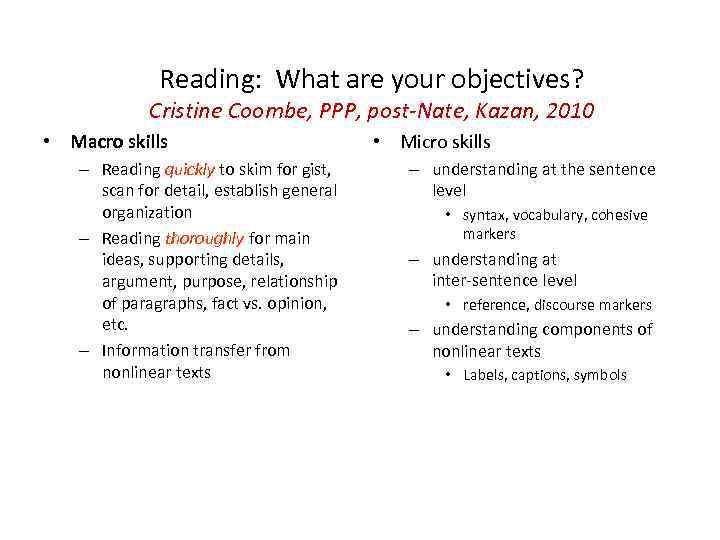 Reading: What are your objectives? Cristine Coombe, PPP, post-Nate, Kazan, 2010 • Macro skills – Reading quickly to skim for gist, scan for detail, establish general organization – Reading thoroughly for main ideas, supporting details, argument, purpose, relationship of paragraphs, fact vs. opinion, etc. – Information transfer from nonlinear texts • Micro skills – understanding at the sentence level • syntax, vocabulary, cohesive markers – understanding at inter-sentence level • reference, discourse markers – understanding components of nonlinear texts • Labels, captions, symbols
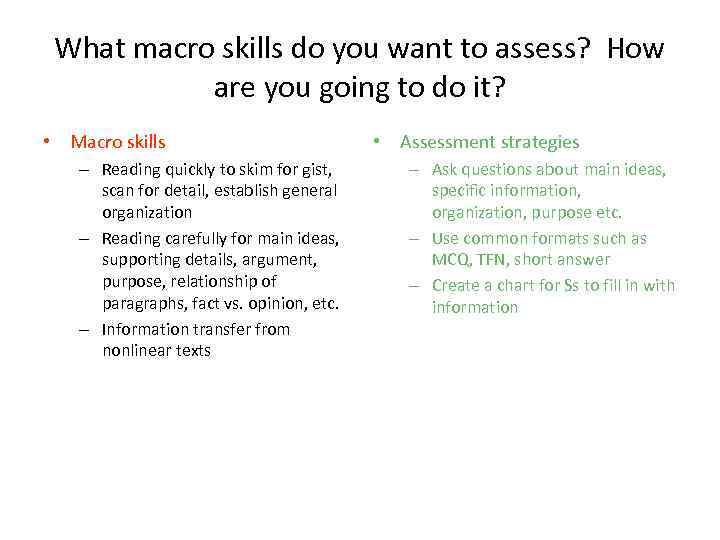 What macro skills do you want to assess? How are you going to do it? • Macro skills – Reading quickly to skim for gist, scan for detail, establish general organization – Reading carefully for main ideas, supporting details, argument, purpose, relationship of paragraphs, fact vs. opinion, etc. – Information transfer from nonlinear texts • Assessment strategies – Ask questions about main ideas, specific information, organization, purpose etc. – Use common formats such as MCQ, TFN, short answer – Create a chart for Ss to fill in with information
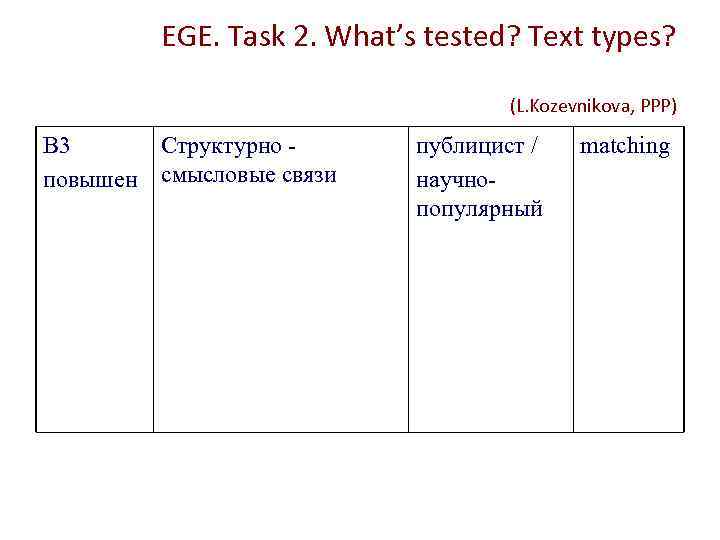 EGE. Task 2. What’s tested? Text types? (L. Kozevnikova, PPP) В 3 Структурно повышен смысловые связи публицист / научнопопулярный matching
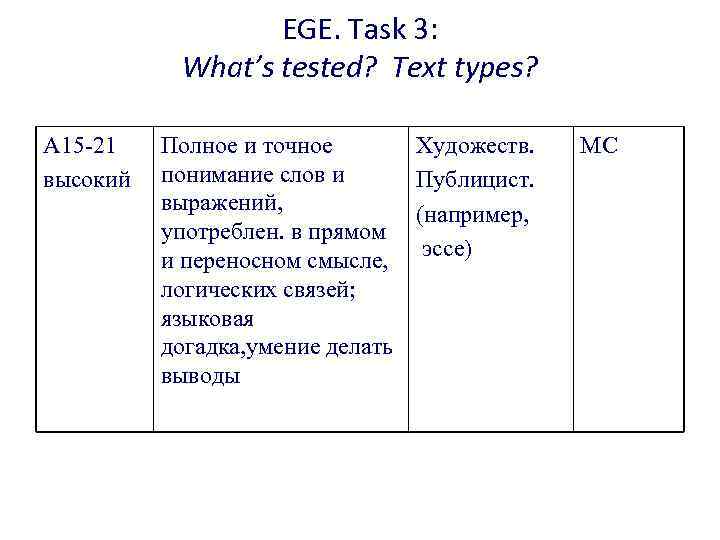 EGE. Task 3: What’s tested? Text types? А 15 -21 высокий Полное и точное Художеств. понимание слов и Публицист. выражений, (например, употреблен. в прямом и переносном смысле, эссе) логических связей; языковая догадка, умение делать выводы MC
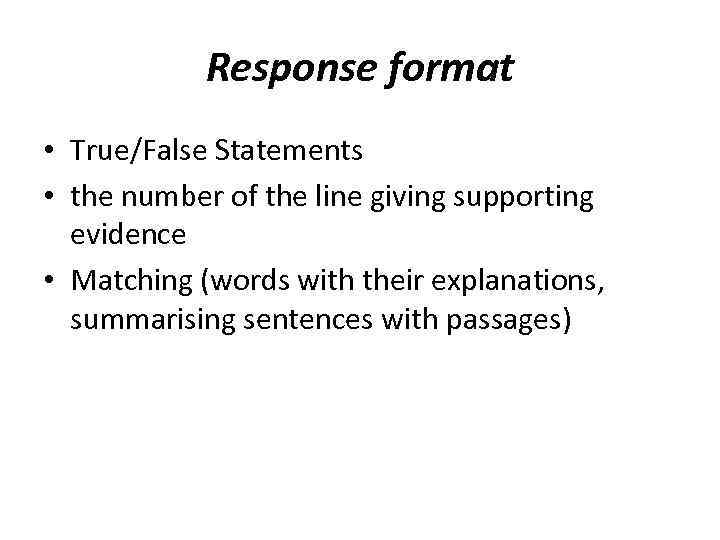 Response format • True/False Statements • the number of the line giving supporting evidence • Matching (words with their explanations, summarising sentences with passages)
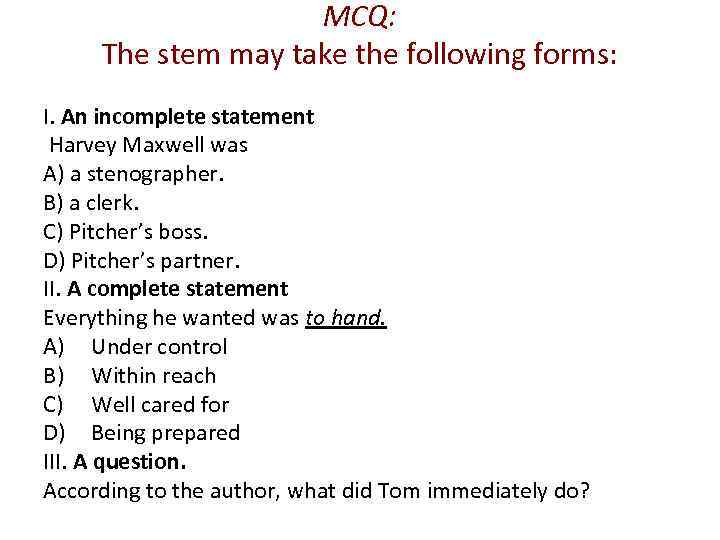 MCQ: The stem may take the following forms: I. An incomplete statement Harvey Maxwell was A) a stenographer. B) a clerk. C) Pitcher’s boss. D) Pitcher’s partner. II. A complete statement Everything he wanted was to hand. A) Under control B) Within reach C) Well cared for D) Being prepared III. A question. According to the author, what did Tom immediately do?