 Скачать презентацию Reading Ambiguous Words Sereno O Donnell Rayner University
594a88d15f514055c5aee7c767518459.ppt
- Количество слайдов: 40




Reading Ambiguous Words Sereno, O’Donnell, & Rayner University of Glasgow University of Massachusetts
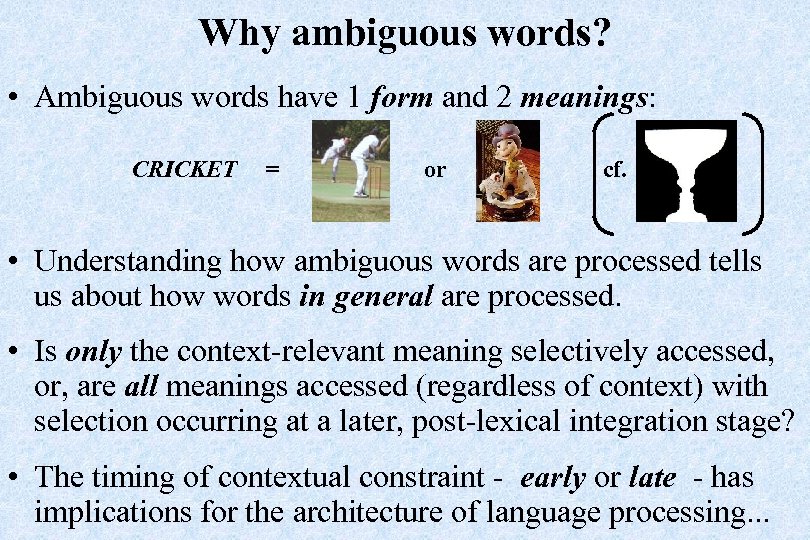
Why ambiguous words? • Ambiguous words have 1 form and 2 meanings: CRICKET = or cf. • Understanding how ambiguous words are processed tells us about how words in general are processed. • Is only the context-relevant meaning selectively accessed, or, are all meanings accessed (regardless of context) with selection occurring at a later, post-lexical integration stage? • The timing of contextual constraint - early or late - has implications for the architecture of language processing. . .
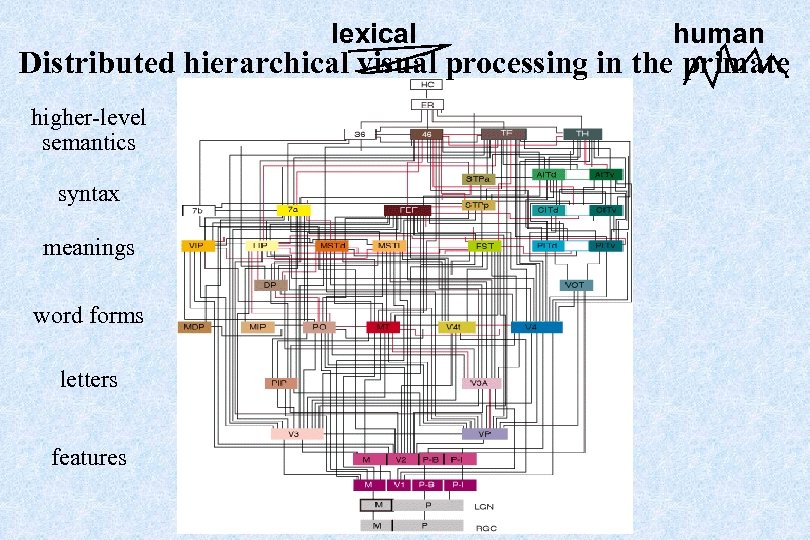
lexical human Distributed hierarchical visual processing in the primate higher-level semantics syntax meanings word forms letters features
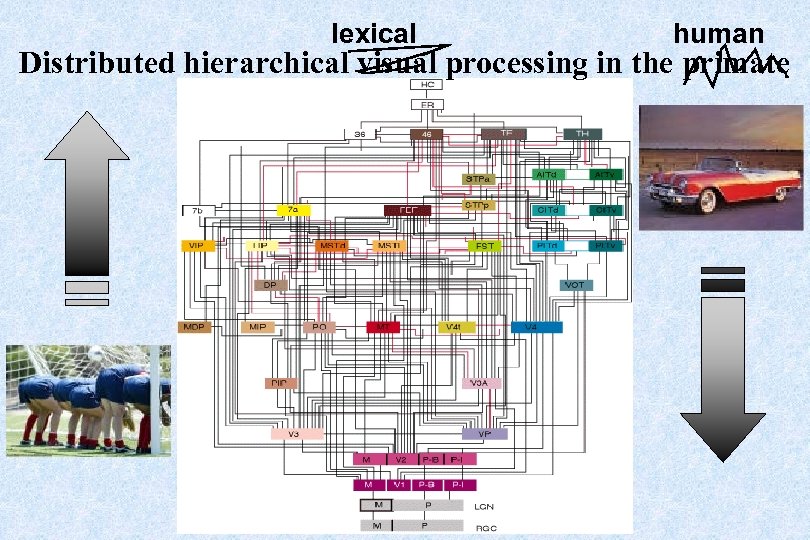
lexical human Distributed hierarchical visual processing in the primate
Models of Lexical Ambiguity Resolution • Modular position – Access is exhaustive: All meanings of ambiguous words are automatically accessed; context cannot directly affect lexical processing, but instead operates on the output of the lexical processor to select the appropriate sense. • Interactive position – Access is selective: Context guides access towards the appropriate sense of an ambiguous word; while both senses may be initially activated, only the contextually appropriate sense is fully accessed.
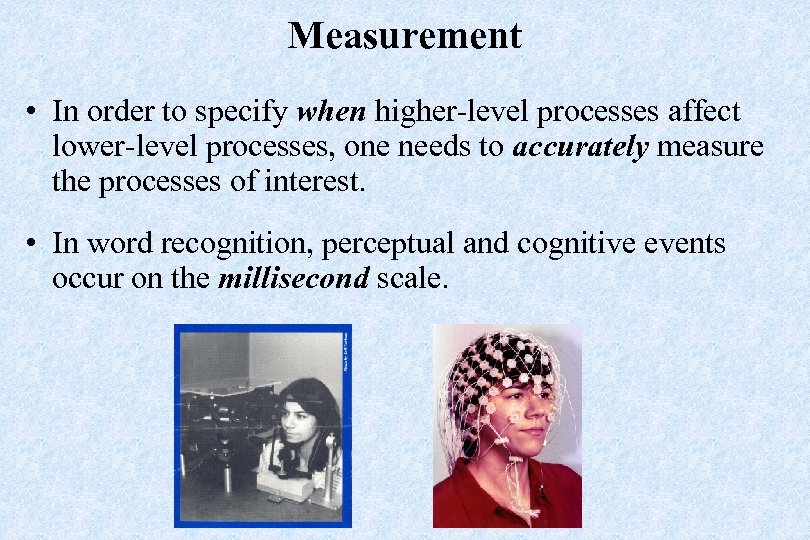
Measurement • In order to specify when higher-level processes affect lower-level processes, one needs to accurately measure the processes of interest. • In word recognition, perceptual and cognitive events occur on the millisecond scale.
So, when is access? • Word frequency effect = differential response to commonly used high-frequency (HF) words vs. low-frequency (LF) words that occur much less often: The sore on Tam-Tam’s (HF) back was swollen. (LF) rump • A word frequency effect [ HF < LF ] is used as a marker (index) of successful word recognition (lexical access). • If you can track frequency, you can track lexical access. . .
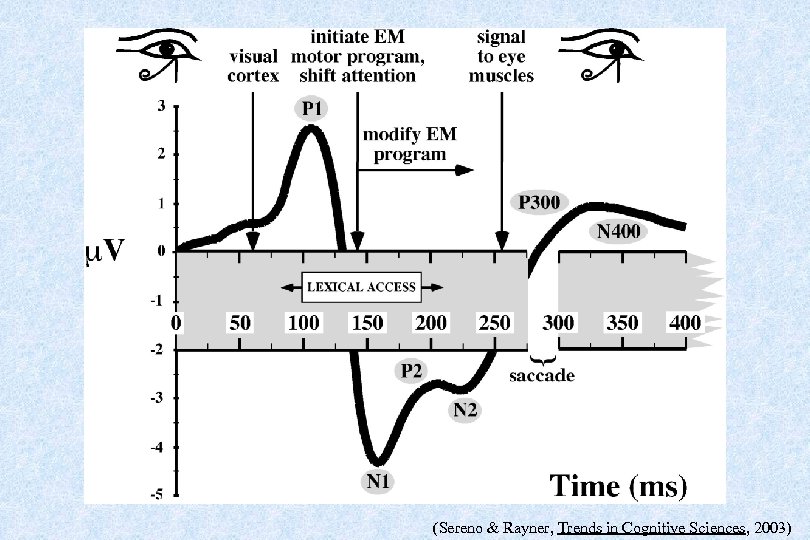
(Sereno & Rayner, Trends in Cognitive Sciences, 2003)
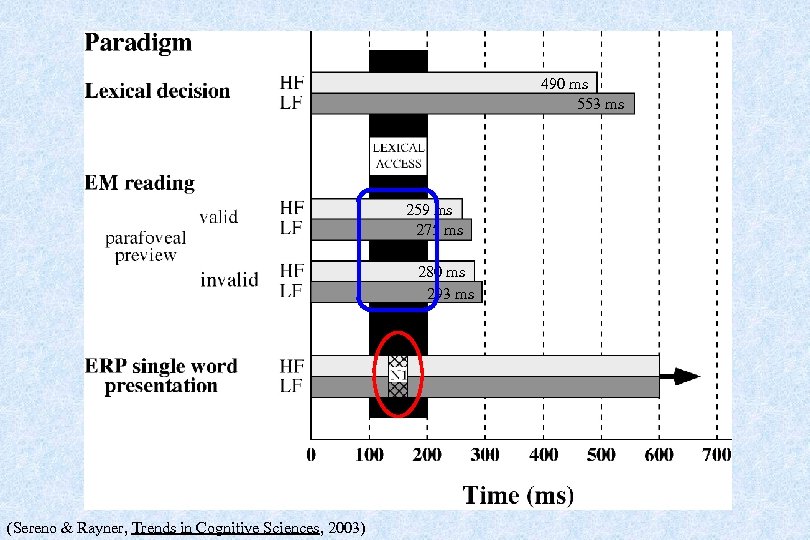
490 ms 553 ms 259 ms 275 ms 280 ms 293 ms (Sereno & Rayner, Trends in Cognitive Sciences, 2003)
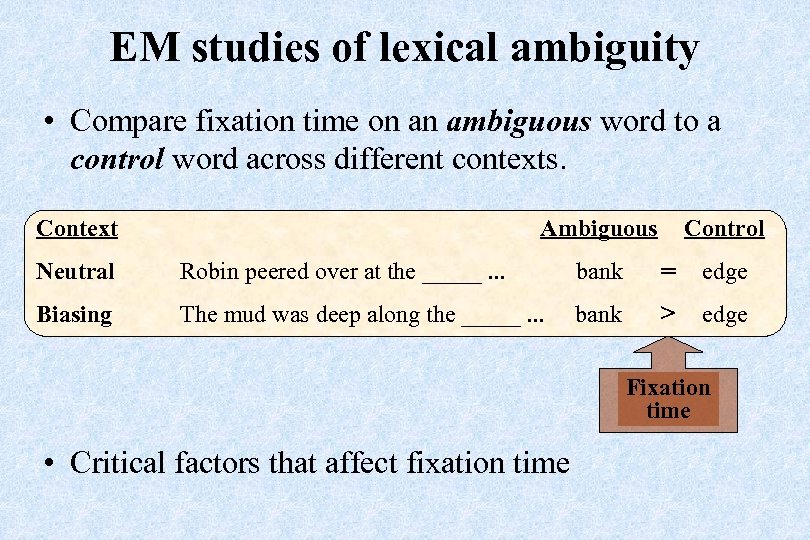
EM studies of lexical ambiguity • Compare fixation time on an ambiguous word to a control word across different contexts. Context Ambiguous Neutral Robin peered over at the _____. . . bank Biasing The mud was deep along the _____. . . bank Control = edge > edge Fixation time • Critical factors that affect fixation time
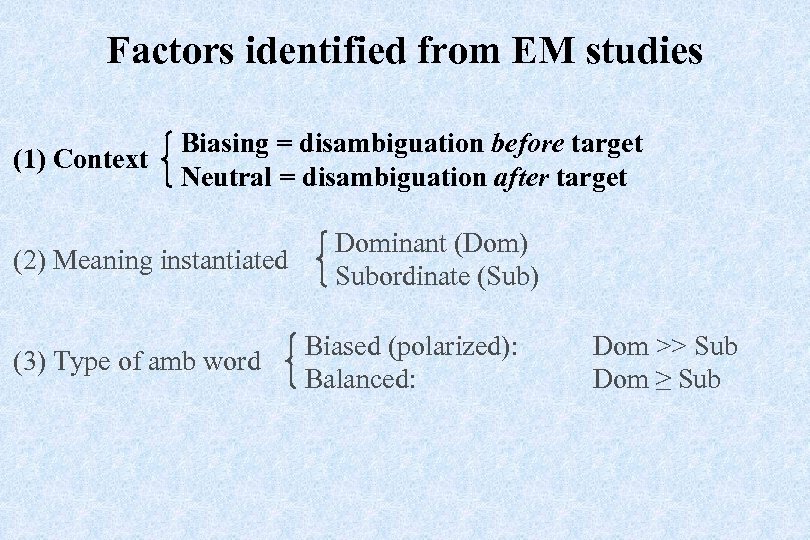
Factors identified from EM studies (1) Context Biasing = disambiguation before target Neutral = disambiguation after target (2) Meaning instantiated (3) Type of amb word Dominant (Dom) Subordinate (Sub) Biased (polarized): Balanced: Dom >> Sub Dom ≥ Sub
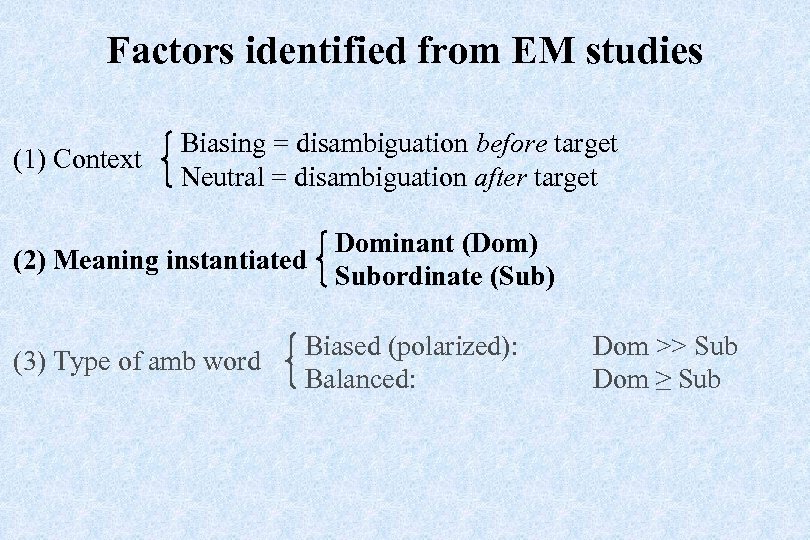
Factors identified from EM studies (1) Context Biasing = disambiguation before target Neutral = disambiguation after target Dominant (Dom) (2) Meaning instantiated Subordinate (Sub) (3) Type of amb word Biased (polarized): Balanced: Dom >> Sub Dom ≥ Sub
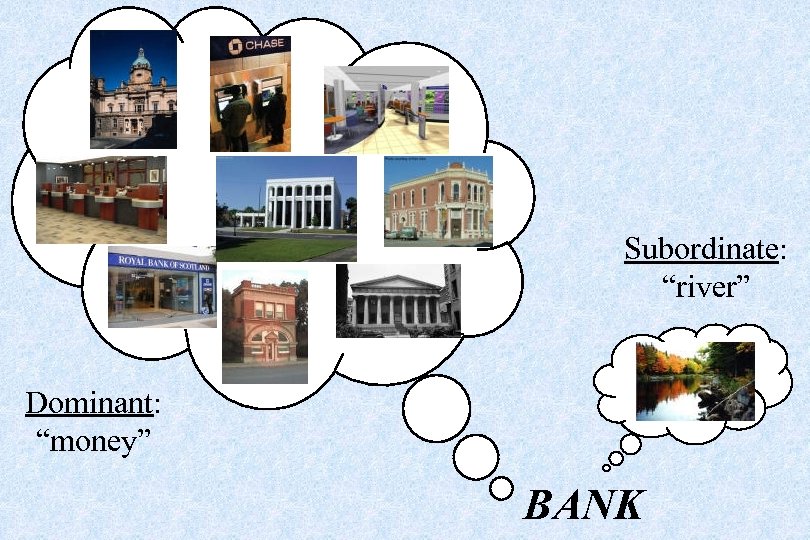
Subordinate: “river” Dominant: “money” BANK
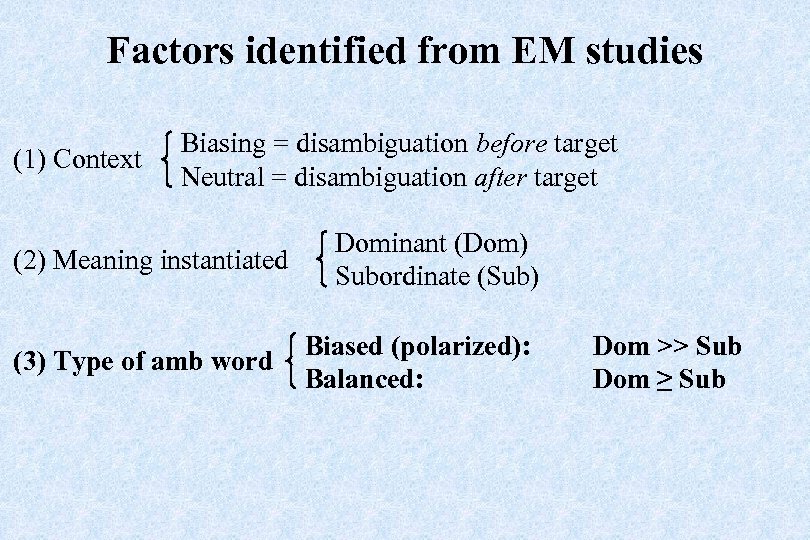
Factors identified from EM studies (1) Context Biasing = disambiguation before target Neutral = disambiguation after target (2) Meaning instantiated (3) Type of amb word Dominant (Dom) Subordinate (Sub) Biased (polarized): Balanced: Dom >> Sub Dom ≥ Sub
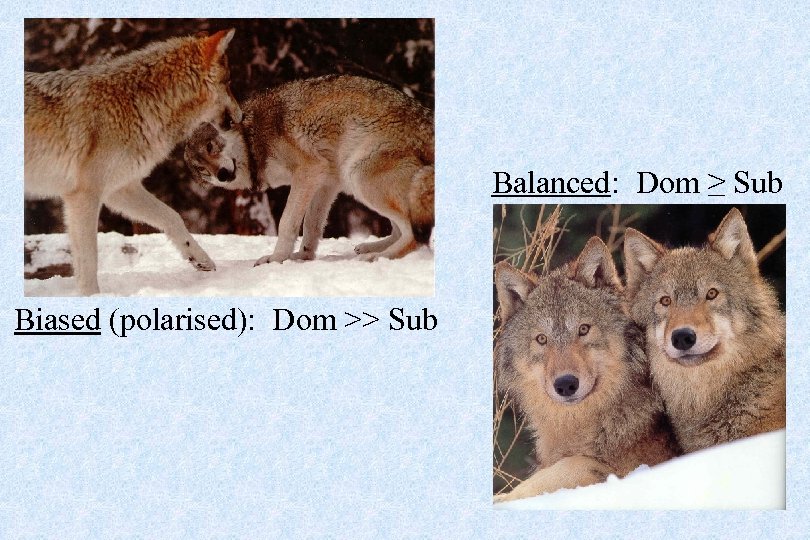
Balanced: Dom ≥ Sub Biased (polarised): Dom >> Sub
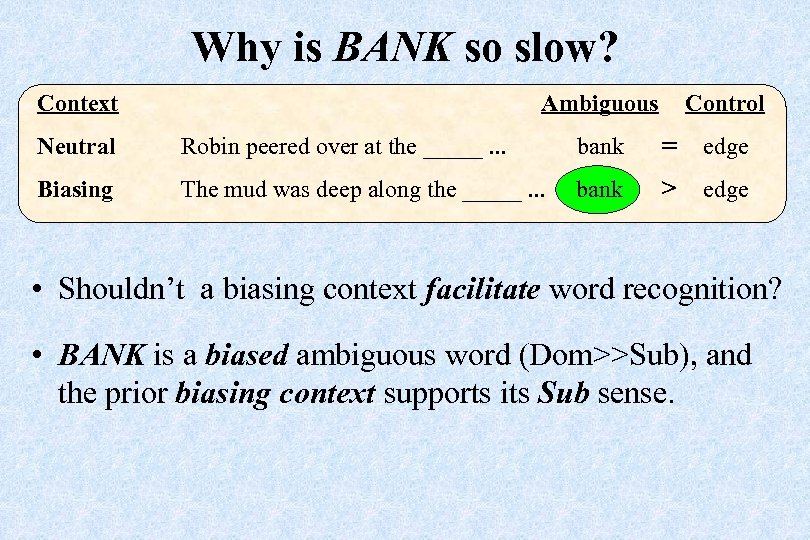
Why is BANK so slow? Context Ambiguous Neutral Robin peered over at the _____. . . bank Biasing The mud was deep along the _____. . . bank Control = edge > edge • Shouldn’t a biasing context facilitate word recognition? • BANK is a biased ambiguous word (Dom>>Sub), and the prior biasing context supports its Sub sense.
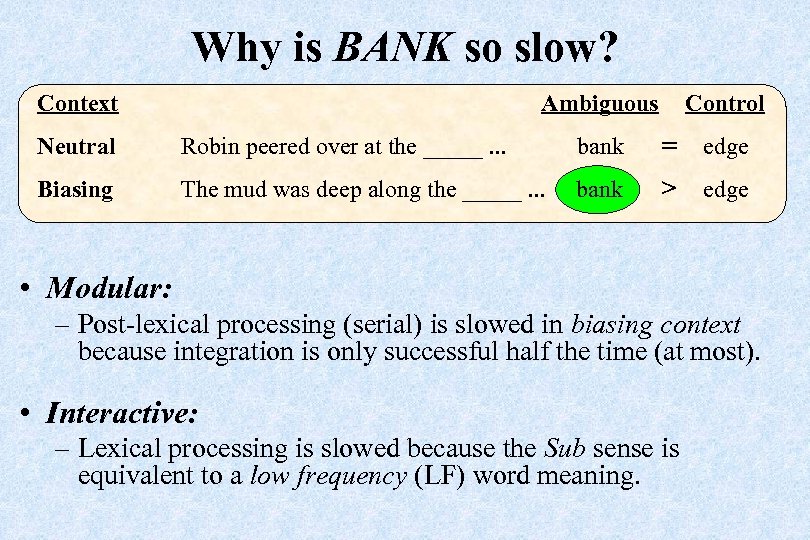
Why is BANK so slow? Context Ambiguous Neutral Robin peered over at the _____. . . bank Biasing The mud was deep along the _____. . . bank Control = edge > edge • Modular: – Post-lexical processing (serial) is slowed in biasing context because integration is only successful half the time (at most). • Interactive: – Lexical processing is slowed because the Sub sense is equivalent to a low frequency (LF) word meaning.
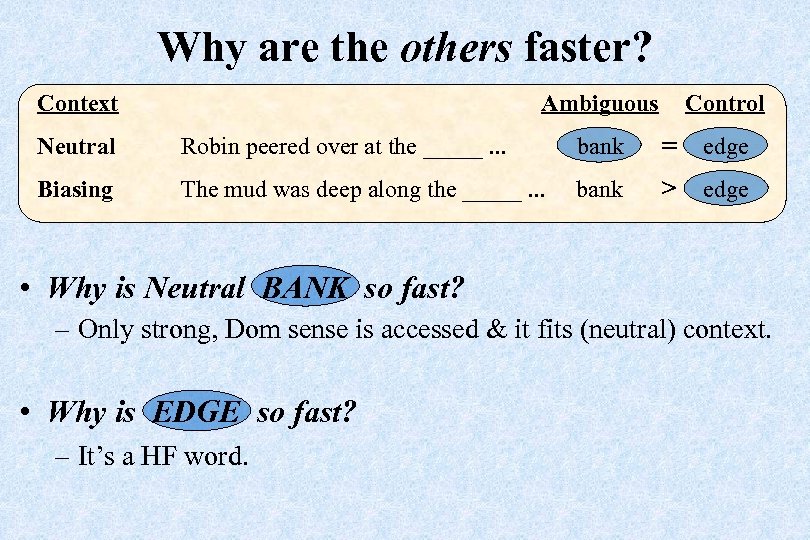
Why are the others faster? Context Ambiguous Neutral Robin peered over at the _____. . . bank Biasing The mud was deep along the _____. . . bank Control = edge > edge • Why is Neutral BANK so fast? – Only strong, Dom sense is accessed & it fits (neutral) context. • Why is EDGE so fast? – It’s a HF word.
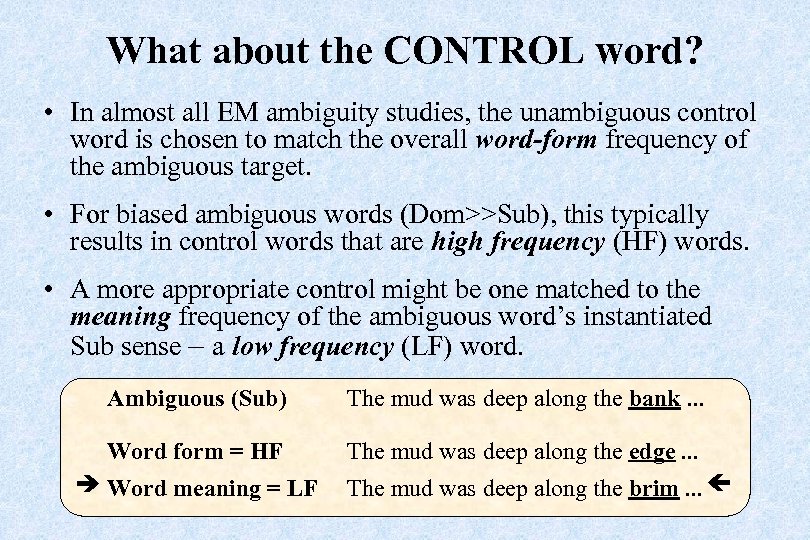
What about the CONTROL word? • In almost all EM ambiguity studies, the unambiguous control word is chosen to match the overall word-form frequency of the ambiguous target. • For biased ambiguous words (Dom>>Sub), this typically results in control words that are high frequency (HF) words. • A more appropriate control might be one matched to the meaning frequency of the ambiguous word’s instantiated Sub sense – a low frequency (LF) word. The mud was deep along the bank. . . Word form = HF The mud was deep along the edge. . . è Word meaning = LF The mud was deep along the brim. . . è Ambiguous (Sub)
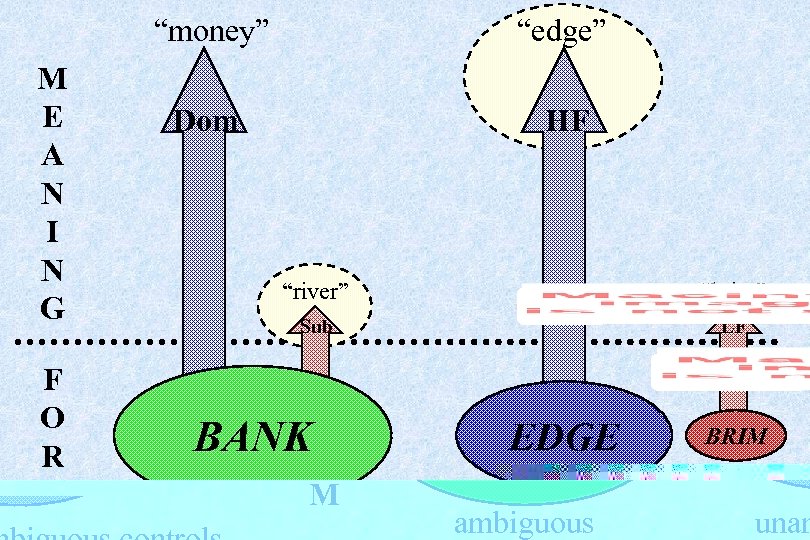
“money” M E A N I N G F O R M “edge” Dom HF “river” “brim” Sub LF BANK ambiguous EDGE BRIM unambiguous controls
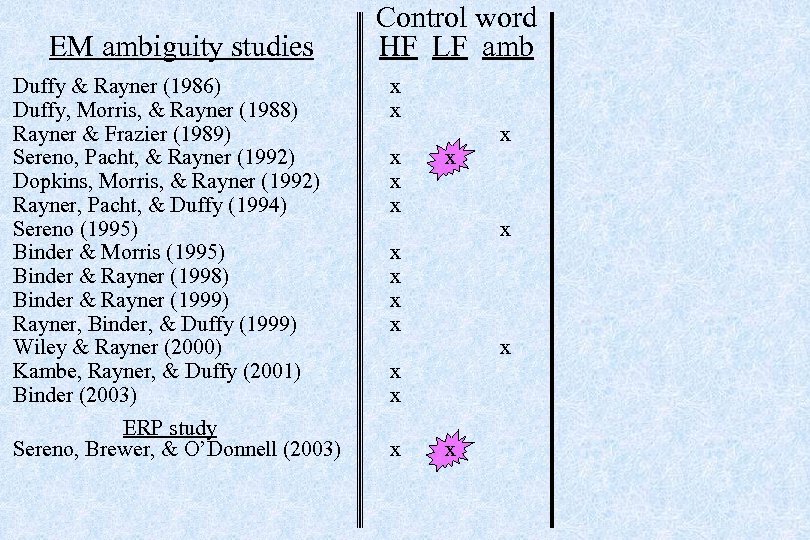
EM ambiguity studies Duffy & Rayner (1986) Duffy, Morris, & Rayner (1988) Rayner & Frazier (1989) Sereno, Pacht, & Rayner (1992) Dopkins, Morris, & Rayner (1992) Rayner, Pacht, & Duffy (1994) Sereno (1995) Binder & Morris (1995) Binder & Rayner (1998) Binder & Rayner (1999) Rayner, Binder, & Duffy (1999) Wiley & Rayner (2000) Kambe, Rayner, & Duffy (2001) Binder (2003) ERP study Sereno, Brewer, & O’Donnell (2003) Control word Context HF LF amb sentence paragraph x x x x x x x - switch
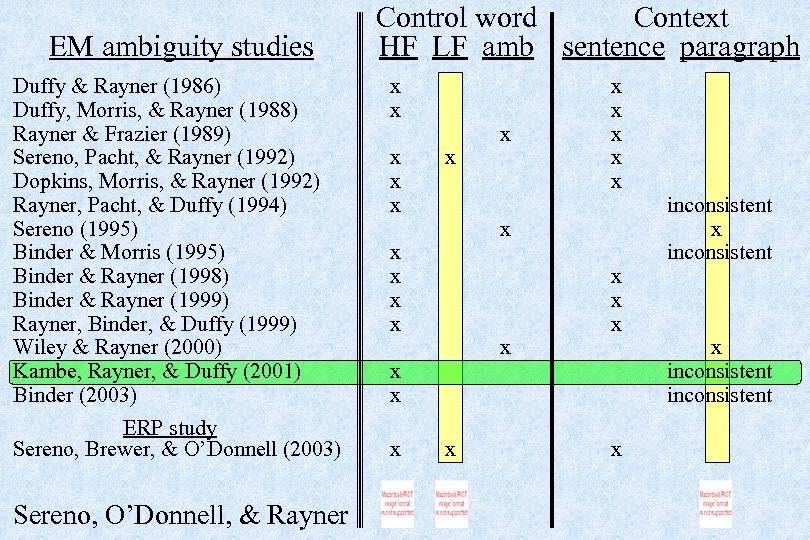
EM ambiguity studies Duffy & Rayner (1986) Duffy, Morris, & Rayner (1988) Rayner & Frazier (1989) Sereno, Pacht, & Rayner (1992) Dopkins, Morris, & Rayner (1992) Rayner, Pacht, & Duffy (1994) Sereno (1995) Binder & Morris (1995) Binder & Rayner (1998) Binder & Rayner (1999) Rayner, Binder, & Duffy (1999) Wiley & Rayner (2000) Kambe, Rayner, & Duffy (2001) Binder (2003) ERP study Sereno, Brewer, & O’Donnell (2003) Sereno, O’Donnell, & Rayner Control word Context HF LF amb sentence paragraph x x x x x x x inconsistent
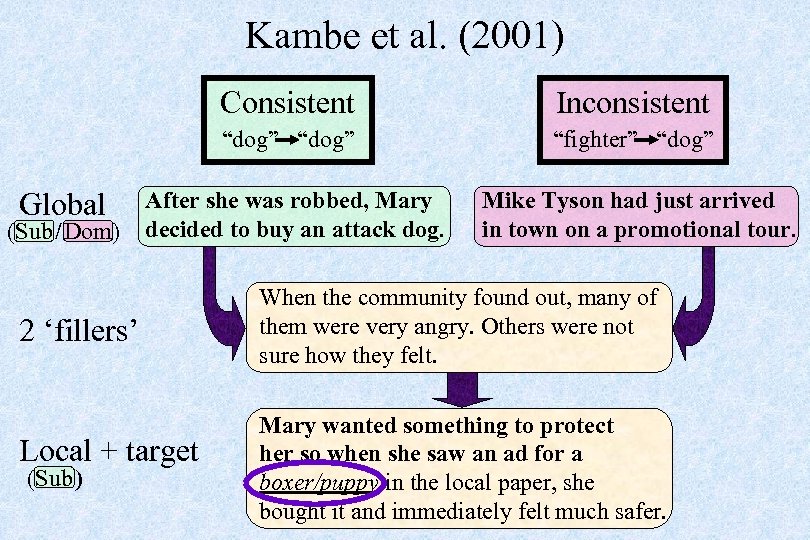
Kambe et al. (2001) Consistent “dog” Global (Sub / Dom) “fighter” “dog” After she was robbed, Mary decided to buy an attack dog. 2 ‘fillers’ Local + target (Sub ) Inconsistent Mike Tyson had just arrived in town on a promotional tour. When the community found out, many of them were very angry. Others were not sure how they felt. Mary wanted something to protect her so when she saw an ad for a boxer/puppy in the local paper, she bought it and immediately felt much safer.
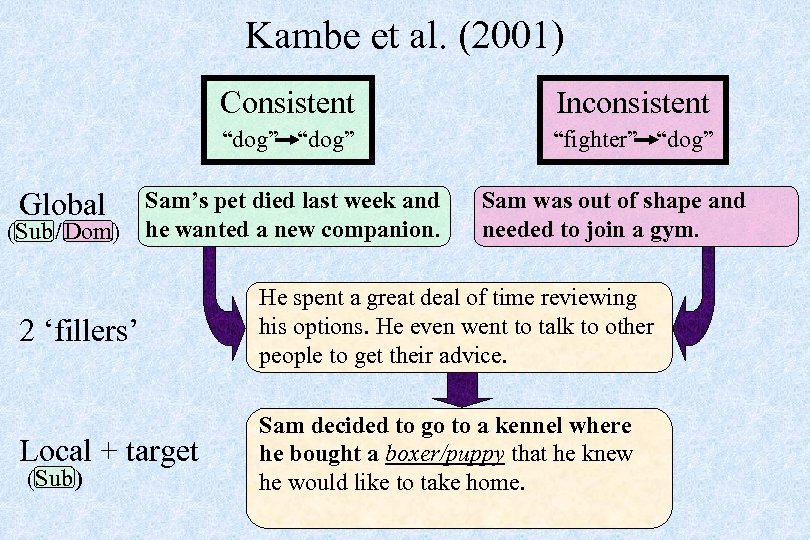
Kambe et al. (2001) Consistent “dog” Global (Sub / Dom) Inconsistent “fighter” “dog” Sam’s pet died last week and he wanted a new companion. Sam was out of shape and needed to join a gym. 2 ‘fillers’ He spent a great deal of time reviewing his options. He even went to talk to other people to get their advice. Local + target Sam decided to go to a kennel where he bought a boxer/puppy that he knew he would like to take home. (Sub )
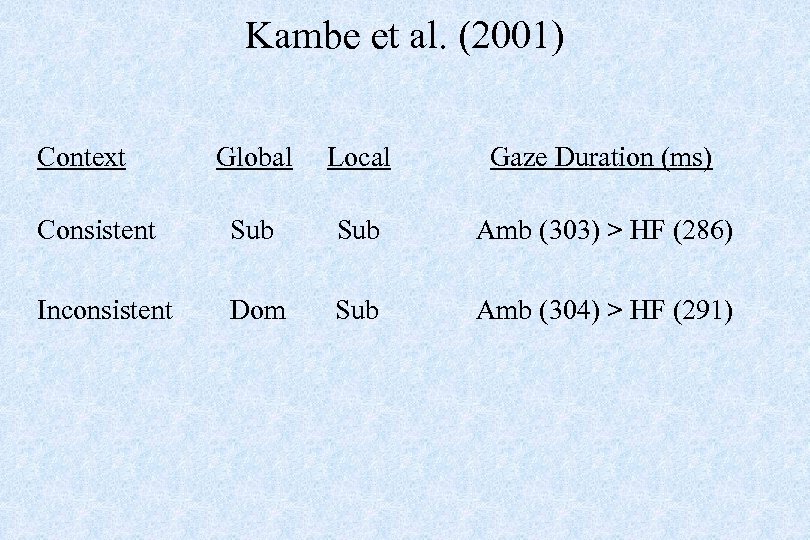
Kambe et al. (2001) Context Global Local Gaze Duration (ms) Consistent Sub Amb (303) > HF (286) Inconsistent Dom Sub Amb (304) > HF (291)
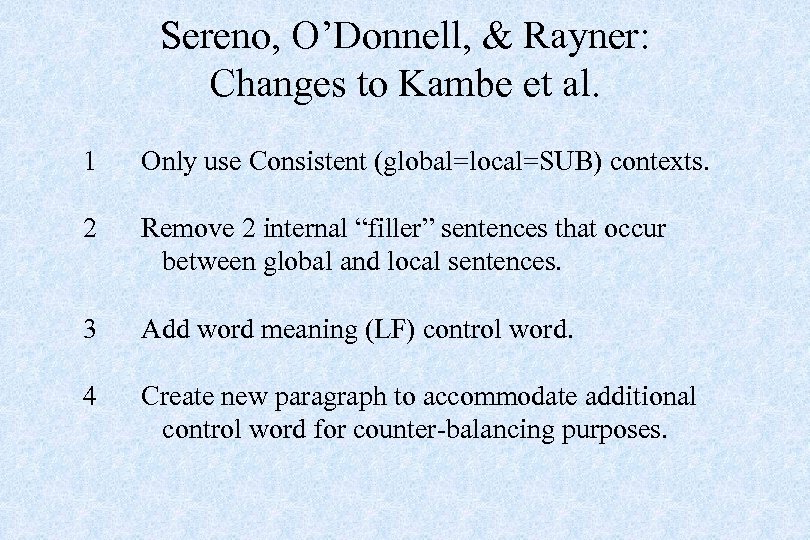
Sereno, O’Donnell, & Rayner: Changes to Kambe et al. 1 Only use Consistent (global=local=SUB) contexts. 2 Remove 2 internal “filler” sentences that occur between global and local sentences. 3 Add word meaning (LF) control word. 4 Create new paragraph to accommodate additional control word for counter-balancing purposes.
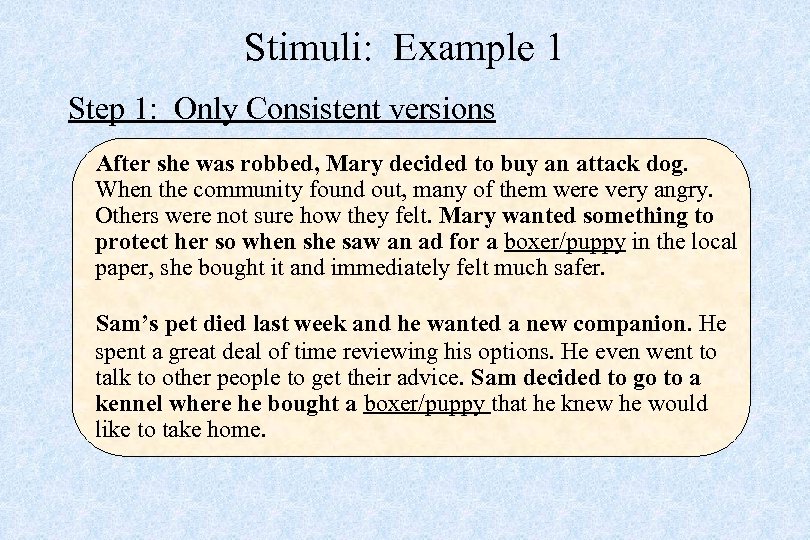
Stimuli: Example 1 Step 1: Only Consistent versions After she was robbed, Mary decided to buy an attack dog. When the community found out, many of them were very angry. Others were not sure how they felt. Mary wanted something to protect her so when she saw an ad for a boxer/puppy in the local paper, she bought it and immediately felt much safer. Sam’s pet died last week and he wanted a new companion. He spent a great deal of time reviewing his options. He even went to talk to other people to get their advice. Sam decided to go to a kennel where he bought a boxer/puppy that he knew he would like to take home.
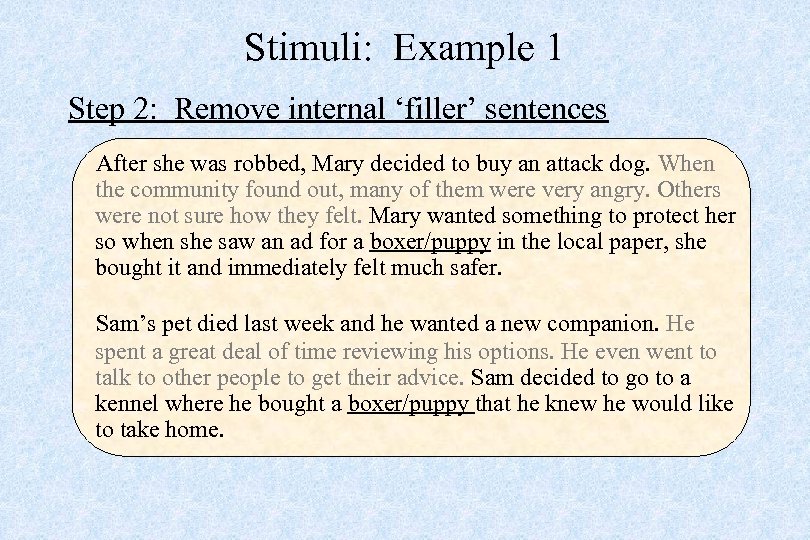
Stimuli: Example 1 Step 2: Remove internal ‘filler’ sentences After she was robbed, Mary decided to buy an attack dog. When the community found out, many of them were very angry. Others were not sure how they felt. Mary wanted something to protect her so when she saw an ad for a boxer/puppy in the local paper, she bought it and immediately felt much safer. Sam’s pet died last week and he wanted a new companion. He spent a great deal of time reviewing his options. He even went to talk to other people to get their advice. Sam decided to go to a kennel where he bought a boxer/puppy that he knew he would like to take home.
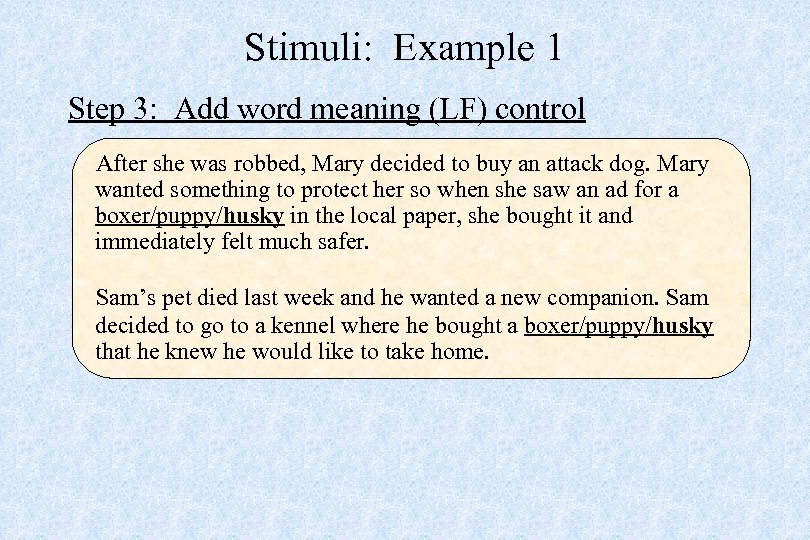
Stimuli: Example 1 Step 3: Add word meaning (LF) control After she was robbed, Mary decided to buy an attack dog. Mary wanted something to protect her so when she saw an ad for a boxer/puppy/husky in the local paper, she bought it and immediately felt much safer. Sam’s pet died last week and he wanted a new companion. Sam decided to go to a kennel where he bought a boxer/puppy/husky that he knew he would like to take home.
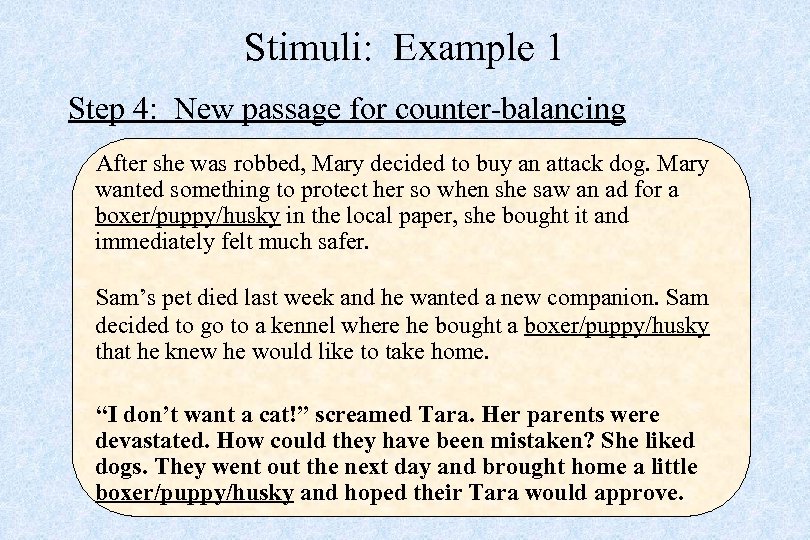
Stimuli: Example 1 Step 4: New passage for counter-balancing After she was robbed, Mary decided to buy an attack dog. Mary wanted something to protect her so when she saw an ad for a boxer/puppy/husky in the local paper, she bought it and immediately felt much safer. Sam’s pet died last week and he wanted a new companion. Sam decided to go to a kennel where he bought a boxer/puppy/husky that he knew he would like to take home. “I don’t want a cat!” screamed Tara. Her parents were devastated. How could they have been mistaken? She liked dogs. They went out the next day and brought home a little boxer/puppy/husky and hoped their Tara would approve.
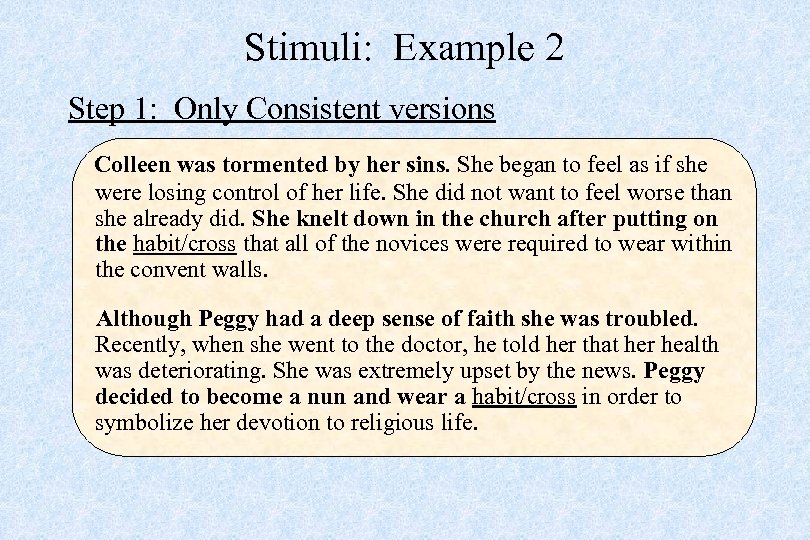
Stimuli: Example 2 Step 1: Only Consistent versions Colleen was tormented by her sins. She began to feel as if she were losing control of her life. She did not want to feel worse than she already did. She knelt down in the church after putting on the habit/cross that all of the novices were required to wear within the convent walls. Although Peggy had a deep sense of faith she was troubled. Recently, when she went to the doctor, he told her that her health was deteriorating. She was extremely upset by the news. Peggy decided to become a nun and wear a habit/cross in order to symbolize her devotion to religious life.
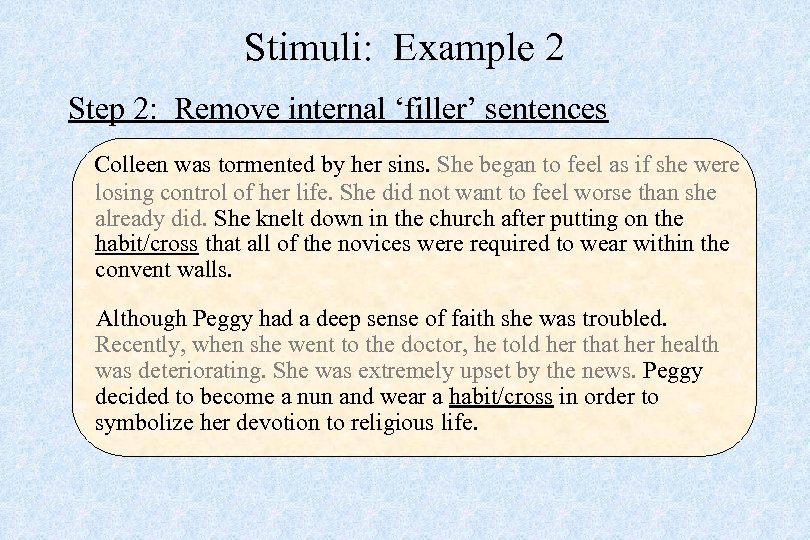
Stimuli: Example 2 Step 2: Remove internal ‘filler’ sentences Colleen was tormented by her sins. She began to feel as if she were losing control of her life. She did not want to feel worse than she already did. She knelt down in the church after putting on the habit/cross that all of the novices were required to wear within the convent walls. Although Peggy had a deep sense of faith she was troubled. Recently, when she went to the doctor, he told her that her health was deteriorating. She was extremely upset by the news. Peggy decided to become a nun and wear a habit/cross in order to symbolize her devotion to religious life.
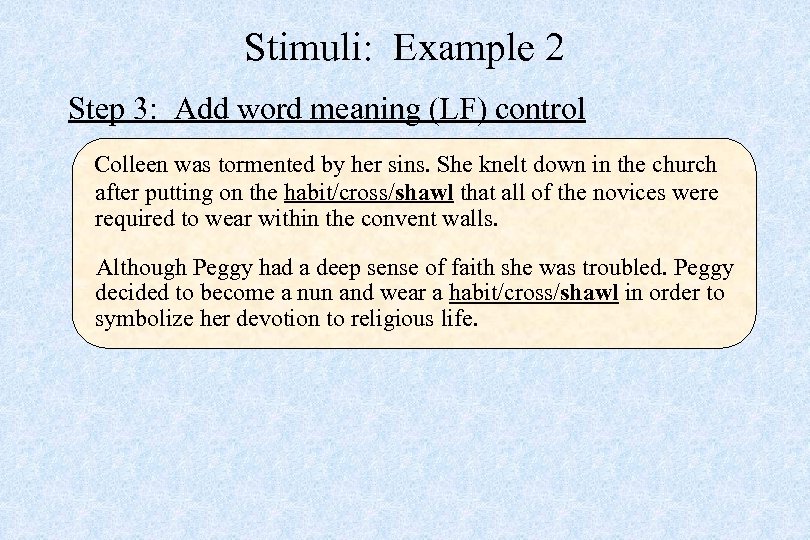
Stimuli: Example 2 Step 3: Add word meaning (LF) control Colleen was tormented by her sins. She knelt down in the church after putting on the habit/cross/shawl that all of the novices were required to wear within the convent walls. Although Peggy had a deep sense of faith she was troubled. Peggy decided to become a nun and wear a habit/cross/shawl in order to symbolize her devotion to religious life.
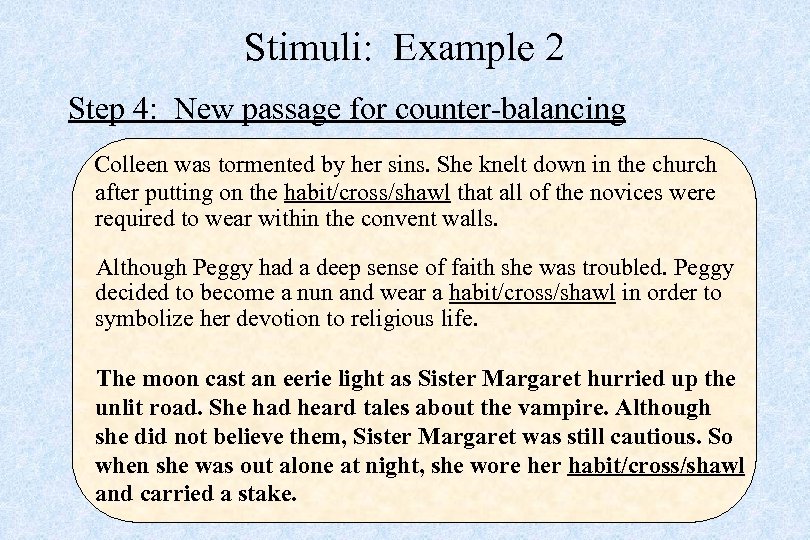
Stimuli: Example 2 Step 4: New passage for counter-balancing Colleen was tormented by her sins. She knelt down in the church after putting on the habit/cross/shawl that all of the novices were required to wear within the convent walls. Although Peggy had a deep sense of faith she was troubled. Peggy decided to become a nun and wear a habit/cross/shawl in order to symbolize her devotion to religious life. The moon cast an eerie light as Sister Margaret hurried up the unlit road. She had heard tales about the vampire. Although she did not believe them, Sister Margaret was still cautious. So when she was out alone at night, she wore her habit/cross/shawl and carried a stake.
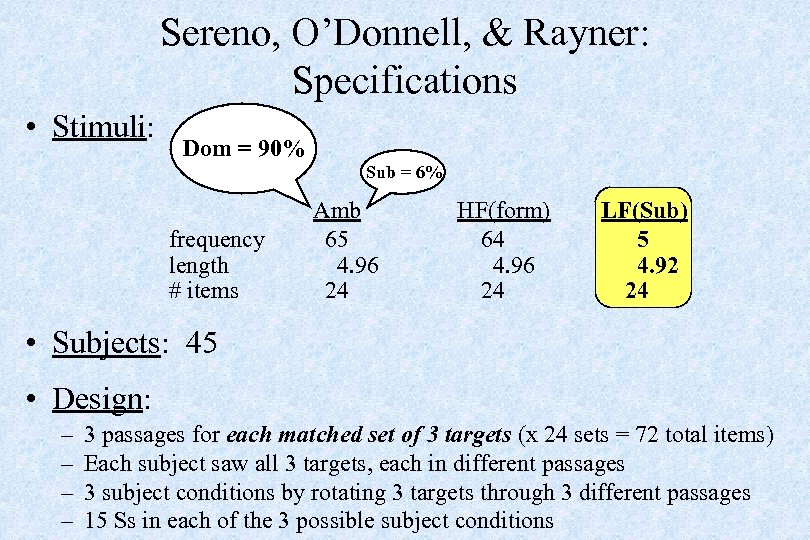
Sereno, O’Donnell, & Rayner: Specifications • Stimuli: Dom = 90% Sub = 6% frequency length # items Amb 65 4. 96 24 HF(form) 64 4. 96 24 LF(Sub) 5 4. 92 24 • Subjects: 45 • Design: – – 3 passages for each matched set of 3 targets (x 24 sets = 72 total items) Each subject saw all 3 targets, each in different passages 3 subject conditions by rotating 3 targets through 3 different passages 15 Ss in each of the 3 possible subject conditions

Amb HF LF
“target” “spillover”
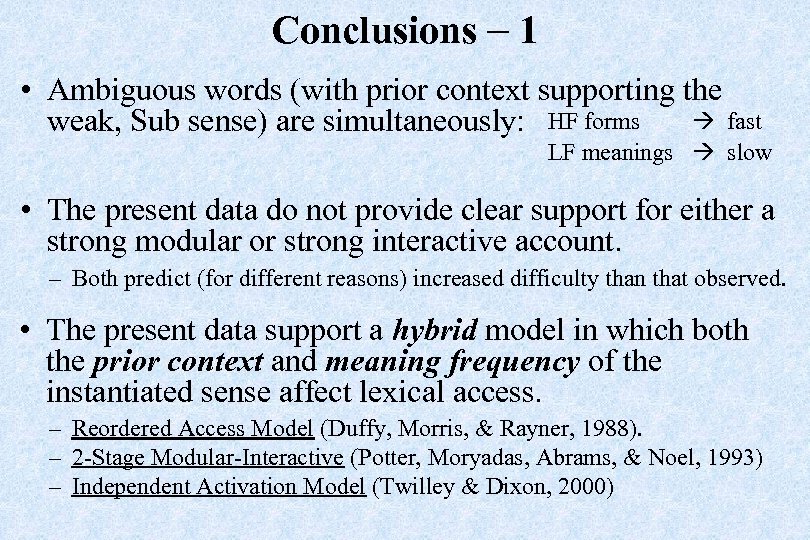
Conclusions – 1 • Ambiguous words (with prior context supporting the fast weak, Sub sense) are simultaneously: HF forms LF meanings slow • The present data do not provide clear support for either a strong modular or strong interactive account. – Both predict (for different reasons) increased difficulty than that observed. • The present data support a hybrid model in which both the prior context and meaning frequency of the instantiated sense affect lexical access. – Reordered Access Model (Duffy, Morris, & Rayner, 1988). – 2 -Stage Modular-Interactive (Potter, Moryadas, Abrams, & Noel, 1993) – Independent Activation Model (Twilley & Dixon, 2000)
Conclusions – 2 • The dual nature of an ambiguous words means that the characteristics of the control word need to be seriously considered. • A LF meaning control can cast light on the contextual constraint of meaning activation. • Bottom line: Future lexical ambiguity studies should use both word-form (HF) & word-meaning (LF) controls.
 Скачать презентацию Reading Ambiguous Words Sereno O Donnell Rayner University
594a88d15f514055c5aee7c767518459.ppt