


 Скачать презентацию Reading a Novel Roll of Thunder Hear My
d80996184cbc03dd54c5e04d581471a5.ppt
- Количество слайдов: 27
 Reading a Novel Roll of Thunder, Hear My Cry by Mildred D. Taylor
 Read with a Purpose • • • Who is telling the story? (point of view) Who are the main characters, and what are they like? (characters) Where and when does the story take place? What is this place, culture, or historical period like? (setting) What happens? (plot) What is the author’s central idea or message? (theme) How does the author express his or her ideas? (style
 Point of View • • No two people tell a story in exactly the same way. Each person picks different things to emphasize. The person who tells the story in a novel is called the narrator. Look at the beginning of Roll of Thunder, Hear My Cry. What can you tell about the narrator?
 Narrator has Three brothers from Roll of Thunder, Hear My Cry “Little Man, would you come on? You keep it up and you’re gonna make us late. ” My youngest brother paid no attention to me. Grasping more firmly is newspaper-wrapped notebook and his tin-can lunch of cornbread and oil sausages, he continued to concentrate on the dusty road. He lagged several feet behind my other First. Person brothers, Stacey and Christopher-John, and me, pronouns attempting to keep the rusty Mississippi dust from swelling with each step…
 Point of View “You keep it up and make us late for school, Mama’s gonna wear you out, ” I threatened, pulling with exasperation at the high collar of the Sunday Dress Mama had made me wear for the first day of school – as if that event were something special. Narrator is a girl
 Point of View • You’ve learned a lot about the story’s point of view. • A girl (named Cassie) is telling the story. • The pronouns (I, me, us, my) are clues that the point of view is first person. • Cassie has three brothers (Little Man, Stacey, and Christopher-John. • As a reader, you will experience the story from Cassie’s viewpoint.
 Characters • • • To understand a novel, you need to keep track of the characters. A novelist gives clues about the characters by describing how they look, act, speak, think, and feel. A novelist also gives clues by revealing how other characters react to them.
 Characterization Cassie bosses her brothers. She likes to be outdoors. “You keep it up and make us late for school, Mama’s gonna wear you out, ” I threatened, pulling with exasperation at the high collar of the Sunday dress Mama had made me wear for the first day of school –as if that were something special. It seemed to me that showing up at school at all on a bright August-like October morning made for running the cool forest trails and wading barefoot in the forest pond was concession enough. Sunday clothing was asking too much.
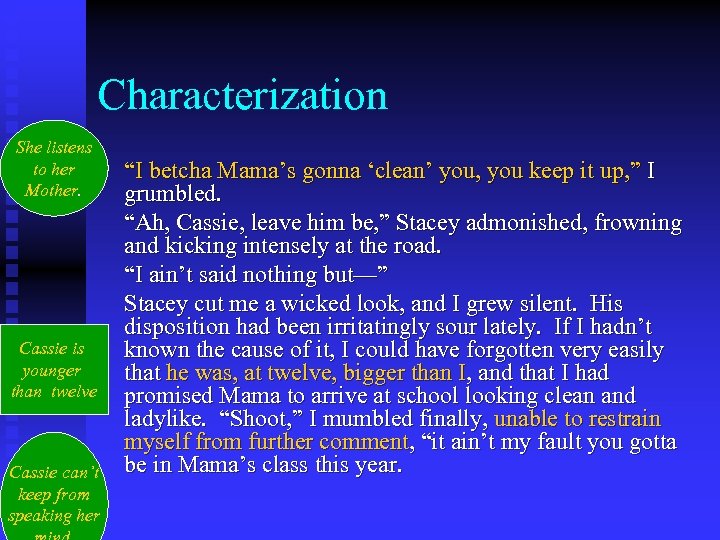 Characterization She listens to her Mother. Cassie is younger than twelve Cassie can’t keep from speaking her “I betcha Mama’s gonna ‘clean’ you, you keep it up, ” I grumbled. “Ah, Cassie, leave him be, ” Stacey admonished, frowning and kicking intensely at the road. “I ain’t said nothing but—” Stacey cut me a wicked look, and I grew silent. His disposition had been irritatingly sour lately. If I hadn’t known the cause of it, I could have forgotten very easily that he was, at twelve, bigger than I, and that I had promised Mama to arrive at school looking clean and ladylike. “Shoot, ” I mumbled finally, unable to restrain myself from further comment, “it ain’t my fault you gotta be in Mama’s class this year.
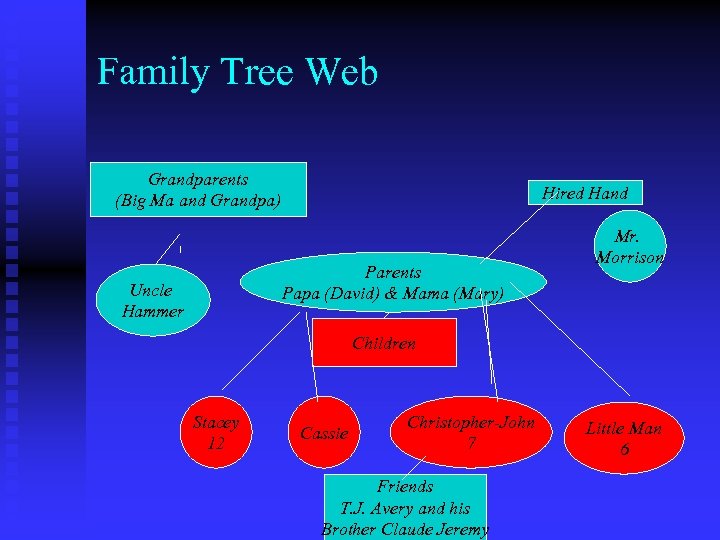 Family Tree Web Grandparents (Big Ma and Grandpa) Hired Hand Parents Papa (David) & Mama (Mary) Uncle Hammer Mr. Morrison Children Stacey 12 Cassie Christopher-John 7 Friends T. J. Avery and his Brother Claude Jeremy Little Man 6
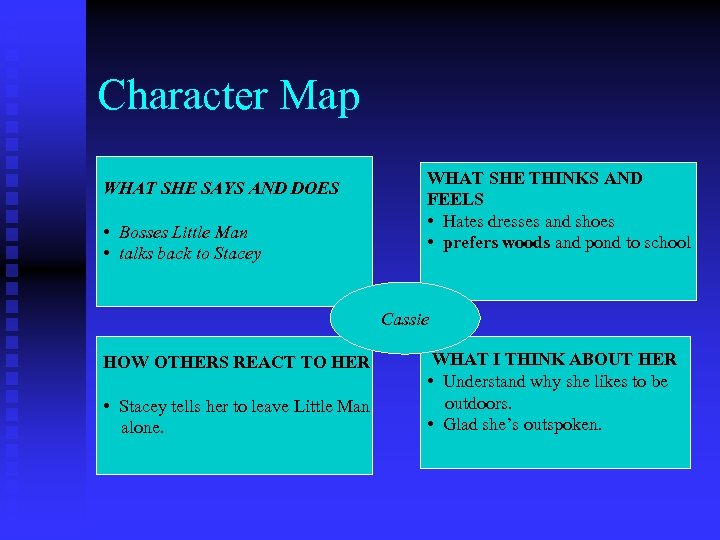 Character Map WHAT SHE SAYS AND DOES • Bosses Little Man • talks back to Stacey WHAT SHE THINKS AND FEELS • Hates dresses and shoes • prefers woods and pond to school Cassie HOW OTHERS REACT TO HER • Stacey tells her to leave Little Man alone. WHAT I THINK ABOUT HER • Understand why she likes to be outdoors. • Glad she’s outspoken.
 Setting • • Time and place in which the action of the story takes place is called its Setting. A novel typically has one general setting and a number of immediate settings. The general setting is the overall location and time period of the entire story. An immediate setting is the exact place and time in which an individual event happens.
 General Setting – Roll of Thunder, Hear My Cry • • • Chapter 1 describes the general setting. From the opening passage, you learn that the Logans live in Mississippi. The highlighting and the notes in the following passage point out other important details about the general setting of the novel.
 Setting – Roll of Thunder, Hear My Cry Logan land surrounding area Before us the narrow, sun-splotched road wound like a lazy red serpent dividing the high forest bank of quiet, old trees on the left from the cotton field, forested by giant green and purple stalks on the right. A barbed-wire fence ran the length of the deep field, stretching eastward for over a quarter of a mile until it met the sloping green pasture that signaled the end of our family’s four hundred acres. Amount of land
 Immediate Settings -- Details • • • Individual events in the novel take place in a number of immediate settings The descriptions of particular places can tell you a lot. Read the description of one bedroom in the Logan house and note the details that help paint the picture of the scene.
 from Roll of Thunder, Hear My Cry Pleasant room It was a warm, comfortable room of doors and wood and pictures. From it a person could reach the front or side porch, the kitchen, and the two other bedrooms. Its walls were made of smooth oak, and on them hung gigantic photographs of Grandpa and Big Ma, Papa, and Uncle Hammer when they were boys, Papa’s two eldest brothers, who were now dead, and pictures of Mama’s family. Pictures of family
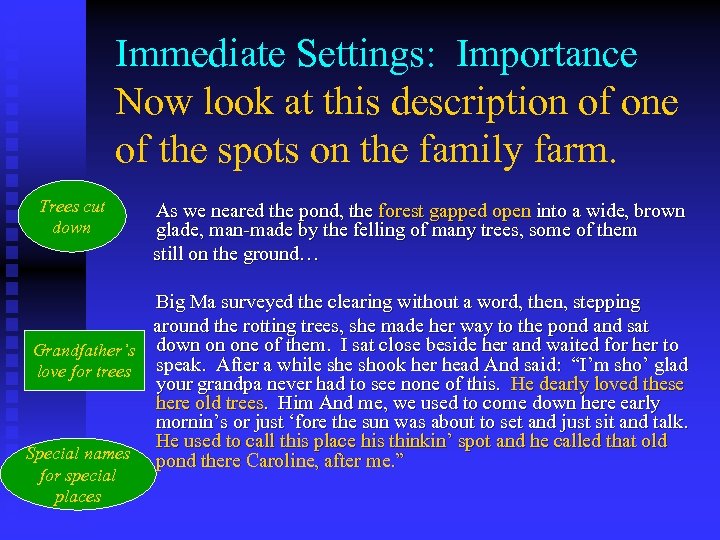 Immediate Settings: Importance Now look at this description of one of the spots on the family farm. Trees cut down As we neared the pond, the forest gapped open into a wide, brown glade, man-made by the felling of many trees, some of them still on the ground… Big Ma surveyed the clearing without a word, then, stepping around the rotting trees, she made her way to the pond and sat Grandfather’s down on one of them. I sat close beside her and waited for her to love for trees speak. After a while shook her head And said: “I’m sho’ glad your grandpa never had to see none of this. He dearly loved these here old trees. Him And me, we used to come down here early mornin’s or just ‘fore the sun was about to set and just sit and talk. He used to call this place his thinkin’ spot and he called that old Special names pond there Caroline, after me. ” for special places
 Plot • • • A plot is a series of events that makes up a story. In a novel, the plot often centers around a conflict, or struggle, between opposing forces. In Roll of Thunder, Hear My Cry, the Logans struggle against the racial attitudes in the South.
 Summary Notes • • Decide on a way to help you keep the plot of a novel clear in your head as you read. On method is to write brief Summary Notes of what happens in each chapter • Chapter I • Cassie and Little Man get whipped at school for refusing to accept books that whites hand down to blacks. Mama stands by them.
 Timeline • Another great way to help you remember the events in a plot is to create a timeline of what’s going on when. • October 1933: Cassie and Little Man get whipped at school. Papa brings Mr. Morrison home. • November 1933: Logan children stop school bus. T. J. lets Stacey take punishment for cheating and Stacey beats up T. J.
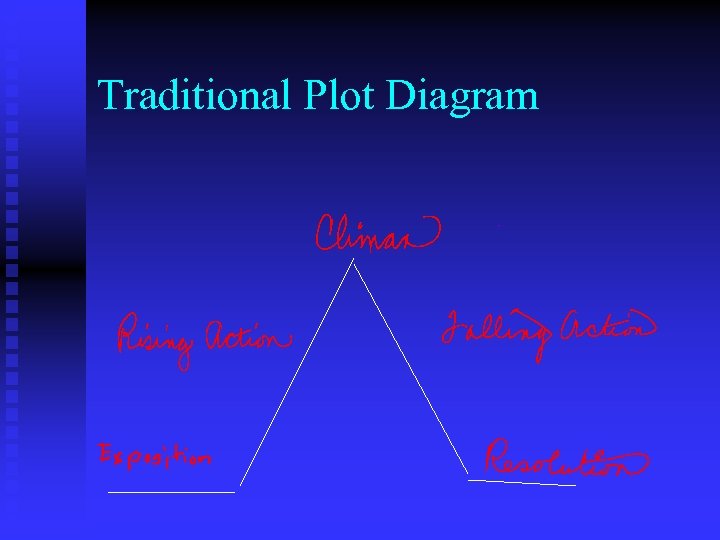
 Plot Diagram • Often, but not always, the events that make up a novel’s plot are presented in chronological order. • That means the same order in which they happened in time. • Like many short stories, novels often follow the traditional plot structure or something close to it.
 Traditional Plot Diagram
 Theme • • A novel’s theme is a message about life from author to reader. It’s a statement that makes clear what the book means. The theme or themes may be stated directly. Other times, you’ll need to do some digging around to come up with a theme.
 Finding the Theme of a Novel • • • What “big idea” is the novel about? What do characters do or say that relates to that topic? What important lessons about life do readers learn?
 Style • • Style refers to the way an author expresses his or her ideas. An author’s style is marked by the kinds of words, sentence structure, and literary devices he or she uses.
 Analyzing an Author’s Style • To analyze an author’s style, ask yourself questions like these: • Does the author use mostly short, simple words and sentences or long, complex ones? • What sort of feeling do I have about the writing? Is it loose and casual, formal and proper, or something else? • Do the characters speak in dialect? Does their language seem realistic and believable? • Does the author use sensory language, or words that appeal to the five senses? • Is there a lot of imagery?
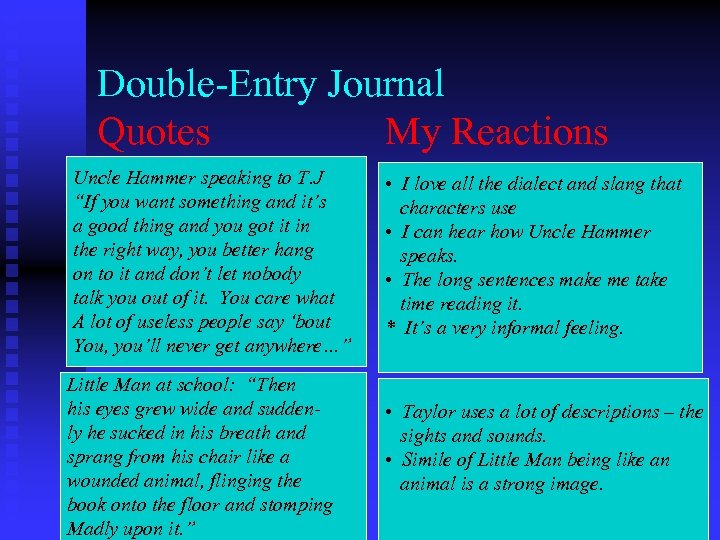 Double-Entry Journal Quotes My Reactions Uncle Hammer speaking to T. J “If you want something and it’s a good thing and you got it in the right way, you better hang on to it and don’t let nobody talk you out of it. You care what A lot of useless people say ‘bout You, you’ll never get anywhere…” • I love all the dialect and slang that characters use • I can hear how Uncle Hammer speaks. • The long sentences make me take time reading it. * It’s a very informal feeling. Little Man at school: “Then his eyes grew wide and suddenly he sucked in his breath and sprang from his chair like a wounded animal, flinging the book onto the floor and stomping Madly upon it. ” • Taylor uses a lot of descriptions – the sights and sounds. • Simile of Little Man being like an animal is a strong image.