


 Скачать презентацию Read Antitrust Statement ASTM International is a not-for-profit
f9eaad1fa93468628251c6178107e29c.ppt
- Количество слайдов: 68
 Read Antitrust Statement ASTM International is a not-for-profit organization and developer of voluntary consensus standards. ASTM’s leadership in international standards development is driven by the contributions of its members: more than 30, 000 technical experts and business professionals representing 135 countries. The purpose of antitrust laws is to preserve economic competition in the marketplace by prohibiting, among other things, unreasonable restraints of trade. In ASTM activities, it is important to recognize that participants often represent competitive interests. Antitrust laws require that all competition be open and unrestricted. It is ASTM’s policy, and the policy of each of its committees and subcommittees, to conduct all business and activity in full compliance with international, federal and state antitrust and competition laws. The ASTM Board of Directors has adopted an antitrust policy which is found in Section 19 of ASTM Regulations Governing Technical Committees. All members need to be aware of and compliant with this policy. The Regulations are accessible on the ASTM website (http: //www. astm. org/COMMIT/Regs. pdf) and copies of the antitrust policy are available at the registration desk Reminder: Electronic recording of ASTM meetings is prohibited. 1
 ASTM International Committee D 02 on Petroleum Products, Liquid Fuels and Lubricants Member Orientation December 2013 Tampa, FL Jim Simnick Vice Chairman Committee D 02 2
 Presentation • Provide an overview of ASTM International • Introduce ASTM’s standardization concepts • Introduce Committee D 02 • Membership • Overview of standards development process • Increase your awareness of and participation in D 02 • Answer questions 3
 About ASTM International n Organized in 1898 n Independent, private sector, not-for-profit n Provides a global forum for the development of voluntary, consensus standards and promotion of related knowledge 4
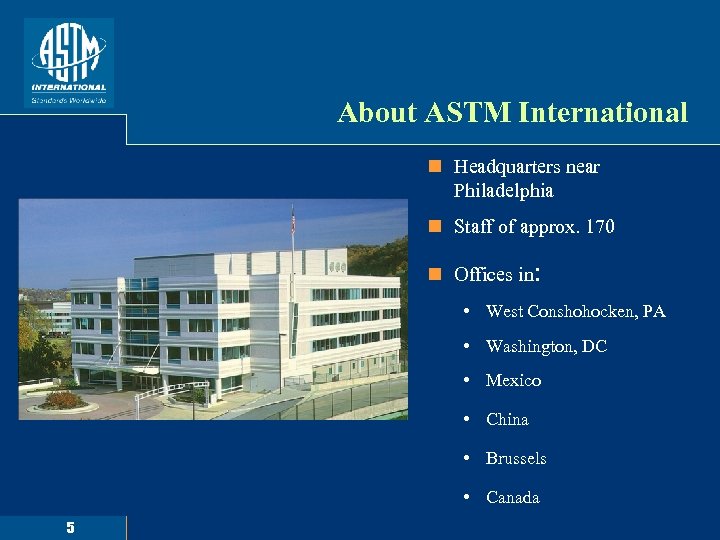 About ASTM International n Headquarters near Philadelphia n Staff of approx. 170 n Offices in: • West Conshohocken, PA • Washington, DC • Mexico • China • Brussels • Canada 5
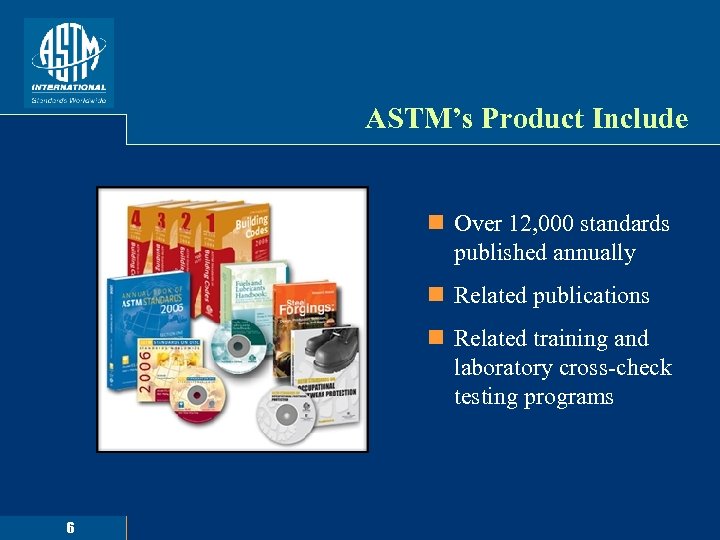 ASTM’s Product Include n Over 12, 000 standards published annually n Related publications n Related training and laboratory cross-check testing programs 6
 ASTM Certification Programs n ASTM Board authorized management to develop capability to offer certification services n Product as well as Personnel Certification n Industry supported programs n ASTM does not permit its trademark to be used in manner that suggest its has approved any product, equipment or service other than Certification Program 7
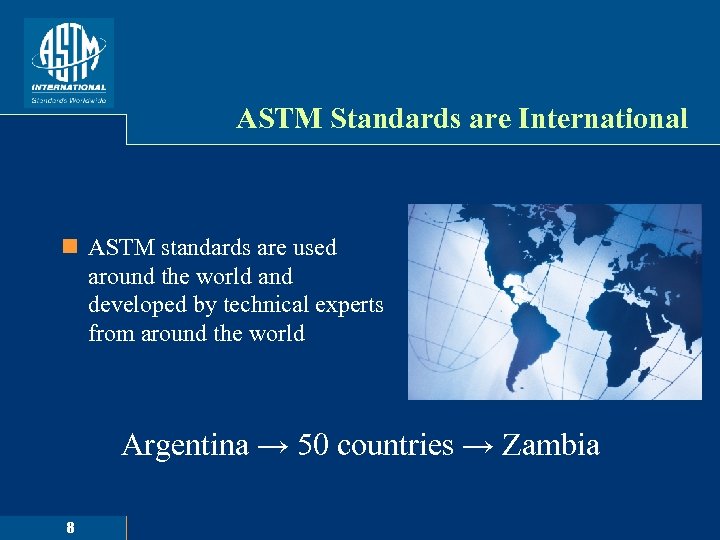 ASTM Standards are International n ASTM standards are used around the world and developed by technical experts from around the world Argentina → 50 countries → Zambia 8
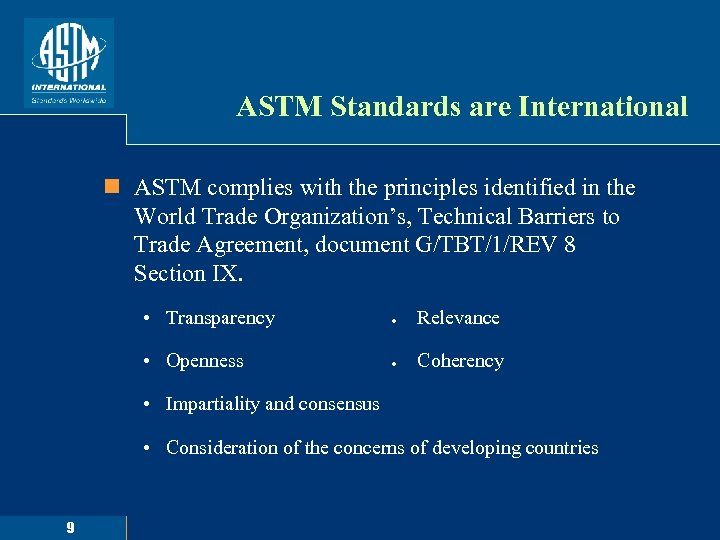 ASTM Standards are International n ASTM complies with the principles identified in the World Trade Organization’s, Technical Barriers to Trade Agreement, document G/TBT/1/REV 8 Section IX. • Transparency ● • Openness ● Relevance Coherency • Impartiality and consensus • Consideration of the concerns of developing countries 9
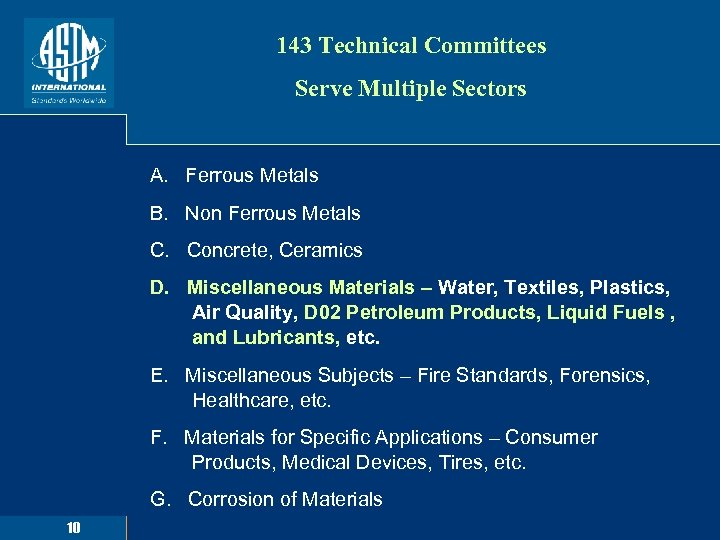 143 Technical Committees Serve Multiple Sectors A. Ferrous Metals B. Non Ferrous Metals C. Concrete, Ceramics D. Miscellaneous Materials – Water, Textiles, Plastics, Air Quality, D 02 Petroleum Products, Liquid Fuels , and Lubricants, etc. E. Miscellaneous Subjects – Fire Standards, Forensics, Healthcare, etc. F. Materials for Specific Applications – Consumer Products, Medical Devices, Tires, etc. G. Corrosion of Materials 10
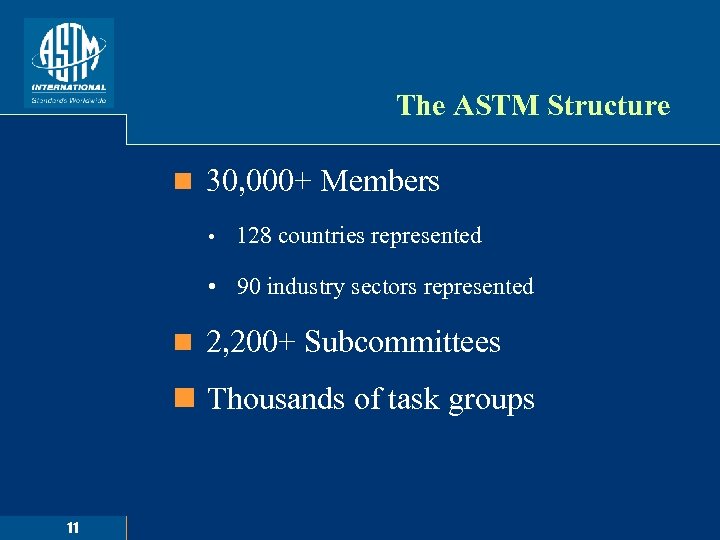 The ASTM Structure n 30, 000+ Members • 128 countries represented • 90 industry sectors represented n 2, 200+ Subcommittees n Thousands of task groups 11
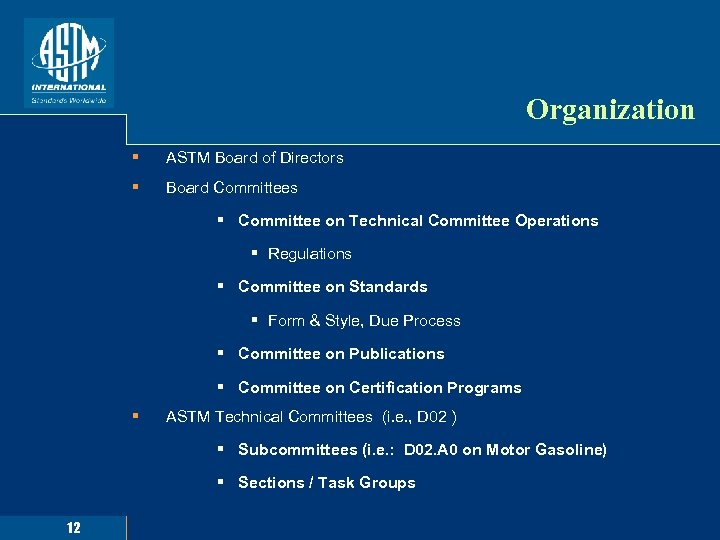 Organization § ASTM Board of Directors § Board Committees § Committee on Technical Committee Operations § Regulations § Committee on Standards § Form & Style, Due Process § Committee on Publications § Committee on Certification Programs § ASTM Technical Committees (i. e. , D 02 ) § Subcommittees (i. e. : D 02. A 0 on Motor Gasoline) § Sections / Task Groups 12
 ASTM Standardization Concepts 13
 ASTM Standardization Concept n A decentralized system • ASTM’s technical committees make the decisions • ASTM provides an open forum and an administrative framework 14
 ASTM Standardization Concept n The system is open § Fair - Anyone may speak and participate (Voting members must participate) § Methodical § Rigorous process with checks and balances 15
 ASTM Standardization Concept n Partnership of the public and private sector n Marketplace orientation n Reflects changes in technology n ASTM’s standards are voluntary • Standards are only mandatory when cited in regulation or called out in a contract 16
 What is a Standard? § As used in ASTM, a document developed and established within the consensus principles of the organization and which meets the requirements of ASTM procedures and regulations. § Full consensus standards developed with participation of all parties who have a stake in the standards’ development and/or use. 17
 Standards § ASTM uses term “standard” as adjective to describe following types of standards: § Specifications § Test Methods § Practices § Guides § Classifications § Terminology 18
 Introduction to ASTM Committee D 02 on Petroleum Products and Lubricants 19
 Committee D 02 n Largest ASTM Committee, organized in 1904 n Includes over 2, 400 members from more than 65 countries n Developer of over 800 petroleum standards that have helped to provide heat for homes, fuel for automobiles and airplanes, and lubricants for machinery n Sponsor of numerous technical publications, laboratory quality assurance programs and technical and professional training courses, workshops, and symposia. 20
 Who Is ASTM D 02? Members from more than 65 Countries Argentina Australia Austria Bahamas Bahrain Belgium Bolivia Botswana Brazil Canada China Columbia Costa Rica Denmark Ecuador Egypt El Salvador 21 Finland France Germany Ghana Greece Guyana India Indonesia Iraq Ireland Israel Italy Jamaica Japan Korea Malaysia Mexico Mongolia Nepal Netherlands New Zealand Nigeria Norway Oman Pakistan Paraguay Peru Philippines Poland Qatar Russia Saudi Arabia Seychelles Slovenia Singapore South Africa Sri Lanka Sudan Suriname Sweden Switzerland Taiwan Thailand Trinidad. /Tobago UAE United Kingdom United States Uruguay Venezuela Vietnam
 Committee D 02 Scope Liquid fuels derived from: petroleum or the liquefaction of coal, shale, oil sands, or other naturally occurring materials including: Liquid fuels, . . Liquid and semi-solid lubricants. . Liquid fuels derived from biological materials (biofuels) Synthesized liquid fuels (also known as renewable or alternative fuels) Hydraulic fluids. . Petroleum Coke. . Gaseous fuels. . Waxes. . 22
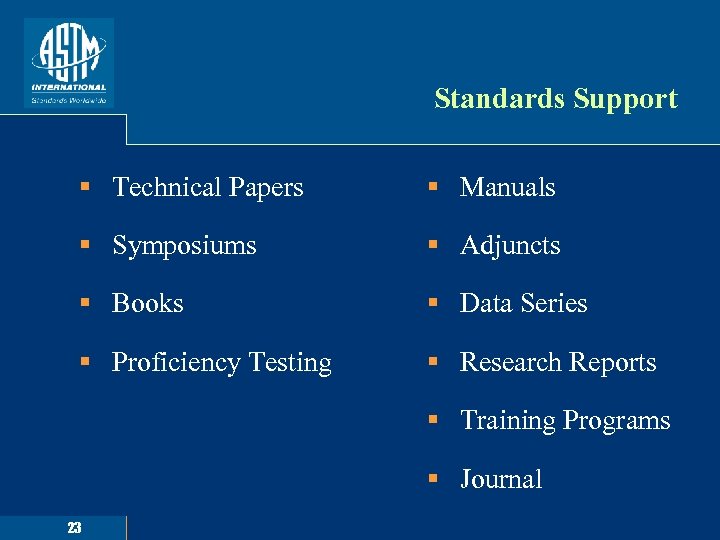 Standards Support § Technical Papers § Manuals § Symposiums § Adjuncts § Books § Data Series § Proficiency Testing § Research Reports § Training Programs § Journal 23
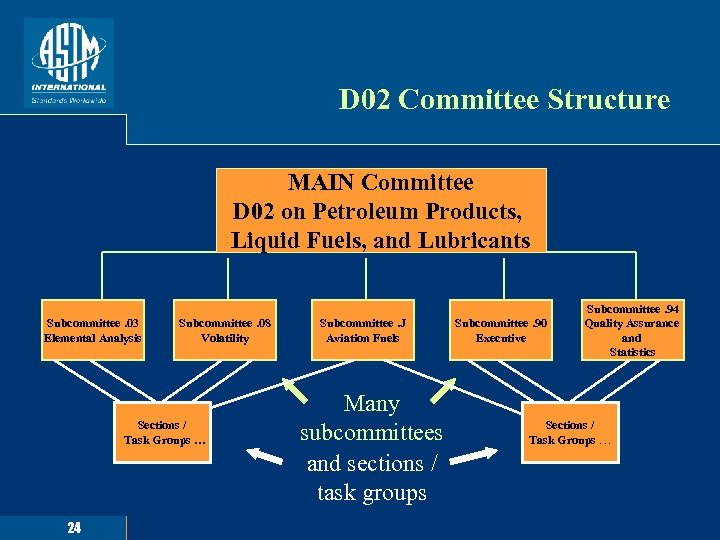 D 02 Committee Structure MAIN Committee D 02 on Petroleum Products, Liquid Fuels, and Lubricants Subcommittee. 03 Elemental Analysis Subcommittee. 08 Volatility Sections / Task Groups … 24 Subcommittee. J Aviation Fuels Many subcommittees and sections / task groups Subcommittee. 90 Executive Subcommittee. 94 Quality Assurance and Statistics Sections / Task Groups …
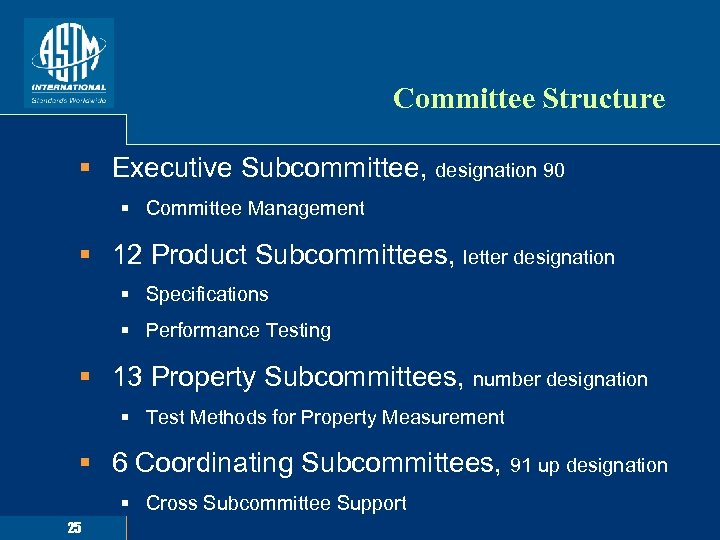 Committee Structure § Executive Subcommittee, designation 90 § Committee Management § 12 Product Subcommittees, letter designation § Specifications § Performance Testing § 13 Property Subcommittees, number designation § Test Methods for Property Measurement § 6 Coordinating Subcommittees, 91 up designation § Cross Subcommittee Support 25
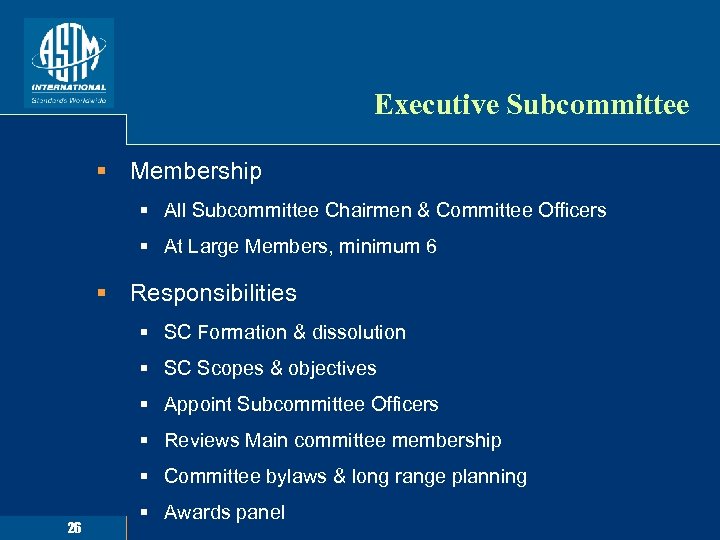 Executive Subcommittee § Membership § All Subcommittee Chairmen & Committee Officers § At Large Members, minimum 6 § Responsibilities § SC Formation & dissolution § SC Scopes & objectives § Appoint Subcommittee Officers § Reviews Main committee membership § Committee bylaws & long range planning 26 § Awards panel
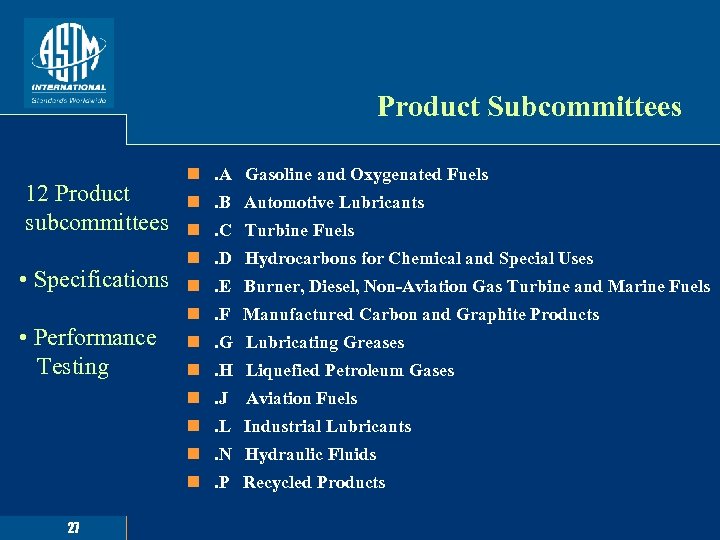 Product Subcommittees 12 Product subcommittees • Specifications • Performance Testing n. A Gasoline and Oxygenated Fuels n. B Automotive Lubricants n. C Turbine Fuels n. D Hydrocarbons for Chemical and Special Uses n. E Burner, Diesel, Non-Aviation Gas Turbine and Marine Fuels n. F Manufactured Carbon and Graphite Products n. G Lubricating Greases n. H Liquefied Petroleum Gases n. J Aviation Fuels n. L Industrial Lubricants n. N Hydraulic Fluids n. P Recycled Products 27
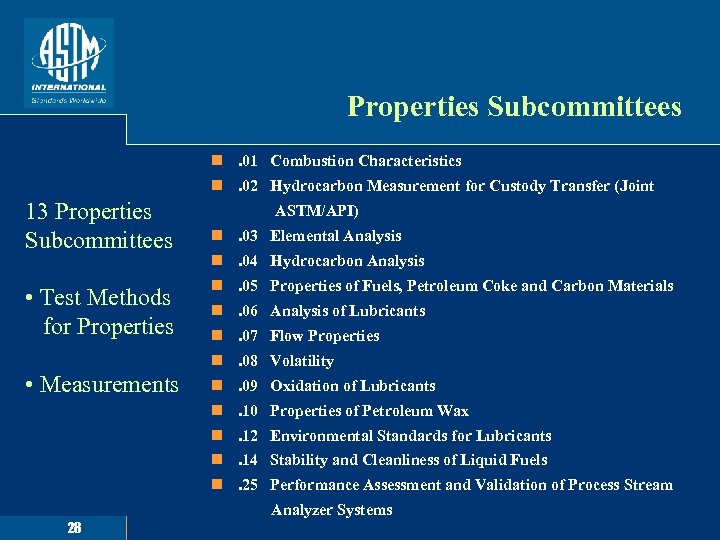 Properties Subcommittees n. 01 Combustion Characteristics n. 02 Hydrocarbon Measurement for Custody Transfer (Joint 13 Properties Subcommittees • Test Methods for Properties ASTM/API) n. 03 Elemental Analysis n. 04 Hydrocarbon Analysis n. 05 Properties of Fuels, Petroleum Coke and Carbon Materials n. 06 Analysis of Lubricants n. 07 Flow Properties n. 08 Volatility • Measurements n. 09 Oxidation of Lubricants n. 10 Properties of Petroleum Wax n. 12 Environmental Standards for Lubricants n. 14 Stability and Cleanliness of Liquid Fuels n. 25 Performance Assessment and Validation of Process Stream Analyzer Systems 28
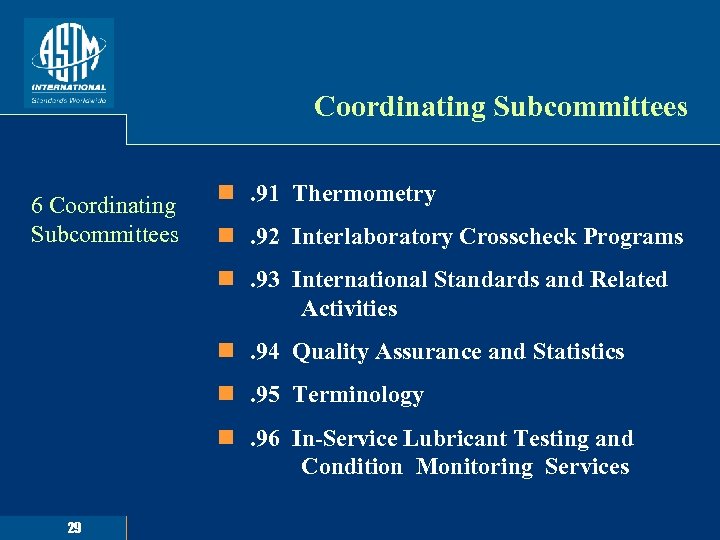 Coordinating Subcommittees 6 Coordinating Subcommittees n. 91 Thermometry n. 92 Interlaboratory Crosscheck Programs n. 93 International Standards and Related Activities n. 94 Quality Assurance and Statistics n. 95 Terminology n. 96 In-Service Lubricant Testing and Condition Monitoring Services 29
 Membership Committee and Subcommittees 30
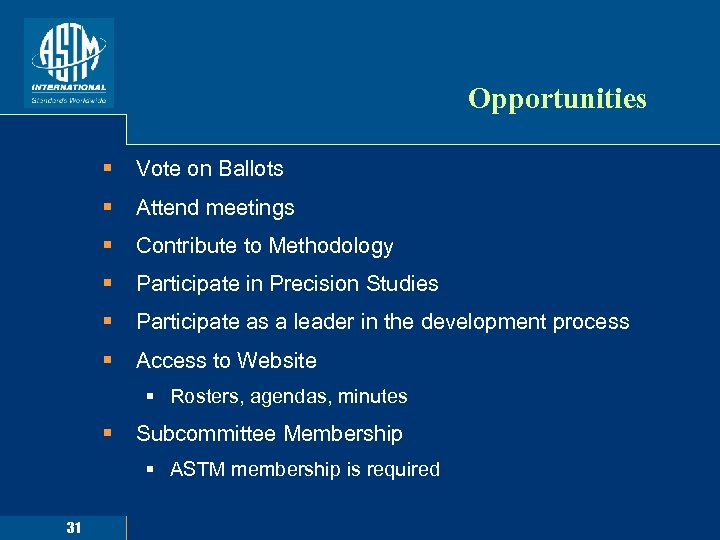 Opportunities § Vote on Ballots § Attend meetings § Contribute to Methodology § Participate in Precision Studies § Participate as a leader in the development process § Access to Website § Rosters, agendas, minutes § Subcommittee Membership § ASTM membership is required 31
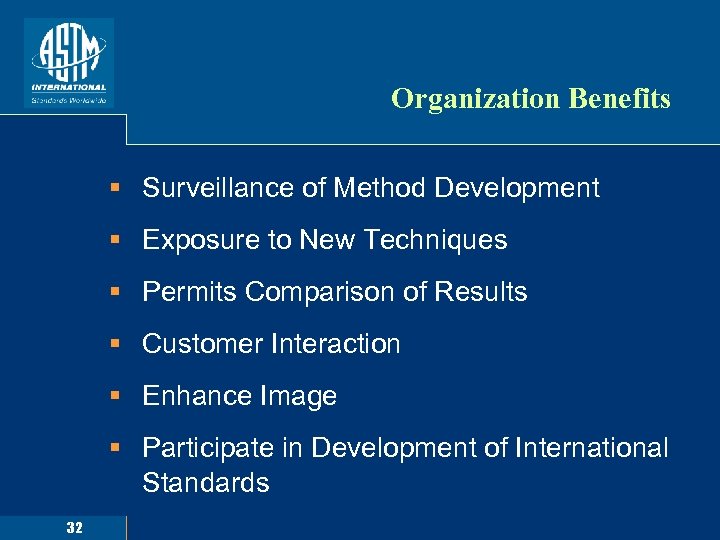 Organization Benefits § Surveillance of Method Development § Exposure to New Techniques § Permits Comparison of Results § Customer Interaction § Enhance Image § Participate in Development of International Standards 32
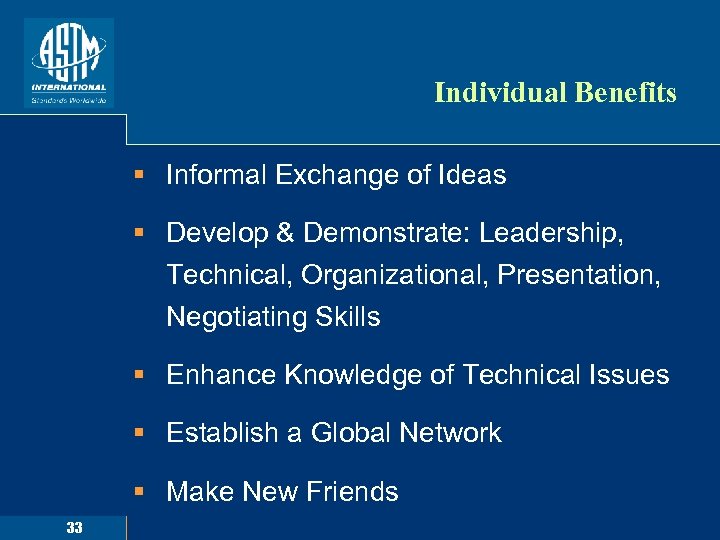 Individual Benefits § Informal Exchange of Ideas § Develop & Demonstrate: Leadership, Technical, Organizational, Presentation, Negotiating Skills § Enhance Knowledge of Technical Issues § Establish a Global Network § Make New Friends 33
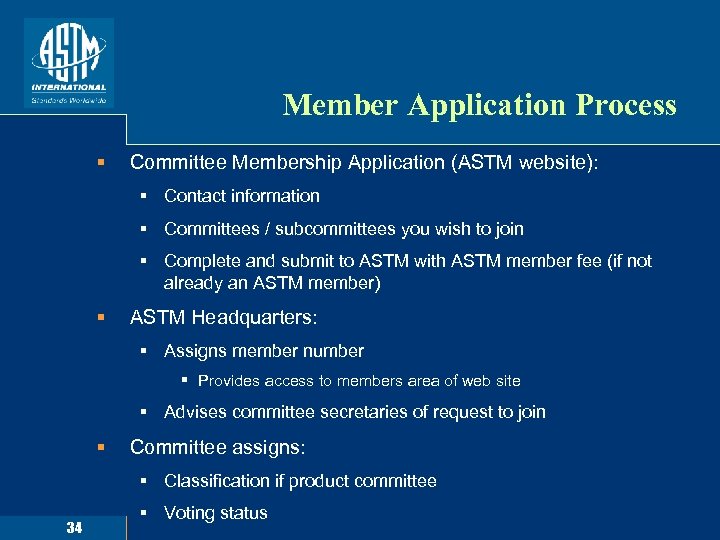 Member Application Process § Committee Membership Application (ASTM website): § Contact information § Committees / subcommittees you wish to join § Complete and submit to ASTM with ASTM member fee (if not already an ASTM member) § ASTM Headquarters: § Assigns member number § Provides access to members area of web site § Advises committee secretaries of request to join § Committee assigns: § Classification if product committee 34 § Voting status
 Member Classifications § Producer § A member representing an organization that produces or sells materials, products, systems or services § User § A member representing an organization that purchases or uses the materials, products, systems or services other than for household use § Consumer § A member who primarily purchases, or represents those who purchase, products and services for household use § General Interest § A member who cannot be categorized as a producer, user or consumer 35
 Subcommittee Membership § Standards development and maintenance responsibility in a topical area § Conducts electronic ballot review of its product § Adjudicates negatives and comments received on ballots § Delegates standards development to smaller working groups § Oversees Task Group Operations 36
 Work Groups § Naming conventions are SC dependent § Sections § Usually a long standing working group dealing with a topical area with in the SC scope § Panels § Working group with specific STM support responsibility § Task Group, Study Group, etc § Small working group who develop, write, conduct precision studies on new or current methods, specifications, etc. § These working groups may report to another work group, to a SC, or to the Committee, depending who created 37
 Work Group Membership § Anyone interested in the task is encouraged to participate § ASTM membership is not required, but preferred § Writes Standard, or conducts a special project § Revise or update a current standard § Conducts Interlaboratory study, if appropriate § Writes research report if appropriate § Research reports are required to support a change in precision 38
 Voting Status § Official Voting Members § One per voting interest § Other members of same interest can be Unofficial Voting Members § Do not vote in ballot adjudication § All Members § Have access to all ballots and supporting materials § Can Participate in standards development process 39
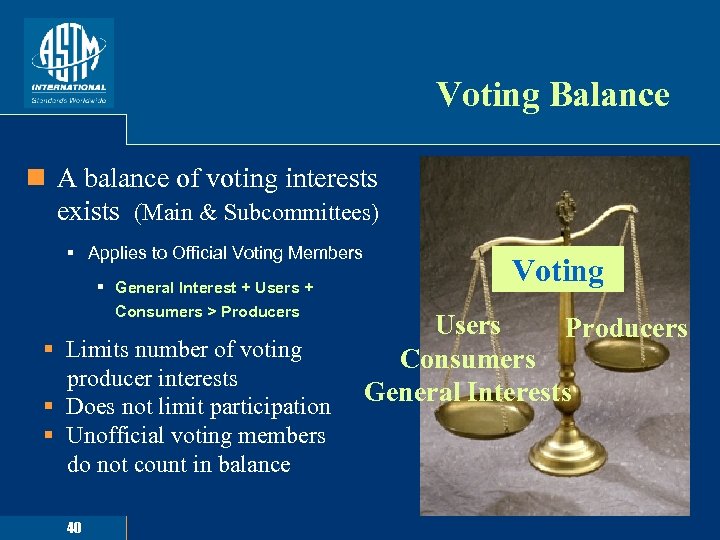 Voting Balance n A balance of voting interests exists (Main & Subcommittees) § Applies to Official Voting Members § General Interest + Users + Consumers > Producers § Limits number of voting producer interests § Does not limit participation § Unofficial voting members do not count in balance 40 Voting Users Producers Consumers General Interests
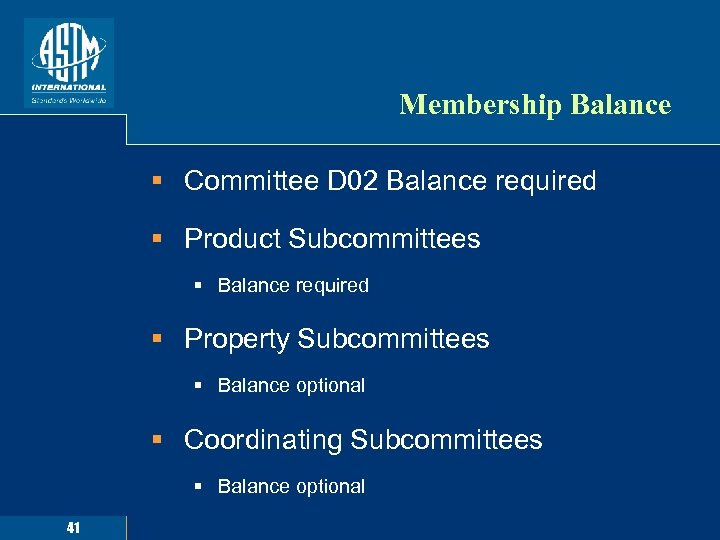 Membership Balance § Committee D 02 Balance required § Product Subcommittees § Balance required § Property Subcommittees § Balance optional § Coordinating Subcommittees § Balance optional 41
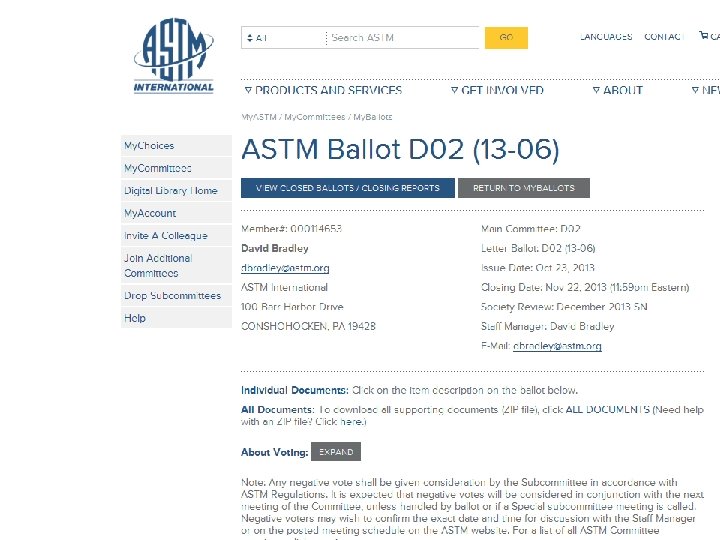
 Ballot Guidelines § New Standards / Revisions § Electronic ballot to all SC members § Concurrent with Main Committee § If it is not the first ballot on the topic § Rationale cover letter is required § Reapproval Standard § Unanimous voice vote in SC meeting § Sent to Main Committee Ballot 42
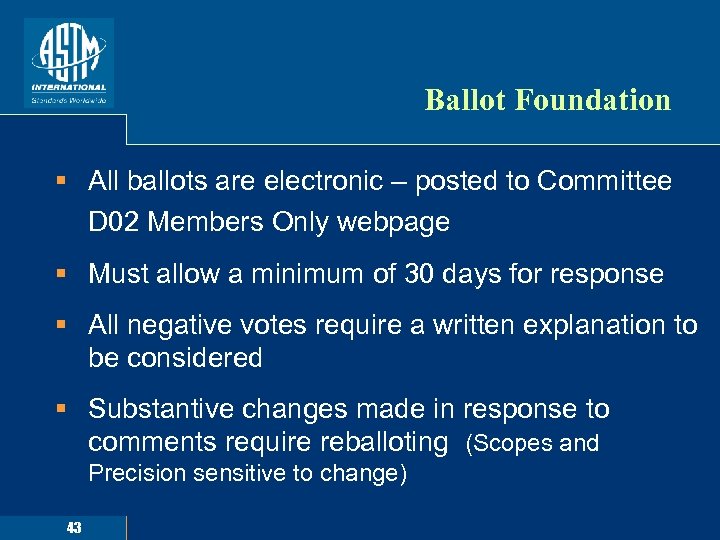 Ballot Foundation § All ballots are electronic – posted to Committee D 02 Members Only webpage § Must allow a minimum of 30 days for response § All negative votes require a written explanation to be considered § Substantive changes made in response to comments require reballoting (Scopes and Precision sensitive to change) 43
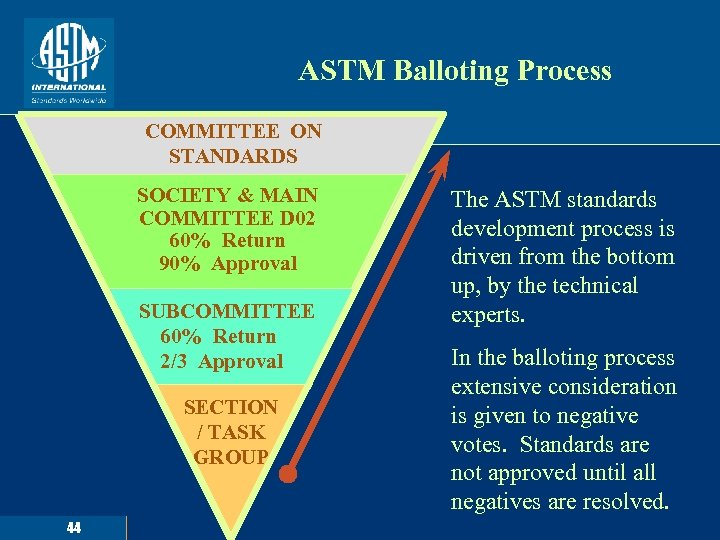 ASTM Balloting Process COMMITTEE ON STANDARDS SOCIETY & MAIN COMMITTEE D 02 60% Return 90% Approval SUBCOMMITTEE 60% Return 2/3 Approval SECTION / TASK GROUP 44 The ASTM standards development process is driven from the bottom up, by the technical experts. In the balloting process extensive consideration is given to negative votes. Standards are not approved until all negatives are resolved.
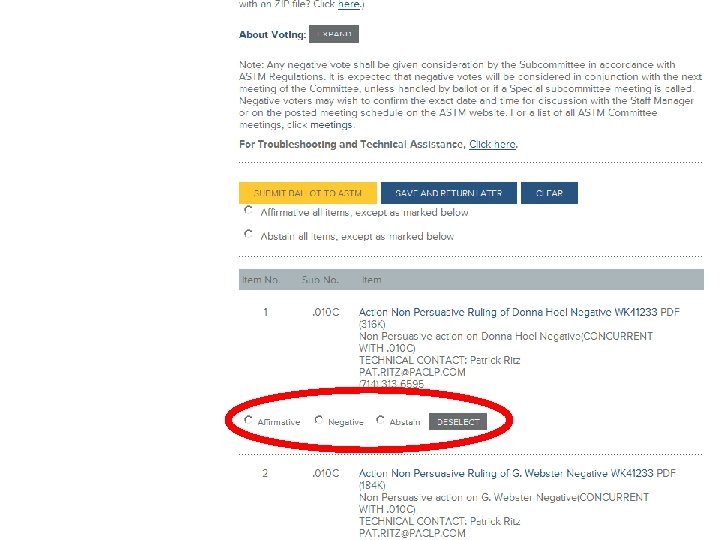
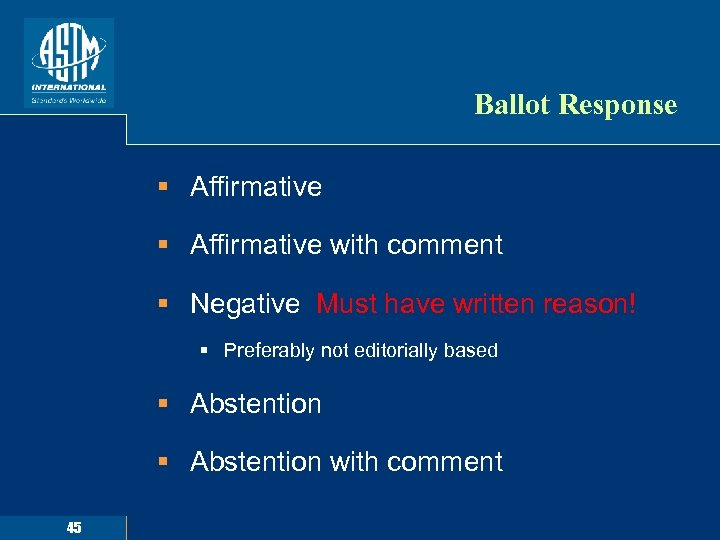 Ballot Response § Affirmative with comment § Negative Must have written reason! § Preferably not editorially based § Abstention with comment 45
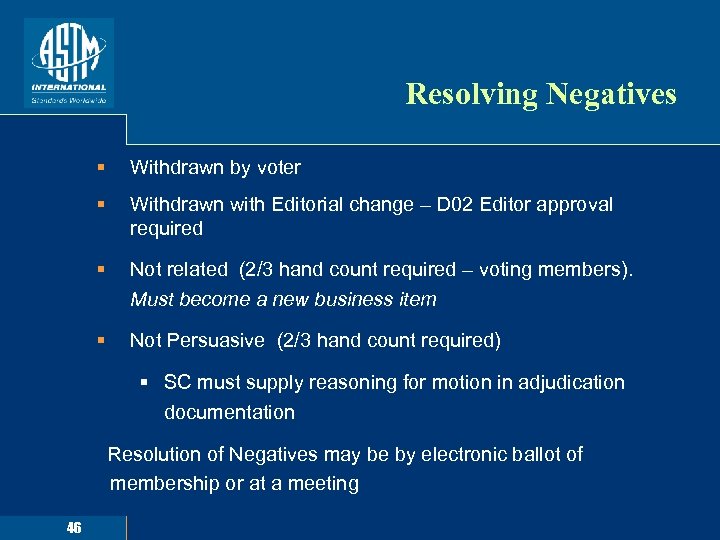 Resolving Negatives § Withdrawn by voter § Withdrawn with Editorial change – D 02 Editor approval required § Not related (2/3 hand count required – voting members). Must become a new business item § Not Persuasive (2/3 hand count required) § SC must supply reasoning for motion in adjudication documentation Resolution of Negatives may be by electronic ballot of membership or at a meeting 46
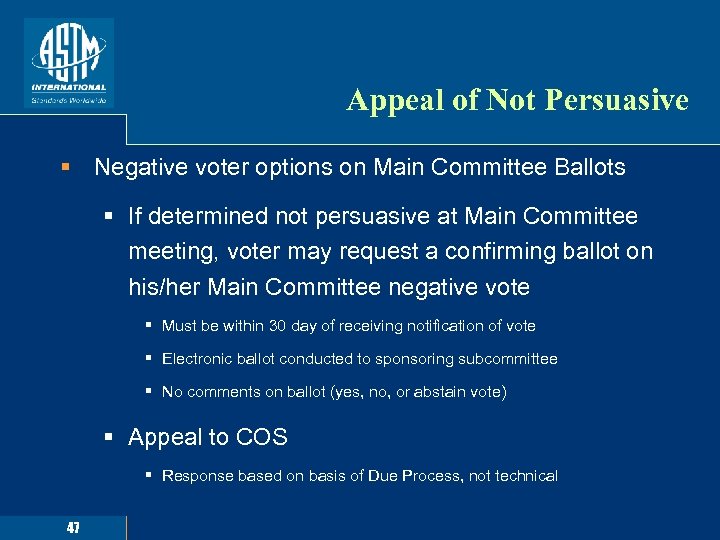 Appeal of Not Persuasive § Negative voter options on Main Committee Ballots § If determined not persuasive at Main Committee meeting, voter may request a confirming ballot on his/her Main Committee negative vote § Must be within 30 day of receiving notification of vote § Electronic ballot conducted to sponsoring subcommittee § No comments on ballot (yes, no, or abstain vote) § Appeal to COS § Response based on basis of Due Process, not technical 47
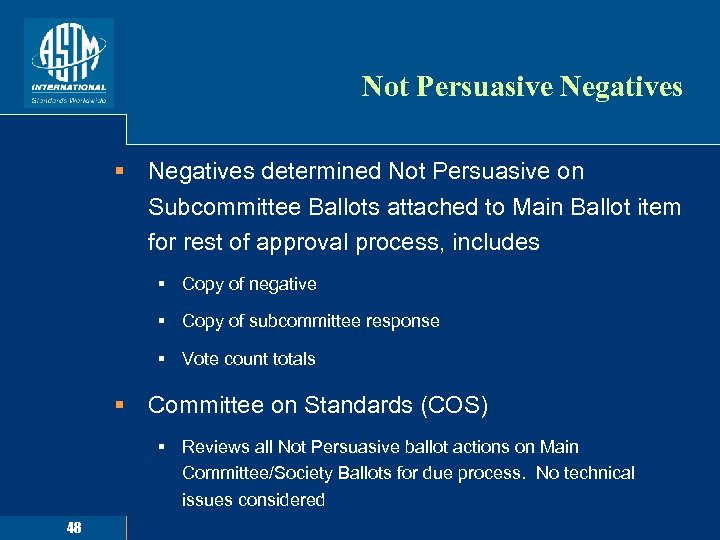 Not Persuasive Negatives § Negatives determined Not Persuasive on Subcommittee Ballots attached to Main Ballot item for rest of approval process, includes § Copy of negative § Copy of subcommittee response § Vote count totals § Committee on Standards (COS) § Reviews all Not Persuasive ballot actions on Main Committee/Society Ballots for due process. No technical issues considered 48
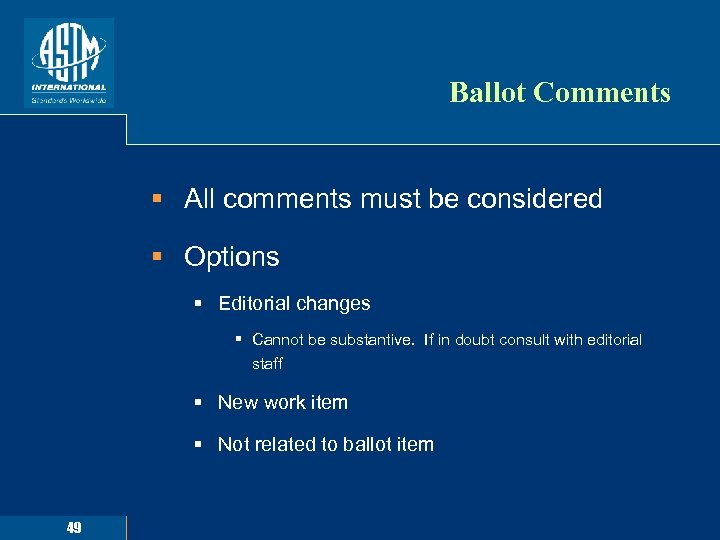 Ballot Comments § All comments must be considered § Options § Editorial changes § Cannot be substantive. If in doubt consult with editorial staff § New work item § Not related to ballot item 49
 Ballot Not Required § Editorial changes § Correct typographical errors § Correct editorial style § Change non-technical information § Reduce ambiguity 50
 Ballot Required § Substantive § Specification limits § Changes to § Procedure § Equipment § Precision statement § Scope § Significance & Use § Any other significant change § Summary of Change Section addition § Contents change automatically when changes are balloted 51
 Committee Meetings (Future Meetings Schedule available in ASTM Registration Area Committee D 02 (and its related subcommittees) meets twice annually • June and December (Sunday pm – Thursday) • 8 am – 5 pm with special topics before and after • Up to 15 groups meet simultaneously • Typical attendance is 800 -900 • International attendance 100 -130 Many subcommittees/ task groups use virtual meetings 52
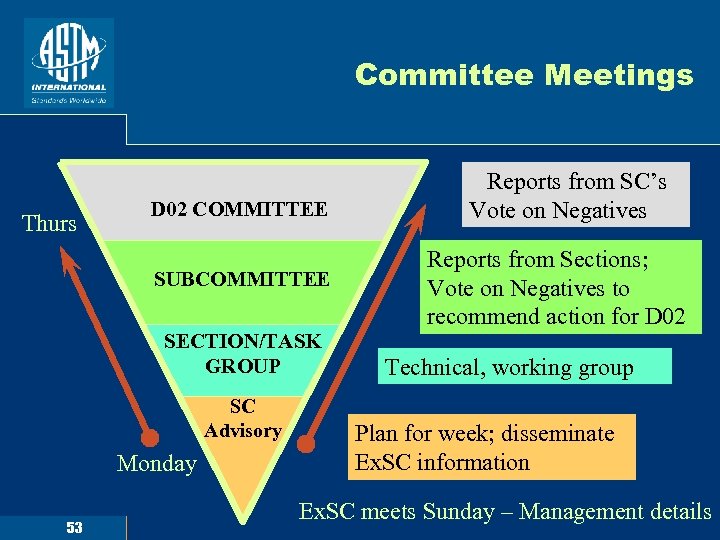 Committee Meetings Thurs D 02 COMMITTEE SUBCOMMITTEE SECTION/TASK GROUP SC Advisory Monday 53 Reports from SC’s Vote on Negatives Reports from Sections; Vote on Negatives to recommend action for D 02 Technical, working group Plan for week; disseminate Ex. SC information Ex. SC meets Sunday – Management details
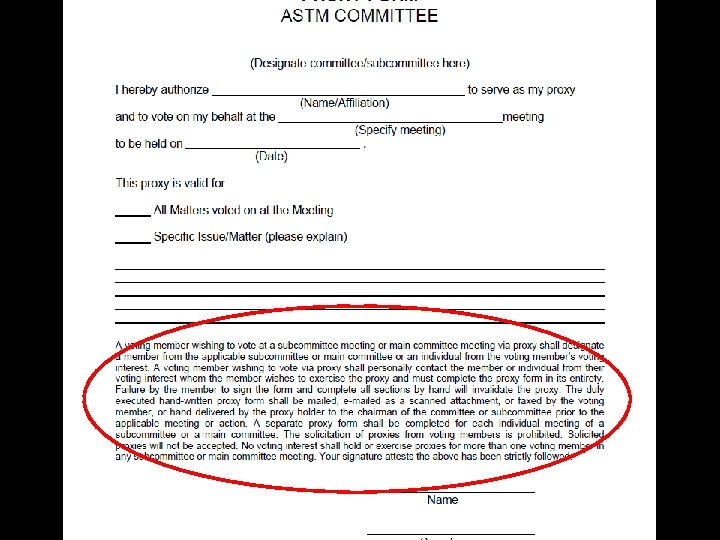
 ASTM Proxy: Votes for a voting member at Subcommittee or Main meeting n Voting member: • Contacts the proxy • Completes form in its entirety and SIGNS it • Sends form to the Chairman prior to action • Separate form required for each individual meeting n Proxy: • Ensures Chairman holds a copy • Cannot hold more than one proxy at a meeting NO SOLICITATION! 54
 55
55
 56
56
 57
57
 58
58
 59
59
 60
60
 61
61
 62
62
 63
63
 64
64
 65
65
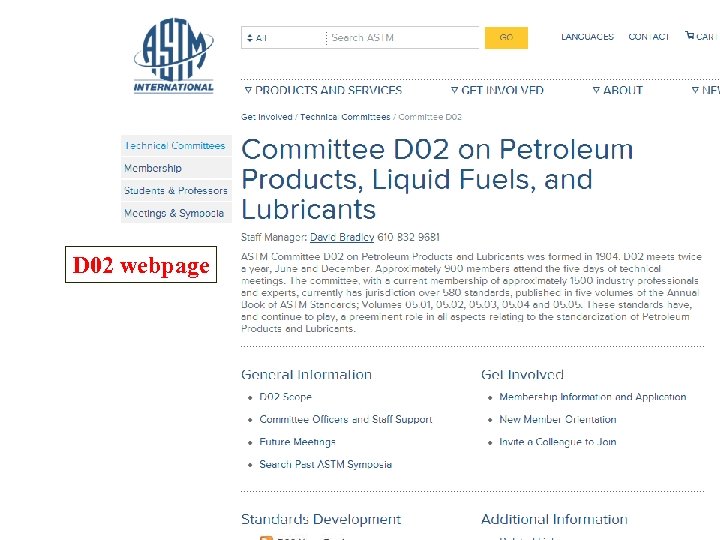 D 02 webpage 66
 QUESTIONS ! Thank You For Attending. If you have questions during the week please see any ASTM staff or Committee or Subcommittee Officers. Invitation to attend other D 02 workshops during the week 67
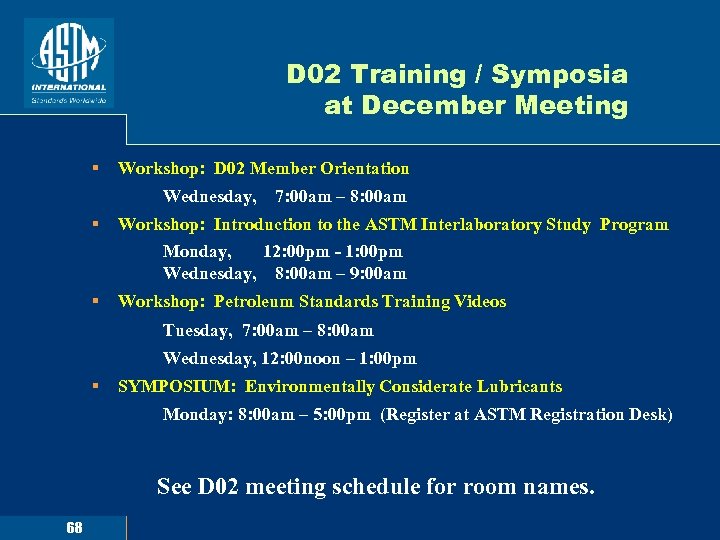 D 02 Training / Symposia at December Meeting § Workshop: D 02 Member Orientation Wednesday, 7: 00 am – 8: 00 am § Workshop: Introduction to the ASTM Interlaboratory Study Program Monday, 12: 00 pm - 1: 00 pm Wednesday, 8: 00 am – 9: 00 am § Workshop: Petroleum Standards Training Videos Tuesday, 7: 00 am – 8: 00 am Wednesday, 12: 00 noon – 1: 00 pm § SYMPOSIUM: Environmentally Considerate Lubricants Monday: 8: 00 am – 5: 00 pm (Register at ASTM Registration Desk) See D 02 meeting schedule for room names. 68