


 Скачать презентацию Reactive Systems Yolanda Gil CS 541 Fall 2003
4543de66c22eddae9ba766417eac19bd.ppt
- Количество слайдов: 42
 Reactive Systems Yolanda Gil CS 541, Fall 2003 (Thanks to Karen Myers from SRI International) 1
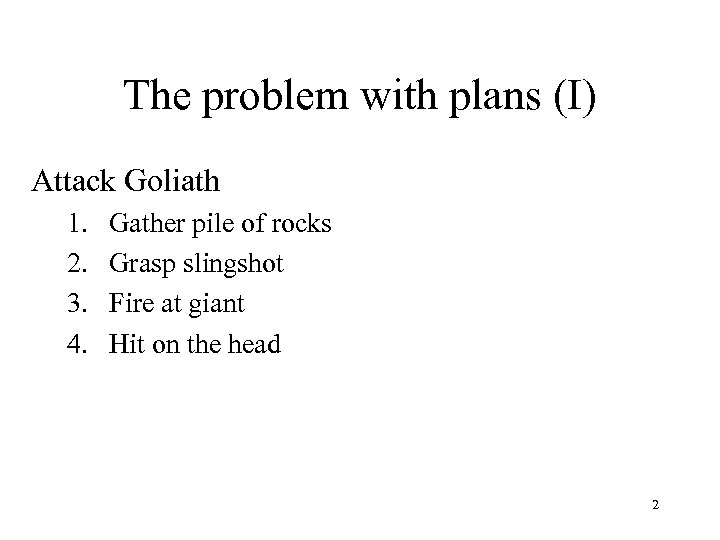 The problem with plans (I) Attack Goliath 1. 2. 3. 4. Gather pile of rocks Grasp slingshot Fire at giant Hit on the head 2
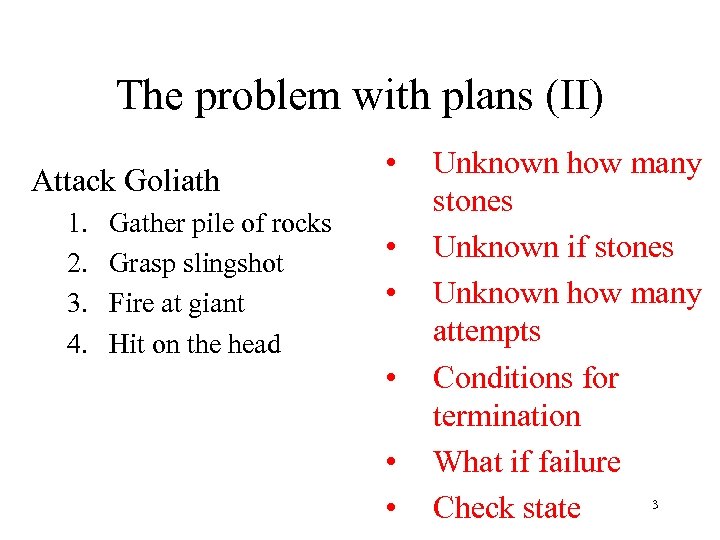 The problem with plans (II) Attack Goliath 1. 2. 3. 4. Gather pile of rocks Grasp slingshot Fire at giant Hit on the head • • • Unknown how many stones Unknown if stones Unknown how many attempts Conditions for termination What if failure 3 Check state
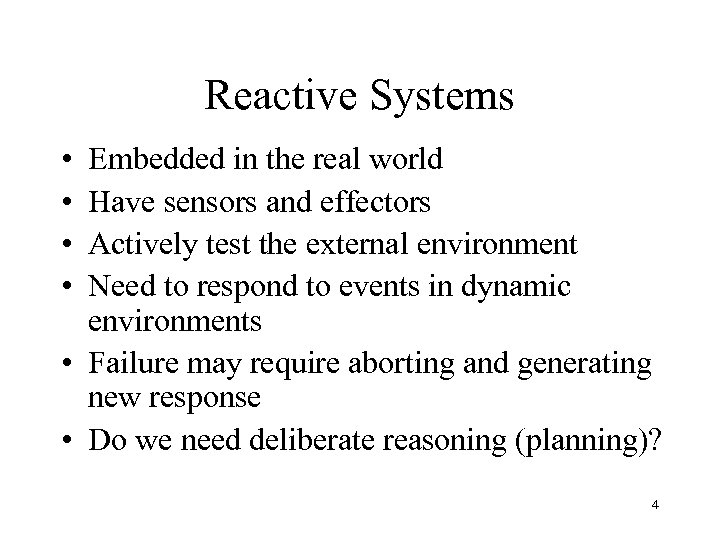 Reactive Systems • • Embedded in the real world Have sensors and effectors Actively test the external environment Need to respond to events in dynamic environments • Failure may require aborting and generating new response • Do we need deliberate reasoning (planning)? 4
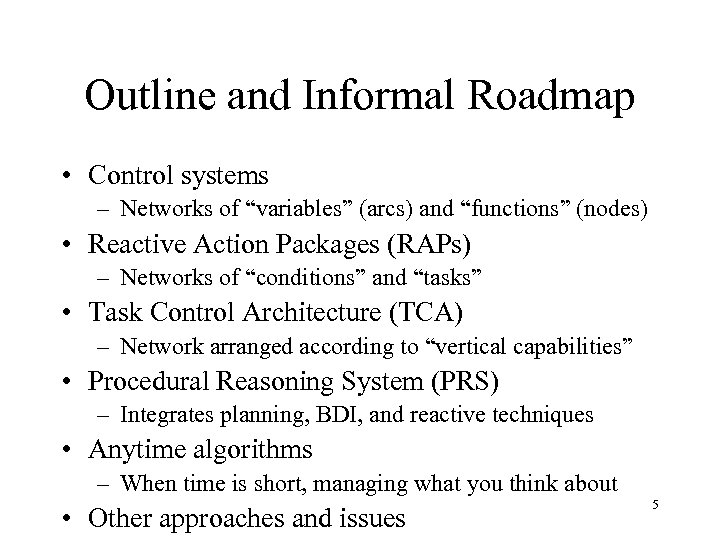 Outline and Informal Roadmap • Control systems – Networks of “variables” (arcs) and “functions” (nodes) • Reactive Action Packages (RAPs) – Networks of “conditions” and “tasks” • Task Control Architecture (TCA) – Network arranged according to “vertical capabilities” • Procedural Reasoning System (PRS) – Integrates planning, BDI, and reactive techniques • Anytime algorithms – When time is short, managing what you think about • Other approaches and issues 5
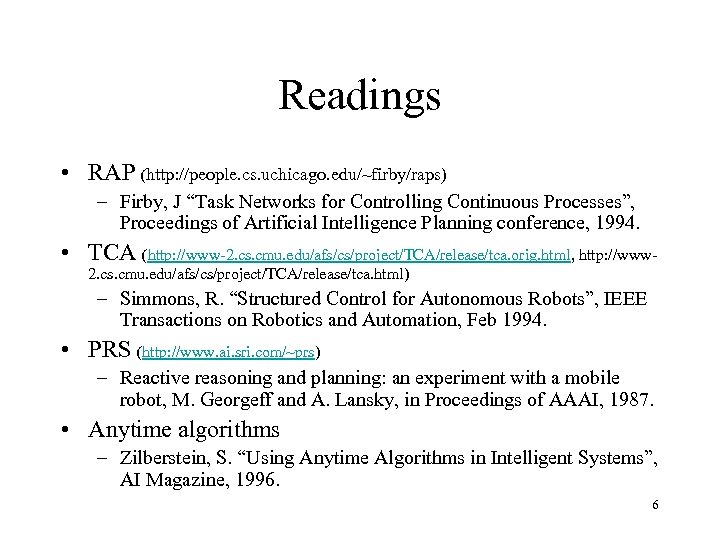 Readings • RAP (http: //people. cs. uchicago. edu/~firby/raps) – Firby, J “Task Networks for Controlling Continuous Processes”, Proceedings of Artificial Intelligence Planning conference, 1994. • TCA (http: //www-2. cs. cmu. edu/afs/cs/project/TCA/release/tca. orig. html, http: //www 2. cs. cmu. edu/afs/cs/project/TCA/release/tca. html) – Simmons, R. “Structured Control for Autonomous Robots”, IEEE Transactions on Robotics and Automation, Feb 1994. • PRS (http: //www. ai. sri. com/~prs) – Reactive reasoning and planning: an experiment with a mobile robot, M. Georgeff and A. Lansky, in Proceedings of AAAI, 1987. • Anytime algorithms – Zilberstein, S. “Using Anytime Algorithms in Intelligent Systems”, AI Magazine, 1996. 6
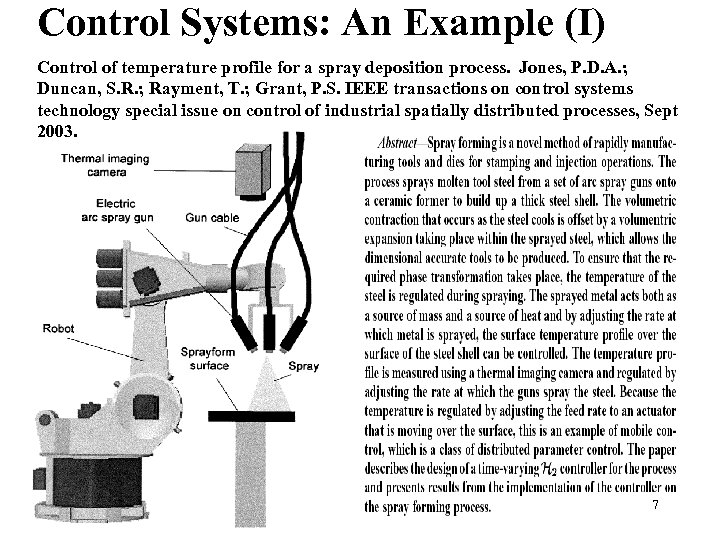 Control Systems: An Example (I) Control of temperature profile for a spray deposition process. Jones, P. D. A. ; Duncan, S. R. ; Rayment, T. ; Grant, P. S. IEEE transactions on control systems technology special issue on control of industrial spatially distributed processes, Sept 2003. 7
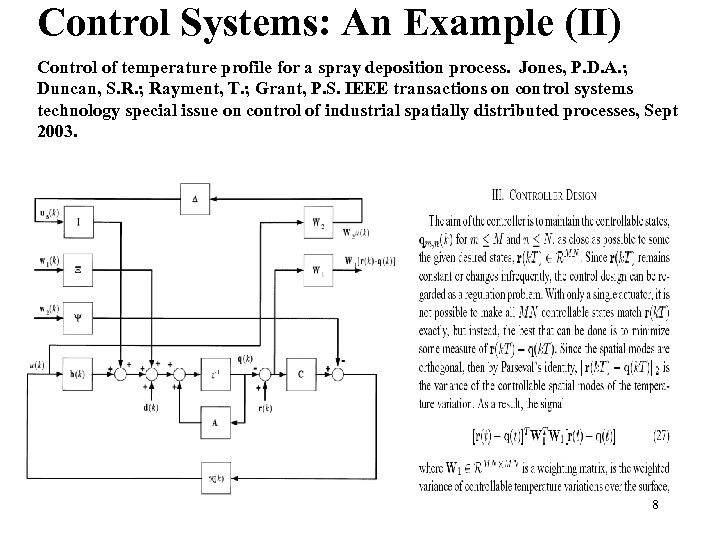 Control Systems: An Example (II) Control of temperature profile for a spray deposition process. Jones, P. D. A. ; Duncan, S. R. ; Rayment, T. ; Grant, P. S. IEEE transactions on control systems technology special issue on control of industrial spatially distributed processes, Sept 2003. 8
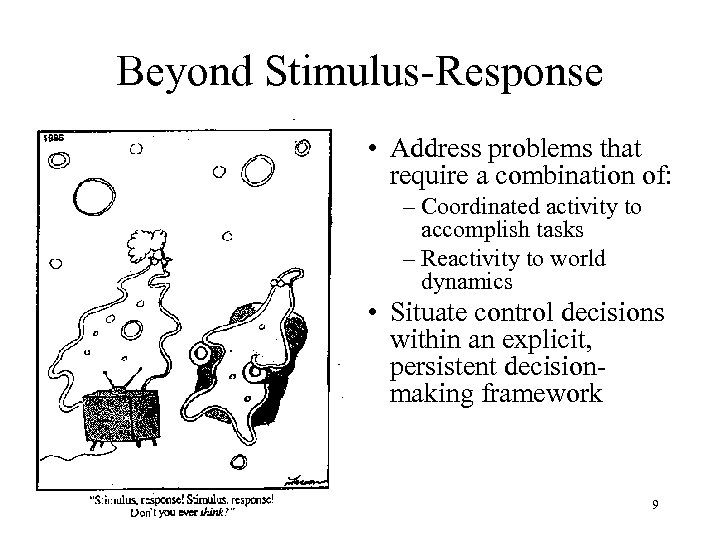 Beyond Stimulus-Response • Address problems that require a combination of: – Coordinated activity to accomplish tasks – Reactivity to world dynamics • Situate control decisions within an explicit, persistent decisionmaking framework 9
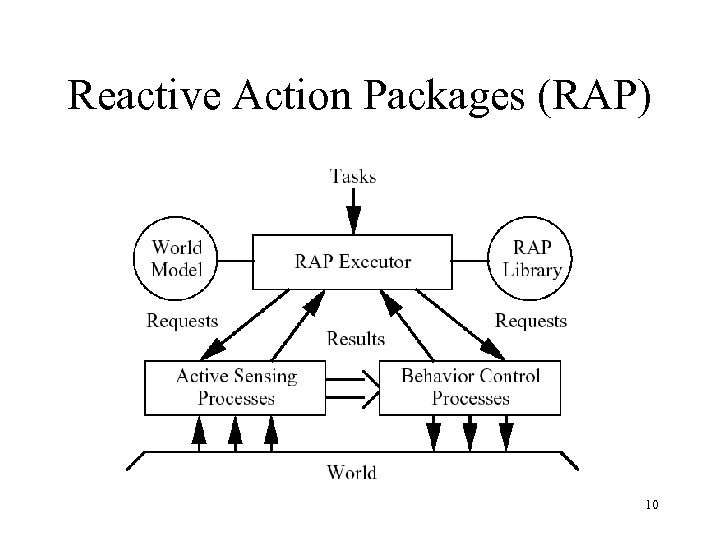 Reactive Action Packages (RAP) 10
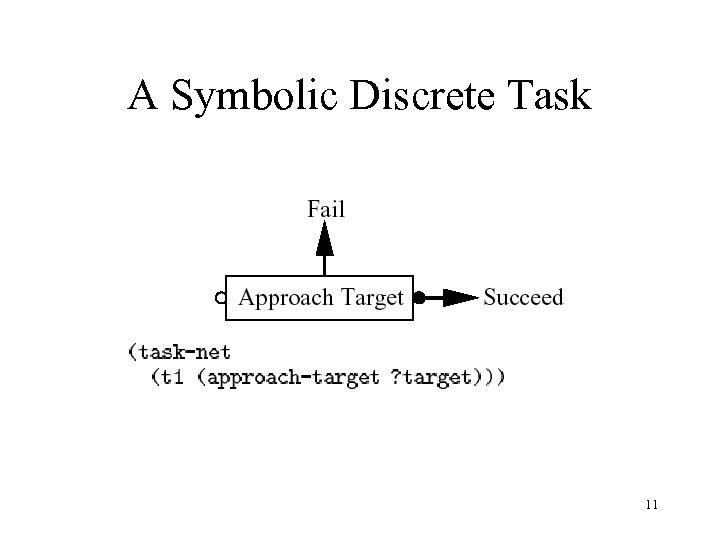 A Symbolic Discrete Task 11
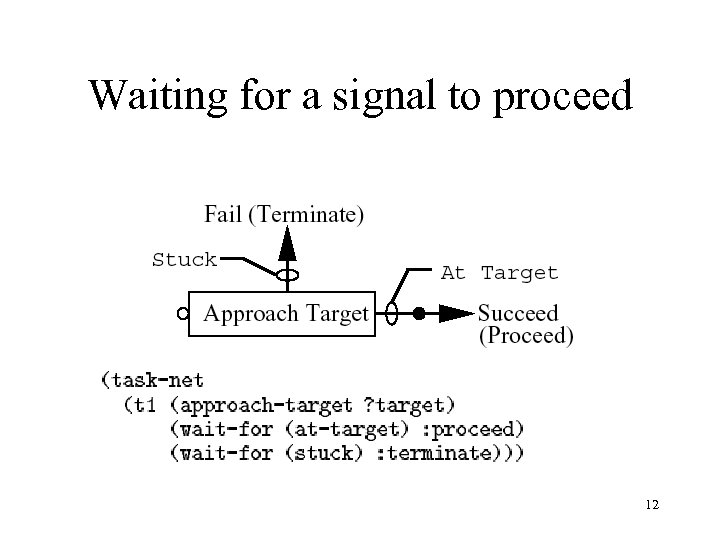 Waiting for a signal to proceed 12
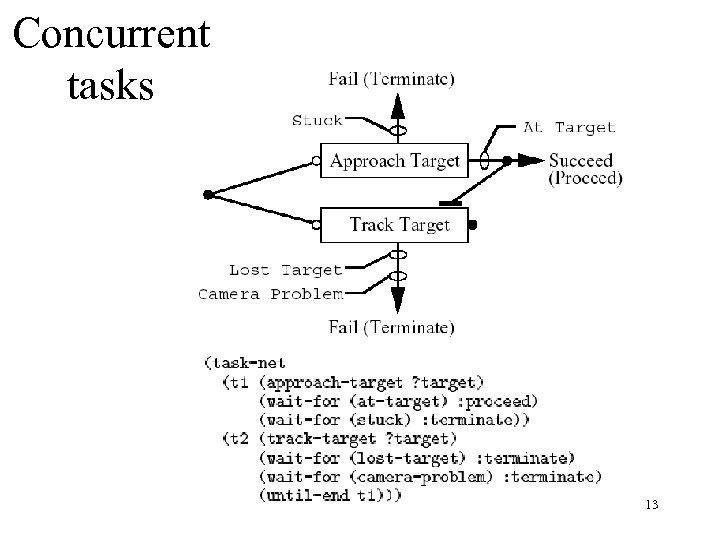 Concurrent tasks 13
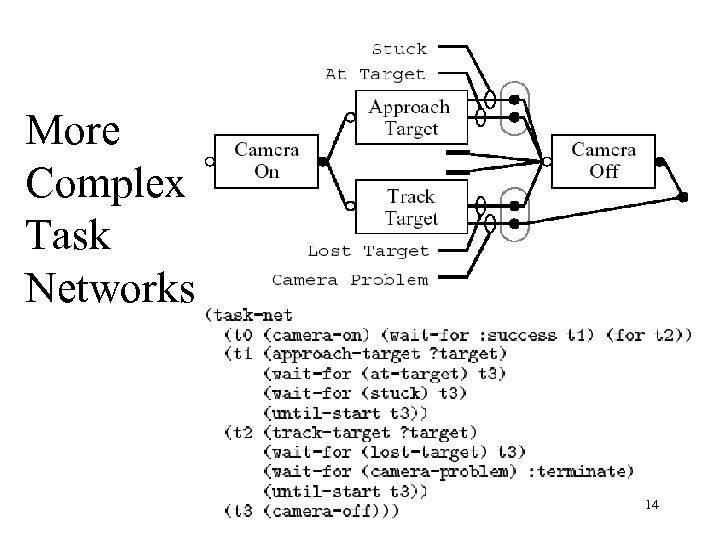 More Complex Task Networks 14
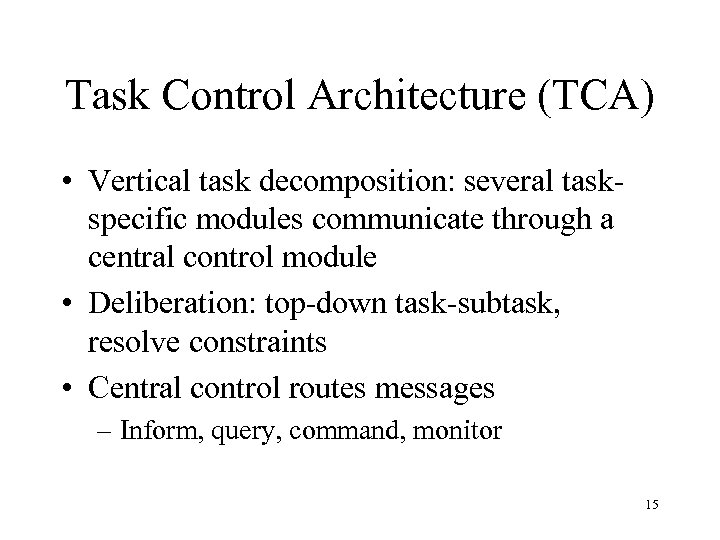 Task Control Architecture (TCA) • Vertical task decomposition: several taskspecific modules communicate through a central control module • Deliberation: top-down task-subtask, resolve constraints • Central control routes messages – Inform, query, command, monitor 15
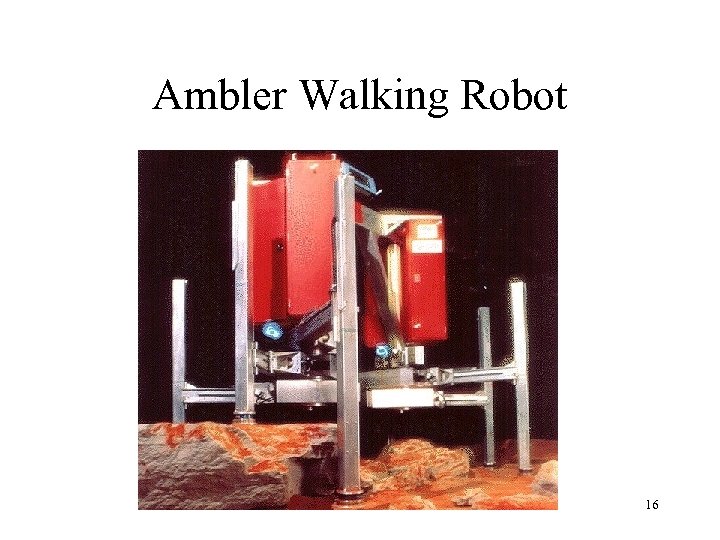 Ambler Walking Robot 16
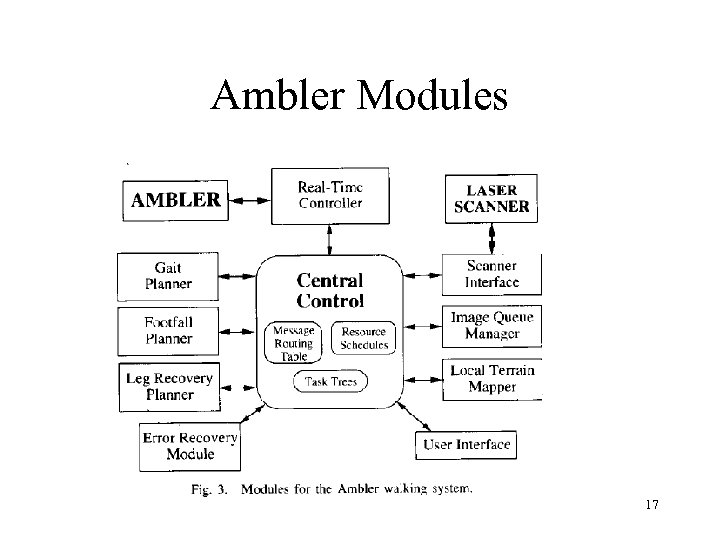 Ambler Modules 17
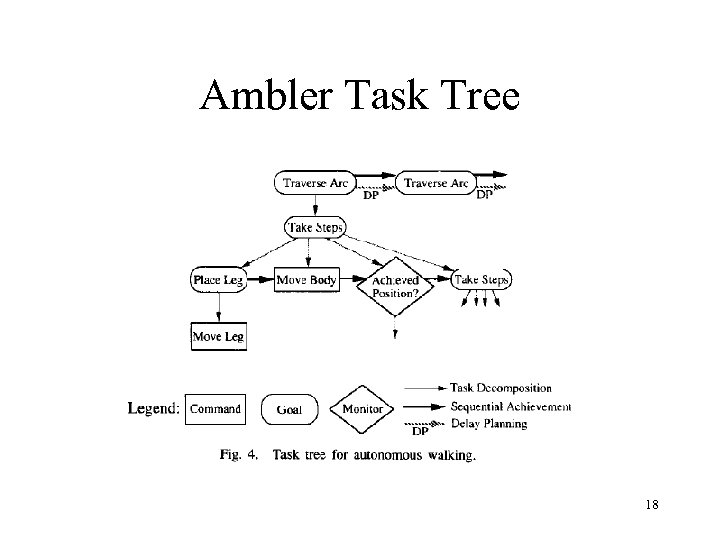 Ambler Task Tree 18
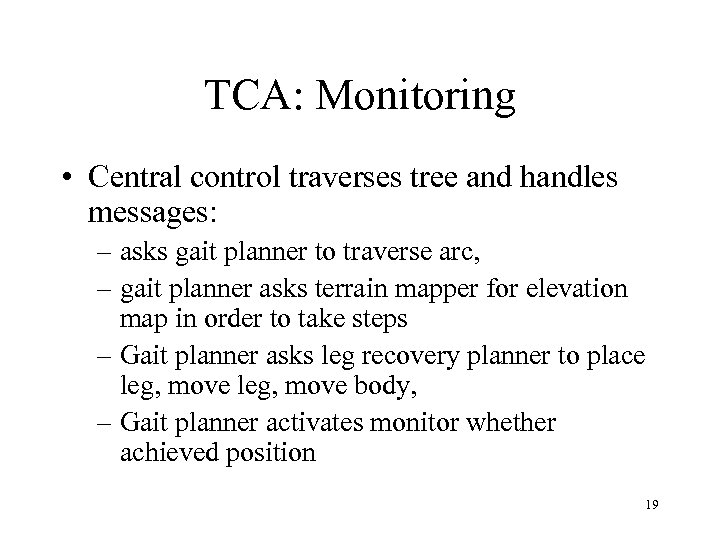 TCA: Monitoring • Central control traverses tree and handles messages: – asks gait planner to traverse arc, – gait planner asks terrain mapper for elevation map in order to take steps – Gait planner asks leg recovery planner to place leg, move body, – Gait planner activates monitor whether achieved position 19
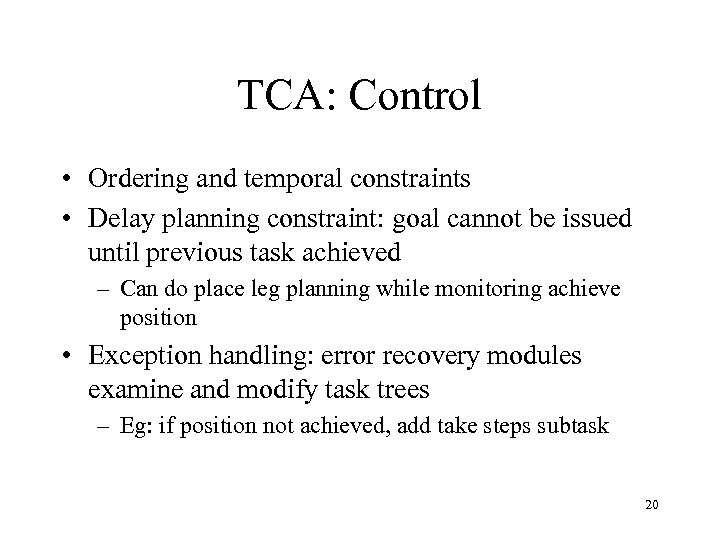 TCA: Control • Ordering and temporal constraints • Delay planning constraint: goal cannot be issued until previous task achieved – Can do place leg planning while monitoring achieve position • Exception handling: error recovery modules examine and modify task trees – Eg: if position not achieved, add take steps subtask 20
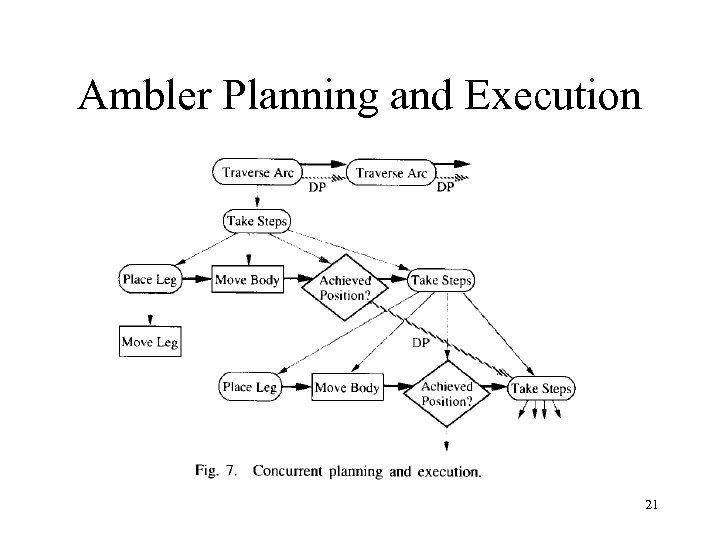 Ambler Planning and Execution 21
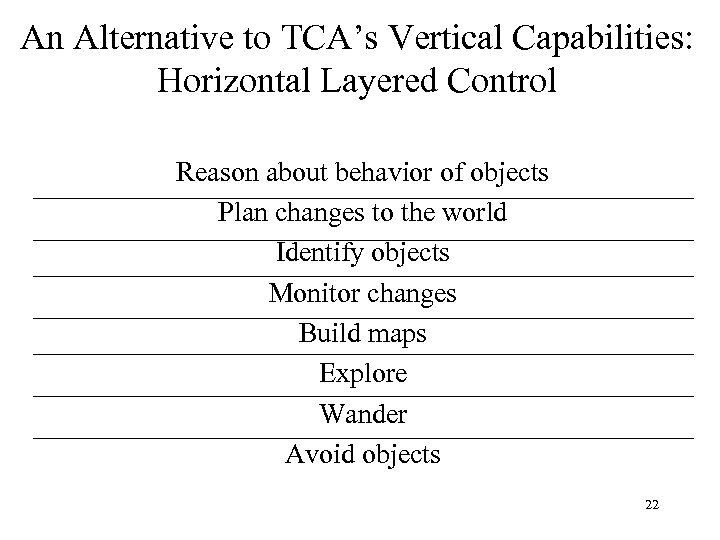 An Alternative to TCA’s Vertical Capabilities: Horizontal Layered Control Reason about behavior of objects Plan changes to the world Identify objects Monitor changes Build maps Explore Wander Avoid objects 22
 Procedural Reasoning System (PRS) • Framework for symbolic reactive control systems in dynamic environments – Eg Mobile robot control – Eg diagnosis of the Space Shuttle’s Reaction Controls System 23
 PRS: Main Features • Pre-compiled procedural knowledge • BDI (Belief, Desires, Intentions) foundation • Combines deliberative and reactive features – Plan selection, formation, execution, sensing • • • Plans dynamically and incrementally Integrates goal-directed and event-driven behavior Can interrupt plan execution Meta-level reasoning Multi-agent planning 24
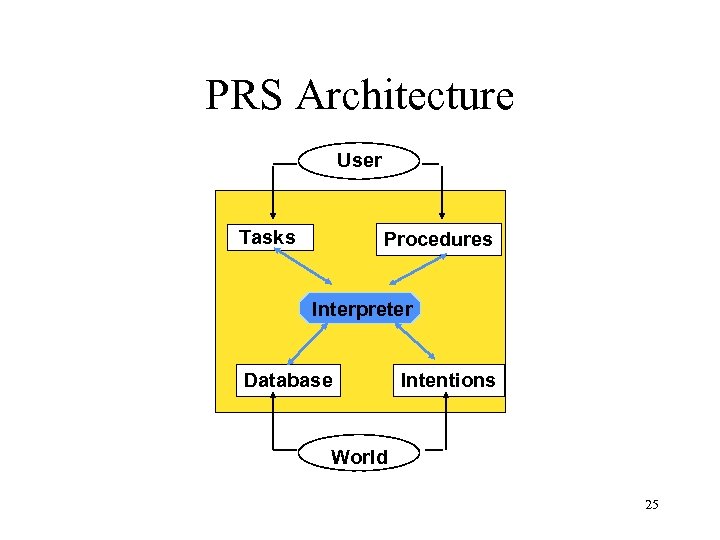 PRS Architecture User Tasks Procedures Interpreter Database Intentions World 25
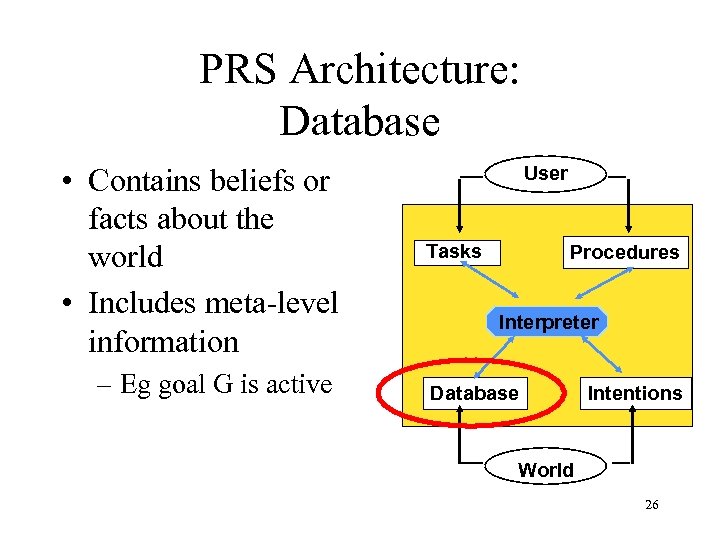 PRS Architecture: Database • Contains beliefs or facts about the world • Includes meta-level information – Eg goal G is active User Tasks Procedures Interpreter Database Intentions World 26
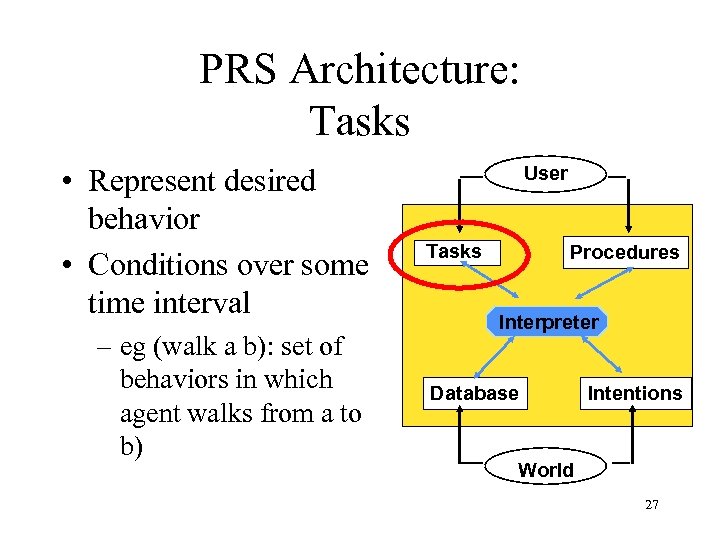 PRS Architecture: Tasks • Represent desired behavior • Conditions over some time interval – eg (walk a b): set of behaviors in which agent walks from a to b) User Tasks Procedures Interpreter Database Intentions World 27
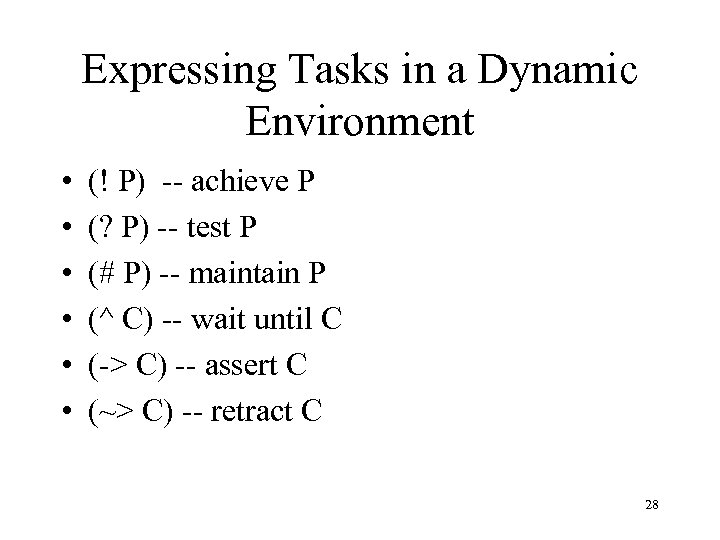 Expressing Tasks in a Dynamic Environment • • • (! P) -- achieve P (? P) -- test P (# P) -- maintain P (^ C) -- wait until C (-> C) -- assert C (~> C) -- retract C 28
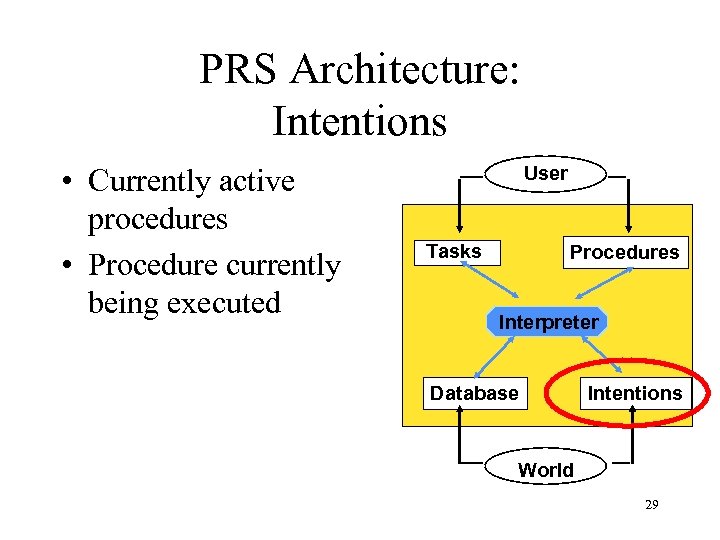 PRS Architecture: Intentions • Currently active procedures • Procedure currently being executed User Tasks Procedures Interpreter Database Intentions World 29
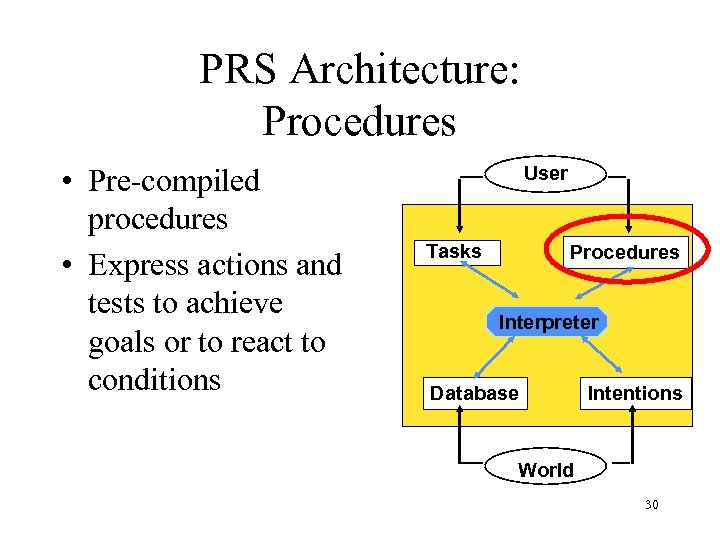 PRS Architecture: Procedures • Pre-compiled procedures • Express actions and tests to achieve goals or to react to conditions User Tasks Procedures Interpreter Database Intentions World 30
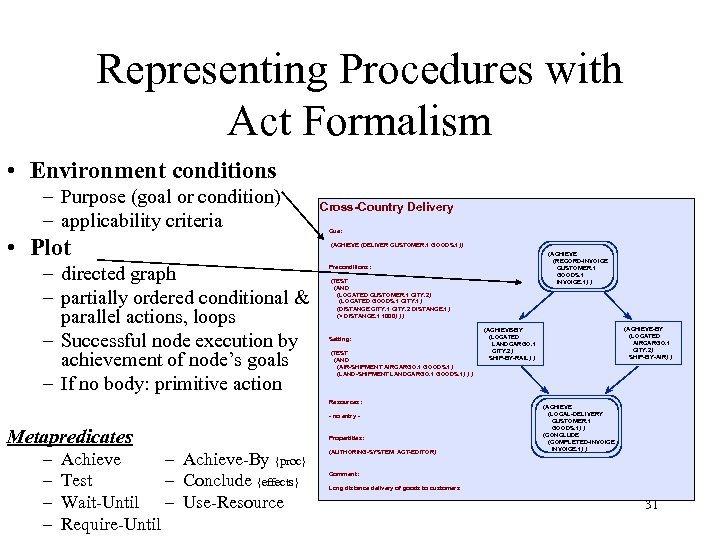 Representing Procedures with Act Formalism • Environment conditions – Purpose (goal or condition) – applicability criteria • Plot – directed graph – partially ordered conditional & parallel actions, loops – Successful node execution by achievement of node’s goals – If no body: primitive action Cross-Country Delivery Cue: (ACHIEVE (DELIVER CUSTOMER. 1 GOODS. 1)) (TEST (AND (LOCATED CUSTOMER. 1 CITY. 2) (LOCATED GOODS. 1 CITY. 1) (DISTANCE CITY. 1 CITY. 2 DISTANCE. 1) (> DISTANCE. 1 1000) ) ) Setting: (TEST (AND (AIR-SHIPMENT AIRCARGO. 1 GOODS. 1) (LAND-SHIPMENT LANDCARGO. 1 GOODS. 1) ) ) Resources: - no entry - Metapredicates – – Achieve-By {proc} Test – Conclude {effects} Wait-Until – Use-Resource Require-Until (ACHIEVE (RECORD-INVOICE CUSTOMER. 1 GOODS. 1 INVOICE. 1) ) Preconditions: Propertities: (AUTHORING-SYSTEM ACT-EDITOR) (ACHIEVE-BY (LOCATED AIRCARGO. 1 CITY. 2) SHIP-BY-AIR) ) (ACHIEVE-BY (LOCATED LANDCARGO. 1 CITY. 2) SHIP-BY-RAIL) ) (ACHIEVE (LOCAL-DELIVERY CUSTOMER. 1 GOODS. 1) ) (CONCLUDE (COMPLETED-INVOICE. 1) ) Comment: Long distance delivery of goods to customers 31
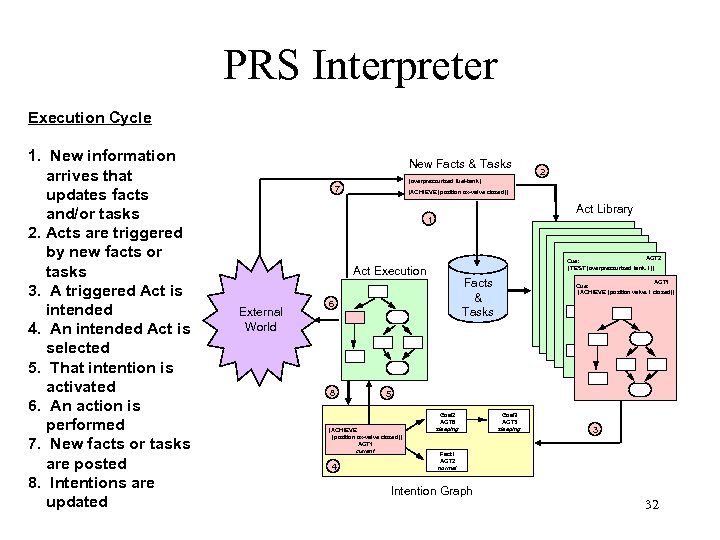 PRS Interpreter Execution Cycle 1. New information arrives that updates facts and/or tasks 2. Acts are triggered by new facts or tasks 3. A triggered Act is intended 4. An intended Act is selected 5. That intention is activated 6. An action is performed 7. New facts or tasks are posted 8. Intentions are updated New Facts & Tasks 7 (ACHIEVE (position ox-valve closed)) Act Library 1 ACT 2 Cue: (TEST (overpressurized tank. 1)) Act Execution External World Facts & Tasks 6 8 ACT 1 Cue: (ACHIEVE (position valve. 1 closed)) 5 (ACHIEVE (position ox-valve closed)) ACT 1 current 4 2 (overpressurized fuel-tank) Goal 2 ACT 8 sleeping Goal 3 ACT 3 sleeping 3 Fact 1 ACT 2 normal Intention Graph 32
 Meta-Reasoning • Can include meta-level procedures – eg: choose among multiple applicable procedures – eg: evaluate how much more reasoning can be done within time constraints – eg: how to achieve a conjunction or disjunction of goals 33
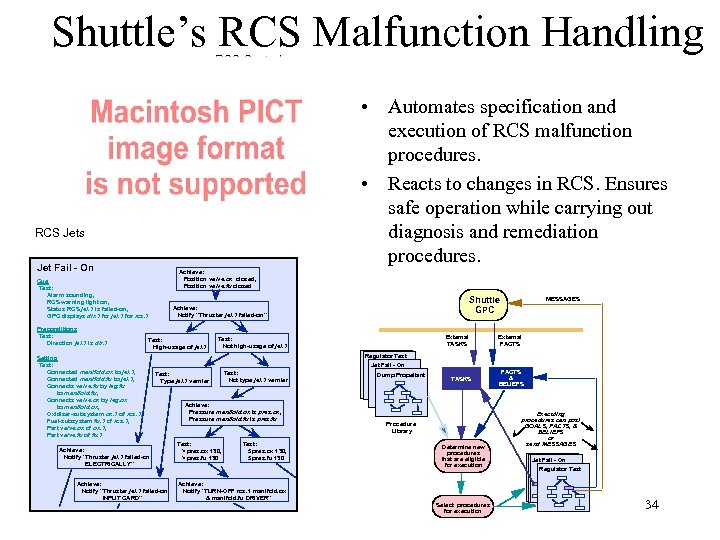 Shuttle’s RCS Malfunction Handling RCS Controls • Automates specification and execution of RCS malfunction procedures. • Reacts to changes in RCS. Ensures safe operation while carrying out diagnosis and remediation procedures. RCS Jets Jet Fail - On Achieve: Position valve. ox closed, Position valve. fu closed Cue Test: Alarm sounding, RCS warning light on, Status RCS jet. 1 is failed-on, GPC displays dir. 1 for jet. 1 for rcs. 1 Preconditions Test: Direction jet. 1 is dir. 1 Test: High-usage of jet. 1 Setting Test: Connected manifold. ox to jet. 1, Connected manifold. fu to jet. 1, Connects valve. fu by leg. fu to manifold. fu, Connects valve. ox by leg. ox to manifold. ox, Oxidizer-subsystem ox. 1 of rcs. 1, Fuel-subsystem fu. 1 of rcs. 1, Part valve. ox of ox. 1, Part valve. fu of fu. 1 Shuttle GPC Achieve: Notify "Thruster jet. 1 failed-on" External TASKS Test: Not high-usage of jet. 1 MESSAGES External FACTS Regulator Test Jet Fail - On Test: Type jet. 1 vernier Achieve: Notify "Thruster jet. 1 failed-on ELECTRICALLY" Achieve: Notify "Thruster jet. 1 failed-on INPUT CARD" Test: Not type jet. 1 vernier Achieve: Pressure manifold. ox is pres. ox, Pressure manifold. fu is pres. fu Test: > pres. ox 130, > pres. fu 130 Test: ≤ pres. ox 130, ≤ pres. fu 130 Dump Propellant TASKS Procedure Library Determine new procedures that are eligible for execution Achieve: Notify "TURN-OFF rcs. 1 manifold. ox & manifold. fu DRIVER" Select procedures for execution FACTS & BELIEFS Executing procedures can post GOALS, FACTS, & BELIEFS or send MESSAGES Jet Fail - On Regulator Test 34
 Multiple Tasks, Multiple Agenst • Multithreaded operation: multiple tasks being performed, runtime stacks where tasks are executed, suspended, and resumed • Supports distributed planning: several PRS agents run asynchronously and communicate through message passing 35
 Anytime Algorithms • Time to deliberate about events varies • Algorithms to compute the best answers they can in the time available • Anytime algorithms – Can be suspended and resumed with little overhead – Can be terminated at any time and return some answer – The answers returned improve with time 36
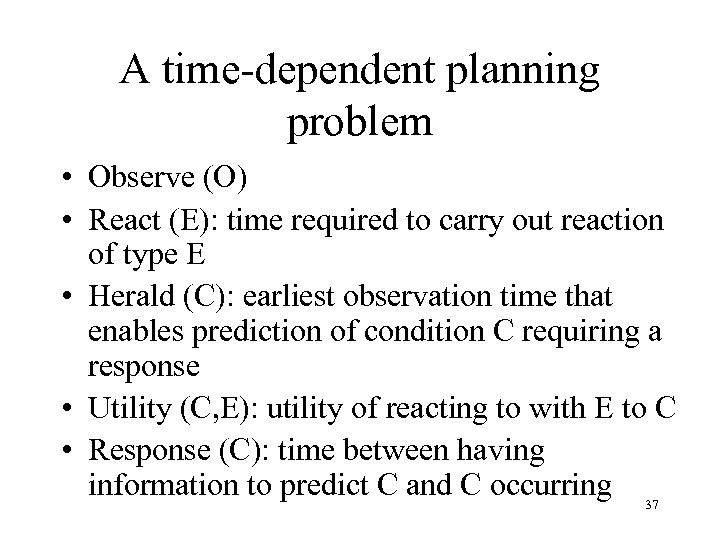 A time-dependent planning problem • Observe (O) • React (E): time required to carry out reaction of type E • Herald (C): earliest observation time that enables prediction of condition C requiring a response • Utility (C, E): utility of reacting to with E to C • Response (C): time between having information to predict C and C occurring 37
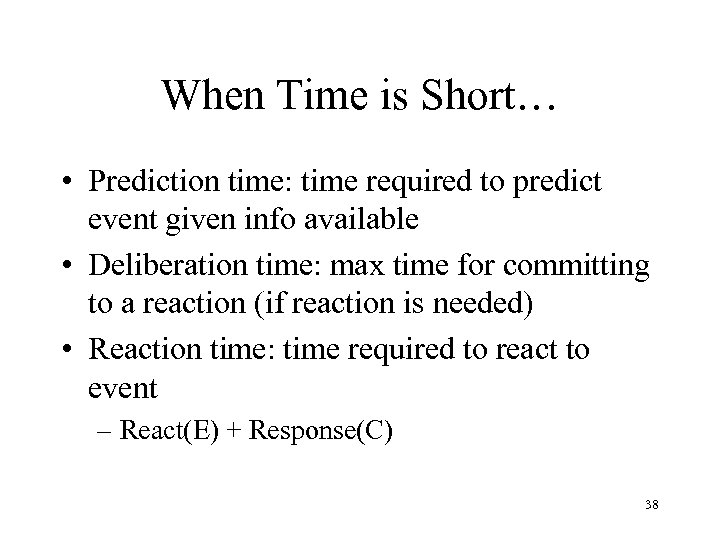 When Time is Short… • Prediction time: time required to predict event given info available • Deliberation time: max time for committing to a reaction (if reaction is needed) • Reaction time: time required to react to event – React(E) + Response(C) 38
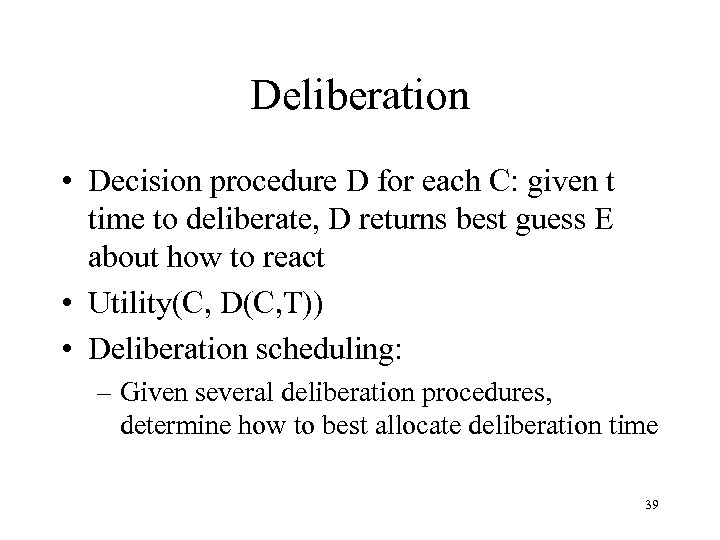 Deliberation • Decision procedure D for each C: given t time to deliberate, D returns best guess E about how to react • Utility(C, D(C, T)) • Deliberation scheduling: – Given several deliberation procedures, determine how to best allocate deliberation time 39
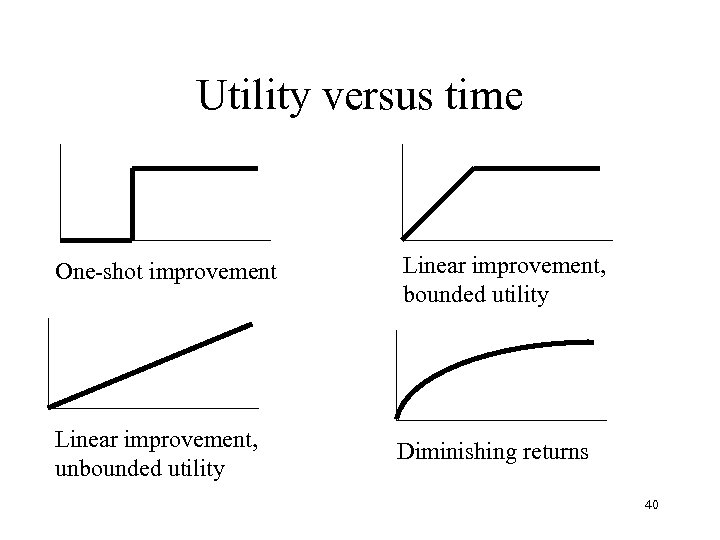 Utility versus time One-shot improvement Linear improvement, bounded utility Linear improvement, unbounded utility Diminishing returns 40
 Other Approaches and Issues • Blackboard architectures (Guardian) • Universal plans • Related issues covered in the course: – Reasoning about uncertainty – Learning • from the environment • Becoming increasingly reactive 41
 Summary • Control systems – Networks of “variables” (arcs) and “functions” (nodes) • Reactive Action Packages (RAPs) – Networks of “conditions” and “tasks” • Task Control Architecture (TCA) – Network arranged according to “vertical capabilities” • Procedural Reasoning System (PRS) – Integrates planning, BDI, and reactive techniques • Anytime algorithms – When time is short, managing what you think about • Learning and uncertainty reasoning 42