


 Скачать презентацию Reaction Types Nuclear Protons Neutrons change Chemical
6121473c1aabc572f46bd8063470e521.ppt
- Количество слайдов: 120
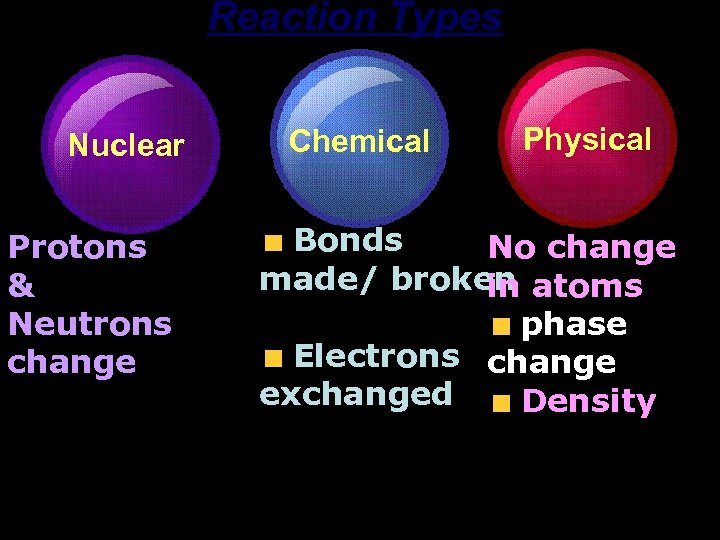 Reaction Types Nuclear Protons & Neutrons change Chemical Physical Bonds No change made/ broken atoms in phase Electrons change exchanged Density Substances can be identified by their properties.
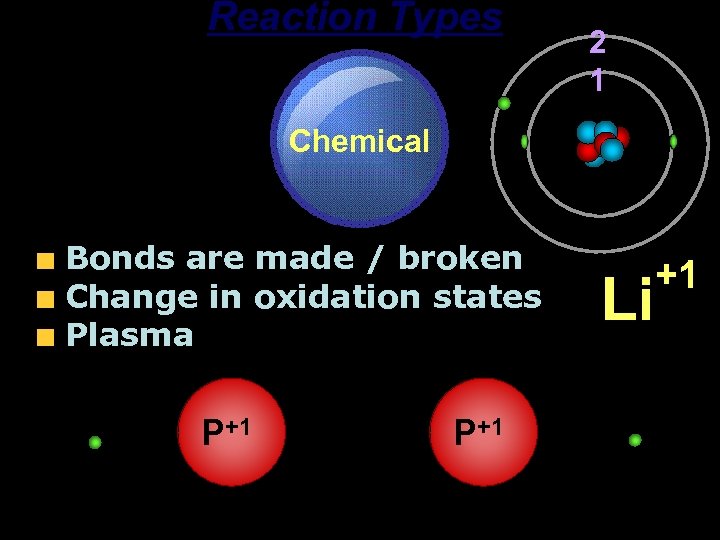
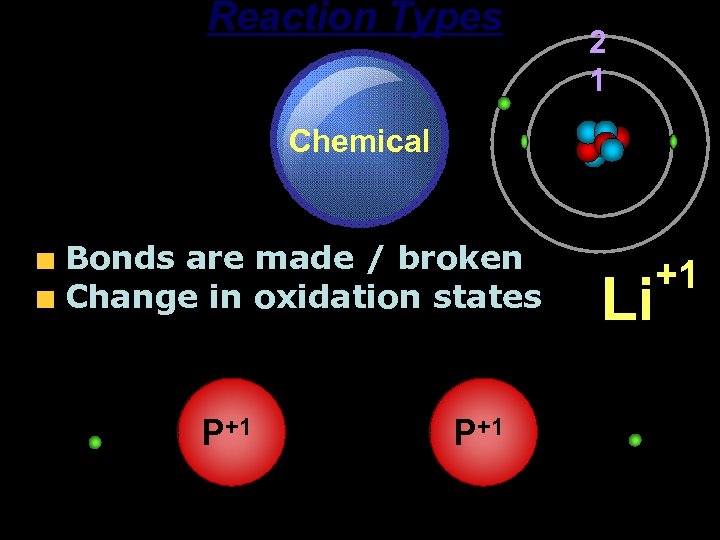 Reaction Types Chemical Bonds are made / broken Change in oxidation states P+1 2 1 P+1 Li +1
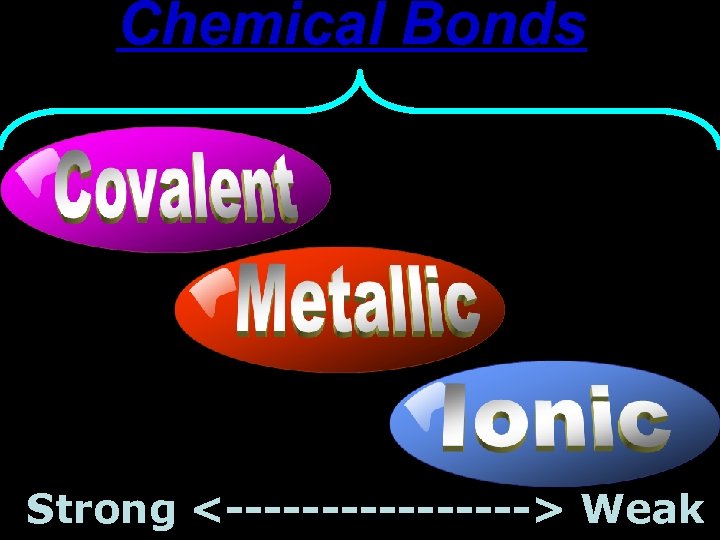 Chemical Bonds Strong <--------> Weak
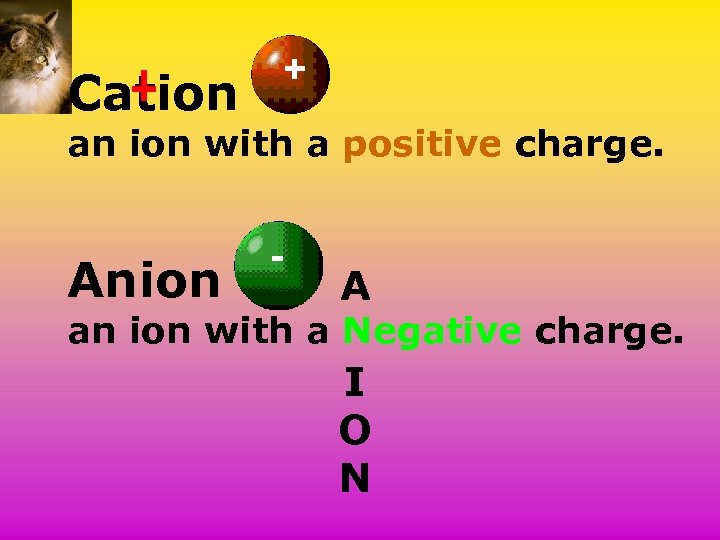 Cation + an ion with a positive charge. Anion - A an ion with a Negative charge. I O N
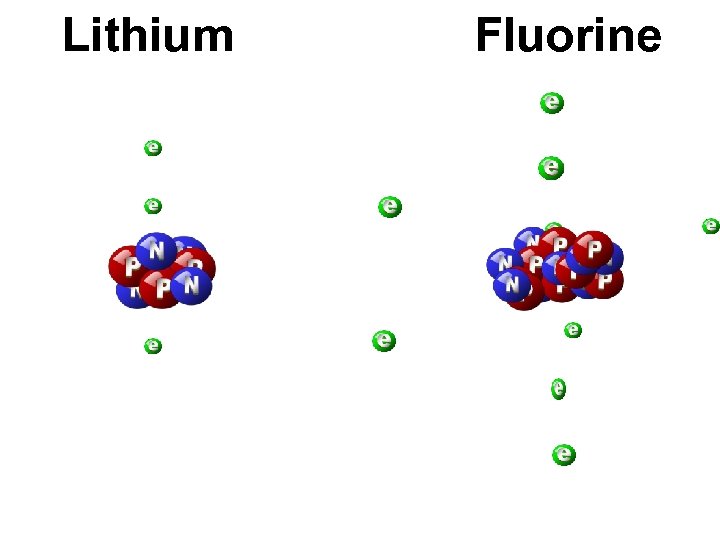
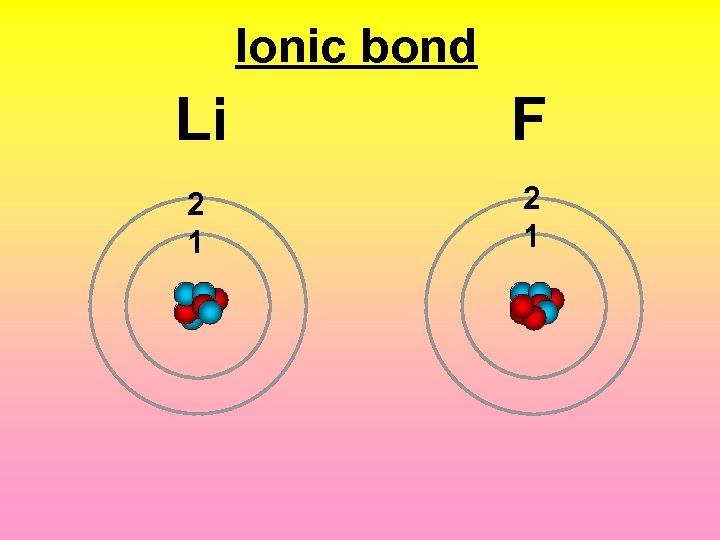 Ionic bond 2 1 F Li
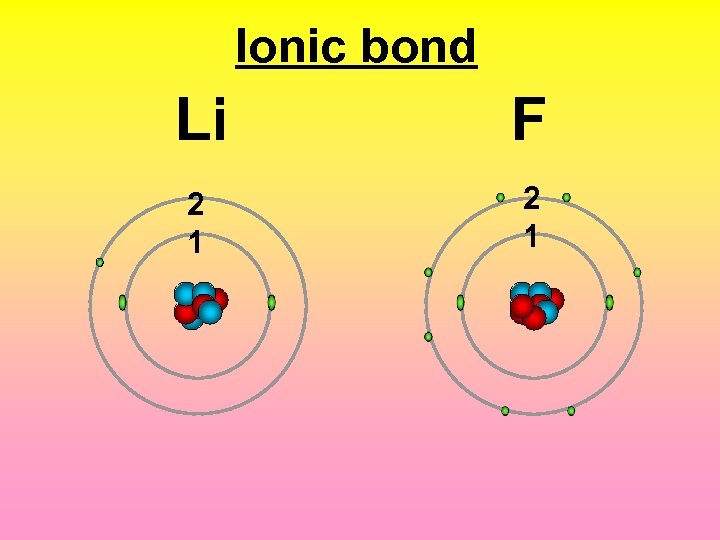 Ionic bond 2 1 F Li
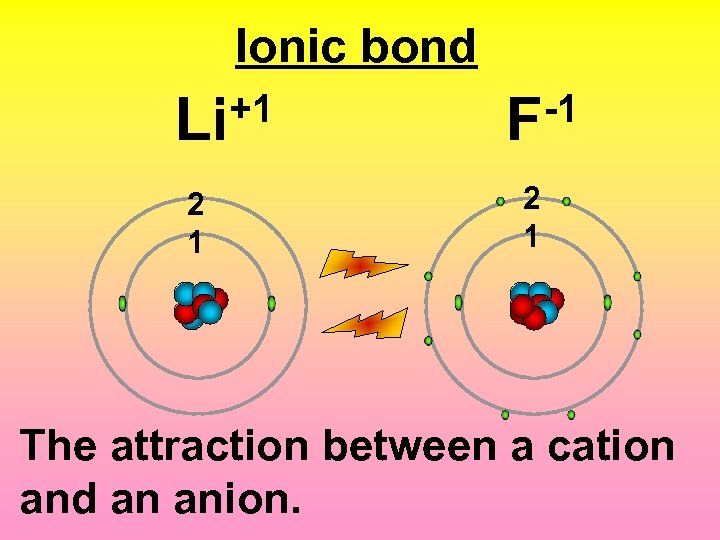 Ionic bond +1 Li -1 F 2 1 The attraction between a cation and an anion.
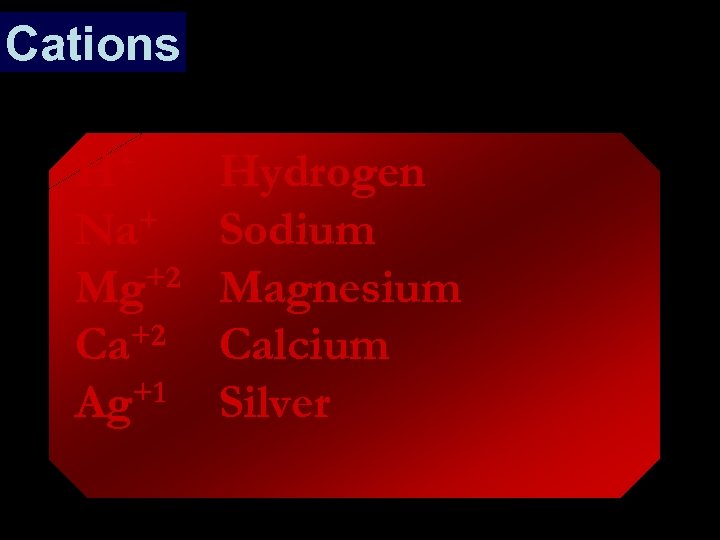 Cations + H Na+ +2 Mg Ca+2 +1 Ag Hydrogen Sodium Magnesium Calcium Silver
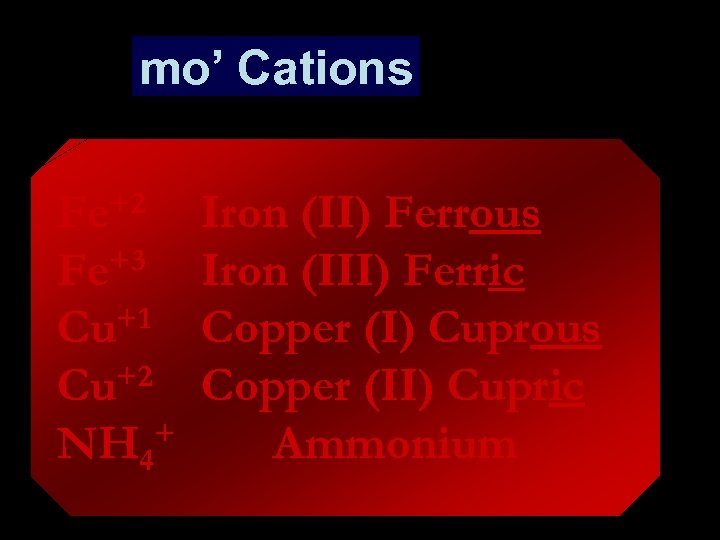 mo’ Cations Fe+2 +3 Fe +1 Cu Cu+2 + NH 4 Iron (II) Ferrous Iron (III) Ferric Copper (I) Cuprous Copper (II) Cupric Ammonium
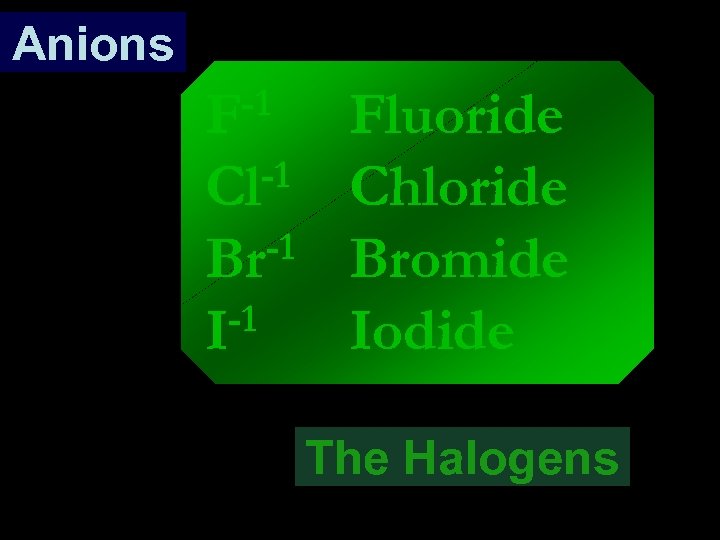 Anions -1 F -1 Cl -1 Br -1 I Fluoride Chloride Bromide Iodide The Halogens
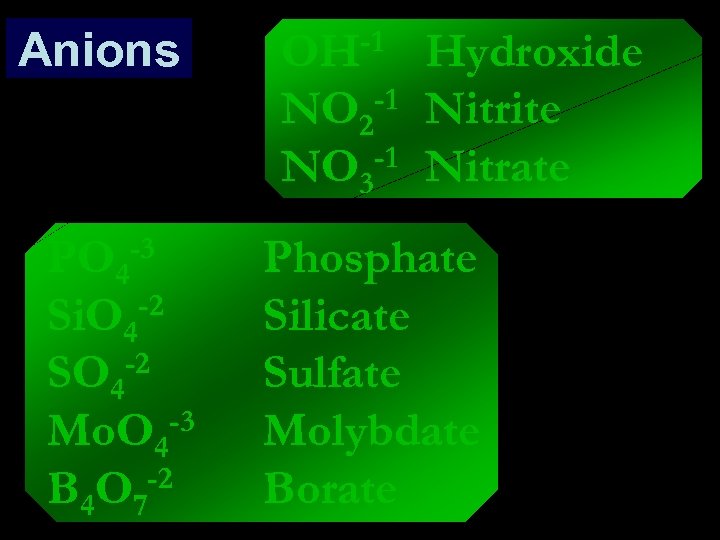 Anions -1 OH NO 2 -1 -1 NO 3 -3 PO 4 -2 Si. O 4 SO 4 -2 -3 Mo. O 4 B 4 O 7 -2 Hydroxide Nitrite Nitrate Phosphate Silicate Sulfate Molybdate Borate
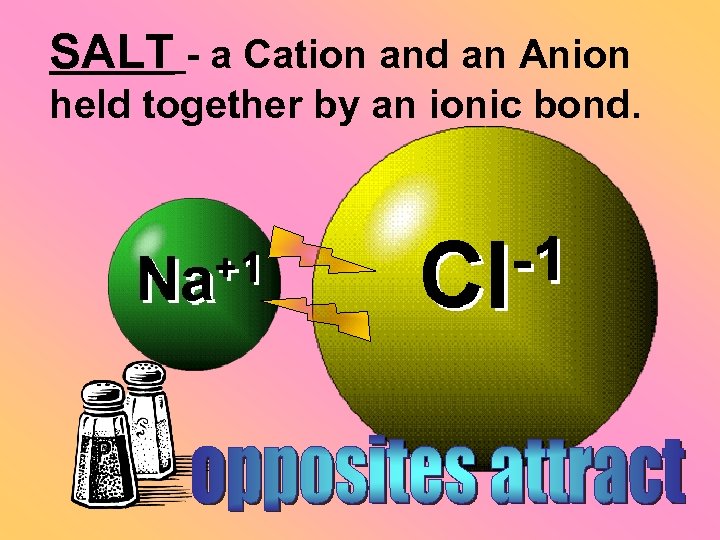 SALT - a Cation and an Anion held together by an ionic bond.
 An engineer searching for a material to develop a new kind of “indestructible” eyeglass frame would desire what characteristics? § High hardness, high elasticity, high brittleness. § Low brittleness, high hardness, high elasticity. § High brittleness, low hardness, low elasticity. § None of the above
 Ice cubes float in a glass of water because: a. the ice is losing mass through the melting process. b. the colder ice is more dense. c. liquid water is less dense than ice cubes. d. the molecules of ice arranged in an orderly way so that there is an unusually large amount of empty space in the ice cubes. e. None of the above
 A hot air balloon rises because molecules become lighter when heated. molecules move faster and farther apart when heated. molecules are less attracted by gravity when heated. molecules become charged and repel each other when heated.
 The solid, liquid, and gaseous states of water differ from each other in the mass of the individual atoms. the size of the individual atoms. the net electrical charge of the individual molecules. the average speed of movement of the individual molecules.
 The molecules in a test tube filled with cold water move more slowly than the molecules in a large tank of warm water. What is responsible for this difference in molecule speed? pressure volume weight heat
 Heat can cause ice to change to liquid water by filling the spaces between molecules. causing molecules to move faster and farther apart. increasing the distance between electrons within molecules. increasing the attraction between molecules
 If you saw an ice cube sink after it was placed in what you thought was a glass of water, which question should you probably ask? What kind of liquid is in the glass? Will the ice melt slower or quicker? How fast did the ice cube sink? How soon would the ice cube start to float?
 What will happen if you mix vinegar and baking soda? It will explode. Nothing will happen. It will bubble up rapidly. It will turn bright red.
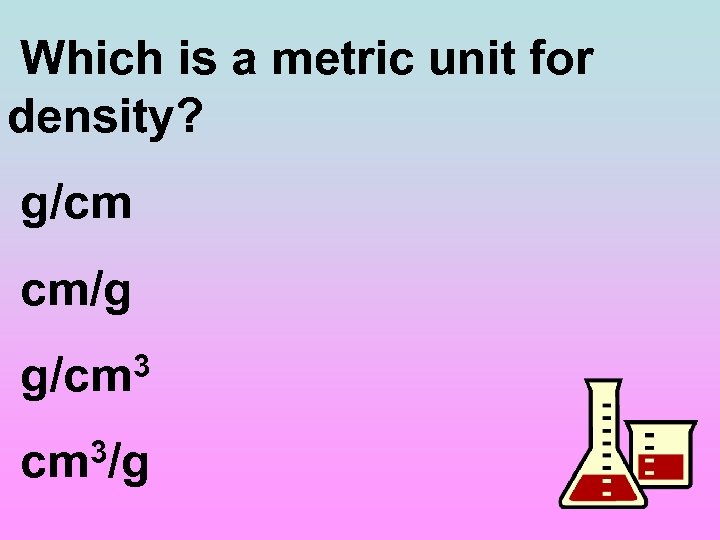 Which is a metric unit for density? g/cm cm/g g/cm 3 3/g cm
 When a gas forms a liquid, which process is taking place? freezing condensation boiling evaporation
 Which unit correctly describes density? pounds/square inch kilograms/square meter milligrams/square centimeter grams/milliliter
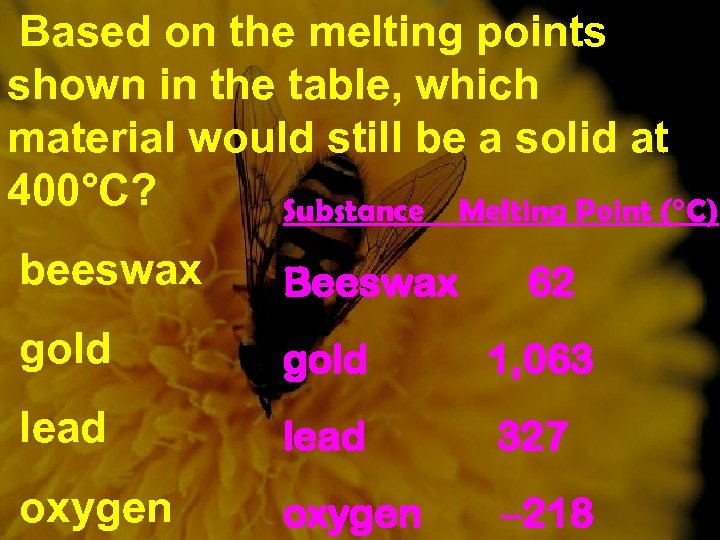 Based on the melting points shown in the table, which material would still be a solid at 400°C? Substance Melting Point (°C) beeswax Beeswax gold 1, 063 lead 327 oxygen – 218 62
 A chemical change for a piece of metal would be being bent in half. getting cut into two pieces. being painted. getting rusty.
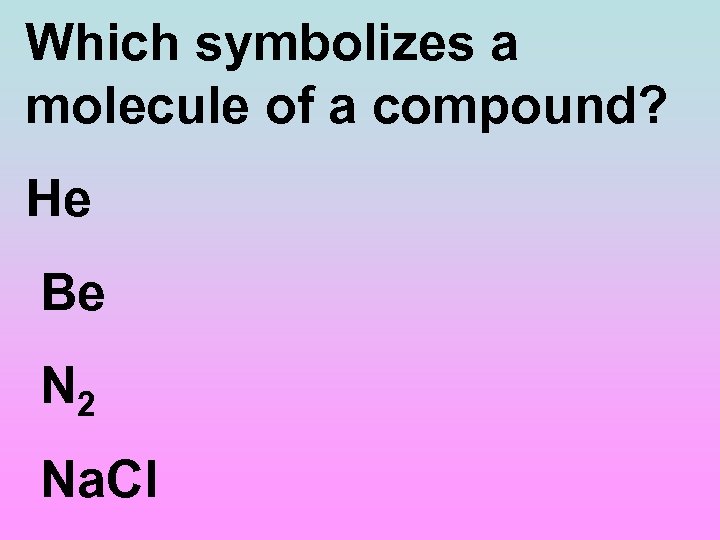 Which symbolizes a molecule of a compound? He Be N 2 Na. Cl
 Putting sand salt together makes a compound. an element. a mixture. a solution.
 Plastic, wood, and iron are all made up of cells. atoms. carbon. plants.
 Water is a compound. an element. a solution. a mixture.
 An atom is to an element, as a molecule is to a metal. nonmetalloid. compound.
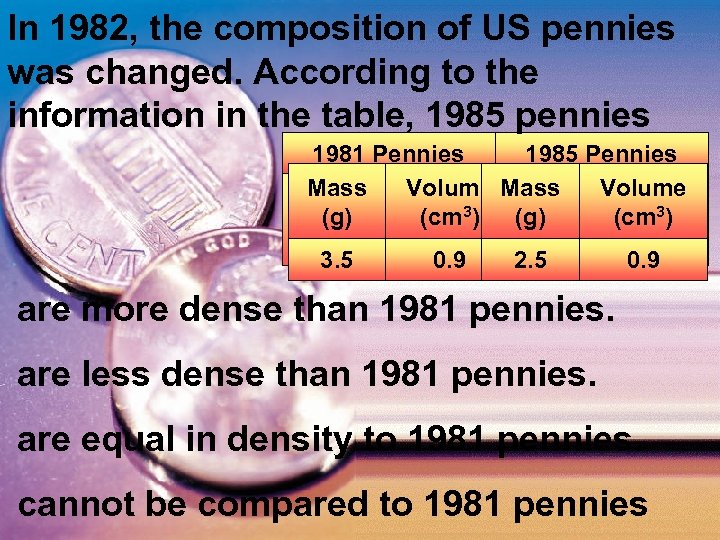 In 1982, the composition of US pennies was changed. According to the information in the table, 1985 pennies 1981 Pennies 1985 Pennies Mass Volume (g) (cm 3) 3. 5 0. 9 2. 5 0. 9 are more dense than 1981 pennies. are less dense than 1981 pennies. are equal in density to 1981 pennies. cannot be compared to 1981 pennies
 All of the substances on the periodic table are classified as elements because they are pure substances. are composed of atoms. cannot be broken down into other substances. cannot be dissolved in water or other liquids.
 Salt (Na. Cl) is a common substance. Salt is which of these? atom element compound mixture
 Each element is assigned an atomic number, which is the same as the number of electrons in the atom's nucleus. the number of protons in the atom's nucleus. the number of neutrons in the atom's nucleus. the number of protons and neutrons in the atom's nucleus
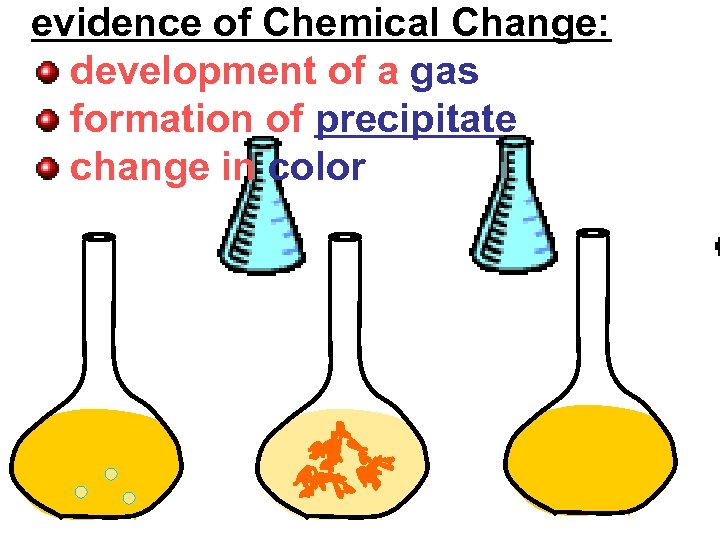
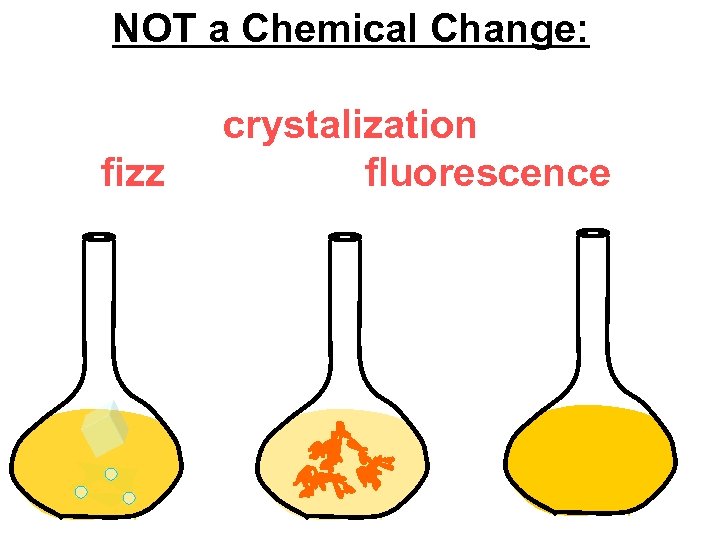
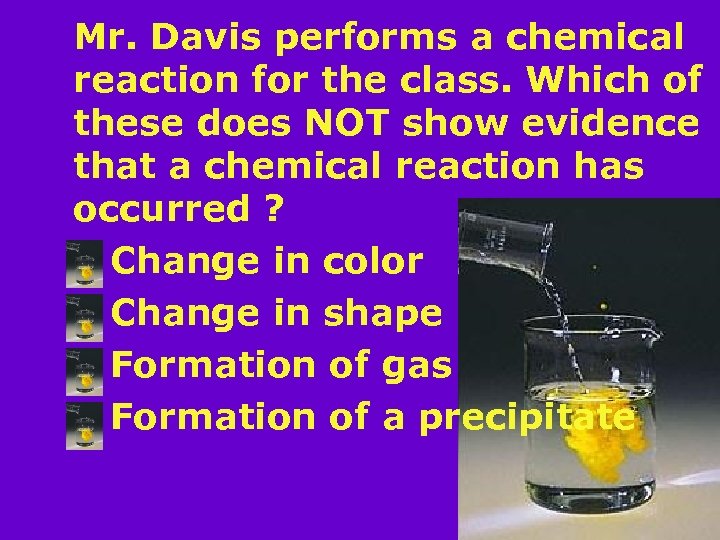 Mr. Davis performs a chemical reaction for the class. Which of these does NOT show evidence that a chemical reaction has occurred ? Change in color Change in shape Formation of gas Formation of a precipitate
 Which is the correct symbol for the element sodium? S Se Cl Na
 Which statement is usually true about the electrical properties of metals? Metals have high electrical resistance. Lightweight metals are the best conductors. Metals and plastics are both good insulators. Metals are good electrical conductors.
 Students poured different liquids to see how the liquids became layered. The denser liquids at the bottom, the lighter liquids at the top. What tool was used in this experiment? a balance scale a thermometer a magnet a graduated cylinder
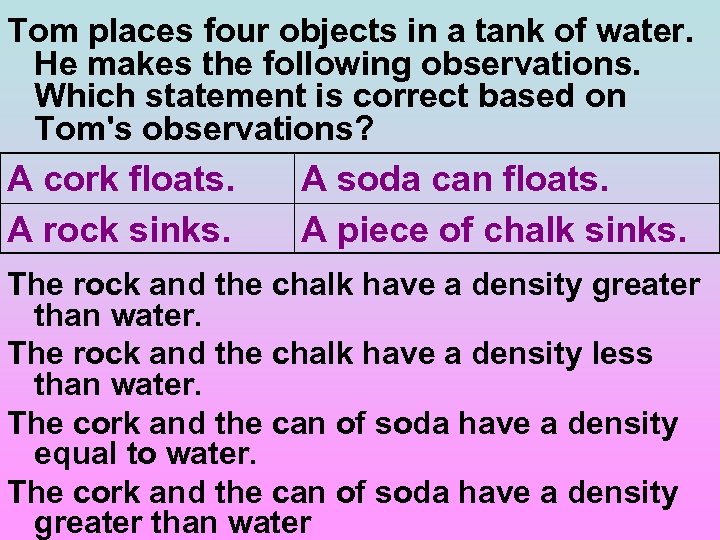 Tom places four objects in a tank of water. He makes the following observations. Which statement is correct based on Tom's observations? A cork floats. A rock sinks. A soda can floats. A piece of chalk sinks. The rock and the chalk have a density greater than water. The rock and the chalk have a density less than water. The cork and the can of soda have a density equal to water. The cork and the can of soda have a density greater than water
 The chemical symbol Al represents which metal on the periodic table? arsenic antimony aurum aluminum
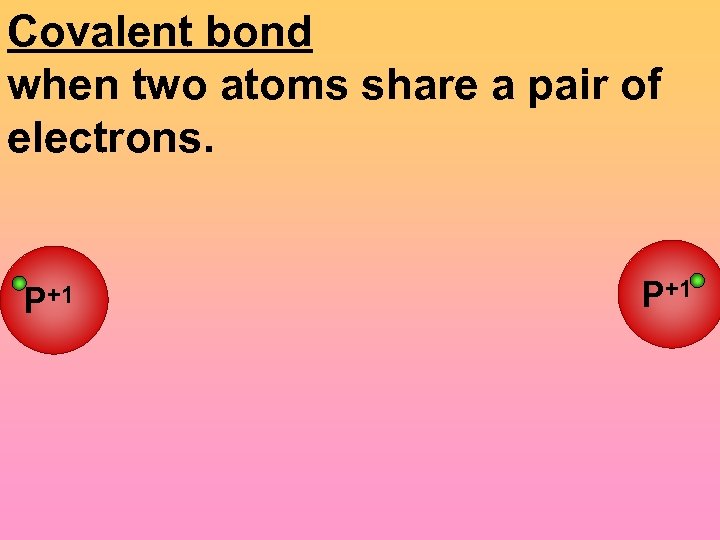 Covalent bond when two atoms share a pair of electrons. P+1 +1 P
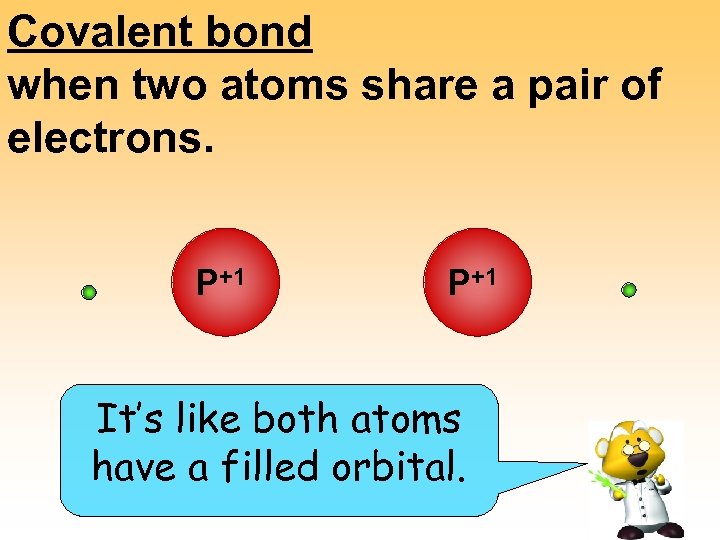 Covalent bond when two atoms share a pair of electrons. P+1 It’s like both atoms have a filled orbital.
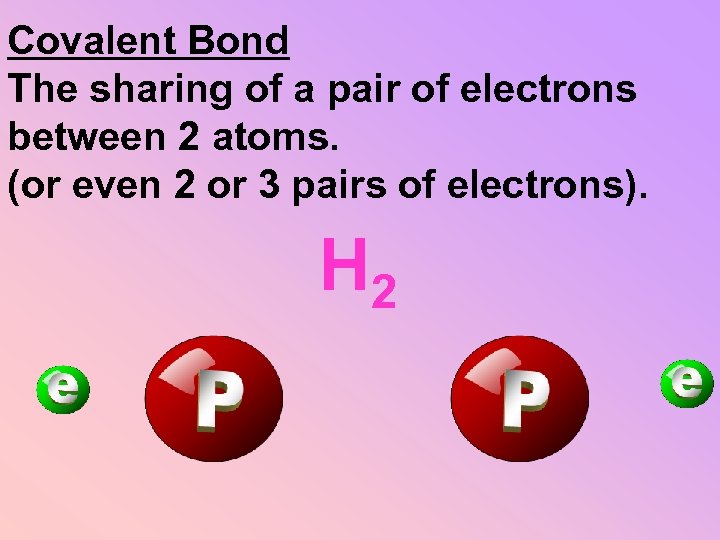 Covalent Bond The sharing of a pair of electrons between 2 atoms. (or even 2 or 3 pairs of electrons). H 2
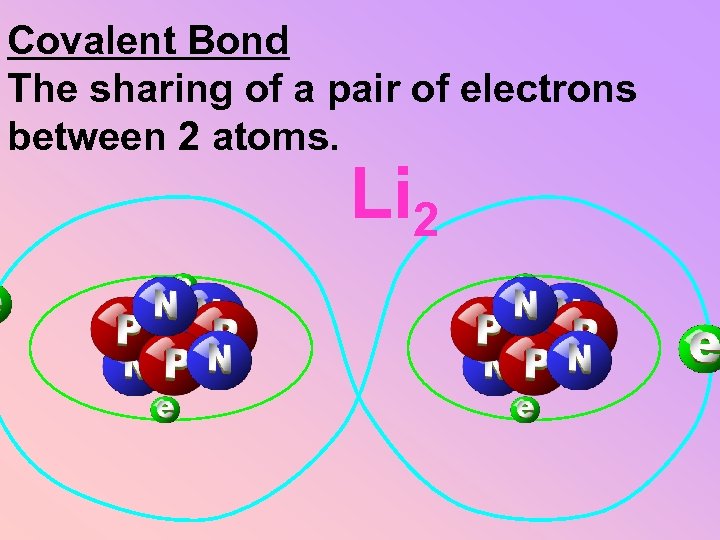 Covalent Bond The sharing of a pair of electrons between 2 atoms. Li 2
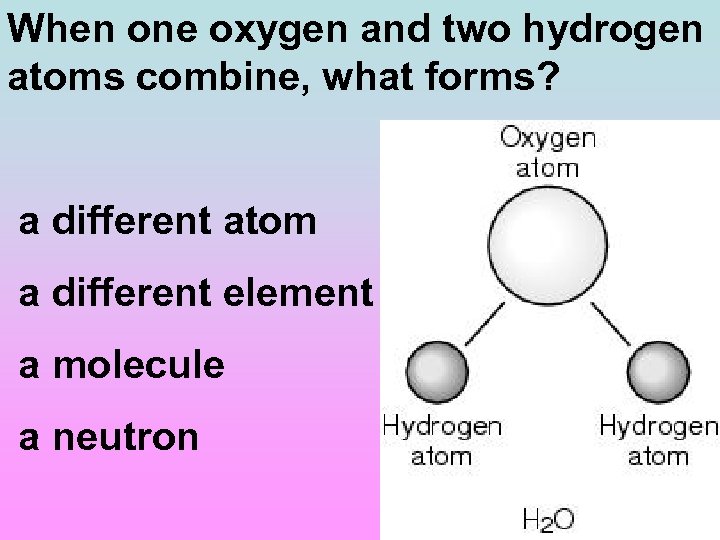 When one oxygen and two hydrogen atoms combine, what forms? a different atom a different element a molecule a neutron
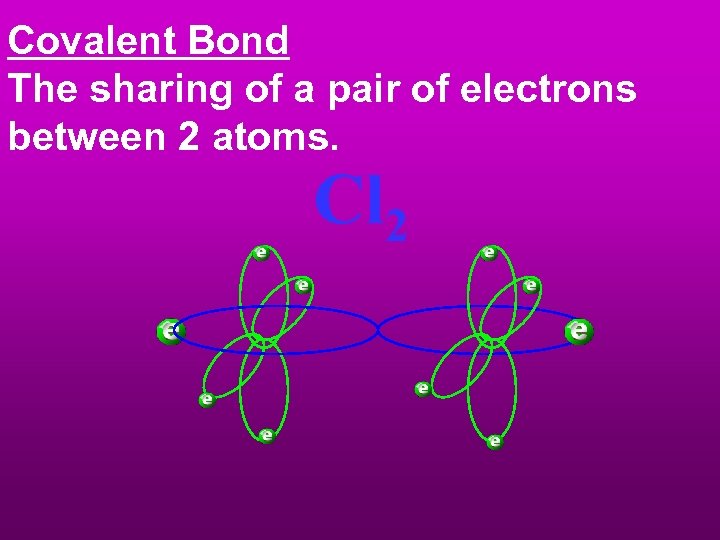 Covalent Bond The sharing of a pair of electrons between 2 atoms. Cl 2
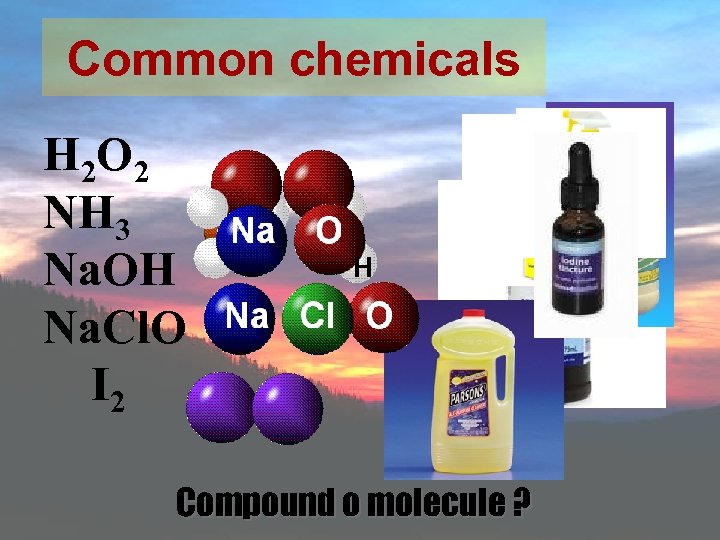 Common chemicals H 2 O 2 NH 3 Na. OH Na. Cl. O I 2 Compound o molecule ?
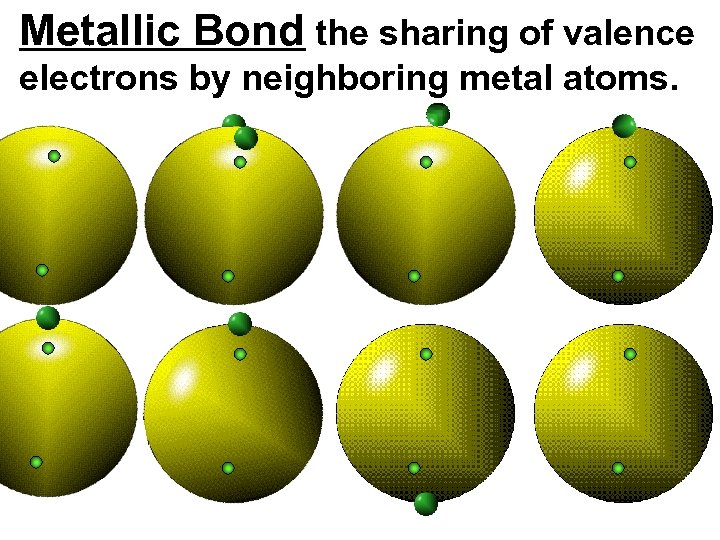 Metallic Bond the sharing of valence electrons by neighboring metal atoms.
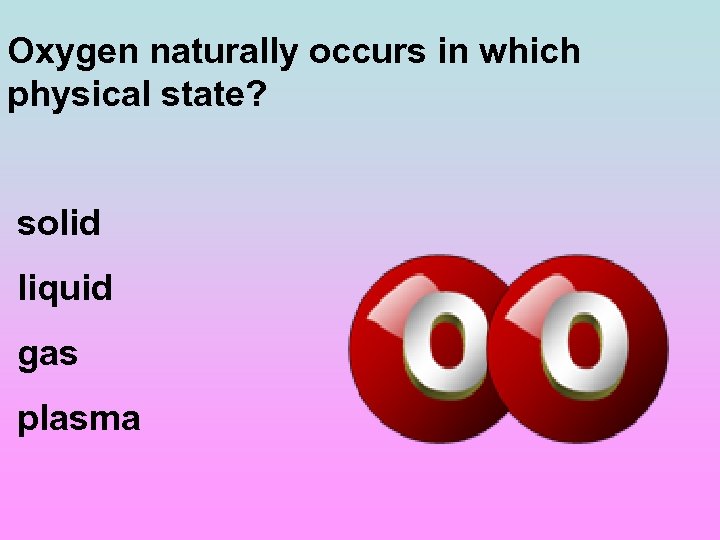 Oxygen naturally occurs in which physical state? solid liquid gas plasma
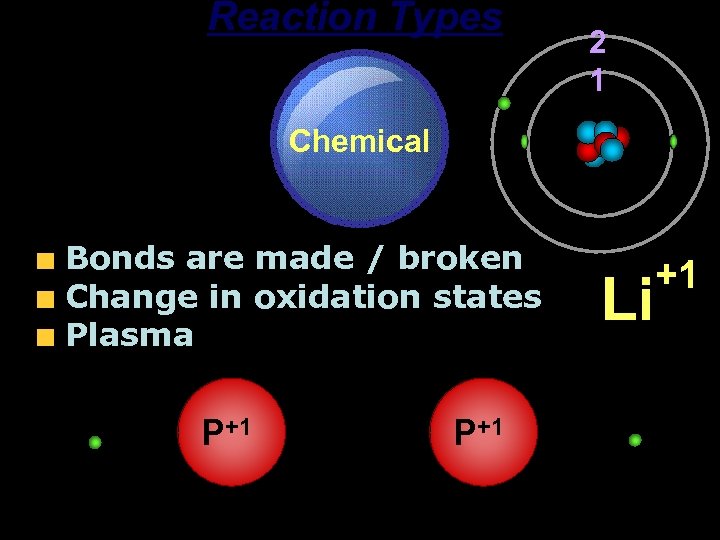 Reaction Types Chemical Bonds are made / broken Change in oxidation states Plasma P+1 2 1 P+1 Li +1
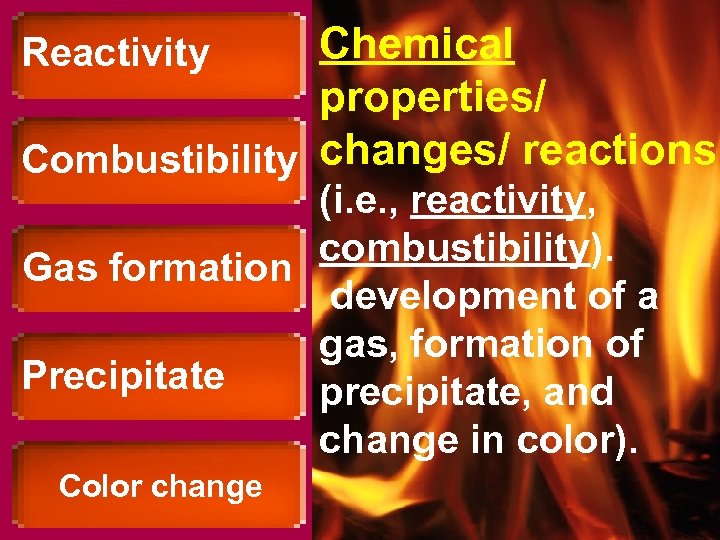 Chemical properties/ Combustibility changes/ reactions Reactivity (i. e. , reactivity, combustibility). Gas formation development of a gas, formation of Precipitate precipitate, and change in color). Color change
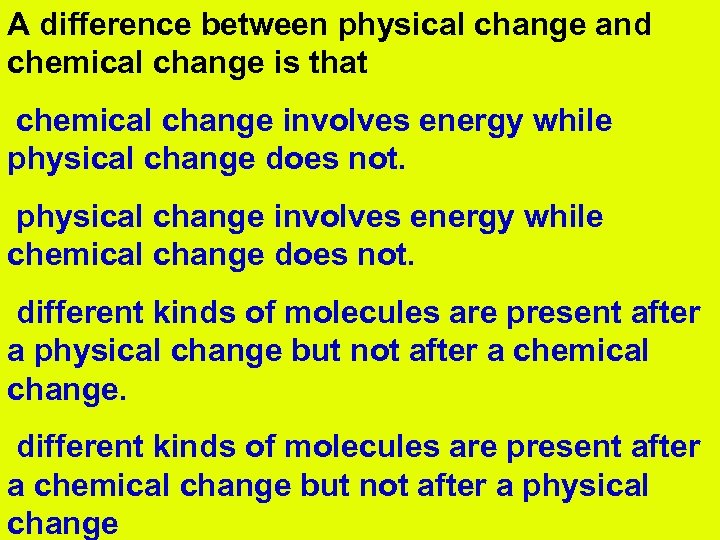 A difference between physical change and chemical change is that chemical change involves energy while physical change does not. physical change involves energy while chemical change does not. different kinds of molecules are present after a physical change but not after a chemical change. different kinds of molecules are present after a chemical change but not after a physical change
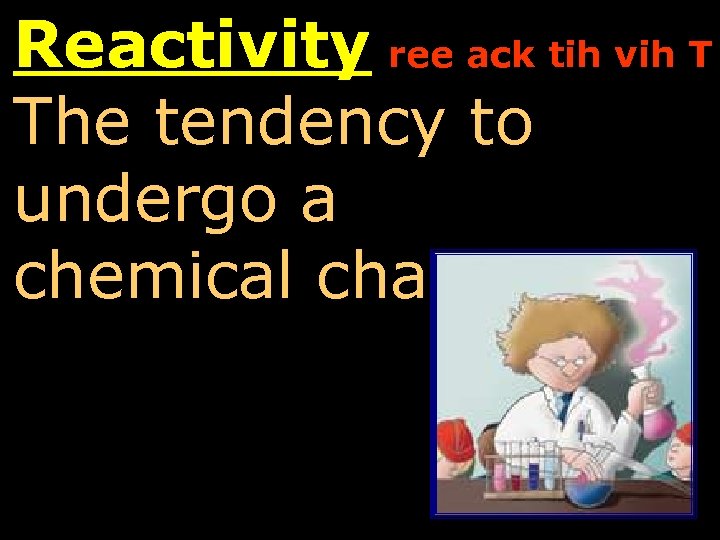 Reactivity ree ack tih vih T The tendency to undergo a chemical change.
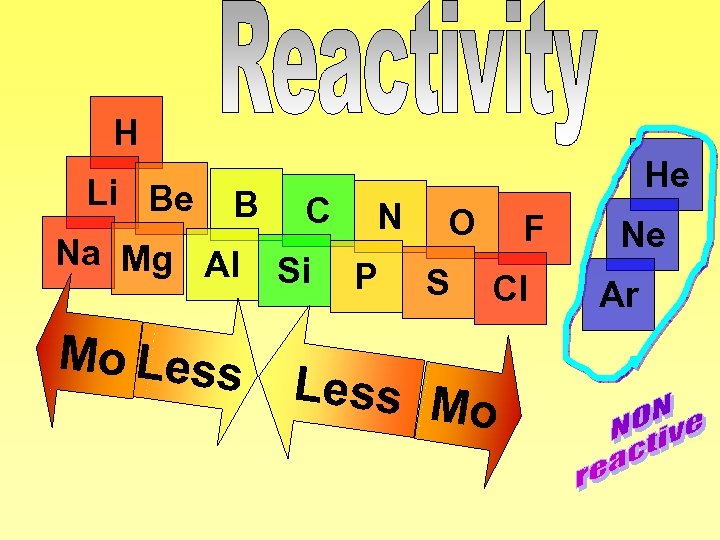 H Li Be B C N O F Na Mg Al Si P S Cl Mo Less M o He Ne Ar
 Calorimeter crystal lab carbohydrate lab fatty acid lab amino acid lab convection lab density II lab radioactive decay lab
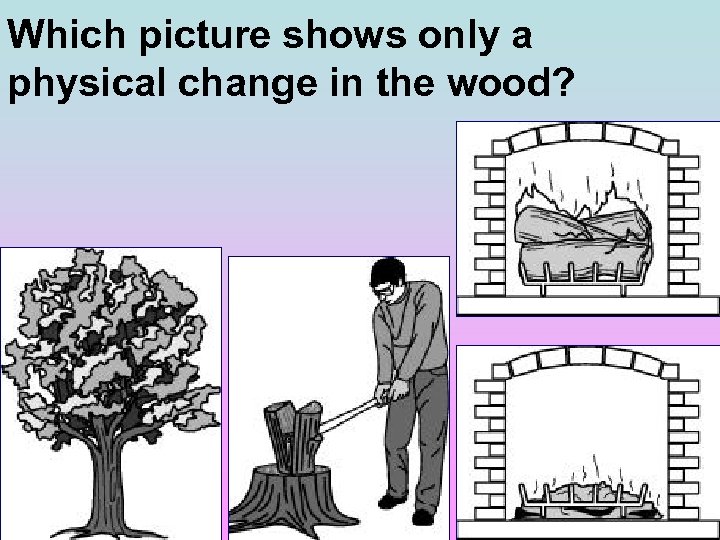 Which picture shows only a physical change in the wood?
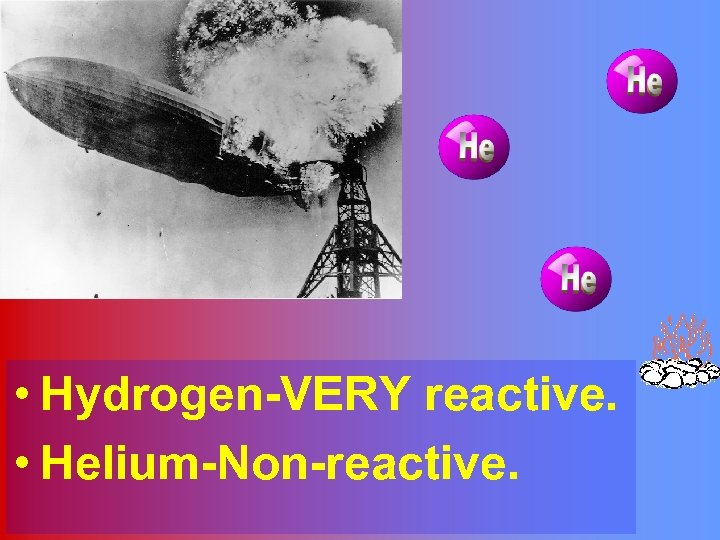 • Hydrogen-VERY reactive. • Helium-Non-reactive.
 On the periodic table, nitrogen is represented by N (atomic number 7). N is a chemical equation. period. symbol. group (family).
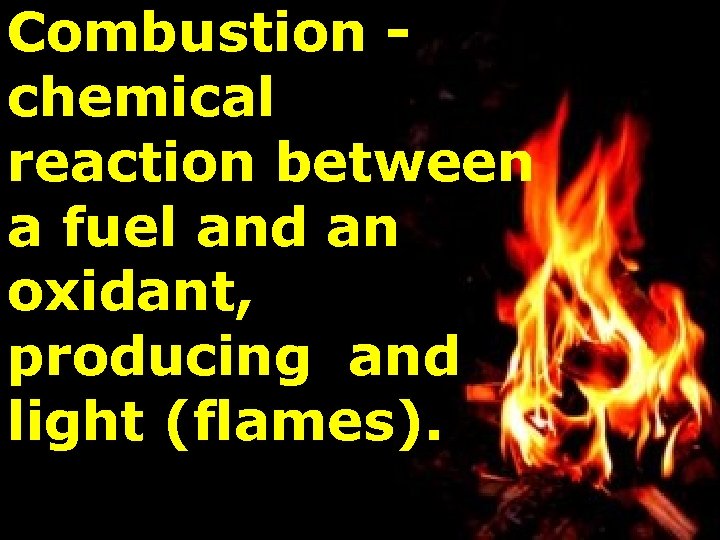 Combustion chemical reaction between a fuel and an oxidant, producing and light (flames).
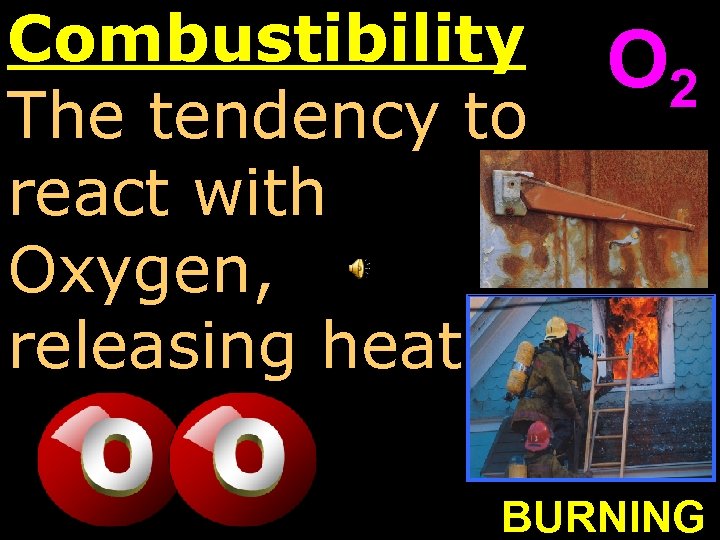 Combustibility The tendency to react with Oxygen, releasing heat. O 2 BURNING
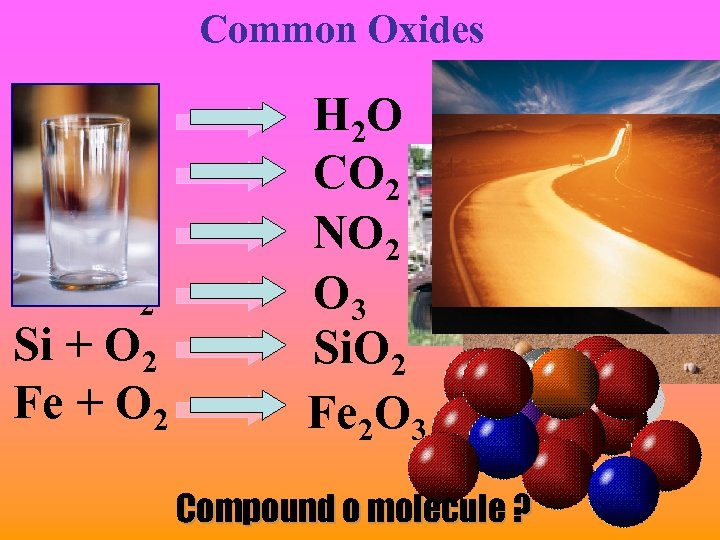 Common Oxides H + O 2 C + O 2 N + O 2 O + O 2 Si + O 2 Fe + O 2 H 2 O CO 2 NO 2 O 3 Si. O 2 Fe 2 O 3 Compound o molecule ?
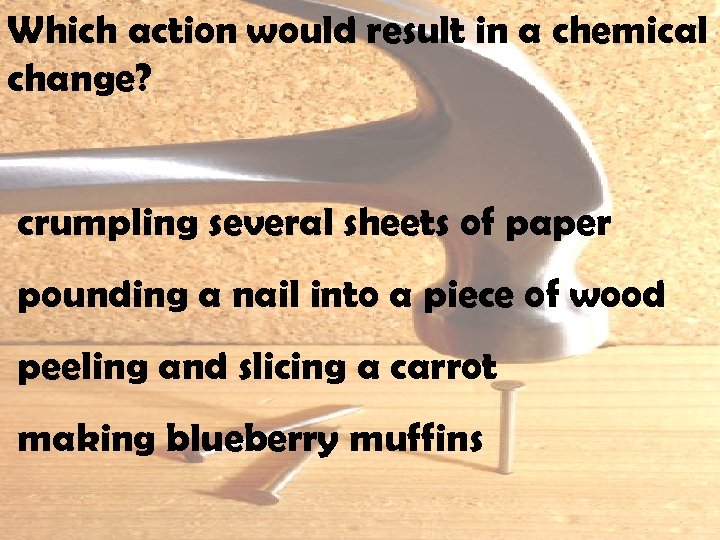 Which action would result in a chemical change? crumpling several sheets of paper pounding a nail into a piece of wood peeling and slicing a carrot making blueberry muffins
 Metals and Non-metals prefer to react with each other. One loses electrons, the other gets electrons. determine how it will react with other substances. produce new substances which have new properties.
 Lithium Fluorine
 Reaction Types Chemical Bonds are made / broken Change in oxidation states Plasma P+1 2 1 P+1 Li +1
 evidence of Chemical Change: development of a gas formation of precipitate change in color
 NOT a Chemical Change: fizz crystalization fluorescence
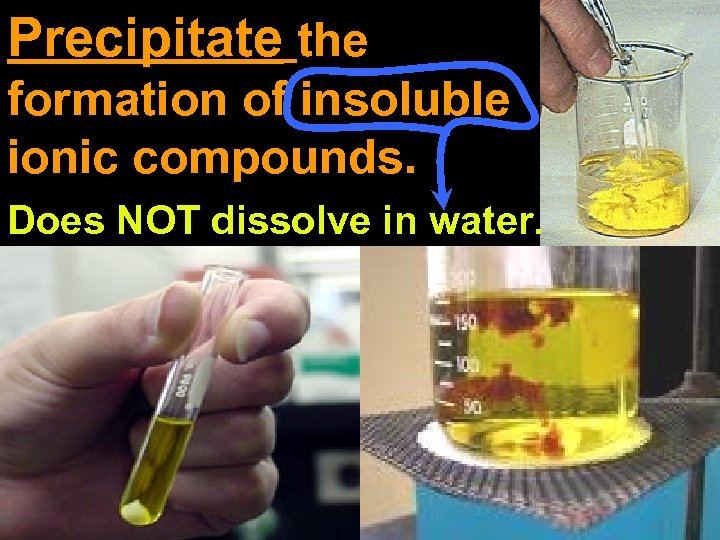 Precipitate the formation of insoluble ionic compounds. Does NOT dissolve in water.
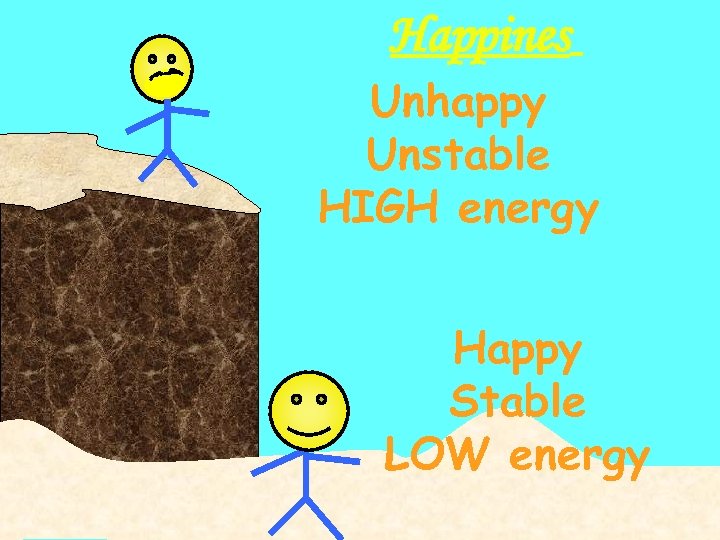 Happines Unhappy Unstable HIGH energy Happy Stable LOW energy
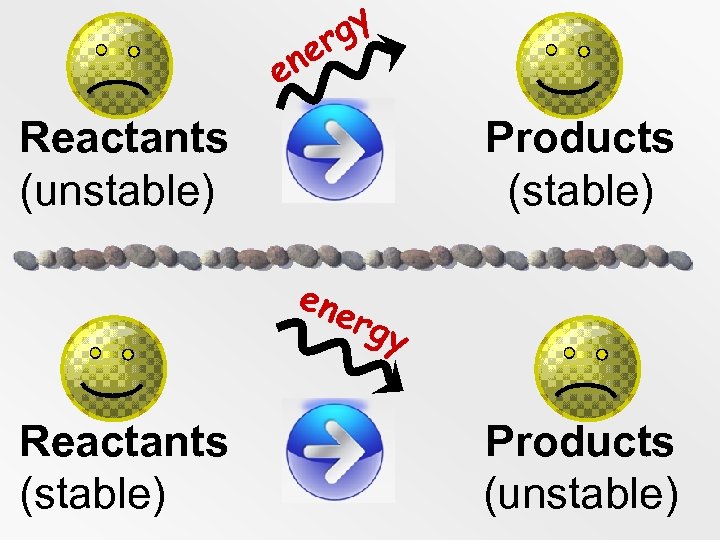 gy r ne e Reactants Products (unstable) (stable) ene rgy Reactants Products (stable) (unstable)
 You get up in the morning and make toast for breakfast. You notice the color changes from light to dark. Later on that day in science class, your teachers asks for every day examples of physical and chemical changes. Should you volunteer your toast as an example of a physical or chemical change? Why?
 A different chemical substance is formed when a piece of cloth is cut. cup breaks. candle burns. piece of chalk breaks.
 Lucy noticed that her coin collection had begun to tarnish. Some of the metal in the coins had begun to change color. The formation of tarnish is most similar to which of the following changes? shredding a piece of paper into hundreds of tiny strips dropping a dinner plate on the floor melting ice cubes in a glass of juice burning a piece of paper to ashes in a fireplace
 Which is an example of a chemical change? ice melting salt crystals being ground to powder water evaporating wood burning
 The law of Conservation of matter can neither be created nor destroyed. (Actually, NOT really true). Matter does not “magically appear" or" disappear”.
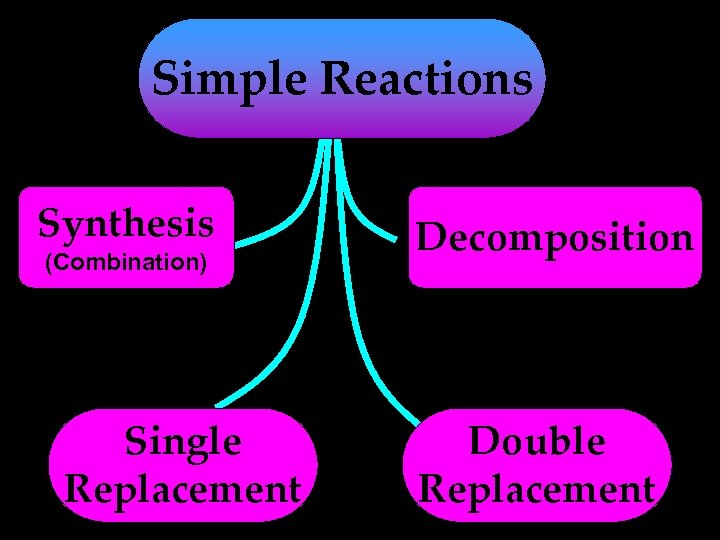 Simple Reactions Synthesis (Combination) Single Replacement Decomposition Double Replacement
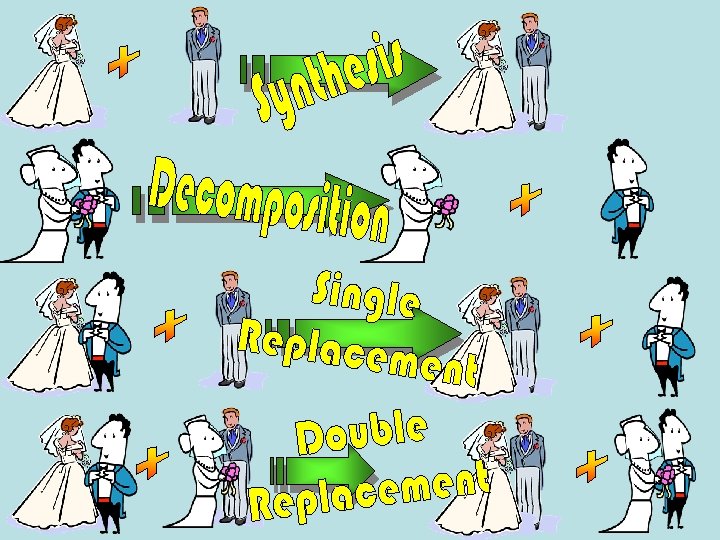
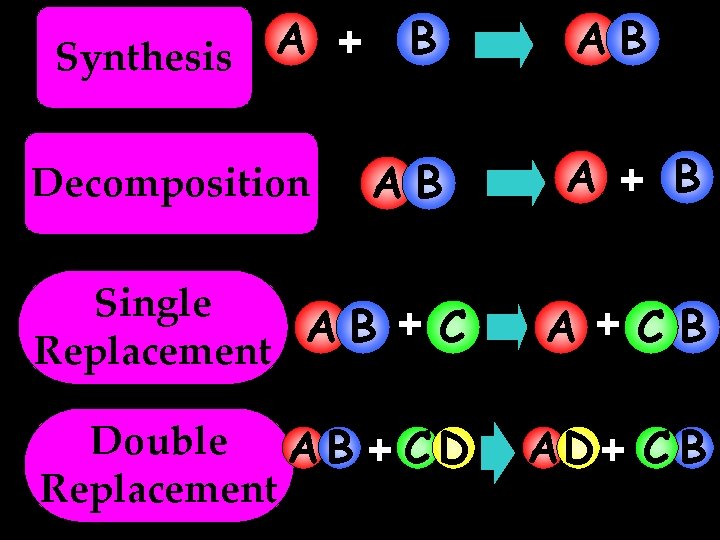 A + Synthesis Decomposition B AB AB A + B Single AB + C Replacement A +CB Double A B + C D Replacement AD + C B
 A + Synthesis Decomposition B AB AB A + B Single AB + C Replacement A +CB Double A B + C D Replacement AD + C B
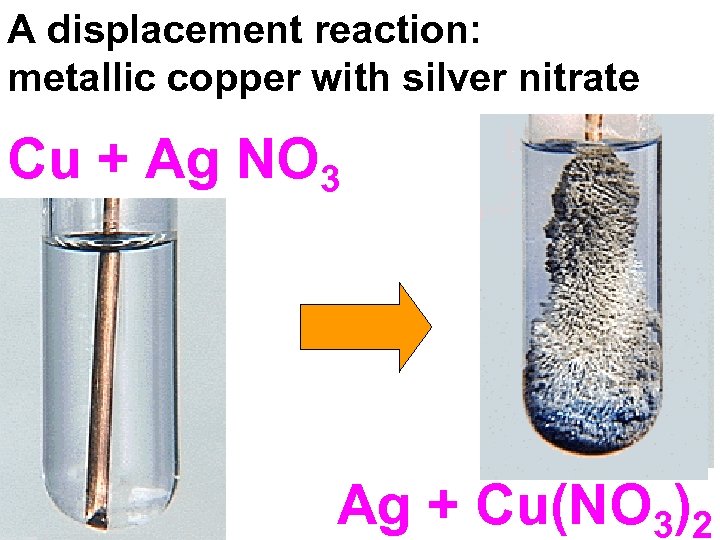 A displacement reaction: metallic copper with silver nitrate Cu + Ag NO 3 Ag + Cu(NO 3)2
 The study of chemicals that make up living things.
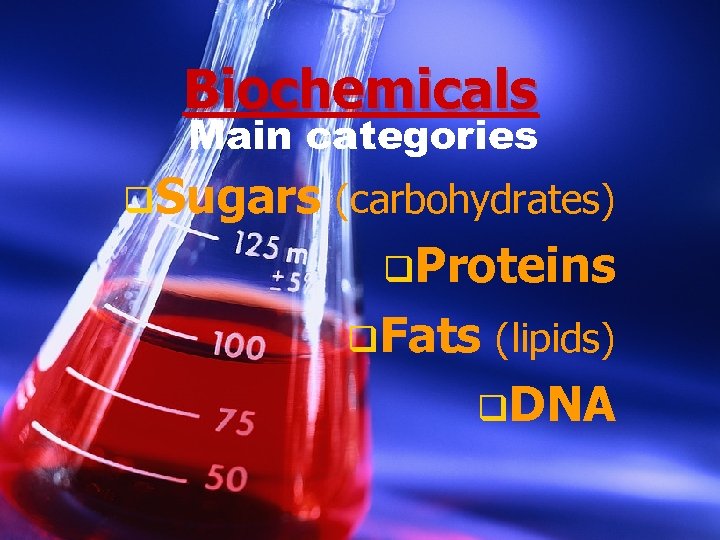 Biochemicals Main categories q. Sugars (carbohydrates) q. Proteins q. Fats (lipids) q. DNA
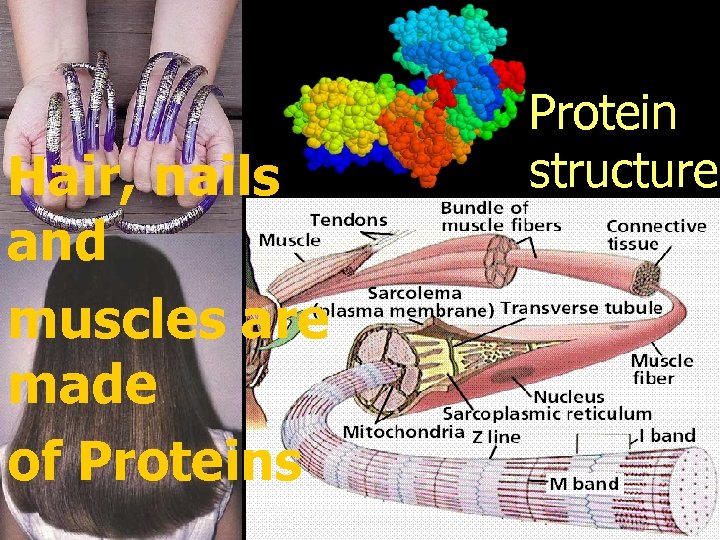 Hair, nails and muscles are made of Proteins Protein structure
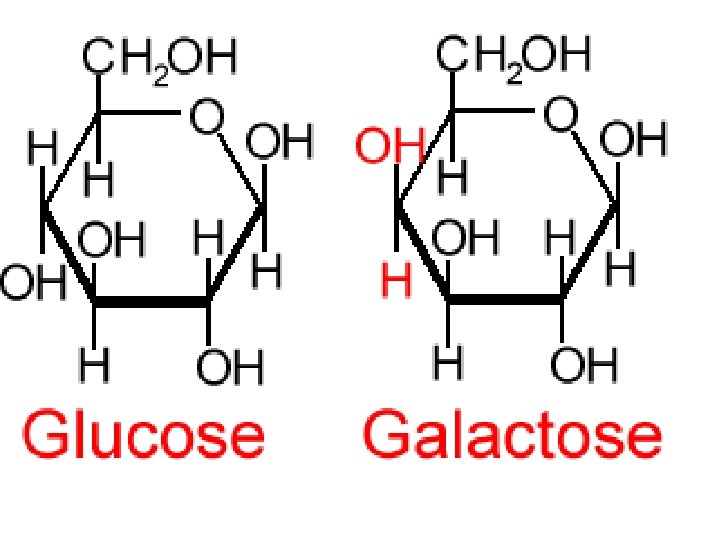
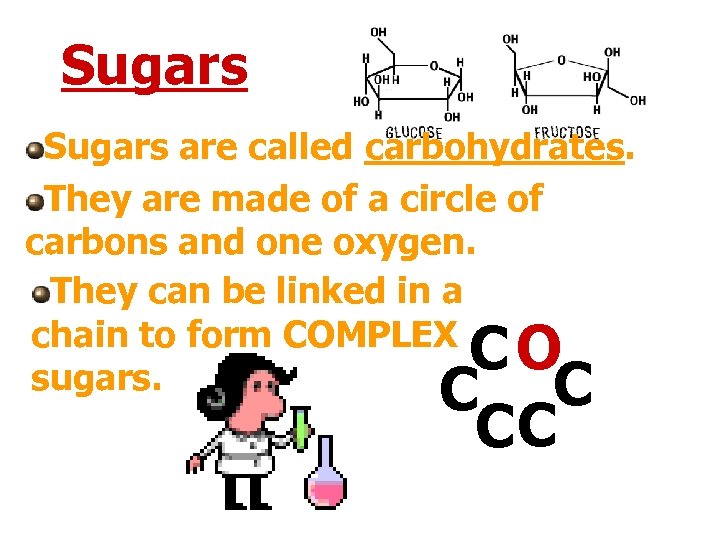 Sugars are called carbohydrates. They are made of a circle of carbons and one oxygen. They can be linked in a chain to form COMPLEX sugars. CO C C CC
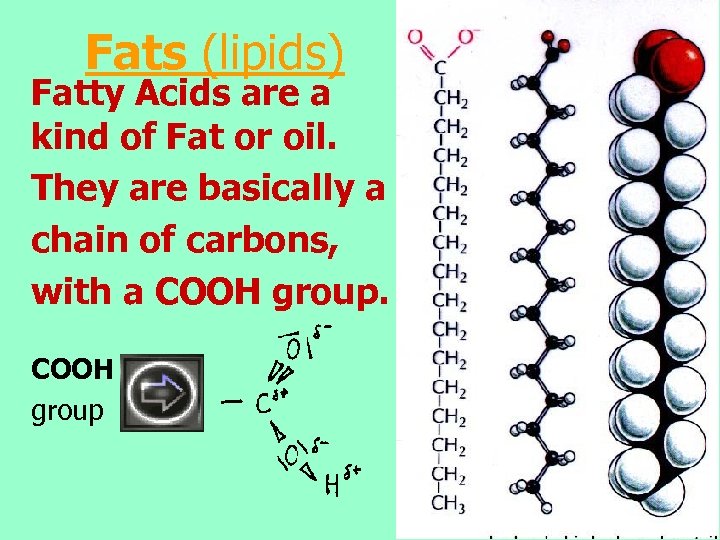 Fats (lipids) Fatty Acids are a kind of Fat or oil. They are basically a chain of carbons, with a COOH group
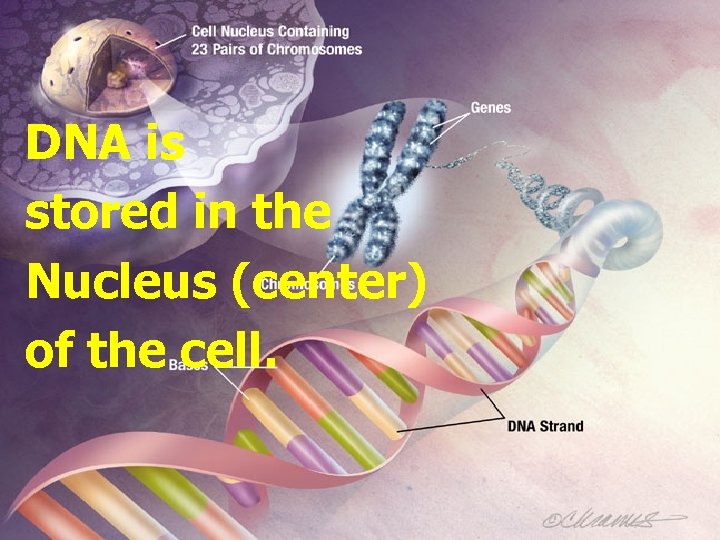 DNA is stored in the Nucleus (center) of the cell.
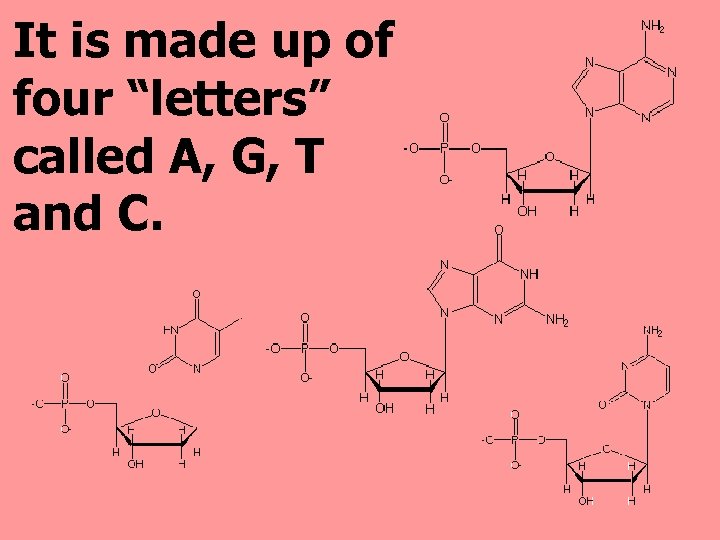 It is made up of four “letters” called A, G, T and C.
 All plant and animal life on Earth contains what element? sulfur carbon silicon aluminum
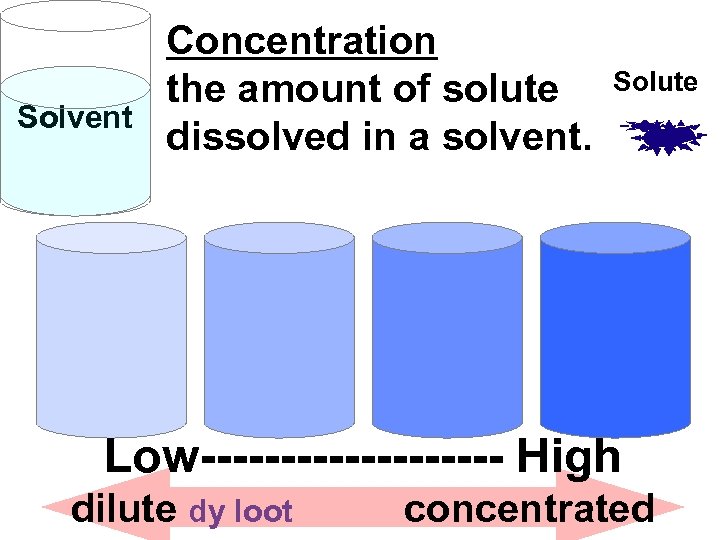 Solvent Concentration the amount of solute dissolved in a solvent. Solute Low---------- High dilute dy loot concentrated
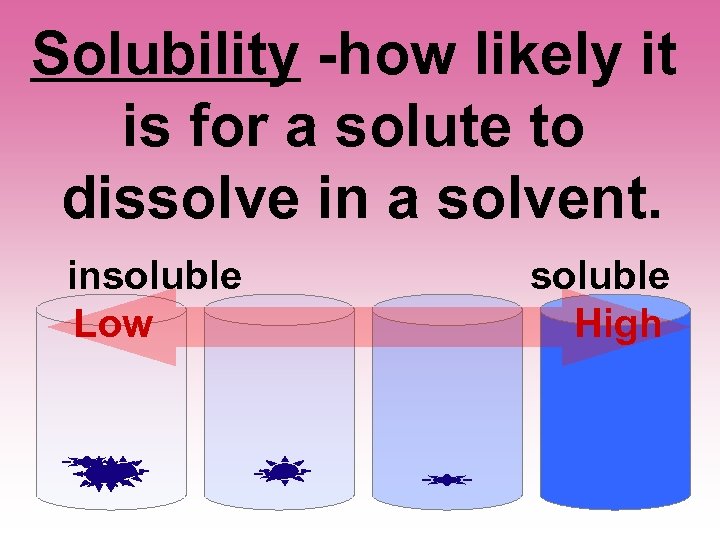 Solubility -how likely it is for a solute to dissolve in a solvent. insoluble Low soluble High
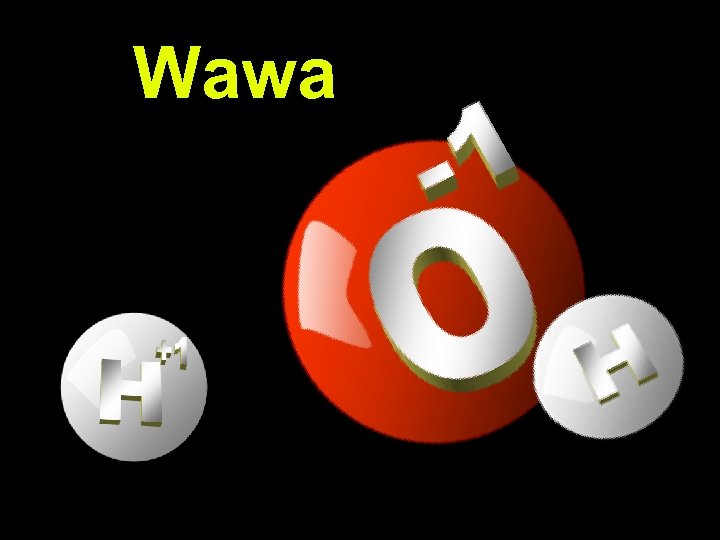 Wawa
Wawa
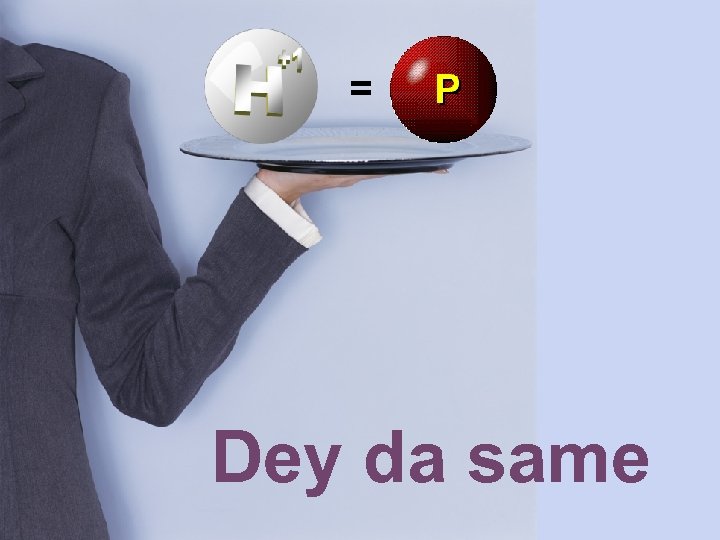 = Dey da same
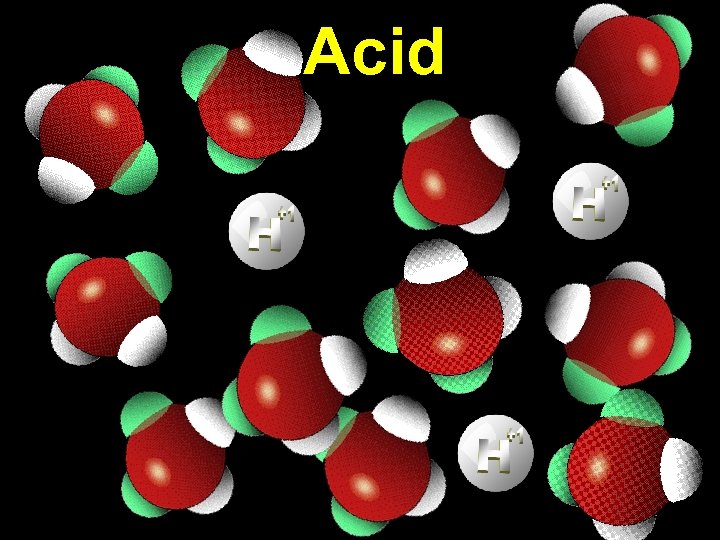 Acid
Acid
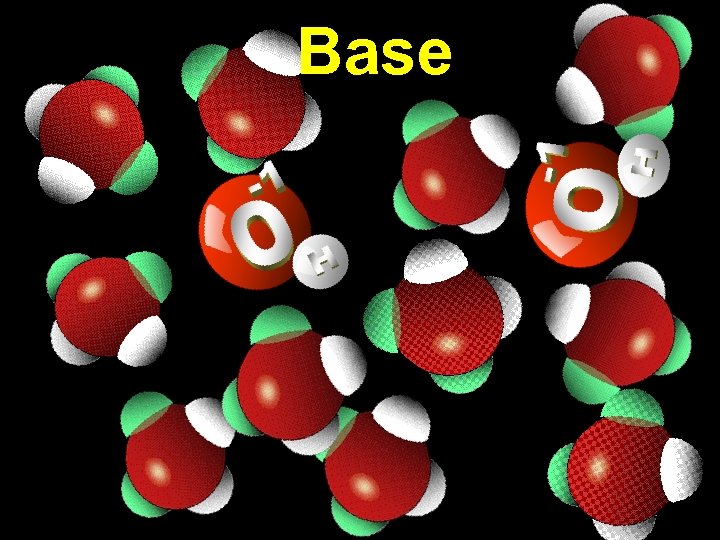 Base
Base
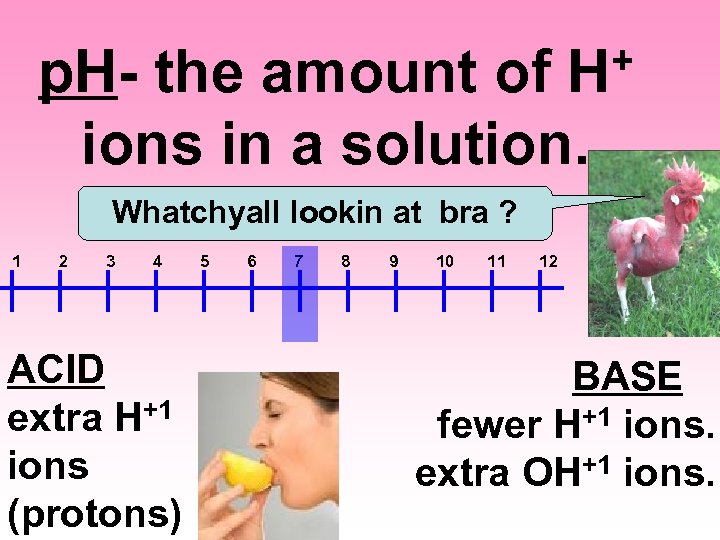 + H p. H- the amount of ions in a solution. Whatchyall lookin at bra ? 1 2 3 4 ACID extra H+1 ions (protons) 5 6 7 8 9 10 11 12 BASE fewer H+1 ions. extra OH+1 ions.
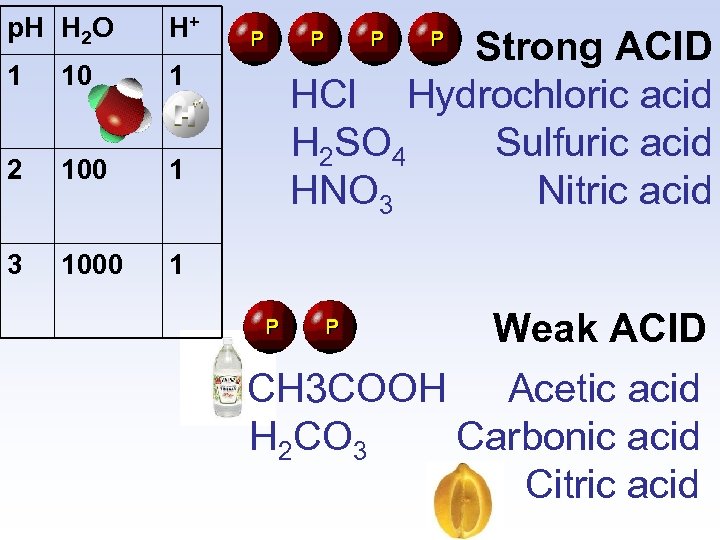 p. H H 2 O H+ 1 10 1 2 100 1 3 1000 1 Strong ACID HCl Hydrochloric acid H 2 SO 4 Sulfuric acid HNO 3 Nitric acid Weak ACID CH 3 COOH Acetic acid H 2 CO 3 Carbonic acid Citric acid
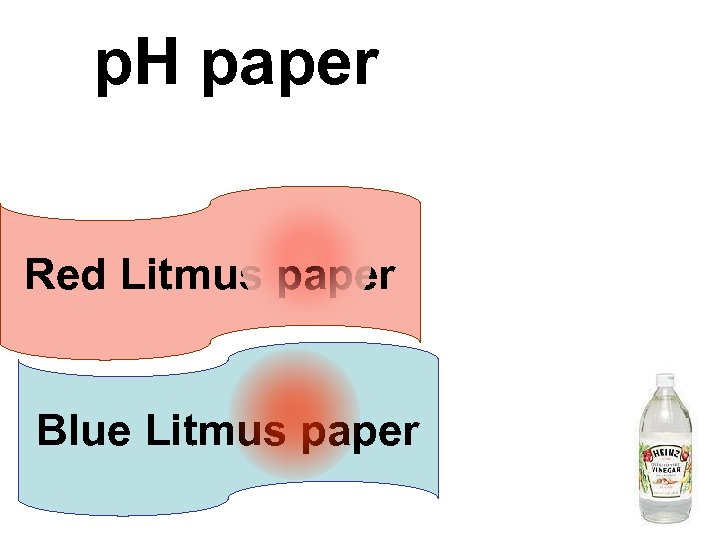 p. H paper Red Litmus paper Blue Litmus paper
 Balancing equations
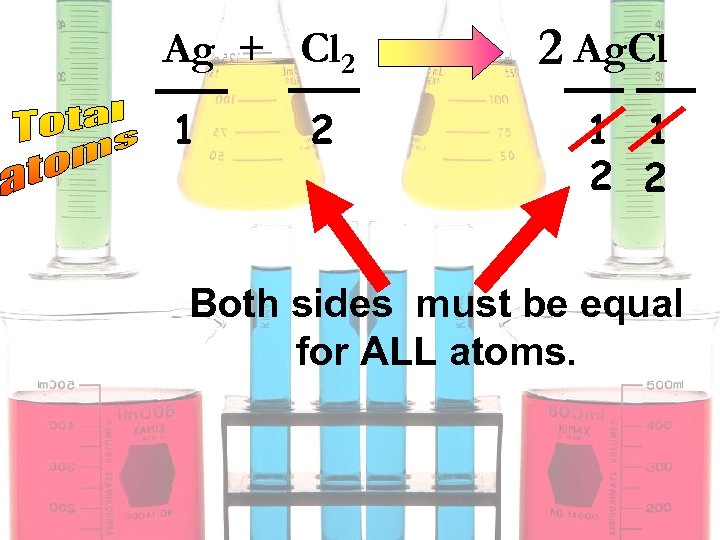 Ag + Cl 2 1 2 2 Ag. Cl 1 1 2 2 Both sides must be equal for ALL atoms.
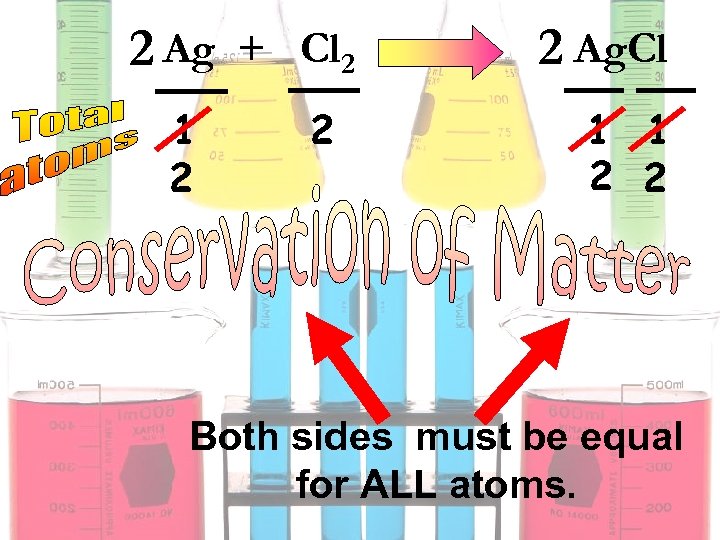 2 Ag + Cl 2 1 2 2 2 Ag. Cl 1 1 2 2 Both sides must be equal for ALL atoms.
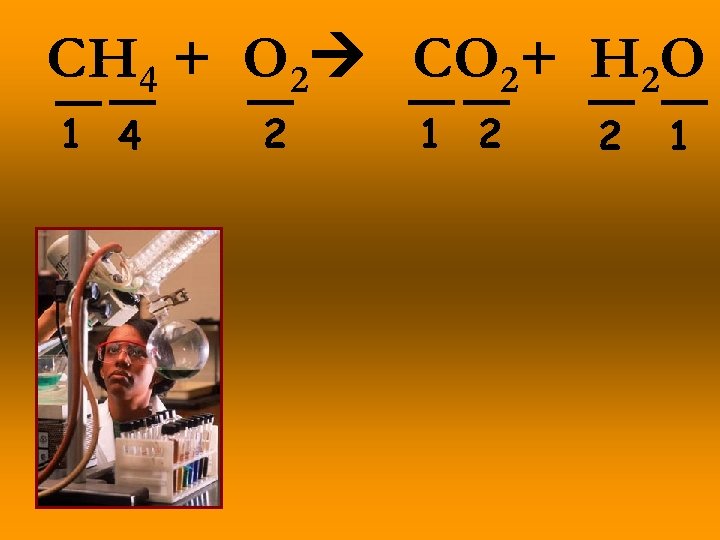 CH 4 + O 2 CO 2+ H 2 O 1 4 2 1 2 2 1
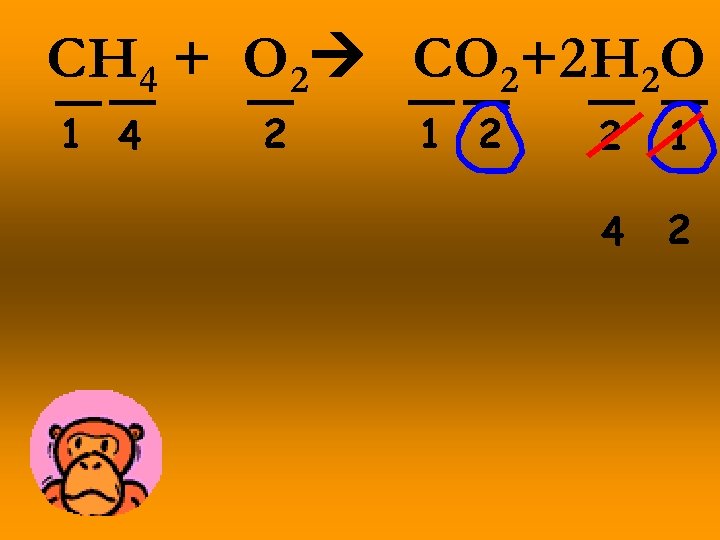 CH 4 + O 2 CO 2+2 H 2 O 1 4 2 1 2 2 1 4 2
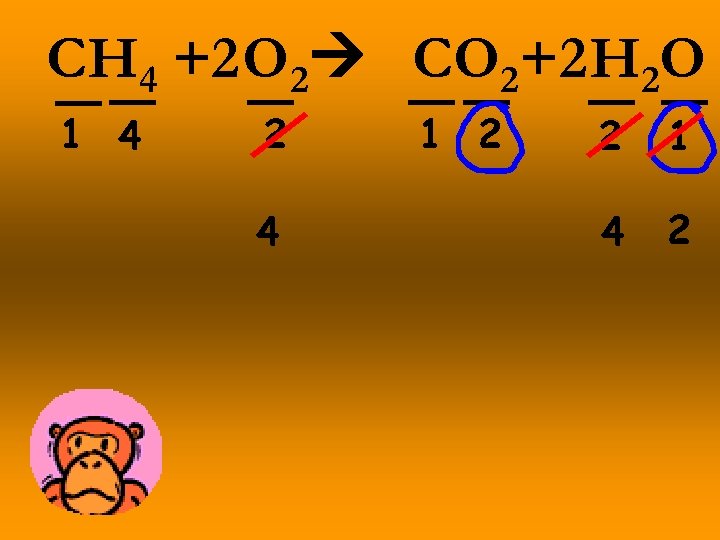 CH 4 +2 O 2 CO 2+2 H 2 O 1 4 2 4 1 2 2 1 4 2
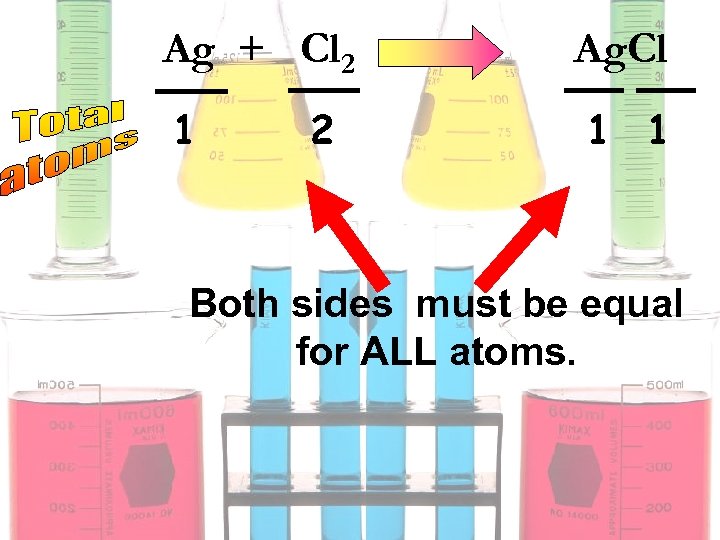 Ag + Cl 2 1 2 Ag. Cl 1 1 Both sides must be equal for ALL atoms.
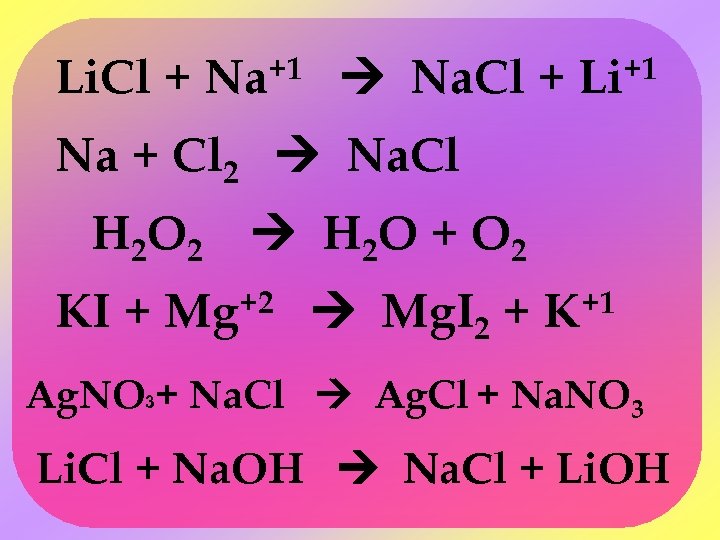 Li. Cl + +1 Na Na. Cl + +1 Li Na + Cl 2 Na. Cl H 2 O 2 H 2 O + O 2 KI + Mg+2 Mg. I 2 + K+1 Ag. NO 3+ Na. Cl Ag. Cl + Na. NO 3 Li. Cl + Na. OH Na. Cl + Li. OH
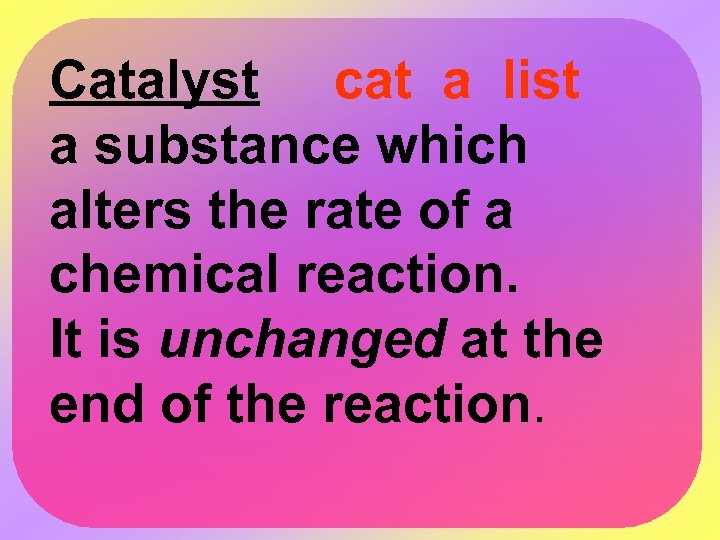 Catalyst cat a list a substance which alters the rate of a chemical reaction. It is unchanged at the end of the reaction.
 Experiment with the changes of states of a substance (i. e. water, dry ice). Chart- state changes: melting, boiling, freezing, evaporation, condensation, and sublimation.
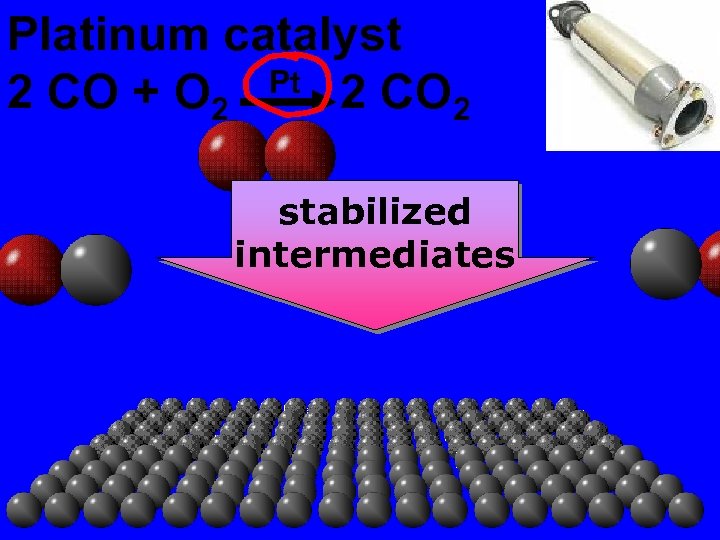 Platinum catalyst 2 CO + O 2 Pt 2 CO 2 stabilized intermediates
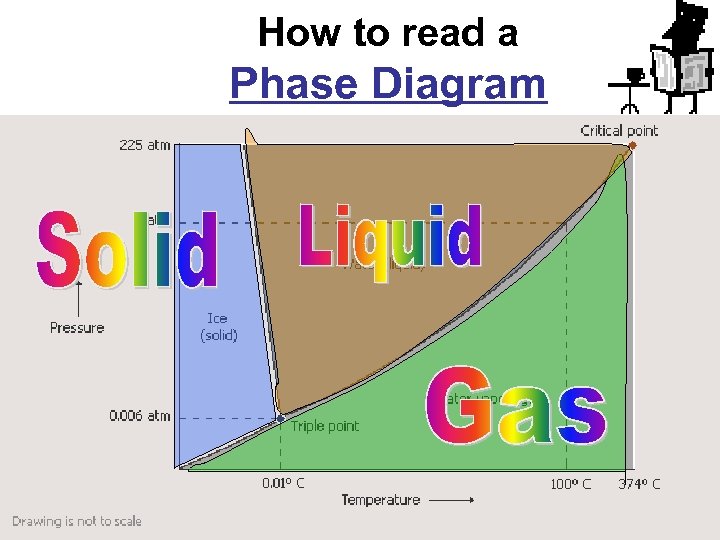 How to read a Phase Diagram
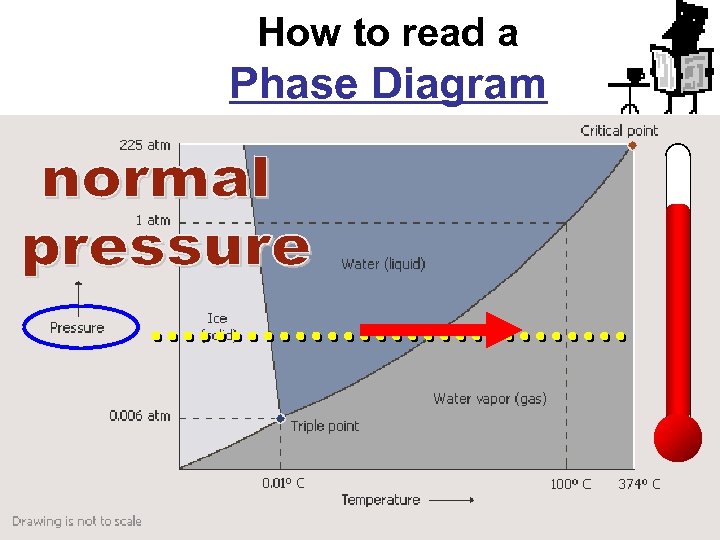 How to read a Phase Diagram
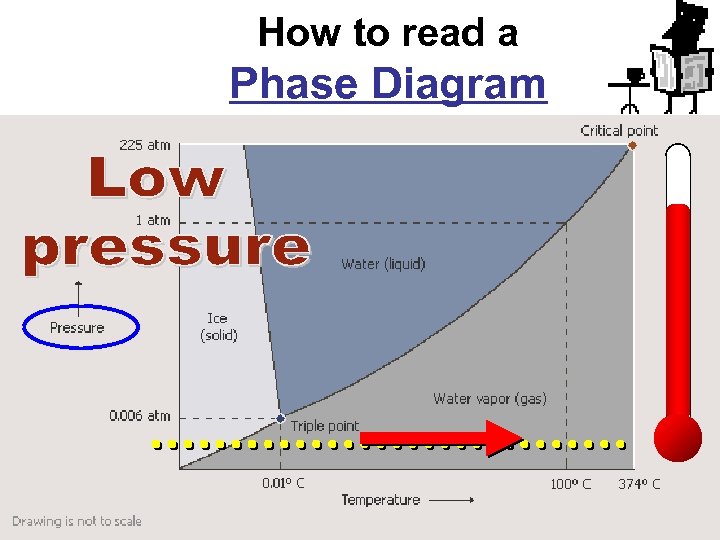 How to read a Phase Diagram
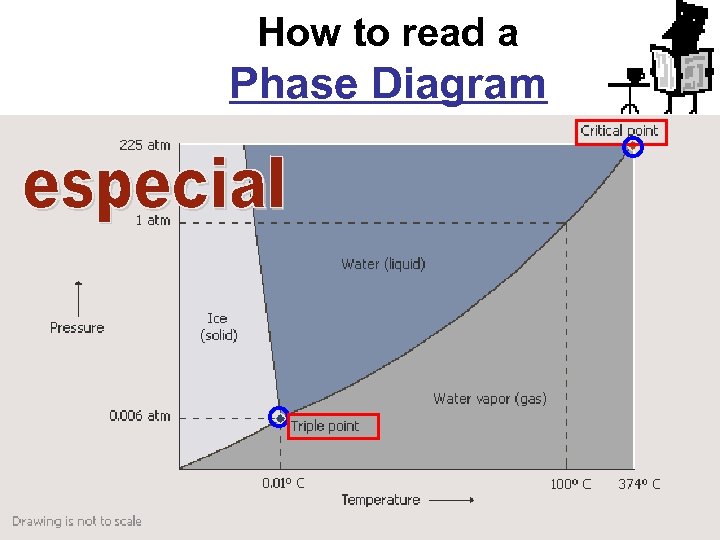 How to read a Phase Diagram
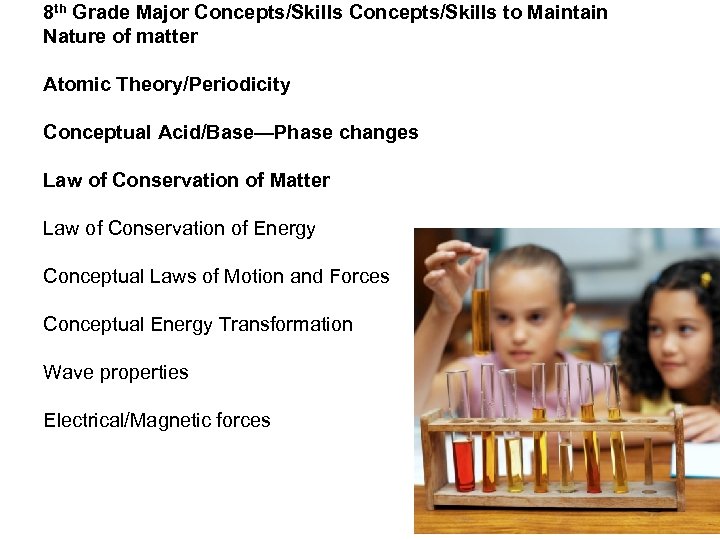 8 th Grade Major Concepts/Skills to Maintain Nature of matter Atomic Theory/Periodicity Conceptual Acid/Base—Phase changes Law of Conservation of Matter Law of Conservation of Energy Conceptual Laws of Motion and Forces Conceptual Energy Transformation Wave properties Electrical/Magnetic forces
 Six munths ago I cudnt evun spelt chemissed. An now I are one.
 This powerpoint was kindly donated to www. worldofteaching. com http: //www. worldofteaching. com is home to over a thousand powerpoints submitted by teachers. This is a completely free site and requires no registration. Please visit and I hope it will help in your teaching.