


 Скачать презентацию REACTION AND IMPACT OF MONETARY POLICY ON WAMZ
1c361a9739468f3de8718d2d632fccfa.ppt
- Количество слайдов: 26
 REACTION AND IMPACT OF MONETARY POLICY ON WAMZ ECONOMIES. By Abwakwa Englama, Ismaila Jarju and Edward Nyarko
 OUTLINE INTRODUCTION THEORETICAL LITERATURE EMPIRICAL LITERATURE METHODOLOGY ESTIMATED RESULTS CONCLUSION POLICY RECOMMENDATIONS
 INTRODUCTION The debate regarding effectiveness of monetary policy and how central banks react to the business cycle have been two protracted contentions among economists. Research on the issues have largely focused on developed economies. Those on developing economies have cantered largely on a few WAMZ countries.
 INTRODUCTION The study is relevant because of the growing concern about; • WAMZ Member States’ inability to attain and/or maintain all the convergence criteria for WAMZ monetary integration; • High domestic interest rates, low growth recorded at both aggregate and sectoral levels; • The vulnerability of the zone to external shocks;
 INTRODUCTION • The objective of the Study is to investigate how WAMZ central banks react to fluctuations in output, inflation and exchange rates and how such policies in turn, affect these indicators.
 Theoretical Literature Review Theoretical views on Effectiveness of Monetary Policy: Old Classical money neutrality argument Orthodox Keynesian non-neutrality Orthodox Monetarist New Classical /Monetary Equilibrium Business Cycle Theory (MEBCT) The Real Equilibrium Business Cycle Theory (REBCT)
 Theoretical Literature Review Theoretical views on Cost of Disinflationary Monetary Policy: the Original Phillips curve of Orthodox Keynesian school Expectation- augmented Phillips curve by Monetarist New Classical School/ the MEBCT explanation
 Theoretical Literature Review Theoretical views on Monetary Policy Transmission Mechanism Mishkin (1996, 2007) : Interest Rate Channel Credit channel’ Exchnage Rate Channel Asset Price Channel( Stock Price , Real Estate etc. ) Expectations Channel
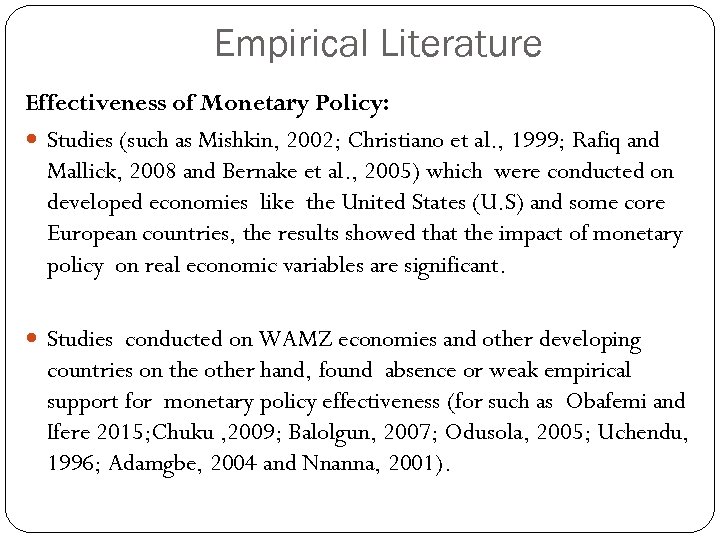 Empirical Literature Effectiveness of Monetary Policy: Studies (such as Mishkin, 2002; Christiano et al. , 1999; Rafiq and Mallick, 2008 and Bernake et al. , 2005) which were conducted on developed economies like the United States (U. S) and some core European countries, the results showed that the impact of monetary policy on real economic variables are significant. Studies conducted on WAMZ economies and other developing countries on the other hand, found absence or weak empirical support for monetary policy effectiveness (for such as Obafemi and Ifere 2015; Chuku , 2009; Balolgun, 2007; Odusola, 2005; Uchendu, 1996; Adamgbe, 2004 and Nnanna, 2001).
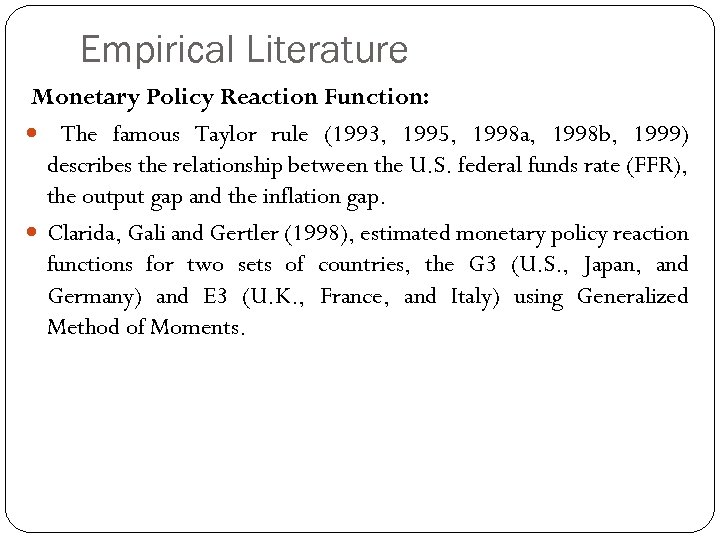 Empirical Literature Monetary Policy Reaction Function: The famous Taylor rule (1993, 1995, 1998 a, 1998 b, 1999) describes the relationship between the U. S. federal funds rate (FFR), the output gap and the inflation gap. Clarida, Gali and Gertler (1998), estimated monetary policy reaction functions for two sets of countries, the G 3 (U. S. , Japan, and Germany) and E 3 (U. K. , France, and Italy) using Generalized Method of Moments.
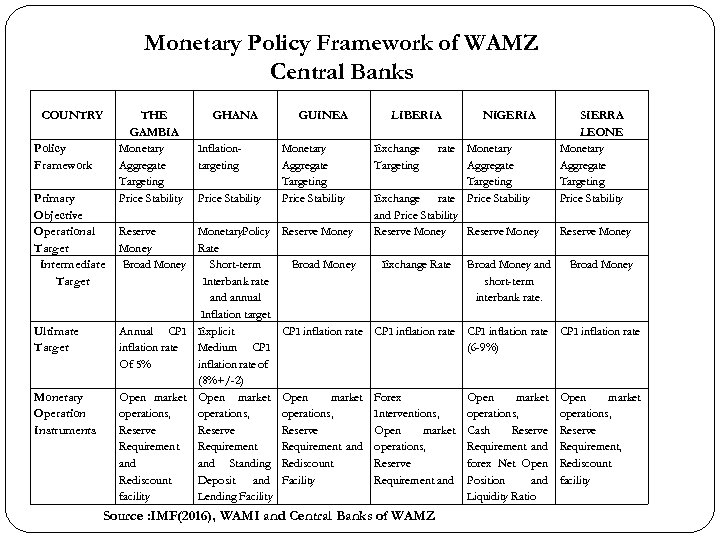 Monetary Policy Framework of WAMZ Central Banks COUNTRY Policy Framework Primary Objective Operational Target Intermediate Target Ultimate Target Monetary Operation Instruments THE GAMBIA Monetary Aggregate Targeting Price Stability GHANA Inflationtargeting Price Stability Reserve Monetary. Policy Money Rate Broad Money Short-term Interbank rate and annual Inflation target Annual CPI Explicit inflation rate Medium CPI Of 5% inflation rate of (8%+/-2) Open market operations, Reserve Requirement and Standing Rediscount Deposit and facility Lending Facility GUINEA Monetary Aggregate Targeting Price Stability Reserve Money Broad Money LIBERIA NIGERIA Exchange Targeting rate Monetary Aggregate Targeting Exchange rate Price Stability and Price Stability Reserve Money Exchange Rate Broad Money and short-term interbank rate. SIERRA LEONE Monetary Aggregate Targeting Price Stability Reserve Money Broad Money CPI inflation rate (6 -9%) Open market operations, Reserve Requirement and Rediscount Facility Forex Interventions, Open market operations, Reserve Requirement and Source : IMF(2016), WAMI and Central Banks of WAMZ Open market operations, Cash Reserve Requirement and forex Net Open Position and Liquidity Ratio Open market operations, Reserve Requirement, Rediscount facility
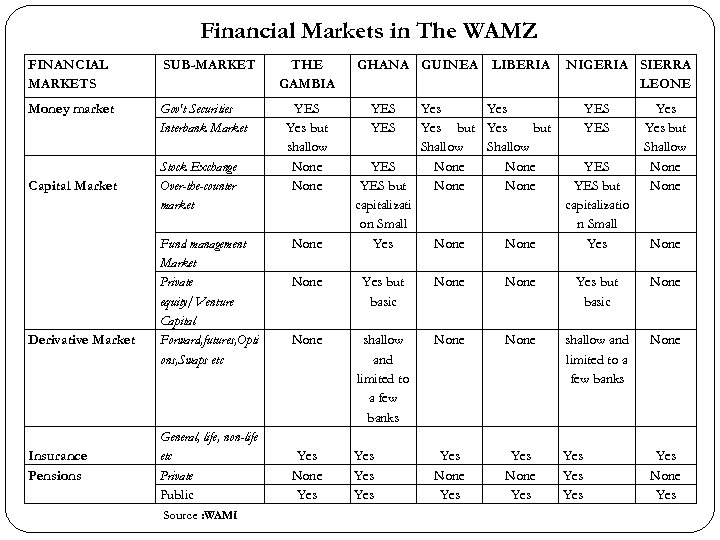 Financial Markets in The WAMZ FINANCIAL MARKETS SUB-MARKET Money market Gov't Securities Interbank Market Capital Market Derivative Market Insurance Pensions Stock Exchange Over-the-counter market Fund management Market Private equity/Venture Capital Forward, futures, Opti ons, Swaps etc General, life, non-life etc Private Public Source : WAMI THE GAMBIA YES Yes but shallow None GHANA GUINEA LIBERIA YES YES but capitalizati on Small Yes Yes but Shallow None None NIGERIA SIERRA LEONE YES YES but capitalizatio n Small Yes Yes but Shallow None Yes but basic None shallow and limited to a few banks None Yes Yes Yes None Yes
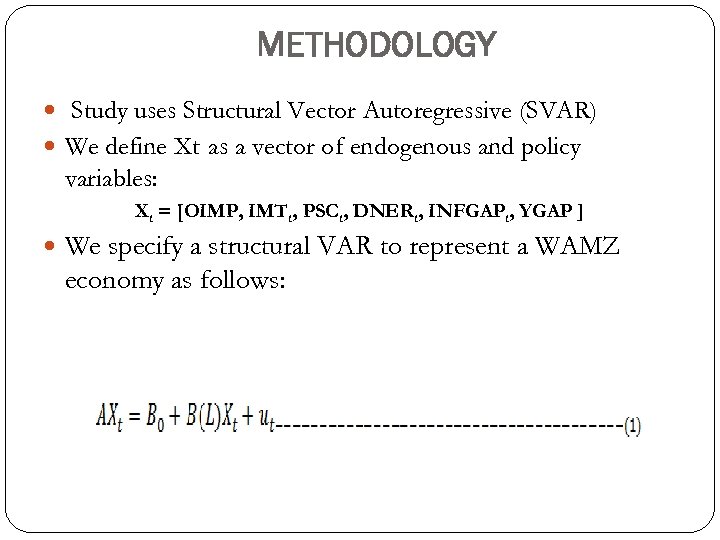 METHODOLOGY Study uses Structural Vector Autoregressive (SVAR) We define Xt as a vector of endogenous and policy variables: Xt = [OIMP, IMTt, PSCt, DNERt, INFGAPt, YGAP ] We specify a structural VAR to represent a WAMZ economy as follows:
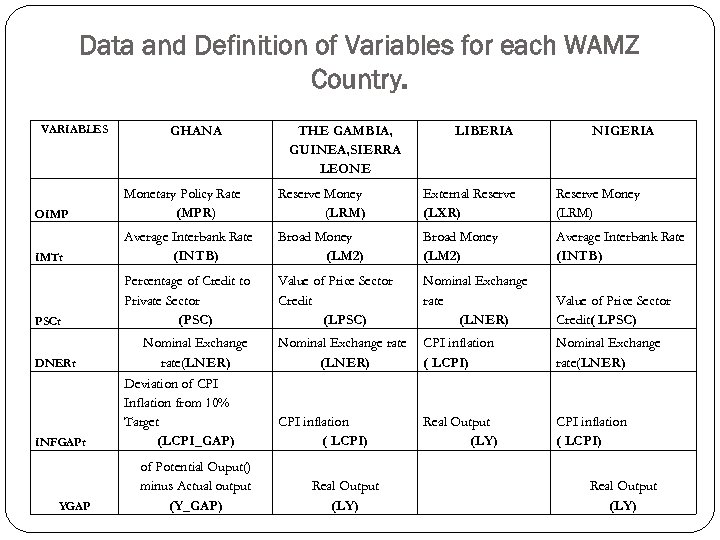 Data and Definition of Variables for each WAMZ Country. VARIABLES GHANA THE GAMBIA, GUINEA, SIERRA LEONE LIBERIA NIGERIA OIMP Monetary Policy Rate (MPR) Reserve Money (LRM) External Reserve (LXR) Reserve Money (LRM) IMTt Average Interbank Rate (INTB) Broad Money (LM 2) Average Interbank Rate (INTB) PSCt Percentage of Credit to Private Sector (PSC) Value of Price Sector Credit (LPSC) Nominal Exchange rate (LNER) Value of Price Sector Credit( LPSC) Nominal Exchange rate(LNER) Deviation of CPI Inflation from 10% Target (LCPI_GAP) Nominal Exchange rate (LNER) CPI inflation ( LCPI) Nominal Exchange rate(LNER) CPI inflation ( LCPI) Real Output (LY) CPI inflation ( LCPI) DNERt INFGAPt YGAP of Potential Ouput() minus Actual output (Y_GAP) Real Output (LY)
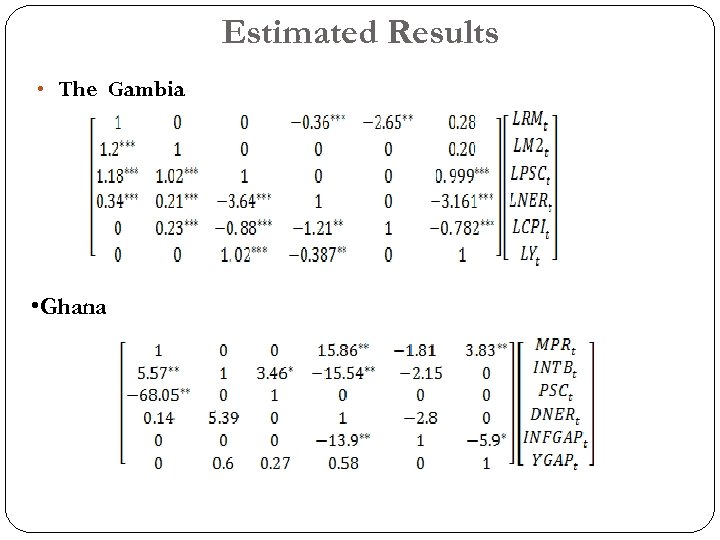 Estimated Results • The Gambia • Ghana
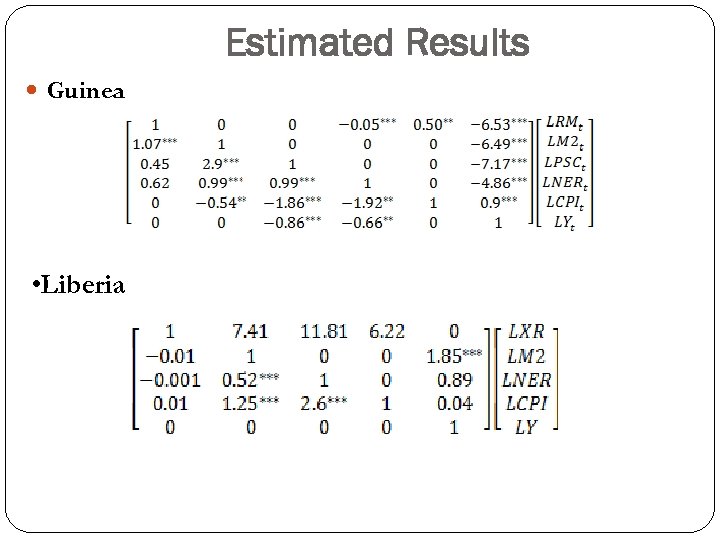 Estimated Results Guinea • Liberia
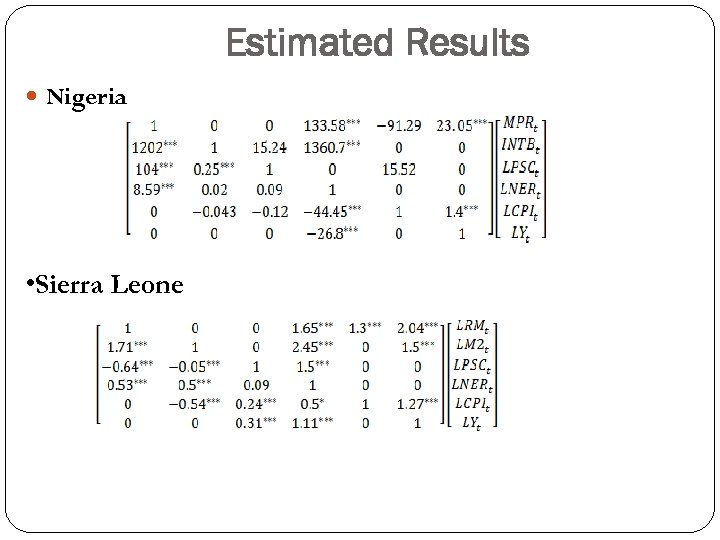 Estimated Results Nigeria • Sierra Leone
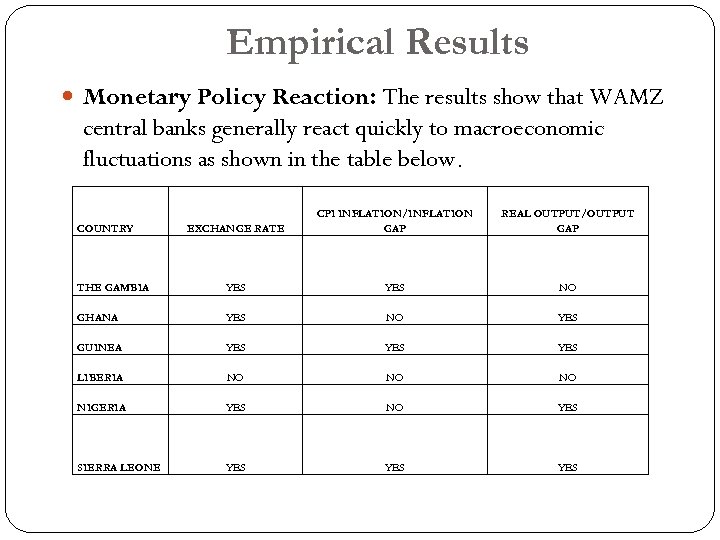 Empirical Results Monetary Policy Reaction: The results show that WAMZ central banks generally react quickly to macroeconomic fluctuations as shown in the table below. EXCHANGE RATE CPI INFLATION/INFLATION GAP REAL OUTPUT/OUTPUT GAP THE GAMBIA YES NO GHANA YES NO YES GUINEA YES YES LIBERIA NO NO NO NIGERIA YES NO YES SIERRA LEONE YES YES COUNTRY
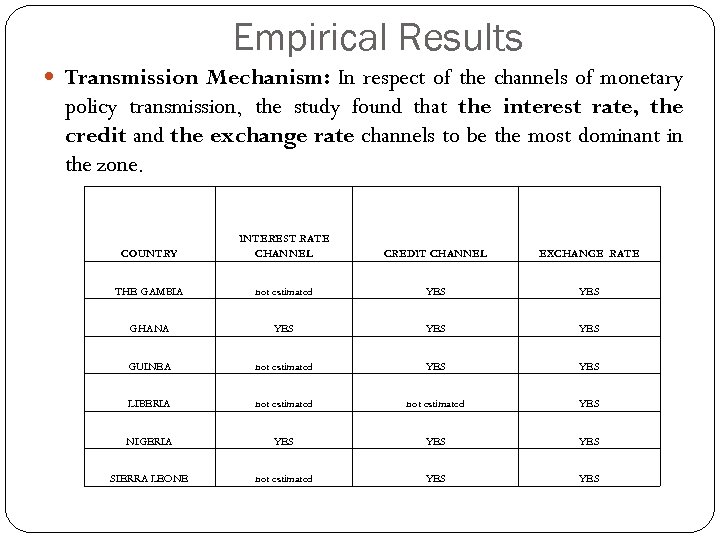 Empirical Results Transmission Mechanism: In respect of the channels of monetary policy transmission, the study found that the interest rate, the credit and the exchange rate channels to be the most dominant in the zone. COUNTRY INTEREST RATE CHANNEL CREDIT CHANNEL EXCHANGE RATE THE GAMBIA not estimated YES GHANA YES YES GUINEA not estimated YES LIBERIA not estimated YES NIGERIA YES YES SIERRA LEONE not estimated YES
 Empirical Results A striking observation from the results of the study is that whilst transmission of monetary impulses from operating targets to the intermediates target appears effective for all WAMZ economies, the transmission from intermediate targets to ultimate target and the real economy appears weak and slow. It was also found that the pass-through of exchange rate to inflation is significant and quick, explaining why most central banks in the zone show quick response to exchange rate developments
 Empirical Results In addition, it was revealed that monetary contraction significantly and in relatively limited time, squeezes credit to private sector and contracts output in most WAMZ countries, indicating high sacrifice ratio.
 Conclusion The results of the study revealed that WAMZ central banks actively and quickly respond to fluctuations in general prices, exchange rates and output. However, due to the limited scope or weaknesses in channels of monetary policy transmission, the effectiveness of monetary policy is generally constrained in economies of the zone. The study also observed that disinflationary monetary contraction results in quick and sizable squeeze in credit to private sector as well as reduction in output, indicating sizeable sacrifice ratio
 Recommendations Central banks in the zone need to continue improving their monetary policy frameworks, building robust forecasting models and enhancing staff capacity. Building of strong statistical database and improving data collection methodology as well as developing indices and conducting surveys for assessing developments and impact of policy on the real economy are essential.
 Recommendations Member countries should endeavour to widen the scope of monetary policy channels by deepening financial markets in the zone, particularly in the Gambia, Guinea, Liberia and Sierra Leone where markets are relatively shallow and limited to money market activities. Capital markets developments should also be intensified in all member countries through financial integration of the zone.
 Recommendations In view of shallowness of financial markets in the zone and weaknesses in monetary policy transmission, it is essential for central banks to consider some appropriate direct intervention programmes to reduce the sacrifice ratio of contractionary monetary policy. Key sectors like agriculture and manufacturing should be given some direct interventions as continuous monetary contraction to fight inflation with its associated interest rate hikes has the tendency to hurt output in such strategic but credit-risky sectors of the economy.
 THANK YOU