 Скачать презентацию Reaching the Rural Poor A World Bank Strategy
a335a3ee88ba6c025a2f0e8576cd40c6.ppt
- Количество слайдов: 30



Reaching the Rural Poor A World Bank Strategy for Rural Development
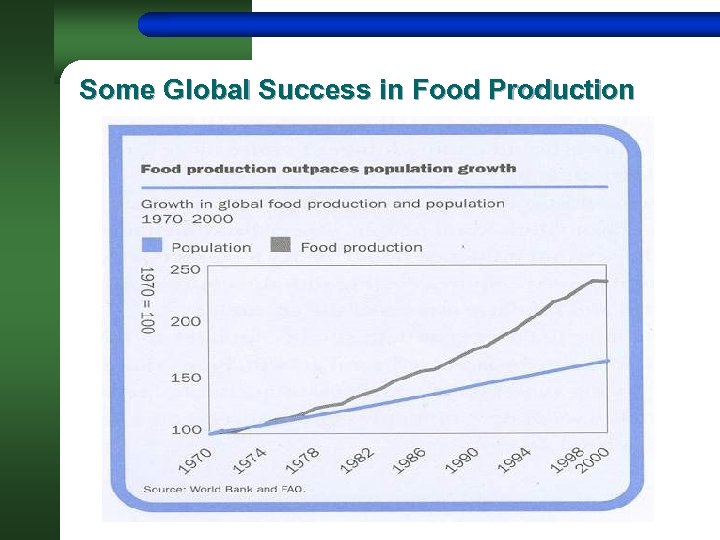
Some Global Success in Food Production
Broader Success with Agriculture l l l International price of food decreasing Caloric intake rising Percent of undernourished fallen Success rate of World Bank agricultural projects about 70% (OED) Successful rural development in China, Thailand, Central Europe, parts of Latin America was initial stimulus to their rapid economic growth
Agriculture Must Grow Faster in Most Low Income Countries to Achieve Millennium Development Goals l Rural poverty and low agricultural growth persists in most low income countries l 3. 6 % p. a per capita GDP growth is needed in low income countries to cut poverty in half by 2015 l Since 24% of low income country GDP is agricultural; agriculture must grow at about 3. 5% p. a to achieve the overall growth and poverty reduction objective
POVERTY REDUCTION IS THE SOLUTION TO HUNGER l l l The hungry are the poor; they do not earn enough to buy food, or if farmers they do not produce enough In some countries, they may also be people with poor access to food or who have nutritional deficiencies due to disease, water Poverty reduction plus improved infrastructure (including for food distribution) and social services is the solution
AGRICULTURAL DEVELOPMENT IS AT THE CONFLUENCE OF THE MDGs, HUNGER, AND SOCIAL PROTECTION l Agriculture is key to: – – Growth in most low income countries Household poverty reduction of the rural poor Food security through farm income growth and in some cases food availability Safety net for the rural poor (who are often subsistence farmers)
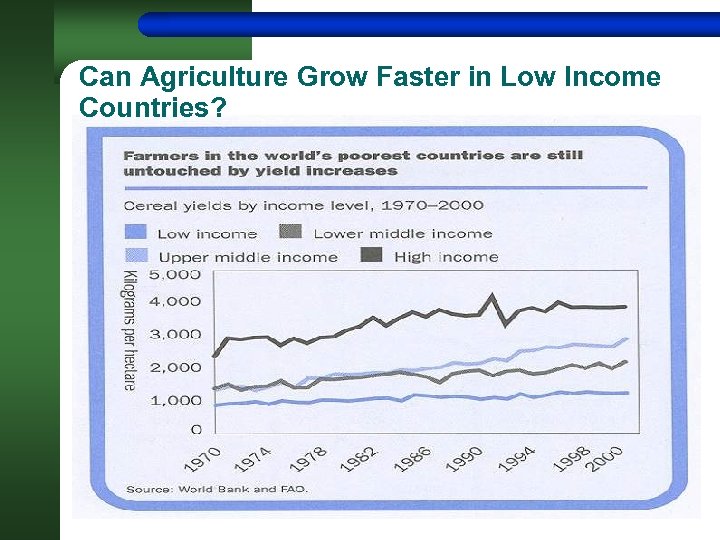
Can Agriculture Grow Faster in Low Income Countries?
A Major Problem: declining Interest by the Bank and by Other Donors Champions of rural development are weak l Other priorities have been added by governments and donors; developing countries allocate half the public budget to rural areas as they do to urban l Rural development projects often performed poorly in the past l Irrigation, water, forest, fisheries projects are often controversial l Private returns to investment in agriculture in low income countries are often very low l
The New World Bank Rural Development Strategy
Preparation Process l Regional rural development strategies l Review of project experience and analysis l Consultations in client countries, in the Bank, with donors and NGOs l Analysis published in technical documents l Corporate strategy developed through ‘bottom-up’ approach l Detailed implementation plan
New Strategic Priorities l l l Fostering broad-based rural growth, based on: agriculture as the primary source of growth, food, and safety net; combined with non-farm and private sector activity in rural areas Improving social well-being, gender equity, managing risk, and reducing vulnerability in rural areas Enhancing sustainable management of natural resources More participation by rural populations in program management Donor alliance and partnership
Responsibilities of Developing Countries l Avoid excessive taxation of farmers and agro-industry which arises from administrative pricing of outputs, overvalued exchange rates, and excessive industrial protection. l Policies and investments needed to create open markets for agricultural products, inputs, and labor, including policies which create a positive climate for private investment in farming and agroindustry. l Policies and investments in agricultural research, extension and education, in collaboration with the private sector and with foreign institutions, to allow greater participation in the global agricultural knowledge and scientific revolution.
Responsibilities of Developing Countries (continued) l Expanded investment in rural infrastructure, rural health, education, energy, telecommunications, finance, in conjunction with local communities and the private sector. l Promotion of producer organizations and trade associations, so that rural people have more responsibility and more say in rural based activities. l Decentralization of some government functions to local government authorities. l Where necessary, improved land administration and land reform.
Responsibilities of Developed Countries l Agricultural trade liberalization, for example, to the levels of tariffs and non-tariff barriers which are established for non-agricultural products. l Reduction of agricultural subsidies, which currently depress world prices and expand world agricultural market share held by developed countries. l Expansion of agricultural and rural development assistance to developing countries to the levels characteristic of the early 1990 s.
Responsibilities of Developed Countries (continued) l A focus on Sub-Saharan Africa is required in international assistance for rural development given the particularly difficult food and agricultural situation which exists there. l Better coordinate aid flows to developing countries. l Support to the transfer of scientific findings of relevance to developing country agriculture.
Overall Implementation Thrusts l l l Raise the profile of rural development in national policy Scale up innovative and successful investments, while exploring new approaches and innovation Improve the quality and impact of donor operations Implement global priorities (e. g. reduce deforestation, water pollution, over-fishing, loss of bio-diversity, adapt to climate change, share the fruits of agricultural science with poor countries) Enhance partnerships between governments, civil society, NGOs, and donor organizations for rural development, including a global forum for rural development
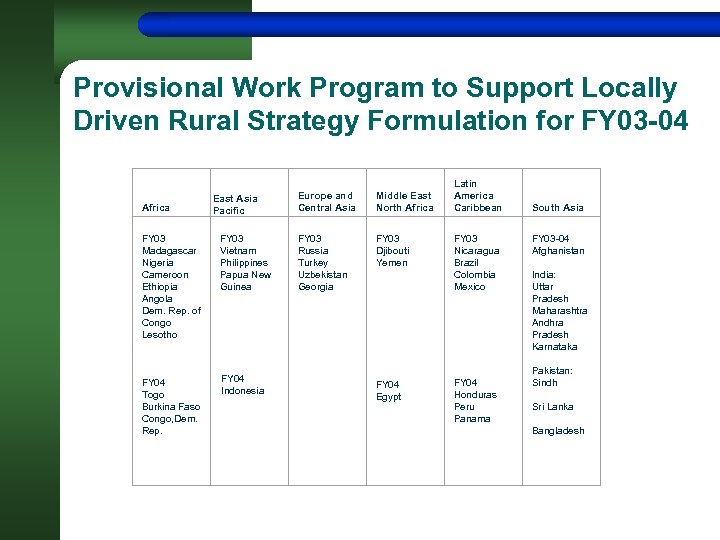
Provisional Work Program to Support Locally Driven Rural Strategy Formulation for FY 03 -04 Africa FY 03 Madagascar Nigeria Cameroon Ethiopia Angola Dem. Rep. of Congo Lesotho FY 04 Togo Burkina Faso Congo, Dem. Rep. East Asia Pacific FY 03 Vietnam Philippines Papua New Guinea FY 04 Indonesia Europe and Central Asia Middle East North Africa FY 03 Russia Turkey Uzbekistan Georgia FY 03 Djibouti Yemen FY 04 Egypt Latin America Caribbean FY 03 Nicaragua Brazil Colombia Mexico FY 04 Honduras Peru Panama South Asia FY 03 -04 Afghanistan India: Uttar Pradesh Maharashtra Andhra Pradesh Karnataka Pakistan: Sindh Sri Lanka Bangladesh
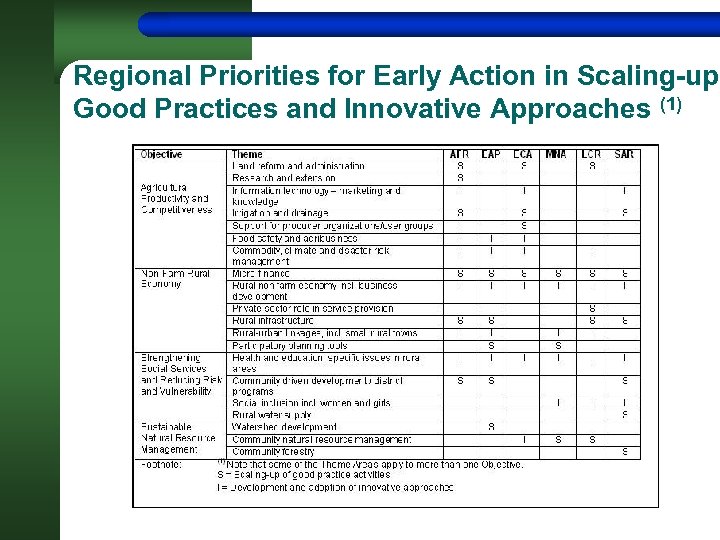
Regional Priorities for Early Action in Scaling-up Good Practices and Innovative Approaches (1)
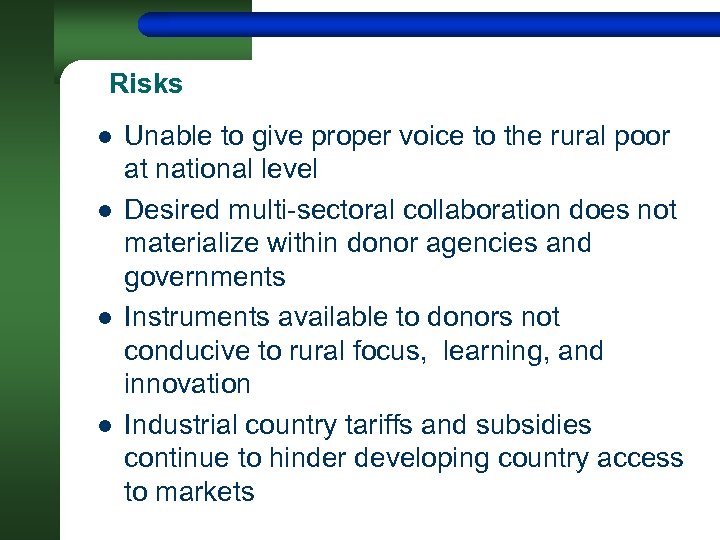
Risks l l Unable to give proper voice to the rural poor at national level Desired multi-sectoral collaboration does not materialize within donor agencies and governments Instruments available to donors not conducive to rural focus, learning, and innovation Industrial country tariffs and subsidies continue to hinder developing country access to markets
Revised Approach to Agriculture in Developing Countries by Governments and Donors l l Improve productivity and quality of the entire food chain from input supply, to farm, to processor to market At the farm level, diversify agriculture and boost high-value products, and tailor assistance to each major farm type Renew commitments to science and technology Promote food safety
Recognition of the Importance of Rural Non-Farm Economy and the Private Sector l Improve investment climate for private investment in rural areas, promote labor mobility l Provide agricultural, financial, infrastructural, market and social services in part through the private sector, using market solutions l Promote producer organizations, trade associations, business chambers, and publicprivate cooperation
Developing Rural Infrastructure and Social Assets, and Managing Risks are Essential l l l Improve access to infrastructure and social services Improve access to nutrition and health Increase access to and improving the quality of rural education Provide assistance in managing household food security Provide new risk management instruments Build the capacity of the public and private sectors and civil society to manage their own services
A Continued Commitment to Enhancing Sustainable Management of Natural Resources l l Environment, forestry and water strategies in the Bank give overall guidelines in approaching rural natural resource management Elements will include – Reducing land degradation – Improving water management – Sustainable production of forest products while protecting the environment and preserving critical natural habitats
Global Forum for Rural Development
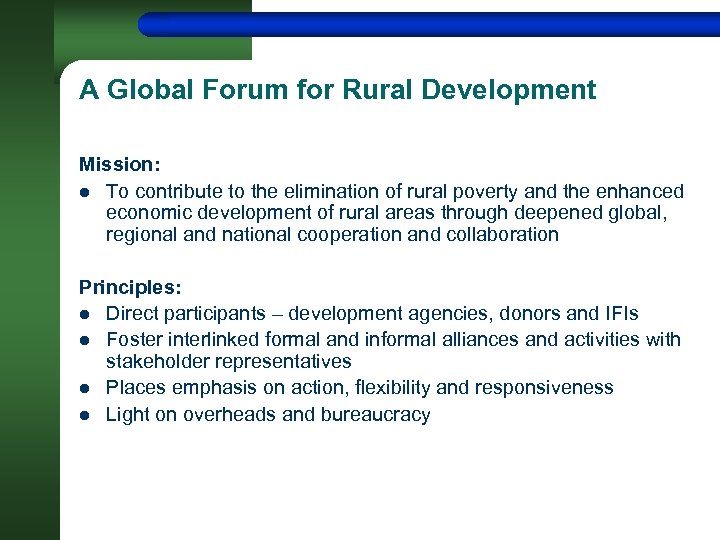
A Global Forum for Rural Development Mission: l To contribute to the elimination of rural poverty and the enhanced economic development of rural areas through deepened global, regional and national cooperation and collaboration Principles: l Direct participants – development agencies, donors and IFIs l Foster interlinked formal and informal alliances and activities with stakeholder representatives l Places emphasis on action, flexibility and responsiveness l Light on overheads and bureaucracy
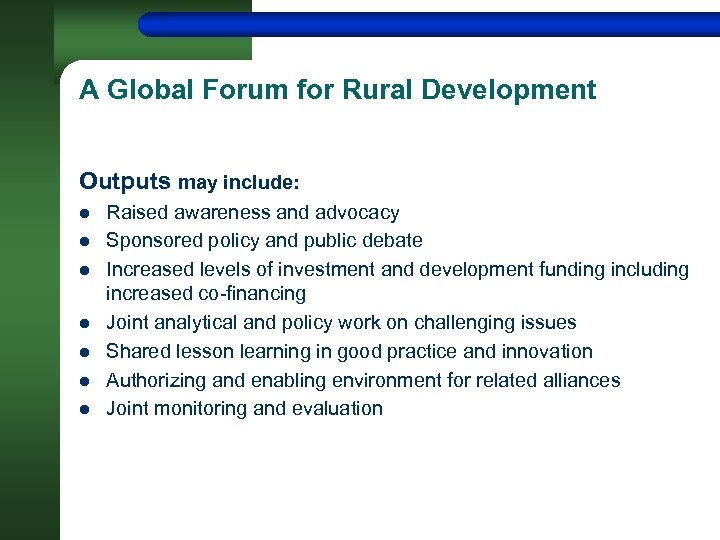
A Global Forum for Rural Development Outputs may include: l l l l Raised awareness and advocacy Sponsored policy and public debate Increased levels of investment and development funding including increased co-financing Joint analytical and policy work on challenging issues Shared lesson learning in good practice and innovation Authorizing and enabling environment for related alliances Joint monitoring and evaluation
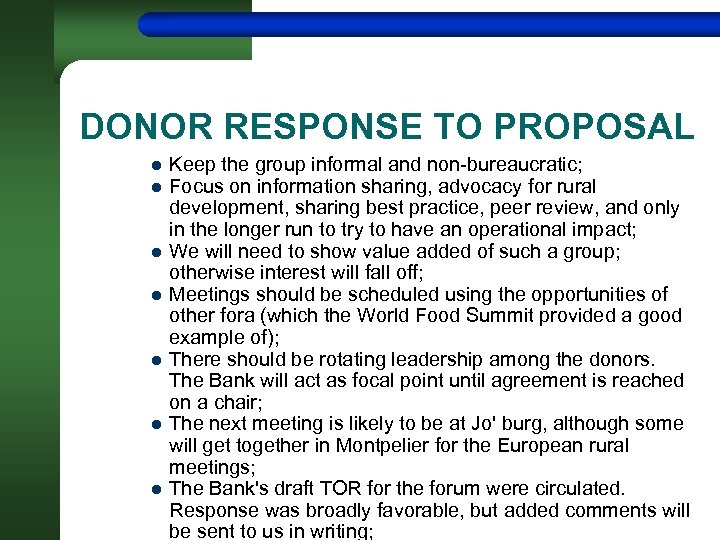
DONOR RESPONSE TO PROPOSAL l l l l Keep the group informal and non-bureaucratic; Focus on information sharing, advocacy for rural development, sharing best practice, peer review, and only in the longer run to try to have an operational impact; We will need to show value added of such a group; otherwise interest will fall off; Meetings should be scheduled using the opportunities of other fora (which the World Food Summit provided a good example of); There should be rotating leadership among the donors. The Bank will act as focal point until agreement is reached on a chair; The next meeting is likely to be at Jo' burg, although some will get together in Montpelier for the European rural meetings; The Bank's draft TOR for the forum were circulated. Response was broadly favorable, but added comments will be sent to us in writing;
l l There is an issue of where the secretariat should be based. The FAO would like to do this and I support this view. However, there were some questions asked about how this would work. Each donor is to name a person who is the focal point; Each meeting would have at least one substantive subject for discussion. I suggested that we should discuss the differences between our respective rural and agricultural strategies. There was strong support for the idea of having a substantive topic to discuss at each meeting, but mixed support on the subject that I suggested (the German response below is not favorable to the topic). Any other topics suggested? Avoid giving impression of donor ganging up on developing countries. But there was a view that developing countries should not at this point be invited to join, before we have established exactly what we can achieve with this forum.
For Further Information and Comment www. worldbank. org/ruralstrategy
Скачать презентацию Reaching the Rural Poor A World Bank Strategy
a335a3ee88ba6c025a2f0e8576cd40c6.ppt