 Скачать презентацию RE-ALLIGNMENT ZAMBIAN SEED LEGISLATION PROGRESS REPORT Zambia National
3be4d1946e5edc4ae9bc07649eae88fe.ppt
- Количество слайдов: 13



RE-ALLIGNMENT ZAMBIAN SEED LEGISLATION –PROGRESS REPORT Zambia National Task Team
• Task team comprise two groups • Seed Certification and Quality Assurance/Variety Testing and Release – Team of four experts assembled • Three Seeds Experts • Legal expert • Quarantine and Phytosanitary services – Team of Five experts • Four PQPS experts and one legal expert
• • Allignment Approach: Team reviewed current legislation Identified all relevant of documents to alignment Following documents were identified and collate: – Plant Variety and Seeds Act + SI – Plant pests and Disease Act + SI – SADC technical agreements – Cotton Act – Tobacco Act – COMESA protocols on Seeds – National Seed policy
– International Standard s for Phytosanitary Measures (ISPMs) – National Agriculture policy (revised draft) – Trade policy from Ministry of Commerce – Plant Breeder’s Rights and regulations – Baseline of the Seed Industry in Zambia
Variety, Testing and release, SC& QA (Substantial Issues/Gaps identified) • The current principal Act lacks specific provisions to regulate varieties (Using the Sis) • The Zambian standards have generalised minimum number of inspections for all crops while the SADC standards specifies minimum number of field inspections for each crop • There is a difference in the number of seed classes between Zambia and SADC. Zambia has six classes while SADC has five classes
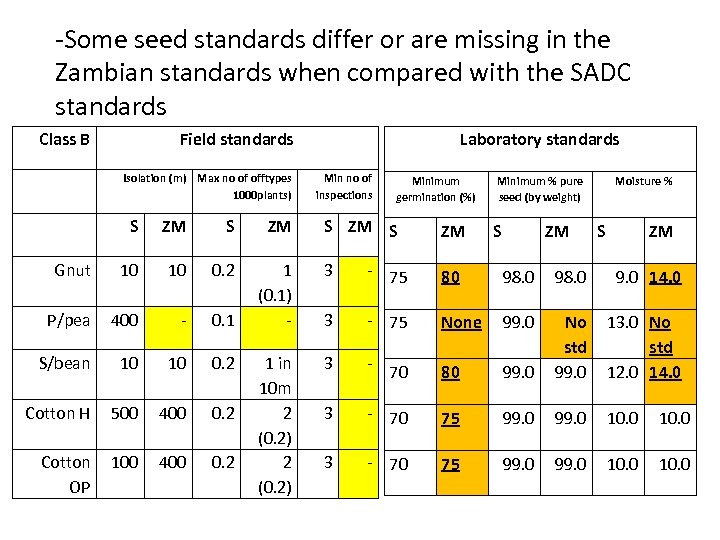
-Some seed standards differ or are missing in the Zambian standards when compared with the SADC standards Class B Field standards Isolation (m) Max no of offtypes 1000 plants) S ZM Gnut 10 10 0. 2 P/pea 400 - 0. 1 S/bean 10 10 0. 2 Cotton H 500 400 0. 2 Cotton OP 100 400 0. 2 Laboratory standards Min no of inspections Minimum germination (%) Minimum % pure seed (by weight) Moisture % S ZM 1 (0. 1) - 3 - 75 80 98. 0 9. 0 14. 0 3 - 75 None 99. 0 1 in 10 m 2 (0. 2) 3 - 70 80 99. 0 No std 99. 0 13. 0 No std 12. 0 14. 0 3 - 70 75 99. 0 10. 0 S ZM
• The color codes for seed class C 1 and C 2 labels differ between Zambian standards and SADC • There is a difference in the information to be put on the label between the current Zambian seed label and the SADC label • The application for terminology used to describe a seed certificate differs between Zambian regulations and the SADC agreement
• Progress (Variety Testing and Release, SC &QA) – Decided to review both principle legislation and regulations – Cleaner route to amend entire legislation – Have so far drafted the provisions for variety testing and release which were missing in the principle legislation – Drafted amendments in the principle legislation where necessary – Currently consulting side by side with drafting – Drafting SI s as well
PQPS-Substantial Issues/Gaps identified • SADC Pest List and Zambian pest list is limiting • Documentation Used (SADC certificates have a SADC logo while National legislation use national logo) • Terminologies Used (National legislation has missing terminologies as compared to SADC

• Progress – Instead of adopting the actual SADC pest list, the pest risk analysis process has been included in the draft SI – Developed a surveillance SI which will support Pest Risk analysis – Domesticated the IPPC documentation which is more encompassing (covers SADC agreement requirements) – Adopted definitions as outlined in the ISPM 5 to take care of national and international requirements

Conclusion ZERO drafts are ready (Phytosanitary regulations, Plant variety and Seeds Act, Seed regulations) Way forward-in work plan § team met to identify relevant documents and discuss the work plan. § Collecting relevant documentation § Review of Act to identify inconsistencies with SADC agreements § Consult with key stakeholders (at their offices) – Was to start this week § Review and draft amendments (Principal Act) started
§ Review and draft amendments (Regulations) § Circulate draft internally to senior MAL officers of departments concerned to gather views and incorporate § Hold a stakeholder meeting with line ministries and policy makers (FANRPAN NODE) – Get comments and advocacy role § Incorporate comments from line ministries policy makers § Hold a national stakeholder workshop to present the amendments and get stakeholders views/advocacy
§ Incorporate stakeholders views into the draft § Present the draft to Directors SCC/ZARI for onward transmission to Ministry of Justice through the Permanent Secretary of the Ministry of Agriculture and Livestock
Скачать презентацию RE-ALLIGNMENT ZAMBIAN SEED LEGISLATION PROGRESS REPORT Zambia National
3be4d1946e5edc4ae9bc07649eae88fe.ppt