


 Скачать презентацию RD 50 Recent Results Development of radiation hard
149f1a7a51f00957226ae91ba03cf688.ppt
- Количество слайдов: 26
 RD 50 Recent Results Development of radiation hard sensors for SLHC Anna Macchiolo* *Max-Planck-Institut für Physik on behalf of the RD 50 Collaboration OUTLINE • • • The RD 50 Collaboration: scope and methods Defect characterization Results on irradiated detectors Planar pixel productions 3 D sensor developments http: //www. cern. ch/rd 50 Michael Moll – PIXEL 2005, September 7, 2005
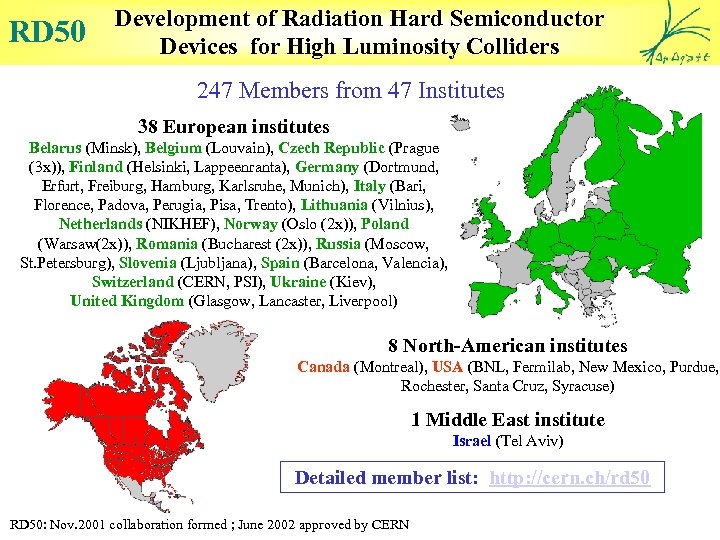 RD 50 Development of Radiation Hard Semiconductor Devices for High Luminosity Colliders 247 Members from 47 Institutes 38 European institutes Belarus (Minsk), Belgium (Louvain), Czech Republic (Prague (3 x)), Finland (Helsinki, Lappeenranta), Germany (Dortmund, Erfurt, Freiburg, Hamburg, Karlsruhe, Munich), Italy (Bari, Florence, Padova, Perugia, Pisa, Trento), Lithuania (Vilnius), Netherlands (NIKHEF), Norway (Oslo (2 x)), Poland (Warsaw(2 x)), Romania (Bucharest (2 x)), Russia (Moscow, St. Petersburg), Slovenia (Ljubljana), Spain (Barcelona, Valencia), Switzerland (CERN, PSI), Ukraine (Kiev), United Kingdom (Glasgow, Lancaster, Liverpool) 8 North-American institutes Canada (Montreal), USA (BNL, Fermilab, New Mexico, Purdue, Rochester, Santa Cruz, Syracuse) 1 Middle East institute Israel (Tel Aviv) Detailed member list: http: //cern. ch/rd 50 RD 50: Nov. 2001 collaboration formed ; June 2002 approved by CERN
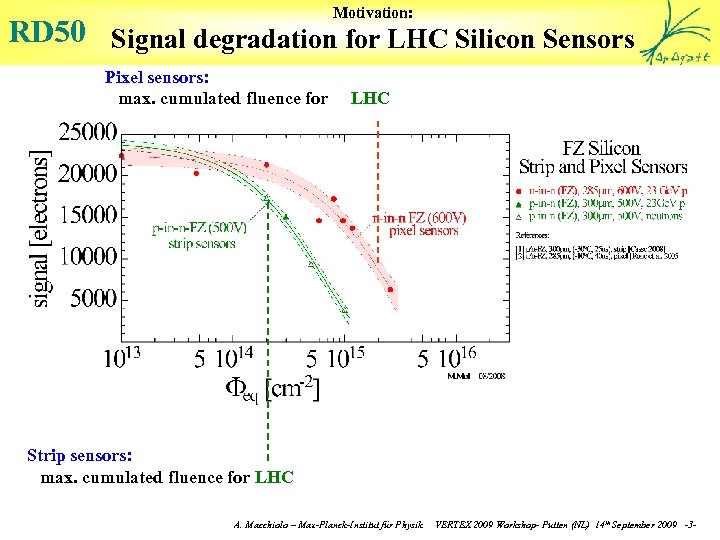 Motivation: RD 50 Signal degradation for LHC Silicon Sensors Pixel sensors: max. cumulated fluence for LHC Strip sensors: max. cumulated fluence for LHC A. Macchiolo – Max-Planck-Institut für Physik VERTEX 2009 Workshop- Putten (NL) 14 th September 2009 -3 -
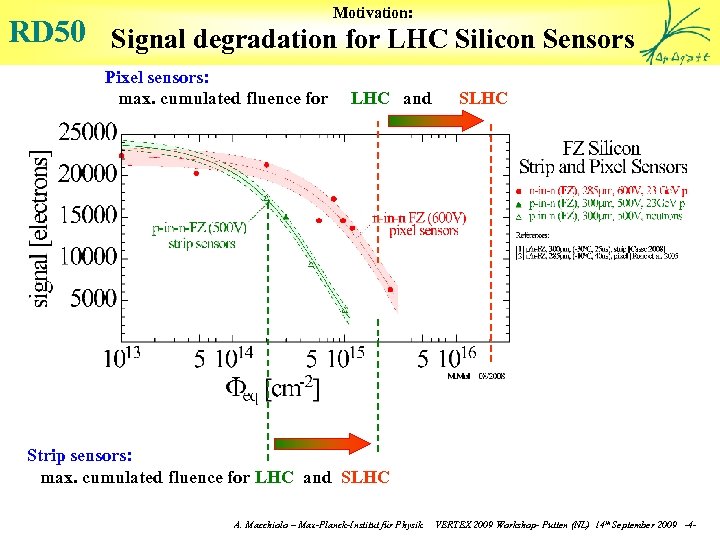 Motivation: RD 50 Signal degradation for LHC Silicon Sensors Pixel sensors: max. cumulated fluence for LHC and SLHC Strip sensors: max. cumulated fluence for LHC and SLHC A. Macchiolo – Max-Planck-Institut für Physik VERTEX 2009 Workshop- Putten (NL) 14 th September 2009 -4 -
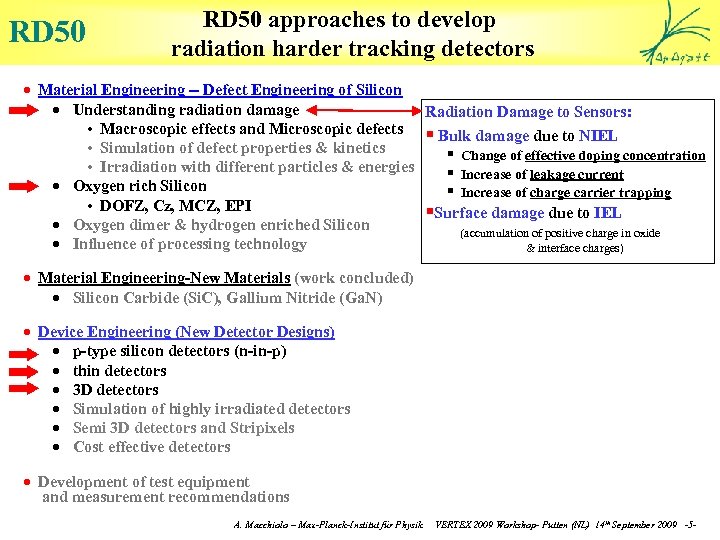 RD 50 approaches to develop radiation harder tracking detectors · Material Engineering -- Defect Engineering of Silicon · Understanding radiation damage Radiation Damage to Sensors: • Macroscopic effects and Microscopic defects § Bulk damage due to NIEL • Simulation of defect properties & kinetics § Change of effective doping concentration • Irradiation with different particles & energies § Increase of leakage current · Oxygen rich Silicon § Increase of charge carrier trapping • DOFZ, Cz, MCZ, EPI §Surface damage due to IEL · Oxygen dimer & hydrogen enriched Silicon (accumulation of positive charge in oxide · Influence of processing technology & interface charges) · Material Engineering-New Materials (work concluded) · Silicon Carbide (Si. C), Gallium Nitride (Ga. N) · Device Engineering (New Detector Designs) · p-type silicon detectors (n-in-p) · thin detectors · 3 D detectors · Simulation of highly irradiated detectors · Semi 3 D detectors and Stripixels · Cost effective detectors · Development of test equipment and measurement recommendations A. Macchiolo – Max-Planck-Institut für Physik VERTEX 2009 Workshop- Putten (NL) 14 th September 2009 -5 -
![RD 50 standard for particle detectors Silicon Material under Investigation Material Thickness [mm] Symbol](https://present5.com/presentation/149f1a7a51f00957226ae91ba03cf688/image-6.jpg "RD 50 standard for particle detectors Silicon Material under Investigation Material Thickness [mm] Symbol") RD 50 standard for particle detectors Silicon Material under Investigation Material Thickness [mm] Symbol ( cm) [Oi] (cm-3) Standard FZ (n- and p-type) 50, 100, 150 300 FZ 1– 30 10 3 < 5 1016 300 DOFZ 1– 7 10 3 ~ 1– 2 1017 100, 300 MCz ~ 1 10 3 ~ 5 1017 300 Cz ~ 1 10 3 ~ 8 -9 1017 25, 50, 75, 100, 150 EPI n: 50 – 500 p: 50 -1000 < 1 1017 75 EPI–DO 50 – 100 ~ 6 1017 Diffusion oxygenated FZ (n- and p-type) used for LHC Pixel detectors “new” silicon material Magnetic Czochralski Si, Okmetic, Finland (n- and p-type) Czochralski Si, Sumitomo, Japan (n-type) Epitaxial layers on Cz-substrates, ITME, Poland (n- and p-type) Diffusion oxyg. Epitaxial layers on CZ · DOFZ silicon · CZ/MCZ silicon - Enriched with oxygen on wafer level, inhomogeneous distribution of oxygen · Epi silicon - high Oi , O 2 i content due to out-diffusion from the CZ substrate (inhomogeneous) - thin layers: high doping possible (low starting resistivity) - as EPI, however additional Oi diffused reaching homogeneous Oi content · Epi-Do silicon - high Oi (oxygen) and O 2 i (oxygen dimer) concentration (homogeneous) - formation of shallow Thermal Donors possible A. Macchiolo – Max-Planck-Institut für Physik VERTEX 2009 Workshop- Putten (NL) 14 th September 2009 -6 -
RD 50 standard for particle detectors Silicon Material under Investigation Material Thickness [mm] Symbol ( cm) [Oi] (cm-3) Standard FZ (n- and p-type) 50, 100, 150 300 FZ 1– 30 10 3 < 5 1016 300 DOFZ 1– 7 10 3 ~ 1– 2 1017 100, 300 MCz ~ 1 10 3 ~ 5 1017 300 Cz ~ 1 10 3 ~ 8 -9 1017 25, 50, 75, 100, 150 EPI n: 50 – 500 p: 50 -1000 < 1 1017 75 EPI–DO 50 – 100 ~ 6 1017 Diffusion oxygenated FZ (n- and p-type) used for LHC Pixel detectors “new” silicon material Magnetic Czochralski Si, Okmetic, Finland (n- and p-type) Czochralski Si, Sumitomo, Japan (n-type) Epitaxial layers on Cz-substrates, ITME, Poland (n- and p-type) Diffusion oxyg. Epitaxial layers on CZ · DOFZ silicon · CZ/MCZ silicon - Enriched with oxygen on wafer level, inhomogeneous distribution of oxygen · Epi silicon - high Oi , O 2 i content due to out-diffusion from the CZ substrate (inhomogeneous) - thin layers: high doping possible (low starting resistivity) - as EPI, however additional Oi diffused reaching homogeneous Oi content · Epi-Do silicon - high Oi (oxygen) and O 2 i (oxygen dimer) concentration (homogeneous) - formation of shallow Thermal Donors possible A. Macchiolo – Max-Planck-Institut für Physik VERTEX 2009 Workshop- Putten (NL) 14 th September 2009 -6 -
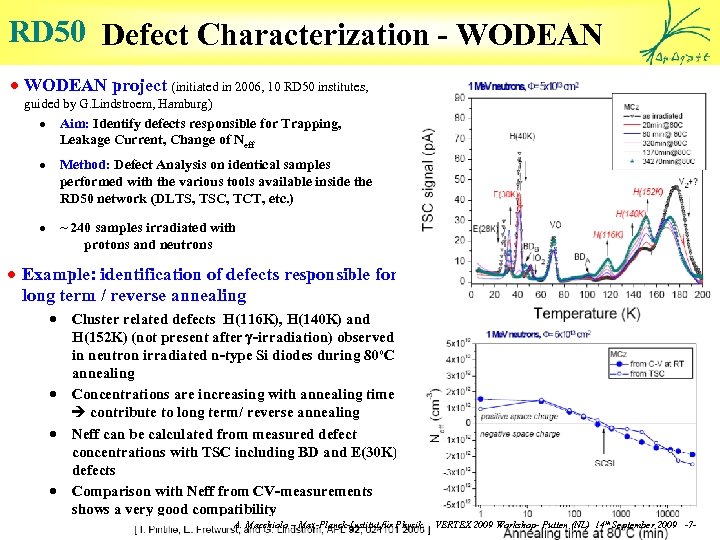 RD 50 Defect Characterization - WODEAN · WODEAN project (initiated in 2006, 10 RD 50 institutes, guided by G. Lindstroem, Hamburg) · Aim: Identify defects responsible for Trapping, Leakage Current, Change of Neff · Method: Defect Analysis on identical samples performed with the various tools available inside the RD 50 network (DLTS, TSC, TCT, etc. ) · ~ 240 samples irradiated with protons and neutrons · Example: identification of defects responsible for long term / reverse annealing · Cluster related defects H(116 K), H(140 K) and H(152 K) (not present after -irradiation) observed in neutron irradiated n-type Si diodes during 80 o. C annealing · Concentrations are increasing with annealing time contribute to long term/ reverse annealing · Neff can be calculated from measured defect concentrations with TSC including BD and E(30 K) defects · Comparison with Neff from CV-measurements shows a very good compatibility A. Macchiolo – Max-Planck-Institut für Physik VERTEX 2009 Workshop- Putten (NL) 14 th September 2009 -7 -
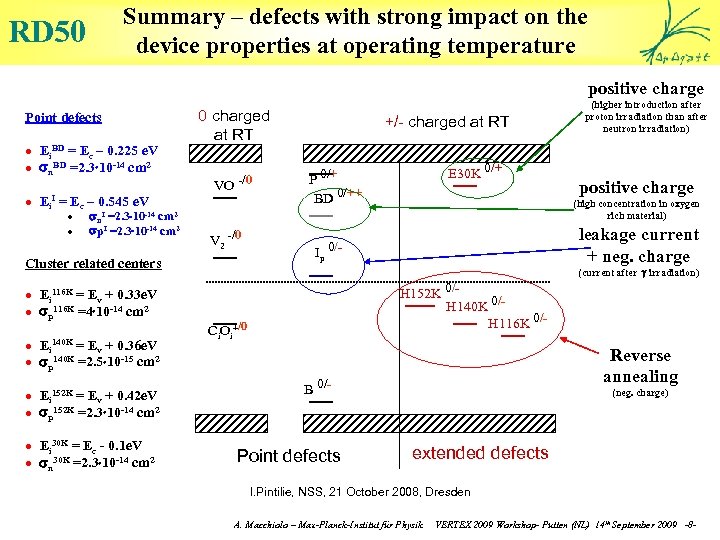 Summary – defects with strong impact on the device properties at operating temperature RD 50 positive charge Point defects · Ei. BD = Ec – 0. 225 e. V · n. BD =2. 3 10 -14 cm 2 · Ei. I = Ec – 0. 545 e. V · · n. I =2. 3 10 -14 cm 2 p. I =2. 3 10 -14 cm 2 0 charged at RT VO -/0 V 2 -/0 Cluster related centers · Ei 116 K = Ev + 0. 33 e. V · p 116 K =4 10 -14 cm 2 · Ei 140 K = Ev + 0. 36 e. V · p 140 K =2. 5 10 -15 cm 2 · Ei 152 K = Ev + 0. 42 e. V · p 152 K =2. 3 10 -14 cm 2 · Ei 30 K = Ec - 0. 1 e. V · n 30 K =2. 3 10 -14 cm 2 +/- charged at RT E 30 K 0/+ P 0/+ BD 0/++ (higher introduction after proton irradiation than after neutron irradiation) positive charge (high concentration in oxygen rich material) leakage current + neg. charge Ip 0/- (current after irradiation) H 152 K 0/H 140 K 0/H 116 K 0/- Ci. Oi+/0 Reverse annealing B 0/- Point defects (neg. charge) extended defects I. Pintilie, NSS, 21 October 2008, Dresden A. Macchiolo – Max-Planck-Institut für Physik VERTEX 2009 Workshop- Putten (NL) 14 th September 2009 -8 -
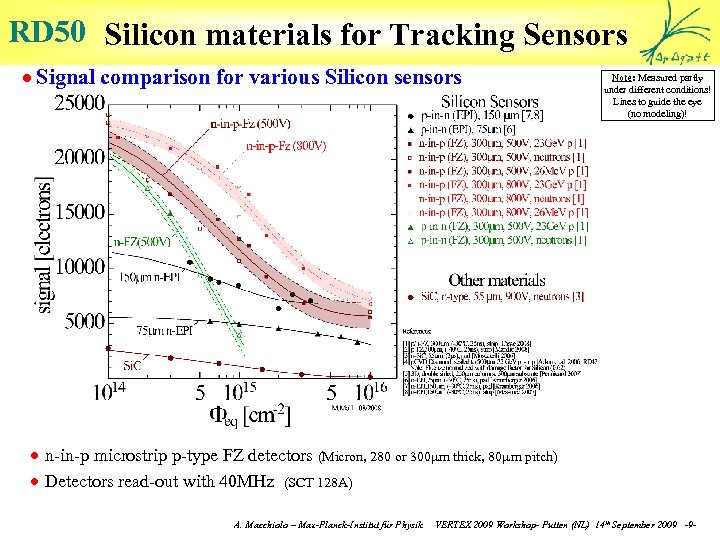 RD 50 Silicon materials for Tracking Sensors · Signal comparison for various Silicon sensors Note: Measured partly under different conditions! Lines to guide the eye (no modeling)! · n-in-p microstrip p-type FZ detectors (Micron, 280 or 300 mm thick, 80 mm pitch) · Detectors read-out with 40 MHz (SCT 128 A) A. Macchiolo – Max-Planck-Institut für Physik VERTEX 2009 Workshop- Putten (NL) 14 th September 2009 -9 -
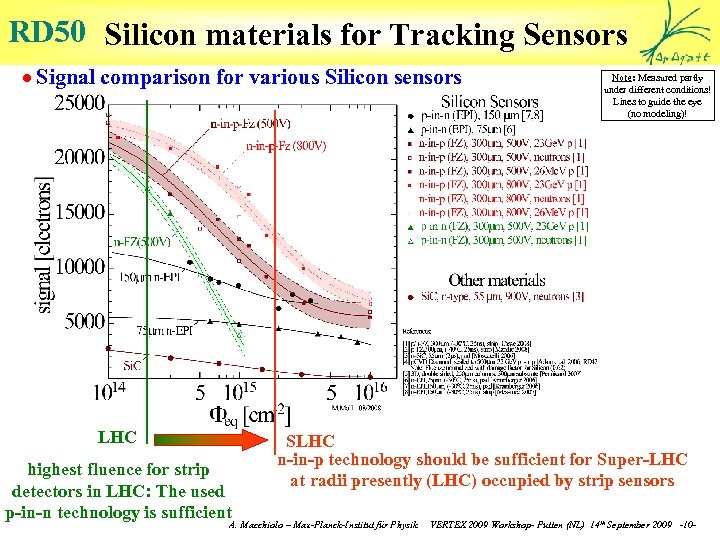 RD 50 Silicon materials for Tracking Sensors · Signal comparison for various Silicon sensors LHC highest fluence for strip detectors in LHC: The used p-in-n technology is sufficient Note: Measured partly under different conditions! Lines to guide the eye (no modeling)! SLHC n-in-p technology should be sufficient for Super-LHC at radii presently (LHC) occupied by strip sensors A. Macchiolo – Max-Planck-Institut für Physik VERTEX 2009 Workshop- Putten (NL) 14 th September 2009 -10 -
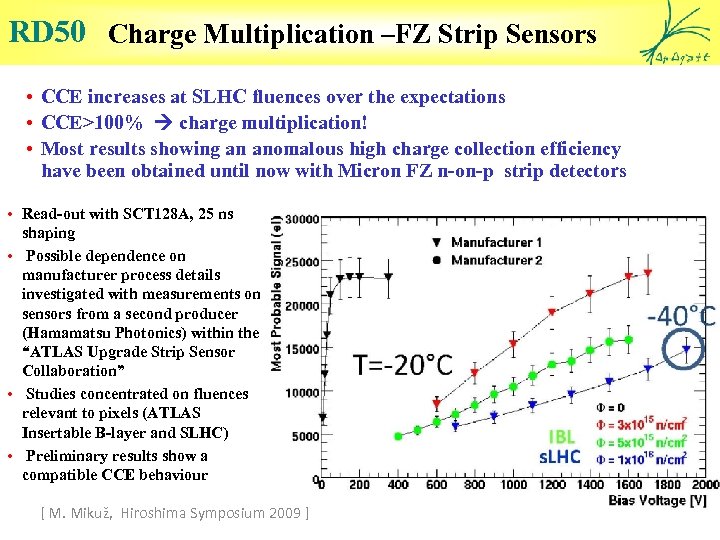 RD 50 Charge Multiplication –FZ Strip Sensors • CCE increases at SLHC fluences over the expectations • CCE>100% charge multiplication! • Most results showing an anomalous high charge collection efficiency have been obtained until now with Micron FZ n-on-p strip detectors • Read-out with SCT 128 A, 25 ns shaping • Possible dependence on manufacturer process details investigated with measurements on sensors from a second producer (Hamamatsu Photonics) within the “ATLAS Upgrade Strip Sensor Collaboration” • Studies concentrated on fluences relevant to pixels (ATLAS Insertable B-layer and SLHC) • Preliminary results show a compatible CCE behaviour [ M. Mikuž, Hiroshima Symposium 2009 ]
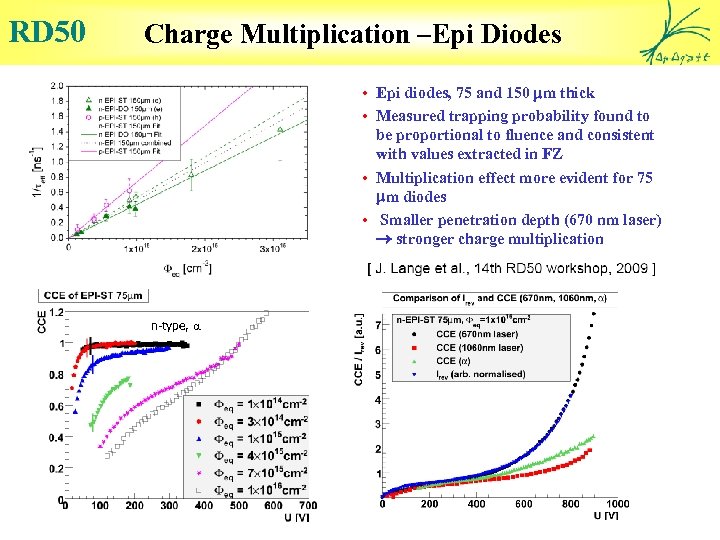 RD 50 Charge Multiplication –Epi Diodes • Epi diodes, 75 and 150 mm thick • Measured trapping probability found to be proportional to fluence and consistent with values extracted in FZ • Multiplication effect more evident for 75 mm diodes • Smaller penetration depth (670 nm laser) stronger charge multiplication n-type, a
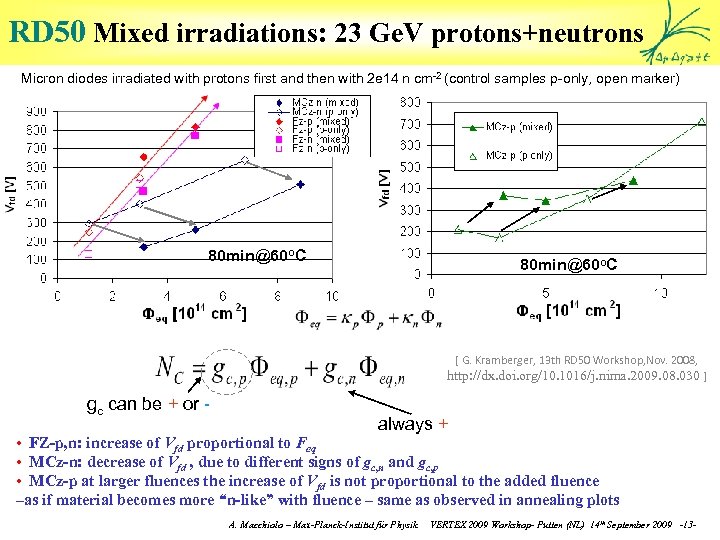 RD 50 Mixed irradiations: 23 Ge. V protons+neutrons Micron diodes irradiated with protons first and then with 2 e 14 n cm-2 (control samples p-only, open marker) 80 min@60 o. C [ G. Kramberger, 13 th RD 50 Workshop, Nov. 2008, http: //dx. doi. org/10. 1016/j. nima. 2009. 08. 030 ] gc can be + or - always + • FZ-p, n: increase of Vfd proportional to Feq • MCz-n: decrease of Vfd , due to different signs of gc, n and gc, p • MCz-p at larger fluences the increase of Vfd is not proportional to the added fluence –as if material becomes more “n-like” with fluence – same as observed in annealing plots A. Macchiolo – Max-Planck-Institut für Physik VERTEX 2009 Workshop- Putten (NL) 14 th September 2009 -13 -
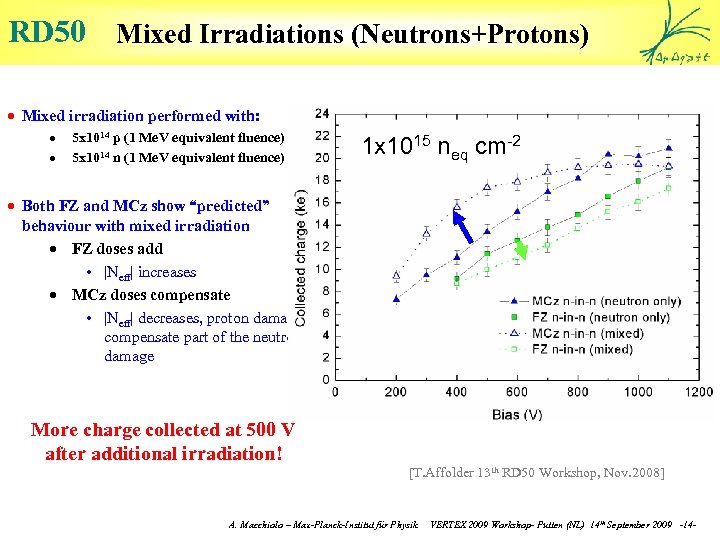 RD 50 Mixed Irradiations (Neutrons+Protons) · Mixed irradiation performed with: · · 5 x 10¹⁴ p (1 Me. V equivalent fluence) 5 x 10¹⁴ n (1 Me. V equivalent fluence) 1 x 10¹⁵ neq cm-2 · Both FZ and MCz show “predicted” behaviour with mixed irradiation · FZ doses add • |Neff| increases · MCz doses compensate • |Neff| decreases, proton damage compensate part of the neutron damage More charge collected at 500 V after additional irradiation! [T. Affolder 13 th RD 50 Workshop, Nov. 2008] A. Macchiolo – Max-Planck-Institut für Physik VERTEX 2009 Workshop- Putten (NL) 14 th September 2009 -14 -
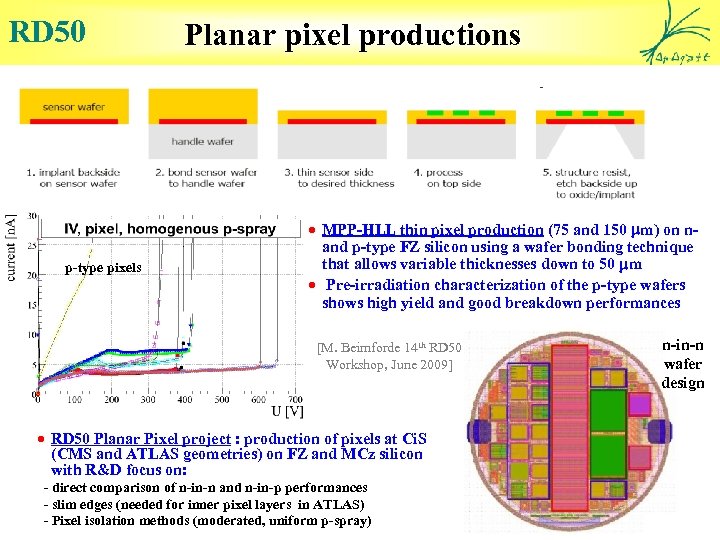 RD 50 p-type pixels Planar pixel productions · MPP-HLL thin pixel production (75 and 150 mm) on nand p-type FZ silicon using a wafer bonding technique that allows variable thicknesses down to 50 mm · Pre-irradiation characterization of the p-type wafers shows high yield and good breakdown performances [M. Beimforde 14 th RD 50 Workshop, June 2009] · RD 50 Planar Pixel project : production of pixels at Ci. S (CMS and ATLAS geometries) on FZ and MCz silicon with R&D focus on: - direct comparison of n-in-n and n-in-p performances - slim edges (needed for inner pixel layers in ATLAS) - Pixel isolation methods (moderated, uniform p-spray) n-in-n wafer design
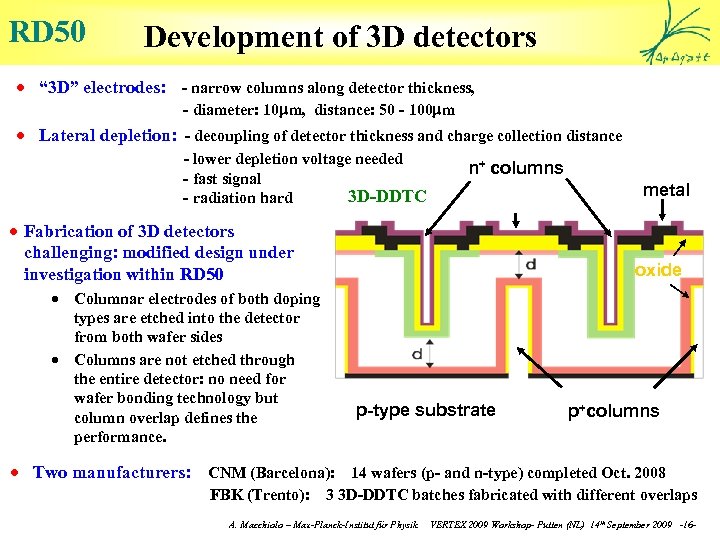 RD 50 Development of 3 D detectors · “ 3 D” electrodes: - narrow columns along detector thickness, - diameter: 10 mm, distance: 50 - 100 mm · Lateral depletion: - decoupling of detector thickness and charge collection distance - lower depletion voltage needed - fast signal 3 D-DDTC - radiation hard n+ columns metal · Fabrication of 3 D detectors challenging: modified design under investigation within RD 50 · Columnar electrodes of both doping types are etched into the detector from both wafer sides · Columns are not etched through the entire detector: no need for wafer bonding technology but column overlap defines the performance. oxide p-type substrate p+columns · Two manufacturers: CNM (Barcelona): 14 wafers (p- and n-type) completed Oct. 2008 FBK (Trento): 3 3 D-DDTC batches fabricated with different overlaps A. Macchiolo – Max-Planck-Institut für Physik VERTEX 2009 Workshop- Putten (NL) 14 th September 2009 -16 -
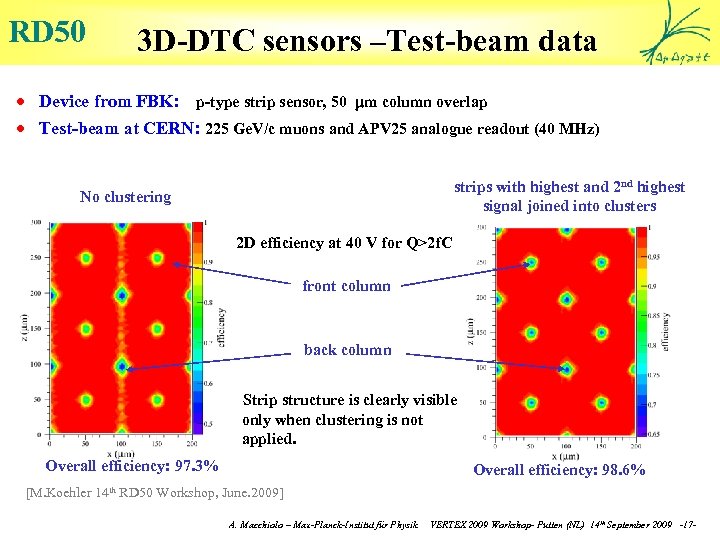 RD 50 3 D-DTC sensors –Test-beam data · Device from FBK: p-type strip sensor, 50 mm column overlap · Test-beam at CERN: 225 Ge. V/c muons and APV 25 analogue readout (40 MHz) strips with highest and 2 nd highest signal joined into clusters No clustering 2 D efficiency at 40 V for Q>2 f. C front column back column Strip structure is clearly visible only when clustering is not applied. Overall efficiency: 97. 3% Overall efficiency: 98. 6% [M. Koehler 14 th RD 50 Workshop, June. 2009] A. Macchiolo – Max-Planck-Institut für Physik VERTEX 2009 Workshop- Putten (NL) 14 th September 2009 -17 -
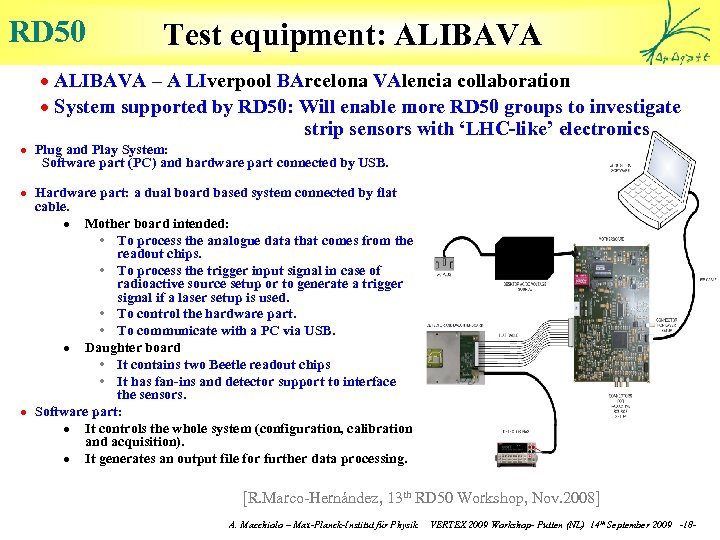 RD 50 Test equipment: ALIBAVA · ALIBAVA – A LIverpool BArcelona VAlencia collaboration · System supported by RD 50: Will enable more RD 50 groups to investigate strip sensors with ‘LHC-like’ electronics · Plug and Play System: Software part (PC) and hardware part connected by USB. · Hardware part: a dual board based system connected by flat cable. · Mother board intended: • To process the analogue data that comes from the readout chips. • To process the trigger input signal in case of radioactive source setup or to generate a trigger signal if a laser setup is used. • To control the hardware part. • To communicate with a PC via USB. · Daughter board • It contains two Beetle readout chips • It has fan-ins and detector support to interface the sensors. · Software part: · It controls the whole system (configuration, calibration and acquisition). · It generates an output file for further data processing. [R. Marco-Hernández, 13 th RD 50 Workshop, Nov. 2008] A. Macchiolo – Max-Planck-Institut für Physik VERTEX 2009 Workshop- Putten (NL) 14 th September 2009 -18 -
 RD 50 achievements & links to LHC Experiments Some important contributions of RD 50 towards the SLHC detectors: · p-type silicon (brought forward by RD 50 community) is now considered to be the base line option for the ATLAS Strip Tracker upgrade · n- MCZ (introduced by RD 50 community) has improved performance in mixed fields due to compensation of neutron and proton damage: MCZ is under investigation in ATLAS, CMS and LHCb · RD 50 results on very highly irradiated silicon strip sensors have shown that planar pixel sensors are a promising option also for the upgrade of the Experiments. · Charge multiplication effect observed for heavily irradiated sensors (diodes and strips). A dedicated R&D effort will be launched in RD 50 to understand the underlying multiplication mechanism and optimize the CCE performances. A. Macchiolo – Max-Planck-Institut für Physik VERTEX 2009 Workshop- Putten (NL) 14 th September 2009 -19 -
 RD 50 Spares A. Macchiolo – Max-Planck-Institut für Physik VERTEX 2009 Workshop- Putten (NL) 14 th September 2009 -20 -
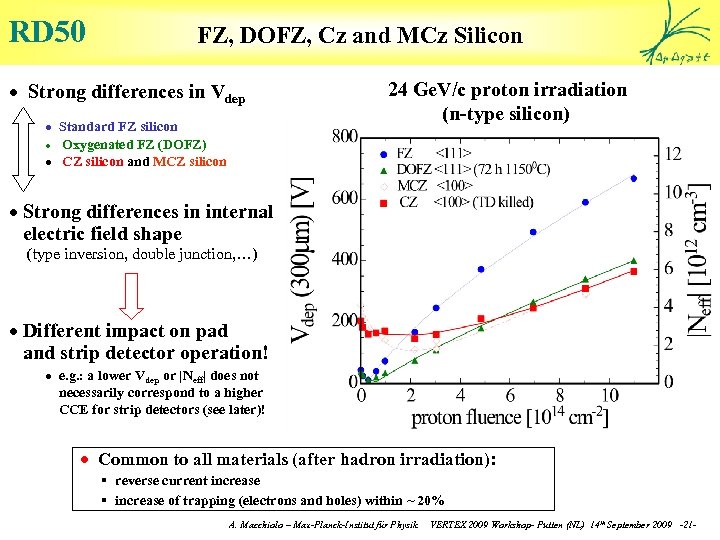 RD 50 FZ, DOFZ, Cz and MCz Silicon · Strong differences in Vdep · Standard FZ silicon · Oxygenated FZ (DOFZ) · CZ silicon and MCZ silicon 24 Ge. V/c proton irradiation (n-type silicon) · Strong differences in internal electric field shape (type inversion, double junction, …) · Different impact on pad and strip detector operation! · e. g. : a lower Vdep or |Neff| does not necessarily correspond to a higher CCE for strip detectors (see later)! · Common to all materials (after hadron irradiation): § reverse current increase § increase of trapping (electrons and holes) within ~ 20% A. Macchiolo – Max-Planck-Institut für Physik VERTEX 2009 Workshop- Putten (NL) 14 th September 2009 -21 -
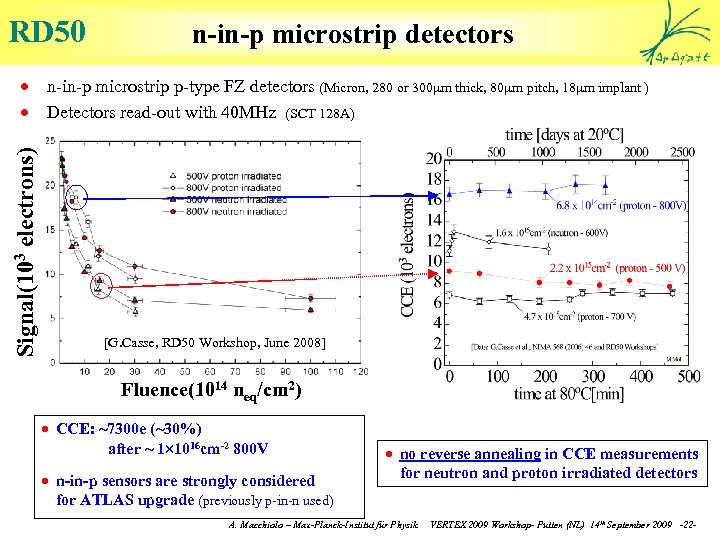 RD 50 Signal(103 electrons) · · n-in-p microstrip detectors n-in-p microstrip p-type FZ detectors (Micron, 280 or 300 mm thick, 80 mm pitch, 18 mm implant ) Detectors read-out with 40 MHz (SCT 128 A) [G. Casse, RD 50 Workshop, June 2008] Fluence(1014 neq/cm 2) · CCE: ~7300 e (~30%) after ~ 1 1016 cm-2 800 V · n-in-p sensors are strongly considered for ATLAS upgrade (previously p-in-n used) · no reverse annealing in CCE measurements for neutron and proton irradiated detectors A. Macchiolo – Max-Planck-Institut für Physik VERTEX 2009 Workshop- Putten (NL) 14 th September 2009 -22 -
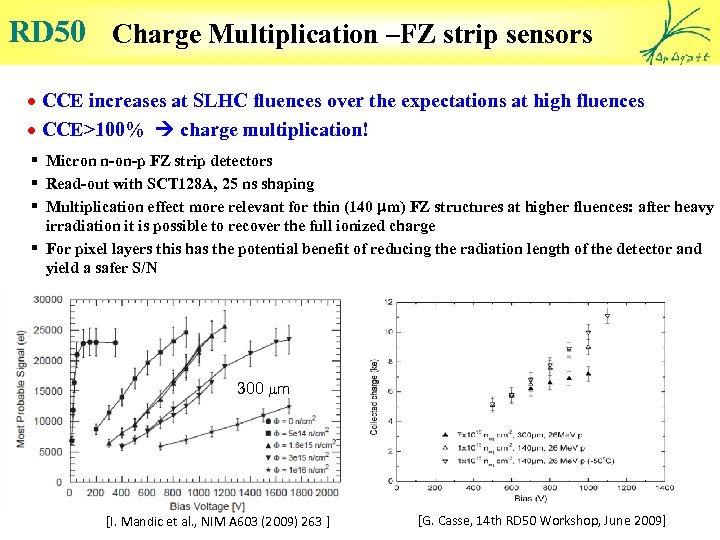 RD 50 Charge Multiplication –FZ strip sensors · CCE increases at SLHC fluences over the expectations at high fluences · CCE>100% charge multiplication! § Micron n-on-p FZ strip detectors § Read-out with SCT 128 A, 25 ns shaping § Multiplication effect more relevant for thin (140 mm) FZ structures at higher fluences: after heavy irradiation it is possible to recover the full ionized charge § For pixel layers this has the potential benefit of reducing the radiation length of the detector and yield a safer S/N 300 mm [I. Mandic et al. , NIM A 603 (2009) 263 ] [G. Casse, 14 th RD 50 Workshop, June 2009]
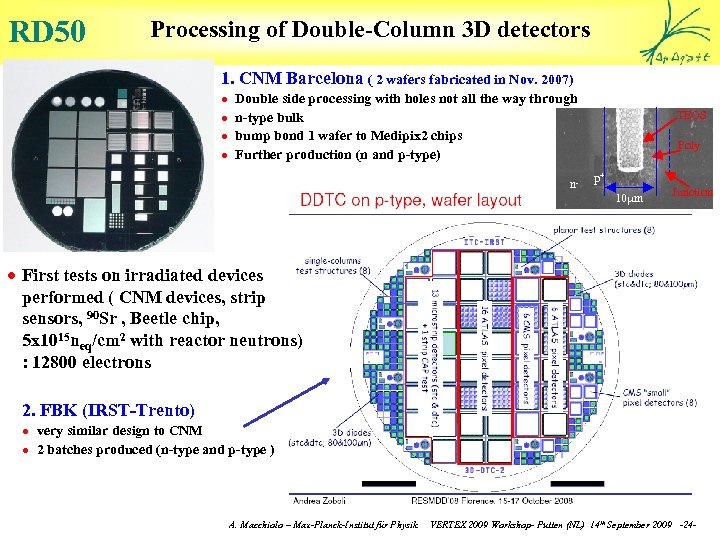 RD 50 Processing of Double-Column 3 D detectors 1. CNM Barcelona ( 2 wafers fabricated in Nov. 2007) · · Double side processing with holes not all the way through n-type bulk bump bond 1 wafer to Medipix 2 chips Further production (n and p-type) n- TEOS Poly p+ 10 mm Junction · First tests on irradiated devices performed ( CNM devices, strip sensors, 90 Sr , Beetle chip, 5 x 10¹⁵ neq/cm 2 with reactor neutrons) : 12800 electrons 2. FBK (IRST-Trento) · very similar design to CNM · 2 batches produced (n-type and p-type ) A. Macchiolo – Max-Planck-Institut für Physik VERTEX 2009 Workshop- Putten (NL) 14 th September 2009 -24 -
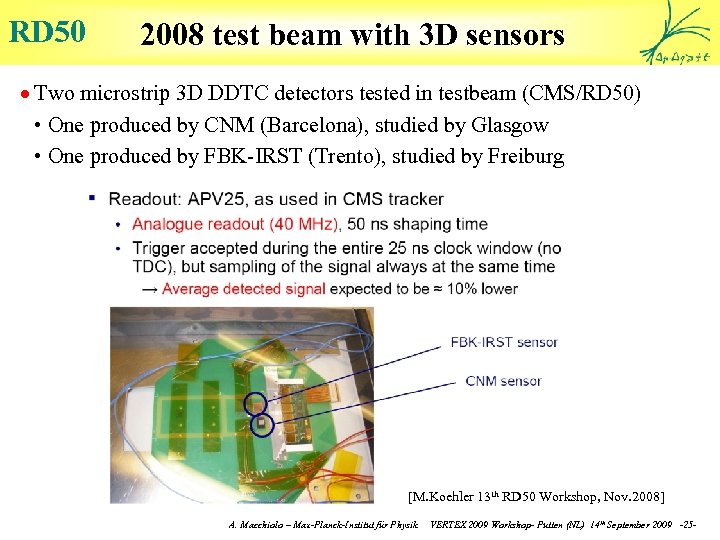 RD 50 2008 test beam with 3 D sensors · Two microstrip 3 D DDTC detectors tested in testbeam (CMS/RD 50) • One produced by CNM (Barcelona), studied by Glasgow • One produced by FBK-IRST (Trento), studied by Freiburg [M. Koehler 13 th RD 50 Workshop, Nov. 2008] A. Macchiolo – Max-Planck-Institut für Physik VERTEX 2009 Workshop- Putten (NL) 14 th September 2009 -25 -
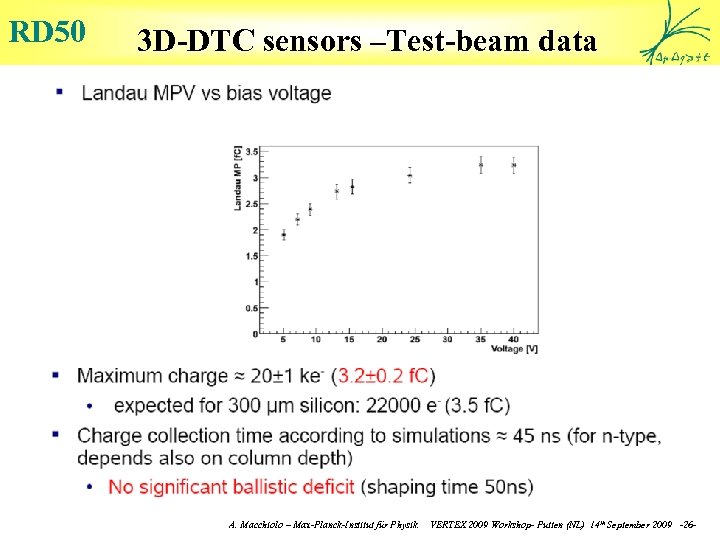 RD 50 3 D-DTC sensors –Test-beam data A. Macchiolo – Max-Planck-Institut für Physik VERTEX 2009 Workshop- Putten (NL) 14 th September 2009 -26 -