


 Скачать презентацию Ray Casting Courtesy of James Arvo and David
9c2e25db685975d0537d352008d4ffa3.ppt
- Количество слайдов: 60
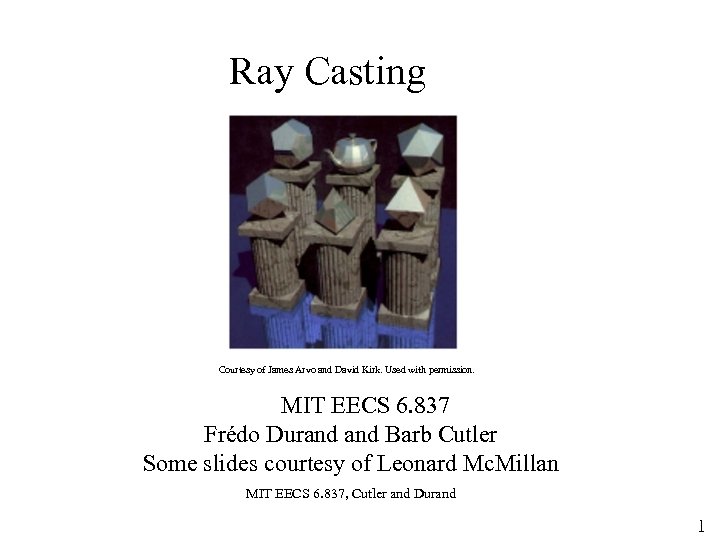 Ray Casting Courtesy of James Arvo and David Kirk. Used with permission. MIT EECS 6. 837 Frédo Durand Barb Cutler Some slides courtesy of Leonard Mc. Millan MIT EECS 6. 837, Cutler and Durand 1
 Administrative • Assignment 1 –Due Wednesday September 17 MIT EECS 6. 837, Cutler and Durand 2
 Calendar • 1 st quiz –Tuesday October 07 th • 2 nd quiz --Thursday Nov 20 th • Week Dec 1 -5 project presentation • Last day of class: December 9: best projects & final report due MIT EECS 6. 837, Cutler and Durand 3
 Questions? MIT EECS 6. 837, Cutler and Durand 4
 Overview of the semester • Ray Tracing –Quiz 1 • Animation, modeling, IBMR –Choice of final project • Rendering pipeline –Quiz 2 • Advanced topics MIT EECS 6. 837, Cutler and Durand 5
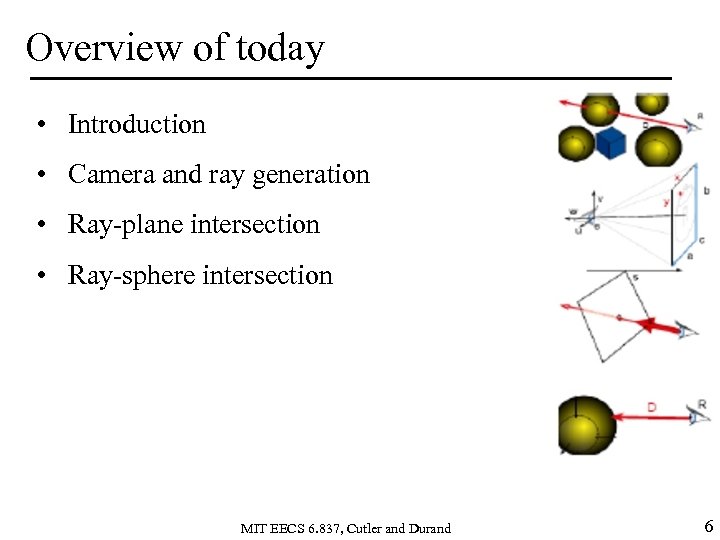 Overview of today • Introduction • Camera and ray generation • Ray-plane intersection • Ray-sphere intersection MIT EECS 6. 837, Cutler and Durand 6
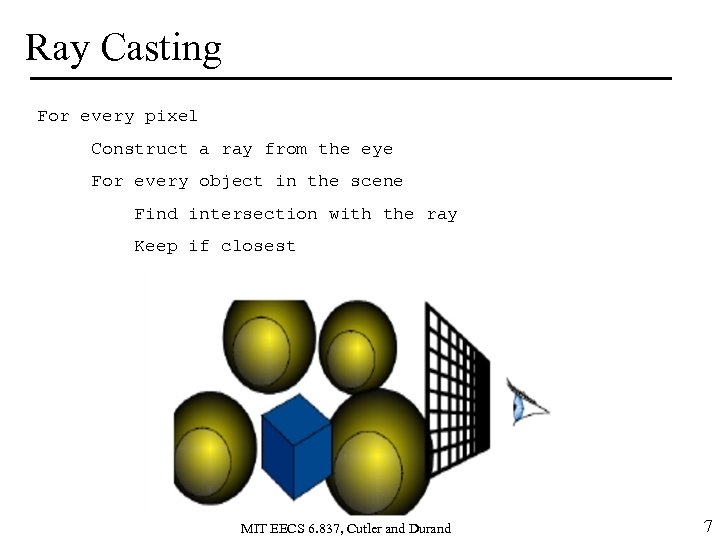 Ray Casting For every pixel Construct a ray from the eye For every object in the scene Find intersection with the ray Keep if closest MIT EECS 6. 837, Cutler and Durand 7
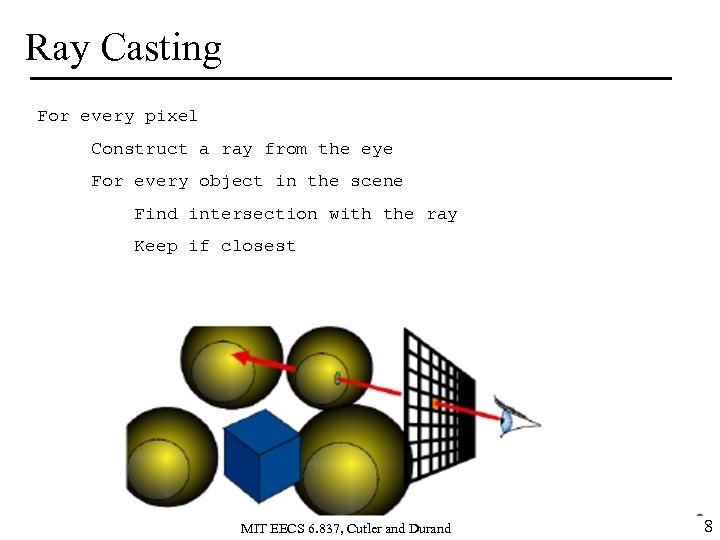 Ray Casting For every pixel Construct a ray from the eye For every object in the scene Find intersection with the ray Keep if closest MIT EECS 6. 837, Cutler and Durand 8
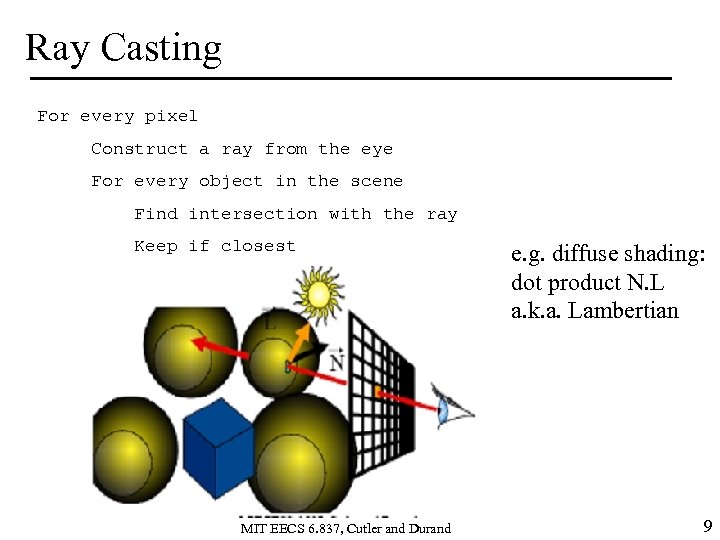 Ray Casting For every pixel Construct a ray from the eye For every object in the scene Find intersection with the ray Keep if closest MIT EECS 6. 837, Cutler and Durand e. g. diffuse shading: dot product N. L a. k. a. Lambertian 9
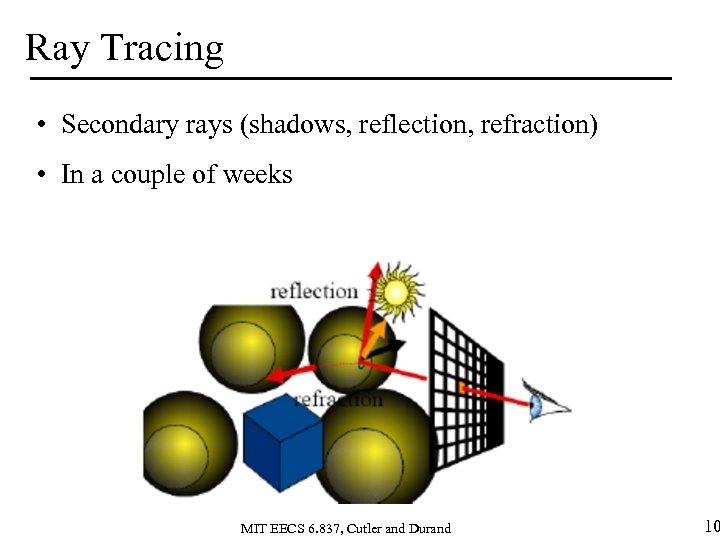 Ray Tracing • Secondary rays (shadows, reflection, refraction) • In a couple of weeks MIT EECS 6. 837, Cutler and Durand 10
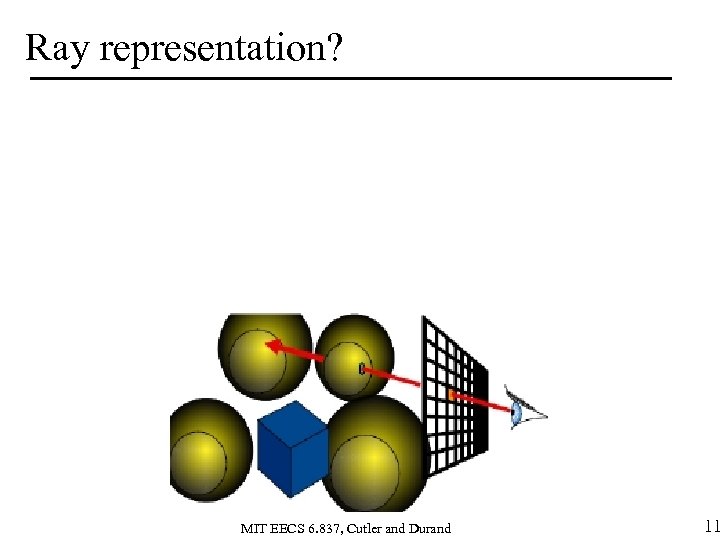 Ray representation? MIT EECS 6. 837, Cutler and Durand 11
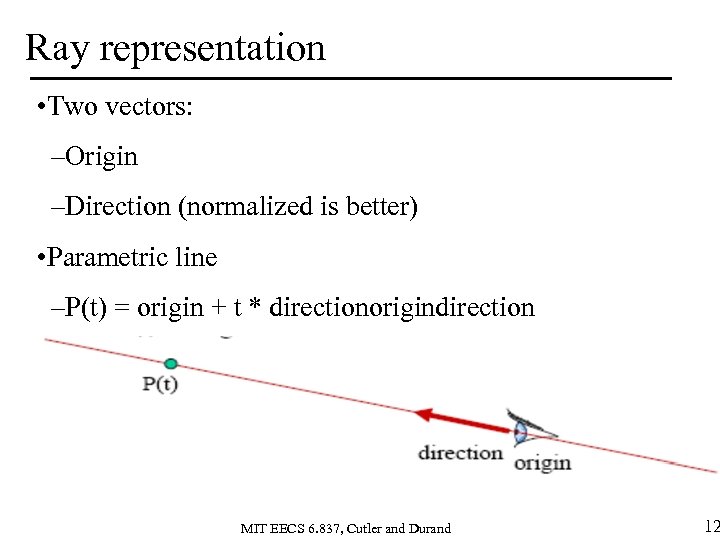 Ray representation • Two vectors: –Origin –Direction (normalized is better) • Parametric line –P(t) = origin + t * directionorigindirection MIT EECS 6. 837, Cutler and Durand 12
 Ray Tracing Original Ray-traced image by Whitted Image removed due to copyright considerations. • Image computed using the Dali ray tracer by Henrik. Wann. Jensen Image removed due to copyright considerations. • Environment map by Paul Debevec MIT EECS 6. 837, Cutler and Durand 13
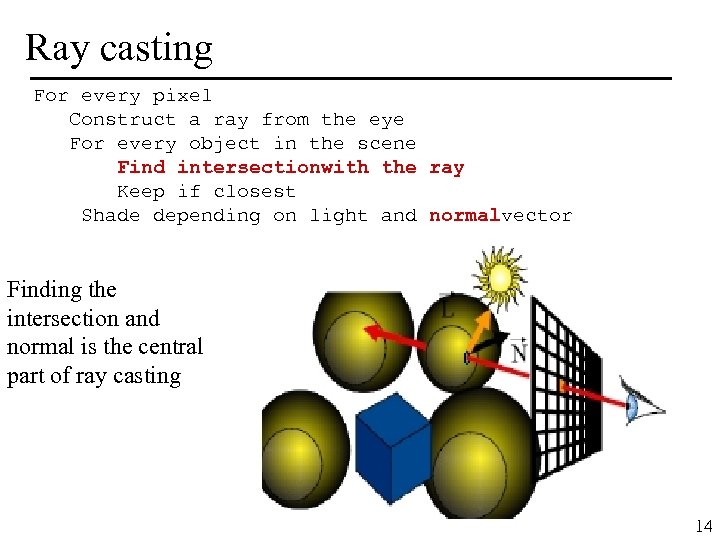 Ray casting For every pixel Construct a ray from the eye For every object in the scene Find intersectionwith the ray Keep if closest Shade depending on light and normalvector Finding the intersection and normal is the central part of ray casting MIT EECS 6. 837, Cutler and Durand 14
 Overview of today • Introduction • Camera and ray generation • Ray-plane intersection • Ray-sphere intersection MIT EECS 6. 837, Cutler and Durand 15
 Cameras For every pixel Construct a ray from the eye For every object in the scene Find intersection with the ray Keep if closest MIT EECS 6. 837, Cutler and Durand 16
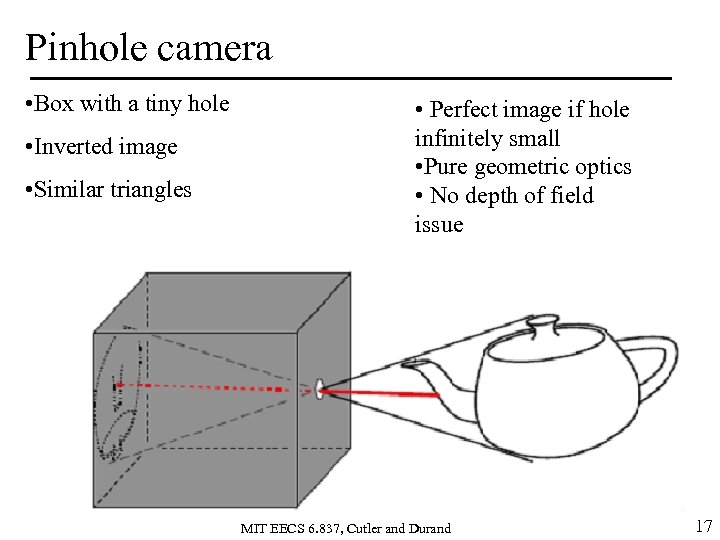 Pinhole camera • Box with a tiny hole • Inverted image • Similar triangles • Perfect image if hole infinitely small • Pure geometric optics • No depth of field issue MIT EECS 6. 837, Cutler and Durand 17
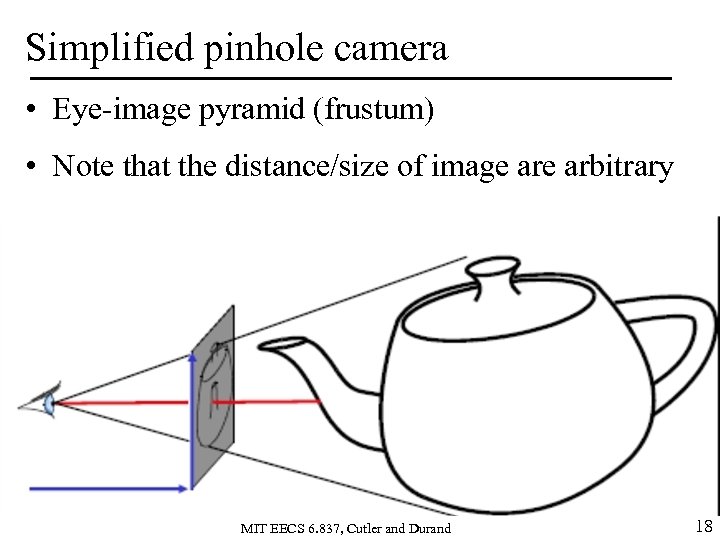 Simplified pinhole camera • Eye-image pyramid (frustum) • Note that the distance/size of image arbitrary MIT EECS 6. 837, Cutler and Durand 18
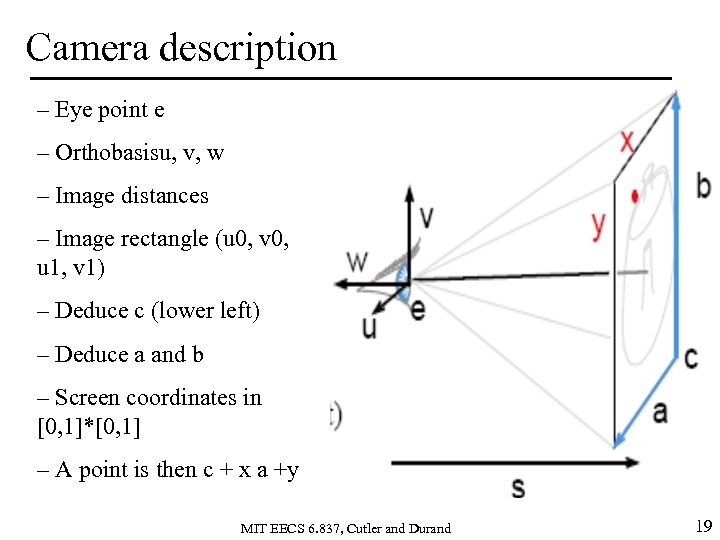 Camera description – Eye point e – Orthobasisu, v, w – Image distances – Image rectangle (u 0, v 0, u 1, v 1) – Deduce c (lower left) – Deduce a and b – Screen coordinates in [0, 1]*[0, 1] – A point is then c + x a +y MIT EECS 6. 837, Cutler and Durand 19
 Alternative perspective encoding • 4 x 4 matrix & viewing frustum • More about that next week MIT EECS 6. 837, Cutler and Durand 20
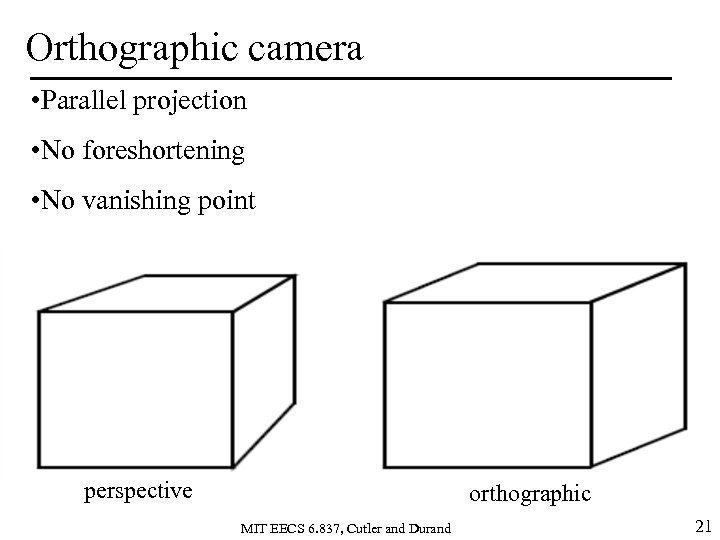 Orthographic camera • Parallel projection • No foreshortening • No vanishing point perspective orthographic MIT EECS 6. 837, Cutler and Durand 21
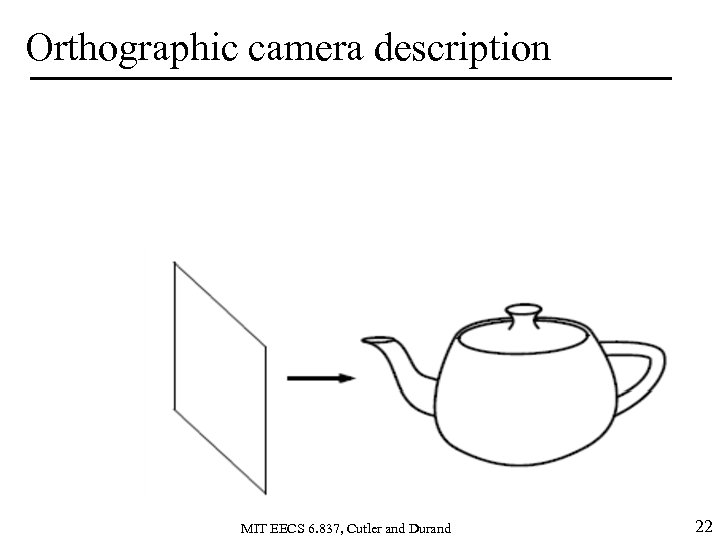 Orthographic camera description MIT EECS 6. 837, Cutler and Durand 22
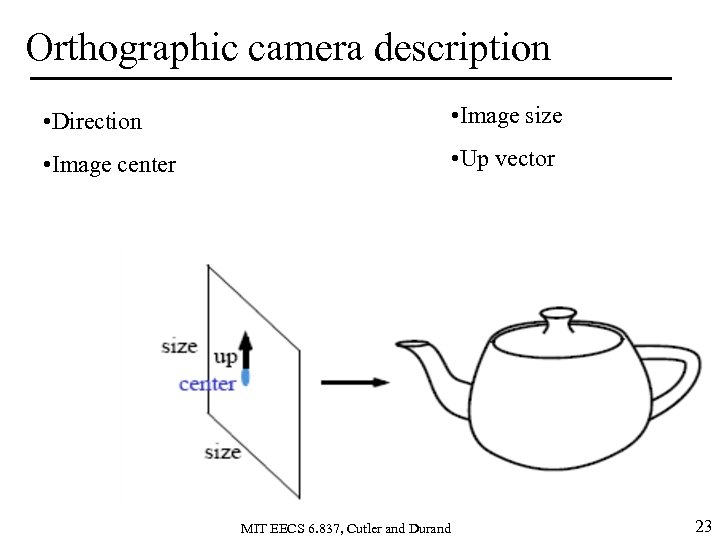 Orthographic camera description • Direction • Image size • Image center • Up vector MIT EECS 6. 837, Cutler and Durand 23
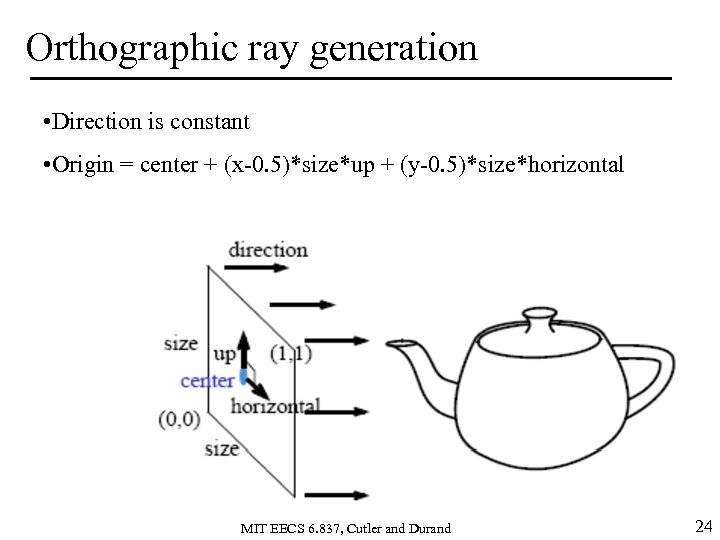 Orthographic ray generation • Direction is constant • Origin = center + (x-0. 5)*size*up + (y-0. 5)*size*horizontal MIT EECS 6. 837, Cutler and Durand 24
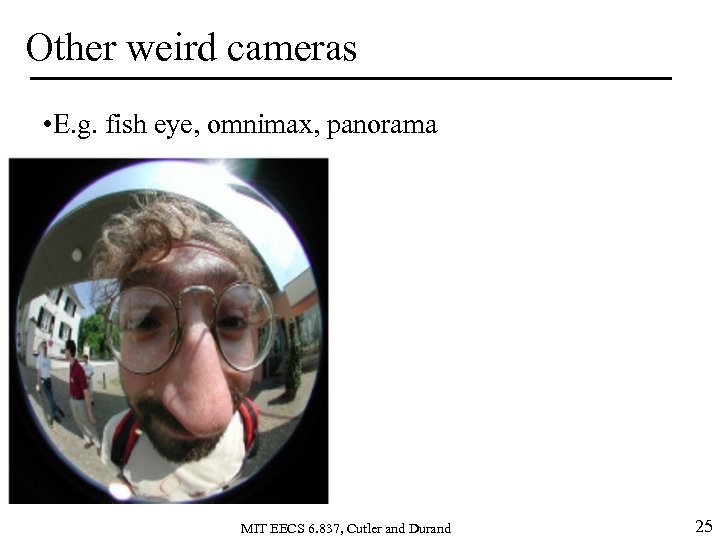 Other weird cameras • E. g. fish eye, omnimax, panorama MIT EECS 6. 837, Cutler and Durand 25
 Overview oftoday • Introduction • Camera and ray generation • Ray-plane intersection • Ray-sphere intersection MIT EECS 6. 837, Cutler and Durand 26
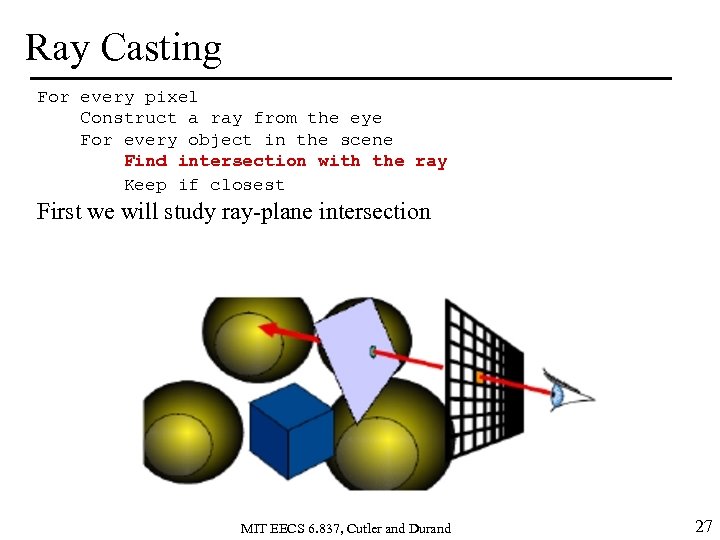 Ray Casting For every pixel Construct a ray from the eye For every object in the scene Find intersection with the ray Keep if closest First we will study ray-plane intersection MIT EECS 6. 837, Cutler and Durand 27
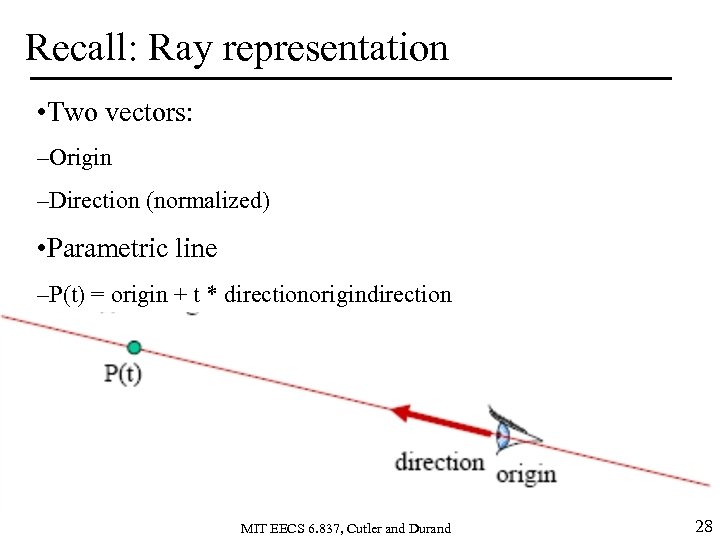 Recall: Ray representation • Two vectors: –Origin –Direction (normalized) • Parametric line –P(t) = origin + t * directionorigindirection MIT EECS 6. 837, Cutler and Durand 28
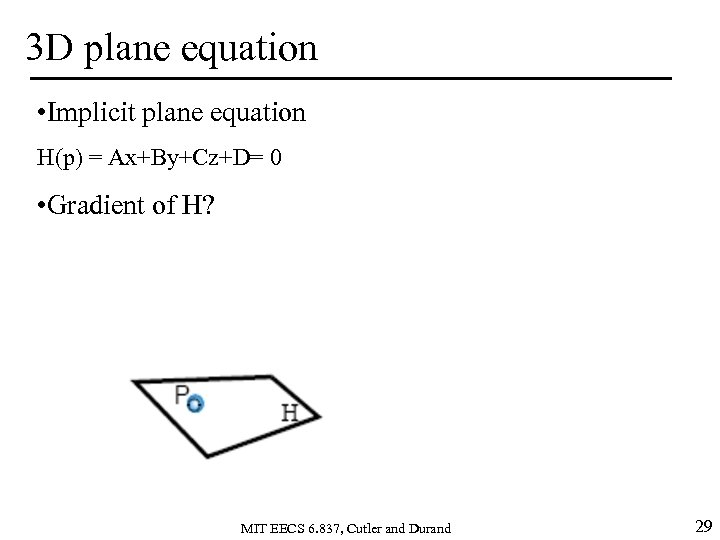 3 D plane equation • Implicit plane equation H(p) = Ax+By+Cz+D= 0 • Gradient of H? MIT EECS 6. 837, Cutler and Durand 29
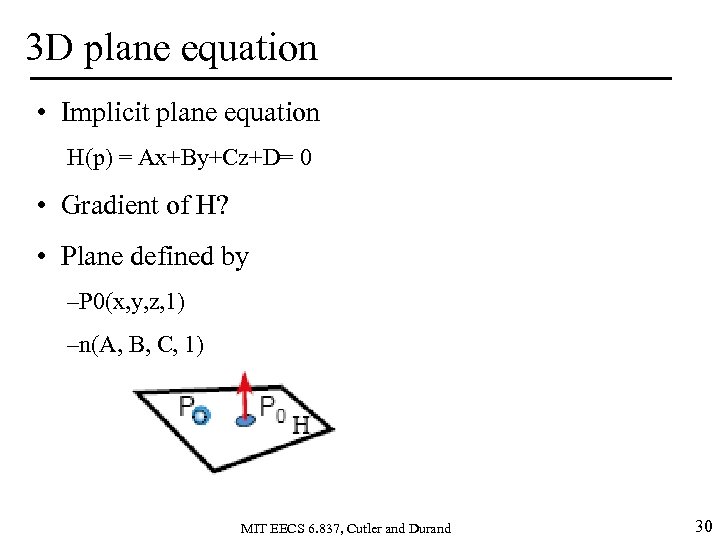 3 D plane equation • Implicit plane equation H(p) = Ax+By+Cz+D= 0 • Gradient of H? • Plane defined by –P 0(x, y, z, 1) –n(A, B, C, 1) MIT EECS 6. 837, Cutler and Durand 30
 Explicit vs. implicit? • Plane equation is implicit –Solution of an equation –Does not tell us how to generate a point on the plane –Tells us how to check that a point is on the plane • Ray equation is explicit –Parametric –How to generate points –Harder to verify that a point is on the ray MIT EECS 6. 837, Cutler and Durand 31
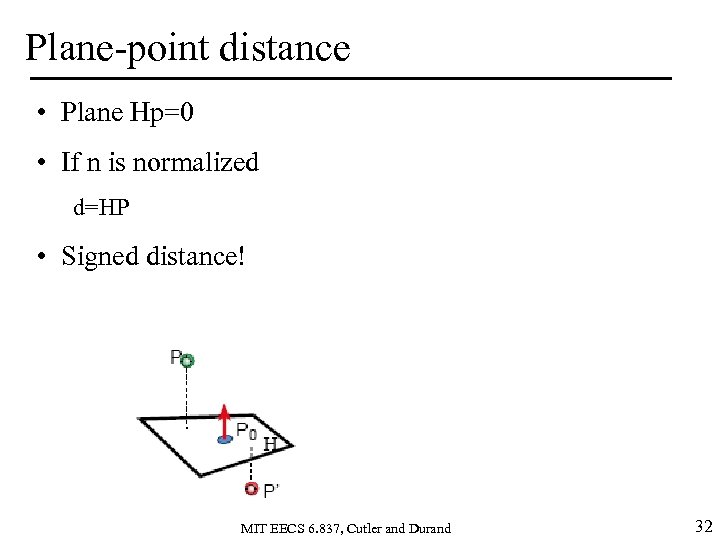 Plane-point distance • Plane Hp=0 • If n is normalized d=HP • Signed distance! MIT EECS 6. 837, Cutler and Durand 32
 Explicit vs. implicit? • Plane equation is implicit –Solution of an equation –Does not tell us how to generate a point on the plane –Tells us how to check that a point is on the plane • Ray equation is explicit –Parametric –How to generate points –Harder to verify that a point is on the ray • Exercise: explicit plane and implicit ray MIT EECS 6. 837, Cutler and Durand 33
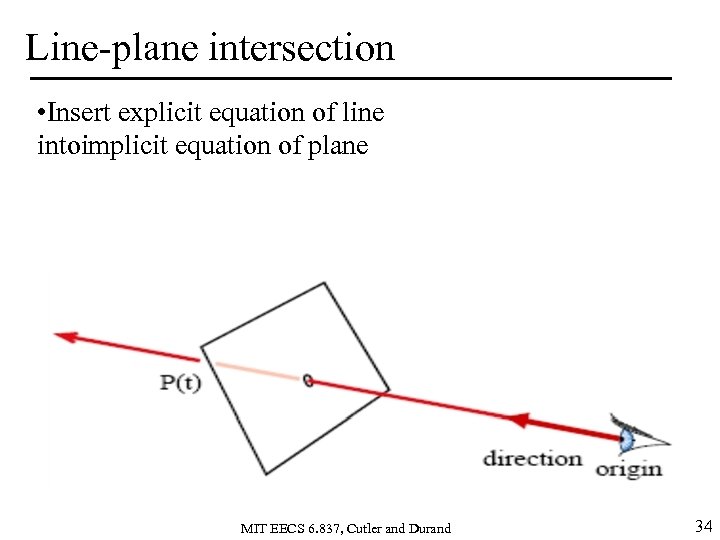 Line-plane intersection • Insert explicit equation of line intoimplicit equation of plane MIT EECS 6. 837, Cutler and Durand 34
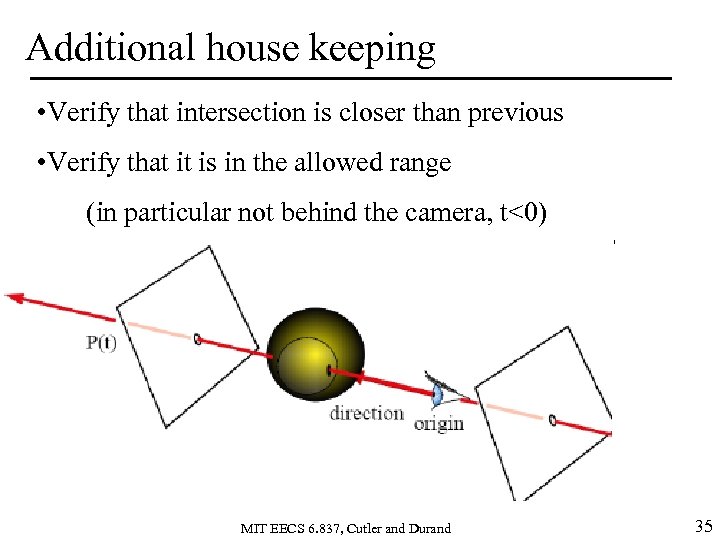 Additional house keeping • Verify that intersection is closer than previous • Verify that it is in the allowed range (in particular not behind the camera, t<0) MIT EECS 6. 837, Cutler and Durand 35
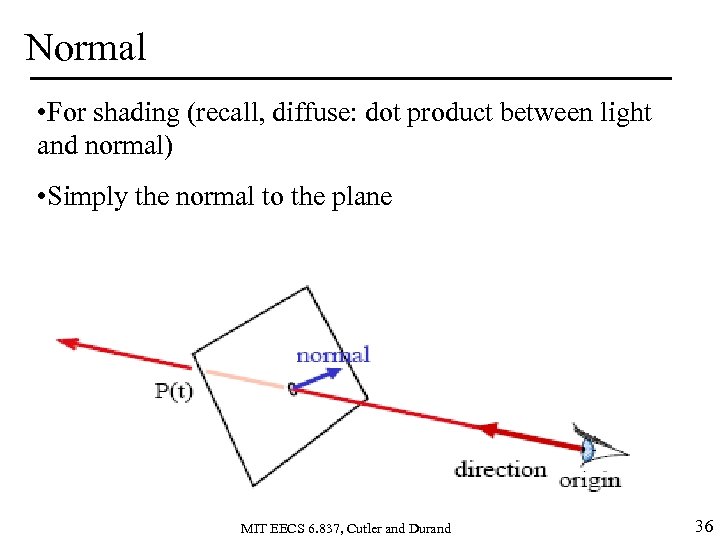 Normal • For shading (recall, diffuse: dot product between light and normal) • Simply the normal to the plane MIT EECS 6. 837, Cutler and Durand 36
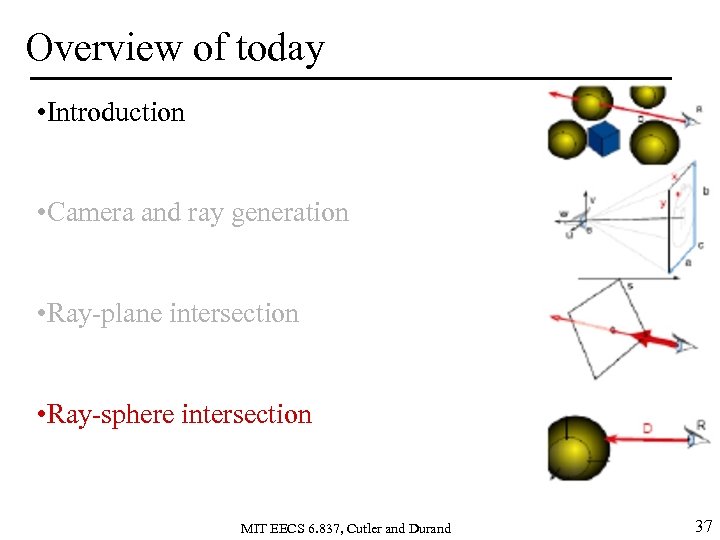 Overview of today • Introduction • Camera and ray generation • Ray-plane intersection • Ray-sphere intersection MIT EECS 6. 837, Cutler and Durand 37
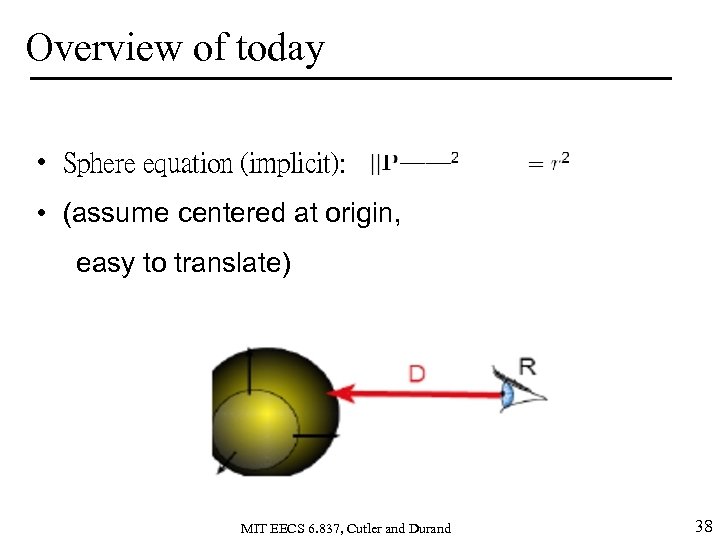 Overview of today • Sphere equation (implicit): • (assume centered at origin, easy to translate) MIT EECS 6. 837, Cutler and Durand 38
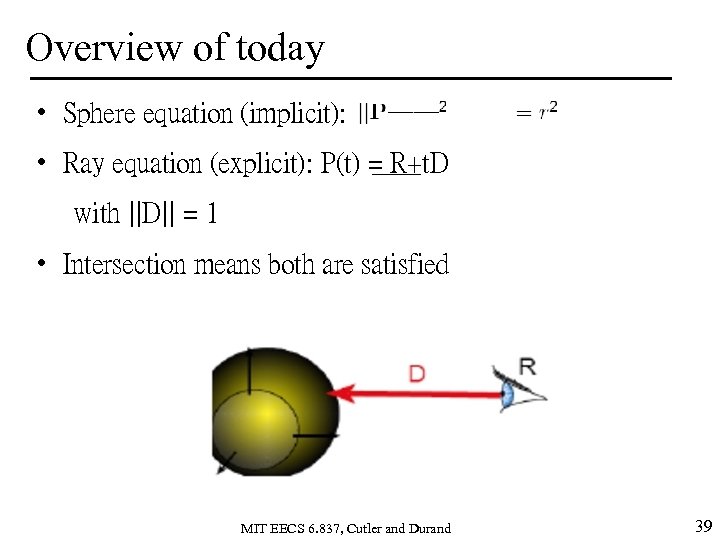 Overview of today • Sphere equation (implicit): • Ray equation (explicit): P(t) = R+t. D with ||D|| = 1 • Intersection means both are satisfied MIT EECS 6. 837, Cutler and Durand 39
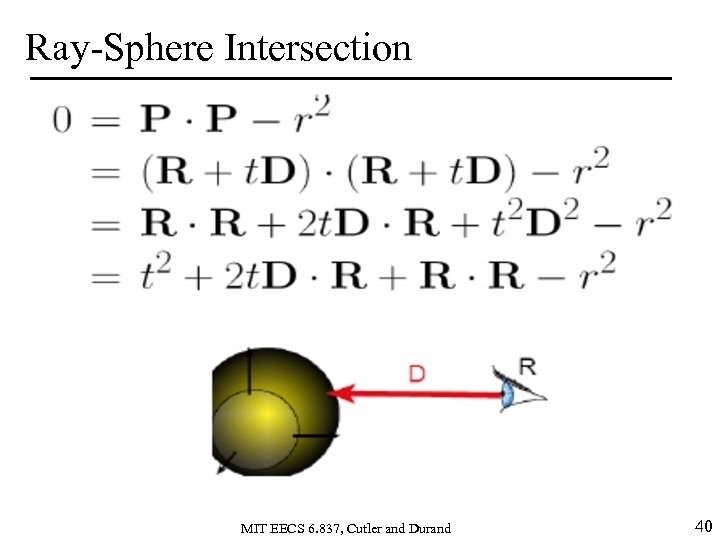 Ray-Sphere Intersection MIT EECS 6. 837, Cutler and Durand 40
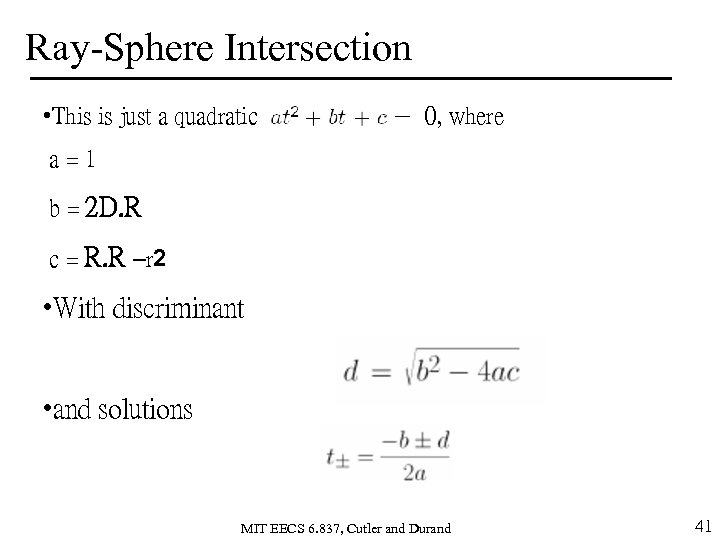 Ray-Sphere Intersection • This is just a quadratic 0, where a=1 b = 2 D. R c = R. R –r 2 • With discriminant • and solutions MIT EECS 6. 837, Cutler and Durand 41
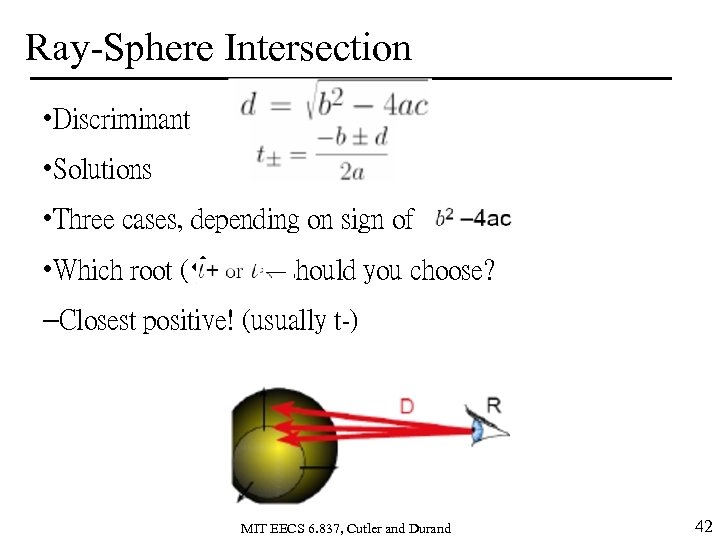 Ray-Sphere Intersection • Discriminant • Solutions • Three cases, depending on sign of • Which root (� should you choose? –Closest positive! (usually t-) MIT EECS 6. 837, Cutler and Durand 42
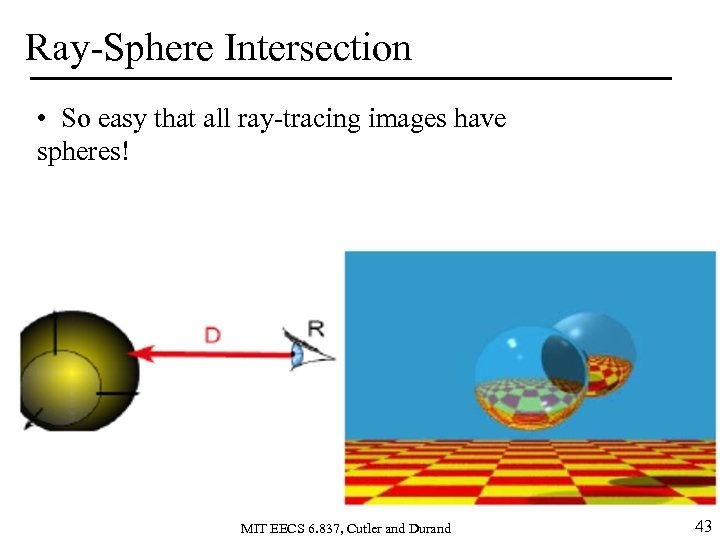 Ray-Sphere Intersection • So easy that all ray-tracing images have spheres! MIT EECS 6. 837, Cutler and Durand 43
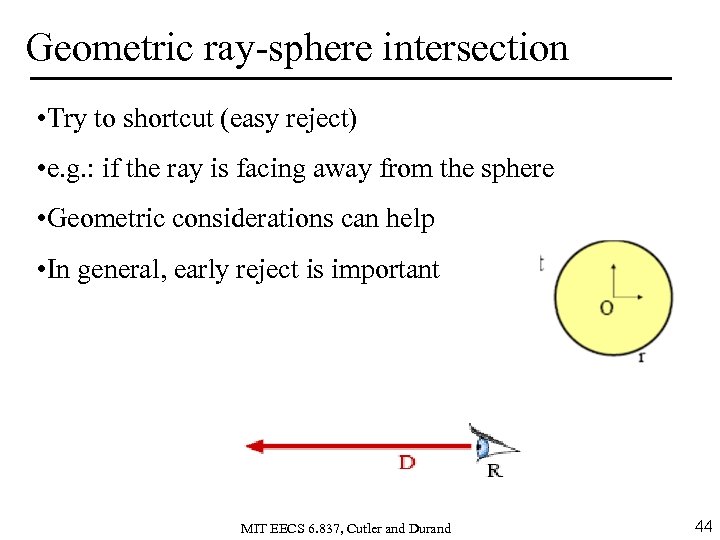 Geometric ray-sphere intersection • Try to shortcut (easy reject) • e. g. : if the ray is facing away from the sphere • Geometric considerations can help • In general, early reject is important MIT EECS 6. 837, Cutler and Durand 44
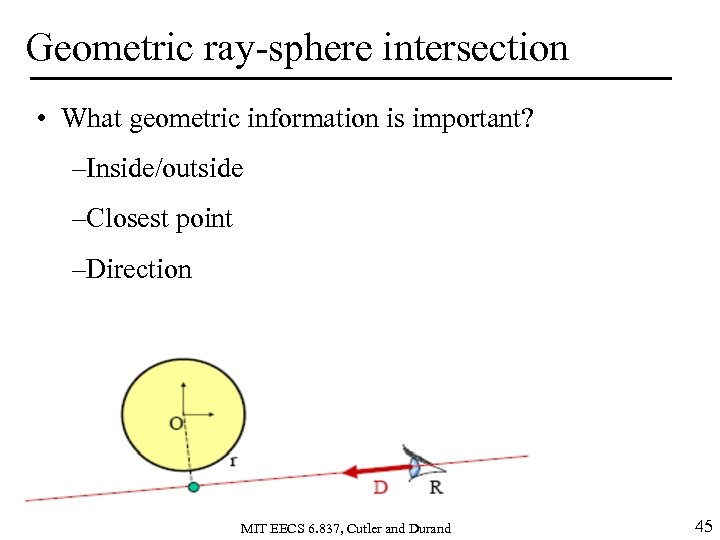 Geometric ray-sphere intersection • What geometric information is important? –Inside/outside –Closest point –Direction MIT EECS 6. 837, Cutler and Durand 45
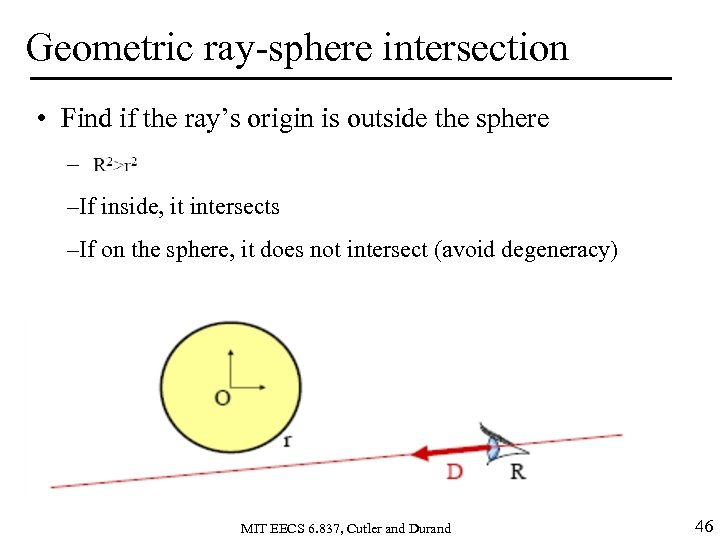 Geometric ray-sphere intersection • Find if the ray’s origin is outside the sphere – –If inside, it intersects –If on the sphere, it does not intersect (avoid degeneracy) MIT EECS 6. 837, Cutler and Durand 46
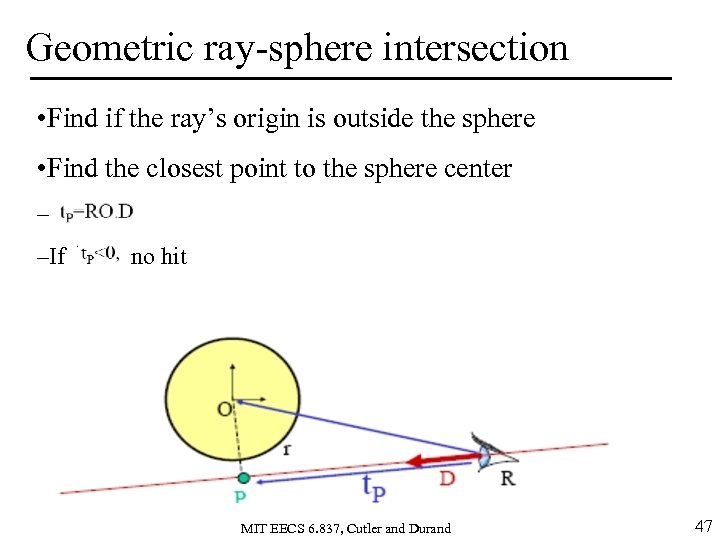 Geometric ray-sphere intersection • Find if the ray’s origin is outside the sphere • Find the closest point to the sphere center – –If no hit MIT EECS 6. 837, Cutler and Durand 47
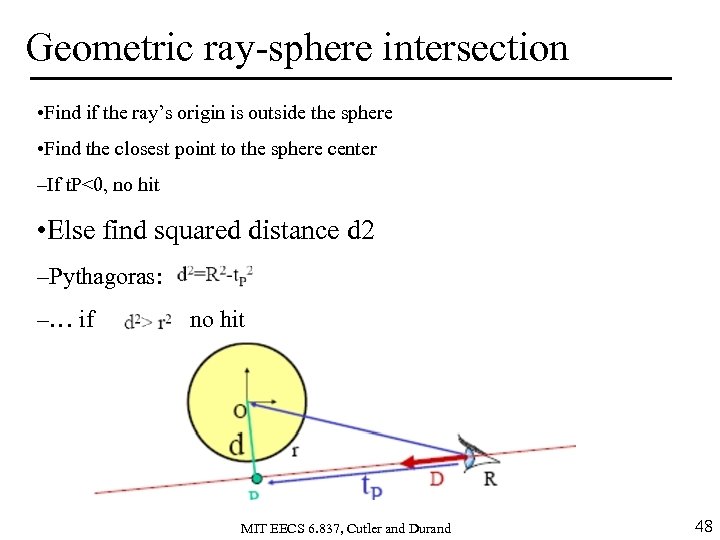 Geometric ray-sphere intersection • Find if the ray’s origin is outside the sphere • Find the closest point to the sphere center –If t. P<0, no hit • Else find squared distance d 2 –Pythagoras: –… if no hit MIT EECS 6. 837, Cutler and Durand 48
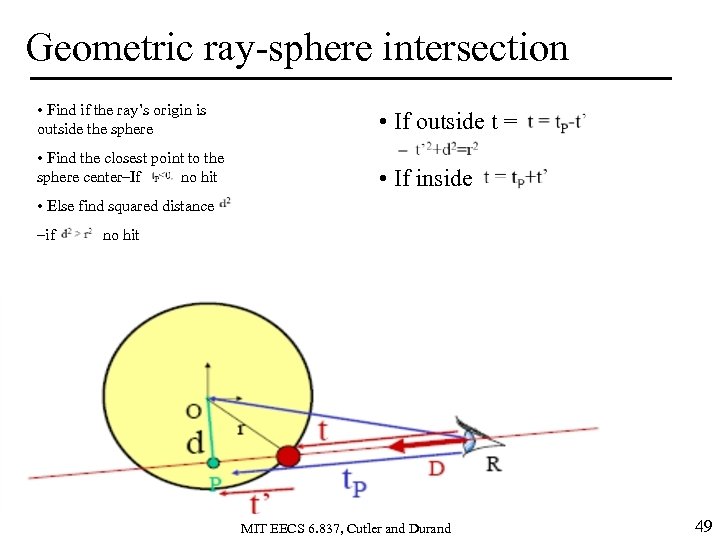 Geometric ray-sphere intersection • Find if the ray’s origin is outside the sphere • If outside t = • Find the closest point to the sphere center–If no hit • If inside • Else find squared distance –if no hit MIT EECS 6. 837, Cutler and Durand 49
 Geometric vs. algebraic • Algebraic was more simple (and more generic) • Geometric is more efficient –Timely tests –In particular for outside and pointing away MIT EECS 6. 837, Cutler and Durand 50
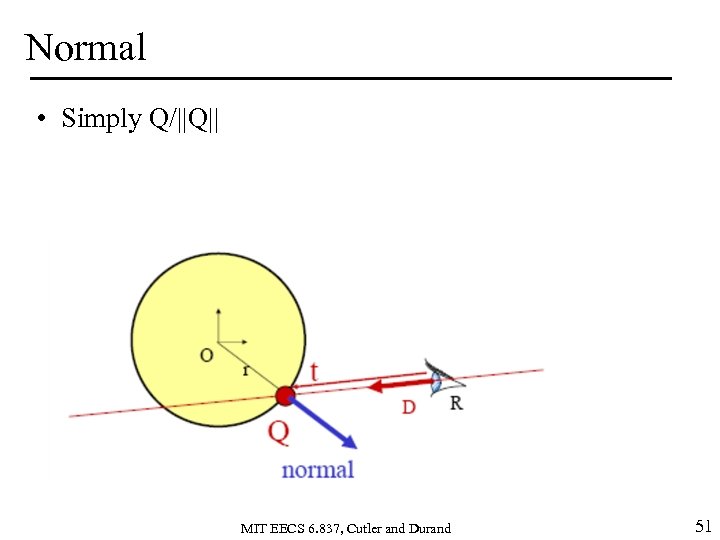 Normal • Simply Q/||Q|| MIT EECS 6. 837, Cutler and Durand 51
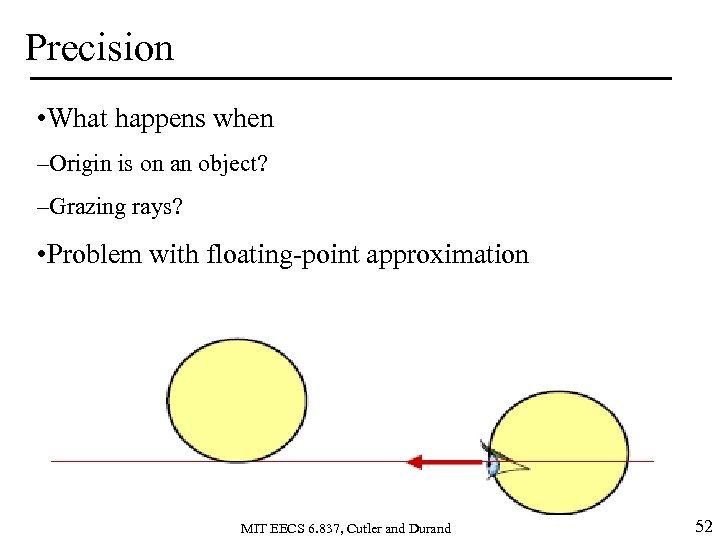 Precision • What happens when –Origin is on an object? –Grazing rays? • Problem with floating-point approximation MIT EECS 6. 837, Cutler and Durand 52
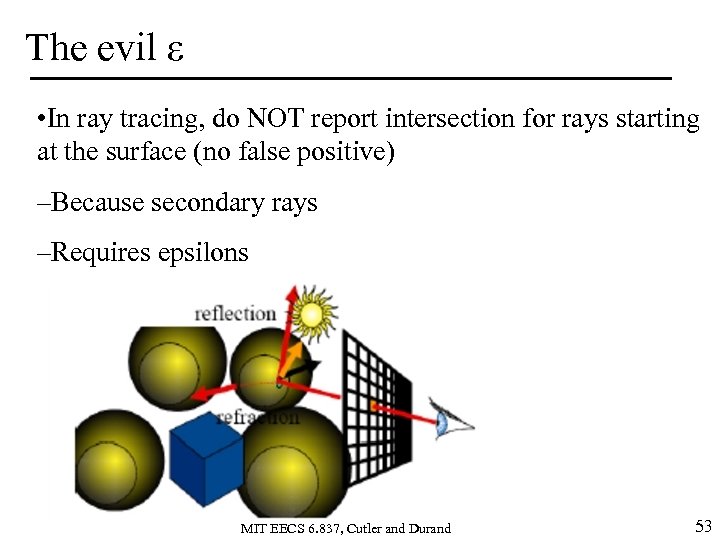 The evil ε • In ray tracing, do NOT report intersection for rays starting at the surface (no false positive) –Because secondary rays –Requires epsilons MIT EECS 6. 837, Cutler and Durand 53
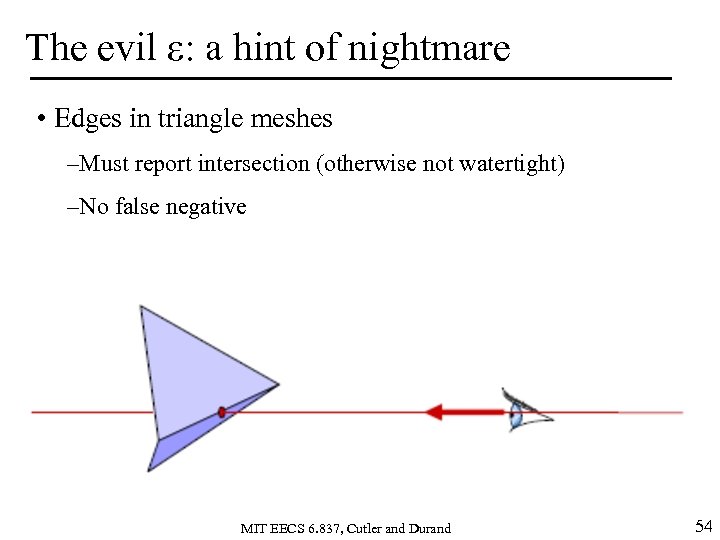 The evil ε: a hint of nightmare • Edges in triangle meshes –Must report intersection (otherwise not watertight) –No false negative MIT EECS 6. 837, Cutler and Durand 54
 Assignment 1 • Write a basic ray caster –Orthographic camera –Spheres –Display: constant color and distance • We provide –Ray –Hit –Parsing –And linear algebra, image MIT EECS 6. 837, Cutler and Durand 55
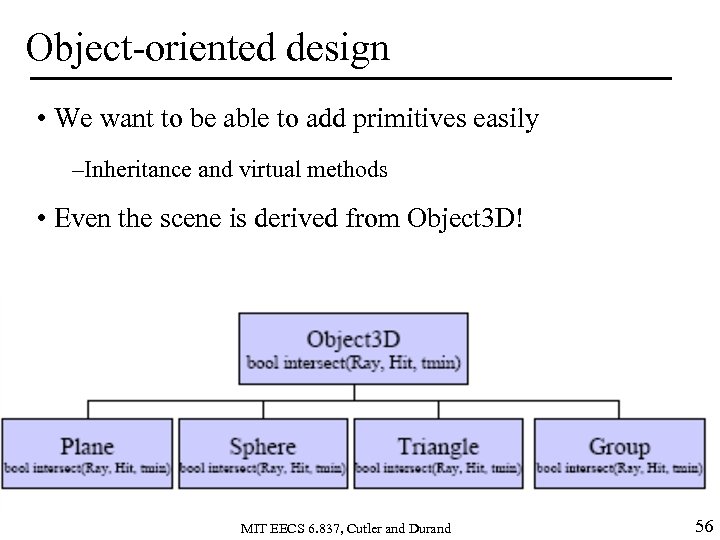 Object-oriented design • We want to be able to add primitives easily –Inheritance and virtual methods • Even the scene is derived from Object 3 D! MIT EECS 6. 837, Cutler and Durand 56
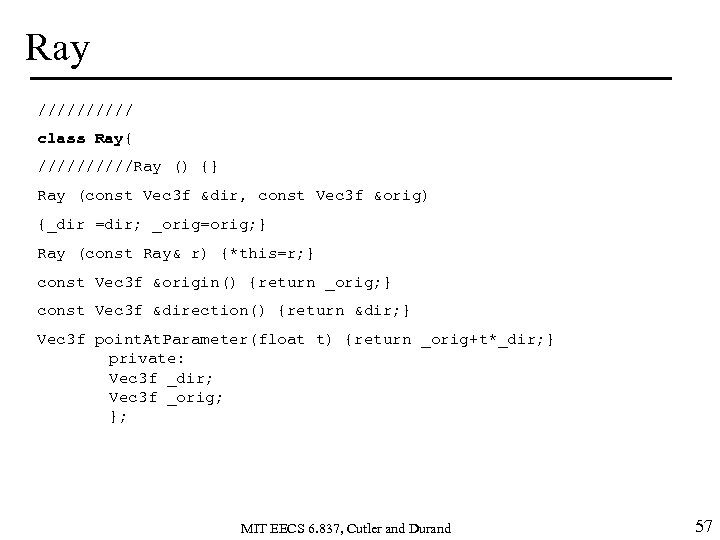 Ray ///// class Ray{ /////Ray () {} Ray (const Vec 3 f &dir, const Vec 3 f &orig) {_dir =dir; _orig=orig; } Ray (const Ray& r) {*this=r; } const Vec 3 f &origin() {return _orig; } const Vec 3 f &direction() {return &dir; } Vec 3 f point. At. Parameter(float t) {return _orig+t*_dir; } private: Vec 3 f _dir; Vec 3 f _orig; }; MIT EECS 6. 837, Cutler and Durand 57
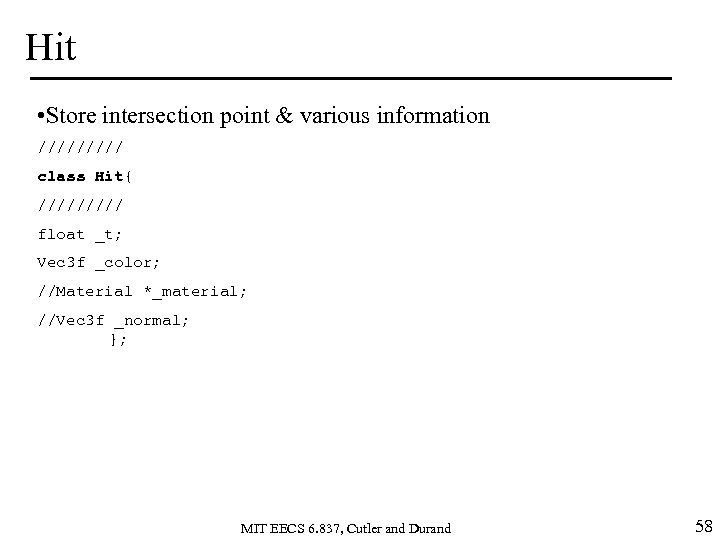 Hit • Store intersection point & various information ///// class Hit{ ///// float _t; Vec 3 f _color; //Material *_material; //Vec 3 f _normal; }; MIT EECS 6. 837, Cutler and Durand 58
 Tasks • • • Abstract Object 3 D Sphere and intersection Scene class Abstract camera and derive Orthographic Main function MIT EECS 6. 837, Cutler and Durand 59
 Thursday: More Ray Casting • Other primitives –Boxes –Triangles –IFS? • Antialiasing MIT EECS 6. 837, Cutler and Durand 60