 Скачать презентацию RAS-Models A Building Block for Self-Healing Benchmarks Rean
ce3a3cbc0d56cbe8ff031c56909c4793.ppt
- Количество слайдов: 25



RAS-Models: A Building Block for Self-Healing Benchmarks Rean Griffith, Ritika Virmani, Gail Kaiser Programming Systems Lab (PSL) Columbia University 1 PMCCS-8 Edinburgh, Scotland September 21 st 2007 Presented by Rean Griffith rg 2023@cs. columbia. edu
Overview l l l 2 Introduction Problem Hypothesis Experiments & Examples Proposed Evaluation Methodology Conclusion & Future Work
Introduction l A self-healing system “…automatically detects, diagnoses and repairs localized software and hardware problems” – The Vision of Autonomic Computing 2003 IEEE Computer Society 3
Why a Self-Healing Benchmark? l To quantify the impact of faults (problems) – l To reason about expected benefits for systems currently lacking self-healing mechanisms – l 4 l Establish a baseline for discussing “improvements” Includes existing/legacy systems To quantify the efficacy of self-healing mechanisms and reason about tradeoffs To compare self-healing systems
Problem l Evaluating self-healing systems and their mechanisms is non-trivial – – 5 Studying the failure behavior of systems can be difficult Multiple styles of healing to consider (reactive, preventative, proactive) Repairs may fail Partially automated repairs are possible
Hypotheses l l 6 Reliability, Availability and Serviceability provide reasonable evaluation metrics Combining practical fault-injection tools with mathematical modeling techniques provides the foundation for a feasible and flexible methodology for evaluating and comparing the reliability, availability and serviceability (RAS) characteristics of computing systems
Objective l To inject faults into the components of the popular n-tier web-application – l l l 7 Specifically the application server and Operating System Observe its responses and any recovery mechanisms available Model and evaluate available mechanisms Identify weaknesses
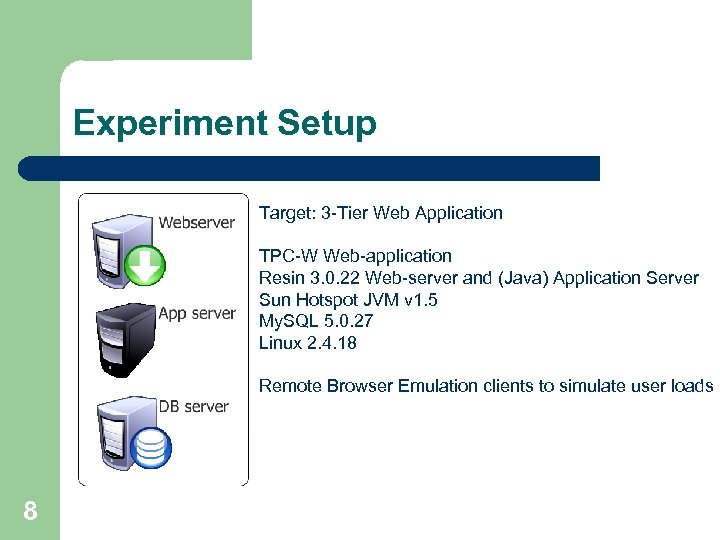
Experiment Setup Target: 3 -Tier Web Application TPC-W Web-application Resin 3. 0. 22 Web-server and (Java) Application Server Sun Hotspot JVM v 1. 5 My. SQL 5. 0. 27 Linux 2. 4. 18 Remote Browser Emulation clients to simulate user loads 8
Practical Fault-Injection Tools l Kheiron/JVM – – l Nooks Device-Driver Fault-Injection Tools – – 9 Uses bytecode rewriting to inject faults into Java Applications Faults include: memory leaks, hangs, delays etc. Uses the kernel module interface on Linux (2. 4 and now 2. 6) to inject device driver faults Faults include: text faults, memory leaks, hangs etc.
Healing Mechanisms Available l Application Server – l Operating System – – 10 Automatic restarts Nooks device driver protection framework Manual system reboot
Mathematical Modeling Techniques l Continuous Time Markov Chains (CTMCs) – – l Markov Reward Networks – – 11 Limiting/steady-state availability Yearly downtime Repair success rates (fault-coverage) Repair times Downtime costs (time, money, #service visits etc. ) SLA penalty-avoidance
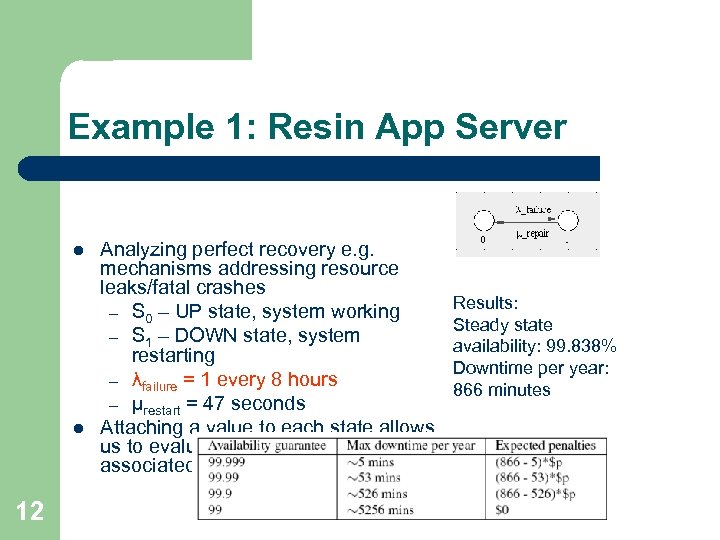
Example 1: Resin App Server l l 12 Analyzing perfect recovery e. g. mechanisms addressing resource leaks/fatal crashes – S 0 – UP state, system working – S 1 – DOWN state, system restarting – λfailure = 1 every 8 hours – µrestart = 47 seconds Attaching a value to each state allows us to evaluate the cost/time impact associated with these failures. Results: Steady state availability: 99. 838% Downtime per year: 866 minutes
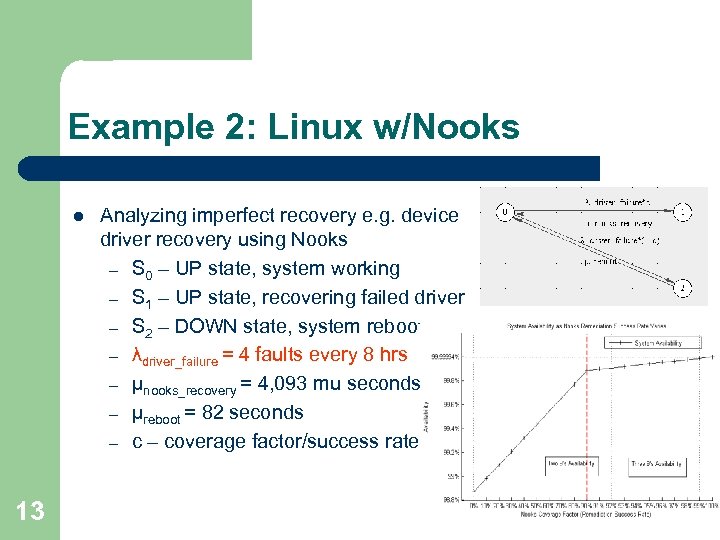
Example 2: Linux w/Nooks l 13 Analyzing imperfect recovery e. g. device driver recovery using Nooks – S 0 – UP state, system working – S 1 – UP state, recovering failed driver – S 2 – DOWN state, system reboot – λdriver_failure = 4 faults every 8 hrs – µnooks_recovery = 4, 093 mu seconds – µreboot = 82 seconds – coverage factor/success rate
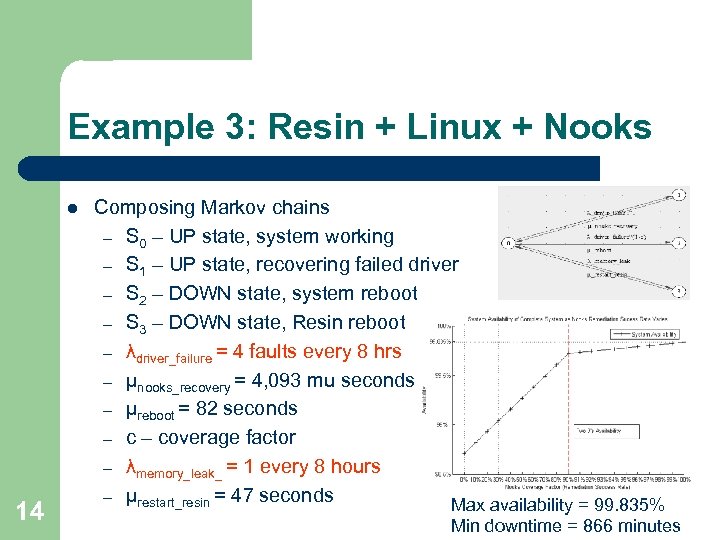
Example 3: Resin + Linux + Nooks l 14 Composing Markov chains – S 0 – UP state, system working – S 1 – UP state, recovering failed driver – S 2 – DOWN state, system reboot – S 3 – DOWN state, Resin reboot – λdriver_failure = 4 faults every 8 hrs – µnooks_recovery = 4, 093 mu seconds – µreboot = 82 seconds – coverage factor – λmemory_leak_ = 1 every 8 hours – µrestart_resin = 47 seconds Max availability = 99. 835% Min downtime = 866 minutes
Benefits of CTMCs + Fault Injection l l Able to model and analyze different styles of self-healing mechanisms Quantifies the impact of mechanism details (success rates, recovery times etc. ) on the system’s operational constraints (SLA penalties, availability etc. ) – l l l 15 Engineering view AND Business view Able to identify under-performing mechanisms Useful at design time as well as post-production Able to control the fault-rates
Caveats of CTMCs + Fault-Injection l CTMCs may not always be the “right” tool – Constant hazard-rate assumption l – Fault-independence assumptions l l l 16 Limited to analyzing near-coincident faults Not suitable for analyzing cascading faults (can we model the precipitating event as an approximation? ) Some failures are harder to replicate/induce than others – l True distribution of faults may be different Better data on faults will improve fault-injection tools Getting detailed breakdown of types/rates of failures – More data should improve the fault-injection experiments and relevance of the results
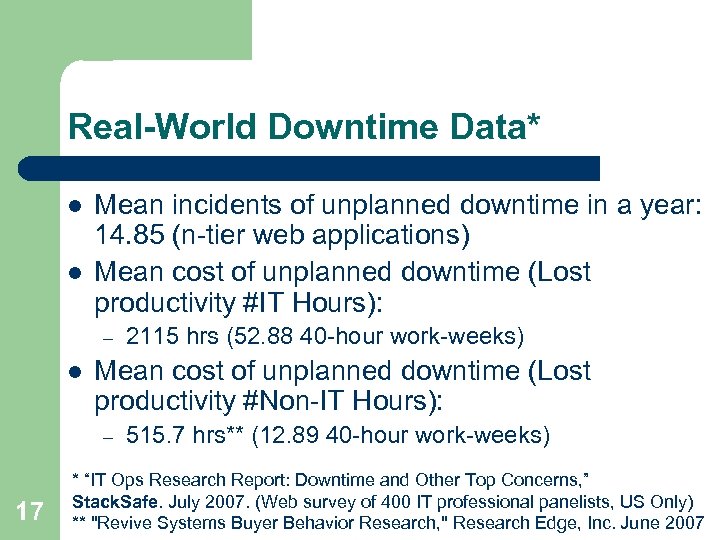
Real-World Downtime Data* l l Mean incidents of unplanned downtime in a year: 14. 85 (n-tier web applications) Mean cost of unplanned downtime (Lost productivity #IT Hours): – l Mean cost of unplanned downtime (Lost productivity #Non-IT Hours): – 17 2115 hrs (52. 88 40 -hour work-weeks) 515. 7 hrs** (12. 89 40 -hour work-weeks) * “IT Ops Research Report: Downtime and Other Top Concerns, ” Stack. Safe. July 2007. (Web survey of 400 IT professional panelists, US Only) ** "Revive Systems Buyer Behavior Research, " Research Edge, Inc. June 2007
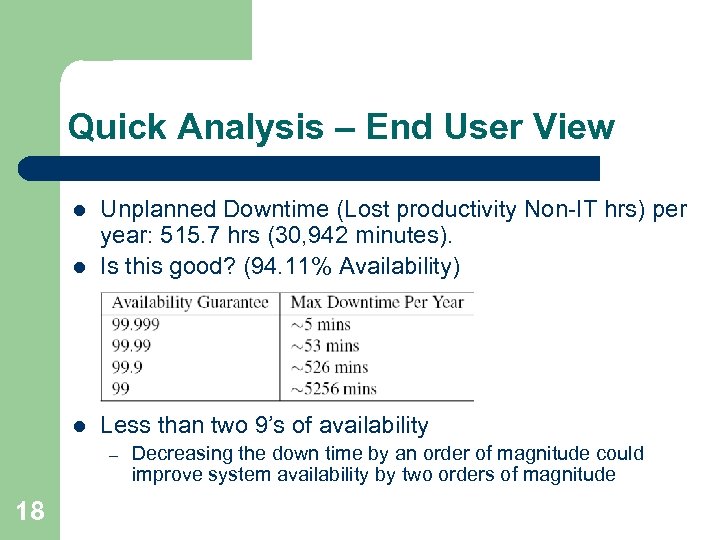
Quick Analysis – End User View l Unplanned Downtime (Lost productivity Non-IT hrs) per year: 515. 7 hrs (30, 942 minutes). Is this good? (94. 11% Availability) l Less than two 9’s of availability l – 18 Decreasing the down time by an order of magnitude could improve system availability by two orders of magnitude
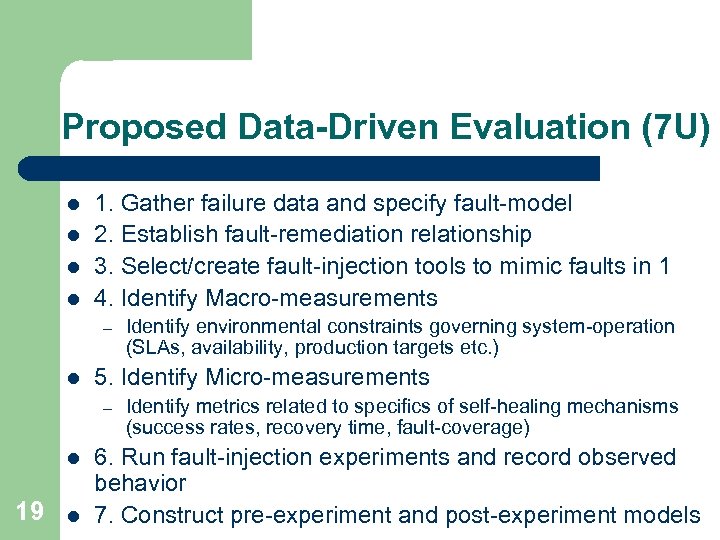
Proposed Data-Driven Evaluation (7 U) l l 1. Gather failure data and specify fault-model 2. Establish fault-remediation relationship 3. Select/create fault-injection tools to mimic faults in 1 4. Identify Macro-measurements – l 5. Identify Micro-measurements – l 19 l Identify environmental constraints governing system-operation (SLAs, availability, production targets etc. ) Identify metrics related to specifics of self-healing mechanisms (success rates, recovery time, fault-coverage) 6. Run fault-injection experiments and record observed behavior 7. Construct pre-experiment and post-experiment models
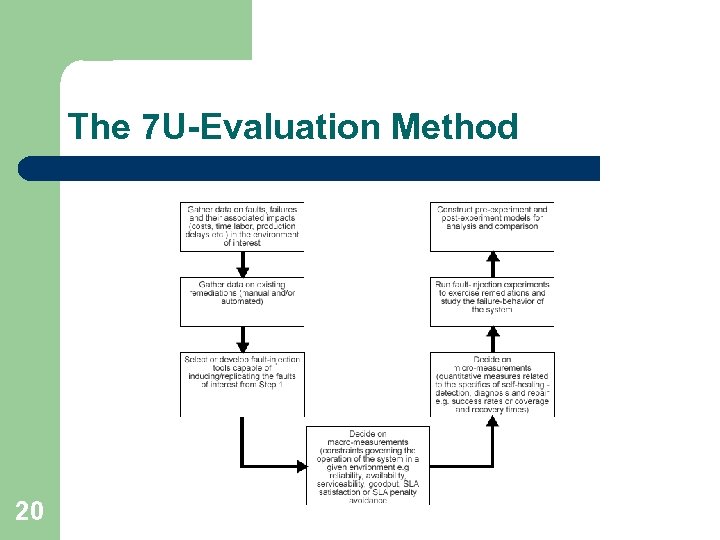
The 7 U-Evaluation Method 20
Conclusions l l l Dynamic instrumentation and fault-injection lets us transparently collect data and replicate problems The CTMC-models are flexible enough to quantitatively analyze various styles of repairs The math is the “easy” part compared to getting customer data on failures, outages, and their impacts. – 21 These details are critical to defining the notions of “better” and “good” for these systems
Future Work l More experiments on an expanded set of operating systems using more server-applications – – – l Modeling and analyzing other self-healing mechanisms – – l 22 Linux 2. 6 Open. Solaris 10 Windows XP SP 2/Windows 2003 Server Error Virtualization (From STEM to SEAD, Locasto et. al Usenix 2007) Self-Healing in Open. Solaris 10 Feedback control for policy-driven repair-mechanism selection
Questions, Comments, Queries? Thank you for your time and attention 23 For more information contact: Rean Griffith rg 2023@cs. columbia. edu
Extra slides 24
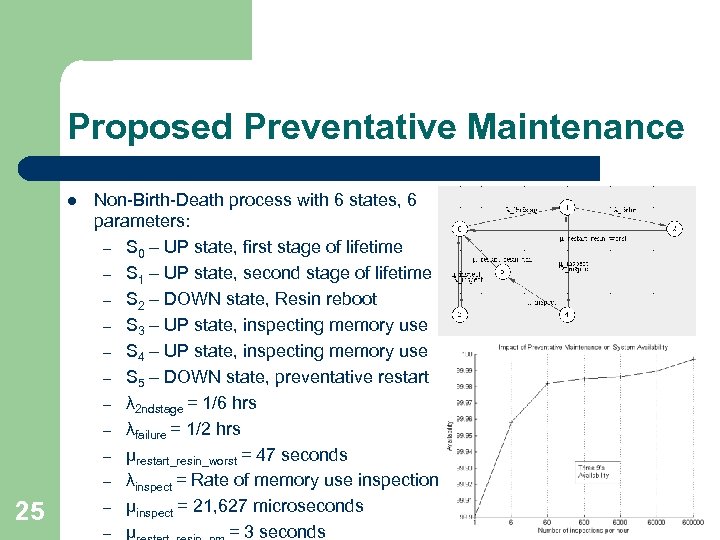
Proposed Preventative Maintenance l 25 Non-Birth-Death process with 6 states, 6 parameters: – S 0 – UP state, first stage of lifetime – S 1 – UP state, second stage of lifetime – S 2 – DOWN state, Resin reboot – S 3 – UP state, inspecting memory use – S 4 – UP state, inspecting memory use – S 5 – DOWN state, preventative restart – λ 2 ndstage = 1/6 hrs – λfailure = 1/2 hrs – µrestart_resin_worst = 47 seconds – λinspect = Rate of memory use inspection – µinspect = 21, 627 microseconds – µ = 3 seconds
Скачать презентацию RAS-Models A Building Block for Self-Healing Benchmarks Rean
ce3a3cbc0d56cbe8ff031c56909c4793.ppt