 Скачать презентацию Raportarea regionala pe seama raspunsului global al infecţiei
6f353d7a54f23edaec2390332cc5025a.ppt
- Количество слайдов: 19



Raportarea regionala pe seama raspunsului global al infecţiei HIV 2012 08. 02. 2012
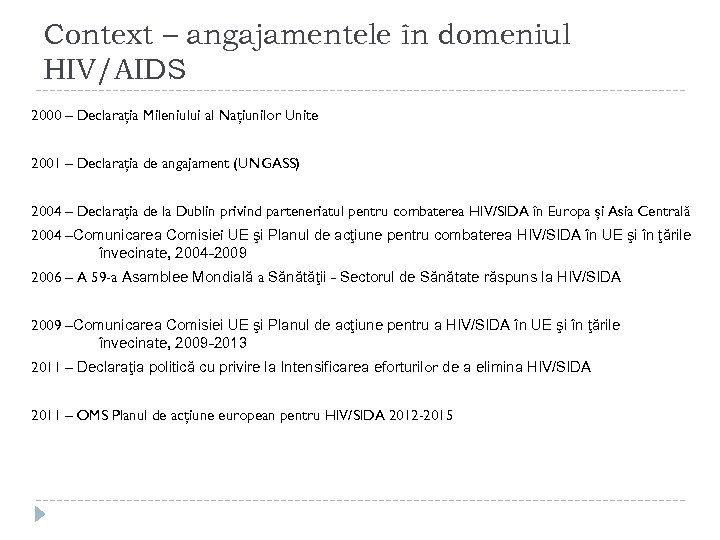
Context – angajamentele în domeniul HIV/AIDS 2000 – Declaraţia Mileniului al Naţiunilor Unite 2001 – Declaraţia de angajament (UNGASS) 2004 – Declaraţia de la Dublin privind parteneriatul pentru combaterea HIV/SIDA în Europa şi Asia Centrală 2004 –Comunicarea Comisiei UE şi Planul de acţiune pentru combaterea HIV/SIDA în UE şi în ţările învecinate, 2004 -2009 2006 – A 59 -a Asamblee Mondială a Sănătăţii - Sectorul de Sănătate răspuns la HIV/SIDA 2009 –Comunicarea Comisiei UE şi Planul de acţiune pentru a HIV/SIDA în UE şi în ţările învecinate, 2009 -2013 2011 – Declaraţia politică cu privire la Intensificarea eforturilor de a elimina HIV/SIDA 2011 – OMS Planul de acţiune european pentru HIV/SIDA 2012 -2015
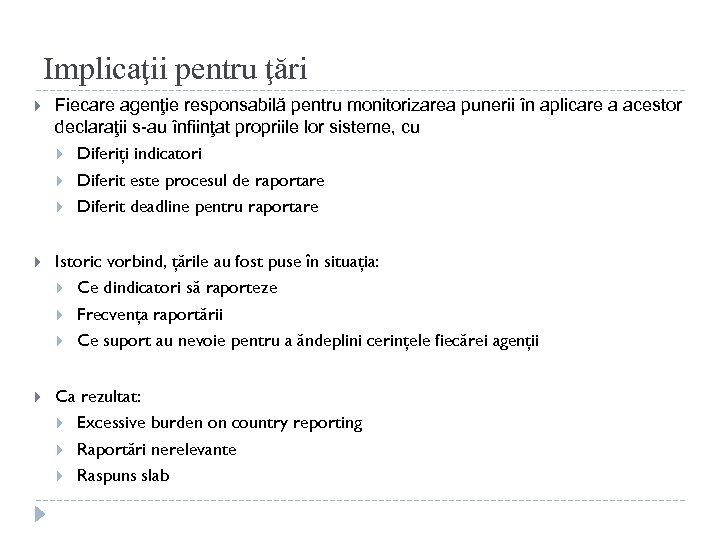
Implicaţii pentru ţări Fiecare agenţie responsabilă pentru monitorizarea punerii în aplicare a acestor declaraţii s-au înfiinţat propriile lor sisteme, cu Diferiţi indicatori Diferit este procesul de raportare Diferit deadline pentru raportare Istoric vorbind, ţările au fost puse în situaţia: Ce dindicatori să raporteze Frecvenţa raportării Ce suport au nevoie pentru a ăndeplini cerinţele fiecărei agenţii Ca rezultat: Excessive burden on country reporting Raportări nerelevante Raspuns slab
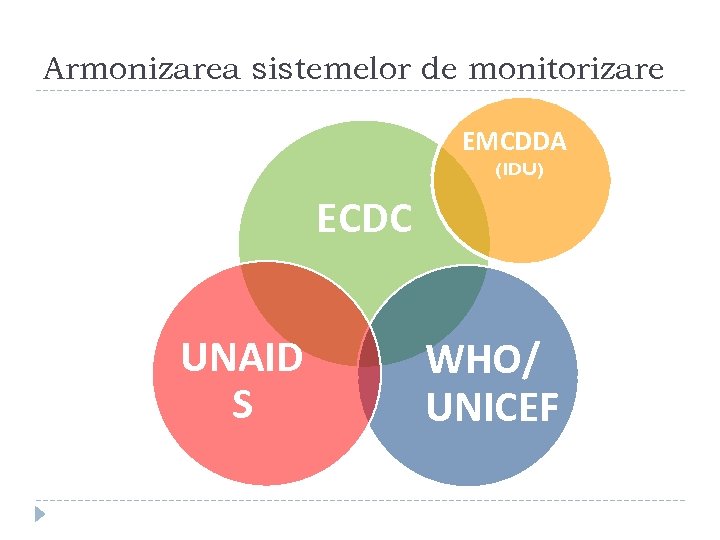
Armonizarea sistemelor de monitorizare EMCDDA (IDU) ECDC UNAID S WHO/ UNICEF
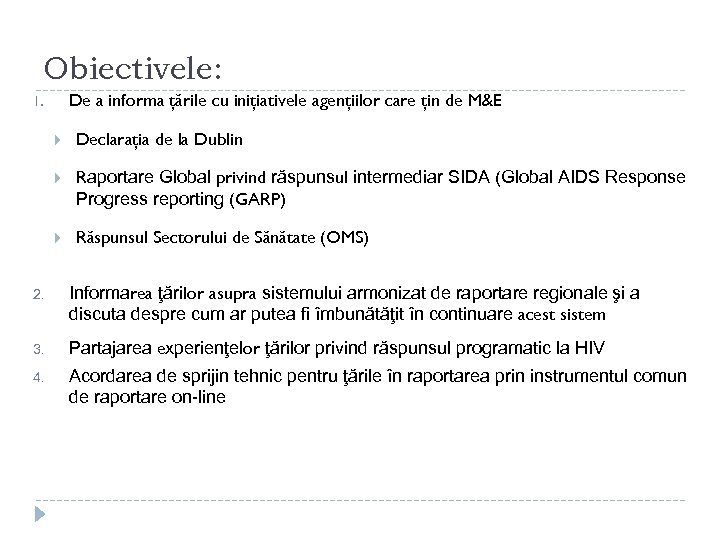
Obiectivele: De a informa ţările cu iniţiativele agenţiilor care ţin de M&E 1. Declaraţia de la Dublin Raportare Global privind răspunsul intermediar SIDA (Global AIDS Response Progress reporting (GARP) Răspunsul Sectorului de Sănătate (OMS) 2. Informarea ţărilor asupra sistemului armonizat de raportare regionale şi a discuta despre cum ar putea fi îmbunătăţit în continuare acest sistem 3. Partajarea experienţelor ţărilor privind răspunsul programatic la HIV 4. Acordarea de sprijin tehnic pentru ţările în raportarea prin instrumentul comun de raportare on-line
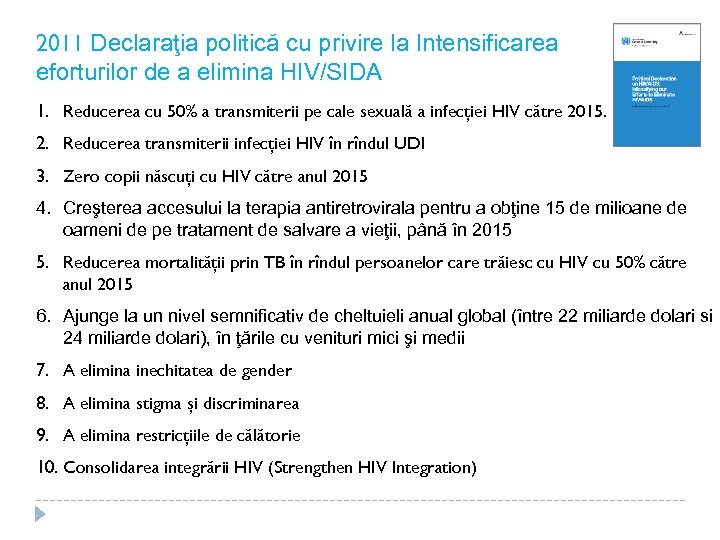
2011 Declaraţia politică cu privire la Intensificarea eforturilor de a elimina HIV/SIDA 1. Reducerea cu 50% a transmiterii pe cale sexuală a infecţiei HIV către 2015. 2. Reducerea transmiterii infecţiei HIV în rîndul UDI 3. Zero copii născuţi cu HIV către anul 2015 4. Creşterea accesului la terapia antiretrovirala pentru a obţine 15 de milioane de oameni de pe tratament de salvare a vieţii, până în 2015 5. Reducerea mortalităţii prin TB în rîndul persoanelor care trăiesc cu HIV cu 50% către anul 2015 6. Ajunge la un nivel semnificativ de cheltuieli anual global (între 22 miliarde dolari si 24 miliarde dolari), în ţările cu venituri mici şi medii 7. A elimina inechitatea de gender 8. A elimina stigma şi discriminarea 9. A elimina restricţiile de călătorie 10. Consolidarea integrării HIV (Strengthen HIV Integration)
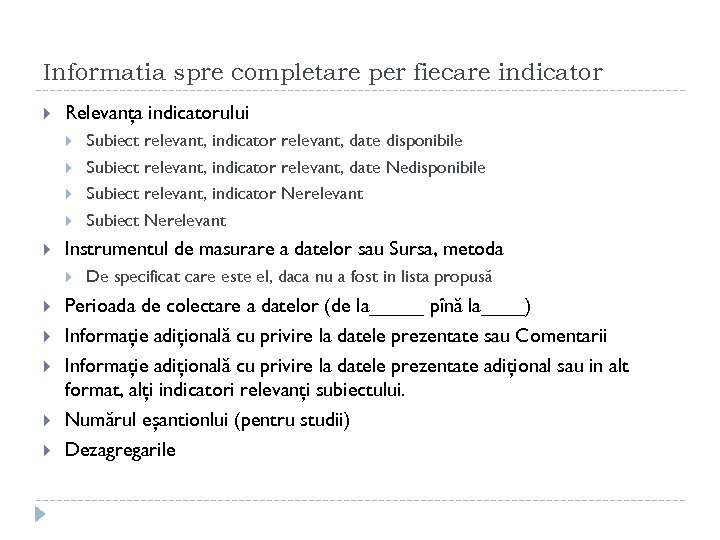
Informatia spre completare per fiecare indicator Relevanţa indicatorului Instrumentul de masurare a datelor sau Sursa, metoda Subiect relevant, indicator relevant, date disponibile Subiect relevant, indicator relevant, date Nedisponibile Subiect relevant, indicator Nerelevant Subiect Nerelevant De specificat care este el, daca nu a fost in lista propusă Perioada de colectare a datelor (de la_____ pînă la____) Informaţie adiţională cu privire la datele prezentate sau Comentarii Informaţie adiţională cu privire la datele prezentate adiţional sau in alt format, alţi indicatori relevanţi subiectului. Numărul eşantionlui (pentru studii) Dezagregarile
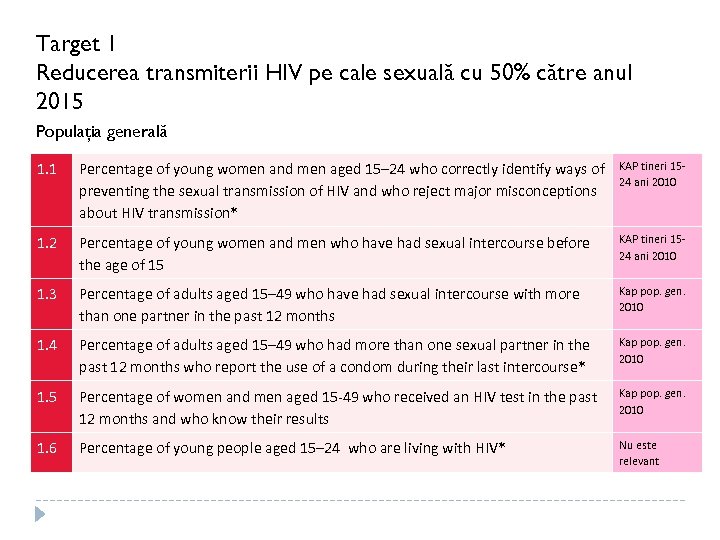
Target 1 Reducerea transmiterii HIV pe cale sexuală cu 50% către anul 2015 Populaţia generală 1. 1 Percentage of young women and men aged 15– 24 who correctly identify ways of preventing the sexual transmission of HIV and who reject major misconceptions about HIV transmission* KAP tineri 1524 ani 2010 1. 2 Percentage of young women and men who have had sexual intercourse before the age of 15 KAP tineri 1524 ani 2010 1. 3 Percentage of adults aged 15– 49 who have had sexual intercourse with more than one partner in the past 12 months Kap pop. gen. 2010 1. 4 Percentage of adults aged 15– 49 who had more than one sexual partner in the past 12 months who report the use of a condom during their last intercourse* Kap pop. gen. 2010 1. 5 Percentage of women and men aged 15 -49 who received an HIV test in the past 12 months and who know their results Kap pop. gen. 2010 1. 6 Percentage of young people aged 15– 24 who are living with HIV* Nu este relevant
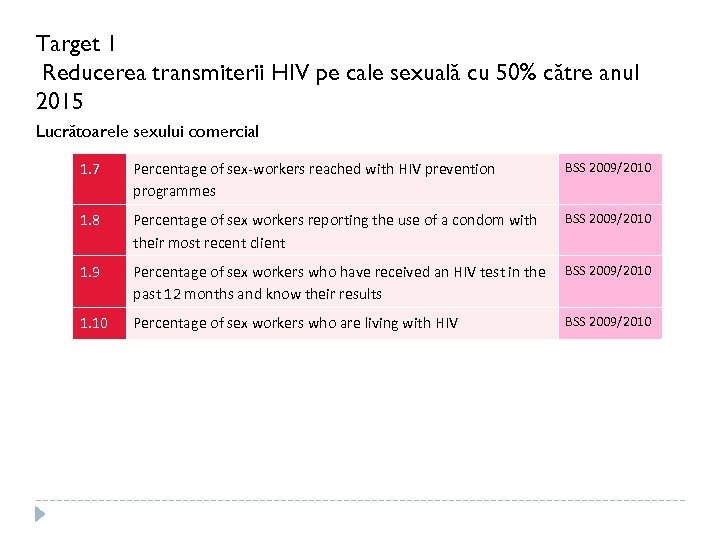
Target 1 Reducerea transmiterii HIV pe cale sexuală cu 50% către anul 2015 Lucrătoarele sexului comercial 1. 7 Percentage of sex-workers reached with HIV prevention programmes BSS 2009/2010 1. 8 Percentage of sex workers reporting the use of a condom with their most recent client BSS 2009/2010 1. 9 Percentage of sex workers who have received an HIV test in the past 12 months and know their results BSS 2009/2010 1. 10 Percentage of sex workers who are living with HIV BSS 2009/2010
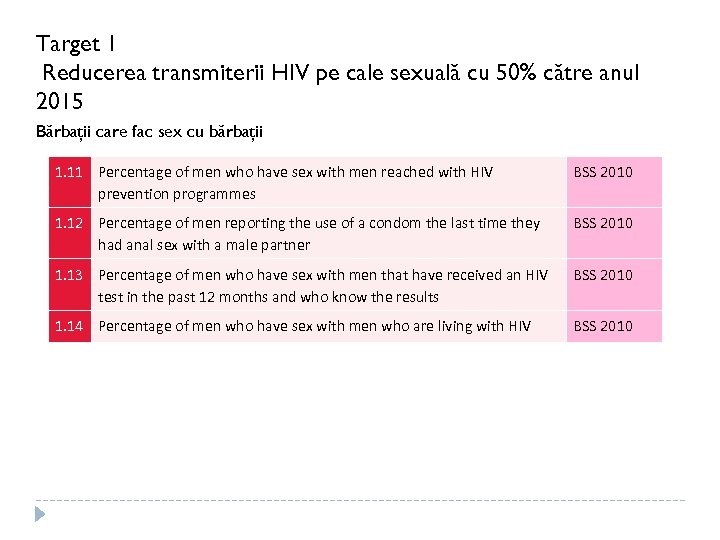
Target 1 Reducerea transmiterii HIV pe cale sexuală cu 50% către anul 2015 Bărbaţii care fac sex cu bărbaţii 1. 11 Percentage of men who have sex with men reached with HIV prevention programmes BSS 2010 1. 12 Percentage of men reporting the use of a condom the last time they had anal sex with a male partner BSS 2010 1. 13 Percentage of men who have sex with men that have received an HIV test in the past 12 months and who know the results BSS 2010 1. 14 Percentage of men who have sex with men who are living with HIV BSS 2010
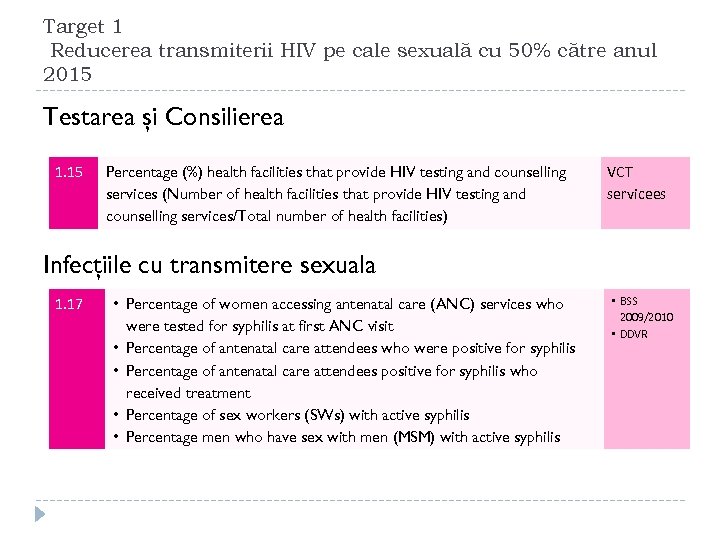
Target 1 Reducerea transmiterii HIV pe cale sexuală cu 50% către anul 2015 Testarea şi Consilierea 1. 15 Percentage (%) health facilities that provide HIV testing and counselling services (Number of health facilities that provide HIV testing and counselling services/Total number of health facilities) VCT servicees Infecţiile cu transmitere sexuala 1. 17 • Percentage of women accessing antenatal care (ANC) services who were tested for syphilis at first ANC visit • Percentage of antenatal care attendees who were positive for syphilis • Percentage of antenatal care attendees positive for syphilis who received treatment • Percentage of sex workers (SWs) with active syphilis • Percentage men who have sex with men (MSM) with active syphilis • BSS 2009/2010 • DDVR
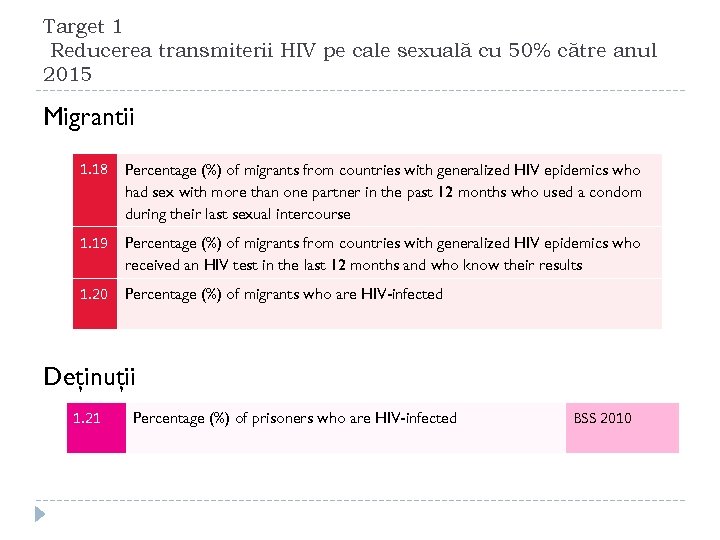
Target 1 Reducerea transmiterii HIV pe cale sexuală cu 50% către anul 2015 Migrantii 1. 18 Percentage (%) of migrants from countries with generalized HIV epidemics who had sex with more than one partner in the past 12 months who used a condom during their last sexual intercourse 1. 19 Percentage (%) of migrants from countries with generalized HIV epidemics who received an HIV test in the last 12 months and who know their results 1. 20 Percentage (%) of migrants who are HIV-infected Deţinuţii 1. 21 Percentage (%) of prisoners who are HIV-infected BSS 2010
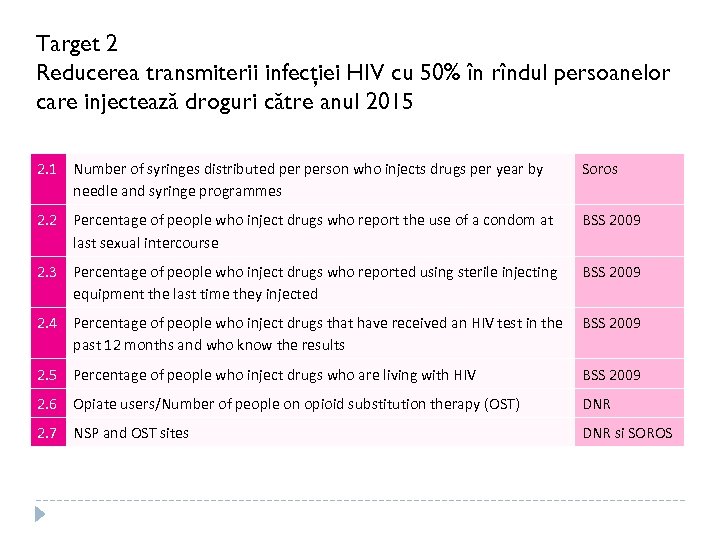
Target 2 Reducerea transmiterii infecţiei HIV cu 50% în rîndul persoanelor care injectează droguri către anul 2015 2. 1 Number of syringes distributed person who injects drugs per year by needle and syringe programmes Soros 2. 2 Percentage of people who inject drugs who report the use of a condom at last sexual intercourse BSS 2009 2. 3 Percentage of people who inject drugs who reported using sterile injecting equipment the last time they injected BSS 2009 2. 4 Percentage of people who inject drugs that have received an HIV test in the past 12 months and who know the results BSS 2009 2. 5 Percentage of people who inject drugs who are living with HIV BSS 2009 2. 6 Opiate users/Number of people on opioid substitution therapy (OST) DNR 2. 7 NSP and OST sites DNR si SOROS
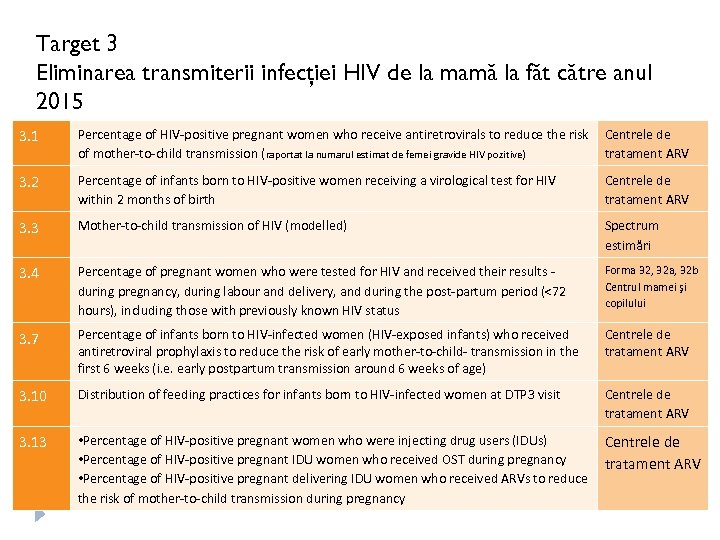
Target 3 Eliminarea transmiterii infecţiei HIV de la mamă la făt către anul 2015 3. 1 Percentage of HIV-positive pregnant women who receive antiretrovirals to reduce the risk of mother-to-child transmission (raportat la numarul estimat de femei gravide HIV pozitive) Centrele de tratament ARV 3. 2 Percentage of infants born to HIV-positive women receiving a virological test for HIV within 2 months of birth Centrele de tratament ARV 3. 3 Mother-to-child transmission of HIV (modelled) Spectrum estimări 3. 4 Percentage of pregnant women who were tested for HIV and received their results during pregnancy, during labour and delivery, and during the post-partum period (<72 hours), including those with previously known HIV status Forma 32, 32 a, 32 b Centrul mamei şi copilului 3. 7 Percentage of infants born to HIV-infected women (HIV-exposed infants) who received antiretroviral prophylaxis to reduce the risk of early mother-to-child- transmission in the first 6 weeks (i. e. early postpartum transmission around 6 weeks of age) Centrele de tratament ARV 3. 10 Distribution of feeding practices for infants born to HIV-infected women at DTP 3 visit Centrele de tratament ARV 3. 13 • Percentage of HIV-positive pregnant women who were injecting drug users (IDUs) • Percentage of HIV-positive pregnant IDU women who received OST during pregnancy • Percentage of HIV-positive pregnant delivering IDU women who received ARVs to reduce the risk of mother-to-child transmission during pregnancy Centrele de tratament ARV
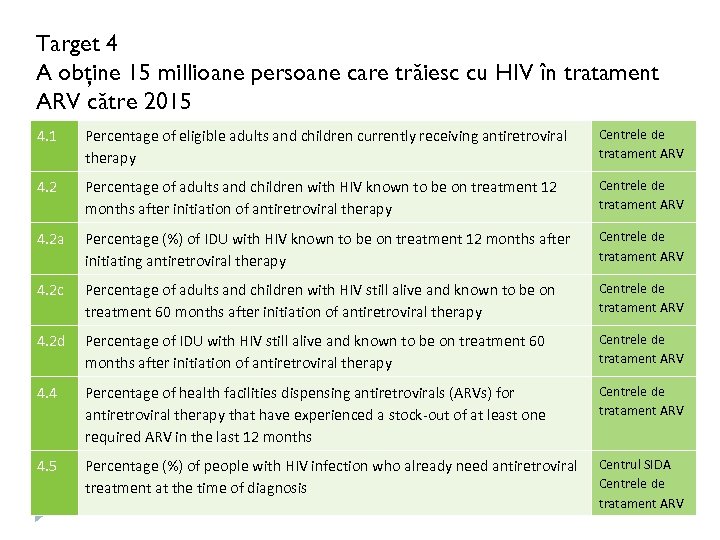
Target 4 A obţine 15 millioane persoane care trăiesc cu HIV în tratament ARV către 2015 4. 1 Percentage of eligible adults and children currently receiving antiretroviral therapy Centrele de tratament ARV 4. 2 Percentage of adults and children with HIV known to be on treatment 12 months after initiation of antiretroviral therapy Centrele de tratament ARV 4. 2 a Percentage (%) of IDU with HIV known to be on treatment 12 months after initiating antiretroviral therapy Centrele de tratament ARV 4. 2 c Percentage of adults and children with HIV still alive and known to be on treatment 60 months after initiation of antiretroviral therapy Centrele de tratament ARV 4. 2 d Percentage of IDU with HIV still alive and known to be on treatment 60 months after initiation of antiretroviral therapy Centrele de tratament ARV 4. 4 Percentage of health facilities dispensing antiretrovirals (ARVs) for antiretroviral therapy that have experienced a stock-out of at least one required ARV in the last 12 months Centrele de tratament ARV 4. 5 Percentage (%) of people with HIV infection who already need antiretroviral treatment at the time of diagnosis Centrul SIDA Centrele de tratament ARV
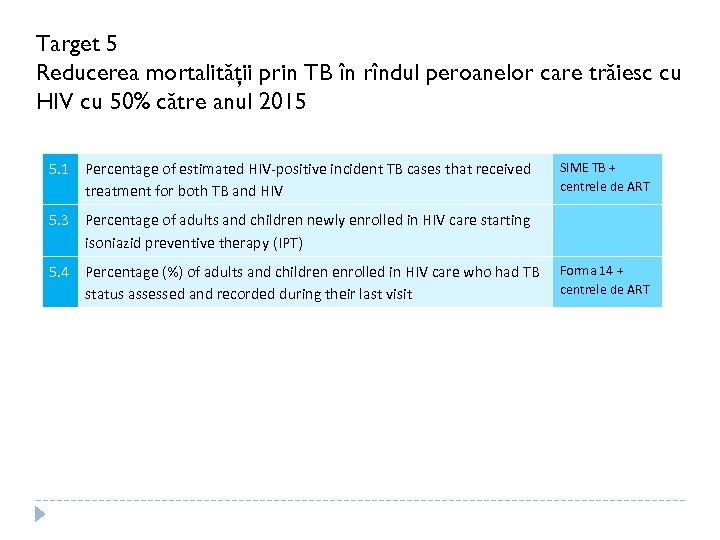
Target 5 Reducerea mortalităţii prin TB în rîndul peroanelor care trăiesc cu HIV cu 50% către anul 2015 5. 1 Percentage of estimated HIV-positive incident TB cases that received treatment for both TB and HIV SIME TB + centrele de ART 5. 3 Percentage of adults and children newly enrolled in HIV care starting isoniazid preventive therapy (IPT) 5. 4 Percentage (%) of adults and children enrolled in HIV care who had TB status assessed and recorded during their last visit Forma 14 + centrele de ART
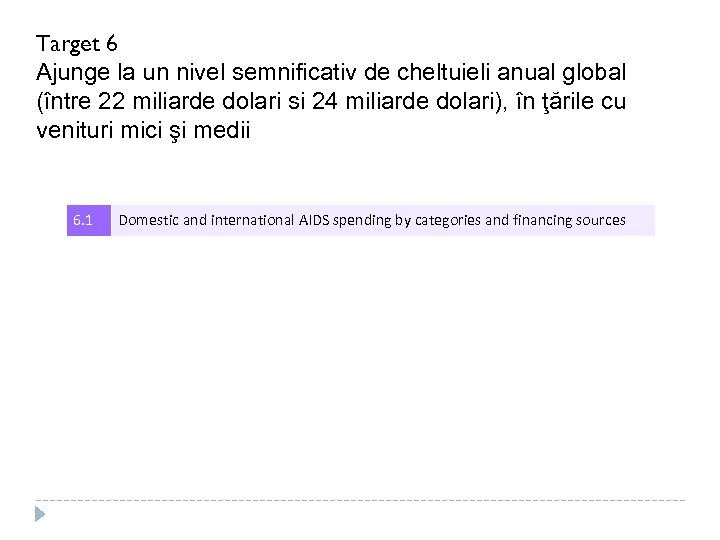
Target 6 Ajunge la un nivel semnificativ de cheltuieli anual global (între 22 miliarde dolari si 24 miliarde dolari), în ţările cu venituri mici şi medii 6. 1 Domestic and international AIDS spending by categories and financing sources
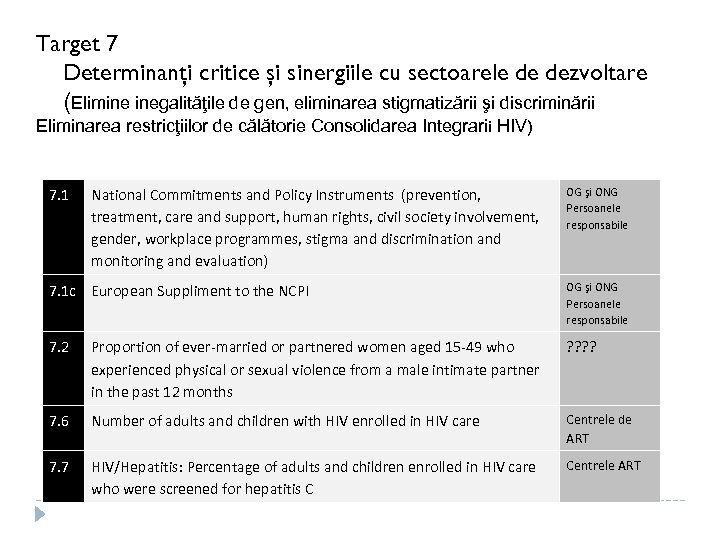
Target 7 Determinanţi critice şi sinergiile cu sectoarele de dezvoltare (Elimine inegalităţile de gen, eliminarea stigmatizării şi discriminării Eliminarea restricţiilor de călătorie Consolidarea Integrarii HIV) 7. 1 National Commitments and Policy Instruments (prevention, treatment, care and support, human rights, civil society involvement, gender, workplace programmes, stigma and discrimination and monitoring and evaluation) OG şi ONG Persoanele responsabile 7. 1 c European Suppliment to the NCPI OG şi ONG Persoanele responsabile 7. 2 Proportion of ever-married or partnered women aged 15 -49 who experienced physical or sexual violence from a male intimate partner in the past 12 months ? ? 7. 6 Number of adults and children with HIV enrolled in HIV care Centrele de ART 7. 7 HIV/Hepatitis: Percentage of adults and children enrolled in HIV care who were screened for hepatitis C Centrele ART
www. aidsreportingtool. unaids. org Rol de vizualizare Username: cv_MD Password: z 0 pllj 6 c www. unaids. org/aidsreporting
Скачать презентацию Raportarea regionala pe seama raspunsului global al infecţiei
6f353d7a54f23edaec2390332cc5025a.ppt