


 Скачать презентацию rans van Vught Frans Kaiser Don F Westerheijden
16825dd3a7b7a386901a7cab07c9b40f.ppt
- Количество слайдов: 34
 rans van Vught, Frans Kaiser Don F. Westerheijden Building a European Classification of Higher Education Institutions Ideas, Concepts, Goals
 Definitions Diversity: • The level of variety in a system at a specific point of time. Differentiation/Diversification: • The process in which the diversity of a system increases.
 A General Distinction External Diversity: • differences between entities in a system. Internal Diversity: • differences within entities in a system.
 In Higher Education Systemic/Structural/Institutional Diversity: • The level of variety in different types of institutions. Programmic Diversity: • The level of variety in types of programmes offered.
 History of Diversity in European Higher Education Middle Ages “… the sixty or so universities of the medieval West were … extremely various as regards their numbers, their intellectual orientations, their social role and the … institutions themselves”. “Nevertheless, … the universities had, at least in ideal terms, a universalist vocation. Although of course situated in a particular town or country, they could wield an influence whose extent was determined … simply by their intrinsic capacity to attract”. J. Verger, Patterns, in: A History of the University in Europe, Volume I, 1992
 History of Diversity in European Higher Education Early Modern Europe (1500 – 1800) “… it is possible to define a few major types of university institutions”. “… universities in the strict sense of the term …, recognized or legitimated by the de facto supreme authority in the territory by its granting the rights to award degrees”. “… teaching academies, higher or illustrious schools … which could claim university status but had not obtained all its privileges, especially that of awarding degrees”. “… the college, teaching … in the form of propaedeutic classes for university entrance or merely as an elementary form of higher education”. W. Frijhoff, Patterns, in: A history of the University in Europe, Volume II, 1996
 History of Diversity in European Higher Education Modern Europe (1800 – ) “Of the sovereign states on the map of Europe in 1993, four had been formed in the sixteenth century, four in the seventeenth, two in the eighteenth, seven in the nineteenth, and no fewer than thirty-six in the twentieth”. N. Davies, Europe, A History , 1996 “The political culture represented by the nation demanded cultural domestication and social standardization right from the start … The university therefore took on the societybuilding role of providing a ‘national education’… Universities were to meet the needs of the modern state…”. B. Henningsen, A Joyful Good-Bye to Wilhelm von Humboldt, in: G. Neave et al (eds), The European Research University, 2006
 History of Diversity in European Higher Education Trends • From a European system to national systems. • Formalization of diversity in national regulation. • Increasing but “hidden” institutional diversity.
 The European Higher Education Area (EHEA) Sorbonne declaration (1998): “harmonization of the architecture of the European higher education system”. Bologna declaration (1999): “to achieve greater compatibility and comparability … taking full respect of the diversity of cultures, languages, national education systems and university autonomy”.
 The EHEA Outcomes Trends Reports (1999, 2001, … 2007): • increasing implementation of structural changes (two or three cycles, ECTS, Diploma Supplement); • different national interpretations; • large variety of operationalisations.
 Diversity in the EHEA General picture Macro-level structural convergence. Large (increased? ) meso- and micro-level diversity.
 Diversity in the EHEA Recreation of a European system (structural convergence). Continued diversity between national systems. Large, hidden institutional diversity remains.
 Diversity in the EHEA § Diversity is a strength! § Needs to be made transparent § By means of a European classification
 Classifications are International Phenomena § § Carnegie Classification (USA): 1973, 1976, 1994, 2000, 2006 Chinese higher education classification: 2007
 Functions of European Classification of Higher Education Institutions Profiles European higher education at a global scale § Offers relevant information to stakeholders and clients § Provides basis for effective policies and investment strategies § Allows institutional development strategies § Facilitates benchmarking, networking and partnerships § Is a prerequisite for rankings §
 Classification and Rankings § § the methodologies of ranking are judged to be ‘simplistic and lacking transparency’. (Hazelkorn, 2007) ‘with increasing competition between institutions, … it is likely that rankings will continue to grow in importance … Further consideration and acknowledgement of wider factors (than in a single league table only) should be considered so that the diversity of institutional mission and focus is taken into account’. (HEFCE, 2008)
 The Classification Project § § Stakeholder approach: exploration and discussions First phase: basic design principles First phase: first set of dimensions and indicators Second phase: second adapted set of dimensions and indicators
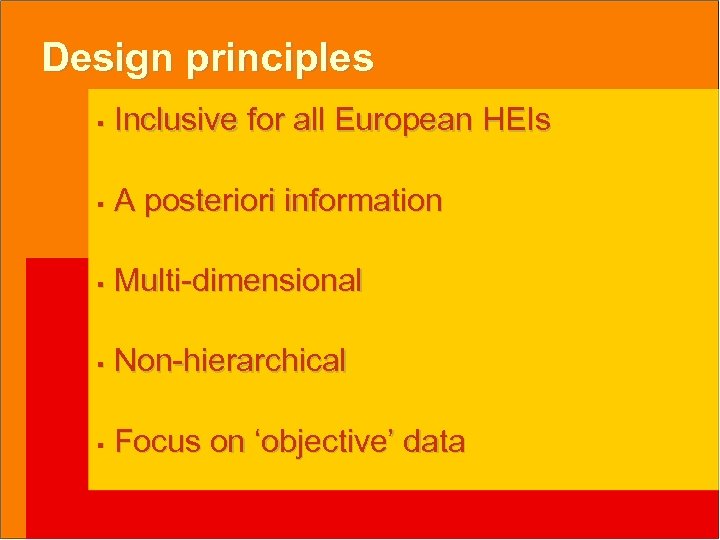 Design principles § Inclusive for all European HEIs § A posteriori information § Multi-dimensional § Non-hierarchical § Focus on ‘objective’ data
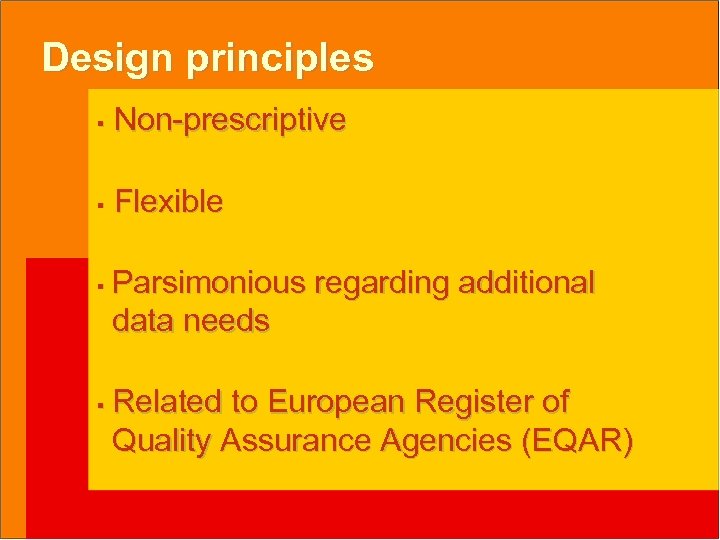 Design principles § Non-prescriptive § Flexible § § Parsimonious regarding additional data needs Related to European Register of Quality Assurance Agencies (EQAR)
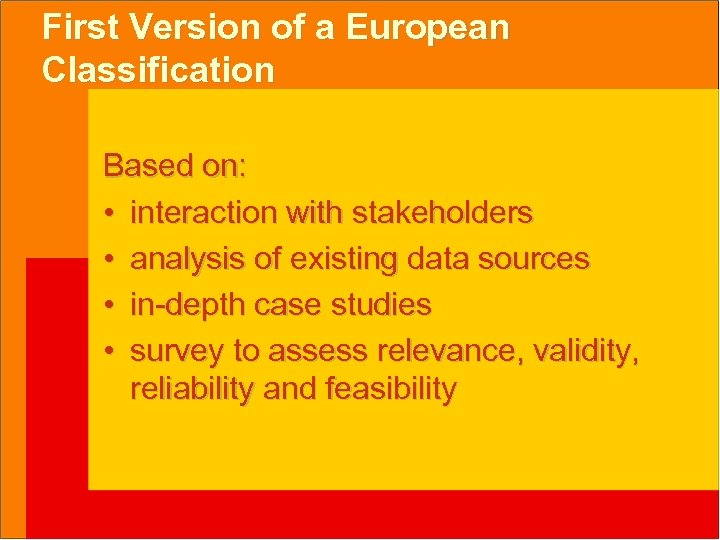 First Version of a European Classification Based on: • interaction with stakeholders • analysis of existing data sources • in-depth case studies • survey to assess relevance, validity, reliability and feasibility
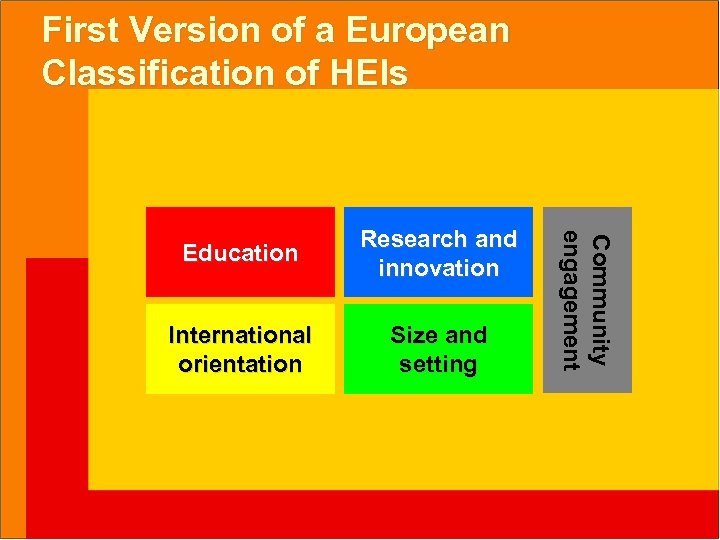 First Version of a European Classification of HEIs International orientation Size and setting Community engagement Education Research and innovation
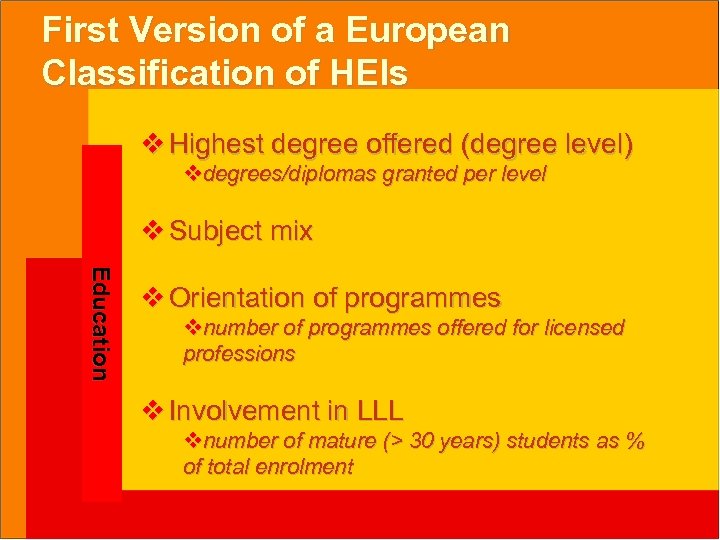 First Version of a European Classification of HEIs v Highest degree offered (degree level) vdegrees/diplomas granted per level v Subject mix E d u c a ti o n v Orientation of programmes vnumber of programmes offered for licensed professions v Involvement in LLL vnumber of mature (> 30 years) students as % of total enrolment
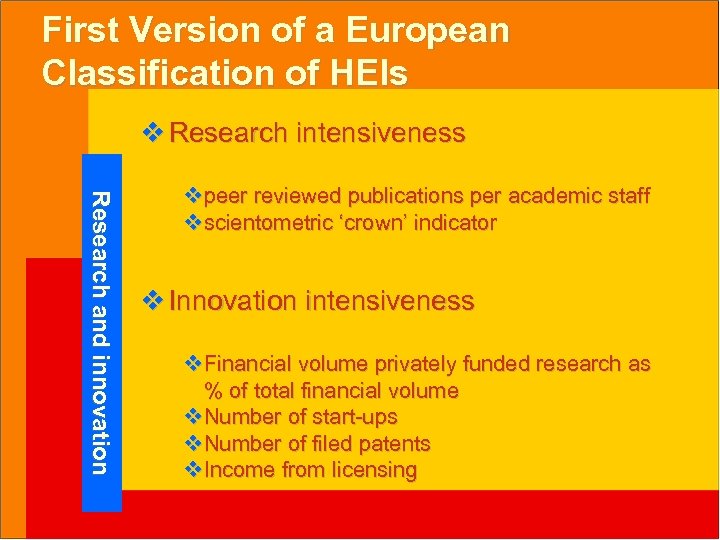 First Version of a European Classification of HEIs v Research intensiveness R e s e a r c h a n d i n n o v a ti o n v peer reviewed publications per academic staff v scientometric ‘crown’ indicator v Innovation intensiveness v Financial volume privately funded research as % of total financial volume v Number of start-ups v Number of filed patents v Income from licensing
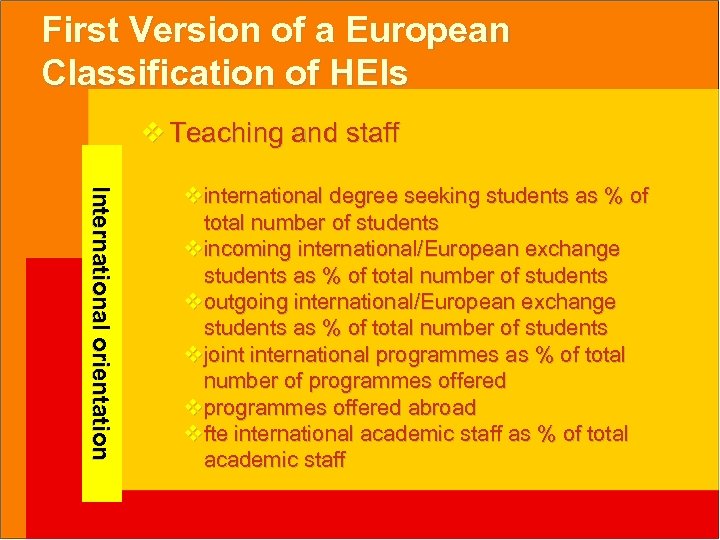 First Version of a European Classification of HEIs v Teaching and staff I n te r n a ti o n a l o r i e n ta ti o n v international degree seeking students as % of total number of students v incoming international/European exchange students as % of total number of students v outgoing international/European exchange students as % of total number of students v joint international programmes as % of total number of programmes offered v programmes offered abroad v fte international academic staff as % of total academic staff
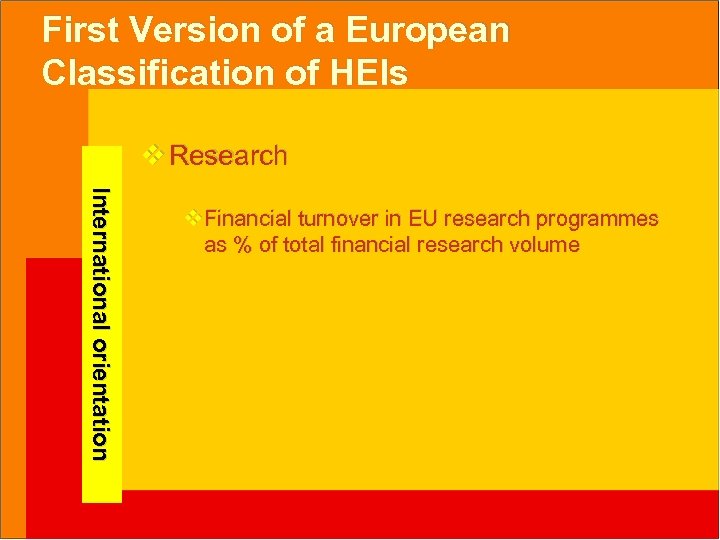 First Version of a European Classification of HEIs v Research I n te r n a ti o n a l o r i e n ta ti o n v Financial turnover in EU research programmes as % of total financial research volume
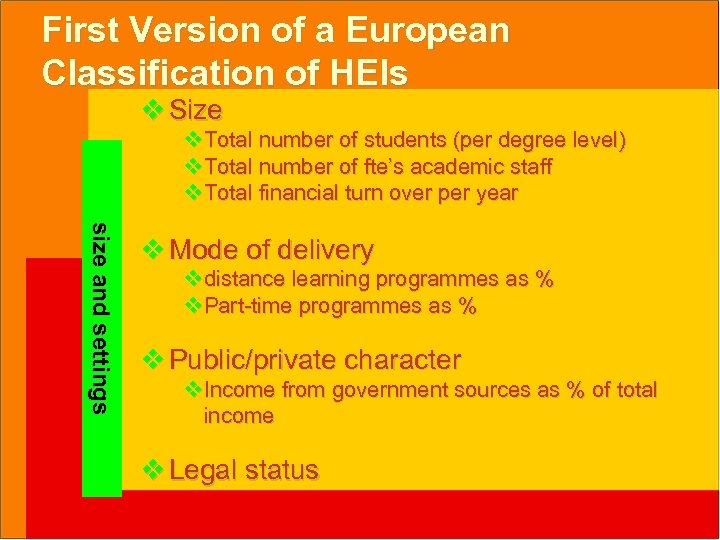 First Version of a European Classification of HEIs v Size v Total number of students (per degree level) v Total number of fte’s academic staff v Total financial turn over per year size and settings v Mode of delivery v distance learning programmes as % v Part-time programmes as % v Public/private character v Income from government sources as % of total income v Legal status
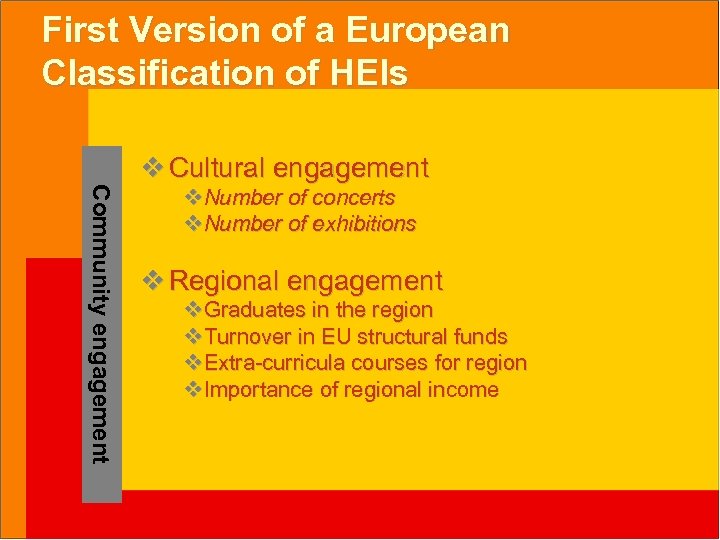 First Version of a European Classification of HEIs v Cultural engagement C o m m u n i ty e n g a g e m e n t v Number of concerts v Number of exhibitions v Regional engagement v Graduates in the region v Turnover in EU structural funds v Extra-curricula courses for region v Importance of regional income
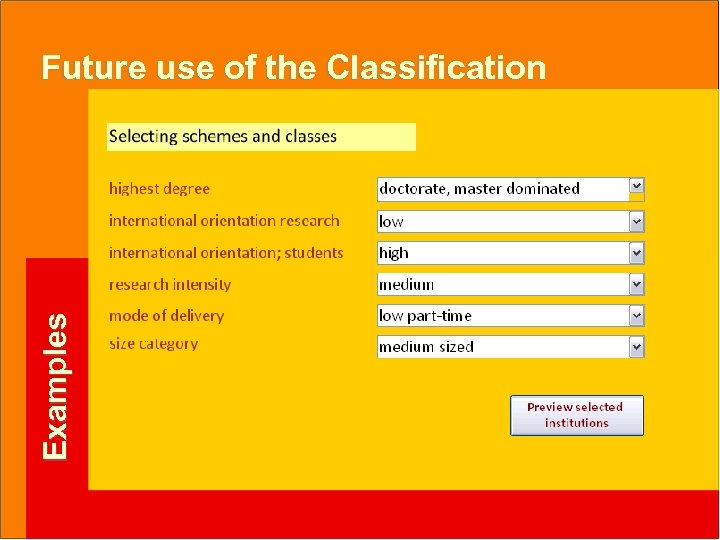
 Next steps § work in progress § further statistical analyses § reduce number of dimensions § develop on-line tool § communication process with stakeholders and preview ‘communities’ for special dimensions § § institutionalisation and ownership
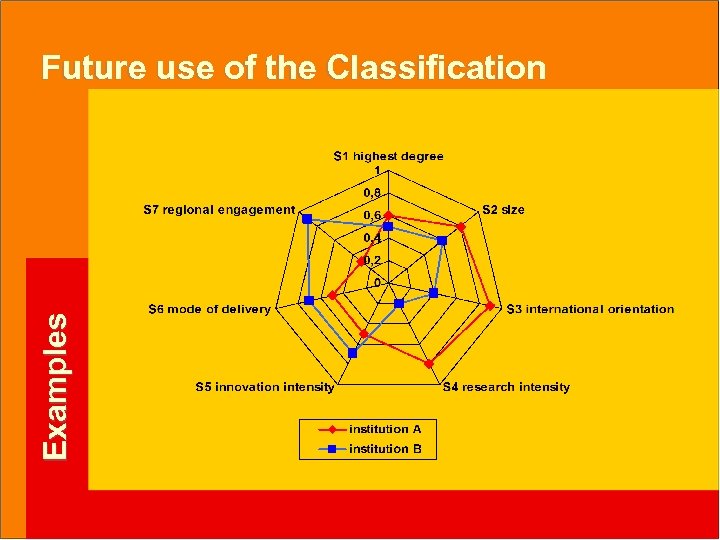
 Future use of the Classification Examples § Providing information to stakeholders and clients about characteristics of a higher education institutions
 Examples Future use of the Classification
 Future use of the Classification Examples § Providing assistance to institutional strategies and inter-institutional partnerships, benchmarking, and networking
 Examples Future use of the Classification
 The European Classification of Higher Education Institutions § § § Is about ‘mapping’ the field of higher education in Europe Join the further development of this instrument see: www. u-map. eu
 The European Classification of Higher Education Institutions www. u-map. eu Thank you for your attention! This project has been funded with support from the European Commission. This presentation content reflects the views only of the author. The Commission cannot be held responsible for any use which may be made of the information contained therein.