


 Скачать презентацию Randomness A computational complexity view Avi Wigderson
e0603060696f9388e252460c7cdf84fe.ppt
- Количество слайдов: 24
 Randomness – A computational complexity view Avi Wigderson Institute for Advanced Study
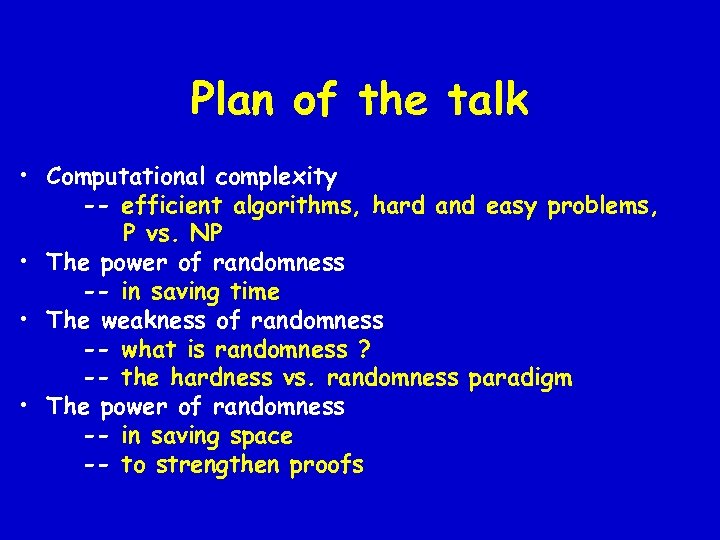 Plan of the talk • Computational complexity -- efficient algorithms, hard and easy problems, P vs. NP • The power of randomness -- in saving time • The weakness of randomness -- what is randomness ? -- the hardness vs. randomness paradigm • The power of randomness -- in saving space -- to strengthen proofs
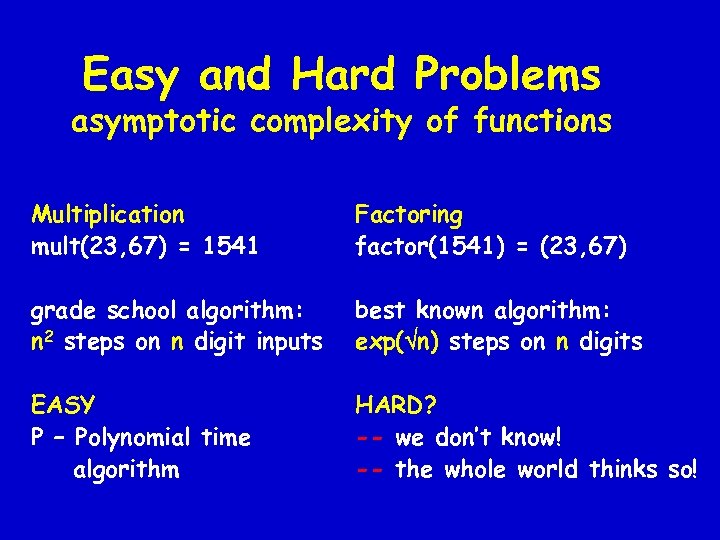 Easy and Hard Problems asymptotic complexity of functions Multiplication mult(23, 67) = 1541 Factoring factor(1541) = (23, 67) grade school algorithm: n 2 steps on n digit inputs best known algorithm: exp( n) steps on n digits EASY P – Polynomial time algorithm HARD? -- we don’t know! -- the whole world thinks so!
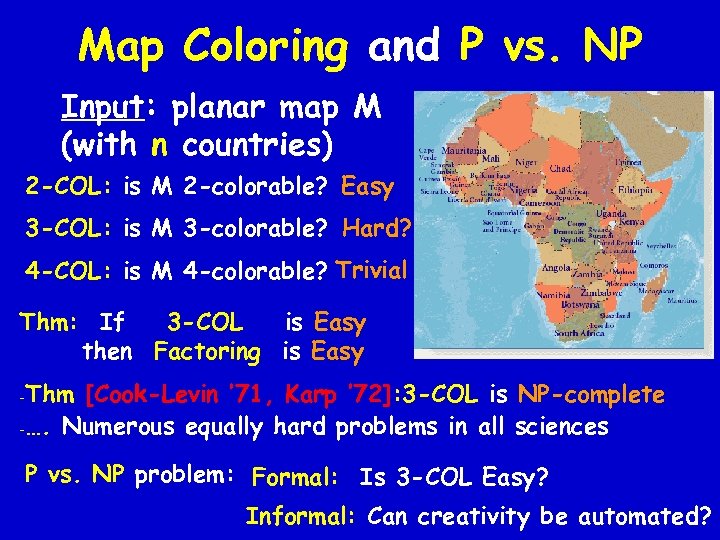 Map Coloring and P vs. NP Input: planar map M (with n countries) 2 -COL: is M 2 -colorable? Easy 3 -COL: is M 3 -colorable? Hard? 4 -COL: is M 4 -colorable? Trivial Thm: If 3 -COL is Easy then Factoring is Easy -Thm [Cook-Levin ’ 71, Karp ’ 72]: 3 -COL is NP-complete -…. Numerous equally hard problems in all sciences P vs. NP problem: Formal: Is 3 -COL Easy? Informal: Can creativity be automated?
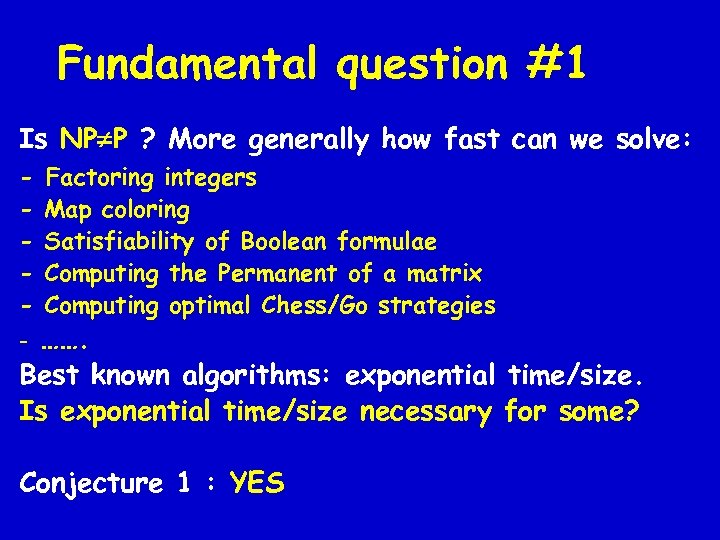 Fundamental question #1 Is NP P ? More generally how fast can we solve: - Factoring integers Map coloring Satisfiability of Boolean formulae Computing the Permanent of a matrix Computing optimal Chess/Go strategies ……. Best known algorithms: exponential time/size. Is exponential time/size necessary for some? - Conjecture 1 : YES
 The Power of Randomness Host of problems for which: - We have probabilistic polynomial time algorithms - We (still) have no deterministic algorithms of subexponential time.
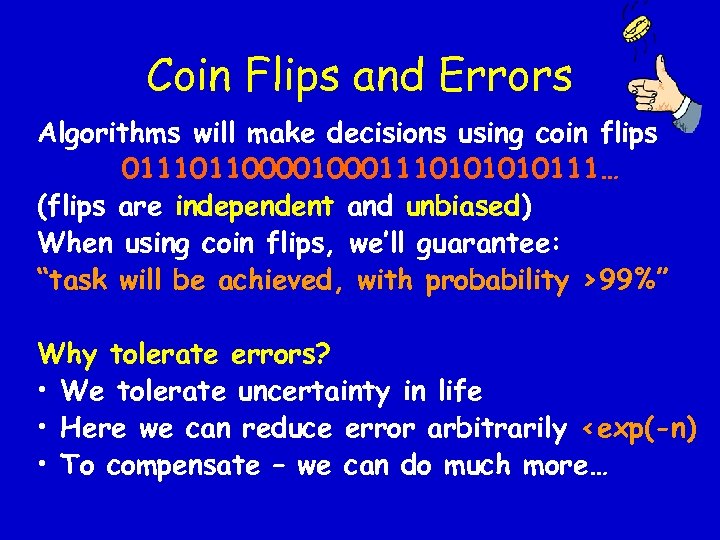 Coin Flips and Errors Algorithms will make decisions using coin flips 01110110000111010111… (flips are independent and unbiased) When using coin flips, we’ll guarantee: “task will be achieved, with probability >99%” Why tolerate errors? • We tolerate uncertainty in life • Here we can reduce error arbitrarily
![Number Theory: Primes Problem 1 [Gauss]: Given x [2 n, 2 n+1], is x](https://present5.com/presentation/e0603060696f9388e252460c7cdf84fe/image-8.jpg "Number Theory: Primes Problem 1 [Gauss]: Given x [2 n, 2 n+1], is x") Number Theory: Primes Problem 1 [Gauss]: Given x [2 n, 2 n+1], is x prime? 1975 [Solovay-Strassen, Rabin] : Probabilistic 2002 [Agrawal-Kayal-Saxena]: Deterministic !! Problem 2: Given n, find a prime in [2 n, 2 n+1] Algorithm: Pick at random x 1, x 2, …, x 1000 n For each xi apply primality test. Prime Number Theorem Pr [ i xi prime] >. 99
Number Theory: Primes Problem 1 [Gauss]: Given x [2 n, 2 n+1], is x prime? 1975 [Solovay-Strassen, Rabin] : Probabilistic 2002 [Agrawal-Kayal-Saxena]: Deterministic !! Problem 2: Given n, find a prime in [2 n, 2 n+1] Algorithm: Pick at random x 1, x 2, …, x 1000 n For each xi apply primality test. Prime Number Theorem Pr [ i xi prime] >. 99
![Algebra: Polynomial Identities Is det( )- i<k (xi-xk) 0 ? Theorem [Vandermonde]: YES Given](https://present5.com/presentation/e0603060696f9388e252460c7cdf84fe/image-9.jpg "Algebra: Polynomial Identities Is det( )- i<k (xi-xk) 0 ? Theorem [Vandermonde]: YES Given") Algebra: Polynomial Identities Is det( )- i
Algebra: Polynomial Identities Is det( )- i
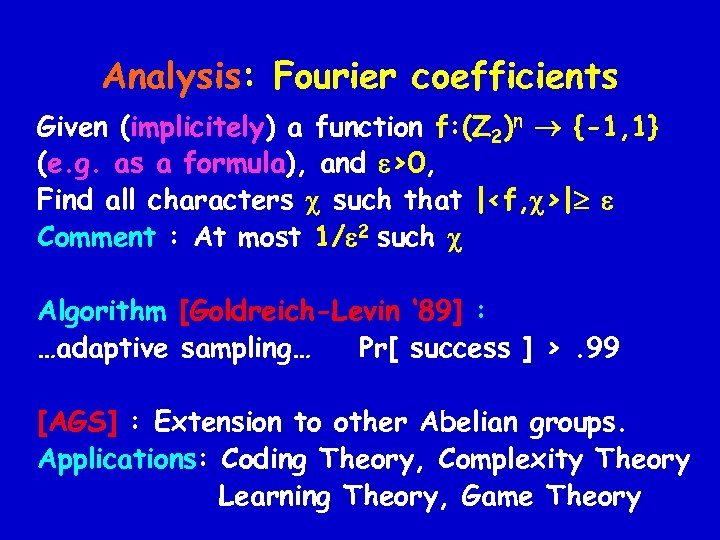 Analysis: Fourier coefficients Given (implicitely) a function f: (Z 2)n {-1, 1} (e. g. as a formula), and >0, Find all characters such that |
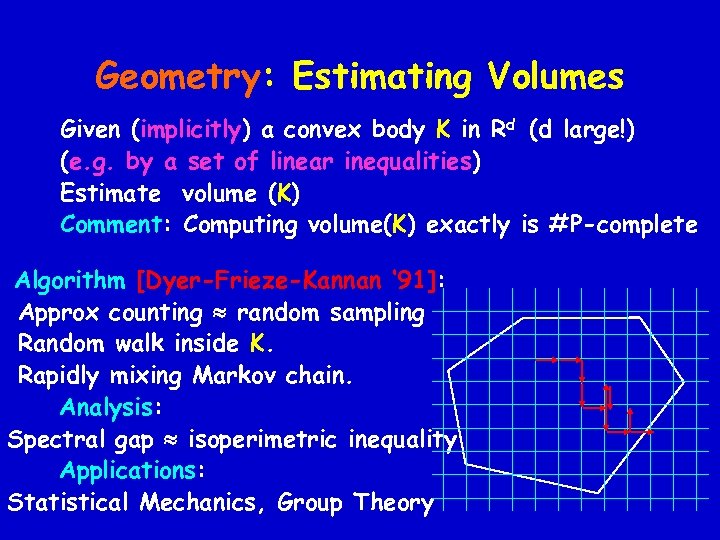 Geometry: Estimating Volumes Given (implicitly) a convex body K in Rd (d large!) (e. g. by a set of linear inequalities) Estimate volume (K) Comment: Computing volume(K) exactly is #P-complete Algorithm [Dyer-Frieze-Kannan ‘ 91]: Approx counting random sampling Random walk inside K. Rapidly mixing Markov chain. Analysis: Spectral gap isoperimetric inequality Applications: Statistical Mechanics, Group Theory
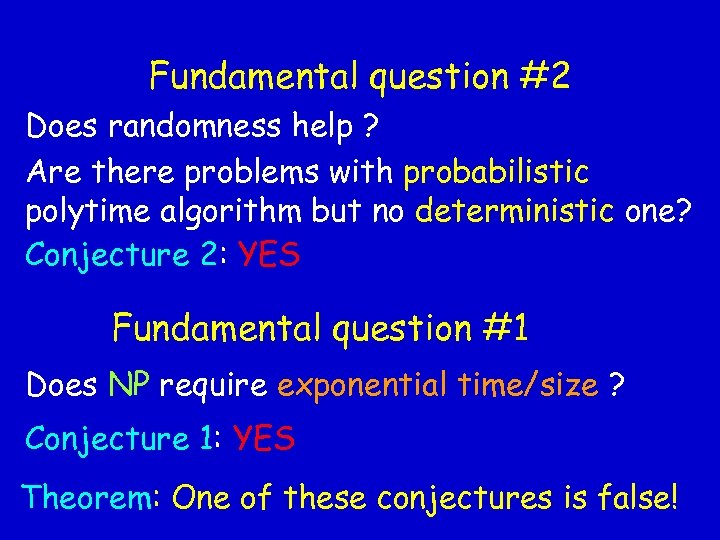 Fundamental question #2 Does randomness help ? Are there problems with probabilistic polytime algorithm but no deterministic one? Conjecture 2: YES Fundamental question #1 Does NP require exponential time/size ? Conjecture 1: YES Theorem: One of these conjectures is false!
![Hardness vs. Randomness Theorems [Blum-Micali, Yao, Nisan-Wigderson, Impagliazzo-Wigderson…] : If there are natural hard](https://present5.com/presentation/e0603060696f9388e252460c7cdf84fe/image-13.jpg "Hardness vs. Randomness Theorems [Blum-Micali, Yao, Nisan-Wigderson, Impagliazzo-Wigderson…] : If there are natural hard") Hardness vs. Randomness Theorems [Blum-Micali, Yao, Nisan-Wigderson, Impagliazzo-Wigderson…] : If there are natural hard problems Then randomness can be efficiently eliminated. Theorem [Impagliazzo-Wigderson ‘ 98] NP requires exponential size circuits every probabilistic polynomial-time algorithm has a deterministic counterpart
Hardness vs. Randomness Theorems [Blum-Micali, Yao, Nisan-Wigderson, Impagliazzo-Wigderson…] : If there are natural hard problems Then randomness can be efficiently eliminated. Theorem [Impagliazzo-Wigderson ‘ 98] NP requires exponential size circuits every probabilistic polynomial-time algorithm has a deterministic counterpart
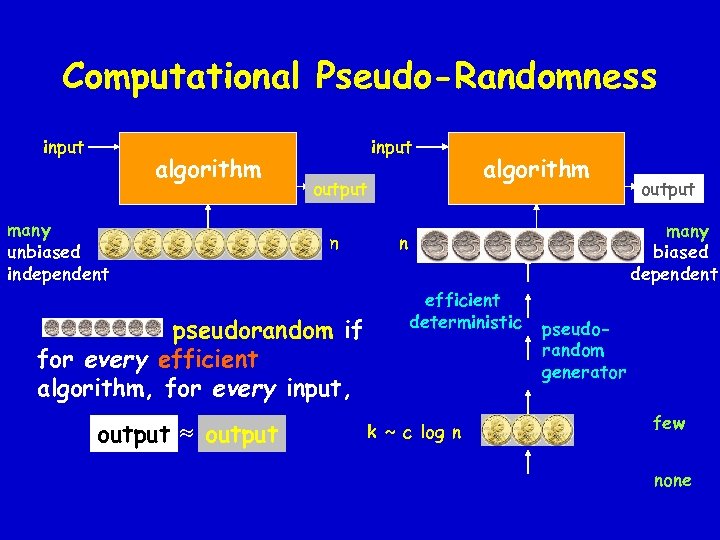 Computational Pseudo-Randomness input algorithm many unbiased independent input output n pseudorandom if for every efficient algorithm, for every input, output algorithm output many biased dependent n efficient deterministic k ~ c log n pseudorandom generator few none
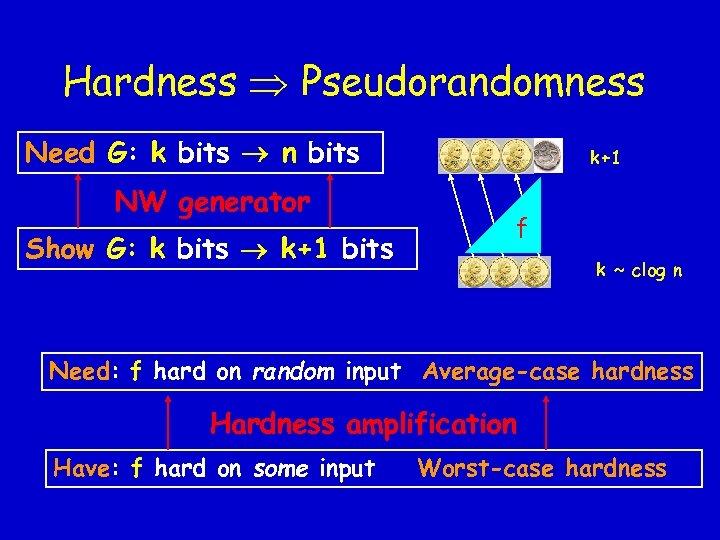 Hardness Pseudorandomness Need G: k bits n bits NW generator Show G: k bits k+1 bits k+1 f k ~ clog n Need: f hard on random input Average-case hardness Hardness amplification Have: f hard on some input Worst-case hardness
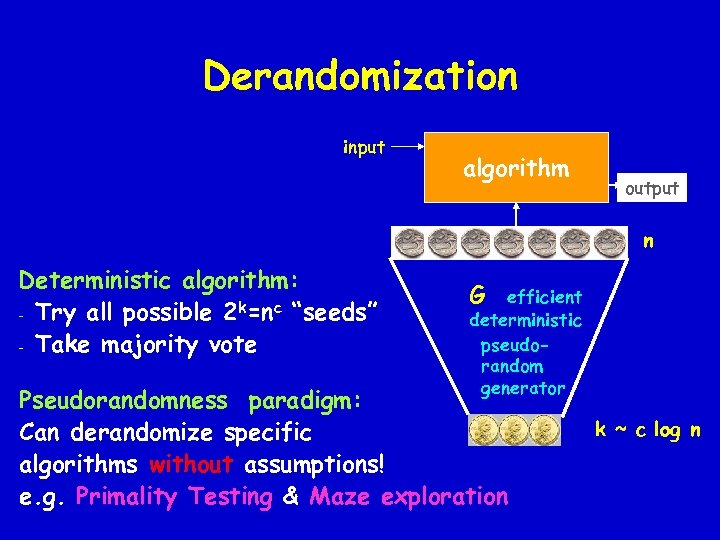 Derandomization input algorithm output n Deterministic algorithm: - Try all possible 2 k=nc “seeds” - Take majority vote G efficient deterministic pseudorandom generator Pseudorandomness paradigm: Can derandomize specific algorithms without assumptions! e. g. Primality Testing & Maze exploration k ~ c log n
 Randomness and space complexity
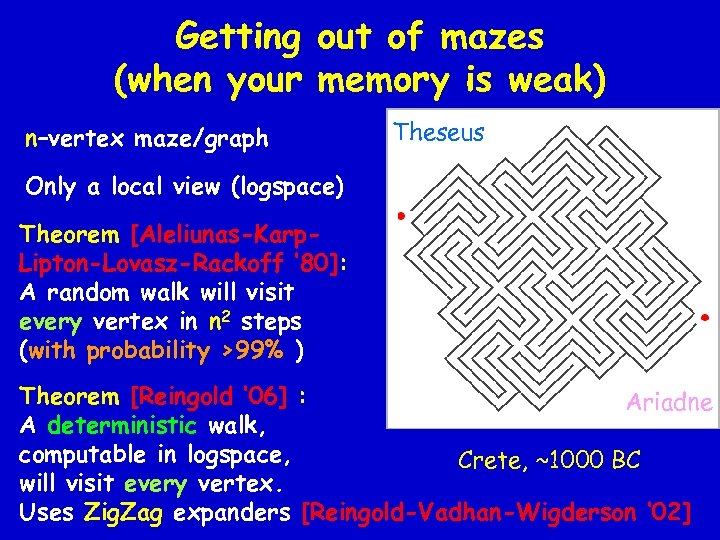 Getting out of mazes (when your memory is weak) n–vertex maze/graph Theseus Only a local view (logspace) Theorem [Aleliunas-Karp. Lipton-Lovasz-Rackoff ‘ 80]: A random walk will visit every vertex in n 2 steps (with probability >99% ) Theorem [Reingold ‘ 06] : Ariadne A deterministic walk, computable in logspace, Crete, ~1000 BC will visit every vertex. Uses Zig. Zag expanders [Reingold-Vadhan-Wigderson ‘ 02]
 The power of pandomness in Proof Systems
![Probabilistic Proof System [Goldwasser-Micali-Rackoff, Babai ‘ 85] Is a mathematical statement claim true? E.](https://present5.com/presentation/e0603060696f9388e252460c7cdf84fe/image-20.jpg "Probabilistic Proof System [Goldwasser-Micali-Rackoff, Babai ‘ 85] Is a mathematical statement claim true? E.") Probabilistic Proof System [Goldwasser-Micali-Rackoff, Babai ‘ 85] Is a mathematical statement claim true? E. g. claim: “No integers x, y, z, n>2 satisfy xn +yn = zn “ claim: “The Riemann Hypothesis has a 200 page proof” probabilistic An efficient Verifier V(claim, argument) satisfies: *) If claim is true then V(claim, argument) = TRUE for some argument always (in which case claim=theorem, argument=proof) **) If claim is false then V(claim, argument) = FALSE for every argument with probability > 99%
Probabilistic Proof System [Goldwasser-Micali-Rackoff, Babai ‘ 85] Is a mathematical statement claim true? E. g. claim: “No integers x, y, z, n>2 satisfy xn +yn = zn “ claim: “The Riemann Hypothesis has a 200 page proof” probabilistic An efficient Verifier V(claim, argument) satisfies: *) If claim is true then V(claim, argument) = TRUE for some argument always (in which case claim=theorem, argument=proof) **) If claim is false then V(claim, argument) = FALSE for every argument with probability > 99%
 Remarkable properties of Probabilistic Proof Systems - Probabilistically Checkable Proofs (PCPs) - Zero-Knowledge (ZK) proofs
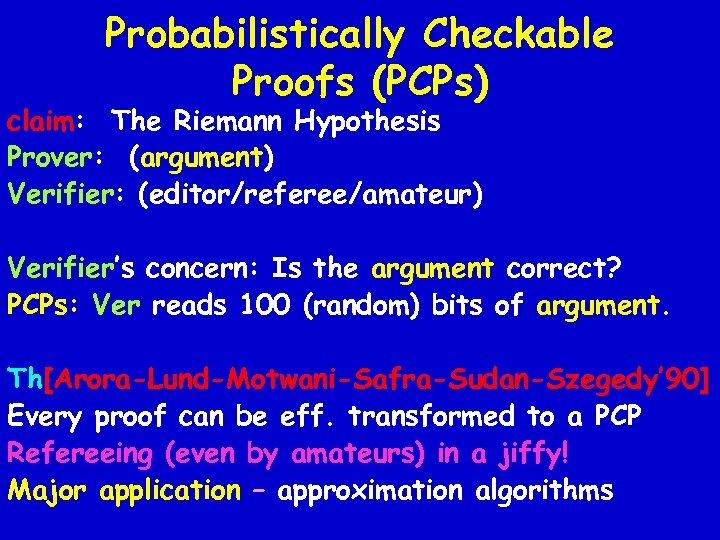 Probabilistically Checkable Proofs (PCPs) claim: The Riemann Hypothesis Prover: (argument) Verifier: (editor/referee/amateur) Verifier’s concern: Is the argument correct? PCPs: Ver reads 100 (random) bits of argument. Th[Arora-Lund-Motwani-Safra-Sudan-Szegedy’ 90] Every proof can be eff. transformed to a PCP Refereeing (even by amateurs) in a jiffy! Major application – approximation algorithms
![Zero-Knowledge (ZK) proofs [Goldwasser-Micali-Rackoff ‘ 85] claim: The Riemann Hypothesis Prover: (argument) Verifier: (editor/referee/amateur)](https://present5.com/presentation/e0603060696f9388e252460c7cdf84fe/image-23.jpg "Zero-Knowledge (ZK) proofs [Goldwasser-Micali-Rackoff ‘ 85] claim: The Riemann Hypothesis Prover: (argument) Verifier: (editor/referee/amateur)") Zero-Knowledge (ZK) proofs [Goldwasser-Micali-Rackoff ‘ 85] claim: The Riemann Hypothesis Prover: (argument) Verifier: (editor/referee/amateur) Prover’s concern: Will Verifier publish first? ZK proofs: argument reveals only correctness! Theorem [Goldreich-Micali-Wigderson ‘ 86]: Every proof can be efficiently transformed to a ZK proof, assuming Factoring is HARD Major application - cryptography
Zero-Knowledge (ZK) proofs [Goldwasser-Micali-Rackoff ‘ 85] claim: The Riemann Hypothesis Prover: (argument) Verifier: (editor/referee/amateur) Prover’s concern: Will Verifier publish first? ZK proofs: argument reveals only correctness! Theorem [Goldreich-Micali-Wigderson ‘ 86]: Every proof can be efficiently transformed to a ZK proof, assuming Factoring is HARD Major application - cryptography
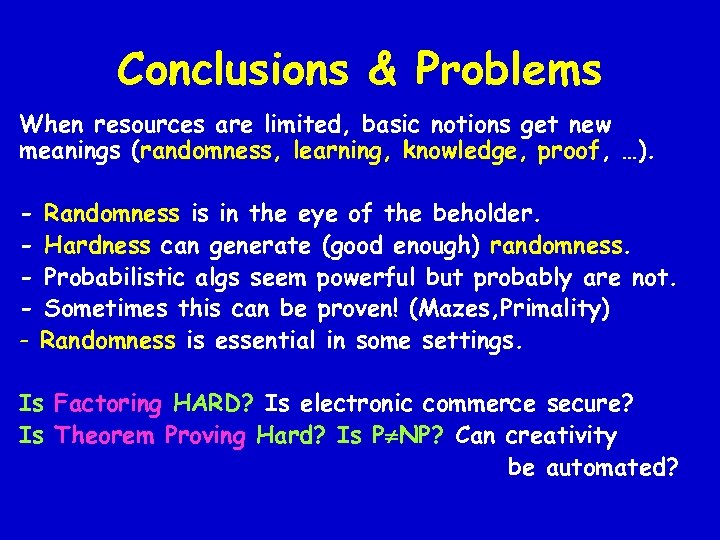 Conclusions & Problems When resources are limited, basic notions get new meanings (randomness, learning, knowledge, proof, …). - Randomness is in the eye of the beholder. - Hardness can generate (good enough) randomness. - Probabilistic algs seem powerful but probably are not. - Sometimes this can be proven! (Mazes, Primality) - Randomness is essential in some settings. Is Factoring HARD? Is electronic commerce secure? Is Theorem Proving Hard? Is P NP? Can creativity be automated?