


 Скачать презентацию RANDOM DISCOVERIES IN CHEMISTRY We live in
Random discoveries in chemistry.pptx
- Количество слайдов: 11
 RANDOM DISCOVERIES IN CHEMISTRY
 We live in a world of chance. Brick can accidentallyfall on the head of someone, and someone can accidentally find the treasure. The same thing happens in science, many great discoveries have been made by accident.
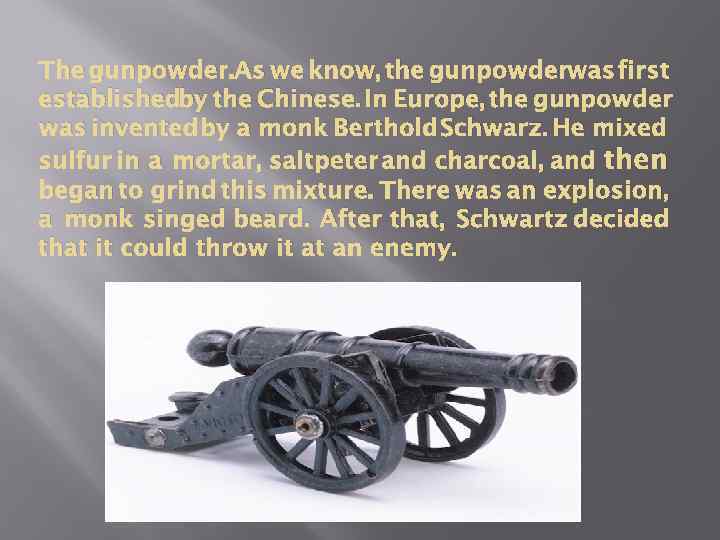 The gunpowder. As we know, the gunpowderwas first establishedby the Chinese. In Europe, the gunpowder was invented by a monk Berthold Schwarz. He mixed sulfur in a mortar, saltpeter and charcoal, and then began to grind this mixture. There was an explosion, a monk singed beard. After that, Schwartz decided that it could throw it at an enemy.
 Phosphorus. Alchemist Henning Brand soldiers, came to the conclusion that the "philosopher's stone" can be extracted from urine in 1669. Brand was suppliedthe material in large quantitiesfrom the soldiers'barracks. He began to experience. In spite of unbearable stench, the alchemist evaporatedand calcined urine as long as glowing white powder was not found on the bottom of the crucible. Brand decided that he became the owner of magic stone. But he was terribly disappointed. It was not a philosopher's stone, but a new chemical element.
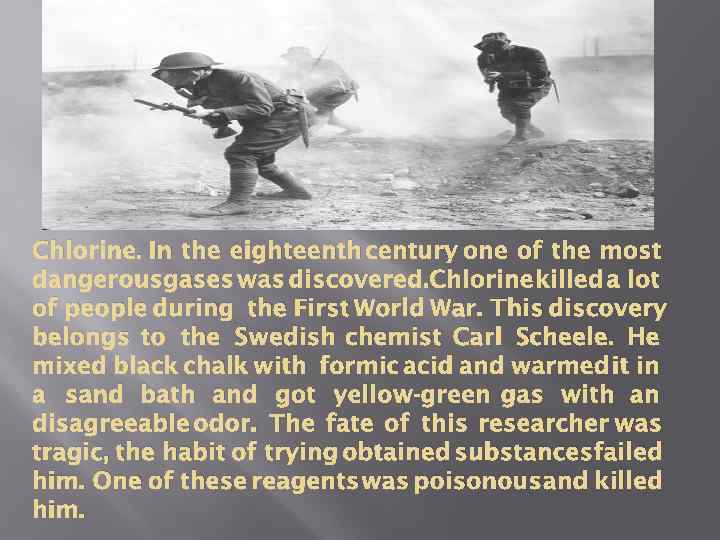 Chlorine. In the eighteenth century one of the most dangerousgases was discovered. Chlorine killed a lot of people during the First World War. This discovery belongs to the Swedish chemist Carl Scheele. He mixed black chalk with formic acid and warmed it in a sand bath and got yellow-green gas with an disagreeable odor. The fate of this researcher was tragic, the habit of trying obtained substancesfailed him. One of these reagents was poisonous and killed him.
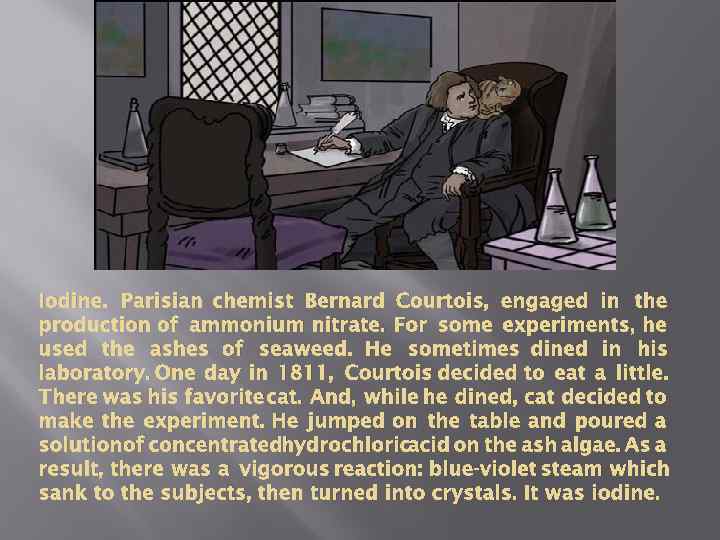 Iodine. Parisian chemist Bernard Courtois, engaged in the production of ammonium nitrate. For some experiments, he used the ashes of seaweed. He sometimes dined in his laboratory. One day in 1811, Courtois decided to eat a little. There was his favorite cat. And, while he dined, cat decided to make the experiment. He jumped on the table and poured a solutionof concentratedhydrochloricacid on the ash algae. As a result, there was a vigorous reaction: blue-violet steam which sank to the subjects, then turned into crystals. It was iodine.
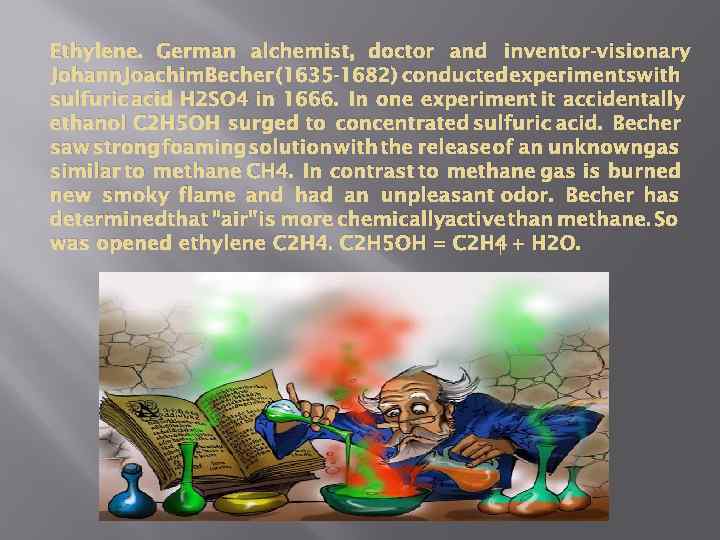 Ethylene. German alchemist, doctor and inventor-visionary Johann. Joachim. Becher (1635 -1682) conducted experimentswith sulfuric acid H 2 SO 4 in 1666. In one experiment it accidentally ethanol C 2 H 5 OH surged to concentrated sulfuric acid. Becher saw strong foaming solution with the release of an unknowngas similar to methane CH 4. In contrast to methane gas is burned new smoky flame and had an unpleasant odor. Becher has determinedthat "air" is more chemicallyactive than methane. So ↑ was opened ethylene C 2 H 4. C 2 H 5 OH = C 2 H 4 + H 2 O.
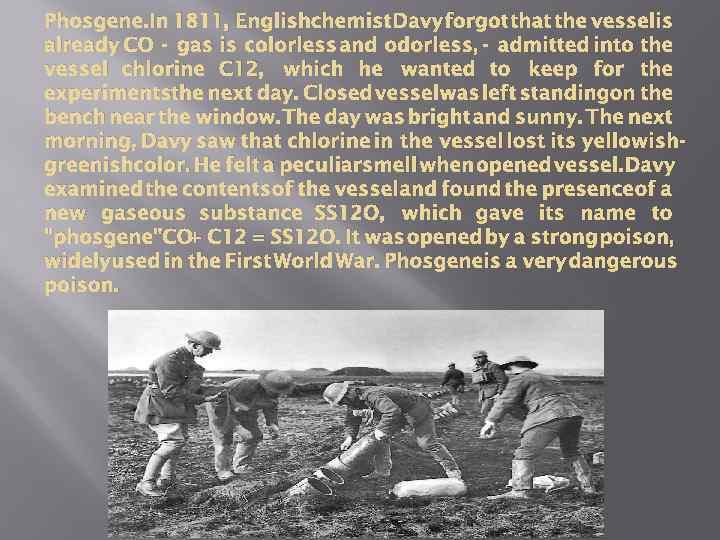 Phosgene. In 1811, Englishchemist Davy forgot that the vesselis already CO - gas is colorless and odorless, - admitted into the vessel chlorine C 12, which he wanted to keep for the experimentsthe next day. Closed vesselwas left standingon the bench near the window. The day was bright and sunny. The next morning, Davy saw that chlorine in the vessel lost its yellowishgreenishcolor. He felt a peculiarsmell when opened vessel. Davy examined the contents of the vesseland found the presenceof a new gaseous substance SS 12 O, which gave its name to "phosgene"CO C 12 = SS 12 O. It was opened by a strong poison, + widelyused in the First World War. Phosgeneis a very dangerous poison.
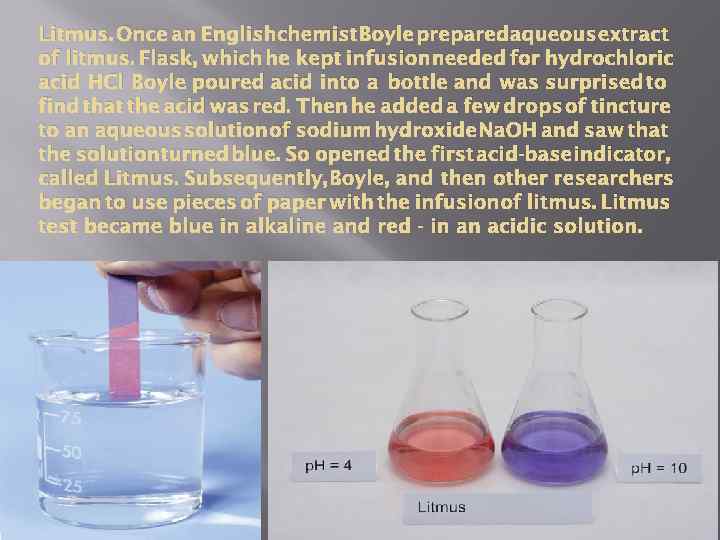 Litmus. Once an Englishchemist Boyle preparedaqueous extract of litmus. Flask, which he kept infusion needed for hydrochloric acid HCl Boyle poured acid into a bottle and was surprised to find that the acid was red. Then he added a few drops of tincture to an aqueous solution of sodium hydroxide Na. OH and saw that the solution turned blue. So opened the first acid-base indicator, called Litmus. Subsequently, Boyle, and then other researchers began to use pieces of paper with the infusion of litmus. Litmus test became blue in alkaline and red - in an acidic solution.
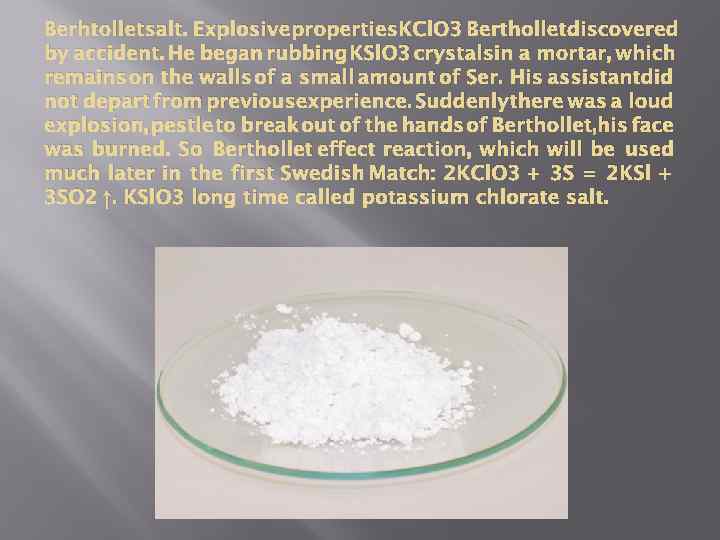 Berhtolletsalt. Explosive properties. KCl. O 3 Bertholletdiscovered by accident. He began rubbing KSl. O 3 crystalsin a mortar, which remains on the walls of a small amount of Ser. His assistantdid not depart from previousexperience. Suddenly there was a loud explosion, pestle to break out of the hands of Berthollet, his face was burned. So Berthollet effect reaction, which will be used much later in the first Swedish Match: 2 KCl. O 3 + 3 S = 2 KSl + 3 SO 2 ↑. KSl. O 3 long time called potassium chlorate salt.
 1. Who helped open the iodine ? 2. Where was the gunpowder first established ? 3. When did the alchemist decide, that philosophers stone can be extracted from urine?