


 Скачать презентацию Random Administrivia n In CMC 301 on Friday
5d3171c0b56f997519adbcf96f661af9.ppt
- Количество слайдов: 19
 Random Administrivia n In CMC 301 on Friday for LISP lab
 Artificial Intelligence: Introduction n n What IS artificial intelligence? Examples of intelligent behavior:
 Definitions of AI There as many definitions as there are practitioners. n How would you define it? What is important for a system to be intelligent? n
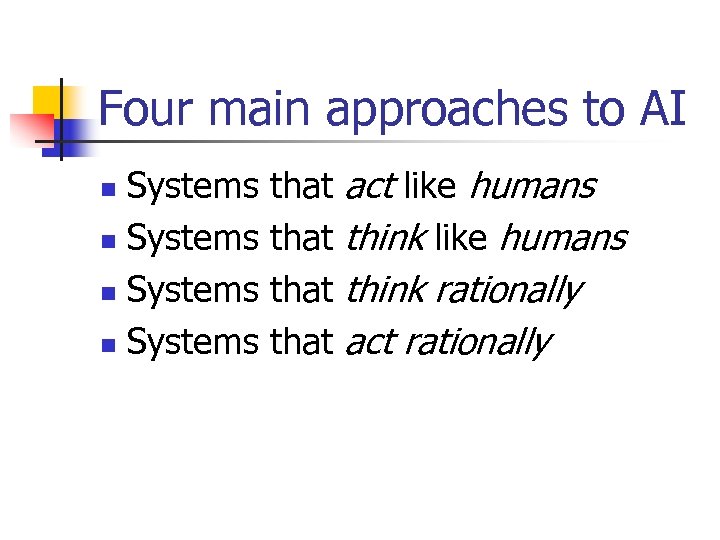 Four main approaches to AI Systems n that act like humans think rationally act rationally
 Approach #1: Acting Humanly AI is: “The art of creating machines that perform functions that require intelligence when performed by people” (Kurzweil) n Ultimately to be tested by the Turing Test n
 The Turing Test n n Picture Demonstrations of software n n n http: //ds. dial. pipex. com/town/avenue/wi 83 /eliza/ (1965) Megahal – finalist in Loebner competition Transcripts: http: //www. loebner. net/Prizef/hutchens 19 96. txt
 In practice n Needs: n n n n Natural language processing Knowledge representation Automated reasoning Machine learning Too general a problem – unsolved in the general case Intelligence takes many forms, which are not necessarily best tested this way Is it actually intelligent? (Chinese room)
![Approach #2: Thinking Humanly n n AI is: “[The automation of] activities that we](https://present5.com/presentation/5d3171c0b56f997519adbcf96f661af9/image-8.jpg "Approach #2: Thinking Humanly n n AI is: “[The automation of] activities that we") Approach #2: Thinking Humanly n n AI is: “[The automation of] activities that we associate with human thinking, activities such as decision-making, problem solving, learning…” (Bellman) Goal is to build systems that function internally in some way similar to human mind
Approach #2: Thinking Humanly n n AI is: “[The automation of] activities that we associate with human thinking, activities such as decision-making, problem solving, learning…” (Bellman) Goal is to build systems that function internally in some way similar to human mind
 Workings of the human mind n Traditional computer game players typically work much differently than human players n n Massive look-ahead, minimal “experience” People think differently in experience, “big picture”, etc. Cognitive science tries to model human mind based on experimentation Cognitive modeling approach tries to act intelligently while actually internally doing something similar to human mind
 Approach #3: Thinking rationally n AI is: “The study of the computations that make it possible to perceive, reason, and act” (Winston) Approach firmly grounded in logic I. e. , how can knowledge be represented logically, and how can a system draw deductions? Uncertain knowledge? Informal knowledge? n “I think I love you. ” n n n
 Approach #4: Acting rationally n n AI is: “The branch of computer science that is concerned with the automation of intelligent behavior” (Luger and Stubblefield) The intelligent approach An agent is something that perceives and acts Emphasis is on behavior
 Acting rationally: emphasis of this class (and most AI today) n n Why? In solving actual problems, it’s what really matters Behavior is more scientifically testable than thought More general: rather than imitating humans trying to solve hard problems, just try to solve hard problems
 Recap on the difference in approaches n n Thought vs. behavior Human vs. rational
 History of AI n n It’s in text and very cool, read it Sections 1. 2 -1. 3
 What we’ll be doing n n LISP Programming Intelligent agents Search methods, and how they relate to game playing (e. g. chess) Logic and reasoning n Propositional logic
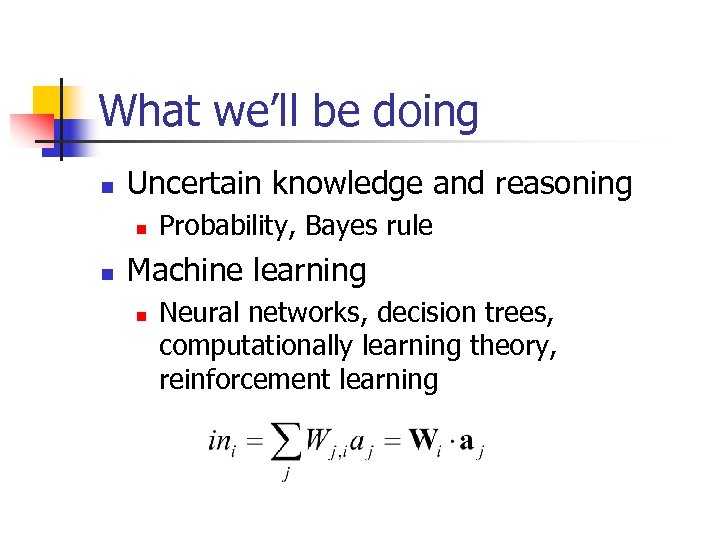 What we’ll be doing n Uncertain knowledge and reasoning n n Probability, Bayes rule Machine learning n Neural networks, decision trees, computationally learning theory, reinforcement learning
 What we won’t be doing in class (but you can for project) n n HAL Robotics Natural language processing (Jeff’s class in the spring) Building Quake-bots
 The Lisp Programming Language n n n Developed by John Mc. Carthy at MIT Second oldest high level language still in use (next to FORTRAN) LISP = LISt Processing Common Lisp is today’s standard Most popular language for AI
 Why use Lisp? n n n Everything's a list Interactive Symbolic Dynamic Garbage collection