


 Скачать презентацию RAND Arroyo Review of Army Arsenals and Ammunition
ef5bb5abe4af99cb1be01f3259982f1c.ppt
- Количество слайдов: 17
 RAND Arroyo Review of Army Arsenals and Ammunition Plants Mike Hix May 2004 Arroyo Center 1 RAND
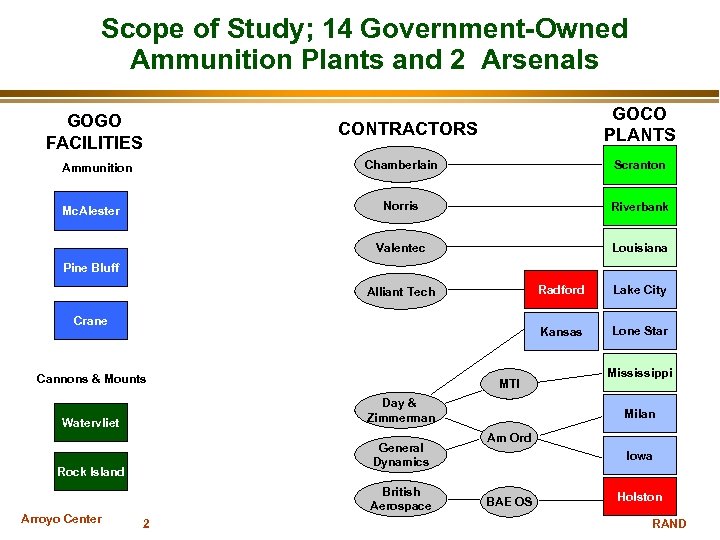 Scope of Study; 14 Government-Owned Ammunition Plants and 2 Arsenals GOGO FACILITIES GOCO PLANTS CONTRACTORS Chamberlain Riverbank Valentec Mc. Alester Scranton Norris Ammunition Louisiana Pine Bluff Radford Crane Cannons & Mounts Day & Zimmerman Watervliet General Dynamics Rock Island Arroyo Center MTI British Aerospace 2 Lake City Kansas Alliant Tech Lone Star Mississippi Milan Am Ord Iowa BAE OS Holston RAND
 Problems in the Ordnance Base (1) Lack of a strategic vision – Ideas, draft plans, reorganizations – But no approved, stable vision and plan for achieving it Army ownership of peripheral function creates management distraction for Army leadership – Manufacturing not a core Army function; commercial activity, 10 USC 2501, 2535 – Peripheral function even in logistics community Reduced workload, over-capacity, high costs--prominent in arsenals – Reducing equipment, space, and personnel helps, but insufficient Arroyo Center 3 RAND
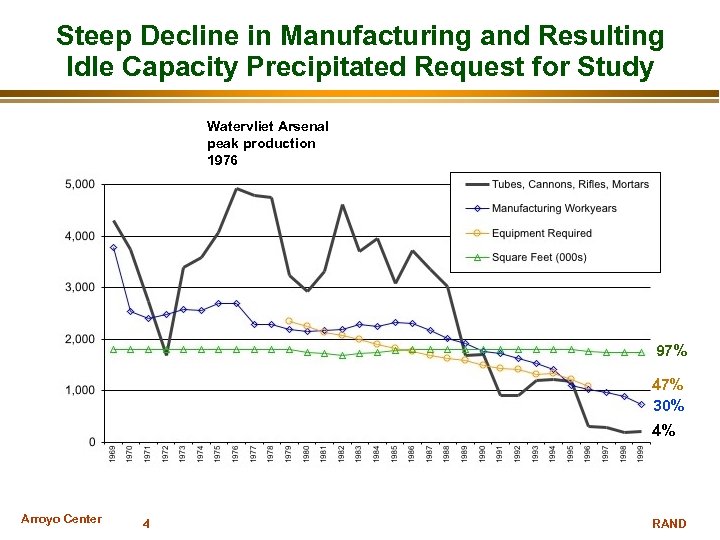 Steep Decline in Manufacturing and Resulting Idle Capacity Precipitated Request for Study Watervliet Arsenal peak production 1976 97% 47% 30% 4% Arroyo Center 4 RAND
 Problems in the Ordnance Base (2) Capital investment doesn’t compete well in Army operating budget – Leads to old and inefficient equipment and practices--particularly in ammo plants – Contractors lack incentives to modernize Army equipment Ammunition has a low funding priority – – Variable buys from year to year Inefficient order quantities Low investment in manufacturing technology and methods Under-funding of war reserves leads to strategy change by default: from replenishment to surge Ammunition replenishment policy in flux – No Do. D guidance – No Army proponent (for equipment, missiles or conventional ammo) – No published Army policy Arroyo Center 5 RAND
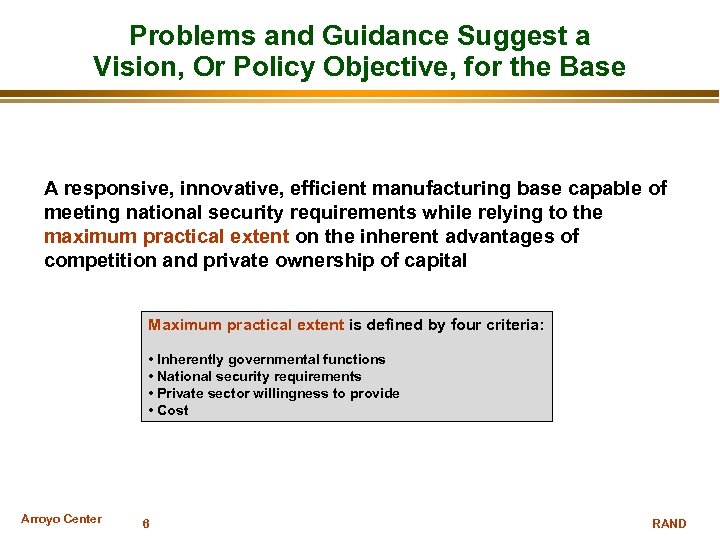 Problems and Guidance Suggest a Vision, Or Policy Objective, for the Base A responsive, innovative, efficient manufacturing base capable of meeting national security requirements while relying to the maximum practical extent on the inherent advantages of competition and private ownership of capital Maximum practical extent is defined by four criteria: • Inherently governmental functions • National security requirements • Private sector willingness to provide • Cost Arroyo Center 6 RAND
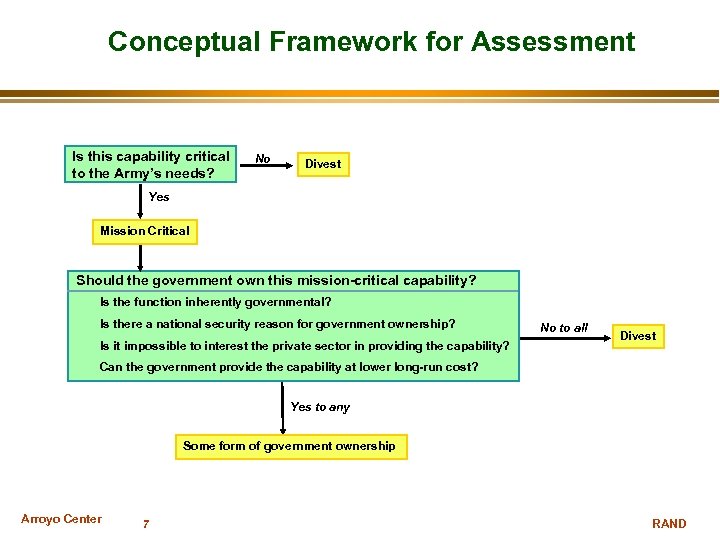 Conceptual Framework for Assessment Is this capability critical to the Army’s needs? No Divest Yes Mission Critical Should the government own this mission-critical capability? Is the function inherently governmental? Is there a national security reason for government ownership? Is it impossible to interest the private sector in providing the capability? No to all Divest Can the government provide the capability at lower long-run cost? Yes to any Some form of government ownership Arroyo Center 7 RAND
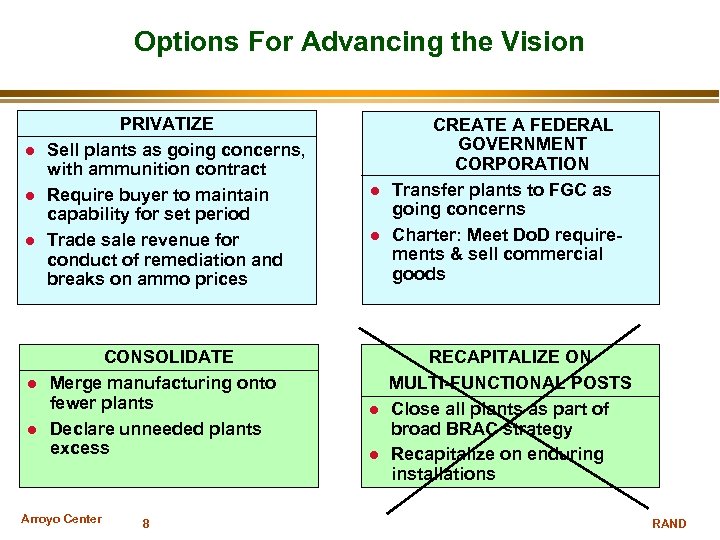 Options For Advancing the Vision PRIVATIZE Sell plants as going concerns, with ammunition contract Require buyer to maintain capability for set period Trade sale revenue for conduct of remediation and breaks on ammo prices CONSOLIDATE Merge manufacturing onto fewer plants Declare unneeded plants excess Arroyo Center 8 CREATE A FEDERAL GOVERNMENT CORPORATION Transfer plants to FGC as going concerns Charter: Meet Do. D requirements & sell commercial goods RECAPITALIZE ON MULTI-FUNCTIONAL POSTS Close all plants as part of broad BRAC strategy Recapitalize on enduring installations RAND
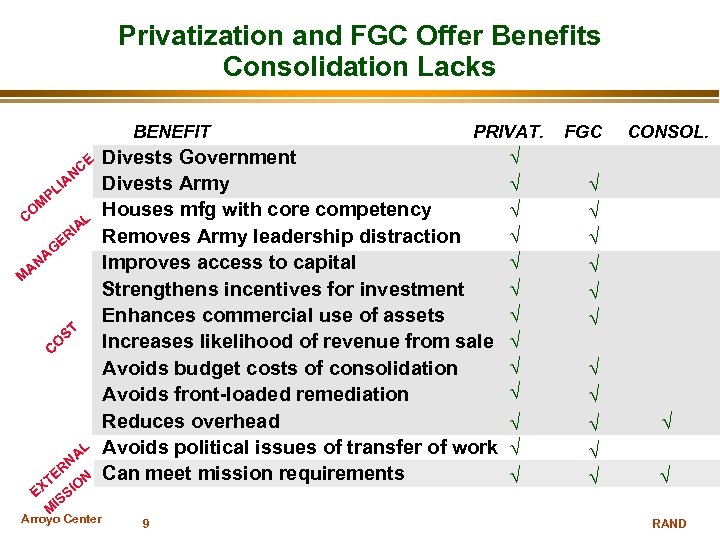 Privatization and FGC Offer Benefits Consolidation Lacks BENEFIT E NC A I PL M CO L IA ER G A AN C O ST M L A RN E N XT SIO E S I M Arroyo Center PRIVAT. Divests Government Divests Army Houses mfg with core competency Removes Army leadership distraction Improves access to capital Strengthens incentives for investment Enhances commercial use of assets Increases likelihood of revenue from sale Avoids budget costs of consolidation Avoids front-loaded remediation Reduces overhead Avoids political issues of transfer of work Can meet mission requirements 9 √ √ √ √ FGC CONSOL. √ √ √ √ RAND
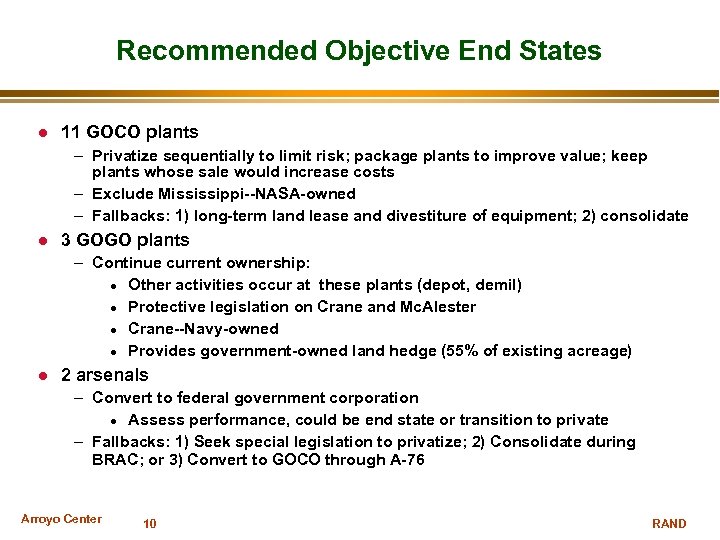 Recommended Objective End States 11 GOCO plants – Privatize sequentially to limit risk; package plants to improve value; keep plants whose sale would increase costs – Exclude Mississippi--NASA-owned – Fallbacks: 1) long-term land lease and divestiture of equipment; 2) consolidate 3 GOGO plants – Continue current ownership: Other activities occur at these plants (depot, demil) Protective legislation on Crane and Mc. Alester Crane--Navy-owned Provides government-owned land hedge (55% of existing acreage) 2 arsenals – Convert to federal government corporation Assess performance, could be end state or transition to private – Fallbacks: 1) Seek special legislation to privatize; 2) Consolidate during BRAC; or 3) Convert to GOCO through A-76 Arroyo Center 10 RAND
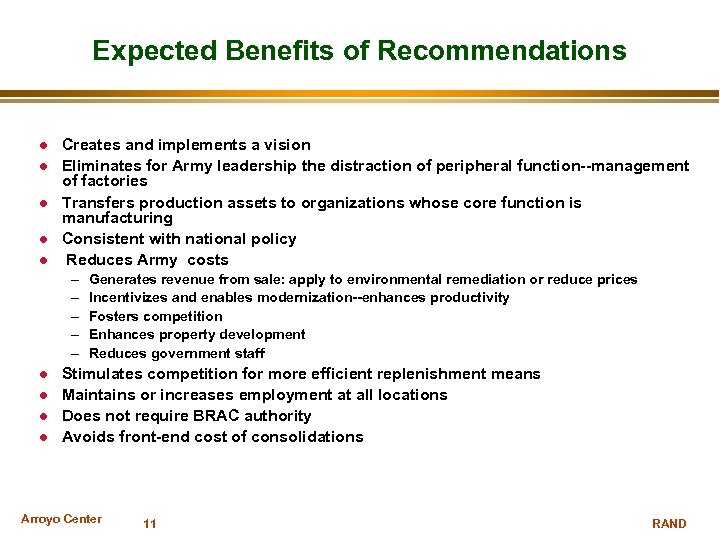 Expected Benefits of Recommendations Creates and implements a vision Eliminates for Army leadership the distraction of peripheral function--management of factories Transfers production assets to organizations whose core function is manufacturing Consistent with national policy Reduces Army costs – – – Generates revenue from sale: apply to environmental remediation or reduce prices Incentivizes and enables modernization--enhances productivity Fosters competition Enhances property development Reduces government staff Stimulates competition for more efficient replenishment means Maintains or increases employment at all locations Does not require BRAC authority Avoids front-end cost of consolidations Arroyo Center 11 RAND
 Substantial Uncertainty Surrounds Savings Estimates Ammo plants Arsenals Ammunition Plants Arsenals 6 plants 3 Arsenals ASSUMPTIONS VARIED Sale revenue (DCF, Multiple of sales) Ammunition prices ARMS benefits Contract termination costs Gov’t employee termination costs Discount rate PRESENT VALUE OF SEVEN-YEAR SAVINGS TO ARMY ($ MILLIONS) Arroyo Center 12 RAND
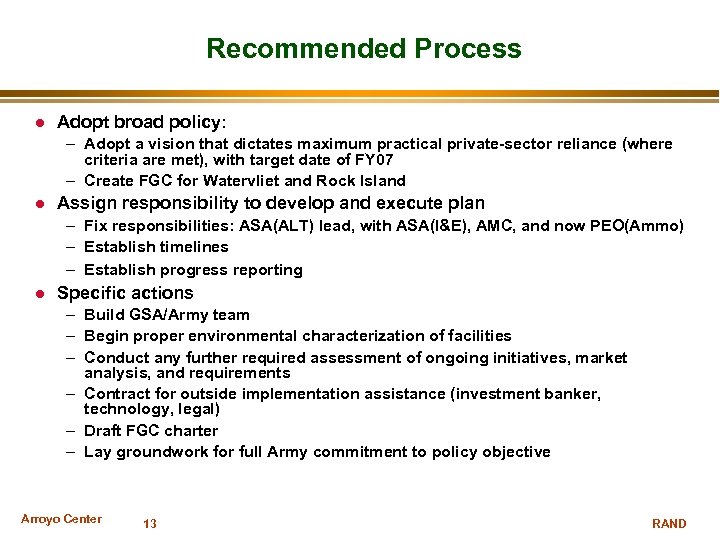 Recommended Process Adopt broad policy: – Adopt a vision that dictates maximum practical private-sector reliance (where criteria are met), with target date of FY 07 – Create FGC for Watervliet and Rock Island Assign responsibility to develop and execute plan – Fix responsibilities: ASA(ALT) lead, with ASA(I&E), AMC, and now PEO(Ammo) – Establish timelines – Establish progress reporting Specific actions – Build GSA/Army team – Begin proper environmental characterization of facilities – Conduct any further required assessment of ongoing initiatives, market analysis, and requirements – Contract for outside implementation assistance (investment banker, technology, legal) – Draft FGC charter – Lay groundwork for full Army commitment to policy objective Arroyo Center 13 RAND
 BACK-UP SLIDES Arroyo Center 14 RAND
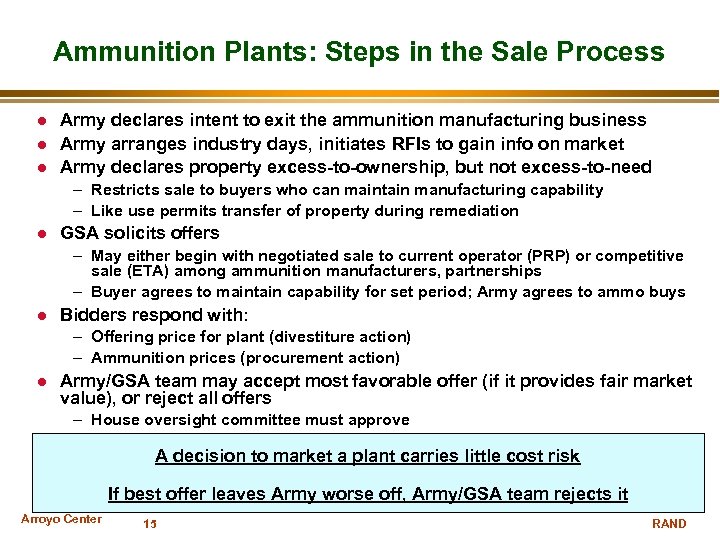 Ammunition Plants: Steps in the Sale Process Army declares intent to exit the ammunition manufacturing business Army arranges industry days, initiates RFIs to gain info on market Army declares property excess-to-ownership, but not excess-to-need – Restricts sale to buyers who can maintain manufacturing capability – Like use permits transfer of property during remediation GSA solicits offers – May either begin with negotiated sale to current operator (PRP) or competitive sale (ETA) among ammunition manufacturers, partnerships – Buyer agrees to maintain capability for set period; Army agrees to ammo buys Bidders respond with: – Offering price for plant (divestiture action) – Ammunition prices (procurement action) Army/GSA team may accept most favorable offer (if it provides fair market value), or reject all offers – House oversight committee must approve A decision to market a plant carries little cost risk If best offer leaves Army worse off, Army/GSA team rejects it Arroyo Center 15 RAND
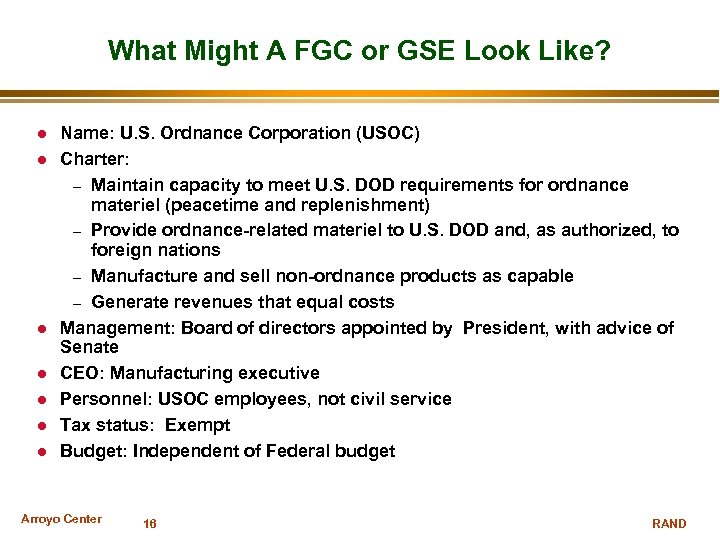 What Might A FGC or GSE Look Like? Name: U. S. Ordnance Corporation (USOC) Charter: – Maintain capacity to meet U. S. DOD requirements for ordnance materiel (peacetime and replenishment) – Provide ordnance-related materiel to U. S. DOD and, as authorized, to foreign nations – Manufacture and sell non-ordnance products as capable – Generate revenues that equal costs Management: Board of directors appointed by President, with advice of Senate CEO: Manufacturing executive Personnel: USOC employees, not civil service Tax status: Exempt Budget: Independent of Federal budget Arroyo Center 16 RAND
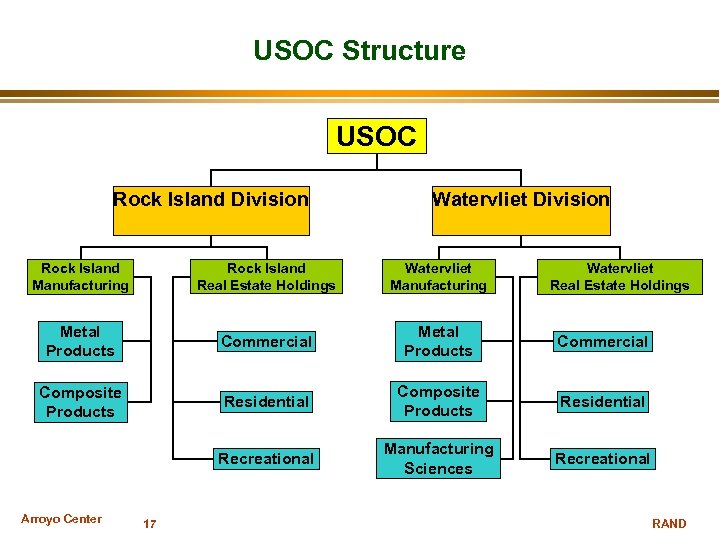 USOC Structure USOC Rock Island Division Watervliet Division Rock Island Manufacturing Rock Island Real Estate Holdings Watervliet Manufacturing Metal Products Commercial Composite Products Residential Recreational Manufacturing Sciences Recreational Arroyo Center 17 Watervliet Real Estate Holdings RAND