


 Скачать презентацию Raising Capital Through Private Equity and Venture Capital
71830adcacc11151a5facdced88096b5.ppt
- Количество слайдов: 63
 Raising Capital Through Private Equity and Venture Capital Presentation by Bruce Norlund of Economic Policy Reform & Competitiveness – Chemonics Ulaanbaatar, Mongolia
 Topics Covered n History and structure of the private equity industry n Stages in venture capital financing n Building a winning business plan n Cash flow forecasting n Valuation n Deal structuring n Legal, regulatory and control issues n Question and Answer Session
 Origins, History and Development of the Private Equity Industry n Private “Risk Capital” is not new ¨ Marcus Crassus of Ancient Rome ¨ Christopher Columbus n “Professional” Venture Capital Investing fairly recent phenomenon
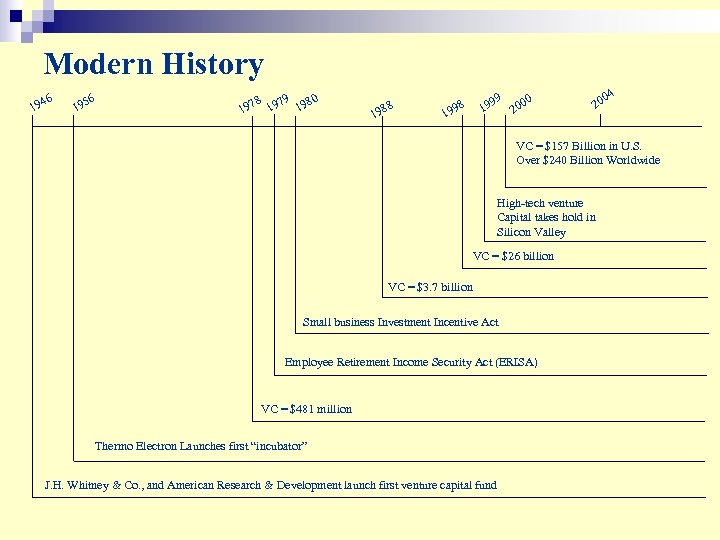 Modern History 46 195 8 7 19 9 7 19 8 19 0 19 88 1 9 9 19 8 99 0 0 20 04 20 VC = $157 Billion in U. S. Over $240 Billion Worldwide High-tech venture Capital takes hold in Silicon Valley VC = $26 billion VC = $3. 7 billion Small business Investment Incentive Act Employee Retirement Income Security Act (ERISA) VC = $481 million Thermo Electron Launches first “incubator” J. H. Whitney & Co. , and American Research & Development launch first venture capital fund
 Bootstrapping n Avoid seeking capital as long as possible n Techniques: ¨ Prepaid licenses, royalties or advances from customers ¨ Development of product while working elseware ¨ Customer funded research ¨ Free access to hardware ¨ Business alliances ¨ Compensating systems
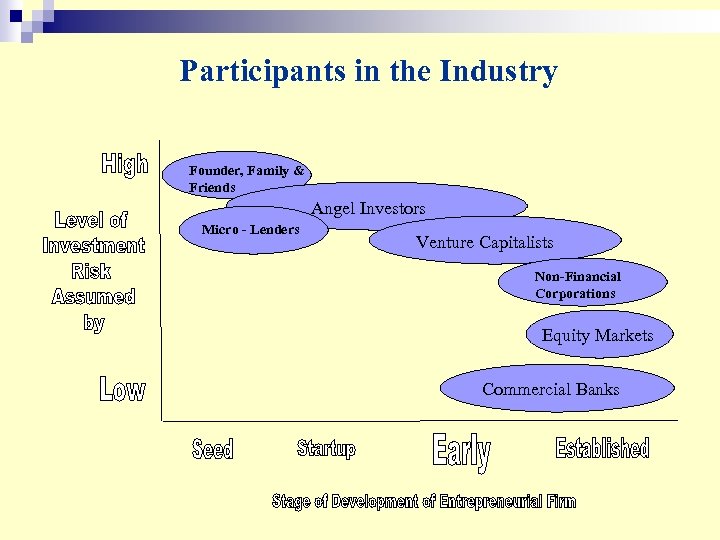 Participants in the Industry Founder, Family & Friends Angel Investors Micro - Lenders Venture Capitalists Non-Financial Corporations Equity Markets Commercial Banks
 Angel Investors n Wealthy individuals n Business people who have “cashed out” n Angel Syndicates
 Angels continued n Oldest, largest and most often used source of outside funds for entrepreneurial firms n In the U. S. alone – 3 million angels – investing $50 Billion every year n Fund 30 -40 times as many firms as formal venture capital funds n Ford, Apple, Amazon. com n Bring many advantages to their investments n Difficult to find n Market may double in next decade
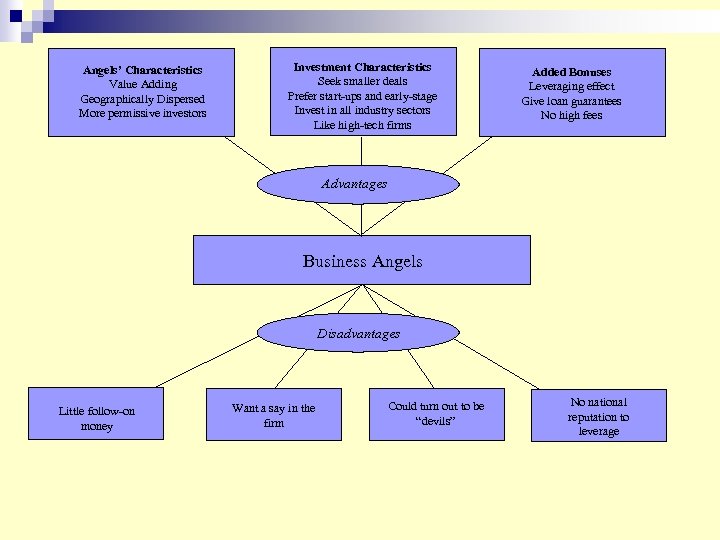 Angels’ Characteristics Value Adding Geographically Dispersed More permissive investors Investment Characteristics Seek smaller deals Prefer start-ups and early-stage Invest in all industry sectors Like high-tech firms Added Bonuses Leveraging effect Give loan guarantees No high fees Advantages Business Angels Disadvantages Little follow-on money Want a say in the firm Could turn out to be “devils” No national reputation to leverage
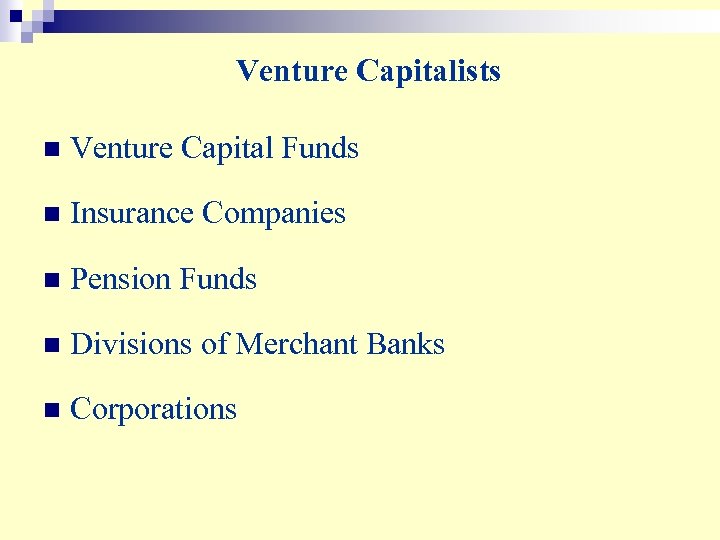 Venture Capitalists n Venture Capital Funds n Insurance Companies n Pension Funds n Divisions of Merchant Banks n Corporations
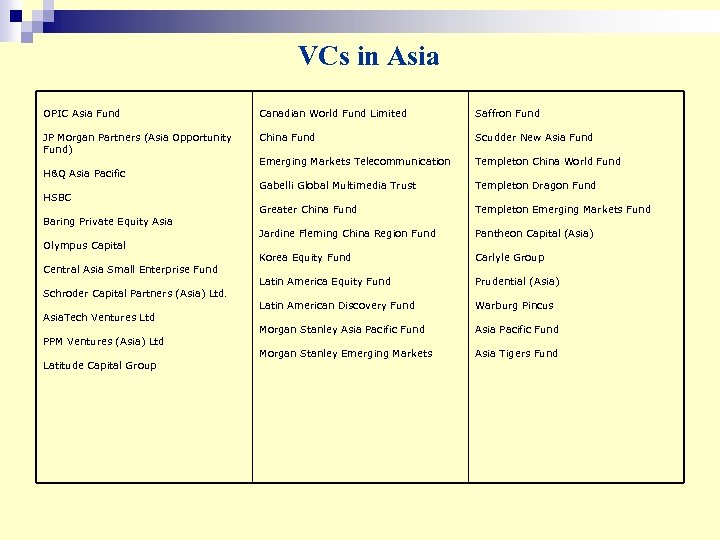 VCs in Asia OPIC Asia Fund Canadian World Fund Limited Saffron Fund JP Morgan Partners (Asia Opportunity Fund) China Fund Scudder New Asia Fund Emerging Markets Telecommunication Templeton China World Fund Gabelli Global Multimedia Trust Templeton Dragon Fund Greater China Fund Templeton Emerging Markets Fund Jardine Fleming China Region Fund Pantheon Capital (Asia) Korea Equity Fund Carlyle Group Latin America Equity Fund Prudential (Asia) Latin American Discovery Fund Warburg Pincus Morgan Stanley Asia Pacific Fund Morgan Stanley Emerging Markets Asia Tigers Fund H&Q Asia Pacific HSBC Baring Private Equity Asia Olympus Capital Central Asia Small Enterprise Fund Schroder Capital Partners (Asia) Ltd. Asia. Tech Ventures Ltd PPM Ventures (Asia) Ltd Latitude Capital Group
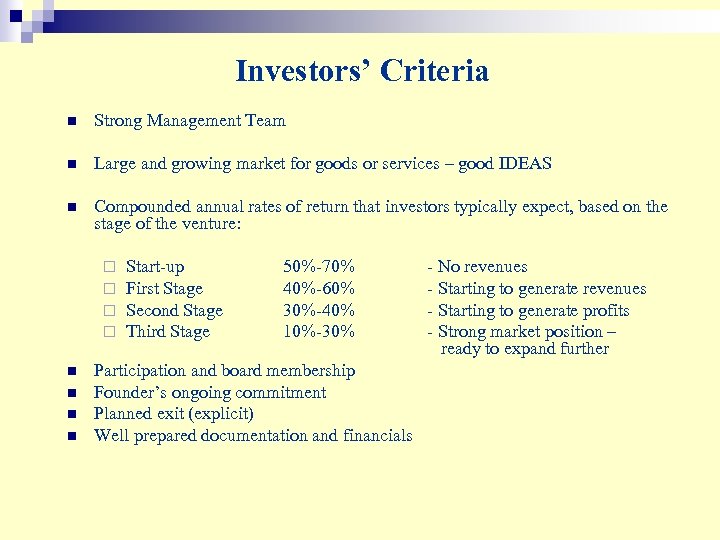 Investors’ Criteria n Strong Management Team n Large and growing market for goods or services – good IDEAS n Compounded annual rates of return that investors typically expect, based on the stage of the venture: ¨ ¨ n n Start-up First Stage Second Stage Third Stage 50%-70% 40%-60% 30%-40% 10%-30% Participation and board membership Founder’s ongoing commitment Planned exit (explicit) Well prepared documentation and financials - No revenues - Starting to generate profits - Strong market position – ready to expand further
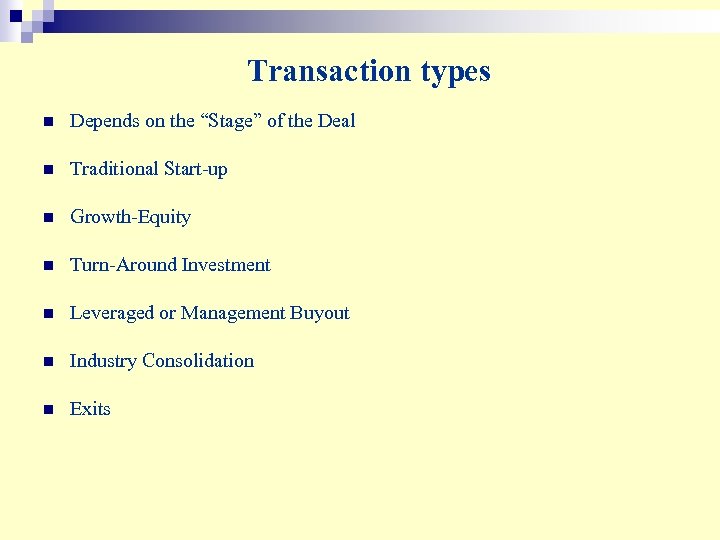 Transaction types n Depends on the “Stage” of the Deal n Traditional Start-up n Growth-Equity n Turn-Around Investment n Leveraged or Management Buyout n Industry Consolidation n Exits
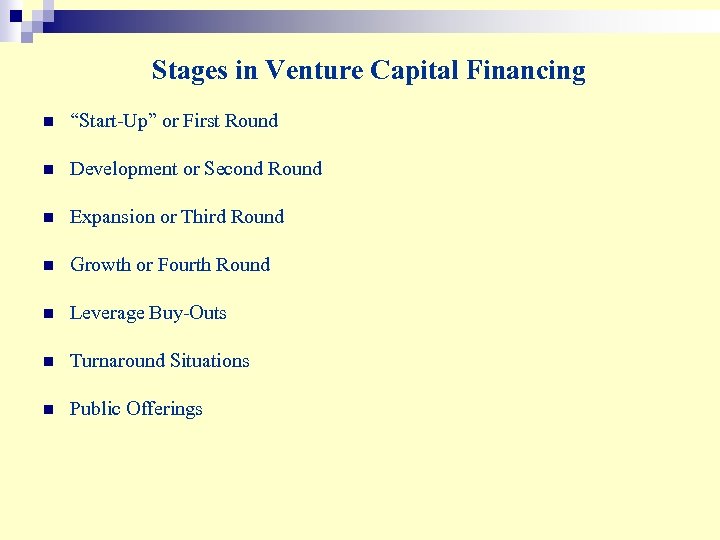 Stages in Venture Capital Financing n “Start-Up” or First Round n Development or Second Round n Expansion or Third Round n Growth or Fourth Round n Leverage Buy-Outs n Turnaround Situations n Public Offerings
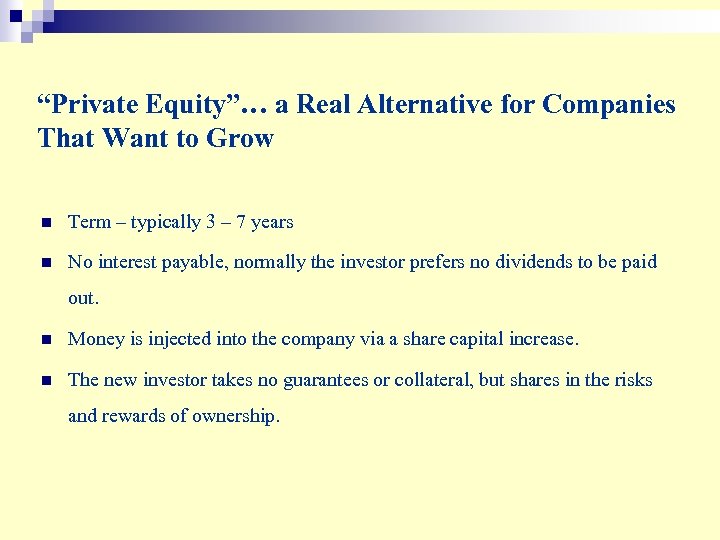 “Private Equity”… a Real Alternative for Companies That Want to Grow n Term – typically 3 – 7 years n No interest payable, normally the investor prefers no dividends to be paid out. n Money is injected into the company via a share capital increase. n The new investor takes no guarantees or collateral, but shares in the risks and rewards of ownership.
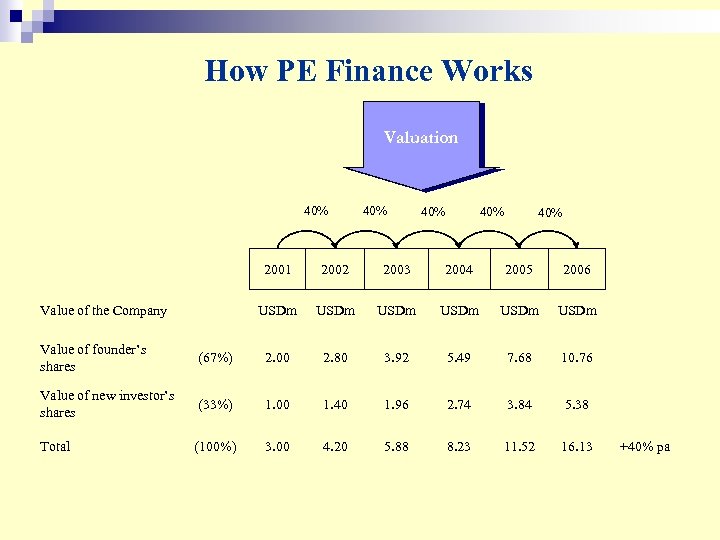 How PE Finance Works Valuation 40% 40% 40% 2001 2003 2004 2005 2006 USDm Value of the Company 2002 USDm USDm Value of founder’s shares (67%) 2. 00 2. 80 3. 92 5. 49 7. 68 10. 76 Value of new investor’s shares (33%) 1. 00 1. 40 1. 96 2. 74 3. 84 5. 38 Total (100%) 3. 00 4. 20 5. 88 8. 23 11. 52 16. 13 +40% pa
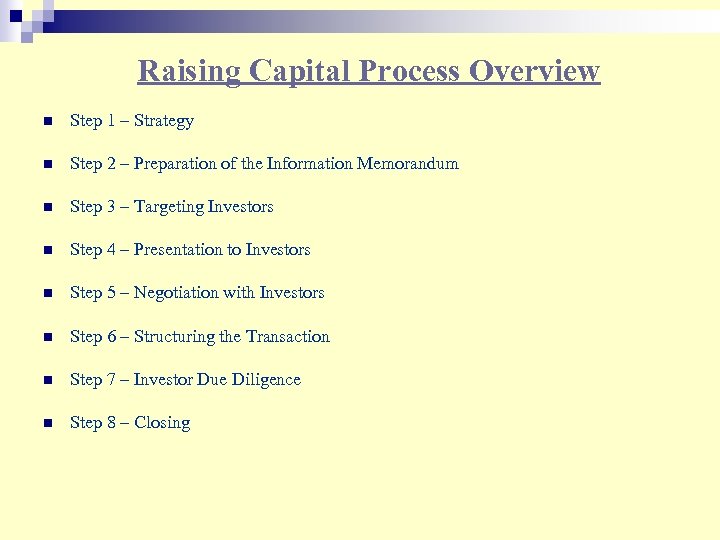 Raising Capital Process Overview n Step 1 – Strategy n Step 2 – Preparation of the Information Memorandum n Step 3 – Targeting Investors n Step 4 – Presentation to Investors n Step 5 – Negotiation with Investors n Step 6 – Structuring the Transaction n Step 7 – Investor Due Diligence n Step 8 – Closing
 Building a Winning Business Plan and Information Memorandum n Management team n Market Opportunity n Business Strategy – Determines Future Cash Flows and Capital Need n Risk – a reality check n Due diligence – being thorough and prepared
 Cash Flow Forecasting n Principles of forecasting n Constructing the forecasts ¨ Studying ¨ Knowing n the market your capacity to capture market share Sensitivity analysis
 Fundamental Analysis n Overview of firm and its strategies n Evaluate the structure of the industry n Evaluate firm’s current economic position n Predict future course of firm
 Valuation n Discounted n Earnings Cash Flow (DCF) method based (multiples) methods n Asset based methods n EVA (Economic Value Added) n Industry specific methods
 The Need For Company Valuations n To support company owners seeking additional equity finance n To guide stock market investors n To guide strategic buyers n To support company owners “Cashing Out”
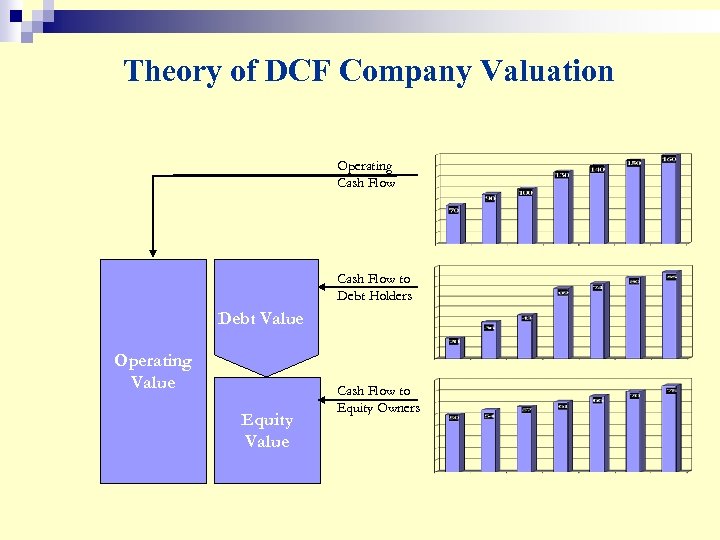
 Discounted Cash Flow Method (DCF) n DCF relies on the principle “Time Value of Money” n Based on the overwhelming evidence that a company’s value is strongly correlated to the sum of its discounted cash flows. n All the cash flows including capital expenditure are discounted over a chosen period of time.
 Discounting and the Time Value of Money
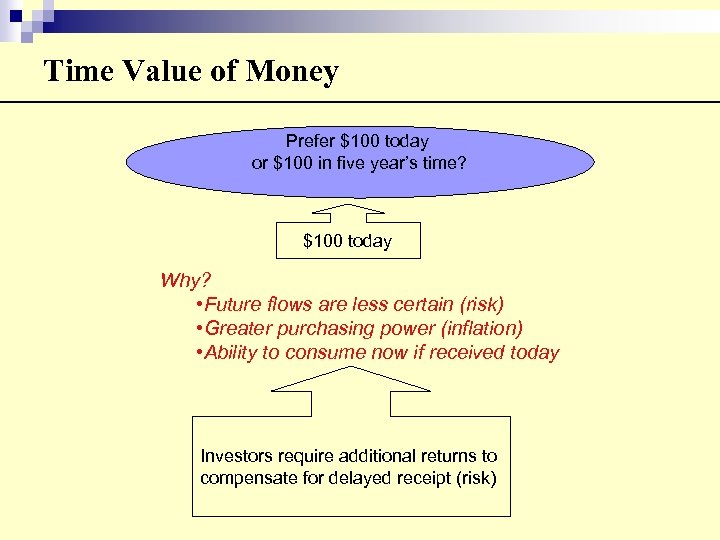 Time Value of Money Prefer $100 today or $100 in five year’s time? $100 today Why? • Future flows are less certain (risk) • Greater purchasing power (inflation) • Ability to consume now if received today Investors require additional returns to compensate for delayed receipt (risk)
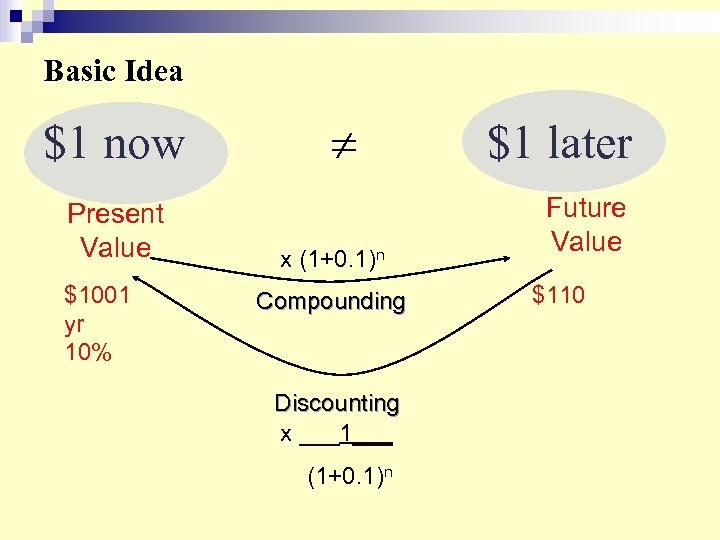 Basic Idea $1 now Present Value $1001 yr 10% x (1+0. 1)n Compounding Discounting x ___1___ (1+0. 1)n $1 later Future Value $110
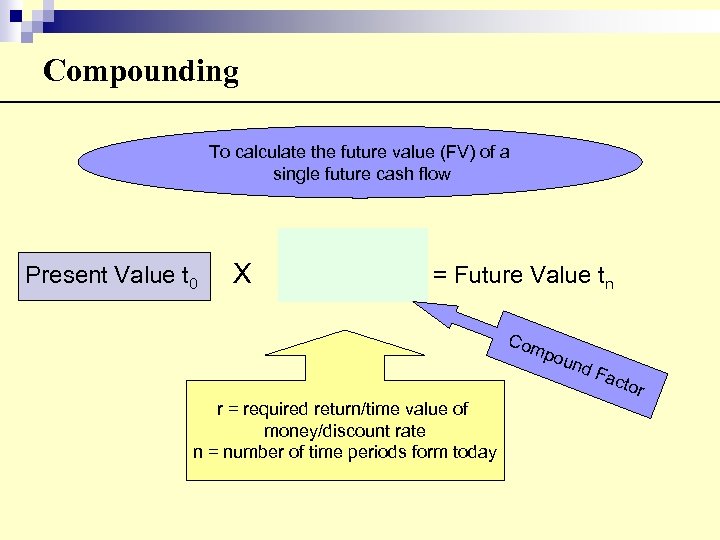 Compounding To calculate the future value (FV) of a single future cash flow Present Value t 0 X = Future Value tn Com pou r = required return/time value of money/discount rate n = number of time periods form today nd F acto r
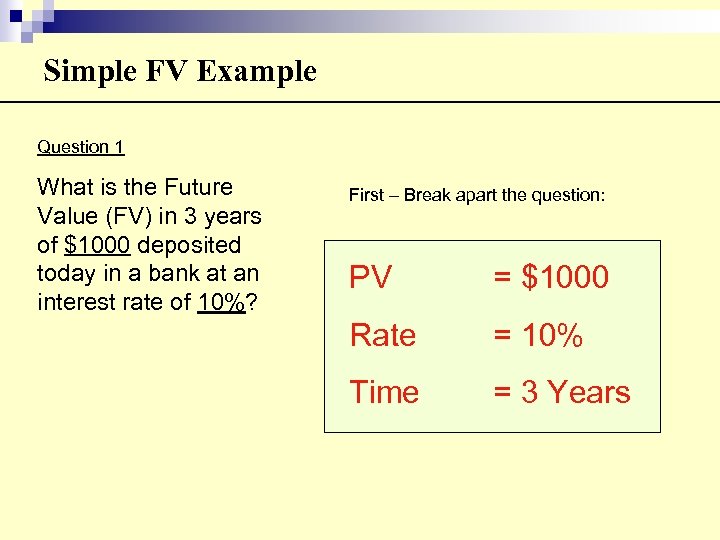 Simple FV Example Question 1 What is the Future Value (FV) in 3 years of $1000 deposited today in a bank at an interest rate of 10%? First – Break apart the question: PV = $1000 Rate = 10% Time = 3 Years
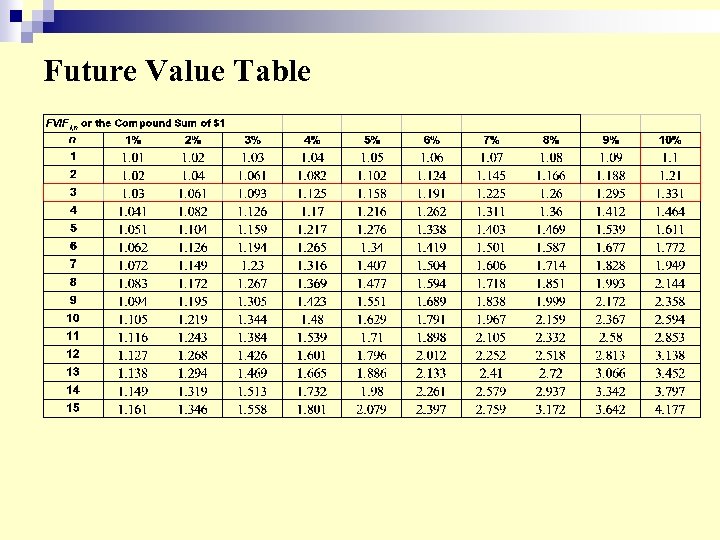 Future Value Table
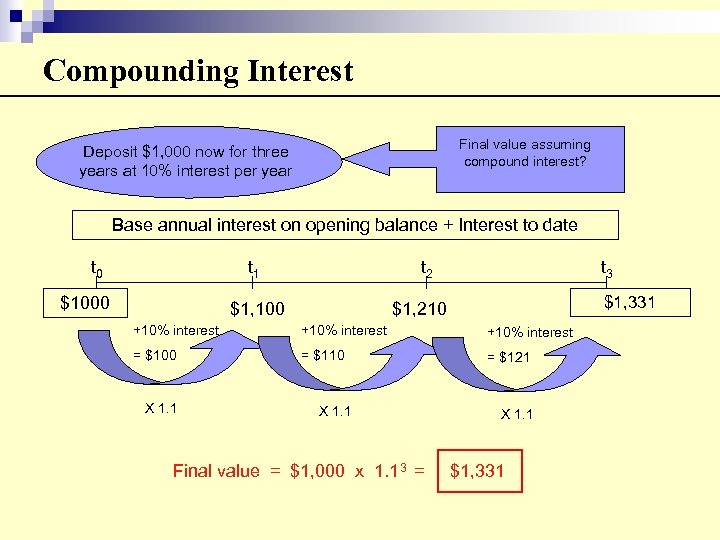 Compounding Interest Final value assuming compound interest? Deposit $1, 000 now for three years at 10% interest per year Base annual interest on opening balance + Interest to date t 0 t 1 $1000 t 2 $1, 100 t 3 $1, 331 $1, 210 +10% interest = $100 = $110 = $121 X 1. 1 Final value = $1, 000 x 1. 13 = X 1. 1 $1, 331
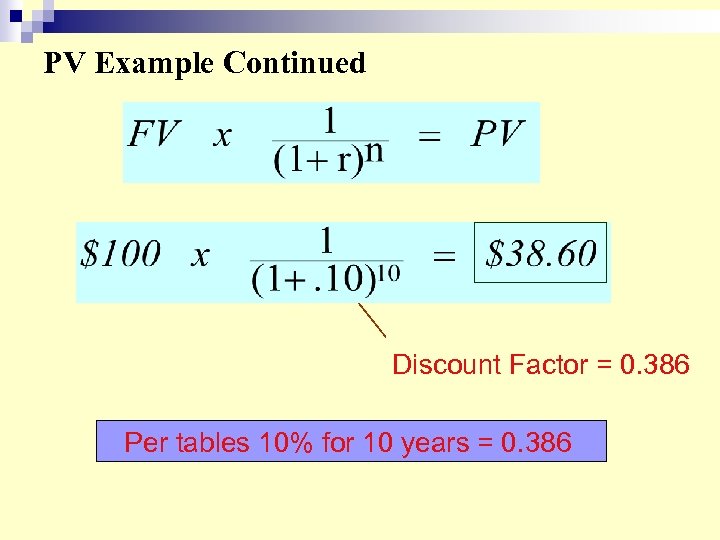
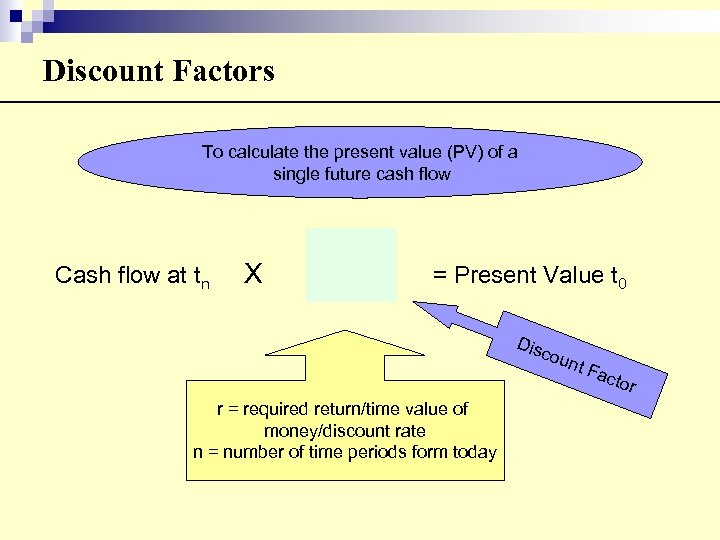 Discount Factors To calculate the present value (PV) of a single future cash flow Cash flow at tn X = Present Value t 0 Dis cou r = required return/time value of money/discount rate n = number of time periods form today nt F acto r
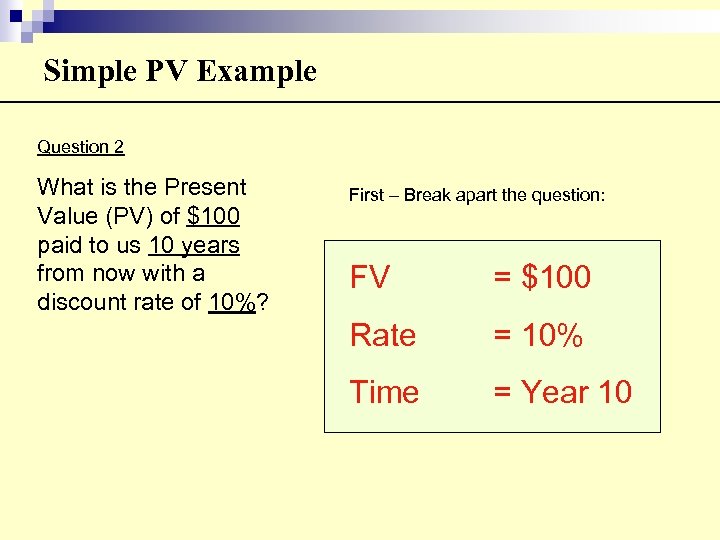 Simple PV Example Question 2 What is the Present Value (PV) of $100 paid to us 10 years from now with a discount rate of 10%? First – Break apart the question: FV = $100 Rate = 10% Time = Year 10
 Present Value Interest Factor Table
 PV Example Continued Discount Factor = 0. 386 Per tables 10% for 10 years = 0. 386
 Cost of Capital n Difficult to predict n Small changes can have a dramatic effect on the estimated Value created n Discount Factor/Required Rate of Return/Expected Rate of Return
 Theory of DCF Company Valuation Operating Cash Flow to Debt Holders Debt Value Operating Value Equity Value Cash Flow to Equity Owners
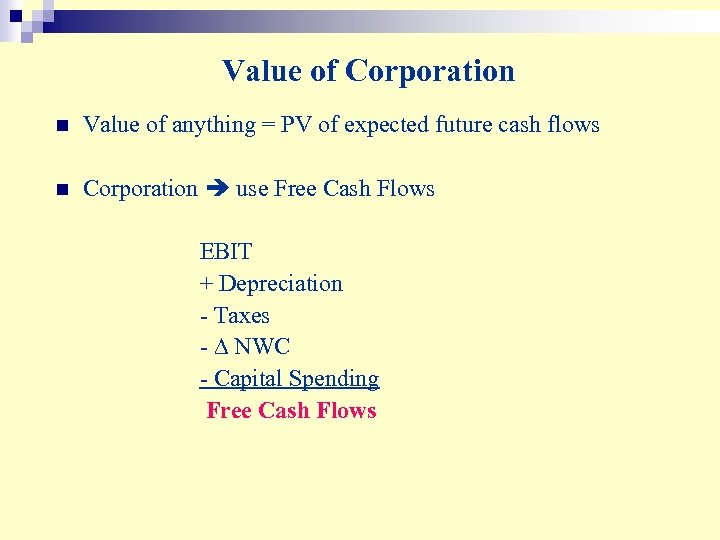 Value of Corporation n Value of anything = PV of expected future cash flows n Corporation use Free Cash Flows EBIT + Depreciation - Taxes - NWC - Capital Spending Free Cash Flows
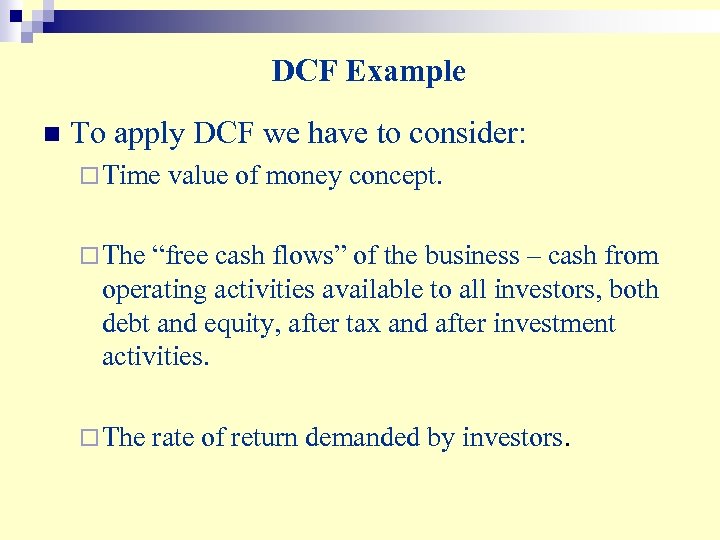 DCF Example n To apply DCF we have to consider: ¨ Time value of money concept. ¨ The “free cash flows” of the business – cash from operating activities available to all investors, both debt and equity, after tax and after investment activities. ¨ The rate of return demanded by investors.
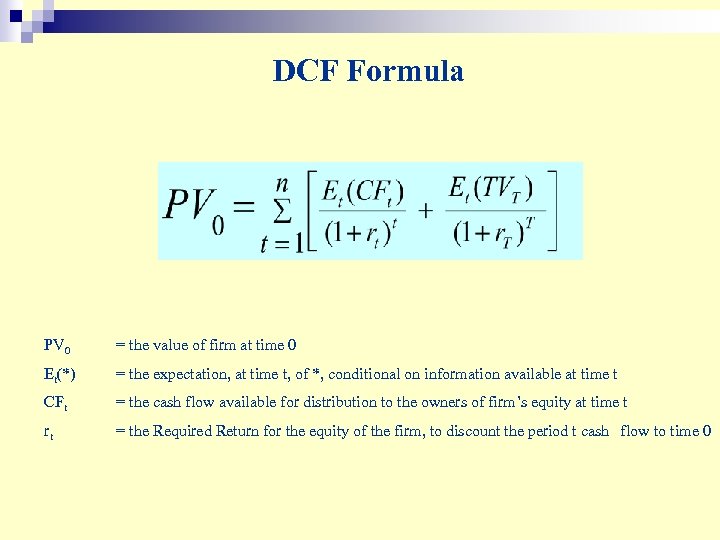 DCF Formula PV 0 = the value of firm at time 0 Et(*) = the expectation, at time t, of *, conditional on information available at time t CFt = the cash flow available for distribution to the owners of firm’s equity at time t rt = the Required Return for the equity of the firm, to discount the period t cash flow to time 0
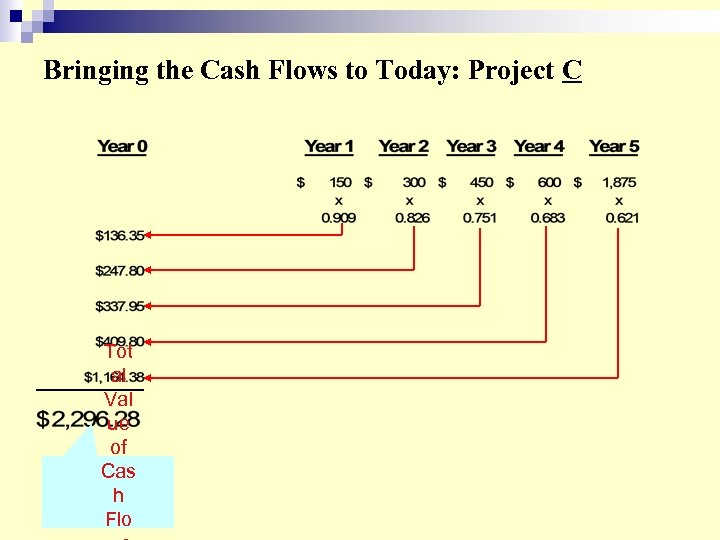 Bringing the Cash Flows to Today: Project C Tot al Val ue of Cas h Flo
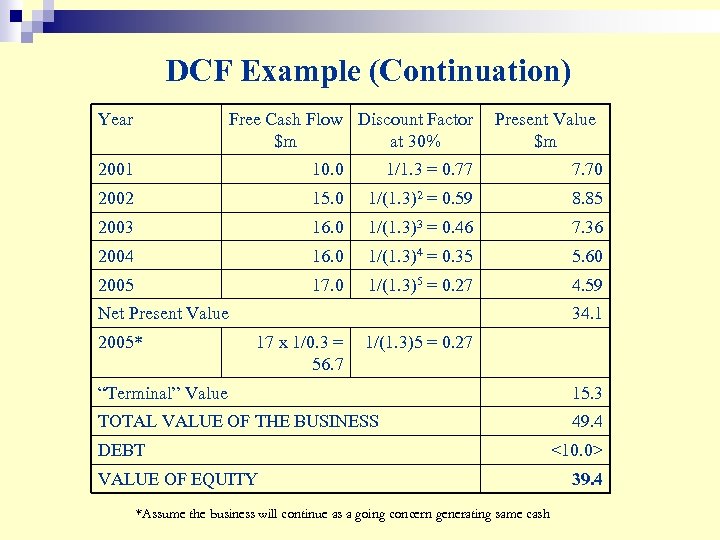 DCF Example (Continuation) Year Free Cash Flow Discount Factor $m at 30% Present Value $m 2001 10. 0 1/1. 3 = 0. 77 7. 70 2002 15. 0 1/(1. 3)2 = 0. 59 8. 85 2003 16. 0 1/(1. 3)3 = 0. 46 7. 36 2004 16. 0 1/(1. 3)4 = 0. 35 5. 60 2005 17. 0 1/(1. 3)5 = 0. 27 4. 59 Net Present Value 2005* 34. 1 17 x 1/0. 3 = 56. 7 1/(1. 3)5 = 0. 27 “Terminal” Value 15. 3 TOTAL VALUE OF THE BUSINESS 49. 4 DEBT VALUE OF EQUITY *Assume the business will continue as a going concern generating same cash <10. 0> 39. 4
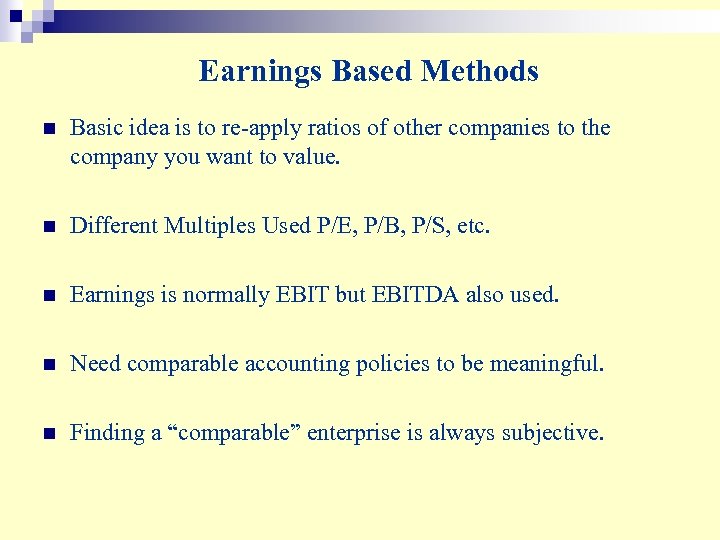 Earnings Based Methods n Basic idea is to re-apply ratios of other companies to the company you want to value. n Different Multiples Used P/E, P/B, P/S, etc. n Earnings is normally EBIT but EBITDA also used. n Need comparable accounting policies to be meaningful. n Finding a “comparable” enterprise is always subjective.
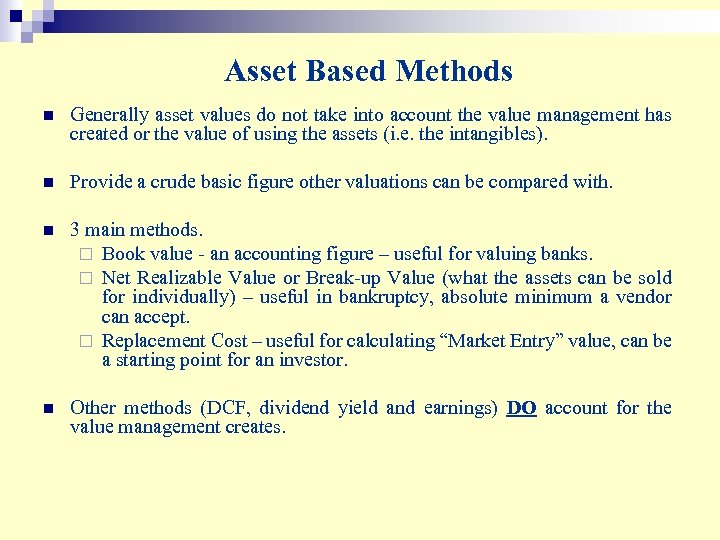 Asset Based Methods n Generally asset values do not take into account the value management has created or the value of using the assets (i. e. the intangibles). n Provide a crude basic figure other valuations can be compared with. n 3 main methods. ¨ Book value - an accounting figure – useful for valuing banks. ¨ Net Realizable Value or Break-up Value (what the assets can be sold for individually) – useful in bankruptcy, absolute minimum a vendor can accept. ¨ Replacement Cost – useful for calculating “Market Entry” value, can be a starting point for an investor. n Other methods (DCF, dividend yield and earnings) DO account for the value management creates.
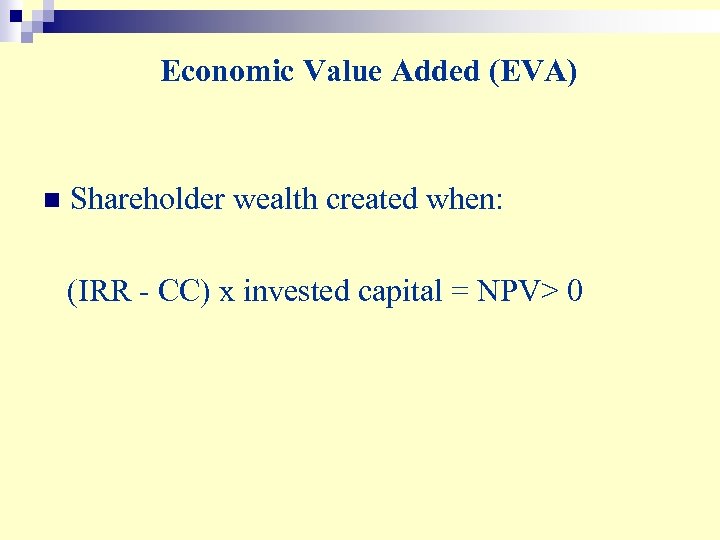 Economic Value Added (EVA) n Shareholder wealth created when: (IRR - CC) x invested capital = NPV> 0
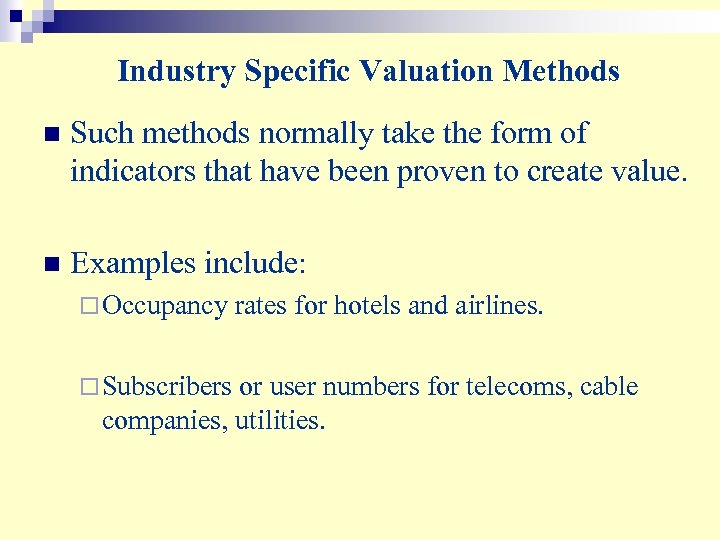 Industry Specific Valuation Methods n Such methods normally take the form of indicators that have been proven to create value. n Examples include: ¨ Occupancy ¨ Subscribers rates for hotels and airlines. or user numbers for telecoms, cable companies, utilities.
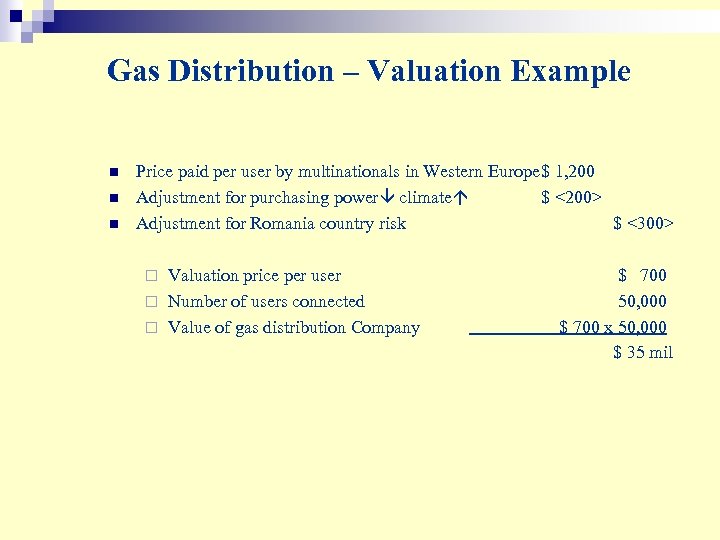 Gas Distribution – Valuation Example n n n Price paid per user by multinationals in Western Europe$ 1, 200 Adjustment for purchasing power climate $ <200> Adjustment for Romania country risk $ <300> Valuation price per user ¨ Number of users connected ¨ Value of gas distribution Company ¨ $ 700 50, 000 $ 700 x 50, 000 $ 35 mil
 The Process of Raising Private Equity
 The Process of Raising Private Equity n There is a process! n There are rules and protocols. n Credibility is everything.
 Step 1 - Strategy n Develop a well thought out, well presented strategy. n Obtain research data and use as basis for projections. n Prepare different scenarios. n Balance vision with realism.
 Step 2 – Preparation of the Information Memorandum n The key presentation document written specifically for investors. It is NOT the same as a business plan. ¨ Company history and strategy; ¨ Market and industry dynamic; ¨ Financial forecasts and financing requirement; ¨ The investment opportunity and associated risks; ¨ Company organization and operations. n An Information Memorandum is written according to accepted industry practices. Only given to investors if they sign a “Confidentiality Agreement. ” n
 Step 3 – Targeting Investors n Decide on the preferred type of investor: ¨ “FINANCIAL” n Angel Investors n Venture Capital Funds n Private Equity Funds n Multilaterals (IFC, EBRD, EIB) ¨ “STRATEGIC” n Companies in the same line of business who want to expand. n Companies in the similar line of business who want complementary business
 Step 4 – Presentations to Investors n The entrepreneur should: ¨ Be fluent in describing the strategy. ¨ Be rehearsed; key facts, figures and other knowledge should be memorized. ¨ Be very familiar with the financial forecasts and financing requirement. ¨ State how the investor may ultimately exit the investment (IPO, purchase by the company over time, sale of the venture to a strategic investor). ¨ Be prepared to answer all conceivable questions about the company.
 Step 5 – Negotiations With Investors n Key negotiation points: ¨ ¨ ¨ Company valuation What percent of the company for the investor’s cash? Rights of the shareholders (especially minority shareholder rights). Management incentives to own more shares based on performance targets. Amount of debt the company should have. Ideally, a competitive situation. n If interested – investor will issue a “Term Sheet”
 Step 6 – Structuring the Transaction n Consideration of: ¨ The most suitable long term combination of equity and debt; ¨ Current interest rates for debt; ¨ The amount required; ¨ Leasing available; ¨ The supply of capital available and practical considerations. n Preliminary Transaction Structure.
 Step 7 – Investor Due Diligence n As an equity investor is taking no collateral and has no guarantees, he needs to do much more “detective work” before he invests his money. n Typically an investor hires one of the “Big 5” and/or a large legal firm, to perform special verification procedures. n These can include: ¨ An audit of IAS financial statements. ¨ Physical asset verification. ¨ Review of all legal aspects.
 Step 8 - Closing n Money is paid, the share ownership changes, agreements are drafted by the lawyers to govern these changes and to govern future behavior. n Typical agreements include: ¨ Share Purchase Agreement. ¨ Shareholders’ Agreement Negotiations can be long! It is important to maintain control of the process at this stage.
 Legal, Regulatory and Control Issues n Documentation n Public company issues n Financial assistance and other regulatory issues n Monitoring
 The Mind of an Investor n The investor will share the risks of ownership so he wants: ¨ TRUST ¨ TRANSPARENCY “The Economist” (February 2001) reported that Russian stocks are undervalued by US$ 58 bn. due to lack of transparency and other corporate governance procedures”
 Key Criteria Investors Look For: n Management. ¨ With vision and determination ¨ Who delegate responsibility and have genuine team dynamics. ¨ Who are open and transparent n High level of future growth. n High return potential with a good exit plan (for example by becoming dominant player). n Well prepared documentation and financials.
 Investors look for “pro-business” governments n Established a strong and sensible regulatory framework ¨ Conducive to the conduct of business ¨ Assurance of investor’s rights ¨ IAS and Internationally accepted laws ¨ Corporate Governance n Only when these are in place can you achieve SUSTAINABLE economic growth
 Gov’t Continued Economic and regulatory reform is never easy – investors want to see commitment and progress n Must be far-sighted n Do not OVER GOVERN n Bankruptcy laws n Developing the country’s human capital n ¨ Constantly upgrading to prepare people to operate in a Global Economy ¨ Training
 Gov’t Continued Taxation n Bureaucracy n “Stampele Hell” n Business Licensing n Get connected n ¨ e. Government for more cost effective management ¨ Leapfrog methods
 Gov’t Continued n Impress Investors with a “Global” Mindset n Model SUCCESS n Success breads Success!