 Скачать презентацию Rain Scavenging of Moderately and Highly Soluble Gaseous
9f2efbba2154af26e4cfc994e76e29ae.ppt
- Количество слайдов: 17



Rain Scavenging of Moderately and Highly Soluble Gaseous Pollutants in the Atmosphere T. Elperin, A. Fominykh and B. Krasovitov Department of Mechanical Engineering The Pearlstone Center for Aeronautical Engineering Studies Ben-Gurion University of the Negev P. O. B. 653, Beer Sheva 84105 ISRAEL

Outline of the presentation Motivation and goals Fundamentals Description of the model Results and discussion Conclusions 11 th EMS/10 th ECAM Berlin 2011 Ben-Gurion University of the Negev
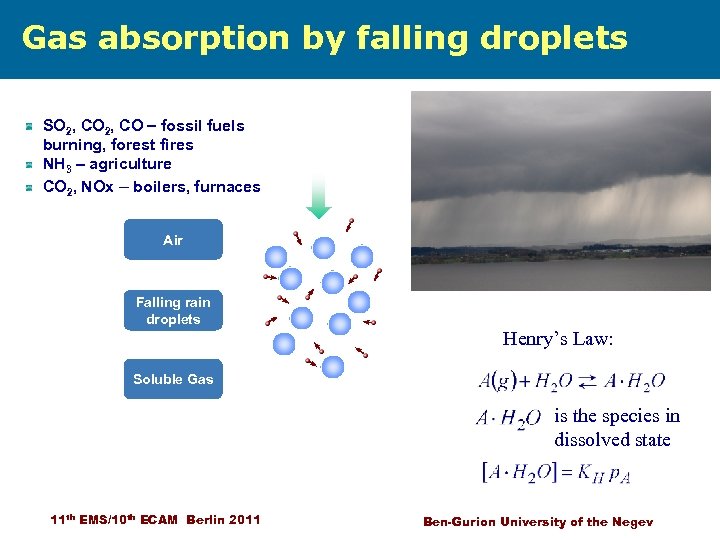
Gas absorption by falling droplets SO 2, CO - fossil fuels burning, forest fires NH 3 - agriculture CO 2, NOx – boilers, furnaces Air Falling rain droplets Henry’s Law: Soluble Gas is the species in dissolved state 11 th EMS/10 th ECAM Berlin 2011 Ben-Gurion University of the Negev
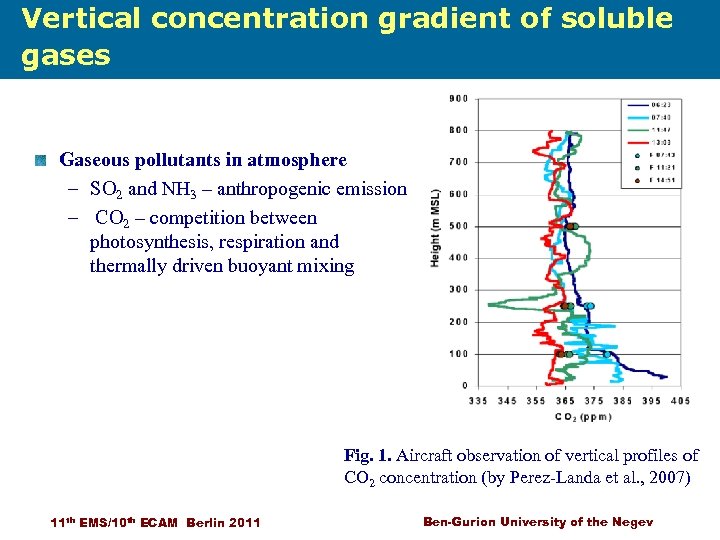
Vertical concentration gradient of soluble gases Scavenging of air pollutions Gaseous pollutants in atmosphere – SO 2 and NH 3 – anthropogenic emission – CO 2 – competition between photosynthesis, respiration and thermally driven buoyant mixing Fig. 1. Aircraft observation of vertical profiles of CO 2 concentration (by Perez-Landa et al. , 2007) 11 th EMS/10 th ECAM Berlin 2011 Ben-Gurion University of the Negev
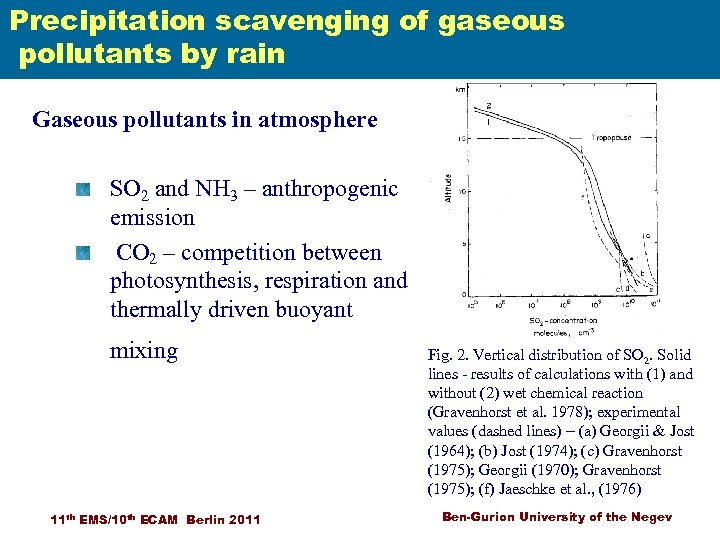
Precipitation scavenging of gaseous pollutants by rain Gaseous pollutants in atmosphere Scavenging of air pollutions SO 2 and NH 3 – anthropogenic emission CO 2 – competition between photosynthesis, respiration and thermally driven buoyant mixing 11 th EMS/10 th ECAM Berlin 2011 Fig. 2. Vertical distribution of SO 2. Solid lines - results of calculations with (1) and without (2) wet chemical reaction (Gravenhorst et al. 1978); experimental values (dashed lines) – (a) Georgii & Jost (1964); (b) Jost (1974); (c) Gravenhorst (1975); Georgii (1970); Gravenhorst (1975); (f) Jaeschke et al. , (1976) Ben-Gurion University of the Negev
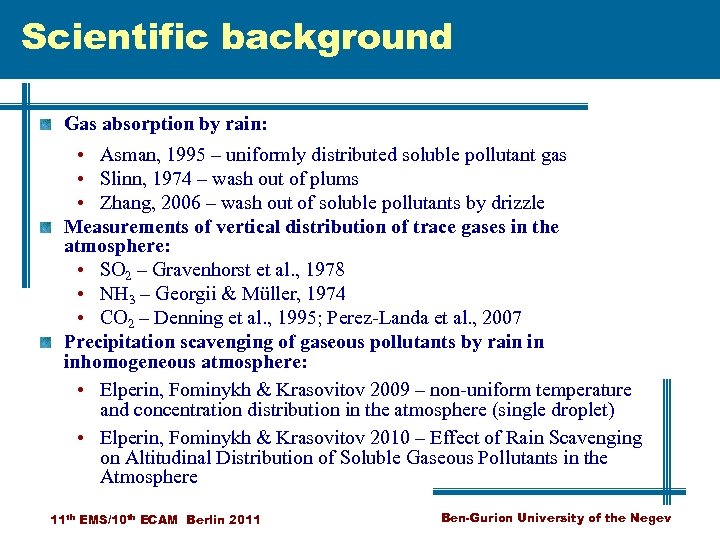
Scientific background Gas absorption by rain: • Asman, 1995 – uniformly distributed soluble pollutant gas • Slinn, 1974 – wash out of plums • Zhang, 2006 – wash out of soluble pollutants by drizzle Measurements of vertical distribution of trace gases in the atmosphere: • SO 2 – Gravenhorst et al. , 1978 • NH 3 – Georgii & Müller, 1974 • CO 2 – Denning et al. , 1995; Perez-Landa et al. , 2007 Precipitation scavenging of gaseous pollutants by rain in inhomogeneous atmosphere: • Elperin, Fominykh & Krasovitov 2009 – non-uniform temperature and concentration distribution in the atmosphere (single droplet) • Elperin, Fominykh & Krasovitov 2010 – Effect of Rain Scavenging on Altitudinal Distribution of Soluble Gaseous Pollutants in the Atmosphere 11 th EMS/10 th ECAM Berlin 2011 Ben-Gurion University of the Negev
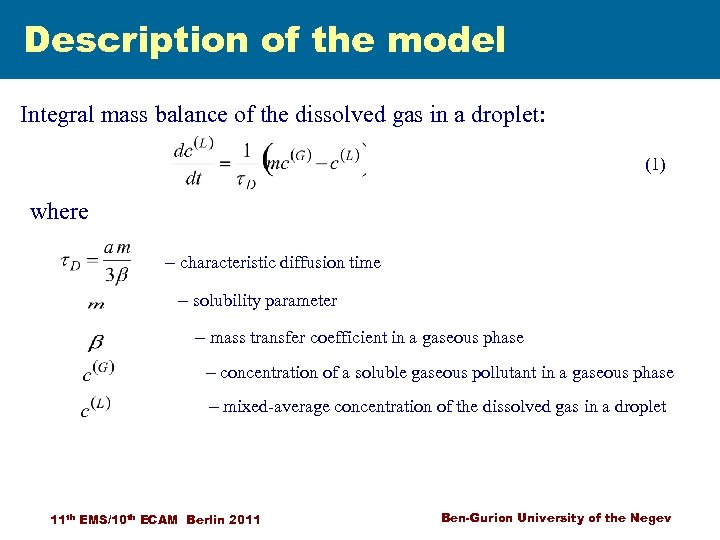
Description of the model Integral mass balance of the dissolved gas in a droplet: (1) where - characteristic diffusion time - solubility parameter - mass transfer coefficient in a gaseous phase - concentration of a soluble gaseous pollutant in a gaseous phase - mixed-average concentration of the dissolved gas in a droplet 11 th EMS/10 th ECAM Berlin 2011 Ben-Gurion University of the Negev
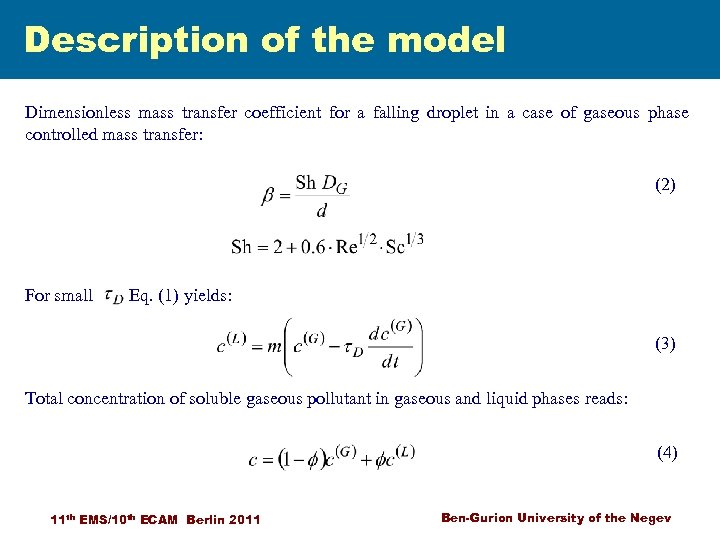
Description of the model Dimensionless mass transfer coefficient for a falling droplet in a case of gaseous phase controlled mass transfer: (2) For small Eq. (1) yields: (3) Total concentration of soluble gaseous pollutant in gaseous and liquid phases reads: (4) 11 th EMS/10 th ECAM Berlin 2011 Ben-Gurion University of the Negev
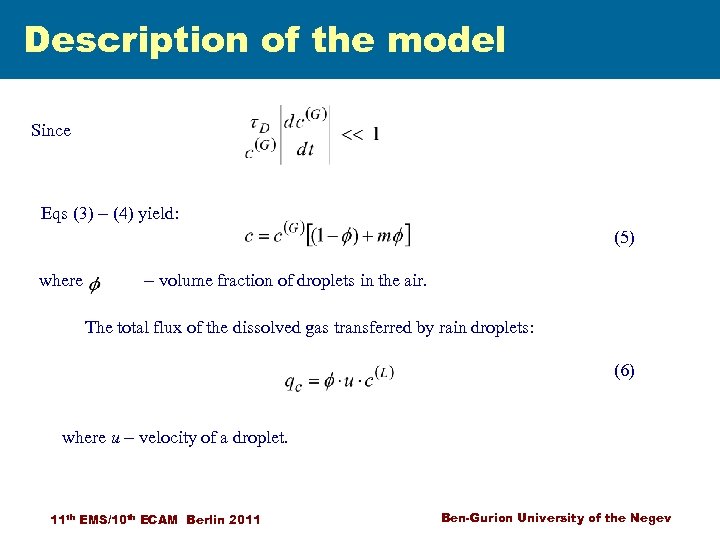
Description of the model Since Eqs (3) - (4) yield: (5) where - volume fraction of droplets in the air. The total flux of the dissolved gas transferred by rain droplets: (6) where u - velocity of a droplet. 11 th EMS/10 th ECAM Berlin 2011 Ben-Gurion University of the Negev
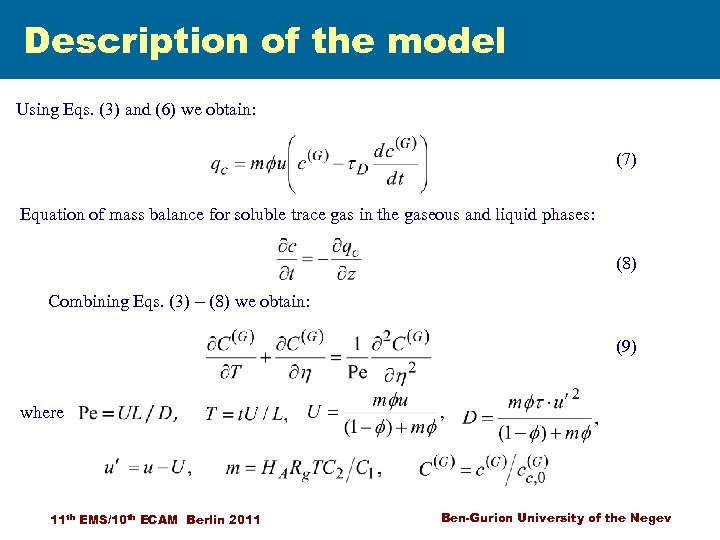
Description of the model Using Eqs. (3) and (6) we obtain: (7) Equation of mass balance for soluble trace gas in the gaseous and liquid phases: (8) Combining Eqs. (3) - (8) we obtain: (9) where 11 th EMS/10 th ECAM Berlin 2011 Ben-Gurion University of the Negev
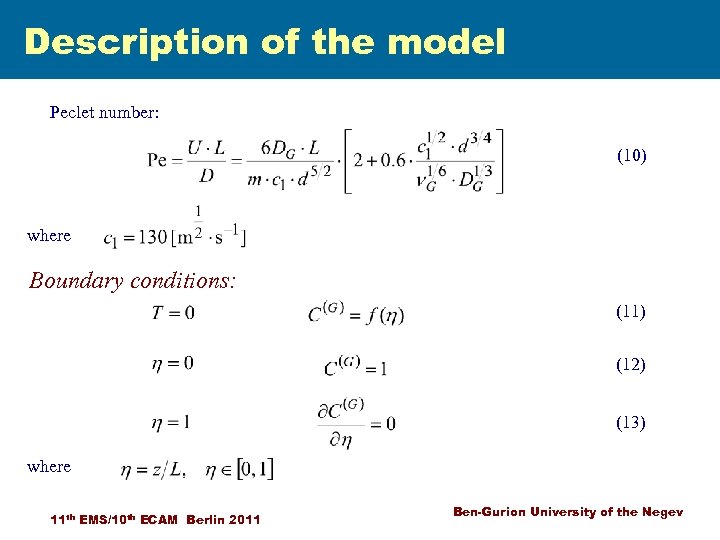
Description of the model Peclet number: (10) where Boundary conditions: (11) (12) (13) where 11 th EMS/10 th ECAM Berlin 2011 Ben-Gurion University of the Negev
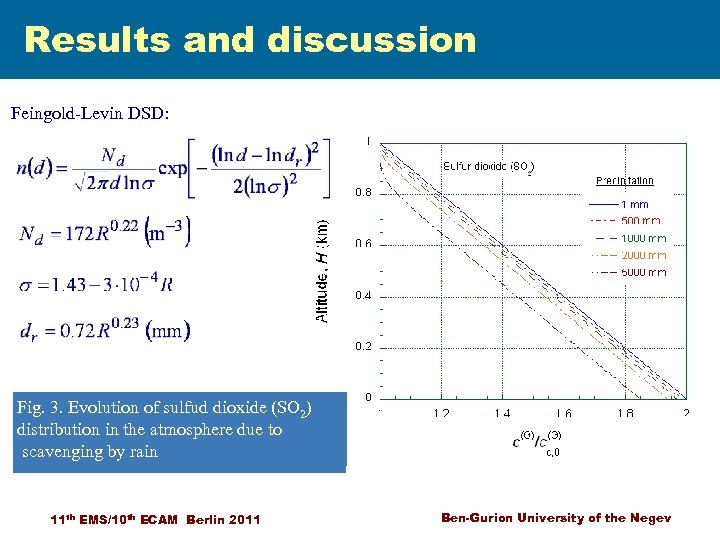
Results and discussion Feingold-Levin DSD: 3. sulfud dioxide ) Fig. 1. Evolution of ammonia (NH 3(SO 2) distribution in the atmosphere due to scavenging by rain 11 th EMS/10 th ECAM Berlin 2011 Ben-Gurion University of the Negev
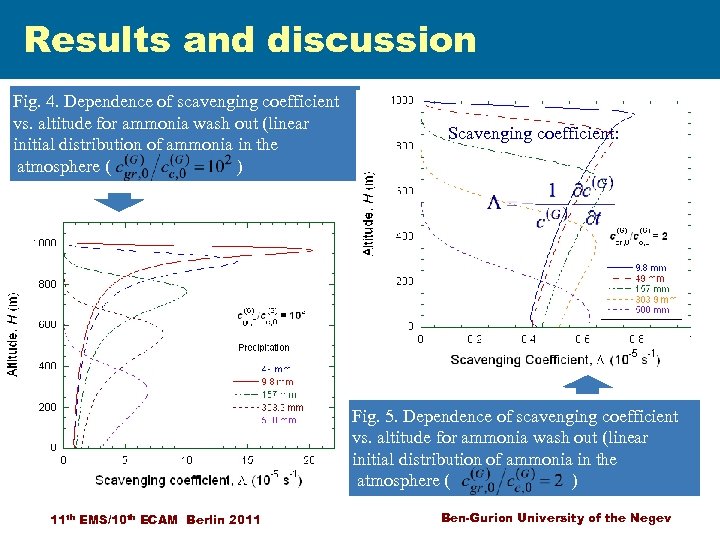
Results and discussion Fig. 4. Dependence of scavenging coefficient vs. altitude for ammonia wash out (linear initial distribution of ammonia in the atmosphere ( ) Scavenging coefficient: Fig. 5. Dependence of scavenging coefficient vs. altitude for ammonia wash out (linear initial distribution of ammonia in the atmosphere ( ) 11 th EMS/10 th ECAM Berlin 2011 Ben-Gurion University of the Negev
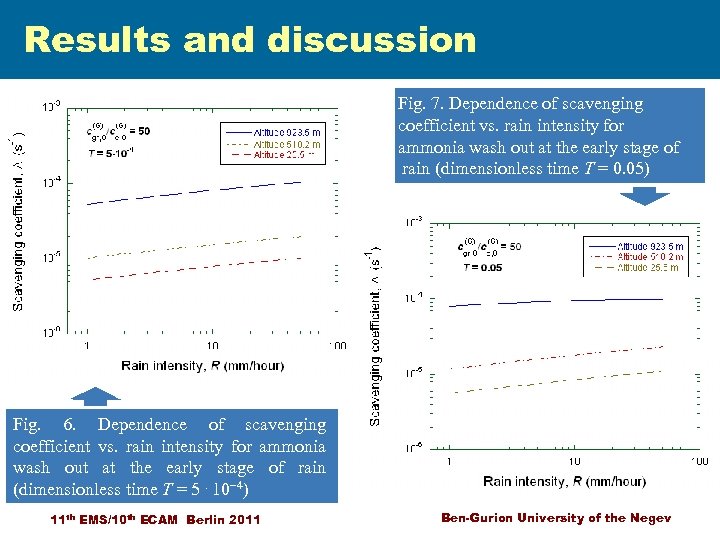
Results and discussion Fig. 7. Dependence of scavenging coefficient vs. rain intensity for ammonia wash out at the early stage of rain (dimensionless time T = 0. 05) Fig. 6. Dependence of scavenging coefficient vs. rain intensity for ammonia wash out at the early stage of rain (dimensionless time T = 5. 10 -4) 11 th EMS/10 th ECAM Berlin 2011 Ben-Gurion University of the Negev
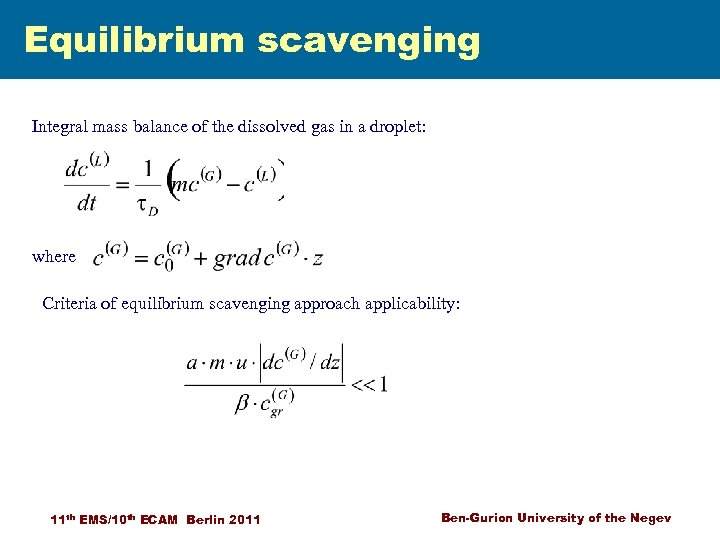
Equilibrium scavenging Integral mass balance of the dissolved gas in a droplet: where Criteria of equilibrium scavenging approach applicability: 11 th EMS/10 th ECAM Berlin 2011 Ben-Gurion University of the Negev
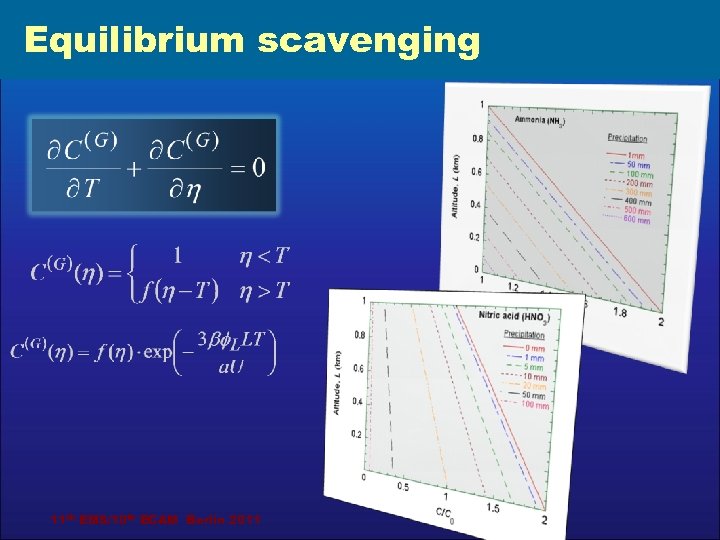
Equilibrium scavenging 11 th EMS/10 th ECAM Berlin 2011
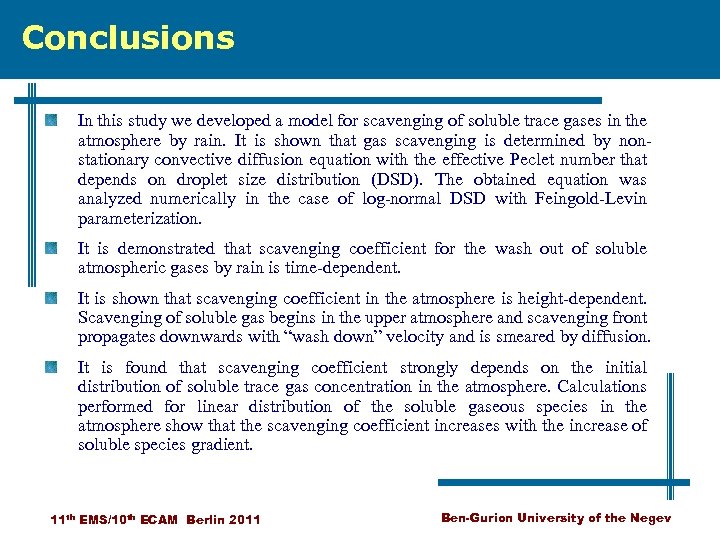
Conclusions In this study we developed a model for scavenging of soluble trace gases in the atmosphere by rain. It is shown that gas scavenging is determined by nonstationary convective diffusion equation with the effective Peclet number that depends on droplet size distribution (DSD). The obtained equation was analyzed numerically in the case of log-normal DSD with Feingold-Levin parameterization. It is demonstrated that scavenging coefficient for the wash out of soluble atmospheric gases by rain is time-dependent. It is shown that scavenging coefficient in the atmosphere is height-dependent. Scavenging of soluble gas begins in the upper atmosphere and scavenging front propagates downwards with “wash down” velocity and is smeared by diffusion. It is found that scavenging coefficient strongly depends on the initial distribution of soluble trace gas concentration in the atmosphere. Calculations performed for linear distribution of the soluble gaseous species in the atmosphere show that the scavenging coefficient increases with the increase of soluble species gradient. 11 th EMS/10 th ECAM Berlin 2011 Ben-Gurion University of the Negev
Скачать презентацию Rain Scavenging of Moderately and Highly Soluble Gaseous
9f2efbba2154af26e4cfc994e76e29ae.ppt