


 Скачать презентацию Raimo Vuorinen ELGPN Co-ordinator Finnish Institute for Educational
4bb5d237f061a1970c8655a96cf706ea.ppt
- Количество слайдов: 26
 Raimo Vuorinen ELGPN, Co-ordinator Finnish Institute for Educational Research University of Jyväskylä Finland ISFOL, 28 April 2010, Rome, Italy Roma, 28 aprile 2010 Finnish Institute for Educational Research (FIER) Report on guidance 2009 Guidance supply in Italy - commentary notes
 • Added value of the report • The reference framework: Widening paradigm of LLG • National situation in comparison to recent development in EU countries • Challenges – relation to parallel developments in European countries Roma, 28 aprile 2010 Finnish Institute for Educational Research (FIER) Themes
 • A national research based development strategy is very unique in Europe • A national research centre focusing on policy related guidance issues like ISFOL is necessary – This type of national centres in e. g. Iceland, Finland, UK • National consultation on the progress is necessary – close links with all the key stakeholders Roma, 28 aprile 2010 Finnish Institute for Educational Research (FIER) Added value of the report
 • The proposed framework is in congruence with current developments in Europe • Shift from individual to wider definition of LLG proposed in the report is the way forward • Distinction of services visible for citizens and the policies which have impact on the service delivery • Common conceptual framework? Roma, 28 aprile 2010 Finnish Institute for Educational Research (FIER) Theoretical cultural reference framework
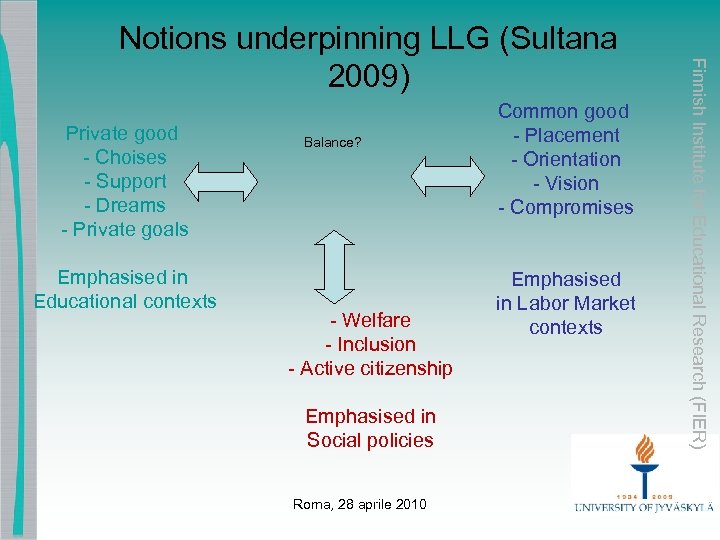 Private good - Choises - Support - Dreams - Private goals Emphasised in Educational contexts Balance? - Welfare - Inclusion - Active citizenship Emphasised in Social policies Roma, 28 aprile 2010 Common good - Placement - Orientation - Vision - Compromises Emphasised in Labor Market contexts Finnish Institute for Educational Research (FIER) Notions underpinning LLG (Sultana 2009)
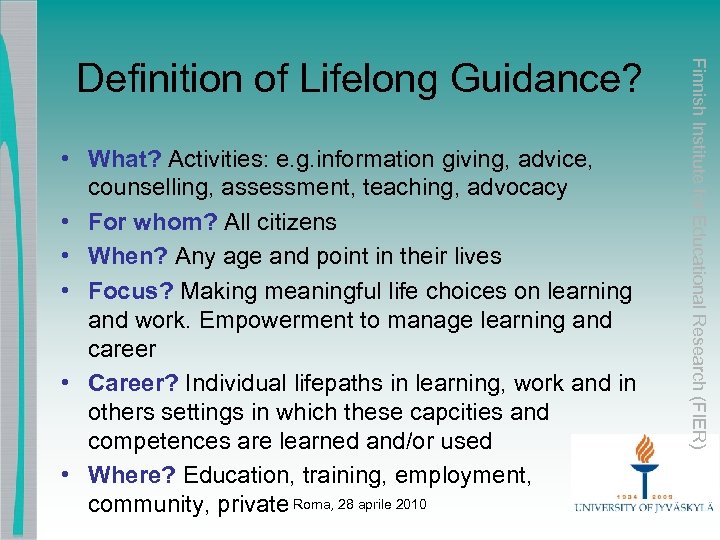 • What? Activities: e. g. information giving, advice, counselling, assessment, teaching, advocacy • For whom? All citizens • When? Any age and point in their lives • Focus? Making meaningful life choices on learning and work. Empowerment to manage learning and career • Career? Individual lifepaths in learning, work and in others settings in which these capcities and competences are learned and/or used • Where? Education, training, employment, community, private Roma, 28 aprile 2010 Finnish Institute for Educational Research (FIER) Definition of Lifelong Guidance?
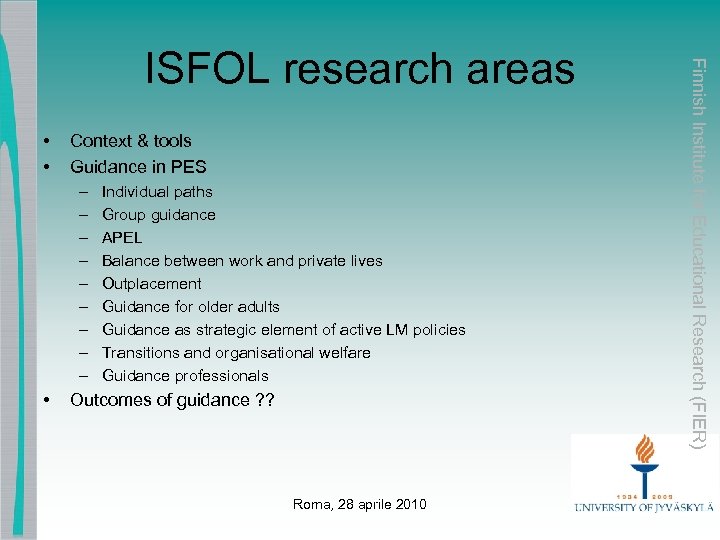 • • Context & tools Guidance in PES – – – – – • Individual paths Group guidance APEL Balance between work and private lives Outplacement Guidance for older adults Guidance as strategic element of active LM policies Transitions and organisational welfare Guidance professionals Outcomes of guidance ? ? Roma, 28 aprile 2010 Finnish Institute for Educational Research (FIER) ISFOL research areas
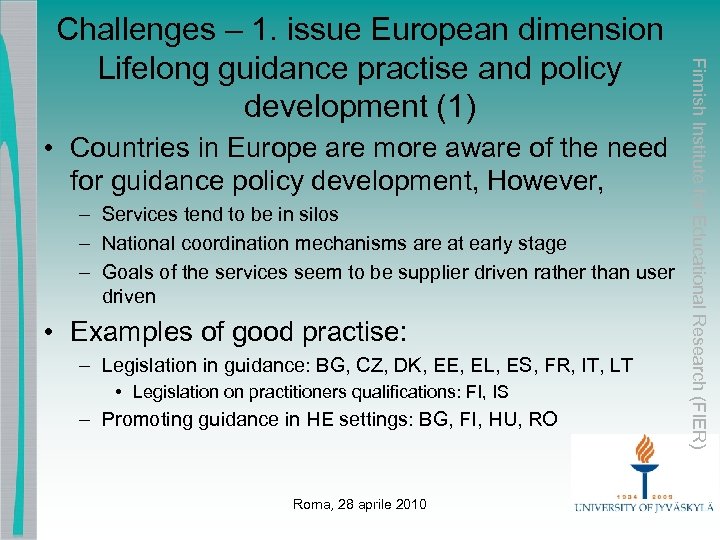 • Countries in Europe are more aware of the need for guidance policy development, However, – Services tend to be in silos – National coordination mechanisms are at early stage – Goals of the services seem to be supplier driven rather than user driven • Examples of good practise: – Legislation in guidance: BG, CZ, DK, EE, EL, ES, FR, IT, LT • Legislation on practitioners qualifications: FI, IS – Promoting guidance in HE settings: BG, FI, HU, RO Roma, 28 aprile 2010 Finnish Institute for Educational Research (FIER) Challenges – 1. issue European dimension Lifelong guidance practise and policy development (1)
 • Proposed guidance functions: – Information – Monitoring of guidance paths/tutoring – Guidance counselling – Analysis of guidance policies • Outcomes? • Building a national system Roma, 28 aprile 2010 Finnish Institute for Educational Research (FIER) Challenges – 2. issue networking
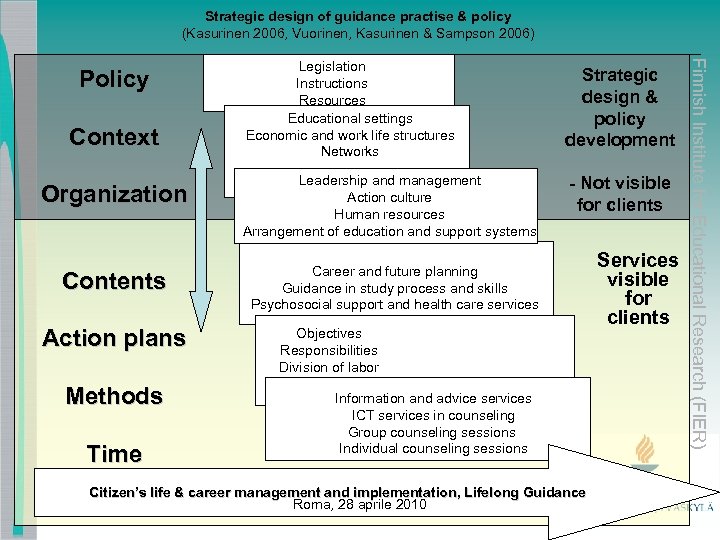 Strategic design of guidance practise & policy (Kasurinen 2006, Vuorinen, Kasurinen & Sampson 2006) Context Organization Contents Action plans Methods Time Leadership and management Action culture Human resources Arrangement of education and support systems Strategic design & policy development - Not visible for clients Career and future planning Guidance in study process and skills Psychosocial support and health care services Objectives Responsibilities Division of labor Information and advice services ICT services in counseling Group counseling sessions Individual counseling sessions Citizen’s life & career management and implementation, Lifelong Guidance Roma, 28 aprile 2010 Services visible for clients Finnish Institute for Educational Research (FIER) Policy Legislation Instructions Resources Educational settings Economic and work life structures Networks
 • Focus on the process dimension • New technologies challenge the traditional counselling relationship • Implications of new technology (including social media) – >critical use of different information sources • Career guidance -> Career management skills as a new competence as such Roma, 28 aprile 2010 Finnish Institute for Educational Research (FIER) Challenges – 3. issue – new competences
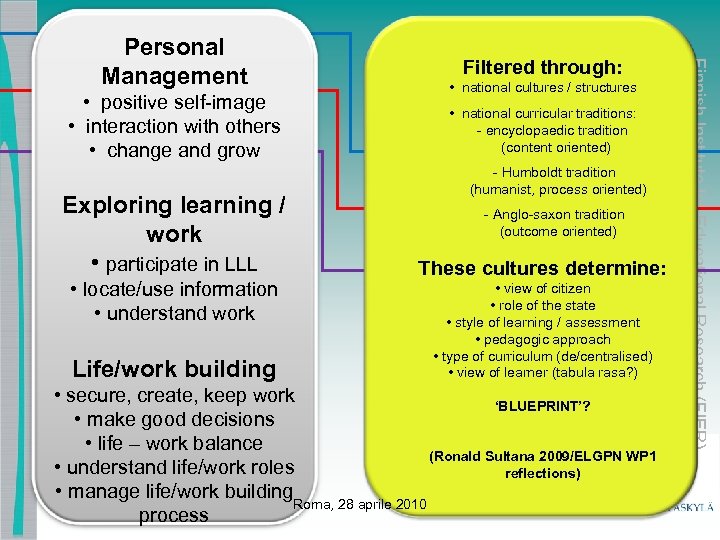 • positive self-image • interaction with others • change and grow Exploring learning / work • participate in LLL • locate/use information • understand work Life/work building Filtered through: • national cultures / structures • national curricular traditions: - encyclopaedic tradition (content oriented) - Humboldt tradition (humanist, process oriented) - Anglo-saxon tradition (outcome oriented) These cultures determine: • view of citizen • role of the state • style of learning / assessment • pedagogic approach • type of curriculum (de/centralised) • view of learner (tabula rasa? ) • secure, create, keep work ‘BLUEPRINT’? • make good decisions • life – work balance (Ronald Sultana 2009/ELGPN WP 1 • understand life/work roles reflections) • manage life/work building Roma, 28 aprile 2010 process Finnish Institute for Educational Research (FIER) Personal Management
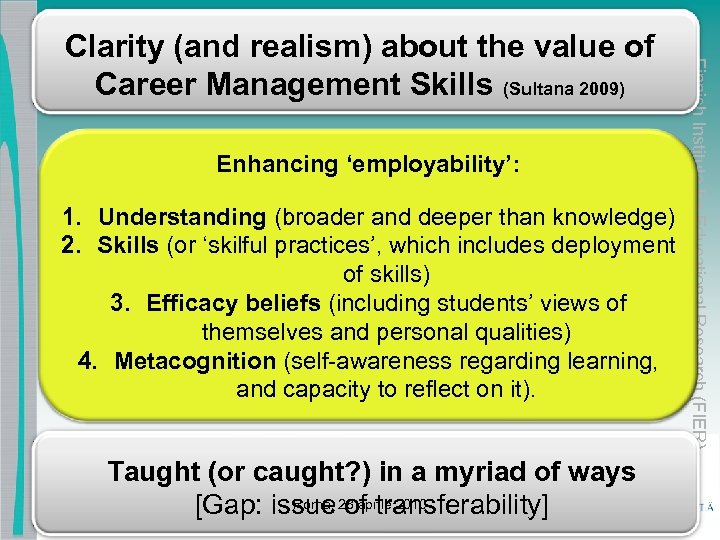 Enhancing ‘employability’: 1. Understanding (broader and deeper than knowledge) 2. Skills (or ‘skilful practices’, which includes deployment of skills) 3. Efficacy beliefs (including students’ views of themselves and personal qualities) 4. Metacognition (self-awareness regarding learning, and capacity to reflect on it). Taught (or caught? ) in a myriad of ways Roma, of transferability] [Gap: issue 28 aprile 2010 Finnish Institute for Educational Research (FIER) Clarity (and realism) about the value of Career Management Skills (Sultana 2009)
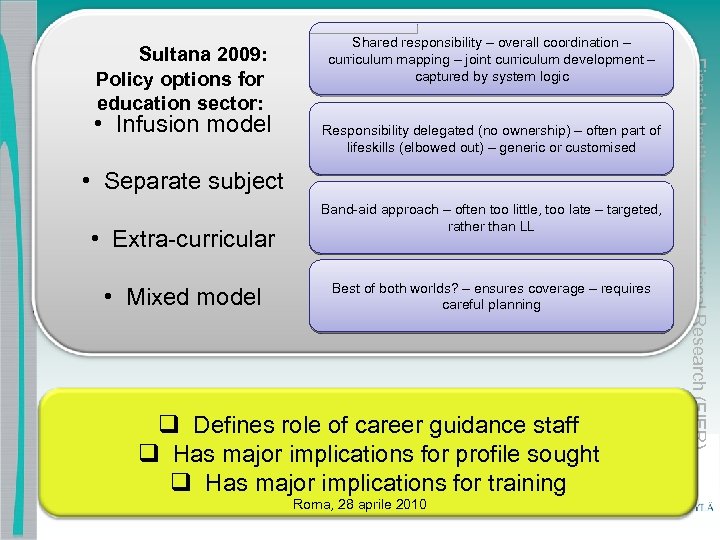 • Infusion model Responsibility delegated (no ownership) – often part of lifeskills (elbowed out) – generic or customised • Separate subject • Extra-curricular • Mixed model Band-aid approach – often too little, too late – targeted, rather than LL Best of both worlds? – ensures coverage – requires careful planning q Defines role of career guidance staff q Has major implications for profile sought q Has major implications for training Roma, 28 aprile 2010 Finnish Institute for Educational Research (FIER) Sultana 2009: Policy options for education sector: Shared responsibility – overall coordination – curriculum mapping – joint curriculum development – captured by system logic
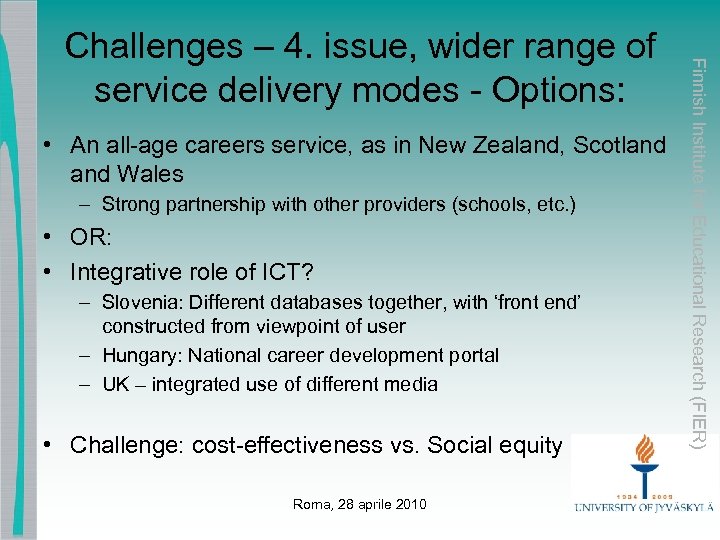 • An all-age careers service, as in New Zealand, Scotland Wales – Strong partnership with other providers (schools, etc. ) • OR: • Integrative role of ICT? – Slovenia: Different databases together, with ‘front end’ constructed from viewpoint of user – Hungary: National career development portal – UK – integrated use of different media • Challenge: cost-effectiveness vs. Social equity Roma, 28 aprile 2010 Finnish Institute for Educational Research (FIER) Challenges – 4. issue, wider range of service delivery modes - Options:
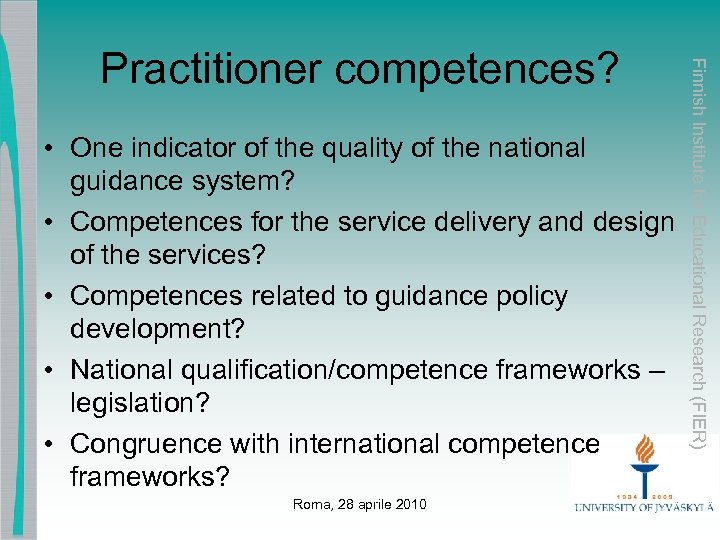 • One indicator of the quality of the national guidance system? • Competences for the service delivery and design of the services? • Competences related to guidance policy development? • National qualification/competence frameworks – legislation? • Congruence with international competence frameworks? Roma, 28 aprile 2010 Finnish Institute for Educational Research (FIER) Practitioner competences?
 • A common conceptual framework for a coherent lifelong career guidance system? • In a situation where most services are disparate parts of other systems (schools, universities, employers, PES, etc. ), each with its own rationale and driving forces ? – (Watts 2009) Roma, 28 aprile 2010 Finnish Institute for Educational Research (FIER) Challenges – 5. issue – guidance economy
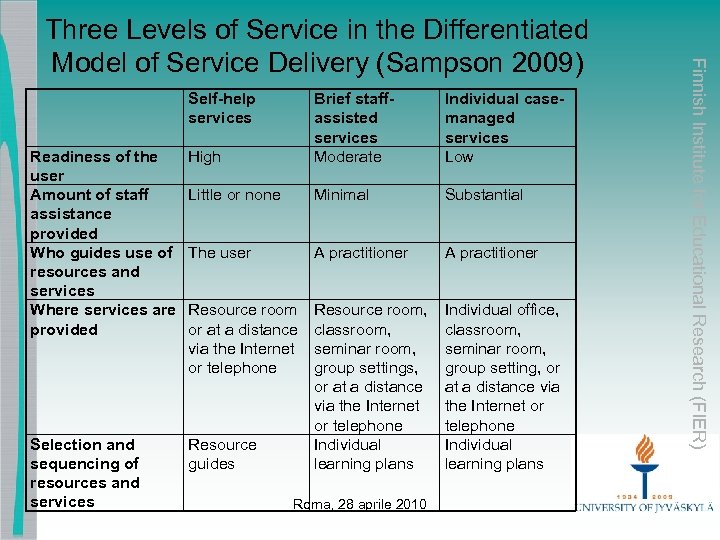 Self-help services Readiness of the user Amount of staff assistance provided Who guides use of resources and services Where services are provided High Brief staffassisted services Moderate Little or none Minimal Substantial The user A practitioner Resource room or at a distance via the Internet or telephone Selection and sequencing of resources and services Resource guides Resource room, classroom, seminar room, group settings, or at a distance via the Internet or telephone Individual learning plans Individual office, classroom, seminar room, group setting, or at a distance via the Internet or telephone Individual learning plans Roma, 28 aprile 2010 Individual casemanaged services Low Finnish Institute for Educational Research (FIER) Three Levels of Service in the Differentiated Model of Service Delivery (Sampson 2009)
 • Distinction between three level of linkages – Communication • Exchanging informaton, exploring potentials for cooperation – Co-operation • Between partners, within existing structures, decision powers and mandates retained by each partner – Co-ordination • Requires a co-ordinating structure with operational mandates and funding (contract or legal mandate) Roma, 28 aprile 2010 Finnish Institute for Educational Research (FIER) Questions for consideration when implementing coherent guidance provision
 • Potential advantages of top-down approaches – Funding base – Direct link with policy • Potential advantages of bottom-up approaches – May be more sustainable – More independence in actions – May produce a greater sense of ownership and motivated participation 28 aprile 2010 Roma, Finnish Institute for Educational Research (FIER) Questions for consideration when implementing coherent guidance provision(2)
 • Integrative potentials of the ICT – – Bringing together the stake holders A tool and a powerful agent of change Data collection and dissemination System integration • Strategic design of curricula with guidance perspective Roma, 28 aprile 2010 Finnish Institute for Educational Research (FIER) Questions for consideration when implementing coherent guidance provision (3)
 • When promoting outcome focused evidence based practise and policy development the focus should be on both services visible for citizens and the design of the services. • In addition of navigating in networks the practitioners need competences to enhance interdisciplinary sustainable forums • Need for consistency in the leadership and management of insterdisciplinary networks Roma, 28 aprile 2010 Finnish Institute for Educational Research (FIER) Questions for consideration when implementing coherent guidance provision (4)
 • Networking – Structures: define the area of cooperation, map out the network with its actors and secure operational preconditions, such as resources. – Processes in organizations and at their interfaces include strategic planning, cooperation, the formation, monitoring and evaluation of information; – Personnel management enhances opportunities for cooperation, attends to the division of work and responsibility, know-how and coping. Counselling professionals also take part in management according to the principles of shared management in networks; – Special questions on client service in management. Attention should be paid to the access of services for citizens outside training and work and at transitional points on their study path. Roma, 28 aprile 2010 Finnish Institute for Educational Research (FIER) Next steps ?
 • A member state driven network established 2007 • A tool for European co-operation • Enhancement of national solutions to meet national challenges. • ELGPN is a conclusion to meet the challenges the policy makers meet in implementing the Lisbon strategies and the tools supporting the strategy (e. g. EQF and ECVET) Roma, 28 aprile 2010 Finnish Institute for Educational Research (FIER) Promotion of national development through European co-operation - ELGPN
 • Support for policy development and implementation at national level • Co-operation and co-ordination mechanisms in guidance practice and policy development • Quality assurance/Evidence-based practice and policy development • Widening access • Promoting career management skills • Synergies between EU funded projects • Education & Training and Employment policy analysis from Lifelong Guidance perspective Roma, 28 aprile 2010 Finnish Institute for Educational Research (FIER) ELGPN Thematic clusters 2009 -2010
 For further information, please contact: Raimo Vuorinen, Senior researcher, Ph. D. Co-ordinator of the ELGPN Finnish Institute for Educational Research P. O. Box 35 FI-40014 University of Jyväskylä tel. +358 -14 -2603271, Mobile +358 -50 -3611909 Fax +358 -14 -2603201 email: raimo. vuorinen@jyu. fi www: http: //elgpn. eu/ Skype: vuorai Roma, 28 aprile 2010 Finnish Institute for Educational Research (FIER) Thank you!