


 Скачать презентацию Radiological Category GI Principal Modality 1 Ultrasound Principal
ac1fa6224ea858a77596a196517c1aa5.ppt
- Количество слайдов: 12
 Radiological Category: GI Principal Modality (1): Ultrasound Principal Modality (2): None Case Report #0652 Submitted by: John S. Yoo , M. D. Faculty reviewer: Eduardo Matta, M. D Date accepted: 29 December 2009
 Case History 80 year-old female with history of thoracoabdominal aortic aneurysm. She originally presented to the hospital with right lower extremity ischemia and underwent a right axillofemoral bypass and bilateral iliac artery thrombectomies. Two days later, she experienced an acute onset of right upper quadrant abdominal pain.
 Radiological Presentations
 Radiological Presentations
 Radiological Presentations
 Radiological Presentations
 Radiological Presentations
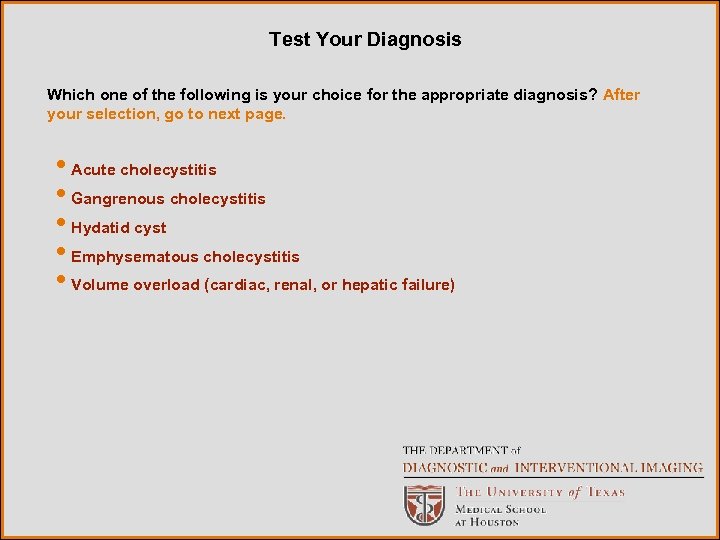 Test Your Diagnosis Which one of the following is your choice for the appropriate diagnosis? After your selection, go to next page. • Acute cholecystitis • Gangrenous cholecystitis • Hydatid cyst • Emphysematous cholecystitis • Volume overload (cardiac, renal, or hepatic failure)
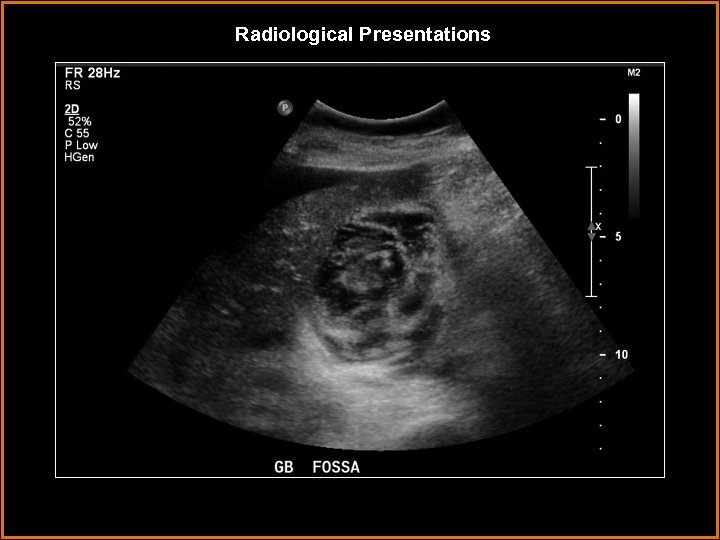
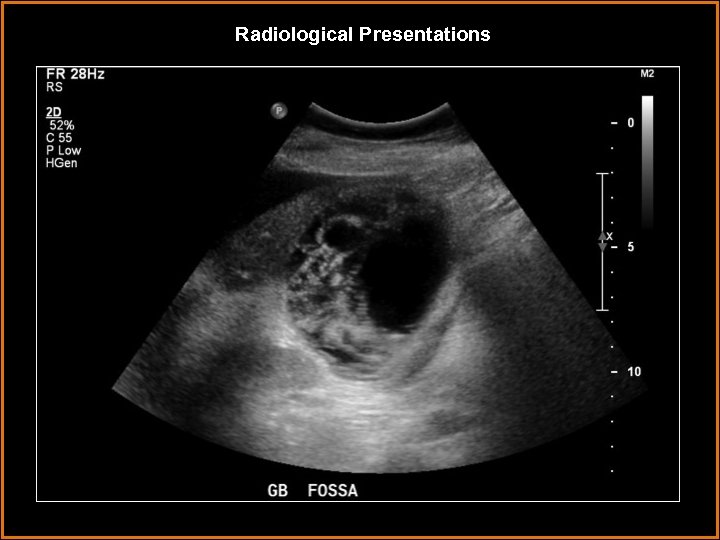
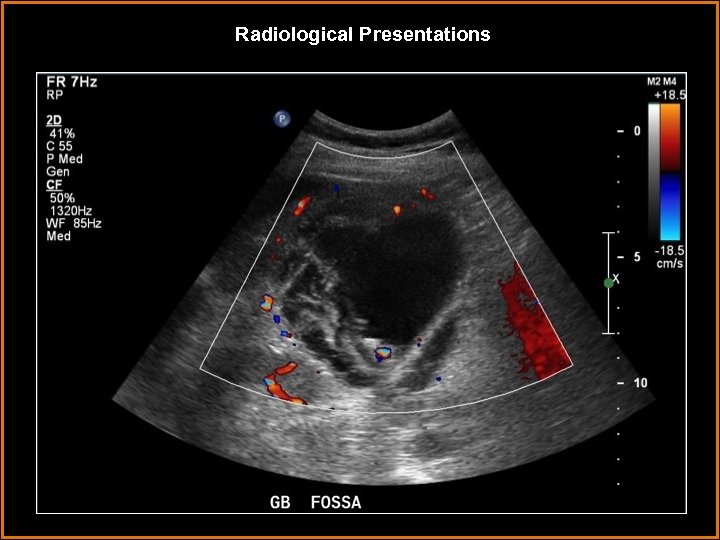
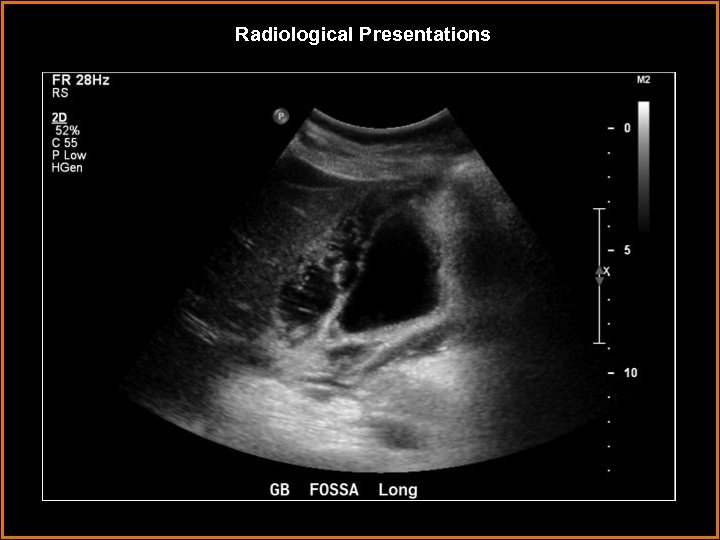
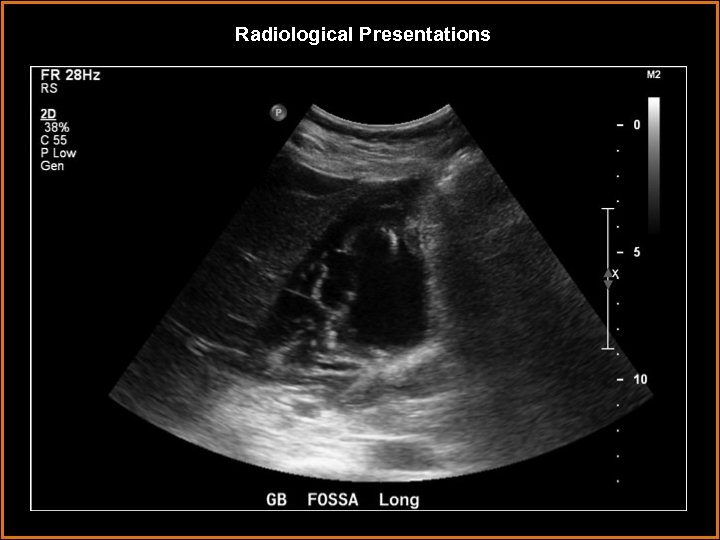
 Findings and Differentials Findings: Striated thickening of the gallbladder wall with multiple hyperechoic, serpentine bands separated by hypoechoic areas. Also, intraluminal membranes concerning for desquamative mucosa. Differentials: • Acute cholecystitis – Wall thickening and pericholecystic fluid are neither sensitive nor specific. The most sensitive finding is a gallbladder stone with a positive Murphy’s sign. • Hydatid cyst – intrahepatic cystic lesion with floating membranes or multiseptated cysts. • Emphysematous cholecystitis – dirty shadowing from gas in gallbladder wall. • Volume overload – usually uniform, homogeneous wall thickening.
 Discussion • Gangrenous cholecystitis is on the severe end of the spectrum of acute cholecystitis. • It is thought to be a result of tension in the gallbladder wall secondary to increased distention. This results in ischemic necrosis of the gallbladder wall, sometimes due to cystic artery thrombosis. • The condition occurs in older patients, usually male. Coexisting vascular disease is commonly seen. Sonographic Murphy’s sign is usually absent, thought to be due to devascularization and denervation. • On ultrasound, the primary finding is layered or striated gallbladder wall thickening. Usually, it is irregular with luminal projections. Less often seen, but more specific, are intraluminal membranes that are thought to represent desquamative mucosa.
 Diagnosis Gangrenous Cholecystitis.
 References • Teefey SA, Baron RL, Bigler SA. Sonography of the Gallbladder: Significance of Striated (Layered) Thickening of the Gallbladder Wall. Am J Roentgenol. 1991 May; 156: 945 -947. • Hanbridge AE. Buckler PM, O’Malley ME, Wilson SR. From the RSNA Refresher Courses: Imaging Evaluation for Acute Pain in the Right Upper Quadrant. Radio. Graphics, July 1, 2004; 24(4): 1117 -1135. • Bennett GL, Rusinek H, Lisi V, Israel GM, Krinsky GA, Slywotzky CM, Megibow A. CT Findings in Acute Gangrenous Cholecystitis.