


 Скачать презентацию Radio Science Issues François Lefeuvre URSI President LPCE CNRS
30c7017435f53cbb91e36d59c0ea4abc.ppt
- Количество слайдов: 58
 Radio Science Issues François Lefeuvre, URSI President, LPCE/CNRS 45071 Orléans cedex 2, France ESWW 4 - Bruxelles – 6 November 2007 1
 The radio spectrum An exploding use for a unique limited resource 2
 1. Radio spectrum 2. Radio Science & Telecommunication 3. URSI scientific activities 4. Present issues 3
 1. THE RADIO SPECTRUM 4
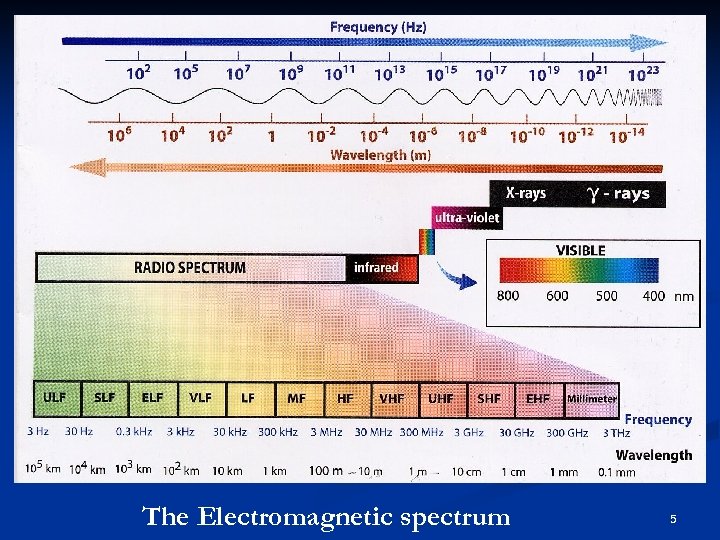 The Electromagnetic spectrum 5
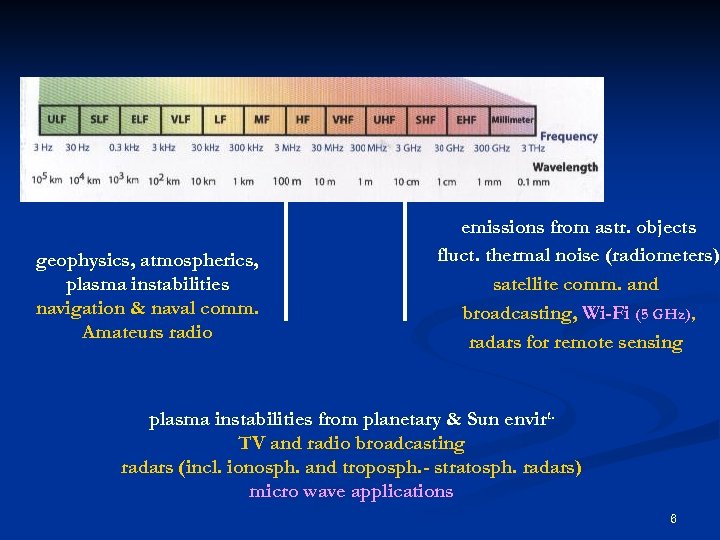 geophysics, atmospherics, plasma instabilities navigation & naval comm. Amateurs radio emissions from astr. objects fluct. thermal noise (radiometers) satellite comm. and broadcasting, Wi-Fi (5 GHz), radars for remote sensing plasma instabilities from planetary & Sun envirt. TV and radio broadcasting radars (incl. ionosph. and troposph. - stratosph. radars) micro wave applications 6
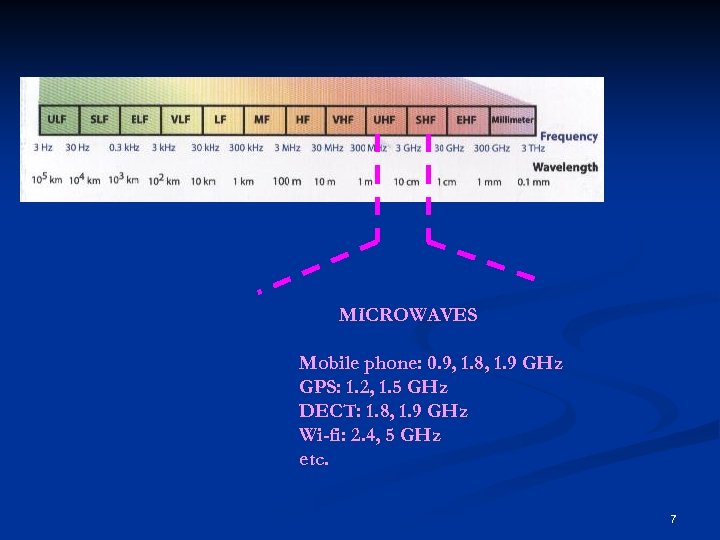 MICROWAVES Mobile phone: 0. 9, 1. 8, 1. 9 GHz GPS: 1. 2, 1. 5 GHz DECT: 1. 8, 1. 9 GHz Wi-fi: 2. 4, 5 GHz etc. 7
 2. RADIO SCIENCE AND TELECOMMUNICATION 8
 The Birth of URSI 9
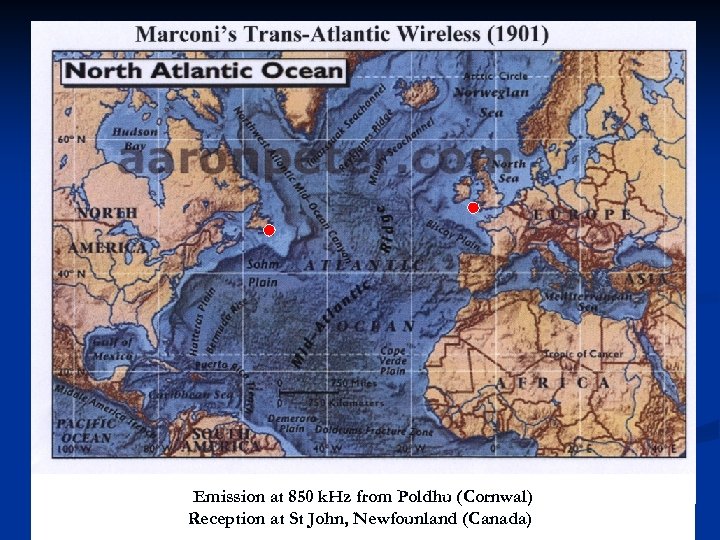 Emission at 850 k. Hz from Poldhu (Cornwal) Reception at St John, Newfounland (Canada)) 10
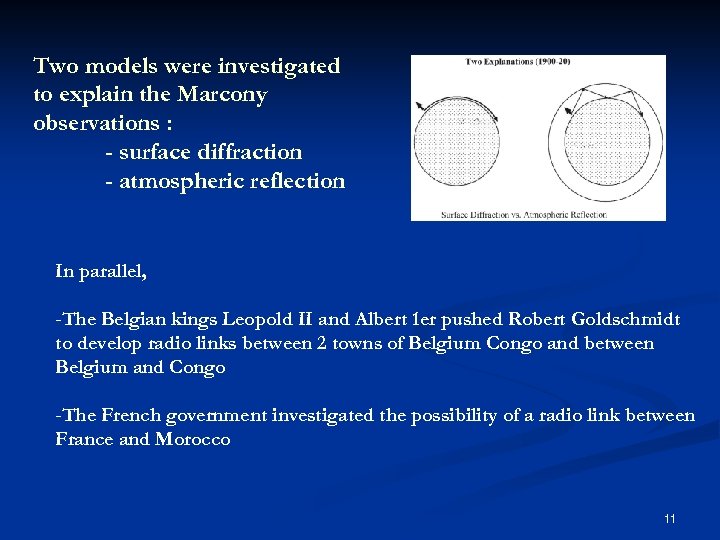 Two models were investigated to explain the Marcony observations : - surface diffraction - atmospheric reflection In parallel, -The Belgian kings Leopold II and Albert 1 er pushed Robert Goldschmidt to develop radio links between 2 towns of Belgium Congo and between Belgium and Congo -The French government investigated the possibility of a radio link between France and Morocco 11
 ■ October 1913, creation of the « Commission Internationale de TSF ■ July 1919 , creation of the « International Union of Scientific Radiotelegraphy » , which very soon became URSI 12
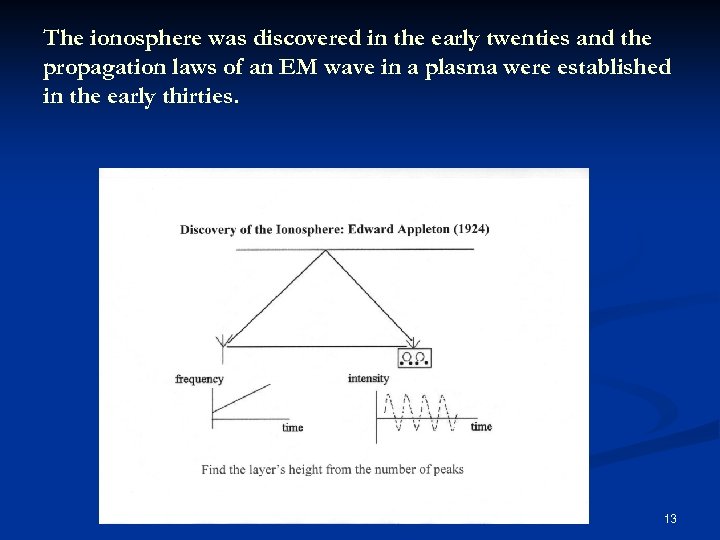 The ionosphere was discovered in the early twenties and the propagation laws of an EM wave in a plasma were established in the early thirties. 13
 URSI Union Radio Scientifique International Union of Radio Science has for objective to stimulate and to coordinate, on an international basis, studies in the fields of radio, telecommunication, and electronic sciences - URSI Secretariat, c/o INTEC, University of Ghent http: //www. ursi. org - 42 National Committees - 10 Scientific Commissions - several standing committees 14
 URSI is an ICSU Scientific Union ICSU (International Council for Science) is part of UNESCO. It is considered as the “voice” of Science. It is engaged in numerous actions concerning science and society. It consists of : - National Members (Academies) - Scientific Unions (29) such as IAU (International Astronomical Union), IUGG/IAGA (International Union of Geodesy and Geophysics / International Association of Geomagnetism and Aeronomy) - Scientific Associates (19) 15
 Interdisciplinary Bodies (IBs) have been created by ICSU Scientific Unions (including URSI) URSI in involved in - COSPAR (Committee on Space and Research) - FAGS (Federation of Astronomical and Geophysical Data Analysis) and its ISES (International Space Environment Service) service - IUCAF (Scientific Committee on frequency Allocations for Radio Astronomy and Space Science) - SCAR (Scientific Committee on Antarctic Research) - SCOSTEP (Scientific committee On Solar-Terrestrial Physics) 16
 Management of the radio spectrum 17
 The management of the radio spectrum is under the responsibility of ITU (International Telecommunication Union) leading United Nations agency for information and communications technologies, with 3 core sectors: - Radio communication - Standardization - Development ITU is an ICSU partner. 18
 URSI, which is a sector member of ITU, pursue radio sciences activities upstream of ITU Professional Societies like IEEE, IEE, SEE, etc pursue R&D activities upstream of ITU Radioscientists belong both to ITU, URSI and professional societies 19
 3. URSI SCIENTIFIC ACTIVITIES 20
 A. Electromagnetic Metrology n Development and refinement of new measurement techniques - based on EM principles (e. g. precise time and wavelength measurements) - or used for the characterization of EM properties of materials and electromagnetic dosimetry with applications in industry, environment ad security, health and safety, communications, etc. n Primary standards, including those based on quantum phenomena: realization and diffusion of time and frequency standards 21
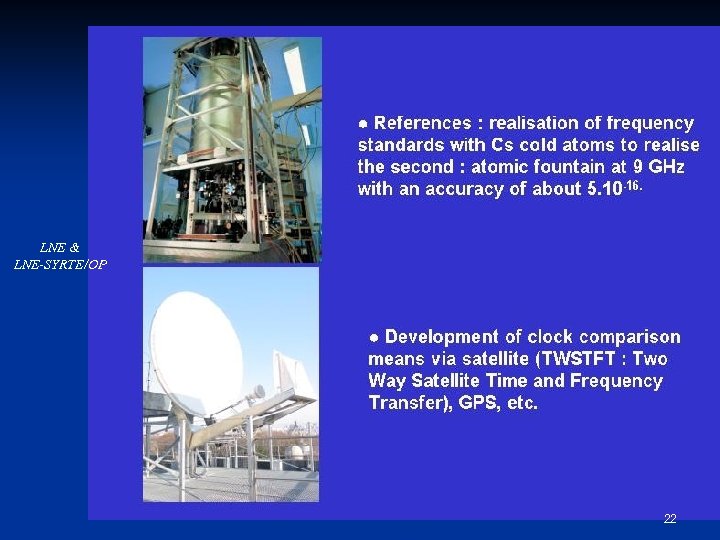 LNE & LNE-SYRTE/OP 22
 B. Fields and waves, EM theory and applications n Analytical, numerical and measurement techniques to understand electromagnetic phenomena - development of antennas and antenna arrays - propagation including waves in specialized media like Metamaterials (MTMs) where n, ε and μ can be made <0 - application of EM fields as a non-destructive tool n Inverse scattering and imaging 23
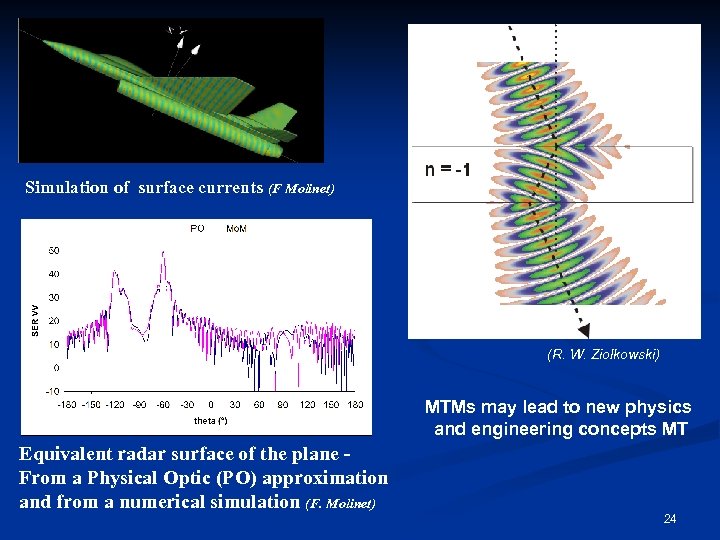 Simulation of surface currents (F Molinet) (R. W. Ziolkowski) MTMs may lead to new physics and engineering concepts MT Equivalent radar surface of the plane From a Physical Optic (PO) approximation and from a numerical simulation (F. Molinet) 24
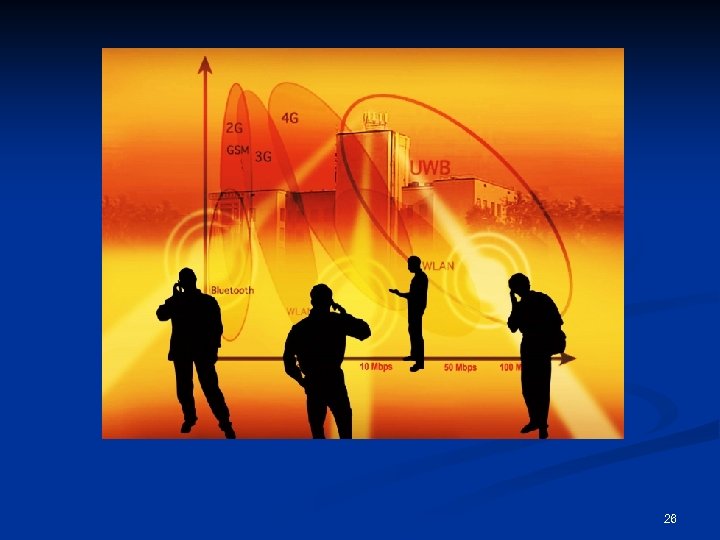
 C. Radio-Communication systems and signal processing n Research and development in: - Radio-Communication and Telecommunication Systems - spectrum and medium utilization - information theory, coding, modulation and detection - signal and image processing n In order to communicate with anyone, anywhere, any time require new concepts like « reconfigurable radio and 25 cognitive radio » .
 26
26
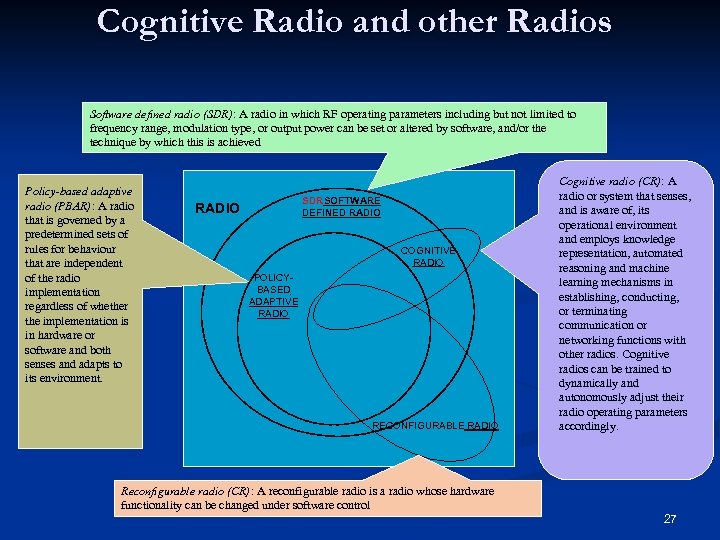 Cognitive Radio and other Radios Software defined radio (SDR): A radio in which RF operating parameters including but not limited to frequency range, modulation type, or output power can be set or altered by software, and/or the technique by which this is achieved Policy-based adaptive radio (PBAR): A radio that is governed by a predetermined sets of rules for behaviour that are independent of the radio implementation regardless of whether the implementation is in hardware or software and both senses and adapts to its environment. SDRSOFTWARE DEFINED RADIO COGNITIVE RADIO POLICYBASED ADAPTIVE RADIO RECONFIGURABLE RADIO Cognitive radio (CR): A radio or system that senses, and is aware of, its operational environment and employs knowledge representation, automated reasoning and machine learning mechanisms in establishing, conducting, or terminating communication or networking functions with other radios. Cognitive radios can be trained to dynamically and autonomously adjust their radio operating parameters accordingly. Reconfigurable radio (CR): A reconfigurable radio is a radio whose hardware functionality can be changed under software control 27
 D. Electronics and photonics n Research of the new electronic and photonic devices and systems permitting the development of digital computers, Television and mobile communications, etc. - semiconductor lasers - optical fibers, - microwave integrated circuits - nano-optics and nano-electronics n Device for generation, detection, storage and processing of EM signals together with their applications from the low frequencies to the optical domain 28
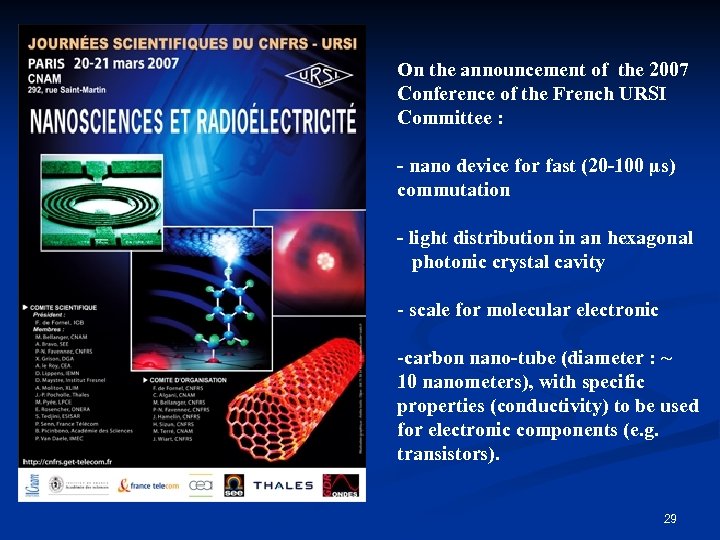 On the announcement of the 2007 Conference of the French URSI Committee : - nano device for fast (20 -100 µs) commutation - light distribution in an hexagonal photonic crystal cavity - scale for molecular electronic -carbon nano-tube (diameter : ~ 10 nanometers), with specific properties (conductivity) to be used for electronic components (e. g. transistors). 29
 E. Electromagnetic Noise and Interference n Investigation of the level and of the effects of natural and man -made noises on the performances of radio, TV, phones, navigation instrument, etc. - adaptation of test techniques to impulsive and higher frequency noises - questions raised by new concepts like Power Line Communications (PLC) - definition of new standards and norms n Terrestrial and planetary noise of natural origin, seismic associated electromagnetic fields 30
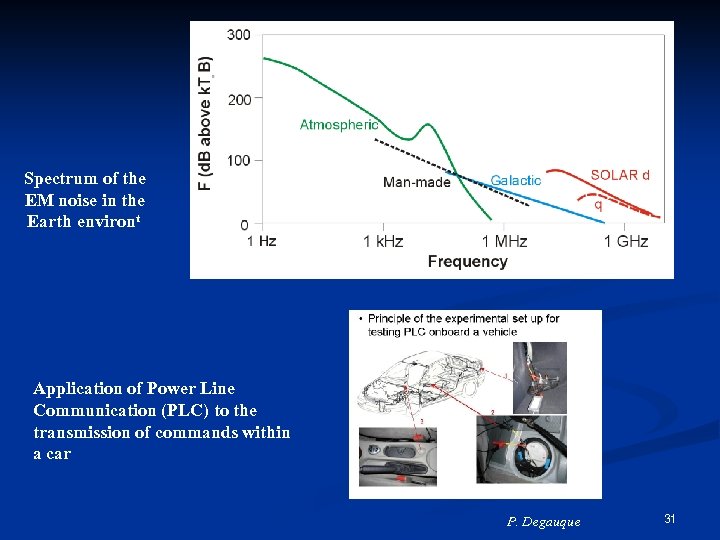 Spectrum of the EM noise in the Earth environt Application of Power Line Communication (PLC) to the transmission of commands within a car P. Degauque 31
 F. Wave propagation and remote sensing n Study of wave propagation and of wave interactions in non ionized media - neutral atmosphere - planetary surfaces and subsurfaces (including land, ocean and ice) n Applications in the areas of remote sensing and communications 32
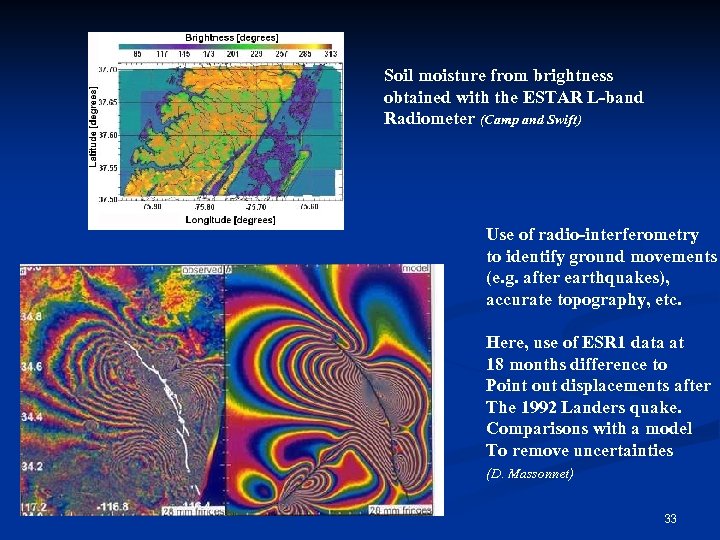 Soil moisture from brightness obtained with the ESTAR L-band Radiometer (Camp and Swift) Use of radio-interferometry to identify ground movements (e. g. after earthquakes), accurate topography, etc. Here, use of ESR 1 data at 18 months difference to Point out displacements after The 1992 Landers quake. Comparisons with a model To remove uncertainties (D. Massonnet) 33
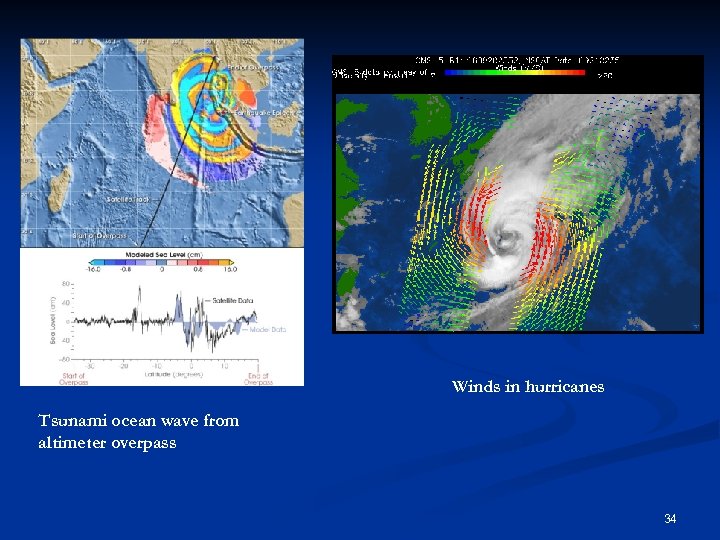 Winds in hurricanes Tsunami ocean wave from altimeter overpass 34
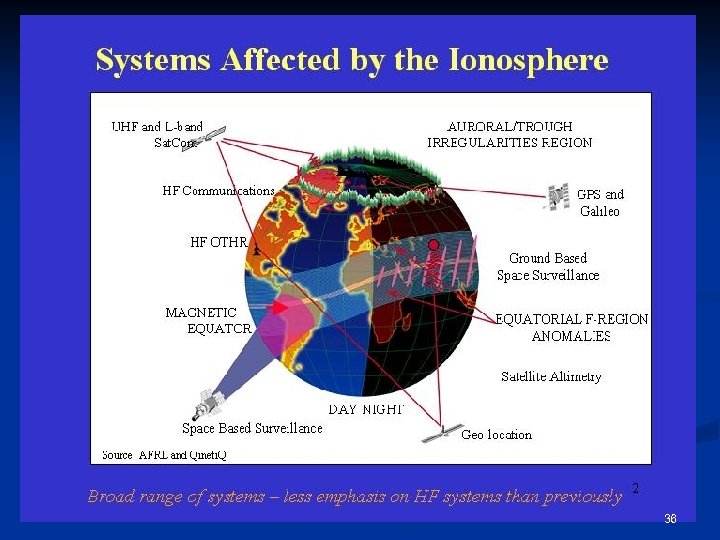
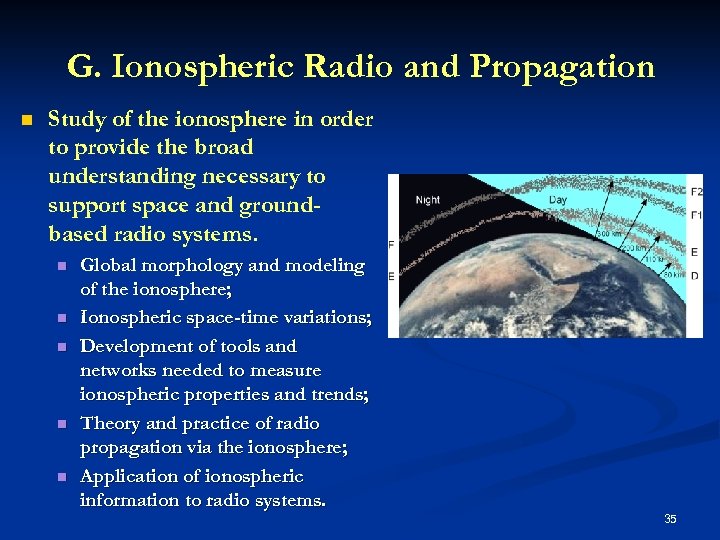 G. Ionospheric Radio and Propagation n Study of the ionosphere in order to provide the broad understanding necessary to support space and groundbased radio systems. n n n Global morphology and modeling of the ionosphere; Ionospheric space-time variations; Development of tools and networks needed to measure ionospheric properties and trends; Theory and practice of radio propagation via the ionosphere; Application of ionospheric information to radio systems. 35
 36
36
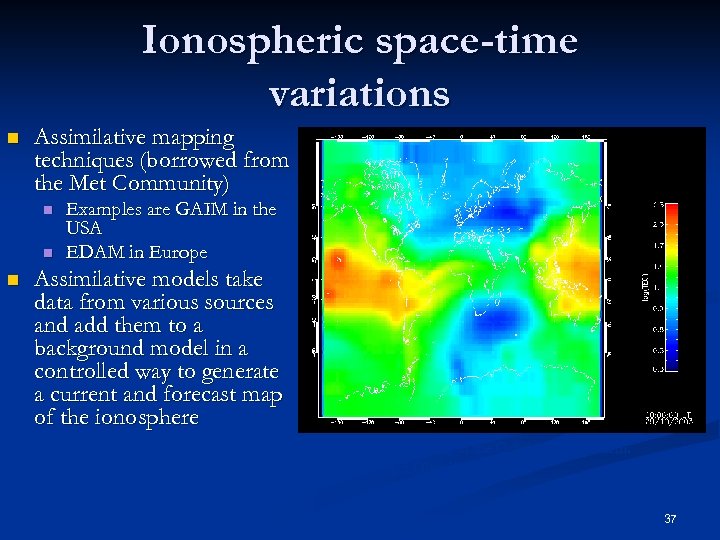 Ionospheric space-time variations n Assimilative mapping techniques (borrowed from the Met Community) n n n Examples are GAIM in the USA EDAM in Europe Assimilative models take data from various sources and add them to a background model in a controlled way to generate a current and forecast map of the ionosphere EDAM mapping of the October 2003 Storm. Copyright Qineti. Q 37
 H. Waves in Plasmas n Study of the generation, propagation and interactions of EM (and ES) waves with space and laboratory plasmas and with other waves n Applications - in the study of the variations of the environment of the Earth and of the planets, and of other astrophysical objects - in Space Weather (spacecraft-plasma interactions, modeling of the radiation belts) 38
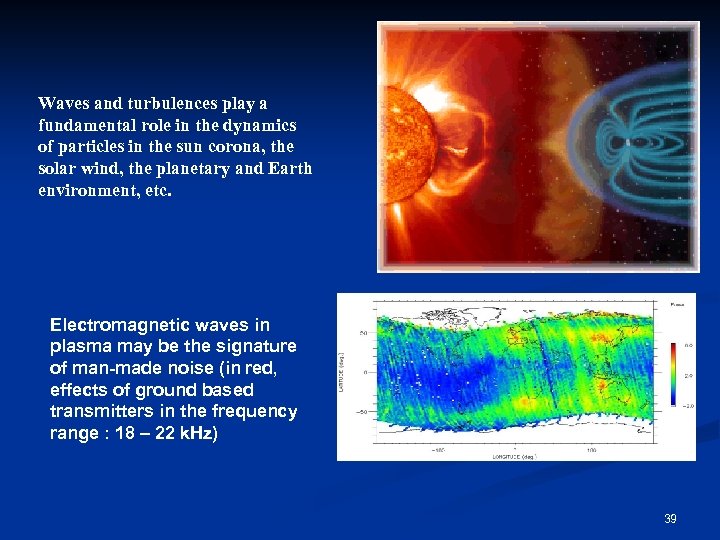 Waves and turbulences play a fundamental role in the dynamics of particles in the sun corona, the solar wind, the planetary and Earth environment, etc. Electromagnetic waves in plasma may be the signature of man-made noise (in red, effects of ground based transmitters in the frequency range : 18 – 22 k. Hz) 39
 J. Radio Astronomy n Observation and interpretation of all radio emissions and reflections from celestial objects n Emphasis is placed on: - the promotion of technical means for making radio-astronomical observations and data analysis - support of activities to protect radioastronomical observations from harmful interference 40
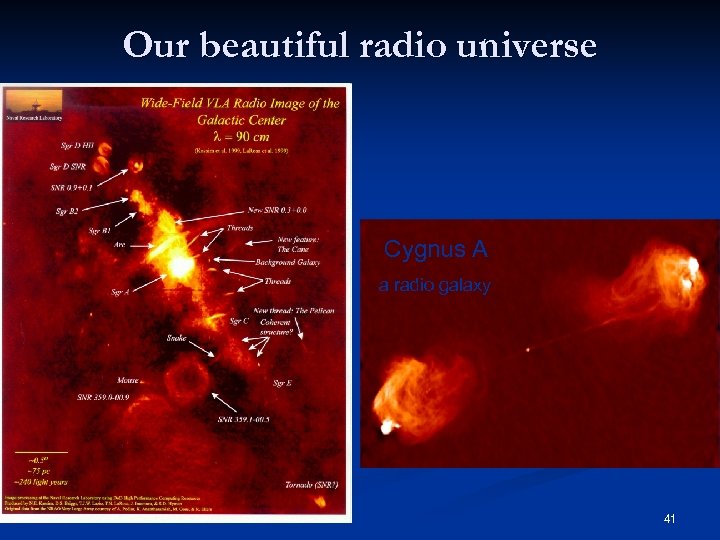 Our beautiful radio universe Cygnus A a radio galaxy 41
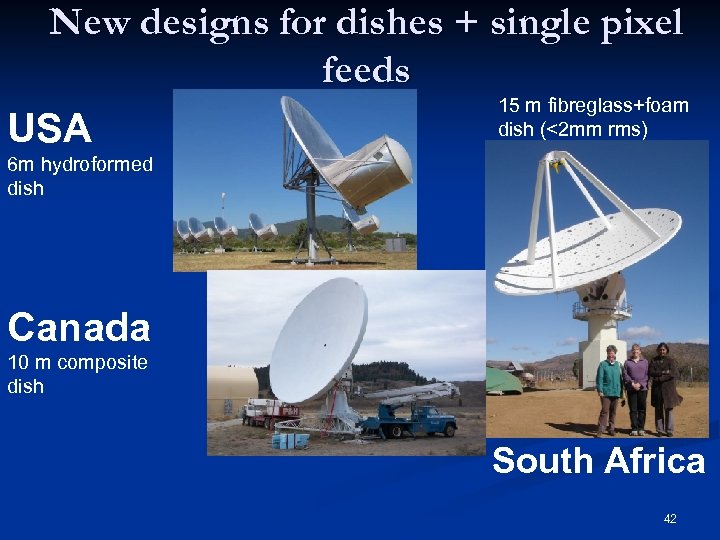 New designs for dishes + single pixel feeds 15 m fibreglass+foam dish (<2 mm rms) USA 6 m hydroformed dish Canada 10 m composite dish South Africa 42
 K. Electromagnetics in biology and medicine n effects of and mechanisms involved with exposure of biological systems (in general) and of humans (in particular) to EM waves n Applications to - studies on effects of radars, power lines, cell phones - medical use of exposures to EM 43
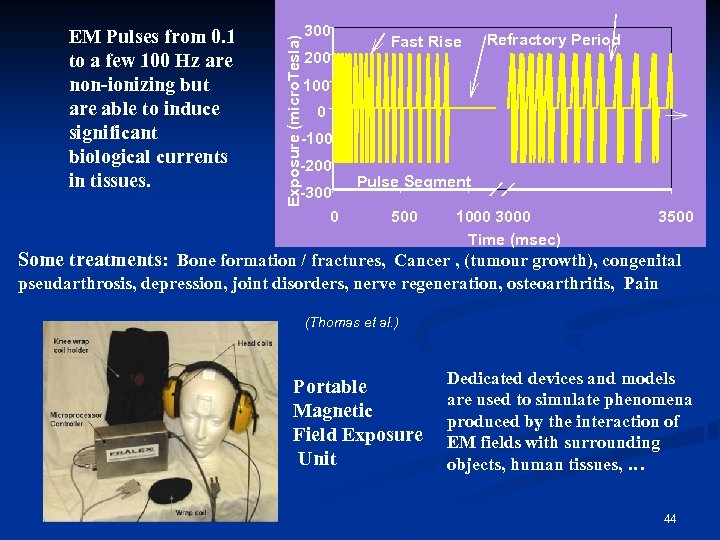 Exposure (micro. Tesla) EM Pulses from 0. 1 to a few 100 Hz are non-ionizing but are able to induce significant biological currents in tissues. 300 200 Fast Rise Refractory Period 100 0 -100 -200 -300 0 Pulse Segment 500 1000 3000 Time (msec) 3500 Some treatments: Bone formation / fractures, Cancer , (tumour growth), congenital pseudarthrosis, depression, joint disorders, nerve regeneration, osteoarthritis, Pain (Thomas et al. ) Portable Magnetic Field Exposure Unit Dedicated devices and models are used to simulate phenomena produced by the interaction of EM fields with surrounding objects, human tissues, … 44
 4. PRESENT ISSUES 45
 Reduce the gap between Telecommunication and Radio Science 46
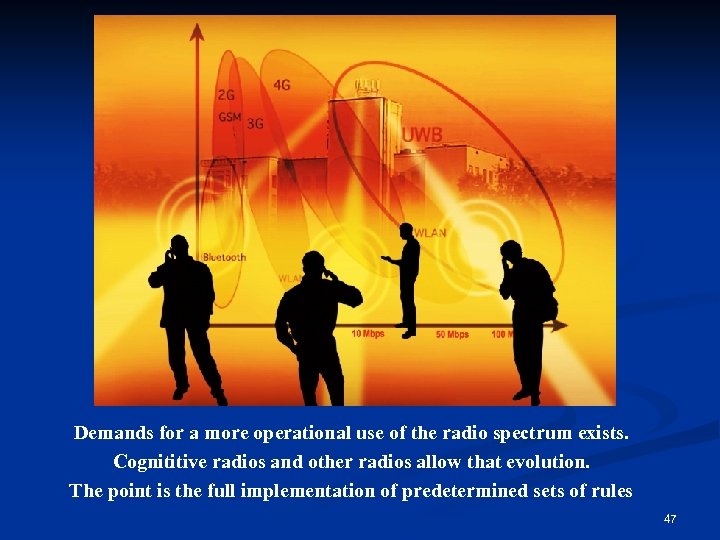 Demands for a more operational use of the radio spectrum exists. Cognititive radios and other radios allow that evolution. The point is the full implementation of predetermined sets of rules 47
 Forum on Radio Science and Telecommunications URSI – General Assembly – Chicago (11 -16 August 2008) - General Lecture (Friday 15, 11. 00 – 12. 00) Wireless Communications in 2020 - Forum (Friday 15, 13. 40 – 17. 20) - Cognitive radio - Ultra wide band - Interference management - health aspects - open discussion 48
 Develop Radio Science in developing countries 49
 n n n The radio spectrum is a unique common limited resource (developing countries included) Its management require agreements between all users (radioscientists included) Except in specific cases (e. g. the existence of international equipments) developing countries generally don’t invest on radio science The point is to identify priorities for development in radio science The three ICSU Regional offices (Africa, Asia, Latin America and Caribbean) have defined priorities. The common one : “Natural and Human induced hazards and disasters” 50
 ICSU list of hazards and disasters - hazards related to hydrometeorological and geophysical trigger events, i. e. earthquakes, volcanoes, flooding storms (hurricanes, typhoons, etc. ) - heat waves - droughts and fires - tsunamis - coastal erosion - landslipes - aspects of climate change (for example, increases of extreme events) - space weather and impacts by near-Earth objects - and related events such as wild fires and locust outbreaks - The effects of human activities on creating or enhancing hazards, including land-use practices should be included 51
 Possible involvement of URSI in disaster management WG to study and develop guidelines related: (a) to communication systems to set up at the time and after disaster, (b) to the use of remote sensing data for: - monitoring and alert, - description of the disturbed environment at the time of disaster - description of the environment after the time of disaster 52
 Answer societal demands for « objective » information (without expressing position or/and support) 53
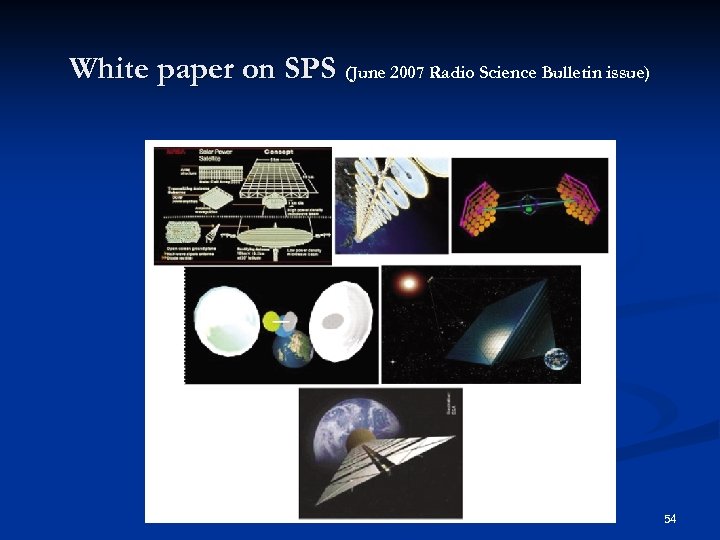 White paper on SPS (June 2007 Radio Science Bulletin issue) 54
 The SPS concept n Solar energy is collected in space by a satellite in a geostationary orbit n The solar energy is converted to direct current by solar cells n The direct current is in turned used to power microwave generators in the GHz frequency (microwave) range n The generators feed a highly directive satellite-borne antenna, which beams the energy to the Earth n On the ground, a rectifying antenna (rectenna) converts the microwave energy from the satellite into direct current n After suitable processing, the current is fed to the power grid 55
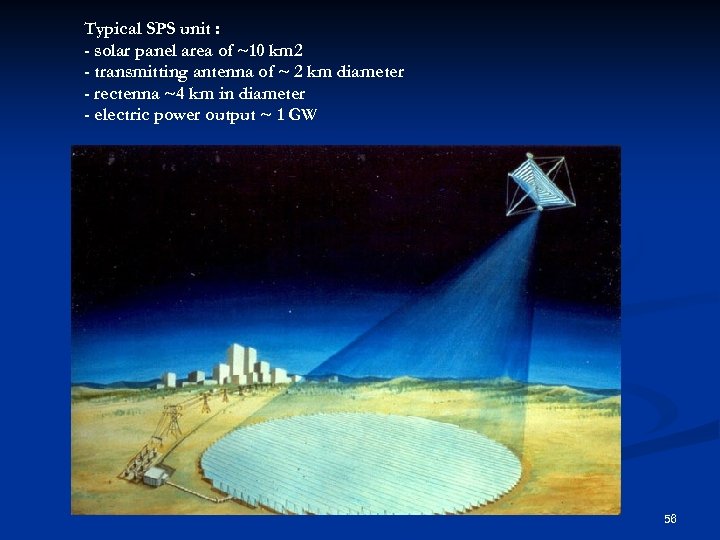 Typical SPS unit : - solar panel area of ~10 km 2 - transmitting antenna of ~ 2 km diameter - rectenna ~4 km in diameter - electric power output ~ 1 GW 56
 Among the points addressed in the URSI WP: - comparison of the output power from a space-based and a terrestrialbased solar power unit -required technology - required pointing accuracy - effects of solar-wind particles and solar radiation on solar cells - lifetime and maintenance - linear and non-linear interactions of the microwave beam with the atmosphere, the ionosphere and the space plasmas - safety measures 57
 Actions in progress about a White Paper on: Wireless communication and health 58