 Скачать презентацию Radio Merit Badge Boy Scouts of America Module
8519f9d0b4a732501531b48465daa989.ppt
- Количество слайдов: 18



Radio Merit Badge Boy Scouts of America Module 1 - Radio Basics 2009
Key Topics in This Module • • What is Radio? Types of Radio Services Radio Call Signs & Identification The Phonetic Alphabet Radio Wave Propagation WWV & WWVH The FCC & ITU The Electromagnetic Spectrum
What is Radio ? • Radio is a way to electronically communicate from one place to another without wires. • Radio is used in broadcast receivers, two way radios, televisions, cellular telephones, wireless LANs, garage door openers, car locks, EZPass, satellites, pagers, radar, microwave ovens, etc. Requirement 1
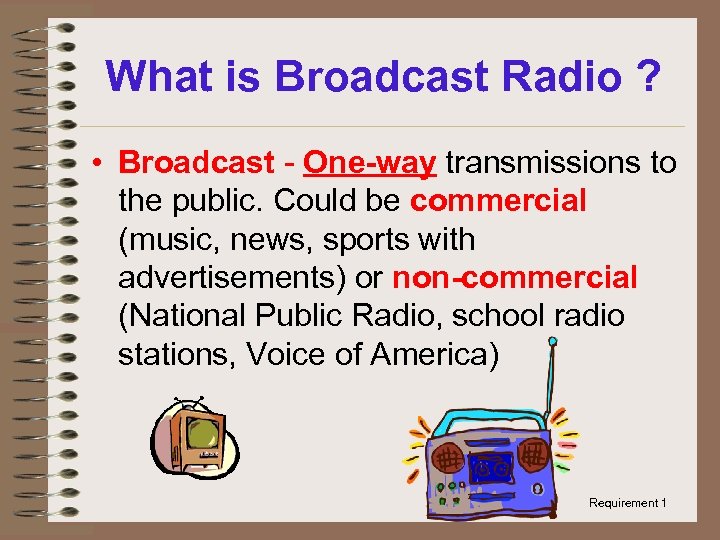
What is Broadcast Radio ? • Broadcast - One-way transmissions to the public. Could be commercial (music, news, sports with advertisements) or non-commercial (National Public Radio, school radio stations, Voice of America) Requirement 1
What is Hobby Radio ? • Use of the radio by the public to communicate with others or to control models. Amateur radio is a licensed type of Hobby Radio Requirement 1
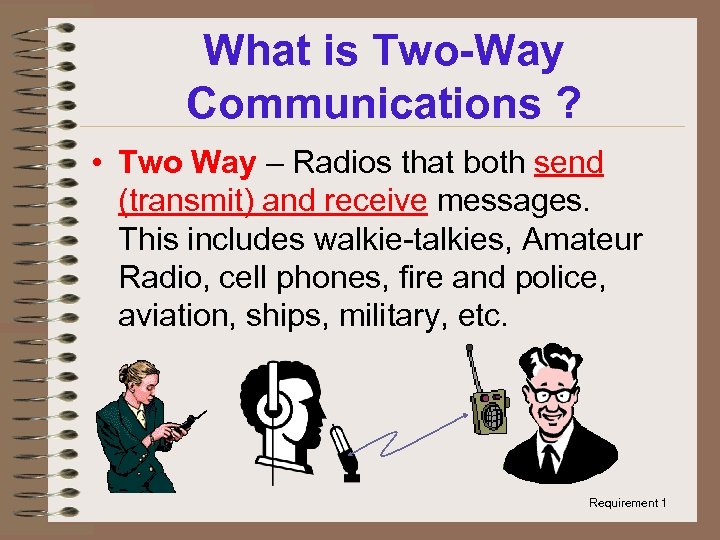
What is Two-Way Communications ? • Two Way – Radios that both send (transmit) and receive messages. This includes walkie-talkies, Amateur Radio, cell phones, fire and police, aviation, ships, military, etc. Requirement 1
What is Amateur Radio? • A type of two-way hobby radio • A place to learn about radio! • Called the “Amateur Radio Service” because it can’t be used for profit. • Also known as “Ham Radio”. • An important part of disaster response. • A lot of fun! Requirement 1
Radio Call Signs • Call Signs are a short method to show you have a license to transmit. • Broadcast Call Signs – WHO, KDKA, KORA, WNBC • Ham Call Signs – WW 3 Y, KB 3 BOY, WW 9 Y, N 3 YVH, JA 1 ABC • Your Imaginary Call Sign – Pick K, N or W, then a number, then your initials. Requirement 1
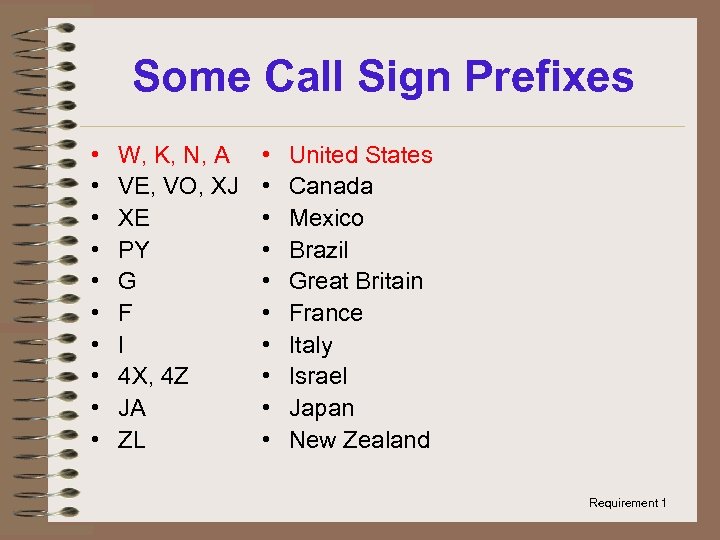
Some Call Sign Prefixes • • • W, K, N, A VE, VO, XJ XE PY G F I 4 X, 4 Z JA ZL • • • United States Canada Mexico Brazil Great Britain France Italy Israel Japan New Zealand Requirement 1
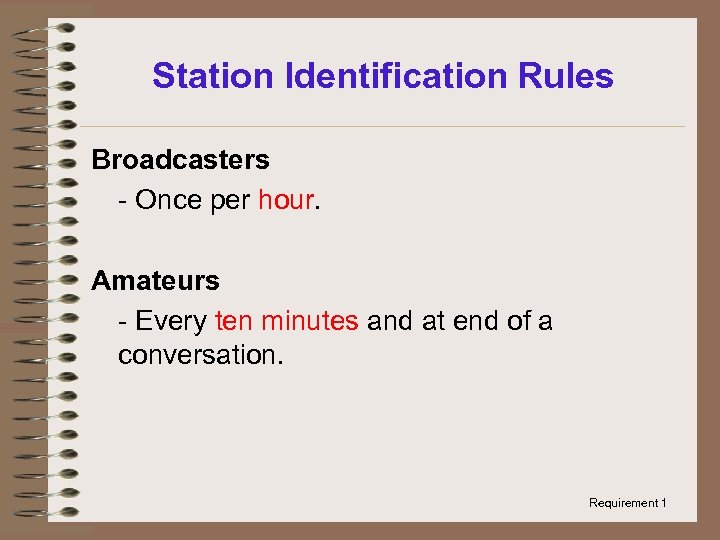
Station Identification Rules Broadcasters - Once per hour. Amateurs - Every ten minutes and at end of a conversation. Requirement 1
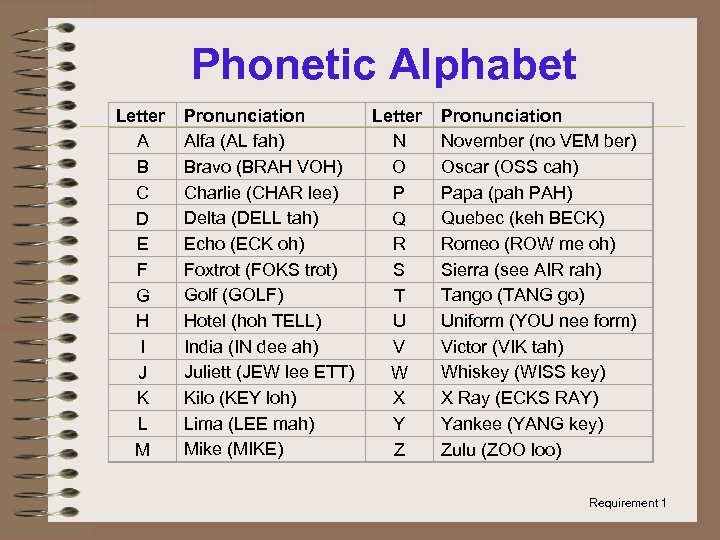
Phonetic Alphabet Letter A B C D E F G H I J K L M Pronunciation Alfa (AL fah) Bravo (BRAH VOH) Charlie (CHAR lee) Delta (DELL tah) Echo (ECK oh) Foxtrot (FOKS trot) Golf (GOLF) Hotel (hoh TELL) India (IN dee ah) Juliett (JEW lee ETT) Kilo (KEY loh) Lima (LEE mah) Mike (MIKE) Letter N O P Q R S T U V W X Y Z Pronunciation November (no VEM ber) Oscar (OSS cah) Papa (pah PAH) Quebec (keh BECK) Romeo (ROW me oh) Sierra (see AIR rah) Tango (TANG go) Uniform (YOU nee form) Victor (VIK tah) Whiskey (WISS key) X Ray (ECKS RAY) Yankee (YANG key) Zulu (ZOO loo) Requirement 1
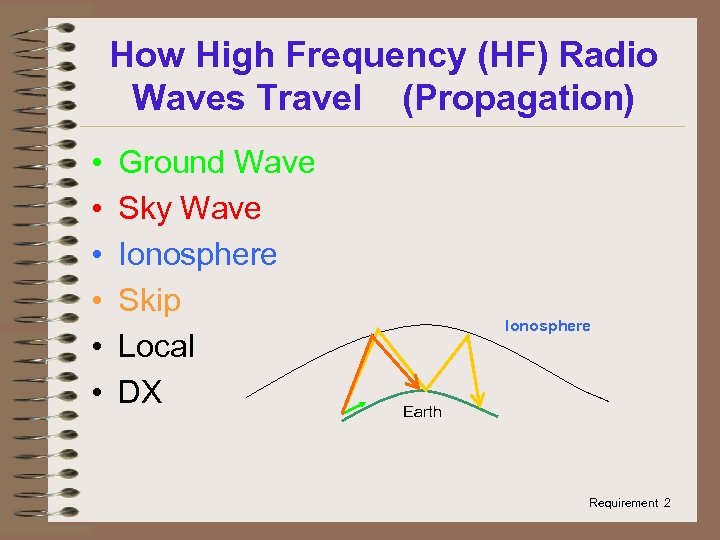
How High Frequency (HF) Radio Waves Travel (Propagation) • • • Ground Wave Sky Wave Ionosphere Skip Local DX Ionosphere Earth Requirement 2
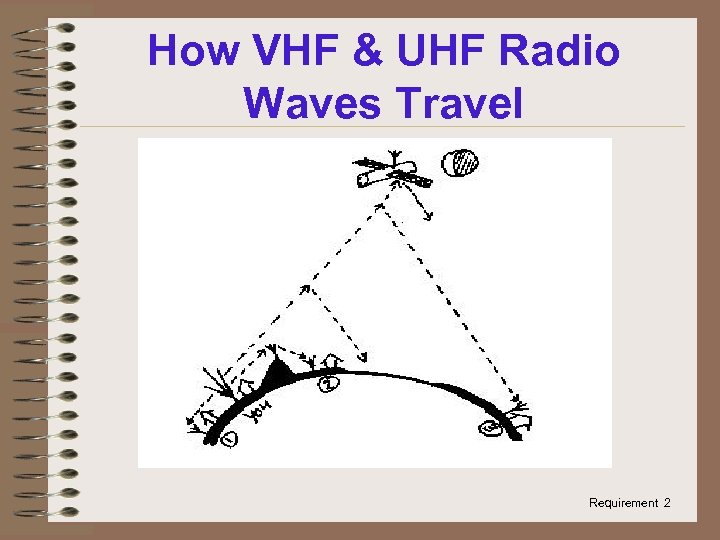
How VHF & UHF Radio Waves Travel Requirement 2
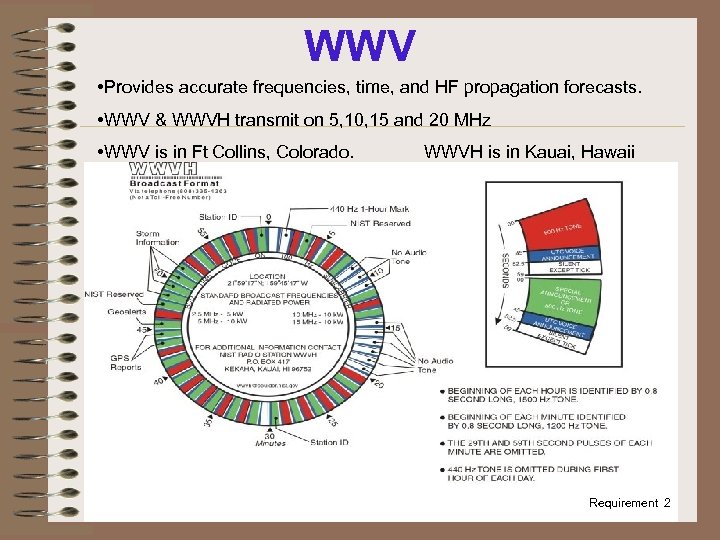
WWV • Provides accurate frequencies, time, and HF propagation forecasts. • WWV & WWVH transmit on 5, 10, 15 and 20 MHz • WWV is in Ft Collins, Colorado. WWVH is in Kauai, Hawaii Requirement 2
Regulation of Radio • ITU – International Telecommunications Union – Meets every few years. – Sets International Frequency assignments. – Assigns prefixes to countries. • FCC – Federal Communication Commission – Set Frequency Assignments in US. – Issues Licenses & Call Signs in US. – Enforces Radio Laws in US. Requirement 2
Frequencies (One Hertz is cycle per second) • DC Power • • AC Power • 60 Hertz (Hz) • Audio (Sound) • 100 Hz to 20 KHz (100 - 20, 000 Hz) • LF • 30 -300 k. Hz (30, 000 -300, 000) • MF • . 3 -3 MHz (300, 000 -3, 000) • HF or Shortwave • 3 -30 MHz (3, 000 -30, 000) • VHF • 30 -300 MHz (30, 000 -300, 000) • UHF • 300 -3, 000 MHz (well, you get the idea) • Microwave • Frequencies above 500 MHz • Visible Light • 400 -800 THz (400, 000 - 800, 000 MHz) 0 Hertz (goes in one direction only) Requirement 3
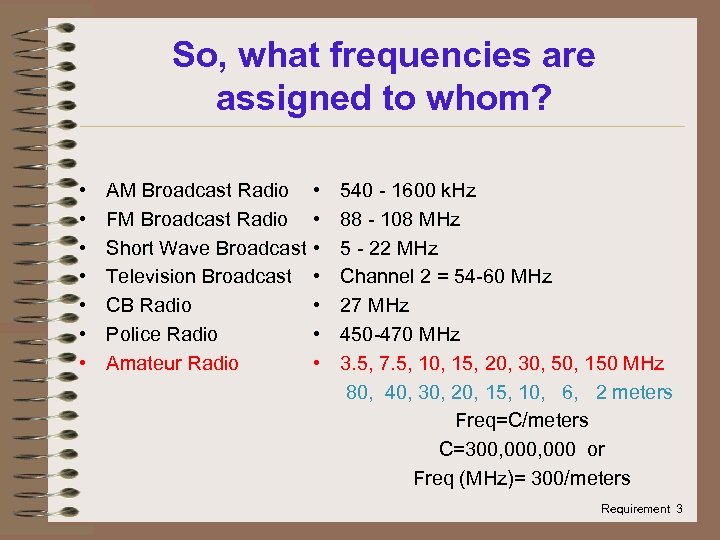
So, what frequencies are assigned to whom? • • AM Broadcast Radio FM Broadcast Radio Short Wave Broadcast Television Broadcast CB Radio Police Radio Amateur Radio • • 540 - 1600 k. Hz 88 - 108 MHz 5 - 22 MHz Channel 2 = 54 -60 MHz 27 MHz 450 -470 MHz 3. 5, 7. 5, 10, 15, 20, 30, 50, 150 MHz 80, 40, 30, 20, 15, 10, 6, 2 meters Freq=C/meters C=300, 000 or Freq (MHz)= 300/meters Requirement 3
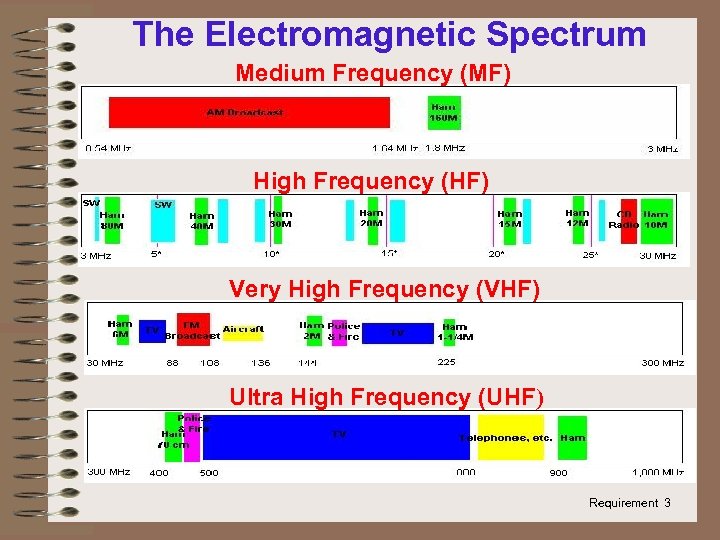
The Electromagnetic Spectrum Medium Frequency (MF) High Frequency (HF) Very High Frequency (VHF) Ultra High Frequency (UHF) Requirement 3
Скачать презентацию Radio Merit Badge Boy Scouts of America Module
8519f9d0b4a732501531b48465daa989.ppt