


 Скачать презентацию Radio Frequency Interference and How to Deal With
2a04a433187cb5615c4ddf9dbc166d4e.ppt
- Количество слайдов: 16
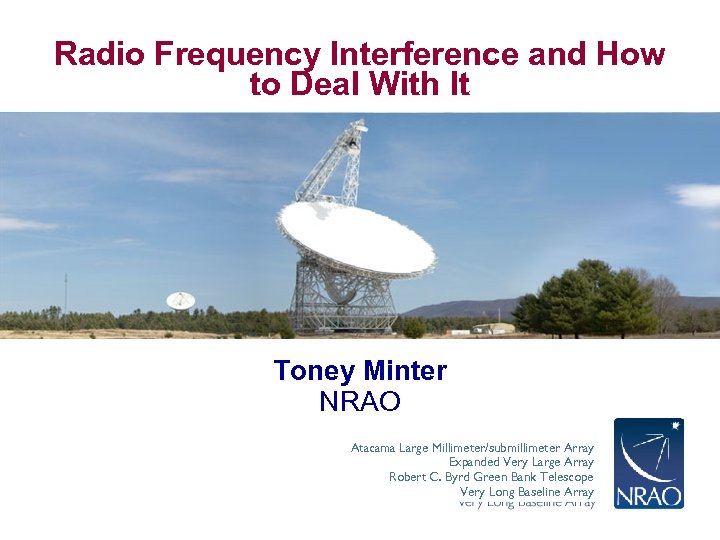 Radio Frequency Interference and How to Deal With It Toney Minter NRAO Atacama Large Millimeter/submillimeter Array Expanded Very Large Array Robert C. Byrd Green Bank Telescope Very Long Baseline Array
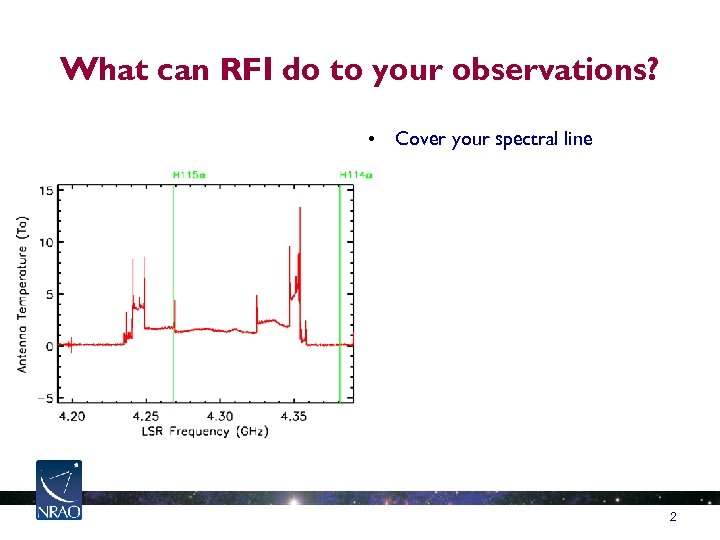 What can RFI do to your observations? • Cover your spectral line 2
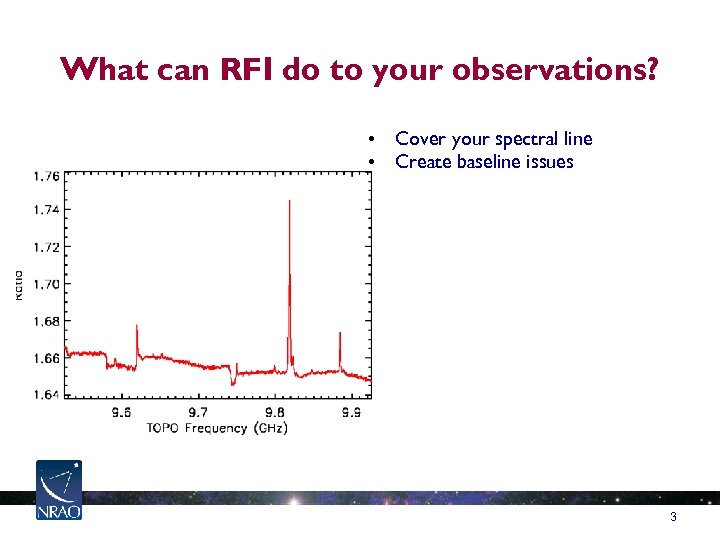 What can RFI do to your observations? • Cover your spectral line • Create baseline issues 3
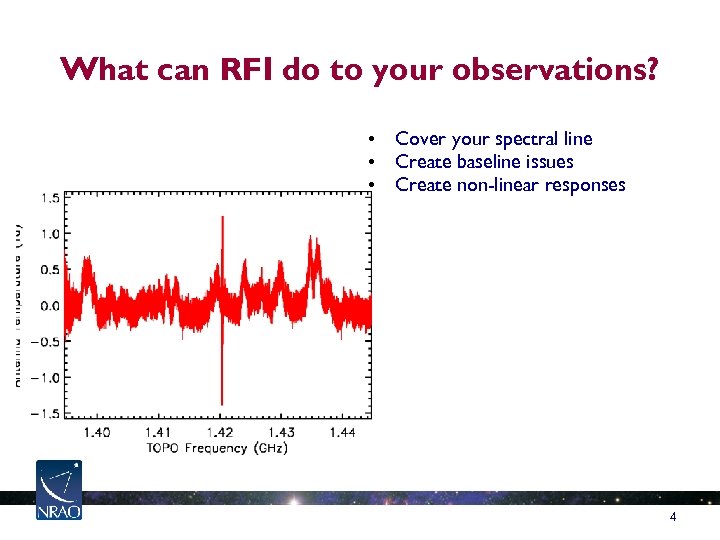 What can RFI do to your observations? • Cover your spectral line • Create baseline issues • Create non-linear responses 4
 What can you do? Ignore the RFI Flag data after observations Get worse results than desired Waste lots of telescope time Modify your observations Try to avoid known RFI Observe when RFI is off (night-time, etc. ) Eliminate the RFI transmitter Not always possible Only have rights in protected bands Quiet Zone Cooperation of transmitter Cancel RFI signal Need reference antenna Subtract reference antenna signal from data
 Planning Your Observations • There is no magic bullet for dealing with RFI • Understand the RFI – What frequencies – How strong – How often • Constant • Periodic • Random – Signal direction • Look at Spectrum Surveys – Arecibo • http: //www. naic. edu/~rfiuser/smarg-hplots. html – Green Bank • http: //www. gb. nrao. edu/IPG/rfiarchivepage. html
 Planning Your Observations • Coordinate the observations if possible – Is RFI less prevalent at night? – Are emitters willing to participate? • IF system – Set filters and frequencies in IF system to remove RFI • Use narrow filters • Offset spectral line from bandpass center – Watch your power levels • Strong RFI can saturate parts of the IF • Backends – Higher level sampling – Shorter integration times
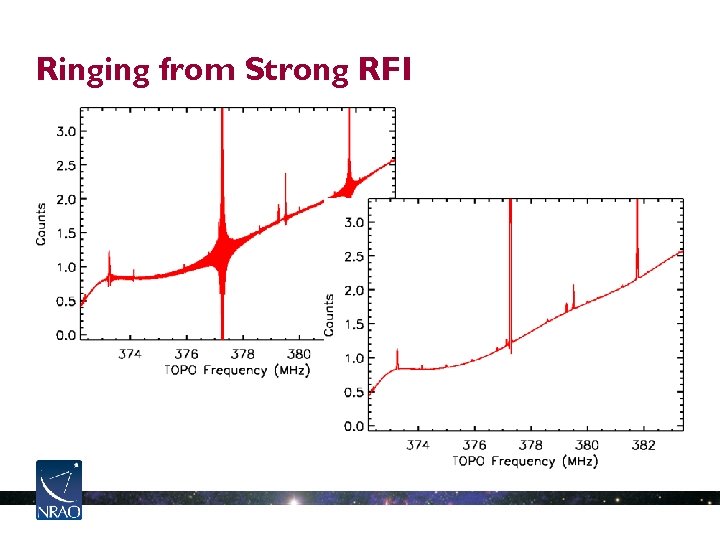 Ringing from Strong RFI
 Removing RFI from Data • Automated removal of RFI very difficult – Pulsars • Very short integration time in each sample • Majority of samples do not have “signal” • “Signal” < noise level in sample • Determine noise level • Clip signal well above noise – Spectral line • Longer integration times – Fewer samples – Lower noise levels – easier to see RFI • How do you tell difference between RFI and line?
 Flagging Spectral Line Data • “Types” of RFI – Narrow lines that vary in time – Narrow lines that are persistent
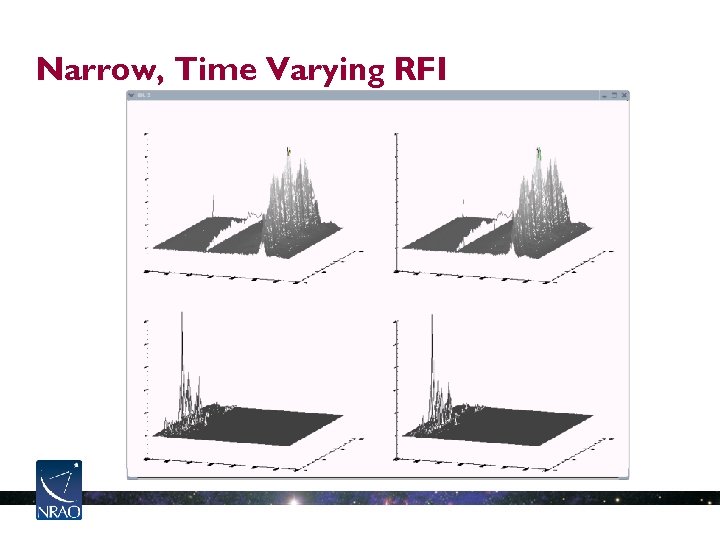 Narrow, Time Varying RFI
 Flagging Spectral Line Data • “Types” of RFI – Narrow lines that vary in time – Narrow lines that are “constant” in time – Strong occasional or periodic RFI
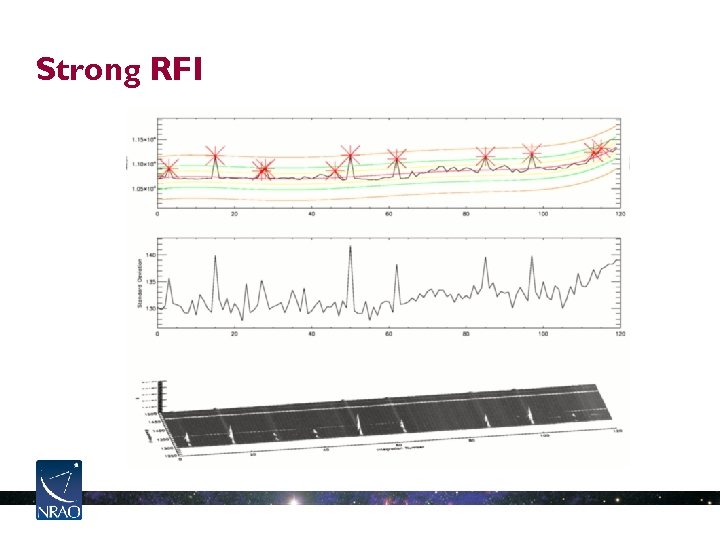 Strong RFI
 Flagging Spectral Line Data • “Types” of RFI – Narrow lines that vary in time – Narrow lines that are “constant” in time – Strong occasional or periodic RFI – Occasional strong out of band RFI
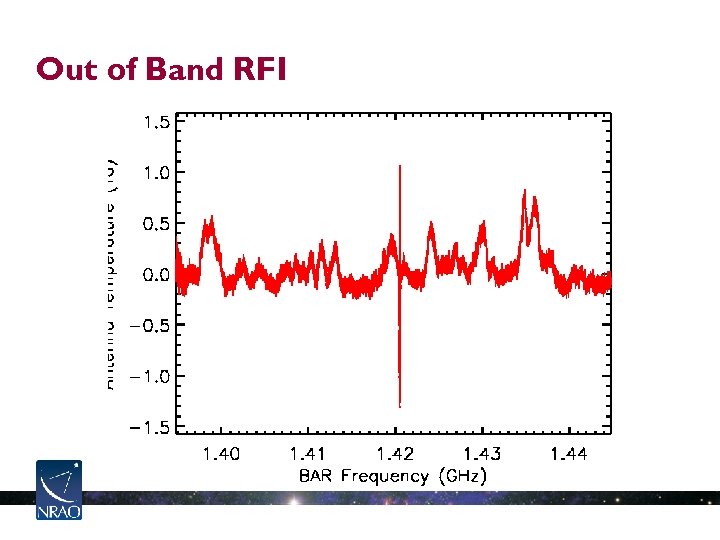 Out of Band RFI
 Conclusions No Magical solutions Do your homework before you observe Do your best to avoid RFI during your observations Understand your data – Where is the RFI – When is the RFI • Flag your data accordingly • •