


 Скачать презентацию Radio Frequency Identification RFID Defense Contract Management Agency
976130b9e92837b35e42d560c337829c.ppt
- Количество слайдов: 59
 Radio Frequency Identification (RFID) Defense Contract Management Agency July 2006 Revision 2. 7 dated July 5, 2006
 AGENDA • RFID Description • DOD RFID Policy • Active Tags • Passive Tags • Tag data constructs • Contract Requirements • MIL-STD-129 • RFID data submittal • Strategies for supplier implementation 2
 What is RFID? • RFID is an ADC (automatic data capture) technology that uses radio-frequency waves to transfer data between a reader and a movable item to identify, categorize, track. . . • RFID is fast, reliable, and does not require physical sight or contact between reader/scanner and the tagged item 3
 Basic Components • There are five basic components to make up an RFID System • One or more RF tags • Two or more antennas • One or more interrogators • One or more host computers • Appropriate software 4
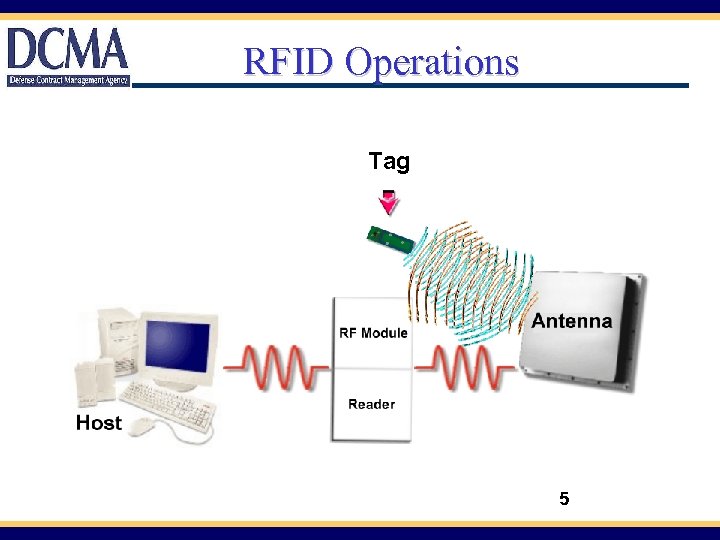 RFID Operations Tag 5
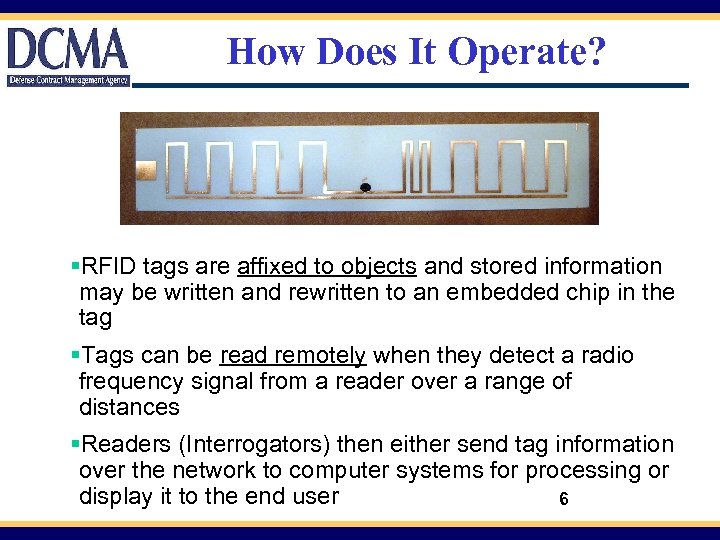 How Does It Operate? §RFID tags are affixed to objects and stored information may be written and rewritten to an embedded chip in the tag §Tags can be read remotely when they detect a radio frequency signal from a reader over a range of distances §Readers (Interrogators) then either send tag information over the network to computer systems for processing or display it to the end user 6
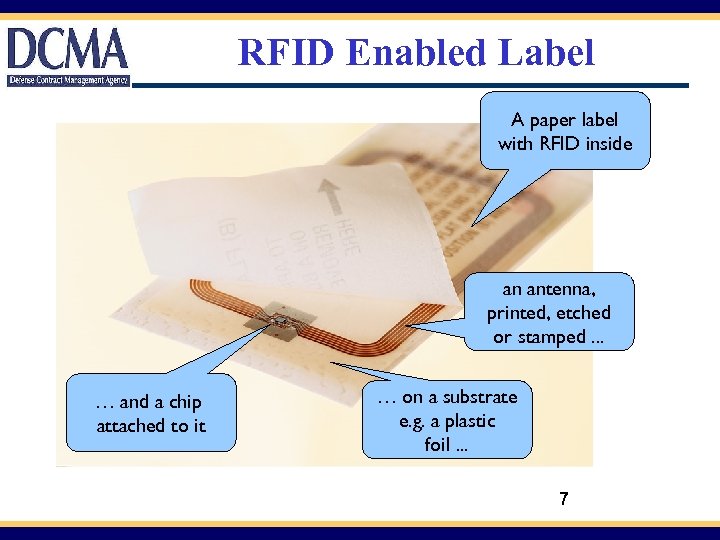 RFID Enabled Label A paper label with RFID inside an antenna, printed, etched or stamped. . . … and a chip attached to it … on a substrate e. g. a plastic foil. . . 7
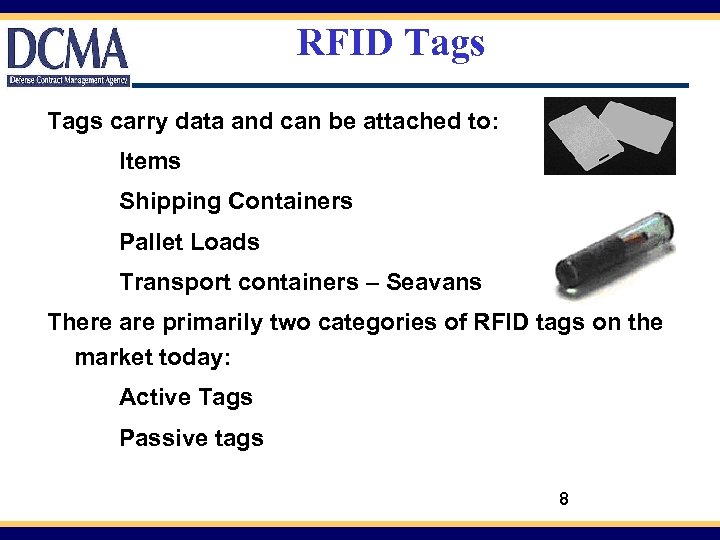 RFID Tags carry data and can be attached to: Items Shipping Containers Pallet Loads Transport containers – Seavans There are primarily two categories of RFID tags on the market today: Active Tags Passive tags 8
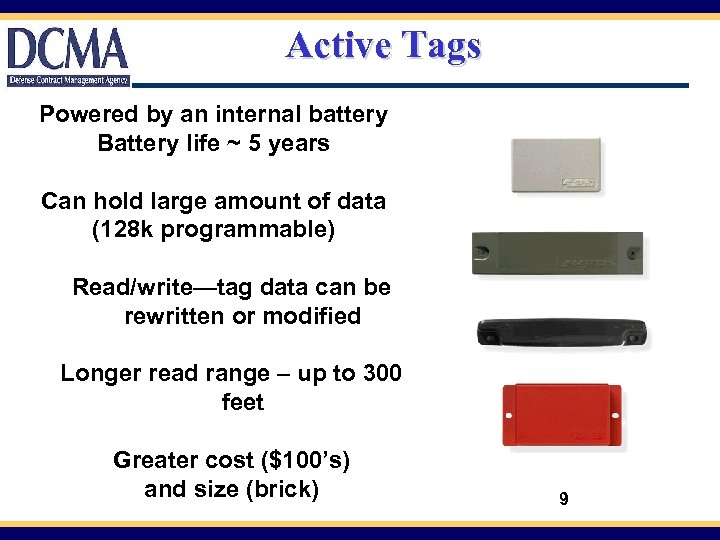 Active Tags Powered by an internal battery Battery life ~ 5 years Can hold large amount of data (128 k programmable) Read/write—tag data can be rewritten or modified Longer read range – up to 300 feet Greater cost ($100’s) and size (brick) 9
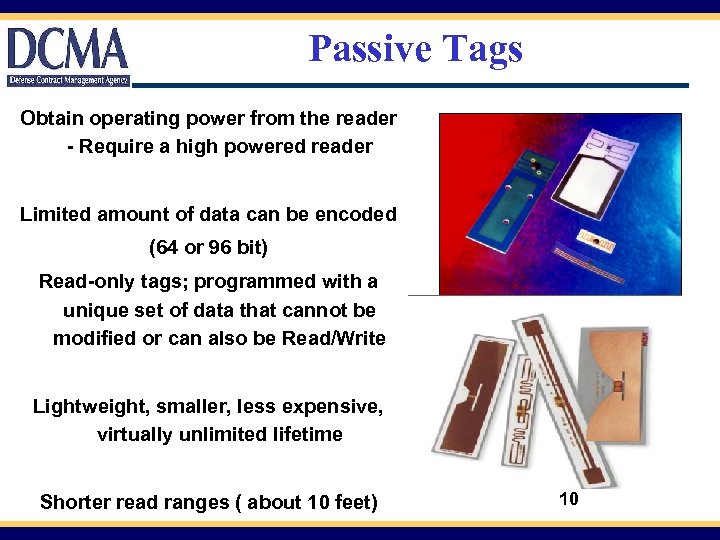 Passive Tags Obtain operating power from the reader - Require a high powered reader Limited amount of data can be encoded (64 or 96 bit) Read-only tags; programmed with a unique set of data that cannot be modified or can also be Read/Write Lightweight, smaller, less expensive, virtually unlimited lifetime Shorter read ranges ( about 10 feet) 10
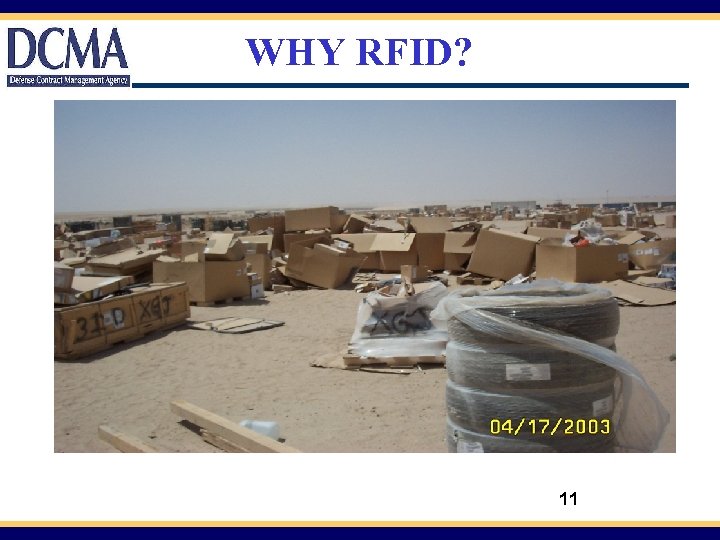 WHY RFID? 11
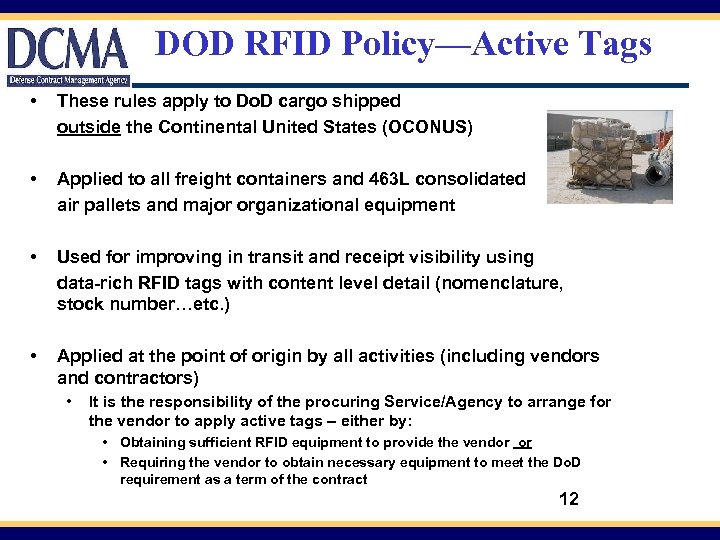 DOD RFID Policy—Active Tags • These rules apply to Do. D cargo shipped outside the Continental United States (OCONUS) • Applied to all freight containers and 463 L consolidated air pallets and major organizational equipment • Used for improving in transit and receipt visibility using data-rich RFID tags with content level detail (nomenclature, stock number…etc. ) • Applied at the point of origin by all activities (including vendors and contractors) • It is the responsibility of the procuring Service/Agency to arrange for the vendor to apply active tags – either by: • Obtaining sufficient RFID equipment to provide the vendor or • Requiring the vendor to obtain necessary equipment to meet the Do. D requirement as a term of the contract 12
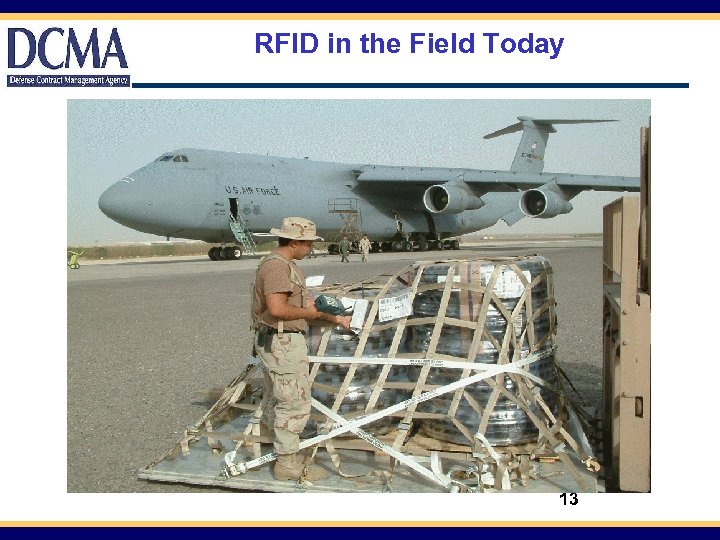 RFID in the Field Today 13
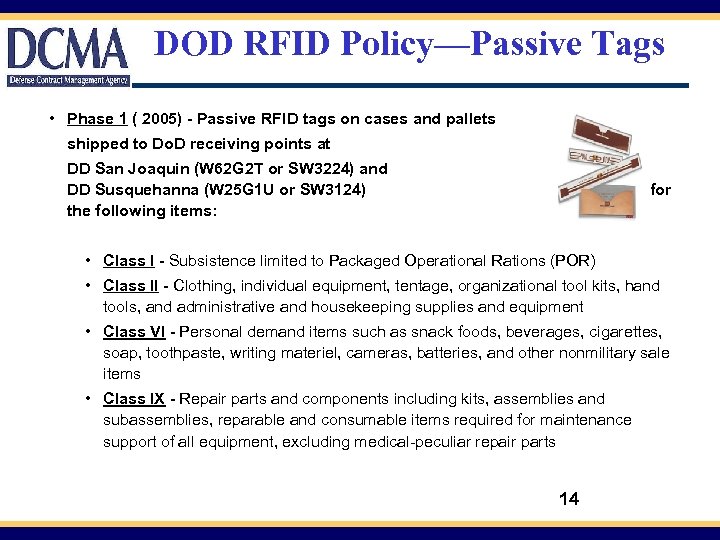 DOD RFID Policy—Passive Tags • Phase 1 ( 2005) - Passive RFID tags on cases and pallets shipped to Do. D receiving points at DD San Joaquin (W 62 G 2 T or SW 3224) and DD Susquehanna (W 25 G 1 U or SW 3124) the following items: for • Class I - Subsistence limited to Packaged Operational Rations (POR) • Class II - Clothing, individual equipment, tentage, organizational tool kits, hand tools, and administrative and housekeeping supplies and equipment • Class VI - Personal demand items such as snack foods, beverages, cigarettes, soap, toothpaste, writing materiel, cameras, batteries, and other nonmilitary sale items • Class IX - Repair parts and components including kits, assemblies and subassemblies, reparable and consumable items required for maintenance support of all equipment, excluding medical-peculiar repair parts 14
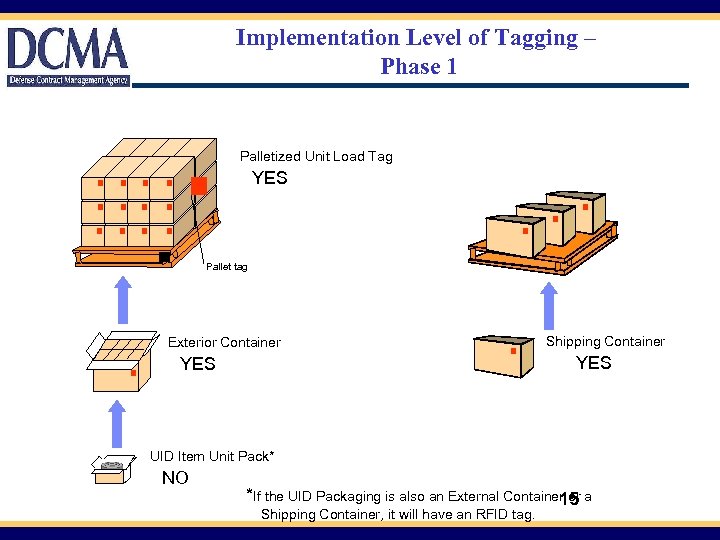 Implementation Level of Tagging – Phase 1 Palletized Unit Load Tag YES Pallet tag Exterior Container Shipping Container YES UID Item Unit Pack* NO *If the UID Packaging is also an External Container or a 15 Shipping Container, it will have an RFID tag.
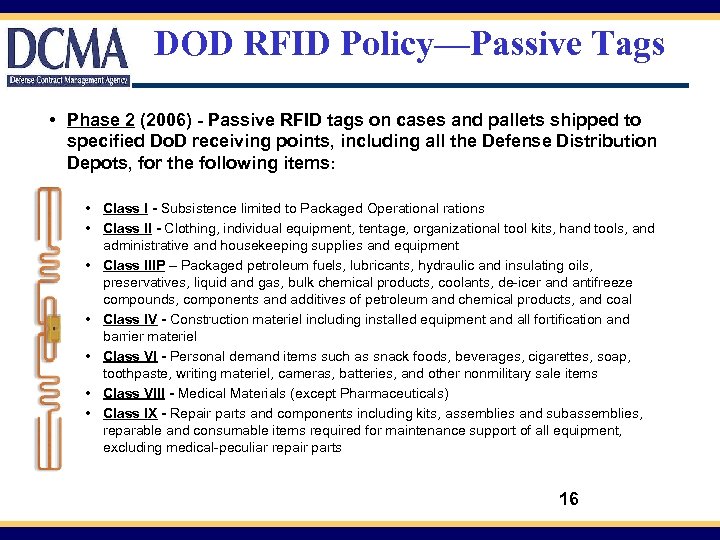 DOD RFID Policy—Passive Tags • Phase 2 (2006) - Passive RFID tags on cases and pallets shipped to specified Do. D receiving points, including all the Defense Distribution Depots, for the following items: • Class I - Subsistence limited to Packaged Operational rations • Class II - Clothing, individual equipment, tentage, organizational tool kits, hand tools, and administrative and housekeeping supplies and equipment • Class IIIP – Packaged petroleum fuels, lubricants, hydraulic and insulating oils, preservatives, liquid and gas, bulk chemical products, coolants, de-icer and antifreeze compounds, components and additives of petroleum and chemical products, and coal • Class IV - Construction materiel including installed equipment and all fortification and barrier materiel • Class VI - Personal demand items such as snack foods, beverages, cigarettes, soap, toothpaste, writing materiel, cameras, batteries, and other nonmilitary sale items • Class VIII - Medical Materials (except Pharmaceuticals) • Class IX - Repair parts and components including kits, assemblies and subassemblies, reparable and consumable items required for maintenance support of all equipment, excluding medical-peculiar repair parts 16
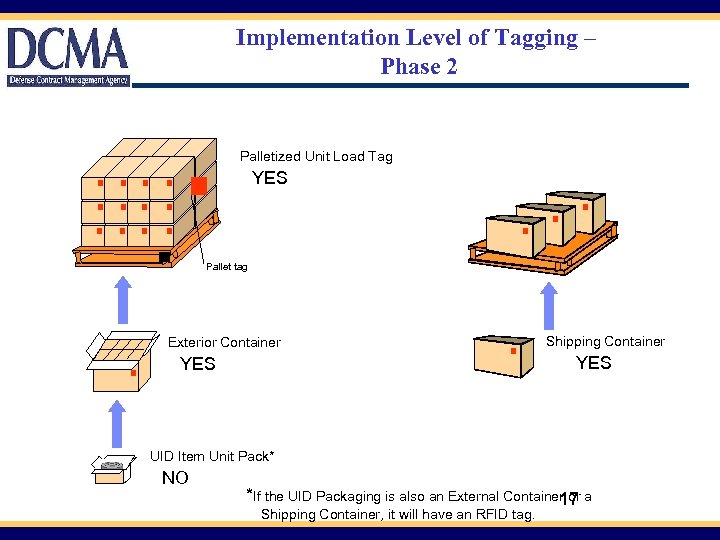 Implementation Level of Tagging – Phase 2 Palletized Unit Load Tag YES Pallet tag Exterior Container Shipping Container YES UID Item Unit Pack* NO *If the UID Packaging is also an External Container or a 17 Shipping Container, it will have an RFID tag.
 DOD RFID Policy—Passive Tags • Phase 3 (2007) - Passive RFID tags on all cases and pallets shipped to any Do. D location for all commodities* and unit packs for items that require a Unique Identification (UID) • except items excluded under the bulk commodities definition 18
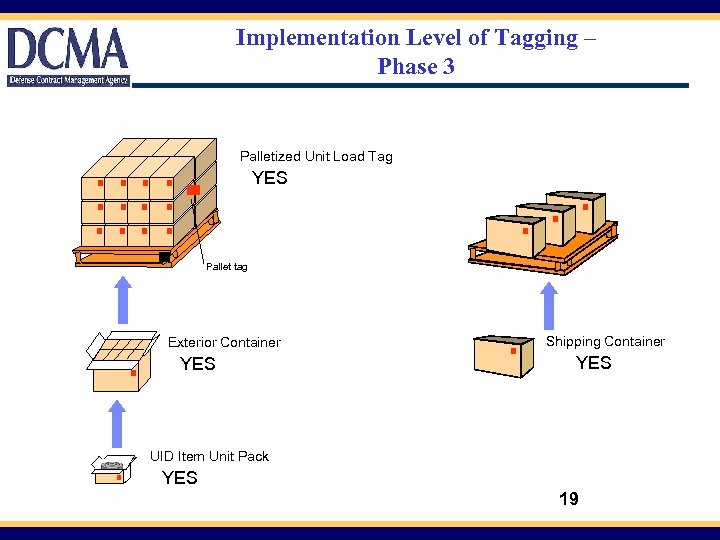 Implementation Level of Tagging – Phase 3 Palletized Unit Load Tag YES Pallet tag Exterior Container YES Shipping Container YES UID Item Unit Pack YES 19
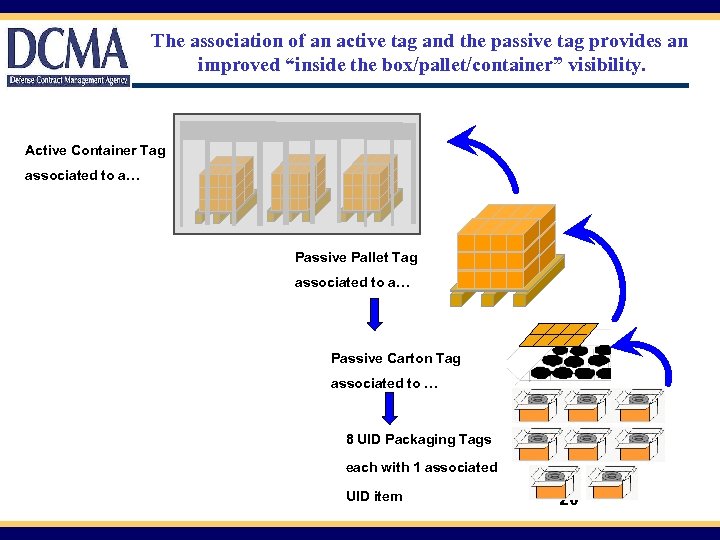 The association of an active tag and the passive tag provides an improved “inside the box/pallet/container” visibility. Active Container Tag associated to a… Passive Pallet Tag associated to a… Passive Carton Tag associated to … 8 UID Packaging Tags each with 1 associated UID item 20
 DOD RFID Policy—Passive Tags • Passive RFID technology is evolving… • EPCglobal published standards on EPC Class 0 and Class 1, V 1 • Class 0 – read only • Class 1, V 1 – write once, read many (worm) • Standards developed for “Generation 2” • Do. D goal is to migrate to use of Gen 2 once it is readily available • Do. D will accept the EPC data format or contractors can use the Do. D tag data construct 21
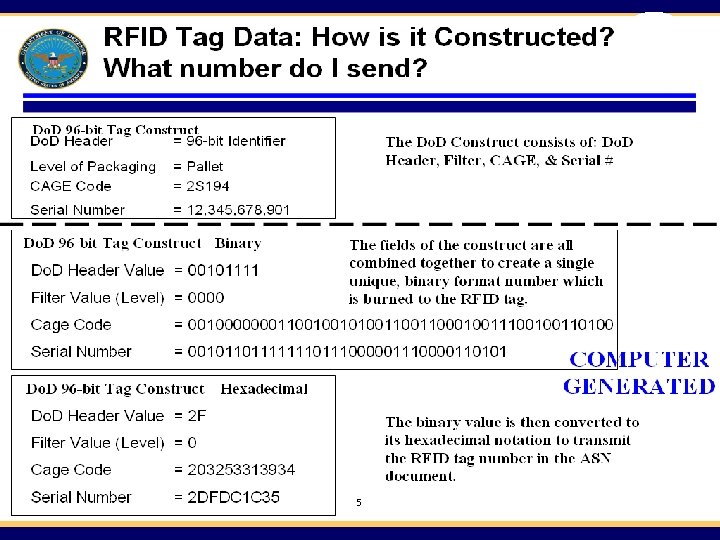
 Data Carried by RFID Tag? • A unique serial number for each exterior container or pallet load • Each RFID tag is like a small license plate which carries the serial number associated with the container • Using the DOD tag data construct, the contractor will use his CAGE code to generate serial numbers unique to his shipping facility. • The contractor will provide the data about the shipment by submitting the data via WAWF. This will relate each serial number to the items in each package. 22
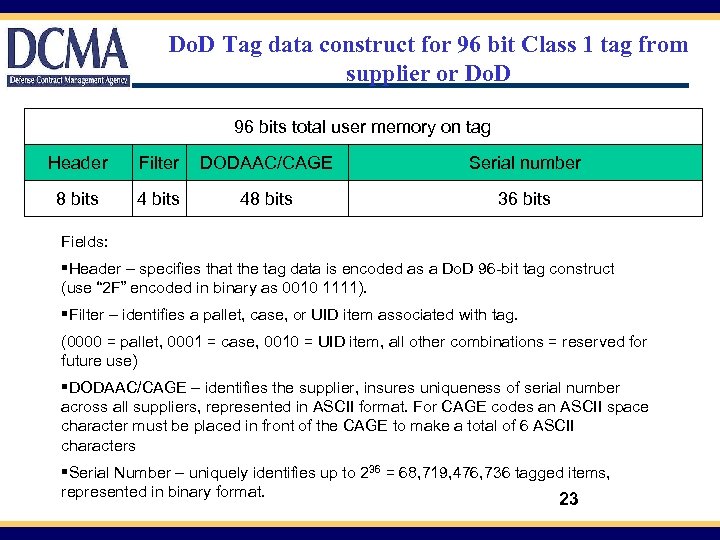 Do. D Tag data construct for 96 bit Class 1 tag from supplier or Do. D 96 bits total user memory on tag Header Filter DODAAC/CAGE Serial number 8 bits 48 bits 36 bits Fields: §Header – specifies that the tag data is encoded as a Do. D 96 -bit tag construct (use “ 2 F” encoded in binary as 0010 1111). §Filter – identifies a pallet, case, or UID item associated with tag. (0000 = pallet, 0001 = case, 0010 = UID item, all other combinations = reserved for future use) §DODAAC/CAGE – identifies the supplier, insures uniqueness of serial number across all suppliers, represented in ASCII format. For CAGE codes an ASCII space character must be placed in front of the CAGE to make a total of 6 ASCII characters §Serial Number – uniquely identifies up to 236 = 68, 719, 476, 736 tagged items, represented in binary format. 23
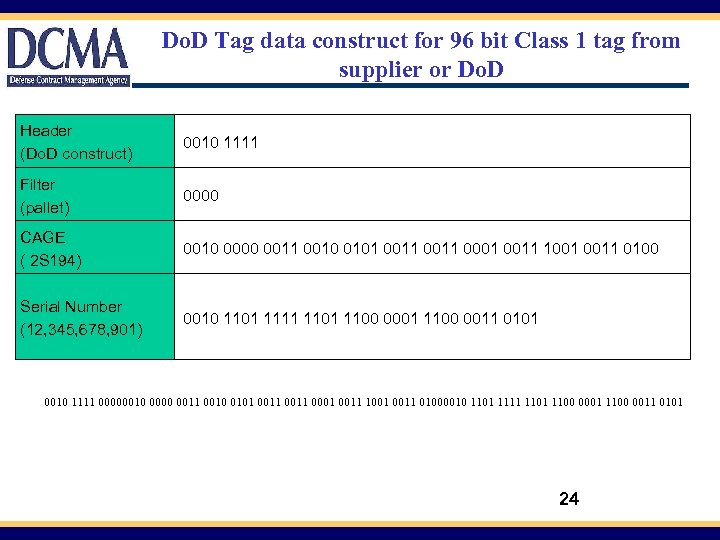 Do. D Tag data construct for 96 bit Class 1 tag from supplier or Do. D Header (Do. D construct) 0010 1111 Filter (pallet) 0000 CAGE ( 2 S 194) 0010 0000 0011 0010 0101 0011 0001 0011 1001 0011 0100 Serial Number (12, 345, 678, 901) 0010 1101 1111 1100 0001 1100 0011 0101 0010 1111 00000010 0000 0011 0010 0101 0011 0001 0011 1001 0011 01000010 1101 1111 1100 0001 1100 0011 0101 24
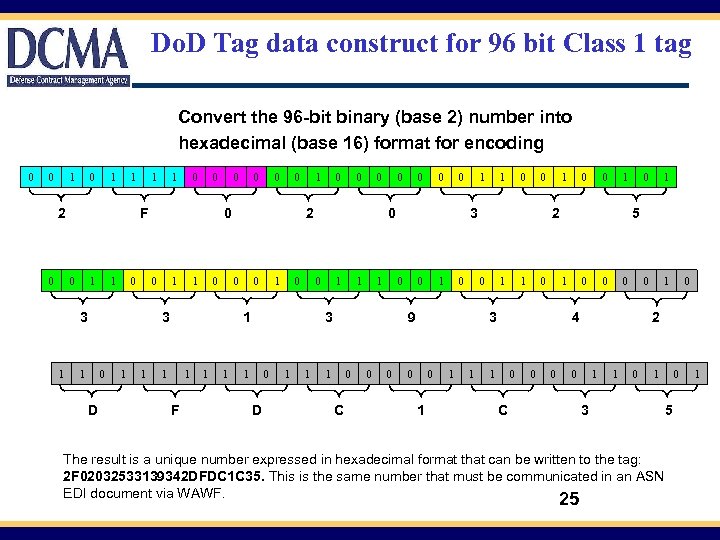 Do. D Tag data construct for 96 bit Class 1 tag Convert the 96 -bit binary (base 2) number into hexadecimal (base 16) format for encoding 0 0 1 1 2 0 1 0 0 F 0 1 1 0 0 D 1 1 0 0 1 0 1 1 F 1 0 0 0 1 1 1 0 D 1 1 0 0 C 0 0 1 1 1 0 0 0 4 1 0 0 0 1 1 5 1 3 0 0 2 0 9 1 1 3 0 3 1 0 0 0 1 1 0 2 0 3 1 0 0 0 3 1 1 2 0 C 1 1 0 1 3 The result is a unique number expressed in hexadecimal format that can be written to the tag: 2 F 02032533139342 DFDC 1 C 35. This is the same number that must be communicated in an ASN EDI document via WAWF. 25 0 0 5 1
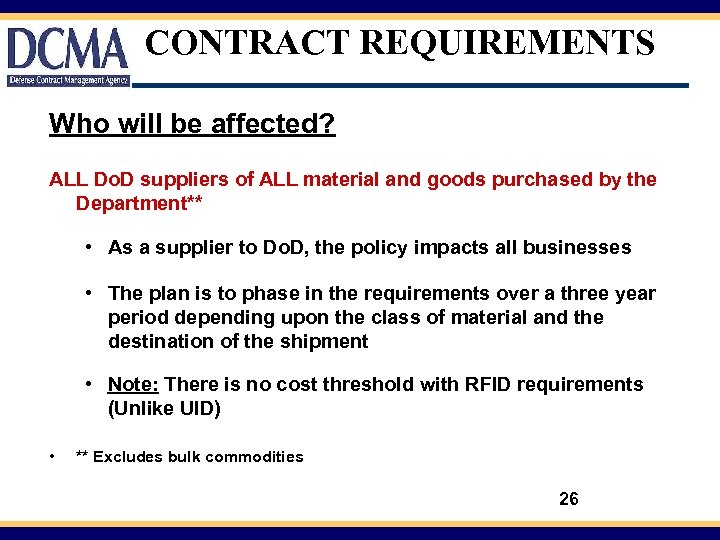 CONTRACT REQUIREMENTS Who will be affected? ALL Do. D suppliers of ALL material and goods purchased by the Department** • As a supplier to Do. D, the policy impacts all businesses • The plan is to phase in the requirements over a three year period depending upon the class of material and the destination of the shipment • Note: There is no cost threshold with RFID requirements (Unlike UID) • ** Excludes bulk commodities 26
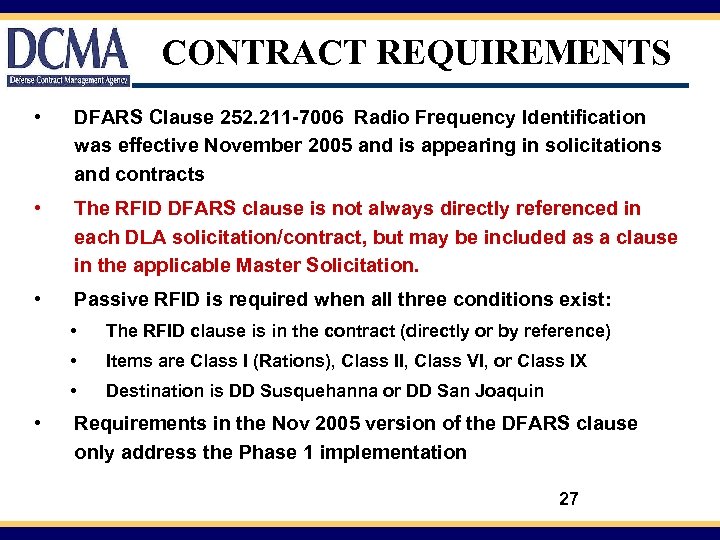 CONTRACT REQUIREMENTS • DFARS Clause 252. 211 -7006 Radio Frequency Identification was effective November 2005 and is appearing in solicitations and contracts • The RFID DFARS clause is not always directly referenced in each DLA solicitation/contract, but may be included as a clause in the applicable Master Solicitation. • Passive RFID is required when all three conditions exist: • • Items are Class I (Rations), Class II, Class VI, or Class IX • • The RFID clause is in the contract (directly or by reference) Destination is DD Susquehanna or DD San Joaquin Requirements in the Nov 2005 version of the DFARS clause only address the Phase 1 implementation 27
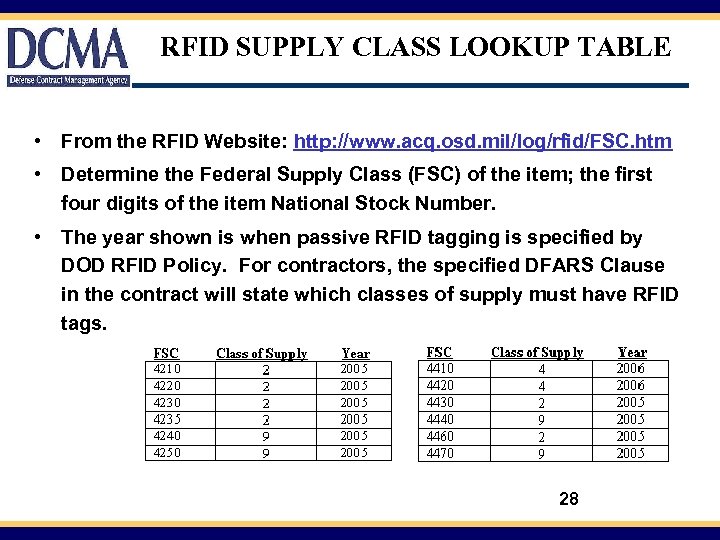 RFID SUPPLY CLASS LOOKUP TABLE • From the RFID Website: http: //www. acq. osd. mil/log/rfid/FSC. htm • Determine the Federal Supply Class (FSC) of the item; the first four digits of the item National Stock Number. • The year shown is when passive RFID tagging is specified by DOD RFID Policy. For contractors, the specified DFARS Clause in the contract will state which classes of supply must have RFID tags. 28
 CONTRACT REQUIREMENTS • DFARS RFID clause incorporating Phase 2 requirements was published as an interim rule in the Federal Register on May 19. The public had until July 18 for comments or questions. • Interim rule—required to be implemented upon publication, prior to answering comments from the public • Interim rule will be specified in contracts as 252. 211 -7006 Radio Frequency Identification (May 2006) • • • Contractor must note date of the new rule specified, or Read entire clause to determine if Phase I or Phase II requirement Requirements of the new, interim rule • Additional Item Supply Classes • Additional destinations • As of 1 October 2006, RFID tags must conform to EPC Class 1, Generation 2 tags 29
 CONTRACT REQUIREMENTS • Phase 2 (expanded) RFID required when all three conditions exist: • The RFID clause (May 2006) is in the contract (or referenced) • Items are Class I (Rations), Class IIIP, Classes IV and VI, Class VIII (excluding pharmaceuticals), or Class IX • Destination is: • Defense Distribution Depot, Susquehanna, PA: Do. DAAC W 25 G 1 U or SW 3124; Defense Distribution Depot, San Joaquin, CA: Do. DAAC W 62 G 2 T or SW 3224; Defense Distribution Depot, Albany, GA: Do. DAAC SW 3121; Defense Distribution Depot, Anniston, AL: Do. DAAC W 31 G 1 Z or SW 3120; Defense Distribution Depot, Barstow, CA: Do. DAAC SW 3215; Defense Distribution Depot, Cherry Point, NC: Do. DAAC SW 3113; 30
 CONTRACT REQUIREMENTS • Defense Distribution Depot, Columbus, OH: Do. DAAC SW 0700; Defense Distribution Depot, Corpus Christi, TX: Do. DAAC W 45 H 08 or SW 3222; Defense Distribution Depot, Hill, UT: Do. DAAC SW 3210; Defense Distribution Depot, Jacksonville, FL: Do. DAAC SW 3122; Defense Distribution Depot, Oklahoma City, OK: Do. DAAC SW 3211; Defense Distribution Depot, Norfolk, VA: Do. DAAC SW 3117; Defense Distribution Depot, Puget Sound, WA: Do. DAAC SW 3216; Defense Distribution Depot, Red River, TX: Do. DAAC W 45 G 19 or SW 3227; Defense Distribution Depot, Richmond, VA: Do. DAAC SW 0400; Defense Distribution Depot, San Diego, CA: Do. DAAC SW 3218; Defense Distribution Depot, Tobyhanna, PA: Do. DAAC W 25 G 1 W or SW 3114; Defense Distribution Depot, Warner Robins, GA: Do. DAAC SW 3119; Air Mobility Command Terminal, Charleston Air Force Base, Charleston, SC: Air Terminal Identifier Code CHS; Air Mobility Command Terminal, Naval Air Station, Norfolk, VA: Air Terminal Identifier Code NGU; Air Mobility Command Terminal, Travis Air Force Base, Fairfield, CA: Air Terminal Identifier Code SUU. 31
 DFARS 252. 211 -7006 Details • Two Major Requirements for Suppliers • • • Passive Tagging at the case, pallet, and case within a pallet load Advance Shipment Notification (ASN) Definitions of levels of tagging are included (in accordance with MIL-STD 129 Definitions) • Case – Shipping Container and/or Exterior Container • Pallet – Palletized Unit Load • Tag Data Standards – EPCglobal or Do. D Construct • EPCglobal Class 0 or Class 1 Specification Tags • Tag Placement – Per MIL-STD-129 Section 4. 9. 2 • Do. D has published guidance on tag data constructs and advance shipment notification at: www. dodrfid. org 32
 MIL-STD-129 P Change 3 • Provides guidance on the application/placement of the RFID tag • Suitable location where there is minimum risk of damage • Highest potential for successful RFID tag interrogation • For tags that are RFID enabled address labels they should be placed to allow easy access to the bar code symbols • Labels should not be placed over a seam • Should be right of center on a vertical face • Allowing a minimum of 2 inches from all edges • Should not be placed in a manner that overlaps any other RF transponder – at least 4 inch separation 33
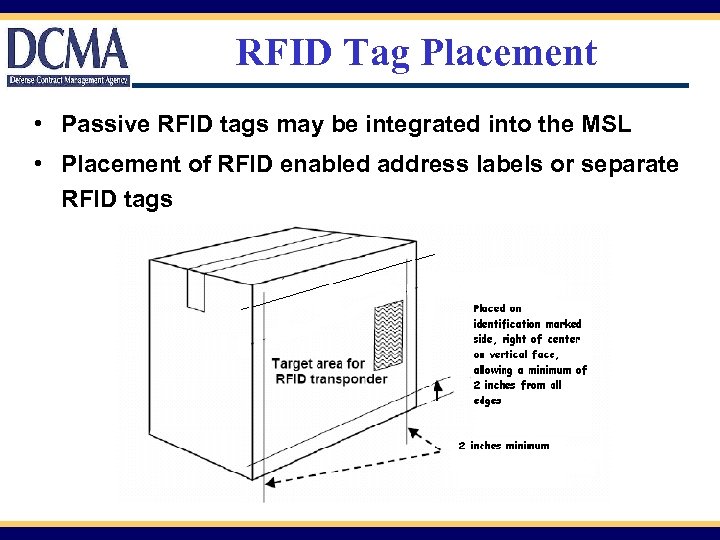 RFID Tag Placement • Passive RFID tags may be integrated into the MSL • Placement of RFID enabled address labels or separate RFID tags 34
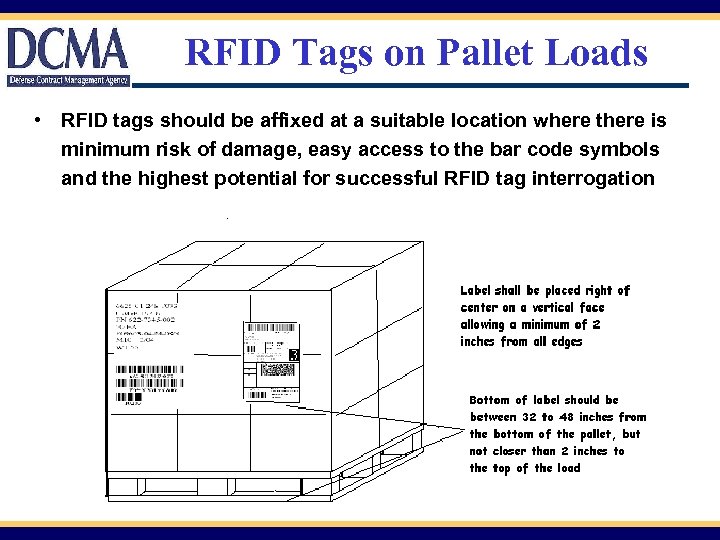 RFID Tags on Pallet Loads • RFID tags should be affixed at a suitable location where there is minimum risk of damage, easy access to the bar code symbols and the highest potential for successful RFID tag interrogation 35
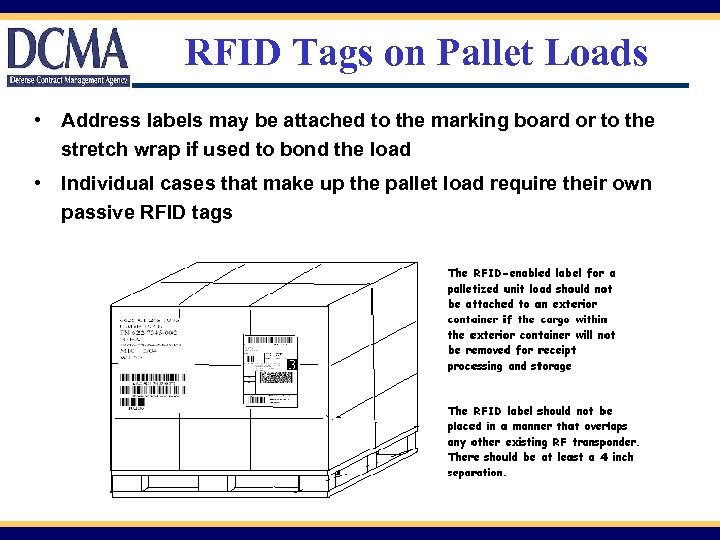 RFID Tags on Pallet Loads • Address labels may be attached to the marking board or to the stretch wrap if used to bond the load • Individual cases that make up the pallet load require their own passive RFID tags 36
 MIL-STD-129 P Change 3 • Performance requirements for passive RFID tags • Portal - For palletized unit load tags and the tags on the shipping containers within the palletized load, the read distance shall be at least 3 meters at 10 miles per hour • Conveyor – For individual shipping containers, the read distance shall be at least 1 meter at 600 feet per minute • Tag data specifications and formats are referenced to the Do. D Supplier’s Information Guide at: www. dodrfid. org • The Do. D approved frequency range is 860 -960 MHz 37
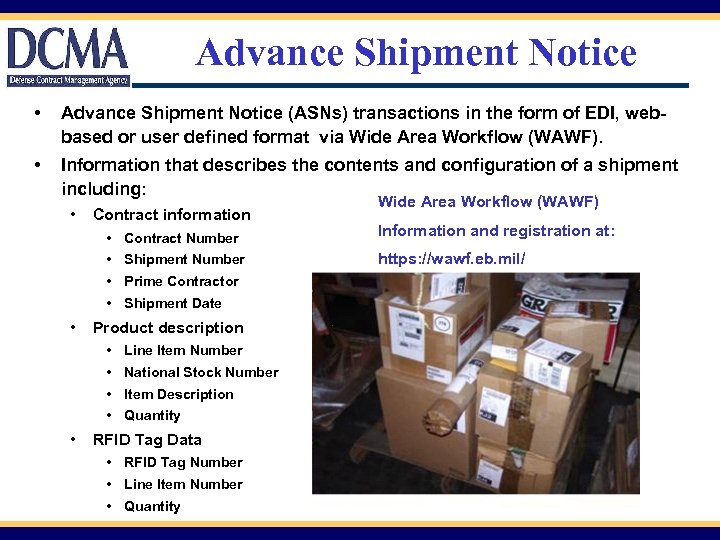 Advance Shipment Notice • Advance Shipment Notice (ASNs) transactions in the form of EDI, webbased or user defined format via Wide Area Workflow (WAWF). • Information that describes the contents and configuration of a shipment including: • Contract information Wide Area Workflow (WAWF) • Contract Number Information and registration at: • Shipment Number https: //wawf. eb. mil/ • Prime Contractor • Shipment Date • Product description • Line Item Number • National Stock Number • Item Description • Quantity • RFID Tag Data • RFID Tag Number • Line Item Number • Quantity 38
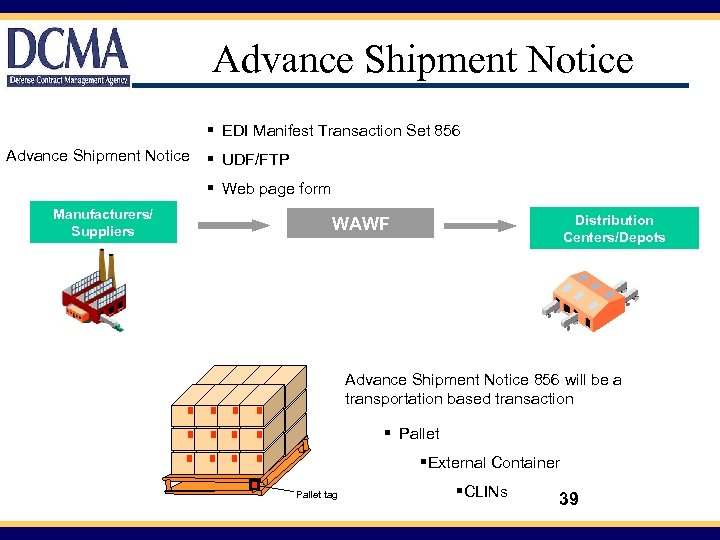 Advance Shipment Notice § EDI Manifest Transaction Set 856 Advance Shipment Notice § UDF/FTP § Web page form Manufacturers/ Suppliers Distribution Centers/Depots WAWF § Advance Shipment Notice 856 will be a transportation based transaction § Pallet §External Container Pallet tag §CLINs 39
 HEX loaded into WAWF 40
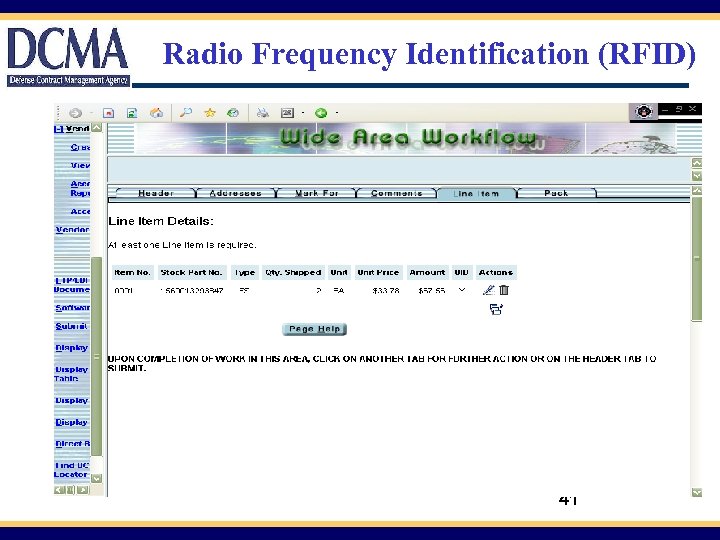 Radio Frequency Identification (RFID) 41
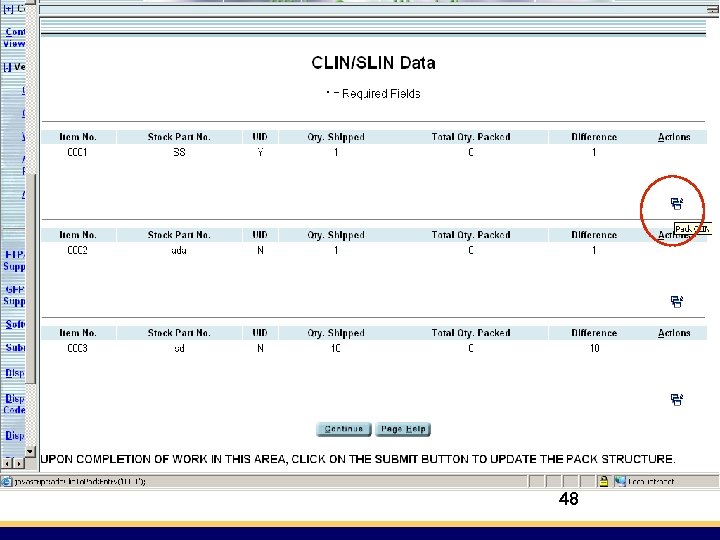
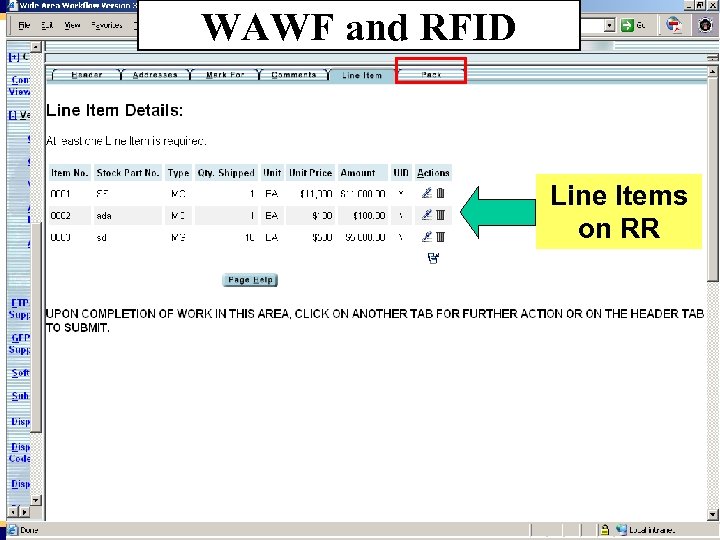 WAWF and RFID Line Items on RR 42
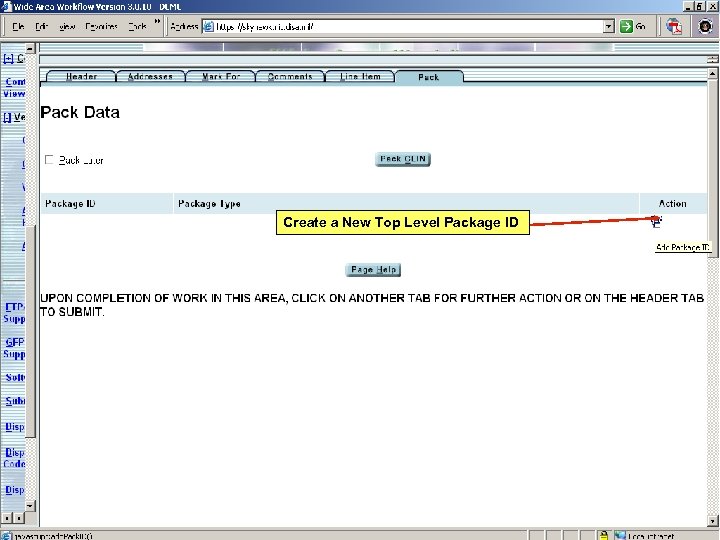 Create a New Top Level Package ID 43
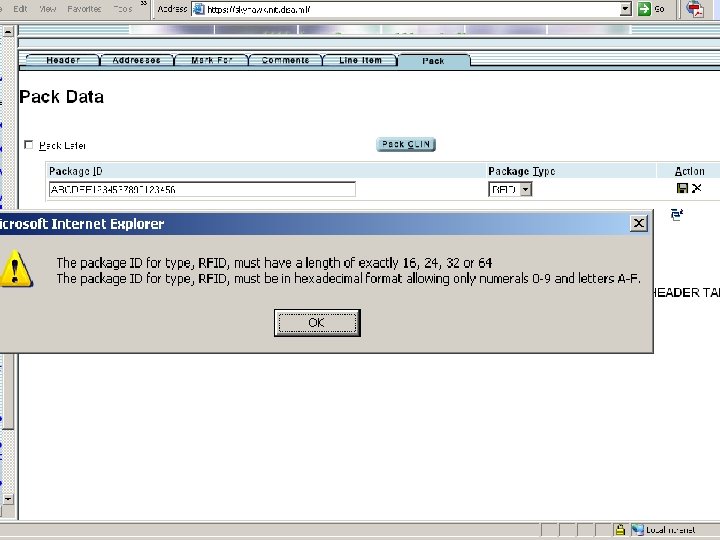
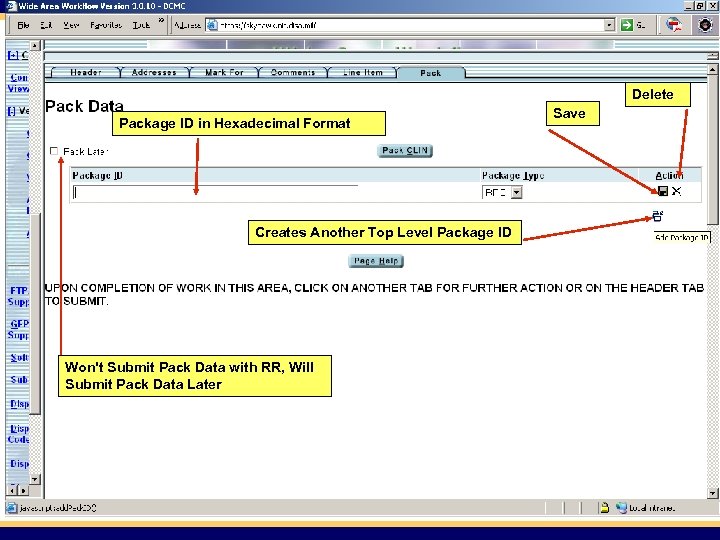 Delete Package ID in Hexadecimal Format Save Creates Another Top Level Package ID Won't Submit Pack Data with RR, Will Submit Pack Data Later 44
 45
45
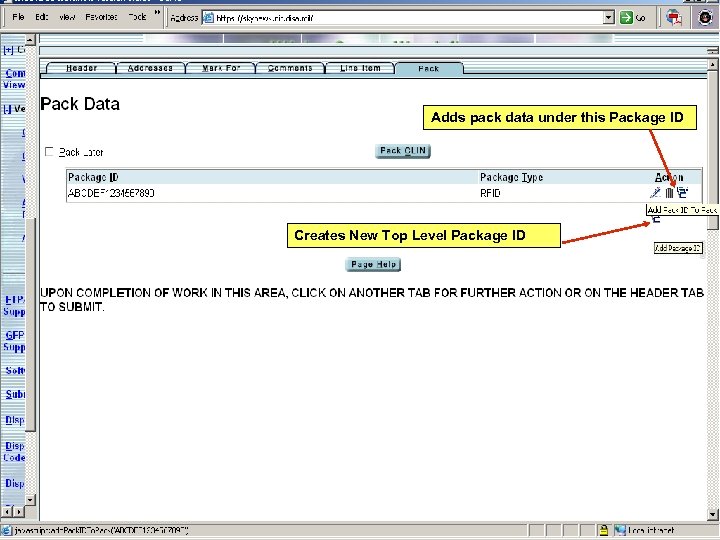 Adds pack data under this Package ID Creates New Top Level Package ID 46
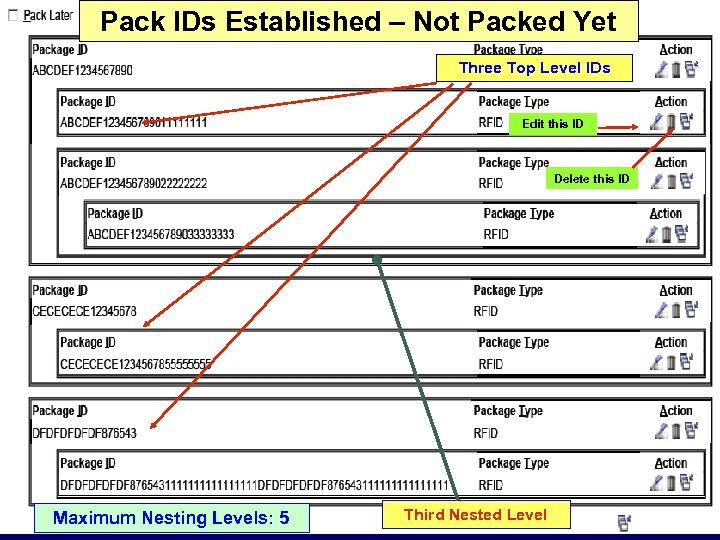 Pack IDs Established – Not Packed Yet Three Top Level IDs Edit this ID Delete this ID Maximum Nesting Levels: 5 Third Nested Level 47
 48
48
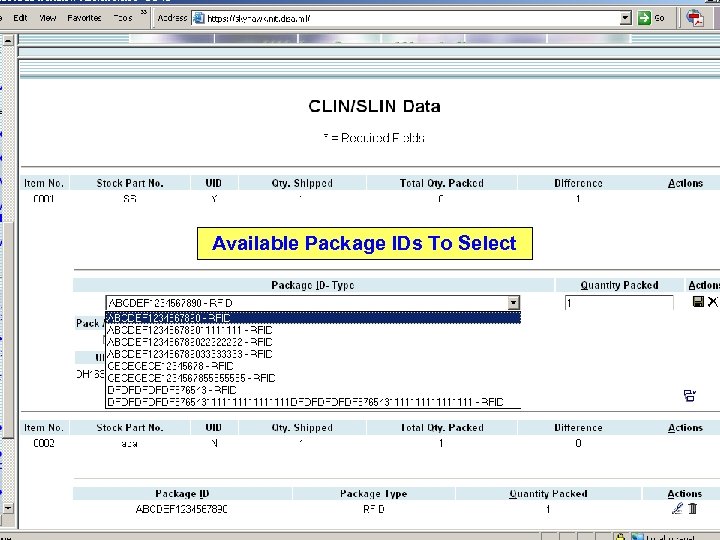 Available Package IDs To Select 49
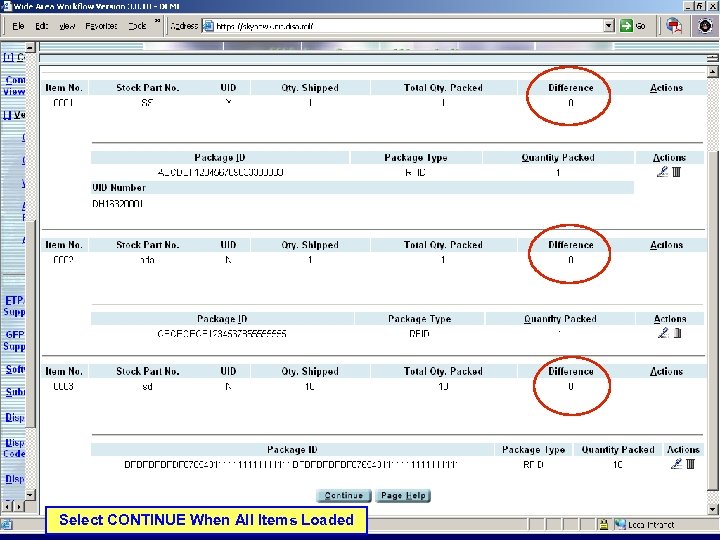 50 Select CONTINUE When All Items Loaded
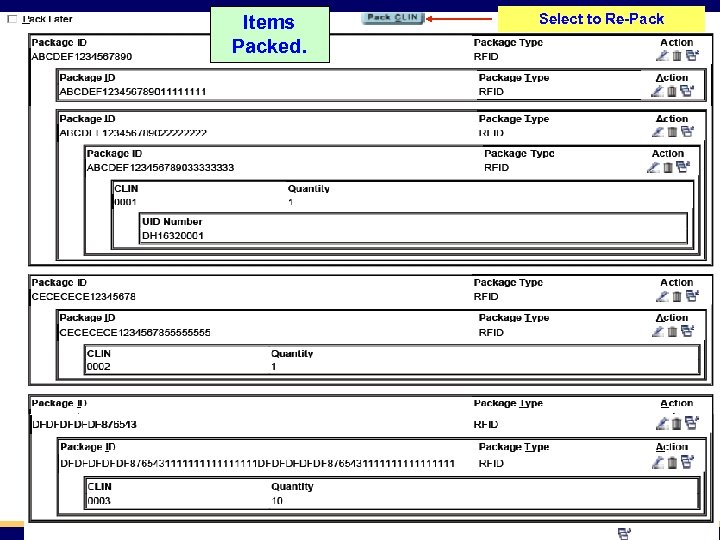 Items Packed. Select to Re-Pack 51
 Supplier Implementation • Various strategies may be employed to meet the Do. D RFID requirements • Use third party logistics provider • Purchase programmed tags and apply to cases/pallets • Purchase equipment (i. e. printer or reader) to program tags • Incorporate a full RFID infrastructure throughout business process • The best course of action will depend upon the amount of business with Do. D or other customers requiring RFID 52
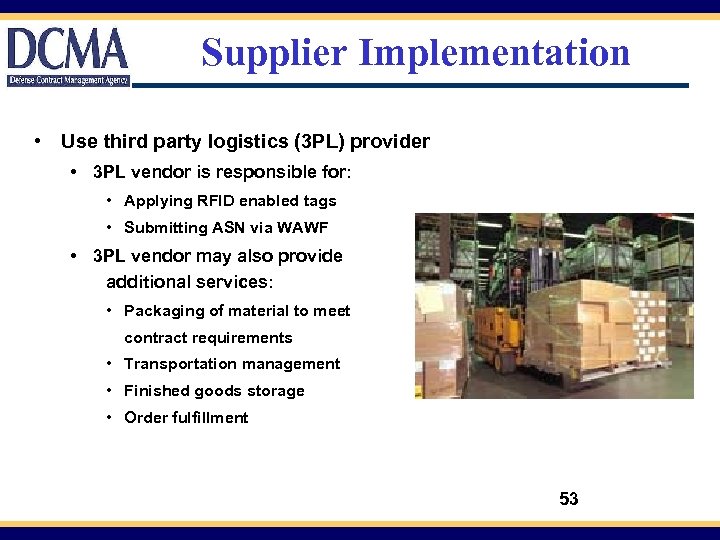 Supplier Implementation • Use third party logistics (3 PL) provider • 3 PL vendor is responsible for: • Applying RFID enabled tags • Submitting ASN via WAWF • 3 PL vendor may also provide additional services: • Packaging of material to meet contract requirements • Transportation management • Finished goods storage • Order fulfillment 53
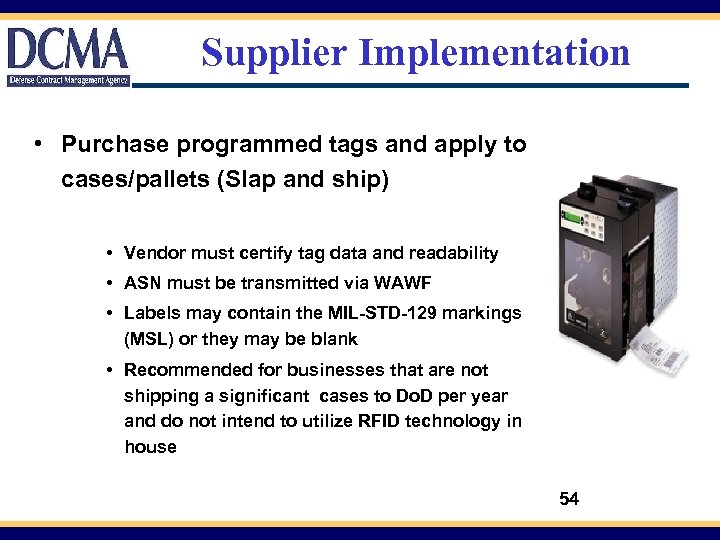 Supplier Implementation • Purchase programmed tags and apply to cases/pallets (Slap and ship) • Vendor must certify tag data and readability • ASN must be transmitted via WAWF • Labels may contain the MIL-STD-129 markings (MSL) or they may be blank • Recommended for businesses that are not shipping a significant cases to Do. D per year and do not intend to utilize RFID technology in house 54
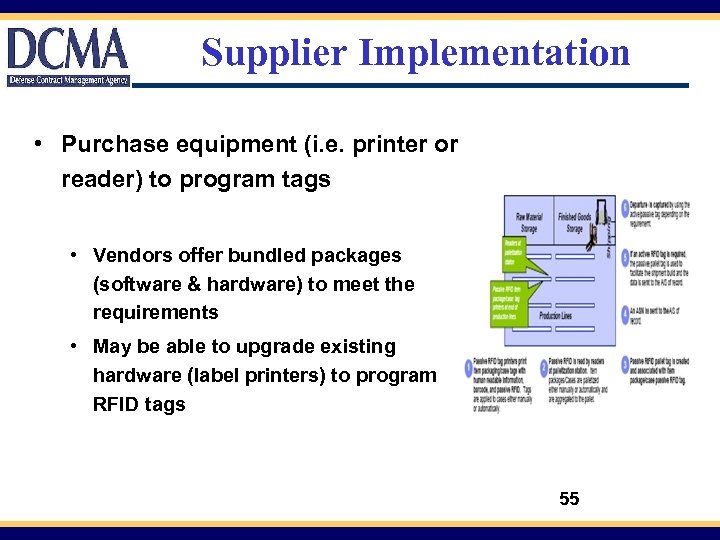 Supplier Implementation • Purchase equipment (i. e. printer or reader) to program tags • Vendors offer bundled packages (software & hardware) to meet the requirements • May be able to upgrade existing hardware (label printers) to program RFID tags 55
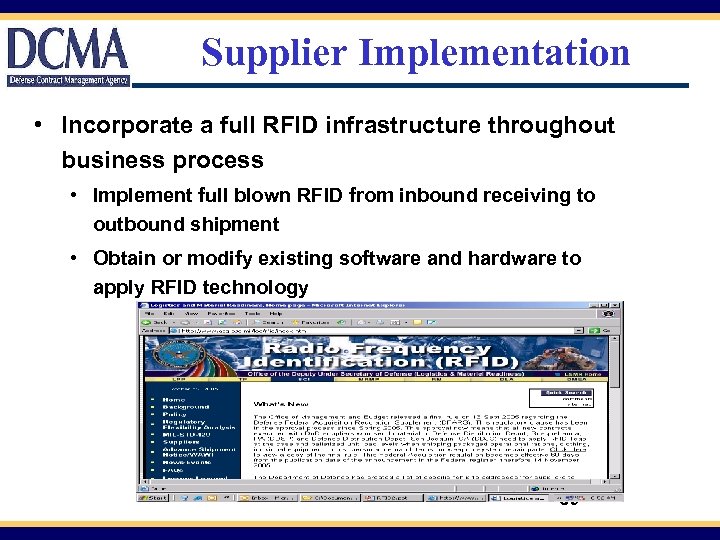 Supplier Implementation • Incorporate a full RFID infrastructure throughout business process • Implement full blown RFID from inbound receiving to outbound shipment • Obtain or modify existing software and hardware to apply RFID technology 56
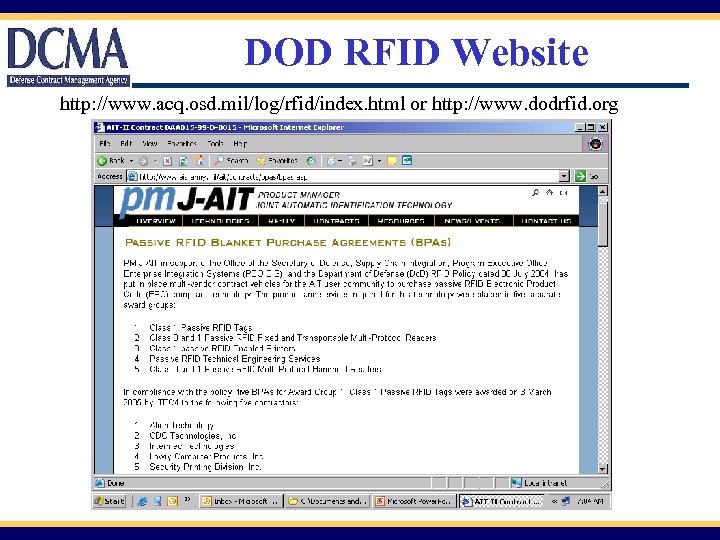 DOD RFID Website http: //www. acq. osd. mil/log/rfid/index. html or http: //www. dodrfid. org 57
 Do. D RFID Contracts Website http: //www. eis. army. mil/ait/contracts/bpas. asp 58
 Bye-Bye Bar Codes? – NO! • Traditional bar codes – Linear (UPC, 3 of 9) • • • 2 D bar codes – Data Matrix, PDF 417 • • • Will remain the dominant auto ID technology in most mainstream applications for the foreseeable future Lowest cost, broadest applicability, huge infrastructure investment Adopted for value added applications Portable data files, supplementary retail coding etc. RFID – Active, Passive and Semi Passive • Will be increasingly adopted where non-line of sight, read/write, and multiple detection requirements are needed. 59