


 Скачать презентацию Radio detection of high energy particles in dense
c88bb9900975acfb645df2e70d52d2a2.ppt
- Количество слайдов: 21
 Radio detection of high energy particles in dense media, & ANITA Peter Gorham University of Hawaii Manoa Department of Physics & Astronomy Co-Is: S. Barwick, UCI; J. Beatty, OSU, W. Binns, M. Israel, Wash. U. St. Louis, M. Du. Vernois, U. Minn. , K. Liewer & C. Naudet, JPL/NASA; D. Saltzberg, UCLA, G. Varner, UH Manoa 1
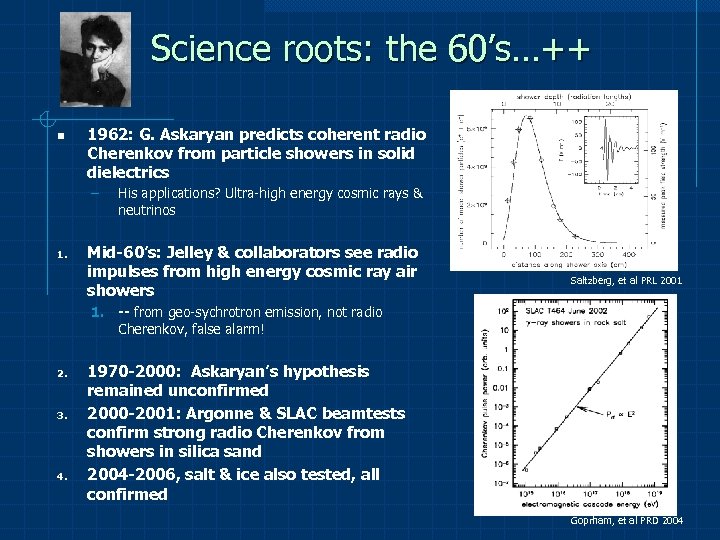 Science roots: the 60’s…++ n 1962: G. Askaryan predicts coherent radio Cherenkov from particle showers in solid dielectrics – 1. Mid-60’s: Jelley & collaborators see radio impulses from high energy cosmic ray air showers 1. 2. 3. 4. His applications? Ultra-high energy cosmic rays & neutrinos Saltzberg, et al PRL 2001 -- from geo-sychrotron emission, not radio Cherenkov, false alarm! 1970 -2000: Askaryan’s hypothesis remained unconfirmed 2000 -2001: Argonne & SLAC beamtests confirm strong radio Cherenkov from showers in silica sand 2004 -2006, salt & ice also tested, all confirmed Goprham, et al PRD 2004
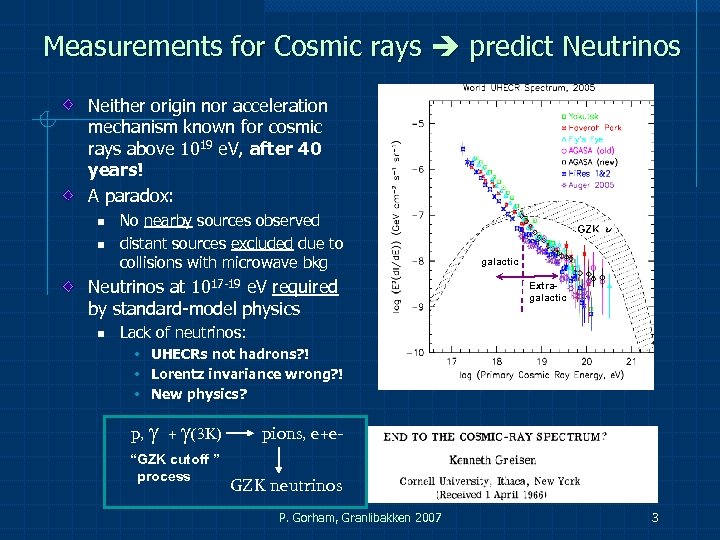 Measurements for Cosmic rays predict Neutrinos Neither origin nor acceleration mechanism known for cosmic rays above 1019 e. V, after 40 years! A paradox: n n No nearby sources observed distant sources excluded due to collisions with microwave bkg Neutrinos at 1017 -19 e. V required by standard-model physics n galactic Extragalactic Lack of neutrinos: w UHECRs not hadrons? ! w Lorentz invariance wrong? ! w New physics? p, g + g(3 K) “GZK cutoff ” process pions, e+e. GZK neutrinos P. Gorham, Granlibakken 2007 3
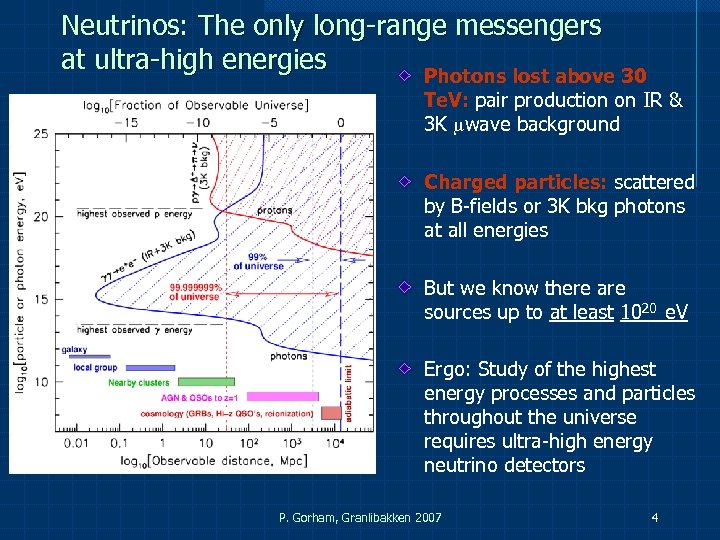 Neutrinos: The only long-range messengers at ultra-high energies Photons lost above 30 Te. V: pair production on IR & 3 K mwave background Region not observable In photons or Charged particles: scattered by B-fields or 3 K bkg photons at all energies But we know there are sources up to at least 1020 e. V Ergo: Study of the highest energy processes and particles throughout the universe requires ultra-high energy neutrino detectors P. Gorham, Granlibakken 2007 4
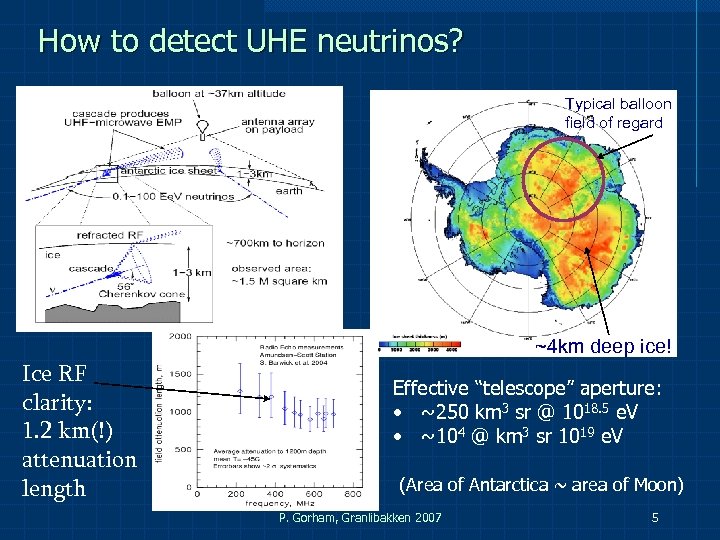 How to detect UHE neutrinos? Typical balloon field of regard Ice RF clarity: 1. 2 km(!) attenuation length ~4 km deep ice! Effective “telescope” aperture: • ~250 km 3 sr @ 1018. 5 e. V • ~104 @ km 3 sr 1019 e. V (Area of Antarctica ~ area of Moon) P. Gorham, Granlibakken 2007 5
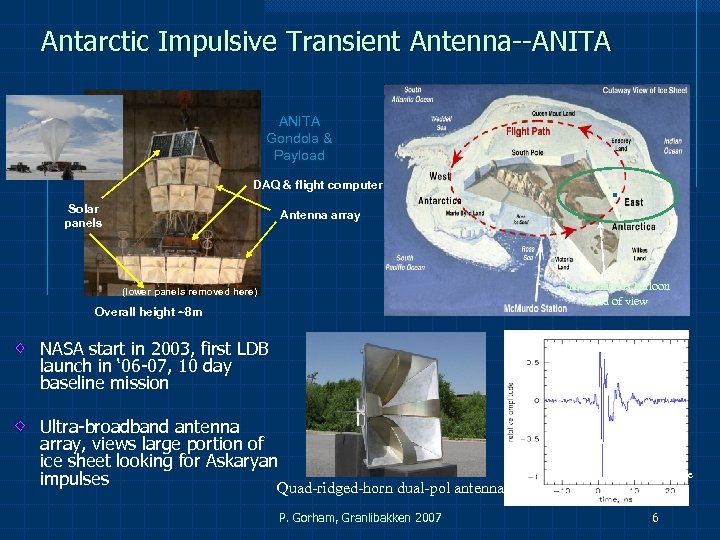 Antarctic Impulsive Transient Antenna--ANITA Gondola & Payload DAQ & flight computer Solar panels Antenna array Instantaneous balloon field of view (lower panels removed here) Overall height ~8 m NASA start in 2003, first LDB launch in ‘ 06 -07, 10 day baseline mission Ultra-broadband antenna array, views large portion of ice sheet looking for Askaryan impulses Quad-ridged-horn dual-pol antenna P. Gorham, Granlibakken 2007 ~320 ps Measured impulse response 6
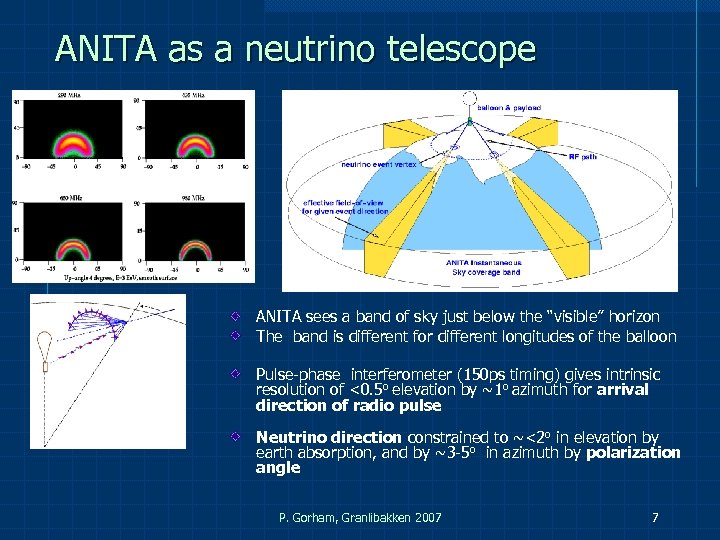 ANITA as a neutrino telescope ANITA sees a band of sky just below the “visible” horizon The band is different for different longitudes of the balloon Pulse-phase interferometer (150 ps timing) gives intrinsic resolution of <0. 5 o elevation by ~1 o azimuth for arrival direction of radio pulse Neutrino direction constrained to ~<2 o in elevation by earth absorption, and by ~3 -5 o in azimuth by polarization angle P. Gorham, Granlibakken 2007 7
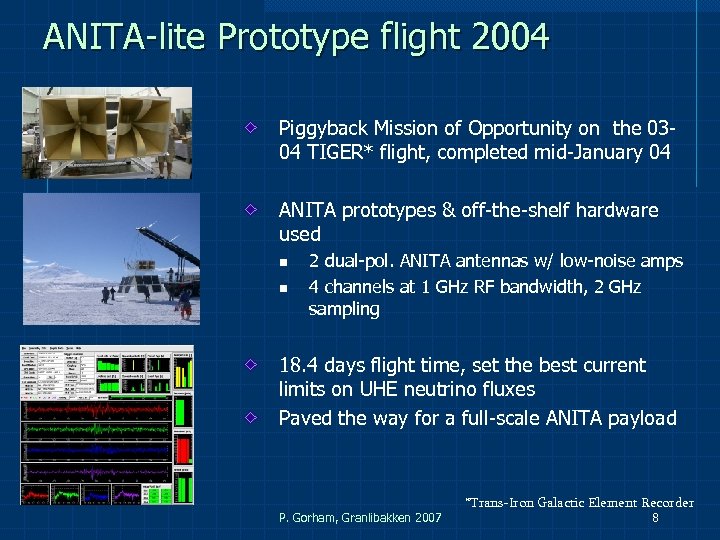 ANITA-lite Prototype flight 2004 Piggyback Mission of Opportunity on the 0304 TIGER* flight, completed mid-January 04 ANITA prototypes & off-the-shelf hardware used n n 2 dual-pol. ANITA antennas w/ low-noise amps 4 channels at 1 GHz RF bandwidth, 2 GHz sampling 18. 4 days flight time, set the best current limits on UHE neutrino fluxes Paved the way for a full-scale ANITA payload P. Gorham, Granlibakken 2007 *Trans-Iron Galactic Element Recorder 8
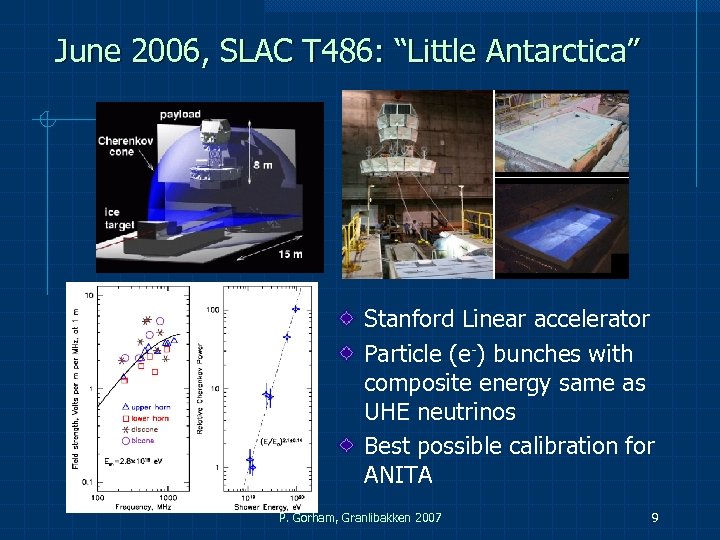 June 2006, SLAC T 486: “Little Antarctica” Stanford Linear accelerator Particle (e-) bunches with composite energy same as UHE neutrinos Best possible calibration for ANITA P. Gorham, Granlibakken 2007 9
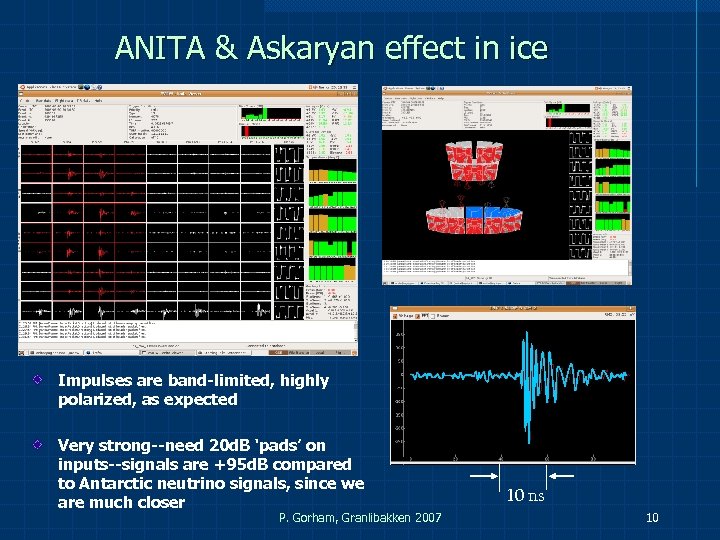 ANITA & Askaryan effect in ice Impulses are band-limited, highly polarized, as expected Very strong--need 20 d. B ‘pads’ on inputs--signals are +95 d. B compared to Antarctic neutrino signals, since we are much closer P. Gorham, Granlibakken 2007 10 ns 10
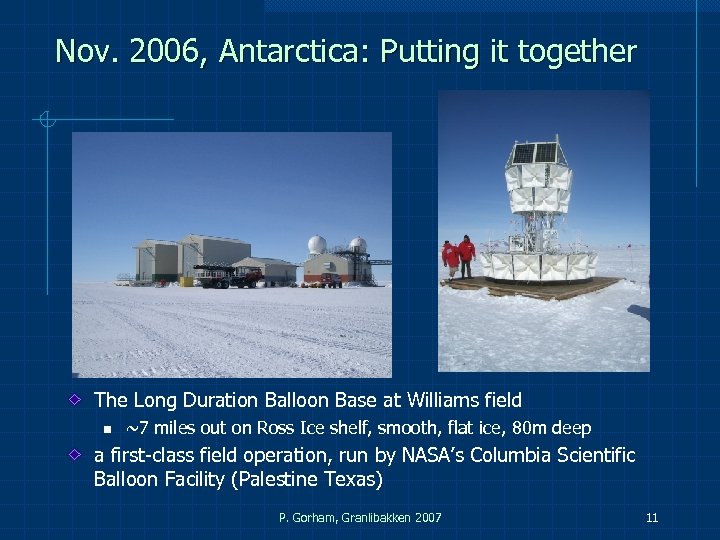 Nov. 2006, Antarctica: Putting it together The Long Duration Balloon Base at Williams field n ~7 miles out on Ross Ice shelf, smooth, flat ice, 80 m deep a first-class field operation, run by NASA’s Columbia Scientific Balloon Facility (Palestine Texas) P. Gorham, Granlibakken 2007 11
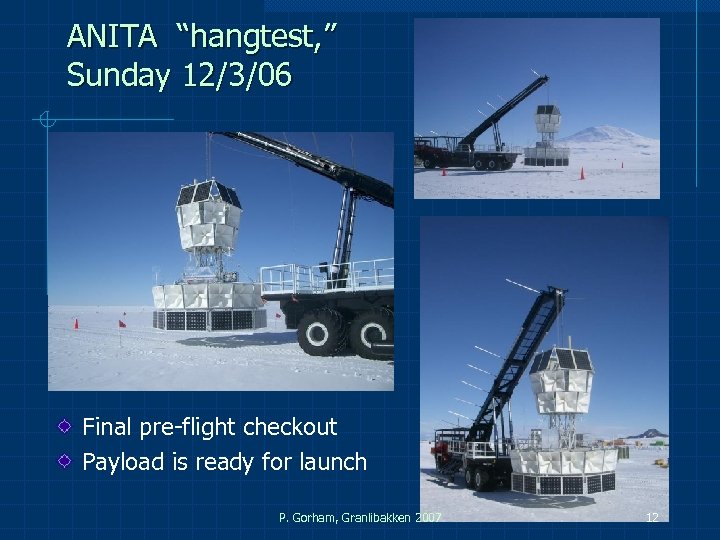 ANITA “hangtest, ” Sunday 12/3/06 Final pre-flight checkout Payload is ready for launch P. Gorham, Granlibakken 2007 12
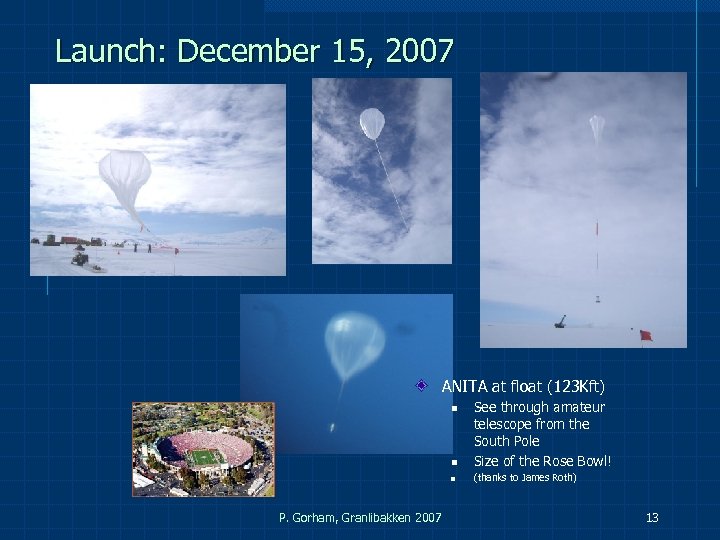 Launch: December 15, 2007 ANITA at float (123 Kft) n See through amateur telescope from the South Pole Size of the Rose Bowl! n (thanks to James Roth) n P. Gorham, Granlibakken 2007 13
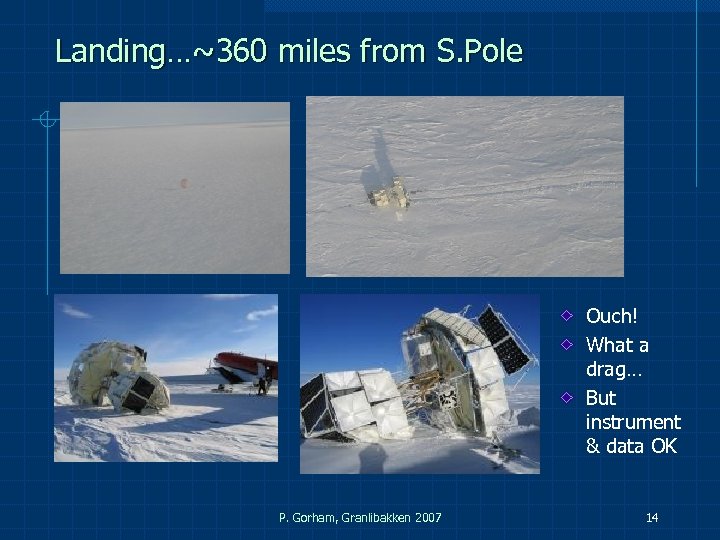 Landing…~360 miles from S. Pole Ouch! What a drag… But instrument & data OK P. Gorham, Granlibakken 2007 14
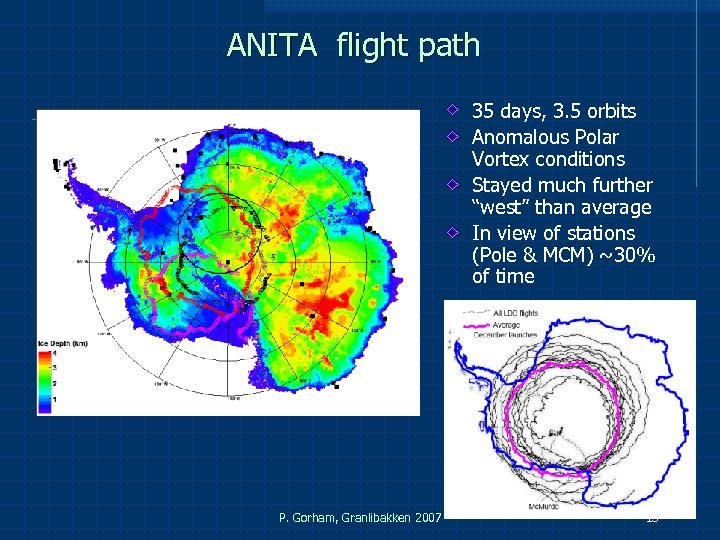 ANITA flight path 35 days, 3. 5 orbits Anomalous Polar Vortex conditions Stayed much further “west” than average In view of stations (Pole & MCM) ~30% of time P. Gorham, Granlibakken 2007 15
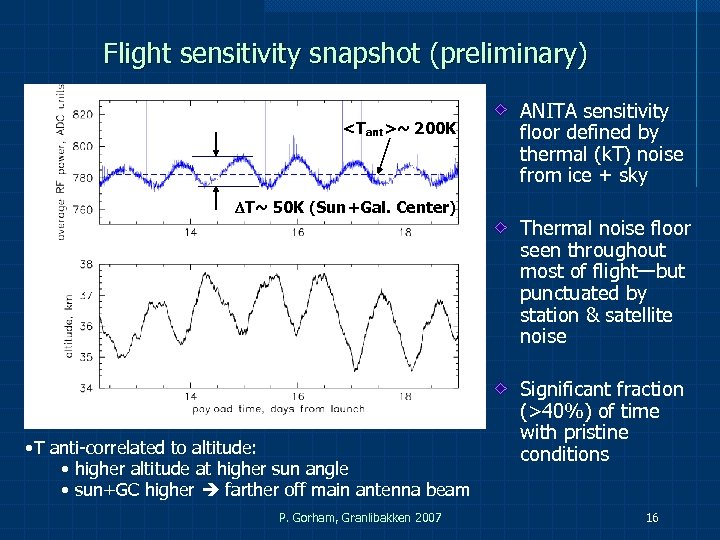 Flight sensitivity snapshot (preliminary)
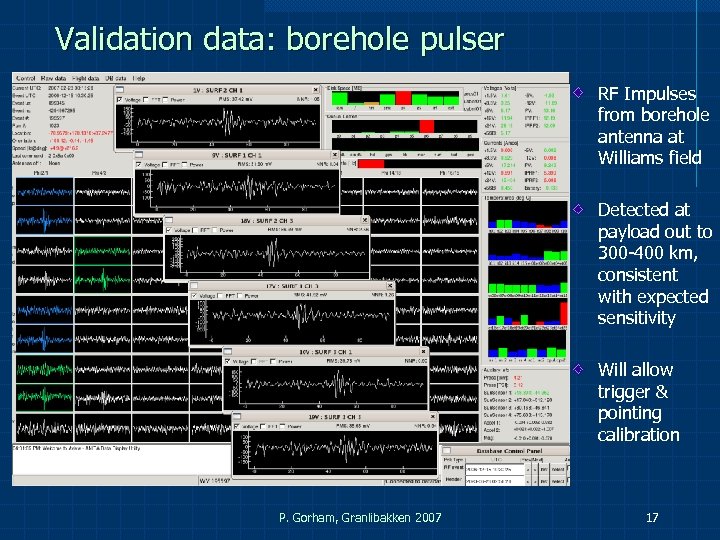 Validation data: borehole pulser RF Impulses from borehole antenna at Williams field Detected at payload out to 300 -400 km, consistent with expected sensitivity Will allow trigger & pointing calibration P. Gorham, Granlibakken 2007 17
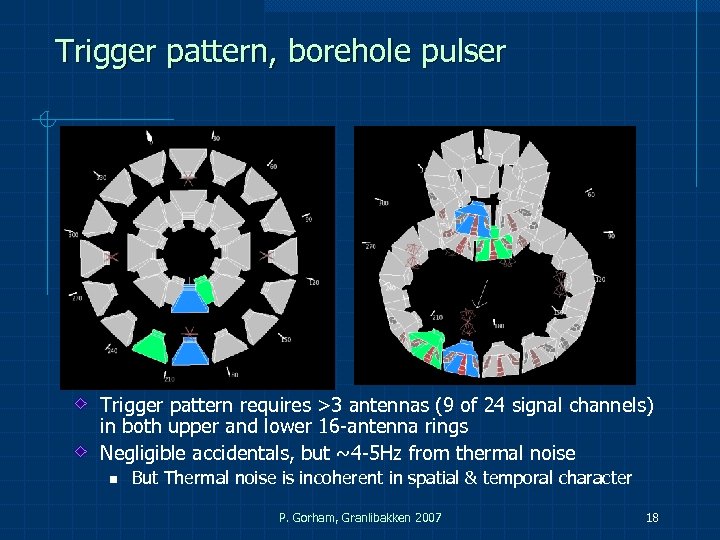 Trigger pattern, borehole pulser Trigger pattern requires >3 antennas (9 of 24 signal channels) in both upper and lower 16 -antenna rings Negligible accidentals, but ~4 -5 Hz from thermal noise n But Thermal noise is incoherent in spatial & temporal character P. Gorham, Granlibakken 2007 18
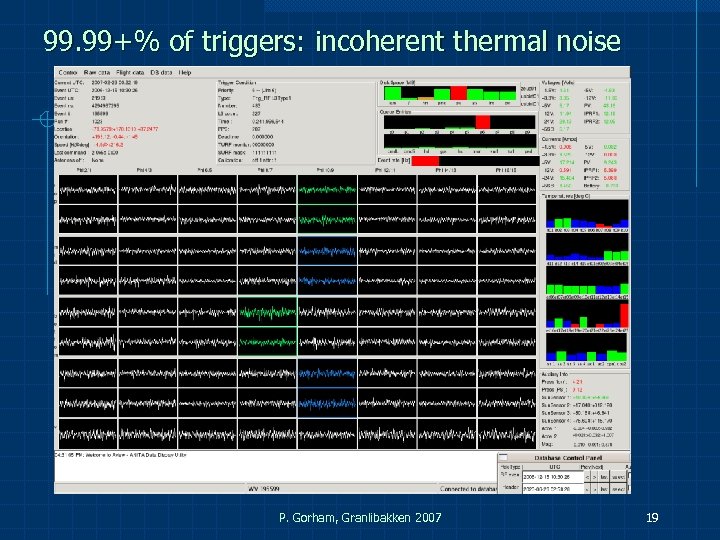 99. 99+% of triggers: incoherent thermal noise P. Gorham, Granlibakken 2007 19
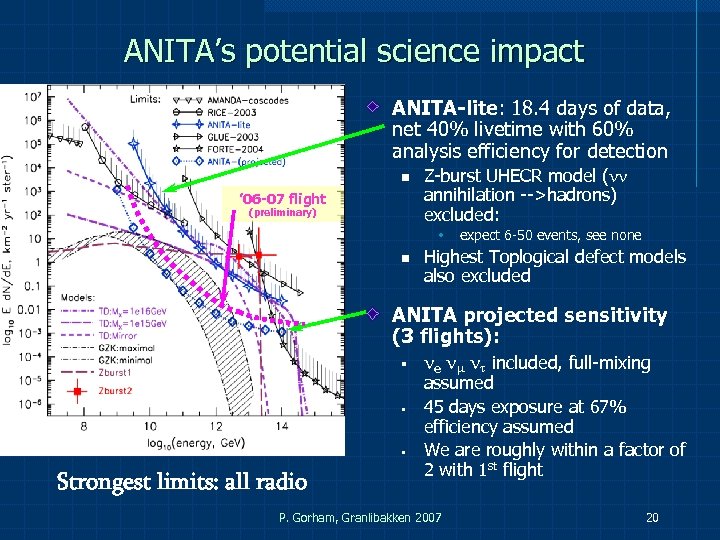 ANITA’s potential science impact ANITA-lite: 18. 4 days of data, net 40% livetime with 60% analysis efficiency for detection n ’ 06 -07 flight (preliminary) Z-burst UHECR model (nn annihilation -->hadrons) excluded: w n expect 6 -50 events, see none Highest Toplogical defect models also excluded ANITA projected sensitivity (3 flights): § ne nm nt included, full-mixing § § Strongest limits: all radio assumed 45 days exposure at 67% efficiency assumed We are roughly within a factor of 2 with 1 st flight P. Gorham, Granlibakken 2007 20
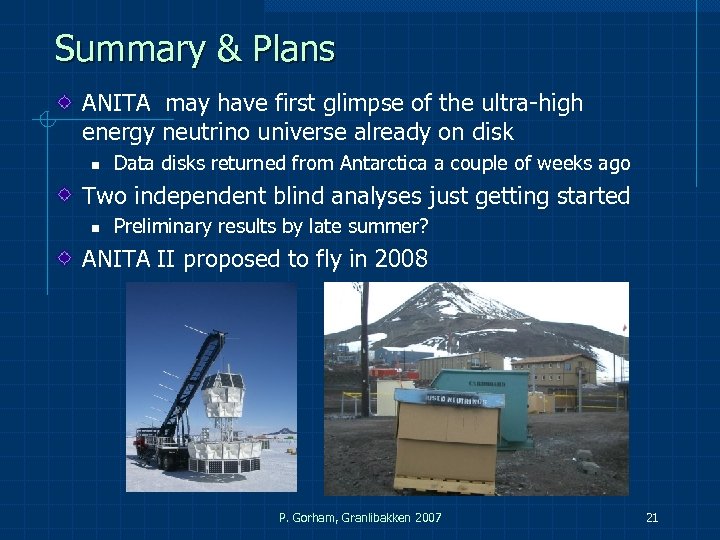 Summary & Plans ANITA may have first glimpse of the ultra-high energy neutrino universe already on disk n Data disks returned from Antarctica a couple of weeks ago Two independent blind analyses just getting started n Preliminary results by late summer? ANITA II proposed to fly in 2008 P. Gorham, Granlibakken 2007 21