


 Скачать презентацию RADIO AIDS NAVIGATION RAN 2204 LECTURE 2
ab2b1421e4590dfefce99f1dad004eee.ppt
- Количество слайдов: 35
 RADIO AIDS & NAVIGATION RAN 2204 LECTURE 2: RADIO COMMUNICATIONS
 Keywords • • • Radio Wavelength Amplitude Frequency Communication System Transmission System Receiver System Signal Electronic Equipment
 History of Communication • Communication was the first requirement for controlling aircraft traffic. • Broadcasting starts in US in 1920 with the invention of RADIO TRANSMITTING EQUIPMENT that capable of transmitting voice and music.
 Radio Transmitting Equipment • The transmitter is the device or installation used to generate and transmit ELECTROMAGNETIC WAVES carrying messages or signals, especially those of radio or television. • The receiver is the part that converts electrical signals into sounds. Example: receiver on radio or television converting broadcast signals into sound or images.
 Communication • Communication is a process of transmitting INFORMATION from one location to another • MEDIUM is required for the delivery of the information to be exchanged
 Medium for Communication • For example : telephone and cable television – Medium for transmission signal is cable and fibre optics • For aircraft or satellite – Medium transmission signal is AIR using ELECTROMAGNETIC WAVES
 What is a Wave A wave is a disturbance that is produced repeatedly, & transfer energy. Often in the form of vibration & oscillation.
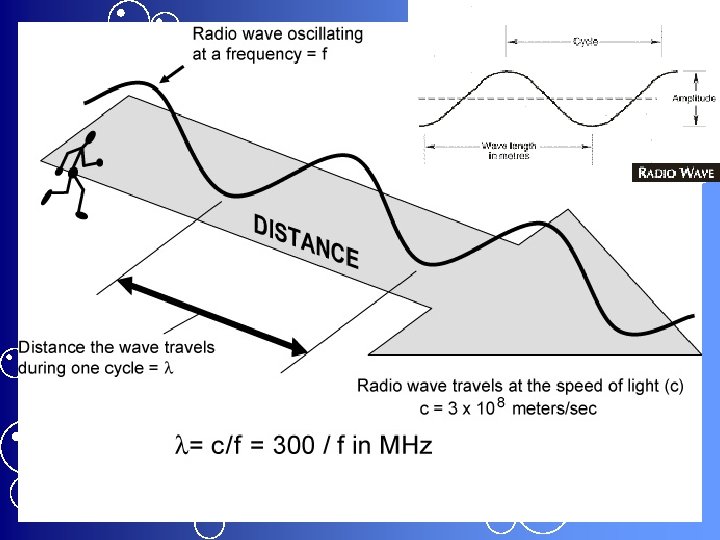
 Frequency, f • Frequency is the number of complete waves passing a given point per second. It is measured in Hertz. • Relationship between frequency, speed and wavelength. • Frequency f= c l l is wavelength, c is speed of light c = 3 108 m/s in vacuum
 Wavelength & Amplitude • Wavelength is the distance a radio wave travels during one cycle. – Wavelength, l = speed of light, c frequency, f • Amplitude is the strength, or width, of one wave; it decreases with distance from the transmitting site.
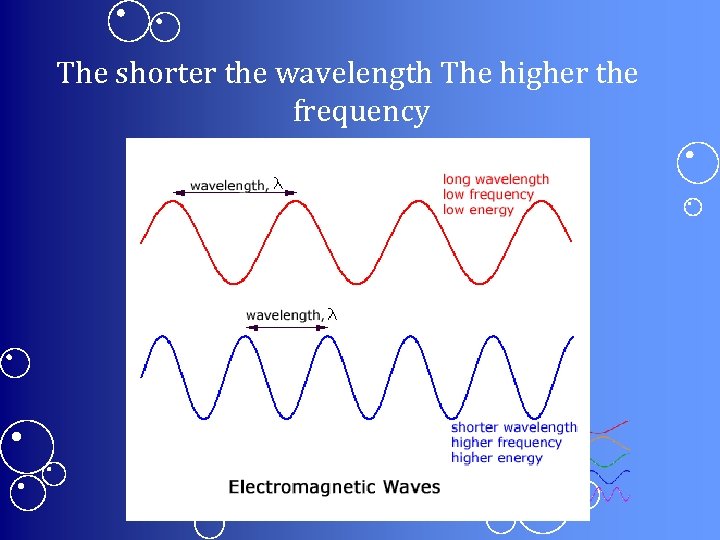 The shorter the wavelength The higher the frequency
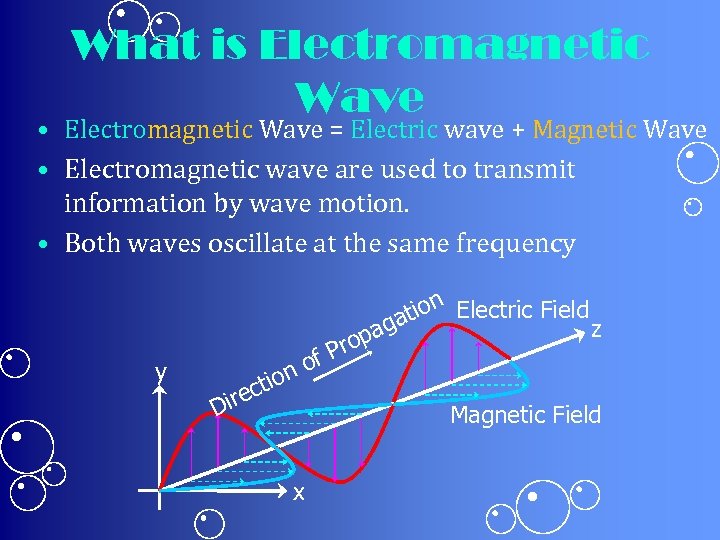 What is Electromagnetic Wave • Electromagnetic Wave = Electric wave + Magnetic Wave • Electromagnetic wave are used to transmit information by wave motion. • Both waves oscillate at the same frequency of n y ctio ire D tion Electric Field z aga op Pr Magnetic Field x
 Examples of Electromagnetic Wave The types of radio wave including: • Radio waves (for TV, radio, aircraft communication, radar) • Microwaves • Infrared radiation • Light • X-rays • Gamma rays
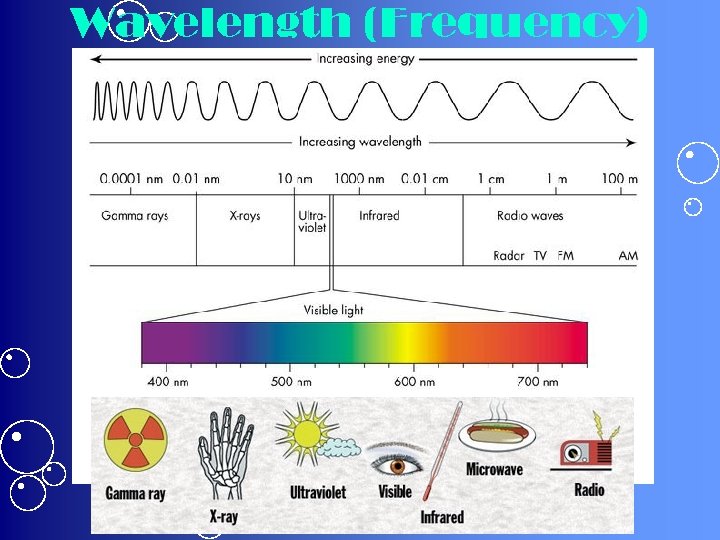 Wavelength (Frequency)
 What is RADIO WAVE • Radio generally works on AIR waves moving across the ATMOSPHERE. • Means that Radio Wave are everywhere. Radio waves are used to carry and to send message to each other. • Radio waves are radiated energy, in free space, they travel in straight lines at the speed of light. • Radio wave can reflect off of clouds or layers of the ionosphere, They also are relayed by satellites in space. • They are used in standard broadcast radio and television, short-wave radio, navigation and air-traffic control. • It is possible as Radio Wave can be sent over a very long distance.
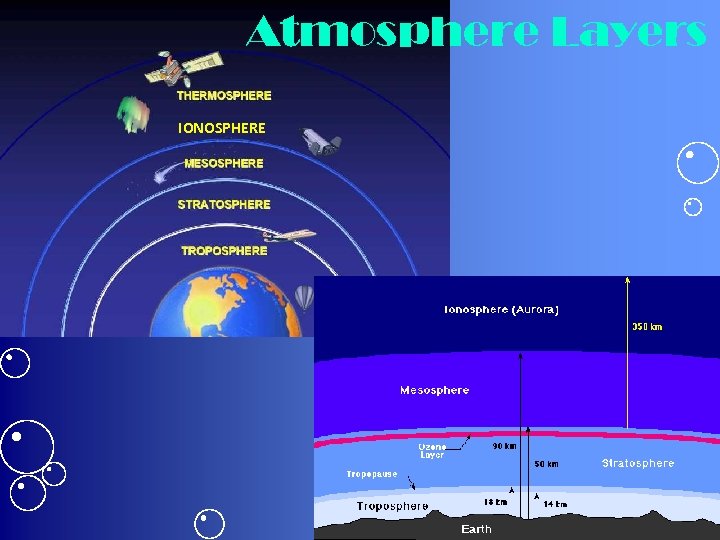 Atmosphere Layers IONOSPHERE
 Atmosphere Layers • Three of the atmosphere layers are: – Troposphere: earth’s surface to about 6. 5 mi – Stratosphere: extends from the troposphere upwards for about 23 mi – Ionosphere: extends from the stratosphere upwards for about 250 mi – Beyond this layer is free space
 Earth Atmosphere • Earth can cause radio wave to take path other than straight line • Significant characteristics of earth – Conductor of electricity – Able to conduct low-frequency • Conductor is a material or device that conducts heat or electricity.
 Earth atmosphere • Another conductor is also the ionosphere layer. • Ionosphere is the layer of ionized gasses. • Ionosphere layer can ct as reflector of radio waves.
 Radio may be subjected to: As Radio Wave moving in air, They will subject to: 1. Reflection (pantulan/lantunan) 2. Refraction (biasan) 3. Diffraction (serakan, sebaran) 4. Attenuation (pengurangan)
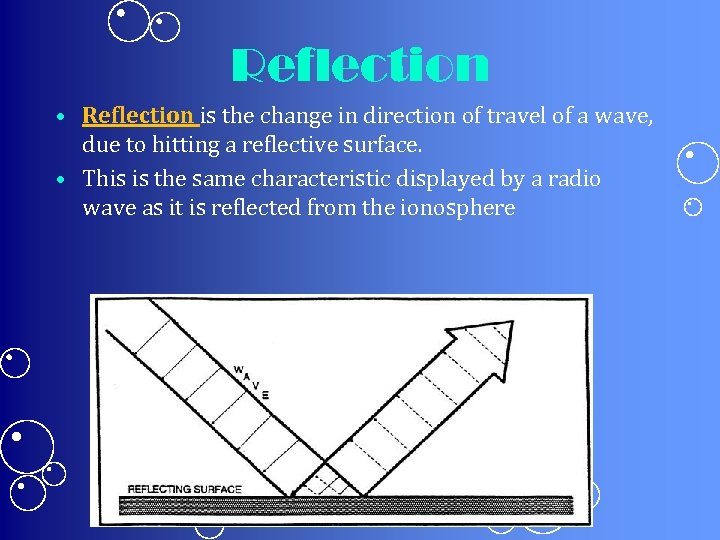 Reflection • Reflection is the change in direction of travel of a wave, due to hitting a reflective surface. • This is the same characteristic displayed by a radio wave as it is reflected from the ionosphere
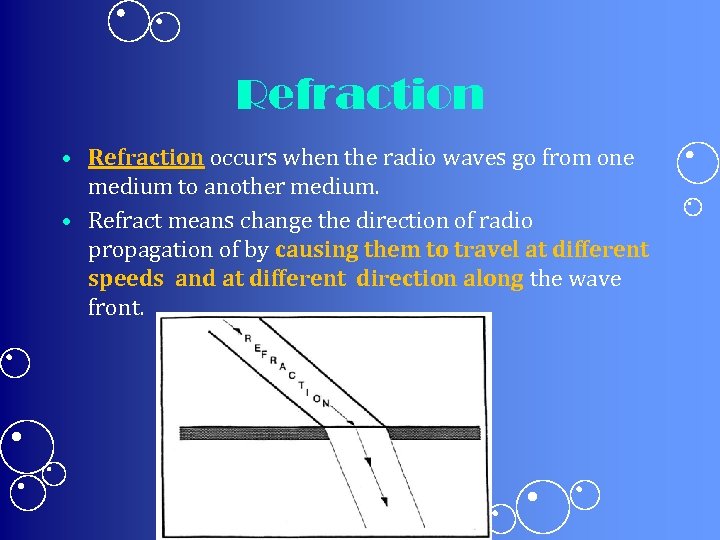 Refraction • Refraction occurs when the radio waves go from one medium to another medium. • Refract means change the direction of radio propagation of by causing them to travel at different speeds and at different direction along the wave front.
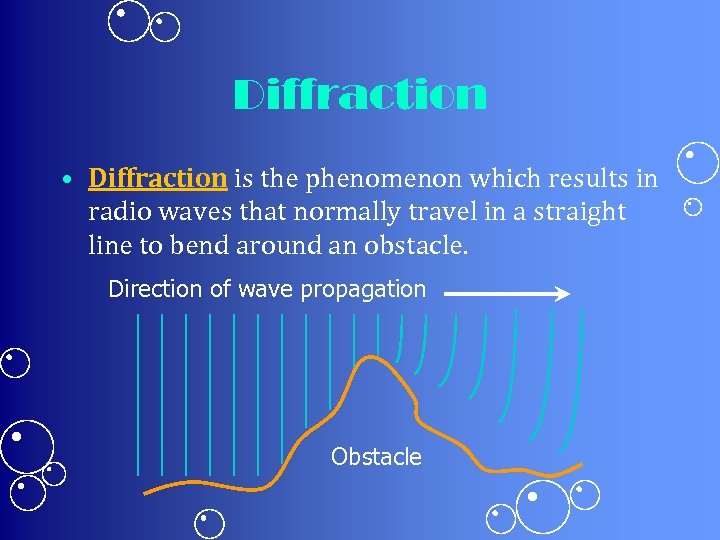 Diffraction • Diffraction is the phenomenon which results in radio waves that normally travel in a straight line to bend around an obstacle. Direction of wave propagation Obstacle
 Attenuation • Attenuation is the loss of wave energy as it travels through a medium. • Or in short word the strength of the radio wave is reduced.
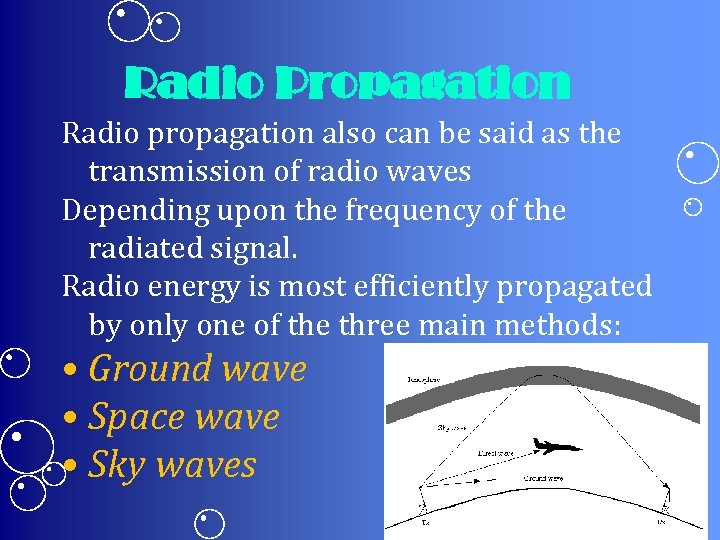 Radio Propagation Radio propagation also can be said as the transmission of radio waves Depending upon the frequency of the radiated signal. Radio energy is most efficiently propagated by only one of the three main methods: • Ground wave • Space wave • Sky waves
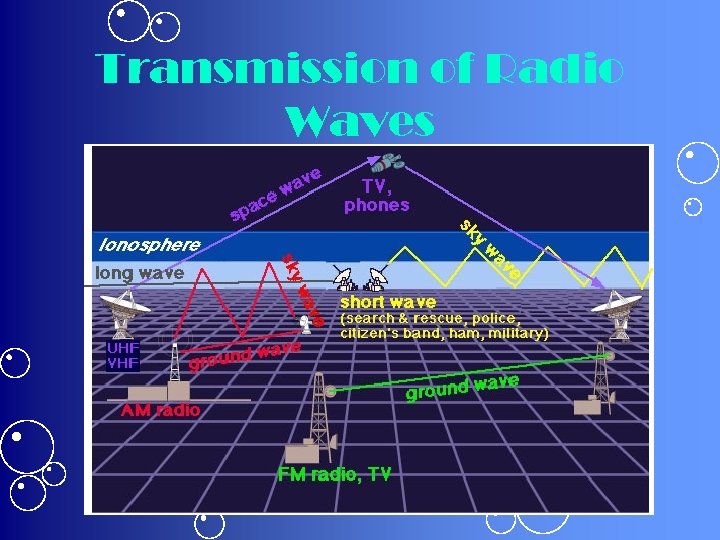 Transmission of Radio Waves
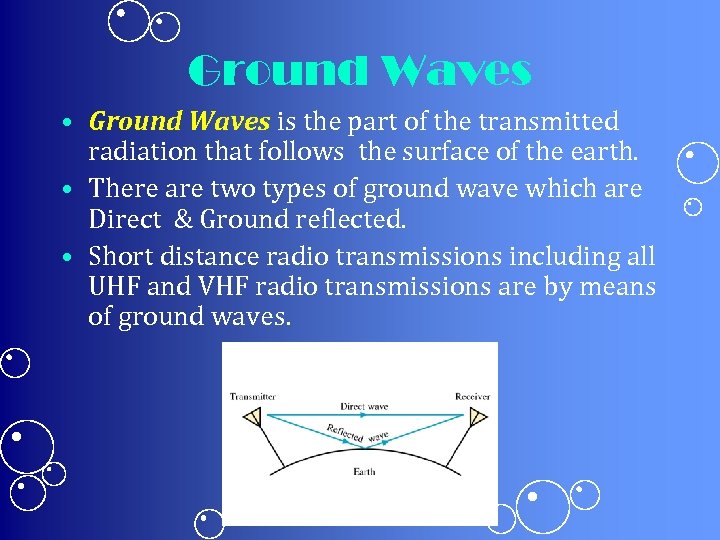 Ground Waves • Ground Waves is the part of the transmitted radiation that follows the surface of the earth. • There are two types of ground wave which are Direct & Ground reflected. • Short distance radio transmissions including all UHF and VHF radio transmissions are by means of ground waves.
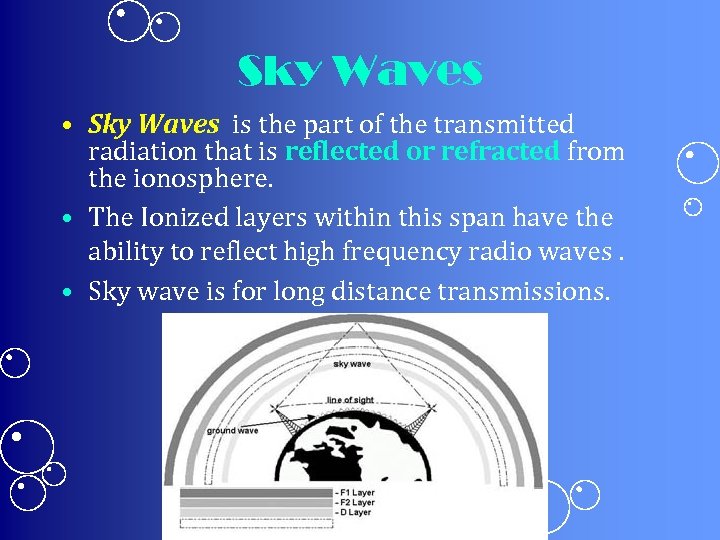 Sky Waves • Sky Waves is the part of the transmitted radiation that is reflected or refracted from the ionosphere. • The Ionized layers within this span have the ability to reflect high frequency radio waves. • Sky wave is for long distance transmissions.
 Space Waves • Space Waves is the part of the transmitted radiation that does not follow the curvature of the earth.
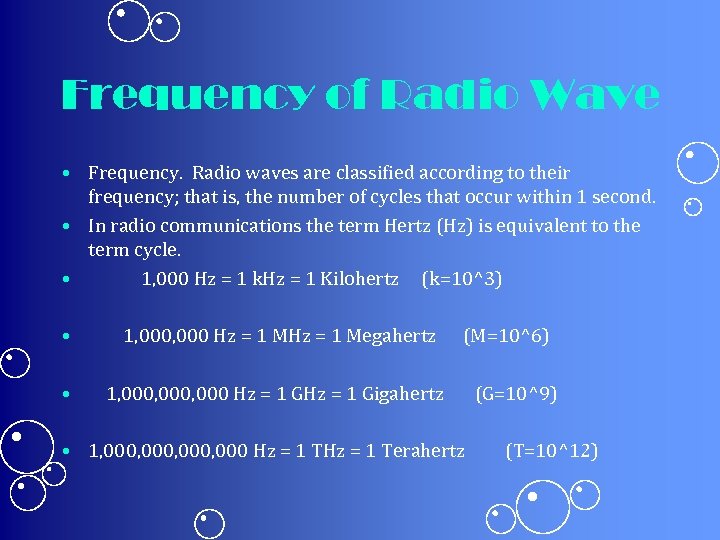 Frequency of Radio Wave • Frequency. Radio waves are classified according to their frequency; that is, the number of cycles that occur within 1 second. • In radio communications the term Hertz (Hz) is equivalent to the term cycle. • 1, 000 Hz = 1 k. Hz = 1 Kilohertz (k=10^3) • 1, 000 Hz = 1 Megahertz • 1, 000, 000 Hz = 1 Gigahertz (M=10^6) • 1, 000, 000 Hz = 1 Terahertz (G=10^9) (T=10^12)
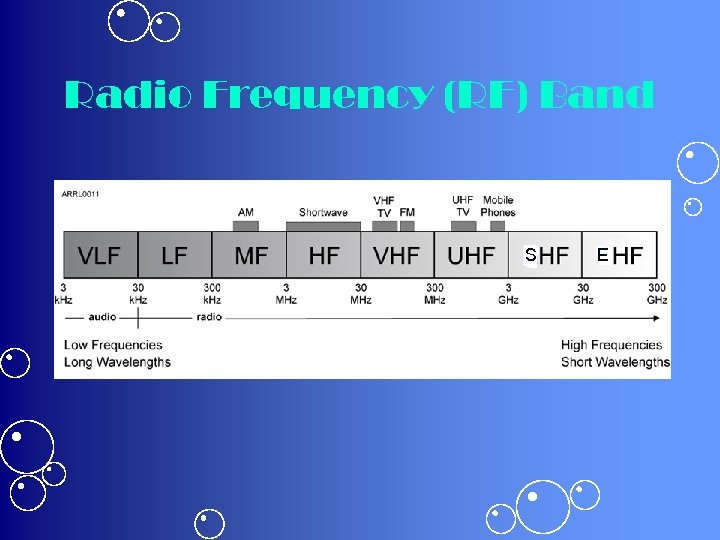 Radio Frequency (RF) Band S E
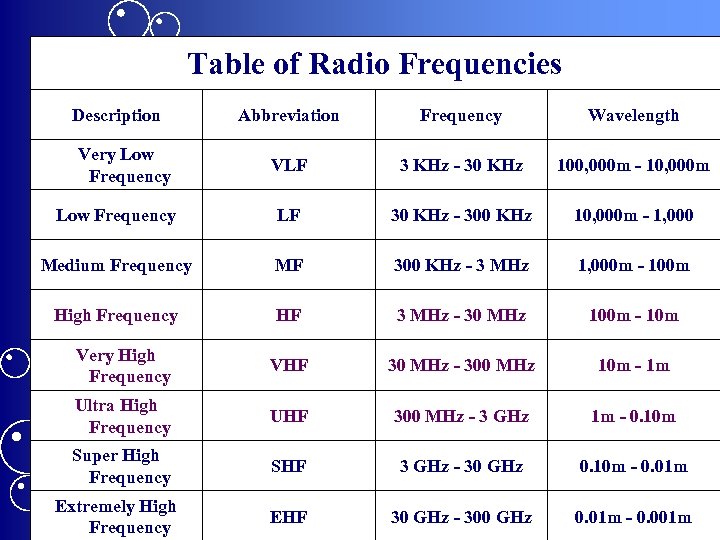 Table of Radio Frequencies Description Very Low Frequency A. RADIO THEORY Abbreviation Frequency Wavelength VLF 3 KHz - 30 KHz 100, 000 m - 10, 000 m Low Frequency LF 30 KHz - 300 KHz 10, 000 m - 1, 000 Medium Frequency MF 300 KHz - 3 MHz 1, 000 m - 100 m High Frequency HF 3 MHz - 30 MHz 100 m - 10 m Very High Frequency VHF 30 MHz - 300 MHz 10 m - 1 m Ultra High Frequency UHF 300 MHz - 3 GHz 1 m - 0. 10 m Super High Frequency SHF 3 GHz - 30 GHz 0. 10 m - 0. 01 m Extremely High Frequency EHF 30 GHz - 300 GHz 0. 01 m - 0. 001 m
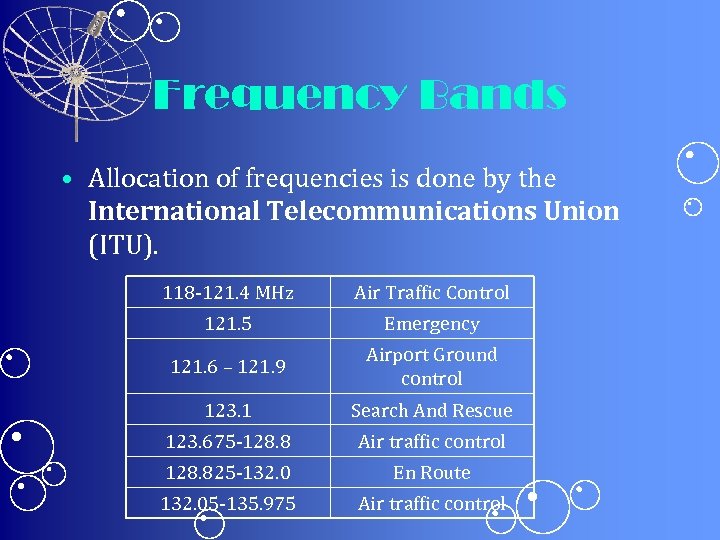 Frequency Bands • Allocation of frequencies is done by the International Telecommunications Union (ITU). 118 -121. 4 MHz Air Traffic Control 121. 5 Emergency 121. 6 – 121. 9 Airport Ground control 123. 1 Search And Rescue 123. 675 -128. 8 Air traffic control 128. 825 -132. 0 En Route 132. 05 -135. 975 Air traffic control
 What is Interference • Interference(disturbance)means the superposition of two or more waves from coherent(same) sources. • There a large number of users of radio communication • How can these users coexist without interfering with each other? • Radio communicators can operate without interfering by choosing different radio frequency • Each frequency generated by electromagnetic waves modulated with information on carrier • Each carrier are distinguished between each other and communication that takes places on one frequency do not interfere with each other
 Modulating Radio Waves: AM vs. FM • Two common ways to carry analog information with radio waves are: 1. Amplitude Modulation (AM)- In A. M. the amplitude of the carrier wave is made to vary in accordance with the audio frequency. • Carries audio for T. V. Broadcasts 2. Frequency Modulation (FM), In F. M the Frequency of the carrier wave is made to vary in accordance with the Audio wave. • Carries video for T. V. Broadcasts