


 Скачать презентацию Radiation protection in NORM industries Karin Wichterey Federal
c1a686a6083dd3fe80486ab3f423bb7a.ppt
- Количество слайдов: 42
 Radiation protection in NORM industries Karin Wichterey Federal Office for Radiation Protection, Germany IRPA 13, Refresher Course (RC 12), 16. 05. 2012, Glasgow
 Content • Natural radioactivity: new field of regulations • Contents of NORM regulations in Germany • Materials / scenarios / pathways • Dose calculations • Impact on industries • Practical experience
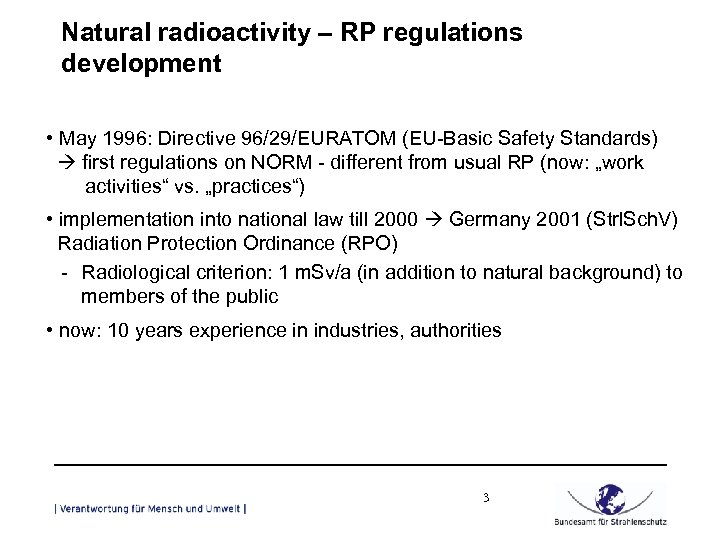 Natural radioactivity – RP regulations development • May 1996: Directive 96/29/EURATOM (EU-Basic Safety Standards) first regulations on NORM - different from usual RP (now: „work activities“ vs. „practices“) • implementation into national law till 2000 Germany 2001 (Strl. Sch. V) Radiation Protection Ordinance (RPO) - Radiological criterion: 1 m. Sv/a (in addition to natural background) to members of the public • now: 10 years experience in industries, authorities 3
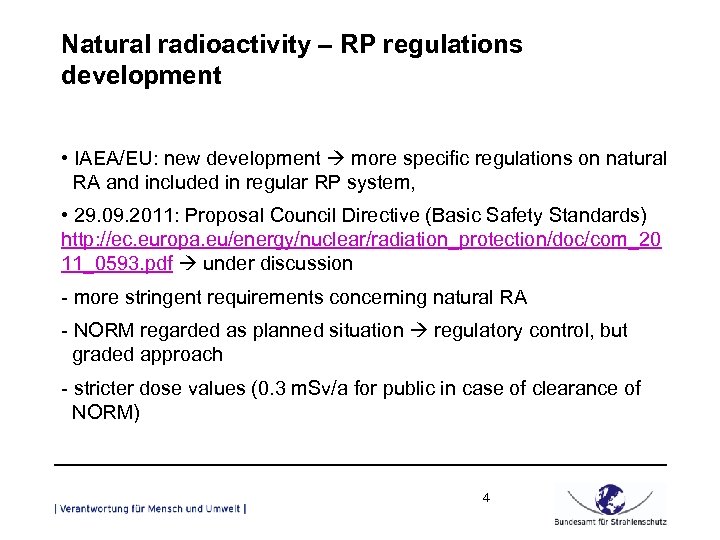 Natural radioactivity – RP regulations development • IAEA/EU: new development more specific regulations on natural RA and included in regular RP system, • 29. 09. 2011: Proposal Council Directive (Basic Safety Standards) http: //ec. europa. eu/energy/nuclear/radiation_protection/doc/com_20 11_0593. pdf under discussion - more stringent requirements concerning natural RA - NORM regarded as planned situation regulatory control, but graded approach - stricter dose values (0. 3 m. Sv/a for public in case of clearance of NORM) 4
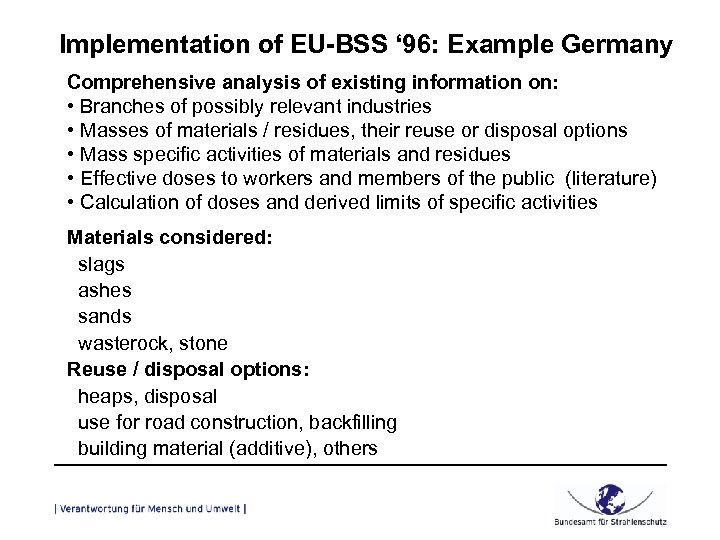 Implementation of EU-BSS ‘ 96: Example Germany Comprehensive analysis of existing information on: • Branches of possibly relevant industries • Masses of materials / residues, their reuse or disposal options • Mass specific activities of materials and residues • Effective doses to workers and members of the public (literature) • Calculation of doses and derived limits of specific activities Materials considered: slags ashes sands wasterock, stone Reuse / disposal options: heaps, disposal use for road construction, backfilling building material (additive), others
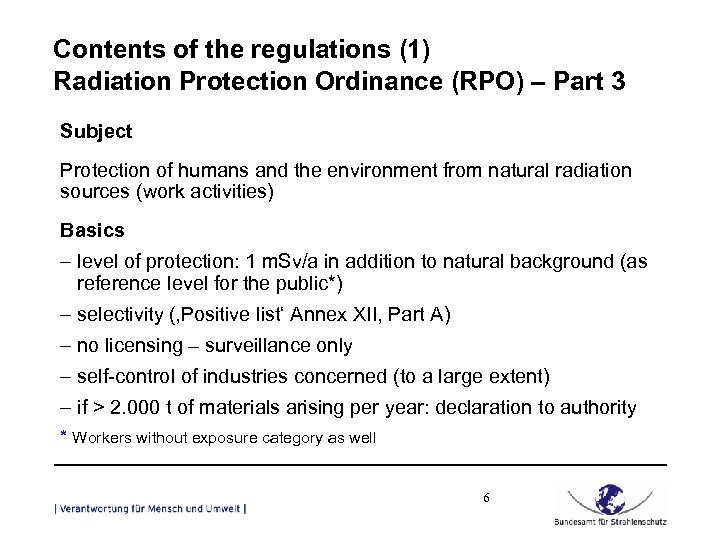 Contents of the regulations (1) Radiation Protection Ordinance (RPO) – Part 3 Subject Protection of humans and the environment from natural radiation sources (work activities) Basics - level of protection: 1 m. Sv/a in addition to natural background (as reference level for the public*) - selectivity (‚Positive list‘ Annex XII, Part A) - no licensing – surveillance only - self-control of industries concerned (to a large extent) - if > 2. 000 t of materials arising per year: declaration to authority * Workers without exposure category as well 6
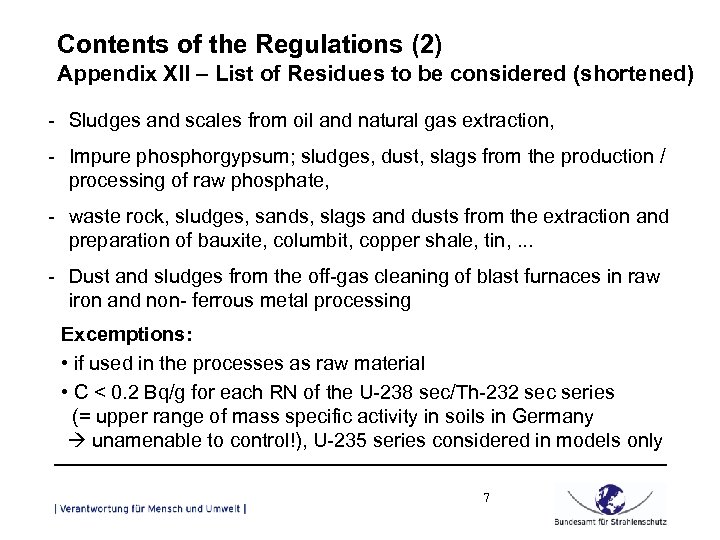 Contents of the Regulations (2) Appendix XII – List of Residues to be considered (shortened) - Sludges and scales from oil and natural gas extraction, - Impure phosphorgypsum; sludges, dust, slags from the production / processing of raw phosphate, - waste rock, sludges, sands, slags and dusts from the extraction and preparation of bauxite, columbit, copper shale, tin, . . . - Dust and sludges from the off-gas cleaning of blast furnaces in raw iron and non- ferrous metal processing Excemptions: • if used in the processes as raw material • C < 0. 2 Bq/g for each RN of the U-238 sec/Th-232 sec series (= upper range of mass specific activity in soils in Germany unamenable to control!), U-235 series considered in models only 7
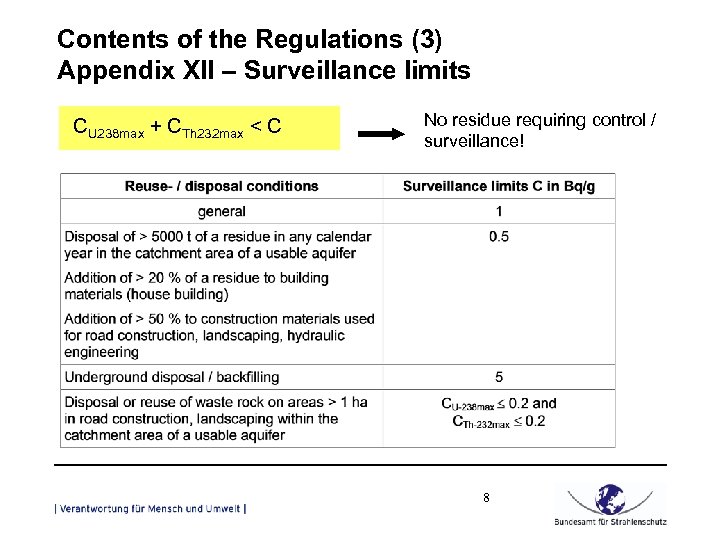 Contents of the Regulations (3) Appendix XII – Surveillance limits CU 238 max + CTh 232 max < C No residue requiring control / surveillance! 8
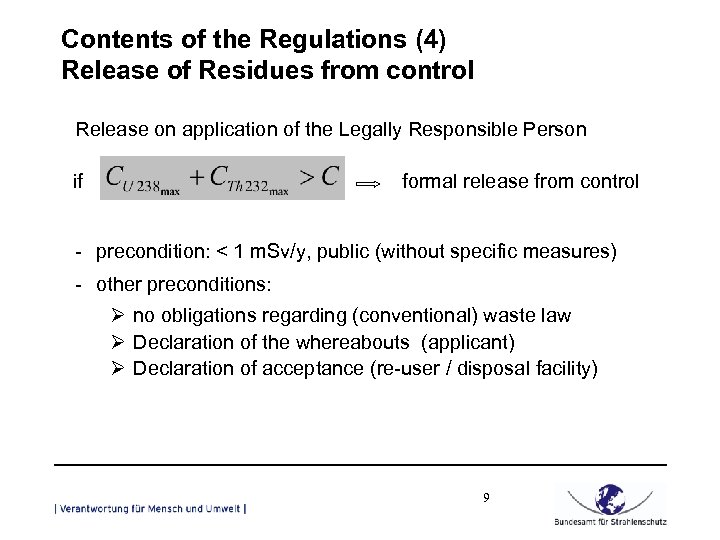 Contents of the Regulations (4) Release of Residues from control Release on application of the Legally Responsible Person formal release from control if - precondition: < 1 m. Sv/y, public (without specific measures) - other preconditions: Ø no obligations regarding (conventional) waste law Ø Declaration of the whereabouts (applicant) Ø Declaration of acceptance (re-user / disposal facility) 9
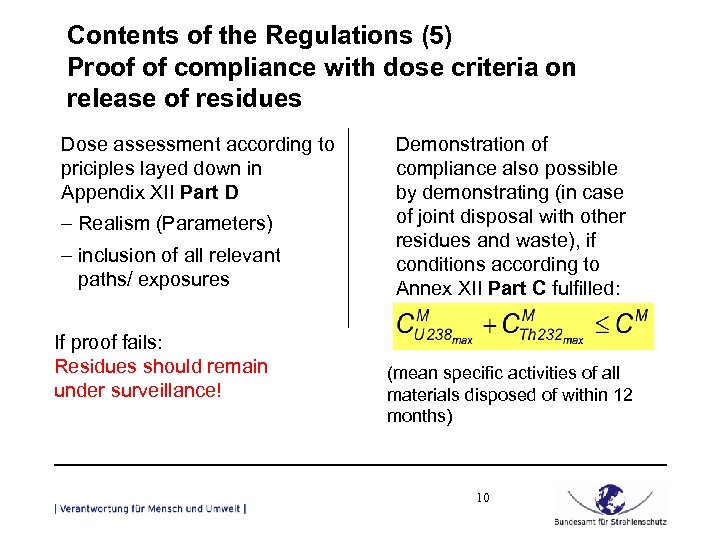 Contents of the Regulations (5) Proof of compliance with dose criteria on release of residues Dose assessment according to priciples layed down in Appendix XII Part D - Realism (Parameters) - inclusion of all relevant paths/ exposures If proof fails: Residues should remain under surveillance! Demonstration of compliance also possible by demonstrating (in case of joint disposal with other residues and waste), if conditions according to Annex XII Part C fulfilled: (mean specific activities of all materials disposed of within 12 months) 10
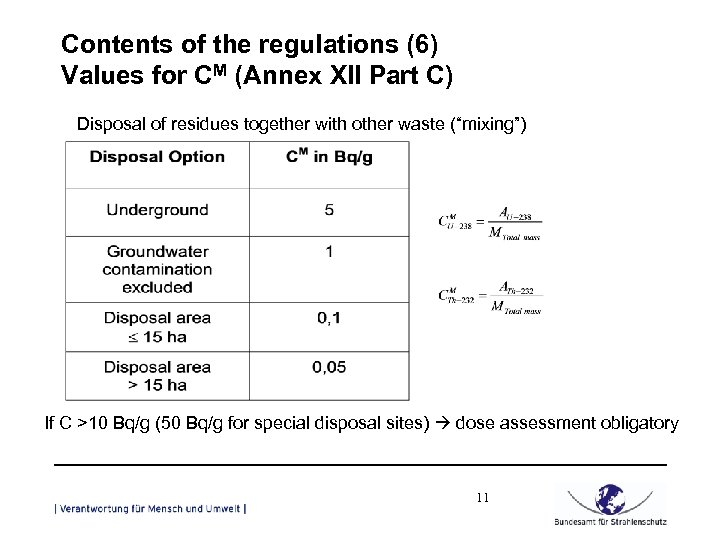 Contents of the regulations (6) Values for CM (Annex XII Part C) Disposal of residues together with other waste (“mixing”) If C >10 Bq/g (50 Bq/g for special disposal sites) dose assessment obligatory 11
 Contents of the regulations (7) Surveillance of other materials Materials: (§ 3 (2) No. 20): Substances comprising natural radioactivity (if not subject to ‚practices‘) • only applicable in case of significantly enhanced exposures • authority may direct: - protective measures - that the materials are to be kept / stored at a specific place - kind of disposal not specific, need for guidelines of application 12
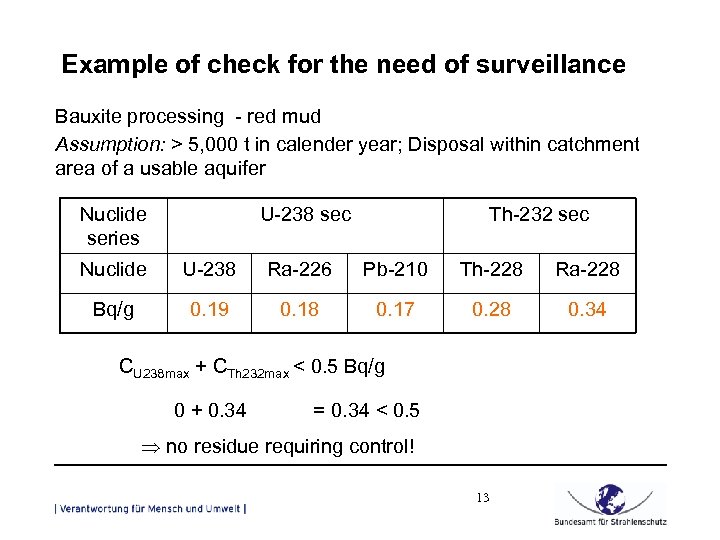 Example of check for the need of surveillance Bauxite processing - red mud Assumption: > 5, 000 t in calender year; Disposal within catchment area of a usable aquifer Nuclide series U-238 sec Th-232 sec Nuclide U-238 Ra-226 Pb-210 Th-228 Ra-228 Bq/g 0. 19 0. 18 0. 17 0. 28 0. 34 CU 238 max + CTh 232 max < 0. 5 Bq/g 0 + 0. 34 = 0. 34 < 0. 5 no residue requiring control! 13
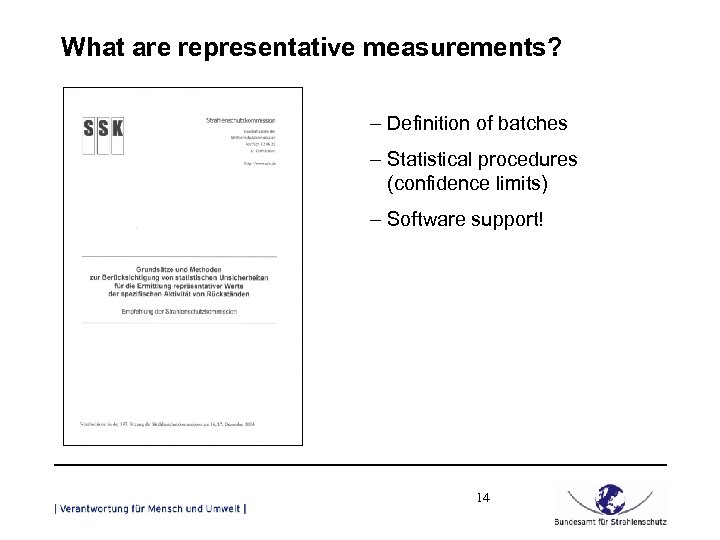 What are representative measurements? - Definition of batches - Statistical procedures (confidence limits) - Software support! 14
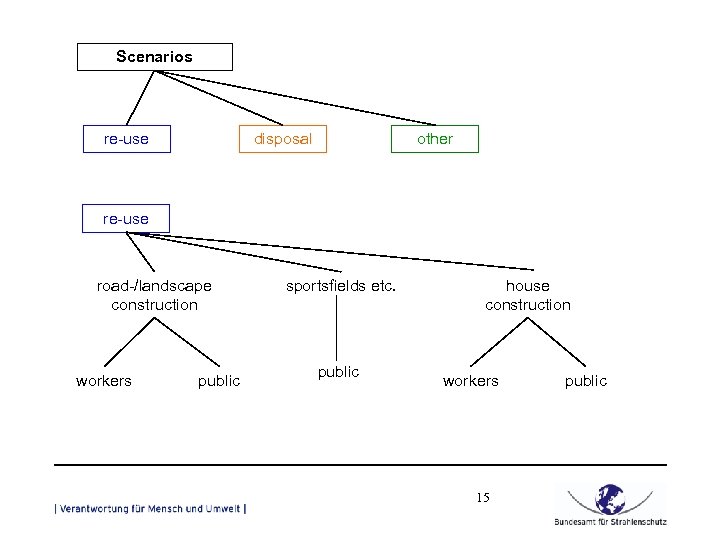 Scenarios re-use disposal other re-use road-/landscape construction workers public sportsfields etc. public house construction workers 15 public
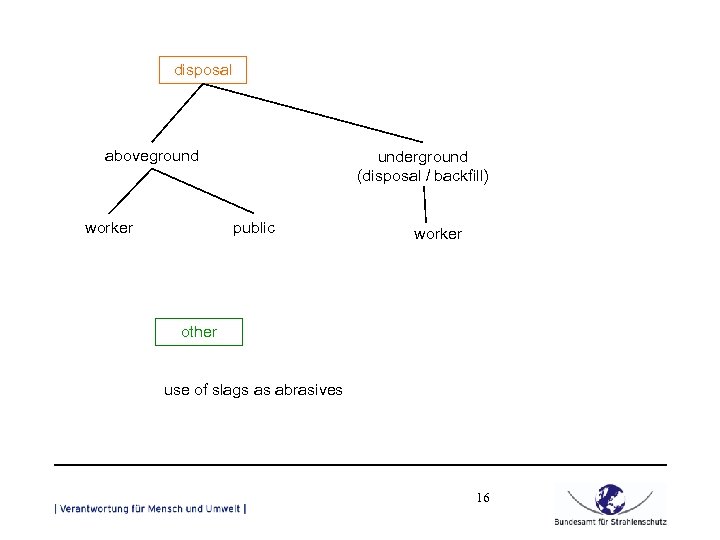 disposal aboveground underground (disposal / backfill) public worker other use of slags as abrasives 16
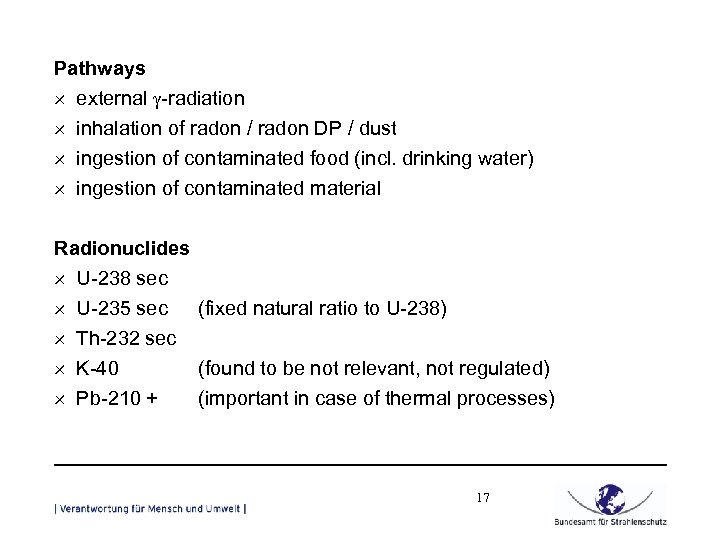 Pathways ´ ´ external -radiation inhalation of radon / radon DP / dust ingestion of contaminated food (incl. drinking water) ingestion of contaminated material Radionuclides ´ ´ ´ U-238 sec U-235 sec Th-232 sec K-40 Pb-210 + (fixed natural ratio to U-238) (found to be not relevant, not regulated) (important in case of thermal processes) 17
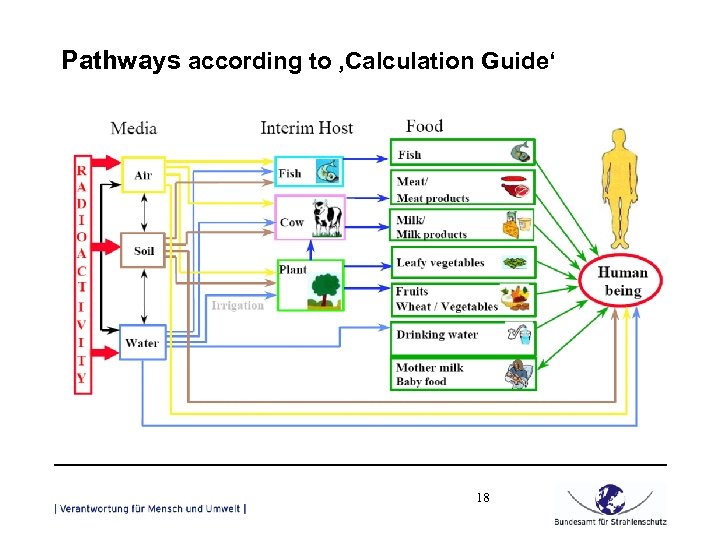 Pathways according to ‚Calculation Guide‘ 18
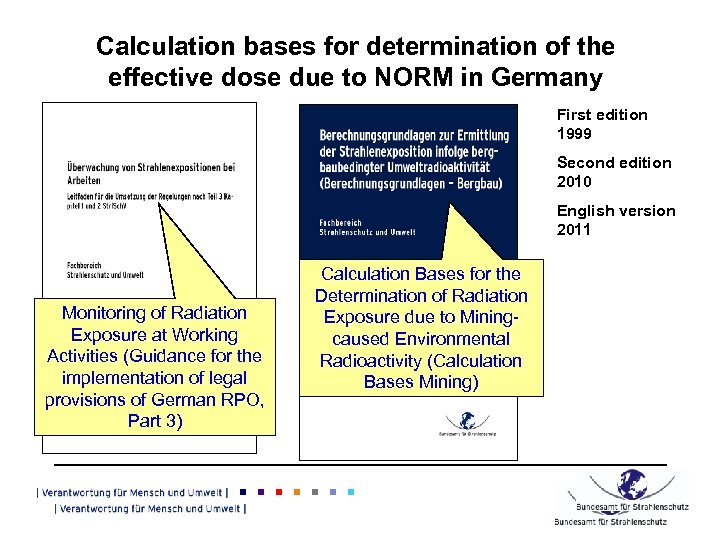 Calculation bases for determination of the effective dose due to NORM in Germany First edition 1999 Second edition 2010 English version 2011 Monitoring of Radiation Exposure at Working Activities (Guidance for the implementation of legal provisions of German RPO, Part 3) Calculation Bases for the Determination of Radiation Exposure due to Miningcaused Environmental Radioactivity (Calculation Bases Mining)
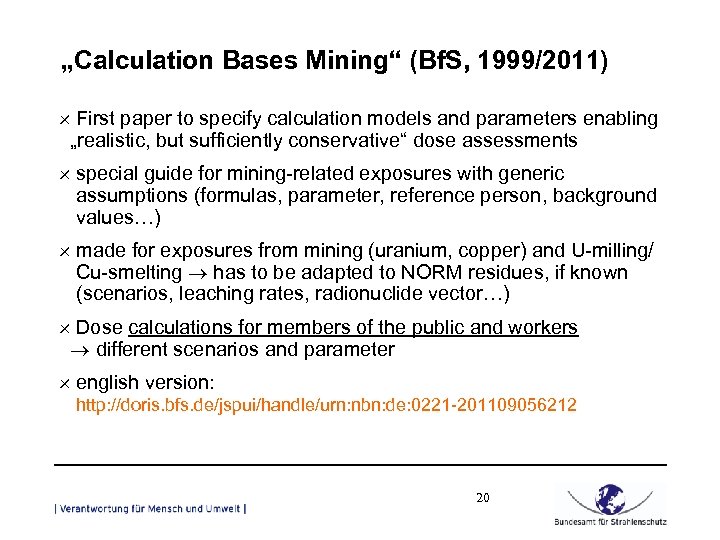 „Calculation Bases Mining“ (Bf. S, 1999/2011) ´ First paper to specify calculation models and parameters enabling „realistic, but sufficiently conservative“ dose assessments ´ special guide for mining-related exposures with generic assumptions (formulas, parameter, reference person, background values…) ´ made for exposures from mining (uranium, copper) and U-milling/ Cu-smelting has to be adapted to NORM residues, if known (scenarios, leaching rates, radionuclide vector…) ´ Dose calculations for members of the public and workers different scenarios and parameter ´ english version: http: //doris. bfs. de/jspui/handle/urn: nbn: de: 0221 -201109056212 20
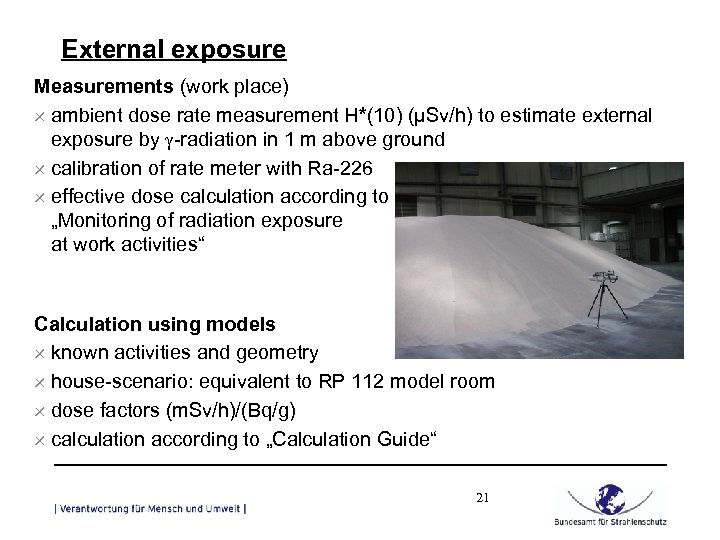 External exposure Measurements (work place) ´ ambient dose rate measurement H*(10) (µSv/h) to estimate external exposure by -radiation in 1 m above ground ´ calibration of rate meter with Ra-226 ´ effective dose calculation according to „Monitoring of radiation exposure at work activities“ Calculation using models ´ known activities and geometry ´ house-scenario: equivalent to RP 112 model room ´ dose factors (m. Sv/h)/(Bq/g) ´ calculation according to „Calculation Guide“ 21
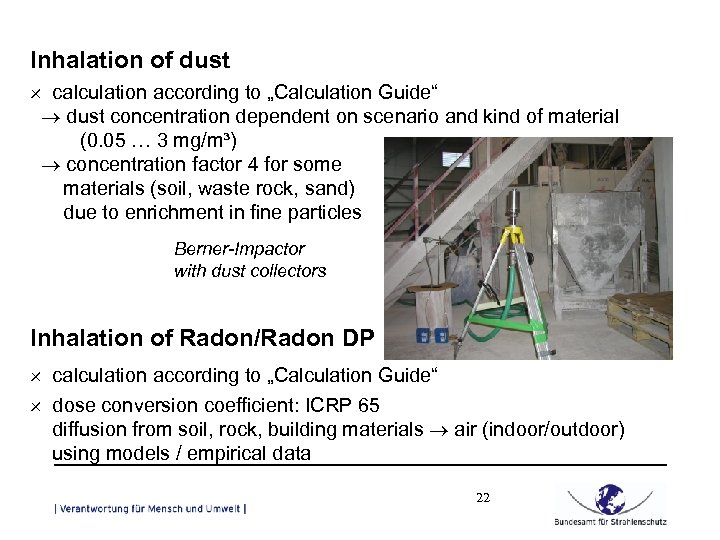 Inhalation of dust ´ calculation according to „Calculation Guide“ dust concentration dependent on scenario and kind of material (0. 05 … 3 mg/m³) concentration factor 4 for some materials (soil, waste rock, sand) due to enrichment in fine particles Berner-Impactor with dust collectors Inhalation of Radon/Radon DP ´ calculation according to „Calculation Guide“ ´ dose conversion coefficient: ICRP 65 diffusion from soil, rock, building materials air (indoor/outdoor) using models / empirical data 22
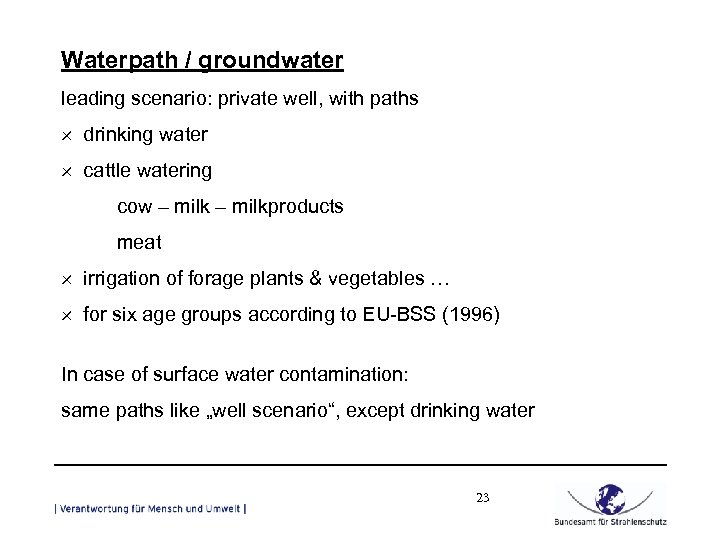 Waterpath / groundwater leading scenario: private well, with paths ´ drinking water ´ cattle watering cow – milkproducts meat ´ irrigation of forage plants & vegetables … ´ for six age groups according to EU-BSS (1996) In case of surface water contamination: same paths like „well scenario“, except drinking water 23
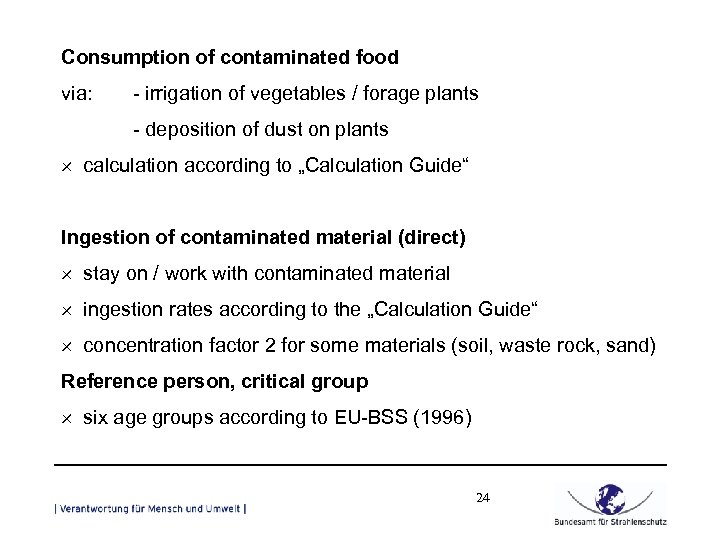 Consumption of contaminated food via: - irrigation of vegetables / forage plants - deposition of dust on plants ´ calculation according to „Calculation Guide“ Ingestion of contaminated material (direct) ´ stay on / work with contaminated material ´ ingestion rates according to the „Calculation Guide“ ´ concentration factor 2 for some materials (soil, waste rock, sand) Reference person, critical group ´ six age groups according to EU-BSS (1996) 24
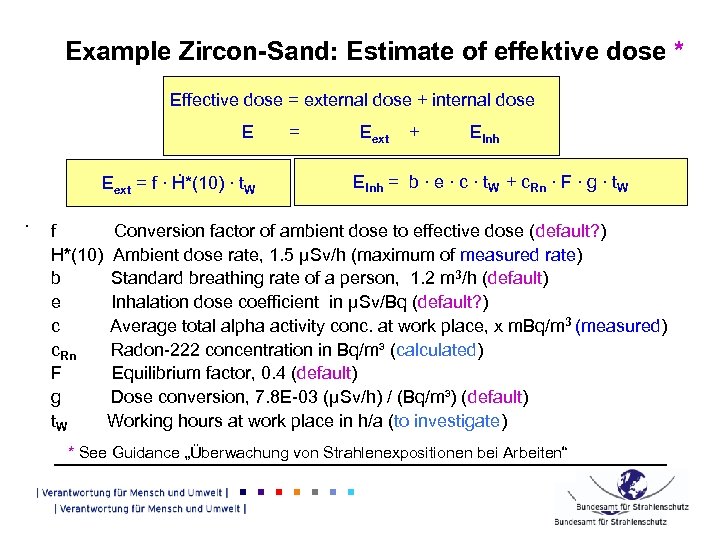 Example Zircon-Sand: Estimate of effektive dose * Effective dose = external dose + internal dose E. Eext = f ∙ H*(10) ∙ t. W. = Eext + EInh = b ∙ e ∙ c ∙ t. W + c. Rn ∙ F ∙ g ∙ t. W f Conversion factor of ambient dose to effective dose (default? ) H*(10) Ambient dose rate, 1. 5 µSv/h (maximum of measured rate) b Standard breathing rate of a person, 1. 2 m 3/h (default) e Inhalation dose coefficient in µSv/Bq (default? ) c Average total alpha activity conc. at work place, x m. Bq/m 3 (measured) c. Rn Radon-222 concentration in Bq/m³ (calculated) F Equilibrium factor, 0. 4 (default) g Dose conversion, 7. 8 E-03 (µSv/h) / (Bq/m³) (default) t. W Working hours at work place in h/a (to investigate) * See Guidance „Überwachung von Strahlenexpositionen bei Arbeiten“
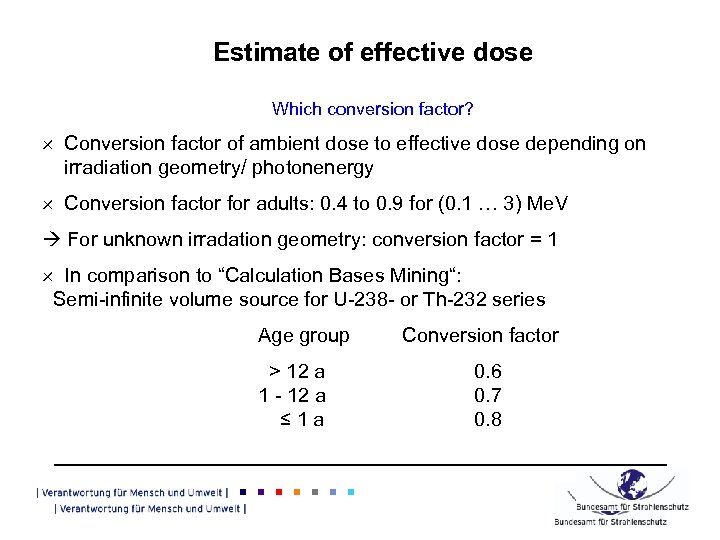 Estimate of effective dose Which conversion factor? ´ Conversion factor of ambient dose to effective dose depending on irradiation geometry/ photonenergy ´ Conversion factor for adults: 0. 4 to 0. 9 for (0. 1 … 3) Me. V For unknown irradation geometry: conversion factor = 1 ´ In comparison to “Calculation Bases Mining“: Semi-infinite volume source for U-238 - or Th-232 series Age group > 12 a 1 - 12 a ≤ 1 a Conversion factor 0. 6 0. 7 0. 8
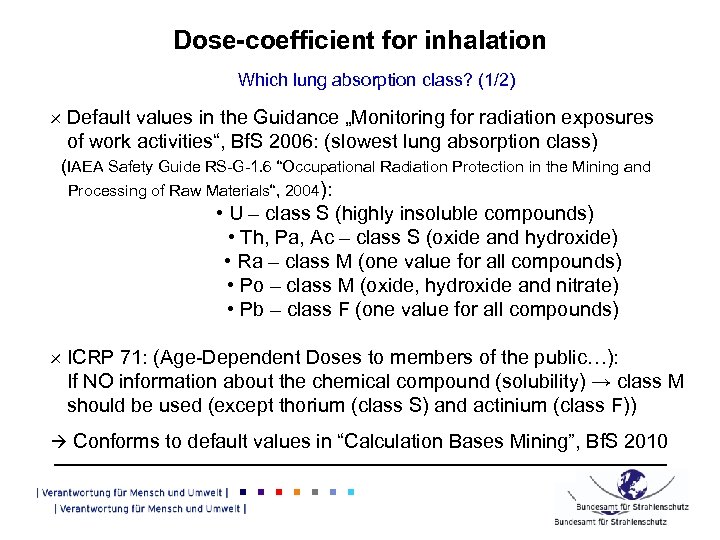 Dose-coefficient for inhalation Which lung absorption class? (1/2) ´ Default values in the Guidance „Monitoring for radiation exposures of work activities“, Bf. S 2006: (slowest lung absorption class) (IAEA Safety Guide RS-G-1. 6 “Occupational Radiation Protection in the Mining and Processing of Raw Materials“, 2004): • U – class S (highly insoluble compounds) • Th, Pa, Ac – class S (oxide and hydroxide) • Ra – class M (one value for all compounds) • Po – class M (oxide, hydroxide and nitrate) • Pb – class F (one value for all compounds) ´ ICRP 71: (Age-Dependent Doses to members of the public…): If NO information about the chemical compound (solubility) → class M should be used (except thorium (class S) and actinium (class F)) Conforms to default values in “Calculation Bases Mining”, Bf. S 2010
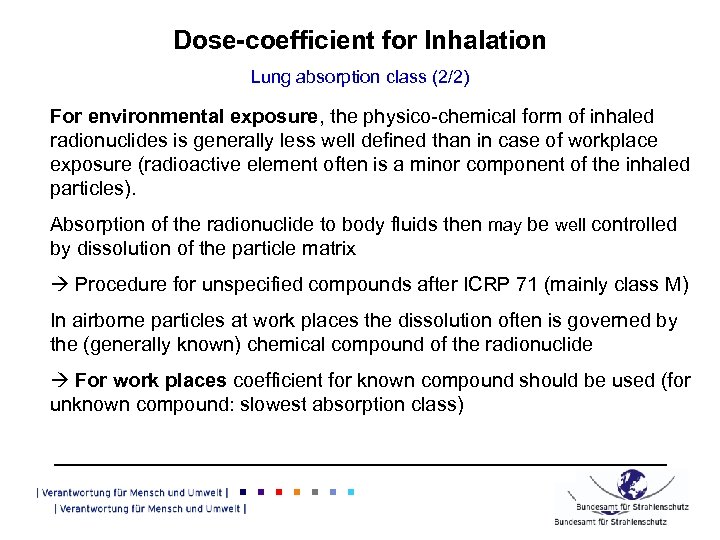 Dose-coefficient for Inhalation Lung absorption class (2/2) For environmental exposure, the physico-chemical form of inhaled radionuclides is generally less well defined than in case of workplace exposure (radioactive element often is a minor component of the inhaled particles). Absorption of the radionuclide to body fluids then may be well controlled by dissolution of the particle matrix Procedure for unspecified compounds after ICRP 71 (mainly class M) In airborne particles at work places the dissolution often is governed by the (generally known) chemical compound of the radionuclide For work places coefficient for known compound should be used (for unknown compound: slowest absorption class)
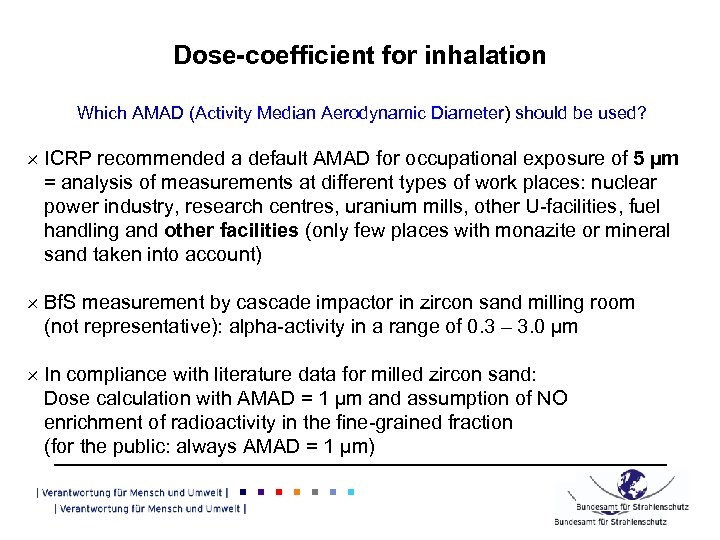 Dose-coefficient for inhalation Which AMAD (Activity Median Aerodynamic Diameter) should be used? ´ ICRP recommended a default AMAD for occupational exposure of 5 µm = analysis of measurements at different types of work places: nuclear power industry, research centres, uranium mills, other U-facilities, fuel handling and other facilities (only few places with monazite or mineral sand taken into account) ´ Bf. S measurement by cascade impactor in zircon sand milling room (not representative): alpha-activity in a range of 0. 3 – 3. 0 µm ´ In compliance with literature data for milled zircon sand: Dose calculation with AMAD = 1 µm and assumption of NO enrichment of radioactivity in the fine-grained fraction (for the public: always AMAD = 1 µm)
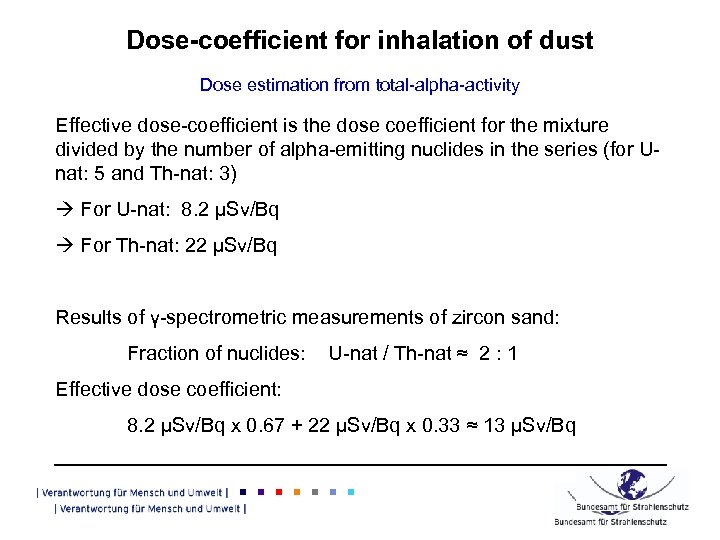 Dose-coefficient for inhalation of dust Dose estimation from total-alpha-activity Effective dose-coefficient is the dose coefficient for the mixture divided by the number of alpha-emitting nuclides in the series (for Unat: 5 and Th-nat: 3) For U-nat: 8. 2 µSv/Bq For Th-nat: 22 µSv/Bq Results of γ-spectrometric measurements of zircon sand: Fraction of nuclides: U-nat / Th-nat ≈ 2 : 1 Effective dose coefficient: 8. 2 µSv/Bq x 0. 67 + 22 µSv/Bq x 0. 33 ≈ 13 µSv/Bq
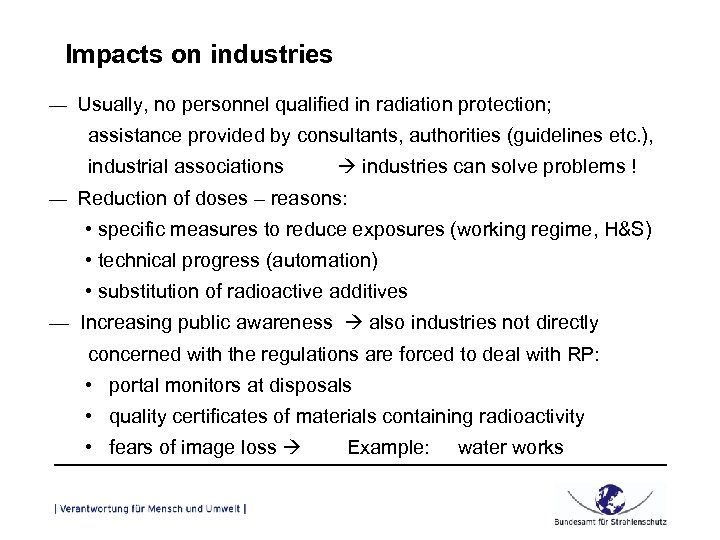 Impacts on industries — Usually, no personnel qualified in radiation protection; assistance provided by consultants, authorities (guidelines etc. ), industrial associations industries can solve problems ! — Reduction of doses – reasons: • specific measures to reduce exposures (working regime, H&S) • technical progress (automation) • substitution of radioactive additives — Increasing public awareness also industries not directly concerned with the regulations are forced to deal with RP: • portal monitors at disposals • quality certificates of materials containing radioactivity • fears of image loss Example: water works
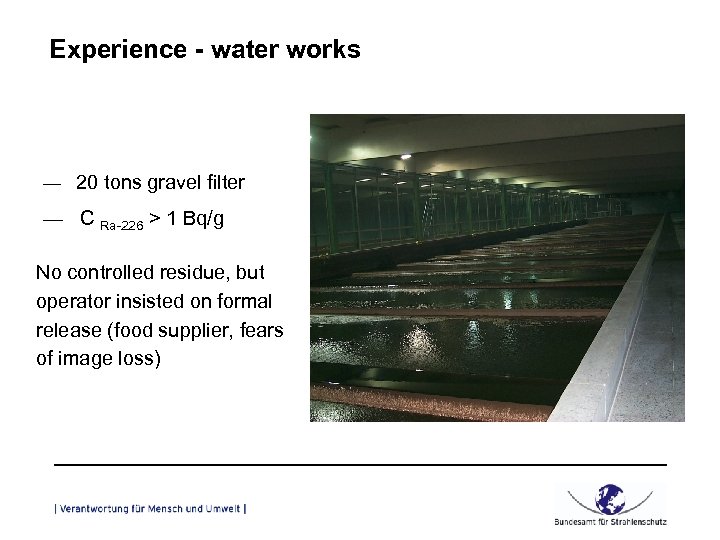 Experience - water works — 20 tons gravel filter — C Ra-226 > 1 Bq/g No controlled residue, but operator insisted on formal release (food supplier, fears of image loss)
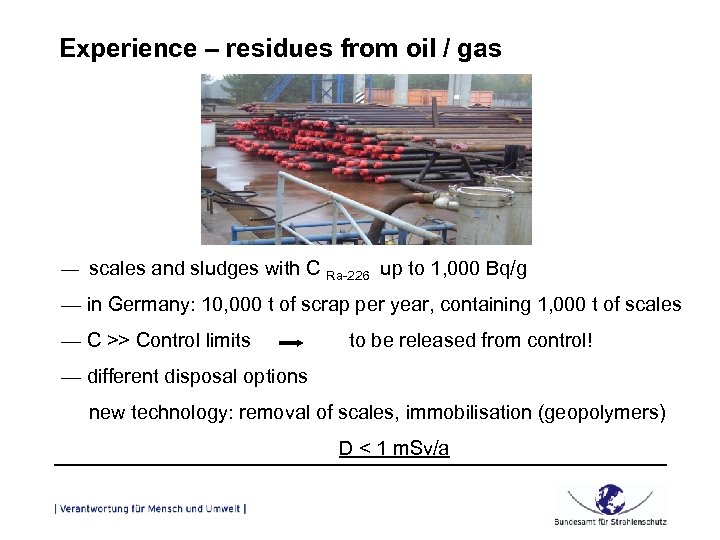 Experience – residues from oil / gas — scales and sludges with C Ra-226 up to 1, 000 Bq/g — in Germany: 10, 000 t of scrap per year, containing 1, 000 t of scales — C >> Control limits to be released from control! — different disposal options new technology: removal of scales, immobilisation (geopolymers) D < 1 m. Sv/a
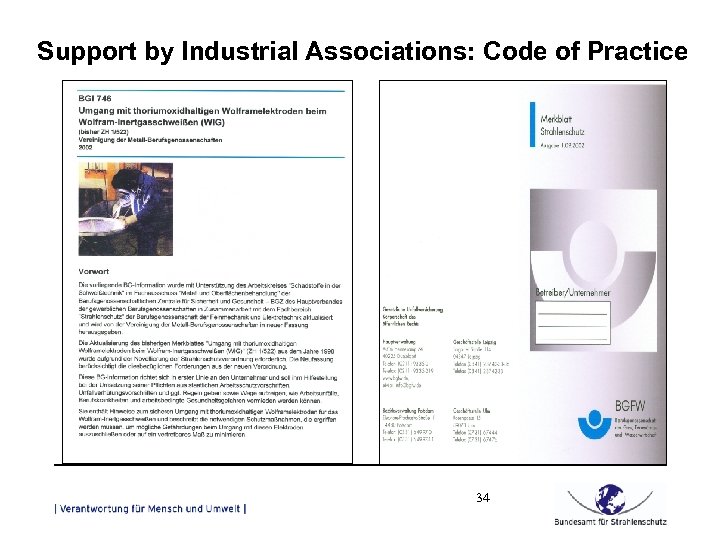 Support by Industrial Associations: Code of Practice 34
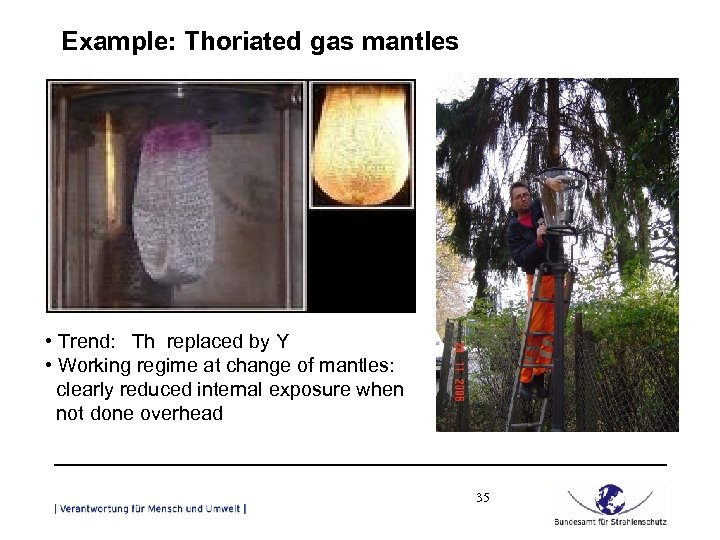 Example: Thoriated gas mantles • Trend: Th replaced by Y • Working regime at change of mantles: clearly reduced internal exposure when not done overhead 35
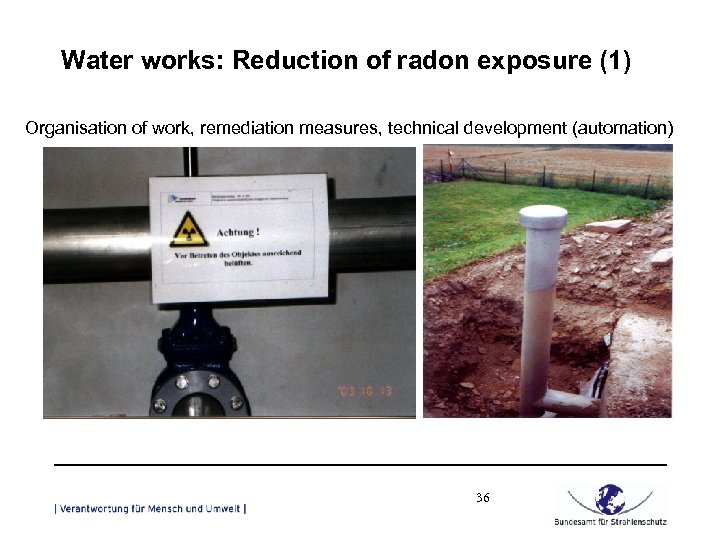 Water works: Reduction of radon exposure (1) Organisation of work, remediation measures, technical development (automation) 36
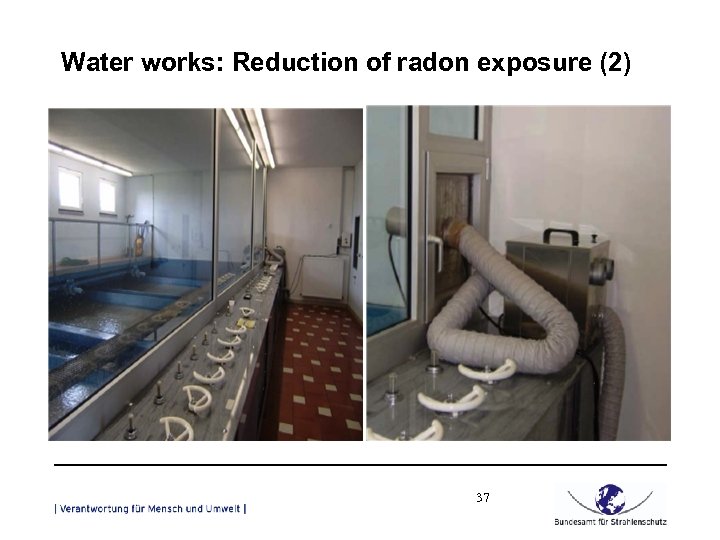 Water works: Reduction of radon exposure (2) 37
 Experience - practical problems (1) — specification of residues to be controlled is suitable to confine regulatory and practical effort Problem: changing industries, raw materials, processes (e. g. geothermal energy) need for updates !? — some possibly important materials are not listed (e. g. filter gravel) — specification of residues partly not precise enough examples: ‚scales from oil production‘ – and if enclosed in pipes ( = scrap? ) ‚residues from the extraction and preparation of bauxite‘
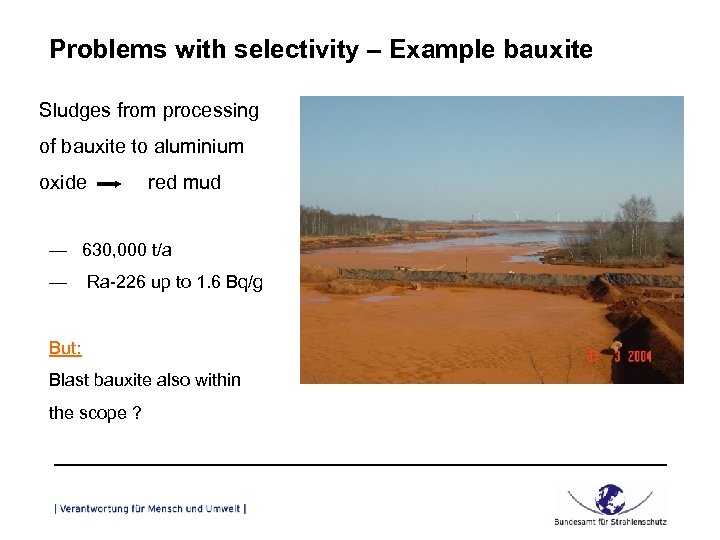 Problems with selectivity – Example bauxite Sludges from processing of bauxite to aluminium oxide red mud — 630, 000 t/a — Ra-226 up to 1. 6 Bq/g But: Blast bauxite also within the scope ?
 Experience - practical problems (2) — some disposal operators reluctant to accept radioactive materials (although released residues are not radioactive in the meaning of law) — regulatory inconsistencies with ADR (European regulations on the carriage of dangerous goods by road): exceedance of ADR limits class 7 transport as „radioactive material“, but not in the sense of RPO (released from surveillance) Some further poblems: — standardisation of methods, models, parameters — NORM specific calculation guide for dose assessments — simple measurement methods (dosemeters, contamination monitors)
 Conclusions Regulations on NORM partly lead to a considerable decrease of exposures of workers In other fields exposures turned out to have been overestimated in the past realistic rather than conservative dose estimates Guideline for dose assessments necessary Regulated workplaces / residues partly not up to date more flexibility desirable! Concept of self-control has proven itself to be adequate (no authorization necessary), but needs assistence by RP professionals 41
 Good luck with the implementation of radiation protection in NORM industries! Thank you for your attention! For questions: Bundesamt für Strahlenschutz SW 1. 2: Natürlich vorkommende radioaktive Materialien, radiologische Altlasten Karin Wichterey +49 -3018 - 333 -4249 kwichterey@bfs. de 42