 Скачать презентацию RADARSAT Constellation Mission Daniel De Lisle on behalf
2945e28f28bd5b67afa62db228ec2967.ppt
- Количество слайдов: 24



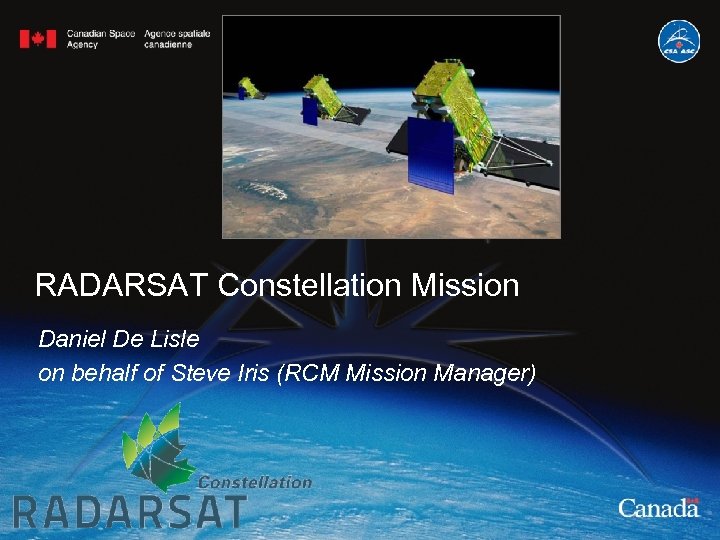
RADARSAT Constellation Mission Daniel De Lisle on behalf of Steve Iris (RCM Mission Manager)
RCM Key Mission Drivers • Continuity of C-Band SAR for Operational Users • Improved revisit over wide areas • Responsive Ground Segment (tasking and latency) • Smaller, more cost efficient satellite development • Improved reliability (i. e. redundancy and scalability) • Evolution to wider Operational use • Government-owned and operated 2
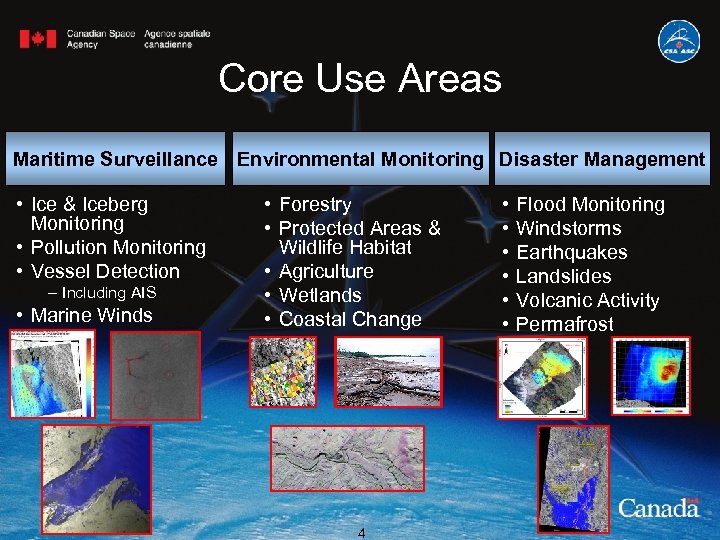
Core Use Areas Maritime Surveillance Environmental Monitoring Disaster Management • Ice & Iceberg Monitoring • Pollution Monitoring • Vessel Detection – Including AIS • Marine Winds • Forestry • Protected Areas & Wildlife Habitat • Agriculture • Wetlands • Coastal Change 4 • • • Flood Monitoring Windstorms Earthquakes Landslides Volcanic Activity Permafrost
Users involvement User & Science Team The U&ST was formed at the early stage of the project (2005 -phase A) to engage end user department to ensure requirements would be addressed and capture in the mission development. User Requirements Document U&ST primary work was to develop the URD including inputs from Canadian Government Departments stakeholders. Mission Requirements Document URD was used as the input to the development of the MRD. This hi-level document is keeping updated to ensure that the end-to-end system meets the mission objectives and user requirements.
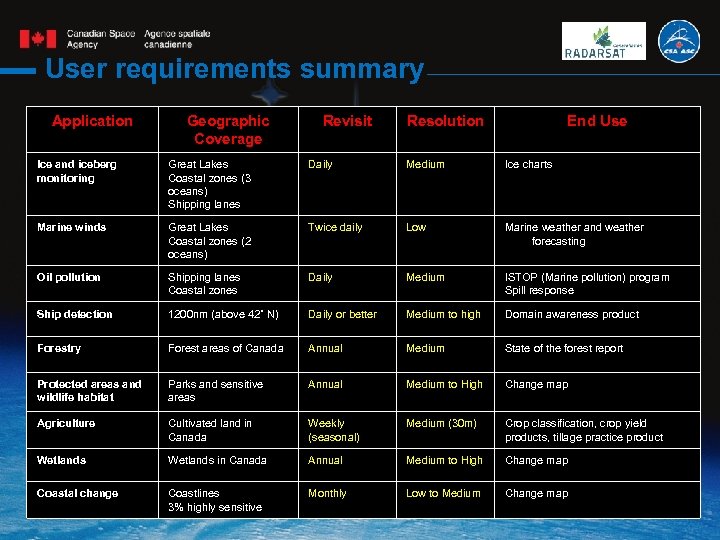
User requirements summary Application Geographic Coverage Revisit Resolution End Use Ice and iceberg monitoring Great Lakes Coastal zones (3 oceans) Shipping lanes Daily Medium Ice charts Marine winds Great Lakes Coastal zones (2 oceans) Twice daily Low Marine weather and weather forecasting Oil pollution Shipping lanes Coastal zones Daily Medium ISTOP (Marine pollution) program Spill response Ship detection 1200 nm (above 42˚ N) Daily or better Medium to high Domain awareness product Forestry Forest areas of Canada Annual Medium State of the forest report Protected areas and wildlife habitat Parks and sensitive areas Annual Medium to High Change map Agriculture Cultivated land in Canada Weekly (seasonal) Medium (30 m) Crop classification, crop yield products, tillage practice product Wetlands in Canada Annual Medium to High Change map Coastal change Coastlines 3% highly sensitive Monthly Low to Medium Change map
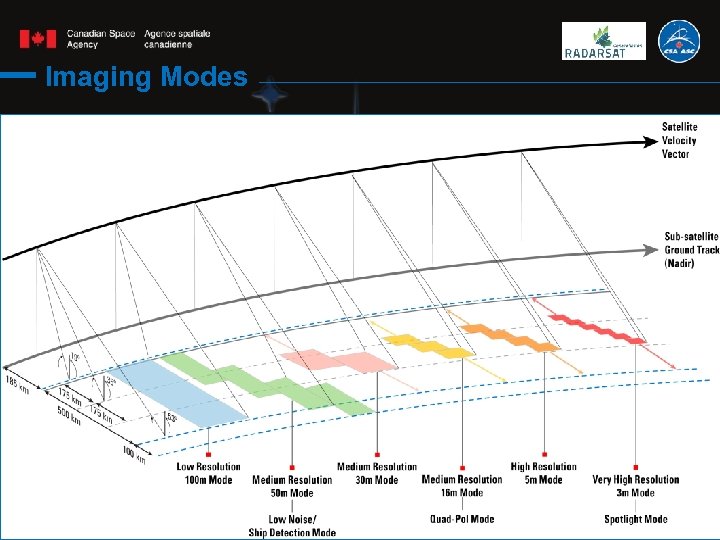
Imaging Modes
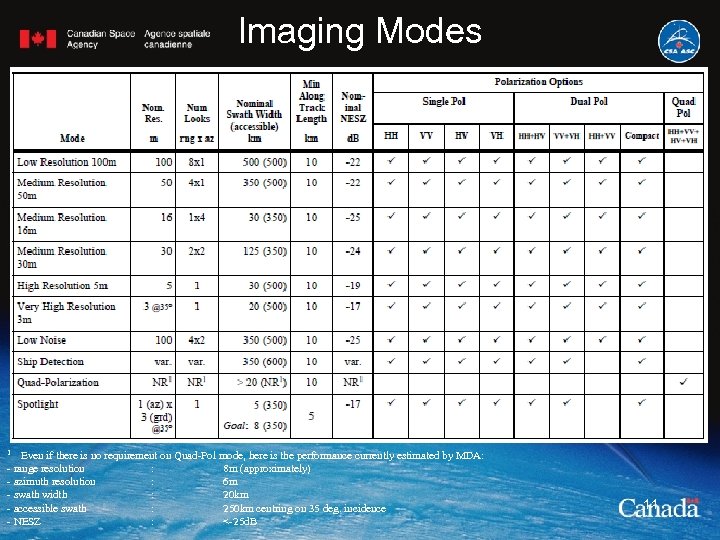
Imaging Modes 2 1 Even if there is no requirement on Quad-Pol mode, here is the performance currently estimated by MDA: - range resolution : 8 m (approximately) - azimuth resolution : 6 m - swath width : 20 km - accessible swath : 250 km centring on 35 deg. incidence - NESZ : <-25 d. B 11
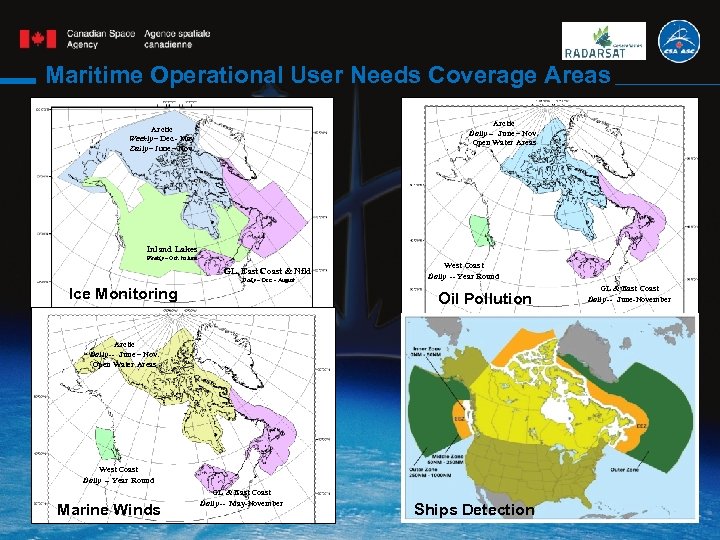
Maritime Operational User Needs Coverage Areas Arctic Daily -- June – Nov. Open Water Areas Arctic Weekly – Dec. - May Daily – June – Nov. Inland Lakes Weekly – Oct. to June GL, East Coast & Nfld. Daily – Dec. - August Ice Monitoring West Coast Daily -- Year Round Oil Pollution Arctic Daily -- June – Nov. Open Water Areas West Coast Daily -- Year Round Marine Winds GL & East Coast Daily -- May-November Ships Detection GL & East Coast Daily -- June-November
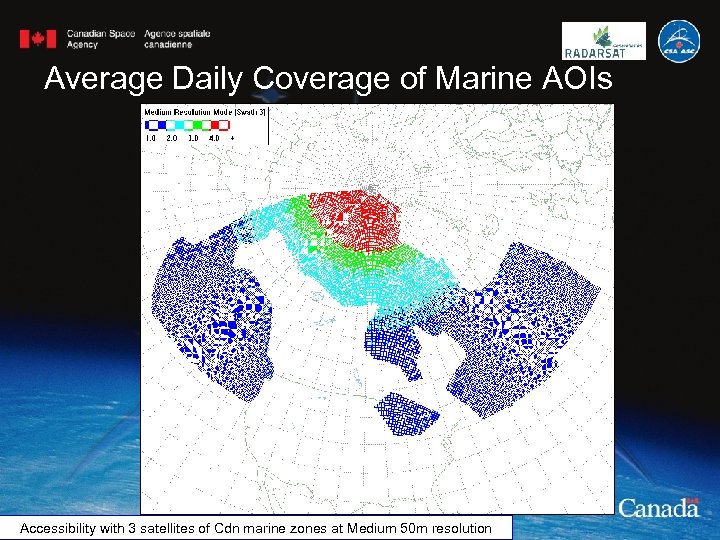
Average Daily Coverage of Marine AOIs Accessibility with 3 satellites of Cdn marine zones at Medium 50 m resolution
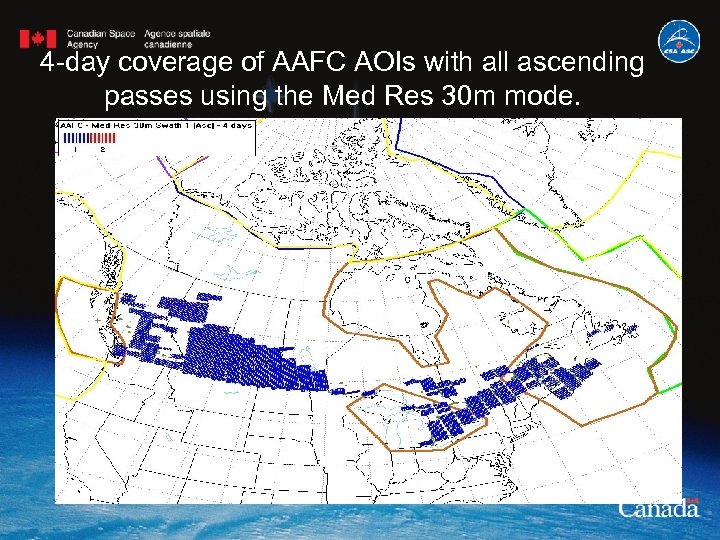
4 -day coverage of AAFC AOIs with all ascending passes using the Med Res 30 m mode.
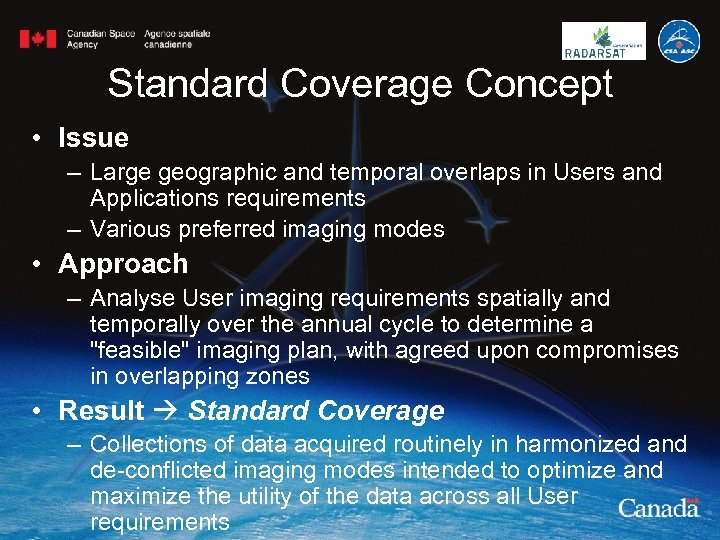
Standard Coverage Concept • Issue – Large geographic and temporal overlaps in Users and Applications requirements – Various preferred imaging modes • Approach – Analyse User imaging requirements spatially and temporally over the annual cycle to determine a "feasible" imaging plan, with agreed upon compromises in overlapping zones • Result Standard Coverage – Collections of data acquired routinely in harmonized and de-conflicted imaging modes intended to optimize and maximize the utility of the data across all User requirements
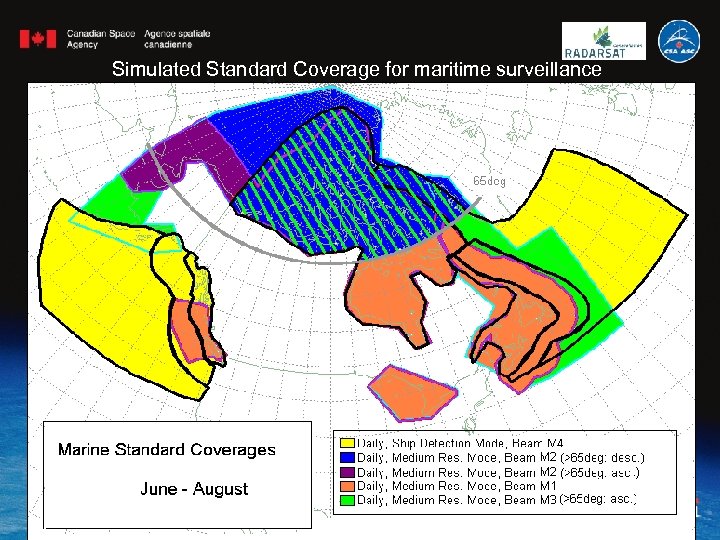
Simulated Standard Coverage for maritime surveillance
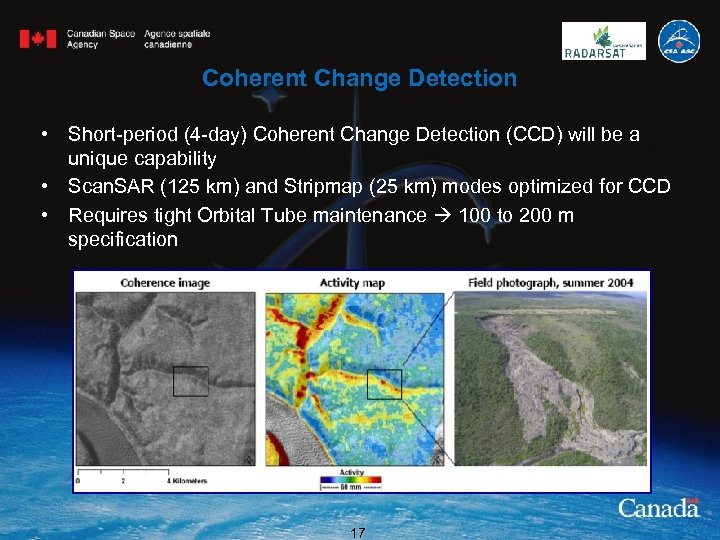
Coherent Change Detection • Short-period (4 -day) Coherent Change Detection (CCD) will be a unique capability • Scan. SAR (125 km) and Stripmap (25 km) modes optimized for CCD • Requires tight Orbital Tube maintenance 100 to 200 m specification 17
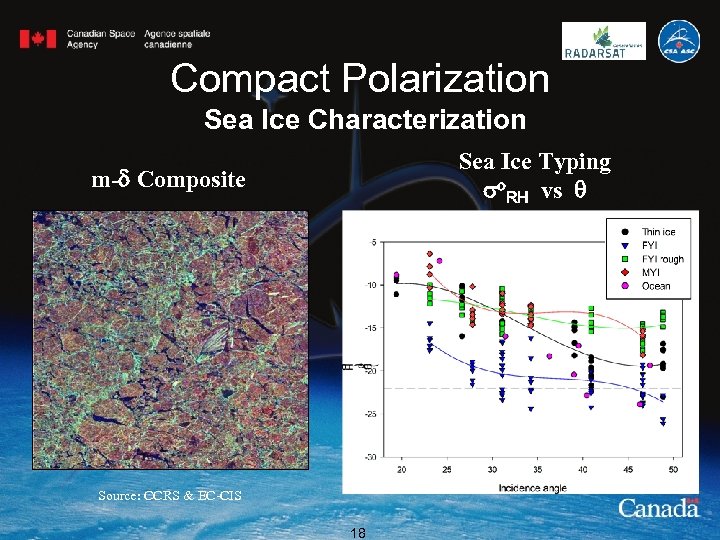
Compact Polarization Sea Ice Characterization Sea Ice Typing so. RH vs q m-d Composite Source: CCRS & EC-CIS 18
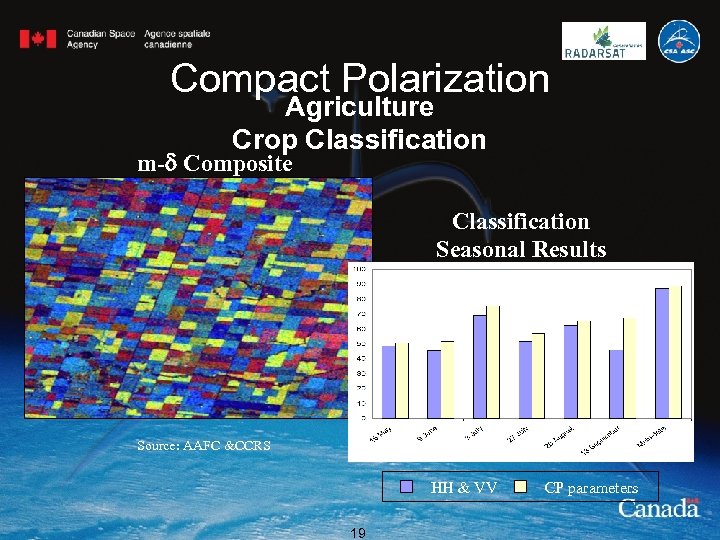
Compact Polarization Agriculture Crop Classification m-d Composite Classification Seasonal Results Source: AAFC &CCRS HH & VV 19 CP parameters
System Products Classes of Products • Raw Products – Raw Radar data in FRED format • Image Products – Processed SAR images – Variety of processing levels • single-look complex products, • multi-looked power-detected geo-referenced products • geo-coded products – Include a “Doppler Grid” with 2 km spacing – Same format as RADARSAT-2: Geo. TIFF images with xml meta-data • Information Products – Ship detection products: xml files with • Time, Location, Confidence measure, Estimated RCS and length
Access, Throughput and Latency • Global Access: Can image anywhere except an area within 1500 km of the south pole (right-looking only) • Global Revisit: 24 hours on average (any point can be imaged 12 times in 12 days) • Real-time downlink over Canadian maritime areas of interest • Most products ready for delivery within minutes of downlink to a Canadian Data Reception Facility • Capability to downlink data acquired over Canadian Maritime Areas of Interest within 3 hours of acquisition outside Canadian station mask • Capability to downlink data acquired over Canadian Land Areas of Interest within 2 hours of acquisition • Products available within 48 hours of receipt of an order for an acquisition anywhere in the world • Fast tasking: 4 hours
Data Policy RCM Priority Roles • Serve public interest by responding to requirements of Canadian government departments and Canadian noncommercial users • Pursue commercial thrust for data distribution and valueadded services • Support science and applications development by industry and academia • Monitoring long term scientific phenomena RCM focuses on operational users for which “Standard Coverages” will be defined
Data Policy Considerations Regulation • RCM is subject to the Cdn Remote Sensing Space Systems Act (RSSSA) which will determine what data may become public and who can access RCM data more generally. Within limitations of the RSSSA and other security elements: • Standard Coverages serve all operational users – Most of their data would become public • RCM Archives are intended to be Free and Open, accessible on-line through an on-line catalogue (except for commercial and sensitive data)
Data Utilization & Applications Plan • Ensure Optimum use of the data when system becomes operational for Canadian Government Users • Facilitate the integration of RCM data into existing operational applications of RADARSAT-1 and RADARSAT-2. • Support the integration of RCM data into applications that have been demonstrated to the point where they are fully integrated into the operations of OGDs in support of their mandates • Support science, research and development activities for potential new applications or improve existing ones. • Facilitate the utilisation and access to data, product and services produced by RCM to users. 24
International Collaboration: RCM – Sentinel-1 • Go. C Users want easier access to multiple SAR missions Both missions are C-Band SARs at the same frequency • Collaboration could improve Go. C Users coverage, reduce latencies, and provide complementary data/modes • Simplified access and synergy with Sentinel-1 could alleviate potential data acquisition conflicts within RCM • Collaboration would maximize the use – and potential benefit to respective Users – of both RCM and Sentinel 1 data
RCM – Sentinel-1 Collaboration The following collaborative activities are currently explored: • Joint / integrated pre-defined acquisition plans (complementarities in observations / modes, increased revisit, etc. ) • Level 1 Product format • Harmonization of catalogue interface • Development of common tools • Harmonized communication, joint publications etc. • Joint calibration working group is being set up
Summary • RADARSAT Constellation Mission is designed to continue/enhance the use of SAR to support Government of Canada operations as well as internationally • Support to government users for application development • Compact Polarization , Multi-pass/Frequent Revisit and 4 -day CCD provide opportunities for new information and applications • Opportunities for synergy and collaboration with Sentinel -1 are being pursued seriously
Thank You ! 28
Скачать презентацию RADARSAT Constellation Mission Daniel De Lisle on behalf
2945e28f28bd5b67afa62db228ec2967.ppt