Скачать презентацию RADARSAT-1 Mission Performance and Plans Surendra Parashar Ahmed
d3a4e7c75f21f777f569530e246b8c72.ppt
- Количество слайдов: 11
 RADARSAT-1: Mission Performance and Plans Surendra Parashar, Ahmed Mahmood, Dan Showalter, Satish Srivastava Canadian Space Agency surendra. parashar@space. gc. ca IGARSS 2007 Barcelona, Spain, July 23 -27, 2007
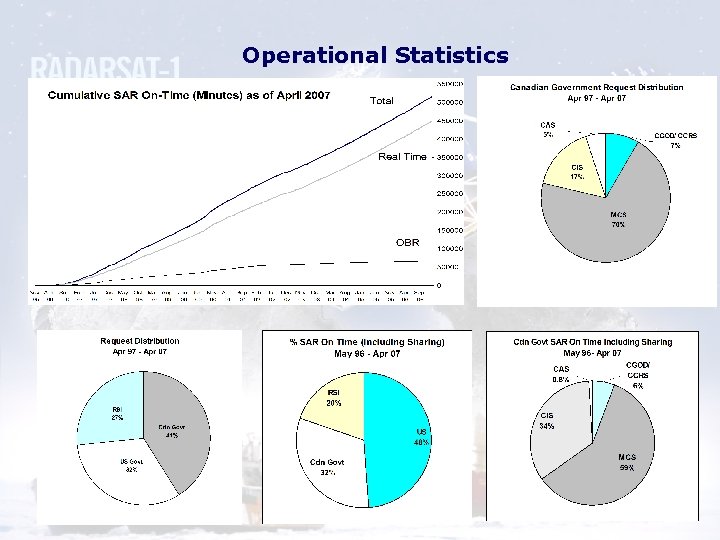
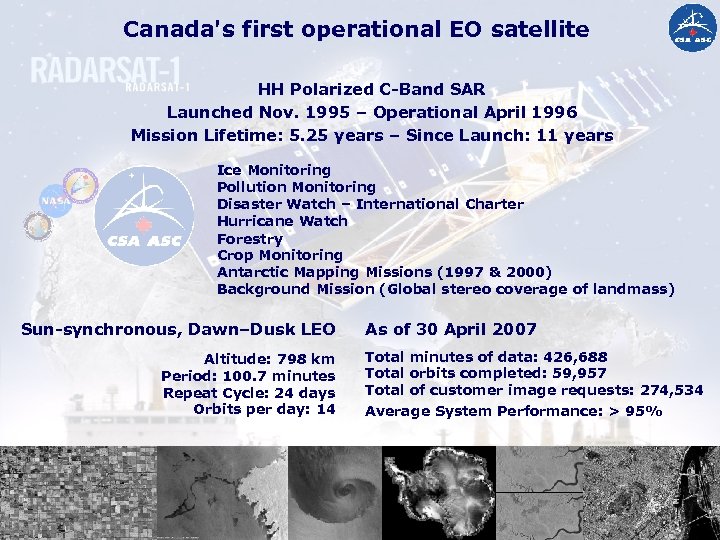 Canada's first operational EO satellite HH Polarized C-Band SAR Launched Nov. 1995 – Operational April 1996 Mission Lifetime: 5. 25 years – Since Launch: 11 years Ice Monitoring Pollution Monitoring Disaster Watch – International Charter Hurricane Watch Forestry Crop Monitoring Antarctic Mapping Missions (1997 & 2000) Background Mission (Global stereo coverage of landmass) Sun-synchronous, Dawn–Dusk LEO Altitude: 798 km Period: 100. 7 minutes Repeat Cycle: 24 days Orbits per day: 14 As of 30 April 2007 Total minutes of data: 426, 688 Total orbits completed: 59, 957 Total of customer image requests: 274, 534 Average System Performance: > 95%
 The Ground Infrastructure 6 Order Desks 35 Data Reception Facilities 23 Archiving Facilities Number of requests per Order Desk CGOD, CIS, MCS/CAS: 112, 829 NASA/NOAA: 88, 588 MDA ESA: (GSI): 79, 247 0
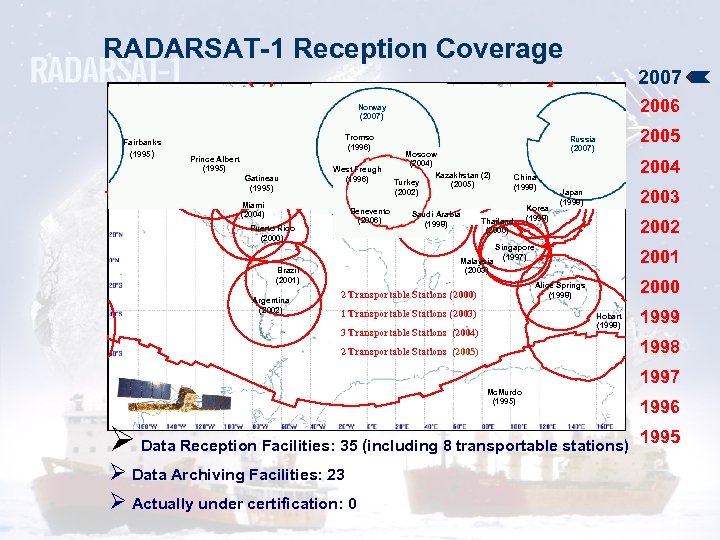 RADARSAT-1 Reception Coverage 2007 2006 Norway (2007) Fairbanks (1995) Tromso (1996) Prince Albert (1995) Gatineau (1995) Miami (2004) Puerto Rico (2000) West Freugh (1996) Benevento (2006) Saudi Arabia (1998) China (1998) Thailand (2000) Malaysia (2003) Brazil (2001) Argentina (2002) Moscow (2004) Kazakhstan (2) Turkey (2005) (2002) 2005 Russia (2007) Korea (1998) 2004 2003 Japan (1998) 2002 Singapore (1997) 2001 2000 Alice Springs (1998) 2 Transportable Stations (2000) 1 Transportable Stations (2003) Hobart (1998) 3 Transportable Stations (2004) 1999 1998 2 Transportable Stations (2005) 1997 Mc. Murdo (1995) Ø Data Reception Facilities: 35 (including 8 transportable stations) Ø Data Archiving Facilities: 23 Ø Actually under certification: 0 1996 1995
 Operational Statistics
 Operational Statistics
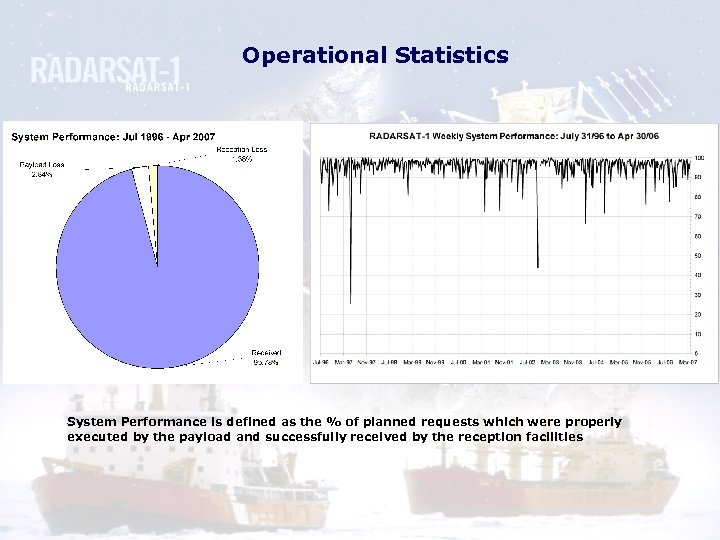 Operational Statistics System Performance is defined as the % of planned requests which were properly executed by the payload and successfully received by the reception facilities
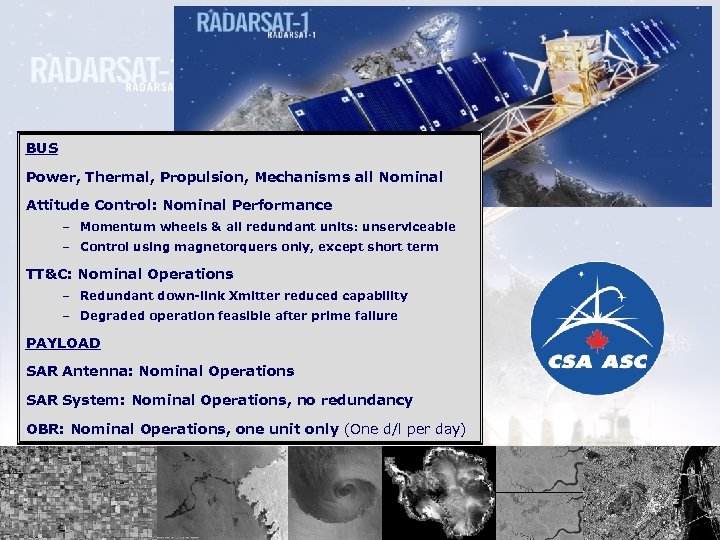 BUS Power, Thermal, Propulsion, Mechanisms all Nominal Attitude Control: Nominal Performance – Momentum wheels & all redundant units: unserviceable – Control using magnetorquers only, except short term TT&C: Nominal Operations – Redundant down-link Xmitter reduced capability – Degraded operation feasible after prime failure PAYLOAD SAR Antenna: Nominal Operations SAR System: Nominal Operations, no redundancy OBR: Nominal Operations, one unit only (One d/l per day)
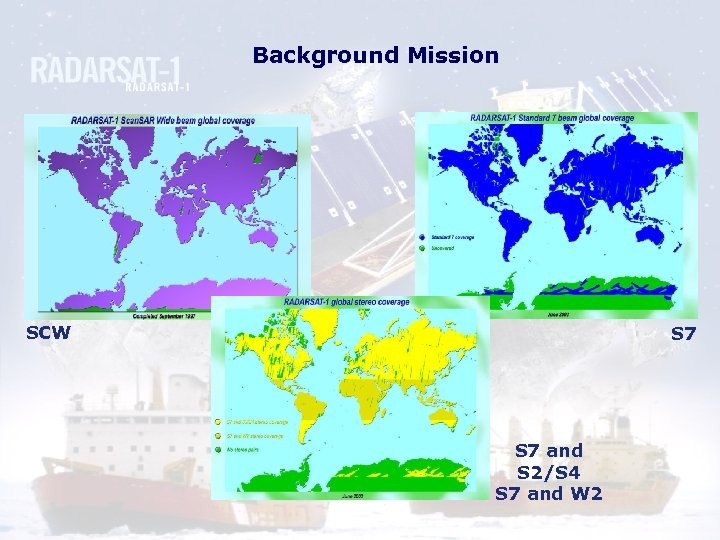 Background Mission SCW S 7 and S 2/S 4 S 7 and W 2
 Future Plans • Continue to use satellite resources prudently so as to prolong satellite life. • Emphasize maintenance and safety, not undertake performance enhancements, and minimize risks. • Continue Operations Transition Planning to allow smooth transfer from RADARSAT-1 to RADARSAT-2 operations, utilization and markets. • RADARSAT-1 Ops funding in place until March 30, 2009, this ensuring overlap with RADARSAT-2 Ops.