


 Скачать презентацию R van Langevelde A J Scholten and D
9e9d1b83e534c85fc65d6c01e2f8662f.ppt
- Количество слайдов: 103
 R. van Langevelde, A. J. Scholten and D. B. M. Klaassen Philips Research, The Netherlands MOS-AK Group Meeting’ 02 XFAB, Erfurt October 21, 2002 MOS-AK Group Meeting : MOS Model 11
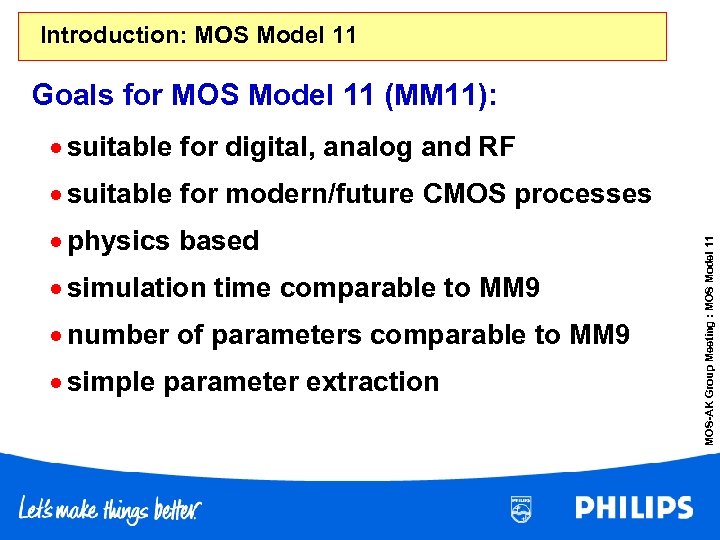 Introduction: MOS Model 11 Goals for MOS Model 11 (MM 11): · suitable for digital, analog and RF · physics based · simulation time comparable to MM 9 · number of parameters comparable to MM 9 · simple parameter extraction MOS-AK Group Meeting : MOS Model 11 · suitable for modern/future CMOS processes
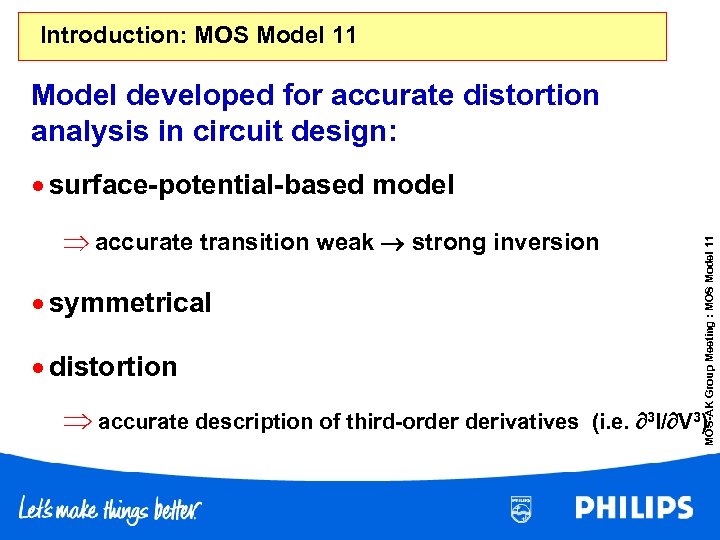 Introduction: MOS Model 11 Model developed for accurate distortion analysis in circuit design: accurate transition weak strong inversion · symmetrical · distortion accurate description of third-order derivatives MOS-AK Group Meeting : MOS Model 11 · surface-potential-based model (i. e. 3 I/ V 3)
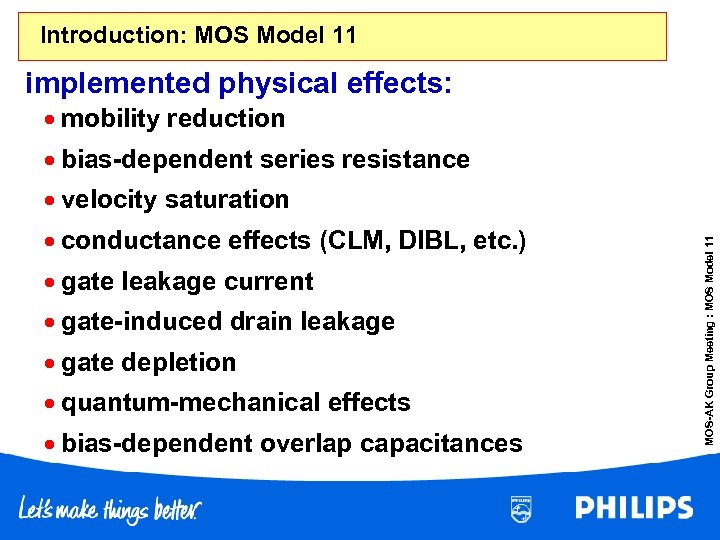 Introduction: MOS Model 11 implemented physical effects: · mobility reduction · bias-dependent series resistance · conductance effects (CLM, DIBL, etc. ) · gate leakage current · gate-induced drain leakage · gate depletion · quantum-mechanical effects · bias-dependent overlap capacitances MOS-AK Group Meeting : MOS Model 11 · velocity saturation
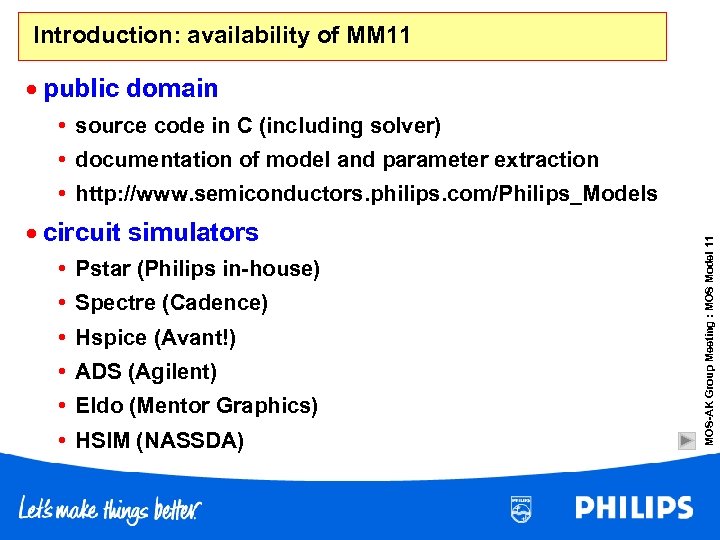 Introduction: availability of MM 11 · public domain • source code in C (including solver) • documentation of model and parameter extraction · circuit simulators • Pstar (Philips in-house) • Spectre (Cadence) • Hspice (Avant!) • ADS (Agilent) • Eldo (Mentor Graphics) • HSIM (NASSDA) MOS-AK Group Meeting : MOS Model 11 • http: //www. semiconductors. philips. com/Philips_Models
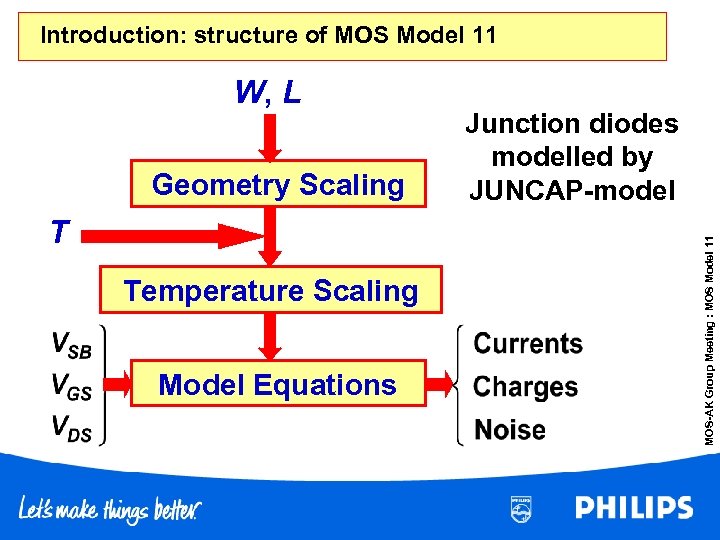 Introduction: structure of MOS Model 11 Geometry Scaling T Temperature Scaling Model Equations Junction diodes modelled by JUNCAP-model MOS-AK Group Meeting : MOS Model 11 W, L
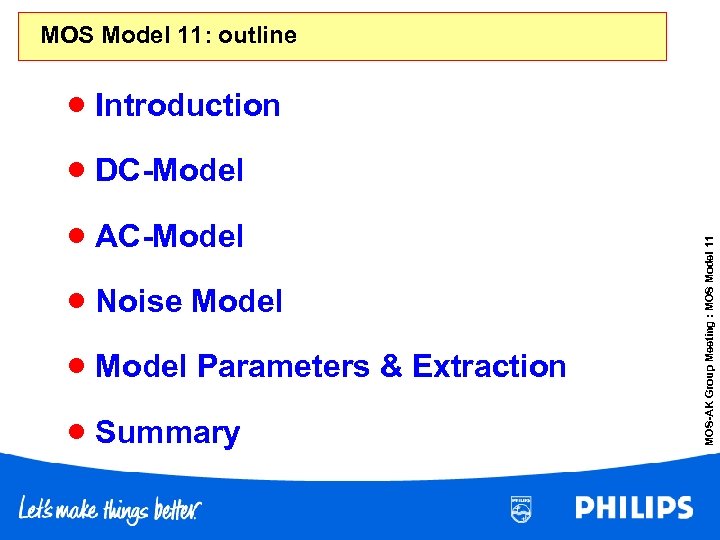 MOS Model 11: outline · Introduction · AC-Model · Noise Model · Model Parameters & Extraction · Summary MOS-AK Group Meeting : MOS Model 11 · DC-Model
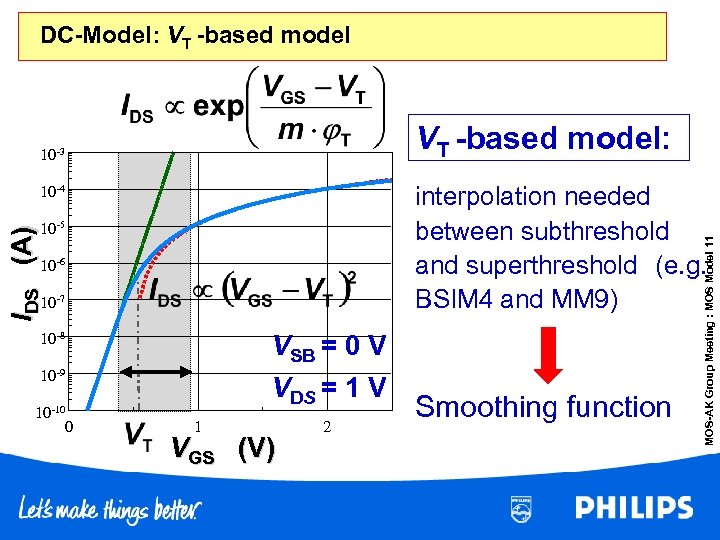 DC-Model: VT -based model: 10 -3 IDS (A) 10 -5 10 -6 10 -7 VSB = 0 V VDS = 1 V 10 -8 10 -9 10 -10 0 1 VGS (V) 2 Smoothing function MOS-AK Group Meeting : MOS Model 11 interpolation needed between subthreshold and superthreshold (e. g. BSIM 4 and MM 9) 10 -4
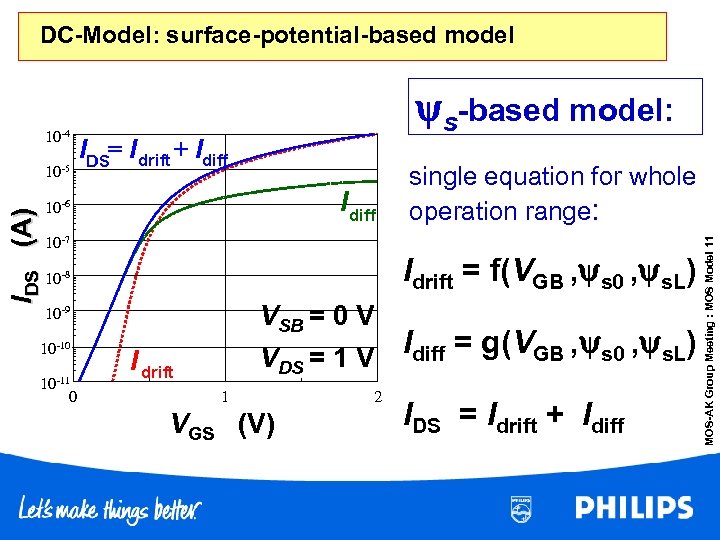 DC-Model: surface-potential-based model IDS (A) 10 -5 IDS= I drift + Idiff I diff 10 -6 single equation for whole operation range: 10 -7 Idrift = f(VGB , s 0 , s. L) 10 -8 VSB = 0 V VDS = 1 V 10 -9 10 -10 10 -11 0 I drift 1 VGS (V) 2 Idiff = g(VGB , s 0 , s. L) IDS = Idrift + Idiff MOS-AK Group Meeting : MOS Model 11 10 -4 s-based model:
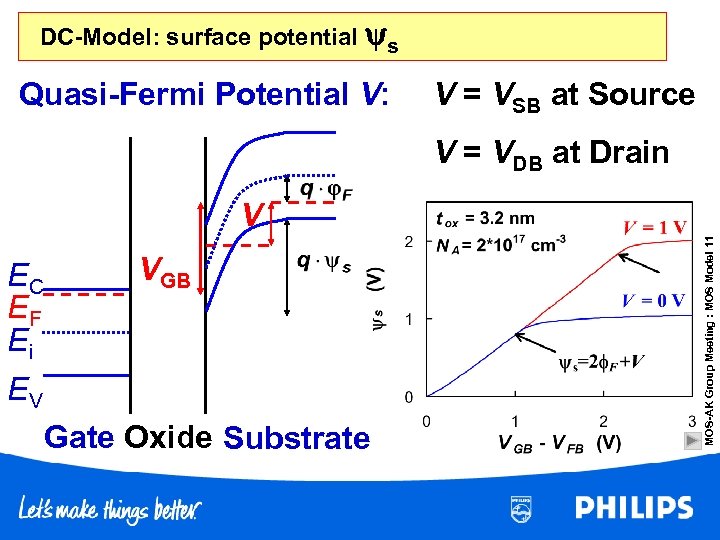 DC-Model: surface potential s Quasi-Fermi Potential V: V = VSB at Source V = VDB at Drain EC EF Ei VGB EV Gate Oxide Substrate MOS-AK Group Meeting : MOS Model 11 V
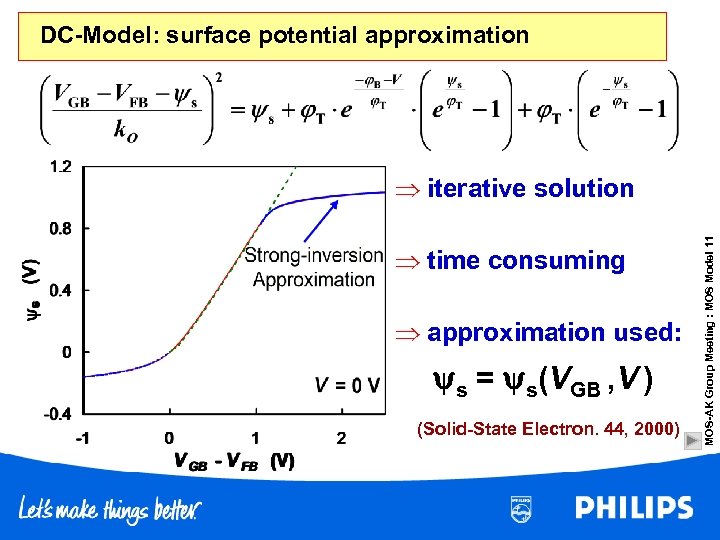 DC-Model: surface potential approximation time consuming approximation used: s = s(VGB , V ) (Solid-State Electron. 44, 2000) MOS-AK Group Meeting : MOS Model 11 iterative solution
 Description of ideal long-channel MOSFET For real devices several physical effects have to be taken into account: · mobility effects new models · conductance effects Special attention to: · distortion · drain-source symmetry MOS-AK Group Meeting : MOS Model 11 DC-Model: surface-potential-based model
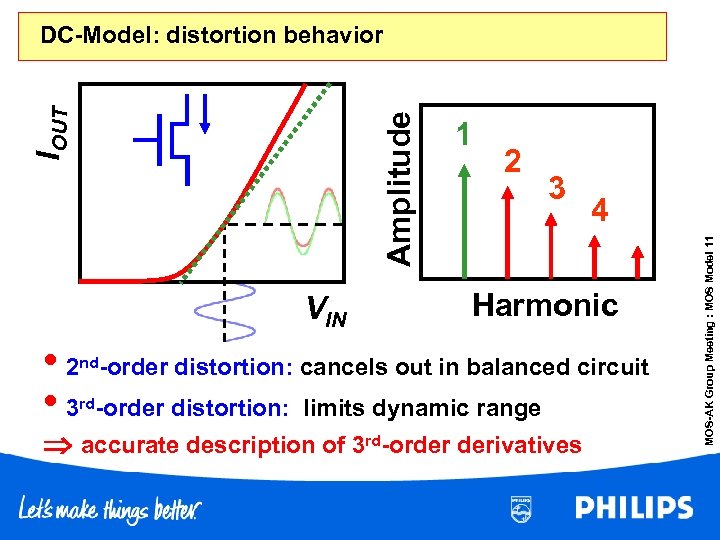 VIN • 2 • 3 1 2 3 4 Harmonic nd-order distortion: cancels out in balanced circuit rd-order distortion: limits dynamic range accurate description of 3 rd-order derivatives MOS-AK Group Meeting : MOS Model 11 Amplitude IOUT DC-Model: distortion behavior
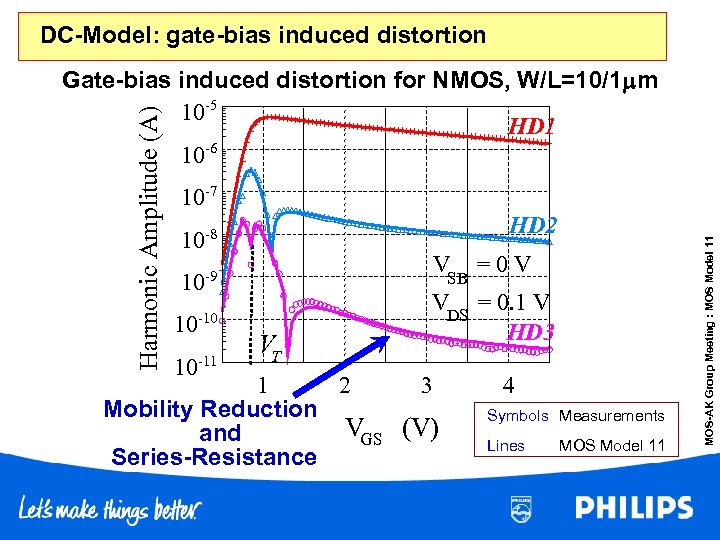 DC-Model: gate-bias induced distortion 10 -7 HD 2 10 -8 10 VSB = 0 V -9 10 -10 10 -11 VT VDS = 0. 1 V HD 3 1 2 3 Mobility Reduction VGS (V) and Series-Resistance 4 Symbols Measurements Lines MOS Model 11 MOS-AK Group Meeting : MOS Model 11 Harmonic Amplitude (A) Gate-bias induced distortion for NMOS, W/L=10/1 m 10 -5 HD 1 10 -6
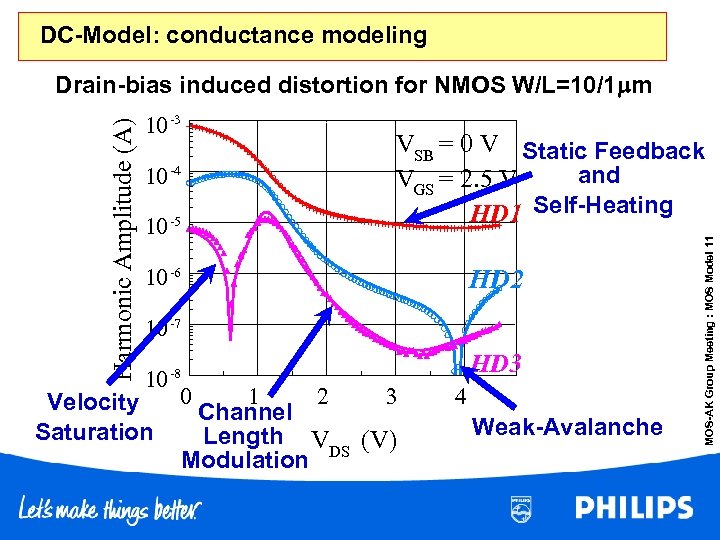 DC-Model: conductance modeling 10 -3 10 -4 10 -5 VSB = 0 V Static Feedback and VGS = 2. 5 V HD 1 Self-Heating HD 2 10 -6 10 -7 10 Velocity Saturation HD 3 -8 0 1 2 3 Channel Length V (V) Modulation DS 4 Weak-Avalanche MOS-AK Group Meeting : MOS Model 11 Harmonic Amplitude (A) Drain-bias induced distortion for NMOS W/L=10/1 m
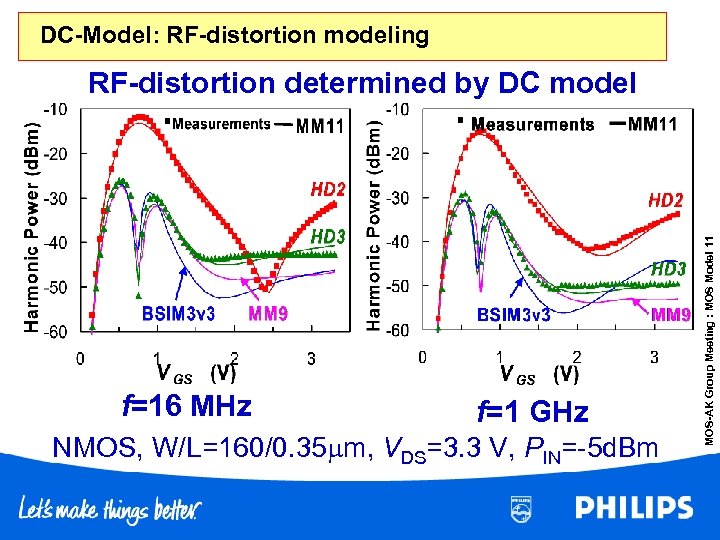 DC-Model: RF-distortion modeling f=16 MHz f=1 GHz NMOS, W/L=160/0. 35 m, VDS=3. 3 V, PIN=-5 d. Bm MOS-AK Group Meeting : MOS Model 11 RF-distortion determined by DC model
 Outline: DC-Model · VT vs. s-based models · Distortion modeling · Gate leakage current MOS-AK Group Meeting : MOS Model 11 · Symmetry
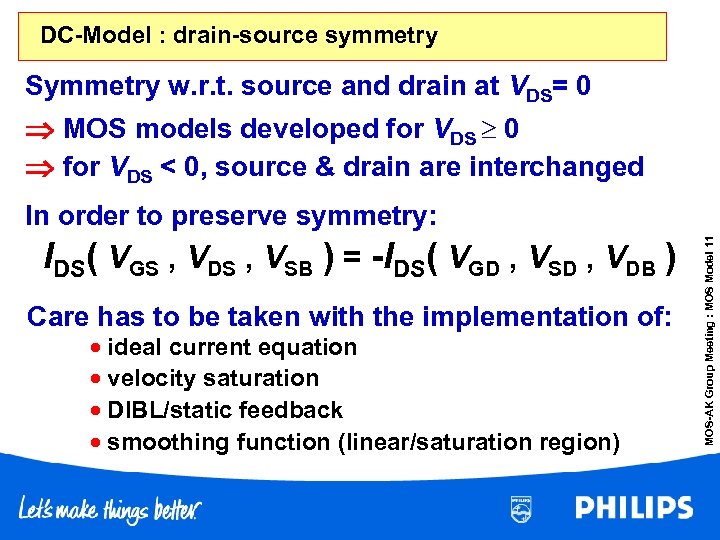 DC-Model : drain-source symmetry Symmetry w. r. t. source and drain at VDS= 0 MOS models developed for VDS 0 for VDS < 0, source & drain are interchanged IDS( VGS , VDS , VSB ) = -IDS( VGD , VSD , VDB ) Care has to be taken with the implementation of: · ideal current equation · velocity saturation · DIBL/static feedback · smoothing function (linear/saturation region) MOS-AK Group Meeting : MOS Model 11 In order to preserve symmetry:
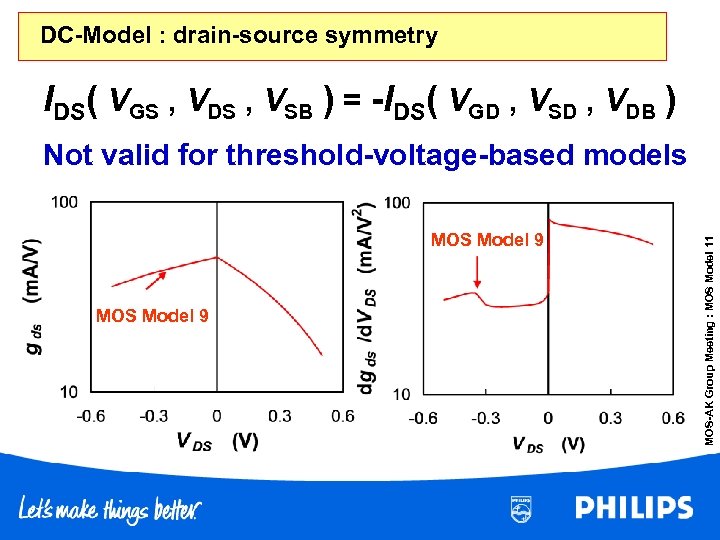 DC-Model : drain-source symmetry IDS( VGS , VDS , VSB ) = -IDS( VGD , VSD , VDB ) MOS Model 9 MOS-AK Group Meeting : MOS Model 11 Not valid for threshold-voltage-based models
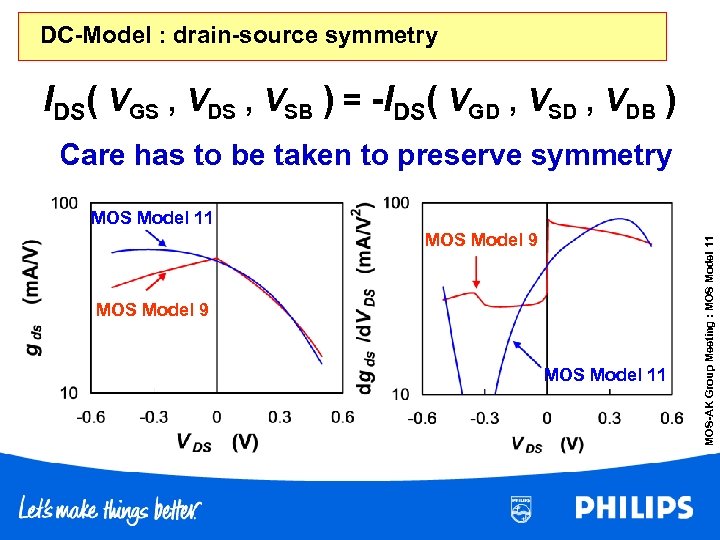 DC-Model : drain-source symmetry IDS( VGS , VDS , VSB ) = -IDS( VGD , VSD , VDB ) Care has to be taken to preserve symmetry MOS Model 9 MOS Model 11 MOS-AK Group Meeting : MOS Model 11
 Outline: DC-Model · VT vs. s-based models · Distortion modeling · Gate leakage current MOS-AK Group Meeting : MOS Model 11 · Symmetry
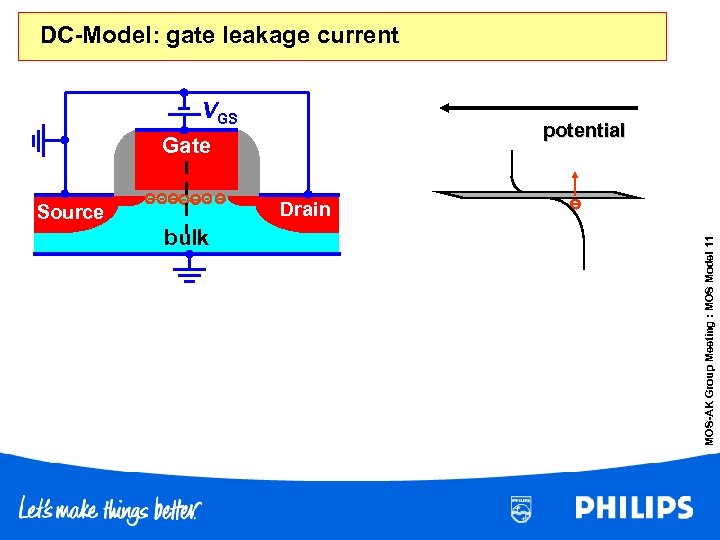 DC-Model: gate leakage current VGS potential Gate bulk MOS-AK Group Meeting : MOS Model 11 Drain Source
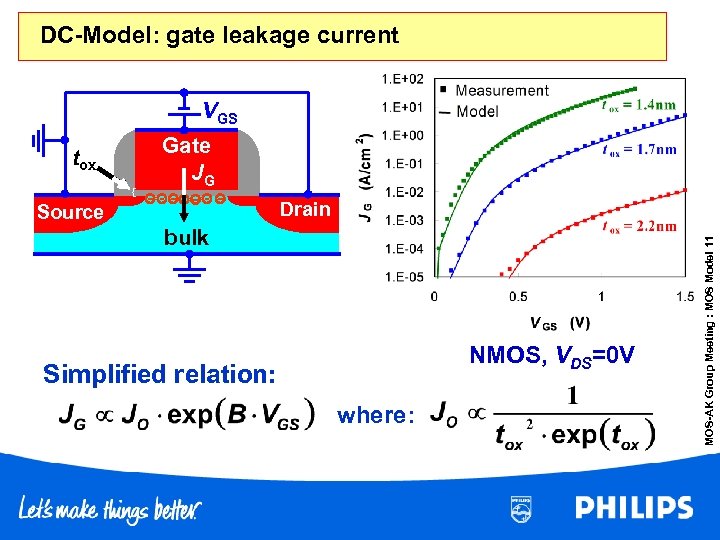 DC-Model: gate leakage current VGS { Gate JG Drain Source bulk NMOS, VDS=0 V Simplified relation: where: MOS-AK Group Meeting : MOS Model 11 tox
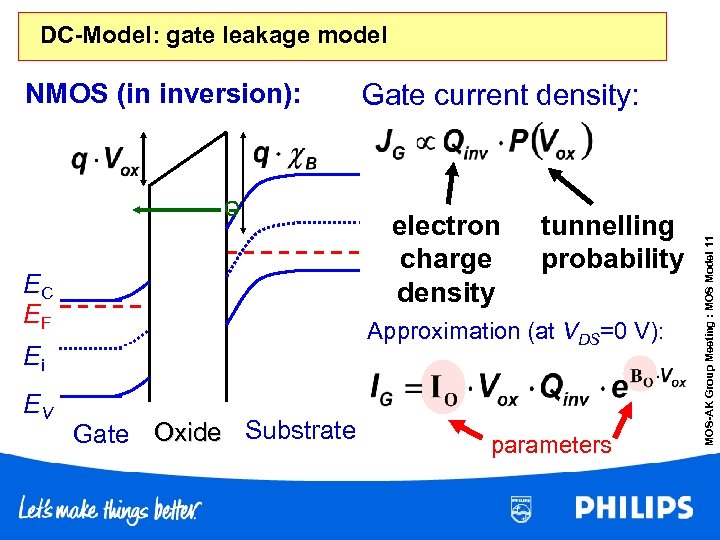 DC-Model: gate leakage model EC EF electron charge density tunnelling probability Approximation (at VDS=0 V): Ei EV Gate current density: Gate Oxide Substrate parameters MOS-AK Group Meeting : MOS Model 11 NMOS (in inversion):
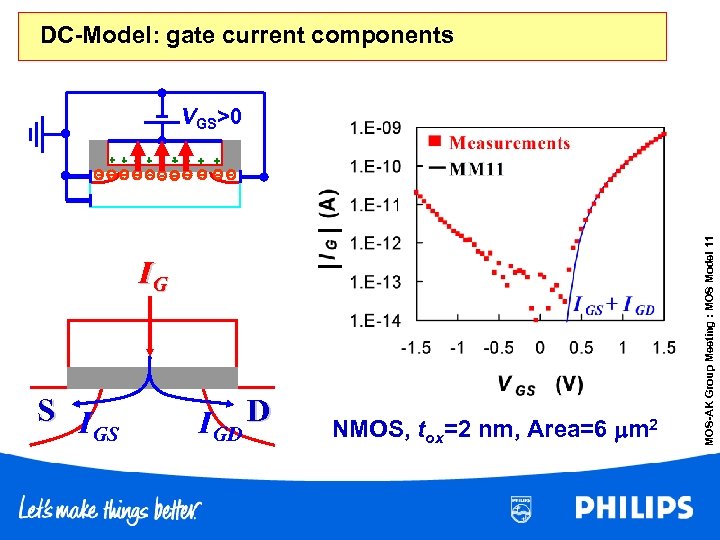 DC-Model: gate current components IG S I GS IGD D NMOS, tox=2 nm, Area=6 m 2 MOS-AK Group Meeting : MOS Model 11 VGS>0
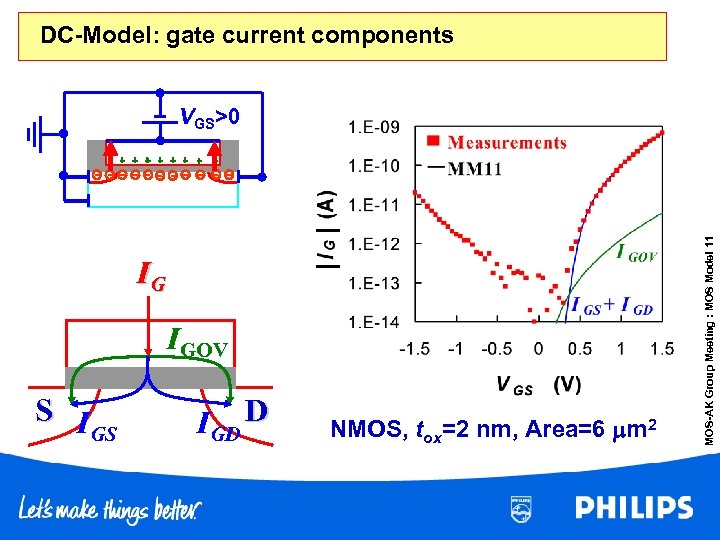 DC-Model: gate current components IG IGOV S I GS IGD D NMOS, tox=2 nm, Area=6 m 2 MOS-AK Group Meeting : MOS Model 11 VGS>0
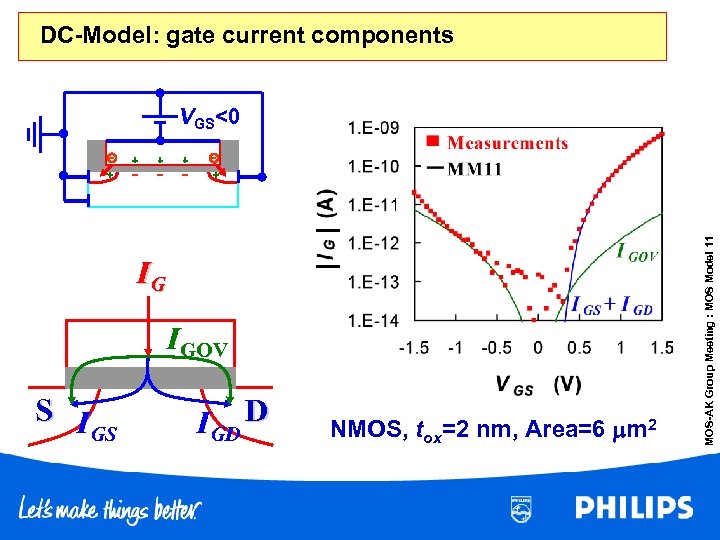 DC-Model: gate current components IG IGOV S I GS IGD D NMOS, tox=2 nm, Area=6 m 2 MOS-AK Group Meeting : MOS Model 11 VGS<0
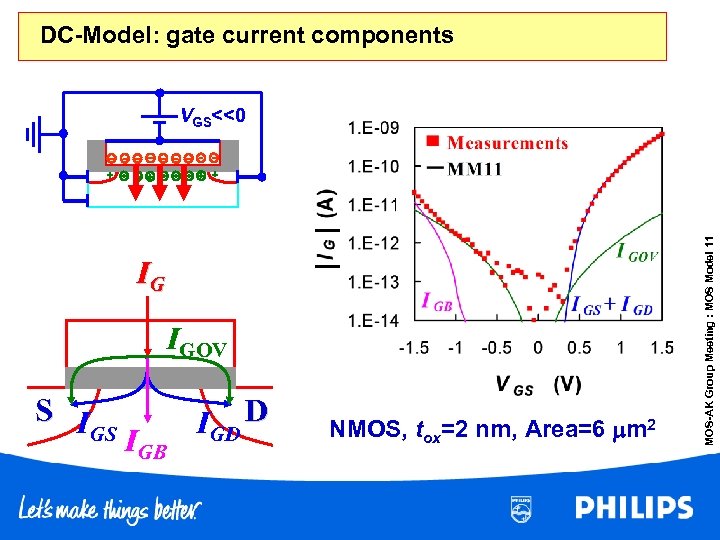 DC-Model: gate current components IG IGOV S I GS IGB IGD D NMOS, tox=2 nm, Area=6 m 2 MOS-AK Group Meeting : MOS Model 11 VGS<<0
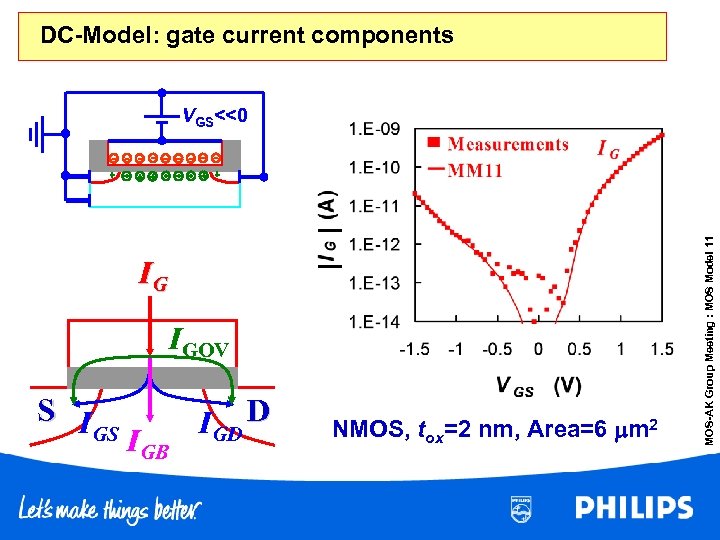 DC-Model: gate current components IG IGOV S I GS IGB IGD D NMOS, tox=2 nm, Area=6 m 2 MOS-AK Group Meeting : MOS Model 11 VGS<<0
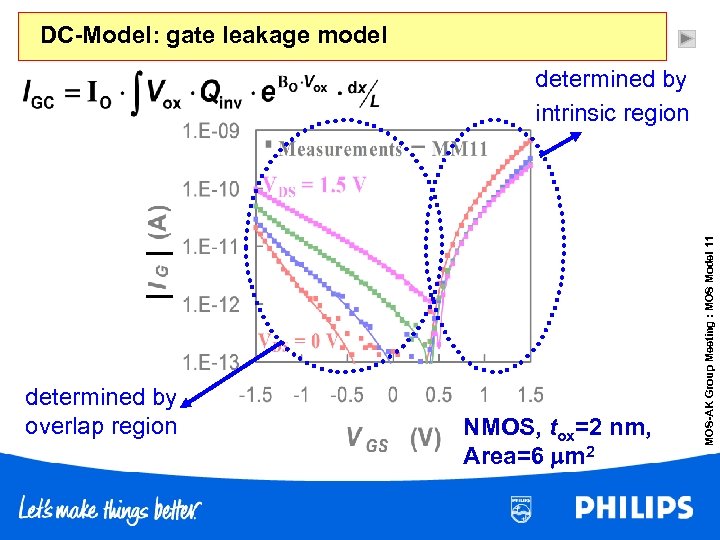 DC-Model: gate leakage model determined by overlap region NMOS, tox=2 nm, Area=6 m 2 MOS-AK Group Meeting : MOS Model 11 determined by intrinsic region
 MOS Model 11: outline · Introduction · AC-Model · Noise Model · Model Parameters & Extraction · Summary MOS-AK Group Meeting : MOS Model 11 · DC-Model
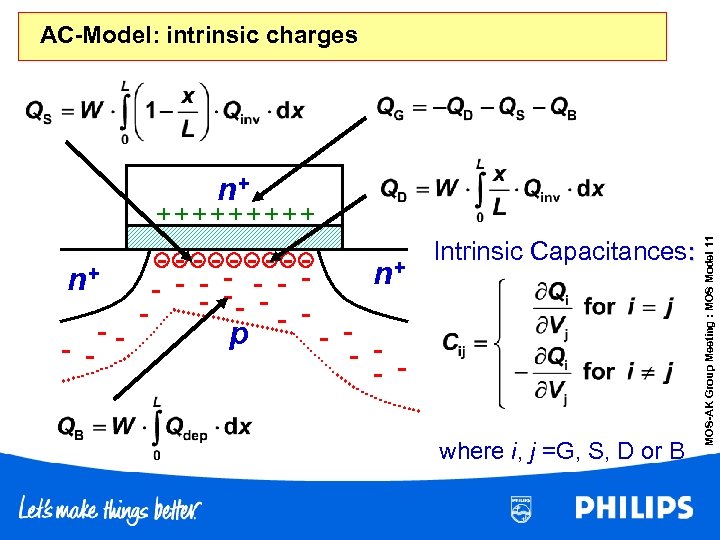 AC-Model: intrinsic charges n+ n+ -- - ----- - - -- - p n+ Intrinsic Capacitances: - - - where i, j =G, S, D or B MOS-AK Group Meeting : MOS Model 11 +++++
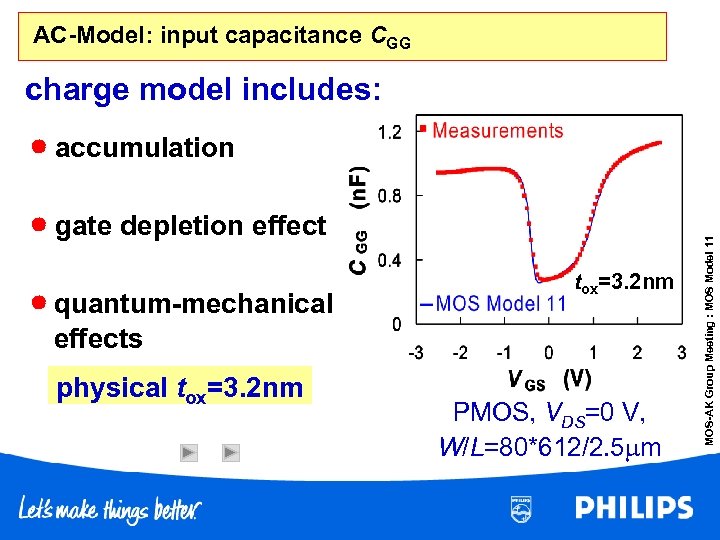 AC-Model: input capacitance CGG charge model includes: gate depletion effect quantum-mechanical tox=3. 6 nm =3. 2 nm effects physical tox=3. 2 nm PMOS, VDS=0 V, W/L=80*612/2. 5 m MOS-AK Group Meeting : MOS Model 11 accumulation
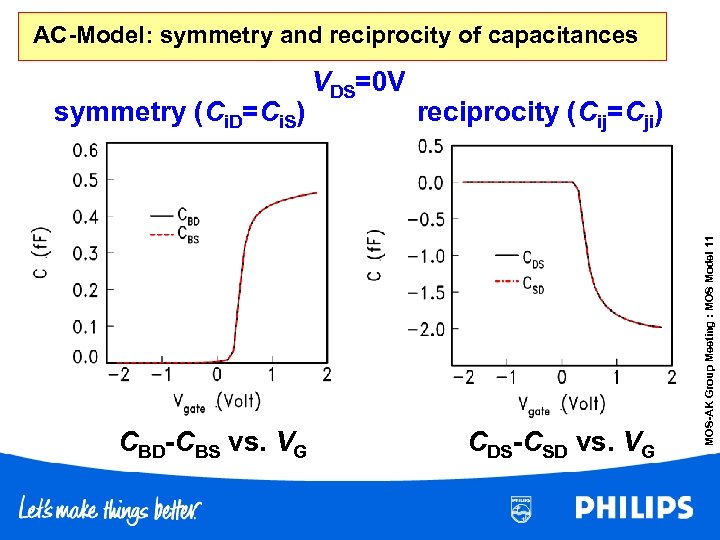 AC-Model: symmetry and reciprocity of capacitances CBD-CBS vs. VG reciprocity (Cij=Cji) CDS-CSD vs. VG MOS-AK Group Meeting : MOS Model 11 symmetry (Ci. D=Ci. S) VDS=0 V
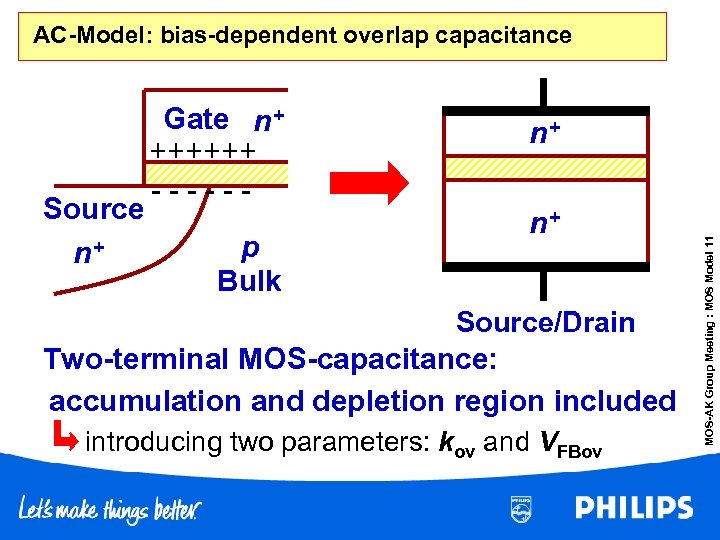 AC-Model: bias-dependent overlap capacitance Source n+ ++++++ ------ p Bulk n+ n+ Source/Drain Two-terminal MOS-capacitance: accumulation and depletion region included introducing two parameters: kov and VFBov MOS-AK Group Meeting : MOS Model 11 Gate n+
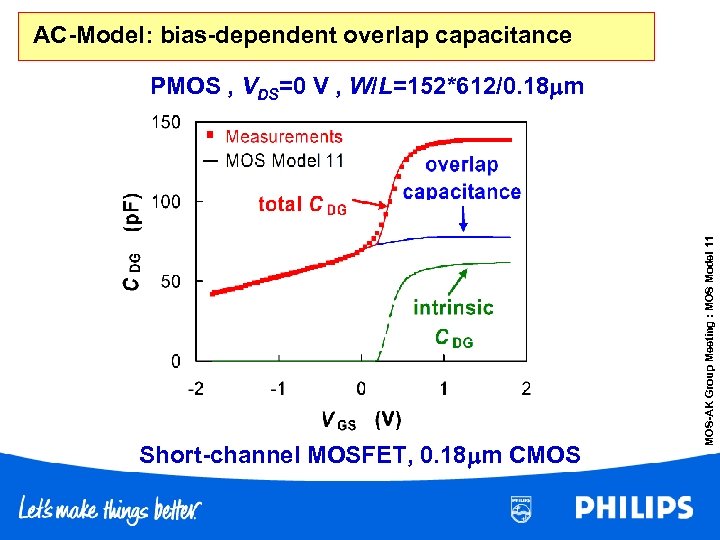 AC-Model: bias-dependent overlap capacitance Short-channel MOSFET, 0. 18 m CMOS MOS-AK Group Meeting : MOS Model 11 PMOS , VDS=0 V , W/L=152*612/0. 18 m
 MOS Model 11: outline · Introduction · AC-Model · Noise Model · Model Parameters & Extraction · Summary MOS-AK Group Meeting : MOS Model 11 · DC-Model
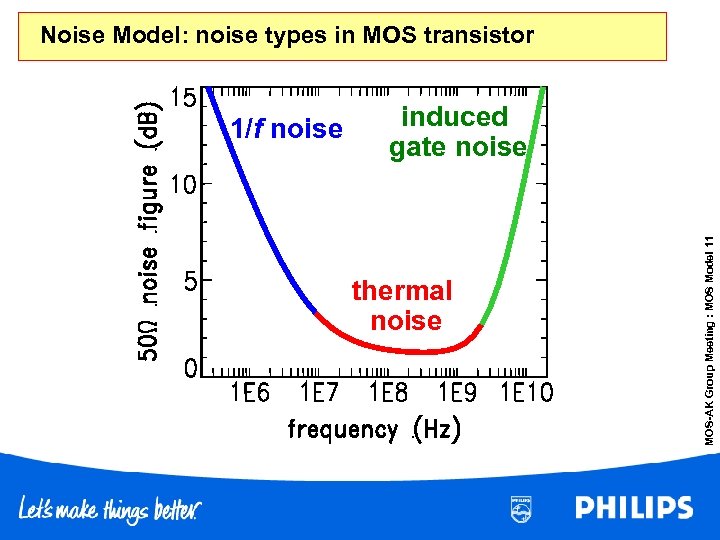 Noise Model: noise types in MOS transistor induced gate noise thermal noise MOS-AK Group Meeting : MOS Model 11 1/f noise
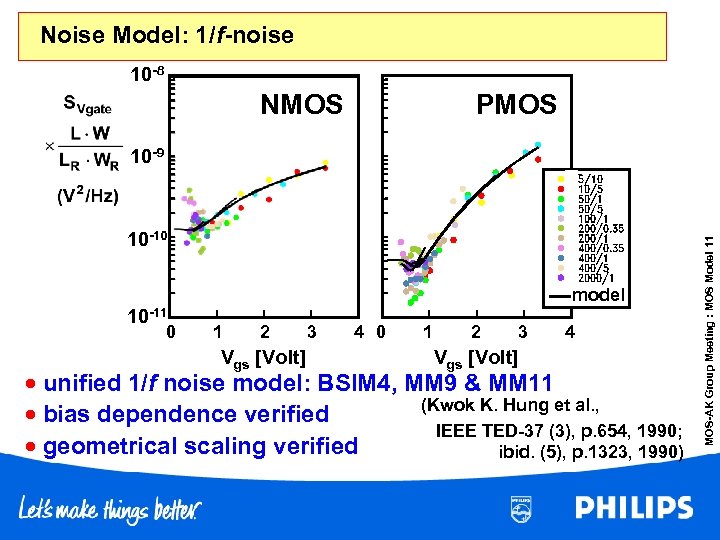 Noise Model: 1/f-noise 10 -8 NMOS PMOS 10 -10 10 -11 0 model 1 2 Vgs [Volt] 3 4 0 1 2 3 Vgs [Volt] 4 · unified 1/f noise model: BSIM 4, MM 9 & MM 11 (Kwok K. Hung et al. , · bias dependence verified IEEE TED-37 (3), p. 654, 1990; · geometrical scaling verified ibid. (5), p. 1323, 1990) MOS-AK Group Meeting : MOS Model 11 10 -9
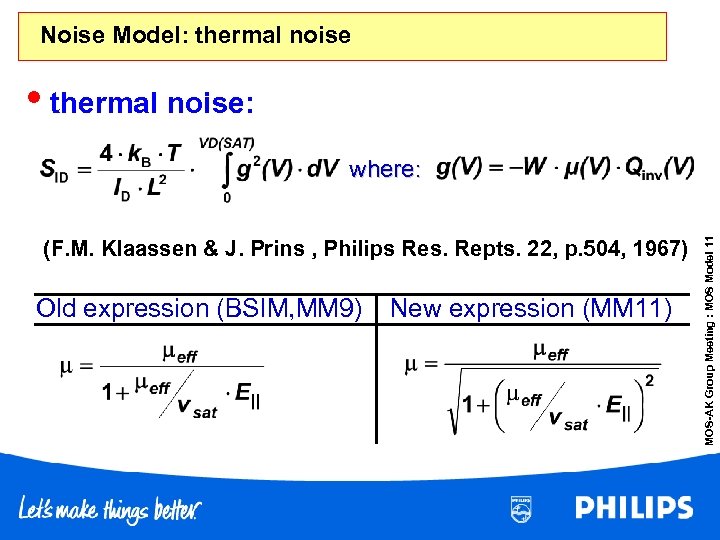 Noise Model: thermal noise • thermal noise: (F. M. Klaassen & J. Prins , Philips Res. Repts. 22, p. 504, 1967) Old expression (BSIM, MM 9) New expression (MM 11) MOS-AK Group Meeting : MOS Model 11 where:
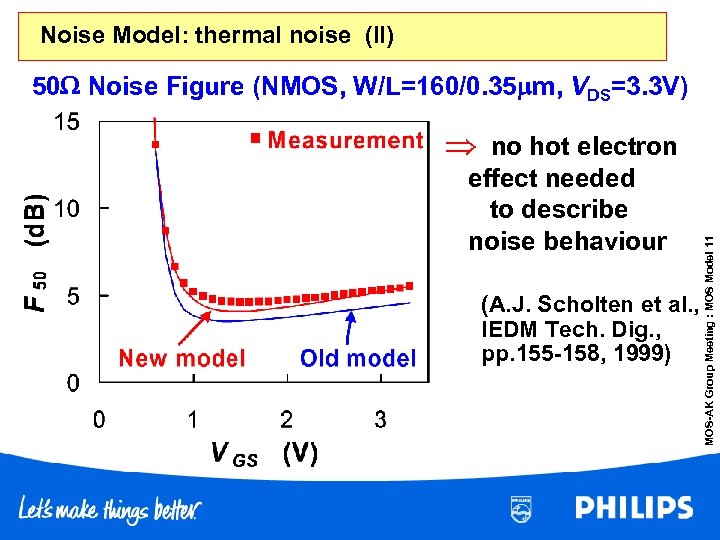 Noise Model: thermal noise (II) 50 Noise Figure (NMOS, W/L=160/0. 35 m, VDS=3. 3 V) no hot electron effect needed to describe noise behaviour (A. J. Scholten et al. , IEDM Tech. Dig. , pp. 155 -158, 1999) MOS-AK Group Meeting : MOS Model 11
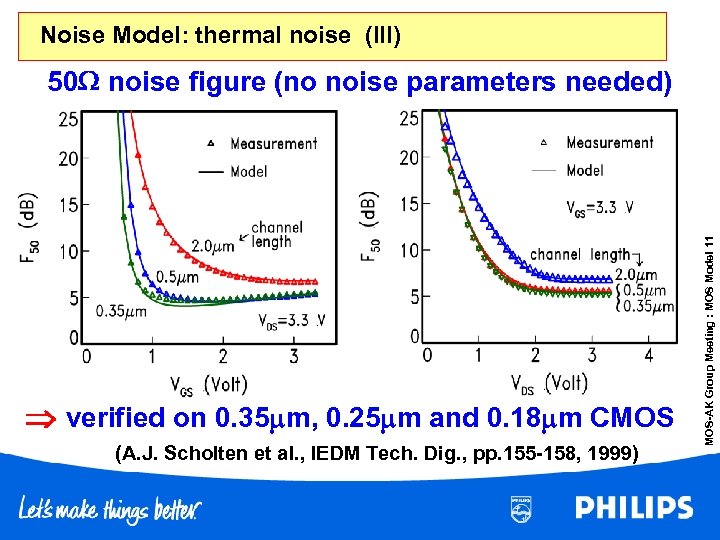 Noise Model: thermal noise (III) verified on 0. 35 m, 0. 25 m and 0. 18 m CMOS (A. J. Scholten et al. , IEDM Tech. Dig. , pp. 155 -158, 1999) MOS-AK Group Meeting : MOS Model 11 50 noise figure (no noise parameters needed)
 MOS Model 11: outline · Introduction · AC-Model · Noise Model · Model Parameters & Extraction · Summary MOS-AK Group Meeting : MOS Model 11 · DC-Model
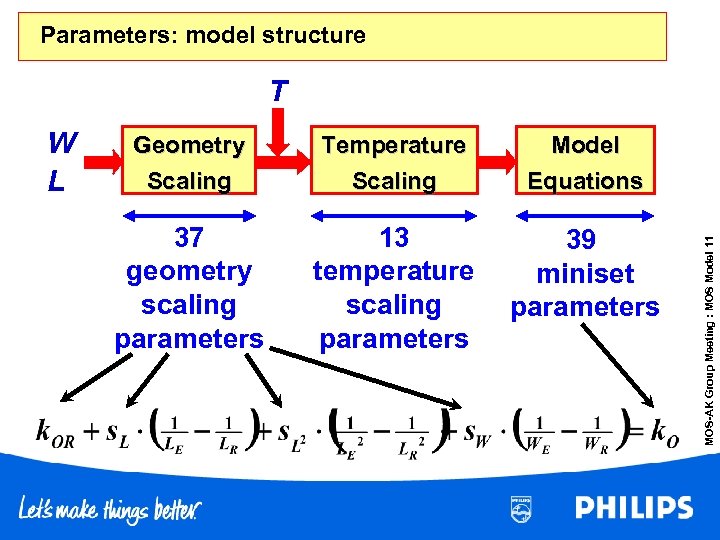 Parameters: model structure T Geometry Scaling Temperature Scaling Model Equations 37 geometry scaling parameters 13 temperature scaling parameters 39 miniset parameters MOS-AK Group Meeting : MOS Model 11 W L
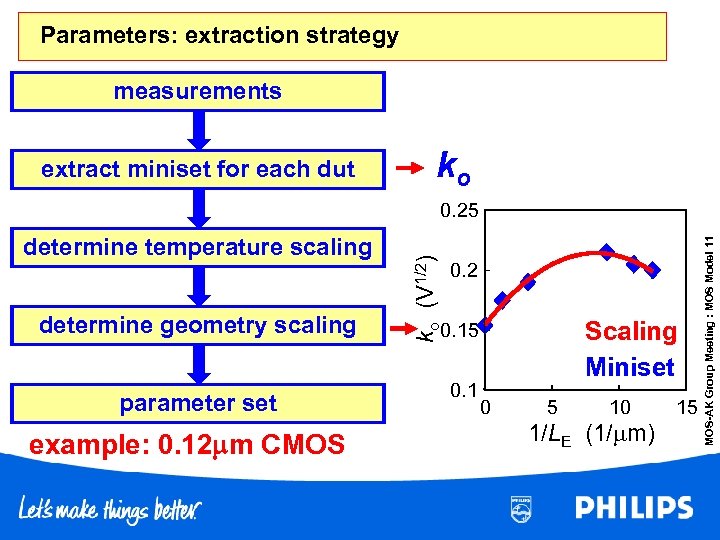 Parameters: extraction strategy measurements extract miniset for each dut ko determine geometry scaling parameter set example: 0. 12 m CMOS 0. 2 Scaling Miniset 0. 15 0. 1 0 5 10 1/LE (1/ m) 15 MOS-AK Group Meeting : MOS Model 11 determine temperature scaling ko (V 1/2) 0. 25
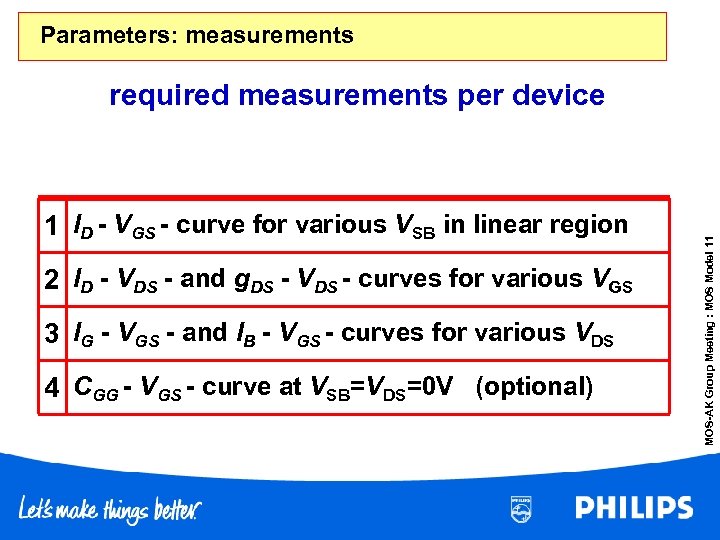 Parameters: measurements 1 ID - VGS - curve for various VSB in linear region 2 ID - VDS - and g. DS - VDS - curves for various VGS 3 IG - VGS - and IB - VGS - curves for various VDS 4 CGG - VGS - curve at VSB=VDS=0 V (optional) MOS-AK Group Meeting : MOS Model 11 required measurements per device
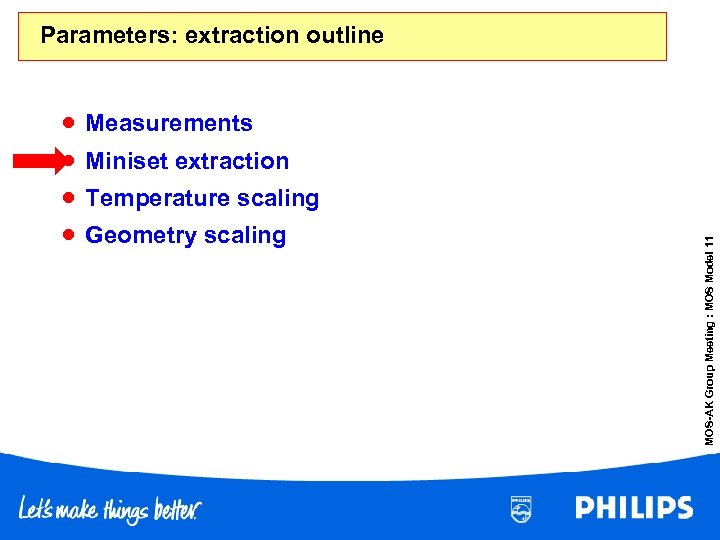 Parameters: extraction outline Measurements Miniset extraction Temperature scaling Geometry scaling MOS-AK Group Meeting : MOS Model 11 · ·
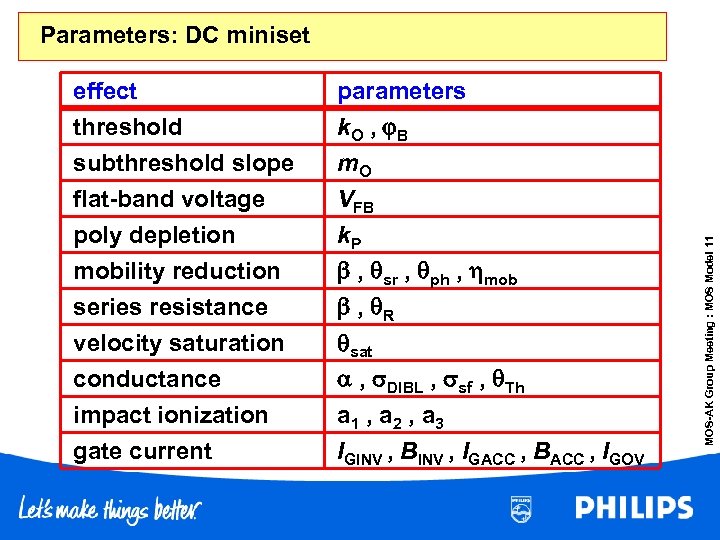 Parameters: DC miniset parameters k O , B subthreshold slope flat-band voltage poly depletion mobility reduction series resistance velocity saturation conductance impact ionization gate current m. O VFB k. P , sr , ph , mob , R sat , DIBL , sf , Th a 1 , a 2 , a 3 IGINV , BINV , IGACC , BACC , IGOV MOS-AK Group Meeting : MOS Model 11 effect threshold
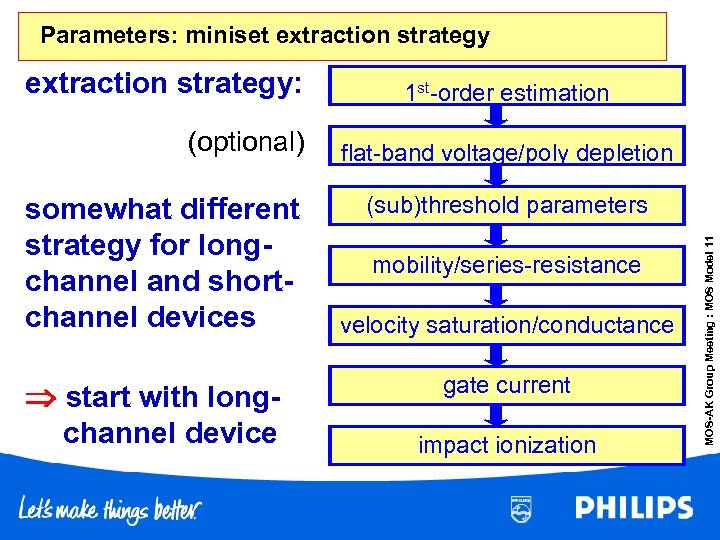 Parameters: miniset extraction strategy (optional) somewhat different strategy for longchannel and shortchannel devices start with longchannel device 1 st-order estimation flat-band voltage/poly depletion (sub)threshold parameters mobility/series-resistance velocity saturation/conductance gate current impact ionization MOS-AK Group Meeting : MOS Model 11 extraction strategy:
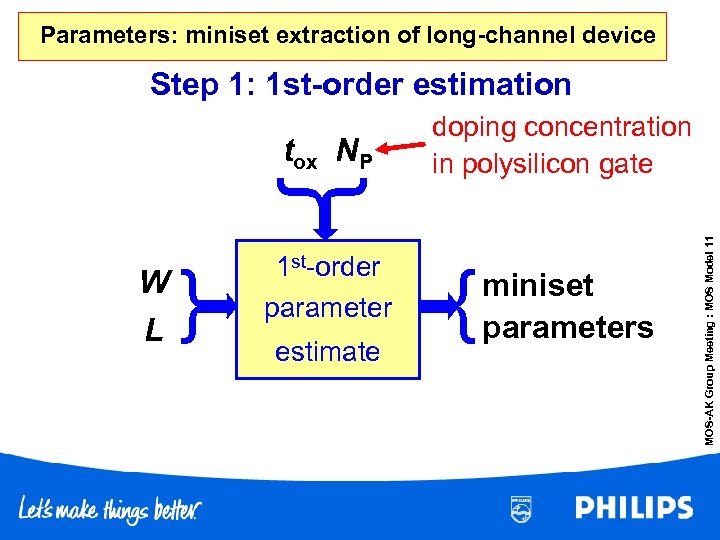 Parameters: miniset extraction of long-channel device Step 1: 1 st-order estimation } W L } 1 st-order parameter estimate { miniset parameters MOS-AK Group Meeting : MOS Model 11 tox NP doping concentration in polysilicon gate
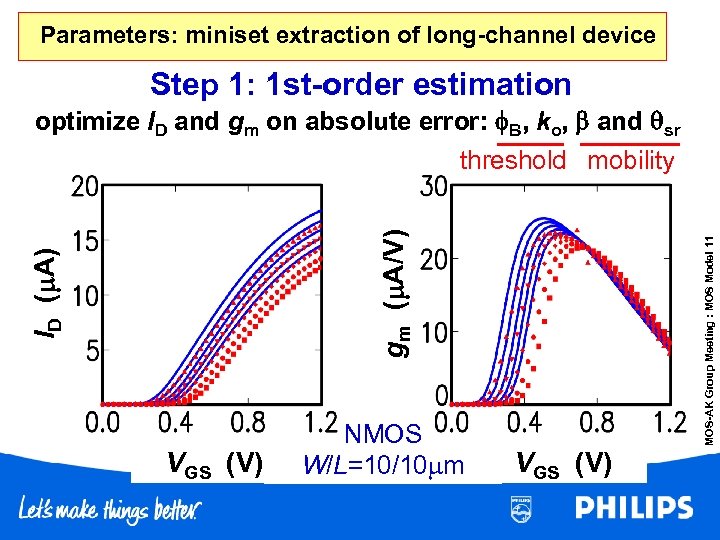 Parameters: miniset extraction of long-channel device Step 1: 1 st-order estimation optimize ID and gm on absolute error: B, ko, and sr VGS (V) NMOS W/L=10/10 m MOS-AK Group Meeting : MOS Model 11 ID ( A) gm ( A/V) threshold mobility VGS (V)
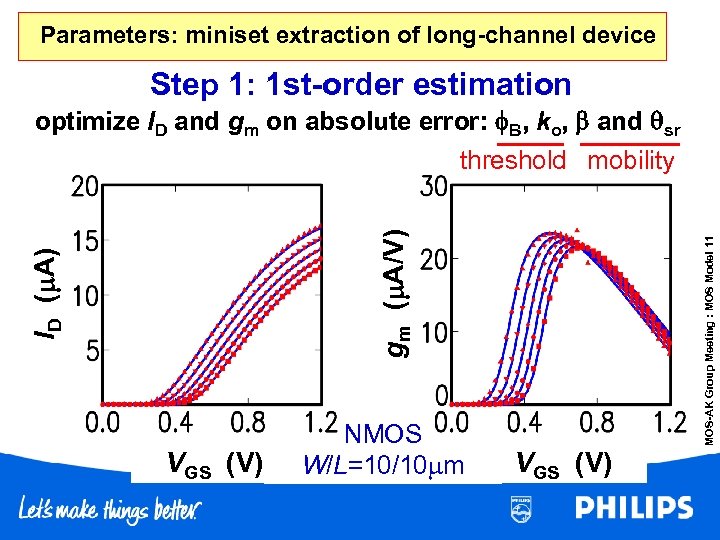 Parameters: miniset extraction of long-channel device Step 1: 1 st-order estimation optimize ID and gm on absolute error: B, ko, and sr VGS (V) NMOS W/L=10/10 m MOS-AK Group Meeting : MOS Model 11 ID ( A) gm ( A/V) threshold mobility VGS (V)
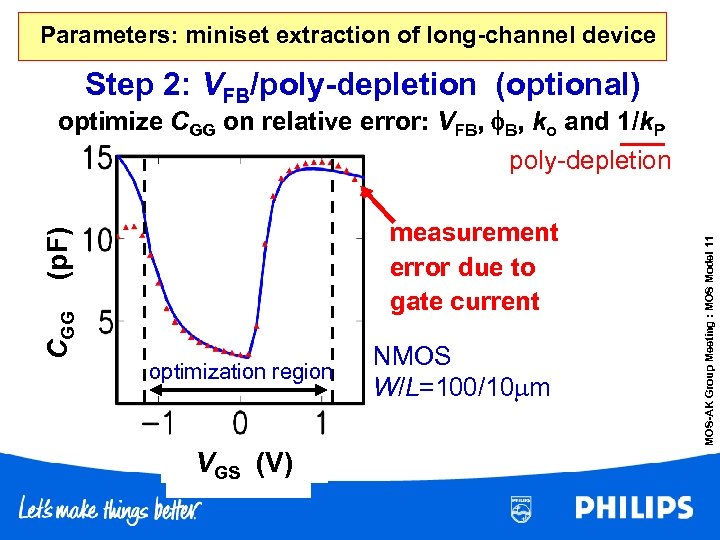 Parameters: miniset extraction of long-channel device Step 2: VFB/poly-depletion (optional) optimize CGG on relative error: VFB, B, ko and 1/k. P CGG (p. F) measurement error due to gate current optimization region VGS (V) NMOS W/L=100/10 m MOS-AK Group Meeting : MOS Model 11 poly-depletion
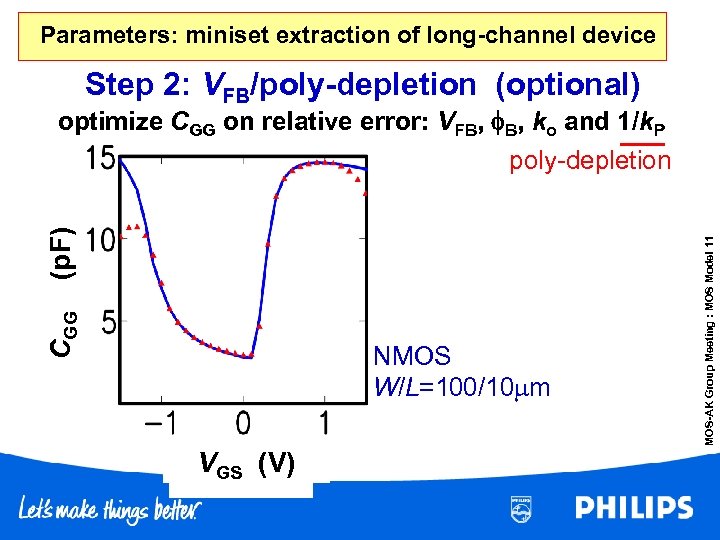 Parameters: miniset extraction of long-channel device Step 2: VFB/poly-depletion (optional) optimize CGG on relative error: VFB, B, ko and 1/k. P NMOS W/L=100/10 m VGS (V) MOS-AK Group Meeting : MOS Model 11 CGG (p. F) poly-depletion
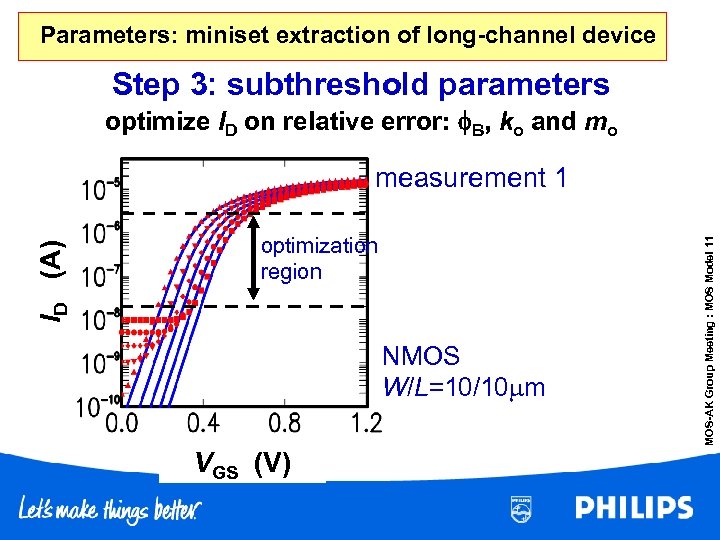 Parameters: miniset extraction of long-channel device Step 3: subthreshold parameters optimize ID on relative error: B, ko and mo optimization region NMOS W/L=10/10 m VGS (V) MOS-AK Group Meeting : MOS Model 11 ID (A) measurement 1
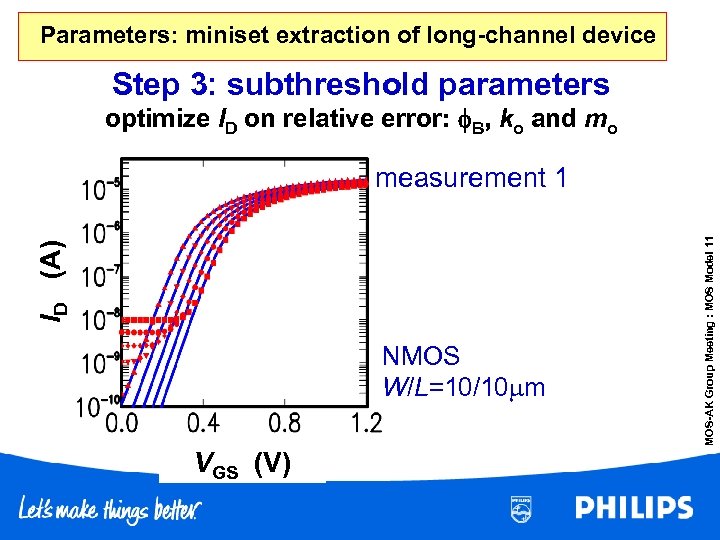 Parameters: miniset extraction of long-channel device Step 3: subthreshold parameters optimize ID on relative error: B, ko and mo NMOS W/L=10/10 m VGS (V) MOS-AK Group Meeting : MOS Model 11 ID (A) measurement 1
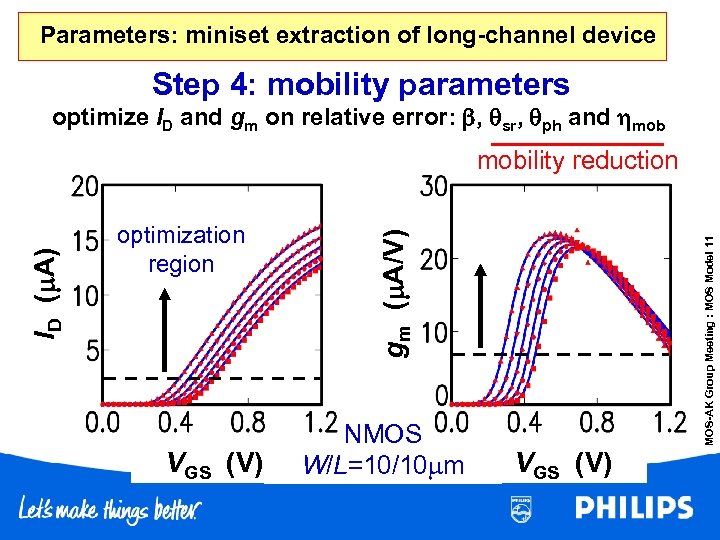 Parameters: miniset extraction of long-channel device Step 4: mobility parameters optimize ID and gm on relative error: , sr, ph and mob VGS (V) NMOS W/L=10/10 m MOS-AK Group Meeting : MOS Model 11 optimization region gm ( A/V) ID ( A) mobility reduction VGS (V)
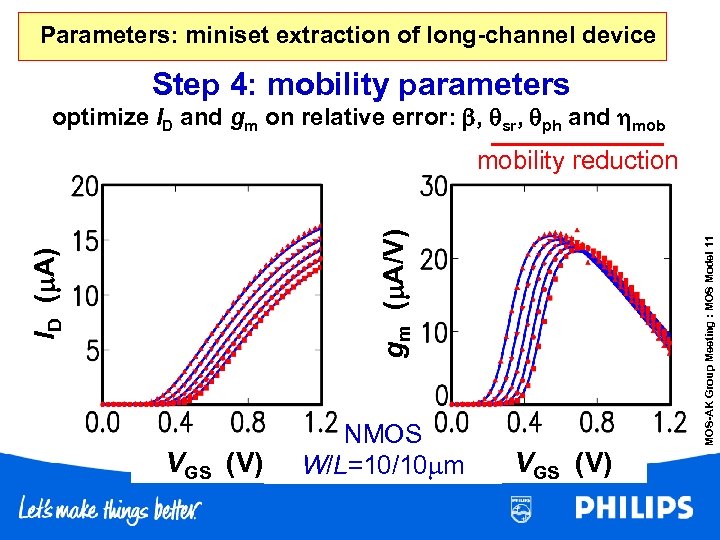 Parameters: miniset extraction of long-channel device Step 4: mobility parameters optimize ID and gm on relative error: , sr, ph and mob VGS (V) NMOS W/L=10/10 m MOS-AK Group Meeting : MOS Model 11 ID ( A) gm ( A/V) mobility reduction VGS (V)
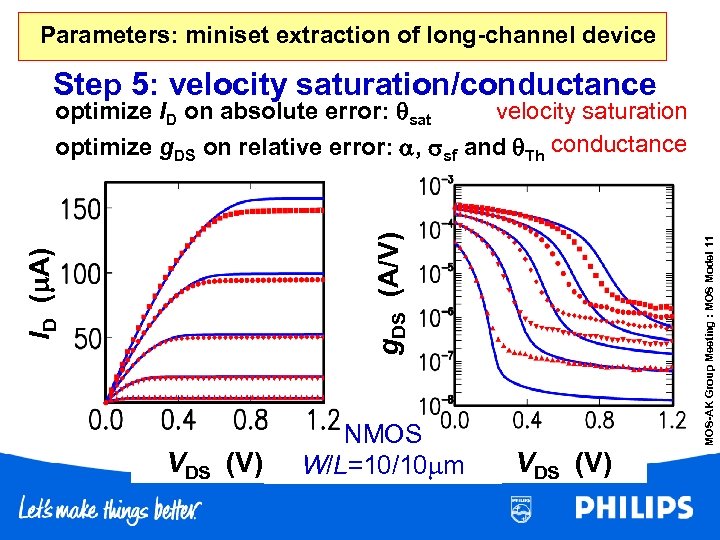 Parameters: miniset extraction of long-channel device Step 5: velocity saturation/conductance optimize ID on absolute error: sat VDS (V) NMOS W/L=10/10 m MOS-AK Group Meeting : MOS Model 11 ID ( A) g. DS (A/V) velocity saturation optimize g. DS on relative error: , sf and Th conductance VDS (V)
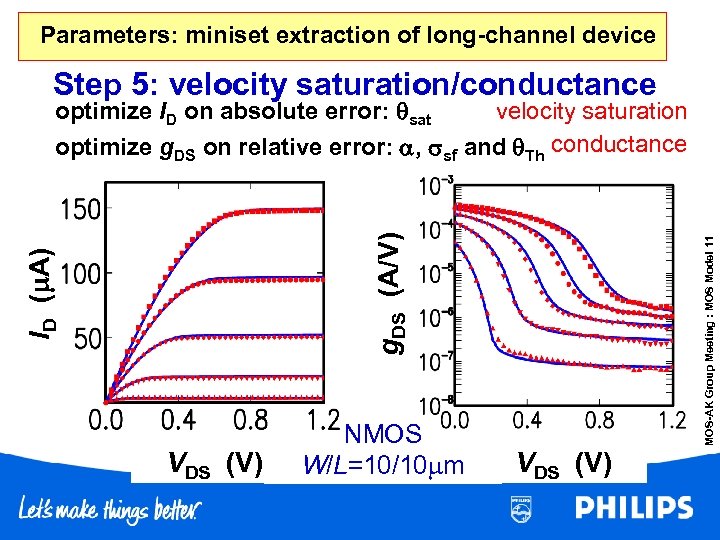 Parameters: miniset extraction of long-channel device Step 5: velocity saturation/conductance optimize ID on absolute error: sat VDS (V) NMOS W/L=10/10 m MOS-AK Group Meeting : MOS Model 11 ID ( A) g. DS (A/V) velocity saturation optimize g. DS on relative error: , sf and Th conductance VDS (V)
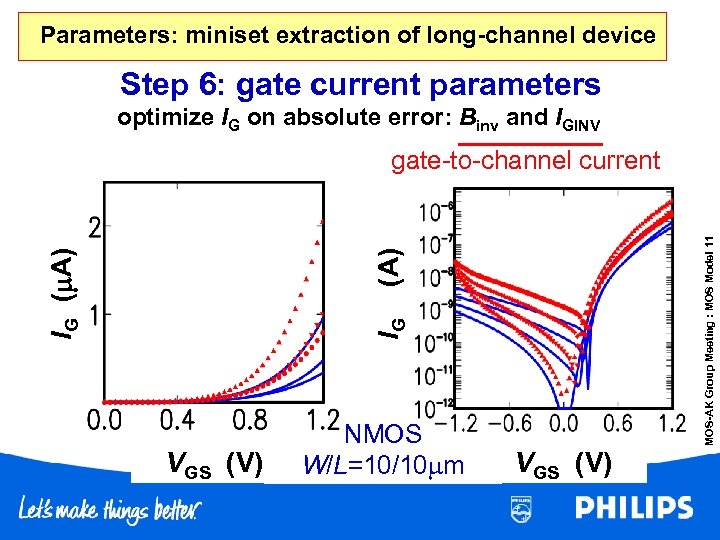 Parameters: miniset extraction of long-channel device Step 6: gate current parameters optimize IG on absolute error: Binv and IGINV MOS-AK Group Meeting : MOS Model 11 IG (A) IG ( A) gate-to-channel current VGS (V) NMOS W/L=10/10 m VGS (V)
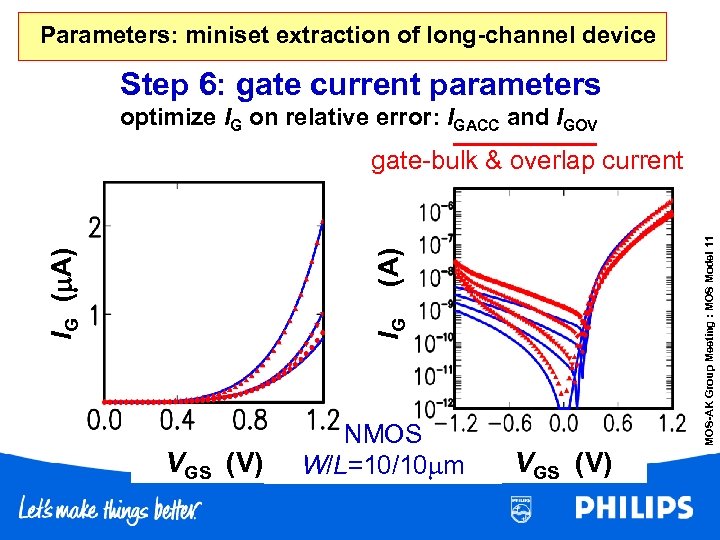 Parameters: miniset extraction of long-channel device Step 6: gate current parameters optimize G on relative error: I Binv optimize IIG on absolute error: GACC and IGINV GOV MOS-AK Group Meeting : MOS Model 11 IG (A) IG ( A) gate-bulk & overlap current gate-to-channel current VGS (V) NMOS W/L=10/10 m VGS (V)
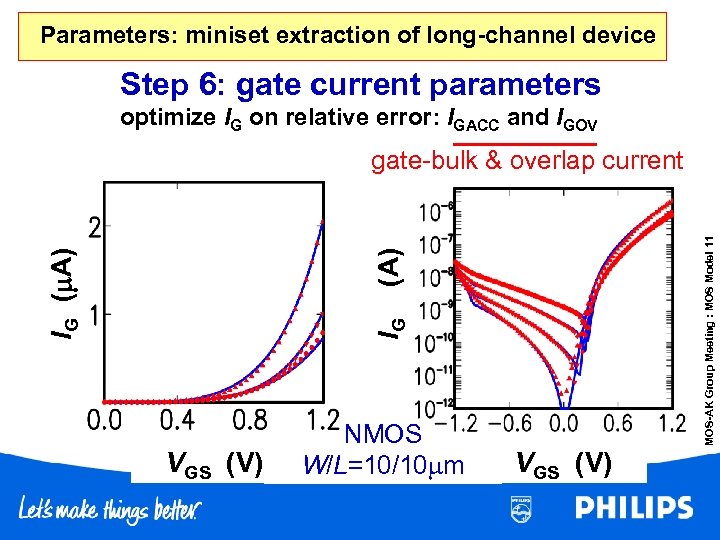 Parameters: miniset extraction of long-channel device Step 6: gate current parameters optimize I on relative error: IGACC and IGINV optimize IGG onabsolute error: Binvand IGOV MOS-AK Group Meeting : MOS Model 11 IG (A) IG ( A) gate-bulk & overlap current VGS (V) NMOS W/L=10/10 m VGS (V)
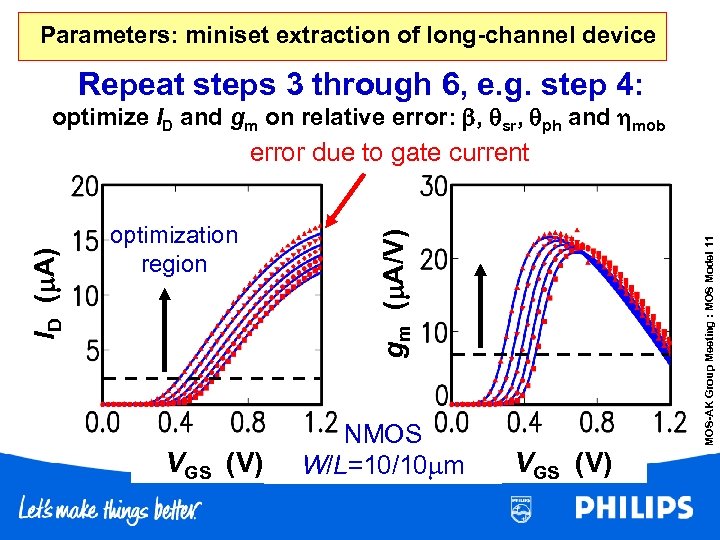 Parameters: miniset extraction of long-channel device Repeat steps 3 through 6, e. g. step 4: optimize ID and gm on relative error: , sr, ph and mob VGS (V) NMOS W/L=10/10 m MOS-AK Group Meeting : MOS Model 11 optimization region gm ( A/V) ID ( A) error due to gate current VGS (V)
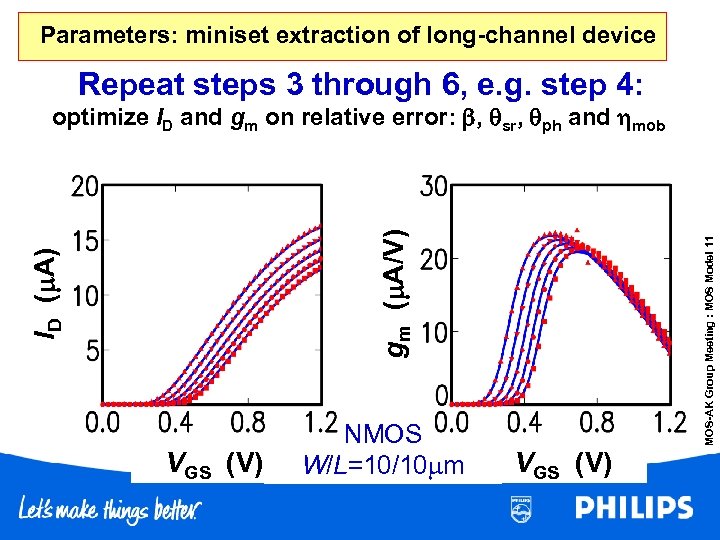 Parameters: miniset extraction of long-channel device Repeat steps 3 through 6, e. g. step 4: VGS (V) NMOS W/L=10/10 m MOS-AK Group Meeting : MOS Model 11 ID ( A) gm ( A/V) optimize ID and gm on relative error: , sr, ph and mob VGS (V)
 Parameters: extraction outline Measurements Miniset extraction Temperature scaling Geometry scaling MOS-AK Group Meeting : MOS Model 11 · ·
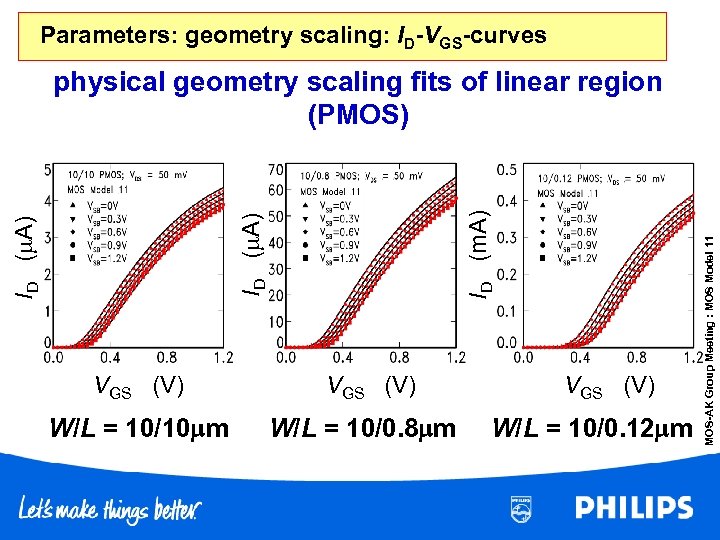
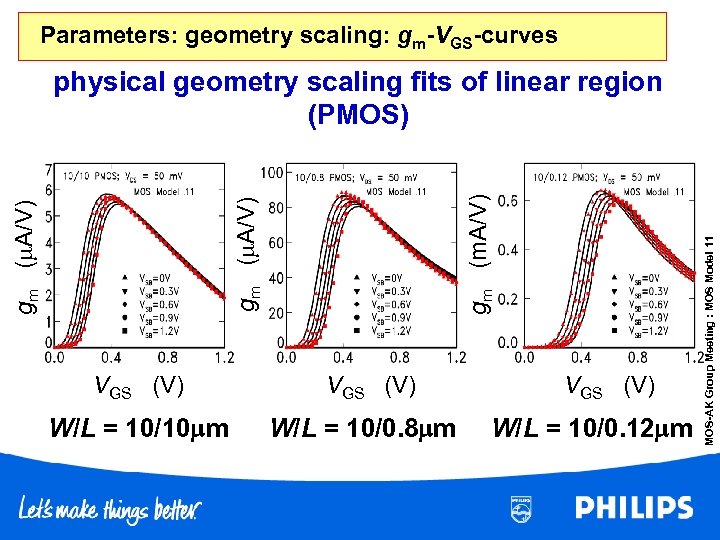
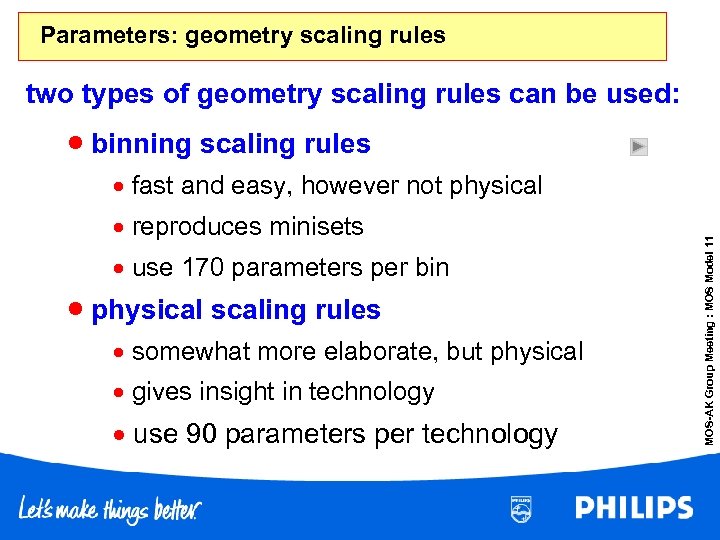 Parameters: geometry scaling rules two types of geometry scaling rules can be used: · binning scaling rules · reproduces minisets · use 170 parameters per bin · physical scaling rules · somewhat more elaborate, but physical · gives insight in technology · use 90 parameters per technology MOS-AK Group Meeting : MOS Model 11 · fast and easy, however not physical
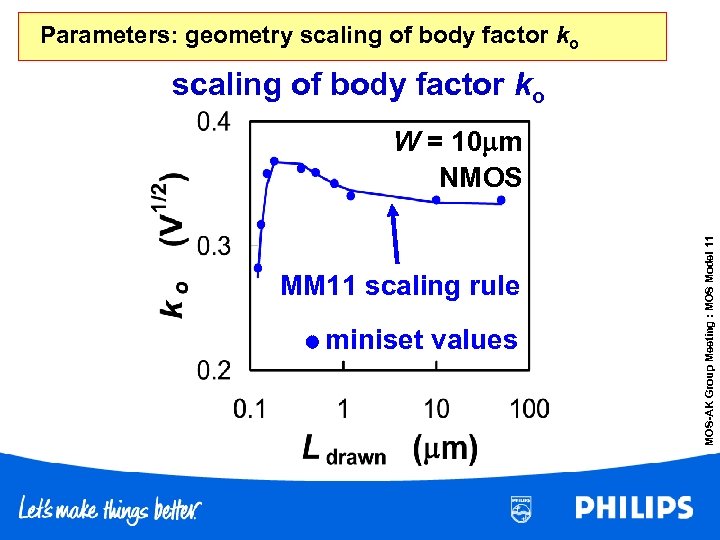
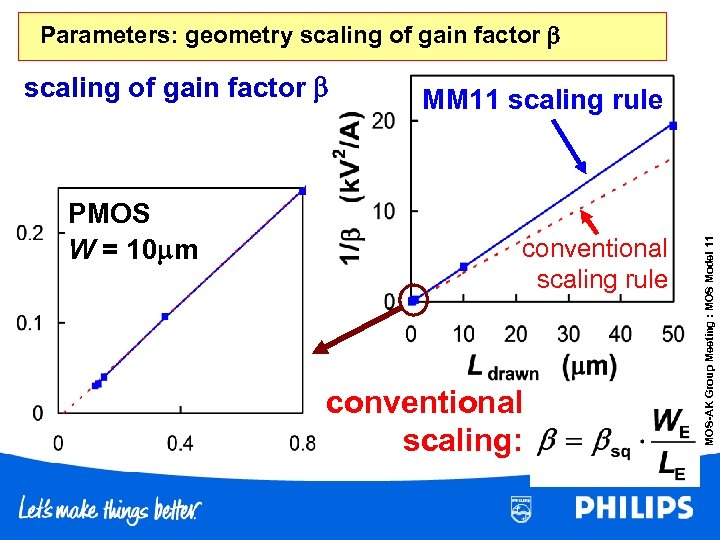
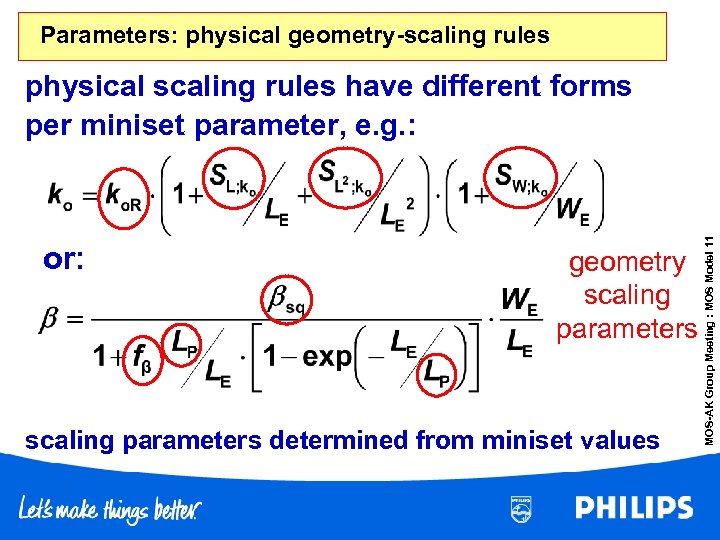 Parameters: physical geometry-scaling rules or: geometry scaling parameters determined from miniset values MOS-AK Group Meeting : MOS Model 11 physical scaling rules have different forms per miniset parameter, e. g. :
 Parameters: geometry scaling of body factor ko MM 11 scaling rule miniset values MOS-AK Group Meeting : MOS Model 11 W = 10 m NMOS
 Parameters: geometry scaling of gain factor PMOS W = 10 m MM 11 scaling rule conventional scaling: MOS-AK Group Meeting : MOS Model 11 scaling of gain factor
 Parameters: geometry scaling: ID-VGS-curves VGS (V) W/L = 10/10 m VGS (V) W/L = 10/0. 8 m VGS (V) W/L = 10/0. 12 m MOS-AK Group Meeting : MOS Model 11 ID ( A) ID (m. A) physical geometry scaling fits of linear region (PMOS)
 Parameters: geometry scaling: gm-VGS-curves VGS (V) W/L = 10/10 m VGS (V) W/L = 10/0. 8 m VGS (V) W/L = 10/0. 12 m MOS-AK Group Meeting : MOS Model 11 gm ( A/V) gm (m. A/V) physical geometry scaling fits of linear region (PMOS)
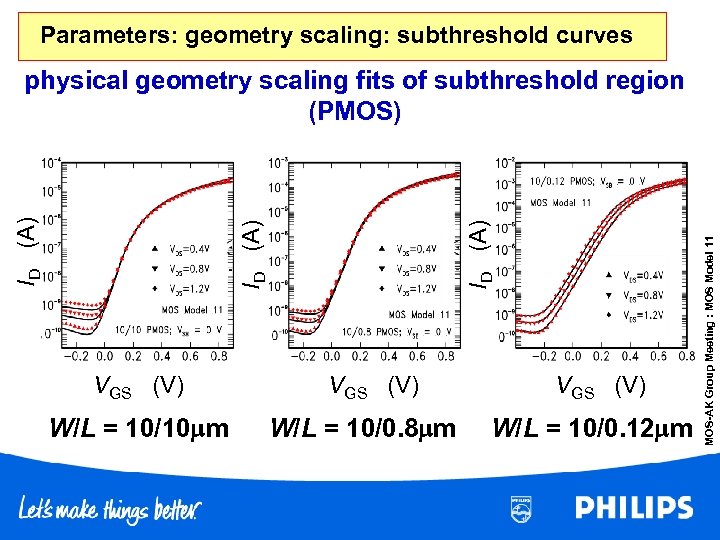 Parameters: geometry scaling: subthreshold curves VGS (V) W/L = 10/10 m VGS (V) W/L = 10/0. 8 m VGS (V) W/L = 10/0. 12 m MOS-AK Group Meeting : MOS Model 11 ID (A) physical geometry scaling fits of subthreshold region (PMOS)
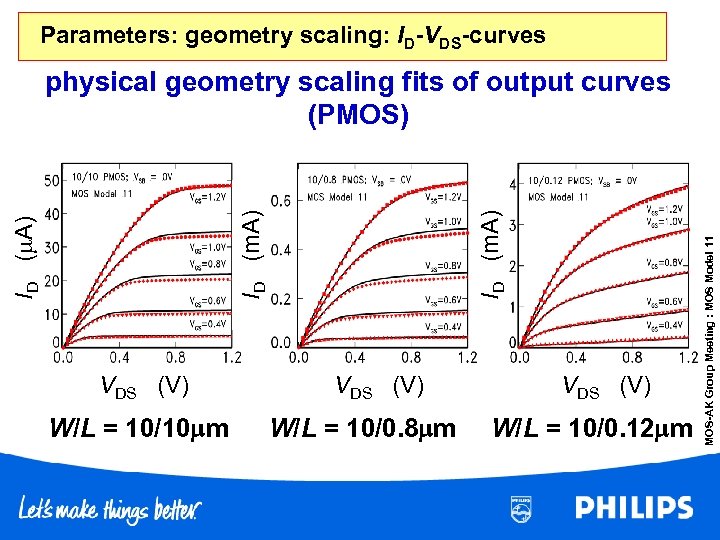 Parameters: geometry scaling: ID-VDS-curves VDS (V) W/L = 10/10 m VDS (V) W/L = 10/0. 8 m VDS (V) W/L = 10/0. 12 m MOS-AK Group Meeting : MOS Model 11 ID ( A) ID (m. A) physical geometry scaling fits of output curves (PMOS)
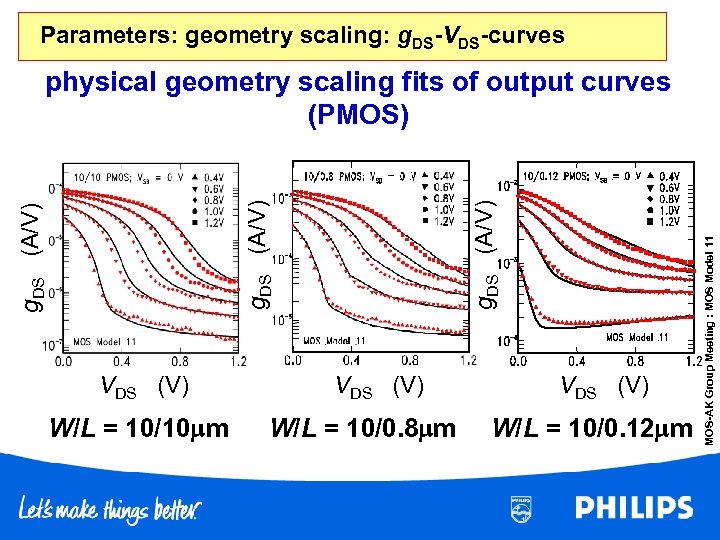 Parameters: geometry scaling: g. DS-VDS-curves W/L = 10/10 m VDS (V) W/L = 10/0. 8 m VDS (V) W/L = 10/0. 12 m MOS-AK Group Meeting : MOS Model 11 VDS (V) g. DS (A/V) physical geometry scaling fits of output curves (PMOS)
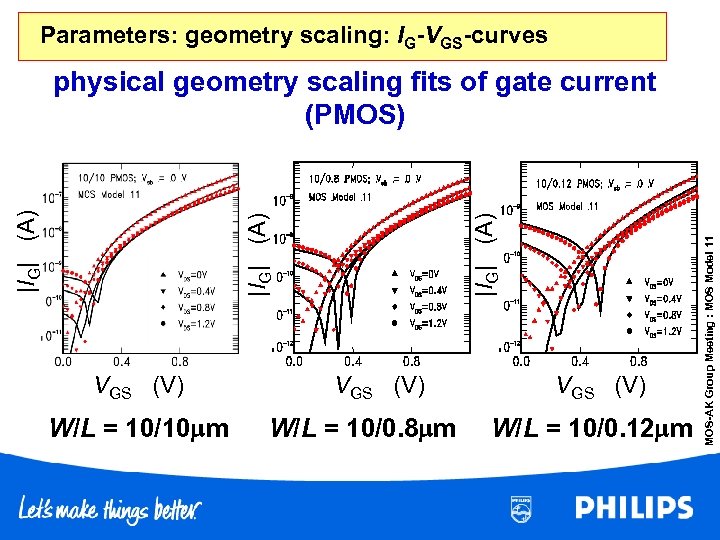 Parameters: geometry scaling: IG-VGS-curves W/L = 10/10 m VGS (V) W/L = 10/0. 8 m VGS (V) W/L = 10/0. 12 m MOS-AK Group Meeting : MOS Model 11 VGS (V) |IG| (A) physical geometry scaling fits of gate current (PMOS)
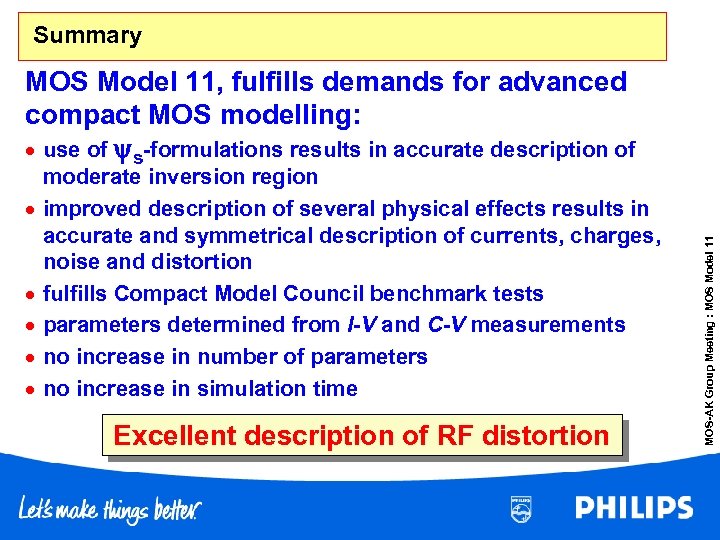 Summary · · · moderate inversion region improved description of several physical effects results in accurate and symmetrical description of currents, charges, noise and distortion fulfills Compact Model Council benchmark tests parameters determined from I-V and C-V measurements no increase in number of parameters no increase in simulation time Excellent description of RF distortion MOS-AK Group Meeting : MOS Model 11, fulfills demands for advanced compact MOS modelling: · use of s-formulations results in accurate description of
 • Why is MM 11 in the public domain? • Surface-potential-based model • Accuracy of s-approximation • Linear/saturation region transition • Drain/source partitioning of IG • Poly-depletion effect • Quantum-mechanical effects • Temperature scaling • Binning geometry-scaling rules • Literature MOS-AK Group Meeting : MOS Model 11 Appendices
 Appendix: Why is MM 11 in the public domain? Hence it makes sense to have MM 11 available for the outside world: • customers can use it • vendors of EDA & extraction tools implement model • facilitates communication about processes and wafer • model is open for discussion and improvements MOS-AK Group Meeting : MOS Model 11 W Semiconductors is a manufacturer with over 85% of sales to external customers
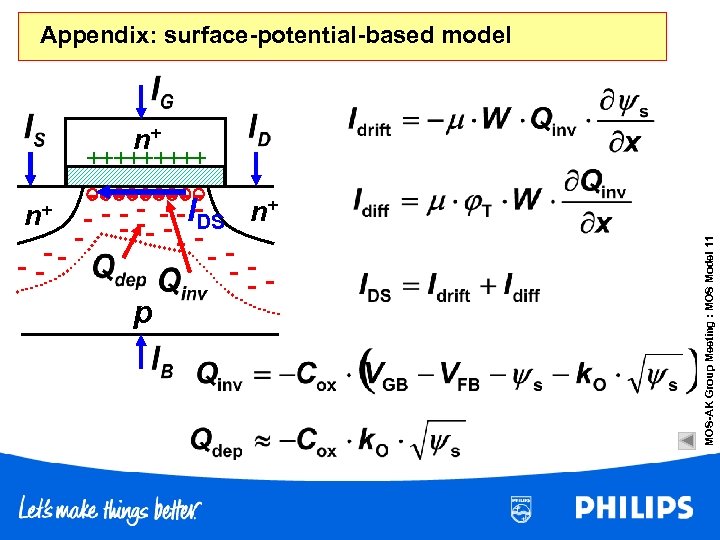 Appendix: surface-potential-based model n+ ----n+ n+ - - -- - IDS - -- -- - p MOS-AK Group Meeting : MOS Model 11 +++++
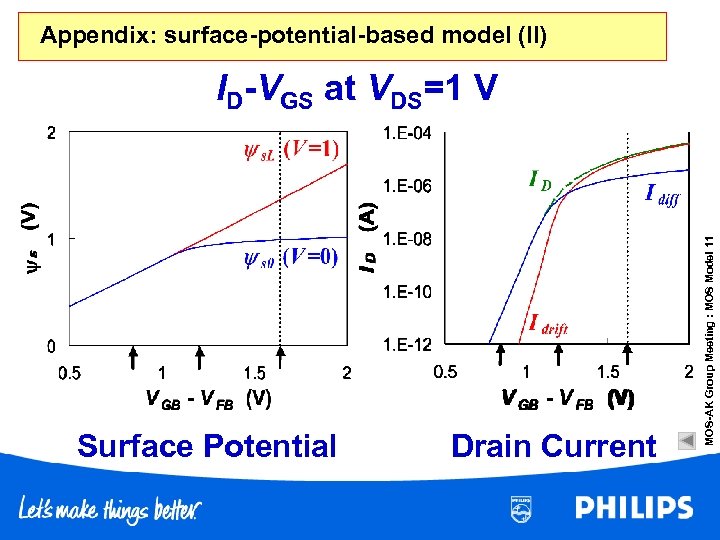 Appendix: surface-potential-based model (II) Surface Potential Drain Current MOS-AK Group Meeting : MOS Model 11 ID-VGS at VDS=1 V
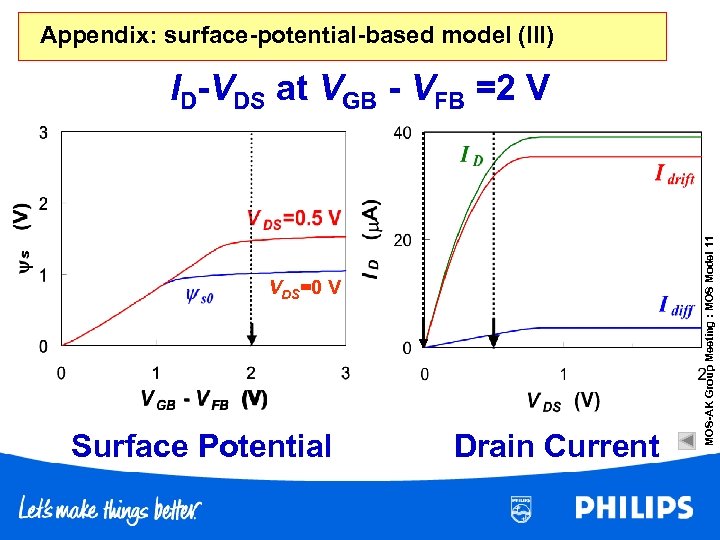 Appendix: surface-potential-based model (III) VDS=0 V Surface Potential Drain Current MOS-AK Group Meeting : MOS Model 11 ID-VDS at VGB - VFB =2 V
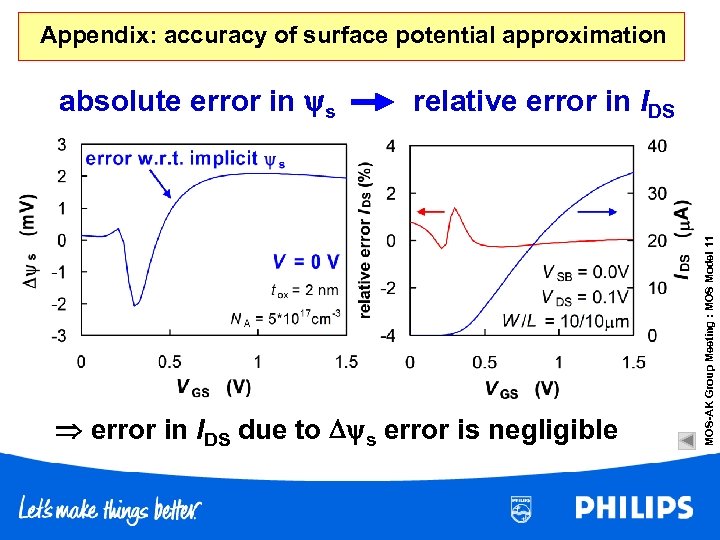 Appendix: accuracy of surface potential approximation relative error in IDS due to s error is negligible MOS-AK Group Meeting : MOS Model 11 absolute error in s
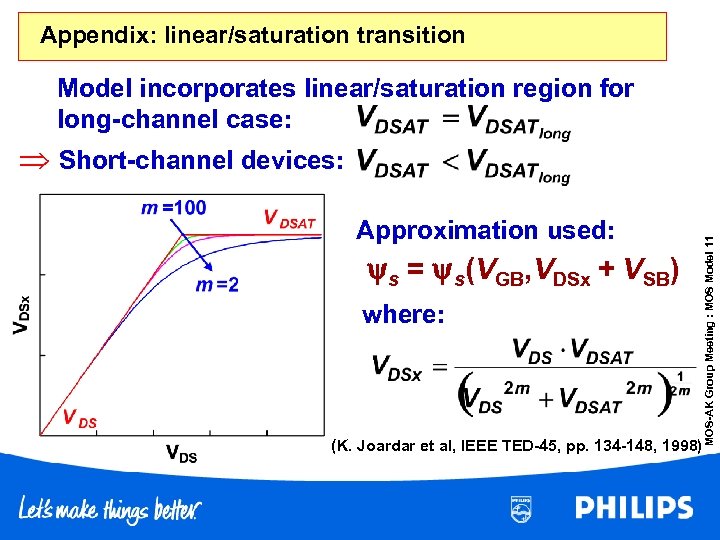 Appendix: linear/saturation transition Model incorporates linear/saturation region for long-channel case: Approximation used: s = s(VGB, VDSx + VSB) where: (K. Joardar et al, IEEE TED-45, pp. 134 -148, 1998) MOS-AK Group Meeting : MOS Model 11 Short-channel devices:
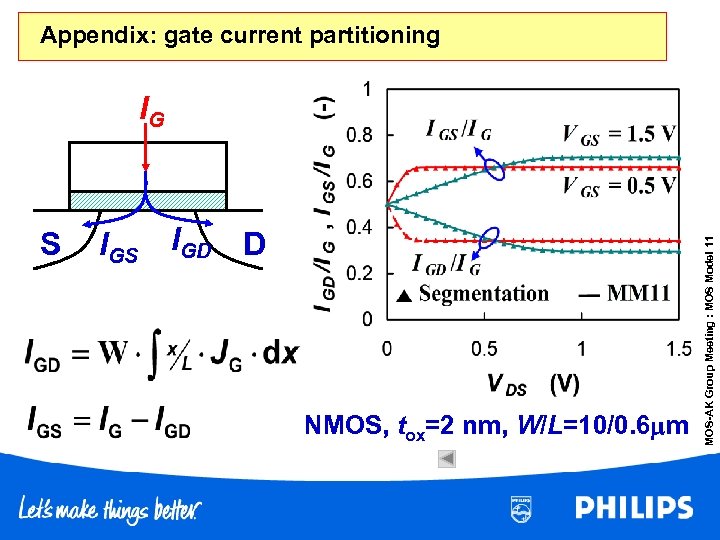 Appendix: gate current partitioning S IGD D NMOS, tox=2 nm, W/L=10/0. 6 m MOS-AK Group Meeting : MOS Model 11 IG
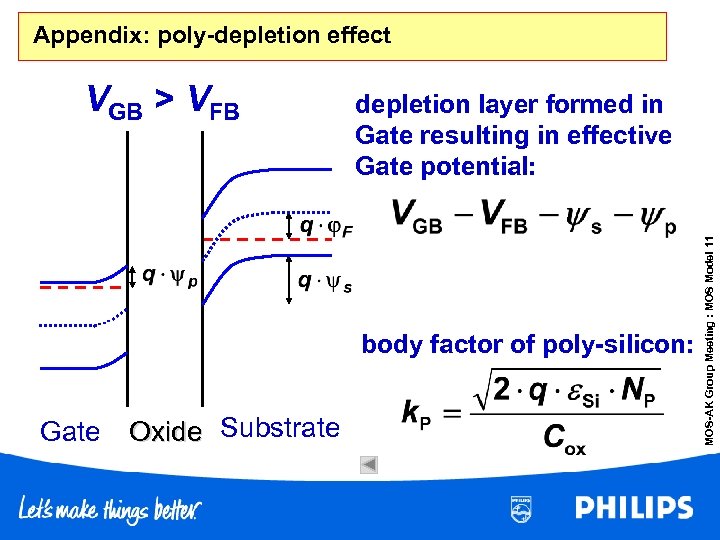 Appendix: poly-depletion effect depletion layer formed in Gate resulting in effective Gate potential: body factor of poly-silicon: Gate Oxide Substrate MOS-AK Group Meeting : MOS Model 11 VGB > VFB
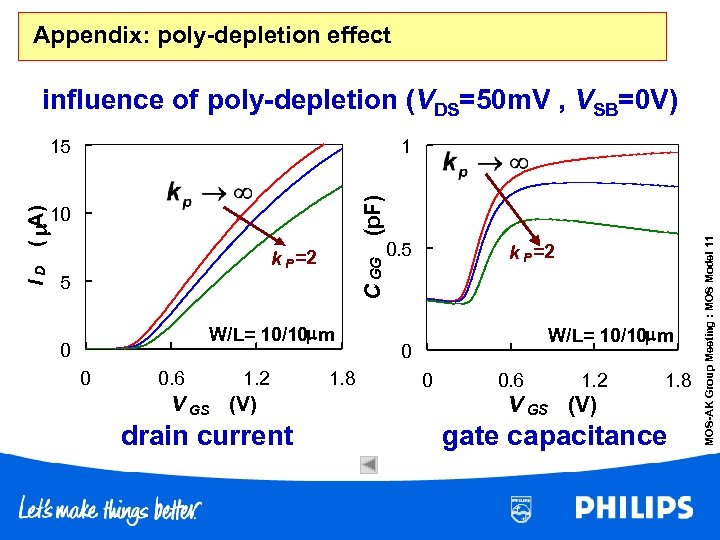 Appendix: poly-depletion effect influence of poly-depletion (VDS=50 m. V , VSB=0 V) I D ( A) 10 k P =2 5 W/L= 10/10 m 0 0 0. 6 1. 2 V GS (V) drain current 1. 8 0. 5 k P =2 W/L= 10/10 m 0 0 0. 6 1. 2 1. 8 V GS (V) gate capacitance MOS-AK Group Meeting : MOS Model 11 1 C GG (p. F) 15
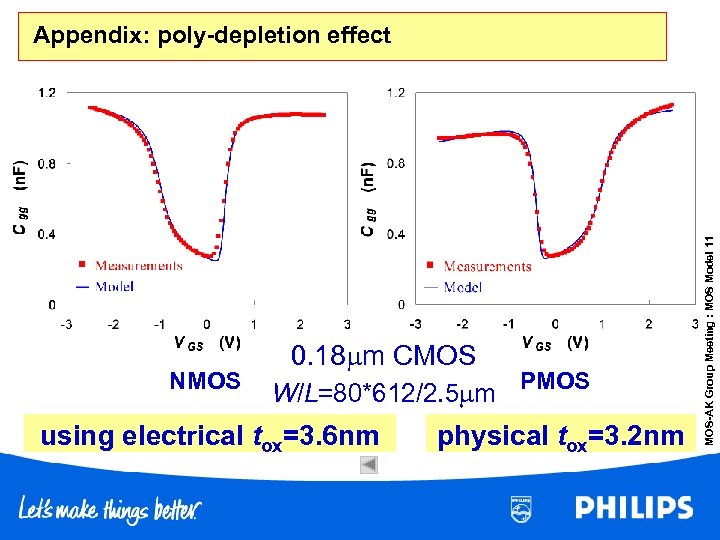 NMOS 0. 18 m CMOS W/L=80*612/2. 5 m using electrical tox=3. 6 nm PMOS physical tox=3. 2 nm MOS-AK Group Meeting : MOS Model 11 Appendix: poly-depletion effect
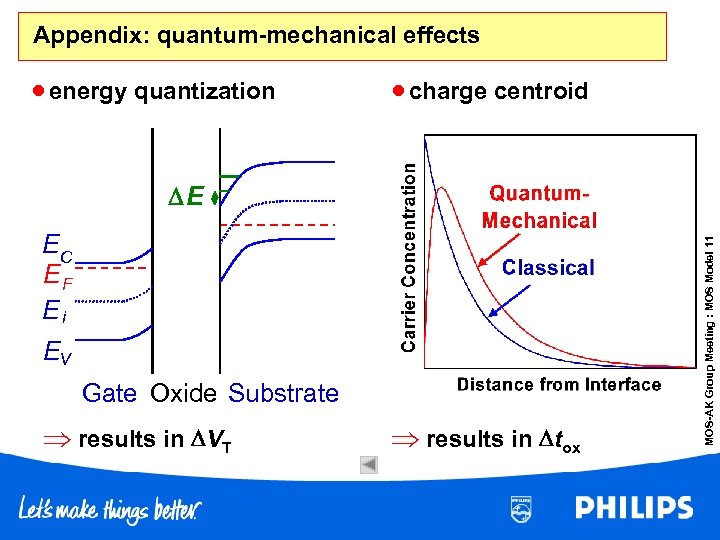 Appendix: quantum-mechanical effects · energy quantization · charge centroid EC EF Ei EV Gate Oxide Substrate results in VT results in tox MOS-AK Group Meeting : MOS Model 11 E
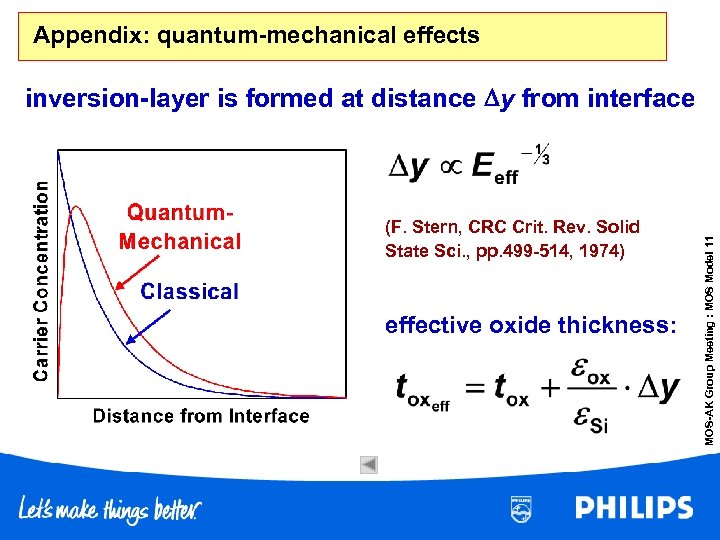 Appendix: quantum-mechanical effects (F. Stern, CRC Crit. Rev. Solid State Sci. , pp. 499 -514, 1974) effective oxide thickness: MOS-AK Group Meeting : MOS Model 11 inversion-layer is formed at distance y from interface
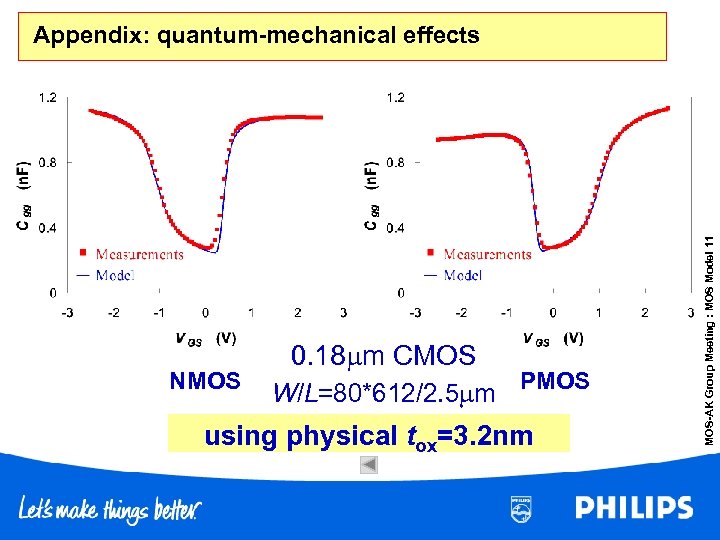 NMOS 0. 18 m CMOS W/L=80*612/2. 5 m PMOS using physical tox=3. 2 nm MOS-AK Group Meeting : MOS Model 11 Appendix: quantum-mechanical effects
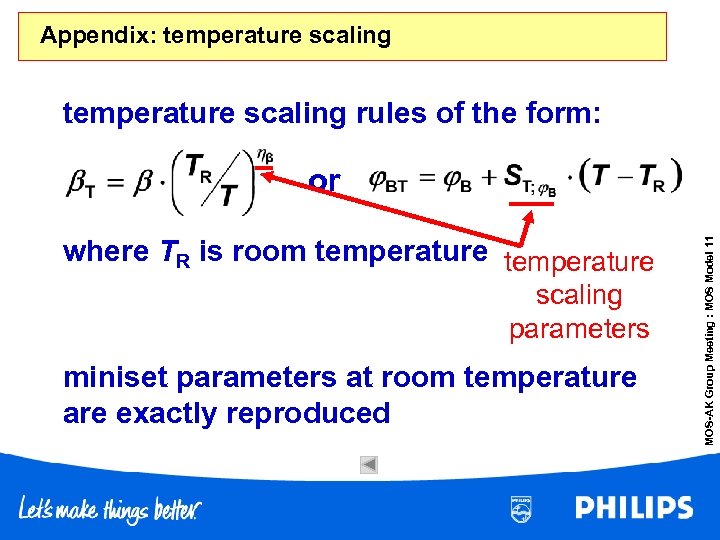 Appendix: temperature scaling rules of the form: where TR is room temperature scaling parameters miniset parameters at room temperature are exactly reproduced MOS-AK Group Meeting : MOS Model 11 or
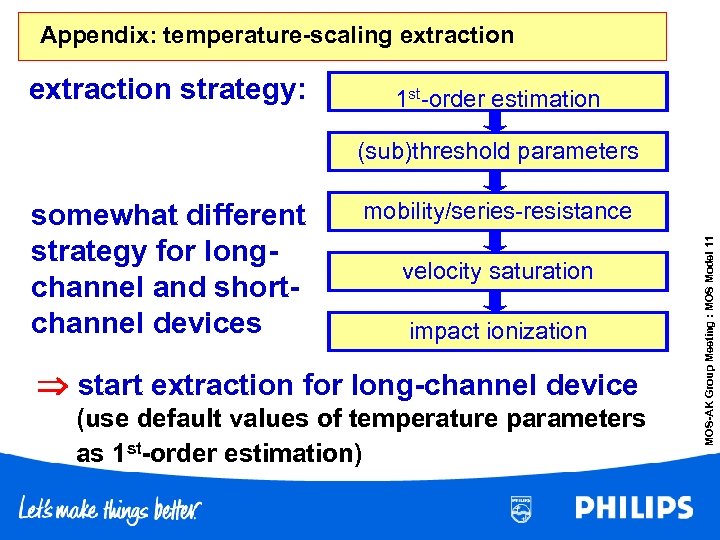 Appendix: temperature-scaling extraction strategy: 1 st-order estimation (sub)threshold parameters mobility/series-resistance velocity saturation impact ionization start extraction for long-channel device (use default values of temperature parameters as 1 st-order estimation) MOS-AK Group Meeting : MOS Model 11 somewhat different strategy for longchannel and shortchannel devices
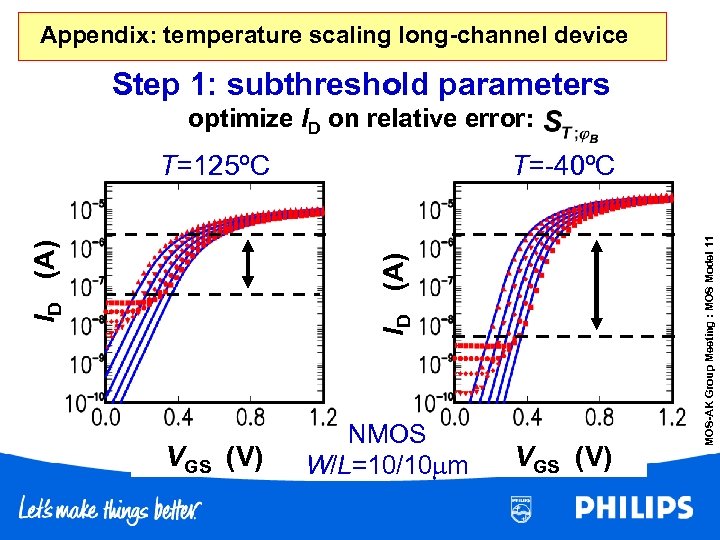 Appendix: temperature scaling long-channel device Step 1: subthreshold parameters optimize ID on relative error: VGS (V) NMOS W/L=10/10 m VGS (V) MOS-AK Group Meeting : MOS Model 11 T=-40ºC ID (A) T=125ºC
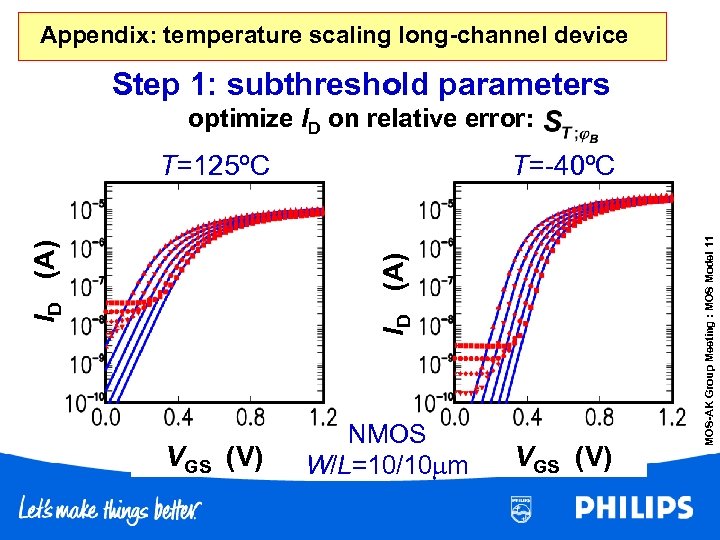 Appendix: temperature scaling long-channel device Step 1: subthreshold parameters optimize ID on relative error: VGS (V) NMOS W/L=10/10 m VGS (V) MOS-AK Group Meeting : MOS Model 11 T=-40ºC ID (A) T=125ºC
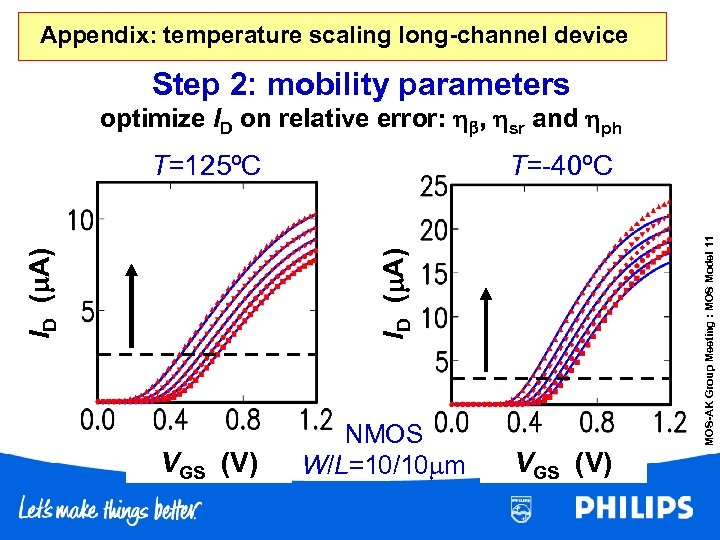 Appendix: temperature scaling long-channel device Step 2: mobility parameters optimize ID on relative error: , sr and ph MOS-AK Group Meeting : MOS Model 11 T=-40ºC ID ( A) T=125ºC VGS (V) NMOS W/L=10/10 m VGS (V)
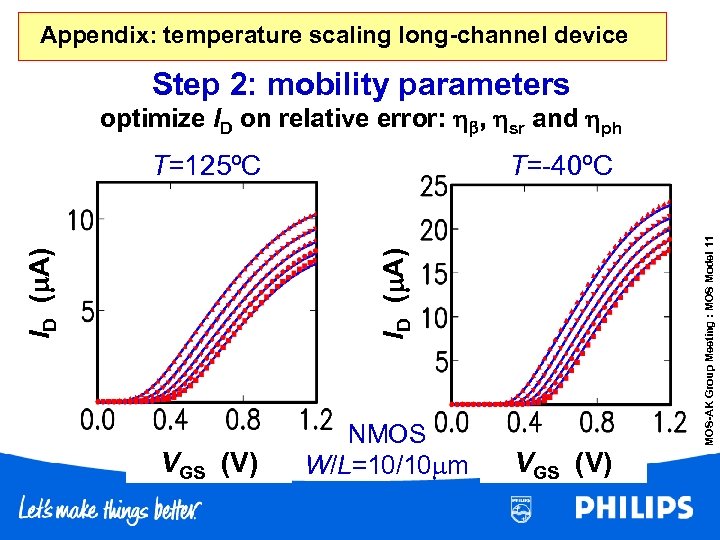 Appendix: temperature scaling long-channel device Step 2: mobility parameters optimize ID on relative error: , sr and ph MOS-AK Group Meeting : MOS Model 11 T=-40ºC ID ( A) T=125ºC VGS (V) NMOS W/L=10/10 m VGS (V)
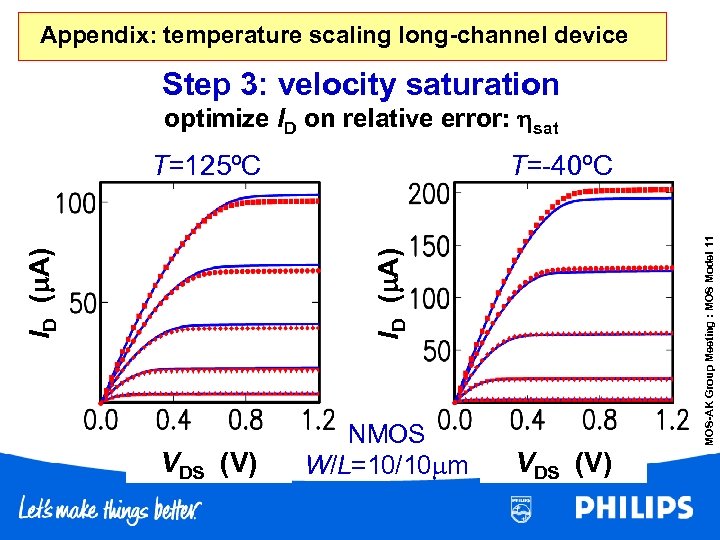 Appendix: temperature scaling long-channel device Step 3: velocity saturation optimize ID on relative error: sat MOS-AK Group Meeting : MOS Model 11 T=-40ºC ID ( A) T=125ºC VDS (V) NMOS W/L=10/10 m VDS (V)
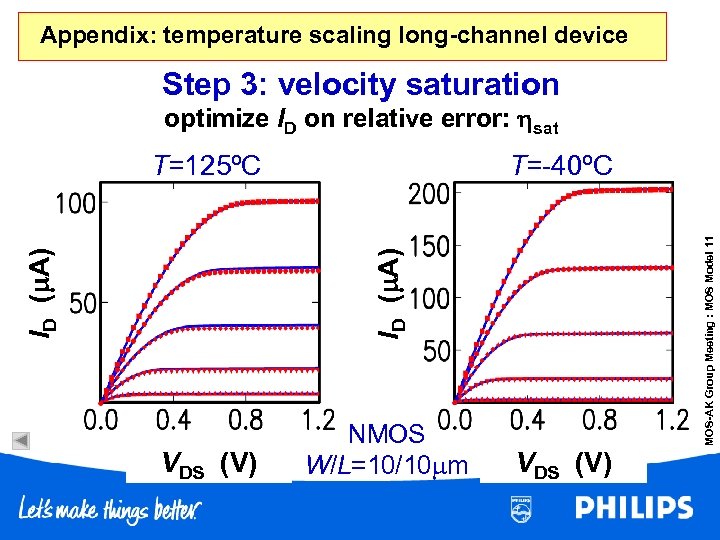 Appendix: temperature scaling long-channel device Step 3: velocity saturation optimize ID on relative error: sat MOS-AK Group Meeting : MOS Model 11 T=-40ºC ID ( A) T=125ºC VDS (V) NMOS W/L=10/10 m VDS (V)
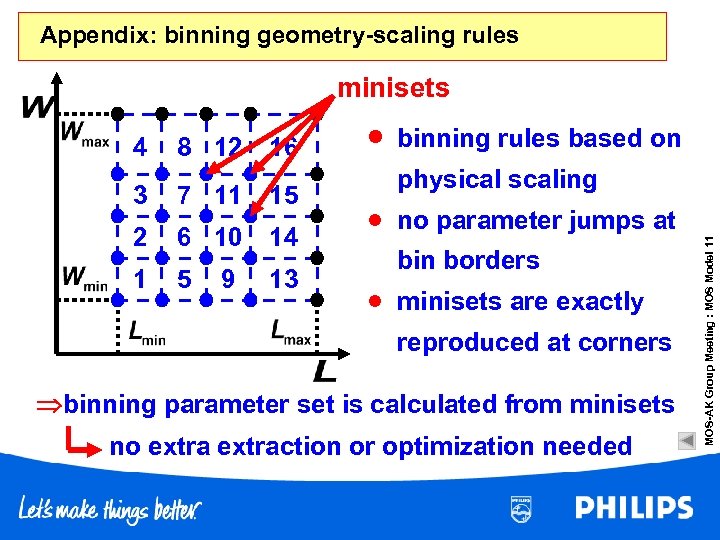 Appendix: binning geometry-scaling rules minisets 8 12 16 3 7 11 15 2 6 10 14 1 5 13 9 · binning rules based on physical scaling · no parameter jumps at bin borders · minisets are exactly reproduced at corners binning parameter set is calculated from minisets no extraction or optimization needed MOS-AK Group Meeting : MOS Model 11 4
 Appendix: literature · “Effect of gate-field dependent mobility degradation on distortion analysis in MOSFET’s”, R. v. Langevelde and F. M. Klaassen, IEEE Trans. El. Dev. , Vol. 44, p. 2044, 1997 · “Accurate drain conductance modeling for distortion analysis in MOSFETs”, · “A compact MOSFET model for distortion analysis in analog circuit design”, R. v. Langevelde, Ph. D. Thesis, University of Technology Eindhoven, 1998 CMC benchmark tests · “Accurate thermal noise model for deep sub-micron CMOS”, A. J. Scholten et al. , IEDM’ 99 Technical Digest, p. 155, 1999 · “An explicit surface-potential-based MOSFET model for circuit simulation”, MOS-AK Group Meeting : MOS Model 11 R. v. Langevelde and F. M. Klaassen, IEDM’ 97 Technical Digest, p. 313, 1997 R. v. Langevelde and F. M. Klaassen, Solid-State Electron. , Vol. 44, p. 409, 2000
 Appendix: literature · “RF-Distortion characterisation of sub-micron CMOS”, L. F. Tiemeijer et al. , Proc. ESSDERC’ 00, p. 464, 2000 · “RF-Distortion in deep sub-micron CMOS technologies”, R. v. Langevelde et al. , IEDM’ 00 Technical Digest, p. 807, 2000 A. J. Scholten et al. , CMC meeting, March 2001, http: //www. eigroup. org/cmc · “MOS Model 11, Level 1100’’, R. v. Langevelde, Nat. Lab. Unclassified Report NL-UR 2001/813, April 2001, see website · “Compact MOS modelling for RF circuit simulation”, A. J. Scholten et al. , Proc. SISPAD’ 01, p. 194, 2001 · “Advanced compact MOS modelling”, R. v. Langevelde et al. , Proc. ESSDERC’ 01, p. 81, 2001 MOS-AK Group Meeting : MOS Model 11 · “BSIM 4 and MOS Model 11 benchmarks for MOSFET capacitances”,
 Appendix: literature · “Compact modelling of pocket-implanted MOSFETs”, A. J. Scholten et al. , Proc. ESSDERC’ 01, p. 311, 2001 · “Gate current: Modeling, L extraction and impact on RF performance”, R. v. Langevelde et al. , IEDM’ 01 Technical Digest, p. 289, 2001 R. v. Langevelde, Agilent World-Wide IC-CAP Users’ Conference, Dec. 2001 · “MOS Model 11, Level 1101’’, R. v. Langevelde et al. , Nat. Lab. Unclassified Report NL-UR 2002/802, June 2002, see website MOS-AK Group Meeting : MOS Model 11 · “Parameter extraction for surface-potential based compact MOS Model 11”,