


 Скачать презентацию R T U New York State Center of
afba5ed58df05554420164dd9b71fb1c.ppt
- Количество слайдов: 161
 R T U New York State Center of Excellence in Bioinformatics & Life Sciences ICBO Tutorial Introduction to Referent Tracking July 22, 2009 112 Norton Hall, UB North Campus Werner CEUSTERS Center of Excellence in Bioinformatics and Life Sciences Ontology Research Group University at Buffalo, NY, USA (corrected version: August 10, 2009)
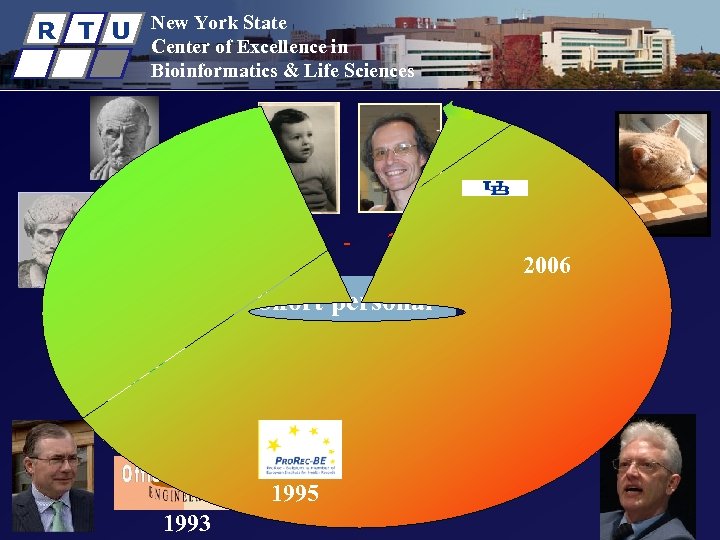 R T U New York State Center of Excellence in Bioinformatics & Life Sciences ? 1977 1959 - 2009 2006 Short personal history 1989 2004 1992 2002 1995 1993 1998
 R T U New York State Center of Excellence in Bioinformatics & Life Sciences House keeping rules • Feel free to ask clarifications at any time if you don’t understand something I just said (but not more than three slides earlier); • Please do not interrupt me if you ‘just’ disagree with something I say until: – near beginning of the break, – near end of the tutorial; • Everybody in the audience may sleep except those students who are here for credit, – I’ll test them – redundancy in my slides serves thus a purpose: to help them !
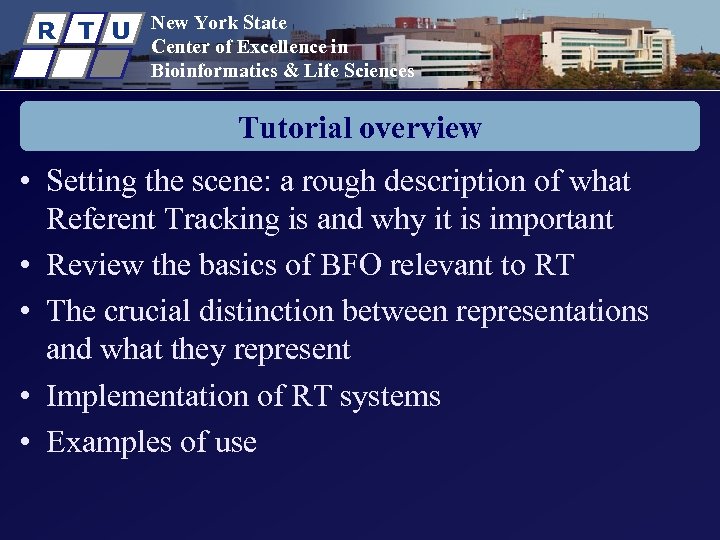 R T U New York State Center of Excellence in Bioinformatics & Life Sciences Tutorial overview • Setting the scene: a rough description of what Referent Tracking is and why it is important • Review the basics of BFO relevant to RT • The crucial distinction between representations and what they represent • Implementation of RT systems • Examples of use
 R T U New York State Center of Excellence in Bioinformatics & Life Sciences Prologue: Referent Tracking: What and Why ?
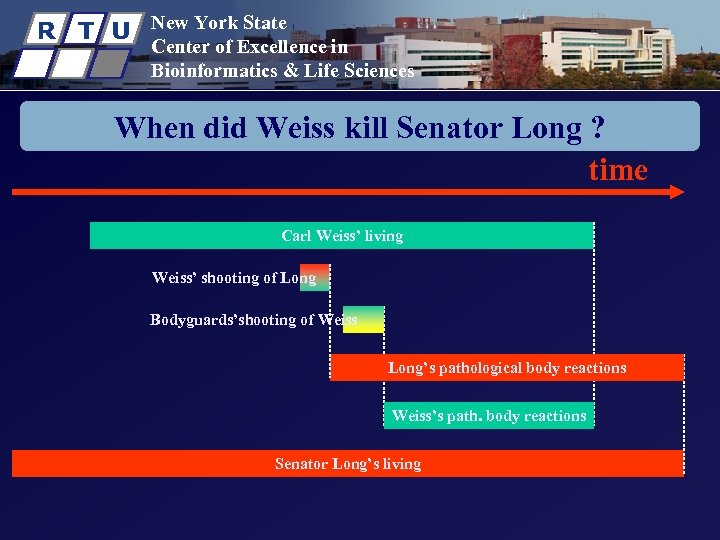 R T U New York State Center of Excellence in Bioinformatics & Life Sciences When did Weiss kill Senator Long ? time Carl Weiss’ living Weiss’ shooting of Long Bodyguards’shooting of Weiss Long’s pathological body reactions Weiss’s path. body reactions Senator Long’s living
 R T U New York State Center of Excellence in Bioinformatics & Life Sciences What is Referent Tracking ? • A paradigm under development since 2005, – based on Basic Formal Ontology, – designed to keep track of relevant portions of reality and what is believed and communicated about them, – enabling adequate use of realism-based ontologies, terminologies, thesauri, and vocabularies, – originally conceived to track particulars on the side of the patient and his environment denoted in his EHR, – but since then studied in and applied to a variety of domains, – and now evolving towards tracking absolutely everything, not only particulars, but also universals.
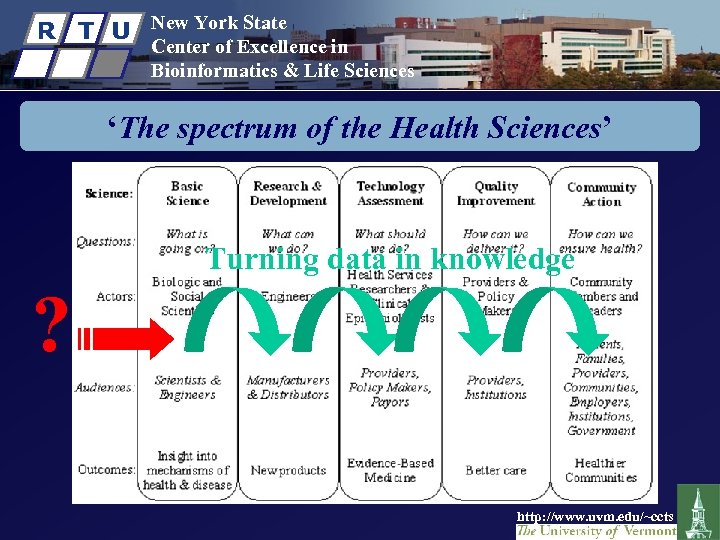 R T U New York State Center of Excellence in Bioinformatics & Life Sciences ‘The spectrum of the Health Sciences’ Turning data in knowledge ? http: //www. uvm. edu/~ccts
 R T U New York State Center of Excellence in Bioinformatics & Life Sciences Source of all data Reality !
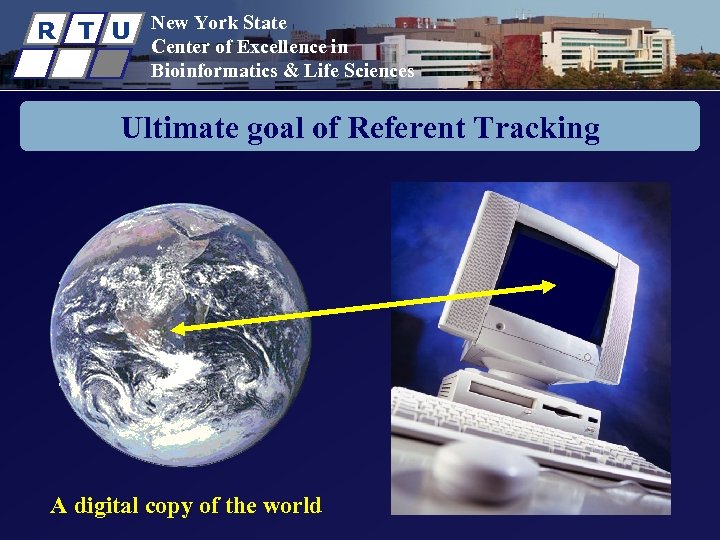 R T U New York State Center of Excellence in Bioinformatics & Life Sciences Ultimate goal of Referent Tracking A digital copy of the world
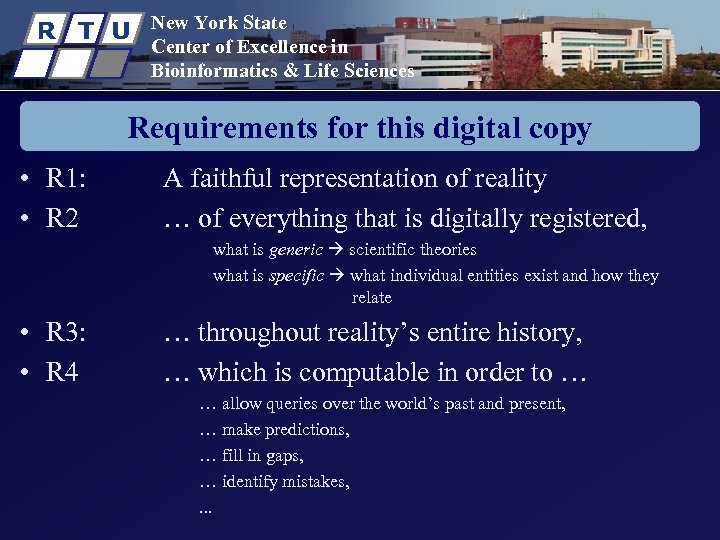 R T U New York State Center of Excellence in Bioinformatics & Life Sciences Requirements for this digital copy • R 1: • R 2 A faithful representation of reality … of everything that is digitally registered, what is generic scientific theories what is specific what individual entities exist and how they relate • R 3: • R 4 … throughout reality’s entire history, … which is computable in order to … … allow queries over the world’s past and present, … make predictions, … fill in gaps, … identify mistakes, . . .
 R T U New York State Center of Excellence in Bioinformatics & Life Sciences In fact … the ultimate crystal ball
 R T U New York State Center of Excellence in Bioinformatics & Life Sciences The ‘binding’ wall tr i o ? ht ig d to w o H I don’t want a cartoon of the world
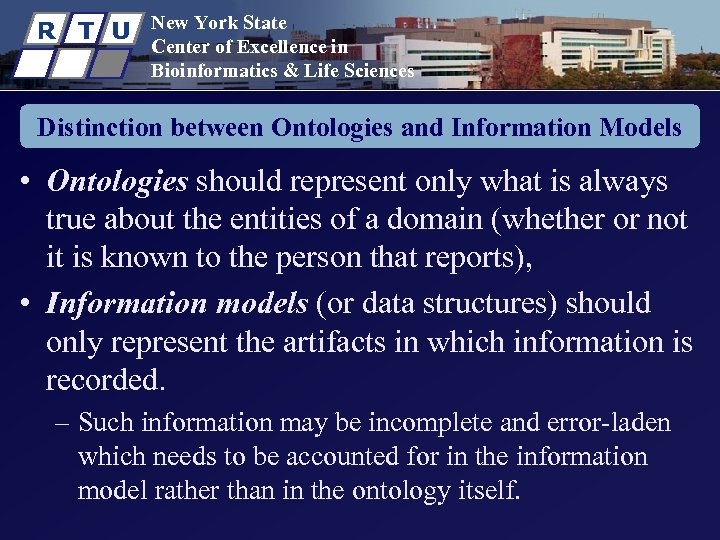 R T U New York State Center of Excellence in Bioinformatics & Life Sciences Distinction between Ontologies and Information Models • Ontologies should represent only what is always true about the entities of a domain (whether or not it is known to the person that reports), • Information models (or data structures) should only represent the artifacts in which information is recorded. – Such information may be incomplete and error-laden which needs to be accounted for in the information model rather than in the ontology itself.
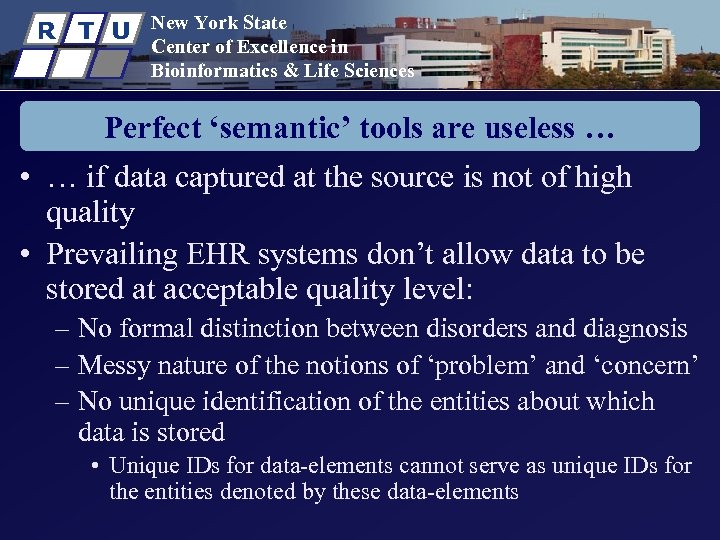 R T U New York State Center of Excellence in Bioinformatics & Life Sciences Perfect ‘semantic’ tools are useless … • … if data captured at the source is not of high quality • Prevailing EHR systems don’t allow data to be stored at acceptable quality level: – No formal distinction between disorders and diagnosis – Messy nature of the notions of ‘problem’ and ‘concern’ – No unique identification of the entities about which data is stored • Unique IDs for data-elements cannot serve as unique IDs for the entities denoted by these data-elements
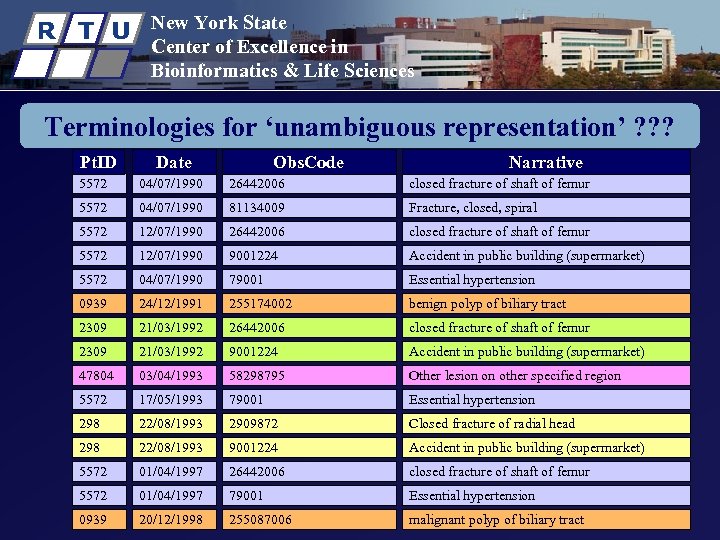 R T U New York State Center of Excellence in Bioinformatics & Life Sciences Terminologies for ‘unambiguous representation’ ? ? ? Pt. ID Date Obs. Code Narrative 5572 04/07/1990 26442006 closed fracture of shaft of femur 5572 04/07/1990 81134009 Fracture, closed, spiral 5572 12/07/1990 26442006 closed fracture of shaft of femur 5572 12/07/1990 9001224 Accident in public building (supermarket) 5572 04/07/1990 79001 Essential hypertension 0939 24/12/1991 255174002 benign polyp of biliary tract 2309 21/03/1992 26442006 closed fracture of shaft of femur 2309 21/03/1992 9001224 Accident in public building (supermarket) 47804 03/04/1993 58298795 Other lesion on other specified region 5572 17/05/1993 79001 Essential hypertension 298 22/08/1993 2909872 Closed fracture of radial head 298 22/08/1993 9001224 Accident in public building (supermarket) 5572 01/04/1997 26442006 closed fracture of shaft of femur 5572 01/04/1997 79001 Essential hypertension 0939 20/12/1998 255087006 malignant polyp of biliary tract
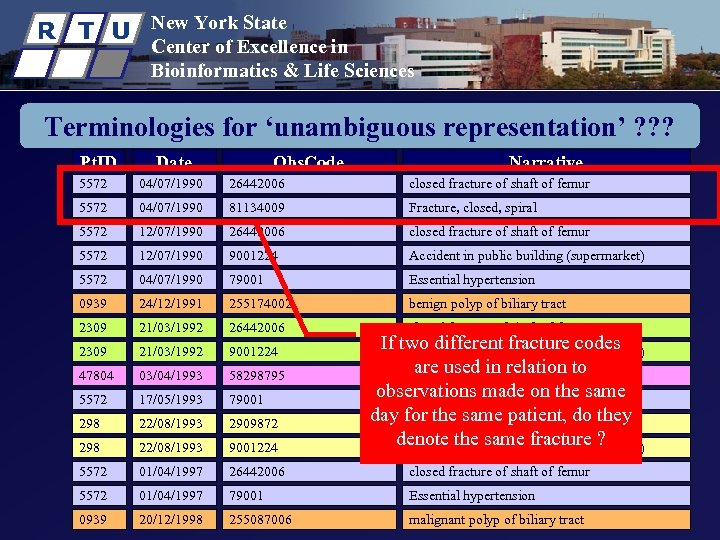 R T U New York State Center of Excellence in Bioinformatics & Life Sciences Terminologies for ‘unambiguous representation’ ? ? ? Pt. ID Date Obs. Code Narrative 5572 04/07/1990 26442006 closed fracture of shaft of femur 5572 04/07/1990 81134009 Fracture, closed, spiral 5572 12/07/1990 26442006 closed fracture of shaft of femur 5572 12/07/1990 9001224 Accident in public building (supermarket) 5572 04/07/1990 79001 Essential hypertension 0939 24/12/1991 255174002 benign polyp of biliary tract 2309 21/03/1992 26442006 closed fracture of shaft of femur 2309 21/03/1992 9001224 47804 03/04/1993 58298795 5572 17/05/1993 79001 298 22/08/1993 2909872 298 22/08/1993 9001224 5572 01/04/1997 26442006 closed fracture of shaft of femur 5572 01/04/1997 79001 Essential hypertension 0939 20/12/1998 255087006 malignant polyp of biliary tract If two different fracture codes Accident in public building (supermarket) are used in relation to Other lesion on other specified region observations made on the same Essential hypertension day for the same patient, do they Closed fracture of radial head denote thepublic building (supermarket) same fracture ? Accident in
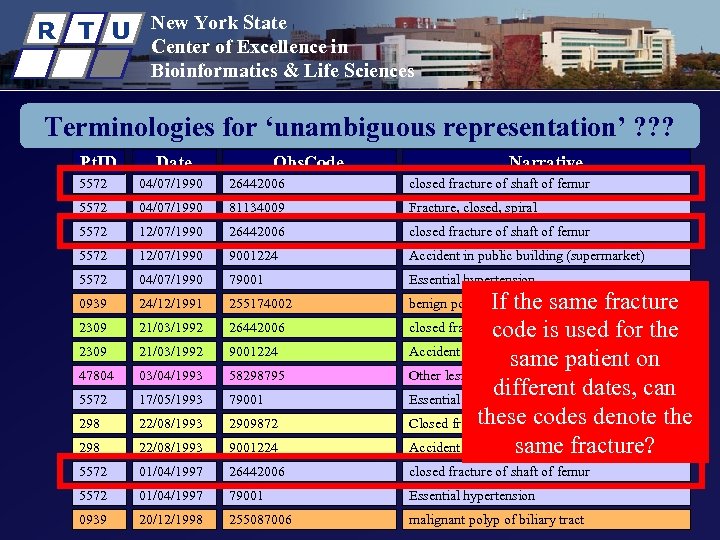 R T U New York State Center of Excellence in Bioinformatics & Life Sciences Terminologies for ‘unambiguous representation’ ? ? ? Pt. ID Date Obs. Code Narrative 5572 04/07/1990 26442006 closed fracture of shaft of femur 5572 04/07/1990 81134009 Fracture, closed, spiral 5572 12/07/1990 26442006 closed fracture of shaft of femur 5572 12/07/1990 9001224 Accident in public building (supermarket) 5572 04/07/1990 79001 Essential hypertension 0939 24/12/1991 255174002 benign polyp of biliary tract 2309 21/03/1992 26442006 2309 21/03/1992 9001224 47804 03/04/1993 58298795 5572 17/05/1993 79001 298 22/08/1993 2909872 298 22/08/1993 9001224 If the same fracture closed fracturecode of femur of shaft is used for the Accident in public building (supermarket) same patient on Other lesion on other specified region different dates, can Essential hypertension these codes Closed fracture of radial head denote the Accident in public same (supermarket) building fracture? 5572 01/04/1997 26442006 closed fracture of shaft of femur 5572 01/04/1997 79001 Essential hypertension 0939 20/12/1998 255087006 malignant polyp of biliary tract
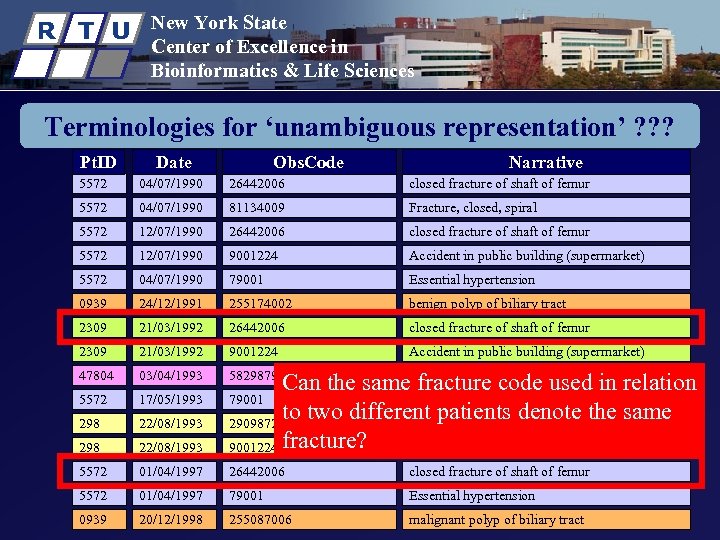 R T U New York State Center of Excellence in Bioinformatics & Life Sciences Terminologies for ‘unambiguous representation’ ? ? ? Pt. ID Date Obs. Code Narrative 5572 04/07/1990 26442006 closed fracture of shaft of femur 5572 04/07/1990 81134009 Fracture, closed, spiral 5572 12/07/1990 26442006 closed fracture of shaft of femur 5572 12/07/1990 9001224 Accident in public building (supermarket) 5572 04/07/1990 79001 Essential hypertension 0939 24/12/1991 255174002 benign polyp of biliary tract 2309 21/03/1992 26442006 closed fracture of shaft of femur 2309 21/03/1992 9001224 Accident in public building (supermarket) 47804 03/04/1993 58298795 5572 17/05/1993 298 22/08/1993 Can the same. Other lesion on code used in relation fracture other specified region 79001 Essential hypertension to two different patients radial head the same denote 2909872 Closed fracture of 9001224 fracture? Accident in public building (supermarket) 5572 01/04/1997 26442006 closed fracture of shaft of femur 5572 01/04/1997 79001 Essential hypertension 0939 20/12/1998 255087006 malignant polyp of biliary tract
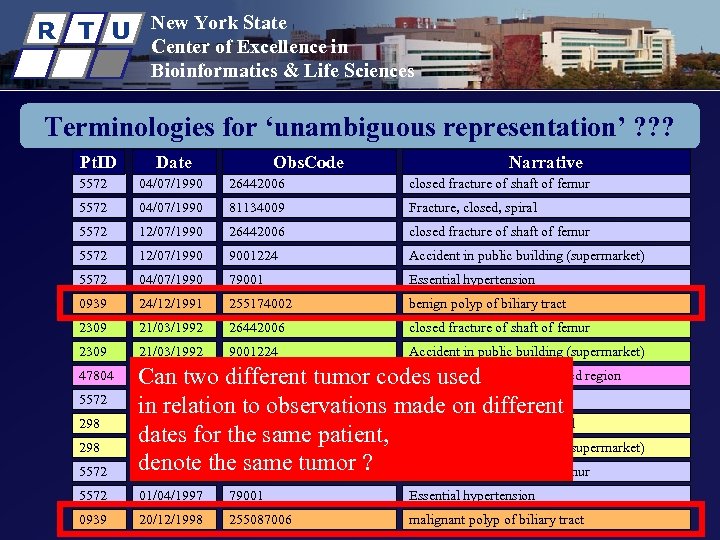 R T U New York State Center of Excellence in Bioinformatics & Life Sciences Terminologies for ‘unambiguous representation’ ? ? ? Pt. ID Date Obs. Code Narrative 5572 04/07/1990 26442006 closed fracture of shaft of femur 5572 04/07/1990 81134009 Fracture, closed, spiral 5572 12/07/1990 26442006 closed fracture of shaft of femur 5572 12/07/1990 9001224 Accident in public building (supermarket) 5572 04/07/1990 79001 Essential hypertension 0939 24/12/1991 255174002 benign polyp of biliary tract 2309 21/03/1992 26442006 closed fracture of shaft of femur 2309 21/03/1992 9001224 Accident in public building (supermarket) 47804 5572 03/04/1993 58298795 Other lesion Can two different tumor codes usedon other specified region 17/05/1993 79001 Essential hypertension in relation to observations made on different 22/08/1993 2909872 Closed fracture of radial head dates for the same patient, Accident in public building (supermarket) 22/08/1993 9001224 denote the same tumor ? 01/04/1997 26442006 closed fracture of shaft of femur 5572 01/04/1997 79001 Essential hypertension 0939 20/12/1998 255087006 malignant polyp of biliary tract 5572 298
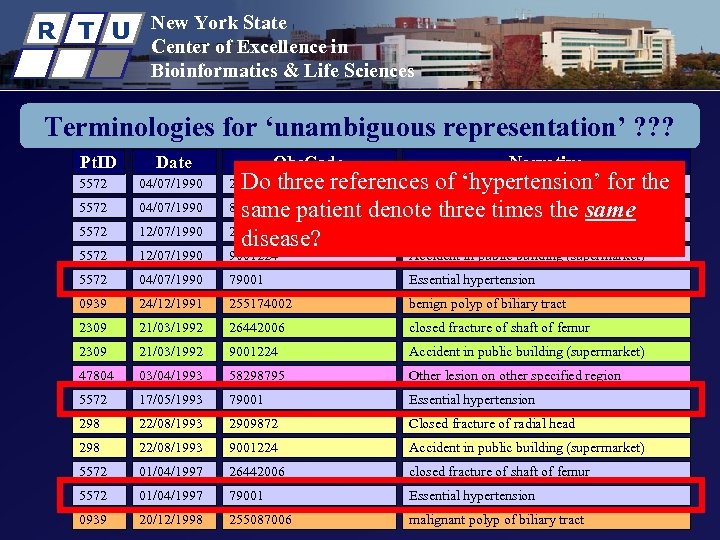 R T U New York State Center of Excellence in Bioinformatics & Life Sciences Terminologies for ‘unambiguous representation’ ? ? ? Pt. ID Date 5572 04/07/1990 5572 12/07/1990 5572 Obs. Code Narrative closed fracture of shaft of femur Do three references of ‘hypertension’ for the 81134009 patient denote three times the same Fracture, closed, spiral same 26442006 closed fracture of shaft of femur disease? 26442006 9001224 Accident in public building (supermarket) 04/07/1990 79001 Essential hypertension 0939 24/12/1991 255174002 benign polyp of biliary tract 2309 21/03/1992 26442006 closed fracture of shaft of femur 2309 21/03/1992 9001224 Accident in public building (supermarket) 47804 03/04/1993 58298795 Other lesion on other specified region 5572 17/05/1993 79001 Essential hypertension 298 22/08/1993 2909872 Closed fracture of radial head 298 22/08/1993 9001224 Accident in public building (supermarket) 5572 01/04/1997 26442006 closed fracture of shaft of femur 5572 01/04/1997 79001 Essential hypertension 0939 20/12/1998 255087006 malignant polyp of biliary tract
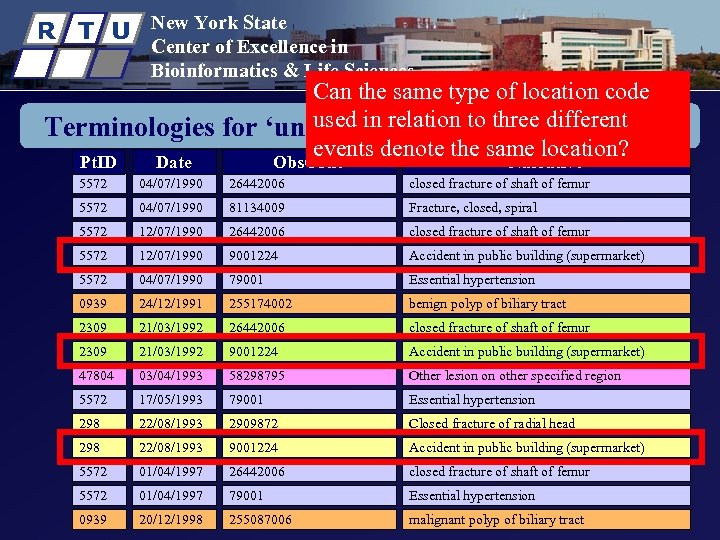 R T U New York State Center of Excellence in Bioinformatics & Life Sciences Can the same type of location code used in relation to three different Terminologies for ‘unambiguous representation’ ? ? ? events denote the same location? Pt. ID Date Obs. Code Narrative 5572 04/07/1990 26442006 closed fracture of shaft of femur 5572 04/07/1990 81134009 Fracture, closed, spiral 5572 12/07/1990 26442006 closed fracture of shaft of femur 5572 12/07/1990 9001224 Accident in public building (supermarket) 5572 04/07/1990 79001 Essential hypertension 0939 24/12/1991 255174002 benign polyp of biliary tract 2309 21/03/1992 26442006 closed fracture of shaft of femur 2309 21/03/1992 9001224 Accident in public building (supermarket) 47804 03/04/1993 58298795 Other lesion on other specified region 5572 17/05/1993 79001 Essential hypertension 298 22/08/1993 2909872 Closed fracture of radial head 298 22/08/1993 9001224 Accident in public building (supermarket) 5572 01/04/1997 26442006 closed fracture of shaft of femur 5572 01/04/1997 79001 Essential hypertension 0939 20/12/1998 255087006 malignant polyp of biliary tract
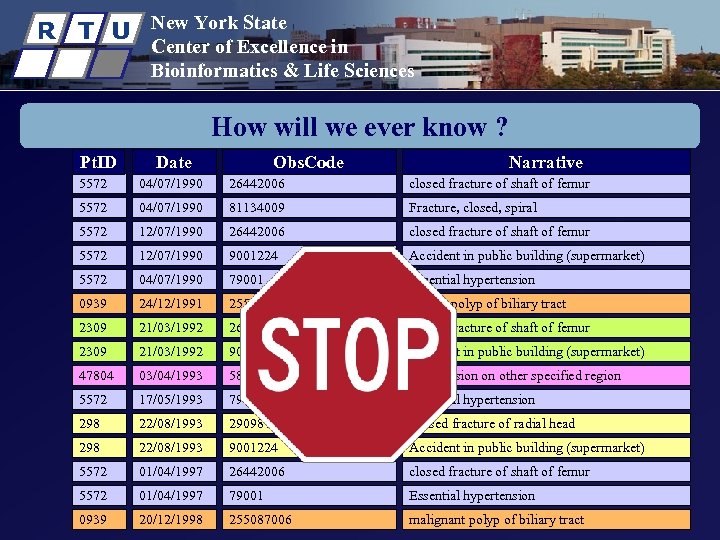 R T U New York State Center of Excellence in Bioinformatics & Life Sciences How will we ever know ? Pt. ID Date Obs. Code Narrative 5572 04/07/1990 26442006 closed fracture of shaft of femur 5572 04/07/1990 81134009 Fracture, closed, spiral 5572 12/07/1990 26442006 closed fracture of shaft of femur 5572 12/07/1990 9001224 Accident in public building (supermarket) 5572 04/07/1990 79001 Essential hypertension 0939 24/12/1991 255174002 benign polyp of biliary tract 2309 21/03/1992 26442006 closed fracture of shaft of femur 2309 21/03/1992 9001224 Accident in public building (supermarket) 47804 03/04/1993 58298795 Other lesion on other specified region 5572 17/05/1993 79001 Essential hypertension 298 22/08/1993 2909872 Closed fracture of radial head 298 22/08/1993 9001224 Accident in public building (supermarket) 5572 01/04/1997 26442006 closed fracture of shaft of femur 5572 01/04/1997 79001 Essential hypertension 0939 20/12/1998 255087006 malignant polyp of biliary tract
 R T U New York State Center of Excellence in Bioinformatics & Life Sciences The problem in a nutshell • Generic terms used to denote specific entities do not have enough referential capacity – Usually enough to convey that some specific entity is denoted, – Not enough to be clear about which one in particular. • For many ‘important’ entities, unique identifiers are used: – – UPS parcels Patients in hospitals VINs on cars …
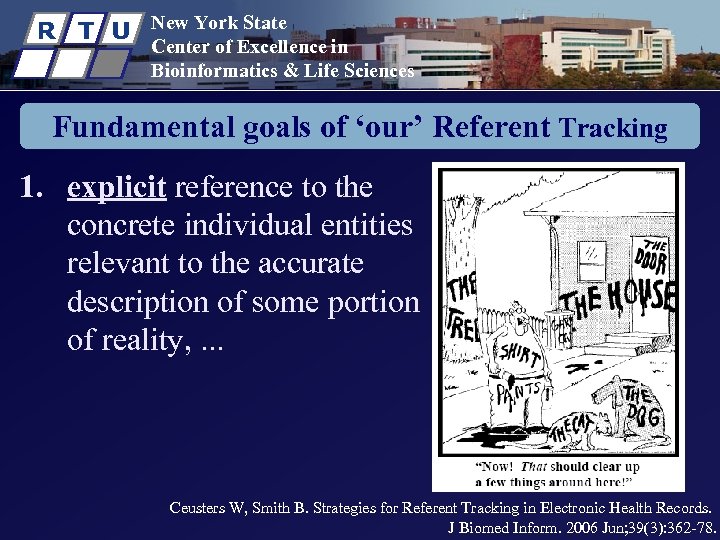 R T U New York State Center of Excellence in Bioinformatics & Life Sciences Fundamental goals of ‘our’ Referent Tracking 1. explicit reference to the concrete individual entities relevant to the accurate description of some portion of reality, . . . Ceusters W, Smith B. Strategies for Referent Tracking in Electronic Health Records. J Biomed Inform. 2006 Jun; 39(3): 362 -78.
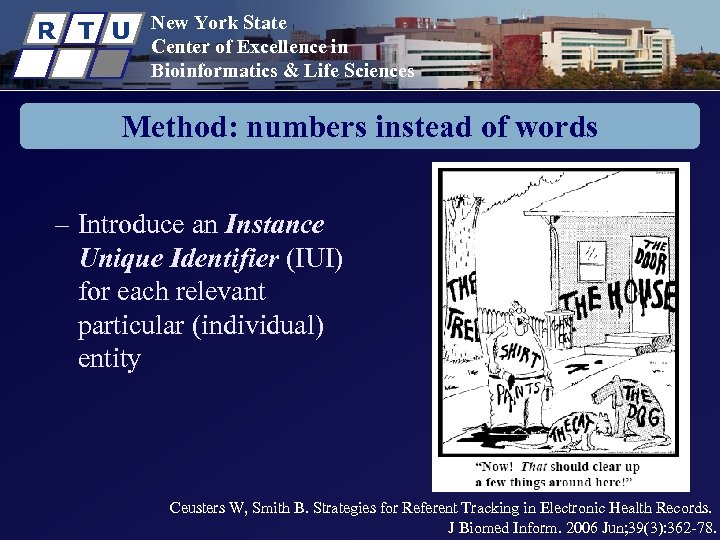 R T U New York State Center of Excellence in Bioinformatics & Life Sciences Method: numbers instead of words – Introduce an Instance Unique Identifier (IUI) for each relevant particular (individual) entity 78 Ceusters W, Smith B. Strategies for Referent Tracking in Electronic Health Records. J Biomed Inform. 2006 Jun; 39(3): 362 -78.
 R T U New York State Center of Excellence in Bioinformatics & Life Sciences Fundamental goals of ‘our’ Referent Tracking 2. Use these identifiers in expressions using a language that acknowledges the structure of reality e. g. : a yellow ball: #1: the ball #2: #1’s yellow Then not: ball(#1) and yellow(#2) and hascolor(#1, #2) But: Strong foundations instance-of(#1, ball, since t) in realism-based instance-of(#2, yellow, since t) ontology inheres-in(#1, #2, since t)
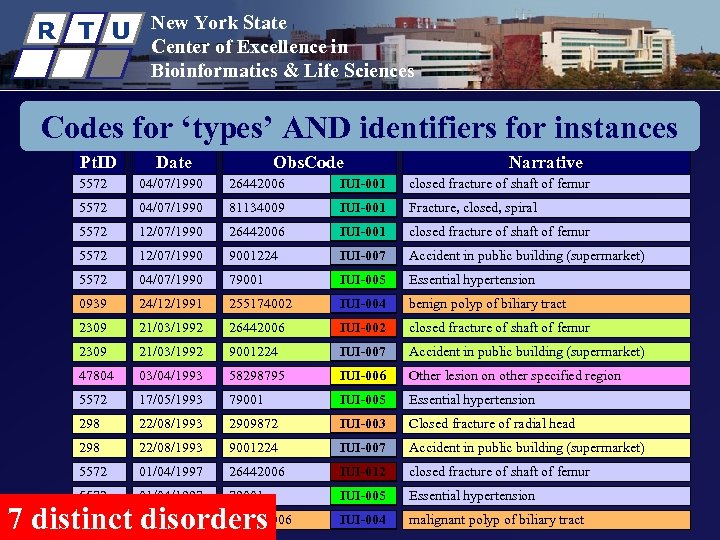 R T U New York State Center of Excellence in Bioinformatics & Life Sciences Codes for ‘types’ AND identifiers for instances Pt. ID Date Obs. Code Narrative 5572 04/07/1990 26442006 IUI-001 closed fracture of shaft of femur 5572 04/07/1990 81134009 IUI-001 Fracture, closed, spiral 5572 12/07/1990 26442006 IUI-001 closed fracture of shaft of femur 5572 12/07/1990 9001224 IUI-007 Accident in public building (supermarket) 5572 04/07/1990 79001 IUI-005 Essential hypertension 0939 24/12/1991 255174002 IUI-004 benign polyp of biliary tract 2309 21/03/1992 26442006 IUI-002 closed fracture of shaft of femur 2309 21/03/1992 9001224 IUI-007 Accident in public building (supermarket) 47804 03/04/1993 58298795 IUI-006 Other lesion on other specified region 5572 17/05/1993 79001 IUI-005 Essential hypertension 298 22/08/1993 2909872 IUI-003 Closed fracture of radial head 298 22/08/1993 9001224 IUI-007 Accident in public building (supermarket) 5572 01/04/1997 26442006 IUI-012 closed fracture of shaft of femur 5572 01/04/1997 79001 IUI-005 Essential hypertension IUI-004 malignant polyp of biliary tract 0939 7 distinct 20/12/1998 255087006 disorders
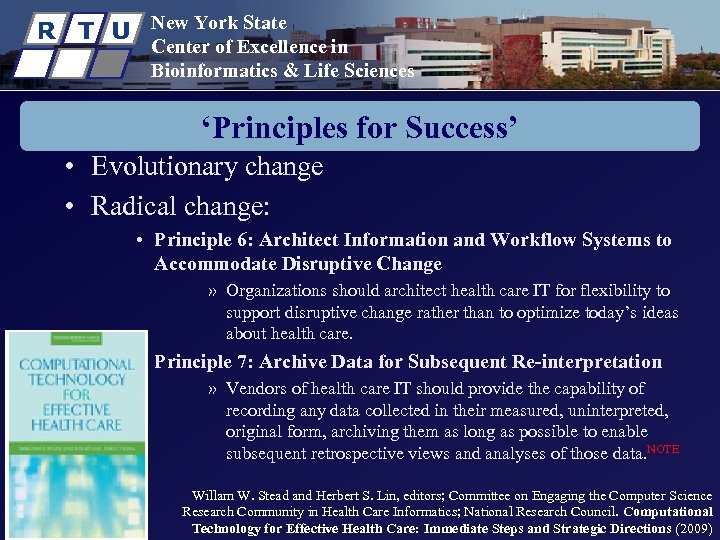 R T U New York State Center of Excellence in Bioinformatics & Life Sciences ‘Principles for Success’ • Evolutionary change • Radical change: • Principle 6: Architect Information and Workflow Systems to Accommodate Disruptive Change » Organizations should architect health care IT for flexibility to support disruptive change rather than to optimize today’s ideas about health care. • Principle 7: Archive Data for Subsequent Re-interpretation » Vendors of health care IT should provide the capability of recording any data collected in their measured, uninterpreted, original form, archiving them as long as possible to enable subsequent retrospective views and analyses of those data. NOTE Willam W. Stead and Herbert S. Lin, editors; Committee on Engaging the Computer Science Research Community in Health Care Informatics; National Research Council. Computational Technology for Effective Health Care: Immediate Steps and Strategic Directions (2009)
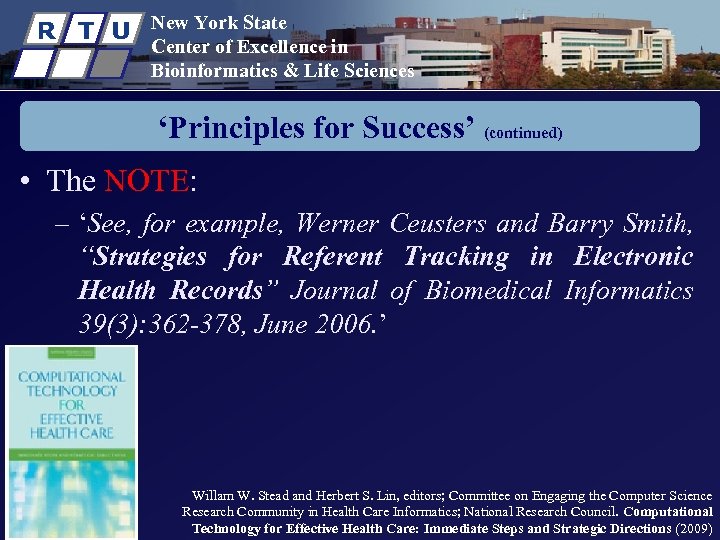 R T U New York State Center of Excellence in Bioinformatics & Life Sciences ‘Principles for Success’ (continued) • The NOTE: – ‘See, for example, Werner Ceusters and Barry Smith, “Strategies for Referent Tracking in Electronic Health Records” Journal of Biomedical Informatics 39(3): 362 -378, June 2006. ’ Willam W. Stead and Herbert S. Lin, editors; Committee on Engaging the Computer Science Research Community in Health Care Informatics; National Research Council. Computational Technology for Effective Health Care: Immediate Steps and Strategic Directions (2009)
 R T U New York State Center of Excellence in Bioinformatics & Life Sciences Words, words, … • A paradigm under development since 2005, – based on Basic Formal Ontology, – designed to keep track of relevant portions of reality and what is believed and communicated about them, – enabling adequate use of realism-based ontologies, terminologies, thesauri, and vocabularies, – originally conceived to track particulars on the side of the patient and his environment denoted in his EHR, – but since then studied in and applied to a variety of domains, – and now evolving towards tracking absolutely everything, not only particulars, but also universals.
 R T U New York State Center of Excellence in Bioinformatics & Life Sciences Therefore: Part 1: the Basics No (good) Referent Tracking without (good) Realism-based Ontology
 R T U New York State Center of Excellence in Bioinformatics & Life Sciences Basic axioms 1. There is an external reality which is ‘objectively’ the way it is; 2. That reality is accessible to us; 3. We build in our brains cognitive representations of reality; 4. We communicate with others about what is there, and what we believe there is there. Smith B, Kusnierczyk W, Schober D, Ceusters W. Towards a Reference Terminology for Ontology Research and Development in the Biomedical Domain. Proceedings of KR-MED 2006, Biomedical Ontology in Action, November 8, 2006, Baltimore MD, USA
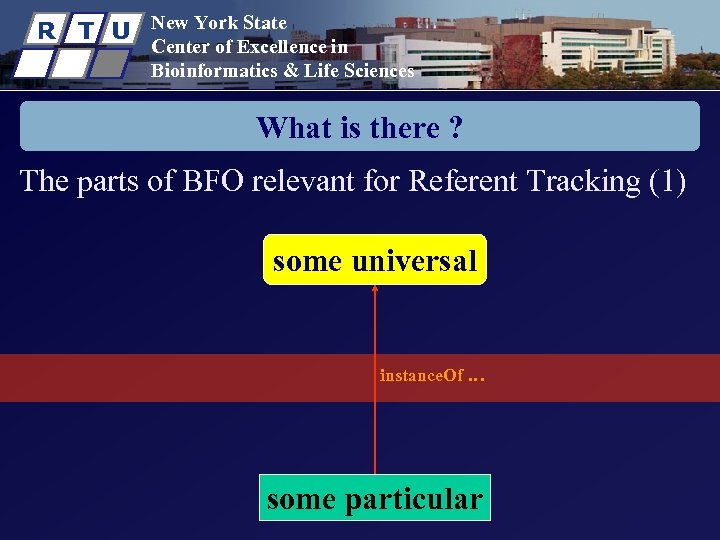 R T U New York State Center of Excellence in Bioinformatics & Life Sciences What is there ? The parts of BFO relevant for Referent Tracking (1) some universal instance. Of … some particular
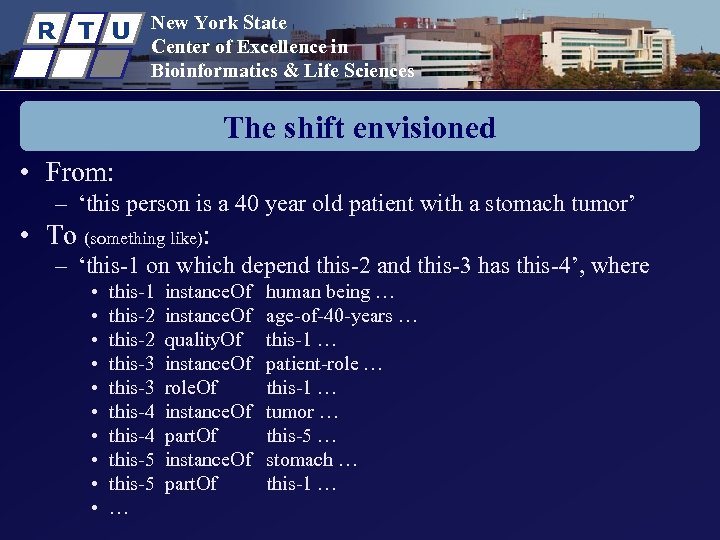 R T U New York State Center of Excellence in Bioinformatics & Life Sciences The shift envisioned • From: – ‘this person is a 40 year old patient with a stomach tumor’ • To (something like): – ‘this-1 on which depend this-2 and this-3 has this-4’, where • • • this-1 this-2 this-3 this-4 this-5 … instance. Of quality. Of instance. Of role. Of instance. Of part. Of human being … age-of-40 -years … this-1 … patient-role … this-1 … tumor … this-5 … stomach … this-1 …
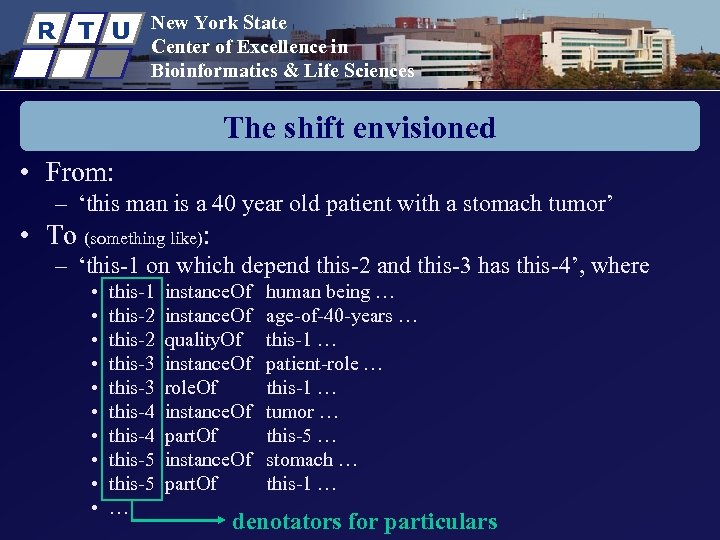 R T U New York State Center of Excellence in Bioinformatics & Life Sciences The shift envisioned • From: – ‘this man is a 40 year old patient with a stomach tumor’ • To (something like): – ‘this-1 on which depend this-2 and this-3 has this-4’, where • • • this-1 this-2 this-3 this-4 this-5 … instance. Of quality. Of instance. Of role. Of instance. Of part. Of human being … age-of-40 -years … this-1 … patient-role … this-1 … tumor … this-5 … stomach … this-1 … denotators for particulars
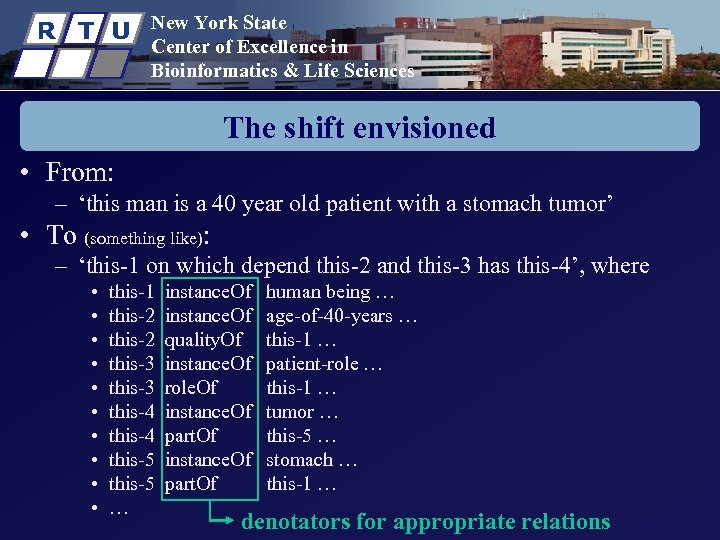 R T U New York State Center of Excellence in Bioinformatics & Life Sciences The shift envisioned • From: – ‘this man is a 40 year old patient with a stomach tumor’ • To (something like): – ‘this-1 on which depend this-2 and this-3 has this-4’, where • • • this-1 this-2 this-3 this-4 this-5 … instance. Of quality. Of instance. Of role. Of instance. Of part. Of human being … age-of-40 -years … this-1 … patient-role … this-1 … tumor … this-5 … stomach … this-1 … denotators for appropriate relations
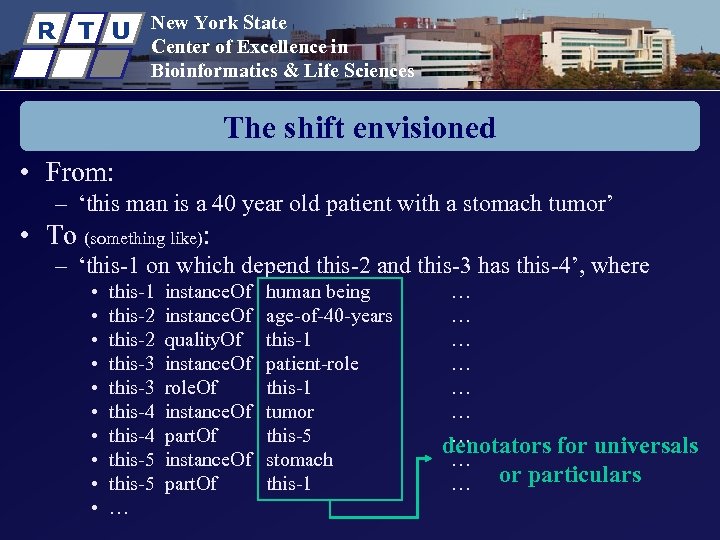 R T U New York State Center of Excellence in Bioinformatics & Life Sciences The shift envisioned • From: – ‘this man is a 40 year old patient with a stomach tumor’ • To (something like): – ‘this-1 on which depend this-2 and this-3 has this-4’, where • • • this-1 this-2 this-3 this-4 this-5 … instance. Of quality. Of instance. Of role. Of instance. Of part. Of human being age-of-40 -years this-1 patient-role this-1 tumor this-5 stomach this-1 … … … … denotators for universals … … or particulars
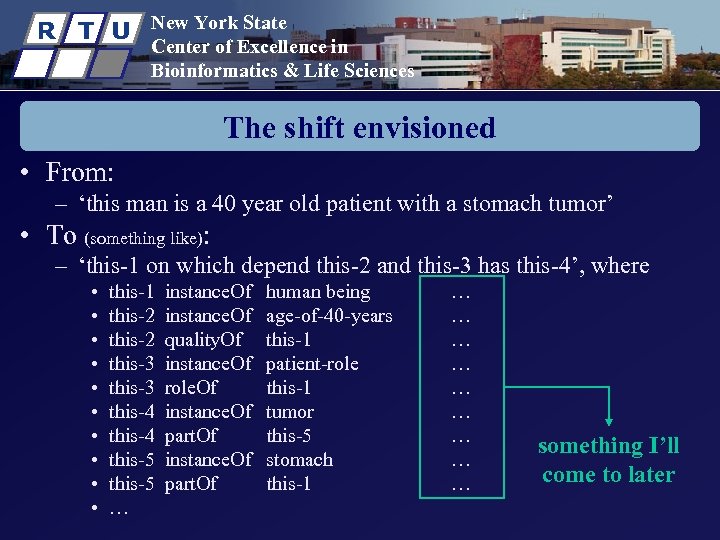 R T U New York State Center of Excellence in Bioinformatics & Life Sciences The shift envisioned • From: – ‘this man is a 40 year old patient with a stomach tumor’ • To (something like): – ‘this-1 on which depend this-2 and this-3 has this-4’, where • • • this-1 this-2 this-3 this-4 this-5 … instance. Of quality. Of instance. Of role. Of instance. Of part. Of human being age-of-40 -years this-1 patient-role this-1 tumor this-5 stomach this-1 … … … … … something I’ll come to later
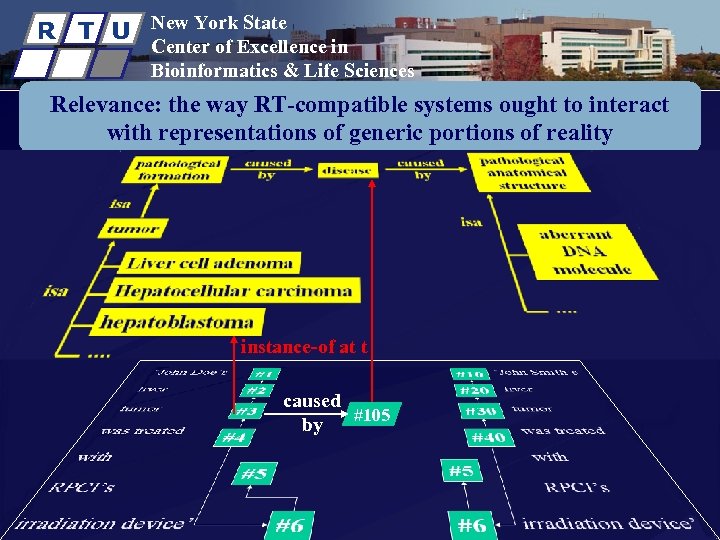 R T U New York State Center of Excellence in Bioinformatics & Life Sciences Relevance: the way RT-compatible systems ought to interact with representations of generic portions of reality instance-of at t caused #105 by
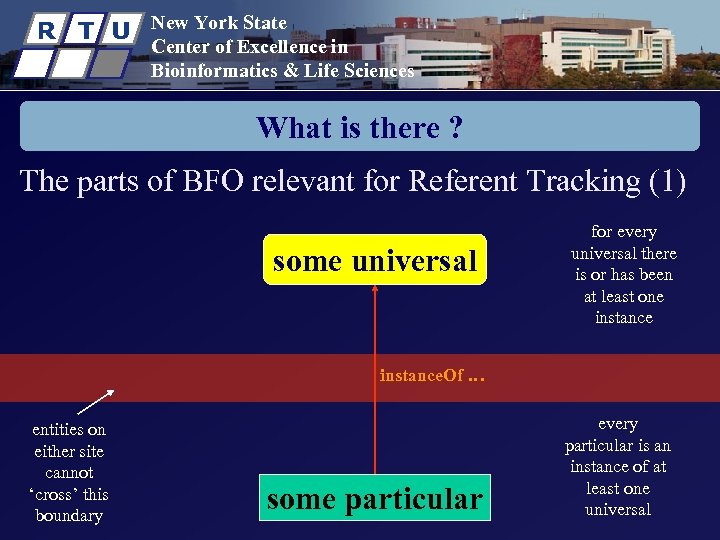 R T U New York State Center of Excellence in Bioinformatics & Life Sciences What is there ? The parts of BFO relevant for Referent Tracking (1) some universal for every universal there is or has been at least one instance. Of … entities on either site cannot ‘cross’ this boundary some particular every particular is an instance of at least one universal
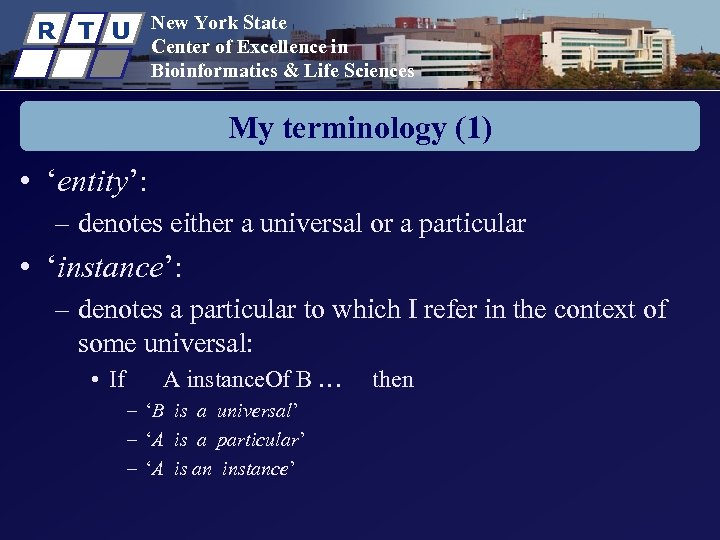 R T U New York State Center of Excellence in Bioinformatics & Life Sciences My terminology (1) • ‘entity’: – denotes either a universal or a particular • ‘instance’: – denotes a particular to which I refer in the context of some universal: • If A instance. Of B … – ‘B is a universal’ – ‘A is a particular’ – ‘A is an instance’ then
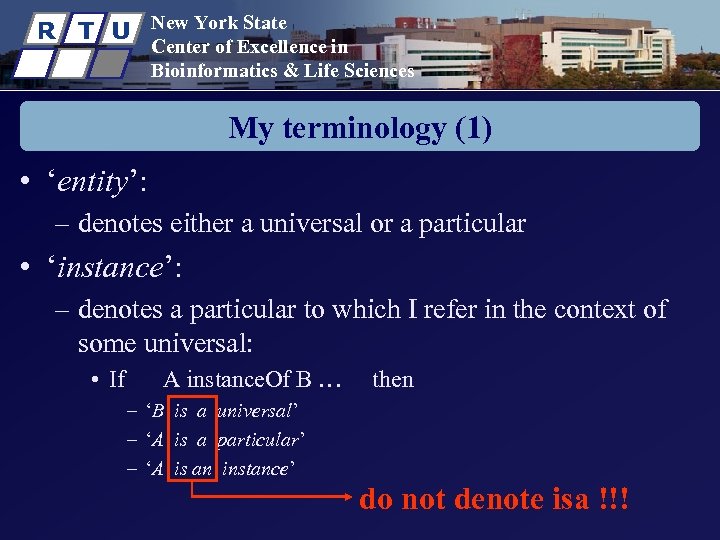 R T U New York State Center of Excellence in Bioinformatics & Life Sciences My terminology (1) • ‘entity’: – denotes either a universal or a particular • ‘instance’: – denotes a particular to which I refer in the context of some universal: • If A instance. Of B … then – ‘B is a universal’ – ‘A is a particular’ – ‘A is an instance’ do not denote isa !!!
 R T U New York State Center of Excellence in Bioinformatics & Life Sciences My terminology (2) • ‘entity’: – denotes either a universal or a particular • ‘instance’: – denotes a particular to which I refer in the context of some universal: • If A instance. Of B … then – ‘B is a universal’ – ‘A is a particular’ – ‘A is an instance’ • ‘denotes’: (roughly for now) a relation between an entity and a representational construct (sign, symbol, term, …) such that the latter stands for the former in descriptions about reality.
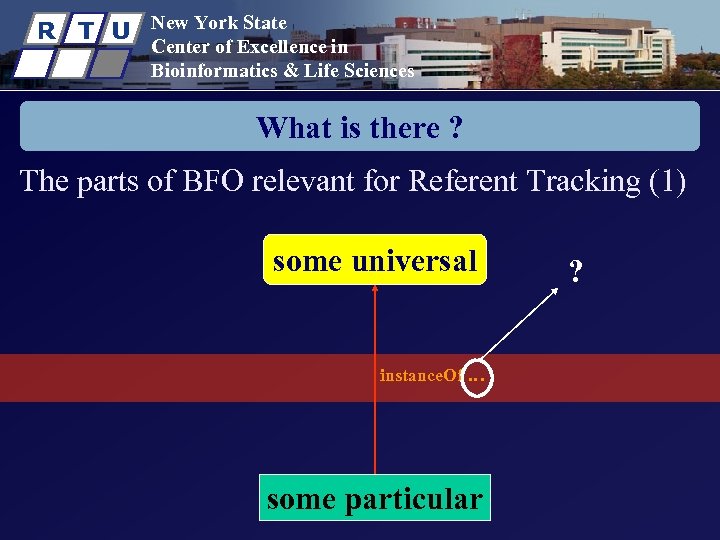 R T U New York State Center of Excellence in Bioinformatics & Life Sciences What is there ? The parts of BFO relevant for Referent Tracking (1) some universal instance. Of … some particular ?
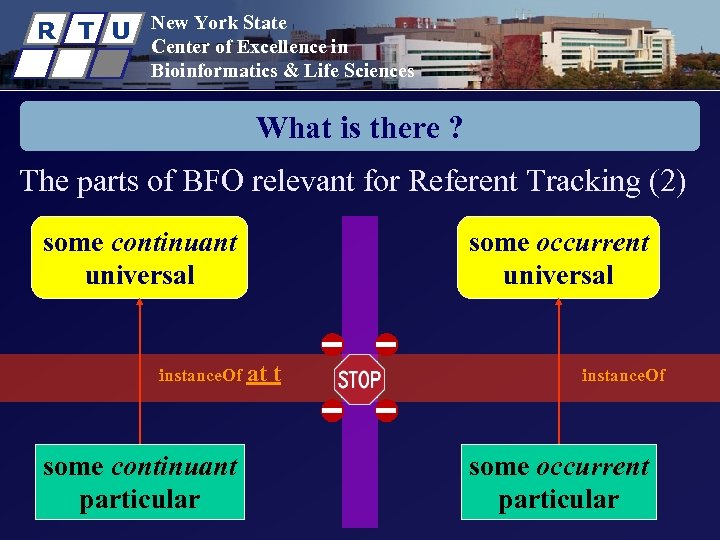 R T U New York State Center of Excellence in Bioinformatics & Life Sciences What is there ? The parts of BFO relevant for Referent Tracking (2) some continuant universal instance. Of at some continuant particular some occurrent universal t instance. Of some occurrent particular
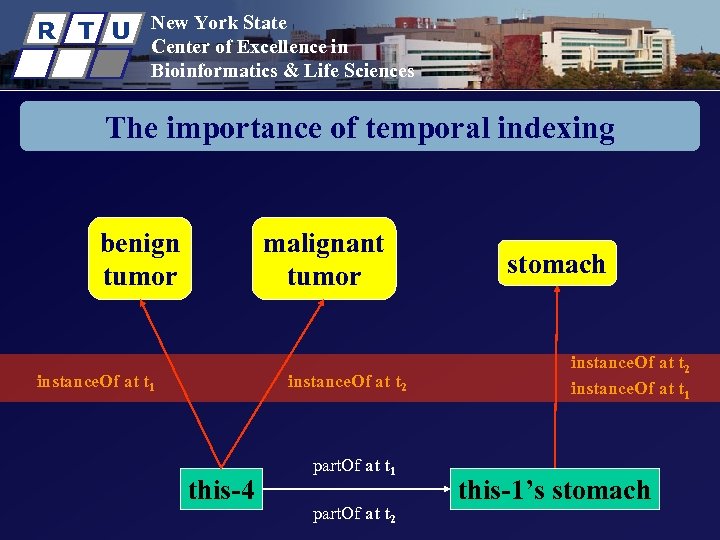 R T U New York State Center of Excellence in Bioinformatics & Life Sciences The importance of temporal indexing malignant tumor benign tumor instance. Of at t 1 instance. Of at t 2 this-4 part. Of at t 1 part. Of at t 2 stomach instance. Of at t 2 instance. Of at t 1 this-1’s stomach
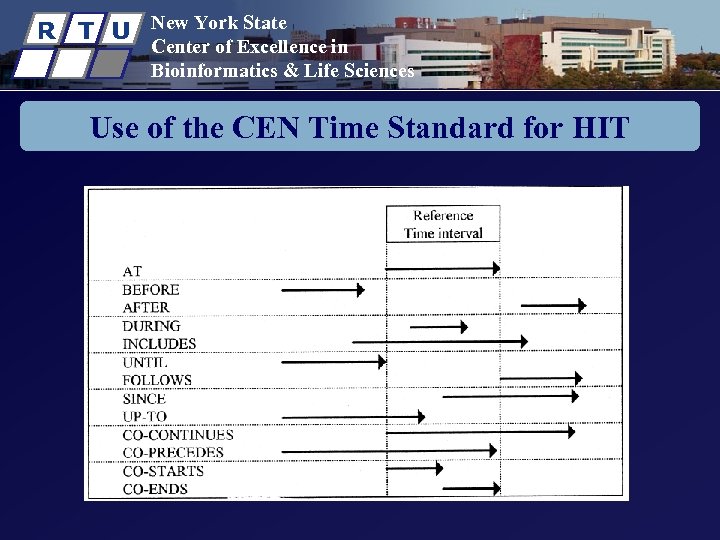
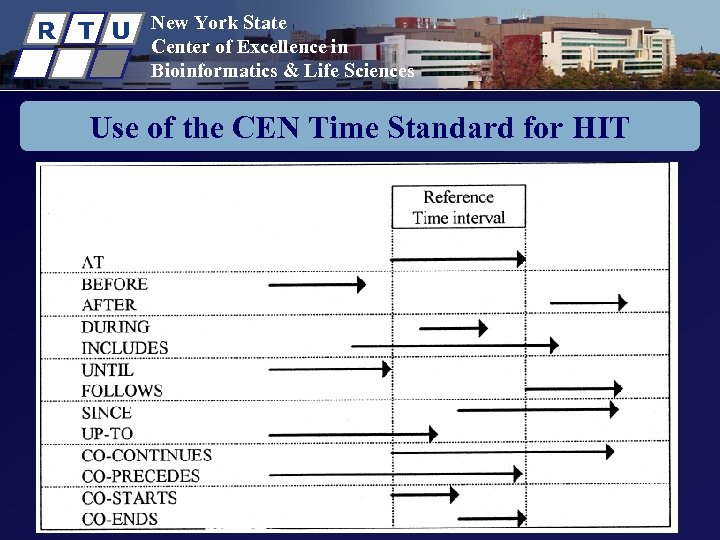 R T U New York State Center of Excellence in Bioinformatics & Life Sciences Use of the CEN Time Standard for HIT
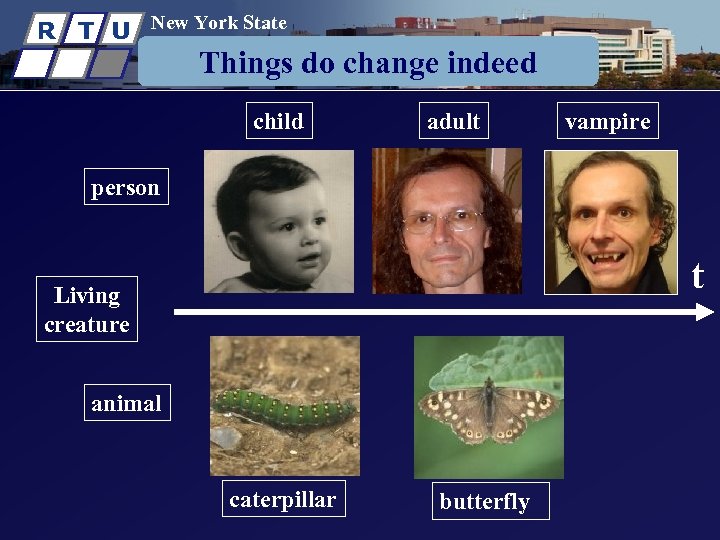 R T U New York State Center of Excellence in Bioinformatics & Life Sciences Things do change indeed child adult vampire person t Living creature animal caterpillar butterfly
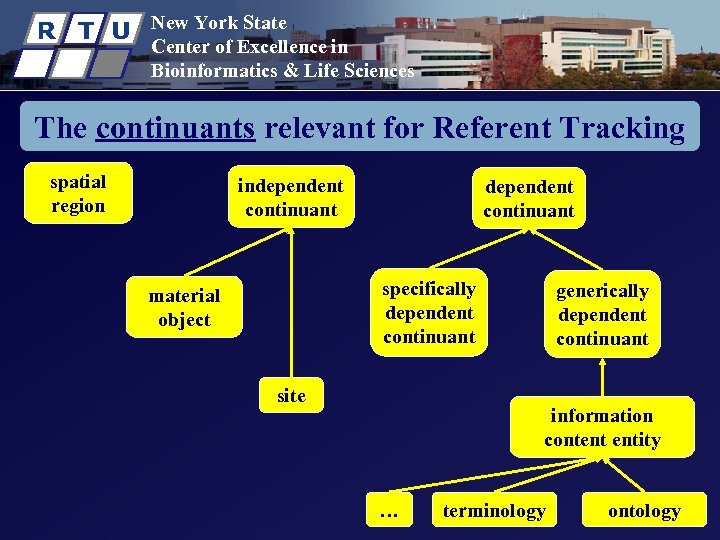 R T U New York State Center of Excellence in Bioinformatics & Life Sciences The continuants relevant for Referent Tracking spatial region independent continuant specifically dependent continuant material object site generically dependent continuant information content entity … terminology ontology
 R T U New York State Center of Excellence in Bioinformatics & Life Sciences My terminology (3) • ‘ontology’: – denotes an information artifact whose representational elements denote universals - either directly or indirectly - and whose structure is intended to mimic the structure of reality • ‘terminology’: – denotes an information artifact whose representational elements are terms from some language that are defined in terms of other terms and that are structured independent of the structure of reality
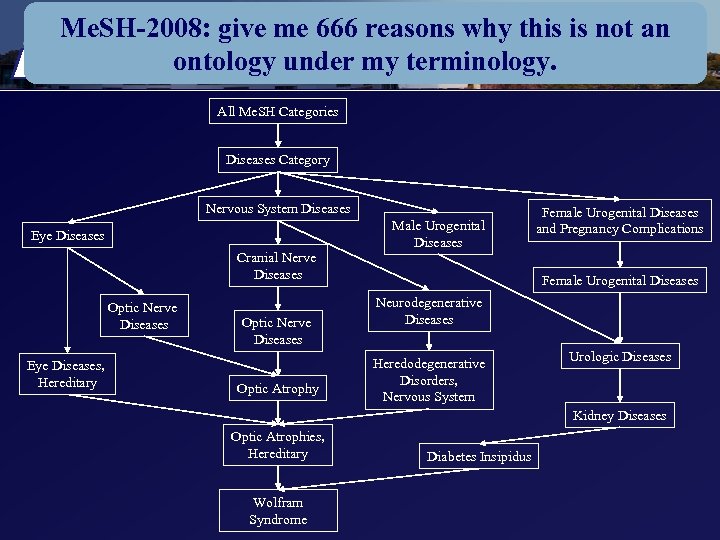 R Me. SH-2008: give me 666 reasons why this is not an T U New York State Center of Excellence in ontology under my terminology. Bioinformatics & Life Sciences All Me. SH Categories Diseases Category Nervous System Diseases Eye Diseases Cranial Nerve Diseases Optic Nerve Diseases Eye Diseases, Hereditary Optic Nerve Diseases Optic Atrophy Male Urogenital Diseases Female Urogenital Diseases and Pregnancy Complications Female Urogenital Diseases Neurodegenerative Diseases Heredodegenerative Disorders, Nervous System Urologic Diseases Kidney Diseases Optic Atrophies, Hereditary Wolfram Syndrome Diabetes Insipidus
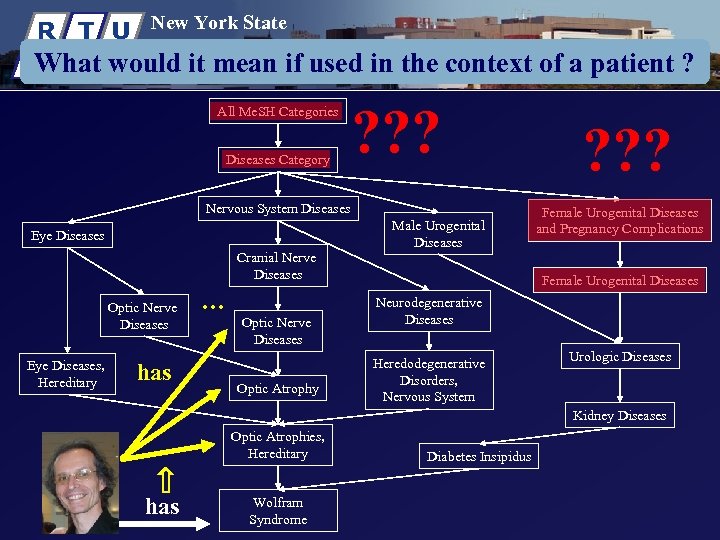 R T U New York State What Center of Excellence in would it mean & Life Sciences Bioinformatics if used in the All Me. SH Categories Diseases Category context of a patient ? ? ? ? Nervous System Diseases Eye Diseases Cranial Nerve Diseases Optic Nerve Diseases Eye Diseases, Hereditary has … Optic Nerve Diseases Optic Atrophy Male Urogenital Diseases ? ? ? Female Urogenital Diseases and Pregnancy Complications Female Urogenital Diseases Neurodegenerative Diseases Heredodegenerative Disorders, Nervous System Urologic Diseases Kidney Diseases Optic Atrophies, Hereditary has Wolfram Syndrome Diabetes Insipidus
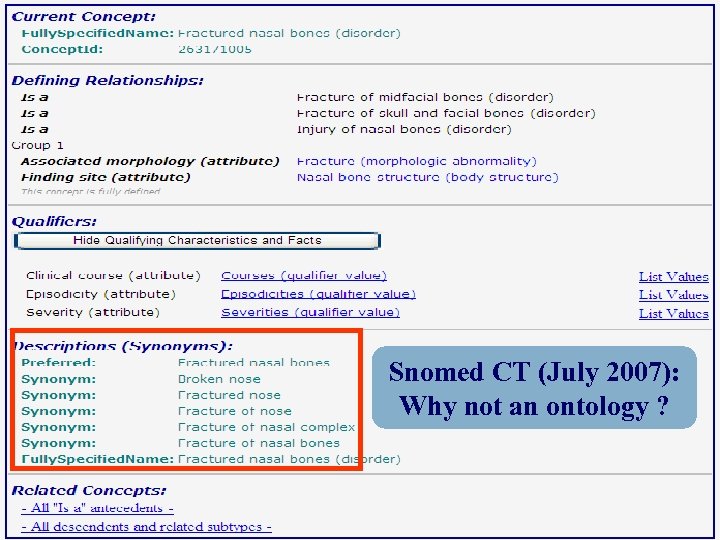 R T U New York State Center of Excellence in Bioinformatics & Life Sciences Snomed CT (July 2007): Why not an ontology ?
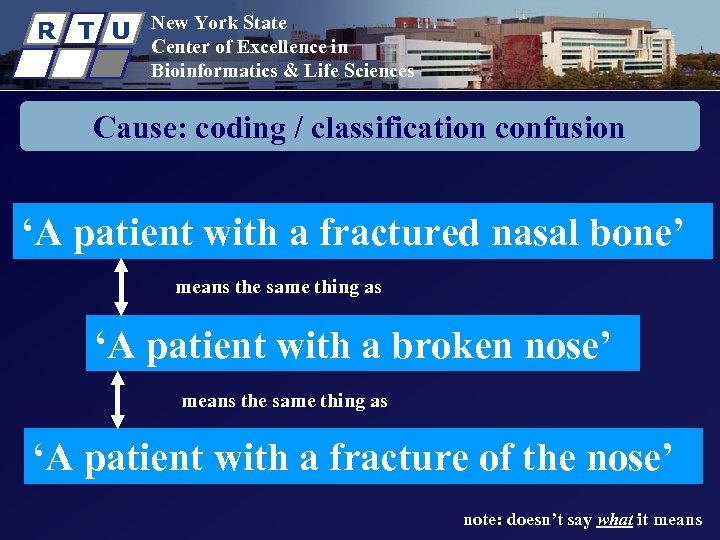 R T U New York State Center of Excellence in Bioinformatics & Life Sciences Cause: coding / classification confusion ‘A patient with a fractured nasal bone’ means the same thing as ‘A patient with a broken nose’ means the same thing as ‘A patient with a fracture of the nose’ note: doesn’t say what it means
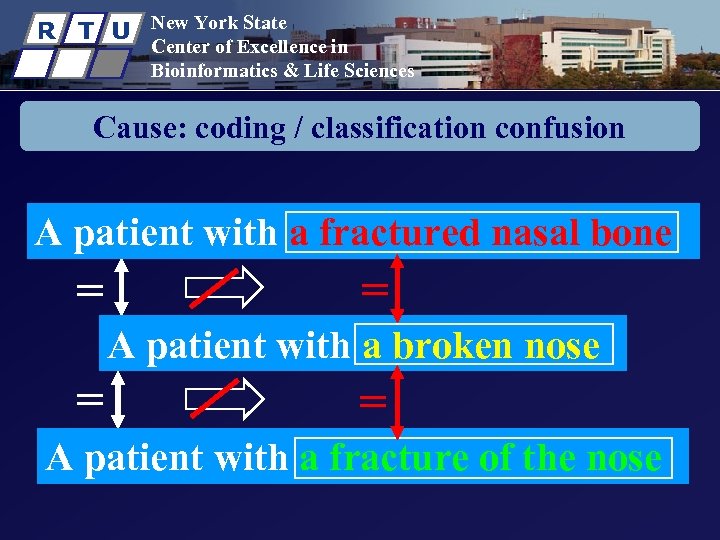 R T U New York State Center of Excellence in Bioinformatics & Life Sciences Cause: coding / classification confusion A patient with a fractured nasal bone = = A patient with a broken nose = = A patient with a fracture of the nose
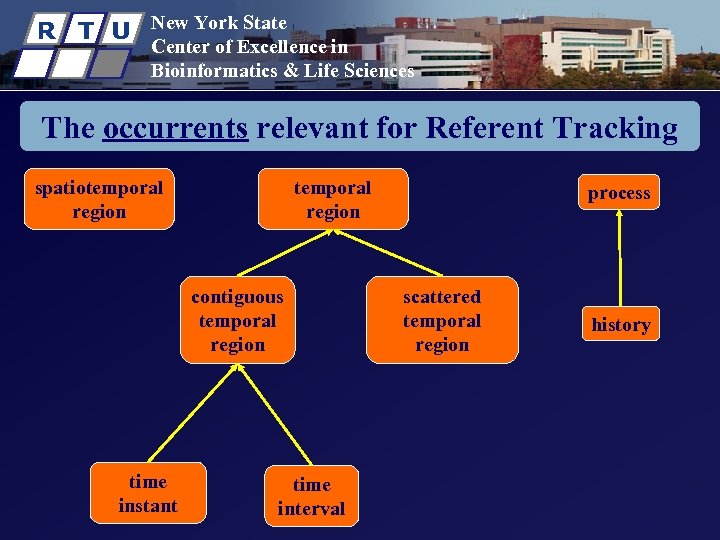 R T U New York State Center of Excellence in Bioinformatics & Life Sciences The occurrents relevant for Referent Tracking spatiotemporal region contiguous temporal region time instant time interval process scattered temporal region history
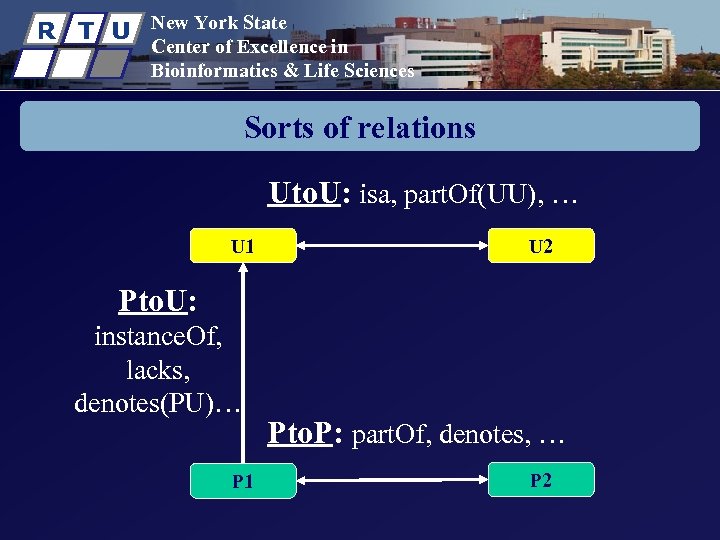 R T U New York State Center of Excellence in Bioinformatics & Life Sciences Sorts of relations Uto. U: isa, part. Of(UU), … U 1 U 2 Pto. U: instance. Of, lacks, denotes(PU)… P 1 Pto. P: part. Of, denotes, … P 2
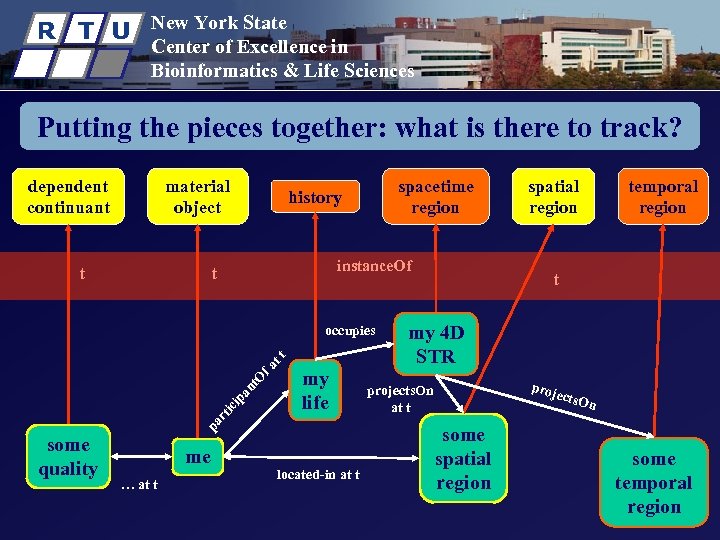 R T U New York State Center of Excellence in Bioinformatics & Life Sciences Putting the pieces together: what is there to track? dependent continuant material object t spacetime region history instance. Of t my life pa rt ic ip an t. O fa tt occupies some quality me … at t located-in at t spatial region temporal region t my 4 D STR projects. On at t ects. O some spatial region n some temporal region
 R T U New York State Center of Excellence in Bioinformatics & Life Sciences Part 2: Let’s get more serious about ‘representation’ (in general) Beware !!! Colors don’t really matter but in what follows I used them in different ways than before.
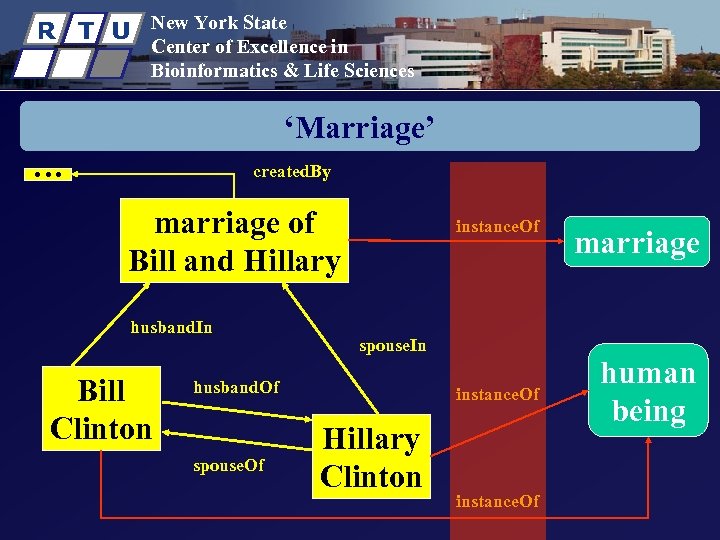 R T U New York State Center of Excellence in Bioinformatics & Life Sciences ‘Marriage’ … created. By marriage of Bill and Hillary husband. In Bill Clinton instance. Of spouse. In husband. Of spouse. Of instance. Of Hillary Clinton instance. Of marriage human being
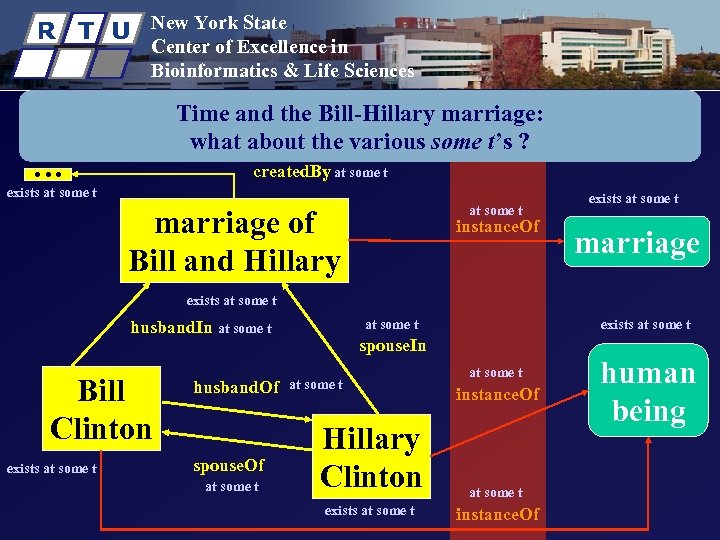 R T U New York State Center of Excellence in Bioinformatics & Life Sciences Time and the Bill-Hillary marriage: what about the various some t’s ? … created. By at some t exists at some t marriage of Bill and Hillary instance. Of exists at some t marriage exists at some t husband. In at some t Bill Clinton exists at some t husband. Of spouse. Of at some t exists at some t spouse. In at some t instance. Of Hillary Clinton at some t exists at some t instance. Of human being
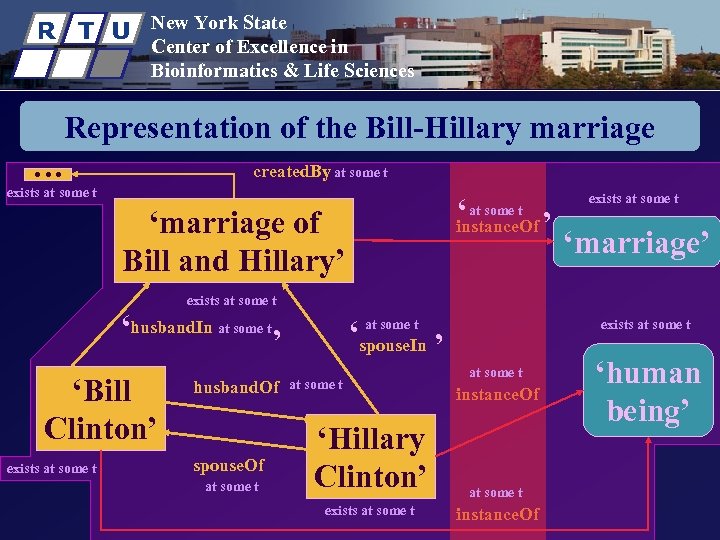 R T U New York State Center of Excellence in Bioinformatics & Life Sciences Representation of the Bill-Hillary marriage … created. By at some t exists at some t , ‘ instance. Of at some t ‘marriage of Bill and Hillary’ exists at some t ‘marriage’ exists at some t ‘husband. In at some t , ‘Bill Clinton’ exists at some t husband. Of spouse. Of at some t ‘spouse. In , at some t exists at some t instance. Of ‘Hillary Clinton’ at some t exists at some t instance. Of ‘human being’
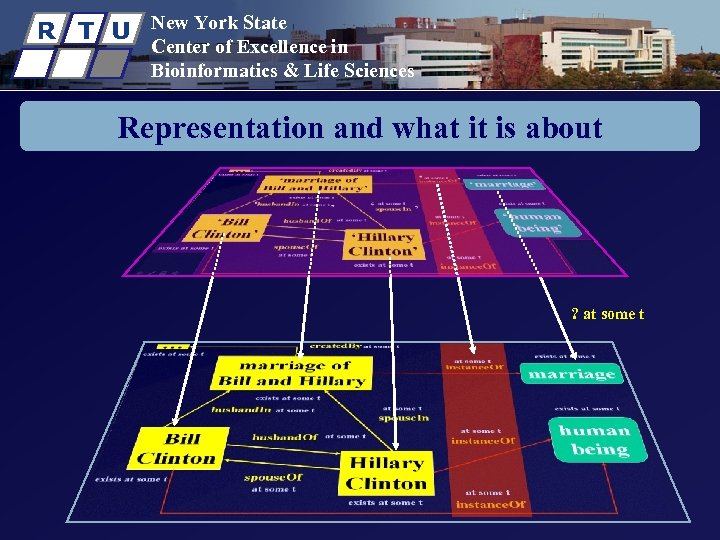 R T U New York State Center of Excellence in Bioinformatics & Life Sciences Representation and what it is about ? at some t
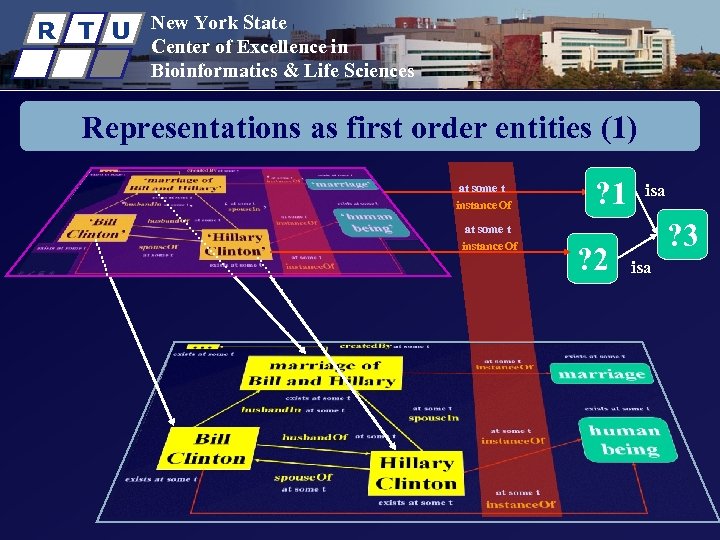 R T U New York State Center of Excellence in Bioinformatics & Life Sciences Representations as first order entities (1) at some t instance. Of ? 1 ? 2 isa ? 3 isa
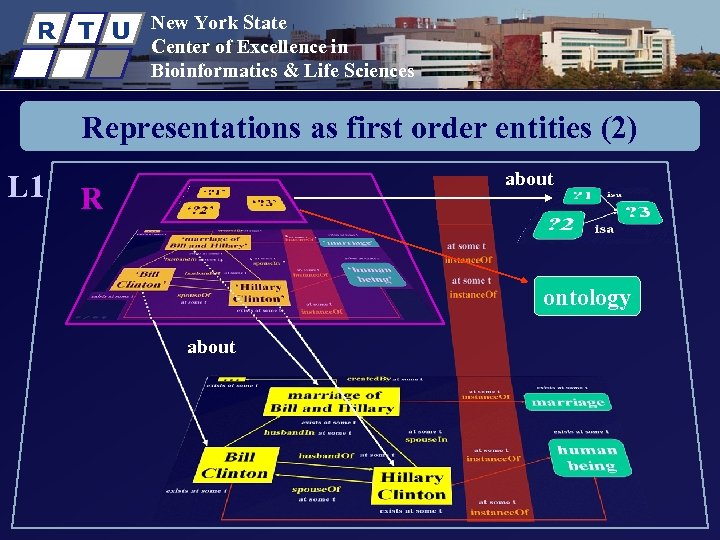 R T U New York State Center of Excellence in Bioinformatics & Life Sciences Representations as first order entities (2) L 1 about R ontology about
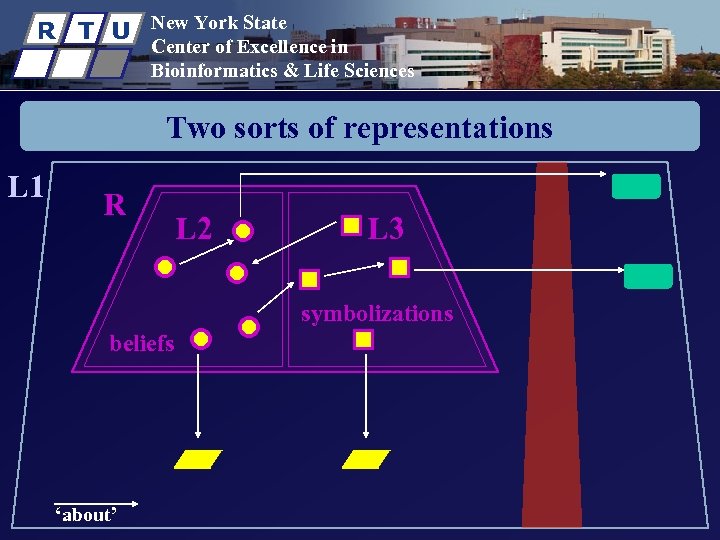 R T U New York State Center of Excellence in Bioinformatics & Life Sciences Two sorts of representations L 1 R L 2 L 3 symbolizations beliefs ‘about’
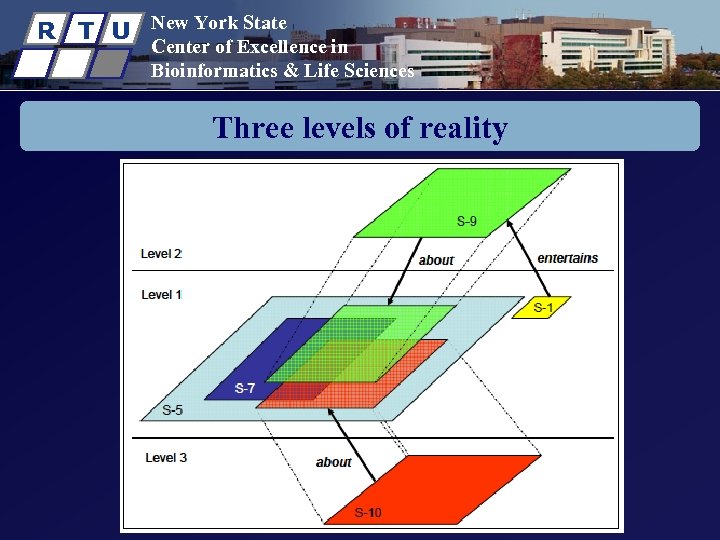 R T U New York State Center of Excellence in Bioinformatics & Life Sciences Three levels of reality
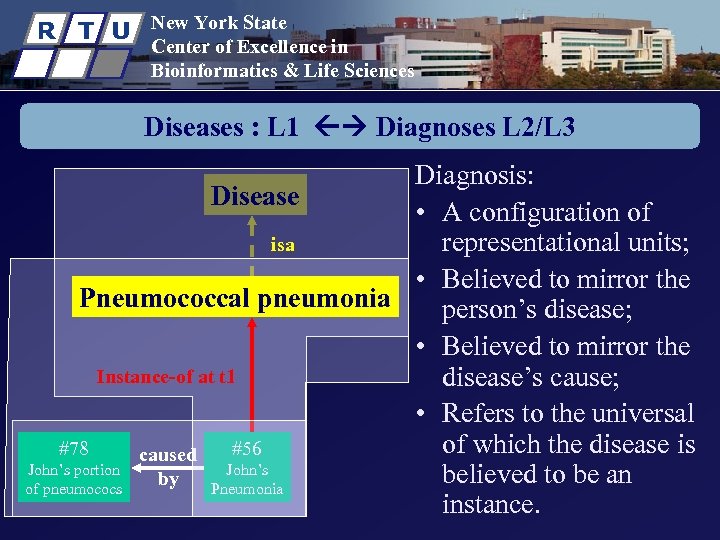 R T U New York State Center of Excellence in Bioinformatics & Life Sciences Diseases : L 1 Diagnoses L 2/L 3 Diagnosis: Disease • A configuration of isa representational units; • Believed to mirror the Pneumococcal pneumonia person’s disease; • Believed to mirror the Instance-of at t 1 disease’s cause; • Refers to the universal of which the disease is #78 #56 caused John’s portion John’s believed to be an by of pneumococs Pneumonia instance.
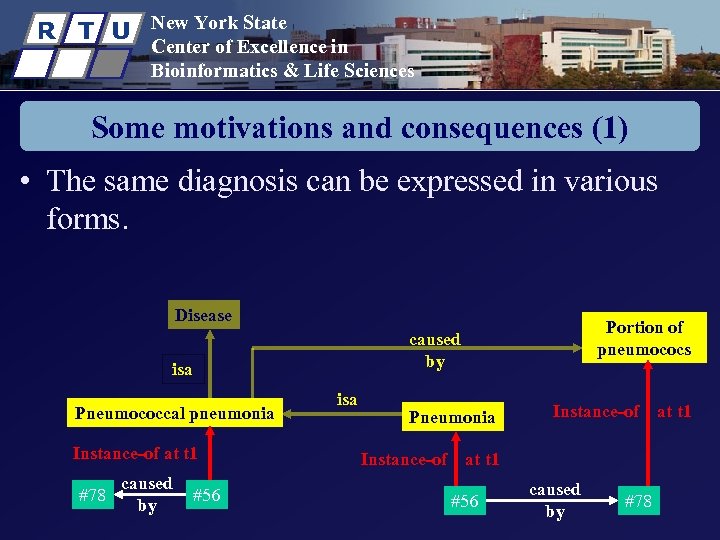 R T U New York State Center of Excellence in Bioinformatics & Life Sciences Some motivations and consequences (1) • The same diagnosis can be expressed in various forms. Disease isa Pneumococcal pneumonia Instance-of at t 1 #78 caused by #56 Portion of pneumococs caused by isa Pneumonia Instance-of at t 1 #56 caused by #78 at t 1
 R T U New York State Center of Excellence in Bioinformatics & Life Sciences Some motivations and consequences (2) • A diagnosis can be of level 2 or level 3, i. e. either in the mind of a cognitive agent, or in some physical form. • Allows for a clean interpretation of assertions of the sort ‘these patients have the same diagnosis’: The configuration of representational units is such that the parts which do not refer to the particulars related to the respective patients, refer to the same portion of reality.
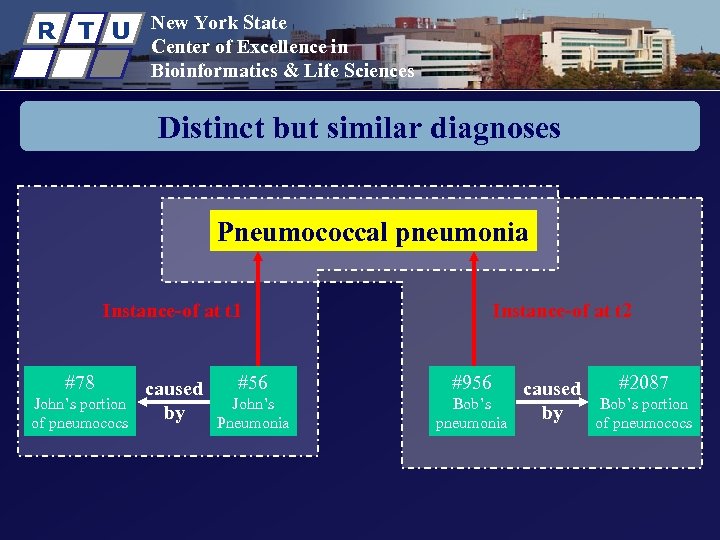 R T U New York State Center of Excellence in Bioinformatics & Life Sciences Distinct but similar diagnoses Pneumococcal pneumonia Instance-of at t 1 #78 John’s portion of pneumococs caused by Instance-of at t 2 #56 #956 John’s Pneumonia Bob’s pneumonia caused by #2087 Bob’s portion of pneumococs
 R T U New York State Center of Excellence in Bioinformatics & Life Sciences Some motivations and consequences (3) • Allows evenly clean interpretations for the wealth of ‘modified’ diagnoses: – With respect to the author of the representation: • ‘nursing diagnosis’, ‘referral diagnosis’ – When created: • ‘post-operative diagnosis’, ‘admitting diagnosis’, ‘final diagnosis’ – Degree of the belief: • ‘uncertain diagnosis’, ‘preliminary diagnosis’
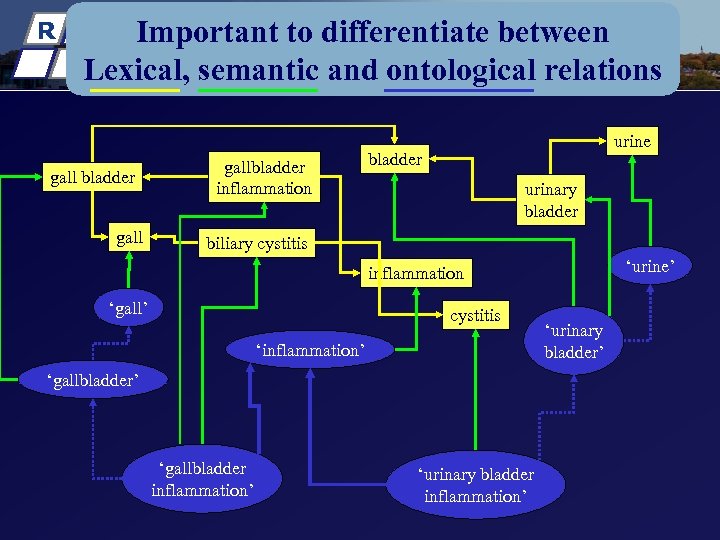 New York State R T U Important to differentiate between Lexical, semantic and ontological relations Center of Excellence in Bioinformatics & Life Sciences gall bladder gallbladder inflammation urine bladder urinary bladder biliary cystitis ‘urine’ inflammation ‘gall’ cystitis ‘inflammation’ ‘gallbladder inflammation’ ‘urinary bladder’
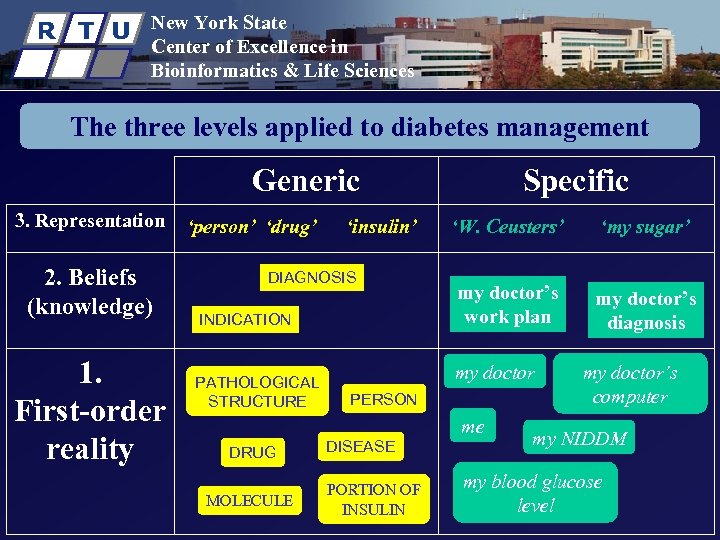 R T U New York State Center of Excellence in Bioinformatics & Life Sciences The three levels applied to diabetes management Generic 3. Representation 2. Beliefs (knowledge) 1. First-order reality ‘person’ ‘drug’ ‘insulin’ DIAGNOSIS INDICATION PATHOLOGICAL STRUCTURE DRUG MOLECULE Specific ‘W. Ceusters’ ‘my sugar’ my doctor’s work plan my doctor’s diagnosis my doctor PERSON DISEASE PORTION OF INSULIN me my doctor’s computer my NIDDM my blood glucose level
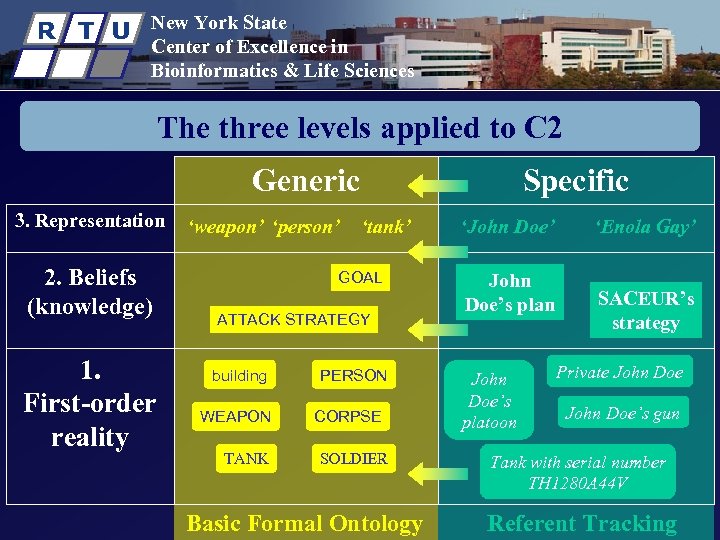 R T U New York State Center of Excellence in Bioinformatics & Life Sciences The three levels applied to C 2 Generic 3. Representation 2. Beliefs (knowledge) 1. First-order reality ‘weapon’ ‘person’ Specific ‘tank’ GOAL ATTACK STRATEGY building WEAPON TANK PERSON CORPSE SOLDIER Basic Formal Ontology ‘John Doe’s plan John Doe’s platoon ‘Enola Gay’ SACEUR’s strategy Private John Doe’s gun Tank with serial number TH 1280 A 44 V Referent Tracking
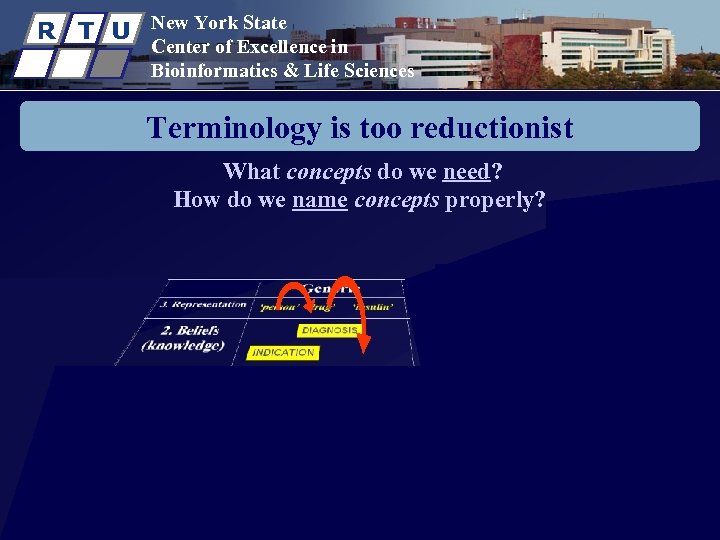 R T U New York State Center of Excellence in Bioinformatics & Life Sciences Terminology is too reductionist What concepts do we need? How do we name concepts properly?
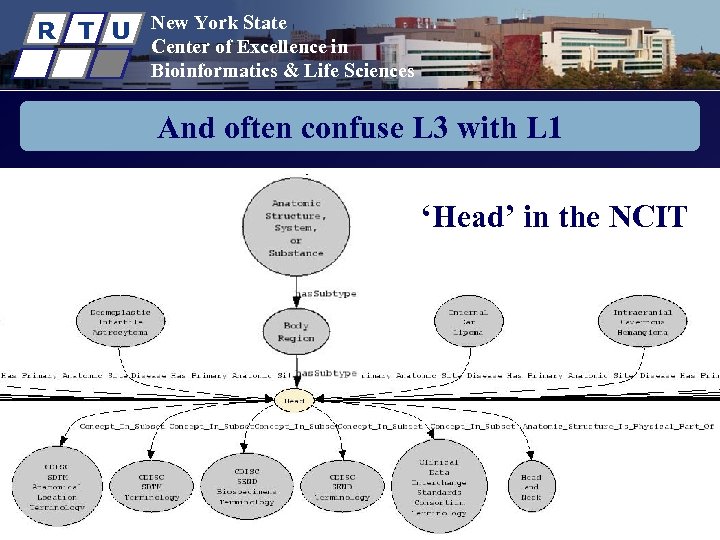 R T U New York State Center of Excellence in Bioinformatics & Life Sciences And often confuse L 3 with L 1 ‘Head’ in the NCIT
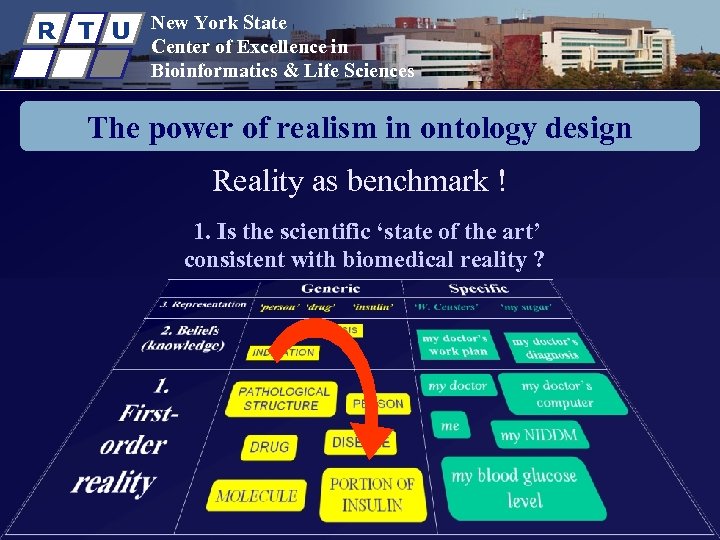 R T U New York State Center of Excellence in Bioinformatics & Life Sciences The power of realism in ontology design Reality as benchmark ! 1. Is the scientific ‘state of the art’ consistent with biomedical reality ?
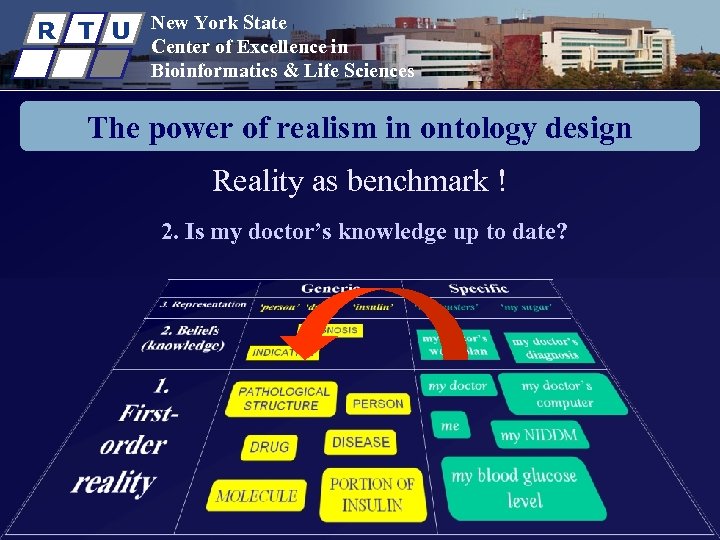 R T U New York State Center of Excellence in Bioinformatics & Life Sciences The power of realism in ontology design Reality as benchmark ! 2. Is my doctor’s knowledge up to date?
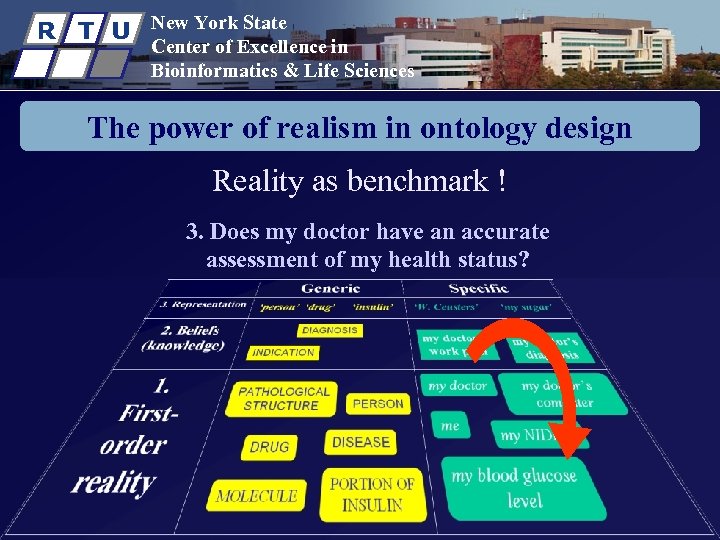 R T U New York State Center of Excellence in Bioinformatics & Life Sciences The power of realism in ontology design Reality as benchmark ! 3. Does my doctor have an accurate assessment of my health status?
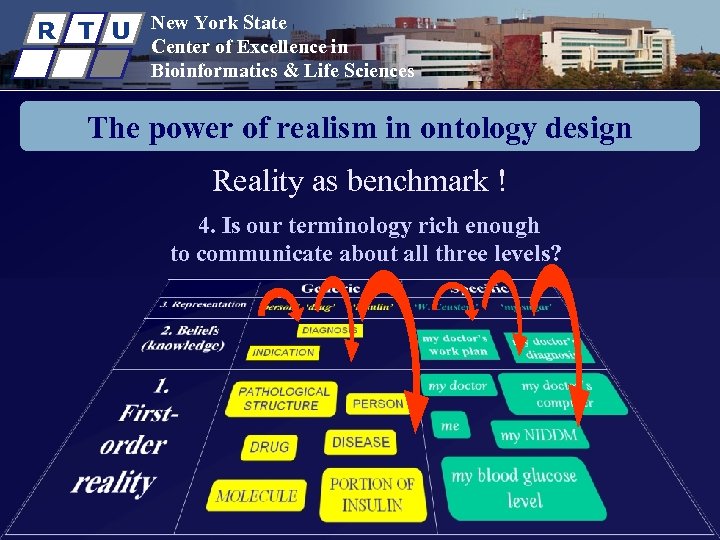 R T U New York State Center of Excellence in Bioinformatics & Life Sciences The power of realism in ontology design Reality as benchmark ! 4. Is our terminology rich enough to communicate about all three levels?
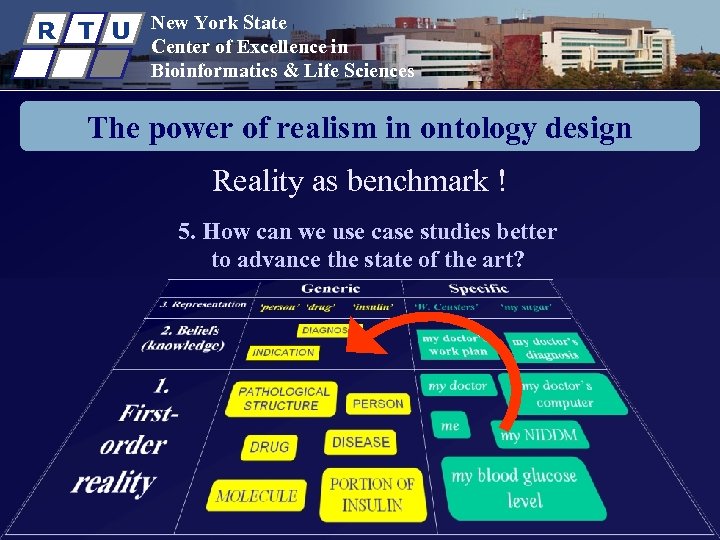 R T U New York State Center of Excellence in Bioinformatics & Life Sciences The power of realism in ontology design Reality as benchmark ! 5. How can we use case studies better to advance the state of the art?
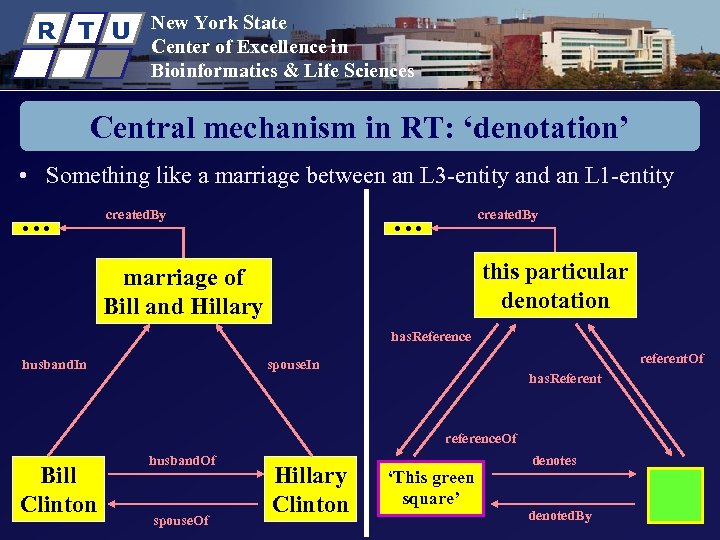 R T U New York State Center of Excellence in Bioinformatics & Life Sciences Central mechanism in RT: ‘denotation’ • Something like a marriage between an L 3 -entity and an L 1 -entity … … created. By this particular denotation marriage of Bill and Hillary has. Reference husband. In referent. Of spouse. In has. Referent reference. Of Bill Clinton husband. Of spouse. Of Hillary Clinton ‘This green square’ denotes denoted. By
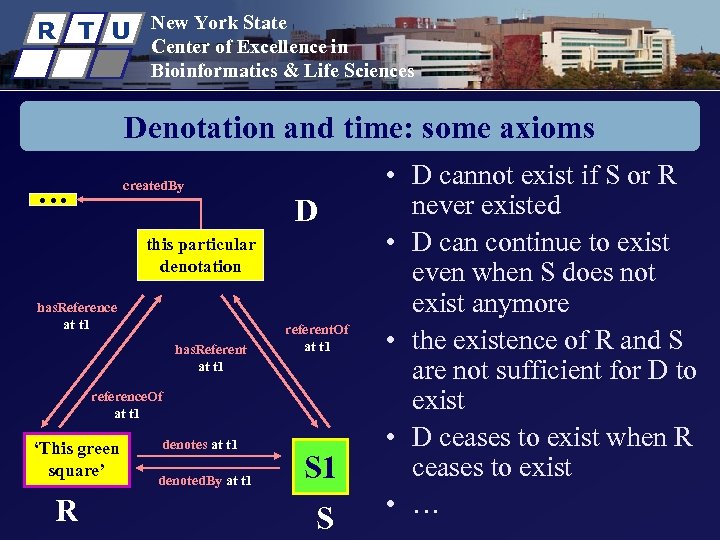 R T U New York State Center of Excellence in Bioinformatics & Life Sciences Denotation and time: some axioms … created. By D this particular denotation has. Reference at t 1 has. Referent at t 1 referent. Of at t 1 reference. Of at t 1 ‘This green square’ R denotes at t 1 denoted. By at t 1 S • D cannot exist if S or R never existed • D can continue to exist even when S does not exist anymore • the existence of R and S are not sufficient for D to exist • D ceases to exist when R ceases to exist • …
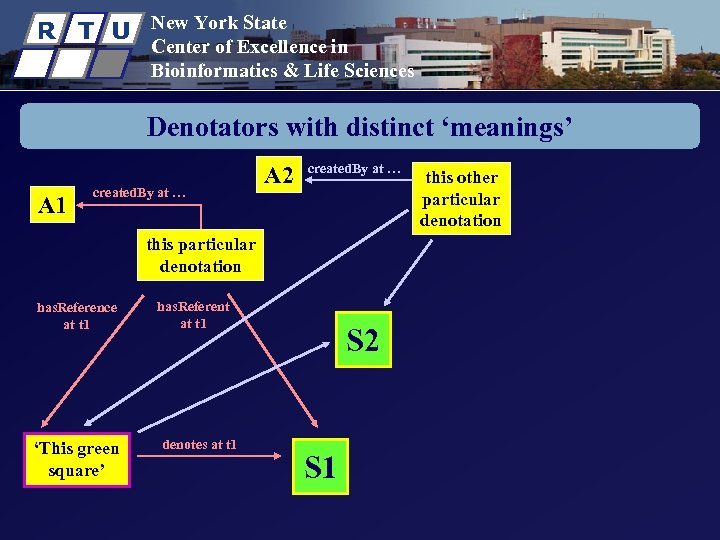 R T U New York State Center of Excellence in Bioinformatics & Life Sciences Denotators with distinct ‘meanings’ A 1 created. By at … A 2 created. By at … this particular denotation has. Reference at t 1 ‘This green square’ has. Referent at t 1 denotes at t 1 S 2 S 1 this other particular denotation
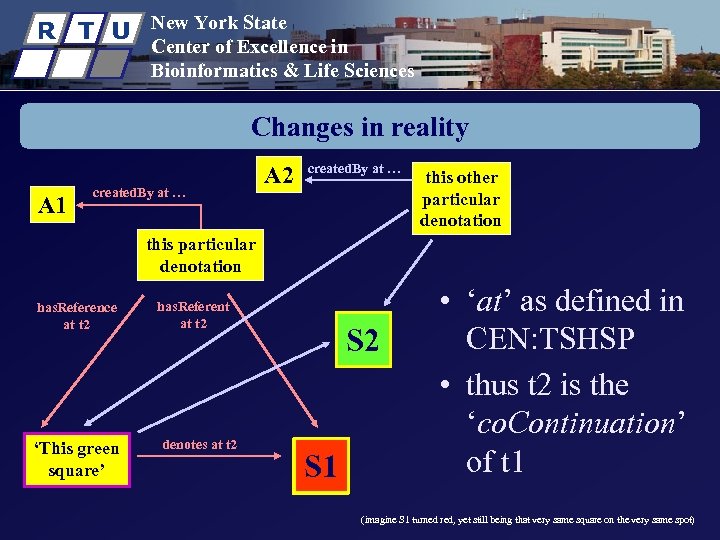 R T U New York State Center of Excellence in Bioinformatics & Life Sciences Changes in reality A 1 created. By at … A 2 created. By at … this other particular denotation this particular denotation has. Reference at t 2 ‘This green square’ has. Referent at t 2 denotes at t 2 S 1 • ‘at’ as defined in CEN: TSHSP • thus t 2 is the ‘co. Continuation’ of t 1 (imagine S 1 turned red, yet still being that very same square on the very same spot)
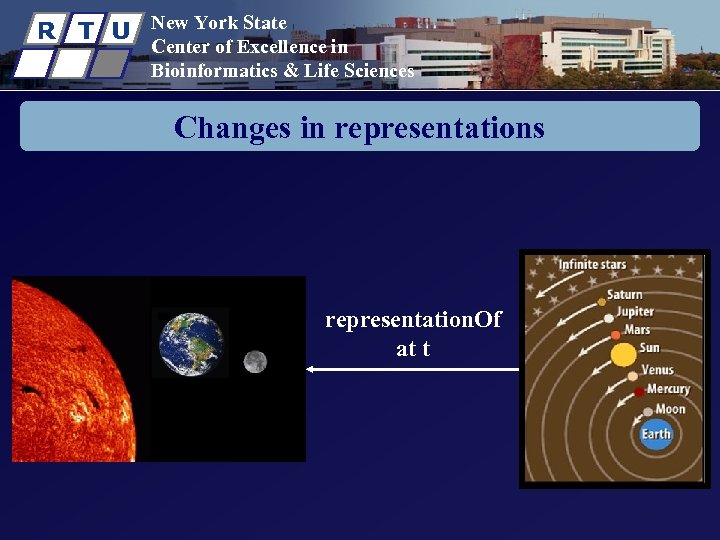 R T U New York State Center of Excellence in Bioinformatics & Life Sciences Changes in representations representation. Of at t
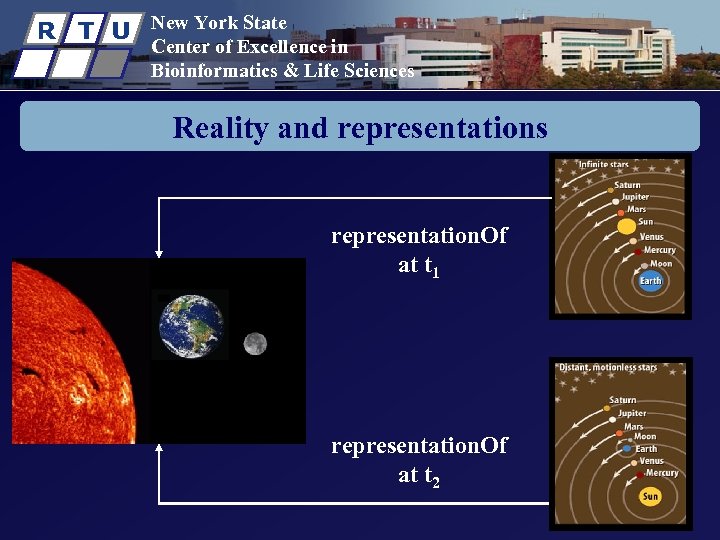 R T U New York State Center of Excellence in Bioinformatics & Life Sciences Reality and representations representation. Of at t 1 representation. Of at t 2
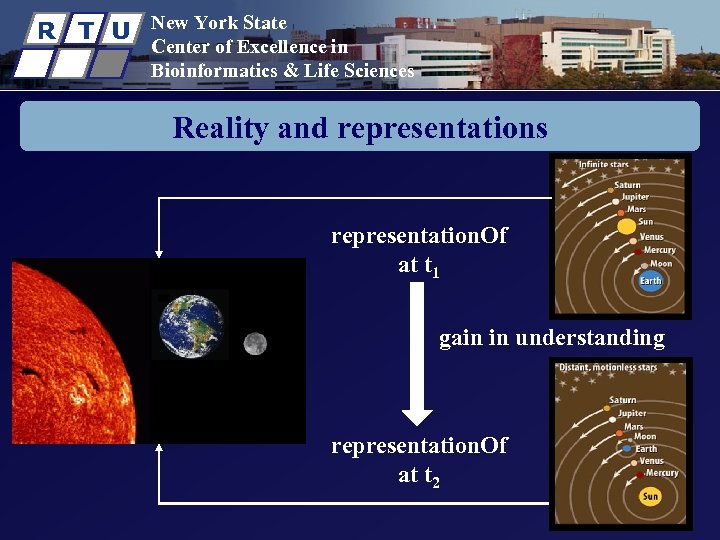 R T U New York State Center of Excellence in Bioinformatics & Life Sciences Reality and representations representation. Of at t 1 gain in understanding representation. Of at t 2
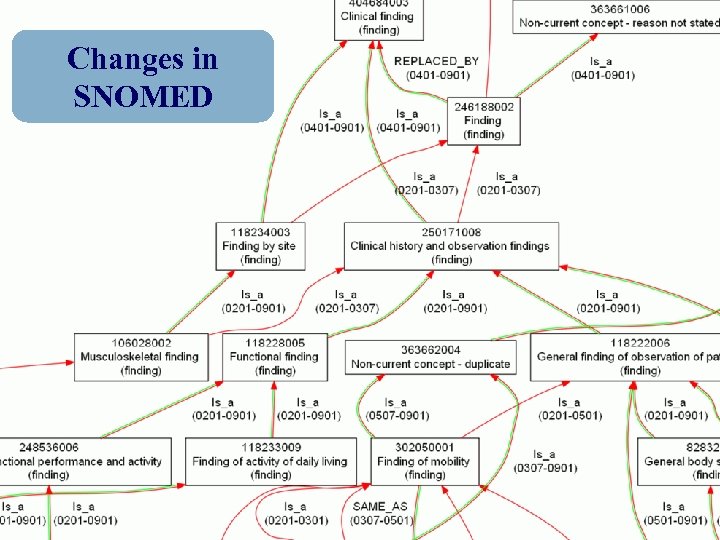 R T U New York State Center of Excellence in Bioinformatics & Life Sciences Changes in SNOMED
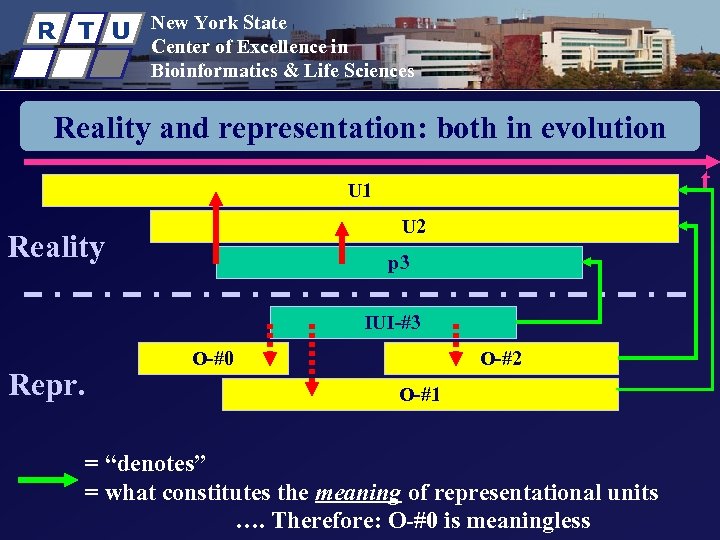 R T U New York State Center of Excellence in Bioinformatics & Life Sciences Reality and representation: both in evolution t U 1 U 2 Reality p 3 IUI-#3 Repr. O-#0 O-#2 O-#1 = “denotes” = what constitutes the meaning of representational units …. Therefore: O-#0 is meaningless
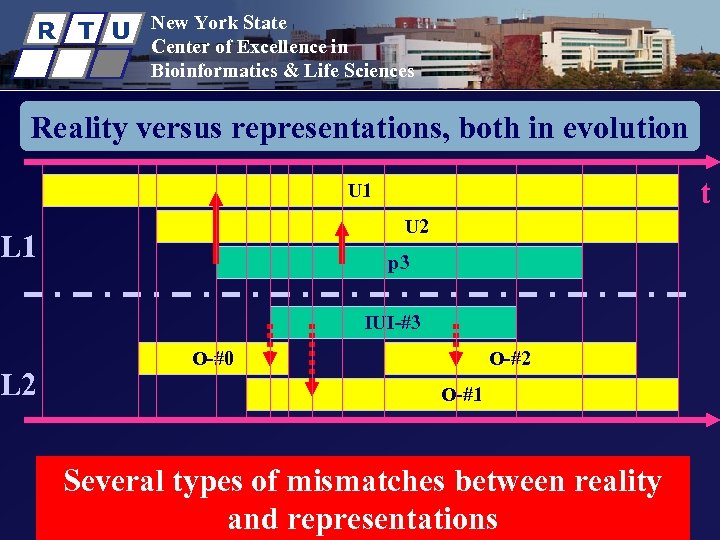 R T U New York State Center of Excellence in Bioinformatics & Life Sciences Reality versus representations, both in evolution t U 1 U 2 L 1 p 3 IUI-#3 L 2 O-#0 O-#2 O-#1 Several types of mismatches between reality and representations
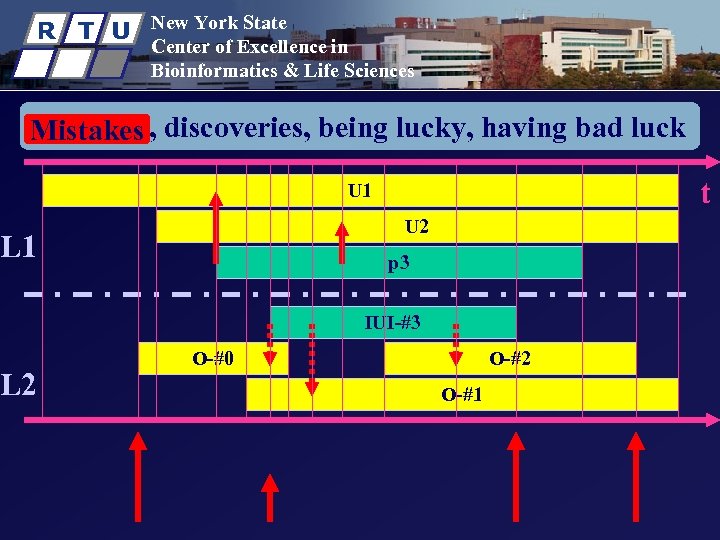 R T U New York State Center of Excellence in Bioinformatics & Life Sciences Mistakes, Mistakes discoveries, being lucky, having bad luck t U 1 U 2 L 1 p 3 IUI-#3 L 2 O-#0 O-#2 O-#1
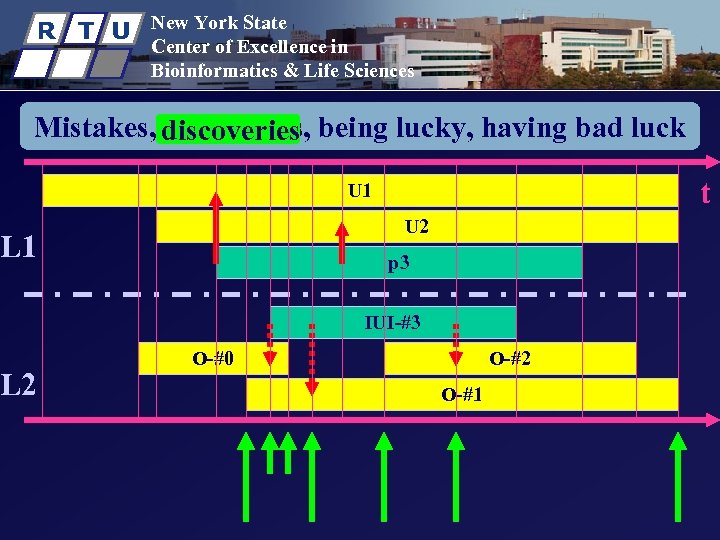 R T U New York State Center of Excellence in Bioinformatics & Life Sciences Mistakes, discoveries being lucky, having bad luck discoveries, t U 1 U 2 L 1 p 3 IUI-#3 L 2 O-#0 O-#2 O-#1
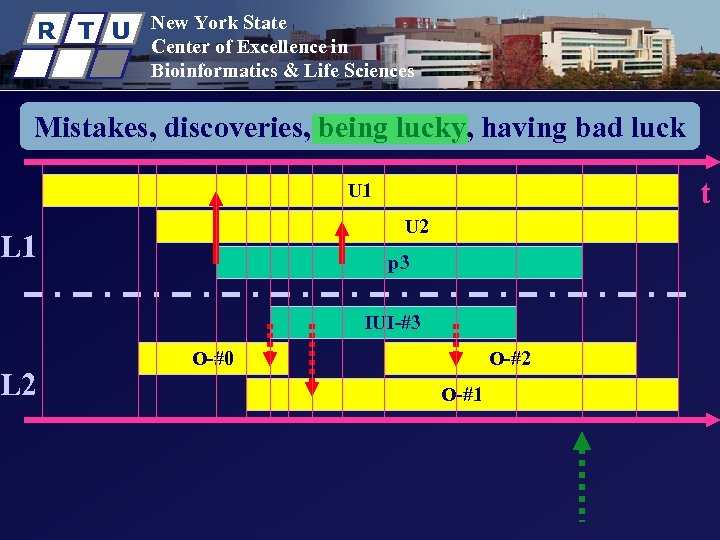 R T U New York State Center of Excellence in Bioinformatics & Life Sciences Mistakes, discoveries, being lucky, having bad luck t U 1 U 2 L 1 p 3 IUI-#3 L 2 O-#0 O-#2 O-#1
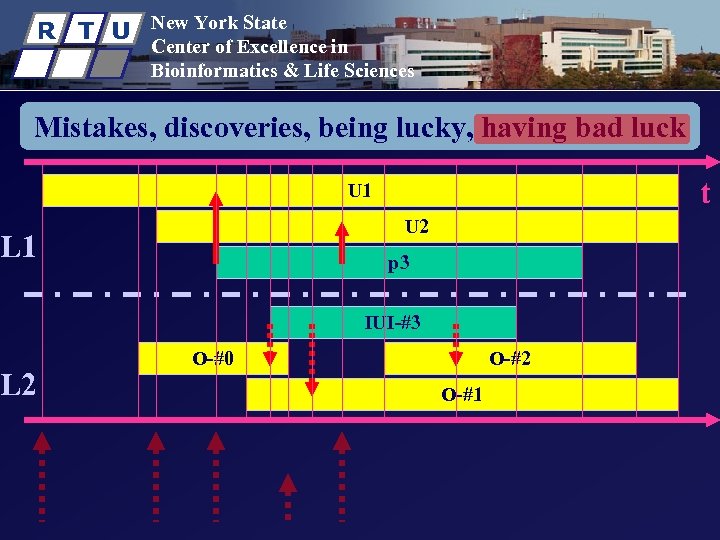 R T U New York State Center of Excellence in Bioinformatics & Life Sciences Mistakes, discoveries, being lucky, having bad luck t U 1 U 2 L 1 p 3 IUI-#3 L 2 O-#0 O-#2 O-#1
 R T U New York State Center of Excellence in Bioinformatics & Life Sciences Changes over time • In John Smith’s Electronic Health Record: – At t 1: “male” at t 2: “female” • What are the possibilities ? • Change in reality: • transgender surgery • change in legal self-identification • Change in understanding: it was female from the very beginning but interpreted wrongly • Correction of data entry mistake: it was understood as male, but wrongly transcribed • (Change in word meaning)
 R T U New York State Center of Excellence in Bioinformatics & Life Sciences Part 3: Representation in Referent Tracking
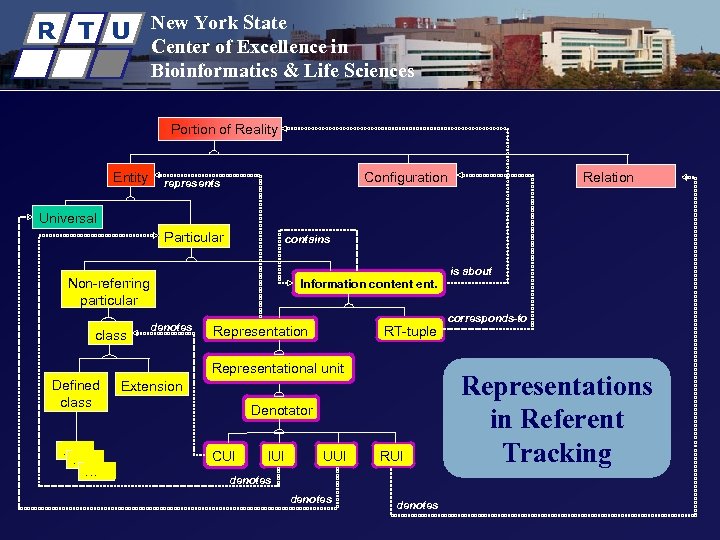 R T U New York State Center of Excellence in Bioinformatics & Life Sciences Portion of Reality Entity Configuration represents Relation Universal Particular contains Non-referring particular class Information content ent. denotes Representation RT-tuple Representational unit Defined class … … … Extension Denotator CUI IUI UUI RUI denotes is about corresponds-to Representations in Referent Tracking
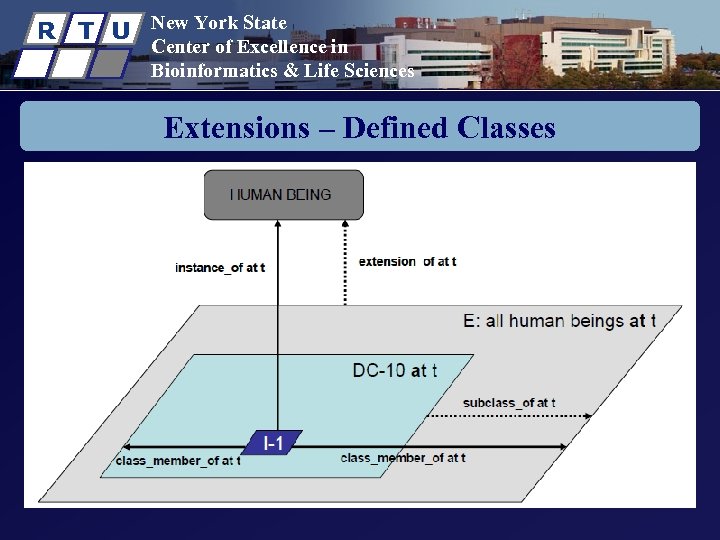 R T U New York State Center of Excellence in Bioinformatics & Life Sciences Extensions – Defined Classes
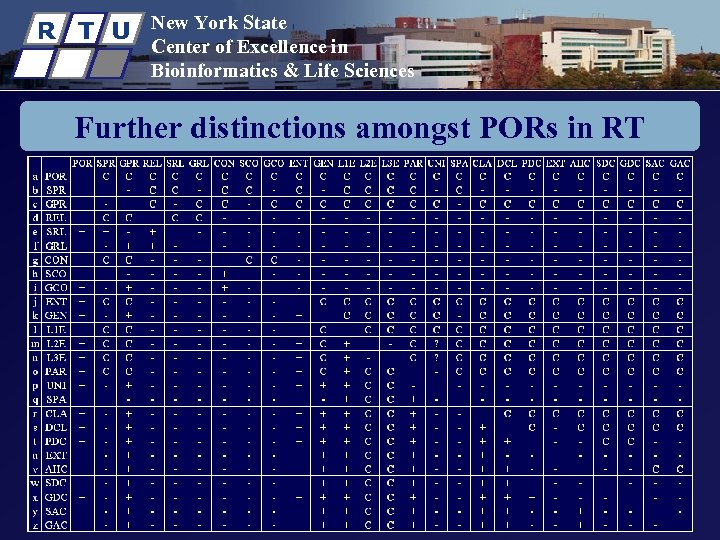 R T U New York State Center of Excellence in Bioinformatics & Life Sciences Further distinctions amongst PORs in RT
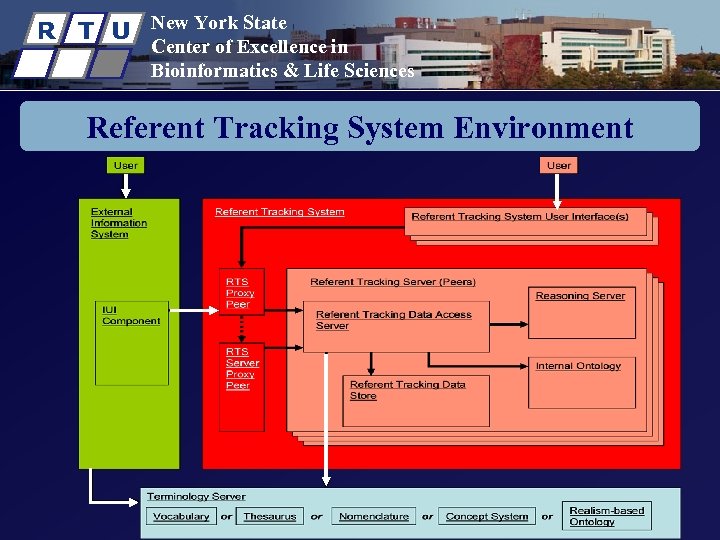
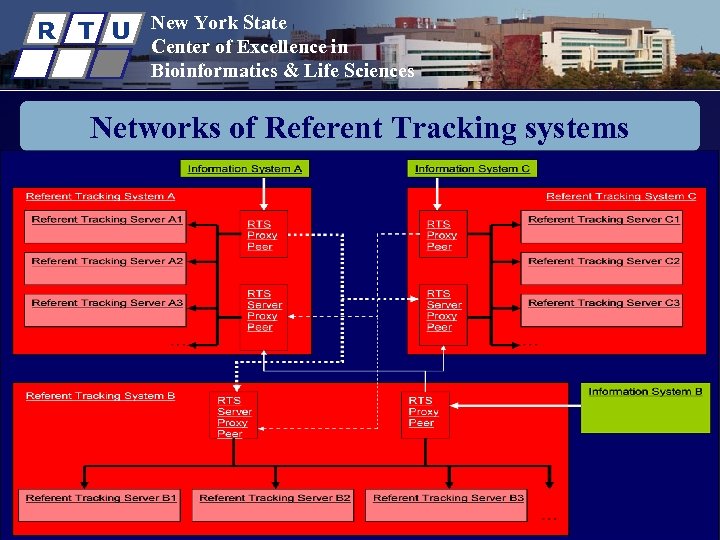
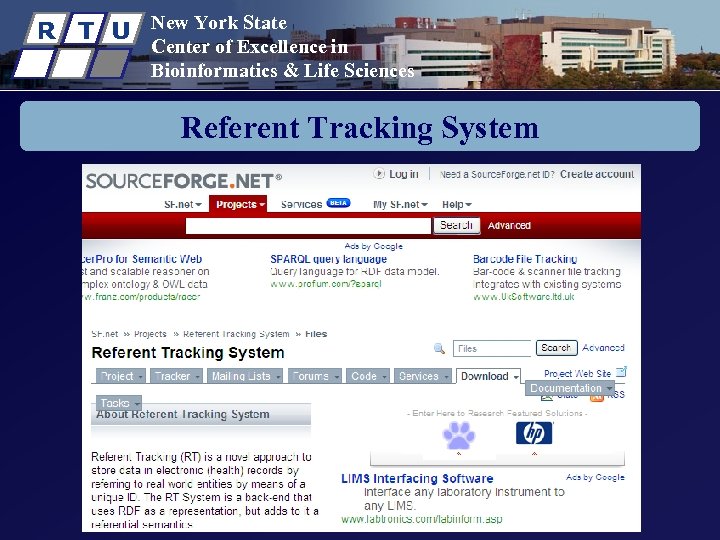 R T U New York State Center of Excellence in Bioinformatics & Life Sciences Referent Tracking System
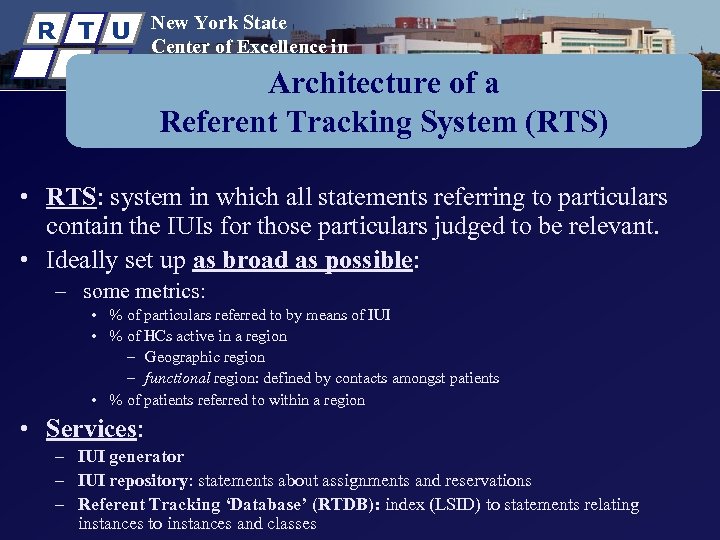 R T U New York State Center of Excellence in Bioinformatics & Life Sciences Architecture of a Referent Tracking System (RTS) • RTS: system in which all statements referring to particulars contain the IUIs for those particulars judged to be relevant. • Ideally set up as broad as possible: – some metrics: • % of particulars referred to by means of IUI • % of HCs active in a region – Geographic region – functional region: defined by contacts amongst patients • % of patients referred to within a region • Services: – IUI generator – IUI repository: statements about assignments and reservations – Referent Tracking ‘Database’ (RTDB): index (LSID) to statements relating instances to instances and classes
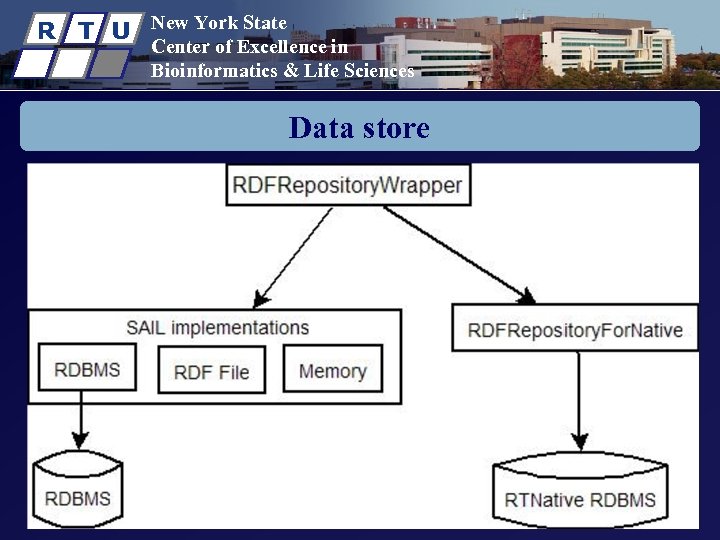
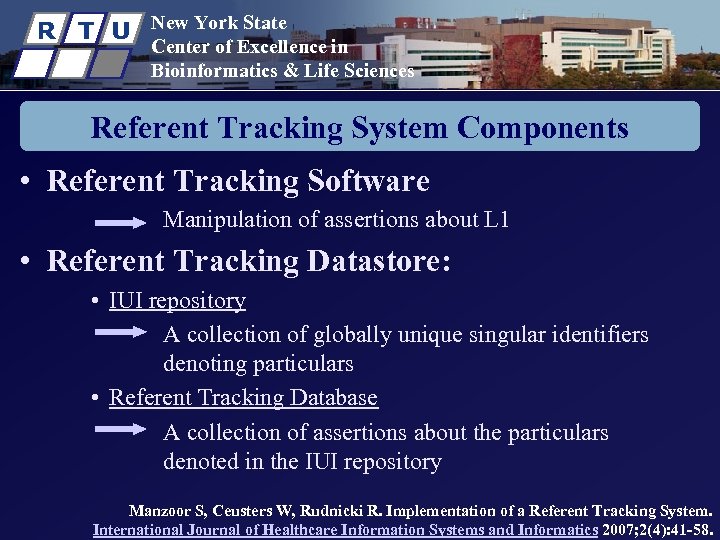 R T U New York State Center of Excellence in Bioinformatics & Life Sciences Referent Tracking System Components • Referent Tracking Software Manipulation of assertions about L 1 • Referent Tracking Datastore: • IUI repository A collection of globally unique singular identifiers denoting particulars • Referent Tracking Database A collection of assertions about the particulars denoted in the IUI repository Manzoor S, Ceusters W, Rudnicki R. Implementation of a Referent Tracking System. International Journal of Healthcare Information Systems and Informatics 2007; 2(4): 41 -58.
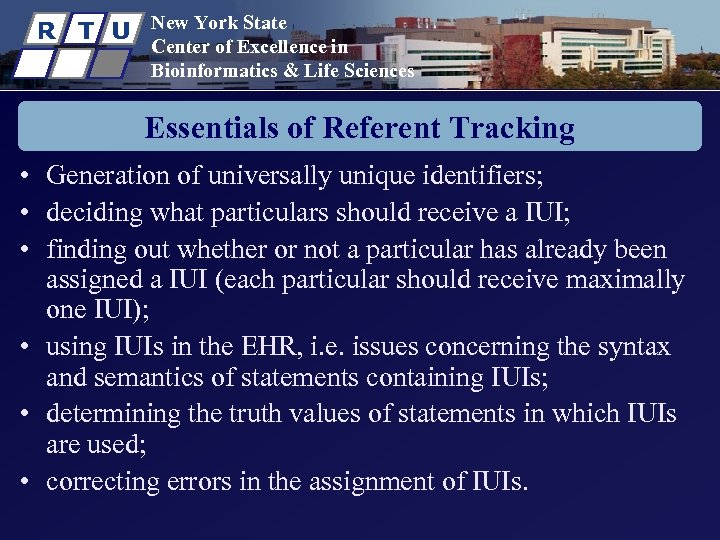 R T U New York State Center of Excellence in Bioinformatics & Life Sciences Essentials of Referent Tracking • Generation of universally unique identifiers; • deciding what particulars should receive a IUI; • finding out whether or not a particular has already been assigned a IUI (each particular should receive maximally one IUI); • using IUIs in the EHR, i. e. issues concerning the syntax and semantics of statements containing IUIs; • determining the truth values of statements in which IUIs are used; • correcting errors in the assignment of IUIs.
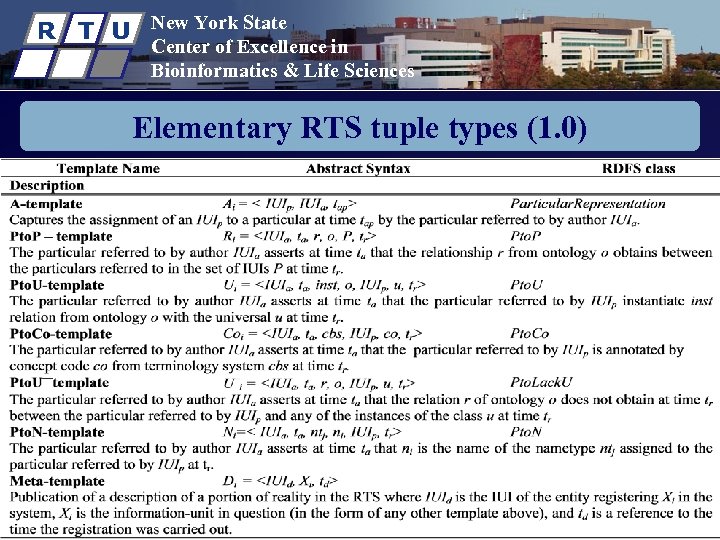 R T U New York State Center of Excellence in Bioinformatics & Life Sciences Elementary RTS tuple types (1. 0)
 R T U New York State Center of Excellence in Bioinformatics & Life Sciences IUI assignment • = an act carried out by the first ‘cognitive agent’ feeling the need to acknowledge the existence of a particular it has information about by labeling it with a UUID. • ‘cognitive agent’: – A person; – An organization; – A device or software agent, e. g. • Bank note printer, • Image analysis software.
 R T U New York State Center of Excellence in Bioinformatics & Life Sciences Criteria for IUI assignment (1) • The particular’s existence must be determined: – – Easy for persons in front of you, body parts, . . . Easy for ‘planned acts’: they do not exist before the plan is executed ! • – More difficult: subjective symptoms • – Only the plan exists and possibly the statements made about the future execution of the plan But the statements the patient makes about them do exist ! However: • • no need to know what the particular exactly is, i. e. which universal it instantiates Not always a need to be able to point to it precisely – – One bee out of a particular swarm that stung the patient, one pain out of a series of pain attacks that made the patient worried But: this is not a matter of choice, not ‘any’ out of. . .
 R T U New York State Center of Excellence in Bioinformatics & Life Sciences Criteria for IUI assignment (2) • May not have already been assigned a IUI. • • Morning star and evening star Himalaya Multiple sclerosis It must be relevant to do so: • • • Personal decision, (scientific) community guideline, . . . Possibilities offered by the EHR system If a IUI has been assigned by somebody, everybody else making statements about the particular should use it
 R T U New York State Center of Excellence in Bioinformatics & Life Sciences Assertion of assignments • IUI assignment is an act of which the execution has to be asserted in the IUI-repository: – Di =
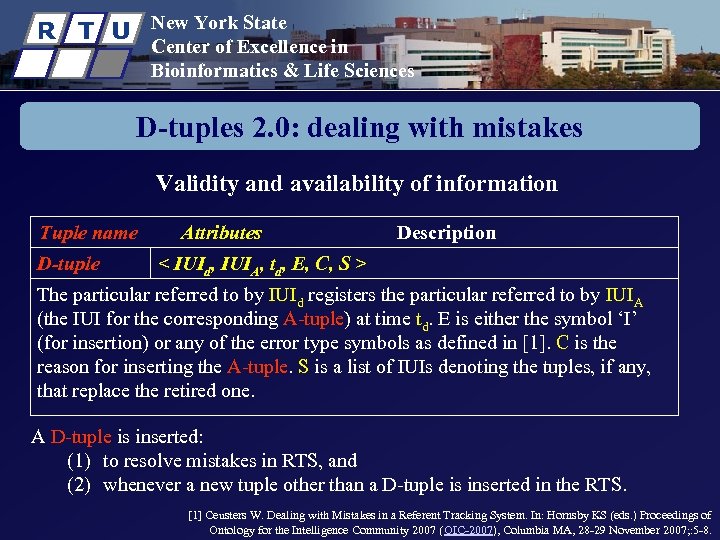 R T U New York State Center of Excellence in Bioinformatics & Life Sciences D-tuples 2. 0: dealing with mistakes Validity and availability of information Tuple name D-tuple Attributes Description < IUId, IUIA, td, E, C, S > The particular referred to by IUId registers the particular referred to by IUIA (the IUI for the corresponding A-tuple) at time td. E is either the symbol ‘I’ (for insertion) or any of the error type symbols as defined in [1]. C is the reason for inserting the A-tuple. S is a list of IUIs denoting the tuples, if any, that replace the retired one. A D-tuple is inserted: (1) to resolve mistakes in RTS, and (2) whenever a new tuple other than a D-tuple is inserted in the RTS. [1] Ceusters W. Dealing with Mistakes in a Referent Tracking System. In: Hornsby KS (eds. ) Proceedings of Ontology for the Intelligence Community 2007 (OIC-2007), Columbia MA, 28 -29 November 2007; : 5 -8.
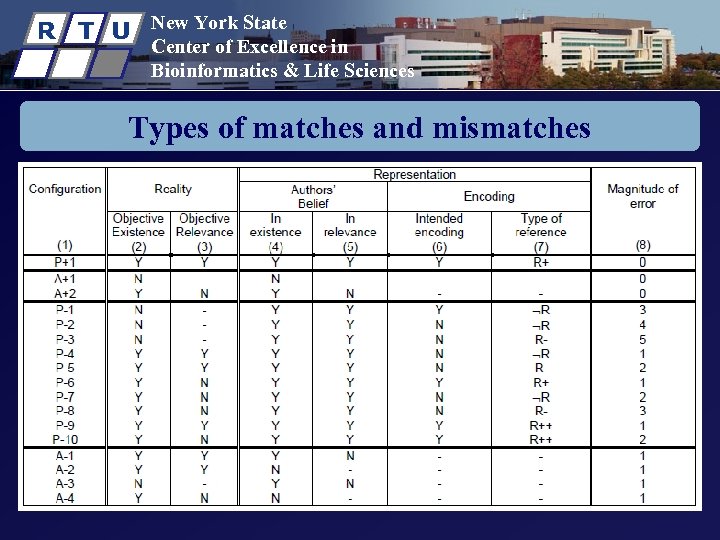 R T U New York State Center of Excellence in Bioinformatics & Life Sciences Types of matches and mismatches
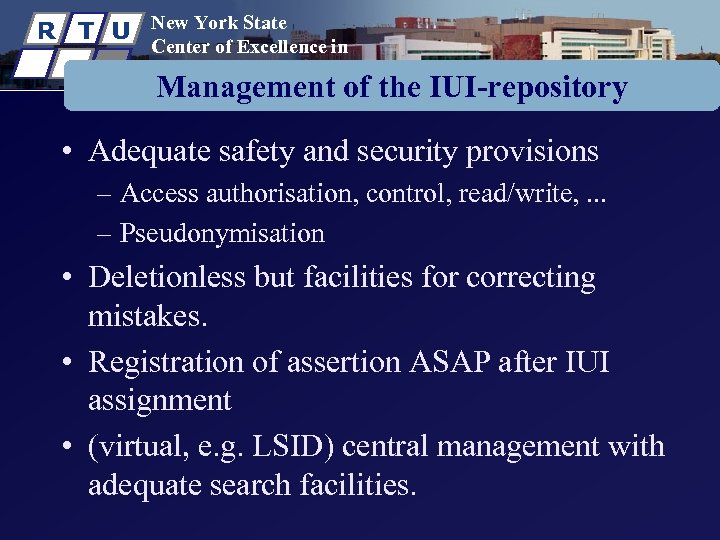 R T U New York State Center of Excellence in Bioinformatics & Life Sciences Management of the IUI-repository • Adequate safety and security provisions – Access authorisation, control, read/write, . . . – Pseudonymisation • Deletionless but facilities for correcting mistakes. • Registration of assertion ASAP after IUI assignment • (virtual, e. g. LSID) central management with adequate search facilities.
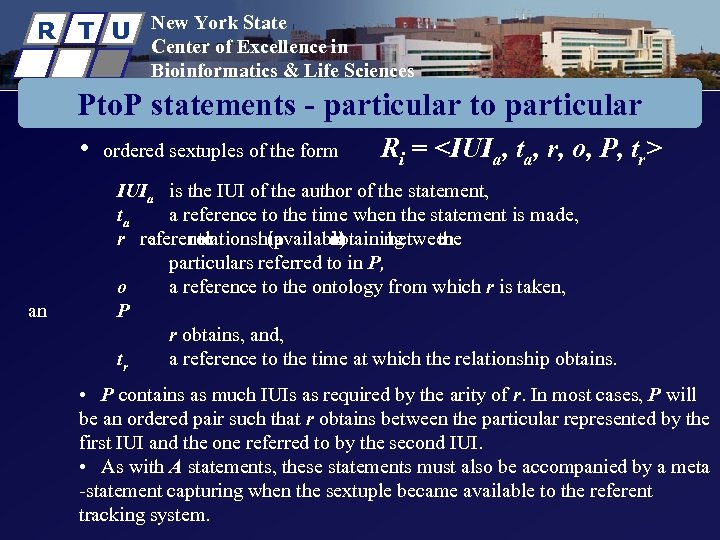 R T U New York State Center of Excellence in Bioinformatics & Life Sciences Pto. P statements - particular to particular • an ordered sextuples of the form Ri =
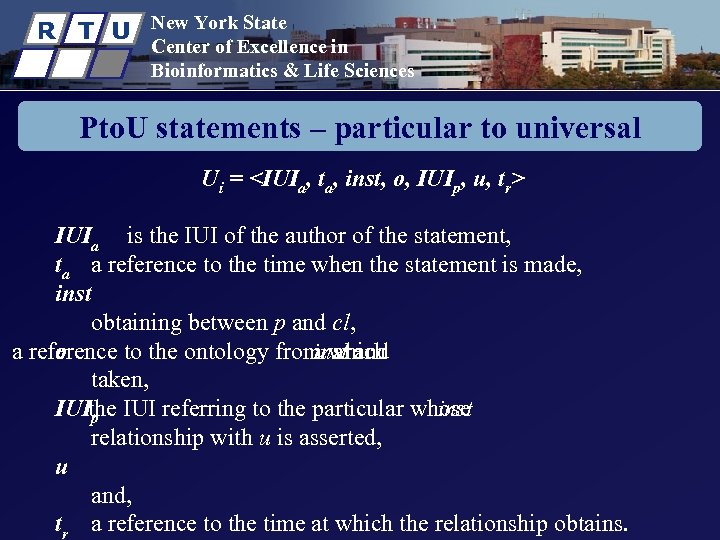 R T U New York State Center of Excellence in Bioinformatics & Life Sciences Pto. U statements – particular to universal Ui =
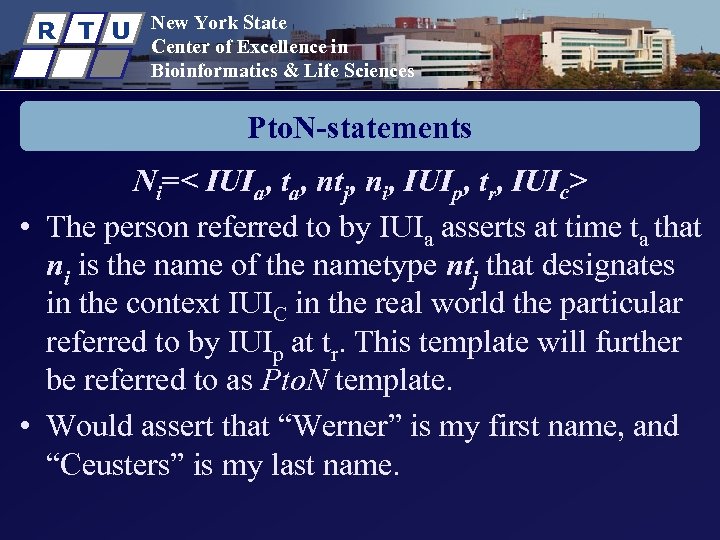 R T U New York State Center of Excellence in Bioinformatics & Life Sciences Pto. N-statements Ni=< IUIa, ta, ntj, ni, IUIp, tr, IUIc> • The person referred to by IUIa asserts at time ta that ni is the name of the nametype ntj that designates in the context IUIC in the real world the particular referred to by IUIp at tr. This template will further be referred to as Pto. N template. • Would assert that “Werner” is my first name, and “Ceusters” is my last name.
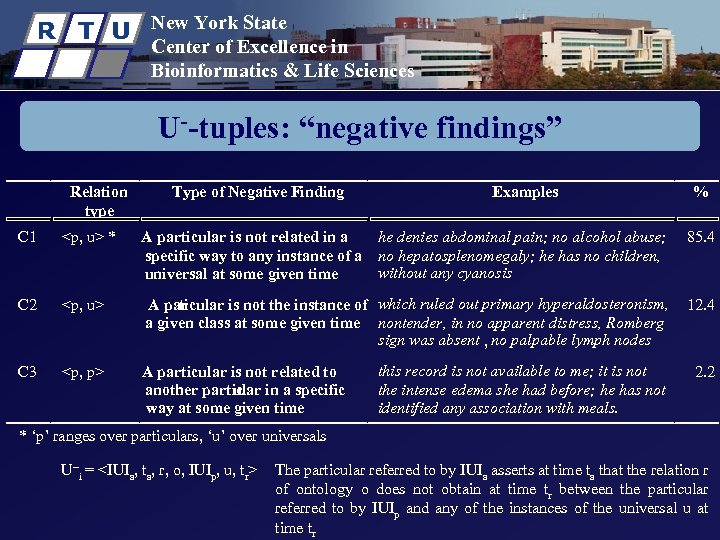 R T U New York State Center of Excellence in Bioinformatics & Life Sciences U--tuples: “negative findings” Relation type Type of Negative Finding Examples % C 1
 a R T U New York State Center of Excellence in Bioinformatics & Life Sciences Pto. CO statements: particular to concept code Coi =
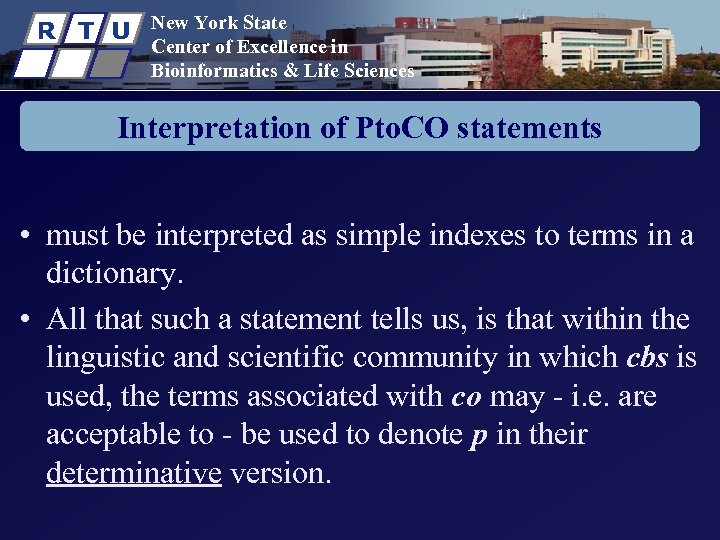 R T U New York State Center of Excellence in Bioinformatics & Life Sciences Interpretation of Pto. CO statements • must be interpreted as simple indexes to terms in a dictionary. • All that such a statement tells us, is that within the linguistic and scientific community in which cbs is used, the terms associated with co may - i. e. are acceptable to - be used to denote p in their determinative version.
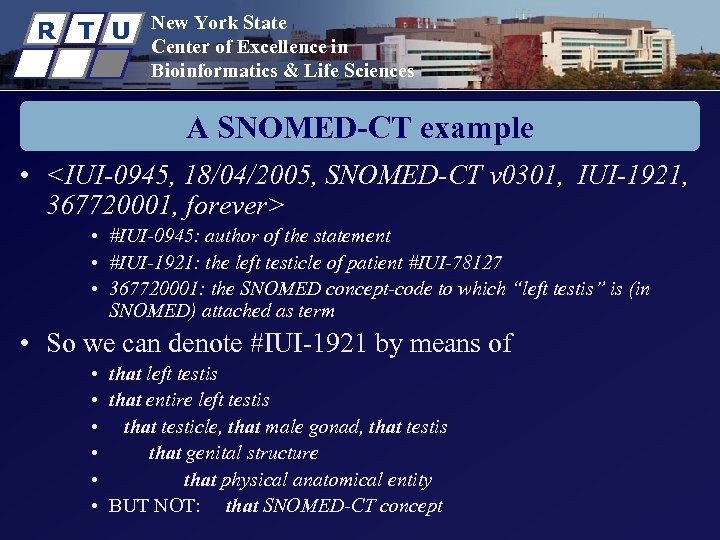 R T U New York State Center of Excellence in Bioinformatics & Life Sciences A SNOMED-CT example •
 R T U New York State Center of Excellence in Bioinformatics & Life Sciences Referent Tracking System Environment
 R T U New York State Center of Excellence in Bioinformatics & Life Sciences Networks of Referent Tracking systems
 R T U New York State Center of Excellence in Bioinformatics & Life Sciences Data store
 R T U New York State Center of Excellence in Bioinformatics & Life Sciences Pragmatics of IUIs in EHRs • IUI assignment requires an additional effort • In principle no difference qua (or just a little bit more) effort compared to using directly codes from conceptbased systems – A search for concept-codes is replaced by a search for the appropriate IUI using exactly the same mechanisms • Browsing • Code-finder software • Auto-coding software (CLEF NLP software Andrea Setzer) – With that IUI comes a wealth of already registered information – If for the same patient different IUIs apply, the user must make the decision which one is the one under scrutiny, or whether it is again a new instance
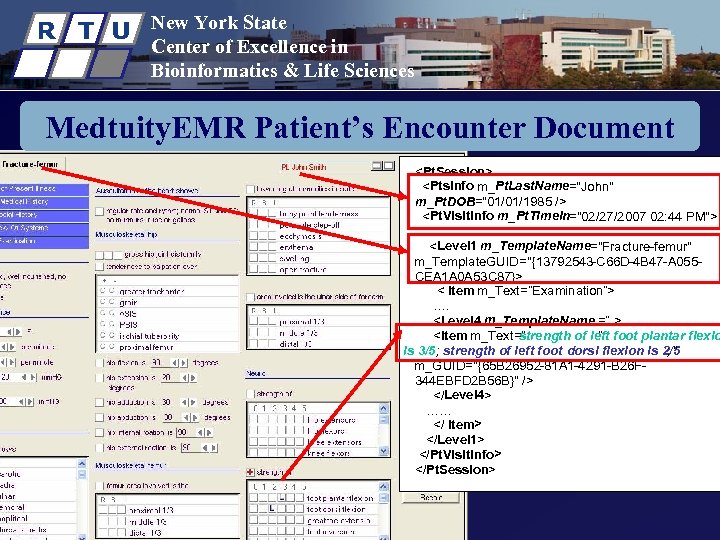 R T U New York State Center of Excellence in Bioinformatics & Life Sciences Medtuity. EMR Patient’s Encounter Document
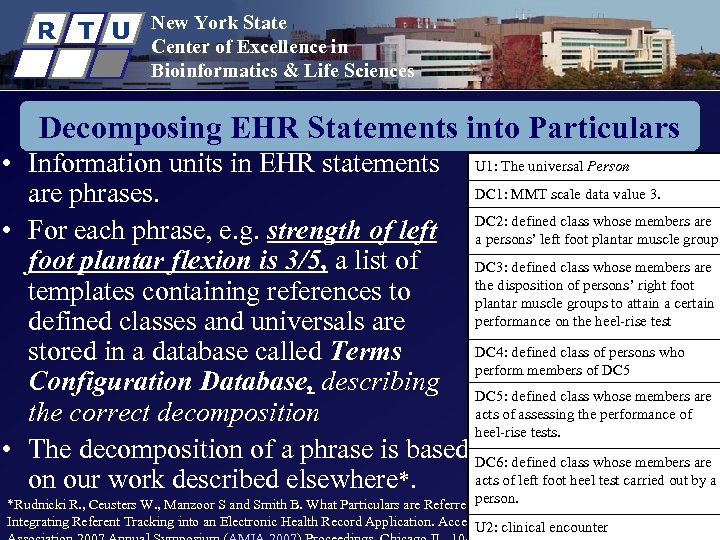 R T U New York State Center of Excellence in Bioinformatics & Life Sciences Decomposing EHR Statements into Particulars • Information units in EHR statements U 1: The universal Person DC 1: MMT scale data value 3. are phrases. whose • For each phrase, e. g. strength of left DC 2: defined class plantar members are a persons’ left foot muscle group foot plantar flexion is 3/5, a list of DC 3: defined class whose members are the disposition of persons’ right foot templates containing references to plantar muscle groups to attain a certain performance on the heel-rise test defined classes and universals are DC 4: defined class of persons who stored in a database called Terms perform members of DC 5 Configuration Database, describing DC 5: defined class whose members are acts of assessing the performance of the correct decomposition heel-rise tests. • The decomposition of a phrase is based DC 6: defined class whose members are acts of left foot heel test carried out by a on our work described elsewhere*. *Rudnicki R. , Ceusters W. , Manzoor S and Smith B. What Particulars are Referred person. Data? A Case Study in to in EHR Integrating Referent Tracking into an Electronic Health Record Application. Accepted for American Medical Informatics U 2: clinical encounter
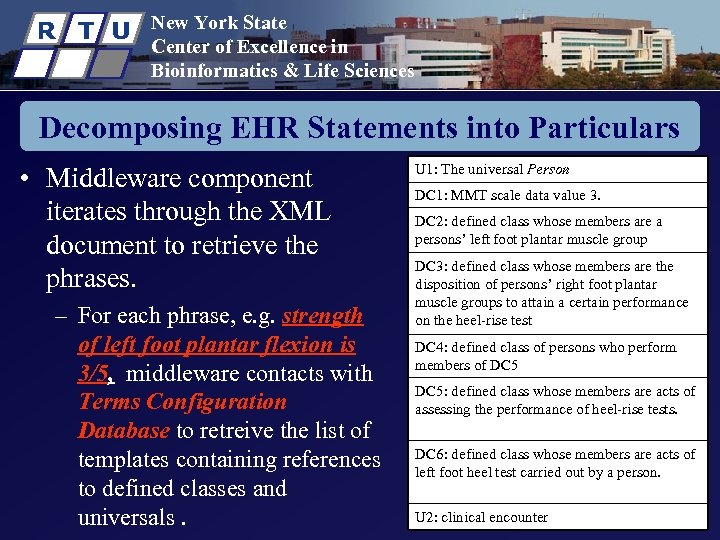 R T U New York State Center of Excellence in Bioinformatics & Life Sciences Decomposing EHR Statements into Particulars • Middleware component iterates through the XML document to retrieve the phrases. – For each phrase, e. g. strength of left foot plantar flexion is 3/5, middleware contacts with Terms Configuration Database to retreive the list of templates containing references to defined classes and universals. U 1: The universal Person DC 1: MMT scale data value 3. DC 2: defined class whose members are a persons’ left foot plantar muscle group DC 3: defined class whose members are the disposition of persons’ right foot plantar muscle groups to attain a certain performance on the heel-rise test DC 4: defined class of persons who perform members of DC 5: defined class whose members are acts of assessing the performance of heel-rise tests. DC 6: defined class whose members are acts of left foot heel test carried out by a person. U 2: clinical encounter
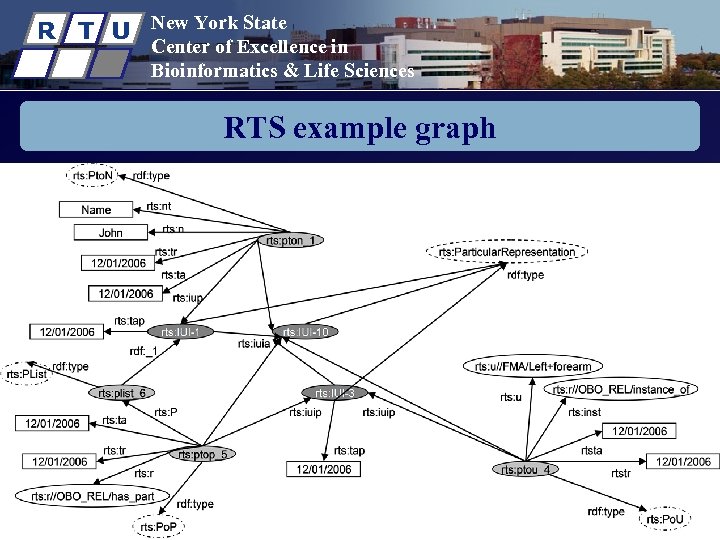 R T U New York State Center of Excellence in Bioinformatics & Life Sciences RTS example graph
 R T U New York State Center of Excellence in Bioinformatics & Life Sciences Part 4: Applications & Projects
 R T U New York State Center of Excellence in Bioinformatics & Life Sciences eye. GENE (June 2008 - …)
 R T U New York State Center of Excellence in Bioinformatics & Life Sciences Ontology for Risks Against Patient Safety
 R T U New York State Center of Excellence in Bioinformatics & Life Sciences Representing particular adverse event cases • Is the generic representation of the portion of reality adequate enough for the description of particular cases? • Example: a patient – born at time t 0 – undergoing anti-inflammatory treatment and physiotherapy since t 2 – for an arthrosis present since t 1 – develops a stomach ulcer at t 3. 133
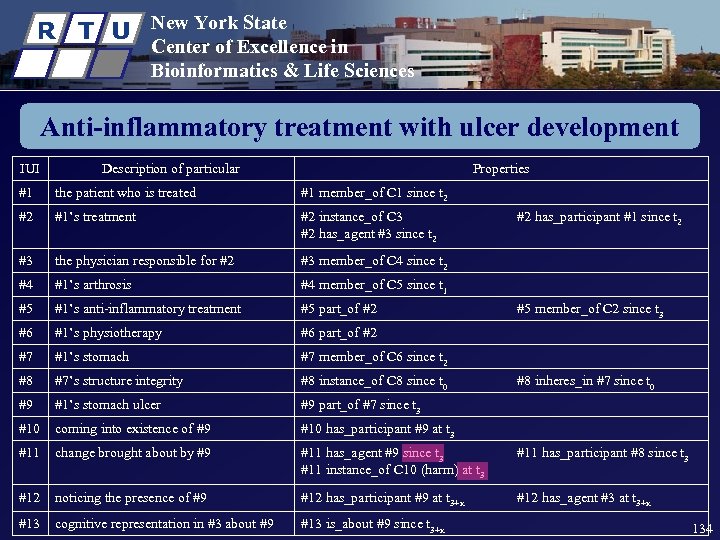 R T U New York State Center of Excellence in Bioinformatics & Life Sciences Anti-inflammatory treatment with ulcer development IUI Description of particular Properties #1 the patient who is treated #1 member_of C 1 since t 2 #2 #1’s treatment #2 instance_of C 3 #2 has_agent #3 since t 2 #3 the physician responsible for #2 #3 member_of C 4 since t 2 #4 #1’s arthrosis #4 member_of C 5 since t 1 #5 #1’s anti-inflammatory treatment #5 part_of #2 #6 #1’s physiotherapy #6 part_of #2 #7 #1’s stomach #7 member_of C 6 since t 2 #8 #7’s structure integrity #8 instance_of C 8 since t 0 #9 #1’s stomach ulcer #9 part_of #7 since t 3 #10 coming into existence of #9 #10 has_participant #9 at t 3 #11 change brought about by #9 #11 has_agent #9 since t 3 #11 instance_of C 10 (harm) at t 3 #11 has_participant #8 since t 3 #12 noticing the presence of #9 #12 has_participant #9 at t 3+x #12 has_agent #3 at t 3+x #13 cognitive representation in #3 about #9 #13 is_about #9 since t 3+x #2 has_participant #1 since t 2 #5 member_of C 2 since t 3 #8 inheres_in #7 since t 0 134
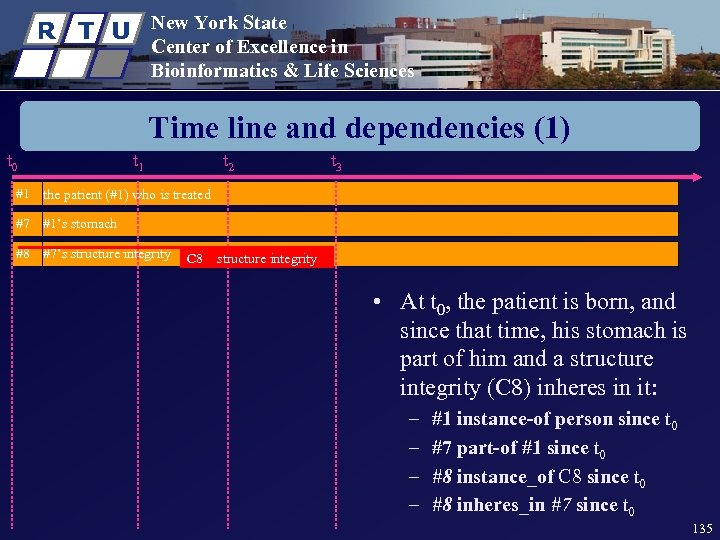 R T U New York State Center of Excellence in Bioinformatics & Life Sciences Time line and dependencies (1) t 0 t 1 t 2 t 3 #1 the patient (#1) who is treated #7 #1’s stomach #8 #7’s structure integrity C 8 structure integrity • At t 0, the patient is born, and since that time, his stomach is part of him and a structure integrity (C 8) inheres in it: – – #1 instance-of person since t 0 #7 part-of #1 since t 0 #8 instance_of C 8 since t 0 #8 inheres_in #7 since t 0 135
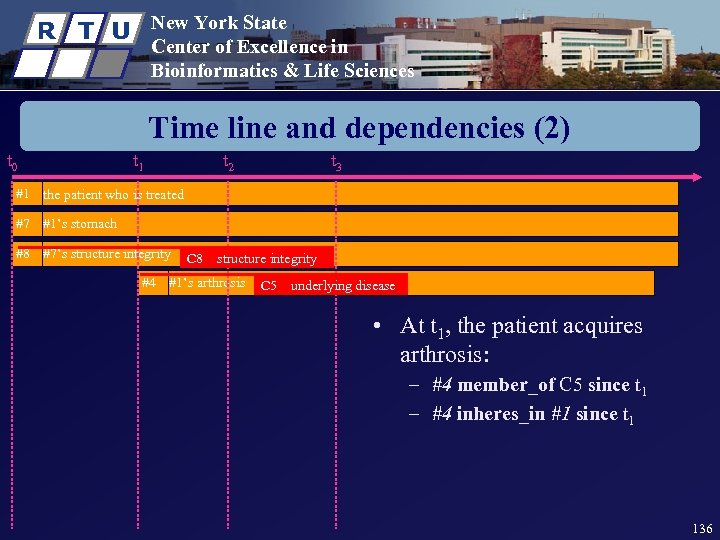 R T U New York State Center of Excellence in Bioinformatics & Life Sciences Time line and dependencies (2) t 0 t 1 t 2 t 3 #1 the patient who is treated #7 #1’s stomach #8 #7’s structure integrity C 8 structure integrity #4 #1’s arthrosis C 5 underlying disease • At t 1, the patient acquires arthrosis: – #4 member_of C 5 since t 1 – #4 inheres_in #1 since t 1 136
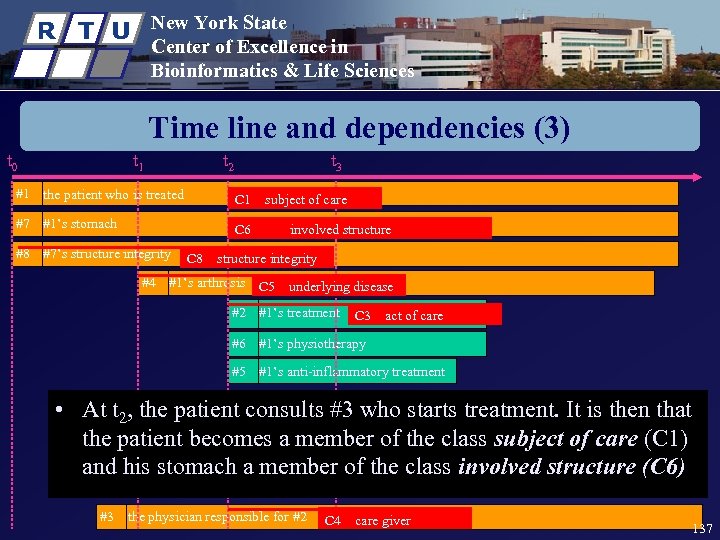 R T U New York State Center of Excellence in Bioinformatics & Life Sciences Time line and dependencies (3) t 0 t 1 t 2 t 3 #1 the patient who is treated C 1 subject of care #7 #1’s stomach C 6 #8 #7’s structure integrity involved structure C 8 structure integrity #4 #1’s arthrosis C 5 underlying disease #2 #1’s treatment C 3 act of care #6 #1’s physiotherapy #5 #1’s anti-inflammatory treatment • At t 2, the patient consults #3 who starts treatment. It is then that the patient becomes a member of the class subject of care (C 1) and his stomach a member of the class involved structure (C 6) #3 the physician responsible for #2 C 4 care giver 137
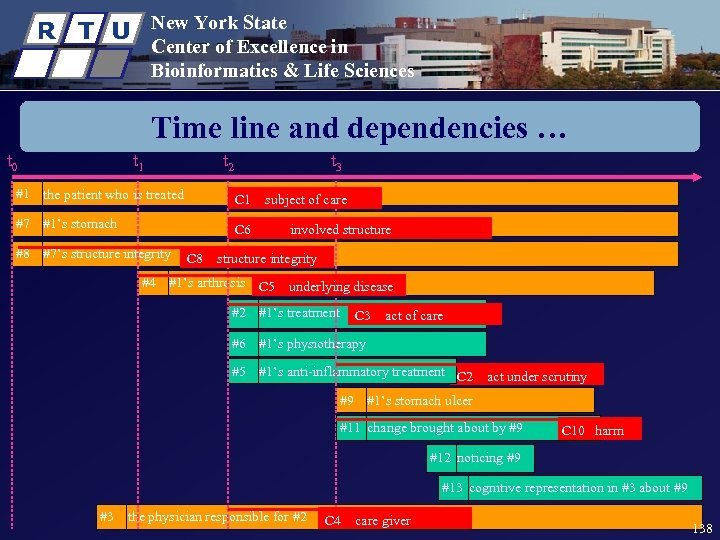 R T U New York State Center of Excellence in Bioinformatics & Life Sciences Time line and dependencies … t 0 t 1 t 2 t 3 #1 the patient who is treated C 1 subject of care #7 #1’s stomach C 6 #8 #7’s structure integrity involved structure C 8 structure integrity #4 #1’s arthrosis C 5 underlying disease #2 #1’s treatment C 3 act of care #6 #1’s physiotherapy #5 #1’s anti-inflammatory treatment C 2 act under scrutiny #9 #1’s stomach ulcer #11 change brought about by #9 C 10 harm #12 noticing #9 #13 cognitive representation in #3 about #9 #3 the physician responsible for #2 C 4 care giver 138
 R T U New York State Center of Excellence in Bioinformatics & Life Sciences Domotics and RFID systems • Avoiding adverse events in a hospital because of insufficient day/night illumination: – Light sensors and motion detectors in rooms and corridors • and representations thereof in an Adverse Event Management System (AEMS) – What are ‘sufficient’ illumination levels for specific sites is expressed in defined classes, – Each change in a detector is registered in real time in the AEMS, – Action-logic implemented in a rule-base system, f. i. to generate alerts.
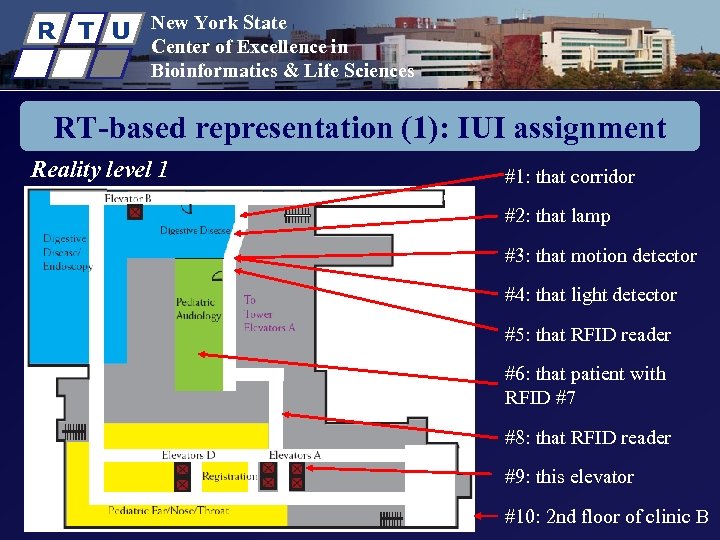 R T U New York State Center of Excellence in Bioinformatics & Life Sciences RT-based representation (1): IUI assignment Reality level 1 #1: that corridor #2: that lamp #3: that motion detector #4: that light detector #5: that RFID reader #6: that patient with RFID #7 #8: that RFID reader #9: this elevator #10: 2 nd floor of clinic B
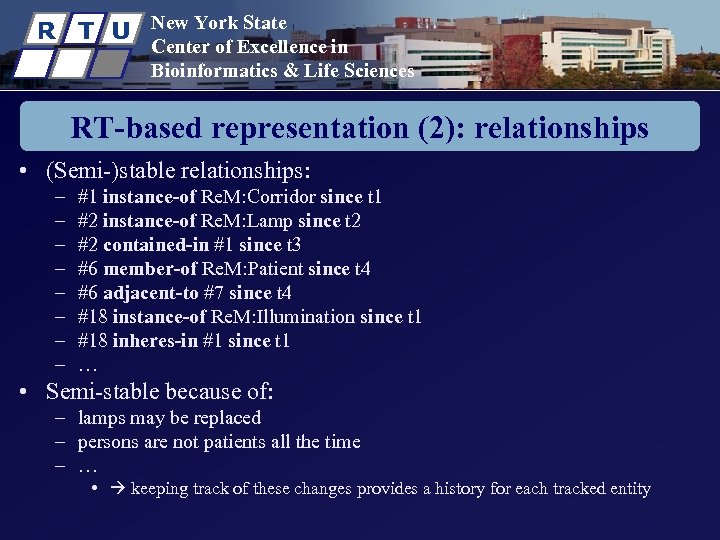 R T U New York State Center of Excellence in Bioinformatics & Life Sciences RT-based representation (2): relationships • (Semi-)stable relationships: – – – – #1 instance-of Re. M: Corridor since t 1 #2 instance-of Re. M: Lamp since t 2 #2 contained-in #1 since t 3 #6 member-of Re. M: Patient since t 4 #6 adjacent-to #7 since t 4 #18 instance-of Re. M: Illumination since t 1 #18 inheres-in #1 since t 1 … • Semi-stable because of: – lamps may be replaced – persons are not patients all the time – … • keeping track of these changes provides a history for each tracked entity
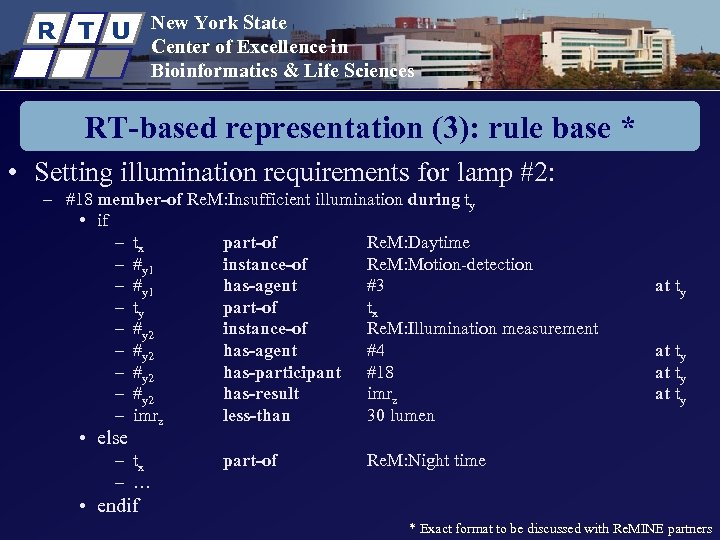 R T U New York State Center of Excellence in Bioinformatics & Life Sciences RT-based representation (3): rule base * • Setting illumination requirements for lamp #2: – #18 member-of Re. M: Insufficient illumination during ty • if – tx part-of Re. M: Daytime – #y 1 instance-of Re. M: Motion-detection – #y 1 has-agent #3 – ty part-of tx – #y 2 instance-of Re. M: Illumination measurement – #y 2 has-agent #4 – #y 2 has-participant #18 – #y 2 has-result imrz – imrz less-than 30 lumen at ty • else – tx – … part-of Re. M: Night time • endif * Exact format to be discussed with Re. MINE partners
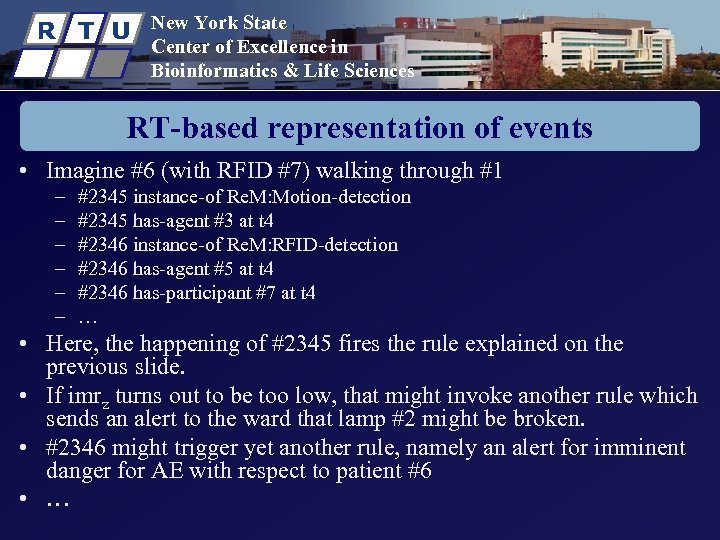 R T U New York State Center of Excellence in Bioinformatics & Life Sciences RT-based representation of events • Imagine #6 (with RFID #7) walking through #1 – – – #2345 instance-of Re. M: Motion-detection #2345 has-agent #3 at t 4 #2346 instance-of Re. M: RFID-detection #2346 has-agent #5 at t 4 #2346 has-participant #7 at t 4 … • Here, the happening of #2345 fires the rule explained on the previous slide. • If imrz turns out to be too low, that might invoke another rule which sends an alert to the ward that lamp #2 might be broken. • #2346 might trigger yet another rule, namely an alert for imminent danger for AE with respect to patient #6 • …
 R T U New York State Center of Excellence in Bioinformatics & Life Sciences Making existing EHR systems RT compatible
 R T U New York State Center of Excellence in Bioinformatics & Life Sciences Tracking versions of representations
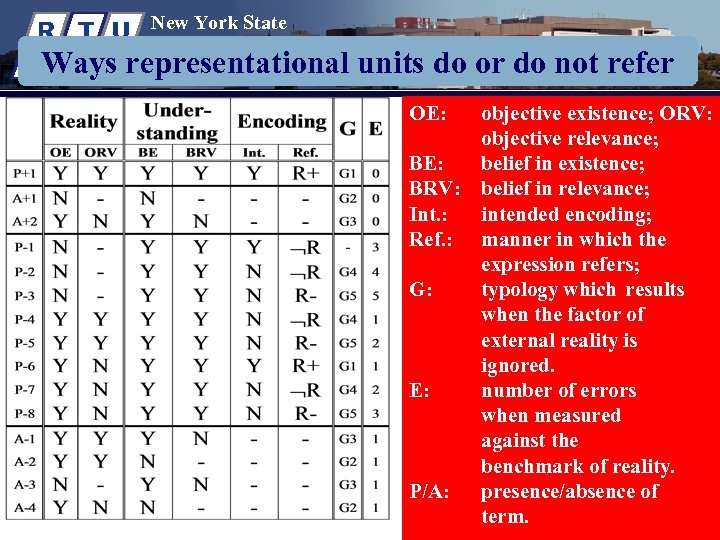 R T U New York State Center of Excellence in Bioinformatics & Life Sciences Ways representational units do or do not refer OE: objective existence; ORV: objective relevance; BE: belief in existence; BRV: belief in relevance; Int. : intended encoding; Ref. : manner in which the expression refers; G: typology which results when the factor of external reality is ignored. E: number of errors when measured against the benchmark of reality. P/A: presence/absence of term.
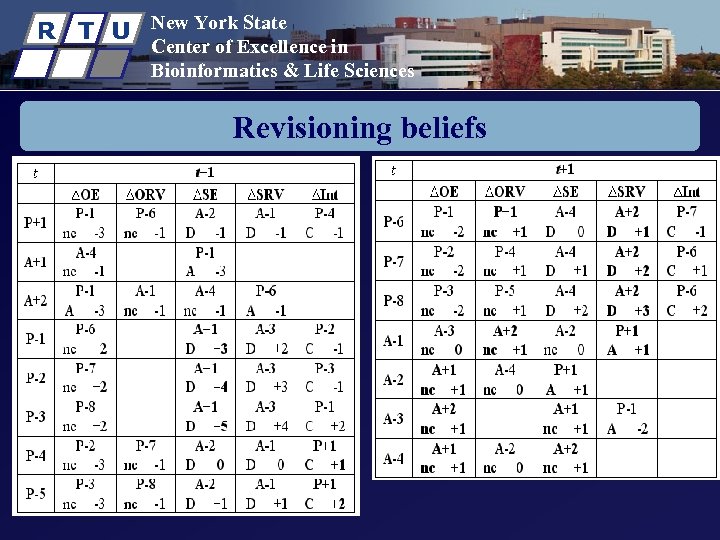 R T U New York State Center of Excellence in Bioinformatics & Life Sciences Revisioning beliefs
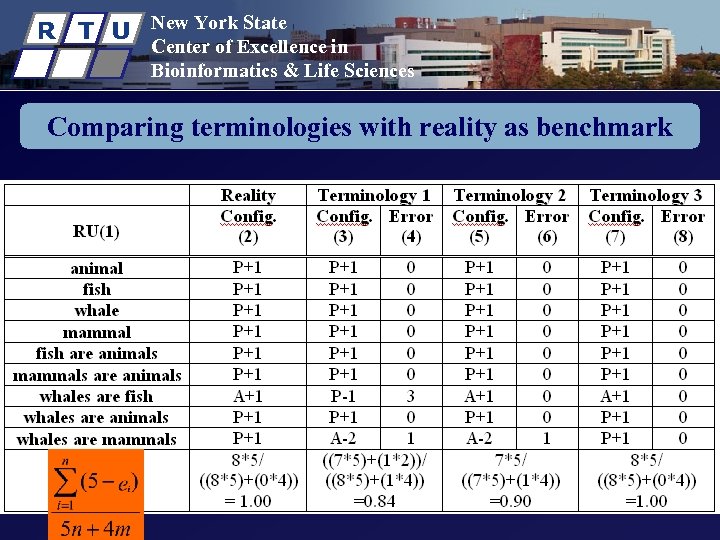 R T U New York State Center of Excellence in Bioinformatics & Life Sciences Comparing terminologies with reality as benchmark
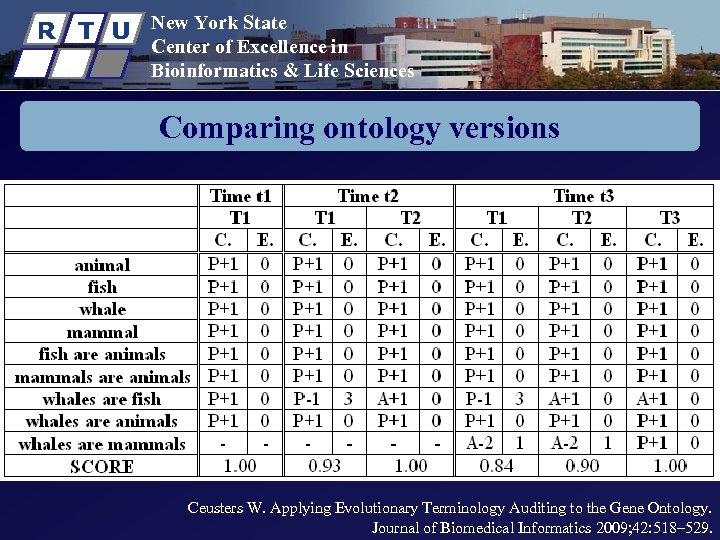 R T U New York State Center of Excellence in Bioinformatics & Life Sciences Comparing ontology versions Ceusters W. Applying Evolutionary Terminology Auditing to the Gene Ontology. Journal of Biomedical Informatics 2009; 42: 518– 529.
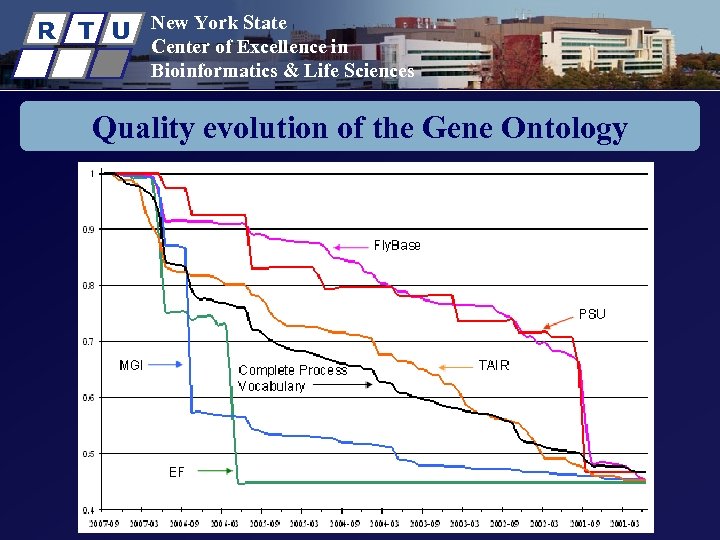 R T U New York State Center of Excellence in Bioinformatics & Life Sciences Quality evolution of the Gene Ontology
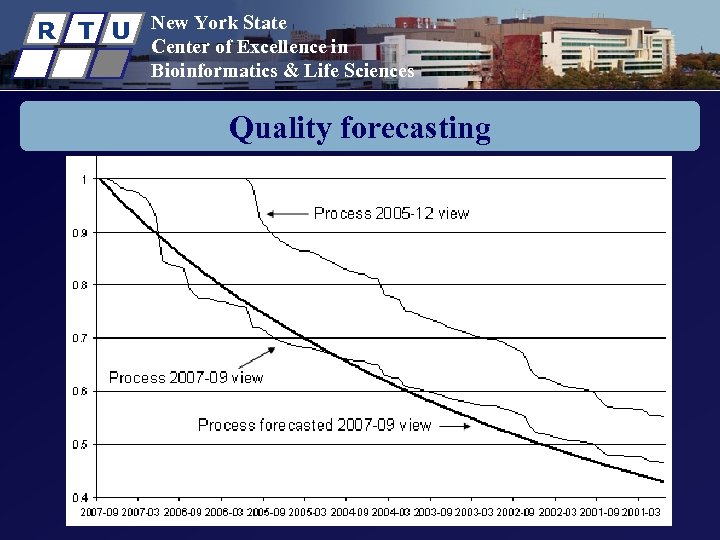 R T U New York State Center of Excellence in Bioinformatics & Life Sciences Quality forecasting
 R T U New York State Center of Excellence in Bioinformatics & Life Sciences Referent Tracking enabled Websites
 R T U New York State Center of Excellence in Bioinformatics & Life Sciences
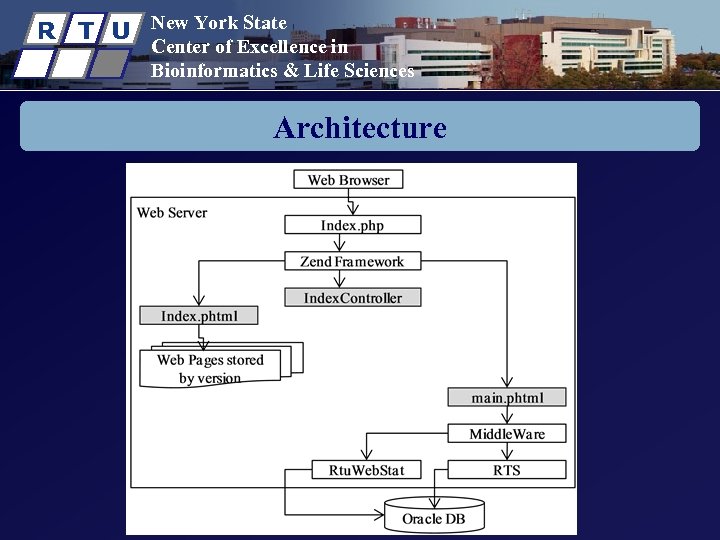 R T U New York State Center of Excellence in Bioinformatics & Life Sciences Architecture
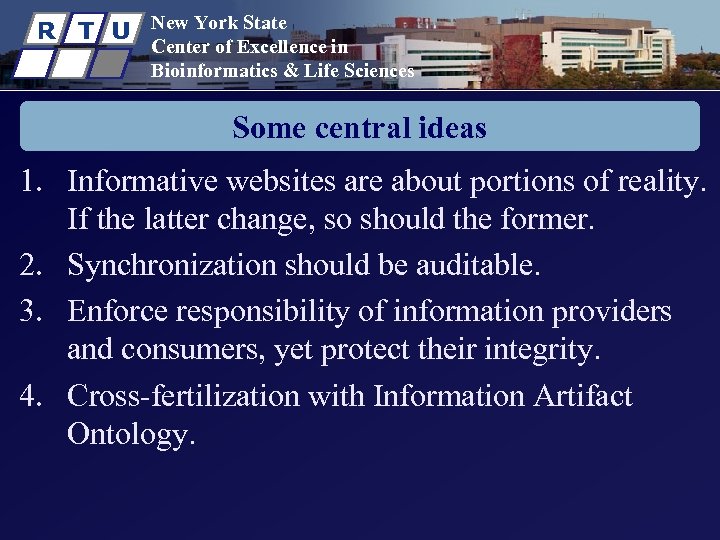 R T U New York State Center of Excellence in Bioinformatics & Life Sciences Some central ideas 1. Informative websites are about portions of reality. If the latter change, so should the former. 2. Synchronization should be auditable. 3. Enforce responsibility of information providers and consumers, yet protect their integrity. 4. Cross-fertilization with Information Artifact Ontology.
 R T U New York State Center of Excellence in Bioinformatics & Life Sciences Some key insights • Static versus dynamic pages; • Web pages usually keep their name (URL), yet undergo changes; – ‘page’ versus ‘file’ – Server file never ‘changes’: always replaced by a new file with the same name • Changes to a file do not always involve changes to the propositional content; • Requests to view a page do not lead the file on the server to be transmitted, but a new copy of it in each single case;
 R T U New York State Center of Excellence in Bioinformatics & Life Sciences Entities to assign IUIs to • • The content file of each page The content of each content file The propositional content of each content Each browser page Each checksum Each ontology and terminology used in RT-tuples Each RT-tuple (except D-tuples) The middleware component
 R T U New York State Center of Excellence in Bioinformatics & Life Sciences Use of the CEN Time Standard for HIT
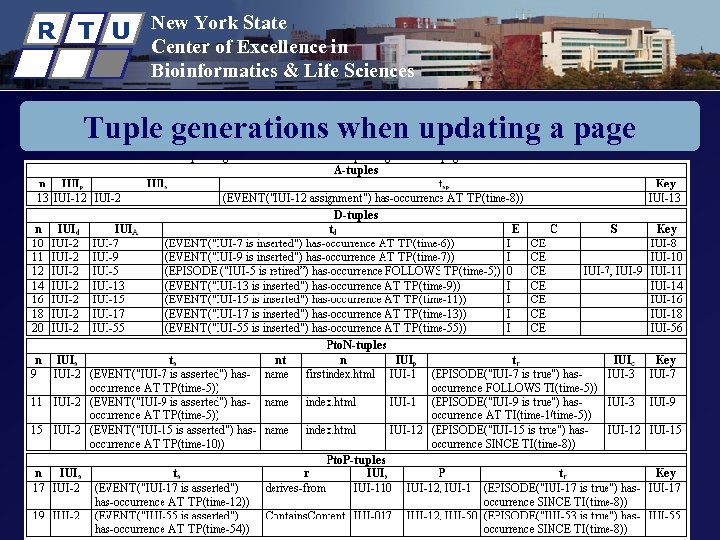
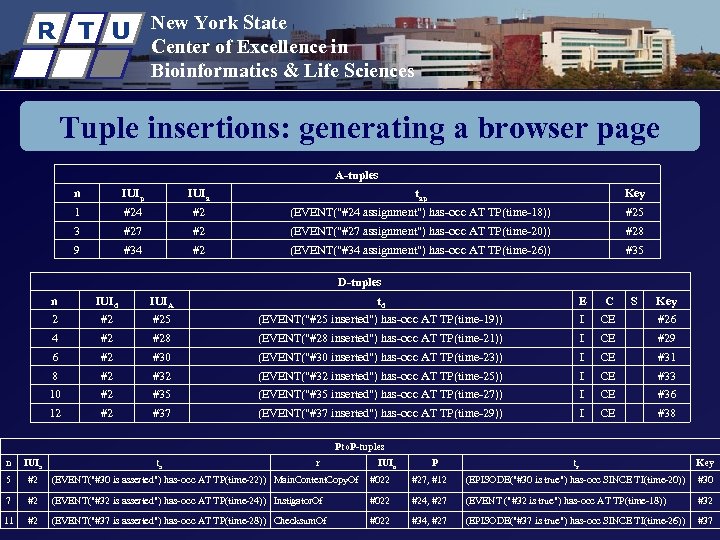
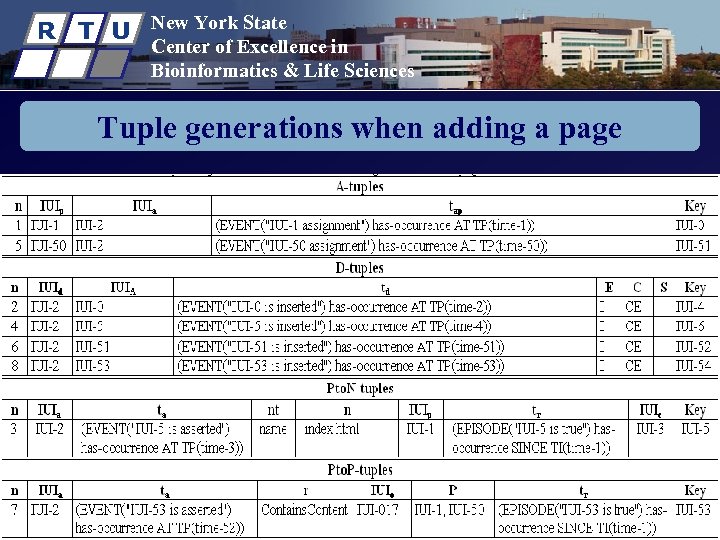 R T U New York State Center of Excellence in Bioinformatics & Life Sciences Tuple generations when adding a page
 R T U New York State Center of Excellence in Bioinformatics & Life Sciences Tuple generations when updating a page
 R T U New York State Center of Excellence in Bioinformatics & Life Sciences Tuple insertions: generating a browser page A-tuples n IUIp IUIa tap Key 1 #24 #2 (EVENT("#24 assignment") has-occ AT TP(time-18)) #25 3 #27 #2 (EVENT("#27 assignment") has-occ AT TP(time-20)) #28 9 #34 #2 (EVENT("#34 assignment") has-occ AT TP(time-26)) #35 D-tuples n IUId IUIA td E C S Key 2 #2 #25 (EVENT("#25 inserted") has-occ AT TP(time-19)) I CE #26 4 #2 #28 (EVENT("#28 inserted") has-occ AT TP(time-21)) I CE #29 6 #2 #30 (EVENT("#30 inserted") has-occ AT TP(time-23)) I CE #31 8 #2 #32 (EVENT("#32 inserted") has-occ AT TP(time-25)) I CE #33 10 #2 #35 (EVENT("#35 inserted") has-occ AT TP(time-27)) I CE #36 12 #2 #37 (EVENT("#37 inserted") has-occ AT TP(time-29)) I CE #38 Pto. P-tuples n IUIa ta r IUIo 5 #2 (EVENT("#30 is asserted") has-occ AT TP(time-22)) Main. Content. Copy. Of #022 7 #2 (EVENT("#32 is asserted") has-occ AT TP(time-24)) Instigator. Of 11 #2 (EVENT("#37 is asserted") has-occ AT TP(time-28)) Checksum. Of P tr Key #27, #12 (EPISODE("#30 is true") has-occ SINCE TI(time-20)) #30 #022 #24, #27 (EVENT ("#32 is true") has-occ AT TP(time-18)) #32 #022 #34, #27 (EPISODE("#37 is true") has-occ SINCE TI(time-26)) #37