


 Скачать презентацию R T U Institute for Healthcare Informatics New
4af50b65bb18ef4153445ba9152f5d50.ppt
- Количество слайдов: 157
 R T U Institute for Healthcare Informatics New York State Center of Excellence in Bioinformatics & Life Sciences IADR 2013 Satellite Workshop on Biomedical Ontology and Referent Tracking: Introduction to Basic Principles March 20, 2013 – Washington State Convention Center, Seattle, WA Werner CEUSTERS, MD Center of Excellence in Bioinformatics and Life Sciences, Ontology Research Group, Institute for Healthcare Informatics, Department of Psychiatry Richard OHRBACH, DDS, Ph. D Department of Oral Diagnostic Sciences University at Buffalo, NY, USA http: //www. org. buffalo. edu/RTU http: //dental. buffalo. edu/asp/home. asp? id=579
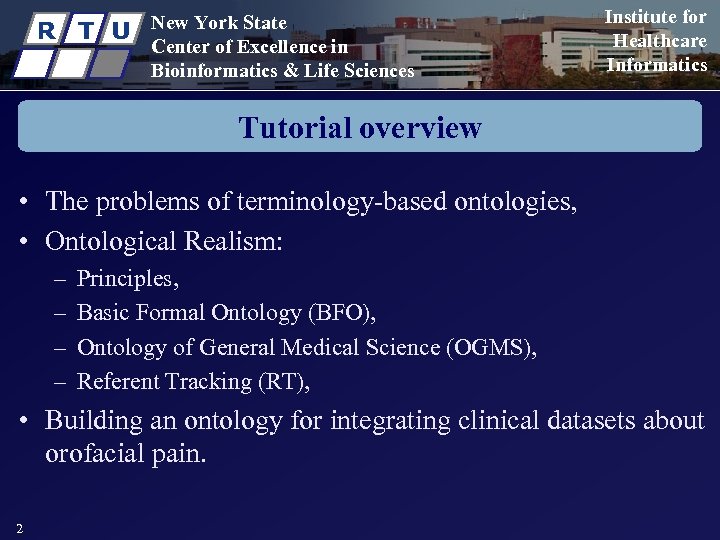 R T U New York State Center of Excellence in Bioinformatics & Life Sciences Institute for Healthcare Informatics Tutorial overview • The problems of terminology-based ontologies, • Ontological Realism: – – Principles, Basic Formal Ontology (BFO), Ontology of General Medical Science (OGMS), Referent Tracking (RT), • Building an ontology for integrating clinical datasets about orofacial pain. 2
 R T U New York State Center of Excellence in Bioinformatics & Life Sciences Why this tutorial, this way ? Institute for Healthcare Informatics
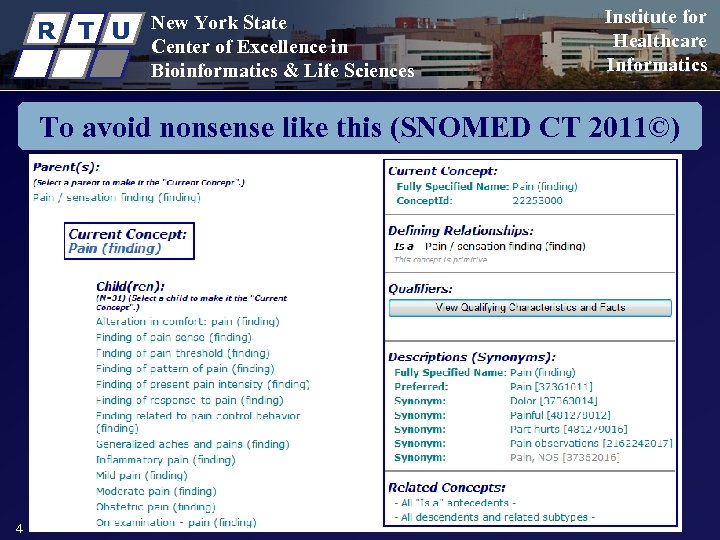 R T U New York State Center of Excellence in Bioinformatics & Life Sciences Institute for Healthcare Informatics To avoid nonsense like this (SNOMED CT 2011©) 4
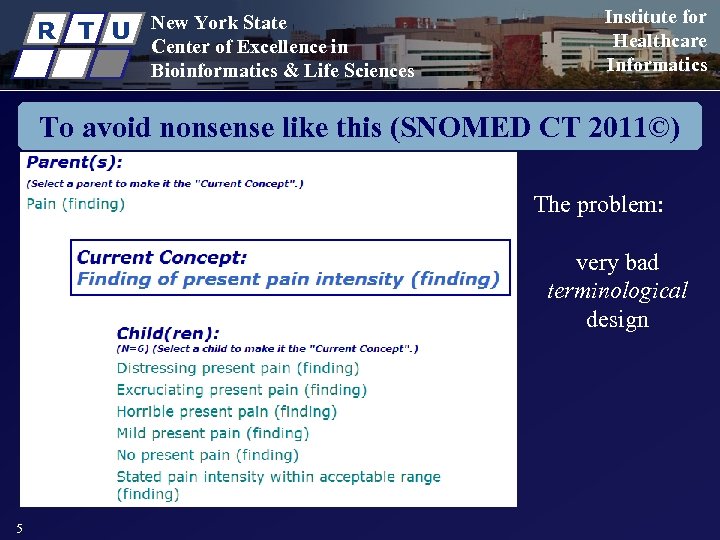 R T U New York State Center of Excellence in Bioinformatics & Life Sciences Institute for Healthcare Informatics To avoid nonsense like this (SNOMED CT 2011©) The problem: very bad terminological design 5
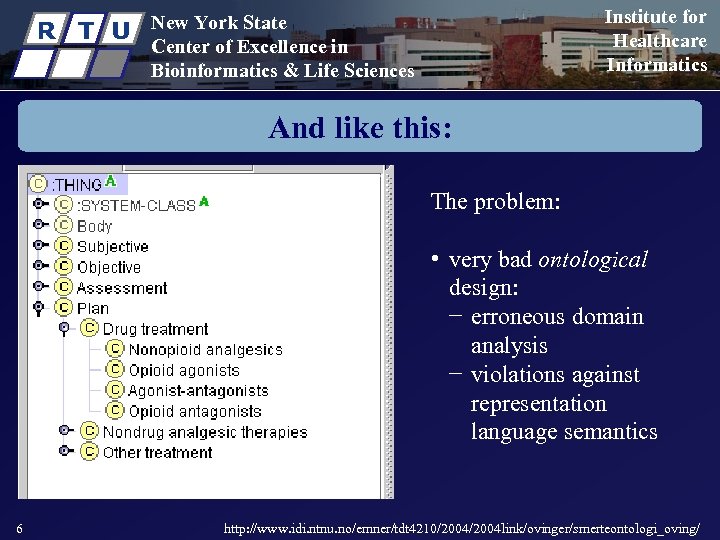 R T U Institute for Healthcare Informatics New York State Center of Excellence in Bioinformatics & Life Sciences And like this: The problem: • very bad ontological design: − erroneous domain analysis − violations against representation language semantics 6 http: //www. idi. ntnu. no/emner/tdt 4210/2004 link/ovinger/smerteontologi_oving/
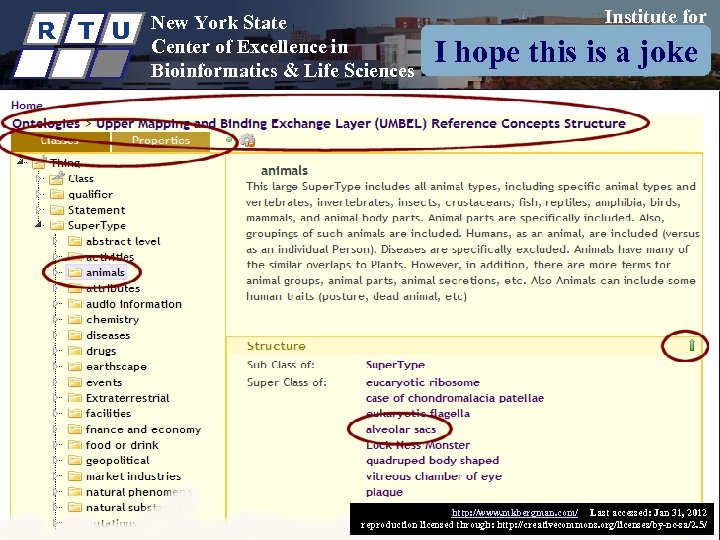 R T U 7 New York State Center of Excellence in Bioinformatics & Life Sciences Institute for Healthcare Informatics I hope this is a joke http: //www. mkbergman. com/ Last accessed: Jan 31, 2012 reproduction licensed through: http: //creativecommons. org/licenses/by-nc-sa/2. 5/
 R T U New York State Center of Excellence in Bioinformatics & Life Sciences Institute for Healthcare Informatics Part 1 The problems of terminology-based ontologies
 R T U New York State Center of Excellence in Bioinformatics & Life Sciences Institute for Healthcare Informatics Language is ambiguous • ‘I know that you believe that you understood what you think I said, but I am not sure you realize that what you heard is not what I meant. ’ – Robert Mc. Closkey, State Department spokesman (attributed). • http: //www. quotationspage. com/quotes/Robert_Mc. Closkey/
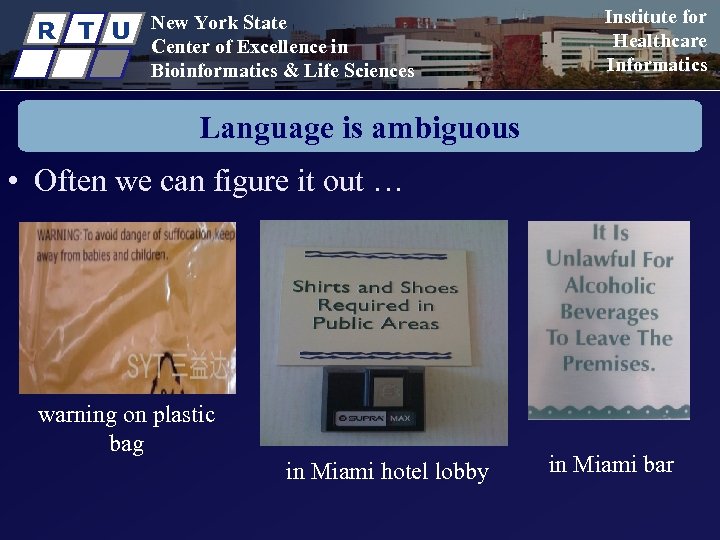 R T U New York State Center of Excellence in Bioinformatics & Life Sciences Institute for Healthcare Informatics Language is ambiguous • Often we can figure it out … warning on plastic bag in Miami hotel lobby in Miami bar
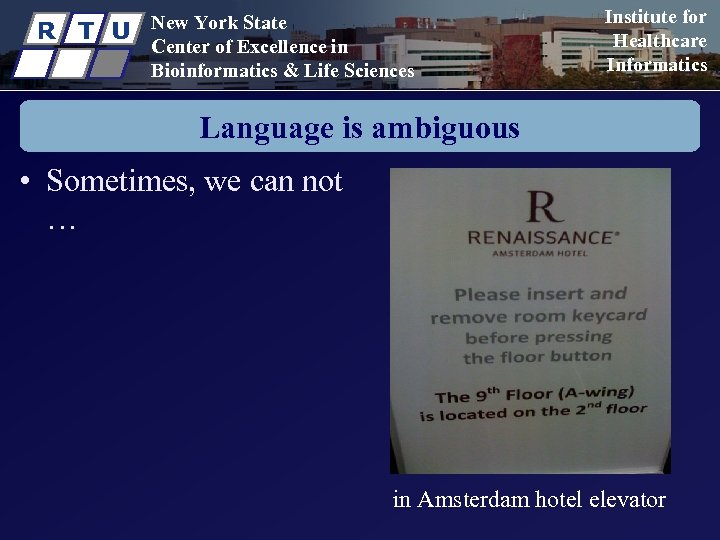 R T U New York State Center of Excellence in Bioinformatics & Life Sciences Institute for Healthcare Informatics Language is ambiguous • Sometimes, we can not … in Amsterdam hotel elevator
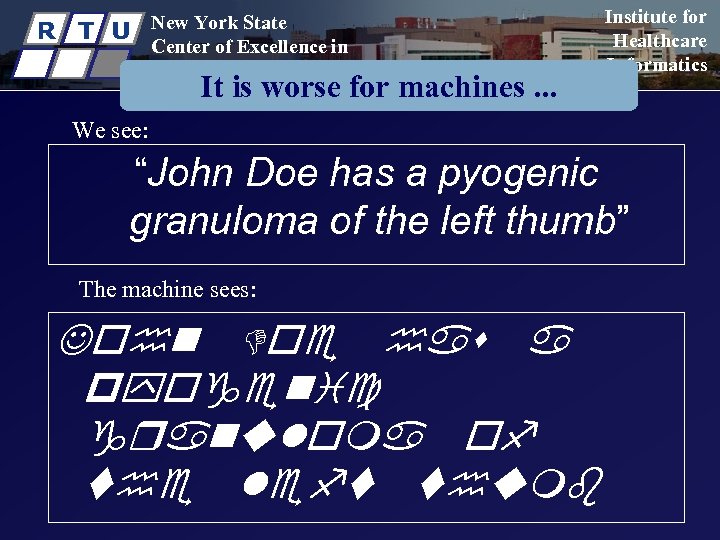 R T U New York State Center of Excellence in Bioinformatics & Life Sciences It is worse for machines. . . Institute for Healthcare Informatics We see: “John Doe has a pyogenic granuloma of the left thumb” The machine sees: John Doe has a pyogenic granuloma of the left thumb
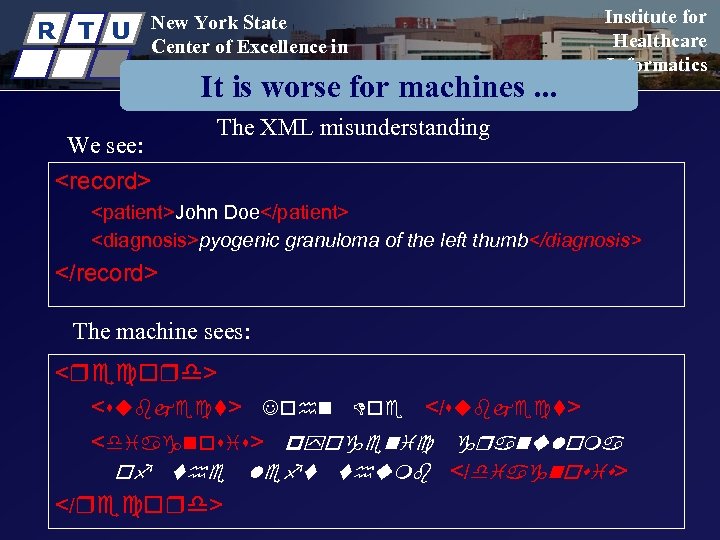 R T U New York State Center of Excellence in Bioinformatics & Life Sciences It is worse for machines. . . We see: Institute for Healthcare Informatics The XML misunderstanding
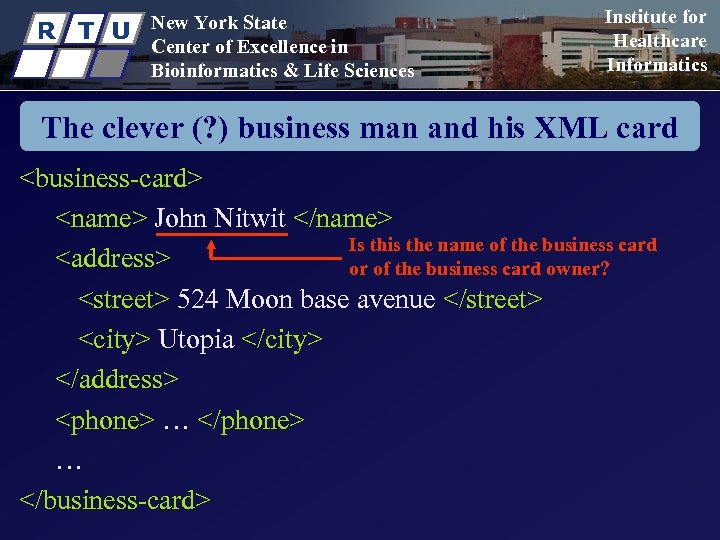 R T U New York State Center of Excellence in Bioinformatics & Life Sciences Institute for Healthcare Informatics The clever (? ) business man and his XML card
 R T U New York State Center of Excellence in Bioinformatics & Life Sciences Institute for Healthcare Informatics Intermediate conclusion • We need for sure methods and techniques that allow: – people to express exactly what they mean, – people to understand exactly what is communicated to them, – machines to communicate information without any distortion. • If information overload is a problem, we also need methods and techniques that allow machines to understand exactly what is communicated to them.
 R T U New York State Center of Excellence in Bioinformatics & Life Sciences Institute for Healthcare Informatics Unfortunately … • Traditional terminology alone is not going to do the job, Not even when you express it (naively) in OWL !!! 16 (yes, I am shouting)
 R T U New York State Center of Excellence in Bioinformatics & Life Sciences Institute for Healthcare Informatics Why not: most terminologies are ‘concept’-based • But what the word ‘concept’ denotes, is usually not clarified and users of it often refer to different entities in a haphazard way: Smith B, Kusnierczyk W, Schober D, Ceusters W. Towards a Reference Terminology for Ontology Research and Development in the Biomedical Domain. Proceedings of KR-MED 2006, Biomedical Ontology in Action, November 8, 2006, Baltimore MD, USA
 R T U New York State Center of Excellence in Bioinformatics & Life Sciences Institute for Healthcare Informatics SNOMED about diseases and concepts (until 2010) • ‘Disorders are concepts in which there is an explicit or implicit pathological process causing a state of disease which tends to exist for a significant length of time under ordinary circumstances. ’ • And also: “Concepts are unique units of thought”. • Thus: Disorders are unique units of thoughts in which there is a pathological process …? ? ? • And thus: to eradicate all diseases in the world at once we simply should stop thinking ?
 R T U New York State Center of Excellence in Bioinformatics & Life Sciences Institute for Healthcare Informatics Most terminologies are ‘concept’-based • But what the word ‘concept’ denotes, is usually not clarified and users of it often refer to different entities in a haphazard way: • meaning shared in common by synonymous terms • idea shared in common in the minds of those who use these terms • unit of describing meanings knowledge • universal that what is shared by all and only all entities in reality of a similar sort Smith B, Kusnierczyk W, Schober D, Ceusters W. Towards a Reference Terminology for Ontology Research and Development in the Biomedical Domain. Proceedings of KR-MED 2006, Biomedical Ontology in Action, November 8, 2006, Baltimore MD, USA
 R T U New York State Center of Excellence in Bioinformatics & Life Sciences Institute for Healthcare Informatics Most terminologies are ‘concept’-based • But what the word ‘concept’ denotes, is usually not clarified and users of it often refer to different entities in a haphazard way, • the result being: chaos Smith B, Kusnierczyk W, Schober D, Ceusters W. Towards a Reference Terminology for Ontology Research and Development in the Biomedical Domain. Proceedings of KR-MED 2006, Biomedical Ontology in Action, November 8, 2006, Baltimore MD, USA
 R T U New York State Center of Excellence in Bioinformatics & Life Sciences Some examples Institute for Healthcare Informatics
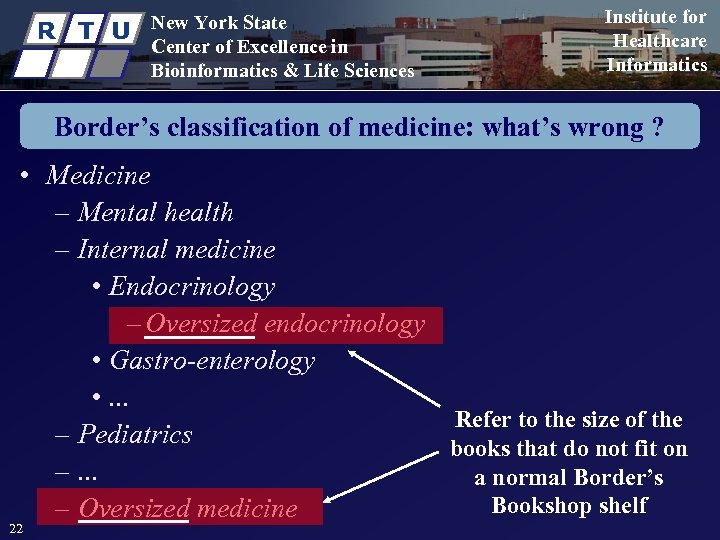 R T U New York State Center of Excellence in Bioinformatics & Life Sciences Institute for Healthcare Informatics Border’s classification of medicine: what’s wrong ? • Medicine – Mental health – Internal medicine • Endocrinology – Oversized endocrinology • Gastro-enterology • . . . Refer to the size of the – Pediatrics books that do not fit on –. . . a normal Border’s Bookshop shelf – Oversized medicine 22
 R T U New York State Center of Excellence in Bioinformatics & Life Sciences Institute for Healthcare Informatics Similar mistake in ICHD • ‘ 13. 1. 2. 4 Painful trigeminal neuropathy attributed to MS plaque’ • ‘attributed to’ relates to somebody’s opinion about what is the case, not to what is the case. – the mistake: a feature on the side of the clinician – his (not) knowing - is taken to be a feature on the side of the patient. • Similar mistakes: – ‘Probable migraine’ – ‘facial pain of unknown origin’ (not in ICHD). 23
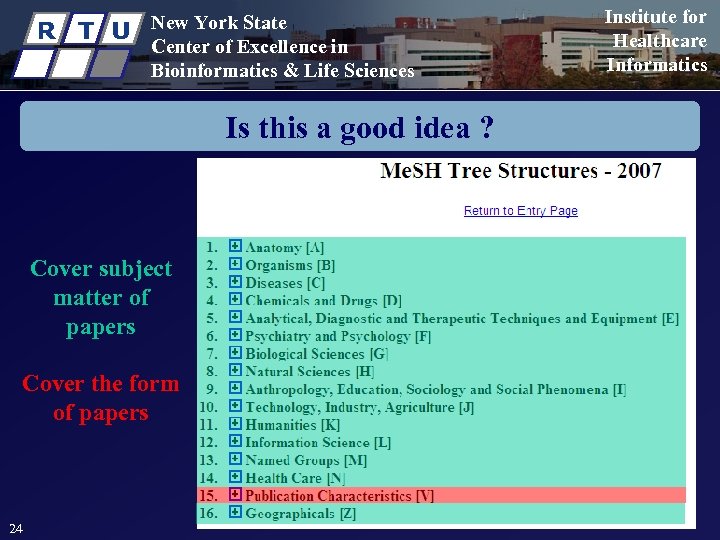 R T U New York State Center of Excellence in Bioinformatics & Life Sciences Is this a good idea ? Cover subject matter of papers Cover the form of papers 24 Institute for Healthcare Informatics
 R T U New York State Center of Excellence in Bioinformatics & Life Sciences Institute for Healthcare Informatics Principle • A representation should not mix object language and meta language – object language describes the referents in the subject domain – meta language describes the object language 25
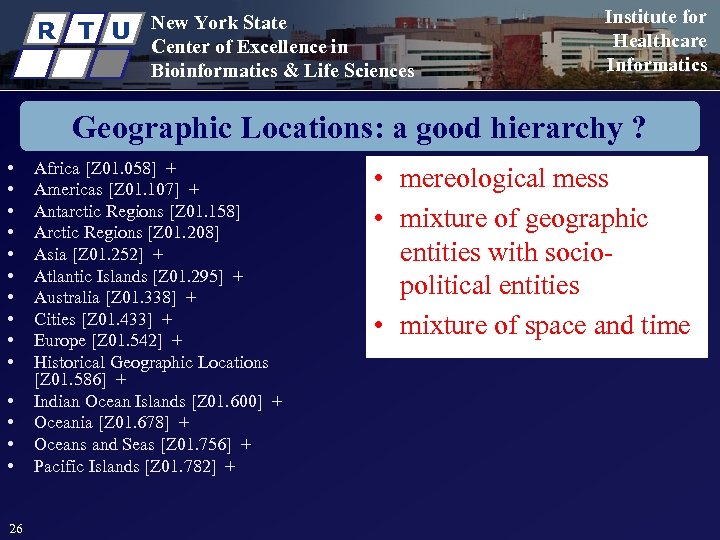 R T U New York State Center of Excellence in Bioinformatics & Life Sciences Institute for Healthcare Informatics Geographic Locations: a good hierarchy ? • • • • 26 Africa [Z 01. 058] + Americas [Z 01. 107] + Antarctic Regions [Z 01. 158] Arctic Regions [Z 01. 208] Asia [Z 01. 252] + Atlantic Islands [Z 01. 295] + Australia [Z 01. 338] + Cities [Z 01. 433] + Europe [Z 01. 542] + Historical Geographic Locations [Z 01. 586] + Indian Ocean Islands [Z 01. 600] + Oceania [Z 01. 678] + Oceans and Seas [Z 01. 756] + Pacific Islands [Z 01. 782] + • mereological mess • mixture of geographic entities with sociopolitical entities • mixture of space and time
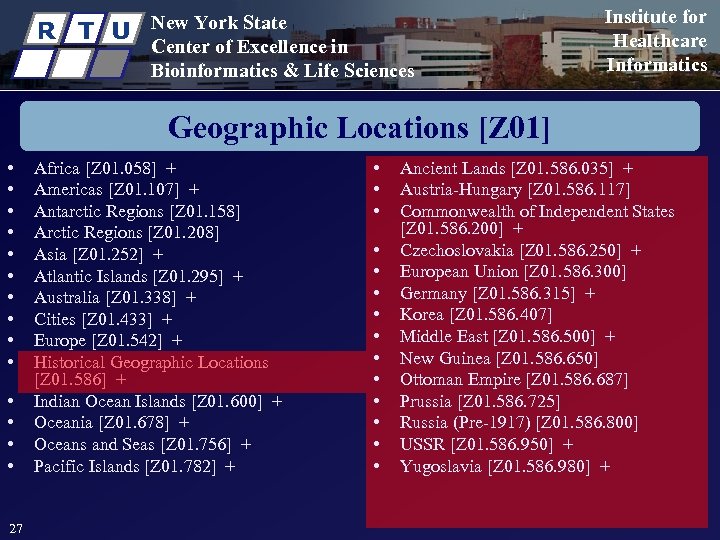 R T U New York State Center of Excellence in Bioinformatics & Life Sciences Institute for Healthcare Informatics Geographic Locations [Z 01] • • • • 27 Africa [Z 01. 058] + Americas [Z 01. 107] + Antarctic Regions [Z 01. 158] Arctic Regions [Z 01. 208] Asia [Z 01. 252] + Atlantic Islands [Z 01. 295] + Australia [Z 01. 338] + Cities [Z 01. 433] + Europe [Z 01. 542] + Historical Geographic Locations [Z 01. 586] + Indian Ocean Islands [Z 01. 600] + Oceania [Z 01. 678] + Oceans and Seas [Z 01. 756] + Pacific Islands [Z 01. 782] + • • • • Ancient Lands [Z 01. 586. 035] + Austria-Hungary [Z 01. 586. 117] Commonwealth of Independent States [Z 01. 586. 200] + Czechoslovakia [Z 01. 586. 250] + European Union [Z 01. 586. 300] Germany [Z 01. 586. 315] + Korea [Z 01. 586. 407] Middle East [Z 01. 586. 500] + New Guinea [Z 01. 586. 650] Ottoman Empire [Z 01. 586. 687] Prussia [Z 01. 586. 725] Russia (Pre-1917) [Z 01. 586. 800] USSR [Z 01. 586. 950] + Yugoslavia [Z 01. 586. 980] +
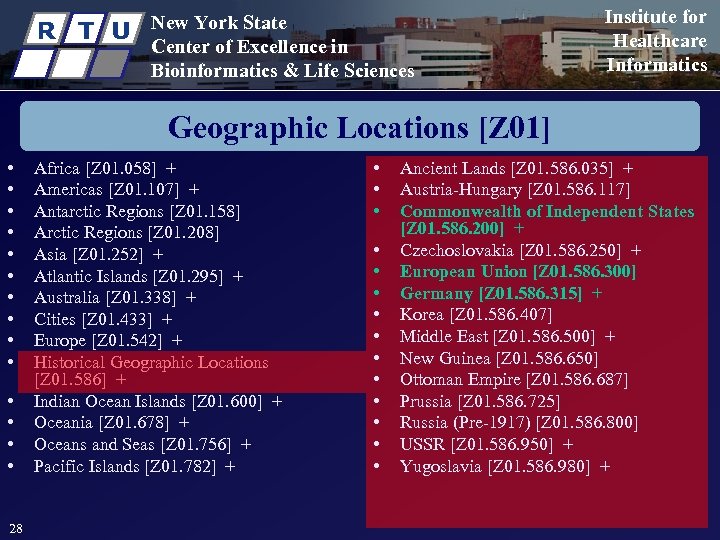 R T U New York State Center of Excellence in Bioinformatics & Life Sciences Institute for Healthcare Informatics Geographic Locations [Z 01] • • • • 28 Africa [Z 01. 058] + Americas [Z 01. 107] + Antarctic Regions [Z 01. 158] Arctic Regions [Z 01. 208] Asia [Z 01. 252] + Atlantic Islands [Z 01. 295] + Australia [Z 01. 338] + Cities [Z 01. 433] + Europe [Z 01. 542] + Historical Geographic Locations [Z 01. 586] + Indian Ocean Islands [Z 01. 600] + Oceania [Z 01. 678] + Oceans and Seas [Z 01. 756] + Pacific Islands [Z 01. 782] + • • • • Ancient Lands [Z 01. 586. 035] + Austria-Hungary [Z 01. 586. 117] Commonwealth of Independent States [Z 01. 586. 200] + Czechoslovakia [Z 01. 586. 250] + European Union [Z 01. 586. 300] Germany [Z 01. 586. 315] + Korea [Z 01. 586. 407] Middle East [Z 01. 586. 500] + New Guinea [Z 01. 586. 650] Ottoman Empire [Z 01. 586. 687] Prussia [Z 01. 586. 725] Russia (Pre-1917) [Z 01. 586. 800] USSR [Z 01. 586. 950] + Yugoslavia [Z 01. 586. 980] +
 R T U New York State Center of Excellence in Bioinformatics & Life Sciences Institute for Healthcare Informatics Principle • A hierarchical structure should not represent distinct hierarchical relations unless they are formally characterized 29
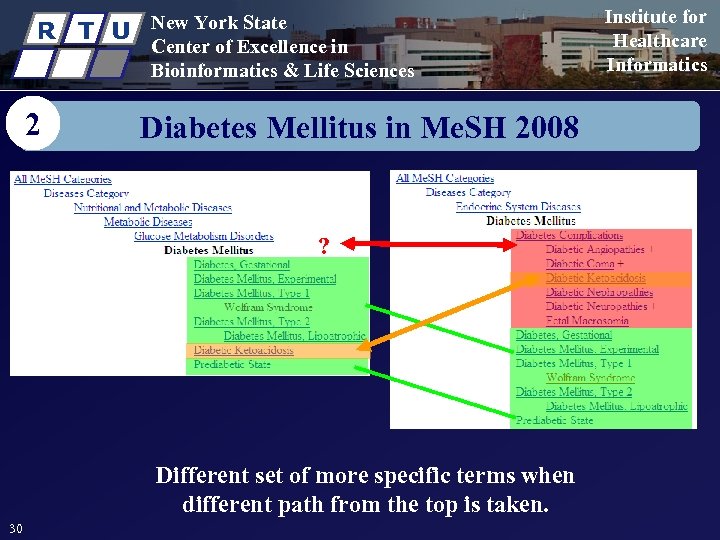 R T U 2 New York State Center of Excellence in Bioinformatics & Life Sciences Diabetes Mellitus in Me. SH 2008 ? Different set of more specific terms when different path from the top is taken. 30 Institute for Healthcare Informatics
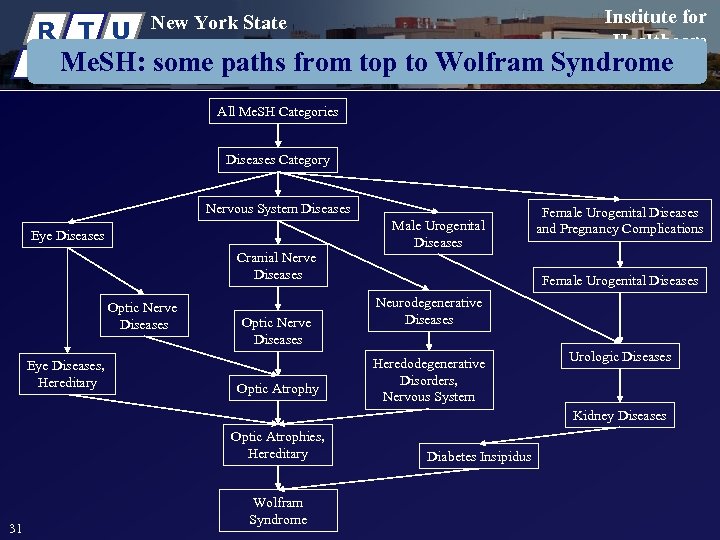 R T U New York State Center of Excellence in Me. SH: Bioinformatics & Life Sciences some paths from top to Wolfram Institute for Healthcare Informatics Syndrome All Me. SH Categories Diseases Category Nervous System Diseases Eye Diseases Cranial Nerve Diseases Optic Nerve Diseases Eye Diseases, Hereditary Optic Nerve Diseases Optic Atrophy Male Urogenital Diseases Female Urogenital Diseases and Pregnancy Complications Female Urogenital Diseases Neurodegenerative Diseases Heredodegenerative Disorders, Nervous System Urologic Diseases Kidney Diseases Optic Atrophies, Hereditary 31 Wolfram Syndrome Diabetes Insipidus
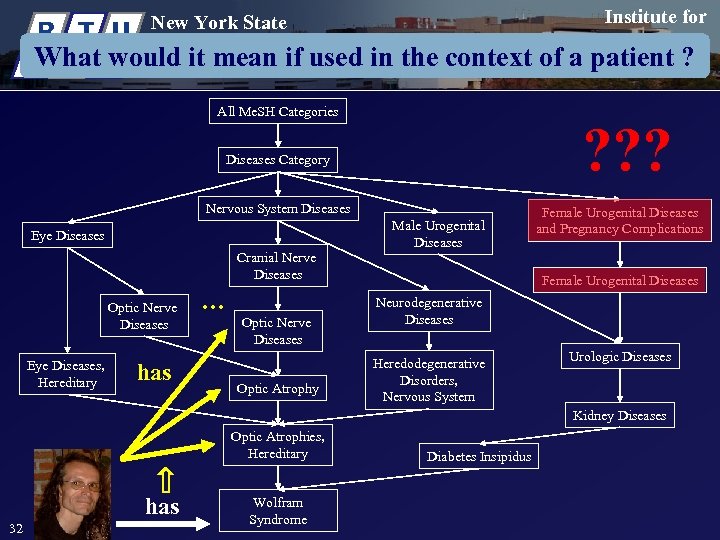 R T What U New York State Center of Excellence in would it mean & Life Sciences if used in the Bioinformatics context of a All Me. SH Categories ? ? ? Diseases Category Nervous System Diseases Eye Diseases Cranial Nerve Diseases Optic Nerve Diseases Eye Diseases, Hereditary has … Optic Nerve Diseases Optic Atrophy Institute for Healthcare patient ? Informatics Male Urogenital Diseases Female Urogenital Diseases and Pregnancy Complications Female Urogenital Diseases Neurodegenerative Diseases Heredodegenerative Disorders, Nervous System Urologic Diseases Kidney Diseases Optic Atrophies, Hereditary has 32 Wolfram Syndrome Diabetes Insipidus
 R T U New York State Center of Excellence in Bioinformatics & Life Sciences Institute for Healthcare Informatics Principle • If a particular (individual) is related in a specific way to a ‘class’, it should also be related in the same way to all the ‘superclasses’ of that class – Technically: “… to all the classes that subsume that class” 33
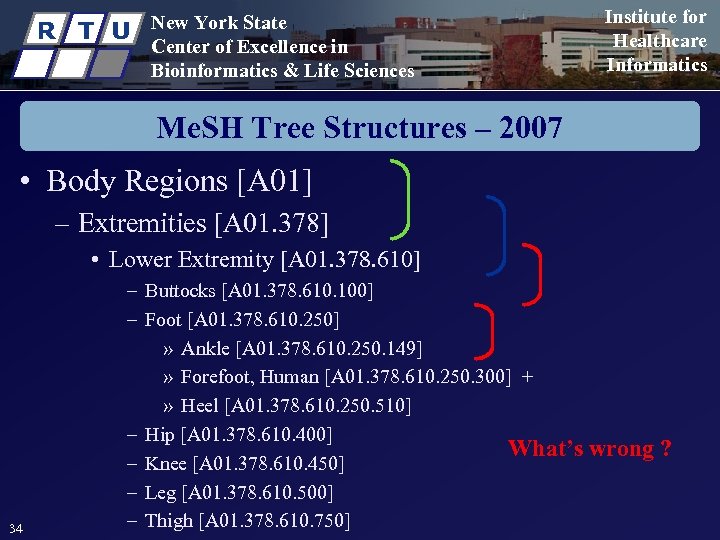 R T U New York State Center of Excellence in Bioinformatics & Life Sciences Institute for Healthcare Informatics Me. SH Tree Structures – 2007 • Body Regions [A 01] – Extremities [A 01. 378] • Lower Extremity [A 01. 378. 610] 34 – Buttocks [A 01. 378. 610. 100] – Foot [A 01. 378. 610. 250] » Ankle [A 01. 378. 610. 250. 149] » Forefoot, Human [A 01. 378. 610. 250. 300] + » Heel [A 01. 378. 610. 250. 510] – Hip [A 01. 378. 610. 400] What’s wrong ? – Knee [A 01. 378. 610. 450] – Leg [A 01. 378. 610. 500] – Thigh [A 01. 378. 610. 750]
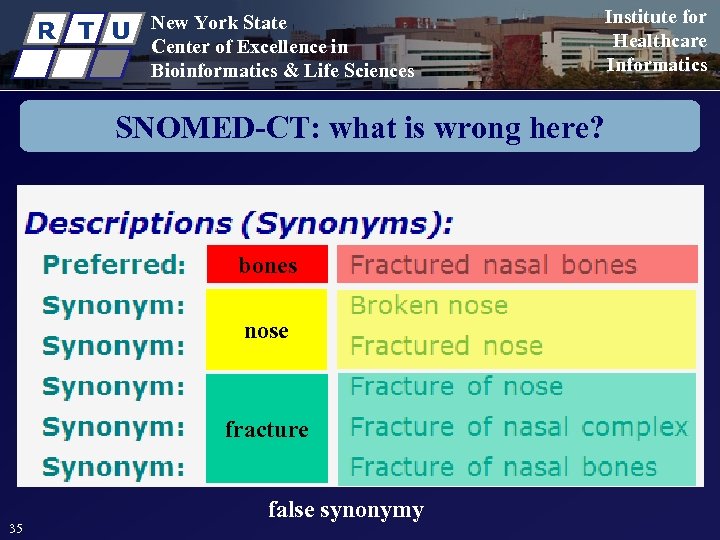 R T U New York State Center of Excellence in Bioinformatics & Life Sciences Institute for Healthcare Informatics SNOMED-CT: what is wrong here? bones nose fracture 35 false synonymy
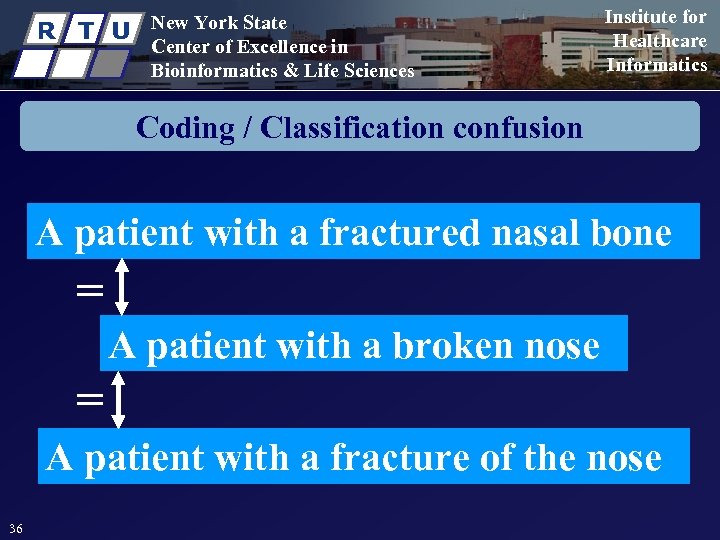 R T U New York State Center of Excellence in Bioinformatics & Life Sciences Institute for Healthcare Informatics Coding / Classification confusion A patient with a fractured nasal bone = A patient with a broken nose = A patient with a fracture of the nose 36
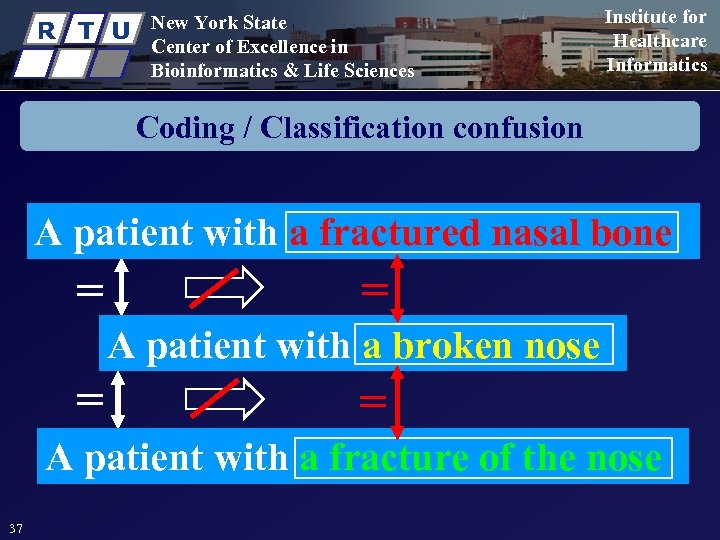 R T U New York State Center of Excellence in Bioinformatics & Life Sciences Institute for Healthcare Informatics Coding / Classification confusion A patient with a fractured nasal bone = = A patient with a broken nose = = A patient with a fracture of the nose 37
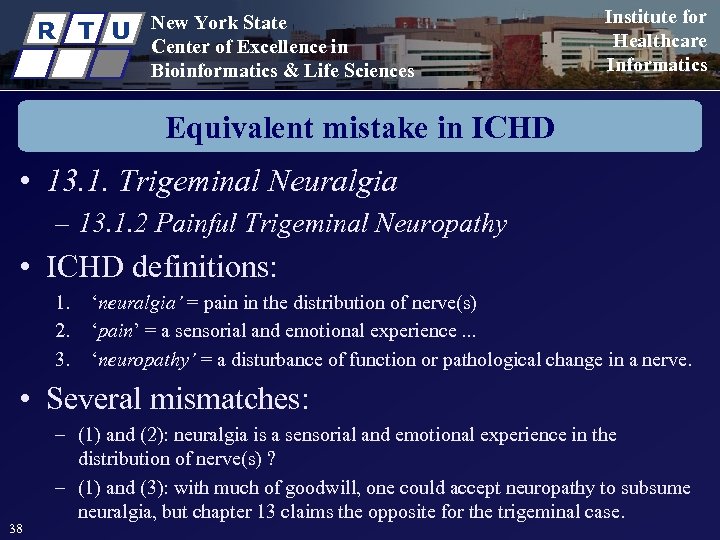 R T U New York State Center of Excellence in Bioinformatics & Life Sciences Institute for Healthcare Informatics Equivalent mistake in ICHD • 13. 1. Trigeminal Neuralgia – 13. 1. 2 Painful Trigeminal Neuropathy • ICHD definitions: 1. 2. 3. ‘neuralgia’ = pain in the distribution of nerve(s) ‘pain’ = a sensorial and emotional experience. . . ‘neuropathy’ = a disturbance of function or pathological change in a nerve. • Several mismatches: 38 – (1) and (2): neuralgia is a sensorial and emotional experience in the distribution of nerve(s) ? – (1) and (3): with much of goodwill, one could accept neuropathy to subsume neuralgia, but chapter 13 claims the opposite for the trigeminal case.
 R T U New York State Center of Excellence in Bioinformatics & Life Sciences Summary of Part 1 Institute for Healthcare Informatics
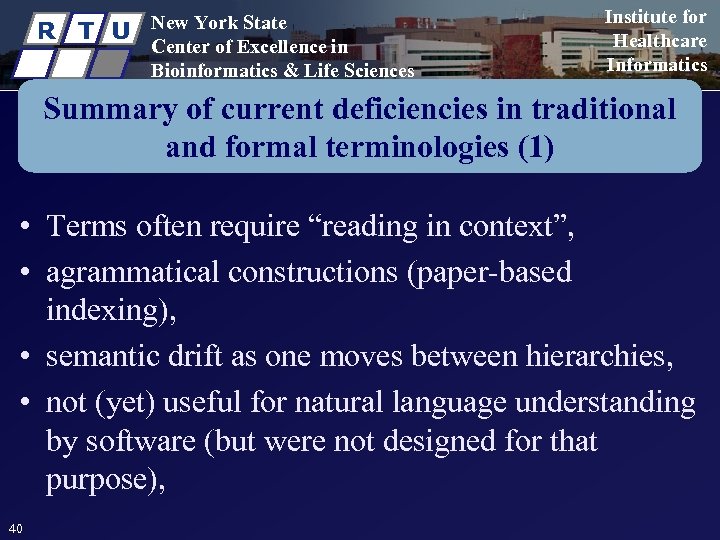 R T U New York State Center of Excellence in Bioinformatics & Life Sciences Institute for Healthcare Informatics Summary of current deficiencies in traditional and formal terminologies (1) • Terms often require “reading in context”, • agrammatical constructions (paper-based indexing), • semantic drift as one moves between hierarchies, • not (yet) useful for natural language understanding by software (but were not designed for that purpose), 40
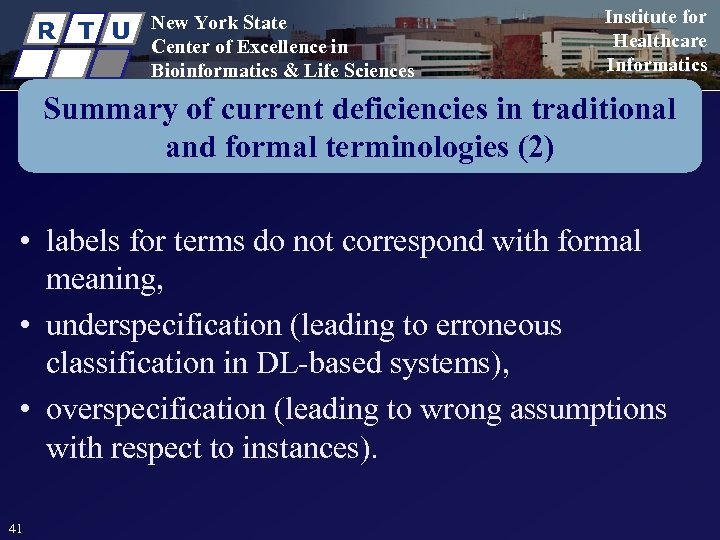 R T U New York State Center of Excellence in Bioinformatics & Life Sciences Institute for Healthcare Informatics Summary of current deficiencies in traditional and formal terminologies (2) • labels for terms do not correspond with formal meaning, • underspecification (leading to erroneous classification in DL-based systems), • overspecification (leading to wrong assumptions with respect to instances). 41
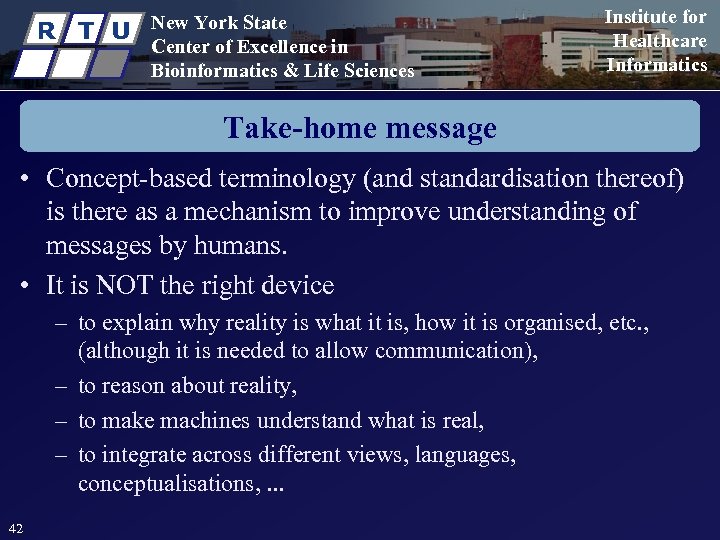 R T U New York State Center of Excellence in Bioinformatics & Life Sciences Institute for Healthcare Informatics Take-home message • Concept-based terminology (and standardisation thereof) is there as a mechanism to improve understanding of messages by humans. • It is NOT the right device – to explain why reality is what it is, how it is organised, etc. , (although it is needed to allow communication), – to reason about reality, – to make machines understand what is real, – to integrate across different views, languages, conceptualisations, . . . 42
 R T U New York State Center of Excellence in Bioinformatics & Life Sciences Institute for Healthcare Informatics Principles of Ontological Realism
 R T U New York State Center of Excellence in Bioinformatics & Life Sciences Institute for Healthcare Informatics ‘Ontology’ • In philosophy: – Ontology (no plural) is the study of what entities exist and how they relate to each other;
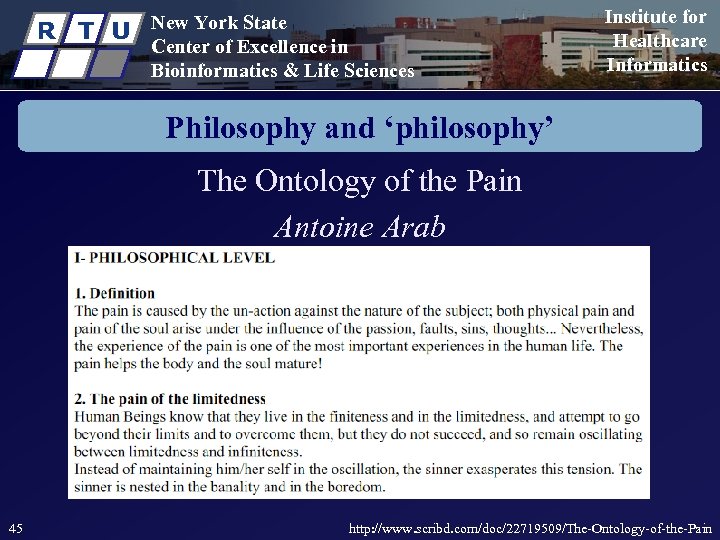 R T U New York State Center of Excellence in Bioinformatics & Life Sciences Institute for Healthcare Informatics Philosophy and ‘philosophy’ The Ontology of the Pain Antoine Arab 45 http: //www. scribd. com/doc/22719509/The-Ontology-of-the-Pain
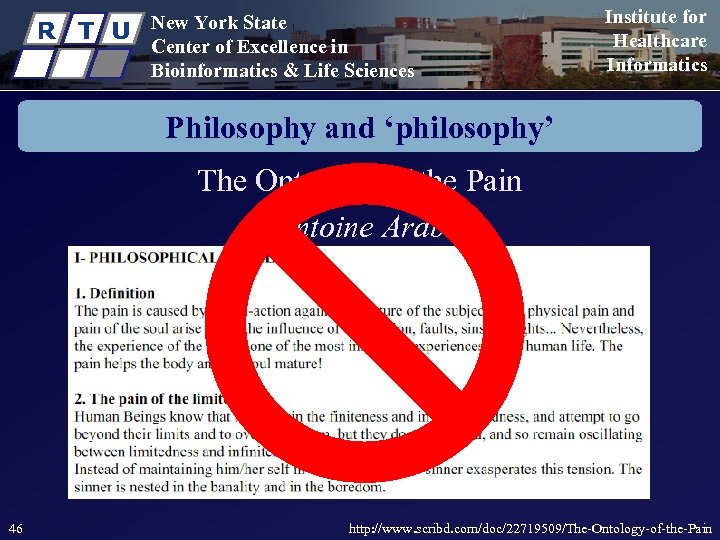 R T U New York State Center of Excellence in Bioinformatics & Life Sciences Institute for Healthcare Informatics Philosophy and ‘philosophy’ The Ontology of the Pain Antoine Arab 46 http: //www. scribd. com/doc/22719509/The-Ontology-of-the-Pain
 R T U New York State Center of Excellence in Bioinformatics & Life Sciences Institute for Healthcare Informatics ‘Ontology’ • In philosophy: – Ontology (no plural) is the study of what entities exist and how they relate to each other; – by some philosophers taken to be synonymous with ‘metaphysics’ while others draw distinctions in many distinct ways (the distinctions being irrelevant for this talk) , but almost agreeing on the following classification: • metaphysics studies ‘how is the world? ’ – general metaphysics studies general principles and ‘laws’ about the world » ontology studies what type of entities exist in the world – special metaphysics focuses on specific principles and entities – distinct from ‘epistemology’ which is the study of how we can come to know about what exists. – distinct from ‘terminology’ which is the study of what terms mean and how to name things.
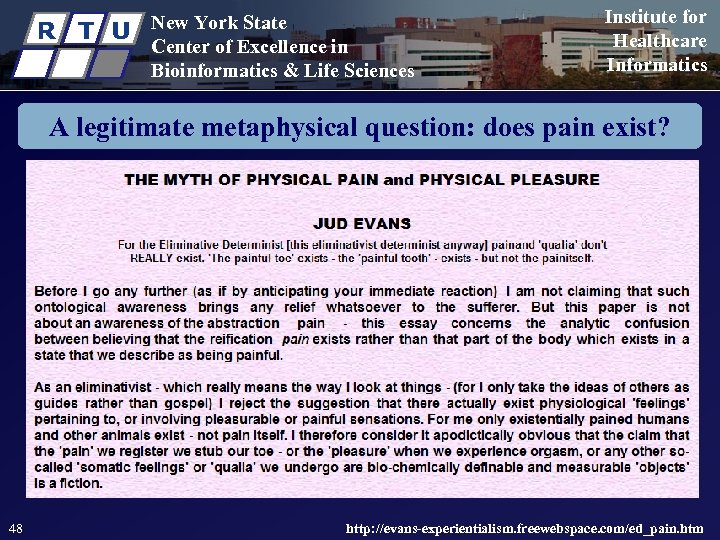 R T U New York State Center of Excellence in Bioinformatics & Life Sciences Institute for Healthcare Informatics A legitimate metaphysical question: does pain exist? 48 http: //evans-experientialism. freewebspace. com/ed_pain. htm
 R T U New York State Center of Excellence in Bioinformatics & Life Sciences Institute for Healthcare Informatics Metaphysics, ontology and pain • A metaphysical account of pain: – determining the nature of pain, • identifying what all pains have in common in virtue of which they are pains. • An ontological account of pain: – determining the ontological commitments acquired by countenancing pains in one's theory. • e. g. : whether one's theory of pain entails the existence of anything immaterial is not a metaphysical question but rather an ontological one. Guillermo Hurtado and Oscar Nudler (eds. ), The Furniture of the World: Essays in Ontology and Metaphysics, Rodopi, 2012, 336 pp. , $94. 50 (pbk), ISBN 9789042035034.
 R T U New York State Center of Excellence in Bioinformatics & Life Sciences Institute for Healthcare Informatics Metaphysics, ontology and pain • These two questions are independent: – a functionalist (#1) about pain may reject any ontological commitment to immaterial things, • aligned with physicalism rather than dualism on the ontological question. – #1 may disagree with both metaphysicalism and dualism about the nature of pain. • to account for what all pains have in common qua pains: – the functionalist would invoke a certain common functional role – the physicalist would invoke something physical – the dualist something immaterial. Guillermo Hurtado and Oscar Nudler (eds. ), The Furniture of the World: Essays in Ontology and Metaphysics, Rodopi, 2012, 336 pp. , $94. 50 (pbk), ISBN 9789042035034.
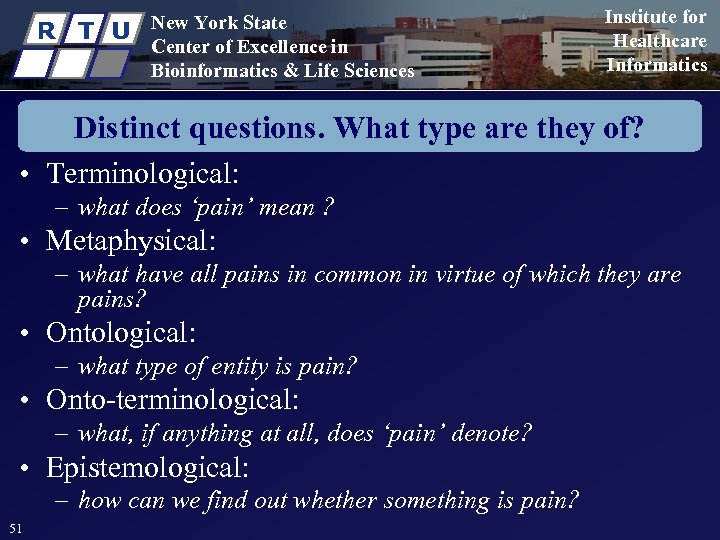 R T U New York State Center of Excellence in Bioinformatics & Life Sciences Institute for Healthcare Informatics Distinct questions. What type are they of? • Terminological: – what does ‘pain’ mean ? • Metaphysical: – what have all pains in common in virtue of which they are pains? • Ontological: – what type of entity is pain? • Onto-terminological: – what, if anything at all, does ‘pain’ denote? • Epistemological: – how can we find out whether something is pain? 51
 R T U New York State Center of Excellence in Bioinformatics & Life Sciences Institute for Healthcare Informatics Unfortunately, ‘ontology’ denotes ambiguously • In philosophy: – Ontology (no plural) is the study of what entities exist and how they relate to each other; • In computer science and many biomedical informatics applications: – An ontology (plural: ontologies) is a shared and agreed upon conceptualization of a domain;
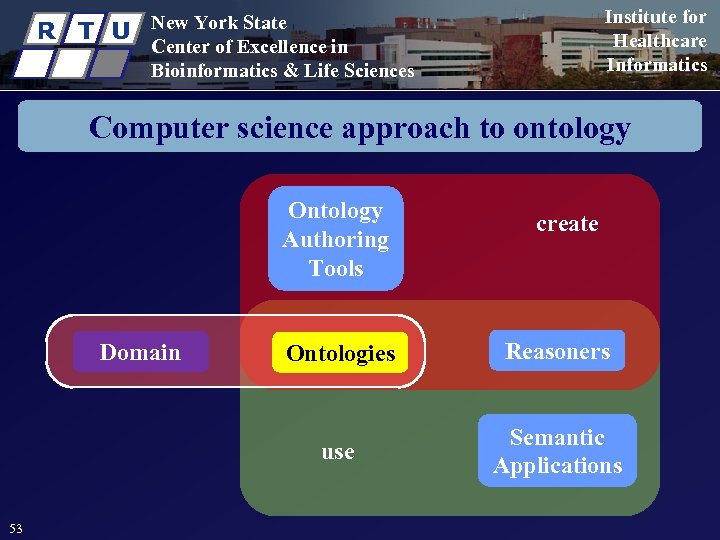 R T U Institute for Healthcare Informatics New York State Center of Excellence in Bioinformatics & Life Sciences Computer science approach to ontology Ontology Authoring Tools create 53 Ontologies Reasoners use Domain Semantic Applications
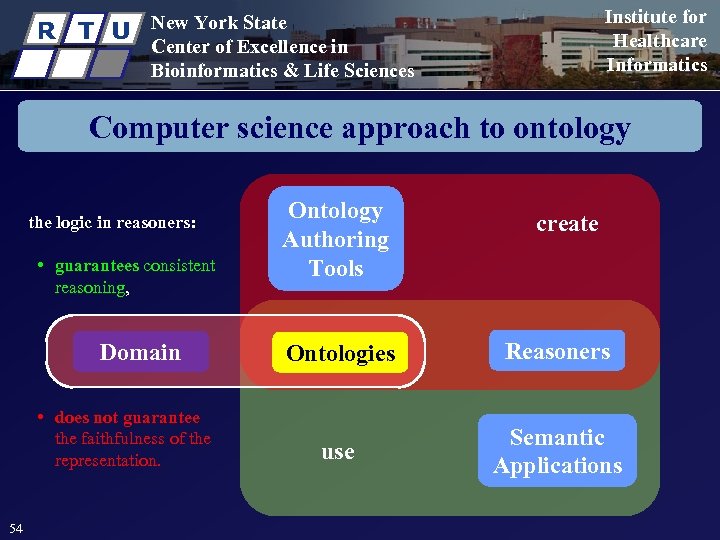 R T U Institute for Healthcare Informatics New York State Center of Excellence in Bioinformatics & Life Sciences Computer science approach to ontology the logic in reasoners: • guarantees consistent reasoning, Domain • does not guarantee the faithfulness of the representation. 54 Ontology Authoring Tools create Ontologies Reasoners use Semantic Applications
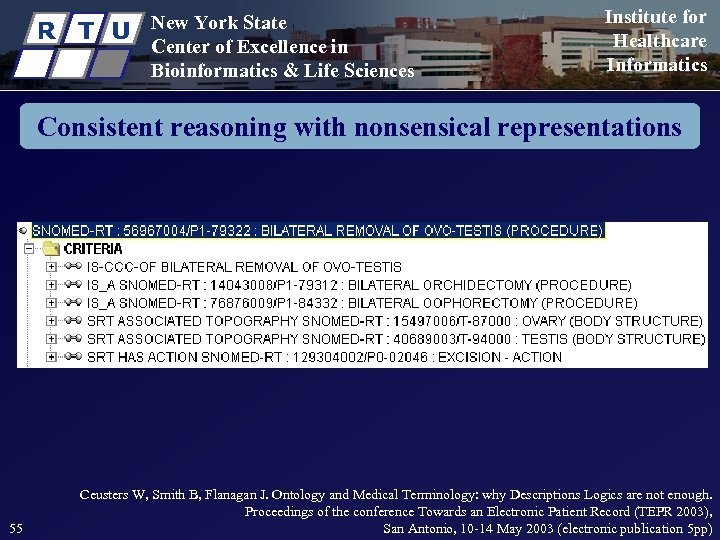 R T U New York State Center of Excellence in Bioinformatics & Life Sciences Institute for Healthcare Informatics Consistent reasoning with nonsensical representations 55 Ceusters W, Smith B, Flanagan J. Ontology and Medical Terminology: why Descriptions Logics are not enough. Proceedings of the conference Towards an Electronic Patient Record (TEPR 2003), San Antonio, 10 -14 May 2003 (electronic publication 5 pp)
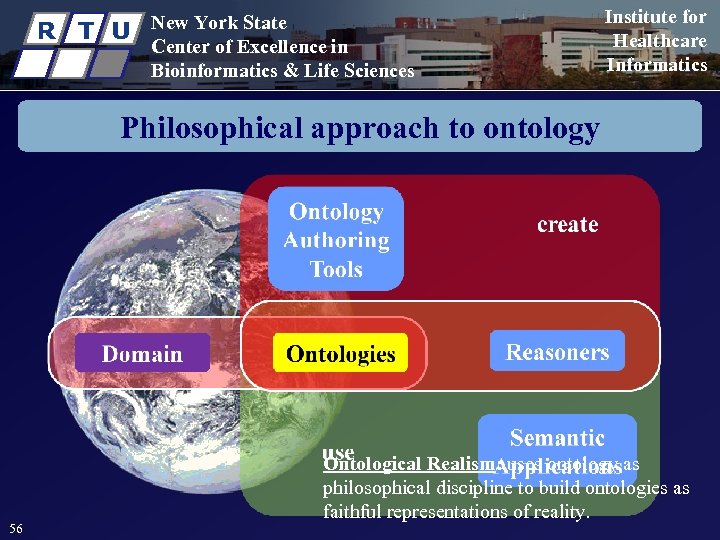 R T U New York State Center of Excellence in Bioinformatics & Life Sciences Institute for Healthcare Informatics Philosophical approach to ontology 56 Ontological Realism: uses ontology as philosophical discipline to build ontologies as faithful representations of reality.
 R T U New York State Center of Excellence in Bioinformatics & Life Sciences Institute for Healthcare Informatics
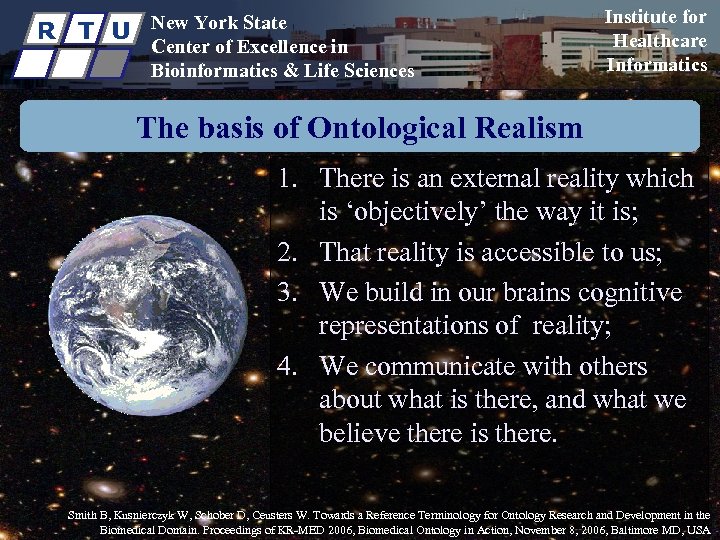 R T U New York State Center of Excellence in Bioinformatics & Life Sciences Institute for Healthcare Informatics The basis of Ontological Realism 1. There is an external reality which is ‘objectively’ the way it is; 2. That reality is accessible to us; 3. We build in our brains cognitive representations of reality; 4. We communicate with others about what is there, and what we believe there is there. Smith B, Kusnierczyk W, Schober D, Ceusters W. Towards a Reference Terminology for Ontology Research and Development in the Biomedical Domain. Proceedings of KR-MED 2006, Biomedical Ontology in Action, November 8, 2006, Baltimore MD, USA
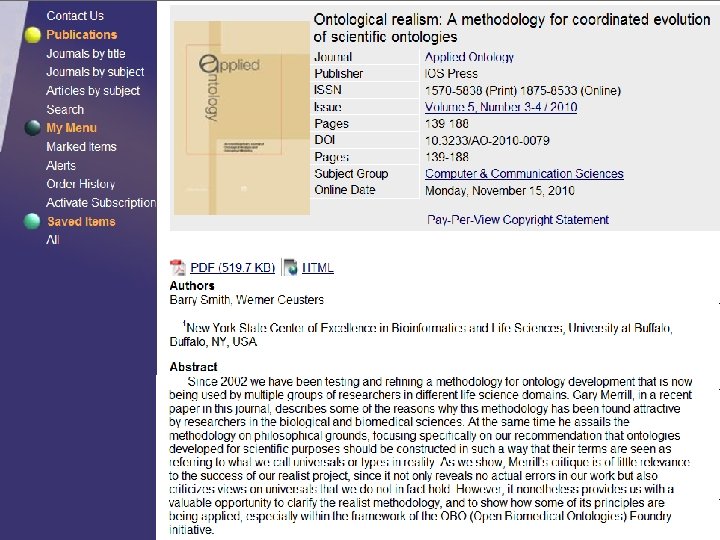
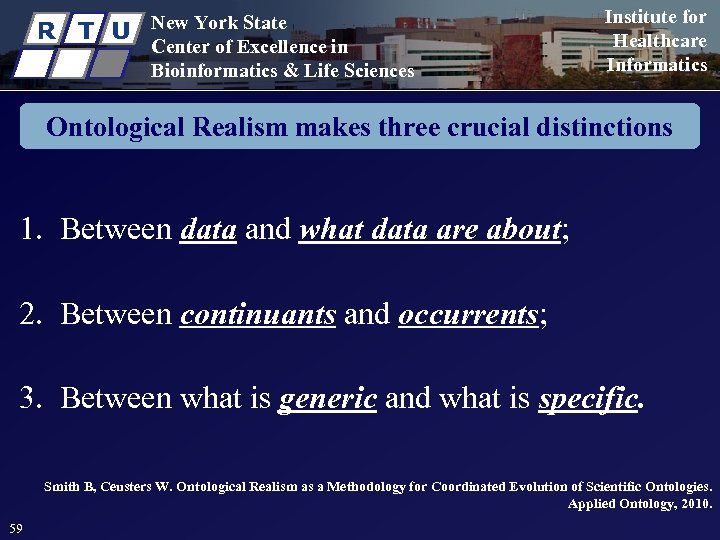 R T U New York State Center of Excellence in Bioinformatics & Life Sciences Institute for Healthcare Informatics Ontological Realism makes three crucial distinctions 1. Between data and what data are about; 2. Between continuants and occurrents; 3. Between what is generic and what is specific. Smith B, Ceusters W. Ontological Realism as a Methodology for Coordinated Evolution of Scientific Ontologies. Applied Ontology, 2010. 59
 R T U 60 New York State Center of Excellence in Bioinformatics & Life Sciences Institute for Healthcare Informatics
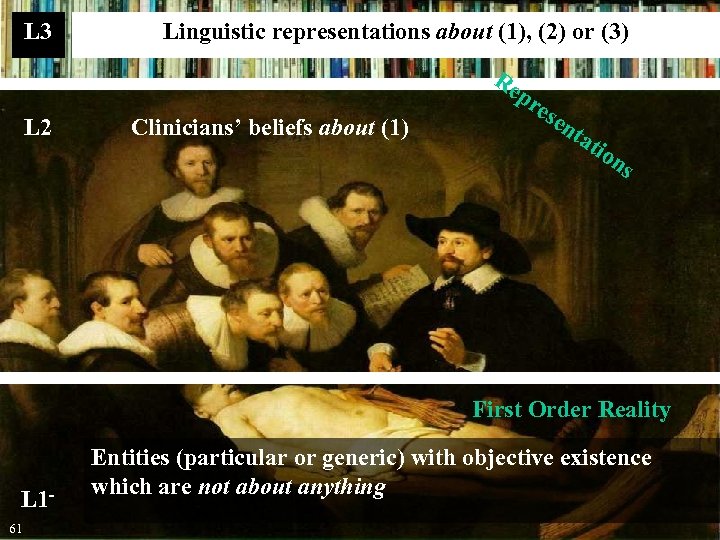 L 3 T U R L 2 New York State Linguistic representations Center of Excellence in Bioinformatics & Life Sciences Clinicians’ beliefs about (1), (2) or Institute for (3) Healthcare Informatics Re pr ese nt ati on s First Order Reality L 161 Entities (particular or generic) with objective existence which are not about anything
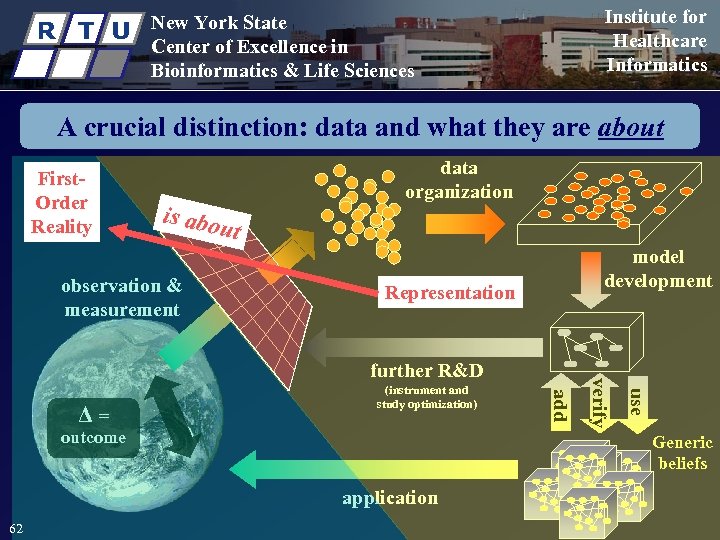 R T U Institute for Healthcare Informatics New York State Center of Excellence in Bioinformatics & Life Sciences A crucial distinction: data and what they are about First. Order Reality is abo ut observation & measurement data organization model development Representation Generic beliefs application 62 use outcome add Δ= (instrument and study optimization) verify further R&D
 R T U New York State Center of Excellence in Bioinformatics & Life Sciences Institute for Healthcare Informatics Mixing L 1 - and L 3 • ‘ 13. 1. 2. 4 Painful Trigeminal neuropathy attributed to MS plaque’: – described as ‘Trigeminal neuropathy induced by MS plaque’. • attributed induced • reference to pain missing in the description 63
 R T U New York State Center of Excellence in Bioinformatics & Life Sciences Institute for Healthcare Informatics L 1 - / L 3 and IASP definition of pain • IASP definition for ‘pain’: – ‘an unpleasant sensory and emotional experience associated with actual or potential tissue damage, or described in terms of such damage’; • what asserts: – a common phenomenology (‘unpleasant sensory and emotional experience’) to all instances of pain, – the recognition of three distinct subtypes of pain involving, respectively: 1. actual tissue damage, 2. what is called ‘potential tissue damage’, and 3. a description involving reference to tissue damage whether or not there is such damage.
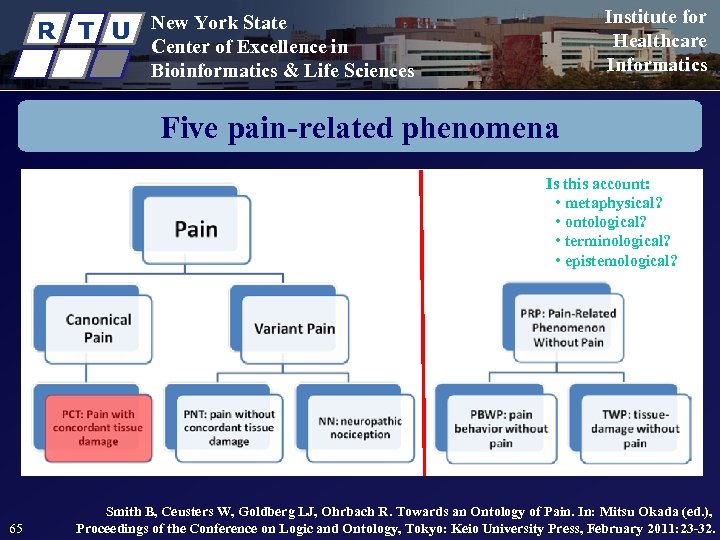 R T U Institute for Healthcare Informatics New York State Center of Excellence in Bioinformatics & Life Sciences Five pain-related phenomena Is this account: • metaphysical? • ontological? • terminological? • epistemological? 65 Smith B, Ceusters W, Goldberg LJ, Ohrbach R. Towards an Ontology of Pain. In: Mitsu Okada (ed. ), Proceedings of the Conference on Logic and Ontology, Tokyo: Keio University Press, February 2011: 23 -32.
 R T U New York State Center of Excellence in Bioinformatics & Life Sciences Institute for Healthcare Informatics Ontological Realism makes crucial distinctions • Between data and what data are about; • Between continuants and occurrents: – obvious differences: • a person versus his life • a disease versus its course • space versus time – more subtle differences: • observation (data-element) versus observing • diagnosis versus making a diagnosis • message versus transmitting a message 66
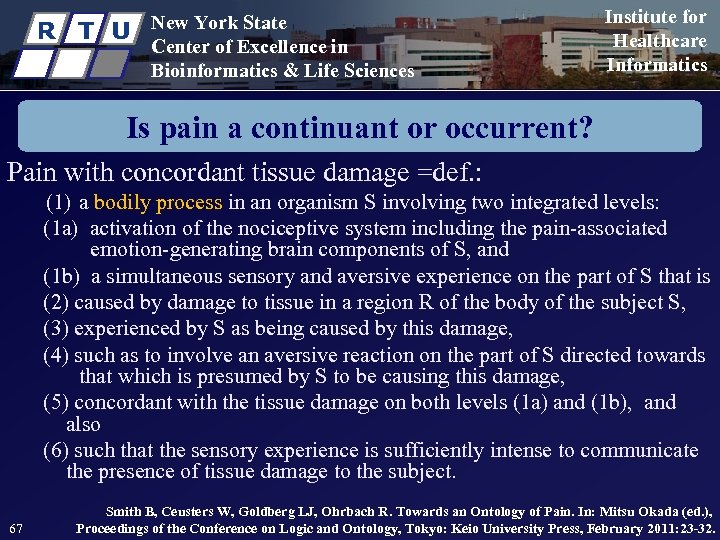 R T U New York State Center of Excellence in Bioinformatics & Life Sciences Institute for Healthcare Informatics Is pain a continuant or occurrent? Pain with concordant tissue damage =def. : (1) a bodily process in an organism S involving two integrated levels: (1 a) activation of the nociceptive system including the pain-associated emotion-generating brain components of S, and (1 b) a simultaneous sensory and aversive experience on the part of S that is (2) caused by damage to tissue in a region R of the body of the subject S, (3) experienced by S as being caused by this damage, (4) such as to involve an aversive reaction on the part of S directed towards that which is presumed by S to be causing this damage, (5) concordant with the tissue damage on both levels (1 a) and (1 b), and also (6) such that the sensory experience is sufficiently intense to communicate the presence of tissue damage to the subject. 67 Smith B, Ceusters W, Goldberg LJ, Ohrbach R. Towards an Ontology of Pain. In: Mitsu Okada (ed. ), Proceedings of the Conference on Logic and Ontology, Tokyo: Keio University Press, February 2011: 23 -32.
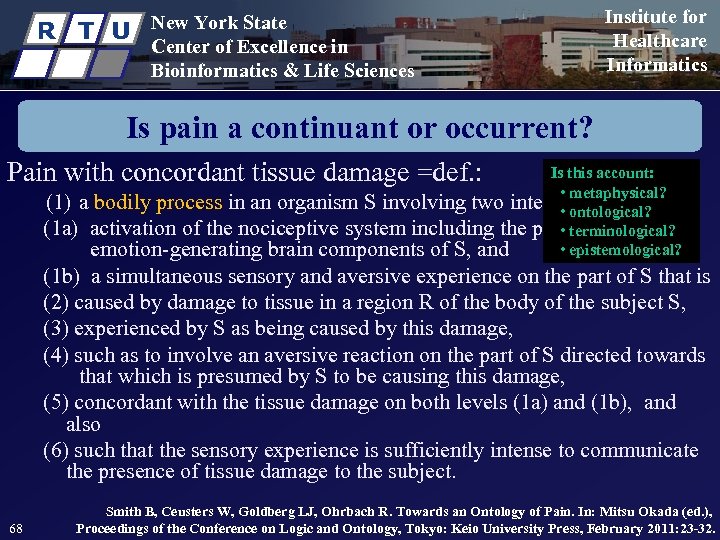 R T U New York State Center of Excellence in Bioinformatics & Life Sciences Institute for Healthcare Informatics Is pain a continuant or occurrent? Pain with concordant tissue damage =def. : Is this account: • metaphysical? (1) a bodily process in an organism S involving two integrated levels: • ontological? (1 a) activation of the nociceptive system including the pain-associated • terminological? • epistemological? emotion-generating brain components of S, and (1 b) a simultaneous sensory and aversive experience on the part of S that is (2) caused by damage to tissue in a region R of the body of the subject S, (3) experienced by S as being caused by this damage, (4) such as to involve an aversive reaction on the part of S directed towards that which is presumed by S to be causing this damage, (5) concordant with the tissue damage on both levels (1 a) and (1 b), and also (6) such that the sensory experience is sufficiently intense to communicate the presence of tissue damage to the subject. 68 Smith B, Ceusters W, Goldberg LJ, Ohrbach R. Towards an Ontology of Pain. In: Mitsu Okada (ed. ), Proceedings of the Conference on Logic and Ontology, Tokyo: Keio University Press, February 2011: 23 -32.
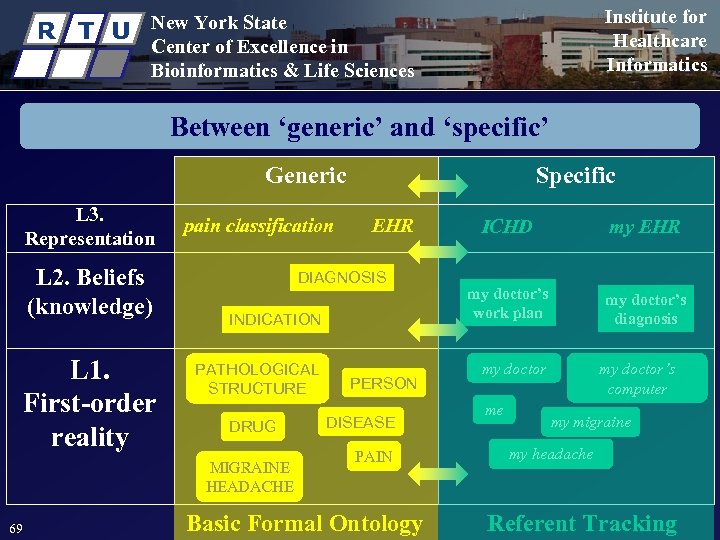 R T U Institute for Healthcare Informatics New York State Center of Excellence in Bioinformatics & Life Sciences Between ‘generic’ and ‘specific’ Generic L 3. Representation L 2. Beliefs (knowledge) L 1. First-order reality pain classification EHR DIAGNOSIS INDICATION PATHOLOGICAL STRUCTURE DRUG MIGRAINE HEADACHE 69 Specific PERSON DISEASE PAIN Basic Formal Ontology ICHD my EHR my doctor’s work plan my doctor’s diagnosis my doctor me my doctor’s computer my migraine my headache Referent Tracking
 R T U New York State Center of Excellence in Bioinformatics & Life Sciences Basic Formal Ontology: an upper ontology based on Ontological Realism Institute for Healthcare Informatics
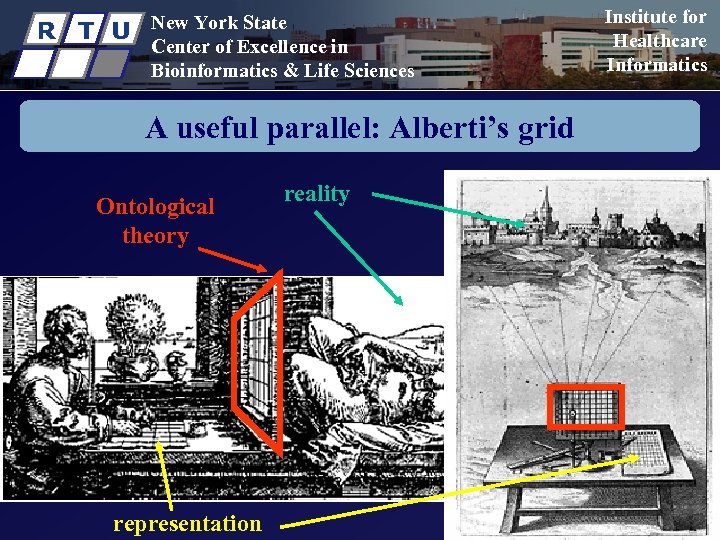 R T U New York State Center of Excellence in Bioinformatics & Life Sciences A useful parallel: Alberti’s grid Ontological theory representation reality Institute for Healthcare Informatics
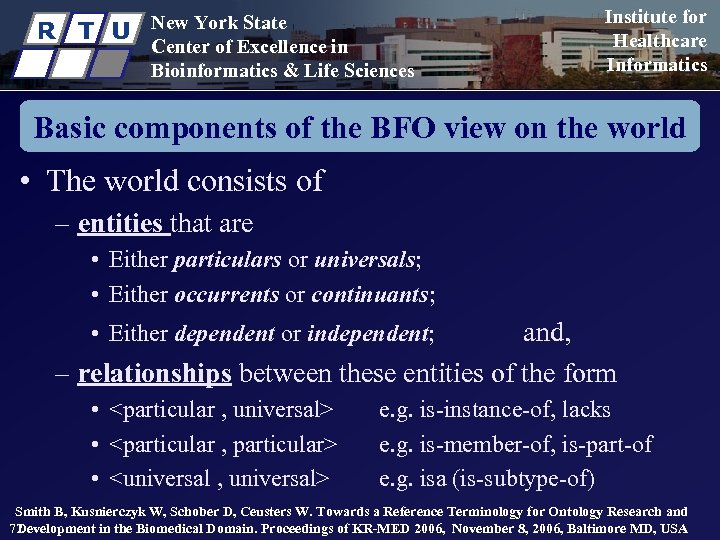 R T U New York State Center of Excellence in Bioinformatics & Life Sciences Institute for Healthcare Informatics Basic components of the BFO view on the world • The world consists of – entities that are • Either particulars or universals; • Either occurrents or continuants; and, – relationships between these entities of the form • Either dependent or independent; •
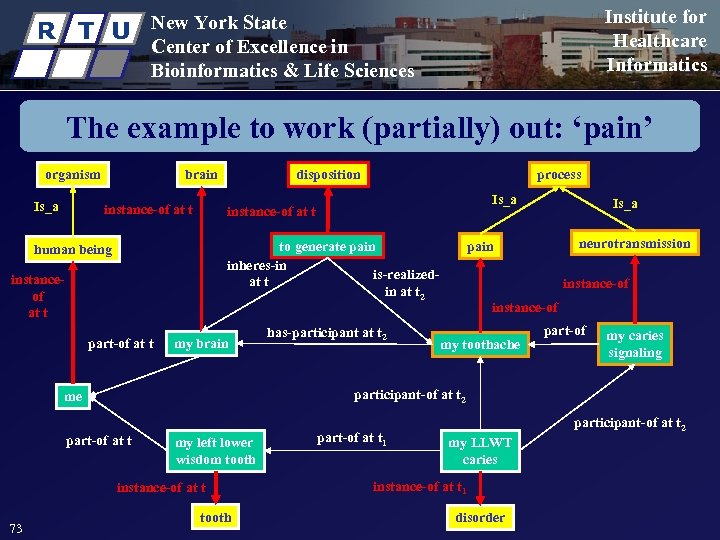 R T U Institute for Healthcare Informatics New York State Center of Excellence in Bioinformatics & Life Sciences The example to work (partially) out: ‘pain’ organism Is_a brain instance-of at t disposition Is_a instance-of at t to generate pain inheres-in is-realizedat t in at t 2 human being instanceof at t part-of at t my brain has-participant at t 2 Is_a neurotransmission pain instance-of my toothache part-of my caries signaling participant-of at t 2 me part-of at t my left lower wisdom tooth instance-of at t 73 process tooth part-of at t 1 participant-of at t 2 my LLWT caries instance-of at t 1 disorder
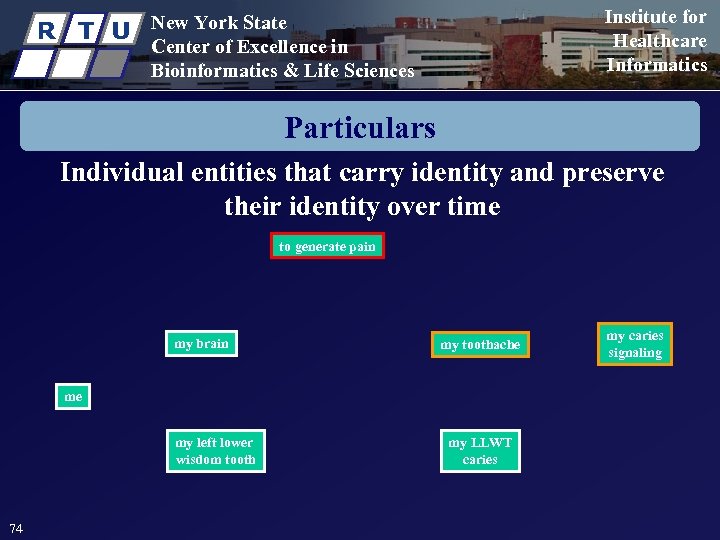 R T U Institute for Healthcare Informatics New York State Center of Excellence in Bioinformatics & Life Sciences Particulars Individual entities that carry identity and preserve their identity over time to generate pain my brain my toothache me my left lower wisdom tooth 74 my LLWT caries my caries signaling
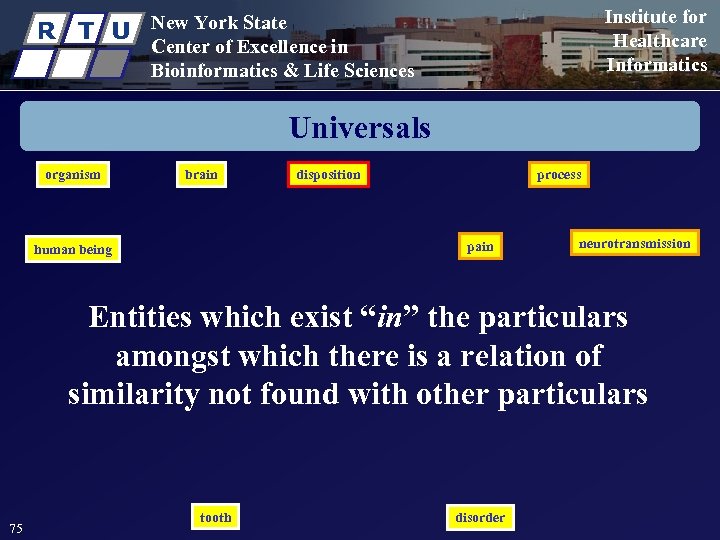 R T U Institute for Healthcare Informatics New York State Center of Excellence in Bioinformatics & Life Sciences Universals organism brain disposition process pain human being neurotransmission Entities which exist “in” the particulars amongst which there is a relation of similarity not found with other particulars 75 tooth disorder
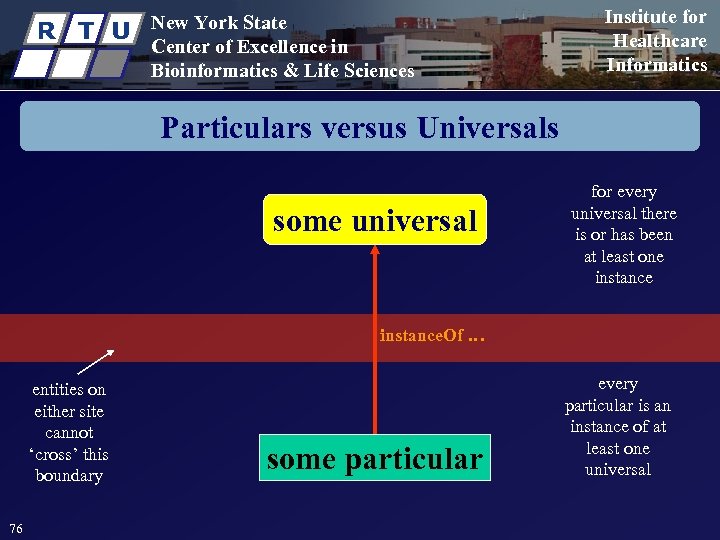 R T U New York State Center of Excellence in Bioinformatics & Life Sciences Institute for Healthcare Informatics Particulars versus Universals some universal for every universal there is or has been at least one instance. Of … entities on either site cannot ‘cross’ this boundary 76 some particular every particular is an instance of at least one universal
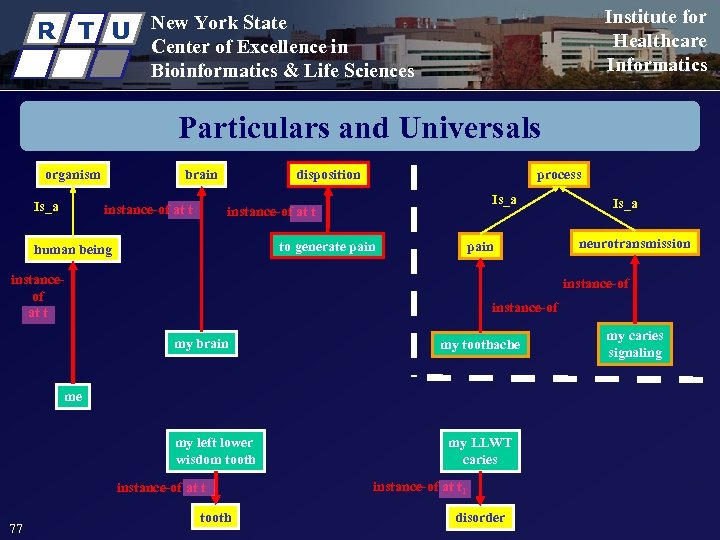 R T U Institute for Healthcare Informatics New York State Center of Excellence in Bioinformatics & Life Sciences Particulars and Universals organism Is_a brain instance-of at t disposition process Is_a instance-of at t to generate pain human being pain instanceof at t neurotransmission instance-of my brain my toothache me my left lower wisdom tooth instance-of at t 77 Is_a tooth my LLWT caries instance-of at t 1 disorder my caries signaling
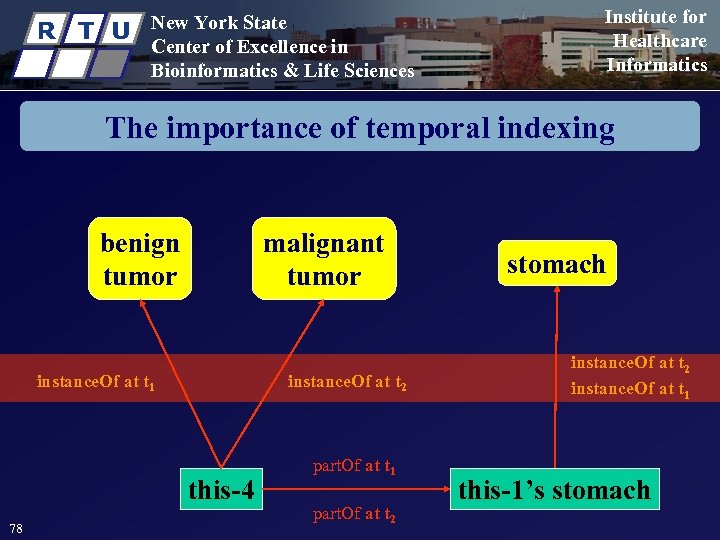 R T U New York State Center of Excellence in Bioinformatics & Life Sciences Institute for Healthcare Informatics The importance of temporal indexing malignant tumor benign tumor instance. Of at t 1 instance. Of at t 2 this-4 78 part. Of at t 1 part. Of at t 2 stomach instance. Of at t 2 instance. Of at t 1 this-1’s stomach
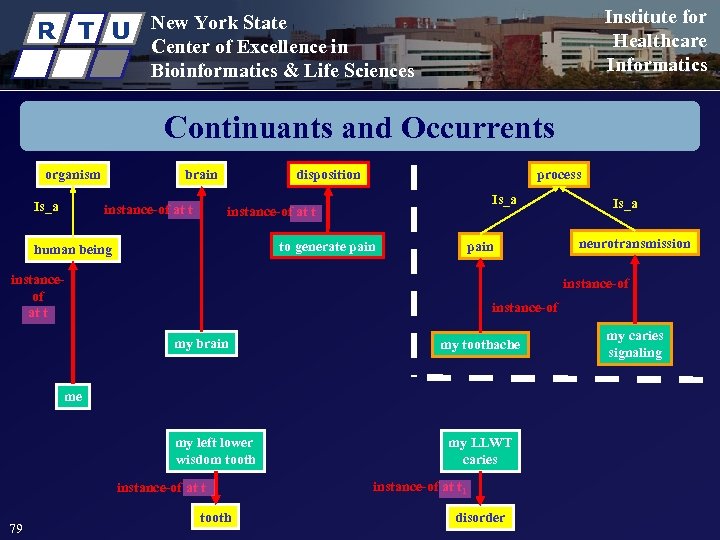 R T U Institute for Healthcare Informatics New York State Center of Excellence in Bioinformatics & Life Sciences Continuants and Occurrents organism Is_a brain instance-of at t disposition process Is_a instance-of at t to generate pain human being pain instanceof at t neurotransmission instance-of my brain my toothache me my left lower wisdom tooth instance-of at t 79 Is_a tooth my LLWT caries instance-of at t 1 disorder my caries signaling
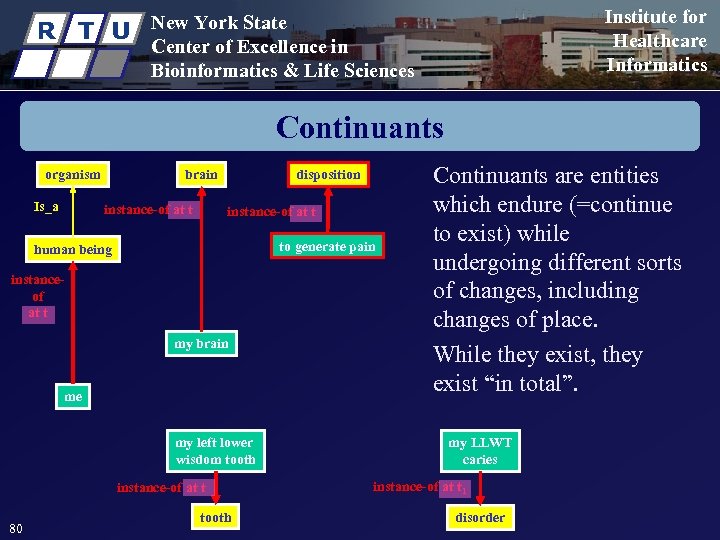 R T U Institute for Healthcare Informatics New York State Center of Excellence in Bioinformatics & Life Sciences Continuants organism Is_a brain instance-of at t disposition instance-of at t to generate pain human being instanceof at t my brain me my left lower wisdom tooth instance-of at t 80 tooth Continuants are entities which endure (=continue to exist) while undergoing different sorts of changes, including changes of place. While they exist, they exist “in total”. my LLWT caries instance-of at t 1 disorder
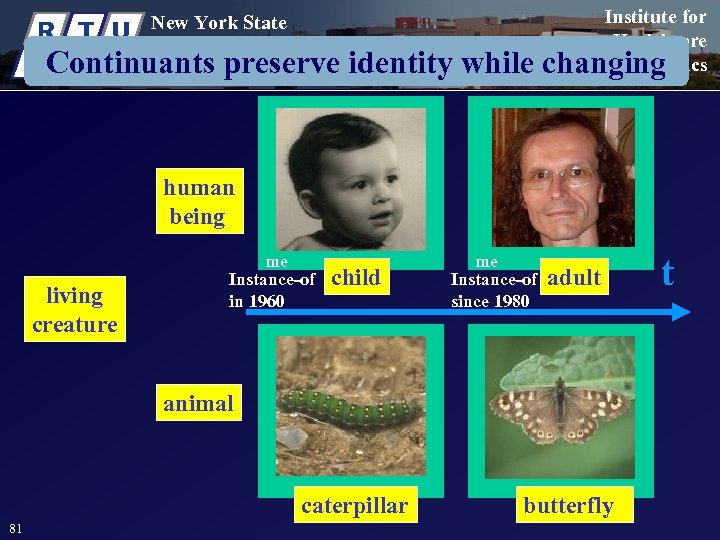 R T U Institute for Healthcare Informatics New York State Center of Excellence in Bioinformatics & Life Sciences Continuants preserve identity while changing human being living creature me Instance-of in 1960 child me Instance-of since 1980 adult animal caterpillar 81 butterfly t
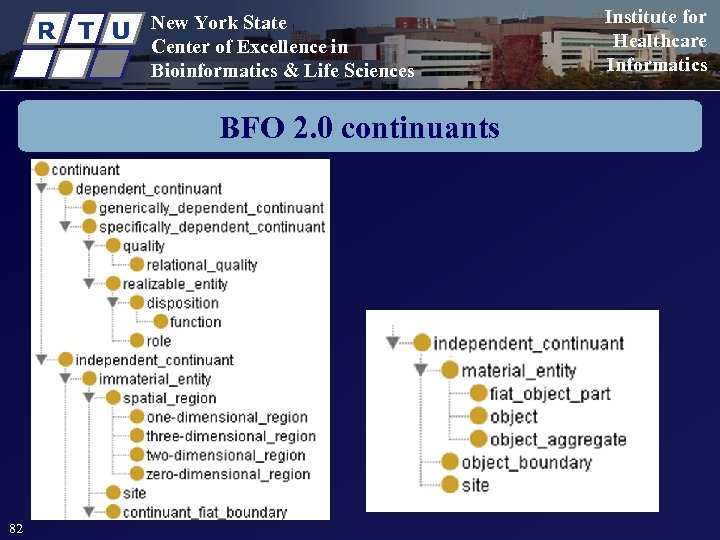 R T U New York State Center of Excellence in Bioinformatics & Life Sciences BFO 2. 0 continuants 82 Institute for Healthcare Informatics
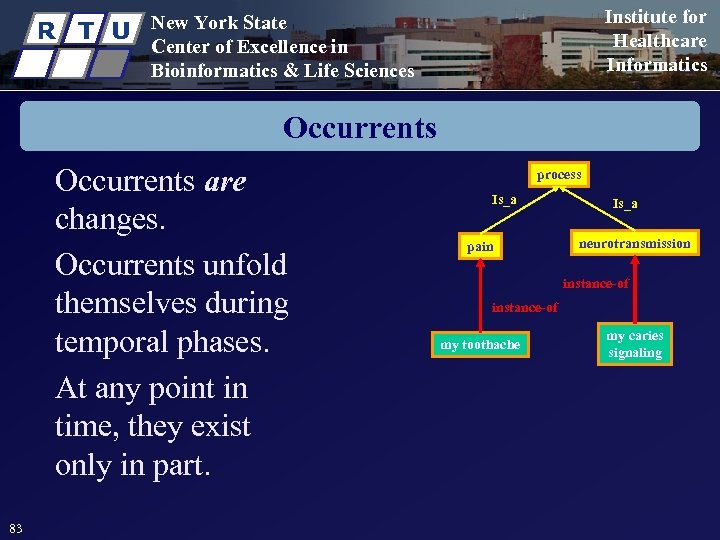 R T U Institute for Healthcare Informatics New York State Center of Excellence in Bioinformatics & Life Sciences Occurrents are changes. Occurrents unfold themselves during temporal phases. At any point in time, they exist only in part. 83 process Is_a pain Is_a neurotransmission instance-of my toothache my caries signaling
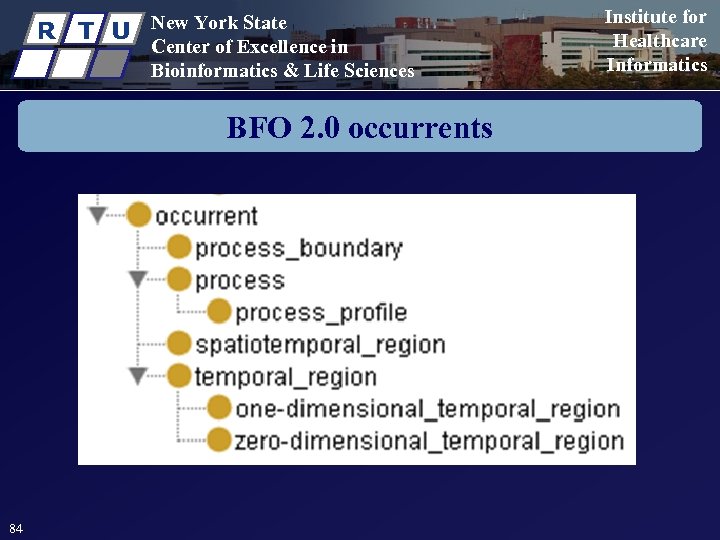 R T U New York State Center of Excellence in Bioinformatics & Life Sciences BFO 2. 0 occurrents 84 Institute for Healthcare Informatics
 R T U New York State Center of Excellence in Bioinformatics & Life Sciences Institute for Healthcare Informatics Not easy to understand for conceptualists • ‘the distinction between continuants and occurrents does not account for the contrast between reversible [processes] and irreversible processes in biology, chemistry, computation, or quantum mechanics’, • compare with: the distinction between males and females does not account for the contrast between nuns and housewives. 85 Maojo V, Crespo J, Garcia-Remesal M, de la Igleasia D, Perez-Rey D, Kulikowski C. Biomedical Ontologies: Towards Scientific Debate. Methods Inf Med. 2011 March 21; 50(3)
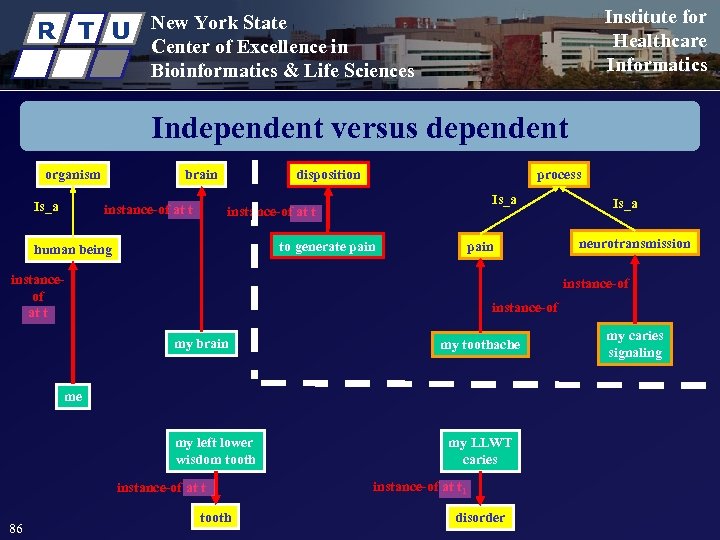 R T U Institute for Healthcare Informatics New York State Center of Excellence in Bioinformatics & Life Sciences Independent versus dependent organism Is_a brain instance-of at t disposition process Is_a instance-of at t to generate pain human being pain instanceof at t neurotransmission instance-of my brain my toothache me my left lower wisdom tooth instance-of at t 86 Is_a tooth my LLWT caries instance-of at t 1 disorder my caries signaling
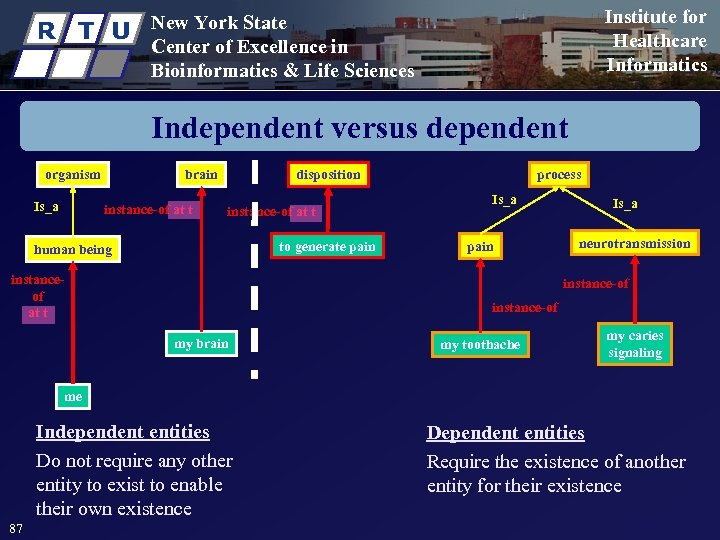 R T U Institute for Healthcare Informatics New York State Center of Excellence in Bioinformatics & Life Sciences Independent versus dependent organism Is_a brain instance-of at t disposition instance-of at t to generate pain human being instanceof at t process Is_a pain Is_a neurotransmission instance-of my brain my toothache my caries signaling me Independent entities Do not require any other entity to exist to enable their own existence 87 Dependent entities Require the existence of another entity for their existence
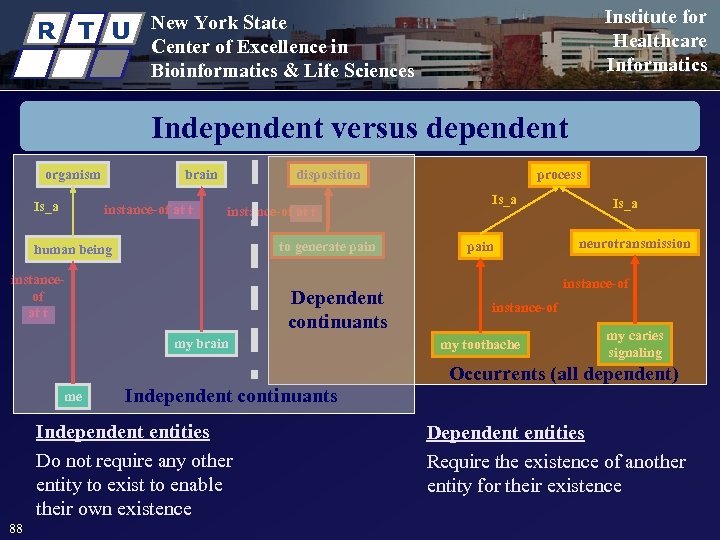 R T U Institute for Healthcare Informatics New York State Center of Excellence in Bioinformatics & Life Sciences Independent versus dependent organism Is_a brain instance-of at t disposition instance-of at t to generate pain human being instanceof at t Dependent continuants my brain me Independent continuants Independent entities Do not require any other entity to exist to enable their own existence 88 process Is_a pain Is_a neurotransmission instance-of my toothache my caries signaling Occurrents (all dependent) Dependent entities Require the existence of another entity for their existence
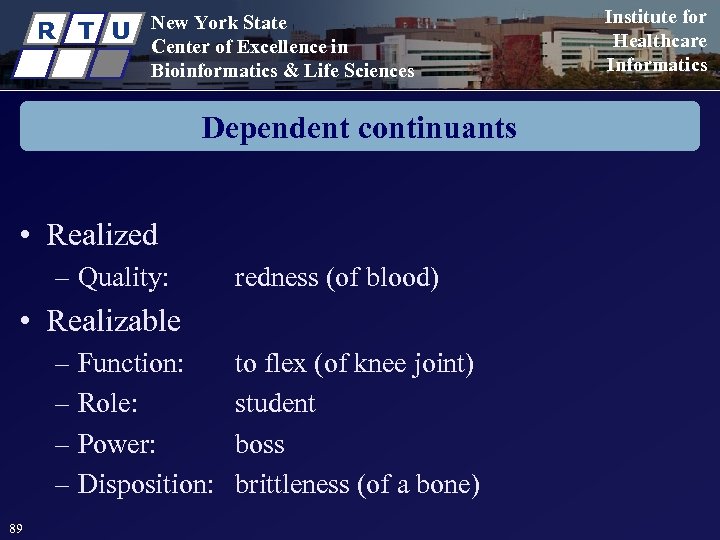 R T U New York State Center of Excellence in Bioinformatics & Life Sciences Dependent continuants • Realized – Quality: redness (of blood) • Realizable – Function: – Role: – Power: – Disposition: 89 to flex (of knee joint) student boss brittleness (of a bone) Institute for Healthcare Informatics
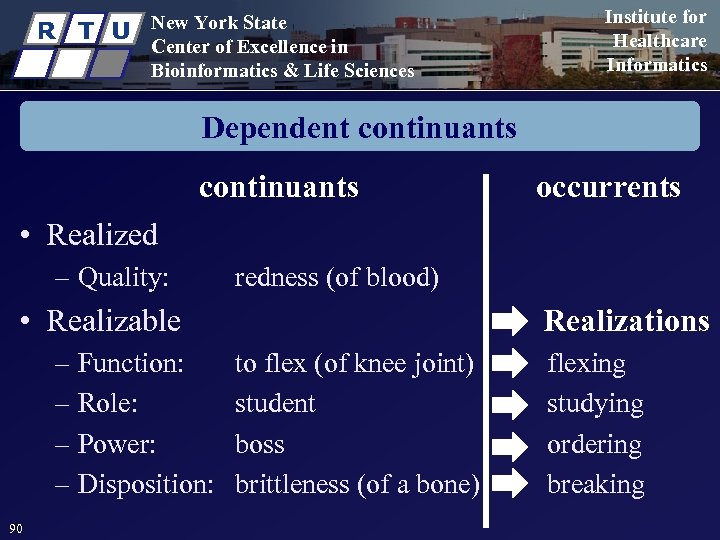 R T U Institute for Healthcare Informatics New York State Center of Excellence in Bioinformatics & Life Sciences Dependent continuants • Realized – Quality: redness (of blood) • Realizable – Function: – Role: – Power: – Disposition: 90 occurrents Realizations to flex (of knee joint) student boss brittleness (of a bone) flexing studying ordering breaking
 R T U New York State Center of Excellence in Bioinformatics & Life Sciences Institute for Healthcare Informatics Not easy to understand for conceptualists • ‘How can cells or viruses be entirely independent entities, even within a controlled laboratory environment? ’ shows not understanding what ‘ontological dependence’ means 91 Maojo V, Crespo J, Garcia-Remesal M, de la Igleasia D, Perez-Rey D, Kulikowski C. Biomedical Ontologies: Towards Scientific Debate. Methods Inf Med. 2011 March 21; 50(3)
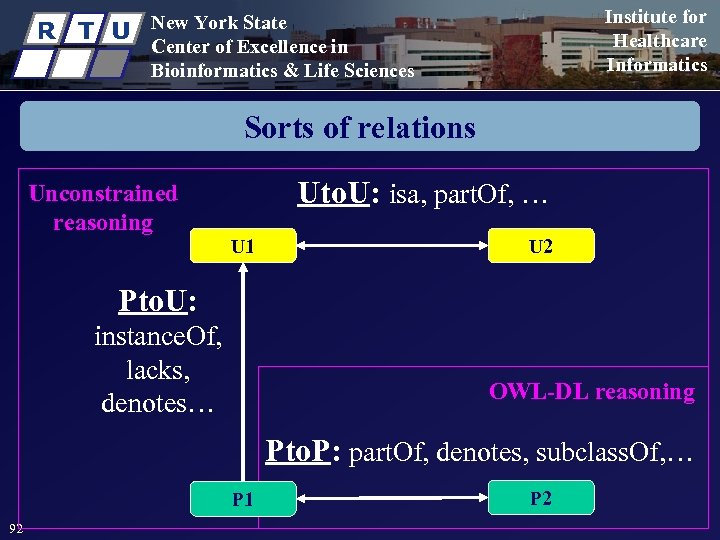 R T U Institute for Healthcare Informatics New York State Center of Excellence in Bioinformatics & Life Sciences Sorts of relations Uto. U: isa, part. Of, … Unconstrained reasoning U 1 U 2 Pto. U: instance. Of, lacks, denotes… OWL-DL reasoning Pto. P: part. Of, denotes, subclass. Of, … P 1 92 P 2
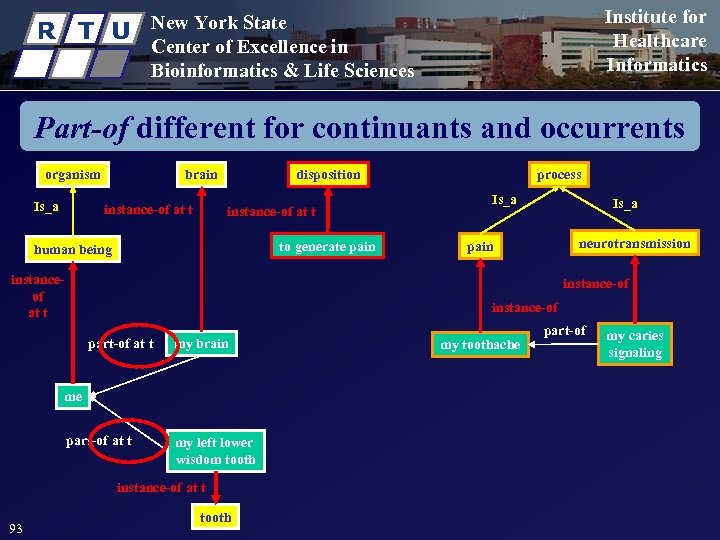 R T U Institute for Healthcare Informatics New York State Center of Excellence in Bioinformatics & Life Sciences Part-of different for continuants and occurrents organism Is_a brain instance-of at t disposition instance-of at t to generate pain human being instanceof at t Is_a neurotransmission pain instance-of part-of at t my brain me part-of at t my left lower wisdom tooth instance-of at t 93 process tooth my toothache part-of my caries signaling
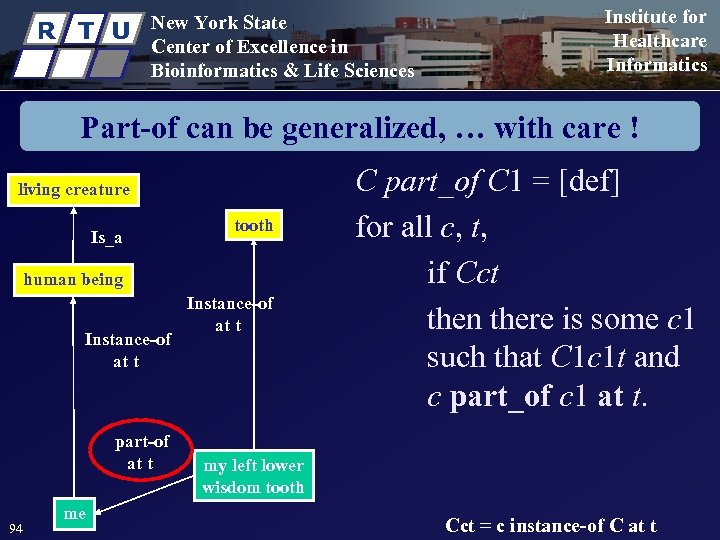 R T U New York State Center of Excellence in Bioinformatics & Life Sciences Institute for Healthcare Informatics Part-of can be generalized, … with care ! living creature Is_a tooth human being Instance-of at t part-of at t 94 me Instance-of at t C part_of C 1 = [def] for all c, t, if Cct then there is some c 1 such that C 1 c 1 t and c part_of c 1 at t. my left lower wisdom tooth Cct = c instance-of C at t
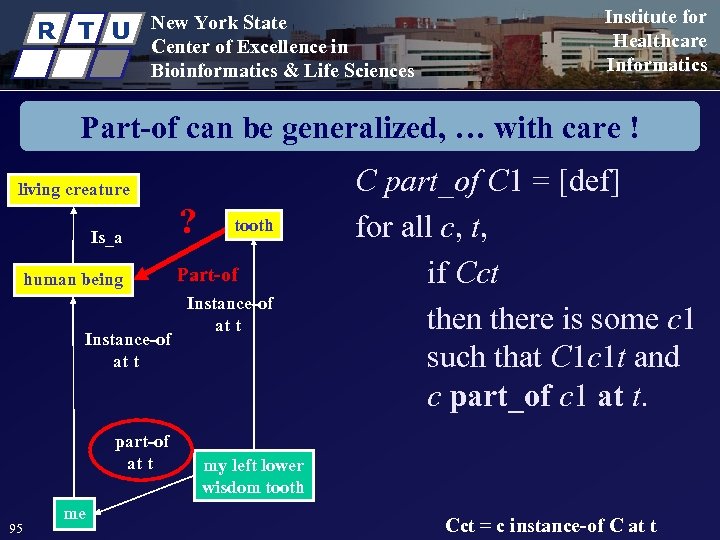 R T U New York State Center of Excellence in Bioinformatics & Life Sciences Institute for Healthcare Informatics Part-of can be generalized, … with care ! living creature Is_a human being Instance-of at t part-of at t 95 me ? tooth Part-of Instance-of at t C part_of C 1 = [def] for all c, t, if Cct then there is some c 1 such that C 1 c 1 t and c part_of c 1 at t. my left lower wisdom tooth Cct = c instance-of C at t
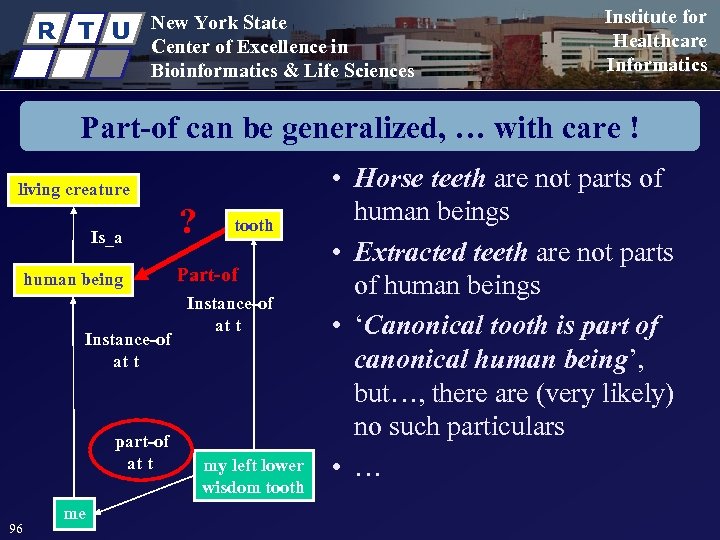 R T U New York State Center of Excellence in Bioinformatics & Life Sciences Institute for Healthcare Informatics Part-of can be generalized, … with care ! living creature Is_a human being Instance-of at t part-of at t 96 me ? tooth Part-of Instance-of at t my left lower wisdom tooth • Horse teeth are not parts of human beings • Extracted teeth are not parts of human beings • ‘Canonical tooth is part of canonical human being’, but…, there are (very likely) no such particulars • …
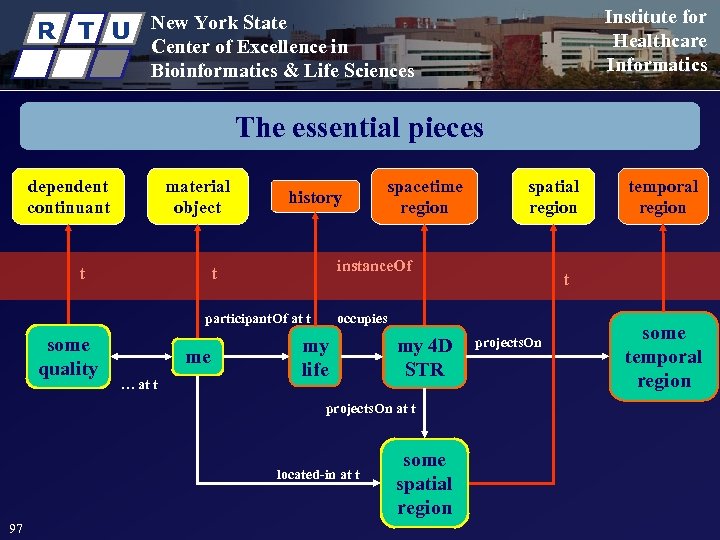 R T U Institute for Healthcare Informatics New York State Center of Excellence in Bioinformatics & Life Sciences The essential pieces dependent continuant material object t history me … at t my life my 4 D STR located-in at t some spatial region temporal region t occupies projects. On at t 97 spatial region instance. Of t participant. Of at t some quality spacetime region projects. On some temporal region
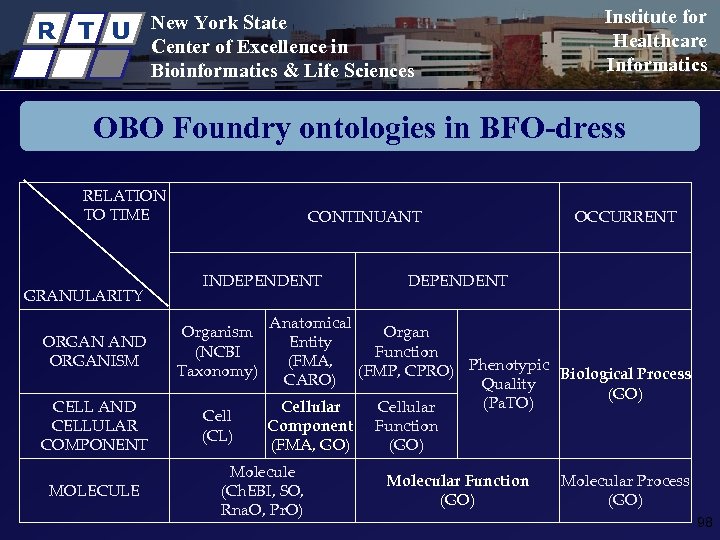 R T U New York State Center of Excellence in Bioinformatics & Life Sciences Institute for Healthcare Informatics OBO Foundry ontologies in BFO-dress RELATION TO TIME GRANULARITY CONTINUANT INDEPENDENT ORGAN AND ORGANISM Organism (NCBI Taxonomy) CELL AND CELLULAR COMPONENT Cell (CL) MOLECULE OCCURRENT DEPENDENT Anatomical Organ Entity Function (FMA, (FMP, CPRO) Phenotypic Biological Process CARO) Quality (GO) (Pa. TO) Cellular Component Function (FMA, GO) (GO) Molecule (Ch. EBI, SO, Rna. O, Pr. O) Molecular Function (GO) Molecular Process (GO) 98
 R T U New York State Center of Excellence in Bioinformatics & Life Sciences Institute for Healthcare Informatics Ontology of General Medical Science First ontology in which the L 1/L 2/L 3 distinction is used Scheuermann R, Ceusters W, Smith B. Toward an Ontological Treatment of Disease and Diagnosis. 2009 AMIA Summit on Translational Bioinformatics, San Francisco, California, March 15 -17, 2009; : 116 -120. Omnipress ISBN: 0 -9647743 -7 -2
 R T U New York State Center of Excellence in Bioinformatics & Life Sciences Institute for Healthcare Informatics Goal of OGMS • To be a consistent, logical and extensible framework (ontology) for the representation of – features of disease – clinical processes – results
 R T U New York State Center of Excellence in Bioinformatics & Life Sciences Motivation • Clarity about: – disease etiology and progression – disease and the diagnostic process – phenotype and signs/symptoms Institute for Healthcare Informatics
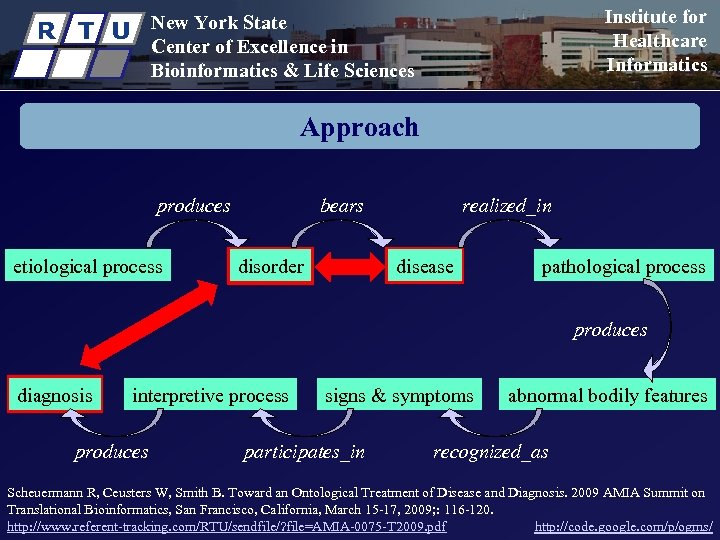 Institute for Healthcare Informatics New York State Center of Excellence in Bioinformatics & Life Sciences R T U Approach produces etiological process bears disorder realized_in disease pathological process produces diagnosis interpretive process produces signs & symptoms participates_in abnormal bodily features recognized_as Scheuermann R, Ceusters W, Smith B. Toward an Ontological Treatment of Disease and Diagnosis. 2009 AMIA Summit on Translational Bioinformatics, San Francisco, California, March 15 -17, 2009; : 116 -120. http: //www. referent-tracking. com/RTU/sendfile/? file=AMIA-0075 -T 2009. pdf http: //code. google. com/p/ogms/
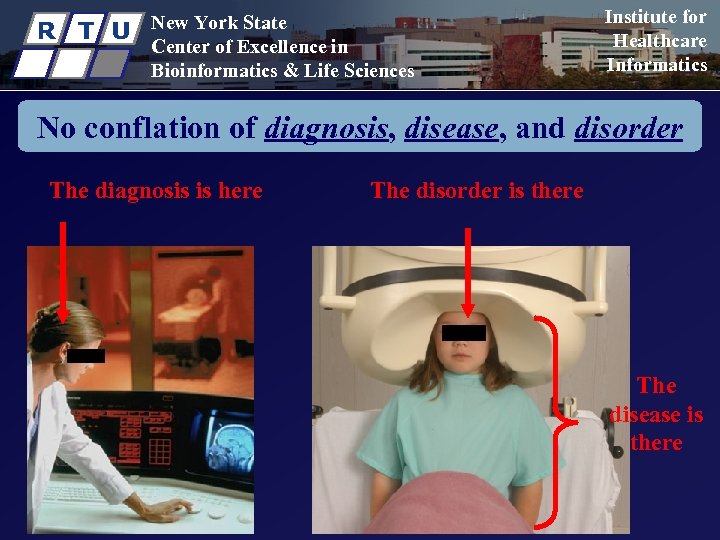 R T U New York State Center of Excellence in Bioinformatics & Life Sciences Institute for Healthcare Informatics No conflation of diagnosis, disease, and disorder The diagnosis is here The disorder is there The disease is there
 R T U New York State Center of Excellence in Bioinformatics & Life Sciences Institute for Healthcare Informatics Cirrhosis - environmental exposure • • Etiological process - phenobarbitolinduced hepatic cell death – produces Disorder - necrotic liver – bears Disposition (disease) - cirrhosis – realized_in Pathological process - abnormal tissue repair with cell proliferation and fibrosis that exceed a certain threshold; hypoxia-induced cell death – produces Abnormal bodily features – recognized_as Symptoms - fatigue, anorexia Signs - jaundice, splenomegaly • • Symptoms & Signs – used_in Interpretive process – produces Hypothesis - rule out cirrhosis – suggests Laboratory tests – produces Test results – documentation of elevated liver enzymes in serum – used_in Interpretive process – produces Result - diagnosis that patient X has a disorder that bears the disease cirrhosis
 R T U New York State Center of Excellence in Bioinformatics & Life Sciences Institute for Healthcare Informatics Foundational Terms (1) • Disorder =def. – A causally linked combination of physical components that is – (a) clinically abnormal and – (b) maximal, in the sense that it is not a part of some larger such combination. • Pathological Process =def. – A bodily process that is a manifestation of a disorder and is clinically abnormal.
 R T U New York State Center of Excellence in Bioinformatics & Life Sciences Institute for Healthcare Informatics Clinically abnormal • - something is clinically abnormal if: – (1) is not part of the life plan for an organism of the relevant type (unlike aging or pregnancy), – (2) is causally linked to an elevated risk either of pain or other feelings of illness, or of death or dysfunction, and – (3) is such that the elevated risk exceeds a certain threshold level.
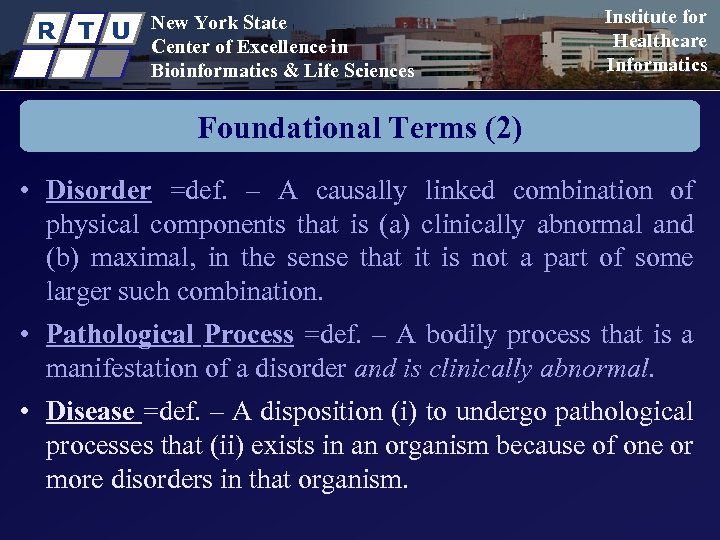 R T U New York State Center of Excellence in Bioinformatics & Life Sciences Institute for Healthcare Informatics Foundational Terms (2) • Disorder =def. – A causally linked combination of physical components that is (a) clinically abnormal and (b) maximal, in the sense that it is not a part of some larger such combination. • Pathological Process =def. – A bodily process that is a manifestation of a disorder and is clinically abnormal. • Disease =def. – A disposition (i) to undergo pathological processes that (ii) exists in an organism because of one or more disorders in that organism.
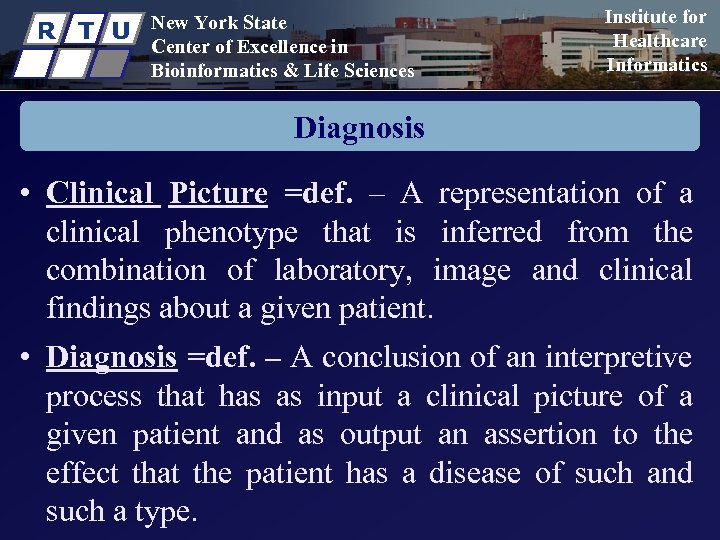 R T U New York State Center of Excellence in Bioinformatics & Life Sciences Institute for Healthcare Informatics Diagnosis • Clinical Picture =def. – A representation of a clinical phenotype that is inferred from the combination of laboratory, image and clinical findings about a given patient. • Diagnosis =def. – A conclusion of an interpretive process that has as input a clinical picture of a given patient and as output an assertion to the effect that the patient has a disease of such and such a type.
 R T U New York State Center of Excellence in Bioinformatics & Life Sciences Referent Tracking Institute for Healthcare Informatics
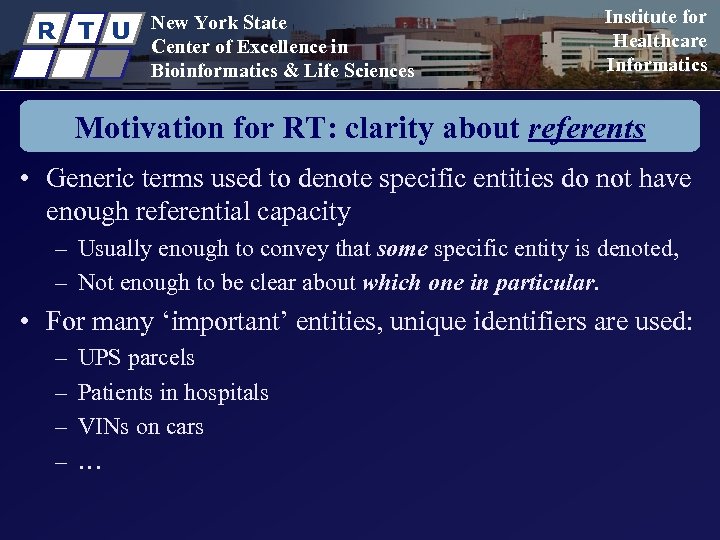 R T U New York State Center of Excellence in Bioinformatics & Life Sciences Institute for Healthcare Informatics Motivation for RT: clarity about referents • Generic terms used to denote specific entities do not have enough referential capacity – Usually enough to convey that some specific entity is denoted, – Not enough to be clear about which one in particular. • For many ‘important’ entities, unique identifiers are used: – – UPS parcels Patients in hospitals VINs on cars …
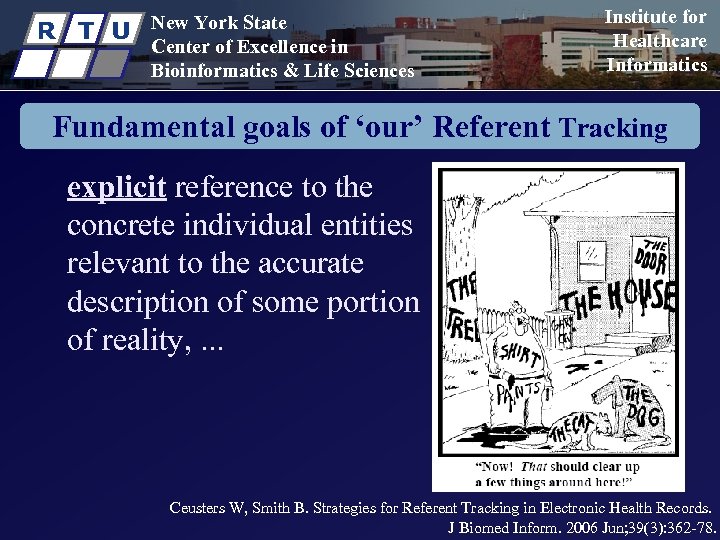 R T U New York State Center of Excellence in Bioinformatics & Life Sciences Institute for Healthcare Informatics Fundamental goals of ‘our’ Referent Tracking explicit reference to the concrete individual entities relevant to the accurate description of some portion of reality, . . . Ceusters W, Smith B. Strategies for Referent Tracking in Electronic Health Records. J Biomed Inform. 2006 Jun; 39(3): 362 -78.
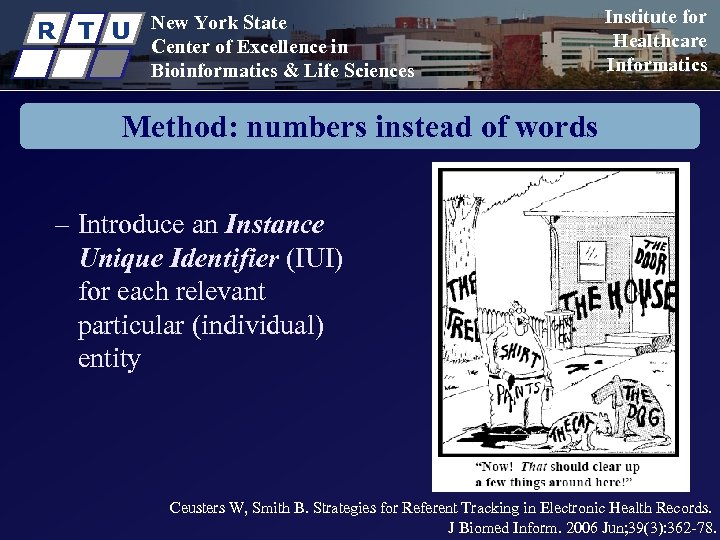 R T U New York State Center of Excellence in Bioinformatics & Life Sciences Institute for Healthcare Informatics Method: numbers instead of words – Introduce an Instance Unique Identifier (IUI) for each relevant particular (individual) entity 78 Ceusters W, Smith B. Strategies for Referent Tracking in Electronic Health Records. J Biomed Inform. 2006 Jun; 39(3): 362 -78.
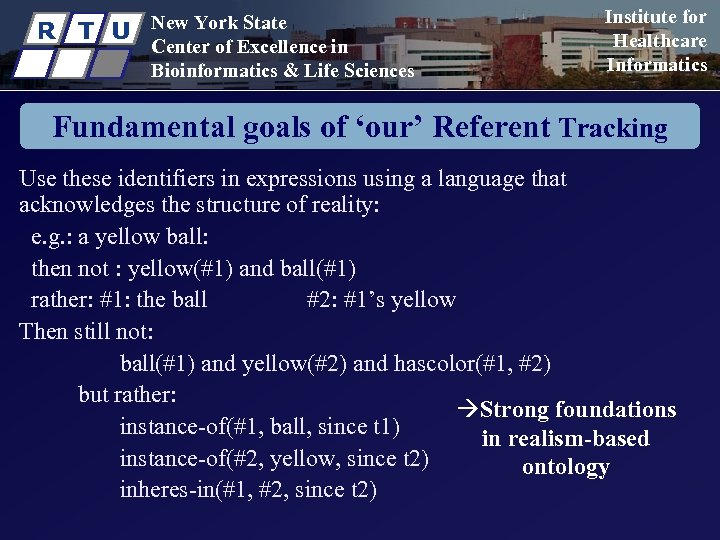 R T U New York State Center of Excellence in Bioinformatics & Life Sciences Institute for Healthcare Informatics Fundamental goals of ‘our’ Referent Tracking Use these identifiers in expressions using a language that acknowledges the structure of reality: e. g. : a yellow ball: then not : yellow(#1) and ball(#1) rather: #1: the ball #2: #1’s yellow Then still not: ball(#1) and yellow(#2) and hascolor(#1, #2) but rather: Strong foundations instance-of(#1, ball, since t 1) in realism-based instance-of(#2, yellow, since t 2) ontology inheres-in(#1, #2, since t 2)
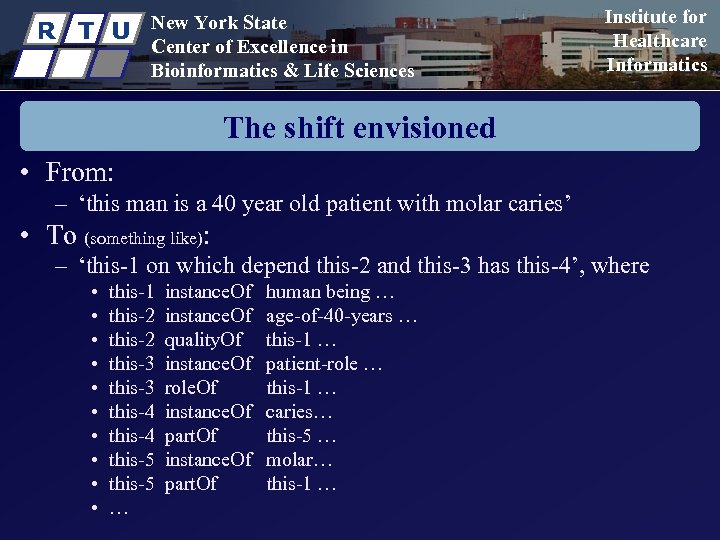 R T U New York State Center of Excellence in Bioinformatics & Life Sciences Institute for Healthcare Informatics The shift envisioned • From: – ‘this man is a 40 year old patient with molar caries’ • To (something like): – ‘this-1 on which depend this-2 and this-3 has this-4’, where • • • this-1 instance. Of human being … this-2 instance. Of age-of-40 -years … this-2 quality. Of this-1 … this-3 instance. Of patient-role … this-3 role. Of this-1 … this-4 instance. Of caries… this-4 part. Of this-5 … this-5 instance. Of molar… this-5 part. Of this-1 … …
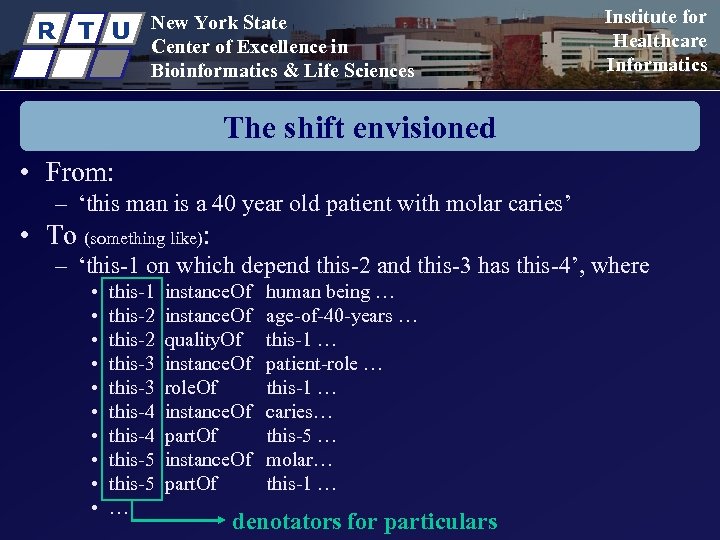 R T U New York State Center of Excellence in Bioinformatics & Life Sciences Institute for Healthcare Informatics The shift envisioned • From: – ‘this man is a 40 year old patient with molar caries’ • To (something like): – ‘this-1 on which depend this-2 and this-3 has this-4’, where • • • this-1 instance. Of human being … this-2 instance. Of age-of-40 -years … this-2 quality. Of this-1 … this-3 instance. Of patient-role … this-3 role. Of this-1 … this-4 instance. Of caries… this-4 part. Of this-5 … this-5 instance. Of molar… this-5 part. Of this-1 … … denotators for particulars
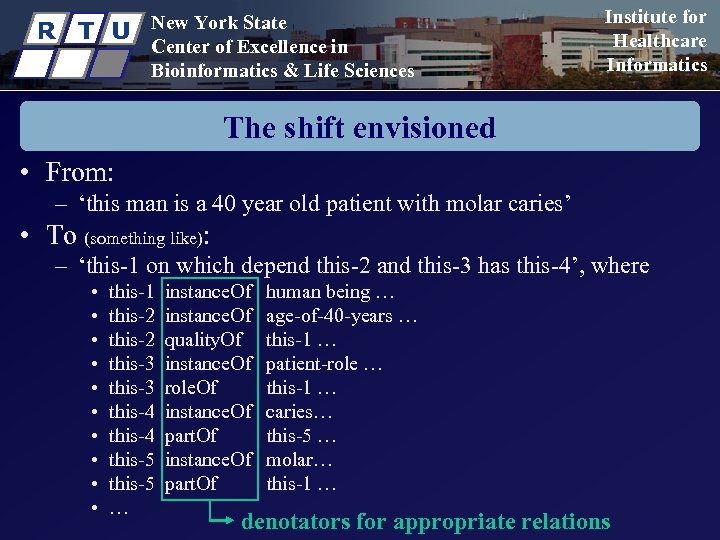 R T U New York State Center of Excellence in Bioinformatics & Life Sciences Institute for Healthcare Informatics The shift envisioned • From: – ‘this man is a 40 year old patient with molar caries’ • To (something like): – ‘this-1 on which depend this-2 and this-3 has this-4’, where • • • this-1 instance. Of human being … this-2 instance. Of age-of-40 -years … this-2 quality. Of this-1 … this-3 instance. Of patient-role … this-3 role. Of this-1 … this-4 instance. Of caries… this-4 part. Of this-5 … this-5 instance. Of molar… this-5 part. Of this-1 … … denotators for appropriate relations
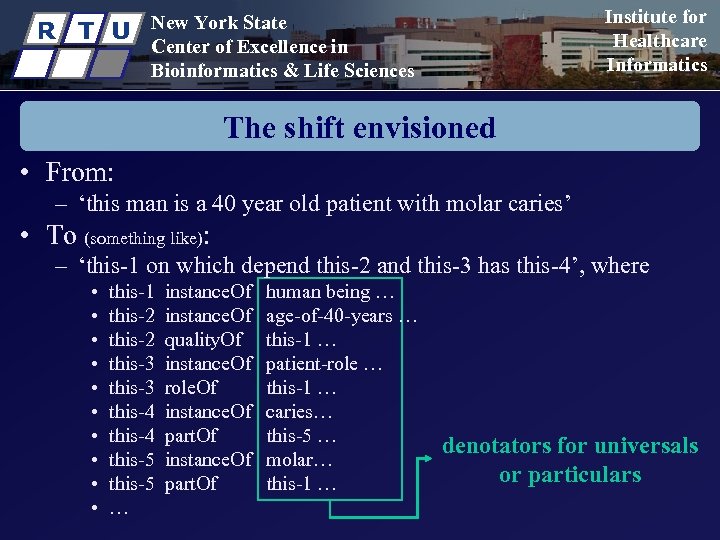 R T U Institute for Healthcare Informatics New York State Center of Excellence in Bioinformatics & Life Sciences The shift envisioned • From: – ‘this man is a 40 year old patient with molar caries’ • To (something like): – ‘this-1 on which depend this-2 and this-3 has this-4’, where • • • this-1 instance. Of human being … this-2 instance. Of age-of-40 -years … this-2 quality. Of this-1 … this-3 instance. Of patient-role … this-3 role. Of this-1 … this-4 instance. Of caries… this-4 part. Of this-5 … this-5 instance. Of molar… this-5 part. Of this-1 … … denotators for universals or particulars
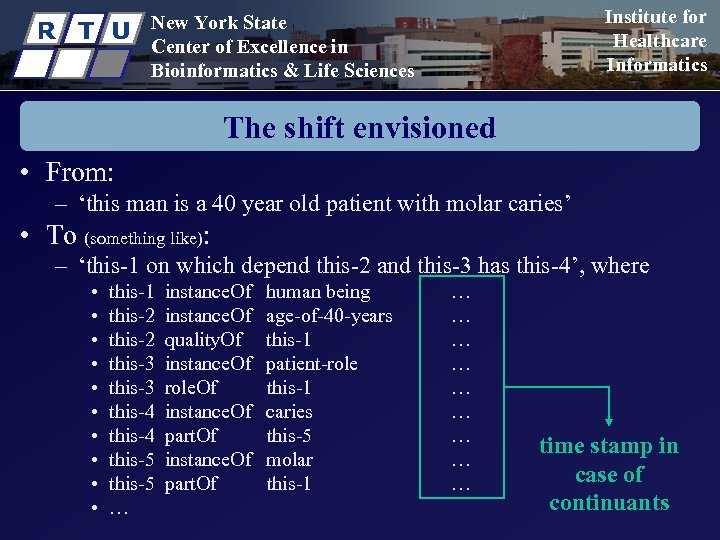 R T U Institute for Healthcare Informatics New York State Center of Excellence in Bioinformatics & Life Sciences The shift envisioned • From: – ‘this man is a 40 year old patient with molar caries’ • To (something like): – ‘this-1 on which depend this-2 and this-3 has this-4’, where • • • this-1 instance. Of human being this-2 instance. Of age-of-40 -years this-2 quality. Of this-1 this-3 instance. Of patient-role this-3 role. Of this-1 this-4 instance. Of caries this-4 part. Of this-5 instance. Of molar this-5 part. Of this-1 … … … … … time stamp in case of continuants
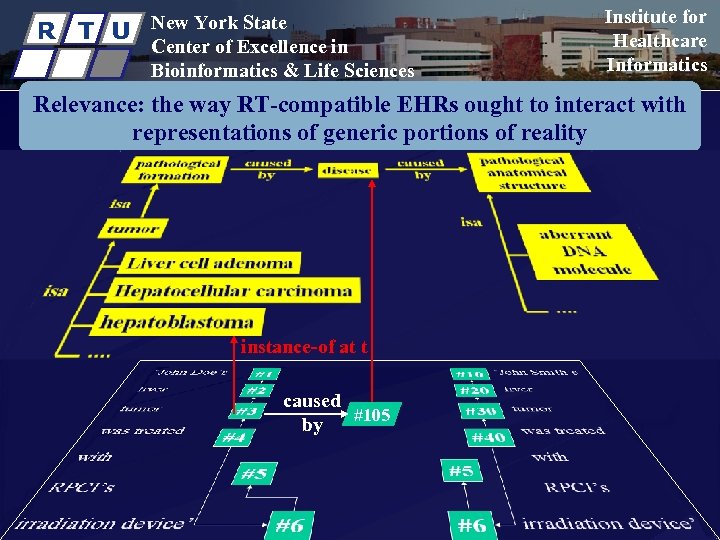 R T U New York State Center of Excellence in Bioinformatics & Life Sciences Institute for Healthcare Informatics Relevance: the way RT-compatible EHRs ought to interact with representations of generic portions of reality instance-of at t caused #105 by
 R T U New York State Center of Excellence in Bioinformatics & Life Sciences Institute for Healthcare Informatics Integrating clinical datasets about orofacial pain
 R T U New York State Center of Excellence in Bioinformatics & Life Sciences Institute for Healthcare Informatics Acknowledgement The work described is funded in part by grant 1 R 01 DE 021917 -01 A 1 from the National Institute of Dental and Craniofacial Research (NIDCR). The content of this presentation is solely the responsibility of the author and does not necessarily represent the official views of the NIDCR or the National Institutes of Health. 121
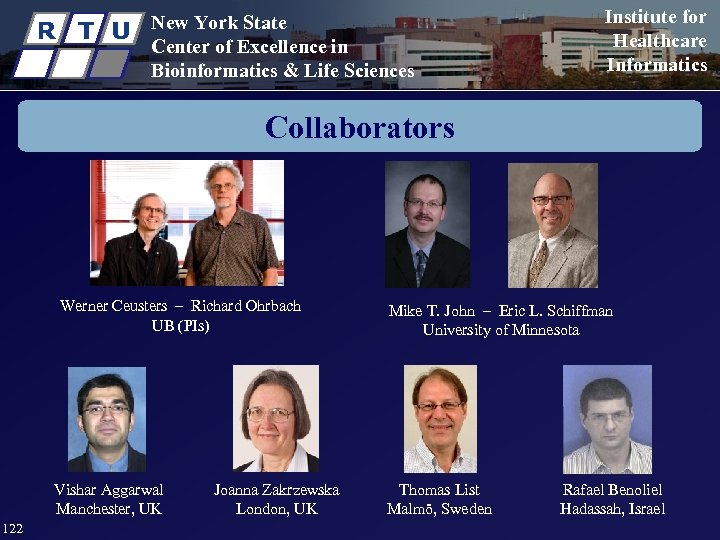 R T U New York State Center of Excellence in Bioinformatics & Life Sciences Institute for Healthcare Informatics Collaborators Werner Ceusters – Richard Ohrbach UB (PIs) Vishar Aggarwal Manchester, UK 122 Joanna Zakrzewska London, UK Mike T. John – Eric L. Schiffman University of Minnesota Thomas List Malmö, Sweden Rafael Benoliel Hadassah, Israel
 R T U New York State Center of Excellence in Bioinformatics & Life Sciences Institute for Healthcare Informatics Background (1) • July 2008, Toronto: – the International RDC/TMD Consortium Network identified a need to incorporate the RDC/TMD diagnostic taxonomy into a comprehensive orofacial pain taxonomy. • April, 2009, Miami: – ‘The International Consensus Workshop: Convergence on an Orofacial Pain Taxonomy’ participants decided that an adequate treatment of the ontology of pain in general, and orofacial pain in particular, together with an appropriate terminology, is mandatory to advance the state of the art in diagnosis, treatment and prevention. 123 Ohrbach R, List T, Goulet J, Svensson P. Recommendations from the International Consensus Workshop: Convergence on an Orofacial Pain Taxonomy. Journal of Oral Rehabilitation. 2010.
 R T U New York State Center of Excellence in Bioinformatics & Life Sciences Institute for Healthcare Informatics Background (2) • The following consecutive steps were proposed: 124 1. study the terminology and ontology of pain as currently defined, 2. find ways to make individual data collections more useful for international research, 3. develop an ontology for integrating knowledge and data over all the known basic and clinical science domains concerning TMD and its relationship to complex disorders, and 4. expand this ontology to cover all pain-related disorders.
 R T U New York State Center of Excellence in Bioinformatics & Life Sciences Institute for Healthcare Informatics Specific Aims 1. describe the portions of reality covered by the five datasets by means of a realism-based ontology (OPMQo. L), 2. design bridging axioms required to express the data dictionaries of the datasets in terms of the OPMQo. L and translate these axioms in the query languages used by the underlying databases, 3. validate OPMQo. L by querying the datasets with and without using the ontology and by comparing the results in function of the clinical question identified, 4. document the development and validation approach in a way that other groups can re-use and expand OPMQo. L, and use our approach in other domains. 125
 R T U New York State Center of Excellence in Bioinformatics & Life Sciences Institute for Healthcare Informatics Considered datasets • ‘US Dataset’ (724 patients) resulted from the NIH funded RDC/TMD Validation Project, • ‘Hadassah Dataset’ (306 patients) from the Orofacial Pain Clinic at the Faculty of Dentistry, Hadassah, • ‘German Dataset’ (416 patients) of patients seeking treatment for orofacial pain at the Department of Prosthodontics and Materials Sciences, University of Leipzig, • ‘Swedish Dataset’of 46 consecutive Atypical Odontalgia (AO) patients recruited from 4 orofacial pain clinics in Sweden as well as data about age- and gender-matched control patients, 35 of which being painless and 41 being TMD patients, • ‘UK Dataset’ (168 patients) of facial pain of non dental origin present for a minimum of three months. 126
 R T U New York State Center of Excellence in Bioinformatics & Life Sciences Institute for Healthcare Informatics Challenges • (1) which terms used in the domain correspond with real entities, • (2) what real entities need to exist for certain signs and symptoms to manifest themselves, • (3) to what degree do distinct pain disorders lead to similar types of signs and symptoms, and • (4) to what extent can individual patients be suffering from distinct pain disorders at the same time, yet exhibiting manifestations that can be explained by the presence of only one particular pain disorder. 127
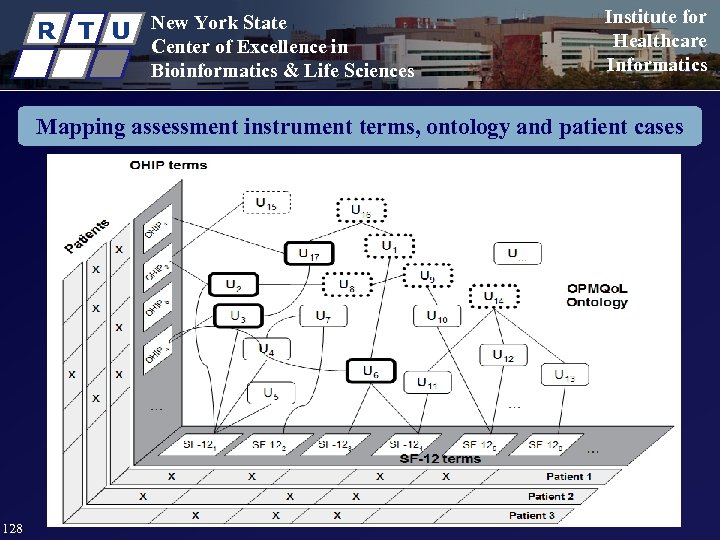 R T U New York State Center of Excellence in Bioinformatics & Life Sciences Institute for Healthcare Informatics Mapping assessment instrument terms, ontology and patient cases 128
 R T U New York State Center of Excellence in Bioinformatics & Life Sciences Institute for Healthcare Informatics
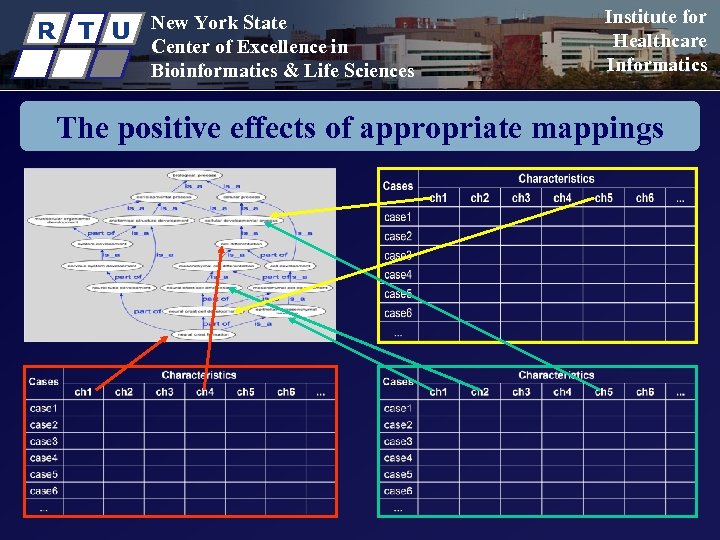 R T U New York State Center of Excellence in Bioinformatics & Life Sciences Institute for Healthcare Informatics The positive effects of appropriate mappings
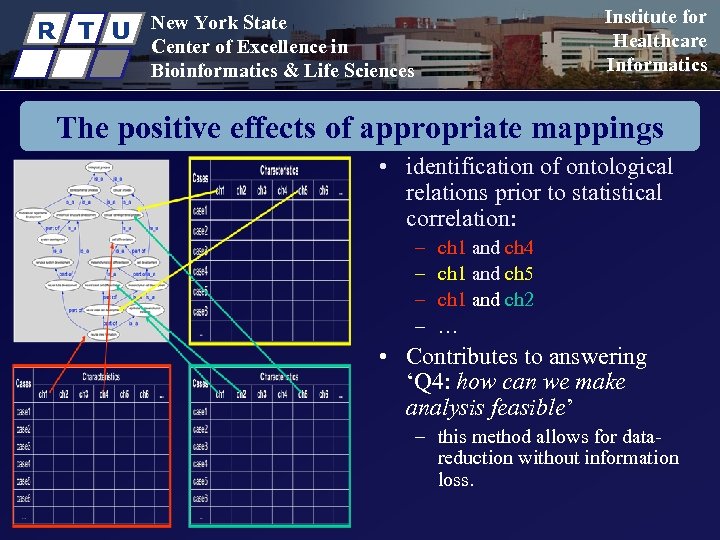 R T U Institute for Healthcare Informatics New York State Center of Excellence in Bioinformatics & Life Sciences The positive effects of appropriate mappings • identification of ontological relations prior to statistical correlation: – – ch 1 and ch 4 ch 1 and ch 5 ch 1 and ch 2 … • Contributes to answering ‘Q 4: how can we make analysis feasible’ – this method allows for datareduction without information loss.
 R T U New York State Center of Excellence in Bioinformatics & Life Sciences Institute for Healthcare Informatics Linking the instruments and other tools • analyze data dictionaries, assessment instruments, study criteria and corresponding terminologies, • build realism-based application ontologies to link these sources to realism-based reference ontologies.
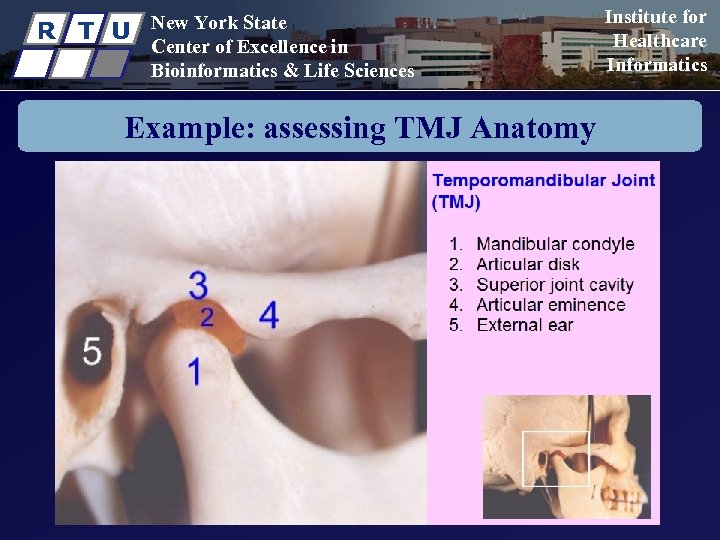 R T U New York State Center of Excellence in Bioinformatics & Life Sciences Example: assessing TMJ Anatomy Institute for Healthcare Informatics
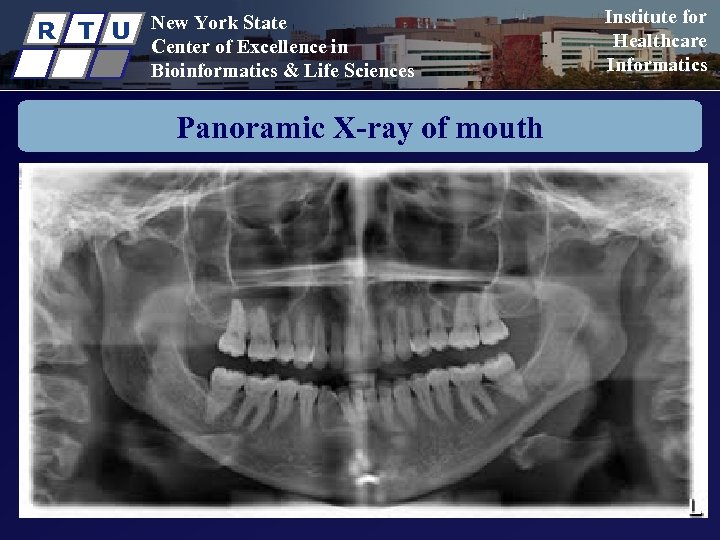 R T U New York State Center of Excellence in Bioinformatics & Life Sciences Panoramic X-ray of mouth Institute for Healthcare Informatics
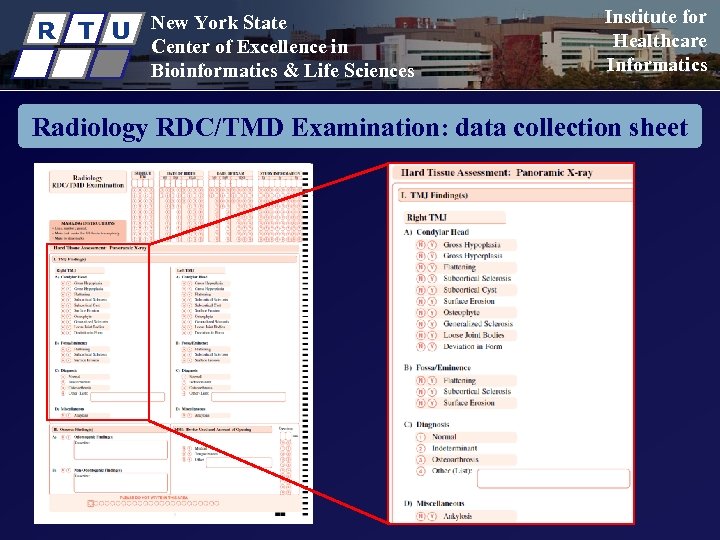 R T U New York State Center of Excellence in Bioinformatics & Life Sciences Institute for Healthcare Informatics Radiology RDC/TMD Examination: data collection sheet
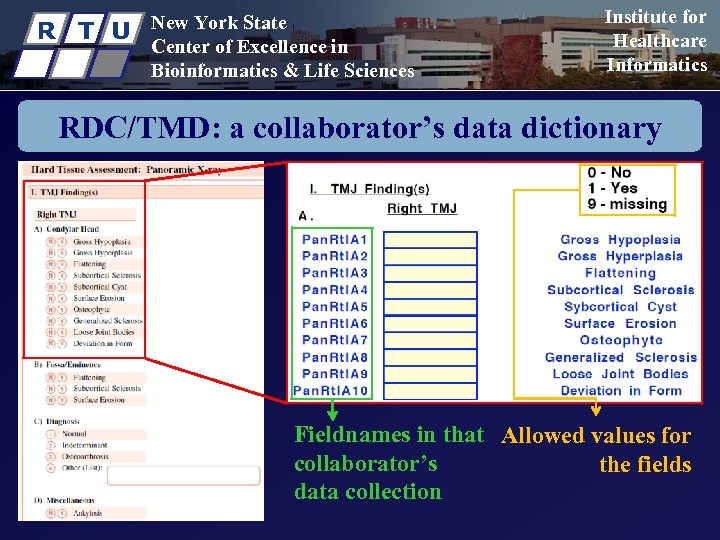 R T U New York State Center of Excellence in Bioinformatics & Life Sciences Institute for Healthcare Informatics RDC/TMD: a collaborator’s data dictionary Fieldnames in that Allowed values for collaborator’s the fields data collection
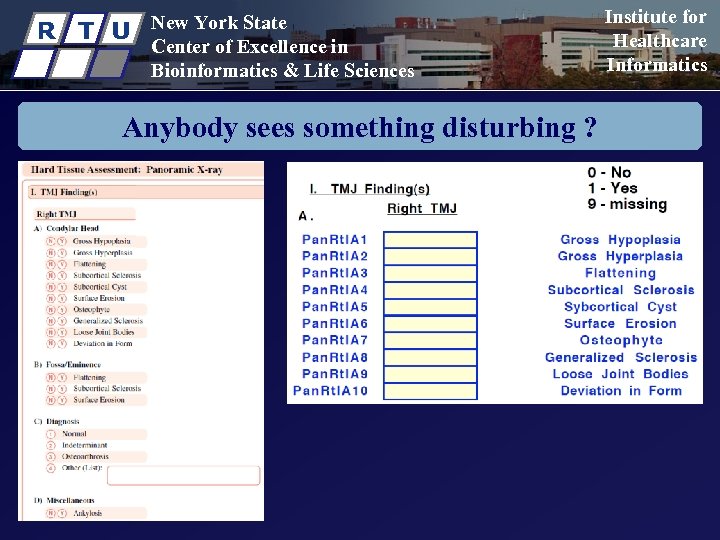 R T U New York State Center of Excellence in Bioinformatics & Life Sciences Anybody sees something disturbing ? Institute for Healthcare Informatics
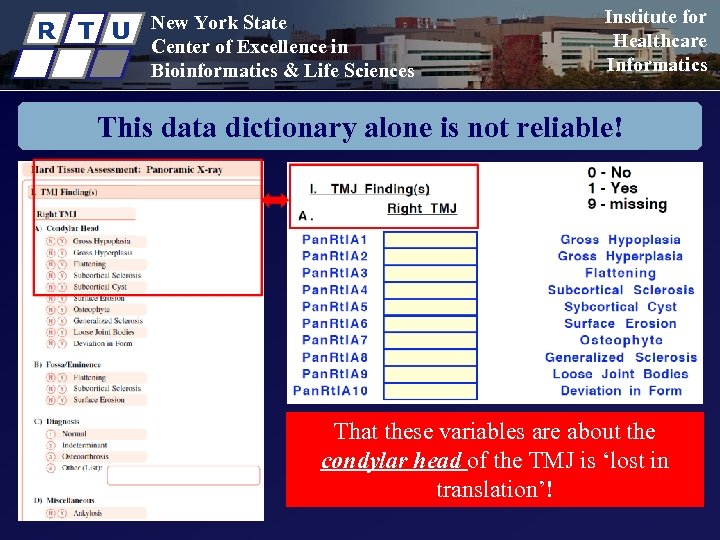 R T U New York State Center of Excellence in Bioinformatics & Life Sciences Institute for Healthcare Informatics This data dictionary alone is not reliable! That these variables are about the condylar head of the TMJ is ‘lost in translation’!
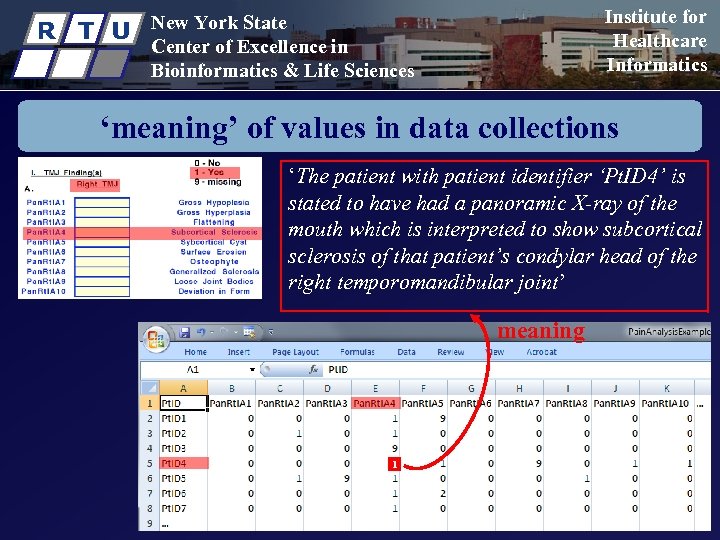 R T U Institute for Healthcare Informatics New York State Center of Excellence in Bioinformatics & Life Sciences ‘meaning’ of values in data collections ‘The patient with patient identifier ‘Pt. ID 4’ is stated to have had a panoramic X-ray of the mouth which is interpreted to show subcortical sclerosis of that patient’s condylar head of the right temporomandibular joint’ meaning 1
 R T U New York State Center of Excellence in Bioinformatics & Life Sciences Institute for Healthcare Informatics Objectives of the ‘sources’ analysis • Find for each value V in the data collections all possible configurations of entities (according to our best scientific understanding) for which the following can be true: – V – ‘it is stated that V’ • Describe these possible configurations by means of sentences from a formal language that mimic the structure of reality.
 R T U New York State Center of Excellence in Bioinformatics & Life Sciences Institute for Healthcare Informatics Objectives of the ‘sources’ analysis (2) • For example, – for the value stating that ‘The patient with patient identifier ‘Pt. ID 4’ has had a panoramic X-ray of the mouth which is interpreted to show subcortical sclerosis of that patient’s condylar head of the right temporomandibular joint’ to be true, – this statement must have been made, – for the statement to be true, there must have been that patient, an X-ray, etc, … – BUT! It is not necessarily true that patient has indeed the sclerosis as diagnosed.
 R T U New York State Center of Excellence in Bioinformatics & Life Sciences Institute for Healthcare Informatics Methodology (1): for the 1 st order reality 1. Formulate for each variable in the data collection a sentence explaining as accurately as possible what the variable stands for, 2. list the entities in reality that the terms in the sentence denote, 3. list recursively for all entities listed further entities that ontologically must exist for the entity under scrutiny to exist, 4. classify all entities in terms of realism-based ontologies (RBO), 5. specify all obtaining relationships between these entities, 6. outline all possible configurations of such entities for the sentence to be true.
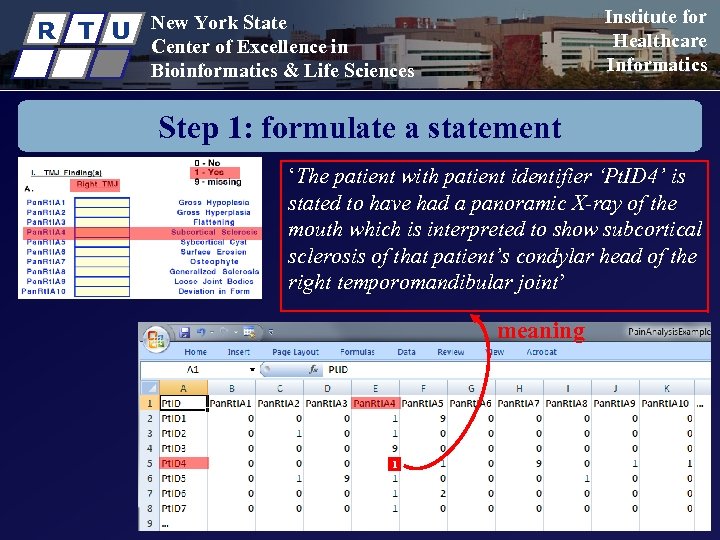 R T U Institute for Healthcare Informatics New York State Center of Excellence in Bioinformatics & Life Sciences Step 1: formulate a statement ‘The patient with patient identifier ‘Pt. ID 4’ is stated to have had a panoramic X-ray of the mouth which is interpreted to show subcortical sclerosis of that patient’s condylar head of the right temporomandibular joint’ meaning 1
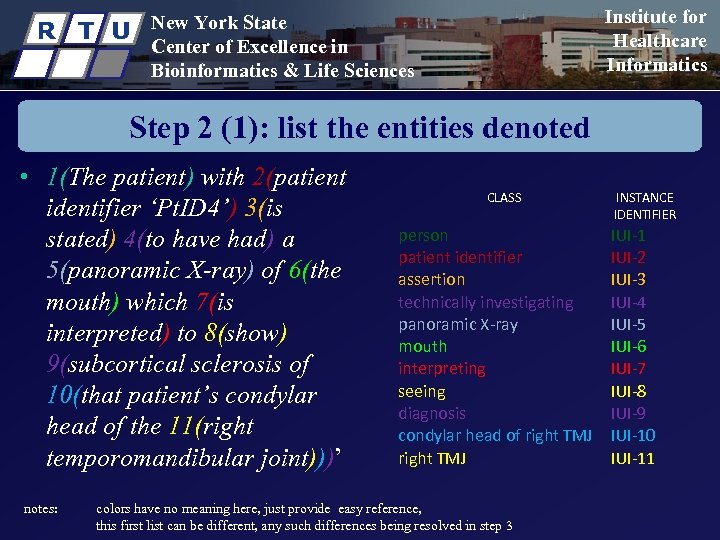 R T U Institute for Healthcare Informatics New York State Center of Excellence in Bioinformatics & Life Sciences Step 2 (1): list the entities denoted • 1(The patient) with 2(patient identifier ‘Pt. ID 4’) 3(is stated) 4(to have had) a 5(panoramic X-ray) of 6(the mouth) which 7(is interpreted) to 8(show) 9(subcortical sclerosis of 10(that patient’s condylar head of the 11(right temporomandibular joint)))’ notes: CLASS person patient identifier assertion technically investigating panoramic X-ray mouth interpreting seeing diagnosis condylar head of right TMJ colors have no meaning here, just provide easy reference, this first list can be different, any such differences being resolved in step 3 INSTANCE IDENTIFIER IUI-1 IUI-2 IUI-3 IUI-4 IUI-5 IUI-6 IUI-7 IUI-8 IUI-9 IUI-10 IUI-11
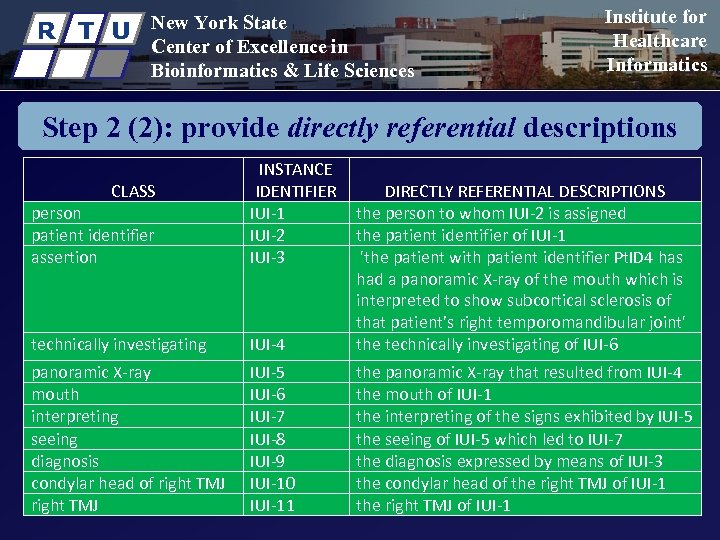 R T U New York State Center of Excellence in Bioinformatics & Life Sciences Institute for Healthcare Informatics Step 2 (2): provide directly referential descriptions person patient identifier assertion INSTANCE IDENTIFIER IUI-1 IUI-2 IUI-3 technically investigating IUI-4 DIRECTLY REFERENTIAL DESCRIPTIONS the person to whom IUI-2 is assigned the patient identifier of IUI-1 'the patient with patient identifier Pt. ID 4 has had a panoramic X-ray of the mouth which is interpreted to show subcortical sclerosis of that patient’s right temporomandibular joint' the technically investigating of IUI-6 panoramic X-ray mouth interpreting seeing diagnosis condylar head of right TMJ IUI-5 IUI-6 IUI-7 IUI-8 IUI-9 IUI-10 IUI-11 the panoramic X-ray that resulted from IUI-4 the mouth of IUI-1 the interpreting of the signs exhibited by IUI-5 the seeing of IUI-5 which led to IUI-7 the diagnosis expressed by means of IUI-3 the condylar head of the right TMJ of IUI-1 CLASS
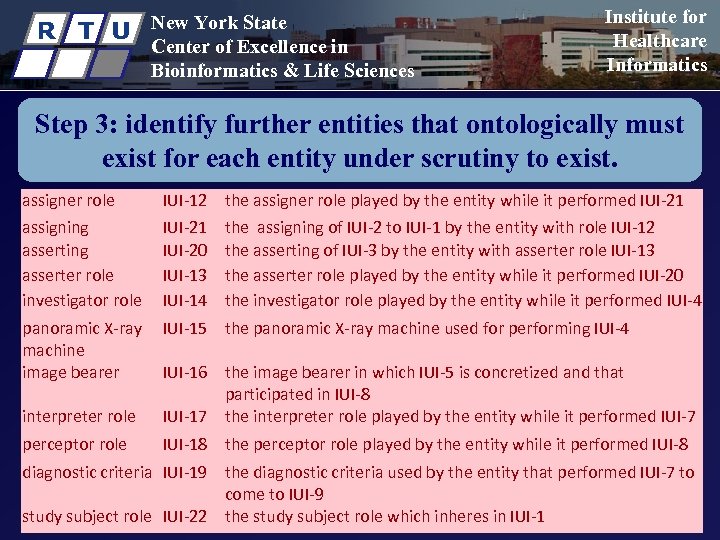 R T U New York State Center of Excellence in Bioinformatics & Life Sciences Institute for Healthcare Informatics Step 3: identify further entities that ontologically must exist for each entity under scrutiny to exist. assigner role assigning asserter role investigator role IUI-12 IUI-21 IUI-20 IUI-13 IUI-14 the assigner role played by the entity while it performed IUI-21 the assigning of IUI-2 to IUI-1 by the entity with role IUI-12 the asserting of IUI-3 by the entity with asserter role IUI-13 the asserter role played by the entity while it performed IUI-20 the investigator role played by the entity while it performed IUI-4 panoramic X-ray machine image bearer IUI-15 the panoramic X-ray machine used for performing IUI-4 interpreter role IUI-16 the image bearer in which IUI-5 is concretized and that participated in IUI-8 IUI-17 the interpreter role played by the entity while it performed IUI-7 perceptor role IUI-18 the perceptor role played by the entity while it performed IUI-8 diagnostic criteria IUI-19 the diagnostic criteria used by the entity that performed IUI-7 to come to IUI-9 study subject role IUI-22 the study subject role which inheres in IUI-1
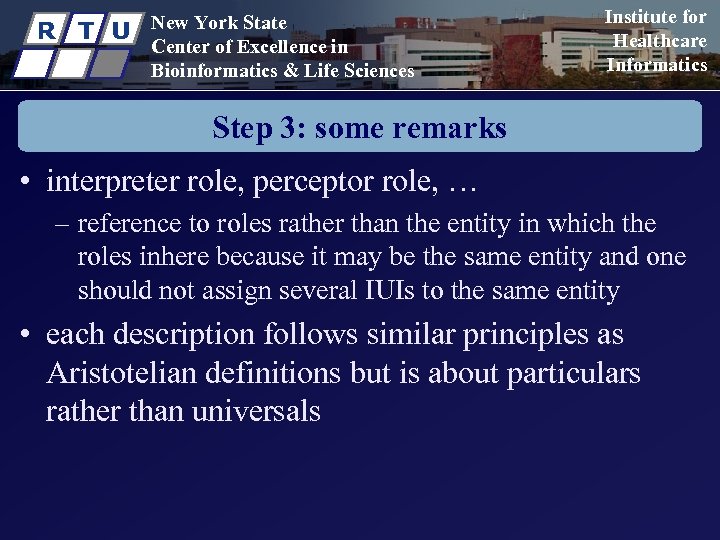 R T U New York State Center of Excellence in Bioinformatics & Life Sciences Institute for Healthcare Informatics Step 3: some remarks • interpreter role, perceptor role, … – reference to roles rather than the entity in which the roles inhere because it may be the same entity and one should not assign several IUIs to the same entity • each description follows similar principles as Aristotelian definitions but is about particulars rather than universals
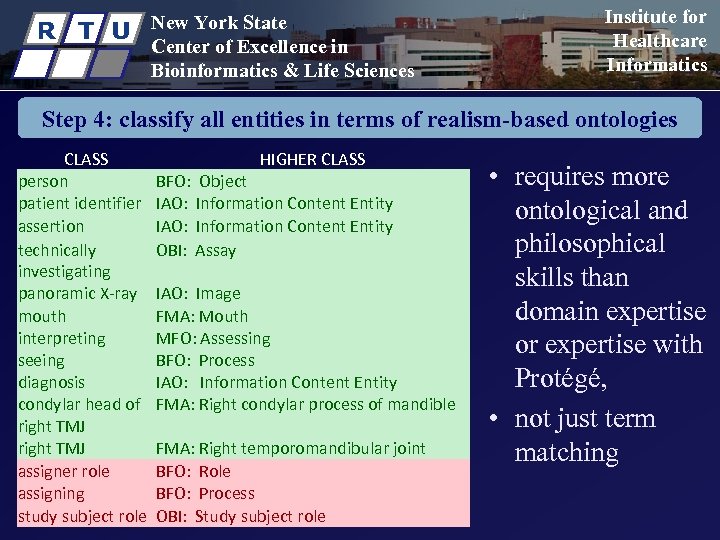 R T U New York State Center of Excellence in Bioinformatics & Life Sciences Institute for Healthcare Informatics Step 4: classify all entities in terms of realism-based ontologies CLASS person patient identifier assertion technically investigating panoramic X-ray mouth interpreting seeing diagnosis condylar head of right TMJ assigner role assigning study subject role HIGHER CLASS BFO: Object IAO: Information Content Entity OBI: Assay IAO: Image FMA: Mouth MFO: Assessing BFO: Process IAO: Information Content Entity FMA: Right condylar process of mandible FMA: Right temporomandibular joint BFO: Role BFO: Process OBI: Study subject role • requires more ontological and philosophical skills than domain expertise or expertise with Protégé, • not just term matching
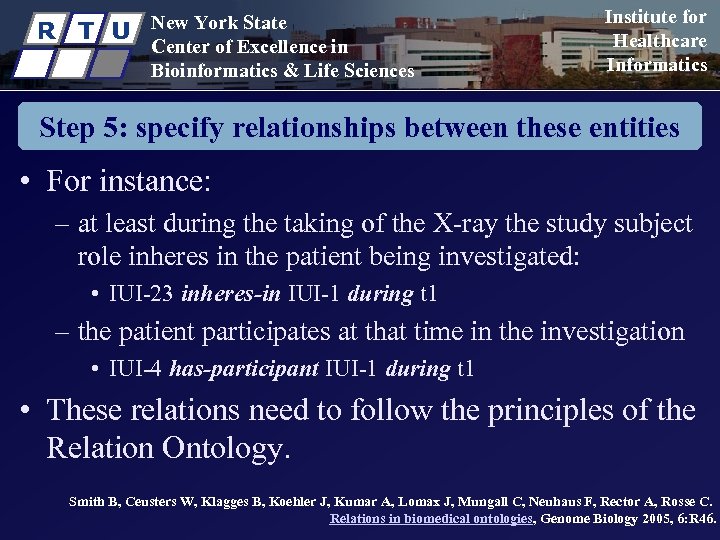 R T U New York State Center of Excellence in Bioinformatics & Life Sciences Institute for Healthcare Informatics Step 5: specify relationships between these entities • For instance: – at least during the taking of the X-ray the study subject role inheres in the patient being investigated: • IUI-23 inheres-in IUI-1 during t 1 – the patient participates at that time in the investigation • IUI-4 has-participant IUI-1 during t 1 • These relations need to follow the principles of the Relation Ontology. Smith B, Ceusters W, Klagges B, Koehler J, Kumar A, Lomax J, Mungall C, Neuhaus F, Rector A, Rosse C. Relations in biomedical ontologies, Genome Biology 2005, 6: R 46.
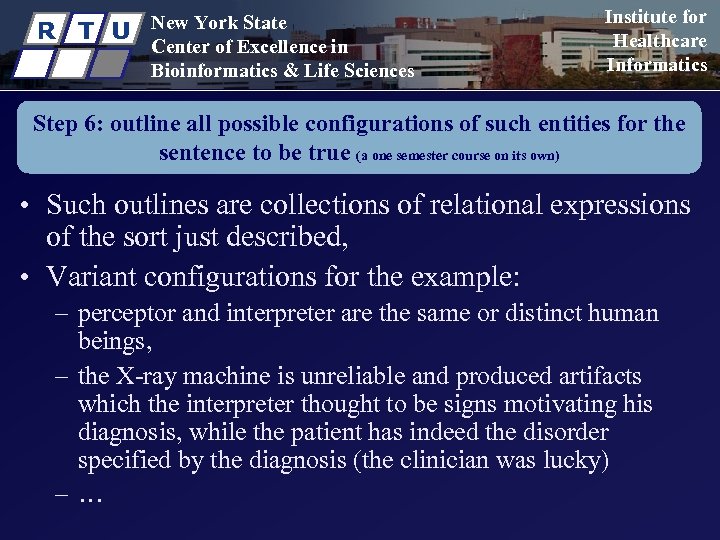 R T U New York State Center of Excellence in Bioinformatics & Life Sciences Institute for Healthcare Informatics Step 6: outline all possible configurations of such entities for the sentence to be true (a one semester course on its own) • Such outlines are collections of relational expressions of the sort just described, • Variant configurations for the example: – perceptor and interpreter are the same or distinct human beings, – the X-ray machine is unreliable and produced artifacts which the interpreter thought to be signs motivating his diagnosis, while the patient has indeed the disorder specified by the diagnosis (the clinician was lucky) –…
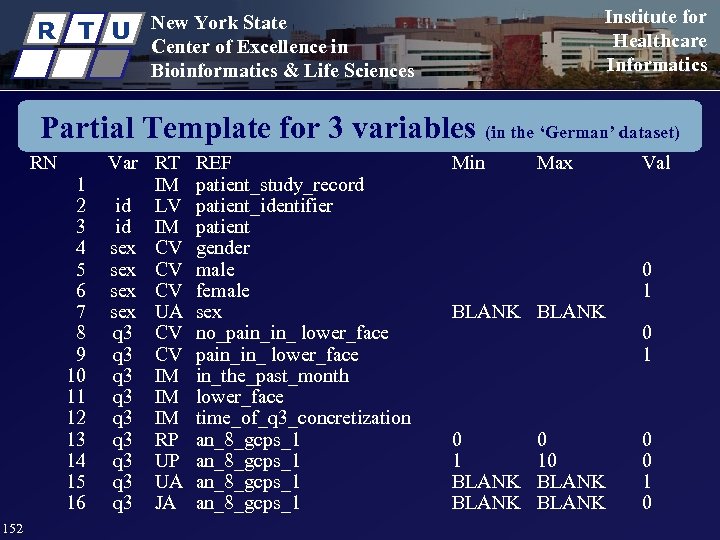
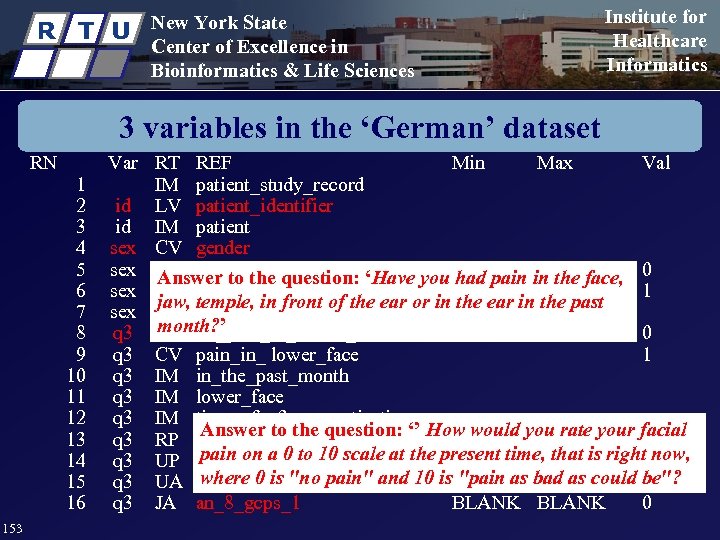
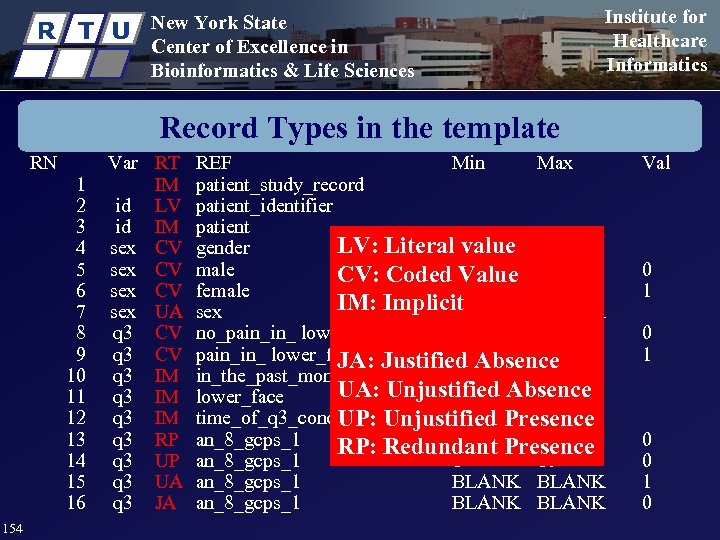
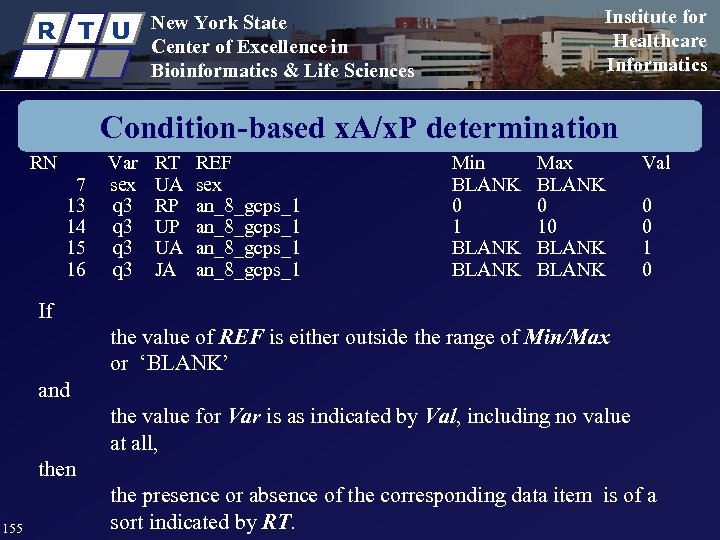
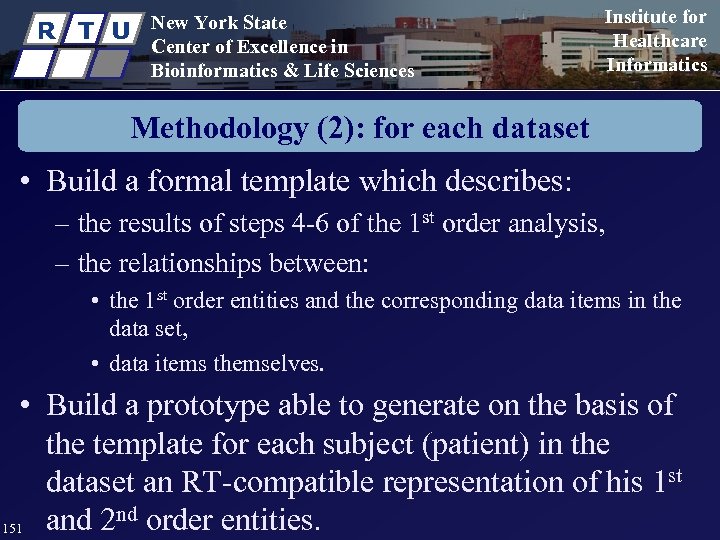 R T U New York State Center of Excellence in Bioinformatics & Life Sciences Institute for Healthcare Informatics Methodology (2): for each dataset • Build a formal template which describes: – the results of steps 4 -6 of the 1 st order analysis, – the relationships between: • the 1 st order entities and the corresponding data items in the data set, • data items themselves. • Build a prototype able to generate on the basis of the template for each subject (patient) in the dataset an RT-compatible representation of his 1 st and 2 nd order entities. 151
 R T U Institute for Healthcare Informatics New York State Center of Excellence in Bioinformatics & Life Sciences Partial Template for 3 variables (in the ‘German’ dataset) RN 152 1 2 3 4 5 6 7 8 9 10 11 12 13 14 15 16 Var RT IM id LV id IM sex CV sex UA q 3 CV q 3 IM q 3 RP q 3 UA q 3 JA REF patient_study_record patient_identifier patient gender male female sex no_pain_in_ lower_face in_the_past_month lower_face time_of_q 3_concretization an_8_gcps_1 Min Max BLANK 0 10 BLANK Val 0 1 0
 R T U New York State Center of Excellence in Bioinformatics & Life Sciences Institute for Healthcare Informatics 3 variables in the ‘German’ dataset RN 153 1 2 3 4 5 6 7 8 9 10 11 12 13 14 15 16 Var RT REF Min Max Val IM patient_study_record id LV patient_identifier id IM patient sex CV gender sex CV male the question: ‘Have you had pain in the face, 0 Answer to sex CV female 1 jaw, sex temple, in front of the ear or in. BLANKin BLANK the ear the past sex UA month? ’ q 3 CV no_pain_in_ lower_face 0 q 3 CV pain_in_ lower_face 1 q 3 IM in_the_past_month q 3 IM lower_face q 3 IM time_of_q 3_concretization Answer to the q 3 RP an_8_gcps_1 question: ‘’ How would you rate your facial 0 0 0 pain on a 0 to 10 scale at the present time, that is right now, q 3 UP an_8_gcps_1 1 10 0 where 0 is "no "pain as BLANK q 3 UA an_8_gcps_1 pain" and 10 is. BLANK bad as could be"? 1 q 3 JA an_8_gcps_1 BLANK 0
 R T U New York State Center of Excellence in Bioinformatics & Life Sciences Institute for Healthcare Informatics Record Types in the template RN 154 1 2 3 4 5 6 7 8 9 10 11 12 13 14 15 16 Var RT IM id LV id IM sex CV sex UA q 3 CV q 3 IM q 3 RP q 3 UA q 3 JA REF Min Max patient_study_record patient_identifier patient LV: Literal value gender male CV: Coded Value female IM: Implicit sex BLANK no_pain_in_ lower_face Justified Absence JA: in_the_past_month UA: Unjustified Absence lower_face time_of_q 3_concretization UP: Unjustified Presence an_8_gcps_1 0 0 RP: Redundant Presence an_8_gcps_1 1 10 an_8_gcps_1 BLANK Val 0 1 0
 R T U Institute for Healthcare Informatics New York State Center of Excellence in Bioinformatics & Life Sciences Condition-based x. A/x. P determination RN 7 13 14 15 16 Var sex q 3 q 3 RT UA RP UP UA JA REF sex an_8_gcps_1 Min BLANK 0 1 BLANK Max BLANK 0 10 BLANK Val 0 0 1 0 If the value of REF is either outside the range of Min/Max or ‘BLANK’ and the value for Var is as indicated by Val, including no value at all, then 155 the presence or absence of the corresponding data item is of a sort indicated by RT.
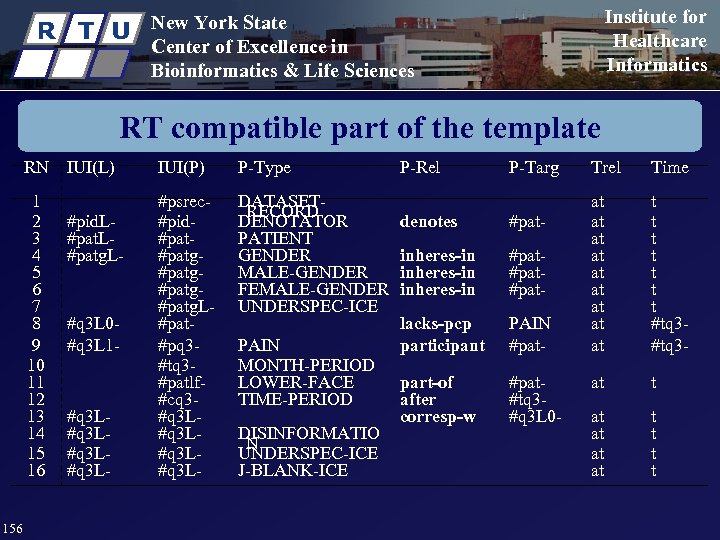 R T U Institute for Healthcare Informatics New York State Center of Excellence in Bioinformatics & Life Sciences RT compatible part of the template RN 1 2 3 4 5 6 7 8 9 10 11 12 13 14 15 16 156 IUI(L) #pid. L#patg. L- #q 3 L 0#q 3 L 1 - #q 3 L#q 3 L- IUI(P) P-Type #psrec#pid#patg#patg#patg. L#pat#pq 3#tq 3#patlf#cq 3#q 3 L#q 3 L- DATASETRECORD DENOTATOR PATIENT GENDER MALE-GENDER FEMALE-GENDER UNDERSPEC-ICE PAIN MONTH-PERIOD LOWER-FACE TIME-PERIOD DISINFORMATIO N UNDERSPEC-ICE J-BLANK-ICE P-Rel P-Targ denotes #pat- inheres-in #pat#pat- lacks-pcp participant PAIN #pat- part-of after corresp-w #pat#tq 3#q 3 L 0 - Trel Time at at at t t t #tq 3 - at t at at t t
 R T U New York State Center of Excellence in Bioinformatics & Life Sciences Institute for Healthcare Informatics Conclusion • Realism-based ontology has a lot to offer to make data collections comparable and unambiguously understandable. • It is hard ! • How far one needs to go depends on the purposes. – ideally: an analysis should be such that it can accommodate ALL purposes, i. e. the analysis should be independent of any purpose; • distinction between reference ontologies and application ontologies.