 Скачать презентацию Quiz 4 Answers November 8 2013 At
1a6421ad00da1e28310a6e27956a3b25.ppt
- Количество слайдов: 26



Quiz 4 Answers November 8, 2013
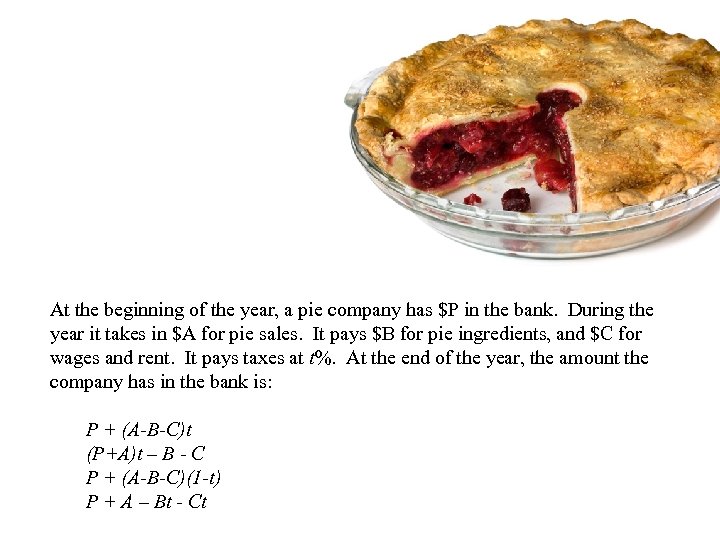
At the beginning of the year, a pie company has $P in the bank. During the year it takes in $A for pie sales. It pays $B for pie ingredients, and $C for wages and rent. It pays taxes at t%. At the end of the year, the amount the company has in the bank is: P + (A-B-C)t (P+A)t – B - C P + (A-B-C)(1 -t) P + A – Bt - Ct
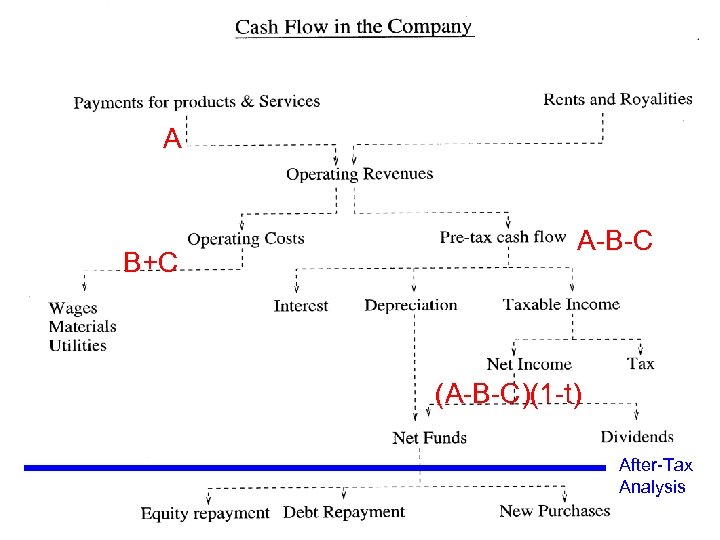
A B+C A-B-C (A-B-C)(1 -t) After-Tax Analysis
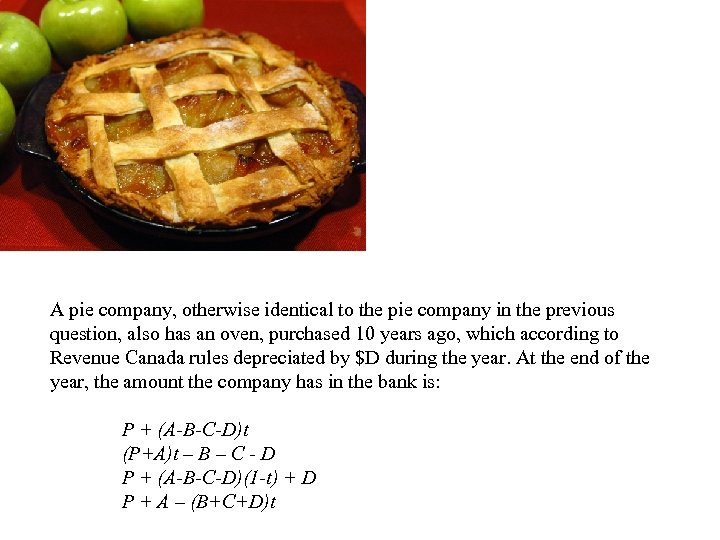
A pie company, otherwise identical to the pie company in the previous question, also has an oven, purchased 10 years ago, which according to Revenue Canada rules depreciated by $D during the year. At the end of the year, the amount the company has in the bank is: P + (A-B-C-D)t (P+A)t – B – C - D P + (A-B-C-D)(1 -t) + D P + A – (B+C+D)t
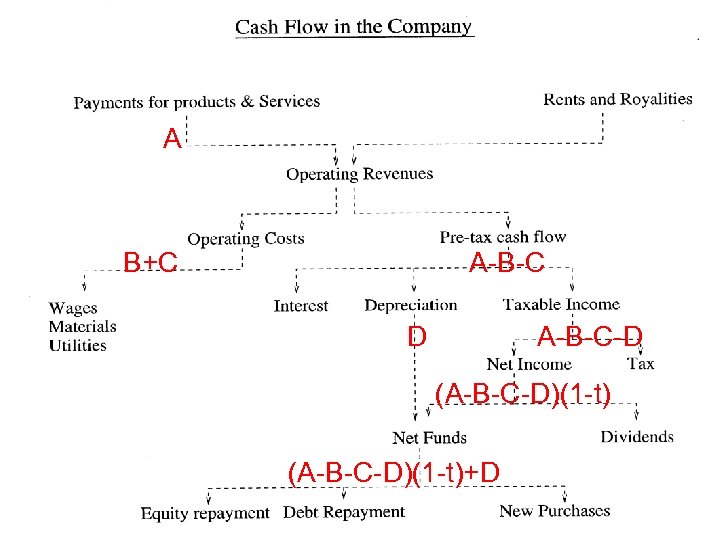
A B+C A-B-C D A-B-C-D (A-B-C-D)(1 -t)+D
Yet a third pie company starts off the year with $P. It sells $A in pies, and pays no wages or rent, but it does buys an oven for $F. If Revenue Canada allows ovens to depreciate at d% per year, at the end of the year, the amount the company has in the bank is: P + A(1 -t) - F P + (A-F)(1 -t) P +A(1 -t) –F(CTF) P + (A-Fd/2)(1 -t) – F + Fd/2
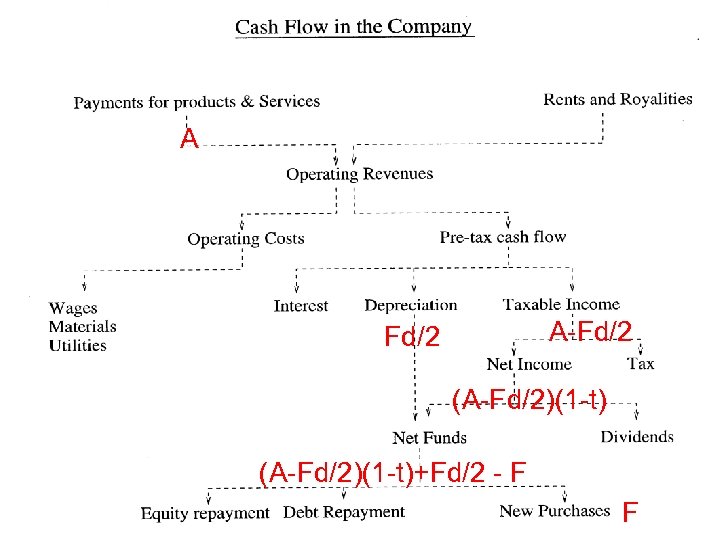
A A-Fd/2 (A-Fd/2)(1 -t)+Fd/2 - F F
A fourth pie company starts the year with $P and an oven whose undepreciated capital cost (UCC) is $G. It sells $A in pies, and pays no wages or rent, but it does sell the oven for $G. At the end of the year, the amount the company has in the bank is: P + A(1 -t) + G P + A + G(CSF) P + A(1 -t) + G(CTF) P + (A+G)(1 -t)
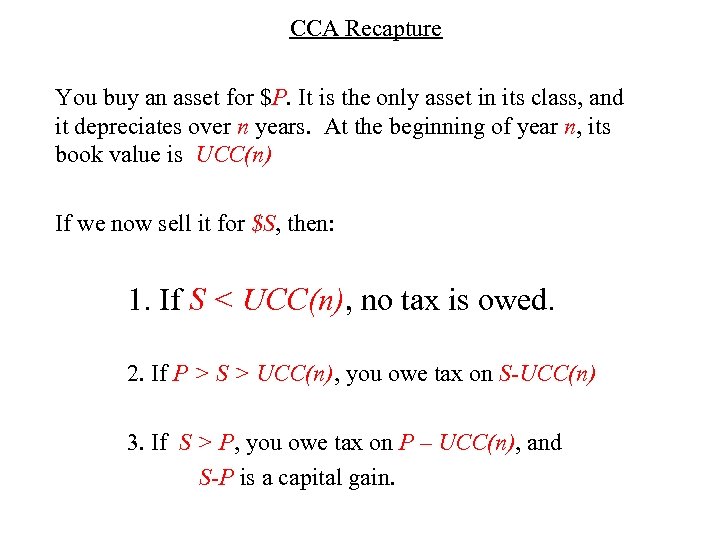
CCA Recapture You buy an asset for $P. It is the only asset in its class, and it depreciates over n years. At the beginning of year n, its book value is UCC(n) If we now sell it for $S, then: 1. If S < UCC(n), no tax is owed. 2. If P > S > UCC(n), you owe tax on S-UCC(n) 3. If S > P, you owe tax on P – UCC(n), and S-P is a capital gain.
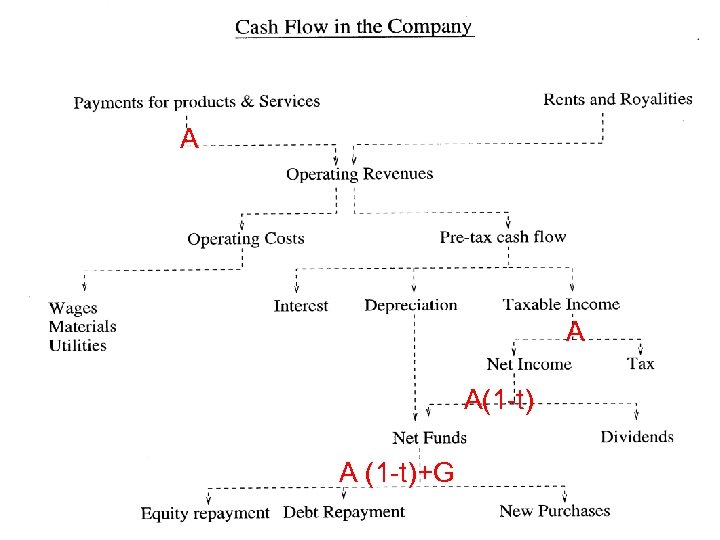
A A A(1 -t) A (1 -t)+G
A fifth pie company starts the year with $P and an oven whose undepreciated capital cost (UCC) is $G. (This oven was originally bought for $3 G. ) It sells $A in pies, and pays no wages or rent, but it does sell the oven for $2 G. At the end of the year, the amount the company has in the bank is: P + A(1 -t) + 2 G P + A + 2 G(CSF) P + A(1 -t) + 2 G(CSF) P + (A+G)(1 -t) + G
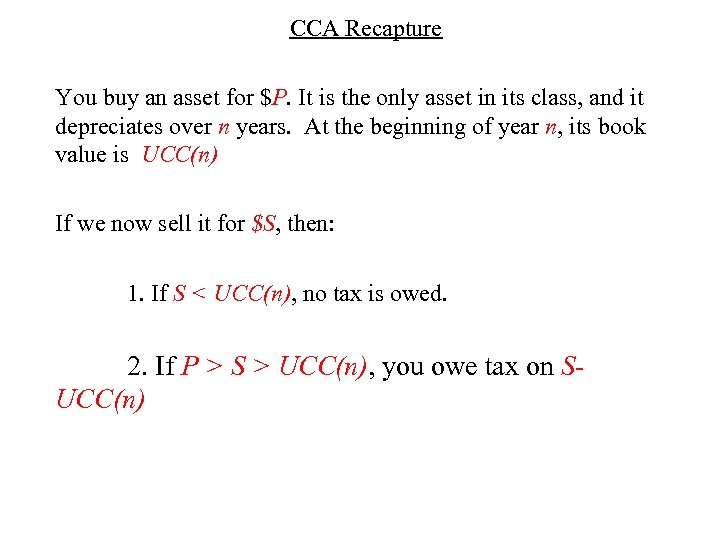
CCA Recapture You buy an asset for $P. It is the only asset in its class, and it depreciates over n years. At the beginning of year n, its book value is UCC(n) If we now sell it for $S, then: 1. If S < UCC(n), no tax is owed. 2. If P > S > UCC(n), you owe tax on SUCC(n)
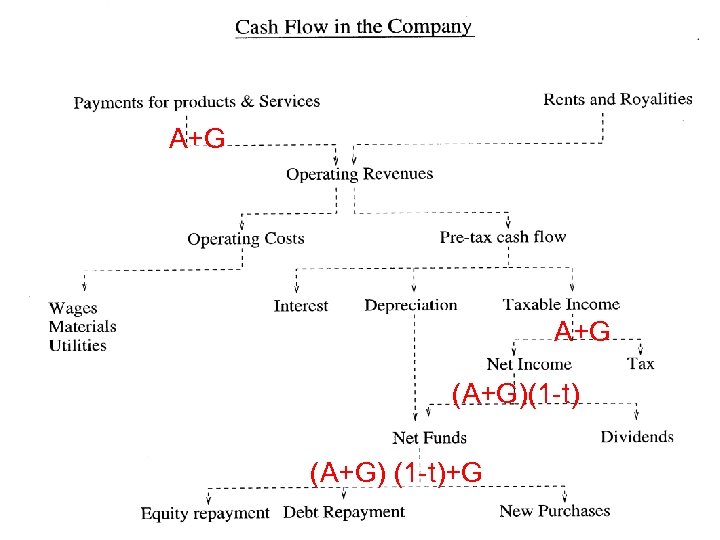
A+G (A+G)(1 -t) (A+G) (1 -t)+G
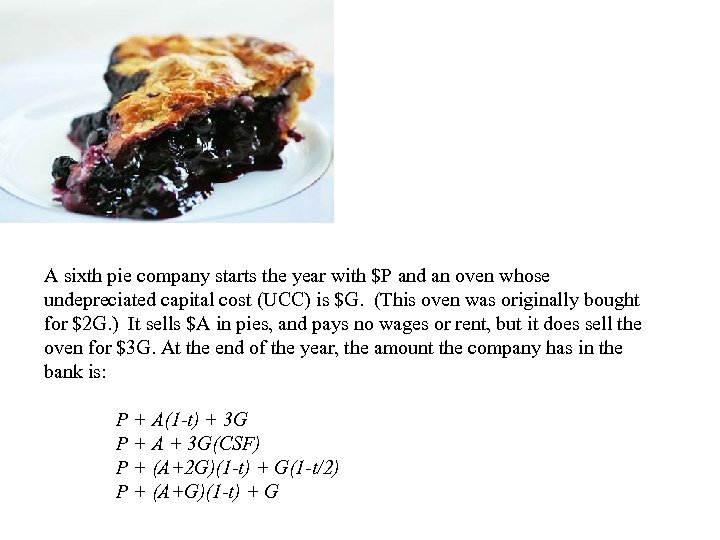
A sixth pie company starts the year with $P and an oven whose undepreciated capital cost (UCC) is $G. (This oven was originally bought for $2 G. ) It sells $A in pies, and pays no wages or rent, but it does sell the oven for $3 G. At the end of the year, the amount the company has in the bank is: P + A(1 -t) + 3 G P + A + 3 G(CSF) P + (A+2 G)(1 -t) + G(1 -t/2) P + (A+G)(1 -t) + G
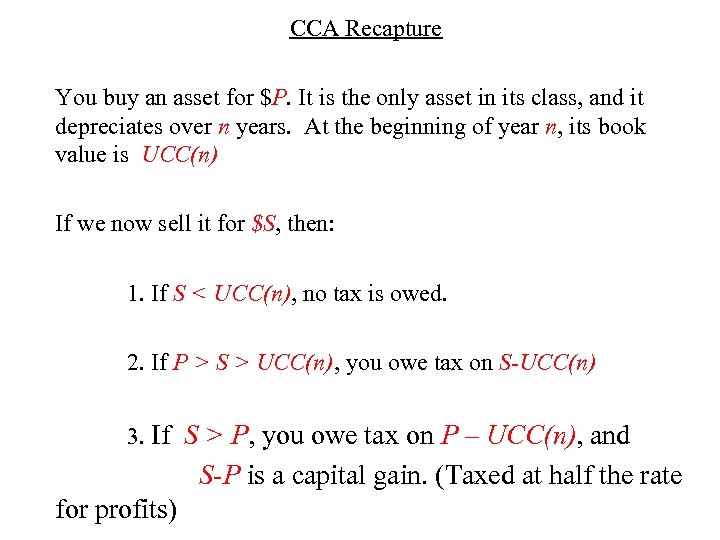
CCA Recapture You buy an asset for $P. It is the only asset in its class, and it depreciates over n years. At the beginning of year n, its book value is UCC(n) If we now sell it for $S, then: 1. If S < UCC(n), no tax is owed. 2. If P > S > UCC(n), you owe tax on S-UCC(n) 3. If S > P, you owe tax on P – UCC(n), and S-P is a capital gain. (Taxed at half the rate for profits)
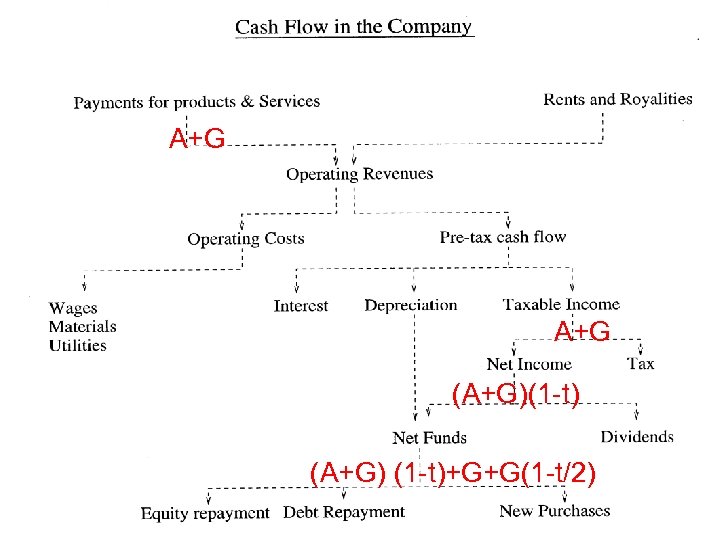
A+G (A+G)(1 -t) (A+G) (1 -t)+G+G(1 -t/2)
I have a profitable company, and have just calculated the CTF to be used in after-tax analyses of possible expansion plans. Now I learn that inflation is predicted to be higher than I expected during the coming few years. If I correct my calculations to take inflation into account, the inflation-adjusted CTF will be: Higher than the original CTF Lower than the original CTF Unchanged Can’t say without additional information
I have a profitable company, and have just calculated the CTF to be used in after-tax analyses of possible expansion plans. Now I learn that inflation is predicted to be higher than I expected during the coming few years. If I correct my calculations to take inflation into account, the inflation-adjusted CTF will be: Higher than the original CTF Lower than the original CTF Unchanged Can’t say without additional information
If the taxation rate for a company increases, the value of the CTF for that company will: Increase Decrease Remain the same Can’t tell without more information
If the taxation rate for a company increases, the value of the CTF for that company will: Increase Decrease Remain the same Can’t tell without more information
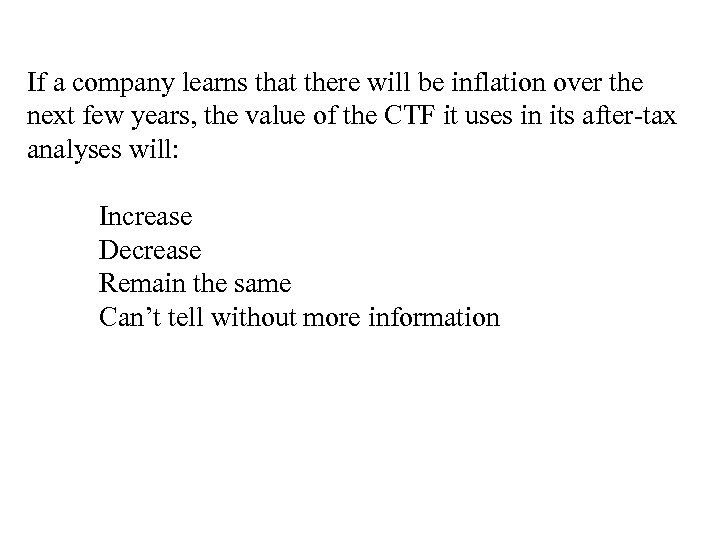
If a company learns that there will be inflation over the next few years, the value of the CTF it uses in its after-tax analyses will: Increase Decrease Remain the same Can’t tell without more information
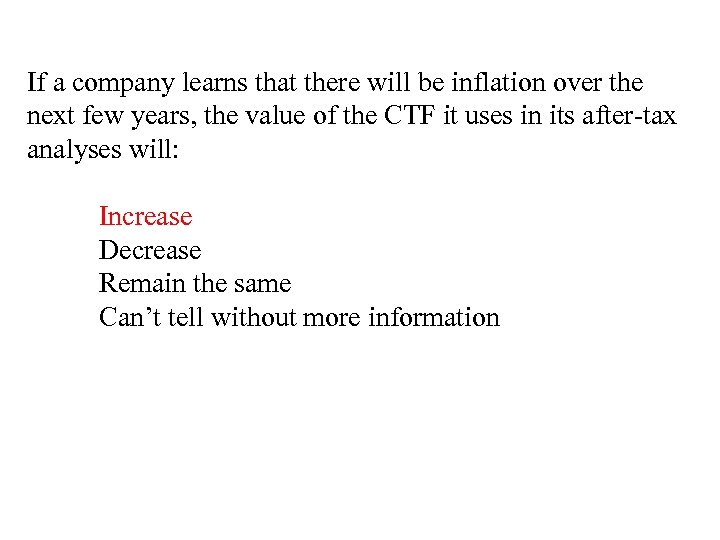
If a company learns that there will be inflation over the next few years, the value of the CTF it uses in its after-tax analyses will: Increase Decrease Remain the same Can’t tell without more information
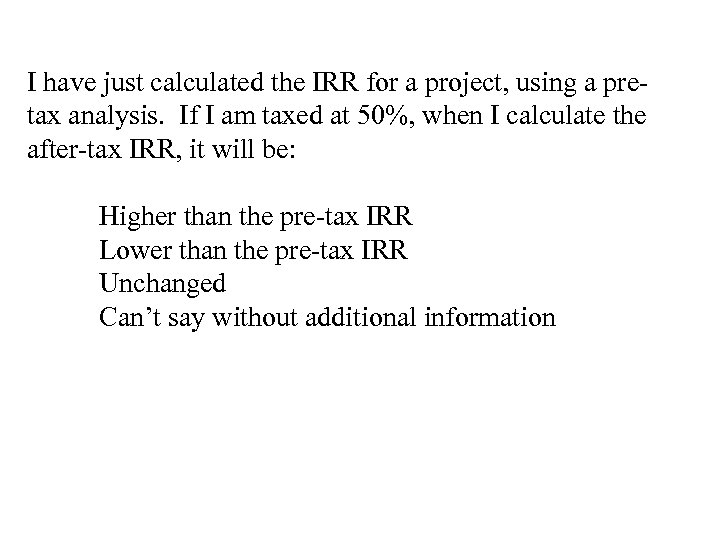
I have just calculated the IRR for a project, using a pretax analysis. If I am taxed at 50%, when I calculate the after-tax IRR, it will be: Higher than the pre-tax IRR Lower than the pre-tax IRR Unchanged Can’t say without additional information
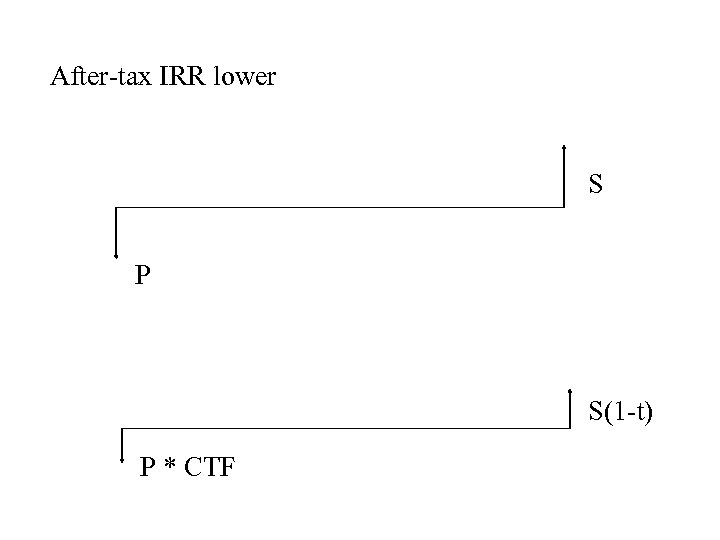
After-tax IRR lower S P S(1 -t) P * CTF
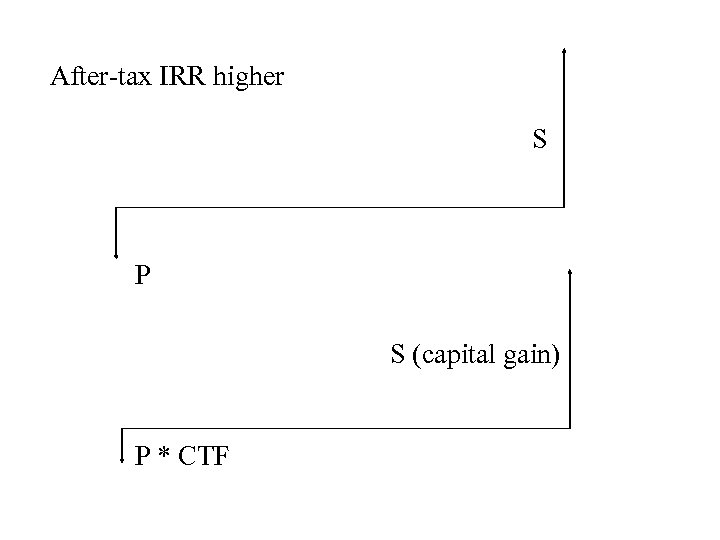
After-tax IRR higher S P S (capital gain) P * CTF
I have just calculated the IRR for a project, using a pretax analysis. If I am taxed at 50%, when I calculate the after-tax IRR, it will be: Higher than the pre-tax IRR Lower than the pre-tax IRR Unchanged Can’t say without additional information
Скачать презентацию Quiz 4 Answers November 8 2013 At
1a6421ad00da1e28310a6e27956a3b25.ppt