


 Скачать презентацию Quick Review 20 1 20 3 20 4
04a0cd8c8e480022e1b0edeb2867e8bd.ppt
- Количество слайдов: 85
 Quick Review 20. 1 20. 3 20. 4
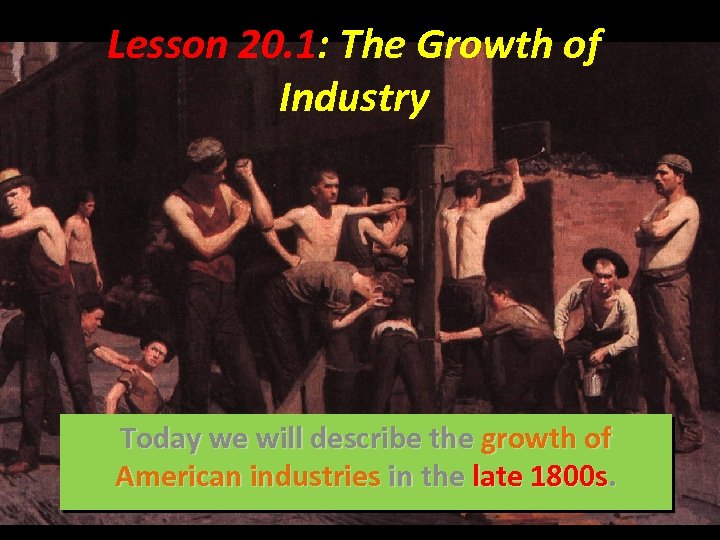 Lesson 20. 1: The Growth of Industry Today we will describe the growth of American industries in the late 1800 s.
 Vocabulary • patent – government document that gives an inventor exclusive rights to make or sell an invention • petroleum – oily flammable liquid that motor oil, gasoline, kerosene, and plastics are made from • business cycle – pattern of good times and bad times in the economy • demand or market – how many customers there are for a product
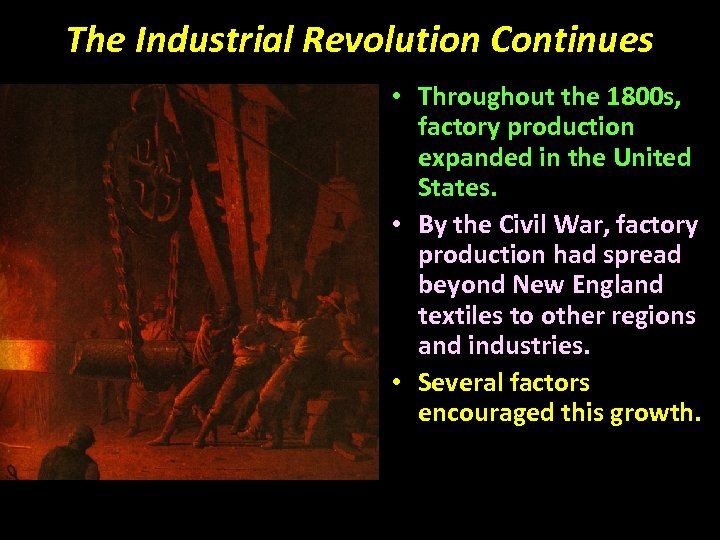 The Industrial Revolution Continues • Throughout the 1800 s, factory production expanded in the United States. • By the Civil War, factory production had spread beyond New England textiles to other regions and industries. • Several factors encouraged this growth.
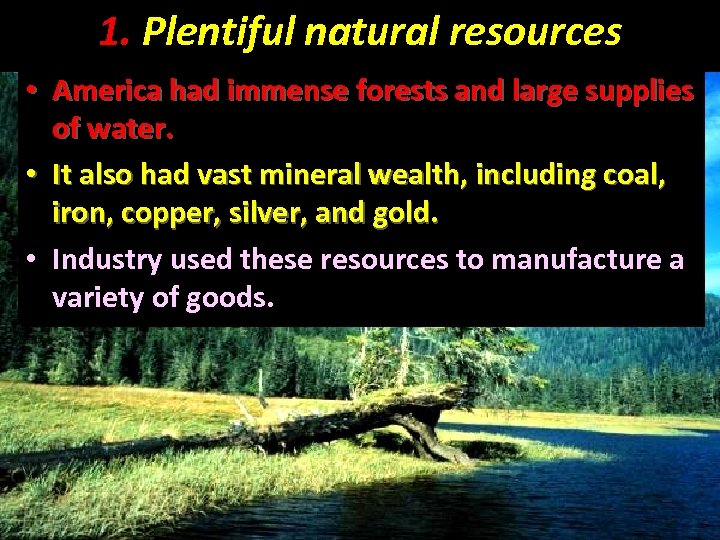 1. Plentiful natural resources • America had immense forests and large supplies of water. • It also had vast mineral wealth, including coal, iron, copper, silver, and gold. • Industry used these resources to manufacture a variety of goods.
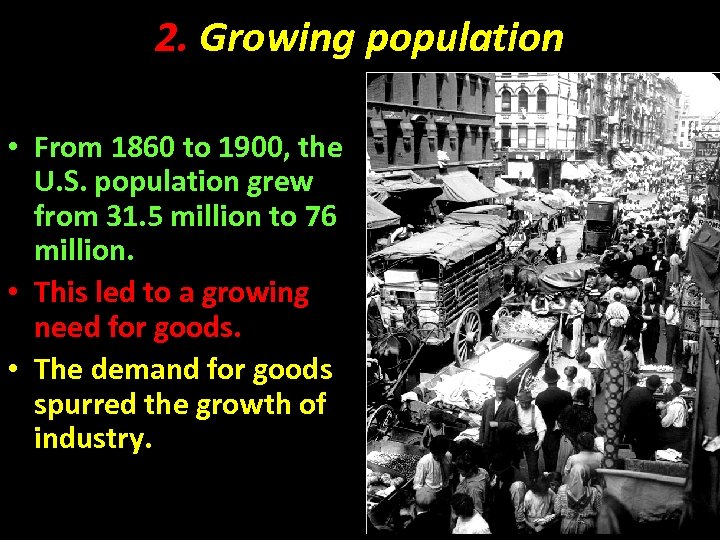 2. Growing population • From 1860 to 1900, the U. S. population grew from 31. 5 million to 76 million. • This led to a growing need for goods. • The demand for goods spurred the growth of industry.
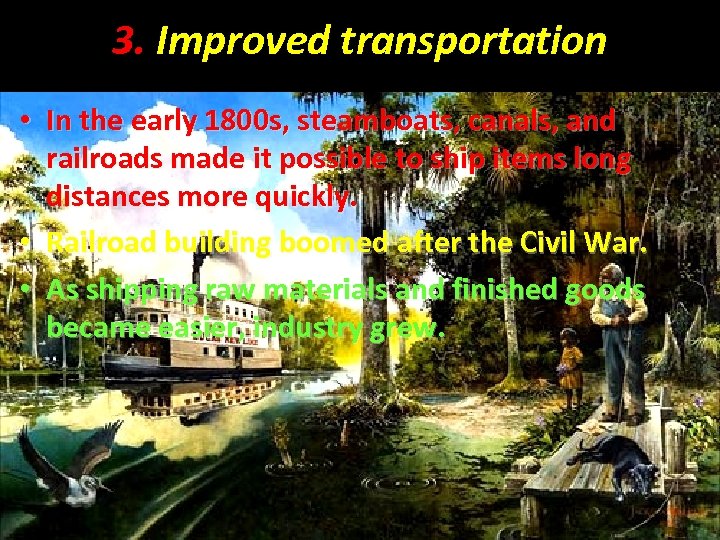 3. Improved transportation • In the early 1800 s, steamboats, canals, and railroads made it possible to ship items long distances more quickly. • Railroad building boomed after the Civil War. • As shipping raw materials and finished goods became easier, industry grew.
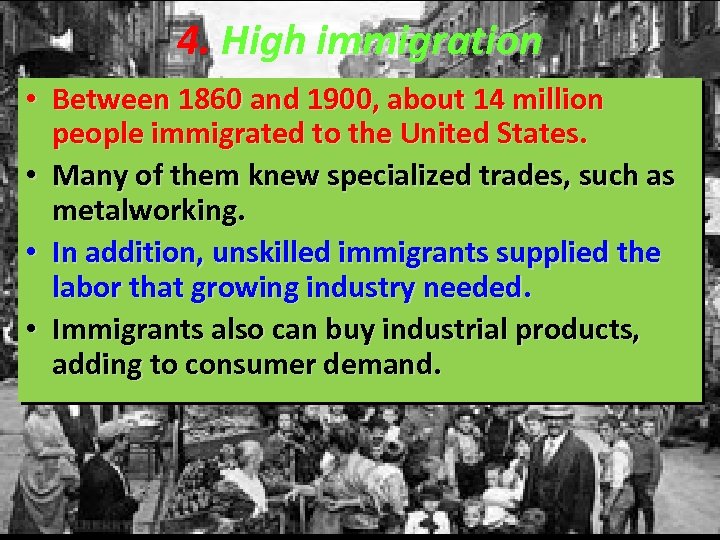 4. High immigration • Between 1860 and 1900, about 14 million people immigrated to the United States. • Many of them knew specialized trades, such as metalworking. • In addition, unskilled immigrants supplied the labor that growing industry needed. • Immigrants also can buy industrial products, adding to consumer demand.
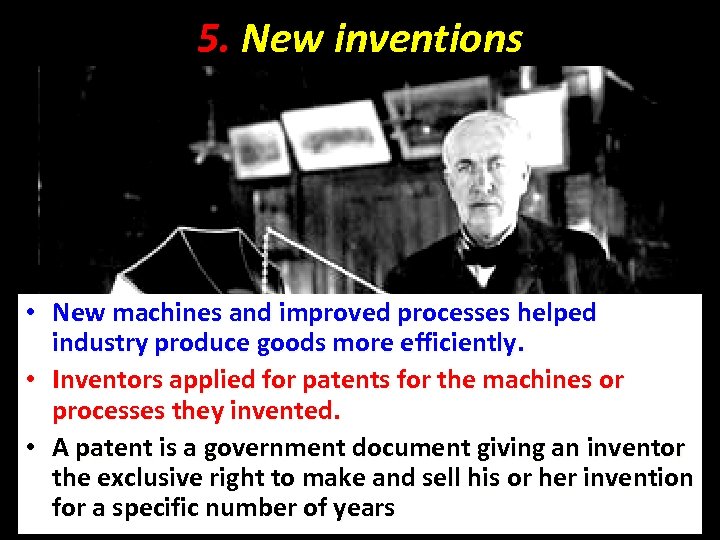 5. New inventions • New machines and improved processes helped industry produce goods more efficiently. • Inventors applied for patents for the machines or processes they invented. • A patent is a government document giving an inventor the exclusive right to make and sell his or her invention for a specific number of years
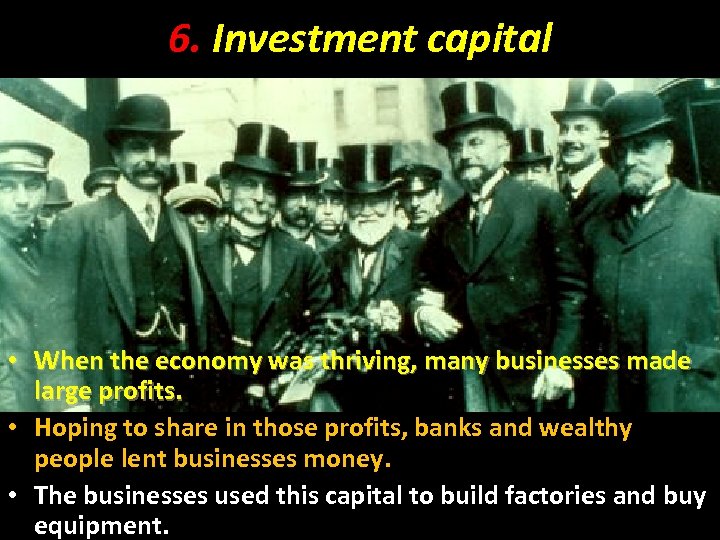 6. Investment capital • When the economy was thriving, many businesses made large profits. • Hoping to share in those profits, banks and wealthy people lent businesses money. • The businesses used this capital to build factories and buy equipment.
 7. Government assistance • Between 1860 and 1900 the United States imposed several tariffs on imported goods. • State and federal governments also used land grants and subsidies to help businesses grow.
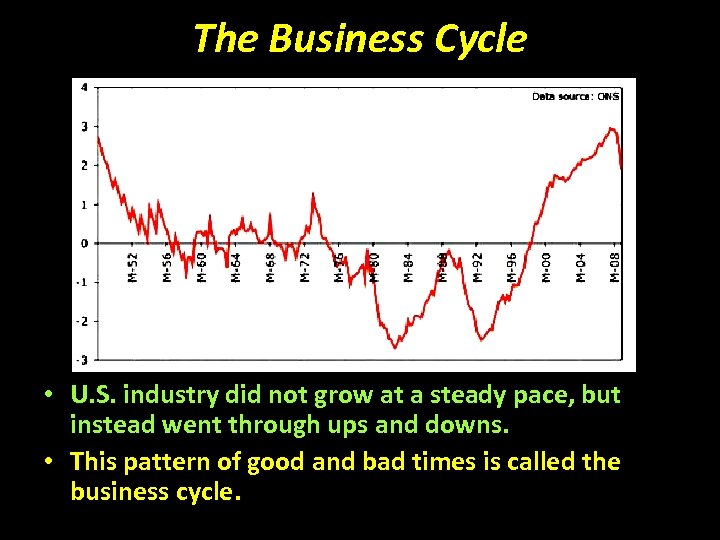 The Business Cycle • U. S. industry did not grow at a steady pace, but instead went through ups and downs. • This pattern of good and bad times is called the business cycle.
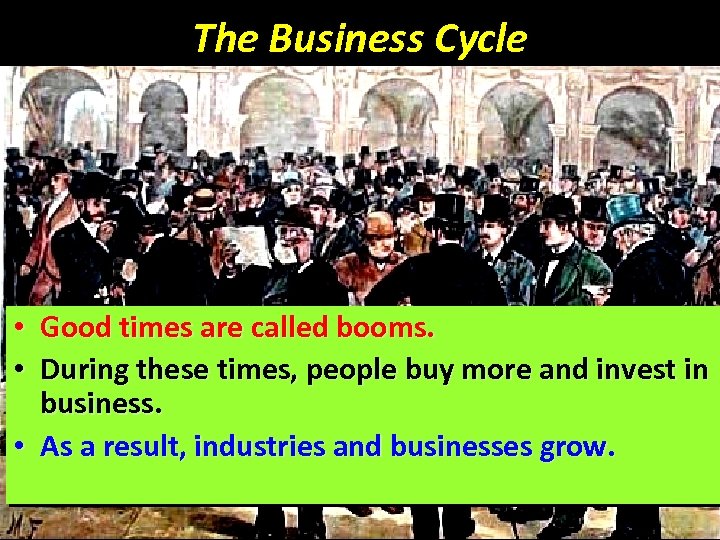 The Business Cycle • Good times are called booms. • During these times, people buy more and invest in business. • As a result, industries and businesses grow.
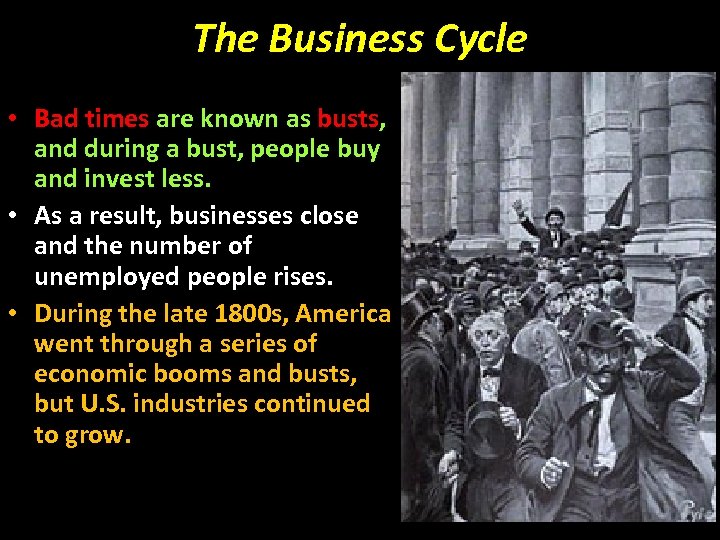 The Business Cycle • Bad times are known as busts, and during a bust, people buy and invest less. • As a result, businesses close and the number of unemployed people rises. • During the late 1800 s, America went through a series of economic booms and busts, but U. S. industries continued to grow.
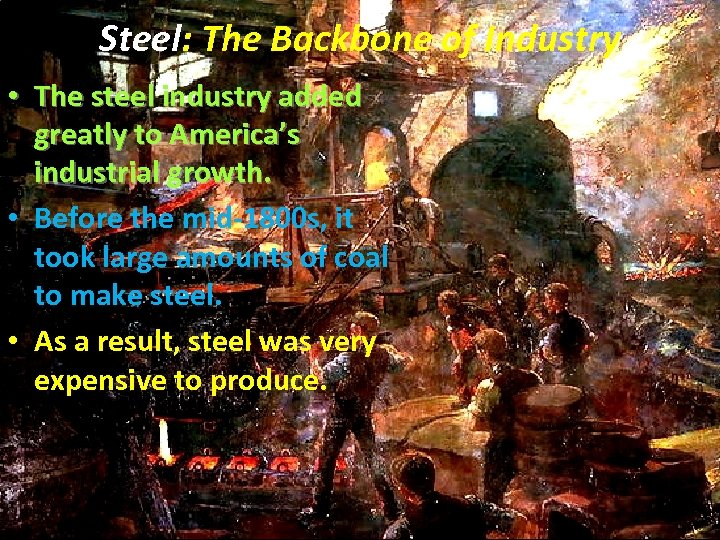 Steel: The Backbone of Industry • The steel industry added greatly to America’s industrial growth. • Before the mid-1800 s, it took large amounts of coal to make steel. • As a result, steel was very expensive to produce.
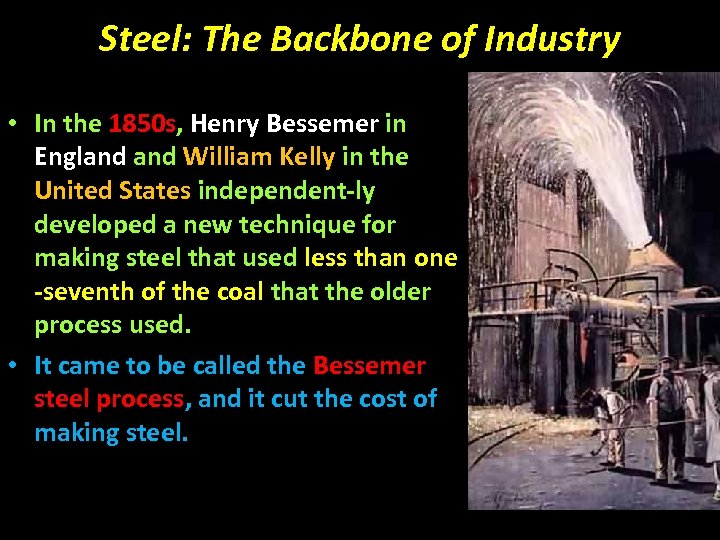 Steel: The Backbone of Industry • In the 1850 s, Henry Bessemer in England William Kelly in the United States independent-ly developed a new technique for making steel that used less than one -seventh of the coal that the older process used. • It came to be called the Bessemer steel process, and it cut the cost of making steel.
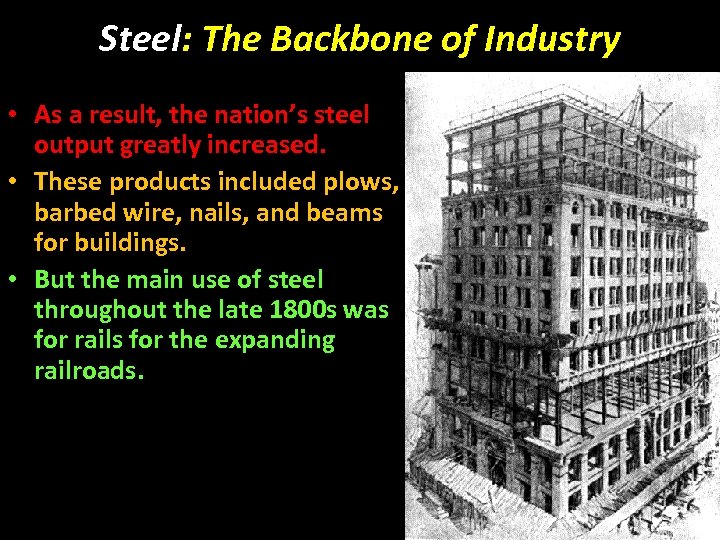 Steel: The Backbone of Industry • As a result, the nation’s steel output greatly increased. • These products included plows, barbed wire, nails, and beams for buildings. • But the main use of steel throughout the late 1800 s was for rails for the expanding railroads.
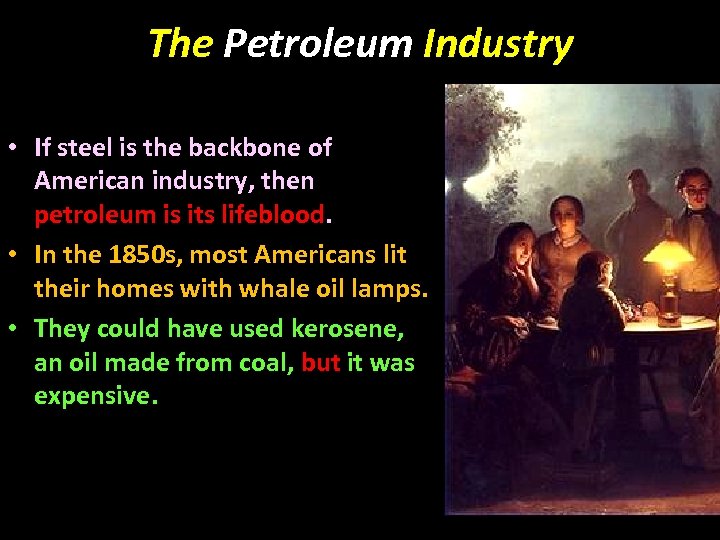 The Petroleum Industry • If steel is the backbone of American industry, then petroleum is its lifeblood. • In the 1850 s, most Americans lit their homes with whale oil lamps. • They could have used kerosene, an oil made from coal, but it was expensive.
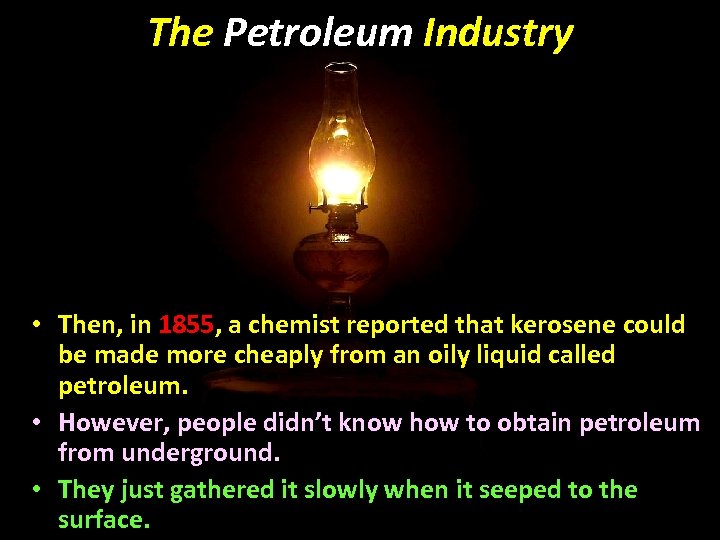 The Petroleum Industry • Then, in 1855, a chemist reported that kerosene could be made more cheaply from an oily liquid called petroleum. • However, people didn’t know how to obtain petroleum from underground. • They just gathered it slowly when it seeped to the surface.
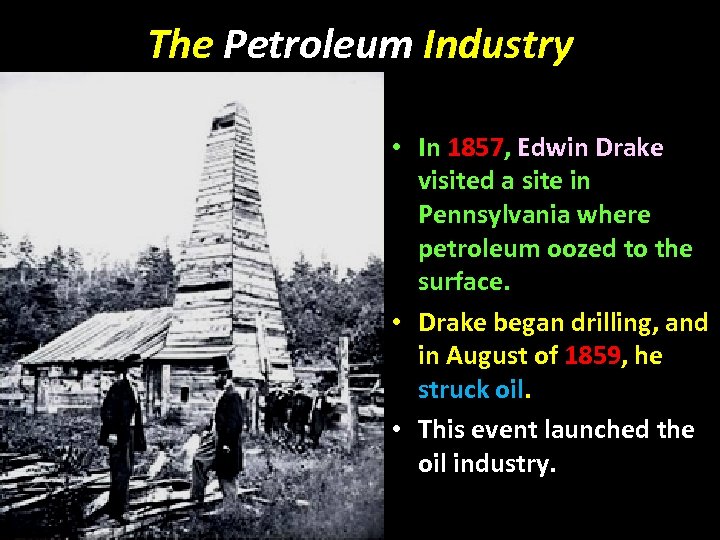 The Petroleum Industry • In 1857, Edwin Drake visited a site in Pennsylvania where petroleum oozed to the surface. • Drake began drilling, and in August of 1859, he struck oil. • This event launched the oil industry.
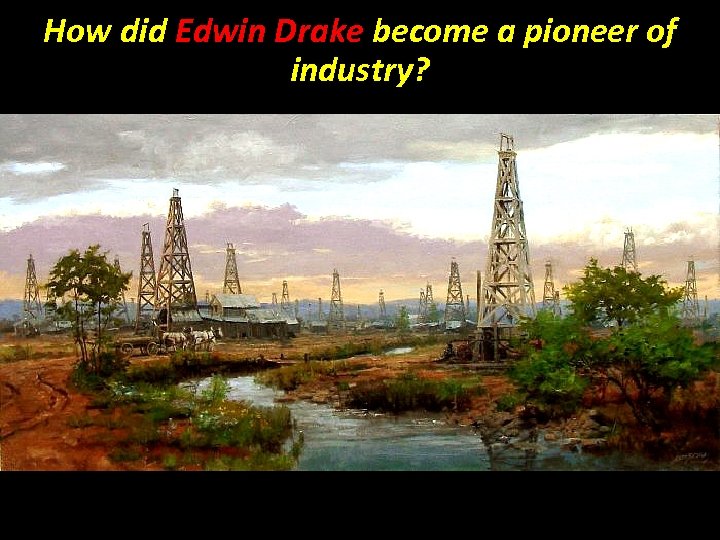 How did Edwin Drake become a pioneer of industry? A. He developed a new type of well-drilling machine to bring water to the Plains. B. He developed the use of pipelines to C. He pioneered the drilling of wells to bring petroleum up from underground. D. He was the first to use canals to ship his factory’s products to the West.
 Edison and Electricity • The industry to create electric power got its start in the late 1800 s. • By the 1870 s, people had invented good generators, which are machines that make electric current. • As a result, people became eager to use electricity. • The man who found the most ways to do so was Thomas Edison.
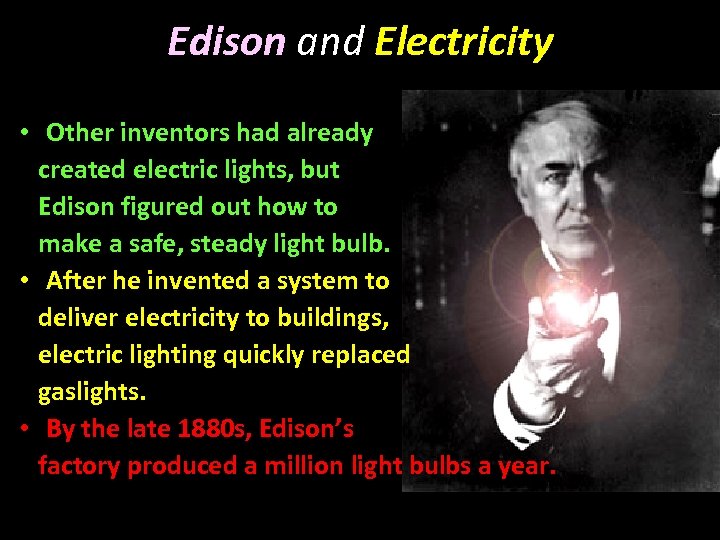 Edison and Electricity • Other inventors had already created electric lights, but Edison figured out how to make a safe, steady light bulb. • After he invented a system to deliver electricity to buildings, electric lighting quickly replaced gaslights. • By the late 1880 s, Edison’s factory produced a million light bulbs a year.
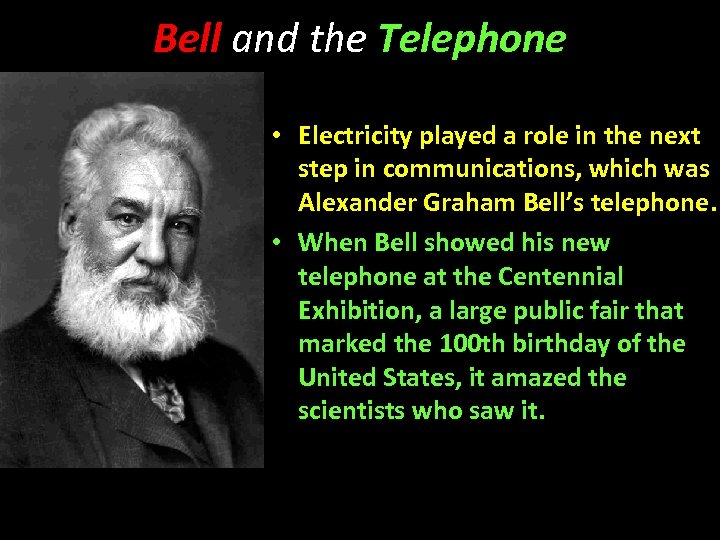 Bell and the Telephone • Electricity played a role in the next step in communications, which was Alexander Graham Bell’s telephone. • When Bell showed his new telephone at the Centennial Exhibition, a large public fair that marked the 100 th birthday of the United States, it amazed the scientists who saw it.
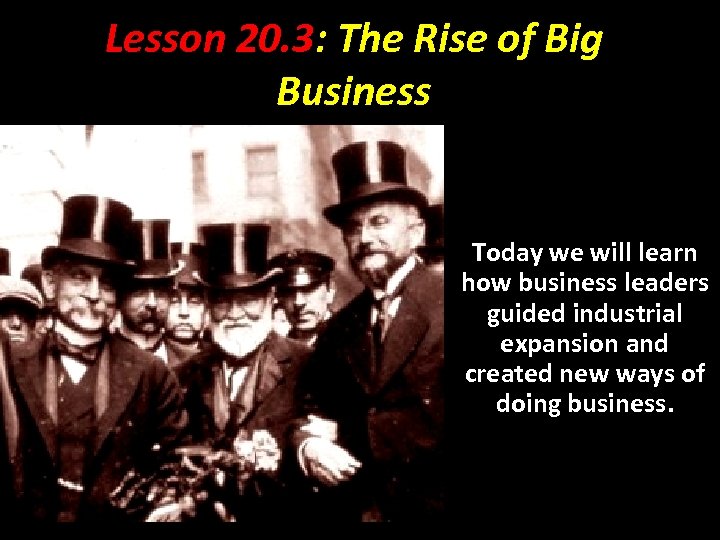 Lesson 20. 3: The Rise of Big Business Today we will learn how business leaders guided industrial expansion and created new ways of doing business.
 Vocabulary • robber baron – a business leader who became wealthy through dishonest methods • monopoly – a company that wipes out its competitors and controls an industry • trust – a legal body created to hold stock in many companies • philanthropists – people who give large sums of money to charity • vertical – straight up and down, like the school flagpole • horizontal – level, like the line where the sky meets the ocean
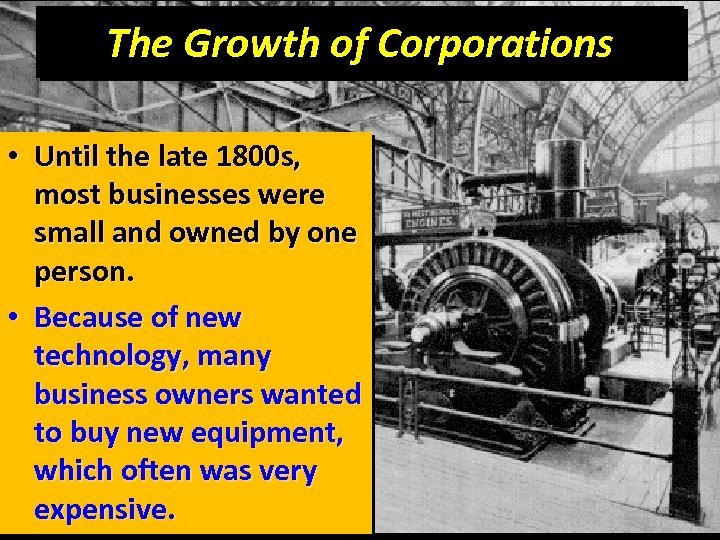 The Growth of Corporations • Until the late 1800 s, most businesses were small and owned by one person. • Because of new technology, many business owners wanted to buy new equipment, which often was very expensive.
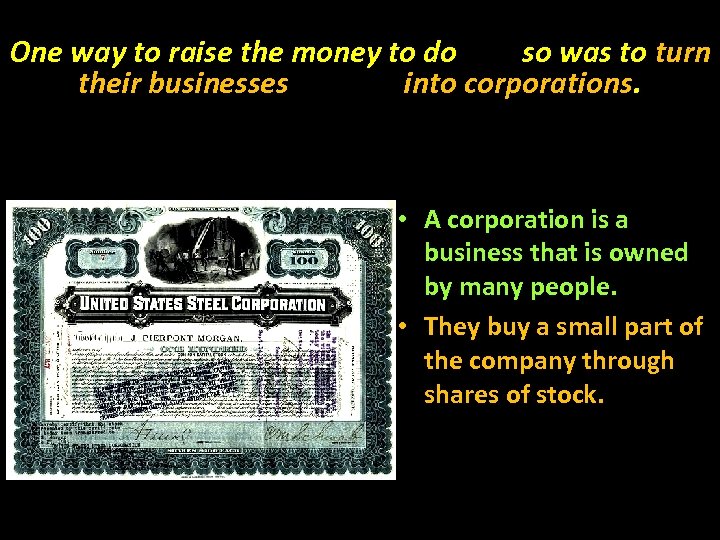 One way to raise the money to do so was to turn their businesses into corporations. • A corporation is a business that is owned by many people. • They buy a small part of the company through shares of stock.
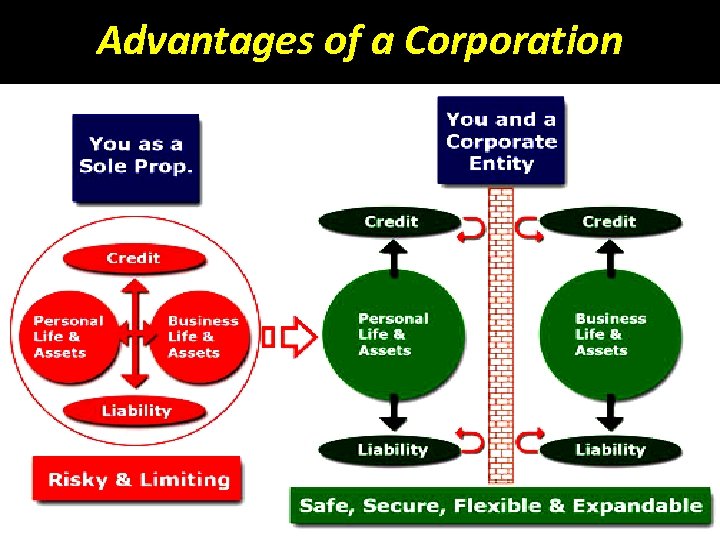 Advantages of a Corporation
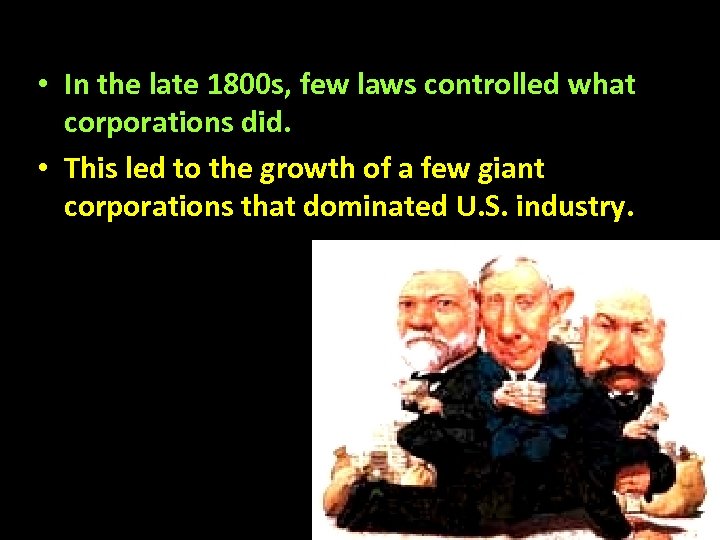 • In the late 1800 s, few laws controlled what corporations did. • This led to the growth of a few giant corporations that dominated U. S. industry.
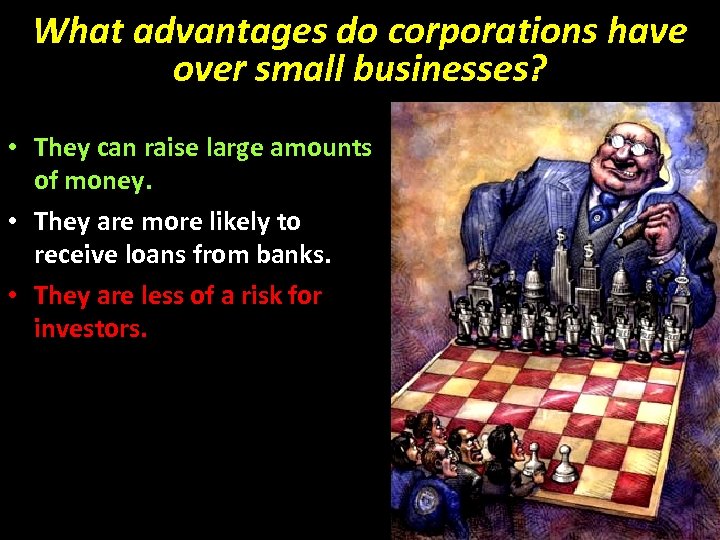 What advantages do corporations have over small businesses? • They can raise large amounts of money. • They are more likely to receive loans from banks. • They are less of a risk for investors.
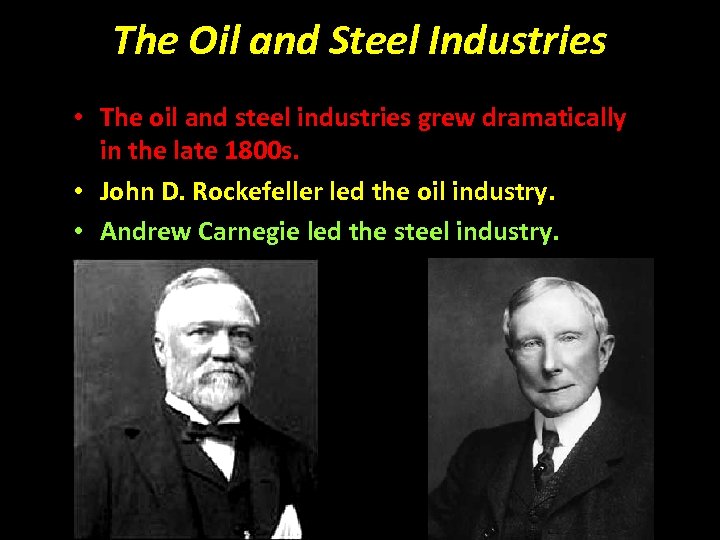 The Oil and Steel Industries • The oil and steel industries grew dramatically in the late 1800 s. • John D. Rockefeller led the oil industry. • Andrew Carnegie led the steel industry.
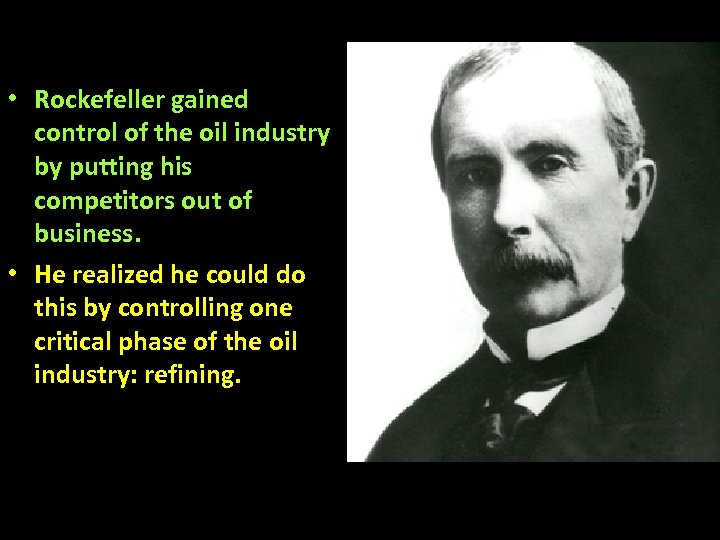 • Rockefeller gained control of the oil industry by putting his competitors out of business. • He realized he could do this by controlling one critical phase of the oil industry: refining.
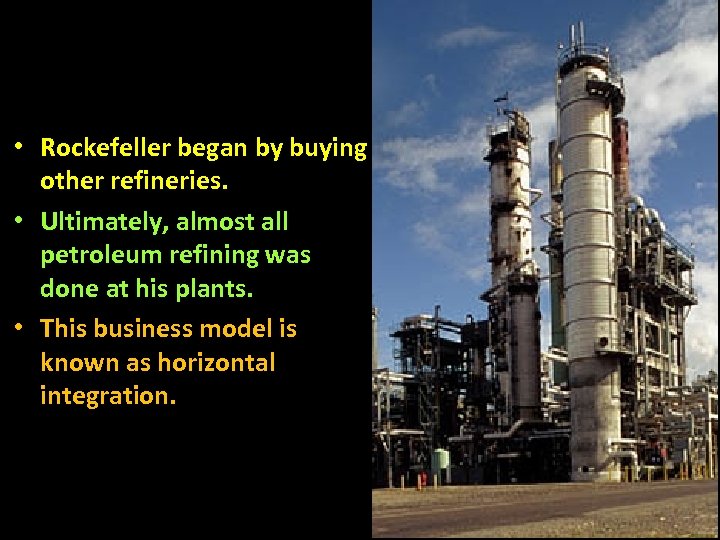 • Rockefeller began by buying other refineries. • Ultimately, almost all petroleum refining was done at his plants. • This business model is known as horizontal integration.
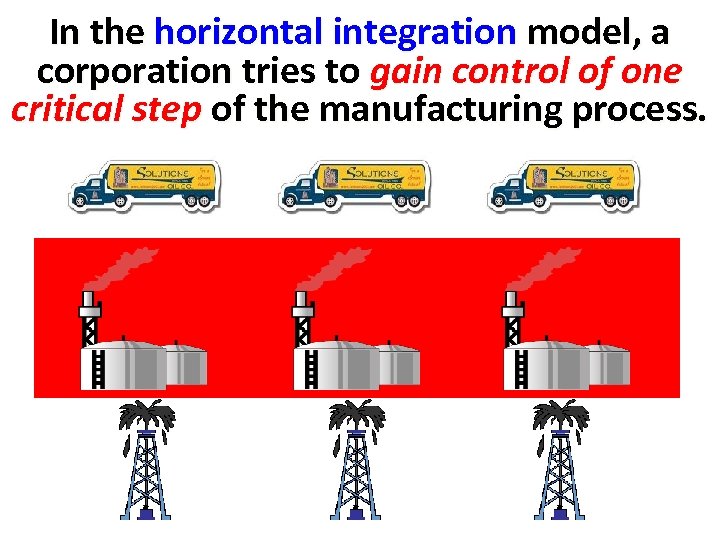 In the horizontal integration model, a corporation tries to gain control of one critical step of the manufacturing process.
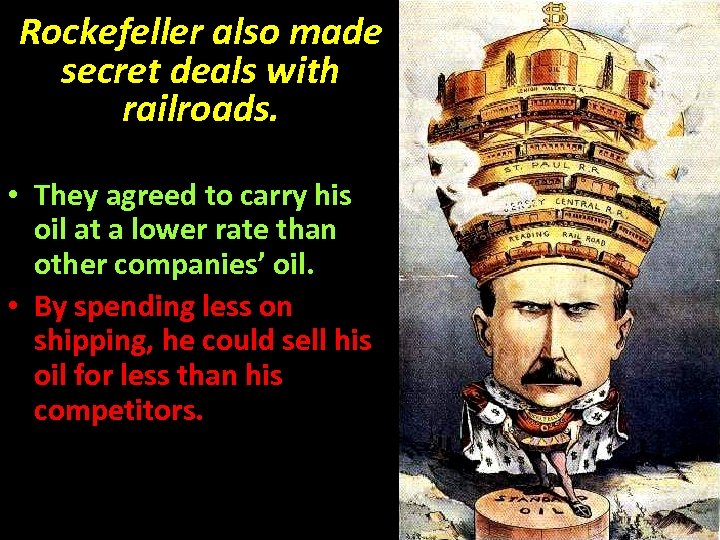 Rockefeller also made secret deals with railroads. • They agreed to carry his oil at a lower rate than other companies’ oil. • By spending less on shipping, he could sell his oil for less than his competitors.
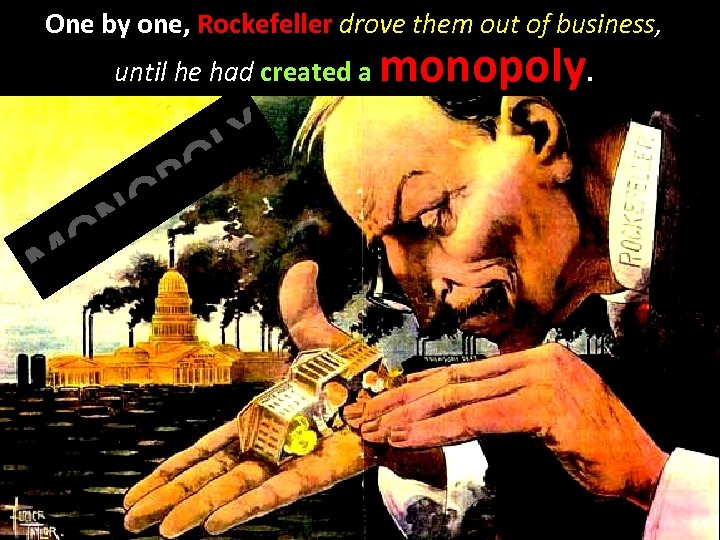 One by one, Rockefeller drove them out of business, until he had created a M N O P O LY O monopoly.
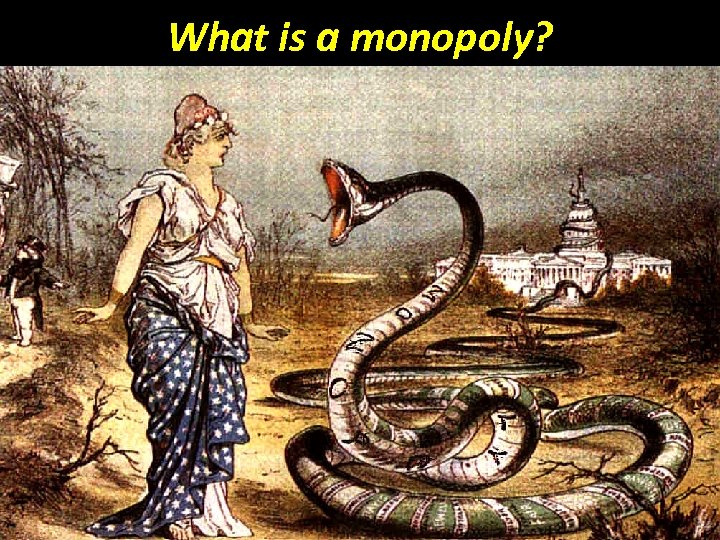 What is a monopoly?
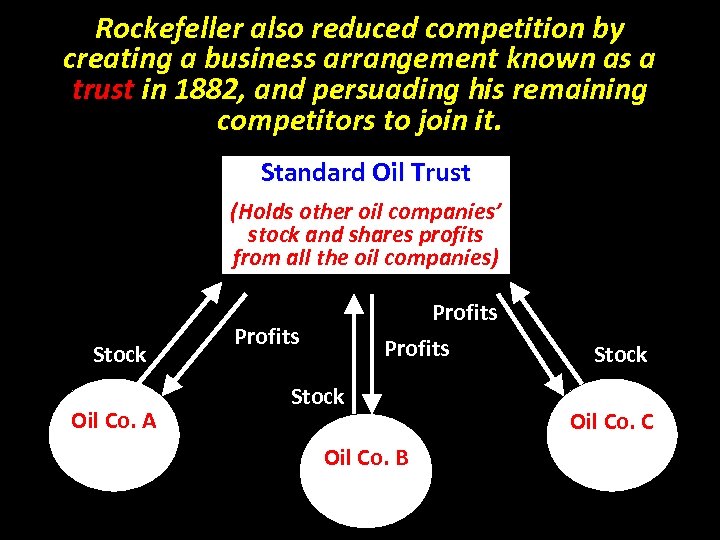 Rockefeller also reduced competition by creating a business arrangement known as a trust in 1882, and persuading his remaining competitors to join it. Standard Oil Trust (Holds other oil companies’ stock and shares profits from all the oil companies) Stock Oil Co. A Profits Stock Oil Co. B Stock Oil Co. C
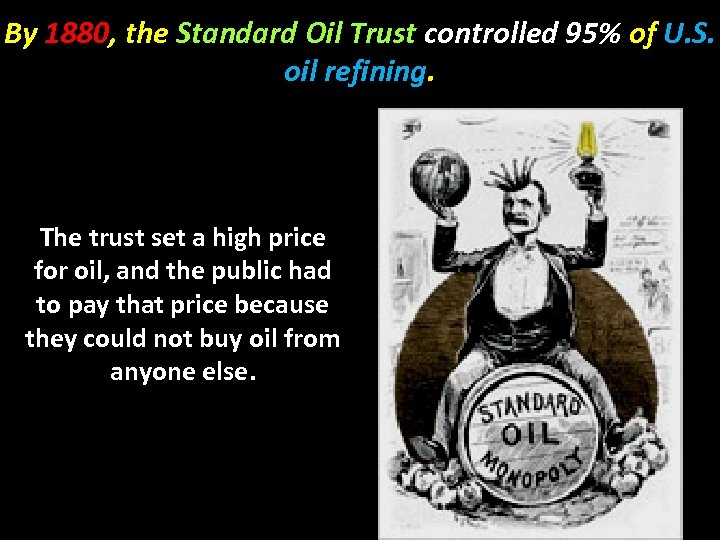 By 1880, the Standard Oil Trust controlled 95% of U. S. oil refining. The trust set a high price for oil, and the public had to pay that price because they could not buy oil from anyone else.
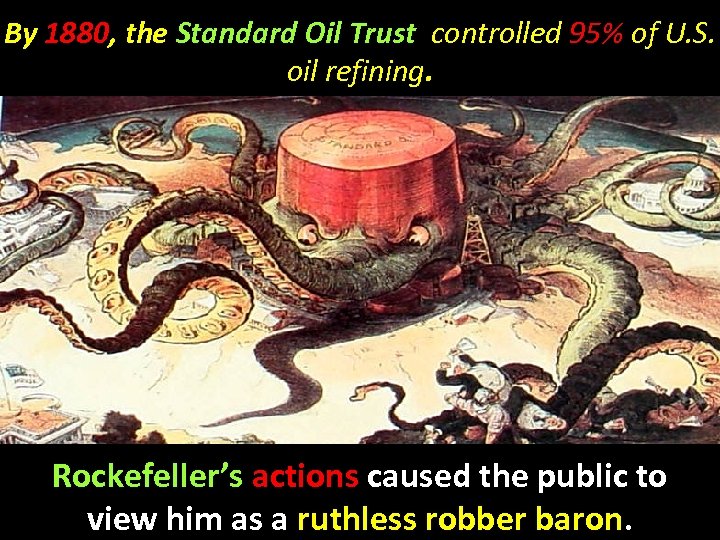 By 1880, the Standard Oil Trust controlled 95% of U. S. oil refining. Rockefeller’s actions caused the public to view him as a ruthless robber baron.
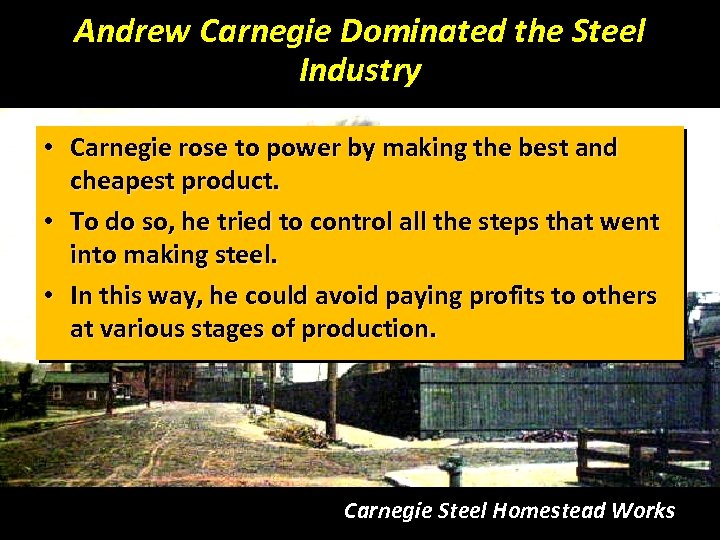 Andrew Carnegie Dominated the Steel Industry • Carnegie rose to power by making the best and cheapest product. • To do so, he tried to control all the steps that went into making steel. • In this way, he could avoid paying profits to others at various stages of production. Carnegie Steel Homestead Works
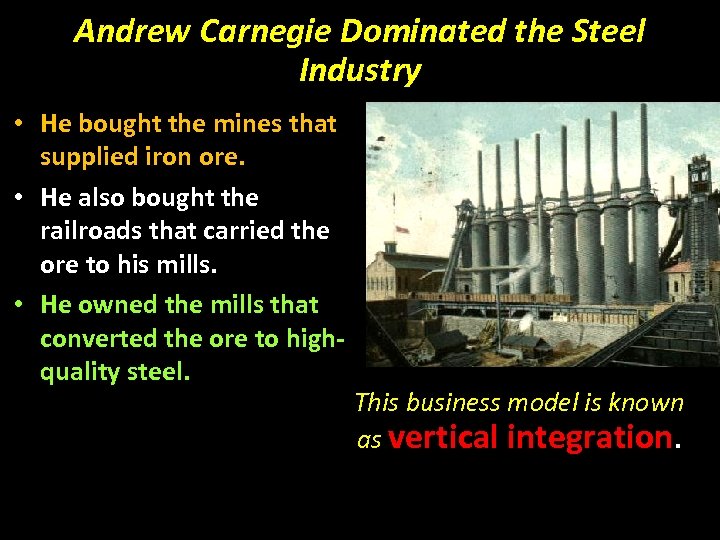 Andrew Carnegie Dominated the Steel Industry • He bought the mines that supplied iron ore. • He also bought the railroads that carried the ore to his mills. • He owned the mills that converted the ore to highquality steel. This business model is known as vertical integration.
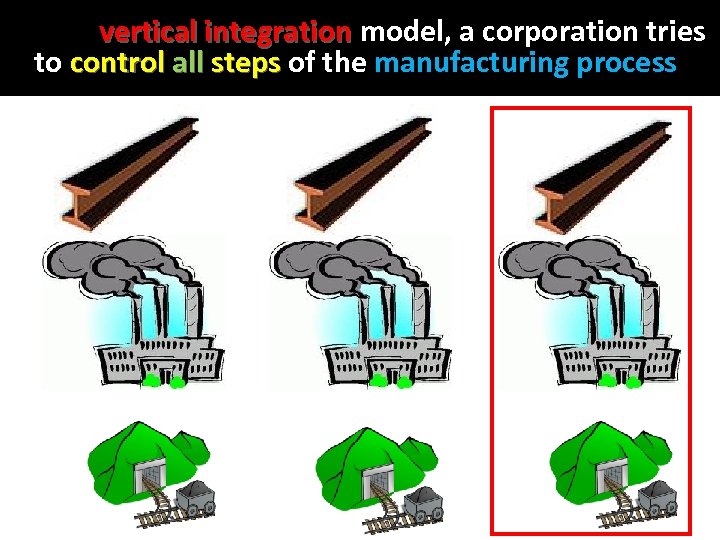 In the vertical integration model, a corporation tries to control all steps of the manufacturing process.
 John D. Rockefeller, and Andrew Carnegie were called ‘robber barons’ because they used ruthless tactics against their competitors
 The Gilded Age • Rockefeller and Carnegie had risen from poverty to become rich. • This caused many other Americans to believe that anyone, even themselves, could become rich through talent and hard work.
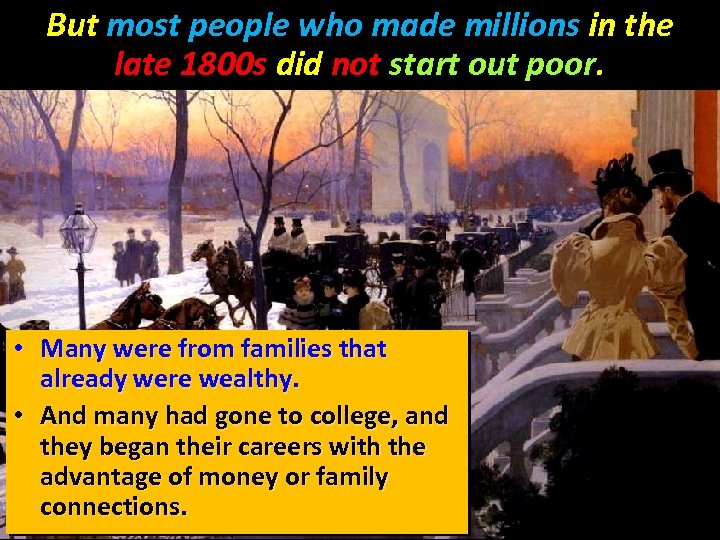 But most people who made millions in the late 1800 s did not start out poor. • Many were from families that already were wealthy. • And many had gone to college, and they began their careers with the advantage of money or family connections.
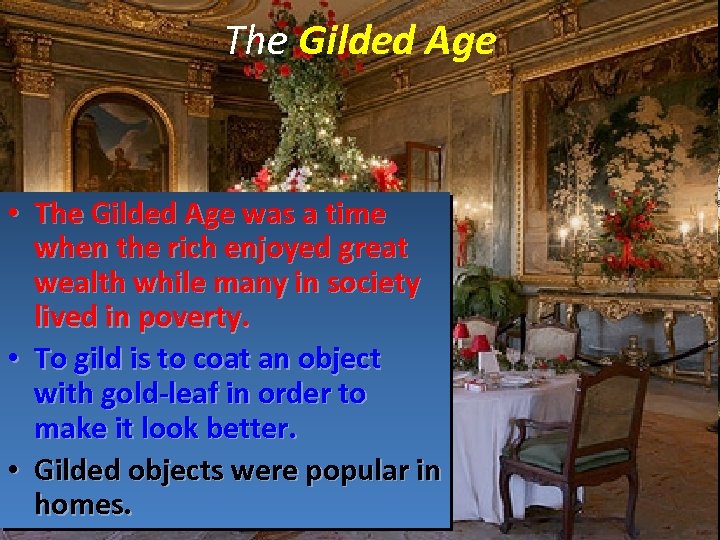 The Gilded Age • The Gilded Age was a time when the rich enjoyed great wealth while many in society lived in poverty. • To gild is to coat an object with gold-leaf in order to make it look better. • Gilded objects were popular in homes.
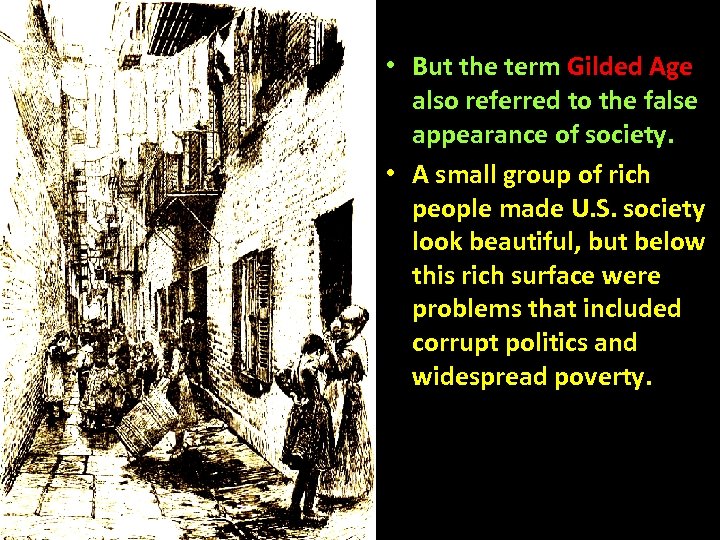 • But the term Gilded Age also referred to the false appearance of society. • A small group of rich people made U. S. society look beautiful, but below this rich surface were problems that included corrupt politics and widespread poverty.
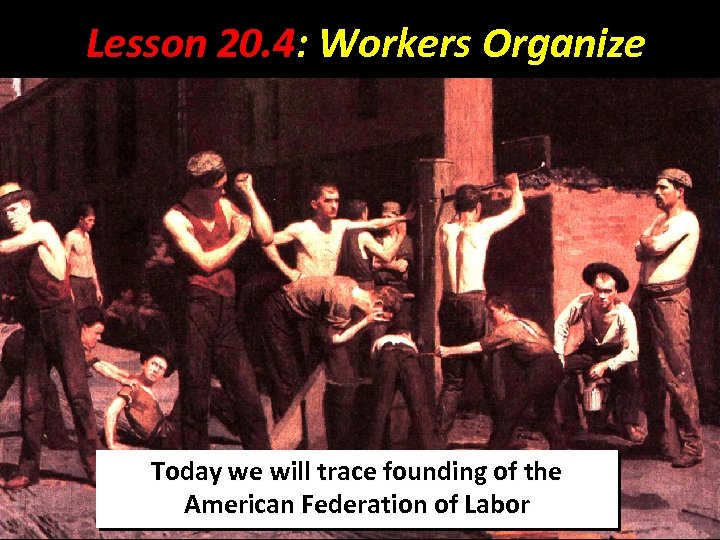 Lesson 20. 4: Workers Organize Today we will trace founding of the American Federation of Labor
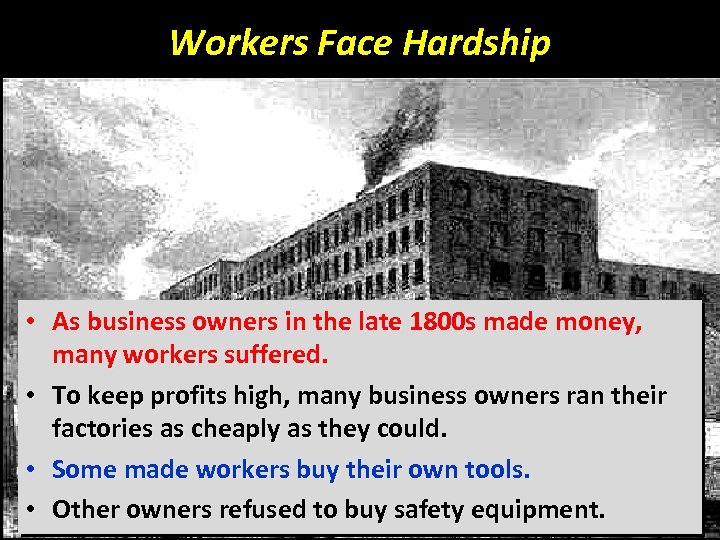 Workers Face Hardship • As business owners in the late 1800 s made money, many workers suffered. • To keep profits high, many business owners ran their factories as cheaply as they could. • Some made workers buy their own tools. • Other owners refused to buy safety equipment.
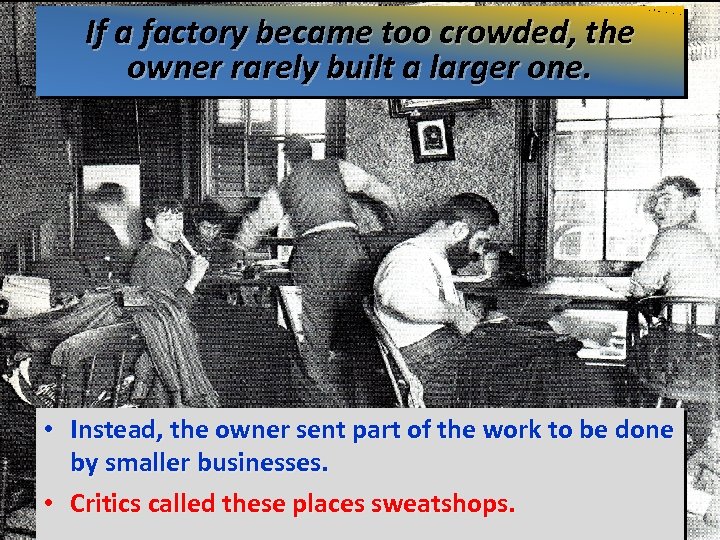 If a factory became too crowded, the owner rarely built a larger one. • Instead, the owner sent part of the work to be done by smaller businesses. • Critics called these places sweatshops.
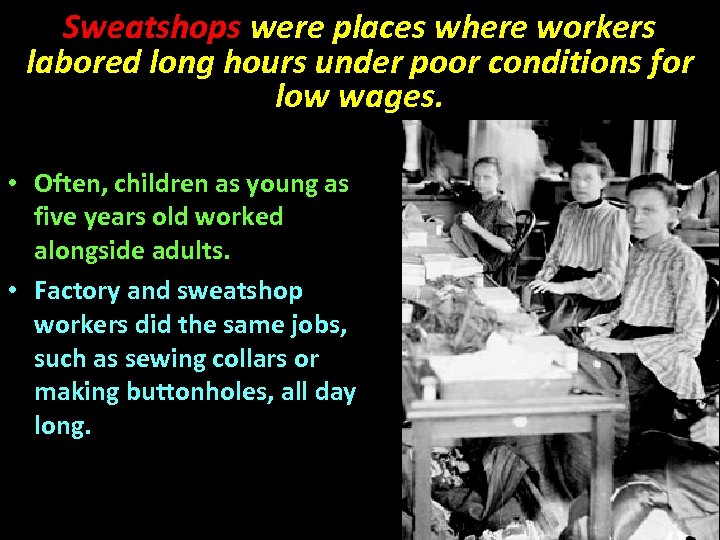 Sweatshops were places where workers labored long hours under poor conditions for low wages. • Often, children as young as five years old worked alongside adults. • Factory and sweatshop workers did the same jobs, such as sewing collars or making buttonholes, all day long.
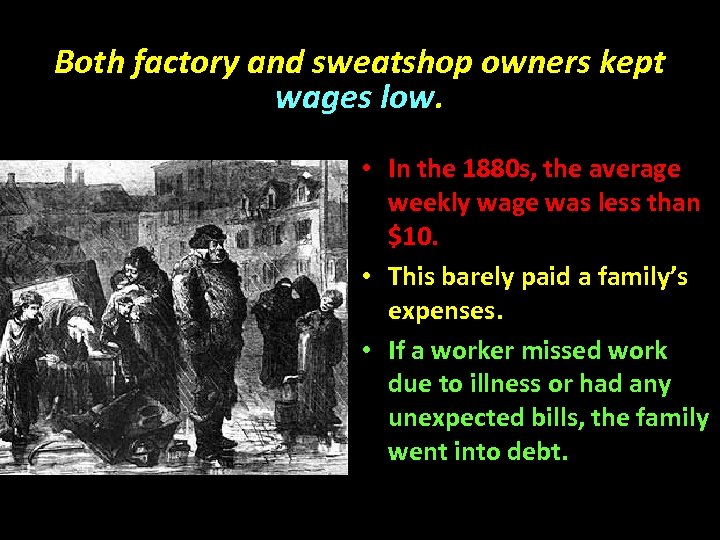 Both factory and sweatshop owners kept wages low. • In the 1880 s, the average weekly wage was less than $10. • This barely paid a family’s expenses. • If a worker missed work due to illness or had any unexpected bills, the family went into debt.
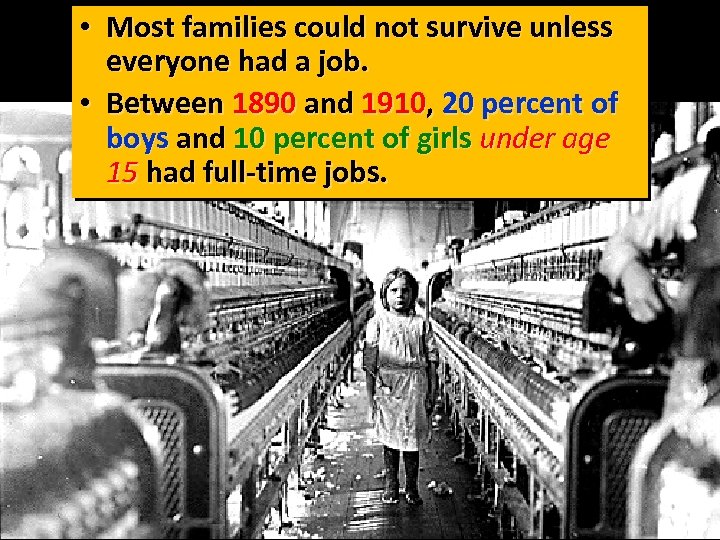 • Most families could not survive unless everyone had a job. • Between 1890 and 1910, 20 percent of boys and 10 percent of girls under age 15 had full-time jobs.
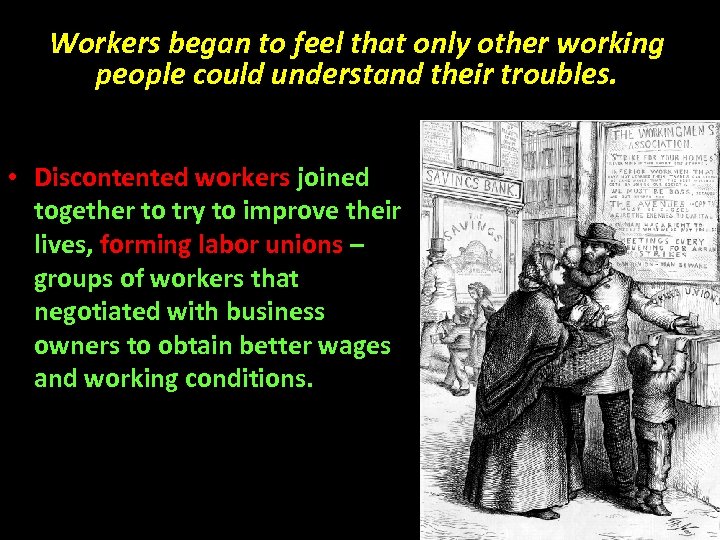 Workers began to feel that only other working people could understand their troubles. • Discontented workers joined together to try to improve their lives, forming labor unions – groups of workers that negotiated with business owners to obtain better wages and working conditions.
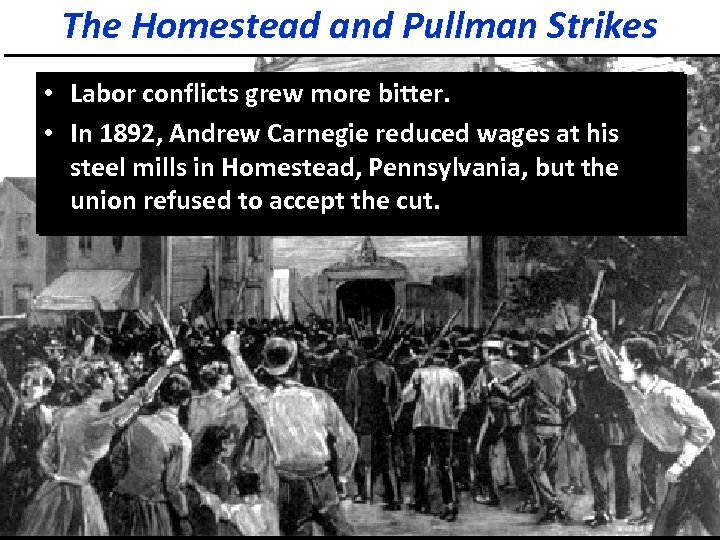 The Homestead and Pullman Strikes • Labor conflicts grew more bitter. • In 1892, Andrew Carnegie reduced wages at his steel mills in Homestead, Pennsylvania, but the union refused to accept the cut.
 Carnegie’s company locked out the striking workers. • The company also announced that it would hire nonunion labor. • The company also hired 300 armed guards. • In response, the locked out workers gathered weapons.
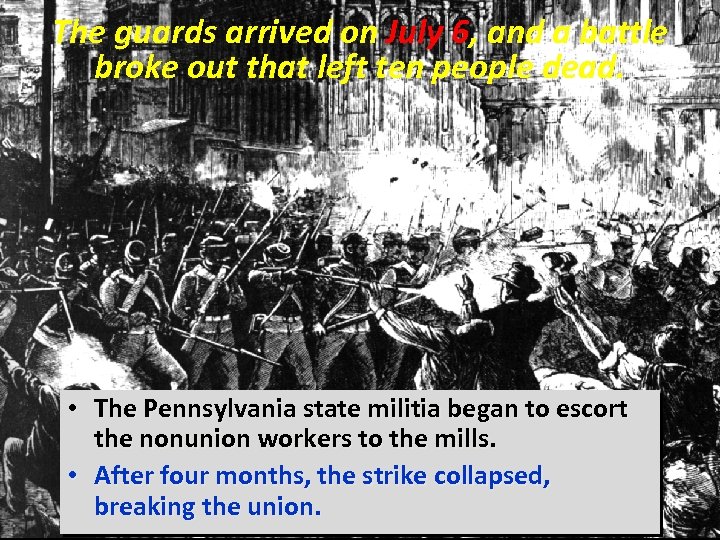 The guards arrived on July 6, and a battle broke out that left ten people dead. • The Pennsylvania state militia began to escort the nonunion workers to the mills. • After four months, the strike collapsed, breaking the union.
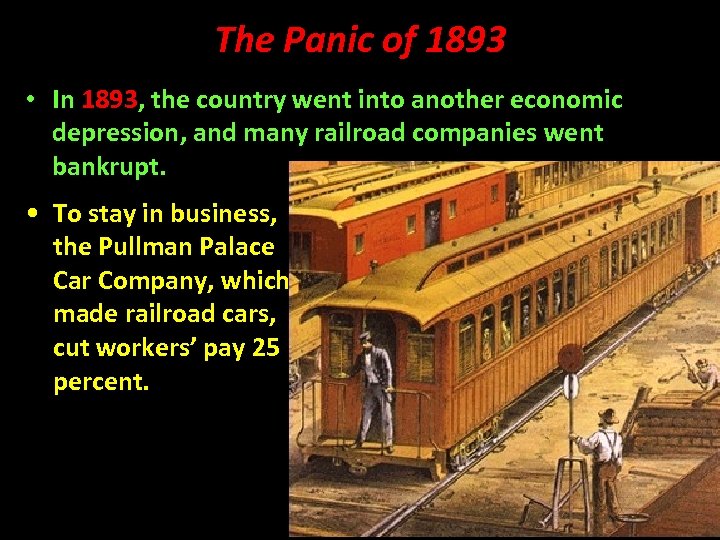 The Panic of 1893 • In 1893, the country went into another economic depression, and many railroad companies went bankrupt. • To stay in business, the Pullman Palace Car Company, which made railroad cars, cut workers’ pay 25 percent.
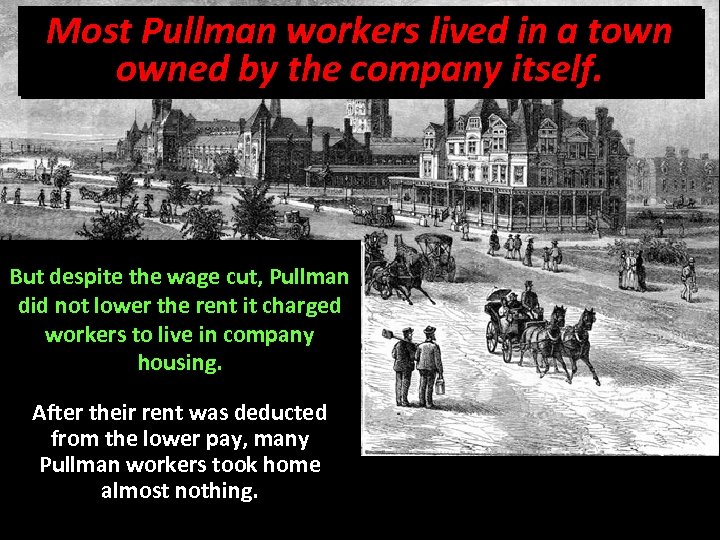 Most Pullman workers lived in a town owned by the company itself. But despite the wage cut, Pullman did not lower the rent it charged workers to live in company housing. After their rent was deducted from the lower pay, many Pullman workers took home almost nothing.
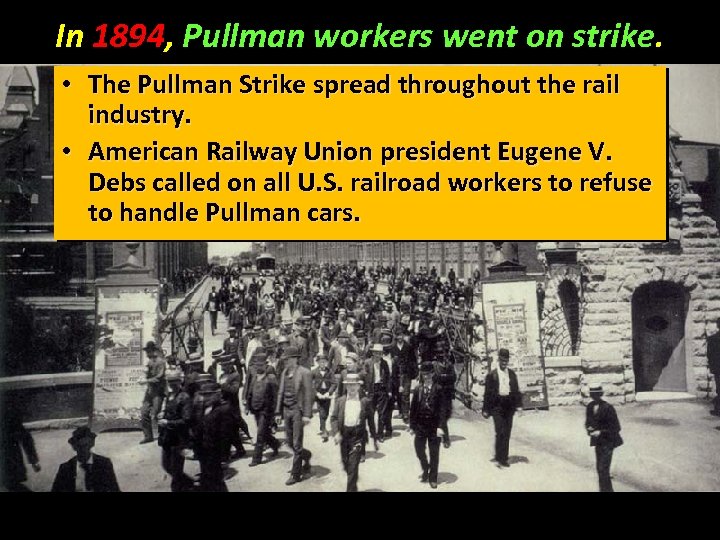 In 1894, Pullman workers went on strike. • The Pullman Strike spread throughout the rail industry. • American Railway Union president Eugene V. Debs called on all U. S. railroad workers to refuse to handle Pullman cars.
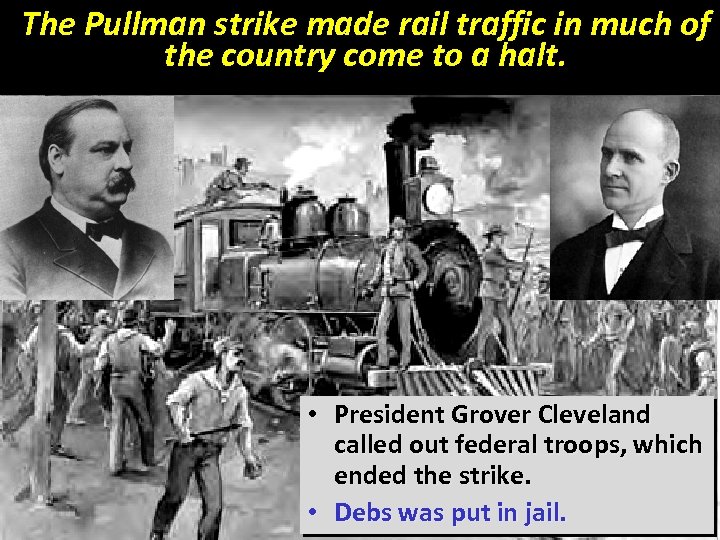 The Pullman strike made rail traffic in much of the country come to a halt. • President Grover Cleveland called out federal troops, which ended the strike. • Debs was put in jail.
 Some Workers Are Treated Fairly • Not all companies treated workers as harshly as Carnegie and Pullman did. • For instance, in the 1880 s, the soap company Procter & Gamble began to give its employees an extra half day off a week. • It also began a profit-sharing plan, in which a company gives part of its profits to workers. • But most workers received low wages and few benefits.
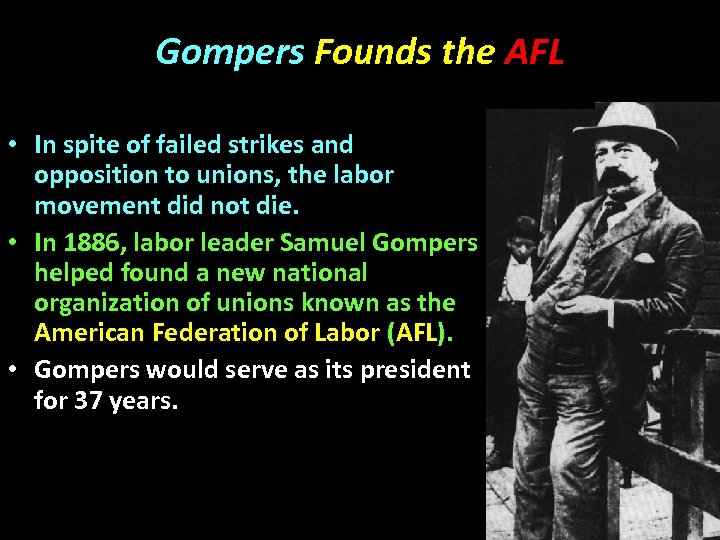 Gompers Founds the AFL • In spite of failed strikes and opposition to unions, the labor movement did not die. • In 1886, labor leader Samuel Gompers helped found a new national organization of unions known as the American Federation of Labor (AFL). • Gompers would serve as its president for 37 years.
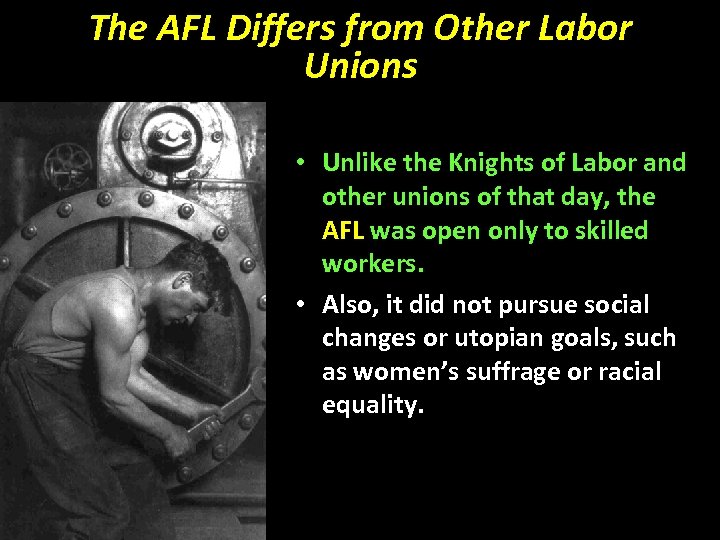 The AFL Differs from Other Labor Unions • Unlike the Knights of Labor and other unions of that day, the AFL was open only to skilled workers. • Also, it did not pursue social changes or utopian goals, such as women’s suffrage or racial equality.
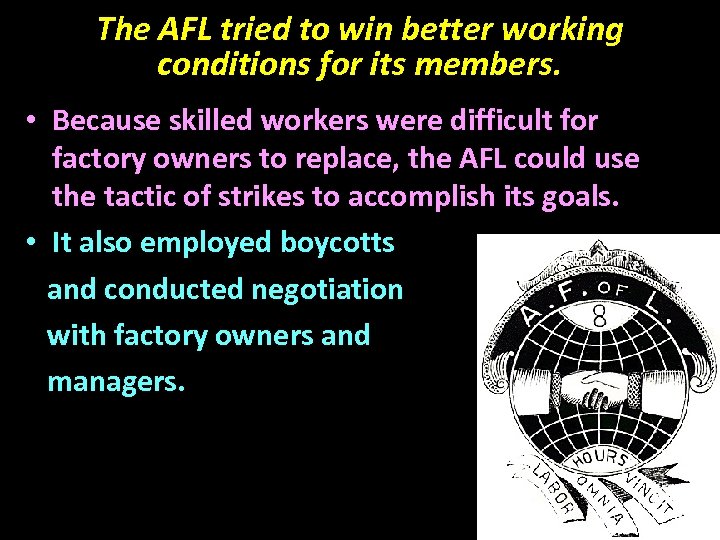 The AFL tried to win better working conditions for its members. • Because skilled workers were difficult for factory owners to replace, the AFL could use the tactic of strikes to accomplish its goals. • It also employed boycotts and conducted negotiation with factory owners and managers.
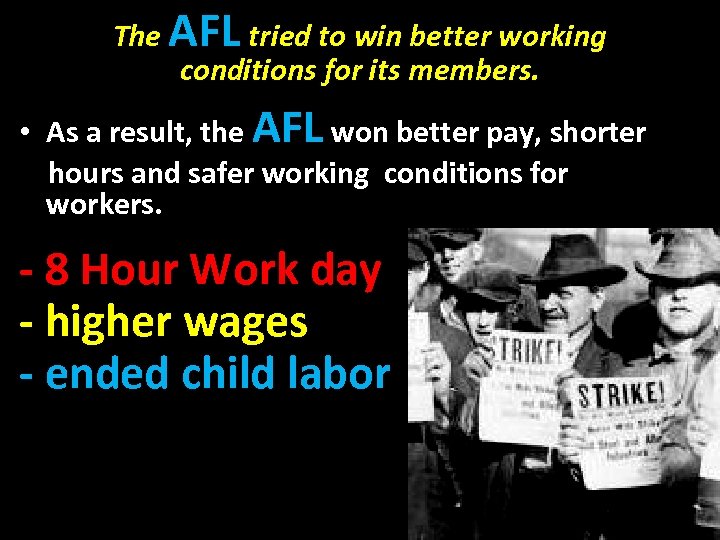 The AFL tried to win better working conditions for its members. • As a result, the AFL won better pay, shorter hours and safer working conditions for workers. - 8 Hour Work day - higher wages - ended child labor
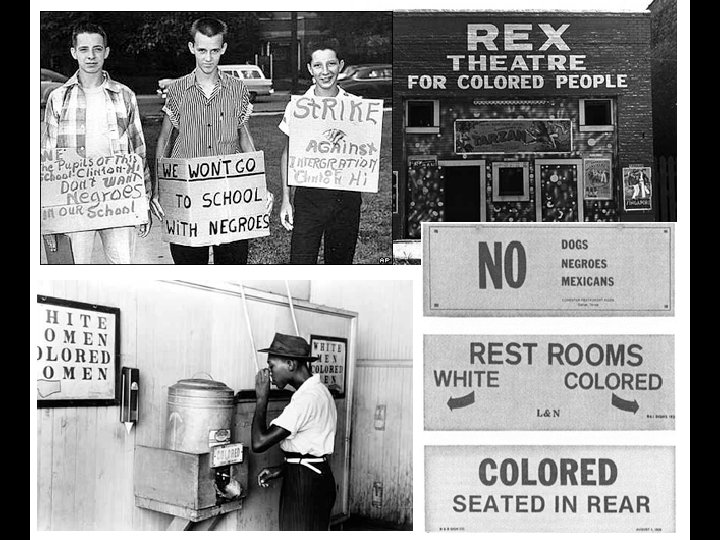
 Jim Crow and segregati
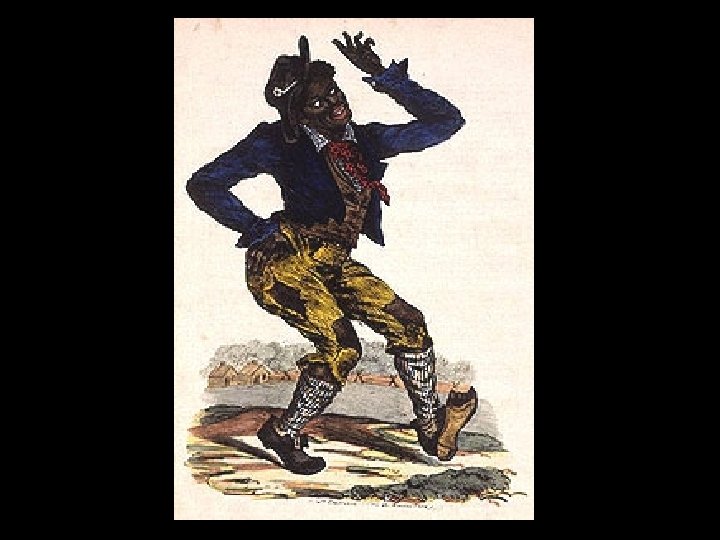
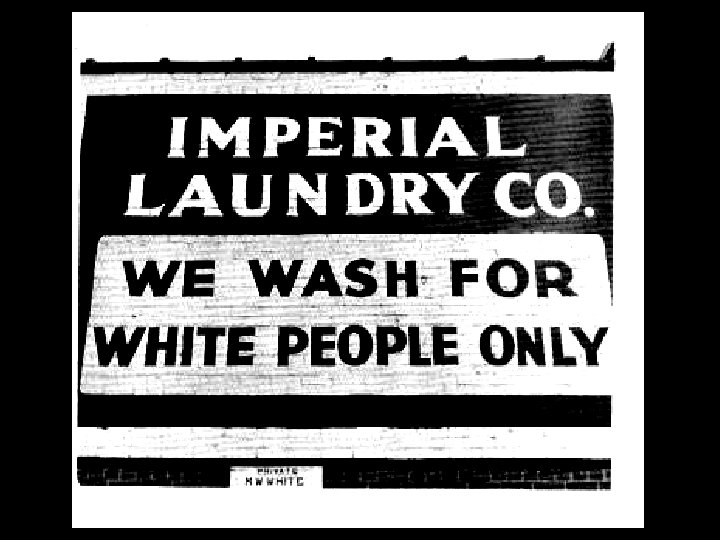
 The name Jim Crow is often used to describe the segregation laws, rules, and customs which arose after Reconstruction ended in 1877 and continued until the mid-1960 s. How did the name become associated with these "Black Codes" which took away many of the rights which had been granted to blacks through the 13 th, 14 th, and 15 th Amendments?
 "Come listen all you galls and boys, I'm going to sing a little song, My name is Jim Crow. Weel about and turn about and do jis so, Eb'ry time I weel about I jump Jim Crow. "
 segrega tion
 segrega tion
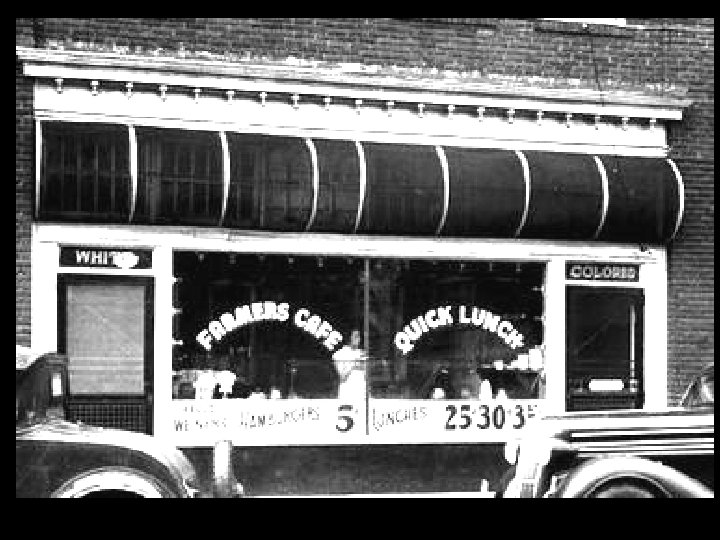
 segrega tion
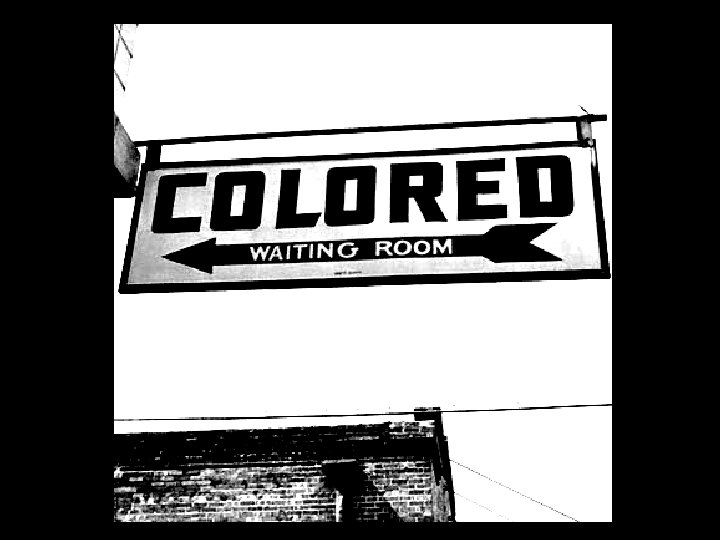
 segrega tion
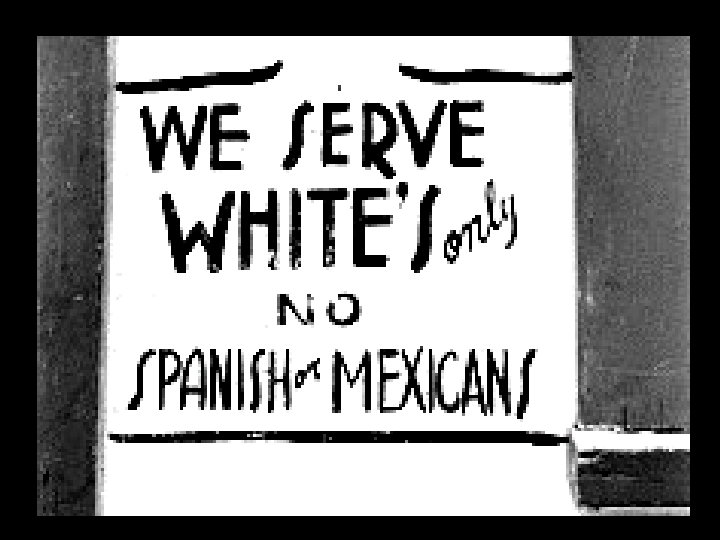
 segrega tion
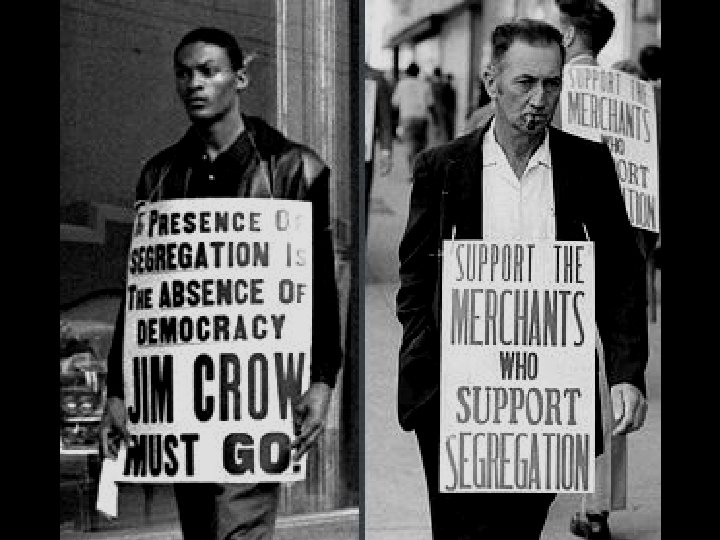
 segrega tion
 Jim Crow was segrega