


 Скачать презентацию QUESTIONS Upitne rečenice Types of questions in
a961bda03f3953bee3e07fc9a830cef8.ppt
- Количество слайдов: 28
 QUESTIONS Upitne rečenice
 Types of questions in English Postoje dve vrste upitnih rečenica: u 1. Yes/No Questions – odgovor je da ili ne u Struktura: pom. glagol (AV) + S +V u Do you know where John lives? u Did she see him? u Will they come tomorrow? u Have you got a pen? u Are you having fun? u
 u 2. Question Word Questions – odgovor je informacija u Struktura: Question word+AV+S+V u Question words: what, where, when, who, which, why, whose, how. u What can I do? u Where do you come from? u How are you feeling today?
 Upitne reči (Question words) u Who i what mogu da se odnose na subjekat upitne rečenice. Red reči je isti kao u izjavnoj rečenici. u SUBJECT u Who rang you? (Someone rang you. ) u Who is helping you? (Someone is helping you. ) u What will happen next? (Something will happen next. )
 u Who and what takođe mogu da se odnose na objekat. Tada je red reči kao u upitnoj rečenici, tj. pomoćni glagol je ispred subjekta. u OBJECT u Who did you ring? (You rang someone. ) u Who are you helping? (You are helping someone. ) u What will they do next? (They will do something next. )
 Other Question Phrases What time is your friend arriving? ~ Half past eight. u What colour is your toothbrush? ~ Yellow. u What kind of/What sort of club is it? ~ A nightclub. u How old is your sister? ~ She's twenty. u How often do you go out? ~ About once a week, usually. u
 u How far is the beach? ~ Only five minutes walk u How long will the meeting last? ~ An hour or so, I expect. u How many phones have you got? ~ Three u How much money did you spend? ~ About a hundred pounds.
 Predlozi u wh-questions u Ponekad se na kraju wh-pitanja nalaze predlozi. Oni obično idu uz glagol, kao i u izjavnim rečenicama. u What are you looking for? u (You are looking for something. ) u What are you worrying about? u (You are worrying about something. )
 What. . . for u what. . . for se koristi za pitanja o razlogu, nameri: u What did you buy this computer magazine for? ~ To read about business software. u What are these bricks for? ~ We're going to build a wall. u What are they digging the road up for? ~ They're repairing a gas pipe. u What. . . for ima isto značenje kao why.
 What. . . like u What . . . Like se koristi za pitanja kakvo je nešto, dobro ili loše, itd. u What was the party like? ~ Oh, we had a great time. u What's the place like where you live? ~ It's pretty quiet. u Izgled- look like. u What does your friend look like? ~ She's very tall and blond.
 How koristimo da postavimo pitanje o nečijem zdravlju, raspoloženju: u How are you? ~ I'm OK, thanks. And you? u How are you getting on in your new job? ~ I'm really enjoying it. u Uporedi: u How's Melanie? ~ Oh, she's fine, thanks. (She is happy/in good health. ) – kako je u What's Melanie like? ~ She's very nice. (She is a nice person. ) – kakva je u
 What or which? u Ispred imenice može se upotrebiti what ili which. u What books do you like to read? u Which way did he go? u Koristimo what kada postoji veliki broj mogućih odgovora: u What sport do you play? – zato što postoji mnogo različitih sportova.
 u Which koristimo kada postoji ograničen broj mogućih odgovora: u Which film did you see last night? – bilo je tri filma na televiziji u Which finger did you hurt? u Često iza ovog pitanja navodimo i moguće odgovore: u Which juice will you have, orange or pineapple?
 u Ponekad su moguće obe varijante: u What day/Which day is your evening class? u What train/Which train will you catch? u What platform/Which platform does the train go from? u What part/Which part of Italy are you from?
 who, what i which mogu se koristiti bez imenice: u Who sent the fax? u What do you think of our plan? u Which is quicker, the bus or the train? u Ispred imenice može se korititi what i which, ali ne i who. u Which secretary sent the fax? NOT *Whosecretary-sent the-fax? u
 Značenje Who uvek označava osobu: u Who did you see? (a person) u What obično označava neživu stvar. Može da označava osobu samo kad je ispred imenice. u What did you see? (a thing) u What doctor/What film did you see? (a person or a thing) u Which može da označava osobu ili stvar: u Which dentist/film did you see? (a person or a thing) u
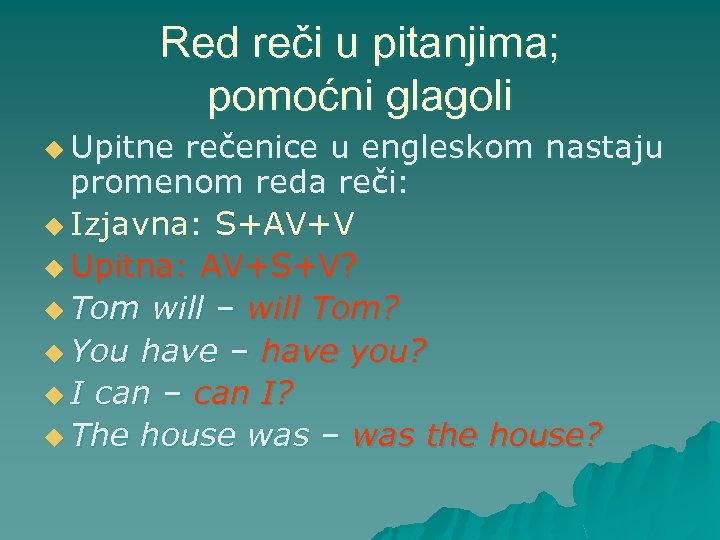 Red reči u pitanjima; pomoćni glagoli u Upitne rečenice u engleskom nastaju promenom reda reči: u Izjavna: S+AV+V u Upitna: AV+S+V? u Tom will – will Tom? u You have – have you? u I can – can I? u The house was – was the house?
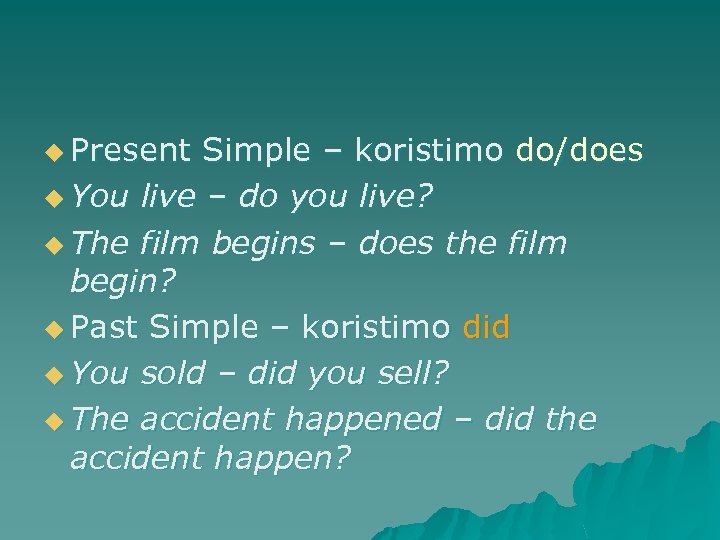 u Present Simple – koristimo do/does u You live – do you live? u The film begins – does the film begin? u Past Simple – koristimo did u You sold – did you sell? u The accident happened – did the accident happen?
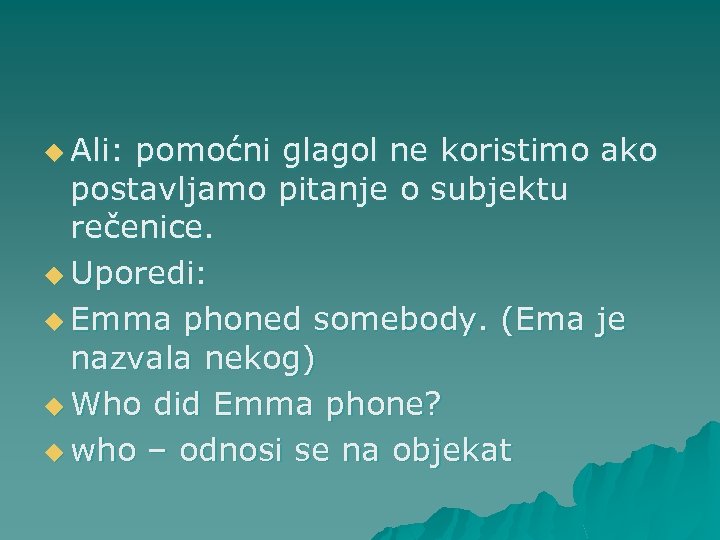 u Ali: pomoćni glagol ne koristimo ako postavljamo pitanje o subjektu rečenice. u Uporedi: u Emma phoned somebody. (Ema je nazvala nekog) u Who did Emma phone? u who – odnosi se na objekat
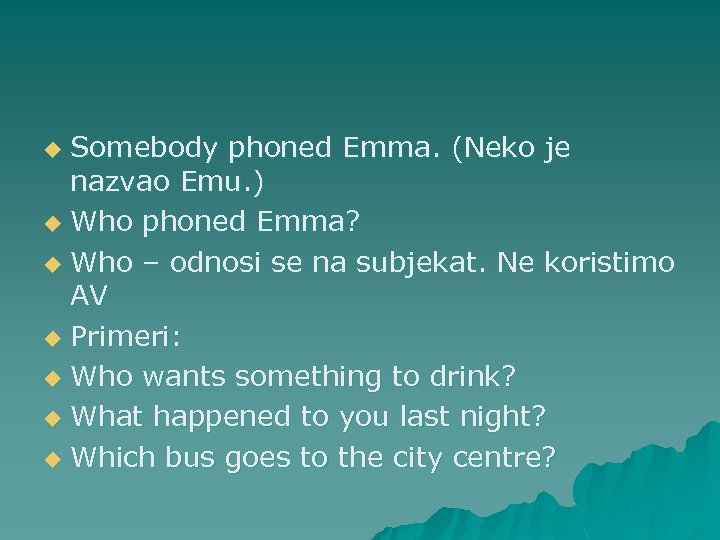 Somebody phoned Emma. (Neko je nazvao Emu. ) u Who phoned Emma? u Who – odnosi se na subjekat. Ne koristimo AV u Primeri: u Who wants something to drink? u What happened to you last night? u Which bus goes to the city centre? u
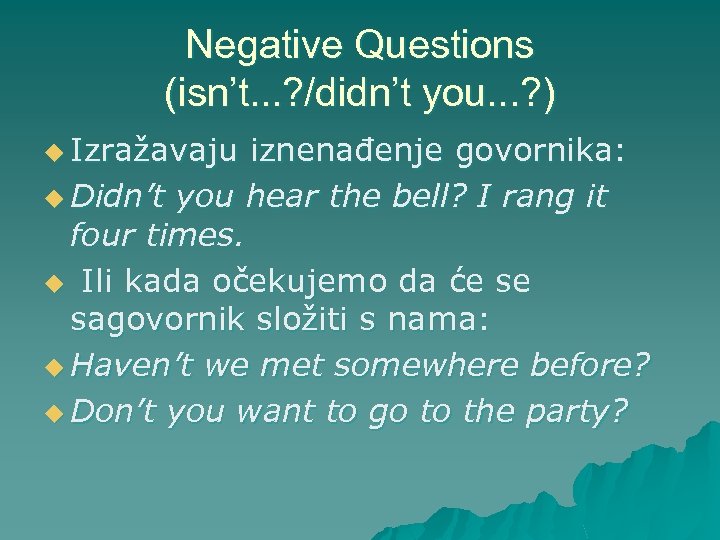 Negative Questions (isn’t. . . ? /didn’t you. . . ? ) u Izražavaju iznenađenje govornika: u Didn’t you hear the bell? I rang it four times. u Ili kada očekujemo da će se sagovornik složiti s nama: u Haven’t we met somewhere before? u Don’t you want to go to the party?
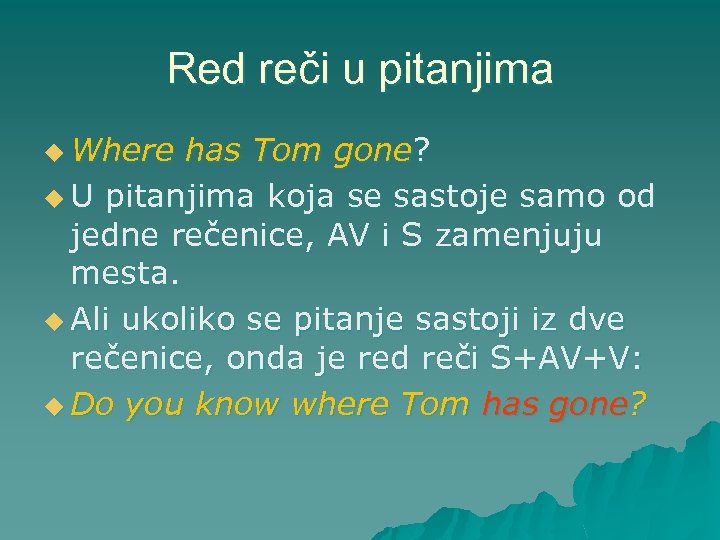 Red reči u pitanjima u Where has Tom gone? u U pitanjima koja se sastoje samo od jedne rečenice, AV i S zamenjuju mesta. u Ali ukoliko se pitanje sastoji iz dve rečenice, onda je red reči S+AV+V: u Do you know where Tom has gone?
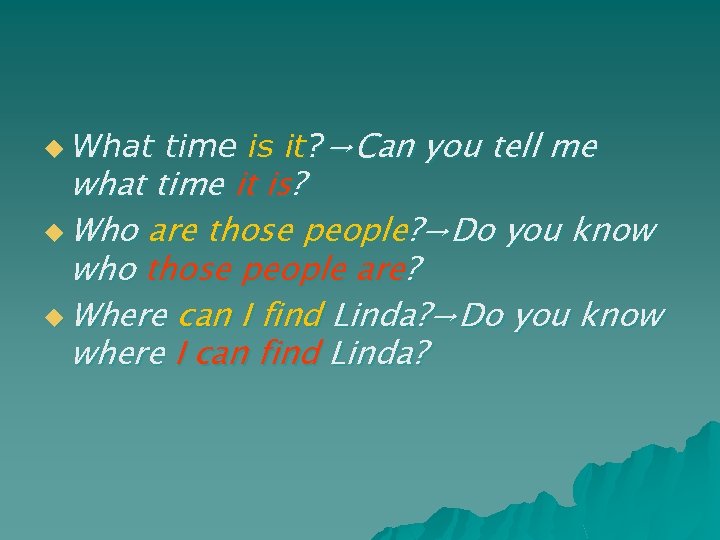 u What time is it? →Can you tell me what time it is? u Who are those people? →Do you know who those people are? u Where can I find Linda? →Do you know where I can find Linda?
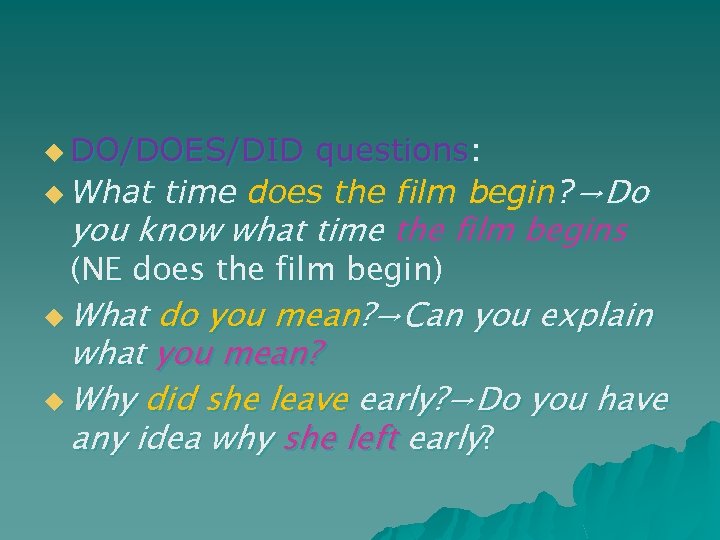 u DO/DOES/DID questions: u What time does the film begin? →Do you know what time the film begins (NE does the film begin) u What do you mean? →Can you explain what you mean? u Why did she leave early? →Do you have any idea why she left early?
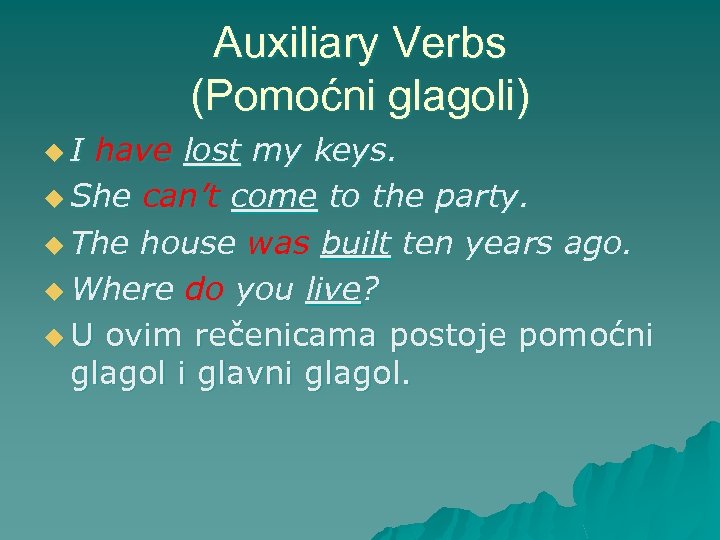 Auxiliary Verbs (Pomoćni glagoli) u. I have lost my keys. u She can’t come to the party. u The house was built ten years ago. u Where do you live? u U ovim rečenicama postoje pomoćni glagol i glavni glagol.
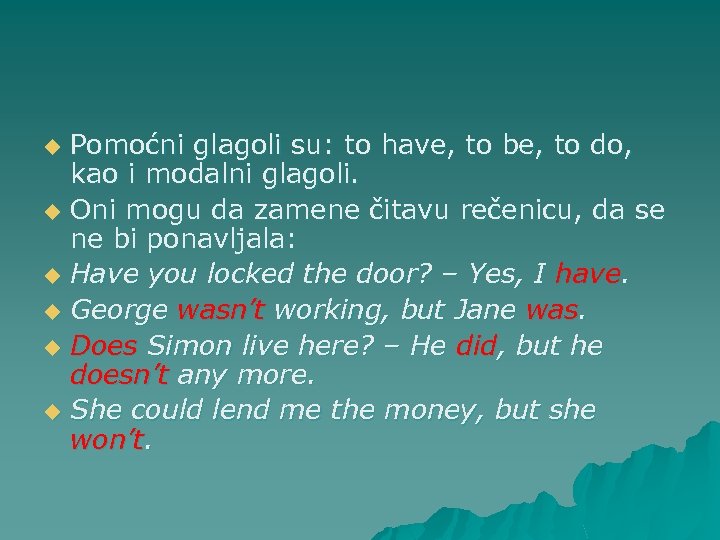 Pomoćni glagoli su: to have, to be, to do, kao i modalni glagoli. u Oni mogu da zamene čitavu rečenicu, da se ne bi ponavljala: u Have you locked the door? – Yes, I have. u George wasn’t working, but Jane was. u Does Simon live here? – He did, but he doesn’t any more. u She could lend me the money, but she won’t. u
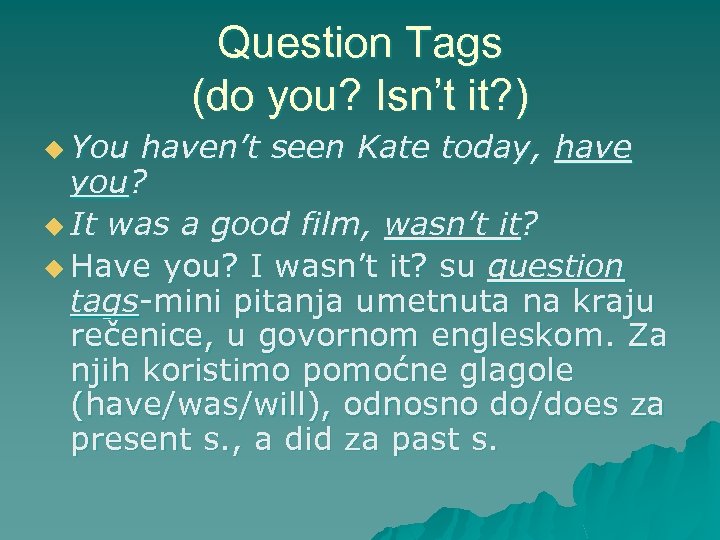 Question Tags (do you? Isn’t it? ) u You haven’t seen Kate today, have you? u It was a good film, wasn’t it? u Have you? I wasn’t it? su question tags-mini pitanja umetnuta na kraju rečenice, u govornom engleskom. Za njih koristimo pomoćne glagole (have/was/will), odnosno do/does za present s. , a did za past s.
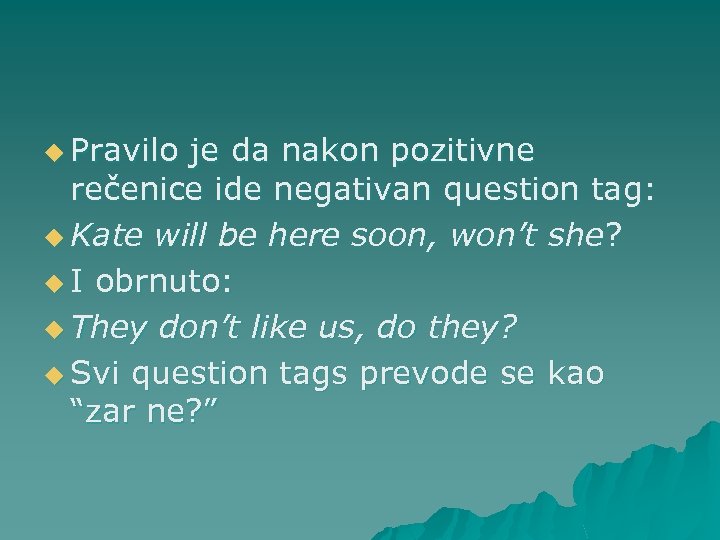 u Pravilo je da nakon pozitivne rečenice ide negativan question tag: u Kate will be here soon, won’t she? u I obrnuto: u They don’t like us, do they? u Svi question tags prevode se kao “zar ne? ”