 Скачать презентацию Question Answering in the Info Sphere Semantic Interoperability
79f10183af5ec6352c3cfc945279438f.ppt
- Количество слайдов: 17



Question Answering in the Info. Sphere: Semantic Interoperability and Lexicon Development Paul Thompson and Steven Lulich Institute for Security Technology Studies Dartmouth College 15 May 2002
Outline • • • The Joint Battlespace Infosphcre Fuselets DARPA IXO Sensor Networks Multiple Query Optimization Semantic Interoperability and Lexicon Development • Conclusions
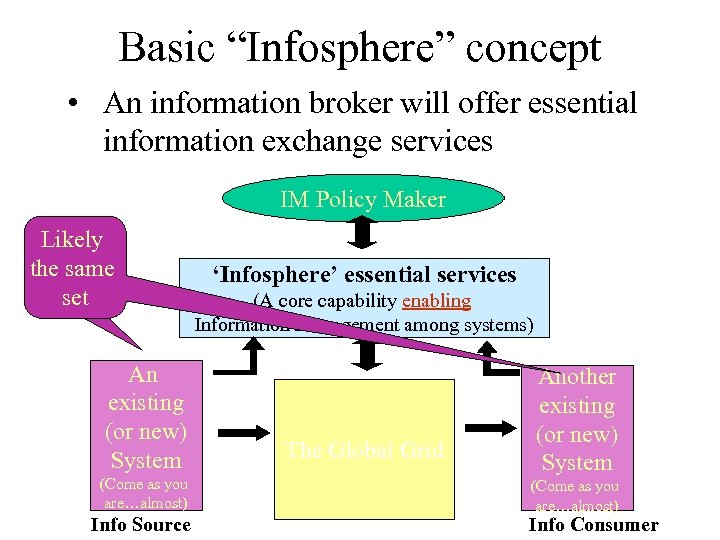
Basic “Infosphere” concept • An information broker will offer essential information exchange services IM Policy Maker Likely the same set An existing (or new) System (Come as you are…almost) Info Source ‘Infosphere’ essential services (A core capability enabling Information Management among systems) The Global Grid Another existing (or new) System (Come as you are…almost) Info Consumer
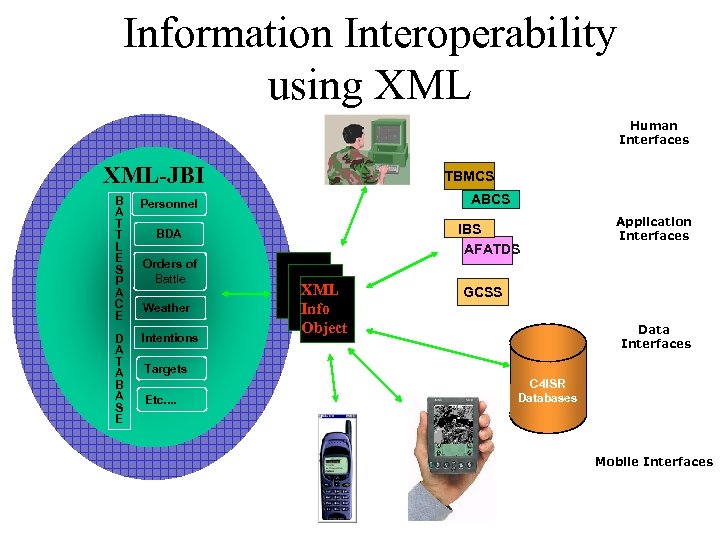
Information Interoperability using XML Human Interfaces XML-JBI TBMCS B A T T L E S P A C E Personnel ABCS BDA IBS AFATDS D A T A B A S E Intentions Orders of Battle Weather XML Info Object Application Interfaces GCSS Data Interfaces Targets Etc. . C 4 ISR Databases Mobile Interfaces
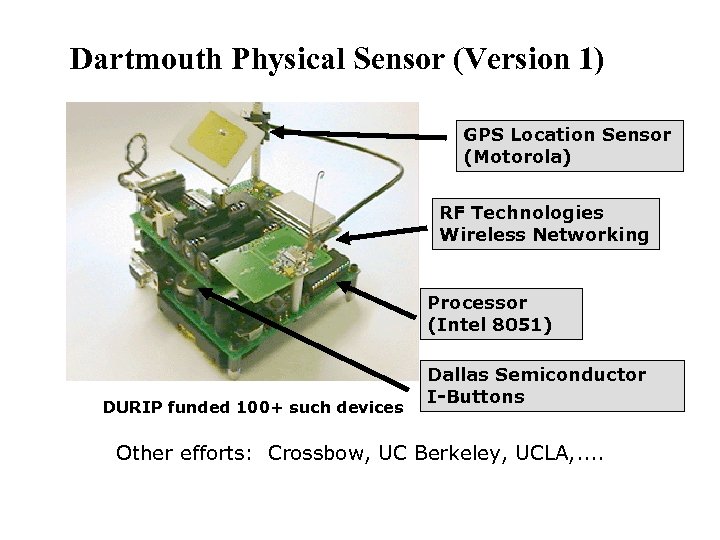
Dartmouth Physical Sensor (Version 1) GPS Location Sensor (Motorola) RF Technologies Wireless Networking Processor (Intel 8051) DURIP funded 100+ such devices Dallas Semiconductor I-Buttons Other efforts: Crossbow, UC Berkeley, UCLA, . .
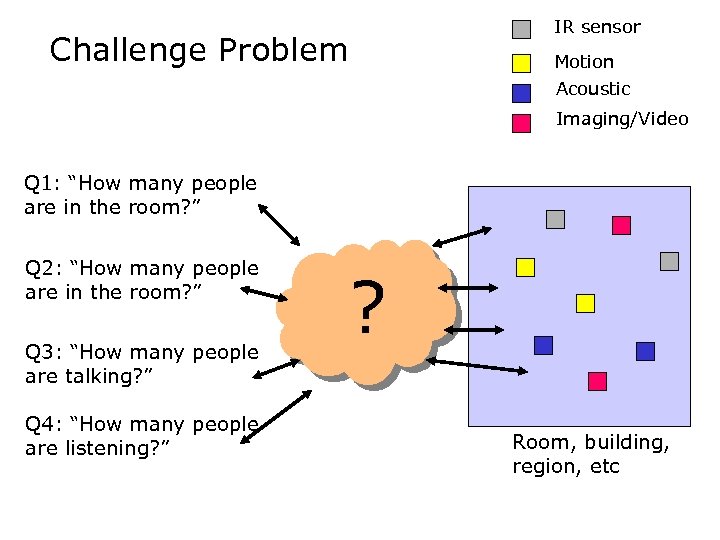
Challenge Problem IR sensor Motion Acoustic Imaging/Video Q 1: “How many people are in the room? ” Q 2: “How many people are in the room? ” Q 3: “How many people are talking? ” Q 4: “How many people are listening? ” ? Room, building, region, etc
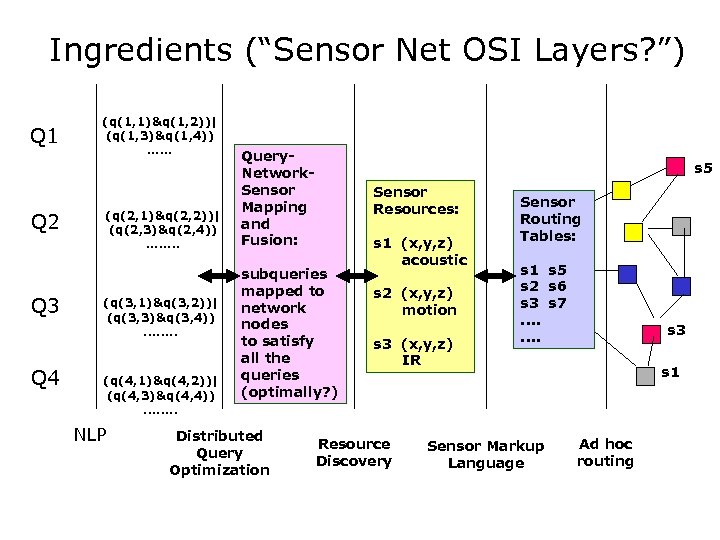
Ingredients (“Sensor Net OSI Layers? ”) Q 1 Q 2 Q 3 Q 4 (q(1, 1)&q(1, 2))| (q(1, 3)&q(1, 4)). . . (q(2, 1)&q(2, 2))| (q(2, 3)&q(2, 4)). . . . (q(3, 1)&q(3, 2))| (q(3, 3)&q(3, 4)). . . . (q(4, 1)&q(4, 2))| (q(4, 3)&q(4, 4)). . . . NLP Query. Network. Sensor Mapping and Fusion: s 5 Sensor Resources: subqueries mapped to network nodes to satisfy all the queries (optimally? ) Distributed Query Optimization s 1 (x, y, z) acoustic s 2 (x, y, z) motion s 3 (x, y, z) IR Resource Discovery Sensor Routing Tables: s 1 s 5 s 2 s 6 s 3 s 7. . . . Sensor Markup Language s 3 s 1 Ad hoc routing
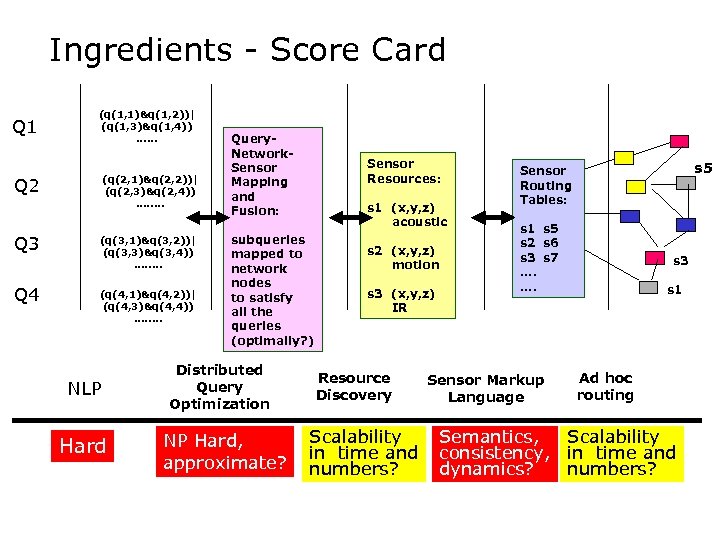
Ingredients - Score Card Q 1 (q(1, 1)&q(1, 2))| (q(1, 3)&q(1, 4)). . . (q(2, 1)&q(2, 2))| (q(2, 3)&q(2, 4)). . . . Q 2 Q 3 Q 4 (q(3, 1)&q(3, 2))| (q(3, 3)&q(3, 4)). . . . (q(4, 1)&q(4, 2))| (q(4, 3)&q(4, 4)). . . . NLP Hard Query. Network. Sensor Mapping and Fusion: Sensor Resources: s 1 (x, y, z) acoustic subqueries mapped to network nodes to satisfy all the queries (optimally? ) Distributed Query Optimization NP Hard, approximate? s 2 (x, y, z) motion s 3 (x, y, z) IR Resource Discovery Scalability in time and numbers? s 5 Sensor Routing Tables: s 1 s 5 s 2 s 6 s 3 s 7. . . . Sensor Markup Language s 3 s 1 Ad hoc routing Semantics, Scalability consistency, in time and dynamics? numbers?
Natural Language Processing Level • “Question and Answer” systems – TREC Question Answering Track, eg – “Who won the women’s downhill gold medal? ” • “Message Understanding” – Bounded domains - military intelligence, logistics, etc – message retrieval using information extraction • Inference capability
Semantic Interoperability and Lexicon Development • DARPA hand-built Ontologies and KBs – DARPA Agent Markup Language (DAML) – Rapid Knowledge Formation (RKF) • Dynamic Ontology Mapping – Learning component – Connectivistic Lexicon
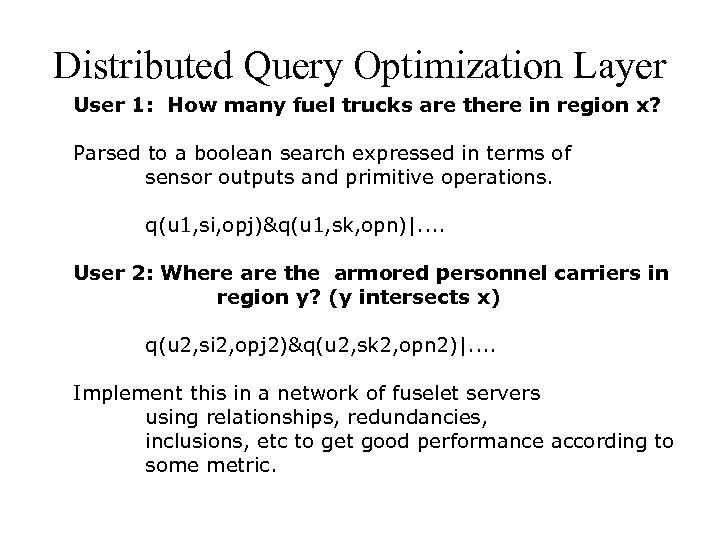
Distributed Query Optimization Layer User 1: How many fuel trucks are there in region x? Parsed to a boolean search expressed in terms of sensor outputs and primitive operations. q(u 1, si, opj)&q(u 1, sk, opn)|. . User 2: Where are the armored personnel carriers in region y? (y intersects x) q(u 2, si 2, opj 2)&q(u 2, sk 2, opn 2)|. . Implement this in a network of fuselet servers using relationships, redundancies, inclusions, etc to get good performance according to some metric.
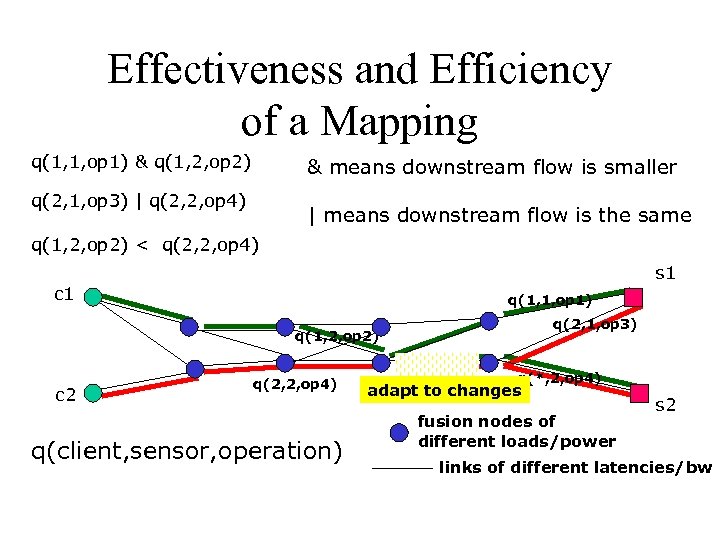
Effectiveness and Efficiency of a Mapping q(1, 1, op 1) & q(1, 2, op 2) & means downstream flow is smaller q(2, 1, op 3) | q(2, 2, op 4) | means downstream flow is the same q(1, 2, op 2) < q(2, 2, op 4) s 1 c 1 q(1, 1, op 1) q(2, 1, op 3) q(1, 2, op 2) c 2 q(2, 2, op 4) q(client, sensor, operation) q(*, 2, op 4) adapt to changes fusion nodes of different loads/power s 2 links of different latencies/bw
Resource Discovery • • • JINI, CORBA, Brokers, Matchmakers, etc Distributed, coherency, overheads, etc Semantics? Indexing? Scalability of distributed, dynamic implementation
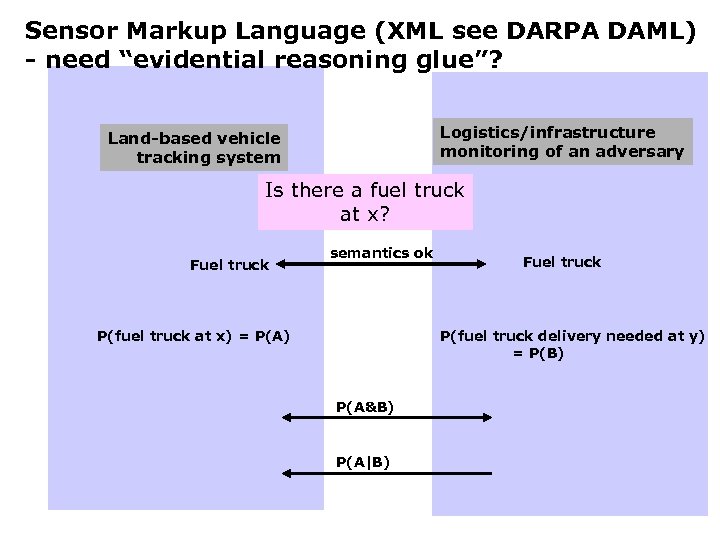
Sensor Markup Language (XML see DARPA DAML) - need “evidential reasoning glue”? Logistics/infrastructure monitoring of an adversary Land-based vehicle tracking system Is there a fuel truck at x? Fuel truck semantics ok Fuel truck P(fuel truck delivery needed at y) = P(B) P(fuel truck at x) = P(A) P(A&B) P(A|B)
Ad hoc routing in dynamic environments • nodes dynamic • requirements dynamic • tradeoff between management overhead and usable BW/latency? • sensor networks: bi-directional vs unidirectional links? • lots to do still
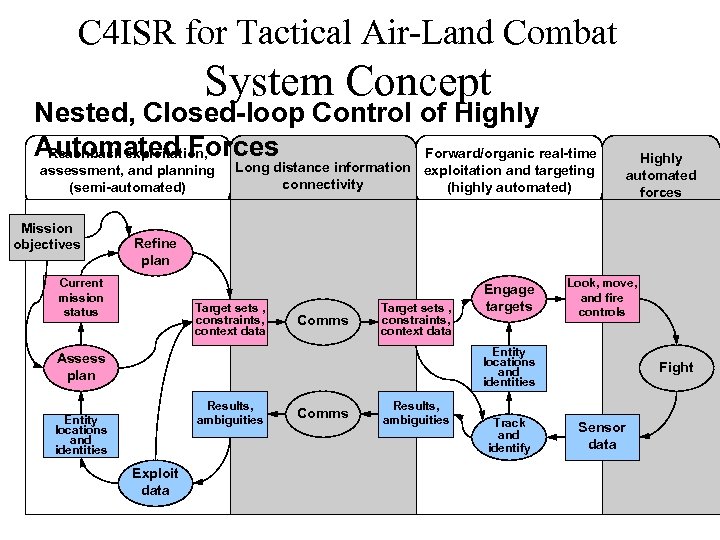
C 4 ISR for Tactical Air-Land Combat System Concept Nested, Closed-loop Control of Highly Automated Forces Reachback exploitation, Forward/organic real-time assessment, and planning (semi-automated) Mission objectives Long distance information exploitation and targeting connectivity (highly automated) Highly automated forces Refine plan Current mission status Target sets , constraints, context data Comms Target sets , constraints, context data Engage targets Look, move, and fire controls Entity locations and identities Assess plan Results, ambiguities Entity locations and identities Exploit data Comms Results, ambiguities Track and identify Fight Sensor data
Conclusions (cont. ) • Question answering from JBI and sensor networks – Different issues from ARDA / TREC – Can build on • ARDA / TREC • NLP interfaces to RDBMS and Knowledge Bases • Data mining from stream data • Semantic Interoperability is crucial
Скачать презентацию Question Answering in the Info Sphere Semantic Interoperability
79f10183af5ec6352c3cfc945279438f.ppt