


 Скачать презентацию Querying XML XQuery XPath and SQL XML in Context
b4ecf48874d996cff263b4d3670e7a4b.ppt
- Количество слайдов: 139
 Querying XML: XQuery, XPath, and SQL/XML in Context Authors: Jim Melton and Stephen Buxton Publisher: Morgan Kaufmann Publication Year: 2006 Lecturer: Kyungpook National University School of EECS Laboratory of Database Systems Young Chul Park 2007 -7/KNU Querying XML: XQuery, XPath, and SQL/XML in Context
 Chapter 10 Introduction to XQuery 1. 0 10. 7 The XQuery Type System Each item in the XQuery Data Model has at least a value and a type name. 10. 7. 1 What Is a Type System Anyway? A type system is a system of splitting entities up into named sets. A strongly typed language such as Java or SQL may do type checking at compile time (static typing) or at run time (dynamic typing). With pessimistic static typing, the processor returns a type error whenever there may be a type error at run time, but if this pessimistic static type check succeeds, then the processor can confidently proceed with the rest of the program or query without bothering with any further type checking. Pessimistic static type checking gains efficiency at the expense of some false type errors. XQuery is a strongly typed language – every entity (every element, attribute, atomic value, etc) has both a value and a type name, and functions and operators are defined to work only on some (combinations of) types. XQuery has an optional static typing feature, which uses pessimistic static typing. 2007 -7/KNU Querying XML: XQuery, XPath, and SQL/XML in Context 2
 Chapter 10 Introduction to XQuery 1. 0 10. 7. 2 XML Schema Types The XQuery type system is based on the types defined in XML Schema Part 2: Datatypes and the structure types defined in XML Schema Part 1: Structures. Datatypes (simple types) Every item (document, node, or atomic value) in the XQuery Data Model has both a value and a named type. XML Schema defines 19 built-in, atomic, primitive data types. – built-in – defined as part of XML Schema, as opposed to user-derived (user-defined) data types. – atomic – a single, indivisible data type definition, as opposed to list (a data type defined as a list of atomic data types) or union (a data type defined as the union of one or more data types). – primitive – a data type that is not defined in terms of other data types. For example, xs: decimal is a primitive data type, while xs: integer is a derived data type, defined as a special case of xs: decimal where fraction. Digits is 0. XML Schema defines 25 built-in, atomic, derived data types. These 44 built-in data types are defined in terms of a value space – the set of values that “belong” to the data type – and a lexical space – the set of valid literals for a data type. Each data type also has some fundamental facets – properties of the data type such as whether the values in the value space have a predefined order, whether the value space is bounded, whether the cardinality of the value space is finite or infinite, and so forth. 2007 -7/KNU Querying XML: XQuery, XPath, and SQL/XML in Context 3
 Chapter 10 Introduction to XQuery 1. 0 In addition to these 44 built-in data types, XML Schema allows for user-derived (user-defined) data types based on the built-in data types. These user-derived data types may combine the built-in data types using list or union, or they may restrict the value space (and hence the lexical space) of a built-in via some constraining facets – properties that restrict the value space, such as length, or an enumeration of allowable values. XML Schema defines one top-level data type, xs: any. Sinple. Type. 2007 -7/KNU Querying XML: XQuery, XPath, and SQL/XML in Context 4
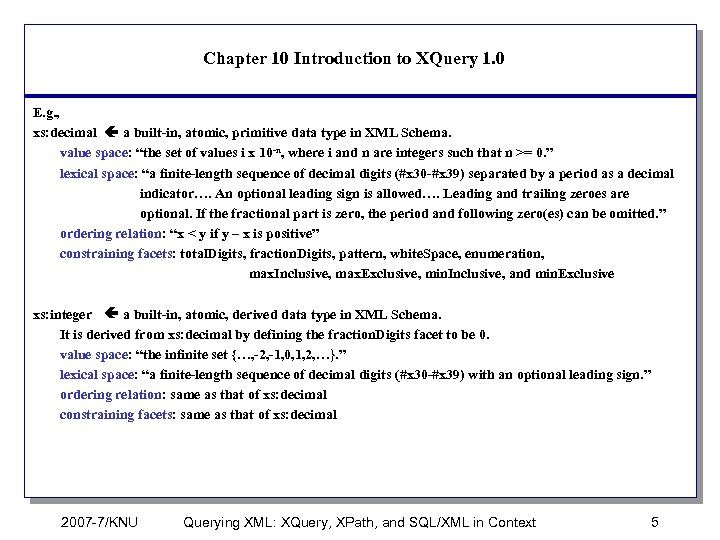 Chapter 10 Introduction to XQuery 1. 0 E. g. , xs: decimal a built-in, atomic, primitive data type in XML Schema. value space: “the set of values i x 10 -n, where i and n are integers such that n >= 0. ” lexical space: “a finite-length sequence of decimal digits (#x 30 -#x 39) separated by a period as a decimal indicator…. An optional leading sign is allowed…. Leading and trailing zeroes are optional. If the fractional part is zero, the period and following zero(es) can be omitted. ” ordering relation: “x < y if y – x is positive” constraining facets: total. Digits, fraction. Digits, pattern, white. Space, enumeration, max. Inclusive, max. Exclusive, min. Inclusive, and min. Exclusive xs: integer a built-in, atomic, derived data type in XML Schema. It is derived from xs: decimal by defining the fraction. Digits facet to be 0. value space: “the infinite set {…, -2, -1, 0, 1, 2, …}. ” lexical space: “a finite-length sequence of decimal digits (#x 30 -#x 39) with an optional leading sign. ” ordering relation: same as that of xs: decimal constraining facets: same as that of xs: decimal 2007 -7/KNU Querying XML: XQuery, XPath, and SQL/XML in Context 5
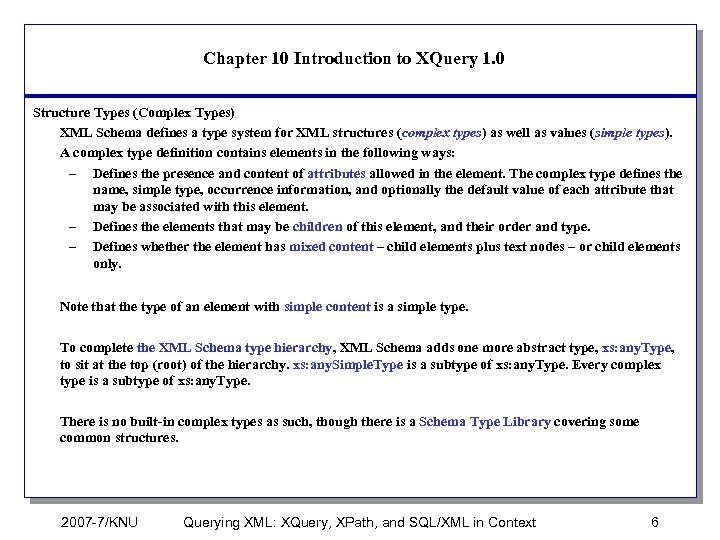 Chapter 10 Introduction to XQuery 1. 0 Structure Types (Complex Types) XML Schema defines a type system for XML structures (complex types) as well as values (simple types). A complex type definition contains elements in the following ways: – Defines the presence and content of attributes allowed in the element. The complex type defines the name, simple type, occurrence information, and optionally the default value of each attribute that may be associated with this element. – Defines the elements that may be children of this element, and their order and type. – Defines whether the element has mixed content – child elements plus text nodes – or child elements only. Note that the type of an element with simple content is a simple type. To complete the XML Schema type hierarchy, XML Schema adds one more abstract type, xs: any. Type, to sit at the top (root) of the hierarchy. xs: any. Simple. Type is a subtype of xs: any. Type. Every complex type is a subtype of xs: any. Type. There is no built-in complex types as such, though there is a Schema Type Library covering some common structures. 2007 -7/KNU Querying XML: XQuery, XPath, and SQL/XML in Context 6
Use this for elements with text-for-reading content. It's mixed so that things like bidi markup can be added, either on an ad-hoc basis in instances, or in types derived from this one. Not required, since according to XML 1. 0 its semantics is inherited, so we don't need it when text is nested inside text, or other elements which already give xml: lang a value. 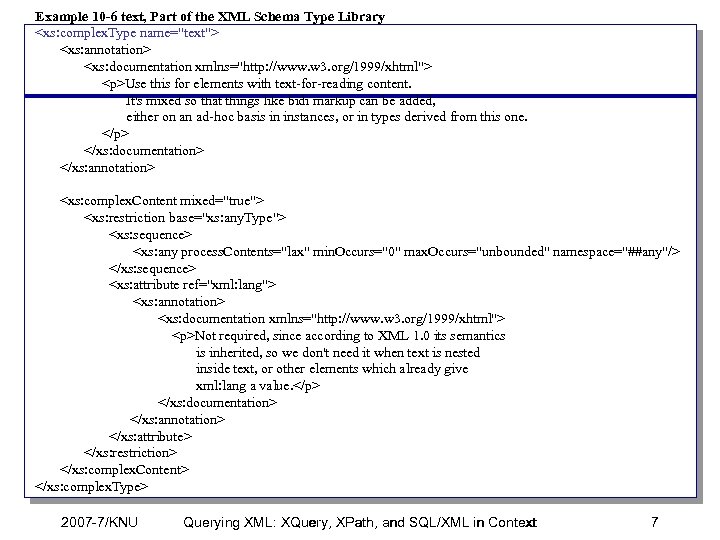 Example 10 -6 text, Part of the XML Schema Type Library
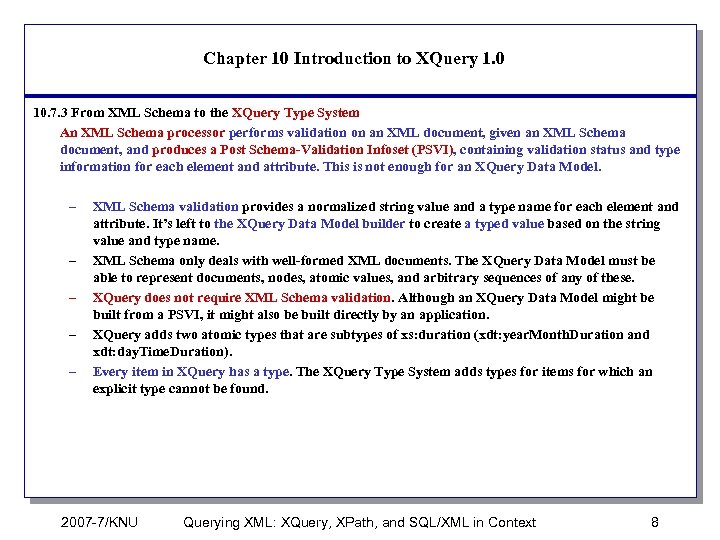 Chapter 10 Introduction to XQuery 1. 0 10. 7. 3 From XML Schema to the XQuery Type System An XML Schema processor performs validation on an XML document, given an XML Schema document, and produces a Post Schema-Validation Infoset (PSVI), containing validation status and type information for each element and attribute. This is not enough for an XQuery Data Model. – – – XML Schema validation provides a normalized string value and a type name for each element and attribute. It’s left to the XQuery Data Model builder to create a typed value based on the string value and type name. XML Schema only deals with well-formed XML documents. The XQuery Data Model must be able to represent documents, nodes, atomic values, and arbitrary sequences of any of these. XQuery does not require XML Schema validation. Although an XQuery Data Model might be built from a PSVI, it might also be built directly by an application. XQuery adds two atomic types that are subtypes of xs: duration (xdt: year. Month. Duration and xdt: day. Time. Duration). Every item in XQuery has a type. The XQuery Type System adds types for items for which an explicit type cannot be found. 2007 -7/KNU Querying XML: XQuery, XPath, and SQL/XML in Context 8
 Chapter 10 Introduction to XQuery 1. 0 The XQuery Type System adds the following abstract types: – – – xdt: untyped – is a special type, meaning that no type information is available. xdt: untyped is a subtype of xs: any. Type, and it cannot be a base type for user-derived types. xdt: any. Atomic. Type – is a subtype of xs: any. Simple. Type. It is a little more restrictive than xs: sny. Simple. Type, encompassing all the subtypes of xs: any. Simple. Type except xs: IDREFS, xs: NMTOKENS, xs: ENTITIES, and user-defined list and union types. xdt: untyped. Atomic – if an item has this type, we know that it is an atomic value, but it has not been validated against an XML Schema. 10. 7. 4 Types and Queries We expect the XQuery Data Model and type system to be the foundation of all XML processing, not just XQuery, over time. 2007 -7/KNU Querying XML: XQuery, XPath, and SQL/XML in Context 9
 Chapter 10 Introduction to XQuery 1. 0 10. 8 XQuery 1. 0 Formal Semantics and Static Typing The Formal Semantics specification defines the static semantics of XQuery, particularly the rules for determining the static types of expressions. The Formal Semantics specification also defines most of the dynamic semantics of XQuery using the same sort of formal notation. The static type of an expression is a data type that is determinable without seeing any instance data on which the expression might be evaluated. In some languages, it is called the compiled type or the declared type of an expression. This is in contrast to the dynamic type, also known as the run-time type or the mostspecific type. Example 10 -7 An XQuery Expression let $i xs: integer : = 3 return $i + 5 2007 -7/KNU Querying XML: XQuery, XPath, and SQL/XML in Context 10
 Chapter 10 Introduction to XQuery 1. 0 10. 8. 1 Notations This notation depends on the concepts of judgments, inference rules, and mapping rules. A judgment is a statement about whether some property holds (“is a fact”) or not. An inference rule states that some judgment holds if and only if other specified judgments also hold. A mapping rule describes how an ordinary XQuery expression is mapped onto a “core XQuery expression. ” (1) The symbol “=>” means “evaluates to”, (2) a colon (“: ”) separates an expression from a type name, and (3) the “turnstile” symbol (which should be “|-” but is simulated in the Formal Semantics spec by “|-” because of HTML and font limitations) separates the name of an environment from a judgment regarding something in that environment. In the Formal Semantics, an environment is a context in which objects can exist; XQuery’s static context and dynamic context are the environments used in the spec. Judgments don’t always use the symbols “=>” and “: ”. They are sometimes written using ordinary English words (“is” or “raises, ” for example). turnstile : 회전식 십자문, 회전식 개찰구 2007 -7/KNU Querying XML: XQuery, XPath, and SQL/XML in Context 11
 Chapter 10 Introduction to XQuery 1. 0 Example 10 -8 Sample Formal Semantics Judgments The following judgment holds? 3 => 3 Film is depressing Expr => Value movies/movie/release. Date = 1989 The following judgment holds if Expr has the type Type Expr : Type E. g. , Net. Movie[title=movies/movie/title]/price : xs: decimal The following judgment holds when Expr raises the error Expr raises Error E. g. , 15 div 0 raises err: FOAR 0001 The following judgment holds when, in the static environment stat. Env (that is, in the static context), an expression Expr has type Type stat. Env |- Expr : Type E. g. , in our sample data, the following judgment always holds stat. Env |- $DVDCost : xs: decimal 2007 -7/KNU Querying XML: XQuery, XPath, and SQL/XML in Context 12
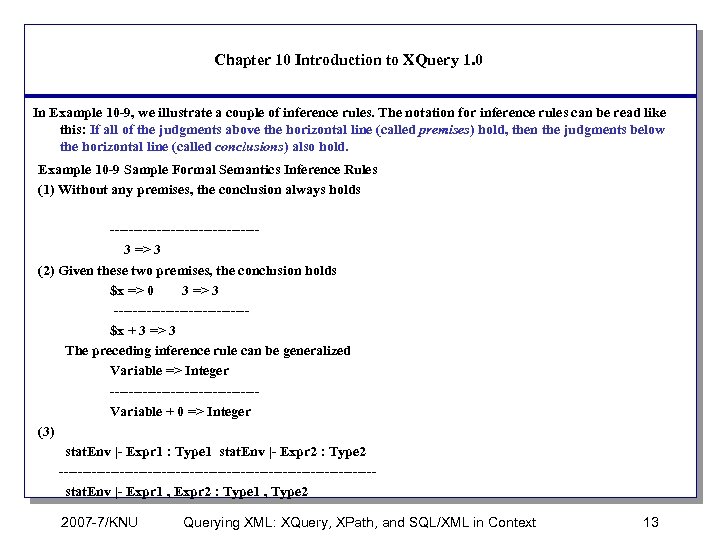 Chapter 10 Introduction to XQuery 1. 0 In Example 10 -9, we illustrate a couple of inference rules. The notation for inference rules can be read like this: If all of the judgments above the horizontal line (called premises) hold, then the judgments below the horizontal line (called conclusions) also hold. Example 10 -9 Sample Formal Semantics Inference Rules (1) Without any premises, the conclusion always holds ----------------3 => 3 (2) Given these two premises, the conclusion holds $x => 0 3 => 3 --------------$x + 3 => 3 The preceding inference rule can be generalized Variable => Integer ----------------Variable + 0 => Integer (3) stat. Env |- Expr 1 : Type 1 stat. Env |- Expr 2 : Type 2 ----------------------------------stat. Env |- Expr 1 , Expr 2 : Type 1 , Type 2 2007 -7/KNU Querying XML: XQuery, XPath, and SQL/XML in Context 13
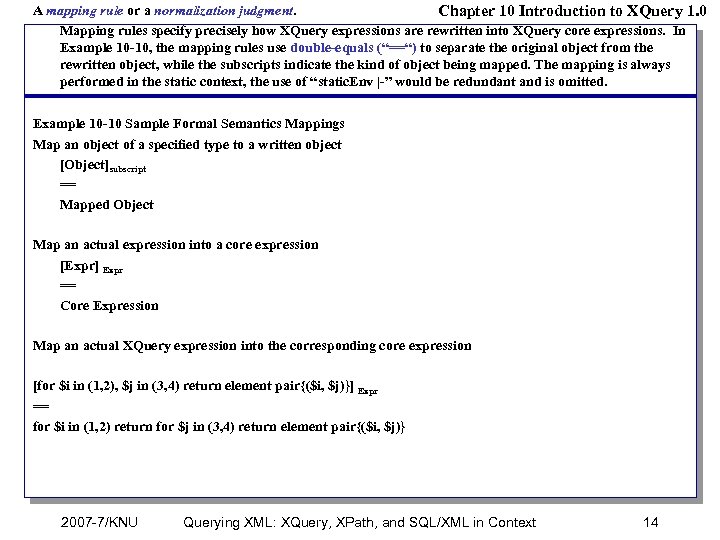 A mapping rule or a normalization judgment. Chapter 10 Introduction to XQuery 1. 0 Mapping rules specify precisely how XQuery expressions are rewritten into XQuery core expressions. In Example 10 -10, the mapping rules use double-equals (“==“) to separate the original object from the rewritten object, while the subscripts indicate the kind of object being mapped. The mapping is always performed in the static context, the use of “static. Env |-” would be redundant and is omitted. Example 10 -10 Sample Formal Semantics Mappings Map an object of a specified type to a written object [Object]subscript == Mapped Object Map an actual expression into a core expression [Expr] Expr == Core Expression Map an actual XQuery expression into the corresponding core expression [for $i in (1, 2), $j in (3, 4) return element pair{($i, $j)}] Expr == for $i in (1, 2) return for $j in (3, 4) return element pair{($i, $j)} 2007 -7/KNU Querying XML: XQuery, XPath, and SQL/XML in Context 14
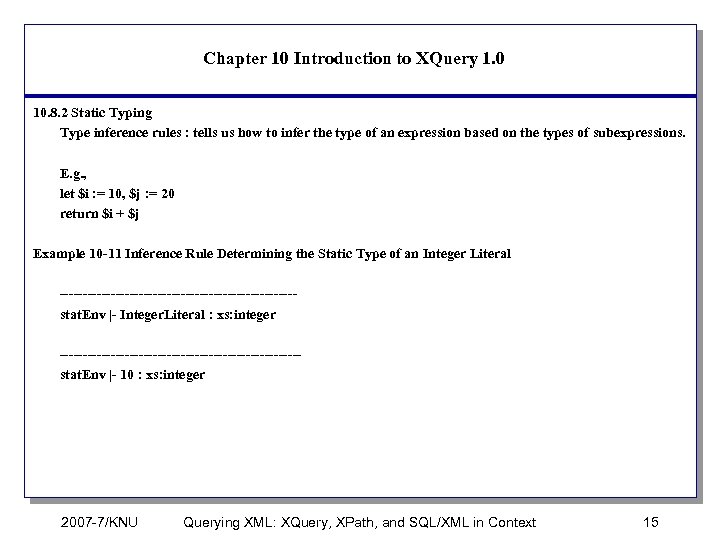 Chapter 10 Introduction to XQuery 1. 0 10. 8. 2 Static Typing Type inference rules : tells us how to infer the type of an expression based on the types of subexpressions. E. g. , let $i : = 10, $j : = 20 return $i + $j Example 10 -11 Inference Rule Determining the Static Type of an Integer Literal -------------------------stat. Env |- Integer. Literal : xs: integer --------------------------stat. Env |- 10 : xs: integer 2007 -7/KNU Querying XML: XQuery, XPath, and SQL/XML in Context 15
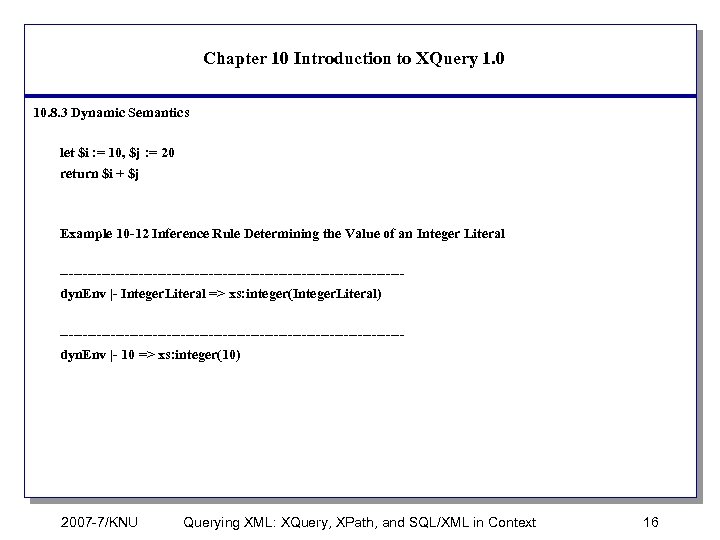 Chapter 10 Introduction to XQuery 1. 0 10. 8. 3 Dynamic Semantics let $i : = 10, $j : = 20 return $i + $j Example 10 -12 Inference Rule Determining the Value of an Integer Literal -------------------------------------dyn. Env |- Integer. Literal => xs: integer(Integer. Literal) -------------------------------------dyn. Env |- 10 => xs: integer(10) 2007 -7/KNU Querying XML: XQuery, XPath, and SQL/XML in Context 16
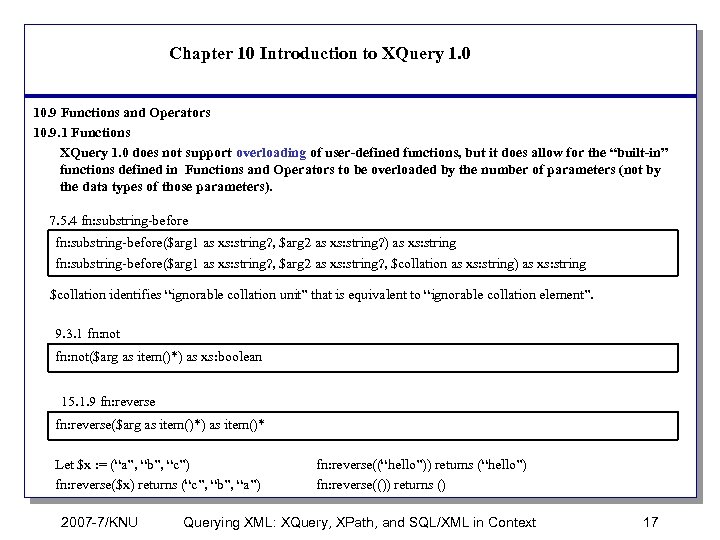 Chapter 10 Introduction to XQuery 1. 0 10. 9 Functions and Operators 10. 9. 1 Functions XQuery 1. 0 does not support overloading of user-defined functions, but it does allow for the “built-in” functions defined in Functions and Operators to be overloaded by the number of parameters (not by the data types of those parameters). 7. 5. 4 fn: substring-before($arg 1 as xs: string? , $arg 2 as xs: string? ) as xs: string fn: substring-before($arg 1 as xs: string? , $arg 2 as xs: string? , $collation as xs: string) as xs: string $collation identifies “ignorable collation unit” that is equivalent to “ignorable collation element”. 9. 3. 1 fn: not($arg as item()*) as xs: boolean 15. 1. 9 fn: reverse($arg as item()*) as item()* Let $x : = (“a”, “b”, “c”) fn: reverse($x) returns (“c”, “b”, “a”) 2007 -7/KNU fn: reverse((“hello”)) returns (“hello”) fn: reverse(()) returns () Querying XML: XQuery, XPath, and SQL/XML in Context 17
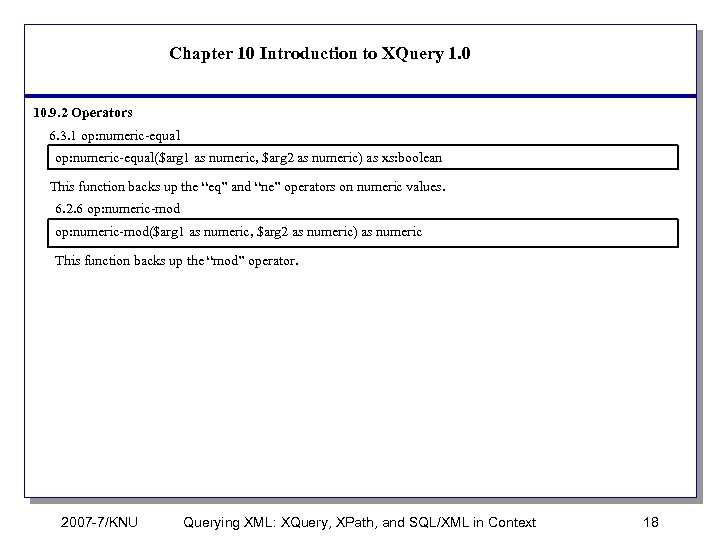 Chapter 10 Introduction to XQuery 1. 0 10. 9. 2 Operators 6. 3. 1 op: numeric-equal($arg 1 as numeric, $arg 2 as numeric) as xs: boolean This function backs up the “eq” and “ne” operators on numeric values. 6. 2. 6 op: numeric-mod($arg 1 as numeric, $arg 2 as numeric) as numeric This function backs up the “mod” operator. 2007 -7/KNU Querying XML: XQuery, XPath, and SQL/XML in Context 18
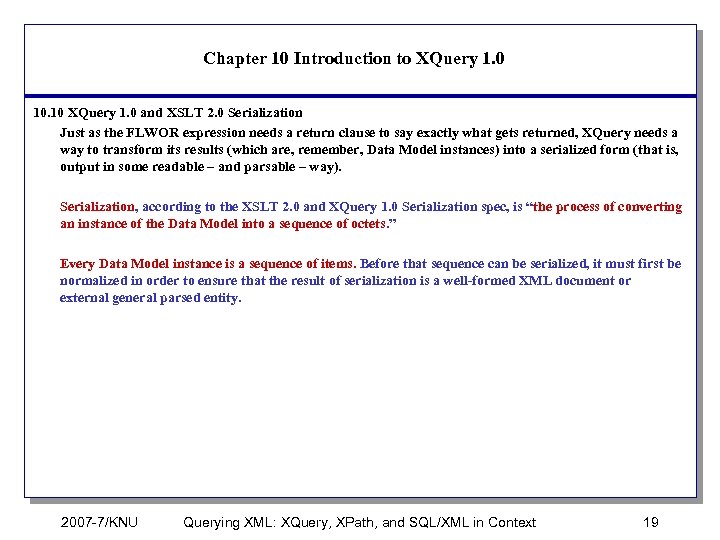 Chapter 10 Introduction to XQuery 1. 0 10. 10 XQuery 1. 0 and XSLT 2. 0 Serialization Just as the FLWOR expression needs a return clause to say exactly what gets returned, XQuery needs a way to transform its results (which are, remember, Data Model instances) into a serialized form (that is, output in some readable – and parsable – way). Serialization, according to the XSLT 2. 0 and XQuery 1. 0 Serialization spec, is “the process of converting an instance of the Data Model into a sequence of octets. ” Every Data Model instance is a sequence of items. Before that sequence can be serialized, it must first be normalized in order to ensure that the result of serialization is a well-formed XML document or external general parsed entity. 2007 -7/KNU Querying XML: XQuery, XPath, and SQL/XML in Context 19
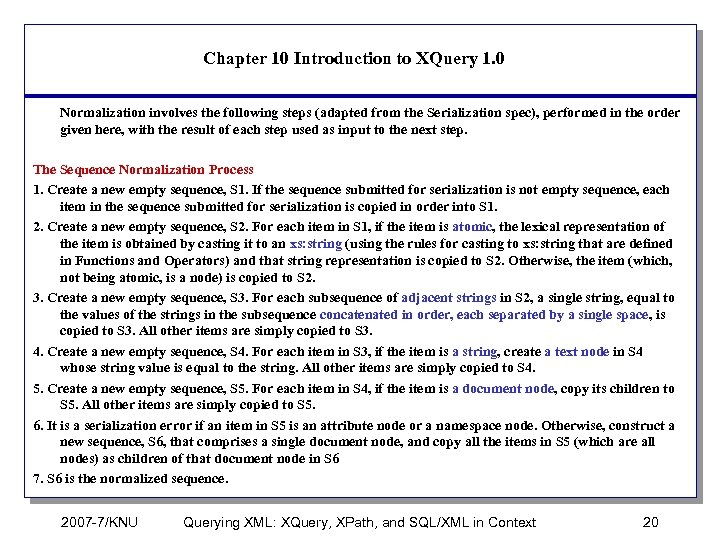 Chapter 10 Introduction to XQuery 1. 0 Normalization involves the following steps (adapted from the Serialization spec), performed in the order given here, with the result of each step used as input to the next step. The Sequence Normalization Process 1. Create a new empty sequence, S 1. If the sequence submitted for serialization is not empty sequence, each item in the sequence submitted for serialization is copied in order into S 1. 2. Create a new empty sequence, S 2. For each item in S 1, if the item is atomic, the lexical representation of the item is obtained by casting it to an xs: string (using the rules for casting to xs: string that are defined in Functions and Operators) and that string representation is copied to S 2. Otherwise, the item (which, not being atomic, is a node) is copied to S 2. 3. Create a new empty sequence, S 3. For each subsequence of adjacent strings in S 2, a single string, equal to the values of the strings in the subsequence concatenated in order, each separated by a single space, is copied to S 3. All other items are simply copied to S 3. 4. Create a new empty sequence, S 4. For each item in S 3, if the item is a string, create a text node in S 4 whose string value is equal to the string. All other items are simply copied to S 4. 5. Create a new empty sequence, S 5. For each item in S 4, if the item is a document node, copy its children to S 5. All other items are simply copied to S 5. 6. It is a serialization error if an item in S 5 is an attribute node or a namespace node. Otherwise, construct a new sequence, S 6, that comprises a single document node, and copy all the items in S 5 (which are all nodes) as children of that document node in S 6 7. S 6 is the normalized sequence. 2007 -7/KNU Querying XML: XQuery, XPath, and SQL/XML in Context 20
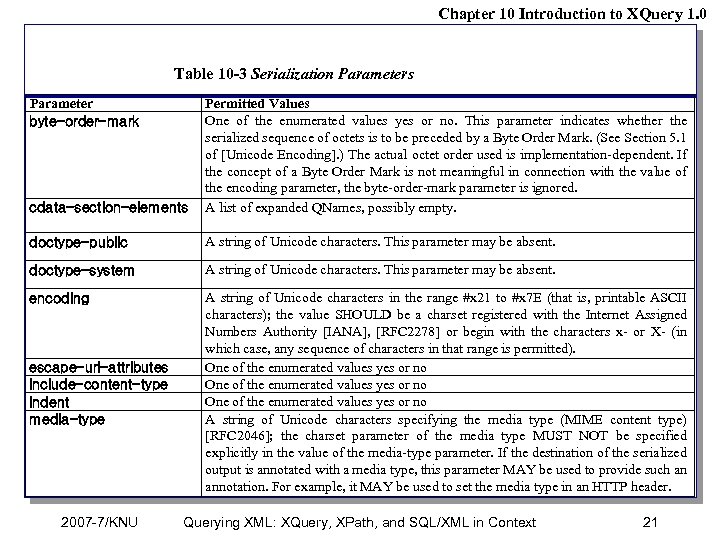 Chapter 10 Introduction to XQuery 1. 0 Table 10 -3 Serialization Parameters Parameter byte-order-mark cdata-section-elements Permitted Values One of the enumerated values yes or no. This parameter indicates whether the serialized sequence of octets is to be preceded by a Byte Order Mark. (See Section 5. 1 of [Unicode Encoding]. ) The actual octet order used is implementation-dependent. If the concept of a Byte Order Mark is not meaningful in connection with the value of the encoding parameter, the byte-order-mark parameter is ignored. A list of expanded QNames, possibly empty. doctype-public A string of Unicode characters. This parameter may be absent. doctype-system A string of Unicode characters. This parameter may be absent. encoding A string of Unicode characters in the range #x 21 to #x 7 E (that is, printable ASCII characters); the value SHOULD be a charset registered with the Internet Assigned Numbers Authority [IANA], [RFC 2278] or begin with the characters x- or X- (in which case, any sequence of characters in that range is permitted). One of the enumerated values yes or no A string of Unicode characters specifying the media type (MIME content type) [RFC 2046]; the charset parameter of the media type MUST NOT be specified explicitly in the value of the media-type parameter. If the destination of the serialized output is annotated with a media type, this parameter MAY be used to provide such an annotation. For example, it MAY be used to set the media type in an HTTP header. escape-uri-attributes include-content-type indent media-type 2007 -7/KNU Querying XML: XQuery, XPath, and SQL/XML in Context 21
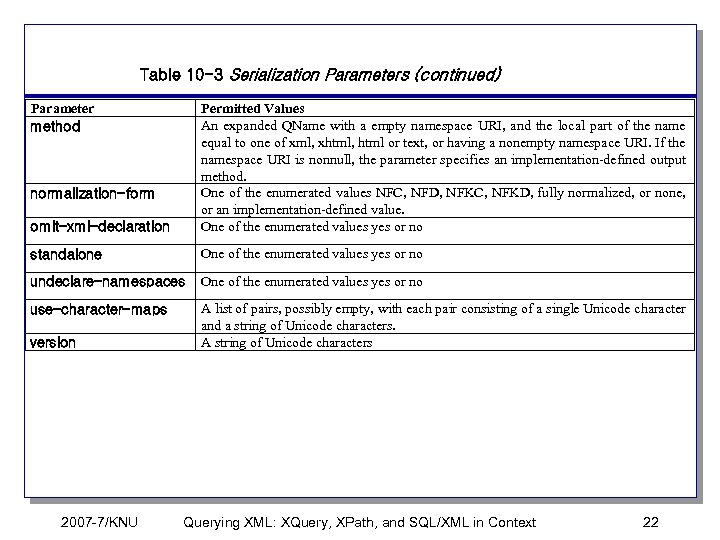 Table 10 -3 Serialization Parameters (continued) Parameter method omit-xml-declaration Permitted Values An expanded QName with a empty namespace URI, and the local part of the name equal to one of xml, xhtml, html or text, or having a nonempty namespace URI. If the namespace URI is nonnull, the parameter specifies an implementation-defined output method. One of the enumerated values NFC, NFD, NFKC, NFKD, fully normalized, or none, or an implementation-defined value. One of the enumerated values yes or no standalone One of the enumerated values yes or no undeclare-namespaces One of the enumerated values yes or no use-character-maps A list of pairs, possibly empty, with each pair consisting of a single Unicode character and a string of Unicode characters. A string of Unicode characters normalization-form version 2007 -7/KNU Querying XML: XQuery, XPath, and SQL/XML in Context 22
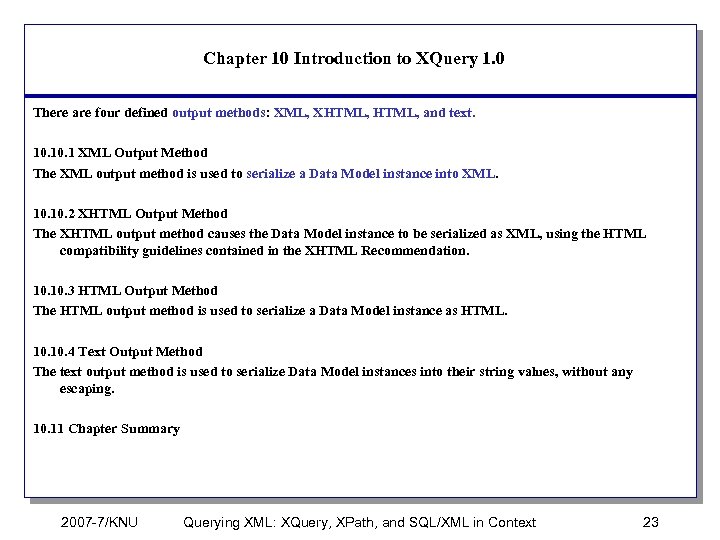 Chapter 10 Introduction to XQuery 1. 0 There are four defined output methods: XML, XHTML, and text. 10. 1 XML Output Method The XML output method is used to serialize a Data Model instance into XML. 10. 2 XHTML Output Method The XHTML output method causes the Data Model instance to be serialized as XML, using the HTML compatibility guidelines contained in the XHTML Recommendation. 10. 3 HTML Output Method The HTML output method is used to serialize a Data Model instance as HTML. 10. 4 Text Output Method The text output method is used to serialize Data Model instances into their string values, without any escaping. 10. 11 Chapter Summary 2007 -7/KNU Querying XML: XQuery, XPath, and SQL/XML in Context 23
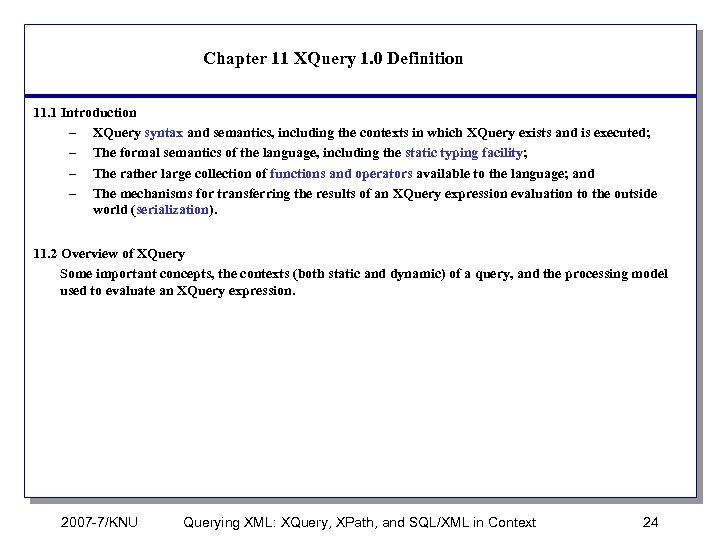 Chapter 11 XQuery 1. 0 Definition 11. 1 Introduction – XQuery syntax and semantics, including the contexts in which XQuery exists and is executed; – The formal semantics of the language, including the static typing facility; – The rather large collection of functions and operators available to the language; and – The mechanisms for transferring the results of an XQuery expression evaluation to the outside world (serialization). 11. 2 Overview of XQuery Some important concepts, the contexts (both static and dynamic) of a query, and the processing model used to evaluate an XQuery expression. 2007 -7/KNU Querying XML: XQuery, XPath, and SQL/XML in Context 24
 Chapter 11 XQuery 1. 0 Definition 11. 2. 1 Concepts n Document order – n Sequence – A sequence is an ordered collection of zero or more items. E. g. , (), (1, 2, 3, 4, 5), (3. 14159, 2. 71828, 0. 5772) n Atomization – Atomization is the result of invoking the fn: data() function on the sequence. That result is the sequence of atomic values produced by applying the following rules to each item in the input sequence: – If the item is an atomic value, it is returned. – If the item is a node, its typed value is returned (an error is raised if the node has no typed value). E. g. , Atomizing the sequence (
 Chapter 11 XQuery 1. 0 Definition n Effective Boolean value (EBV) – The effective Boolean value of an expression is the result of invoking the fn: boolean() function on the value of expression. That result is a Boolean value produced by applying the following rules, in this order: – If its operand is an empty sequence, fn: boolean() returns false. – If its operand is a sequence whose first item is a node, fn: boolean() returns true. – If its operand is a singleton value of type xs: Boolean or derived from xs: boolean, fn: boolean() returns the value of its operand unchanged. – If its operand is a singleton value of type xs: string, xdt: untyped. Atomic, or a type derived from one of these, fn: boolean() returns false if the operand value has zero length and true otherwise. – If its operand is a singleton value of any numeric type or derived from a numeric type, fn: boolean() returns false if the operand value is Na. N or is numerically equal to zero and true otherwise. – In all other cases, fn: boolean() raises a type error. n String value – Every node has a string value. The string value of a node is a string and, formally, is the result of applying fn: string() to the node. n Typed value – Every node has a typed value. The typed value of a node is a sequence of atomic values and, formally, is the result of applying fn: data() to the node. 2007 -7/KNU Querying XML: XQuery, XPath, and SQL/XML in Context 26
 Chapter 11 XQuery 1. 0 Definition 11. 3 The XQuery Processing Model XQuery Processor XQuery Engine 2007 -7/KNU Querying XML: XQuery, XPath, and SQL/XML in Context 27
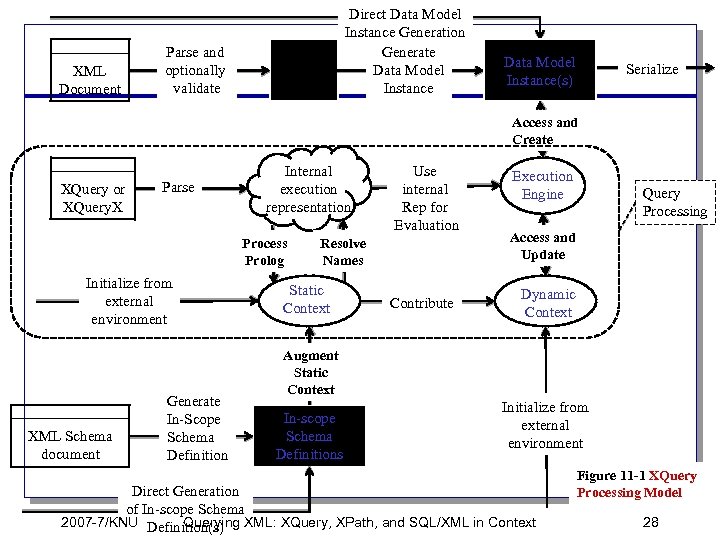 XML Document Parse and optionally validate Infoset or PSVI Direct Data Model Instance Generation Generate Data Model Instance(s) Serialize Access and Create XQuery or XQuery. X Parse Internal execution representation Process Prolog Initialize from external environment XML Schema document Generate In-Scope Schema Definition Use internal Rep for Evaluation Resolve Names Static Context Contribute Execution Engine Query Processing Access and Update Dynamic Context Augment Static Context In-scope Schema Definitions Initialize from external environment Direct Generation of In-scope Schema 2007 -7/KNU Definition(s) XML: XQuery, XPath, and SQL/XML in Context Querying Figure 11 -1 XQuery Processing Model 28
 Chapter 11 XQuery 1. 0 Definition 11. 3. 1 The Static Context Whenever an XQuery expression is processed, the set of initial conditions governing its behavior is called the static context. The static context is a set of components, with values that are set globally by the XQuery implementation before any expression is evaluated. The values of a few of those components can be modified by the query prolog, and the values of a very few can be modified by the actions of the query itself. 2007 -7/KNU Querying XML: XQuery, XPath, and SQL/XML in Context 29
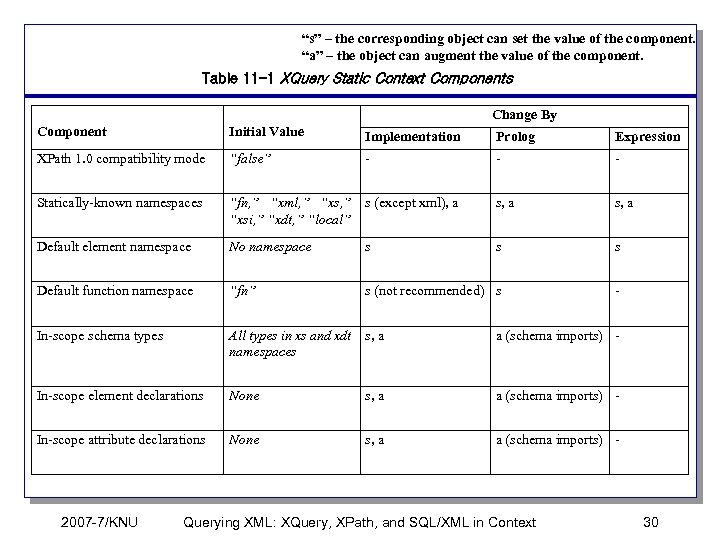 “s” – the corresponding object can set the value of the component. “a” – the object can augment the value of the component. Table 11 -1 XQuery Static Context Components Change By Component Initial Value Implementation Prolog Expression XPath 1. 0 compatibility mode “false” - - - Statically-known namespaces “fn, ” “xml, ” “xsi, ” “xdt, ” “local” s (except xml), a s, a Default element namespace No namespace s s s Default function namespace “fn” s (not recommended) s - In-scope schema types All types in xs and xdt namespaces s, a a (schema imports) - In-scope element declarations None s, a a (schema imports) - In-scope attribute declarations None s, a a (schema imports) - 2007 -7/KNU Querying XML: XQuery, XPath, and SQL/XML in Context 30
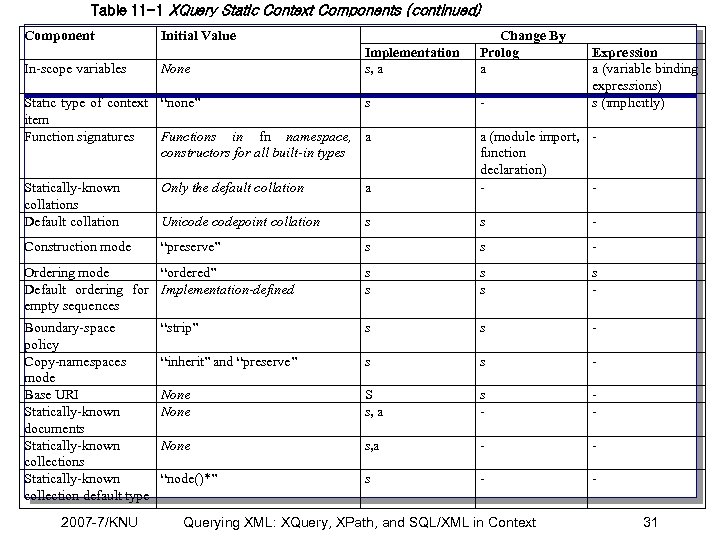 Table 11 -1 XQuery Static Context Components (continued) Component In-scope variables Initial Value None Implementation s, a Static type of context “none” s item Function signatures Functions in fn namespace, a constructors for all built-in types Change By Prolog a - Expression a (variable binding expressions) s (implicitly) Statically-known collations Default collation Only the default collation a a (module import, function declaration) - Unicodepoint collation s s - Construction mode “preserve” s s - Ordering mode “ordered” Default ordering for Implementation-defined empty sequences s s - Boundary-space policy Copy-namespaces mode Base URI Statically-known documents Statically-known collection default type “strip” s s - “inherit” and “preserve” s s - None S s, a s - - None s, a - - “node()*” s - - 2007 -7/KNU Querying XML: XQuery, XPath, and SQL/XML in Context 31
 Chapter 11 XQuery 1. 0 Definition 11. 3. 2 The Dynamic Context The dynamic context represents aspects of the environment that may change during the evaluation of an XQuery or that might be changed by environmental factors other than the XQuery implementation itself. Some people, us included, view the static context as part of the dynamic context; others don’t. 2007 -7/KNU Querying XML: XQuery, XPath, and SQL/XML in Context 32
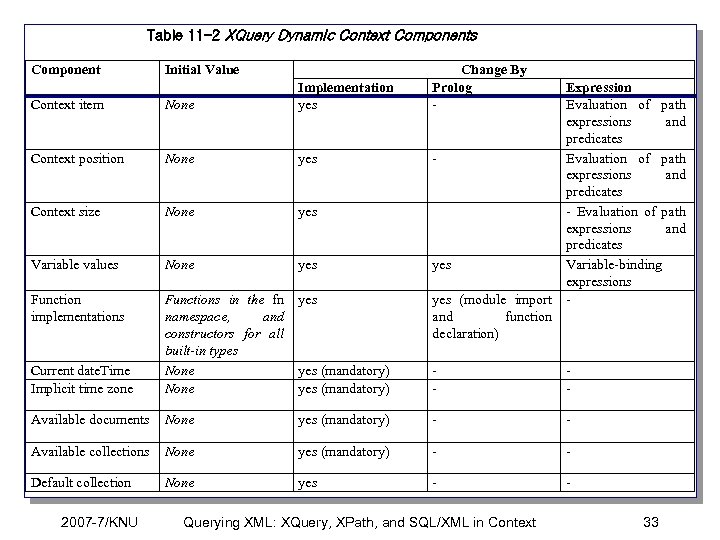 Table 11 -2 XQuery Dynamic Context Components Component Initial Value Change By Prolog - Context item None Implementation yes Context position None yes Context size None yes Variable values None yes Function implementations yes Current date. Time Implicit time zone Functions in the fn namespace, and constructors for all built-in types None yes (mandatory) - - Available documents None yes (mandatory) - - Available collections None yes (mandatory) - - Default collection None yes - - 2007 -7/KNU Expression Evaluation of path expressions and predicates - Evaluation of path expressions and predicates yes Variable-binding expressions yes (module import and function declaration) Querying XML: XQuery, XPath, and SQL/XML in Context 33
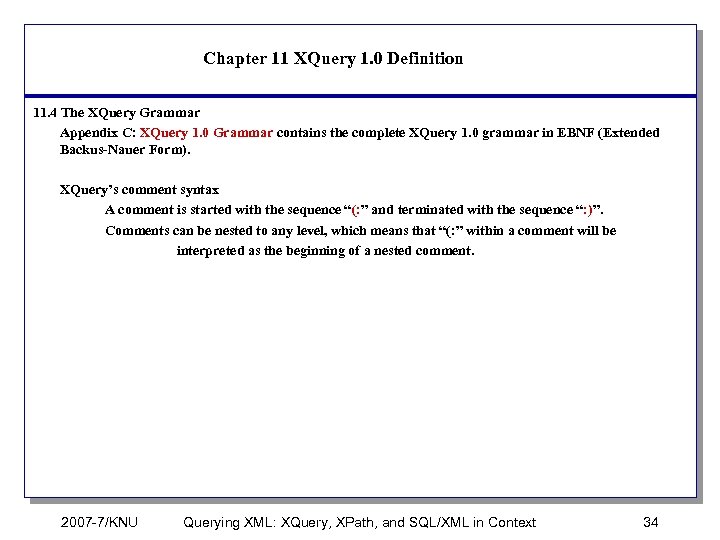 Chapter 11 XQuery 1. 0 Definition 11. 4 The XQuery Grammar Appendix C: XQuery 1. 0 Grammar contains the complete XQuery 1. 0 grammar in EBNF (Extended Backus-Nauer Form). XQuery’s comment syntax A comment is started with the sequence “(: ” and terminated with the sequence “: )”. Comments can be nested to any level, which means that “(: ” within a comment will be interpreted as the beginning of a nested comment. 2007 -7/KNU Querying XML: XQuery, XPath, and SQL/XML in Context 34
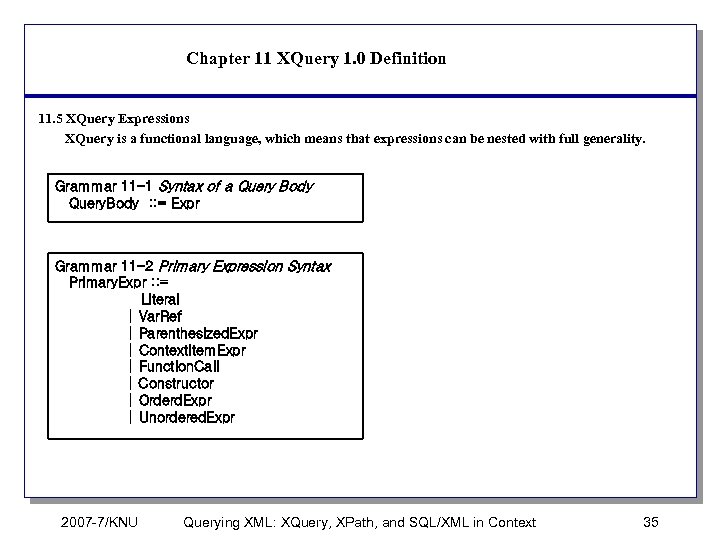 Chapter 11 XQuery 1. 0 Definition 11. 5 XQuery Expressions XQuery is a functional language, which means that expressions can be nested with full generality. Grammar 11 -1 Syntax of a Query Body Query. Body : : = Expr Grammar 11 -2 Primary Expression Syntax Primary. Expr : : = Literal | Var. Ref | Parenthesized. Expr | Context. Item. Expr | Function. Call | Constructor | Orderd. Expr | Unordered. Expr 2007 -7/KNU Querying XML: XQuery, XPath, and SQL/XML in Context 35
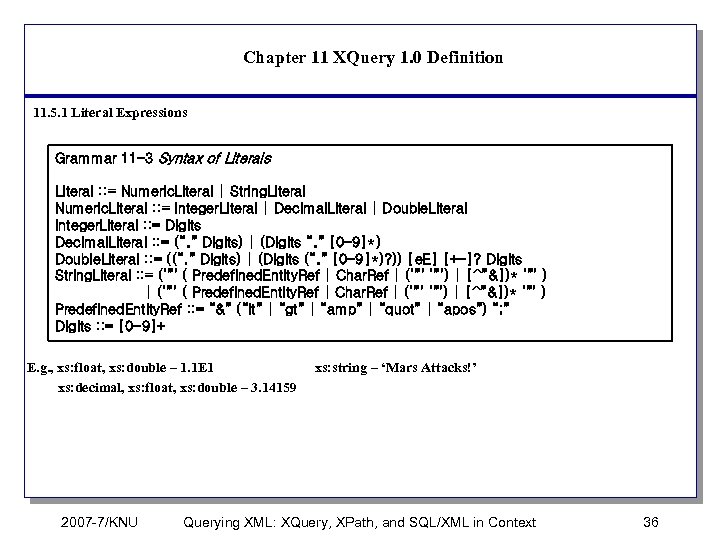 Chapter 11 XQuery 1. 0 Definition 11. 5. 1 Literal Expressions Grammar 11 -3 Syntax of Literals Literal : : = Numeric. Literal | String. Literal Numeric. Literal : : = Integer. Literal | Decimal. Literal | Double. Literal Integer. Literal : : = Digits Decimal. Literal : : = (“. ” Digits) | (Digits “. ” [0 -9]*) Double. Literal : : = ((“. ” Digits) | (Digits (“. ” [0 -9]*)? )) [e. E] [+-]? Digits String. Literal : : = (‘”’ ( Predefined. Entity. Ref | Char. Ref | (‘”’ ‘”’) | [^”&])* ‘”’ ) | (‘”’ ( Predefined. Entity. Ref | Char. Ref | (‘”’ ‘”’) | [^”&])* ‘”’ ) Predefined. Entity. Ref : : = “&” (“lt” | “gt” | “amp” | “quot” | “apos”) “; ” Digits : : = [0 -9]+ E. g. , xs: float, xs: double – 1. 1 E 1 xs: decimal, xs: float, xs: double – 3. 14159 2007 -7/KNU xs: string – ‘Mars Attacks!’ Querying XML: XQuery, XPath, and SQL/XML in Context 36
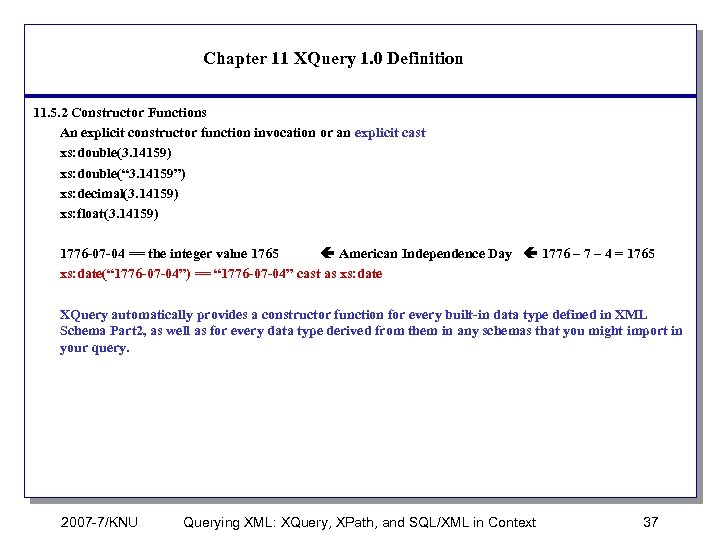 Chapter 11 XQuery 1. 0 Definition 11. 5. 2 Constructor Functions An explicit constructor function invocation or an explicit cast xs: double(3. 14159) xs: double(“ 3. 14159”) xs: decimal(3. 14159) xs: float(3. 14159) 1776 -07 -04 == the integer value 1765 American Independence Day 1776 – 7 – 4 = 1765 xs: date(“ 1776 -07 -04”) == “ 1776 -07 -04” cast as xs: date XQuery automatically provides a constructor function for every built-in data type defined in XML Schema Part 2, as well as for every data type derived from them in any schemas that you might import in your query. 2007 -7/KNU Querying XML: XQuery, XPath, and SQL/XML in Context 37
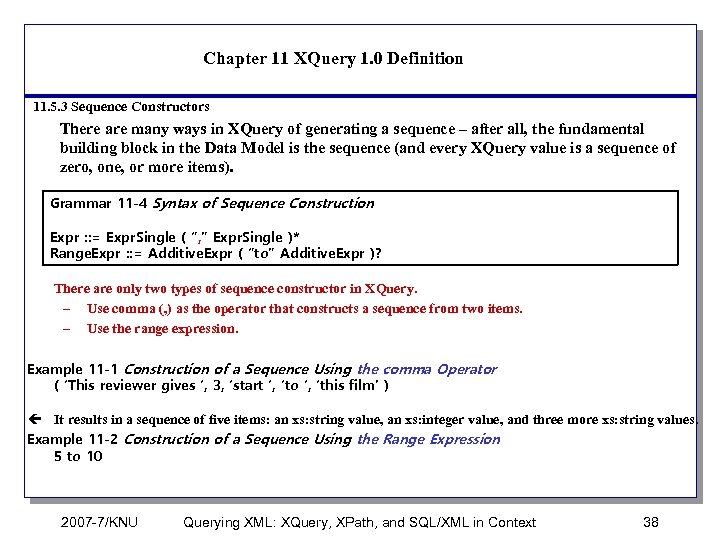 Chapter 11 XQuery 1. 0 Definition 11. 5. 3 Sequence Constructors There are many ways in XQuery of generating a sequence – after all, the fundamental building block in the Data Model is the sequence (and every XQuery value is a sequence of zero, one, or more items). Grammar 11 -4 Syntax of Sequence Construction Expr : : = Expr. Single ( “, ” Expr. Single )* Range. Expr : : = Additive. Expr ( “to” Additive. Expr )? There are only two types of sequence constructor in XQuery. – Use comma (, ) as the operator that constructs a sequence from two items. – Use the range expression. Example 11 -1 Construction of a Sequence Using the comma Operator ( ‘This reviewer gives ‘, 3, ‘start ‘, ‘to ‘, ‘this film’ ) It results in a sequence of five items: an xs: string value, an xs: integer value, and three more xs: string values. Example 11 -2 Construction of a Sequence Using the Range Expression 5 to 10 2007 -7/KNU Querying XML: XQuery, XPath, and SQL/XML in Context 38
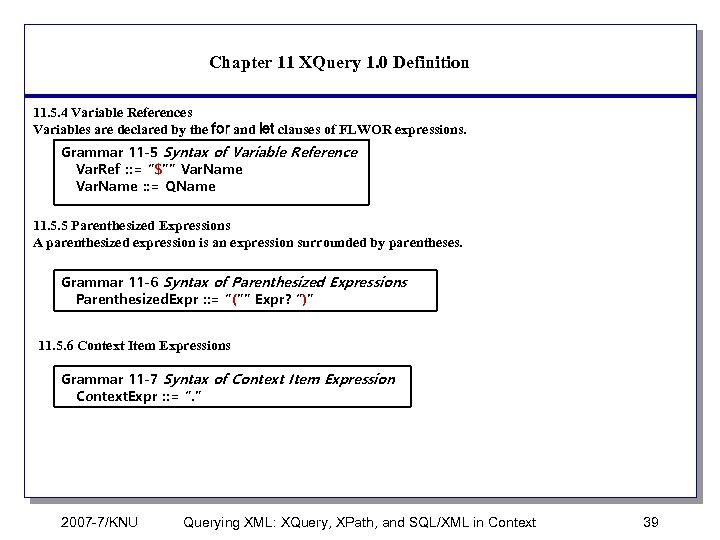 Chapter 11 XQuery 1. 0 Definition 11. 5. 4 Variable References Variables are declared by the for and let clauses of FLWOR expressions. Grammar 11 -5 Syntax of Variable Reference Var. Ref : : = “$”” Var. Name : : = QName 11. 5. 5 Parenthesized Expressions A parenthesized expression is an expression surrounded by parentheses. Grammar 11 -6 Syntax of Parenthesized Expressions Parenthesized. Expr : : = “(”” Expr? “)” 11. 5. 6 Context Item Expressions Grammar 11 -7 Syntax of Context Item Expression Context. Expr : : = “. ” 2007 -7/KNU Querying XML: XQuery, XPath, and SQL/XML in Context 39
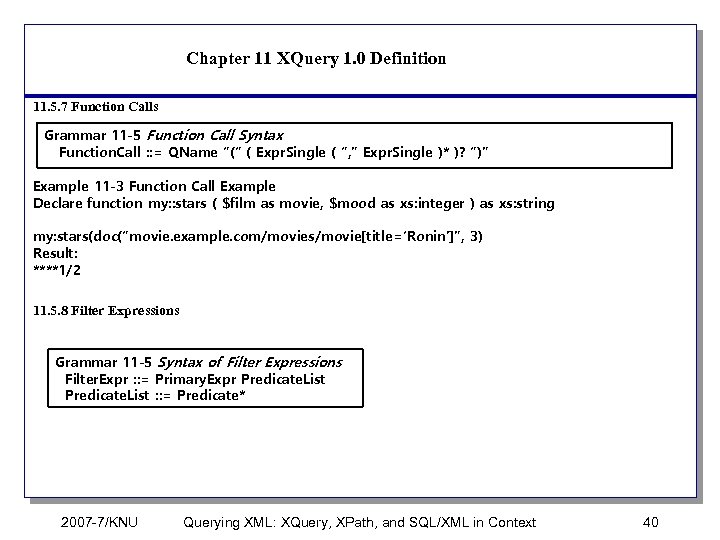 Chapter 11 XQuery 1. 0 Definition 11. 5. 7 Function Calls Grammar 11 -5 Function Call Syntax Function. Call : : = QName “(“ ( Expr. Single ( “, ” Expr. Single )* )? “)” Example 11 -3 Function Call Example Declare function my: : stars ( $film as movie, $mood as xs: integer ) as xs: string my: stars(doc(“movie. example. com/movies/movie[title=‘Ronin’]”, 3) Result: ****1/2 11. 5. 8 Filter Expressions Grammar 11 -5 Syntax of Filter Expressions Filter. Expr : : = Primary. Expr Predicate. List : : = Predicate* 2007 -7/KNU Querying XML: XQuery, XPath, and SQL/XML in Context 40
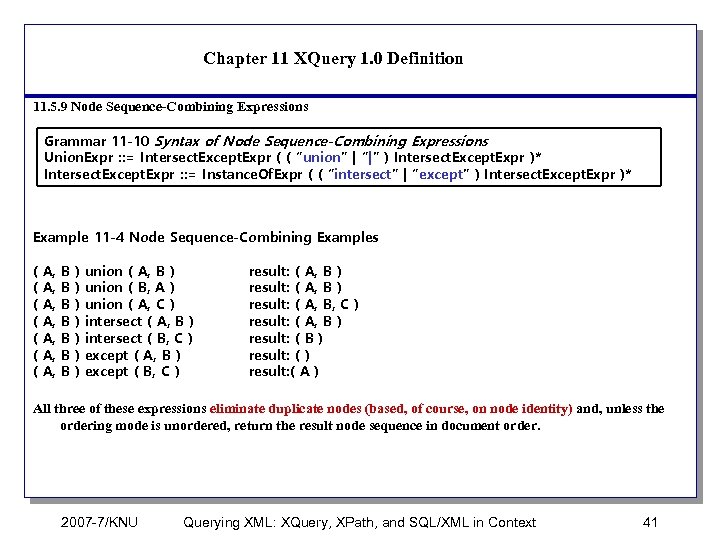 Chapter 11 XQuery 1. 0 Definition 11. 5. 9 Node Sequence-Combining Expressions Grammar 11 -10 Syntax of Node Sequence-Combining Expressions Union. Expr : : = Intersect. Except. Expr ( ( “union” | “|” ) Intersect. Except. Expr )* Intersect. Except. Expr : : = Instance. Of. Expr ( ( “intersect” | “except” ) Intersect. Except. Expr )* Example 11 -4 Node Sequence-Combining Examples ( ( ( ( A, A, B B B B ) ) ) ) union ( A, B ) union ( B, A ) union ( A, C ) intersect ( A, B ) intersect ( B, C ) except ( A, B ) except ( B, C ) result: ( A, B, C ) result: ( A, B ) result: ( A ) All three of these expressions eliminate duplicate nodes (based, of course, on node identity) and, unless the ordering mode is unordered, return the result node sequence in document order. 2007 -7/KNU Querying XML: XQuery, XPath, and SQL/XML in Context 41
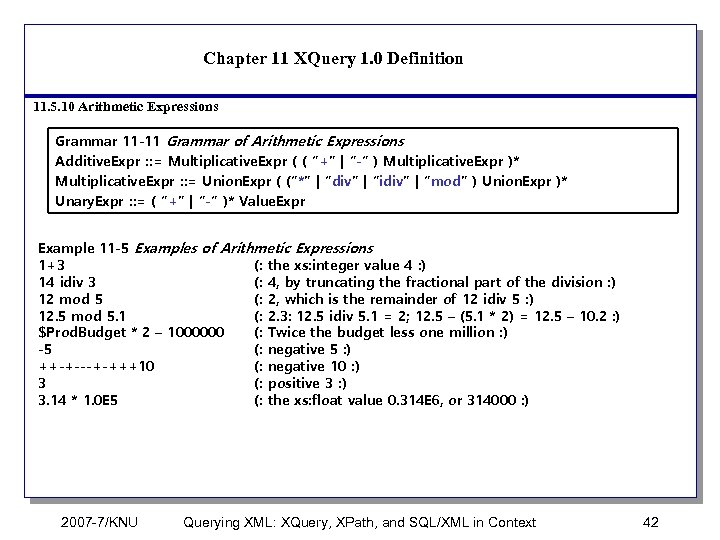 Chapter 11 XQuery 1. 0 Definition 11. 5. 10 Arithmetic Expressions Grammar 11 -11 Grammar of Arithmetic Expressions Additive. Expr : : = Multiplicative. Expr ( ( “+” | “-“ ) Multiplicative. Expr )* Multiplicative. Expr : : = Union. Expr ( (“*” | “div” | “idiv” | “mod” ) Union. Expr )* Unary. Expr : : = ( “+” | “-“ )* Value. Expr Example 11 -5 Examples of Arithmetic Expressions 1+3 (: the xs: integer value 4 : ) 14 idiv 3 (: 4, by truncating the fractional part of the division : ) 12 mod 5 (: 2, which is the remainder of 12 idiv 5 : ) 12. 5 mod 5. 1 (: 2. 3: 12. 5 idiv 5. 1 = 2; 12. 5 – (5. 1 * 2) = 12. 5 – 10. 2 : ) $Prod. Budget * 2 – 1000000 (: Twice the budget less one million : ) -5 (: negative 5 : ) ++-+---+-+++10 (: negative 10 : ) 3 (: positive 3 : ) 3. 14 * 1. 0 E 5 (: the xs: float value 0. 314 E 6, or 314000 : ) 2007 -7/KNU Querying XML: XQuery, XPath, and SQL/XML in Context 42
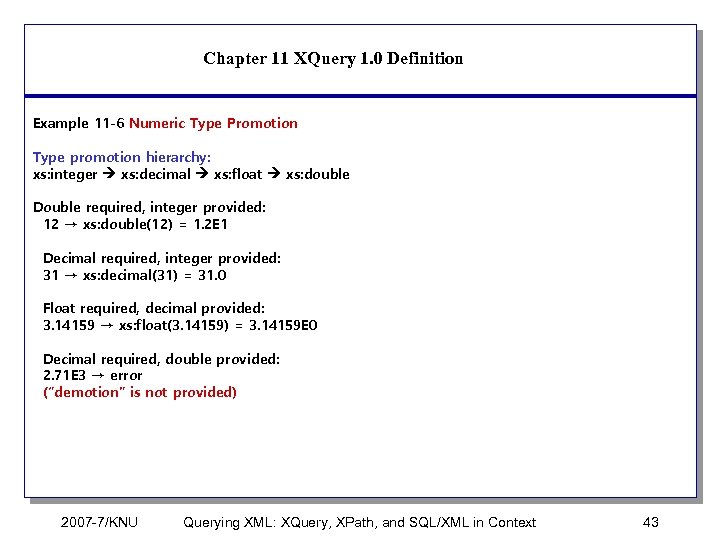 Chapter 11 XQuery 1. 0 Definition Example 11 -6 Numeric Type Promotion Type promotion hierarchy: xs: integer xs: decimal xs: float xs: double Double required, integer provided: 12 → xs: double(12) = 1. 2 E 1 Decimal required, integer provided: 31 → xs: decimal(31) = 31. 0 Float required, decimal provided: 3. 14159 → xs: float(3. 14159) = 3. 14159 E 0 Decimal required, double provided: 2. 71 E 3 → error (“demotion” is not provided) 2007 -7/KNU Querying XML: XQuery, XPath, and SQL/XML in Context 43
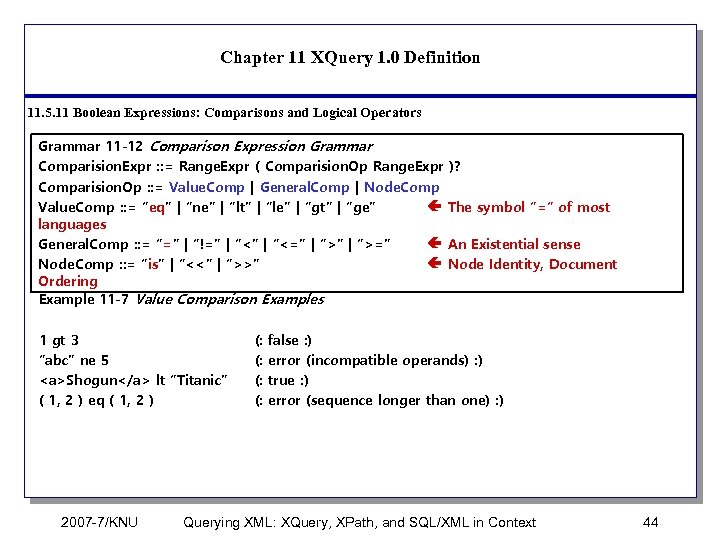 Chapter 11 XQuery 1. 0 Definition 11. 5. 11 Boolean Expressions: Comparisons and Logical Operators Grammar 11 -12 Comparison Expression Grammar Comparision. Expr : : = Range. Expr ( Comparision. Op Range. Expr )? Comparision. Op : : = Value. Comp | General. Comp | Node. Comp Value. Comp : : = “eq” | “ne” | “lt” | “le” | “gt” | “ge” The symbol “=“ of most languages General. Comp : : = “=” | “!=” | “<=” | “>=” An Existential sense Node. Comp : : = “is” | “<<” | “>>” Node Identity, Document Ordering Example 11 -7 Value Comparison Examples 1 gt 3 “abc” ne 5 Shogun lt “Titanic” ( 1, 2 ) eq ( 1, 2 ) 2007 -7/KNU (: (: false : ) error (incompatible operands) : ) true : ) error (sequence longer than one) : ) Querying XML: XQuery, XPath, and SQL/XML in Context 44
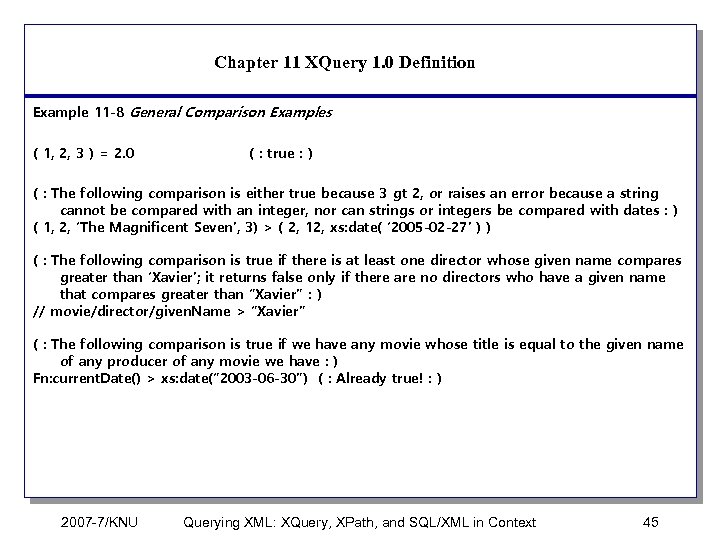 Chapter 11 XQuery 1. 0 Definition Example 11 -8 General Comparison Examples ( 1, 2, 3 ) = 2. 0 ( : true : ) ( : The following comparison is either true because 3 gt 2, or raises an error because a string cannot be compared with an integer, nor can strings or integers be compared with dates : ) ( 1, 2, ‘The Magnificent Seven’, 3) > ( 2, 12, xs: date( ‘ 2005 -02 -27’ ) ) ( : The following comparison is true if there is at least one director whose given name compares greater than ‘Xavier’; it returns false only if there are no directors who have a given name that compares greater than “Xavier” : ) // movie/director/given. Name > “Xavier” ( : The following comparison is true if we have any movie whose title is equal to the given name of any producer of any movie we have : ) Fn: current. Date() > xs: date(“ 2003 -06 -30”) ( : Already true! : ) 2007 -7/KNU Querying XML: XQuery, XPath, and SQL/XML in Context 45
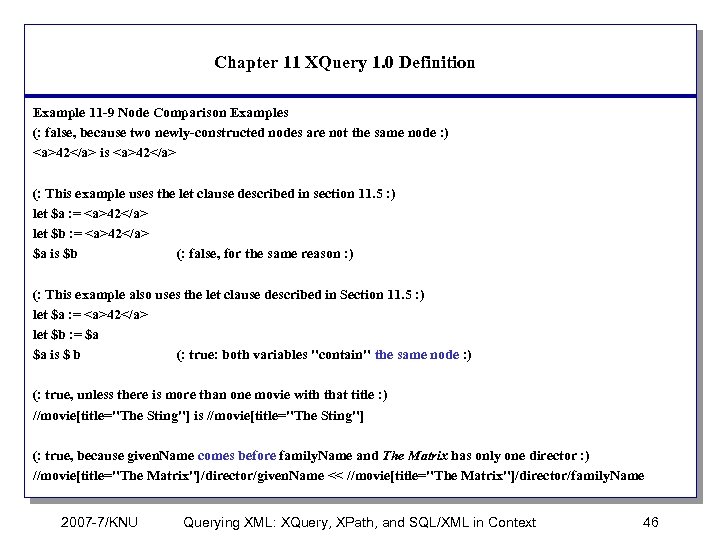 Chapter 11 XQuery 1. 0 Definition Example 11 -9 Node Comparison Examples (: false, because two newly-constructed nodes are not the same node : ) 42 is 42 (: This example uses the let clause described in section 11. 5 : ) let $a : = 42 let $b : = 42 $a is $b (: false, for the same reason : ) (: This example also uses the let clause described in Section 11. 5 : ) let $a : = 42 let $b : = $a $a is $ b (: true: both variables "contain" the same node : ) (: true, unless there is more than one movie with that title : ) //movie[title="The Sting"] is //movie[title="The Sting"] (: true, because given. Name comes before family. Name and The Matrix has only one director : ) //movie[title="The Matrix"]/director/given. Name << //movie[title="The Matrix"]/director/family. Name 2007 -7/KNU Querying XML: XQuery, XPath, and SQL/XML in Context 46
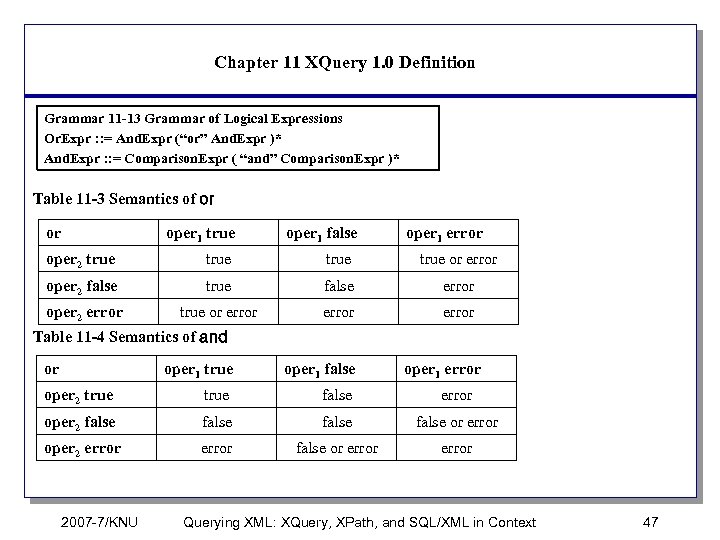 Chapter 11 XQuery 1. 0 Definition Grammar 11 -13 Grammar of Logical Expressions Or. Expr : : = And. Expr (“or” And. Expr )* And. Expr : : = Comparison. Expr ( “and” Comparison. Expr )* Table 11 -3 Semantics of or or oper 1 true oper 1 false oper 1 error oper 2 true or error oper 2 false true false error oper 2 error true or error Table 11 -4 Semantics of and or oper 1 true oper 1 false oper 2 true false error oper 2 false or error oper 2 error false or error 2007 -7/KNU oper 1 error Querying XML: XQuery, XPath, and SQL/XML in Context 47
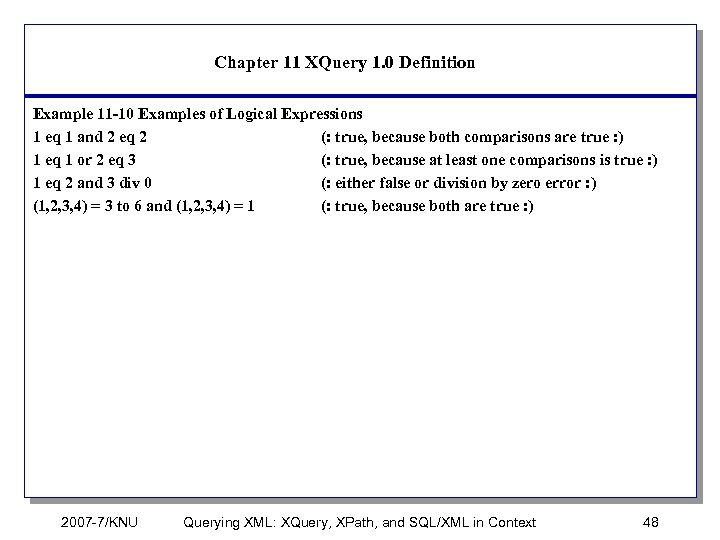 Chapter 11 XQuery 1. 0 Definition Example 11 -10 Examples of Logical Expressions 1 eq 1 and 2 eq 2 (: true, because both comparisons are true : ) 1 eq 1 or 2 eq 3 (: true, because at least one comparisons is true : ) 1 eq 2 and 3 div 0 (: either false or division by zero error : ) (1, 2, 3, 4) = 3 to 6 and (1, 2, 3, 4) = 1 (: true, because both are true : ) 2007 -7/KNU Querying XML: XQuery, XPath, and SQL/XML in Context 48
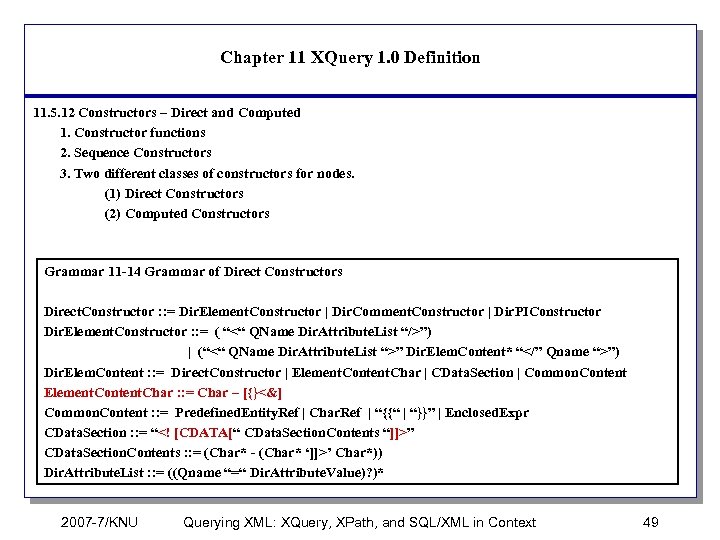 Chapter 11 XQuery 1. 0 Definition 11. 5. 12 Constructors – Direct and Computed 1. Constructor functions 2. Sequence Constructors 3. Two different classes of constructors for nodes. (1) Direct Constructors (2) Computed Constructors Grammar 11 -14 Grammar of Direct Constructors Direct. Constructor : : = Dir. Element. Constructor | Dir. Comment. Constructor | Dir. PIConstructor Dir. Element. Constructor : : = ( “<“ QName Dir. Attribute. List “/>”) | (“<“ QName Dir. Attribute. List “>” Dir. Elem. Content* “”) Dir. Elem. Content : : = Direct. Constructor | Element. Content. Char | CData. Section | Common. Content Element. Content. Char : : = Char – [{}<&] Common. Content : : = Predefined. Entity. Ref | Char. Ref | “{{“ | “}}” | Enclosed. Expr CData. Section : : = “” CData. Section. Contents : : = (Char* - (Char* ‘]]>’ Char*)) Dir. Attribute. List : : = ((Qname “=“ Dir. Attribute. Value)? )* 2007 -7/KNU Querying XML: XQuery, XPath, and SQL/XML in Context 49
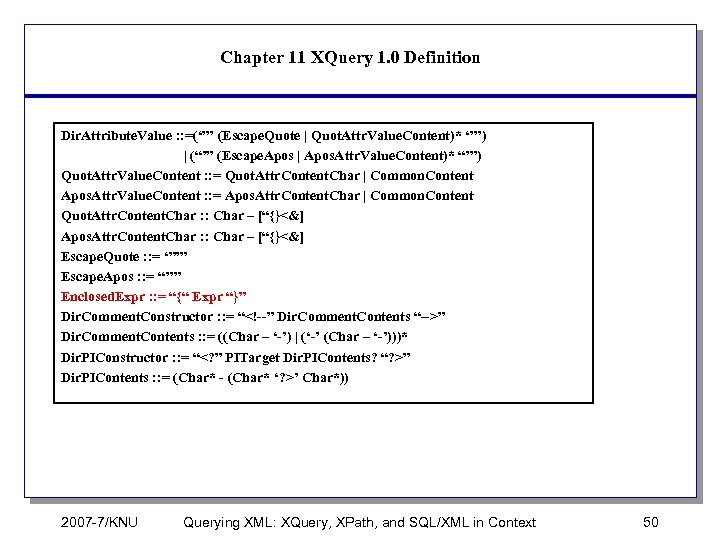 Chapter 11 XQuery 1. 0 Definition Dir. Attribute. Value : : =(‘”’ (Escape. Quote | Quot. Attr. Value. Content)* ‘”’) | (“’” (Escape. Apos | Apos. Attr. Value. Content)* “’”) Quot. Attr. Value. Content : : = Quot. Attr. Content. Char | Common. Content Apos. Attr. Value. Content : : = Apos. Attr. Content. Char | Common. Content Quot. Attr. Content. Char : : Char – [“{}<&] Apos. Attr. Content. Char : : Char – [“{}<&] Escape. Quote : : = ‘””’ Escape. Apos : : = “’’” Enclosed. Expr : : = “{“ Expr “}” Dir. Comment. Constructor : : = “” Dir. Comment. Contents : : = ((Char – ‘-’) | (‘-’ (Char – ‘-’)))* Dir. PIConstructor : : = “” Dir. PIContents : : = (Char* - (Char* ‘? >’ Char*)) 2007 -7/KNU Querying XML: XQuery, XPath, and SQL/XML in Context 50
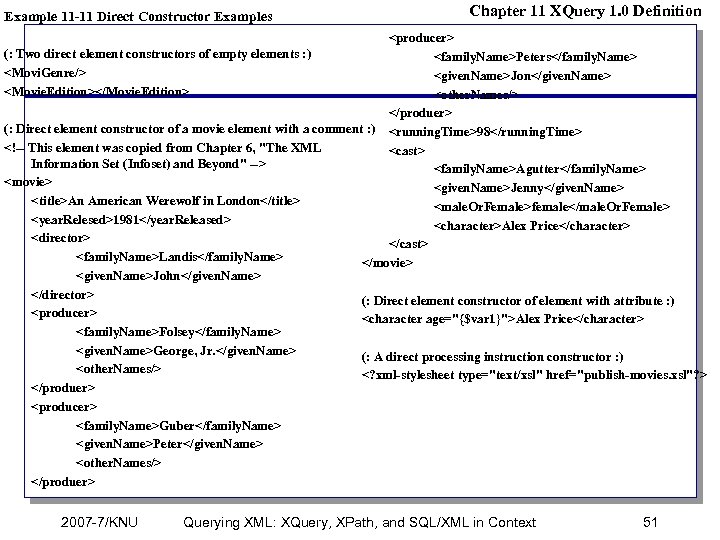 Example 11 -11 Direct Constructor Examples Chapter 11 XQuery 1. 0 Definition
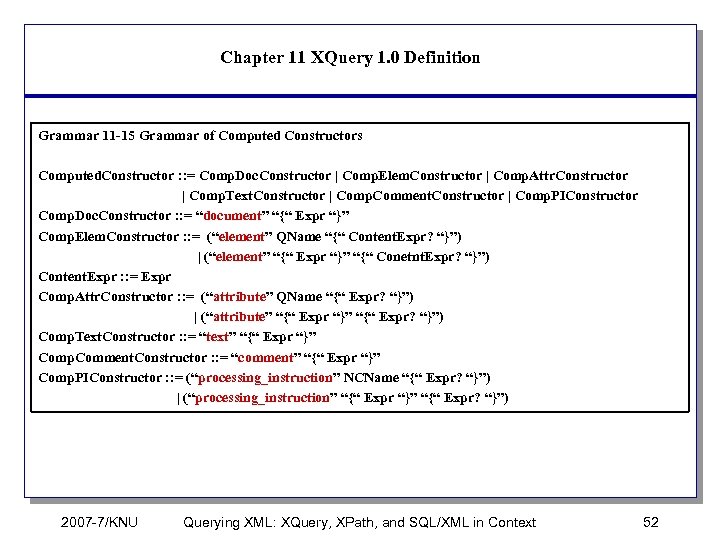 Chapter 11 XQuery 1. 0 Definition Grammar 11 -15 Grammar of Computed Constructors Computed. Constructor : : = Comp. Doc. Constructor | Comp. Elem. Constructor | Comp. Attr. Constructor | Comp. Text. Constructor | Comp. Comment. Constructor | Comp. PIConstructor Comp. Doc. Constructor : : = “document” “{“ Expr “}” Comp. Elem. Constructor : : = (“element” QName “{“ Content. Expr? “}”) | (“element” “{“ Expr “}” “{“ Conetnt. Expr? “}”) Content. Expr : : = Expr Comp. Attr. Constructor : : = (“attribute” QName “{“ Expr? “}”) | (“attribute” “{“ Expr “}” “{“ Expr? “}”) Comp. Text. Constructor : : = “text” “{“ Expr “}” Comp. Comment. Constructor : : = “comment” “{“ Expr “}” Comp. PIConstructor : : = (“processing_instruction” NCName “{“ Expr? “}”) | (“processing_instruction” “{“ Expr “}” “{“ Expr? “}”) 2007 -7/KNU Querying XML: XQuery, XPath, and SQL/XML in Context 52
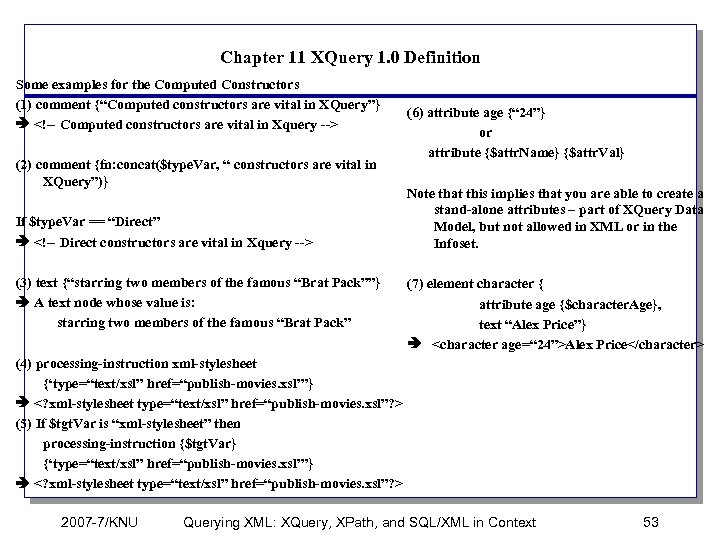 Chapter 11 XQuery 1. 0 Definition Some examples for the Computed Constructors (1) comment {“Computed constructors are vital in XQuery”} (2) comment {fn: concat($type. Var, “ constructors are vital in XQuery”)} If $type. Var == “Direct” (3) text {“starring two members of the famous “Brat Pack””} A text node whose value is: starring two members of the famous “Brat Pack” (6) attribute age {“ 24”} or attribute {$attr. Name} {$attr. Val} Note that this implies that you are able to create a stand-alone attributes – part of XQuery Data Model, but not allowed in XML or in the Infoset. (7) element character { attribute age {$character. Age}, text “Alex Price”}
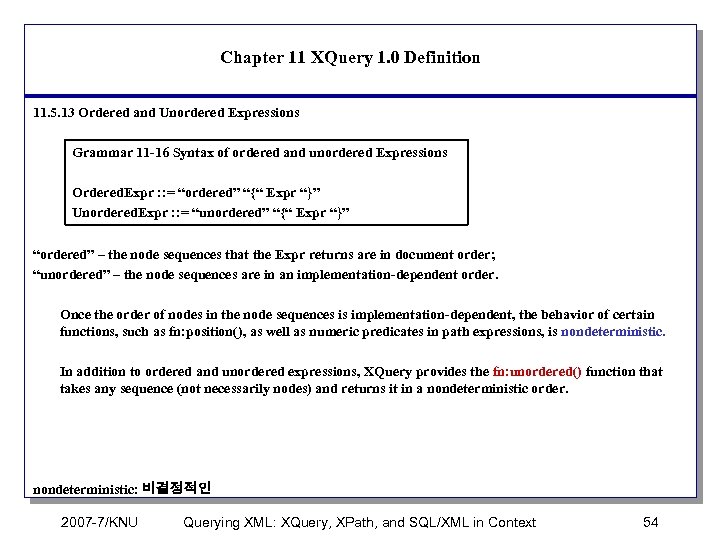 Chapter 11 XQuery 1. 0 Definition 11. 5. 13 Ordered and Unordered Expressions Grammar 11 -16 Syntax of ordered and unordered Expressions Ordered. Expr : : = “ordered” “{“ Expr “}” Unordered. Expr : : = “unordered” “{“ Expr “}” “ordered” – the node sequences that the Expr returns are in document order; “unordered” – the node sequences are in an implementation-dependent order. Once the order of nodes in the node sequences is implementation-dependent, the behavior of certain functions, such as fn: position(), as well as numeric predicates in path expressions, is nondeterministic. In addition to ordered and unordered expressions, XQuery provides the fn: unordered() function that takes any sequence (not necessarily nodes) and returns it in a nondeterministic order. nondeterministic: 비결정적인 2007 -7/KNU Querying XML: XQuery, XPath, and SQL/XML in Context 54
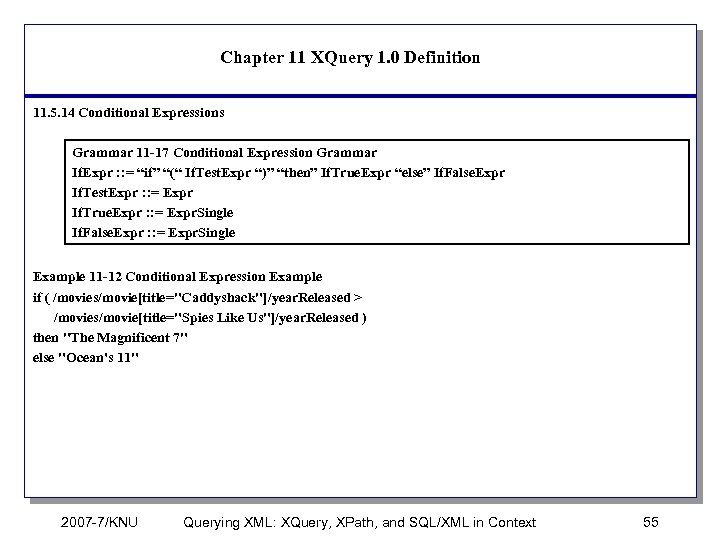 Chapter 11 XQuery 1. 0 Definition 11. 5. 14 Conditional Expressions Grammar 11 -17 Conditional Expression Grammar If. Expr : : = “if” “(“ If. Test. Expr “)” “then” If. True. Expr “else” If. False. Expr If. Test. Expr : : = Expr If. True. Expr : : = Expr. Single If. False. Expr : : = Expr. Single Example 11 -12 Conditional Expression Example if ( /movies/movie[title="Caddyshack"]/year. Released > /movies/movie[title="Spies Like Us"]/year. Released ) then "The Magnificent 7" else "Ocean's 11" 2007 -7/KNU Querying XML: XQuery, XPath, and SQL/XML in Context 55
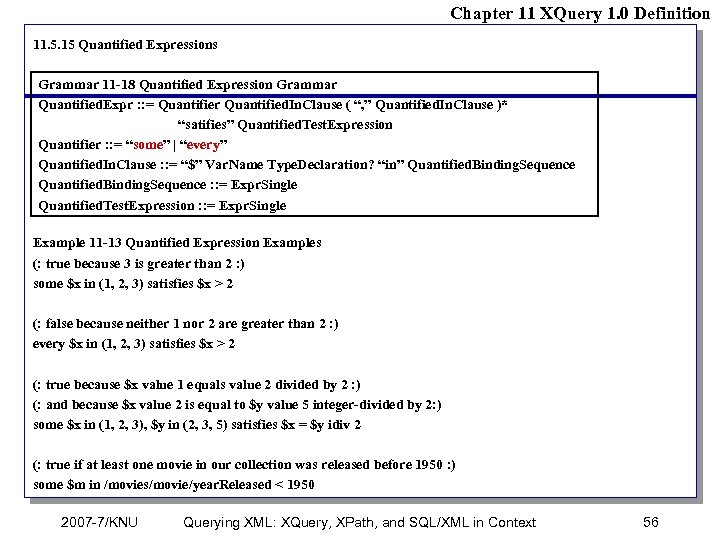 Chapter 11 XQuery 1. 0 Definition 11. 5. 15 Quantified Expressions Grammar 11 -18 Quantified Expression Grammar Quantified. Expr : : = Quantifier Quantified. In. Clause ( “, ” Quantified. In. Clause )* “satifies” Quantified. Test. Expression Quantifier : : = “some” | “every” Quantified. In. Clause : : = “$” Var. Name Type. Declaration? “in” Quantified. Binding. Sequence : : = Expr. Single Quantified. Test. Expression : : = Expr. Single Example 11 -13 Quantified Expression Examples (: true because 3 is greater than 2 : ) some $x in (1, 2, 3) satisfies $x > 2 (: false because neither 1 nor 2 are greater than 2 : ) every $x in (1, 2, 3) satisfies $x > 2 (: true because $x value 1 equals value 2 divided by 2 : ) (: and because $x value 2 is equal to $y value 5 integer-divided by 2: ) some $x in (1, 2, 3), $y in (2, 3, 5) satisfies $x = $y idiv 2 (: true if at least one movie in our collection was released before 1950 : ) some $m in /movies/movie/year. Released < 1950 2007 -7/KNU Querying XML: XQuery, XPath, and SQL/XML in Context 56
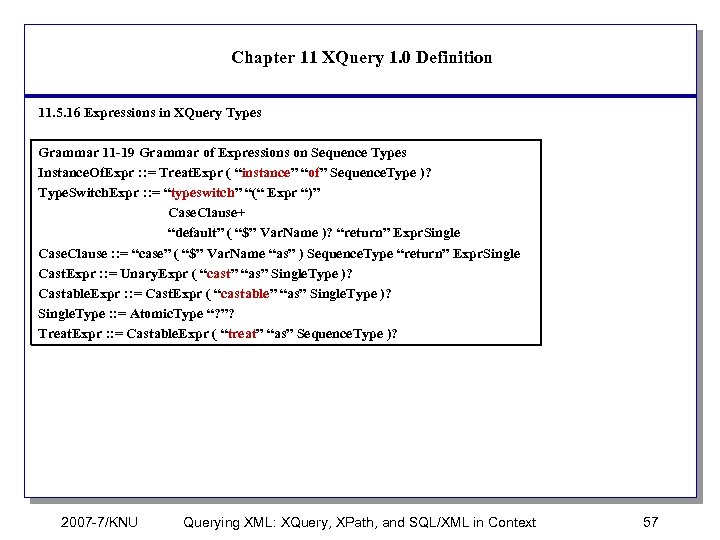 Chapter 11 XQuery 1. 0 Definition 11. 5. 16 Expressions in XQuery Types Grammar 11 -19 Grammar of Expressions on Sequence Types Instance. Of. Expr : : = Treat. Expr ( “instance” “of” Sequence. Type )? Type. Switch. Expr : : = “typeswitch” “(“ Expr “)” Case. Clause+ “default” ( “$” Var. Name )? “return” Expr. Single Case. Clause : : = “case” ( “$” Var. Name “as” ) Sequence. Type “return” Expr. Single Cast. Expr : : = Unary. Expr ( “cast” “as” Single. Type )? Castable. Expr : : = Cast. Expr ( “castable” “as” Single. Type )? Single. Type : : = Atomic. Type “? ”? Treat. Expr : : = Castable. Expr ( “treat” “as” Sequence. Type )? 2007 -7/KNU Querying XML: XQuery, XPath, and SQL/XML in Context 57
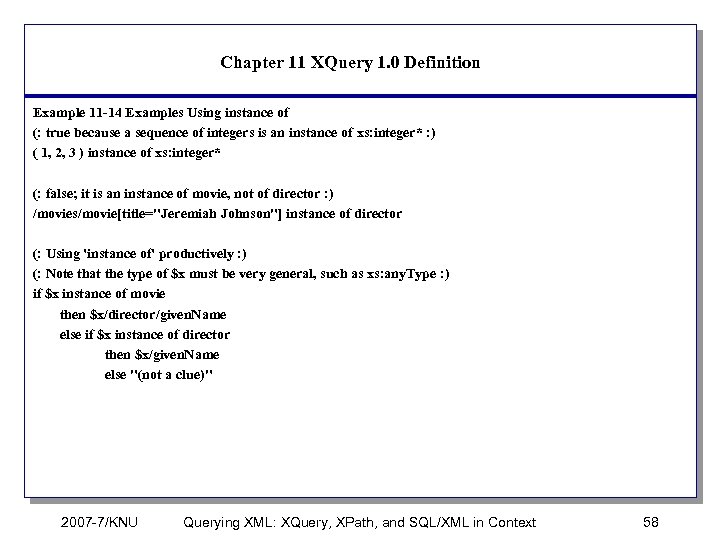 Chapter 11 XQuery 1. 0 Definition Example 11 -14 Examples Using instance of (: true because a sequence of integers is an instance of xs: integer* : ) ( 1, 2, 3 ) instance of xs: integer* (: false; it is an instance of movie, not of director : ) /movies/movie[title="Jeremiah Johnson"] instance of director (: Using 'instance of' productively : ) (: Note that the type of $x must be very general, such as xs: any. Type : ) if $x instance of movie then $x/director/given. Name else if $x instance of director then $x/given. Name else "(not a clue)" 2007 -7/KNU Querying XML: XQuery, XPath, and SQL/XML in Context 58
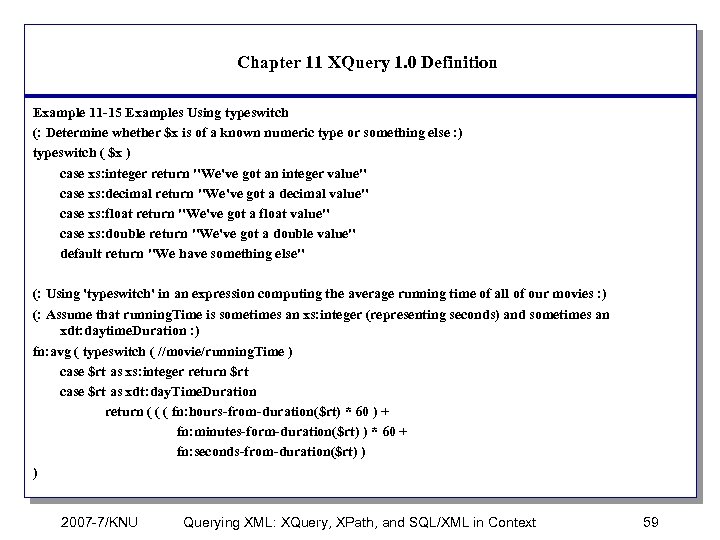 Chapter 11 XQuery 1. 0 Definition Example 11 -15 Examples Using typeswitch (: Determine whether $x is of a known numeric type or something else : ) typeswitch ( $x ) case xs: integer return "We've got an integer value" case xs: decimal return "We've got a decimal value" case xs: float return "We've got a float value" case xs: double return "We've got a double value" default return "We have something else" (: Using 'typeswitch' in an expression computing the average running time of all of our movies : ) (: Assume that running. Time is sometimes an xs: integer (representing seconds) and sometimes an xdt: daytime. Duration : ) fn: avg ( typeswitch ( //movie/running. Time ) case $rt as xs: integer return $rt case $rt as xdt: day. Time. Duration return ( ( ( fn: hours-from-duration($rt) * 60 ) + fn: minutes-form-duration($rt) ) * 60 + fn: seconds-from-duration($rt) ) ) 2007 -7/KNU Querying XML: XQuery, XPath, and SQL/XML in Context 59
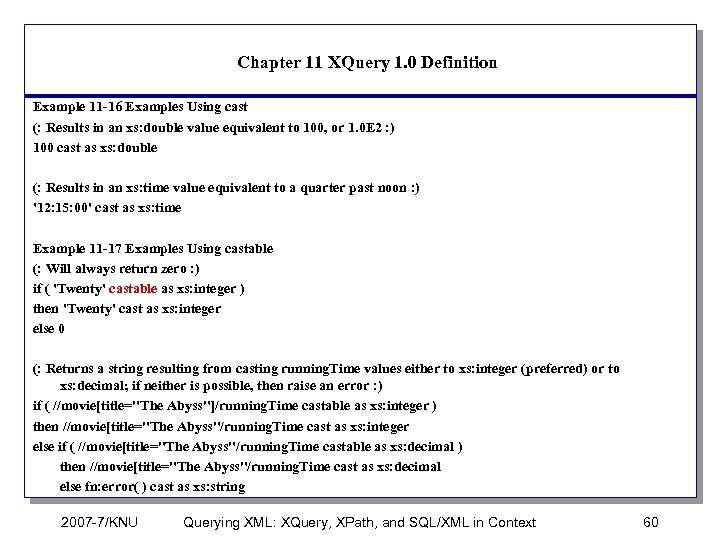 Chapter 11 XQuery 1. 0 Definition Example 11 -16 Examples Using cast (: Results in an xs: double value equivalent to 100, or 1. 0 E 2 : ) 100 cast as xs: double (: Results in an xs: time value equivalent to a quarter past noon : ) '12: 15: 00' cast as xs: time Example 11 -17 Examples Using castable (: Will always return zero : ) if ( 'Twenty' castable as xs: integer ) then 'Twenty' cast as xs: integer else 0 (: Returns a string resulting from casting running. Time values either to xs: integer (preferred) or to xs: decimal; if neither is possible, then raise an error : ) if ( //movie[title="The Abyss"]/running. Time castable as xs: integer ) then //movie[title="The Abyss"/running. Time cast as xs: integer else if ( //movie[title="The Abyss"/running. Time castable as xs: decimal ) then //movie[title="The Abyss"/running. Time cast as xs: decimal else fn: error( ) cast as xs: string 2007 -7/KNU Querying XML: XQuery, XPath, and SQL/XML in Context 60
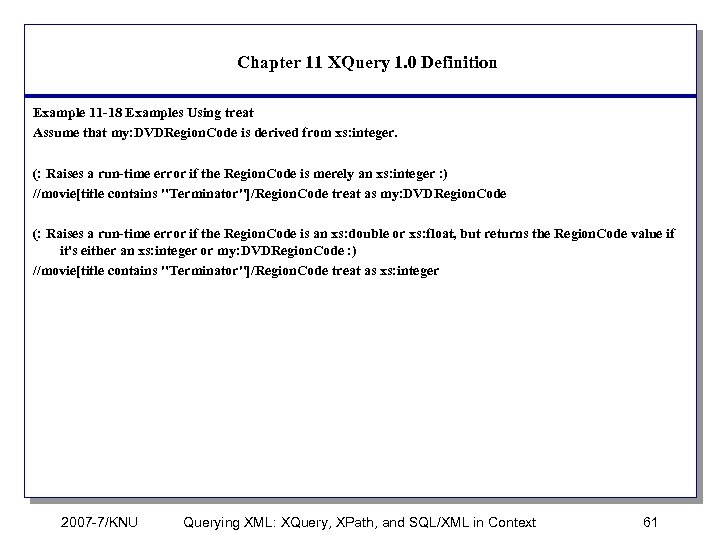 Chapter 11 XQuery 1. 0 Definition Example 11 -18 Examples Using treat Assume that my: DVDRegion. Code is derived from xs: integer. (: Raises a run-time error if the Region. Code is merely an xs: integer : ) //movie[title contains "Terminator"]/Region. Code treat as my: DVDRegion. Code (: Raises a run-time error if the Region. Code is an xs: double or xs: float, but returns the Region. Code value if it's either an xs: integer or my: DVDRegion. Code : ) //movie[title contains "Terminator"]/Region. Code treat as xs: integer 2007 -7/KNU Querying XML: XQuery, XPath, and SQL/XML in Context 61
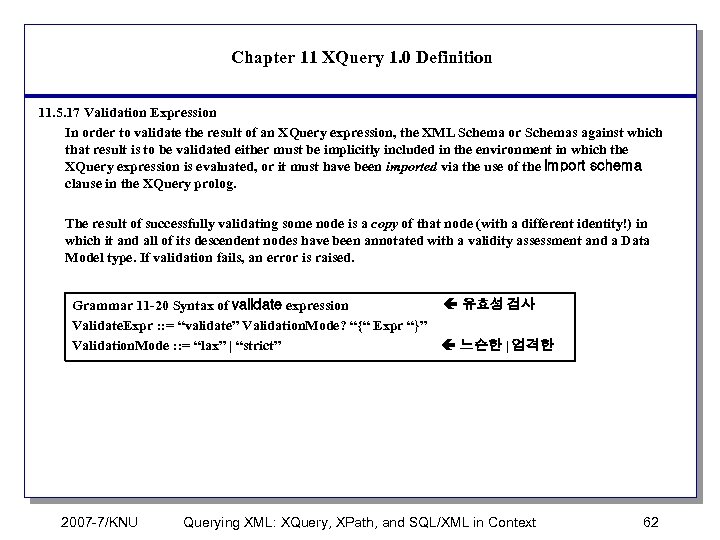 Chapter 11 XQuery 1. 0 Definition 11. 5. 17 Validation Expression In order to validate the result of an XQuery expression, the XML Schema or Schemas against which that result is to be validated either must be implicitly included in the environment in which the XQuery expression is evaluated, or it must have been imported via the use of the import schema clause in the XQuery prolog. The result of successfully validating some node is a copy of that node (with a different identity!) in which it and all of its descendent nodes have been annotated with a validity assessment and a Data Model type. If validation fails, an error is raised. Grammar 11 -20 Syntax of validate expression Validate. Expr : : = “validate” Validation. Mode? “{“ Expr “}” Validation. Mode : : = “lax” | “strict” 2007 -7/KNU 유효성 검사 느슨한 | 엄격한 Querying XML: XQuery, XPath, and SQL/XML in Context 62
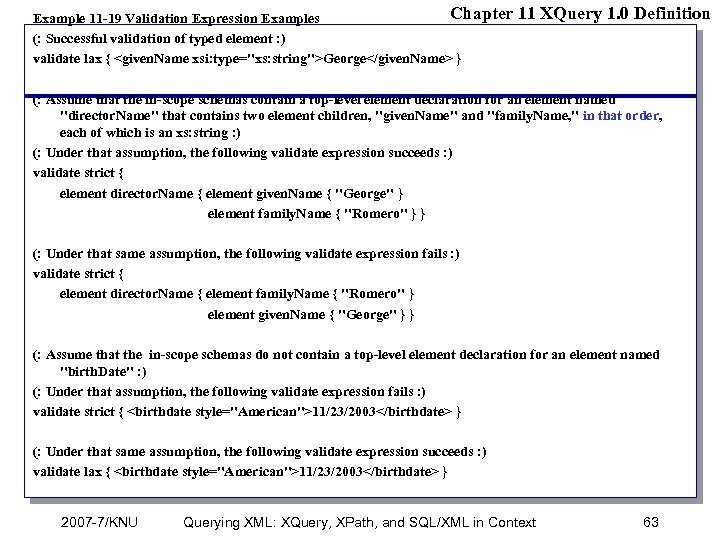 Chapter Example 11 -19 Validation Expression Examples (: Successful validation of typed element : ) validate lax {
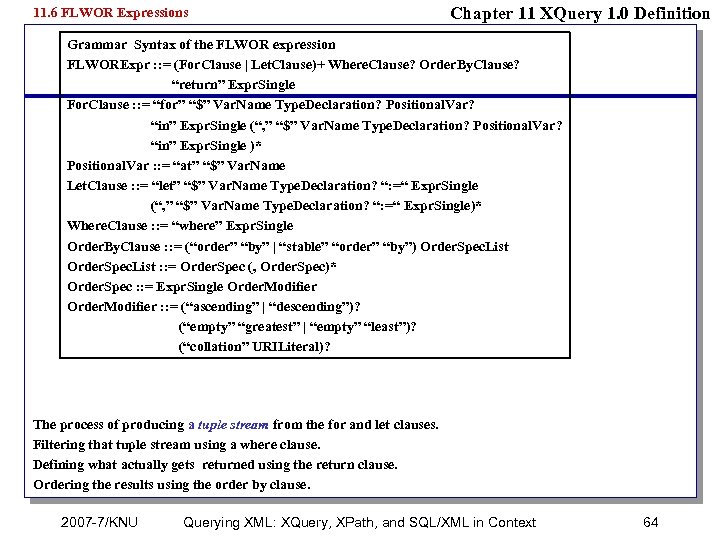 11. 6 FLWOR Expressions Chapter 11 XQuery 1. 0 Definition Grammar Syntax of the FLWOR expression FLWORExpr : : = (For. Clause | Let. Clause)+ Where. Clause? Order. By. Clause? “return” Expr. Single For. Clause : : = “for” “$” Var. Name Type. Declaration? Positional. Var? “in” Expr. Single (“, ” “$” Var. Name Type. Declaration? Positional. Var? “in” Expr. Single )* Positional. Var : : = “at” “$” Var. Name Let. Clause : : = “let” “$” Var. Name Type. Declaration? “: =“ Expr. Single (“, ” “$” Var. Name Type. Declaration? “: =“ Expr. Single)* Where. Clause : : = “where” Expr. Single Order. By. Clause : : = (“order” “by” | “stable” “order” “by”) Order. Spec. List : : = Order. Spec (, Order. Spec)* Order. Spec : : = Expr. Single Order. Modifier : : = (“ascending” | “descending”)? (“empty” “greatest” | “empty” “least”)? (“collation” URILiteral)? The process of producing a tuple stream from the for and let clauses. Filtering that tuple stream using a where clause. Defining what actually gets returned using the return clause. Ordering the results using the order by clause. 2007 -7/KNU Querying XML: XQuery, XPath, and SQL/XML in Context 64
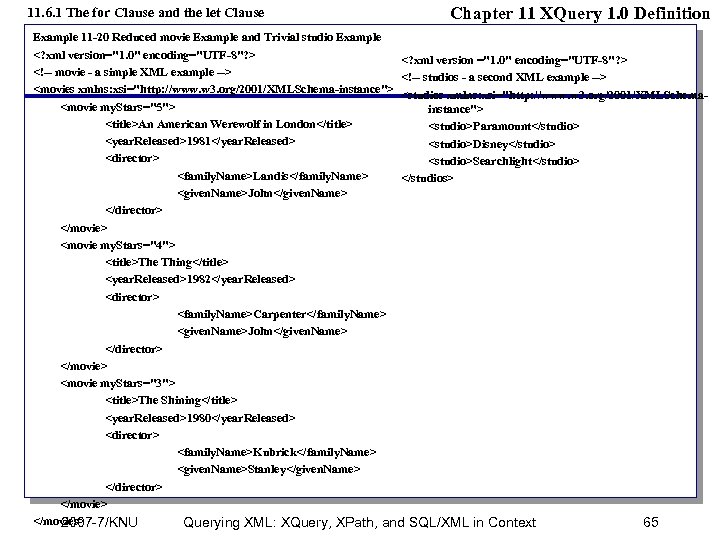 11. 6. 1 The for Clause and the let Clause Chapter 11 XQuery 1. 0 Definition Example 11 -20 Reduced movie Example and Trivial studio Example
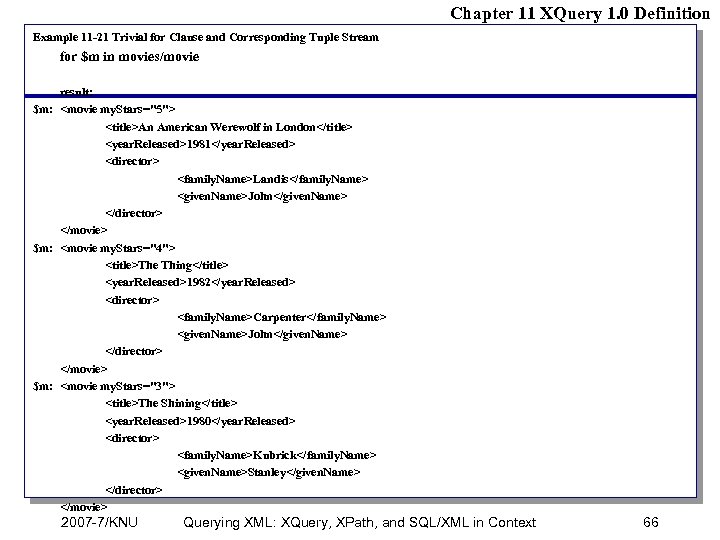 Chapter 11 XQuery 1. 0 Definition Example 11 -21 Trivial for Clause and Corresponding Tuple Stream for $m in movies/movie result: $m:
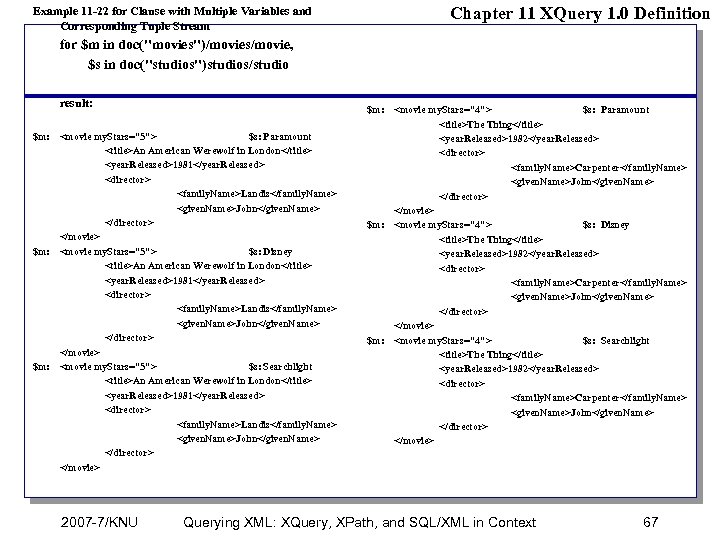 Chapter 11 XQuery 1. 0 Definition Example 11 -22 for Clause with Multiple Variables and Corresponding Tuple Stream for $m in doc("movies")/movies/movie, $s in doc("studios")studios/studio result: $m:
$s: Paramount
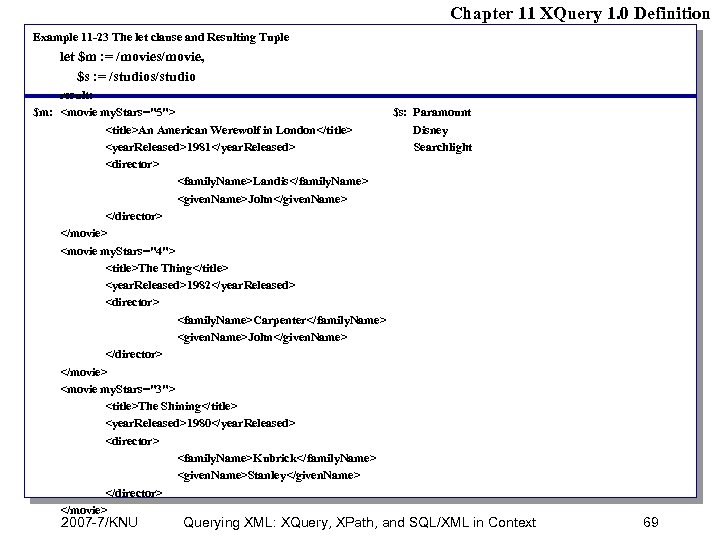 Chapter 11 XQuery 1. 0 Definition Example 11 -23 The let clause and Resulting Tuple let $m : = /movies/movie, $s : = /studios/studio result: $m:
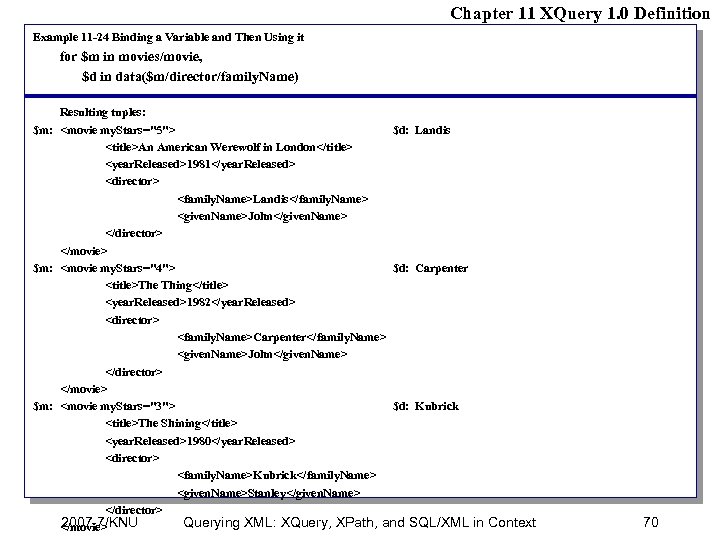 Chapter 11 XQuery 1. 0 Definition Example 11 -24 Binding a Variable and Then Using it for $m in movies/movie, $d in data($m/director/family. Name) Resulting tuples: $m:
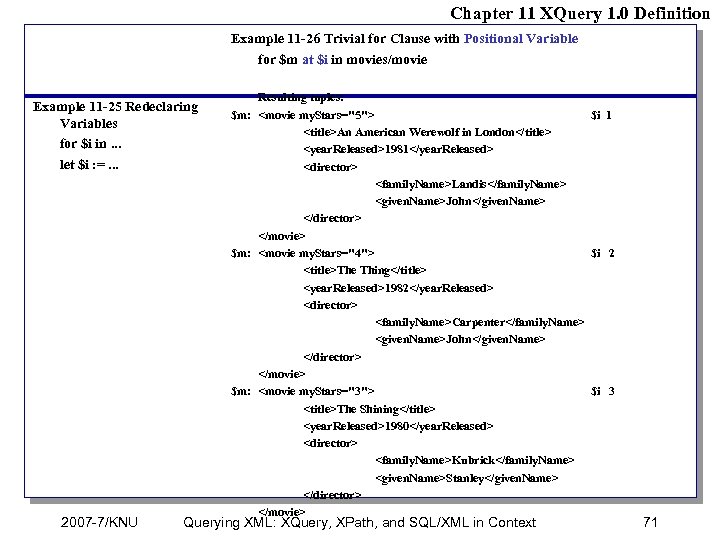 Chapter 11 XQuery 1. 0 Definition Example 11 -26 Trivial for Clause with Positional Variable for $m at $i in movies/movie Example 11 -25 Redeclaring Variables for $i in. . . let $i : =. . . 2007 -7/KNU Resulting tuples: $m:
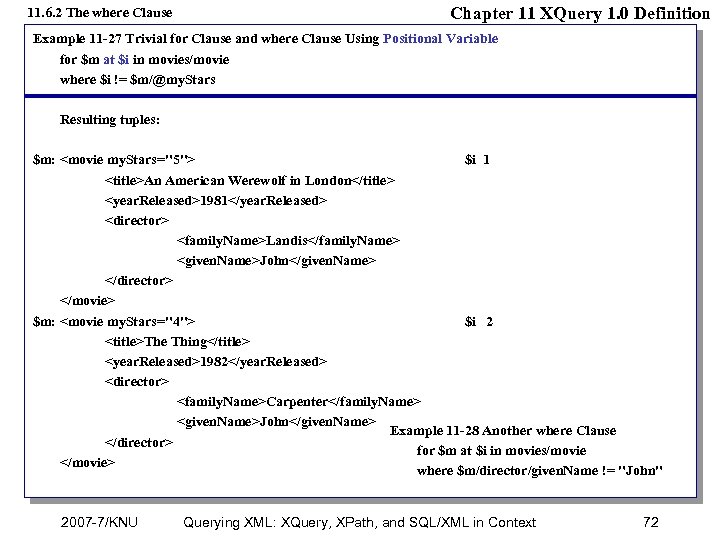 11. 6. 2 The where Clause Chapter 11 XQuery 1. 0 Definition Example 11 -27 Trivial for Clause and where Clause Using Positional Variable for $m at $i in movies/movie where $i != $m/@my. Stars Resulting tuples: $m:
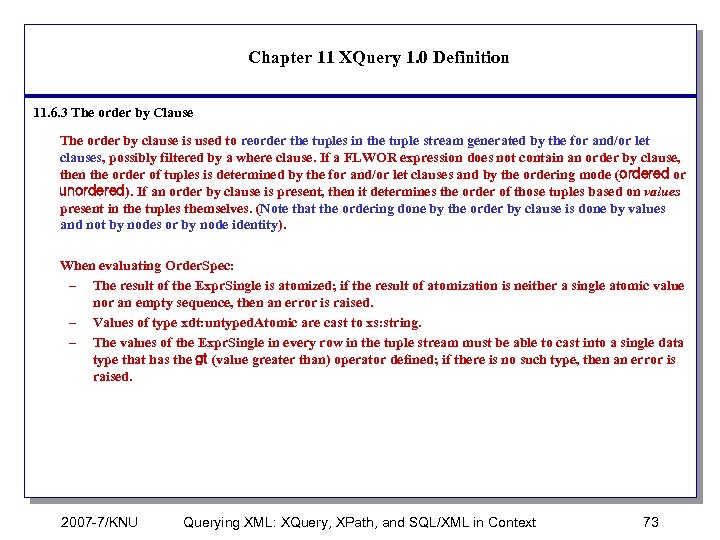 Chapter 11 XQuery 1. 0 Definition 11. 6. 3 The order by Clause The order by clause is used to reorder the tuples in the tuple stream generated by the for and/or let clauses, possibly filtered by a where clause. If a FLWOR expression does not contain an order by clause, then the order of tuples is determined by the for and/or let clauses and by the ordering mode (ordered or unordered). If an order by clause is present, then it determines the order of those tuples based on values present in the tuples themselves. (Note that the ordering done by the order by clause is done by values and not by nodes or by node identity). When evaluating Order. Spec: – The result of the Expr. Single is atomized; if the result of atomization is neither a single atomic value nor an empty sequence, then an error is raised. – Values of type xdt: untyped. Atomic are cast to xs: string. – The values of the Expr. Single in every row in the tuple stream must be able to cast into a single data type that has the gt (value greater than) operator defined; if there is no such type, then an error is raised. 2007 -7/KNU Querying XML: XQuery, XPath, and SQL/XML in Context 73
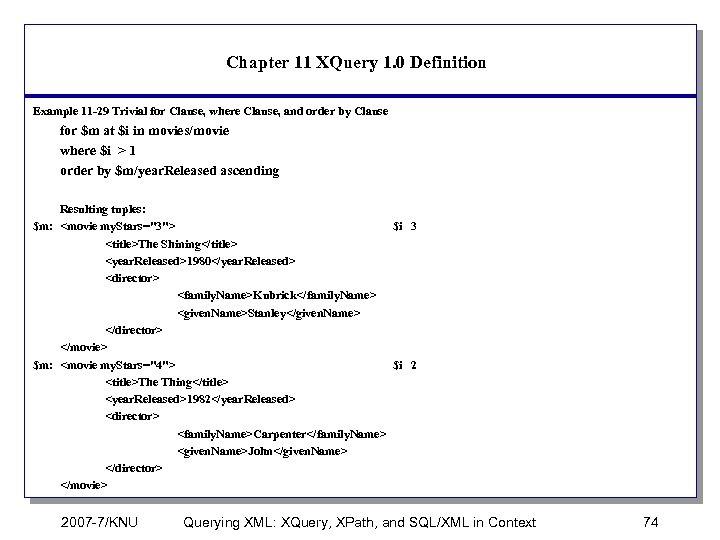 Chapter 11 XQuery 1. 0 Definition Example 11 -29 Trivial for Clause, where Clause, and order by Clause for $m at $i in movies/movie where $i > 1 order by $m/year. Released ascending Resulting tuples: $m:
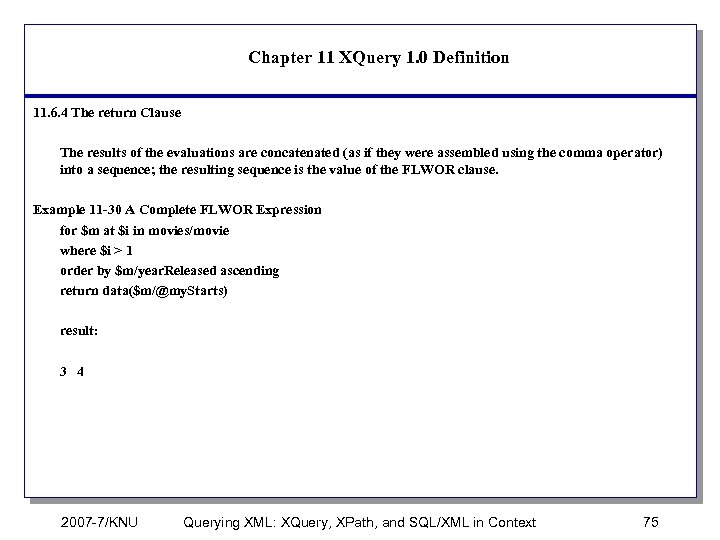 Chapter 11 XQuery 1. 0 Definition 11. 6. 4 The return Clause The results of the evaluations are concatenated (as if they were assembled using the comma operator) into a sequence; the resulting sequence is the value of the FLWOR clause. Example 11 -30 A Complete FLWOR Expression for $m at $i in movies/movie where $i > 1 order by $m/year. Released ascending return data($m/@my. Starts) result: 3 4 2007 -7/KNU Querying XML: XQuery, XPath, and SQL/XML in Context 75
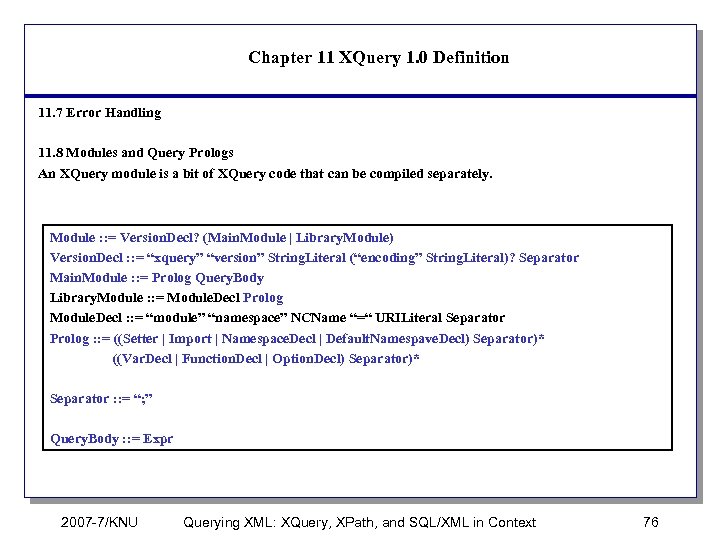 Chapter 11 XQuery 1. 0 Definition 11. 7 Error Handling 11. 8 Modules and Query Prologs An XQuery module is a bit of XQuery code that can be compiled separately. Module : : = Version. Decl? (Main. Module | Library. Module) Version. Decl : : = “xquery” “version” String. Literal (“encoding” String. Literal)? Separator Main. Module : : = Prolog Query. Body Library. Module : : = Module. Decl Prolog Module. Decl : : = “module” “namespace” NCName “=“ URILiteral Separator Prolog : : = ((Setter | Import | Namespace. Decl | Default. Namespave. Decl) Separator)* ((Var. Decl | Function. Decl | Option. Decl) Separator)* Separator : : = “; ” Query. Body : : = Expr 2007 -7/KNU Querying XML: XQuery, XPath, and SQL/XML in Context 76
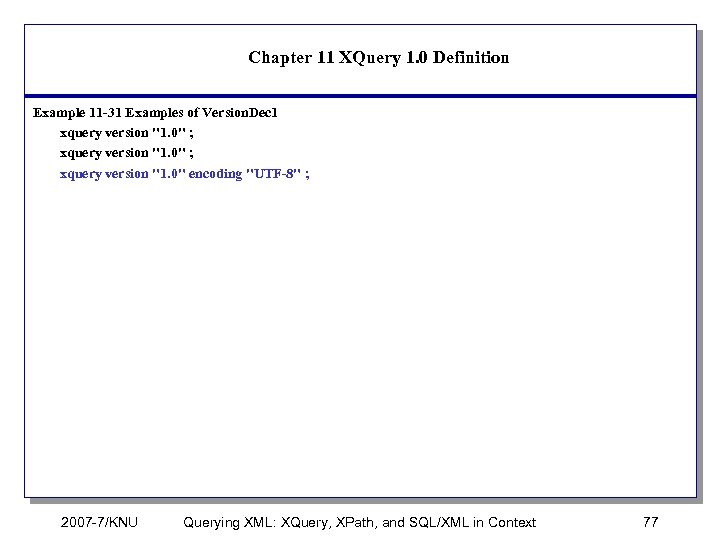 Chapter 11 XQuery 1. 0 Definition Example 11 -31 Examples of Version. Dec 1 xquery version "1. 0" ; xquery version "1. 0" encoding "UTF-8" ; 2007 -7/KNU Querying XML: XQuery, XPath, and SQL/XML in Context 77
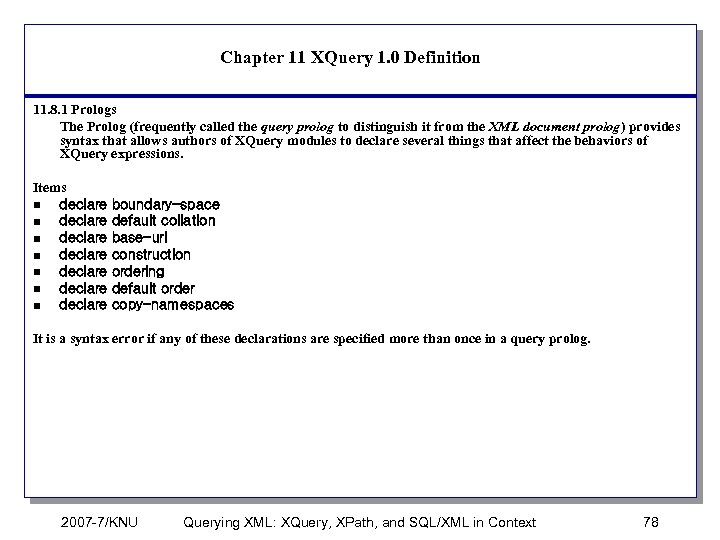 Chapter 11 XQuery 1. 0 Definition 11. 8. 1 Prologs The Prolog (frequently called the query prolog to distinguish it from the XML document prolog) provides syntax that allows authors of XQuery modules to declare several things that affect the behaviors of XQuery expressions. Items n declare n declare boundary-space default collation base-uri construction ordering default order copy-namespaces It is a syntax error if any of these declarations are specified more than once in a query prolog. 2007 -7/KNU Querying XML: XQuery, XPath, and SQL/XML in Context 78
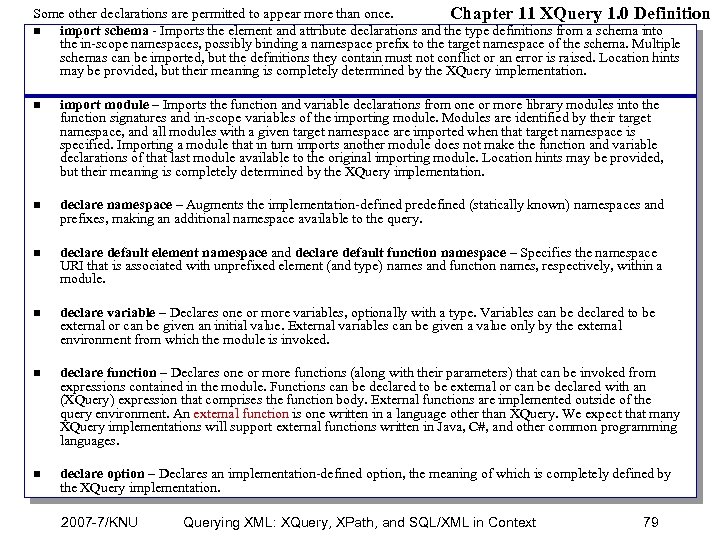 Some other declarations are permitted to appear more than once. Chapter 11 XQuery 1. 0 Definition n import schema - Imports the element and attribute declarations and the type definitions from a schema into the in-scope namespaces, possibly binding a namespace prefix to the target namespace of the schema. Multiple schemas can be imported, but the definitions they contain must not conflict or an error is raised. Location hints may be provided, but their meaning is completely determined by the XQuery implementation. n import module – Imports the function and variable declarations from one or more library modules into the function signatures and in-scope variables of the importing module. Modules are identified by their target namespace, and all modules with a given target namespace are imported when that target namespace is specified. Importing a module that in turn imports another module does not make the function and variable declarations of that last module available to the original importing module. Location hints may be provided, but their meaning is completely determined by the XQuery implementation. n declare namespace – Augments the implementation-defined predefined (statically known) namespaces and prefixes, making an additional namespace available to the query. n declare default element namespace and declare default function namespace – Specifies the namespace URI that is associated with unprefixed element (and type) names and function names, respectively, within a module. n declare variable – Declares one or more variables, optionally with a type. Variables can be declared to be external or can be given an initial value. External variables can be given a value only by the external environment from which the module is invoked. n declare function – Declares one or more functions (along with their parameters) that can be invoked from expressions contained in the module. Functions can be declared to be external or can be declared with an (XQuery) expression that comprises the function body. External functions are implemented outside of the query environment. An external function is one written in a language other than XQuery. We expect that many XQuery implementations will support external functions written in Java, C#, and other common programming languages. n declare option – Declares an implementation-defined option, the meaning of which is completely defined by the XQuery implementation. 2007 -7/KNU Querying XML: XQuery, XPath, and SQL/XML in Context 79
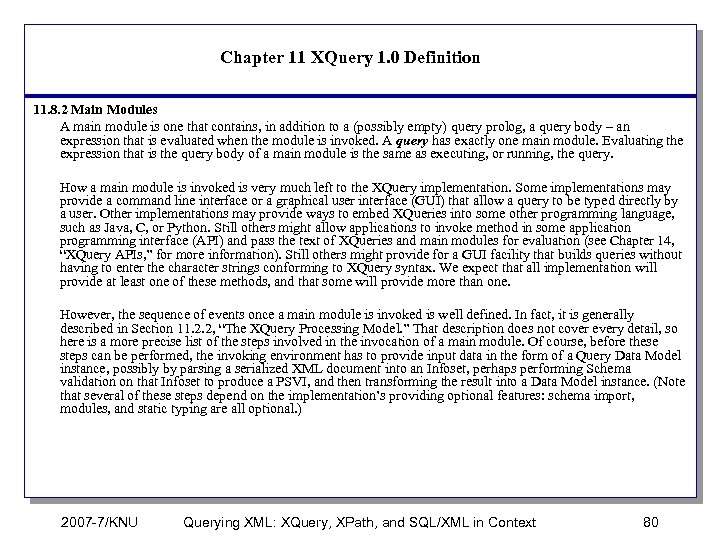 Chapter 11 XQuery 1. 0 Definition 11. 8. 2 Main Modules A main module is one that contains, in addition to a (possibly empty) query prolog, a query body – an expression that is evaluated when the module is invoked. A query has exactly one main module. Evaluating the expression that is the query body of a main module is the same as executing, or running, the query. How a main module is invoked is very much left to the XQuery implementation. Some implementations may provide a command line interface or a graphical user interface (GUI) that allow a query to be typed directly by a user. Other implementations may provide ways to embed XQueries into some other programming language, such as Java, C, or Python. Still others might allow applications to invoke method in some application programming interface (API) and pass the text of XQueries and main modules for evaluation (see Chapter 14, “XQuery APIs, ” for more information). Still others might provide for a GUI facility that builds queries without having to enter the character strings conforming to XQuery syntax. We expect that all implementation will provide at least one of these methods, and that some will provide more than one. However, the sequence of events once a main module is invoked is well defined. In fact, it is generally described in Section 11. 2. 2, “The XQuery Processing Model. ” That description does not cover every detail, so here is a more precise list of the steps involved in the invocation of a main module. Of course, before these steps can be performed, the invoking environment has to provide input data in the form of a Query Data Model instance, possibly by parsing a serialized XML document into an Infoset, perhaps performing Schema validation on that Infoset to produce a PSVI, and then transforming the result into a Data Model instance. (Note that several of these steps depend on the implementation’s providing optional features: schema import, modules, and static typing are all optional. ) 2007 -7/KNU Querying XML: XQuery, XPath, and SQL/XML in Context 80
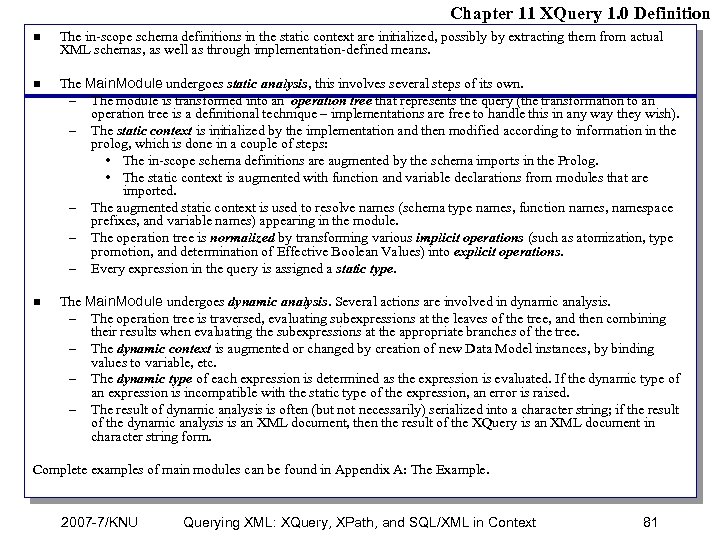 Chapter 11 XQuery 1. 0 Definition n The in-scope schema definitions in the static context are initialized, possibly by extracting them from actual XML schemas, as well as through implementation-defined means. n The Main. Module undergoes static analysis, this involves several steps of its own. – The module is transformed into an operation tree that represents the query (the transformation to an operation tree is a definitional technique – implementations are free to handle this in any way they wish). – The static context is initialized by the implementation and then modified according to information in the prolog, which is done in a couple of steps: • The in-scope schema definitions are augmented by the schema imports in the Prolog. • The static context is augmented with function and variable declarations from modules that are imported. – The augmented static context is used to resolve names (schema type names, function names, namespace prefixes, and variable names) appearing in the module. – The operation tree is normalized by transforming various implicit operations (such as atomization, type promotion, and determination of Effective Boolean Values) into explicit operations. – Every expression in the query is assigned a static type. n The Main. Module undergoes dynamic analysis. Several actions are involved in dynamic analysis. – The operation tree is traversed, evaluating subexpressions at the leaves of the tree, and then combining their results when evaluating the subexpressions at the appropriate branches of the tree. – The dynamic context is augmented or changed by creation of new Data Model instances, by binding values to variable, etc. – The dynamic type of each expression is determined as the expression is evaluated. If the dynamic type of an expression is incompatible with the static type of the expression, an error is raised. – The result of dynamic analysis is often (but not necessarily) serialized into a character string; if the result of the dynamic analysis is an XML document, then the result of the XQuery is an XML document in character string form. Complete examples of main modules can be found in Appendix A: The Example. 2007 -7/KNU Querying XML: XQuery, XPath, and SQL/XML in Context 81
 Chapter 11 XQuery 1. 0 Definition 11. 8. 3 Library Modules Library modules support the notion of modularizing applications, which is done for reasons of design, maintenance, and code reuse. A library module comprises only a Module. Decl and a Prolog, The Module. Decl defines the target namespace of the library module, while the Prolog contains declarations for functions and variables that are exported (made available) for importation (inclusion) by other library modules and by main modules. Example 11 -32 contains a scenario of importing library modules 2007 -7/KNU Querying XML: XQuery, XPath, and SQL/XML in Context 82
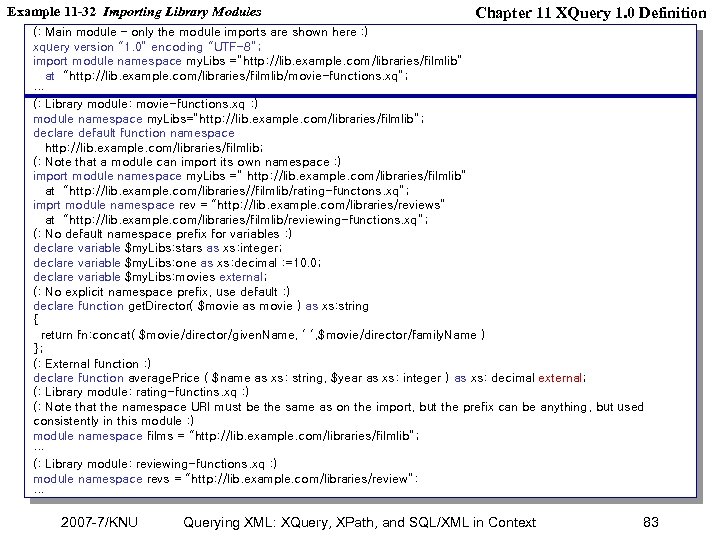 Example 11 -32 Importing Library Modules Chapter 11 XQuery 1. 0 Definition (: Main module – only the module imports are shown here : ) xquery version “ 1. 0” encoding “UTF-8”; import module namespace my. Libs =”http: //lib. example. com/libraries/filmlib” at “http: //lib. example. com/libraries/filmlib/movie-functions. xq”; … (: Library module: movie-functions. xq : ) module namespace my. Libs=”http: //lib. example. com/libraries/filmlib”; declare default function namespace http: //lib. example. com/libraries/filmlib; (: Note that a module can import its own namespace : ) import module namespace my. Libs =” http: //lib. example. com/libraries/filmlib” at “http: //lib. example. com/libraries//filmlib/rating-functons. xq”; imprt module namespace rev = “http: //lib. example. com/libraries/reviews” at “http: //lib. example. com/libraries/filmlib/reviewing-functions. xq”; (: No default namespace prefix for variables : ) declare variable $my. Libs: stars as xs: integer; declare variable $my. Libs: one as xs: decimal : =10. 0; declare variable $my. Libs: movies external; (: No explicit namespace prefix, use default : ) declare function get. Director( $movie as movie ) as xs: string { return fn: concat( $movie/director/given. Name, ‘ ‘, $movie/director/family. Name ) }; (: External function : ) declare function average. Price ( $name as xs: string, $year as xs: integer ) as xs: decimal external; (: Library module: rating-functins. xq : ) (: Note that the namespace URI must be the same as on the import, but the prefix can be anything, but used consistently in this module : ) module namespace films = “http: //lib. example. com/libraries/filmlib”; … (: Library module: reviewing-functions. xq : ) module namespace revs = “http: //lib. example. com/libraries/review”: … 2007 -7/KNU Querying XML: XQuery, XPath, and SQL/XML in Context 83
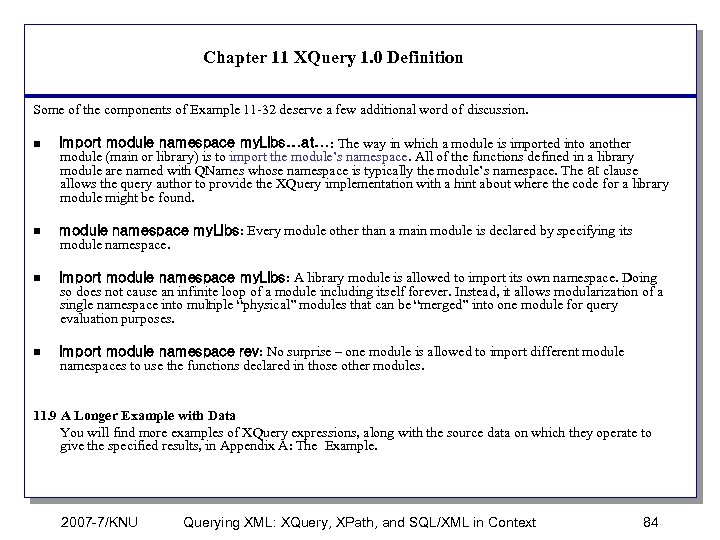 Chapter 11 XQuery 1. 0 Definition Some of the components of Example 11 -32 deserve a few additional word of discussion. n import module namespace my. Libs. . . at. . . : The way in which a module is imported into another module (main or library) is to import the module’s namespace. All of the functions defined in a library module are named with QNames whose namespace is typically the module’s namespace. The at clause allows the query author to provide the XQuery implementation with a hint about where the code for a library module might be found. n module namespace my. Libs: Every module other than a main module is declared by specifying its module namespace. n import module namespace my. Libs: A library module is allowed to import its own namespace. Doing so does not cause an infinite loop of a module including itself forever. Instead, it allows modularization of a single namespace into multiple “physical” modules that can be “merged” into one module for query evaluation purposes. n import module namespace rev: No surprise – one module is allowed to import different module namespaces to use the functions declared in those other modules. 11. 9 A Longer Example with Data You will find more examples of XQuery expressions, along with the source data on which they operate to give the specified results, in Appendix A: The Example. 2007 -7/KNU Querying XML: XQuery, XPath, and SQL/XML in Context 84
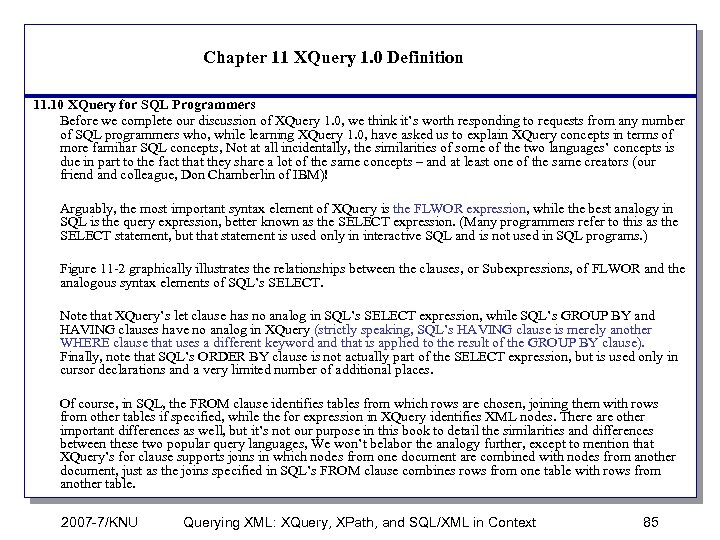 Chapter 11 XQuery 1. 0 Definition 11. 10 XQuery for SQL Programmers Before we complete our discussion of XQuery 1. 0, we think it’s worth responding to requests from any number of SQL programmers who, while learning XQuery 1. 0, have asked us to explain XQuery concepts in terms of more familiar SQL concepts, Not at all incidentally, the similarities of some of the two languages’ concepts is due in part to the fact that they share a lot of the same concepts – and at least one of the same creators (our friend and colleague, Don Chamberlin of IBM)! Arguably, the most important syntax element of XQuery is the FLWOR expression, while the best analogy in SQL is the query expression, better known as the SELECT expression. (Many programmers refer to this as the SELECT statement, but that statement is used only in interactive SQL and is not used in SQL programs. ) Figure 11 -2 graphically illustrates the relationships between the clauses, or Subexpressions, of FLWOR and the analogous syntax elements of SQL’s SELECT. Note that XQuery’s let clause has no analog in SQL’s SELECT expression, while SQL’s GROUP BY and HAVING clauses have no analog in XQuery (strictly speaking, SQL’s HAVING clause is merely another WHERE clause that uses a different keyword and that is applied to the result of the GROUP BY clause). Finally, note that SQL’s ORDER BY clause is not actually part of the SELECT expression, but is used only in cursor declarations and a very limited number of additional places. Of course, in SQL, the FROM clause identifies tables from which rows are chosen, joining them with rows from other tables if specified, while the for expression in XQuery identifies XML nodes. There are other important differences as well, but it’s not our purpose in this book to detail the similarities and differences between these two popular query languages, We won’t belabor the analogy further, except to mention that XQuery’s for clause supports joins in which nodes from one document are combined with nodes from another document, just as the joins specified in SQL’s FROM clause combines rows from one table with rows from another table. 2007 -7/KNU Querying XML: XQuery, XPath, and SQL/XML in Context 85
 Chapter 11 XQuery 1. 0 Definition There are other concepts that the two languages share but for which there are important differences, For examples, SQL’s collection of data types is not the same as XQuery’s. Many of the data types in the two languages are similar in purpose, but the details vary, often considerably. In Table 11 -5, we have provided a correspondence between SQL’s set of data types and the XQuery Data Model’s set of data types. Note that most of the XQuery Data Model’s types are shown with the namespace prefix “xs: ”, indicating that those types are defined in XML Schema. Other types are shown with the namespace prefix “xdt: ” to indicate that they are defined by the Data Model itself. Some of SQL’s data types have no analogy in XQuery, and some types used in XQuery have no analogy in SQL; we use a dash(“-“) to indicate that situation, Chapter 15, “SQL/XML, ” has more discussion of type correspondences between the two languages. Many of SQL’s expressions have analogs in XQuery (the reverse is true as well). Both languages have arithmetic expressions, string expressions, comparison expression (and predicates), datetime expressions, and so forth. The details naturally vary, because the languages’ needs are different, as are their data types’ details. With this modest discussion, we believe that most SQL programmers will be able to use this chapter to begin learning XQuery and applying it in their own applications. 2007 -7/KNU Querying XML: XQuery, XPath, and SQL/XML in Context 86
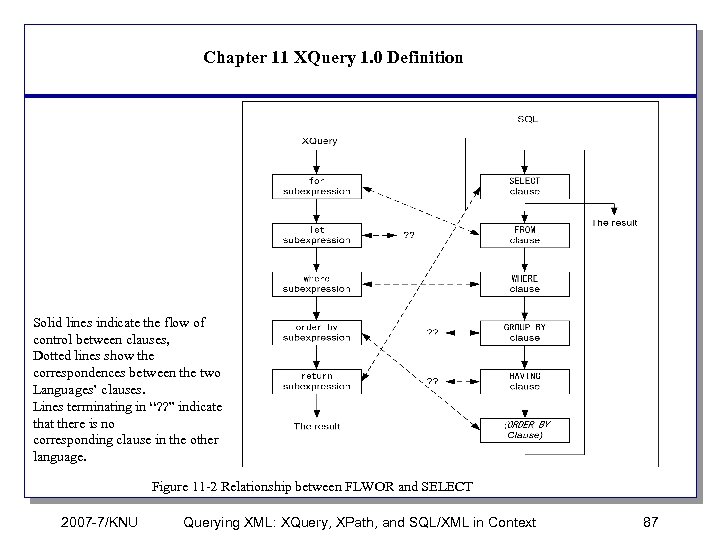 Chapter 11 XQuery 1. 0 Definition Solid lines indicate the flow of control between clauses, Dotted lines show the correspondences between the two Languages’ clauses. Lines terminating in “? ? ” indicate that there is no corresponding clause in the other language. Figure 11 -2 Relationship between FLWOR and SELECT 2007 -7/KNU Querying XML: XQuery, XPath, and SQL/XML in Context 87
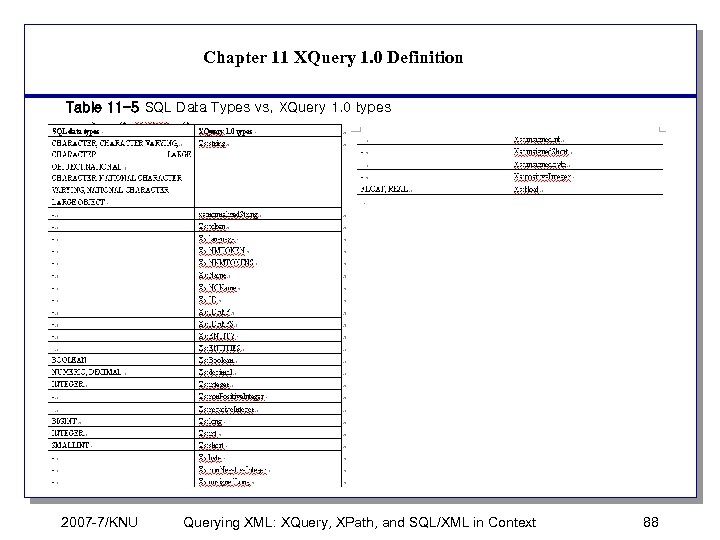 Chapter 11 XQuery 1. 0 Definition Table 11 -5 SQL Data Types vs, XQuery 1. 0 types 2007 -7/KNU Querying XML: XQuery, XPath, and SQL/XML in Context 88
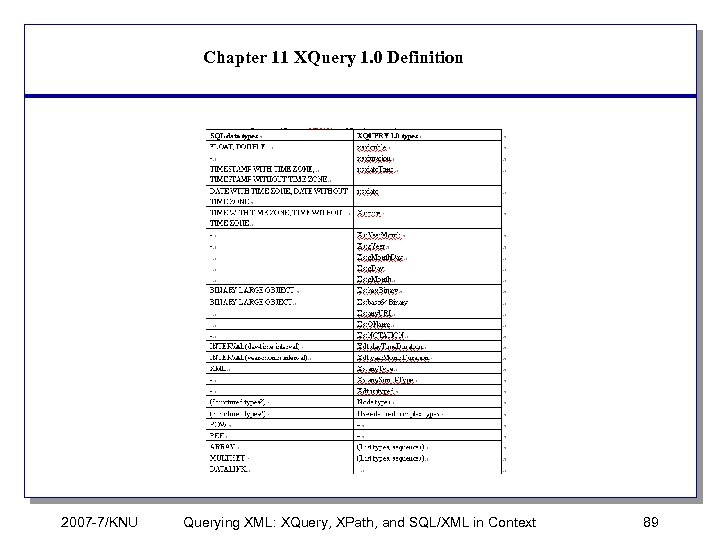 Chapter 11 XQuery 1. 0 Definition 2007 -7/KNU Querying XML: XQuery, XPath, and SQL/XML in Context 89
 Chapter 12 XQuery. X 12. 1 Introduction XQuery. X is an alternative syntax for the XQuery language, where a query is represented as a well-formed XML document (as opposed to just a string of characters). There is a mindset in the XML world that says, “XML is a good way of representing stuff, and therefore all stuff should be represented as XML. ” For example, one of the advantages of XML Schema over DTDs is that an XML Schema is an XML document, while a DTD is not. This turns out to be a very practical way to go about things – it really is useful to be able to treat an XML Schema, or an XQuery, as an XML document, It means you can: • Validate it against an XML Schema (an XML Schema can be validated against the Schema for Schemas, and an XQuery. X can be validated against the XQuery. X Schema). • Create it with an XML editing tool. • Store it the same way you store other XML documents. • Pass it around as an XML document, e. g. , as a SOAP message. • Query it, using XPath or XQuery –or XQuery. X. • Embed it in another XML document. 2007 -7/KNU Querying XML: XQuery, XPath, and SQL/XML in Context 90
 Chapter 12 XQuery. X The XQuery. X spec notes a couple of other benefits of an XML representation of an XQuery – parser reuse and automatic query generation. In fact, many people believe that XQuery. X is the only XML query syntax we need – after all (the argument goes), nobody actually writes queries by hand; they write applications that write queries. So what if XQuery. X is verbose and difficult to read and write, only applications will read and write XQuerise, so it’s more important to make the language machine-readable/writable than human-readable/writable, That argument does have supporters, but the bulk of the XQuery Working Group’s efforts have gone into creating the humanreadable/writable syntax for XQuery. X, though recognized as a requirement early on, has been defined as an adjunct to the non-XML syntax. Given the XQuery language, there a number of ways you could define an XML syntax (that is, a way to represent any possible XQuery in XML). In Section 12. 2 we describe two possible extremes – a trivial embedding and a fully parsed XQuery – and we describe some of the design features of XQuery. X. In Section 12. 3 we describe how the XQuery. X spec defines XQuery. X. In Section 12. 4 we look closely at some example XQueries and their XQuery. X representations. And in Section 12. 5 we discuss how and why you might query XQuery. X documents. 2007 -7/KNU Querying XML: XQuery, XPath, and SQL/XML in Context 91
 Chapter 12 XQuery. X 12. 2 How Far to Go? There is a non-XML, human-readable/writable syntax for the XQuery language, and we want to define an XML syntax based on that language. The XML syntax must be able to express exactly what the non-XML syntax expresses, no more and no less. And it probably should be recognizable as an XML representation of the non-XML syntax, reusing the same key words and clauses. But how far should XQuery. X go in the direction of XML? Let’s look at the two possible extremes – a trivial embedding of XQuery into XML, and an XML representation of a parsed XQuery – before discussing what XQuery. X actually does. 2007 -7/KNU Querying XML: XQuery, XPath, and SQL/XML in Context 92
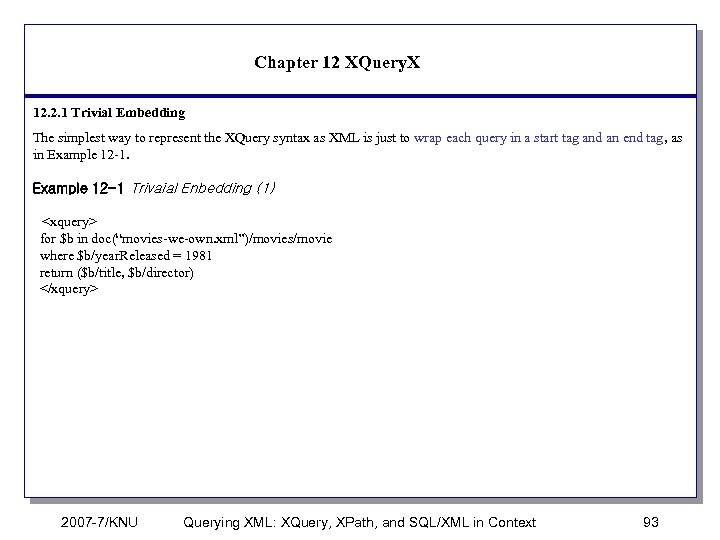 Chapter 12 XQuery. X 12. 2. 1 Trivial Embedding The simplest way to represent the XQuery syntax as XML is just to wrap each query in a start tag and an end tag, as in Example 12 -1 Trivaial Enbedding (1)
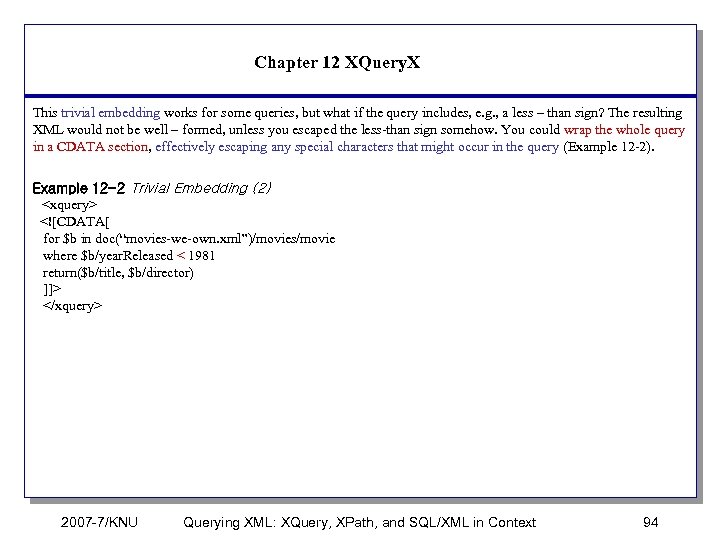 Chapter 12 XQuery. X This trivial embedding works for some queries, but what if the query includes, e. g. , a less – than sign? The resulting XML would not be well – formed, unless you escaped the less-than sign somehow. You could wrap the whole query in a CDATA section, effectively escaping any special characters that might occur in the query (Example 12 -2). Example 12 -2 Trivial Embedding (2)
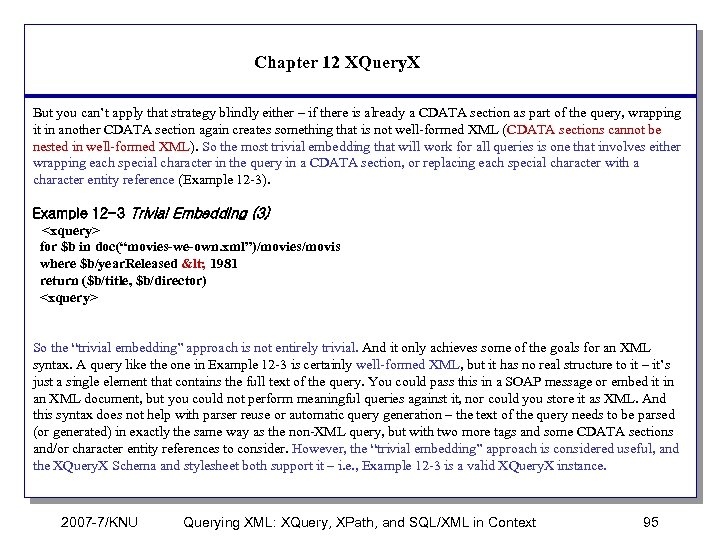 Chapter 12 XQuery. X But you can’t apply that strategy blindly either – if there is already a CDATA section as part of the query, wrapping it in another CDATA section again creates something that is not well-formed XML (CDATA sections cannot be nested in well-formed XML). So the most trivial embedding that will work for all queries is one that involves either wrapping each special character in the query in a CDATA section, or replacing each special character with a character entity reference (Example 12 -3). Example 12 -3 Trivial Embedding (3)
 Chapter 12 XQuery. X 12. 2. 2 Fully-Parsed XQuery The opposite extreme to trivial embedding would be to represent the fully-parsed form of an XQuery as XML, where each language construct, down to individual characters, is a separate element or attribute, By adopting this approach, you achieve all the benefits of XQuery. X – a query needs to be parsed only once (when you forst create the XQuery. X), and this form is easy to generate automatically (as a natural by –product of parsing the query). The downside to this approach is its verbosity – you’ll see in Example 12 -5 just how long the simplest XQuery. X would be if it mapped every XQuery grammar production. And, as you’ll see in Section 12. 2. 3, it is possible to define XQuery. X so that XQuery. X queries are even more amenable to being queried than this fully-parsed representation. 2007 -7/KNU Querying XML: XQuery, XPath, and SQL/XML in Context 96
 Chapter 12 XQuery. X 12. 2. 3 The XQuery. X Approach The approach taken in the XQuery. X spec is fairly close to the “Fully-Parsed XQuery. ” That is, an XQuery. X looks quite like an XML representation of the parsed form of an Xquery. There are two broad areas where XQuery. X deviates from a straightforward parsed query mapping. First, XQuery. X does not reflect every production, and it does not represent “empty” parts of a production (parts of a production that are optional, and that don’t exist in the XQuery being represented). If XQuery. X did faithfully represent every part of every grammar production, then XQuery. X queries would be even more verbose than they are under the current spec – see Example 12 -5 for an example. Second, XQuery. X represents constructs such as expressions, operators, and literals so that their representation (in an XQuery. X instance document) is concise, yet you can create broad or narrow queries (to search for nodes higher or lower in the parse tree). We look at each of these in turn, illustrating them with fragments of the XQuery. X instance document. In the XQuery. X instance fragments, we use the namespace prefix “xqx. ” 2007 -7/KNU Querying XML: XQuery, XPath, and SQL/XML in Context 97
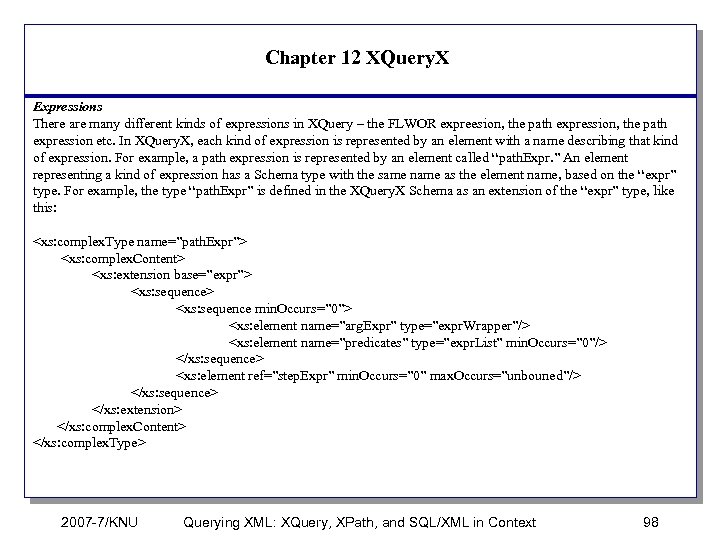 Chapter 12 XQuery. X Expressions There are many different kinds of expressions in XQuery – the FLWOR expreesion, the path expression etc. In XQuery. X, each kind of expression is represented by an element with a name describing that kind of expression. For example, a path expression is represented by an element called “path. Expr. ” An element representing a kind of expression has a Schema type with the same name as the element name, based on the “expr” type. For example, the type “path. Expr” is defined in the XQuery. X Schema as an extension of the “expr” type, like this:
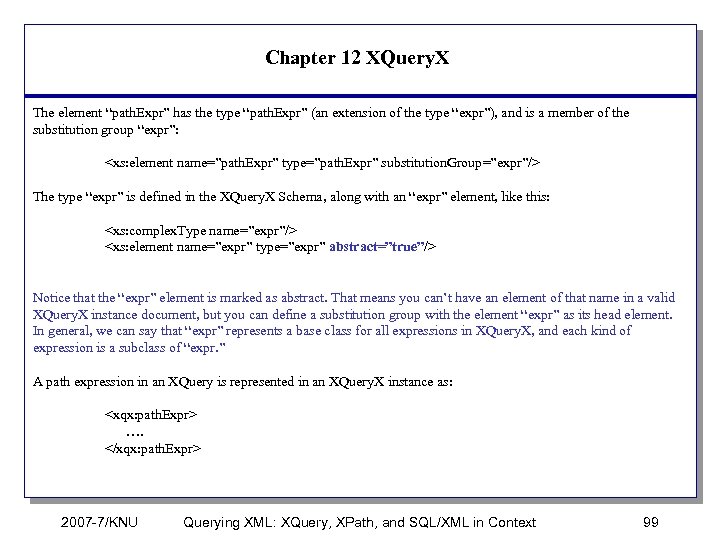 Chapter 12 XQuery. X The element “path. Expr” has the type “path. Expr” (an extension of the type “expr”), and is a member of the substitution group “expr”:
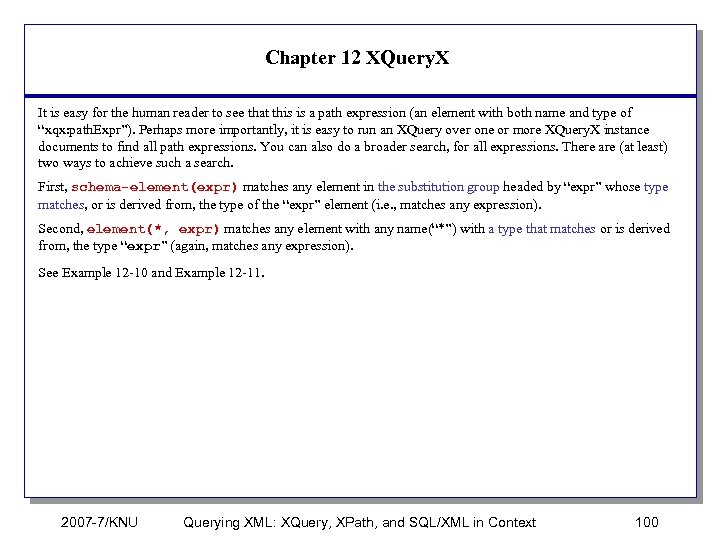 Chapter 12 XQuery. X It is easy for the human reader to see that this is a path expression (an element with both name and type of “xqx: path. Expr”). Perhaps more importantly, it is easy to run an XQuery over one or more XQuery. X instance documents to find all path expressions. You can also do a broader search, for all expressions. There are (at least) two ways to achieve such a search. First, schema-element(expr) matches any element in the substitution group headed by “expr” whose type matches, or is derived from, the type of the “expr” element (i. e. , matches any expression). Second, element(*, expr) matches any element with any name(“*”) with a type that matches or is derived from, the type “expr” (again, matches any expression). See Example 12 -10 and Example 12 -11. 2007 -7/KNU Querying XML: XQuery, XPath, and SQL/XML in Context 100
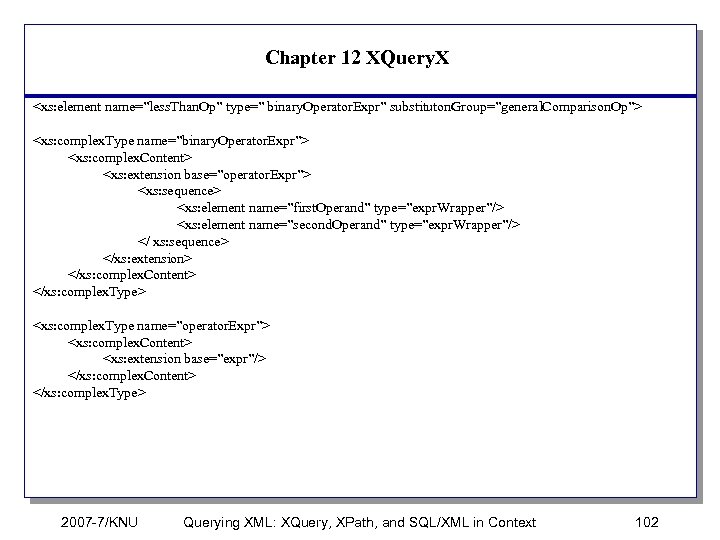
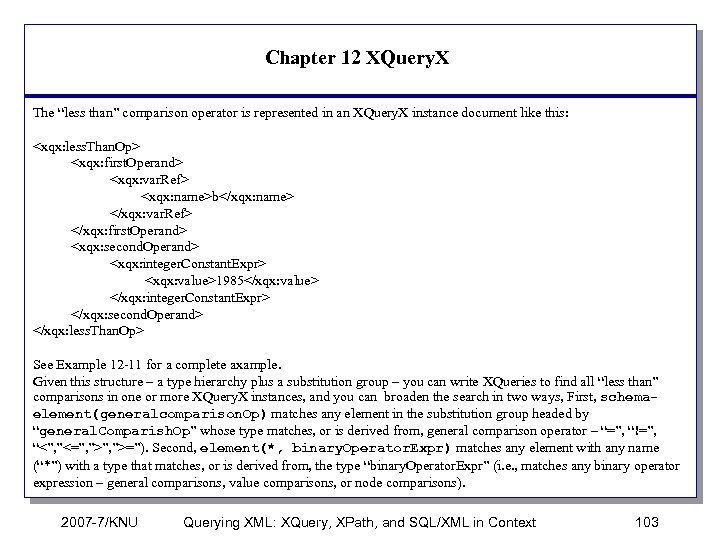
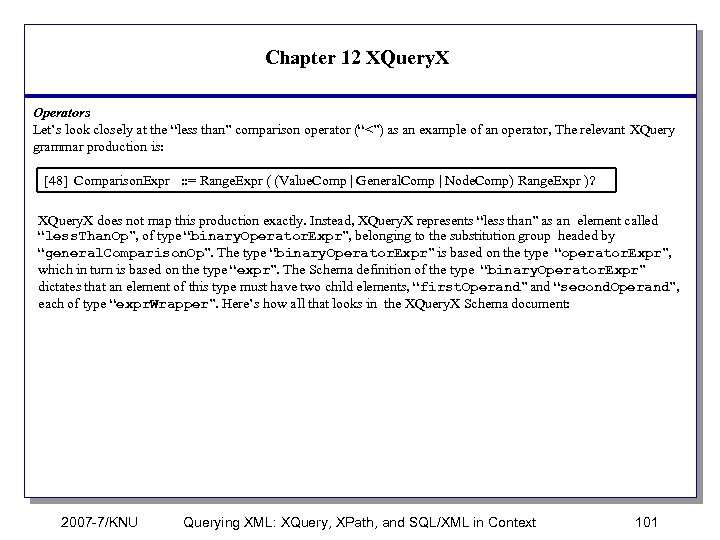 Chapter 12 XQuery. X Operators Let’s look closely at the “less than” comparison operator (“<”) as an example of an operator, The relevant XQuery grammar production is: [48] Comparison. Expr : : = Range. Expr ( (Value. Comp | General. Comp | Node. Comp) Range. Expr )? XQuery. X does not map this production exactly. Instead, XQuery. X represents “less than” as an element called “less. Than. Op”, of type “binary. Operator. Expr”, belonging to the substitution group headed by “general. Comparison. Op”. The type “binary. Operator. Expr” is based on the type “operator. Expr”, which in turn is based on the type “expr”. The Schema definition of the type “binary. Operator. Expr” dictates that an element of this type must have two child elements, “first. Operand” and “second. Operand”, each of type “expr. Wrapper”. Here’s how all that looks in the XQuery. X Schema document: 2007 -7/KNU Querying XML: XQuery, XPath, and SQL/XML in Context 101
 Chapter 12 XQuery. X
 Chapter 12 XQuery. X The “less than” comparison operator is represented in an XQuery. X instance document like this:
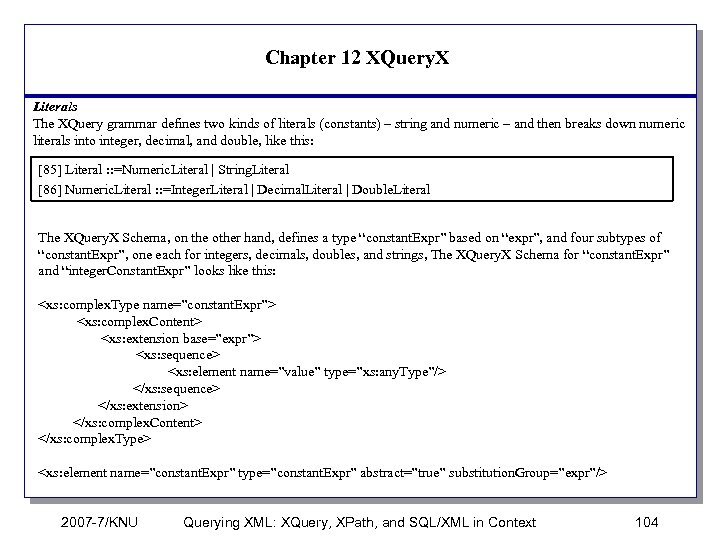 Chapter 12 XQuery. X Literals The XQuery grammar defines two kinds of literals (constants) – string and numeric – and then breaks down numeric literals into integer, decimal, and double, like this: [85] Literal : : =Numeric. Literal | String. Literal [86] Numeric. Literal : : =Integer. Literal | Decimal. Literal | Double. Literal The XQuery. X Schema, on the other hand, defines a type “constant. Expr” based on “expr”, and four subtypes of “constant. Expr”, one each for integers, decimals, doubles, and strings, The XQuery. X Schema for “constant. Expr” and “integer. Constant. Expr” looks like this:
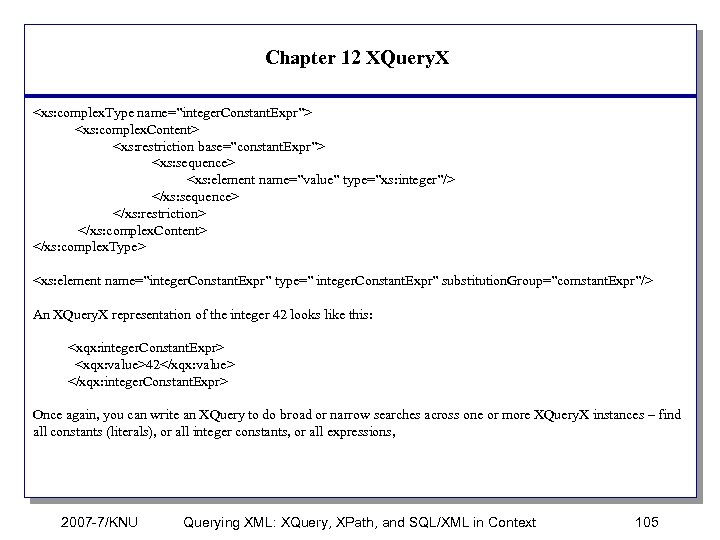 Chapter 12 XQuery. X
 Chapter 12 XQuery. X Summary In summary, XQuery. X nearly represents the parsed form of an XQuery, representing tokens and atomic values, but not individual characters, as elements. XQuery. X represents all the structure of the XQuery grammar, including, for example, each step in an XPath expression. This means you can query a collection of queries to find out, e. g. , how many queries include some string literal, or which queries include a particular XPath axis (see Section 12. 5). XQuery. X does not include a one-to-one representation of every XQuery grammar production – instead, it uses subtyping and substitution groups to enable broad or narrow queries over (fairly) concise XQuery. X instances. 2007 -7/KNU Querying XML: XQuery, XPath, and SQL/XML in Context 106
 Chapter 12 XQuery. X 12. 3 The XQuery. X Specification Now that you have the general flavor of the XQuery. X approach to representing XQueries in XML, let’s look at the XQuery. X specification before stepping through some complete examples. The XQuery. X specification defines XQuery. X by providing an XML Schema, which defines the syntax of XQuery. X, and a stylesheet, which defines the semantics. The spec also includes some worked examples and a definition of a trivial embedding. The XQuery. X Schema defines what an XQuery. X query can look like. The Schema follows the XQuery grammar quite closely. The size of an XQuery. X query is kept manageable by skipping some productions, and by not forcing empty productions to be represented. In grammar rules, the XQuery. X Schema, and the XQuery. X representation of the query together. The semantics of XQuery. X are defined by the XQuery. X stylesheet – i. e. , the meaning of any XQuery. X instance is the meaning of the XQuery produced by applying the XQuery. X stylesheet to it. The XQuery. X spec does not explain how to get from XQuery to XQuery. X, but the stylesheet ensures that we always know when we get there. 2007 -7/KNU Querying XML: XQuery, XPath, and SQL/XML in Context 107
 Chapter 12 XQuery. X 12. 4 XQuery. X By Example The XQuery. X specification does not give any guidelines on how to produce an XQuery. X instance (query), given an XQuery. But if you study the XQuery grammar productions the XQuery. X Schema, and the examples in the XQuery. X specification, it’s not too difficult to produce XQuery. X queries. If you are not too sure how your XQuery should parse, you can get (some of) the parse tree for an XQuery from the XQuery grammar test applet. And of course you can check the resulting XQuery. X query by running it past the XQuery. X stylesheet and checking the result against your original XQuery. 2007 -7/KNU Querying XML: XQuery, XPath, and SQL/XML in Context 108
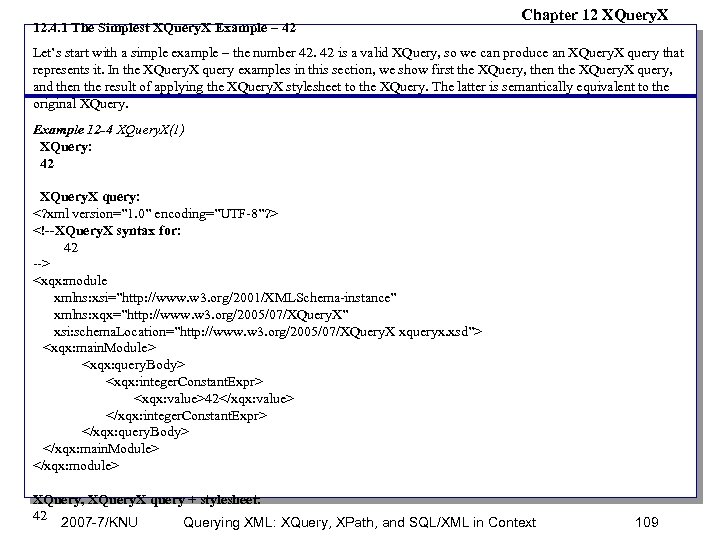 12. 4. 1 The Simplest XQuery. X Example – 42 Chapter 12 XQuery. X Let’s start with a simple example – the number 42. 42 is a valid XQuery, so we can produce an XQuery. X query that represents it. In the XQuery. X query examples in this section, we show first the XQuery, then the XQuery. X query, and then the result of applying the XQuery. X stylesheet to the XQuery. The latter is semantically equivalent to the original XQuery. Example 12 -4 XQuery. X(1) XQuery: 42 XQuery. X query:
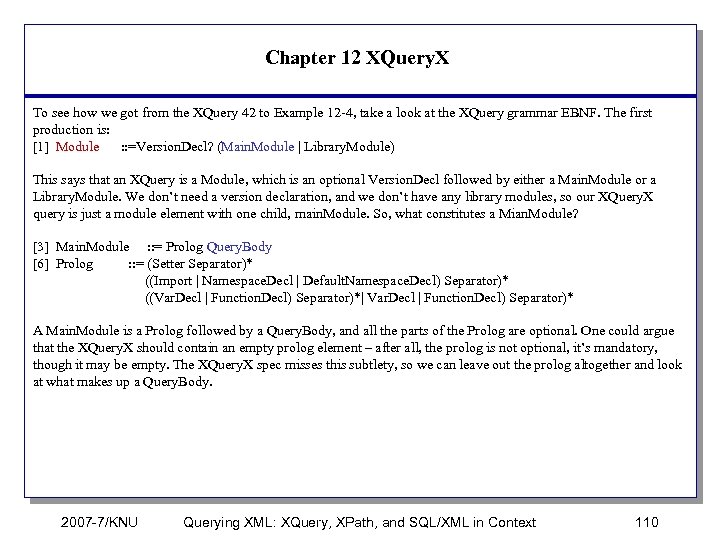 Chapter 12 XQuery. X To see how we got from the XQuery 42 to Example 12 -4, take a look at the XQuery grammar EBNF. The first production is: [1] Module : : =Version. Decl? (Main. Module | Library. Module) This says that an XQuery is a Module, which is an optional Version. Decl followed by either a Main. Module or a Library. Module. We don’t need a version declaration, and we don’t have any library modules, so our XQuery. X query is just a module element with one child, main. Module. So, what constitutes a Mian. Module? [3] Main. Module : : = Prolog Query. Body [6] Prolog : : = (Setter Separator)* ((Import | Namespace. Decl | Default. Namespace. Decl) Separator)* ((Var. Decl | Function. Decl) Separator)*| Var. Decl | Function. Decl) Separator)* A Main. Module is a Prolog followed by a Query. Body, and all the parts of the Prolog are optional. One could argue that the XQuery. X should contain an empty prolog element – after all, the prolog is not optional, it’s mandatory, though it may be empty. The XQuery. X spec misses this subtlety, so we can leave out the prolog altogether and look at what makes up a Query. Body. 2007 -7/KNU Querying XML: XQuery, XPath, and SQL/XML in Context 110
![Chapter 12 XQuery X [30] Query. Body : : =Expr [31] Expr : :](https://present5.com/presentation/b4ecf48874d996cff263b4d3670e7a4b/image-111.jpg "Chapter 12 XQuery X [30] Query. Body : : =Expr [31] Expr : :") Chapter 12 XQuery X [30] Query. Body : : =Expr [31] Expr : : = Expr. Single (“, ” Expr. Single)* A Query. Body is an Expr, and an Expr is one or more Expr. Singles separated by commas. At this point we have to take a long walk through several grammar productions to find that an Expr. Single can be just a Path. Expr. This may look a little convoluted, but it works for XQuery – the grammar is (mostly) LL(1) (meaning you can parse any statement by looking at each token ), and the precedence of the operators such as “and” and “or” is implicitly defined by the grammar productions – operator precedence doesn’t have to be defined separately. Scott Boag, XQuery grammar guru, calls this cascading precedence. You’ll read more about the XQuery grammar in Appendix C: XQuery 1. 0 Grammar. For now, it’s enough to read through the next few grammar productions, ignoring anything that is optional. guru : (정신적) 지도자 2007 -7/KNU Querying XML: XQuery, XPath, and SQL/XML in Context 111
Chapter 12 XQuery X [30] Query. Body : : =Expr [31] Expr : : = Expr. Single (“, ” Expr. Single)* A Query. Body is an Expr, and an Expr is one or more Expr. Singles separated by commas. At this point we have to take a long walk through several grammar productions to find that an Expr. Single can be just a Path. Expr. This may look a little convoluted, but it works for XQuery – the grammar is (mostly) LL(1) (meaning you can parse any statement by looking at each token ), and the precedence of the operators such as “and” and “or” is implicitly defined by the grammar productions – operator precedence doesn’t have to be defined separately. Scott Boag, XQuery grammar guru, calls this cascading precedence. You’ll read more about the XQuery grammar in Appendix C: XQuery 1. 0 Grammar. For now, it’s enough to read through the next few grammar productions, ignoring anything that is optional. guru : (정신적) 지도자 2007 -7/KNU Querying XML: XQuery, XPath, and SQL/XML in Context 111
![Chapter 12 XQuery X [32] Expr. Single : : = FLWORExpr | Quantified. Expr](https://present5.com/presentation/b4ecf48874d996cff263b4d3670e7a4b/image-112.jpg "Chapter 12 XQuery X [32] Expr. Single : : = FLWORExpr | Quantified. Expr") Chapter 12 XQuery X [32] Expr. Single : : = FLWORExpr | Quantified. Expr | Typeswitch. Expr | If. Expr | Or. Expr [46] Or. Expr : : = And. Expr ( “or” And. Expr )* [47] And. Expr : : = Comparison. Expr ( “and” Comparison. Expr )* [48] Comparison. Expr : : = Range. Expr (( Value. Comp | Genral. Comp | Node. Comp ) Range. Expr )? [49] Range. Expr : : = Additive. Expr ( “to” Additive. Expr )? [50] Additive. Expr : : = Multiplicative. Expr ( (“+” | “-“) Multiplicative. Expr )* [51] Multiplicative. Expr : : = Union. Expr ( (“*” | “div” | “idiv” | “mod”) Union. Expr )* [52] Union. Expr : : = Intersect. Except. Expr ( (“union” | ”|”) Inersect. Except. Expr)* [53] Inersect. Except. Expr : : = Instanceof. Expr ( (“intersect” | “except”) Instanceof. Expr )* [54] Instanceof. Expr : : = Treat. Expr ( <”instance” “of”> Sequence. Type )? ? ? ? [55] Treat. Expr : : = Castable. Expr ( <”treat” “as”> Sequence. Type )? ? [56] Castable. Expr : : = Cast. Expr ( <”castable” “as”> Single. Type )? ? ? ? [57] Cast. Expr : : = Unary. Expr ( <”cast” “as”> Single. Type )? ? ? ? [58] Unary. Expr : : = (“-“ |”+”)* Value. Expr [59] Value. Expr : : = Validate. Expr | Path. Expr So an Expr. Single can be a Path. Expr. In the same way, a Path. Expr can be simply an Integer. Literal (Path. Expr =Relative. Path. Expr =Step. Expr =Filter. Expr =Primary. Expr =Literal =Numeric. Literal =Integer. Literal). 2007 -7/KNU Querying XML: XQuery, XPath, and SQL/XML in Context 112
Chapter 12 XQuery X [32] Expr. Single : : = FLWORExpr | Quantified. Expr | Typeswitch. Expr | If. Expr | Or. Expr [46] Or. Expr : : = And. Expr ( “or” And. Expr )* [47] And. Expr : : = Comparison. Expr ( “and” Comparison. Expr )* [48] Comparison. Expr : : = Range. Expr (( Value. Comp | Genral. Comp | Node. Comp ) Range. Expr )? [49] Range. Expr : : = Additive. Expr ( “to” Additive. Expr )? [50] Additive. Expr : : = Multiplicative. Expr ( (“+” | “-“) Multiplicative. Expr )* [51] Multiplicative. Expr : : = Union. Expr ( (“*” | “div” | “idiv” | “mod”) Union. Expr )* [52] Union. Expr : : = Intersect. Except. Expr ( (“union” | ”|”) Inersect. Except. Expr)* [53] Inersect. Except. Expr : : = Instanceof. Expr ( (“intersect” | “except”) Instanceof. Expr )* [54] Instanceof. Expr : : = Treat. Expr ( <”instance” “of”> Sequence. Type )? ? ? ? [55] Treat. Expr : : = Castable. Expr ( <”treat” “as”> Sequence. Type )? ? [56] Castable. Expr : : = Cast. Expr ( <”castable” “as”> Single. Type )? ? ? ? [57] Cast. Expr : : = Unary. Expr ( <”cast” “as”> Single. Type )? ? ? ? [58] Unary. Expr : : = (“-“ |”+”)* Value. Expr [59] Value. Expr : : = Validate. Expr | Path. Expr So an Expr. Single can be a Path. Expr. In the same way, a Path. Expr can be simply an Integer. Literal (Path. Expr =Relative. Path. Expr =Step. Expr =Filter. Expr =Primary. Expr =Literal =Numeric. Literal =Integer. Literal). 2007 -7/KNU Querying XML: XQuery, XPath, and SQL/XML in Context 112
![Chapter 12 XQuery X [68] Path. Expr : : = (“/” Relative. Path. Expr?](https://present5.com/presentation/b4ecf48874d996cff263b4d3670e7a4b/image-113.jpg "Chapter 12 XQuery X [68] Path. Expr : : = (“/” Relative. Path. Expr?") Chapter 12 XQuery X [68] Path. Expr : : = (“/” Relative. Path. Expr? ) | (“// “ Relative. Path. Expr) | Relative. Path. Expr [69] Relative. Path. Expr : : = Step. Expr ((“/” | “//”) Step. Expr)* [70] Step. Expr : : = Axis. Step | Filter. Expr [81] Filter. Expr : : = Primary. Expr Predicate. List [84] Primary. Expr : : = Literal | Var. Ref | Parenthesize. Expr | Context. Item. Expr | Fuction. Call | Constructor | Ordered. Expr |Unordered. Expr [85] Literal : : = Numeric. Literal | String. Literal [86] Numeric. Literal : : = Ineger. Literal | Deciaml. Literal | Double. Literal Finally, an Integer. Literal is a Digits, which is a sequence of one or more characters in the range 0 through 9. [141] Integer. Literal : : = Digits [158] Digits : : = [0 -9]+ The simplest way to represent the XQuery 42 as XML, mapping each grammar rule in turn into a new element, would yield the XQuery. X-like syntax in Example 12 -5. 2007 -7/KNU Querying XML: XQuery, XPath, and SQL/XML in Context 113
Chapter 12 XQuery X [68] Path. Expr : : = (“/” Relative. Path. Expr? ) | (“// “ Relative. Path. Expr) | Relative. Path. Expr [69] Relative. Path. Expr : : = Step. Expr ((“/” | “//”) Step. Expr)* [70] Step. Expr : : = Axis. Step | Filter. Expr [81] Filter. Expr : : = Primary. Expr Predicate. List [84] Primary. Expr : : = Literal | Var. Ref | Parenthesize. Expr | Context. Item. Expr | Fuction. Call | Constructor | Ordered. Expr |Unordered. Expr [85] Literal : : = Numeric. Literal | String. Literal [86] Numeric. Literal : : = Ineger. Literal | Deciaml. Literal | Double. Literal Finally, an Integer. Literal is a Digits, which is a sequence of one or more characters in the range 0 through 9. [141] Integer. Literal : : = Digits [158] Digits : : = [0 -9]+ The simplest way to represent the XQuery 42 as XML, mapping each grammar rule in turn into a new element, would yield the XQuery. X-like syntax in Example 12 -5. 2007 -7/KNU Querying XML: XQuery, XPath, and SQL/XML in Context 113
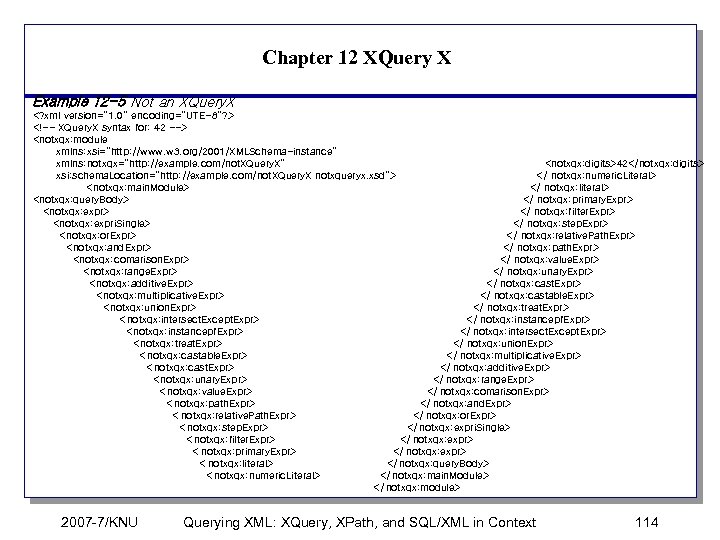 Chapter 12 XQuery X Example 12 -5 Not an XQuery. X
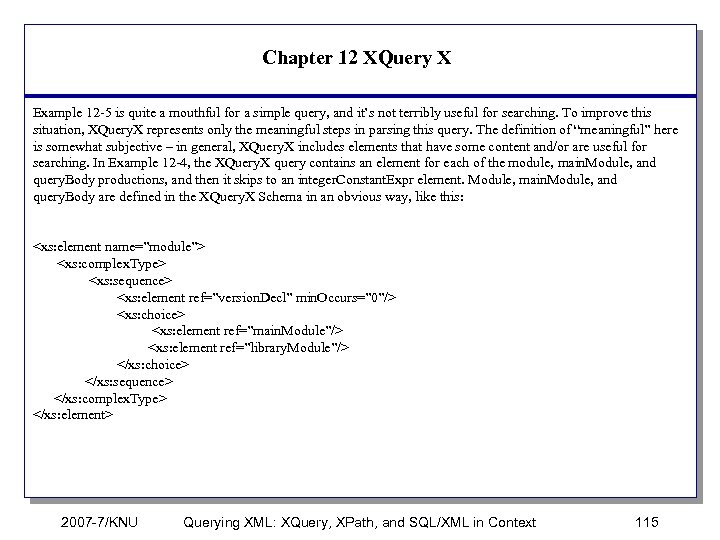 Chapter 12 XQuery X Example 12 -5 is quite a mouthful for a simple query, and it’s not terribly useful for searching. To improve this situation, XQuery. X represents only the meaningful steps in parsing this query. The definition of “meaningful” here is somewhat subjective – in general, XQuery. X includes elements that have some content and/or are useful for searching. In Example 12 -4, the XQuery. X query contains an element for each of the module, main. Module, and query. Body productions, and then it skips to an integer. Constant. Expr element. Module, main. Module, and query. Body are defined in the XQuery. X Schema in an obvious way, like this:
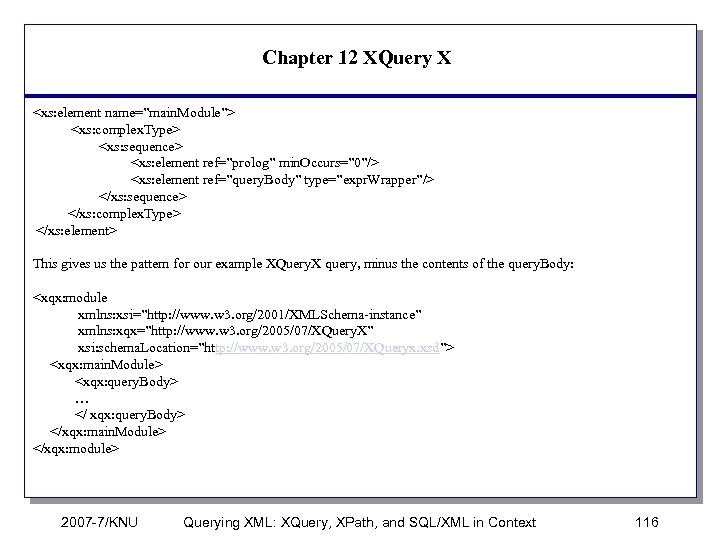 Chapter 12 XQuery X
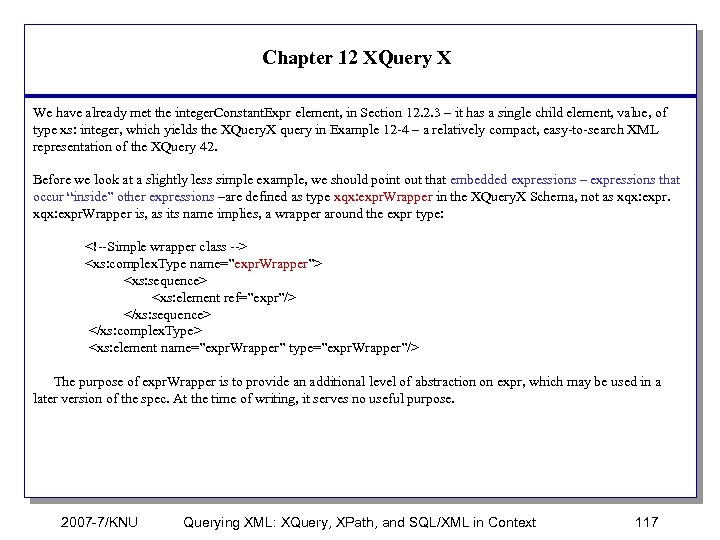 Chapter 12 XQuery X We have already met the integer. Constant. Expr element, in Section 12. 2. 3 – it has a single child element, value, of type xs: integer, which yields the XQuery. X query in Example 12 -4 – a relatively compact, easy-to-search XML representation of the XQuery 42. Before we look at a slightly less simple example, we should point out that embedded expressions – expressions that occur “inside” other expressions –are defined as type xqx: expr. Wrapper in the XQuery. X Schema, not as xqx: expr. Wrapper is, as its name implies, a wrapper around the expr type:
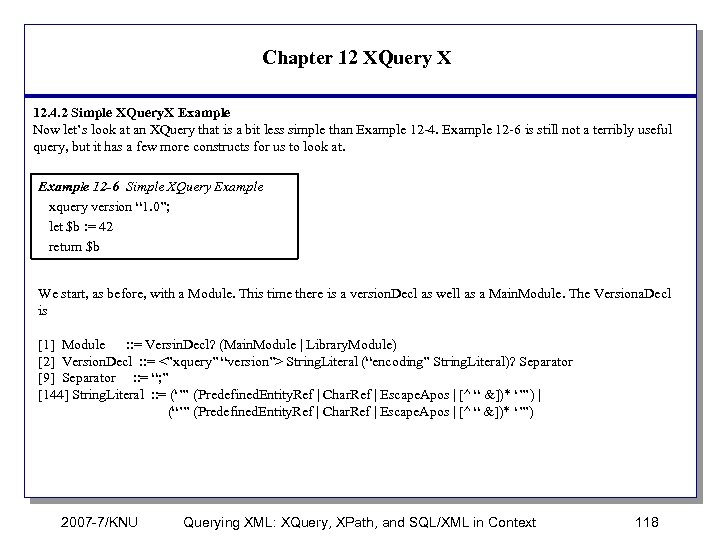 Chapter 12 XQuery X 12. 4. 2 Simple XQuery. X Example Now let’s look at an XQuery that is a bit less simple than Example 12 -4. Example 12 -6 is still not a terribly useful query, but it has a few more constructs for us to look at. Example 12 -6 Simple XQuery Example xquery version “ 1. 0”; let $b : = 42 return $b We start, as before, with a Module. This time there is a version. Decl as well as a Main. Module. The Versiona. Decl is [1] Module : : = Versin. Decl? (Main. Module | Library. Module) [2] Version. Decl : : = <”xquery” “version”> String. Literal (“encoding” String. Literal)? Separator [9] Separator : : = “; ” [144] String. Literal : : = (‘”’ (Predefined. Entity. Ref | Char. Ref | Escape. Apos | [^ “ &])* ‘”’) | (“’” (Predefined. Entity. Ref | Char. Ref | Escape. Apos | [^ “ &])* ‘”’) 2007 -7/KNU Querying XML: XQuery, XPath, and SQL/XML in Context 118
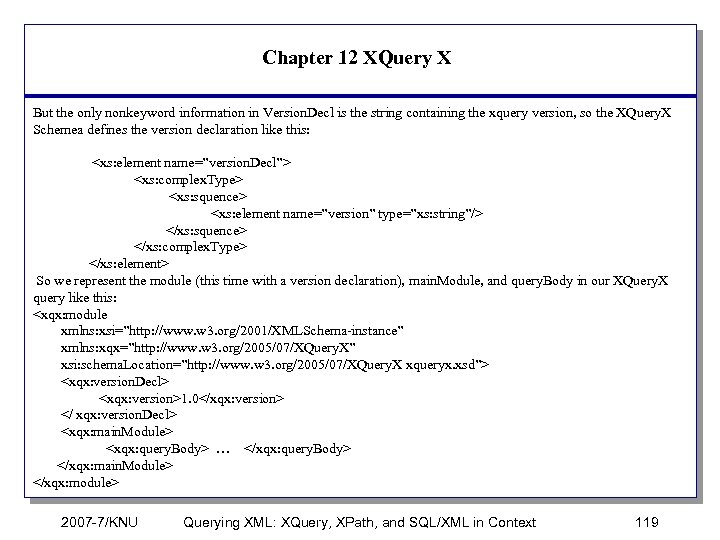 Chapter 12 XQuery X But the only nonkeyword information in Version. Decl is the string containing the xquery version, so the XQuery. X Schemea defines the version declaration like this:
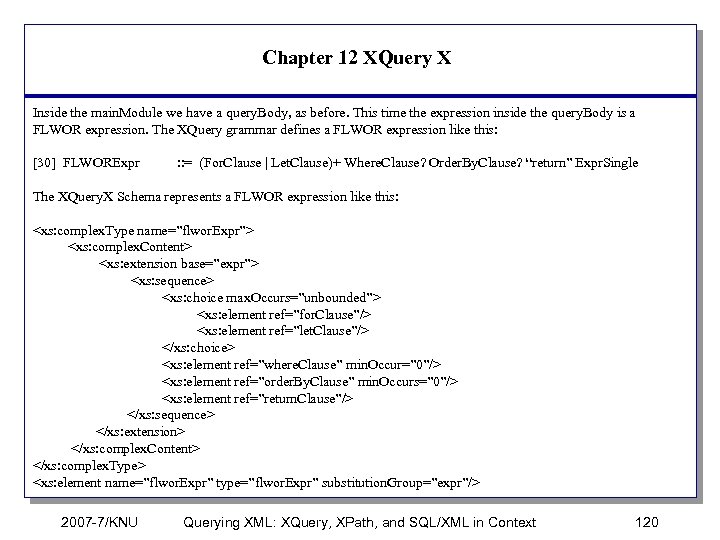 Chapter 12 XQuery X Inside the main. Module we have a query. Body, as before. This time the expression inside the query. Body is a FLWOR expression. The XQuery grammar defines a FLWOR expression like this: [30] FLWORExpr : : = (For. Clause | Let. Clause)+ Where. Clause? Order. By. Clause? “return” Expr. Single The XQuery. X Schema represents a FLWOR expression like this:
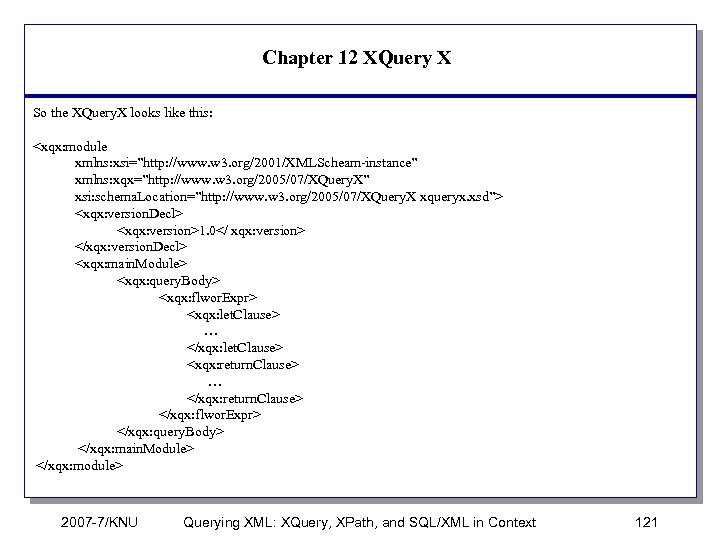 Chapter 12 XQuery X So the XQuery. X looks like this:
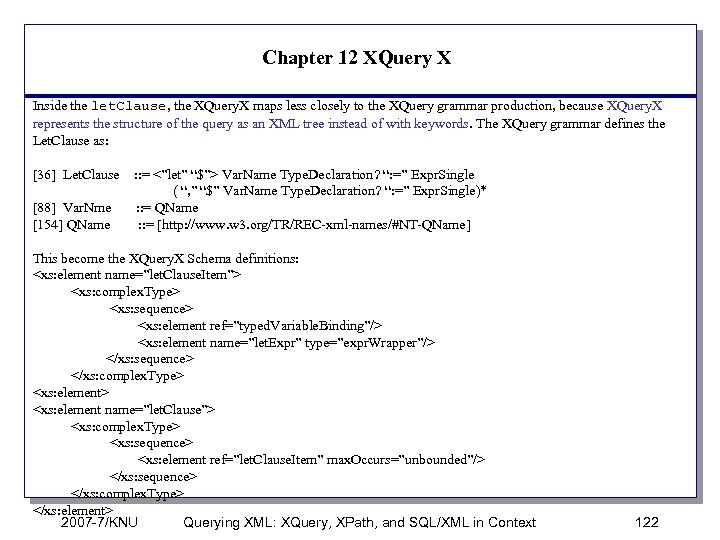 Chapter 12 XQuery X Inside the let. Clause, the XQuery. X maps less closely to the XQuery grammar production, because XQuery. X represents the structure of the query as an XML tree instead of with keywords. The XQuery grammar defines the Let. Clause as: [36] Let. Clause : : = <”let” “$”> Var. Name Type. Declaration? “: =” Expr. Single ( “, ” “$” Var. Name Type. Declaration? “: =” Expr. Single)* [88] Var. Nme : : = QName [154] QName : : = [http: //www. w 3. org/TR/REC-xml-names/#NT-QName] This become the XQuery. X Schema definitions:
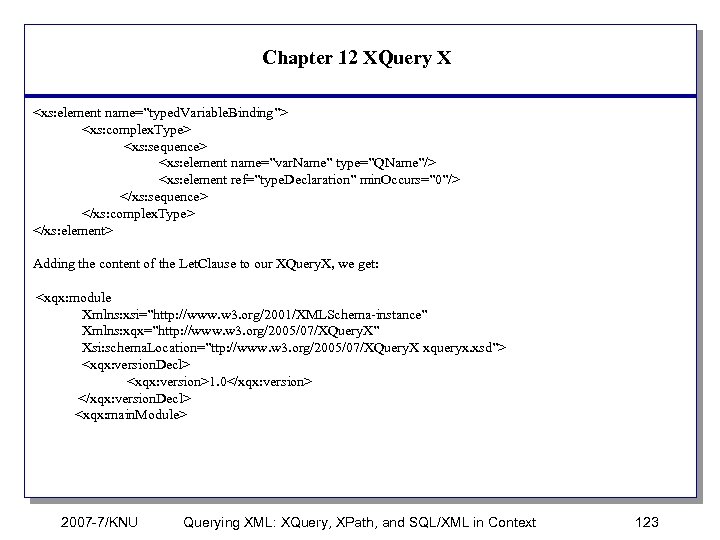 Chapter 12 XQuery X
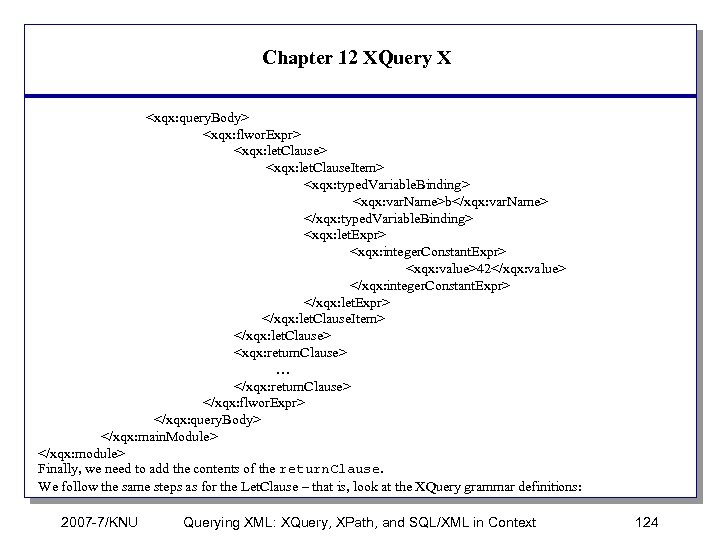 Chapter 12 XQuery X
![Chapter 12 XQuery X [33] FLWORExpr : : = (For. Clause | Let. Clause)+](https://present5.com/presentation/b4ecf48874d996cff263b4d3670e7a4b/image-125.jpg "Chapter 12 XQuery X [33] FLWORExpr : : = (For. Clause | Let. Clause)+") Chapter 12 XQuery X [33] FLWORExpr : : = (For. Clause | Let. Clause)+ Where. Clause? Order. By. Clauses? “return” Expr. Single Here, the XQuery grammar designers have decided not to split out return as a separate clause. This rule could have been (but was not) written as two rules: [33] FLWORExpr : : = (For. Clause | Let. Clause)+ Where. Clause? Order. By. Clauses? “return. Clause [NN] return. Clause : : = “return” Expr. Single The XQuery. X Schema is written as though the return. Clause were a separate grammar rule:
Chapter 12 XQuery X [33] FLWORExpr : : = (For. Clause | Let. Clause)+ Where. Clause? Order. By. Clauses? “return” Expr. Single Here, the XQuery grammar designers have decided not to split out return as a separate clause. This rule could have been (but was not) written as two rules: [33] FLWORExpr : : = (For. Clause | Let. Clause)+ Where. Clause? Order. By. Clauses? “return. Clause [NN] return. Clause : : = “return” Expr. Single The XQuery. X Schema is written as though the return. Clause were a separate grammar rule:
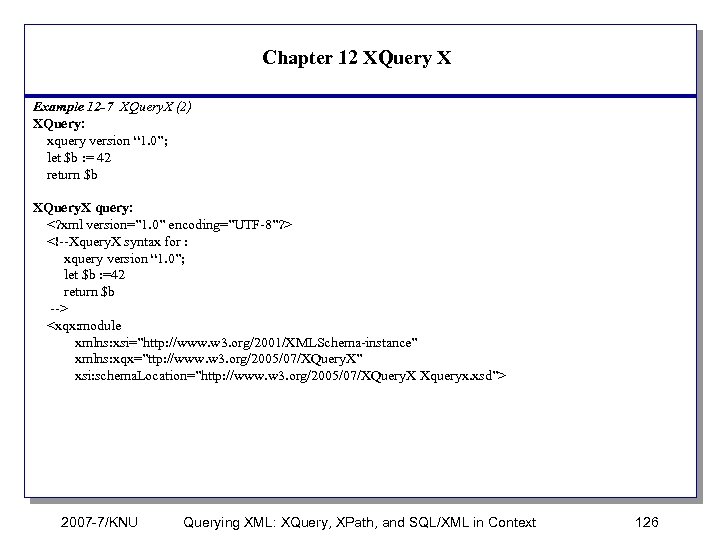 Chapter 12 XQuery X Example 12 -7 XQuery. X (2) XQuery: xquery version “ 1. 0”; let $b : = 42 return $b XQuery. X query:
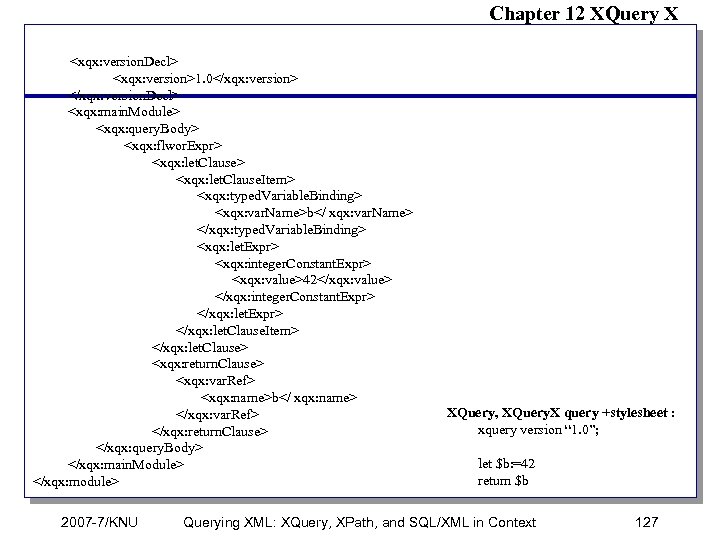 Chapter 12 XQuery X
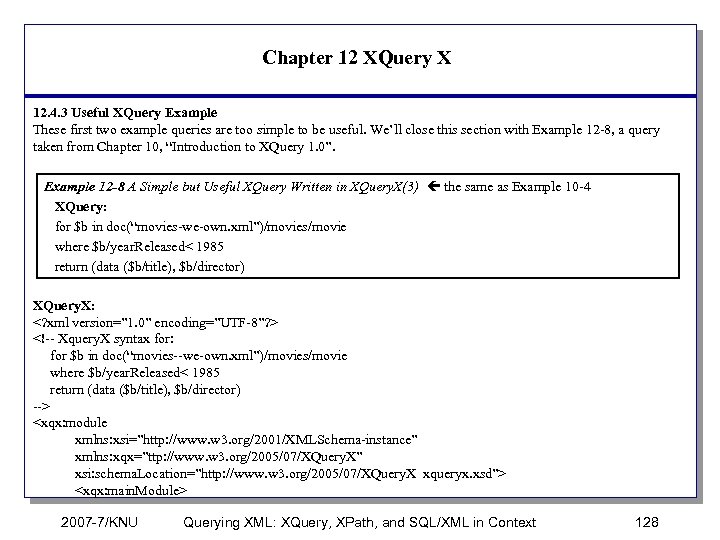 Chapter 12 XQuery X 12. 4. 3 Useful XQuery Example These first two example queries are too simple to be useful. We’ll close this section with Example 12 -8, a query taken from Chapter 10, “Introduction to XQuery 1. 0”. Example 12 -8 A Simple but Useful XQuery Written in XQuery. X(3) the same as Example 10 -4 XQuery: for $b in doc(“movies-we-own. xml”)/movies/movie where $b/year. Released< 1985 return (data ($b/title), $b/director) XQuery. X:
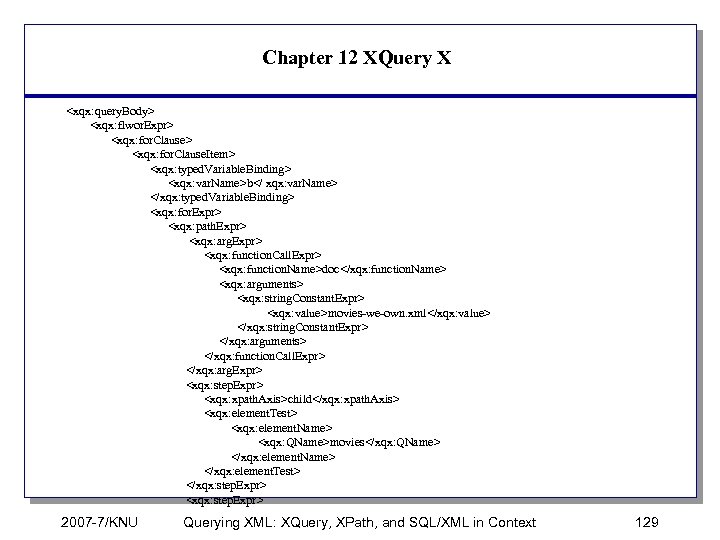 Chapter 12 XQuery X
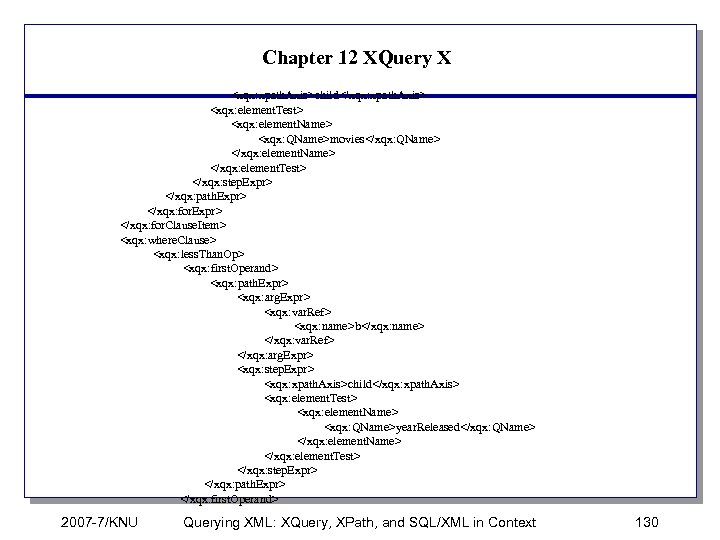 Chapter 12 XQuery X
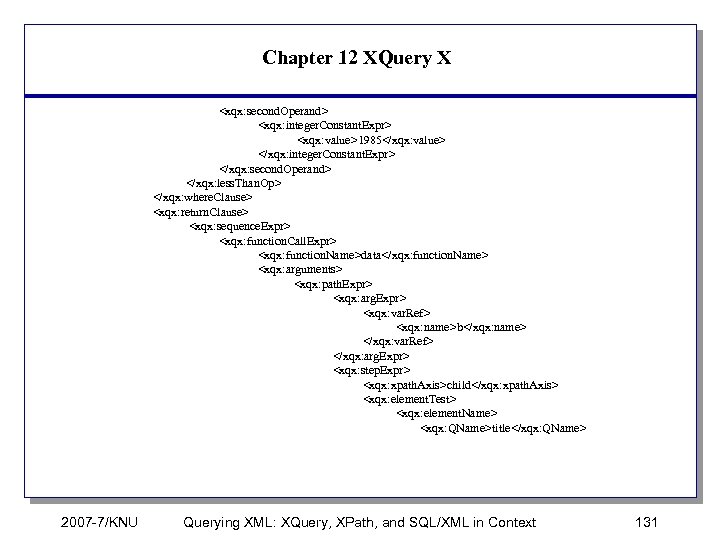 Chapter 12 XQuery X
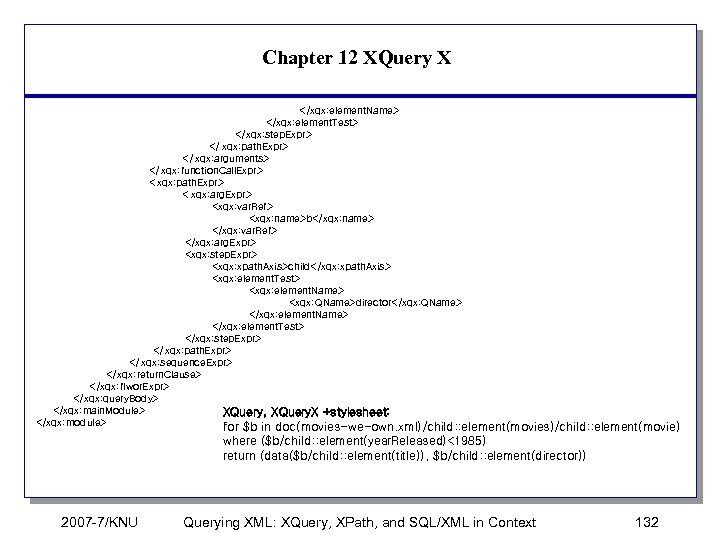 Chapter 12 XQuery X < xqx: path. Expr> < xqx: arg. Expr>
 Chapter 12 XQuery X 12. 5 Querying XQuery. X As we said in Section 12. 1, one of the reasons for having an XML syntax for XQuery is so that you can do queries over queries. In this section, we look at two kinds of queries you might want to do over a collection of XQueries – queries that will help you improve your application or service. In the examples in the rest of this section we use a new document, “xqueryxs. xml, ” made up of the XQuery. X queries in Example 12 -6, Example 12 -7, and Example 12 -8, with a new root element
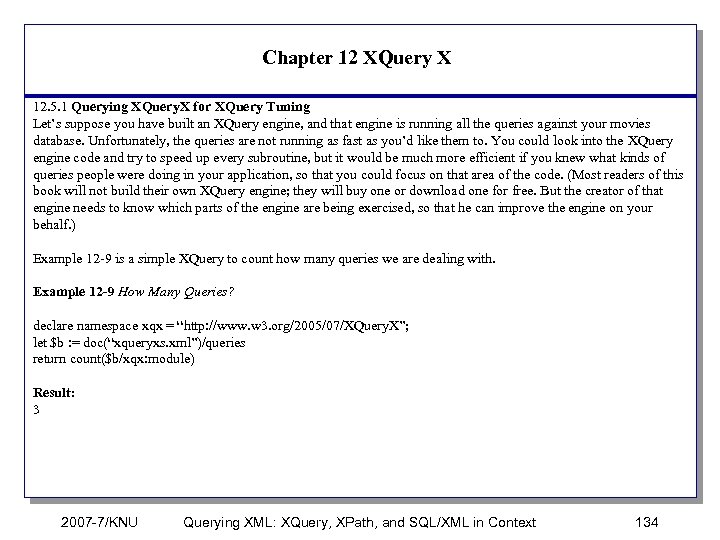 Chapter 12 XQuery X 12. 5. 1 Querying XQuery. X for XQuery Tuning Let’s suppose you have built an XQuery engine, and that engine is running all the queries against your movies database. Unfortunately, the queries are not running as fast as you’d like them to. You could look into the XQuery engine code and try to speed up every subroutine, but it would be much more efficient if you knew what kinds of queries people were doing in your application, so that you could focus on that area of the code. (Most readers of this book will not build their own XQuery engine; they will buy one or download one for free. But the creator of that engine needs to know which parts of the engine are being exercised, so that he can improve the engine on your behalf. ) Example 12 -9 is a simple XQuery to count how many queries we are dealing with. Example 12 -9 How Many Queries? declare namespace xqx = “http: //www. w 3. org/2005/07/XQuery. X”; let $b : = doc(“xqueryxs. xml”)/queries return count($b/xqx: module) Result: 3 2007 -7/KNU Querying XML: XQuery, XPath, and SQL/XML in Context 134
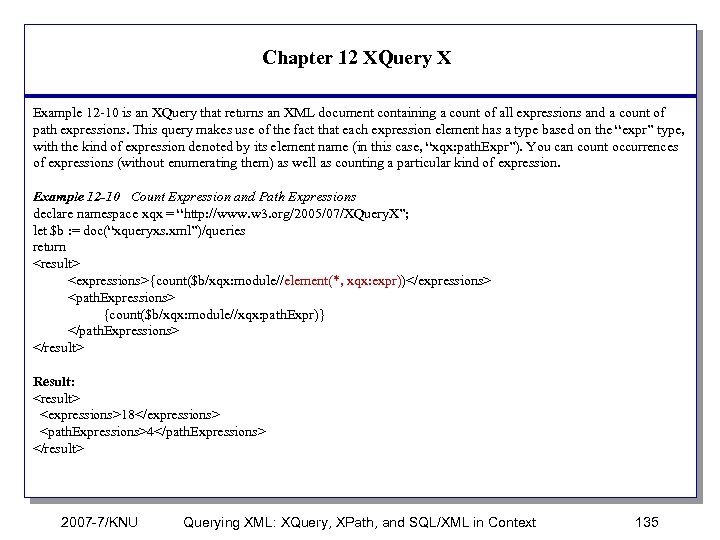 Chapter 12 XQuery X Example 12 -10 is an XQuery that returns an XML document containing a count of all expressions and a count of path expressions. This query makes use of the fact that each expression element has a type based on the “expr” type, with the kind of expression denoted by its element name (in this case, “xqx: path. Expr”). You can count occurrences of expressions (without enumerating them) as well as counting a particular kind of expression. Example 12 -10 Count Expression and Path Expressions declare namespace xqx = “http: //www. w 3. org/2005/07/XQuery. X”; let $b : = doc(“xqueryxs. xml”)/queries return
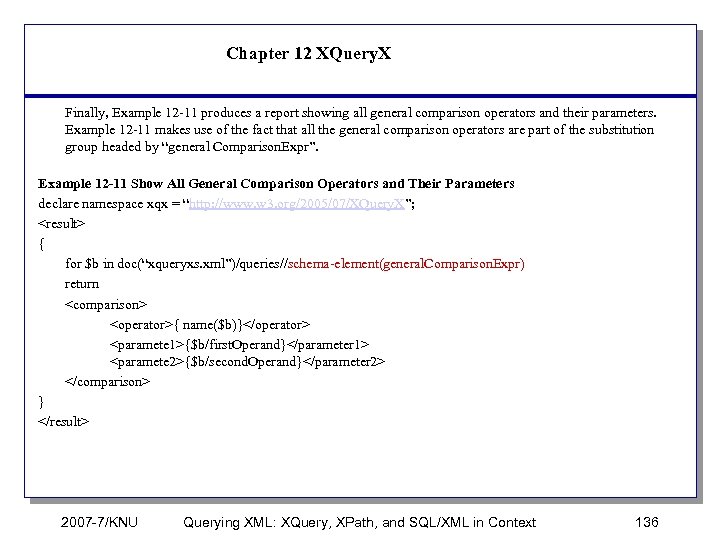 Chapter 12 XQuery. X Finally, Example 12 -11 produces a report showing all general comparison operators and their parameters. Example 12 -11 makes use of the fact that all the general comparison operators are part of the substitution group headed by “general Comparison. Expr”. Example 12 -11 Show All General Comparison Operators and Their Parameters declare namespace xqx = “http: //www. w 3. org/2005/07/XQuery. X”;
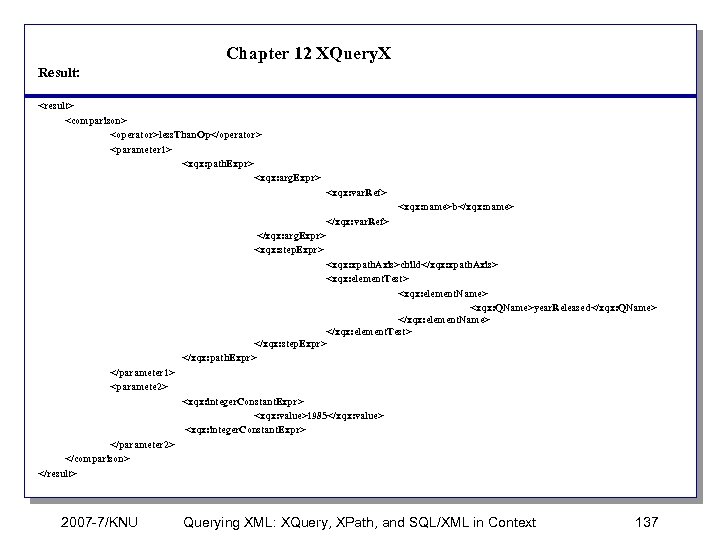 Chapter 12 XQuery. X Result:
 Chapter 12 XQuery X 12. 5. 2 Querying XQuery. X for Application Improvement Even if you are not building your own XQuery engine, you probably want to know what kinds of queries your users are doing. You may want to know what kind of things they are searching for, so that you can make them more readily available. Suppose you created a public web page so that anyone can search your movies archive. You know lots of people come to the site and do searches, but you want to improve the user experience by offering pull-down lists for some fields and by showing some movies on the home page without the need for a search. Example 12 -12 shows a query that would tell you which fields were being used as filters. If you found that “year. Released” was a popular filter, you might add a pull-down list to your search page to filter on the year that movies were released. Further queries would tell you which ranges were appropriate (5 years? 20 years? ). If most of the queries restricted the search to a particular 5 -year period, you might display those movies on the first page of your browsable movie archive. Example 12 -12 Show Which Filters Are Being Used declare namespace xqx = “http: //www. w 3. org/2005/07/XQuery. X”; doc(“xqueryxs. xml”)/queries//xqx: where. Clause//xqx: Qname 12. 6 Chapter Summary 2007 -7/KNU Querying XML: XQuery, XPath, and SQL/XML in Context 138
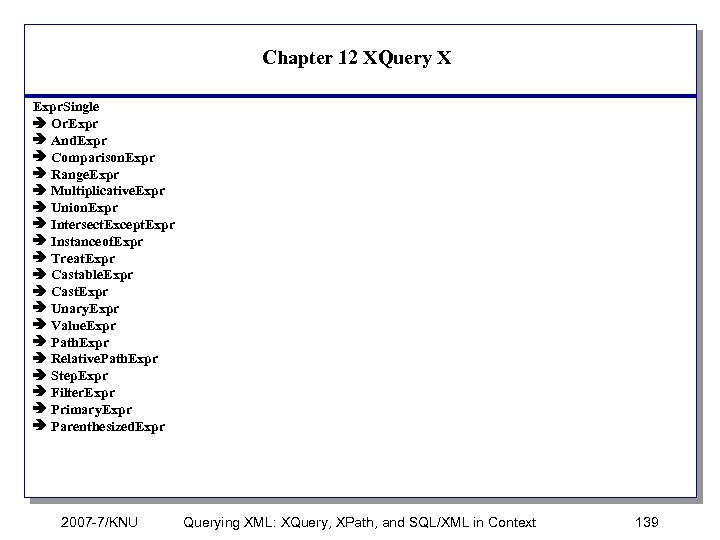 Chapter 12 XQuery X Expr. Single Or. Expr And. Expr Comparison. Expr Range. Expr Multiplicative. Expr Union. Expr Intersect. Except. Expr Instanceof. Expr Treat. Expr Castable. Expr Cast. Expr Unary. Expr Value. Expr Path. Expr Relative. Path. Expr Step. Expr Filter. Expr Primary. Expr Parenthesized. Expr 2007 -7/KNU Querying XML: XQuery, XPath, and SQL/XML in Context 139