 Скачать презентацию Queen Victoria Birth and family Victoria s father
Queen Victoria.pptx
- Количество слайдов: 6



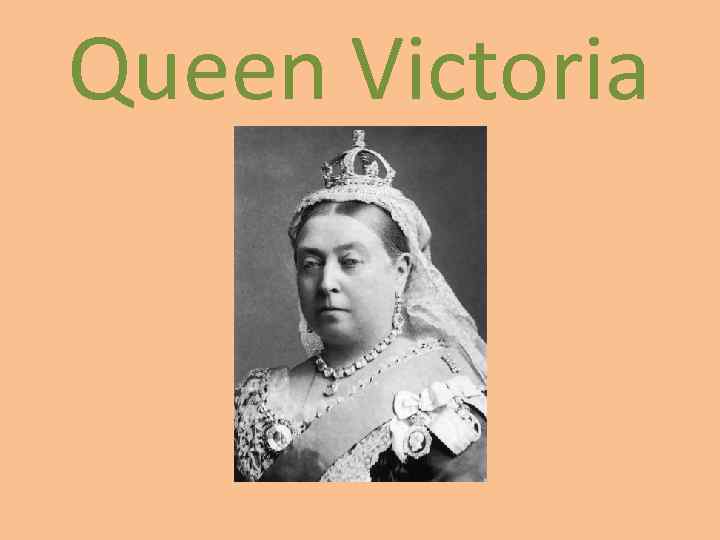
Queen Victoria
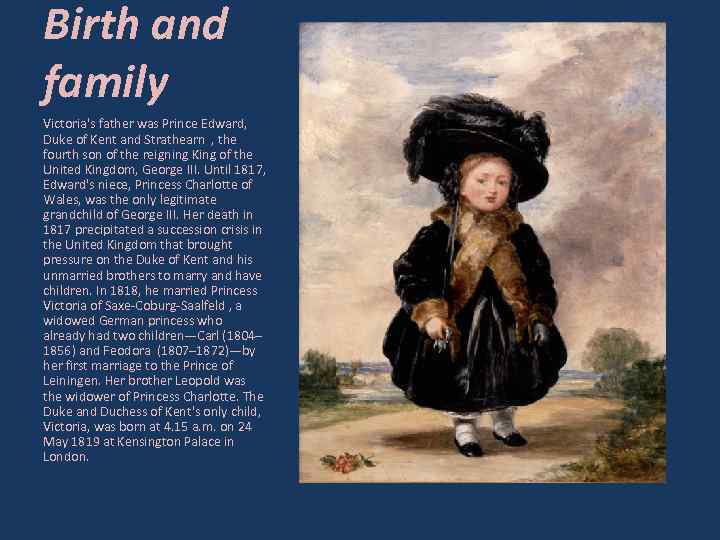
Birth and family Victoria's father was Prince Edward, Duke of Kent and Strathearn , the fourth son of the reigning King of the United Kingdom, George III. Until 1817, Edward's niece, Princess Charlotte of Wales, was the only legitimate grandchild of George III. Her death in 1817 precipitated a succession crisis in the United Kingdom that brought pressure on the Duke of Kent and his unmarried brothers to marry and have children. In 1818, he married Princess Victoria of Saxe-Coburg-Saalfeld , a widowed German princess who already had two children—Carl (1804– 1856) and Feodora (1807– 1872)—by her first marriage to the Prince of Leiningen. Her brother Leopold was the widower of Princess Charlotte. The Duke and Duchess of Kent's only child, Victoria, was born at 4. 15 a. m. on 24 May 1819 at Kensington Palace in London.
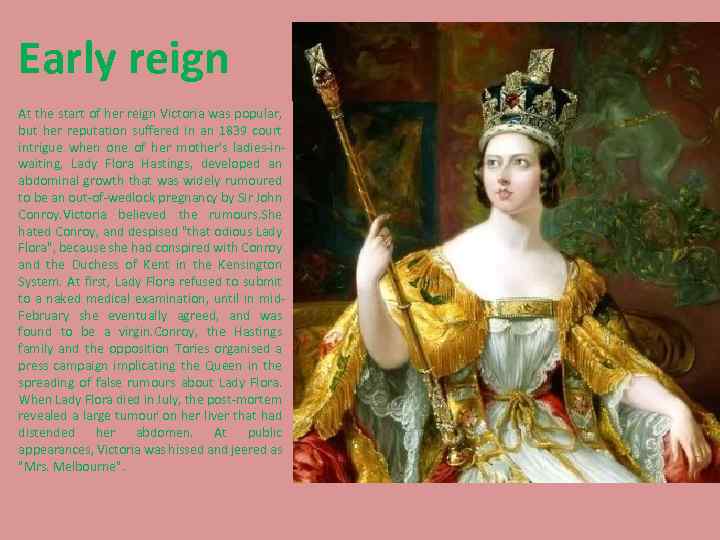
Early reign At the start of her reign Victoria was popular, but her reputation suffered in an 1839 court intrigue when one of her mother's ladies-inwaiting, Lady Flora Hastings, developed an abdominal growth that was widely rumoured to be an out-of-wedlock pregnancy by Sir John Conroy. Victoria believed the rumours. She hated Conroy, and despised "that odious Lady Flora", because she had conspired with Conroy and the Duchess of Kent in the Kensington System. At first, Lady Flora refused to submit to a naked medical examination, until in mid. February she eventually agreed, and was found to be a virgin. Conroy, the Hastings family and the opposition Tories organised a press campaign implicating the Queen in the spreading of false rumours about Lady Flora. When Lady Flora died in July, the post-mortem revealed a large tumour on her liver that had distended her abdomen. At public appearances, Victoria was hissed and jeered as "Mrs. Melbourne".
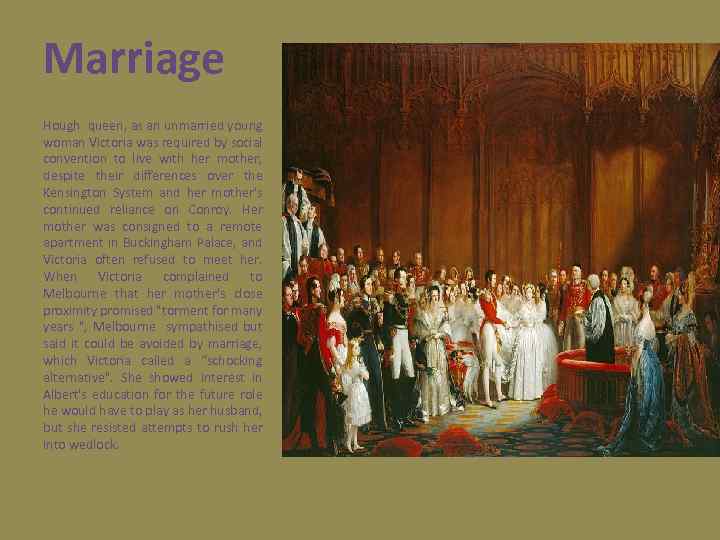
Marriage Hough queen, as an unmarried young woman Victoria was required by social convention to live with her mother, despite their differences over the Kensington System and her mother's continued reliance on Conroy. Her mother was consigned to a remote apartment in Buckingham Palace, and Victoria often refused to meet her. When Victoria complained to Melbourne that her mother's close proximity promised "torment for many years ", Melbourne sympathised but said it could be avoided by marriage, which Victoria called a “schocking alternative". She showed interest in Albert's education for the future role he would have to play as her husband, but she resisted attempts to rush her into wedlock.
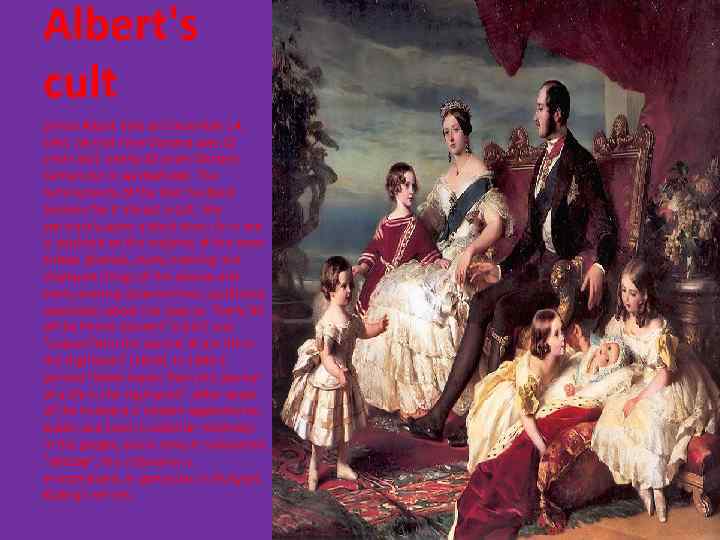
Albert's cult prince Albert died on December 14, 1861 (at that time Victoria was 42 years old), nearly 40 years Victoria carried out in widowhood. The reminiscence of the died husband became for it almost a cult. She constantly wore a black dress (in it she is depicted on the majority of the most known photos), every morning she displayed things of the spouse and every evening cleaned them, published two books about the spouse: "Early life of the Prince Consort" (1867) and "Leaves from the journal of our life in the Highlands" (1868). In 1884 it printed "More leaves from the journal of a life in the Highlands". After death of the husband it seldom appeared on public and lived in isolation relatively. In the people and in army it nicknamed "Widow", this nickname is immortalized, in particular, in Rudyard Kipling's verses.
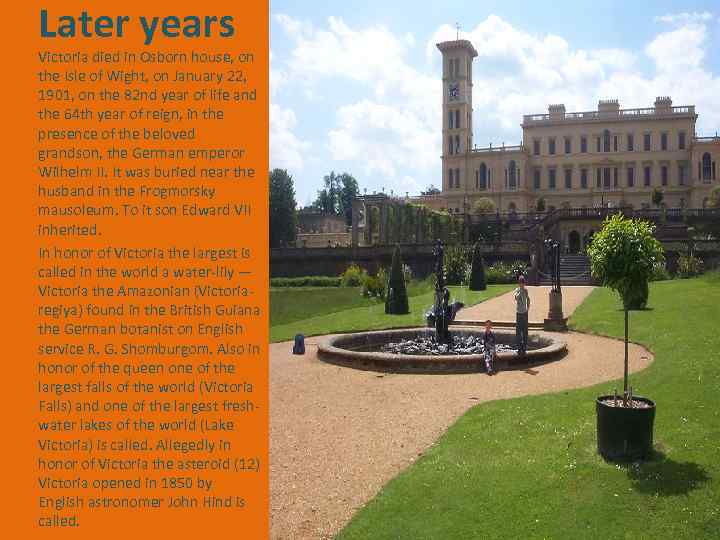
Later years Victoria died in Osborn house, on the Isle of Wight, on January 22, 1901, on the 82 nd year of life and the 64 th year of reign, in the presence of the beloved grandson, the German emperor Wilhelm II. It was buried near the husband in the Frogmorsky mausoleum. To it son Edward VII inherited. In honor of Victoria the largest is called in the world a water-lily — Victoria the Amazonian (Victoriaregiya) found in the British Guiana the German botanist on English service R. G. Shomburgom. Also in honor of the queen one of the largest falls of the world (Victoria Falls) and one of the largest freshwater lakes of the world (Lake Victoria) is called. Allegedly in honor of Victoria the asteroid (12) Victoria opened in 1850 by English astronomer John Hind is called.
Скачать презентацию Queen Victoria Birth and family Victoria s father
Queen Victoria.pptx