


 Скачать презентацию Queen Victoria 24 May 1819 22 January
Queen Victoria.pptx
- Количество слайдов: 11
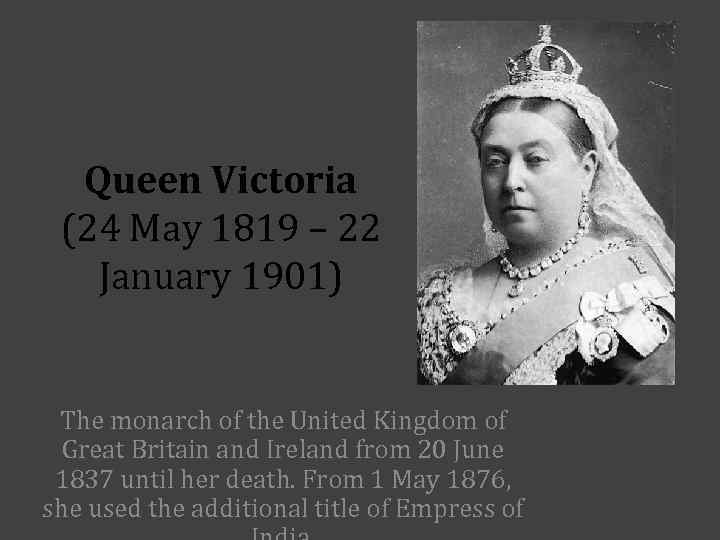 Queen Victoria (24 May 1819 – 22 January 1901) The monarch of the United Kingdom of Great Britain and Ireland from 20 June 1837 until her death. From 1 May 1876, she used the additional title of Empress of
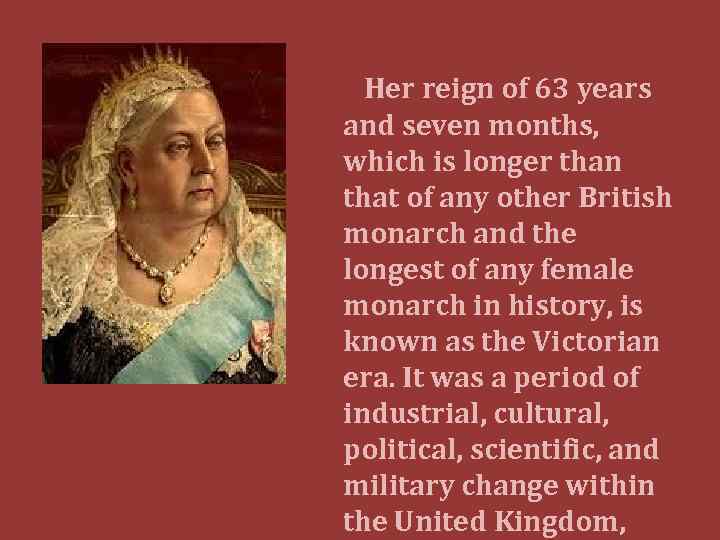 Her reign of 63 years and seven months, which is longer than that of any other British monarch and the longest of any female monarch in history, is known as the Victorian era. It was a period of industrial, cultural, political, scientific, and military change within the United Kingdom,
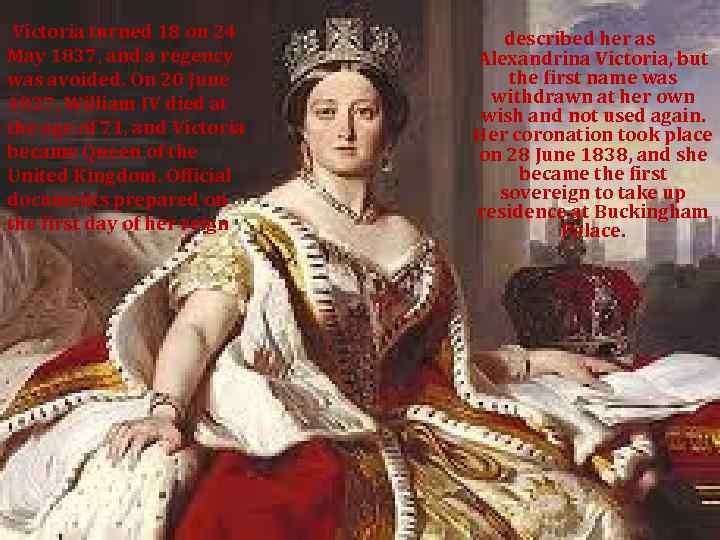 Victoria turned 18 on 24 May 1837, and a regency was avoided. On 20 June 1837, William IV died at the age of 71, and Victoria became Queen of the United Kingdom. Official documents prepared on the first day of her reign described her as Alexandrina Victoria, but the first name was withdrawn at her own wish and not used again. Her coronation took place on 28 June 1838, and she became the first sovereign to take up residence at Buckingham Palace.
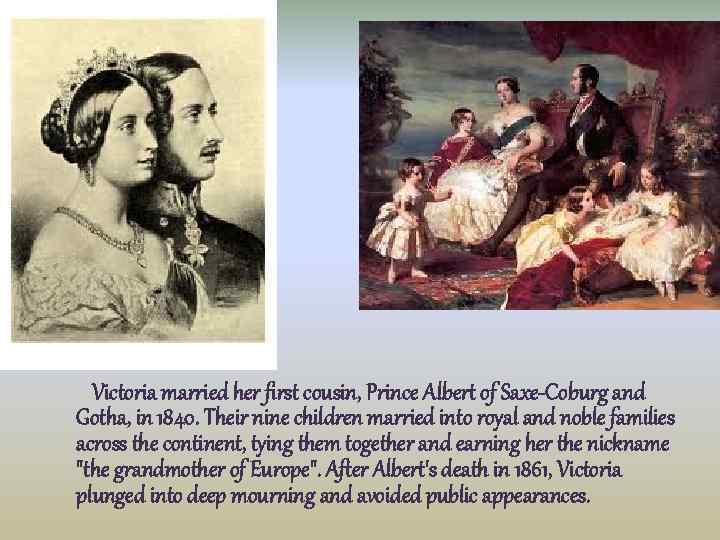 Victoria married her first cousin, Prince Albert of Saxe-Coburg and Gotha, in 1840. Their nine children married into royal and noble families across the continent, tying them together and earning her the nickname "the grandmother of Europe". After Albert's death in 1861, Victoria plunged into deep mourning and avoided public appearances.
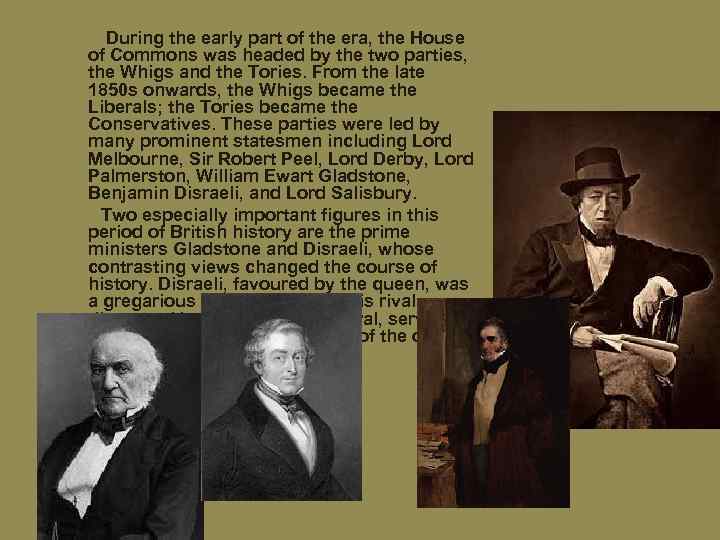 During the early part of the era, the House of Commons was headed by the two parties, the Whigs and the Tories. From the late 1850 s onwards, the Whigs became the Liberals; the Tories became the Conservatives. These parties were led by many prominent statesmen including Lord Melbourne, Sir Robert Peel, Lord Derby, Lord Palmerston, William Ewart Gladstone, Benjamin Disraeli, and Lord Salisbury. Two especially important figures in this period of British history are the prime ministers Gladstone and Disraeli, whose contrasting views changed the course of history. Disraeli, favoured by the queen, was a gregarious Tory. Gladstone, his rival distrusted by the Queen, a Liberal, served more terms and oversaw much of the overall law-making of the era.
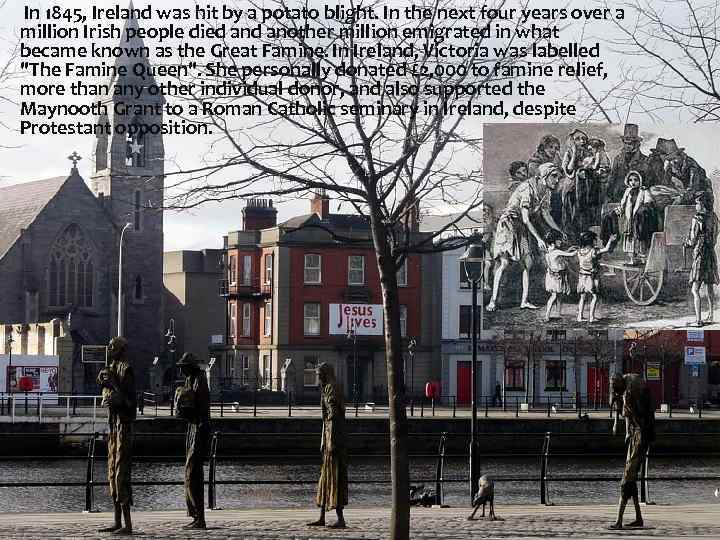 In 1845, Ireland was hit by a potato blight. In the next four years over a million Irish people died another million emigrated in what became known as the Great Famine. In Ireland, Victoria was labelled "The Famine Queen". She personally donated £ 2, 000 to famine relief, more than any other individual donor, and also supported the Maynooth Grant to a Roman Catholic seminary in Ireland, despite Protestant opposition.
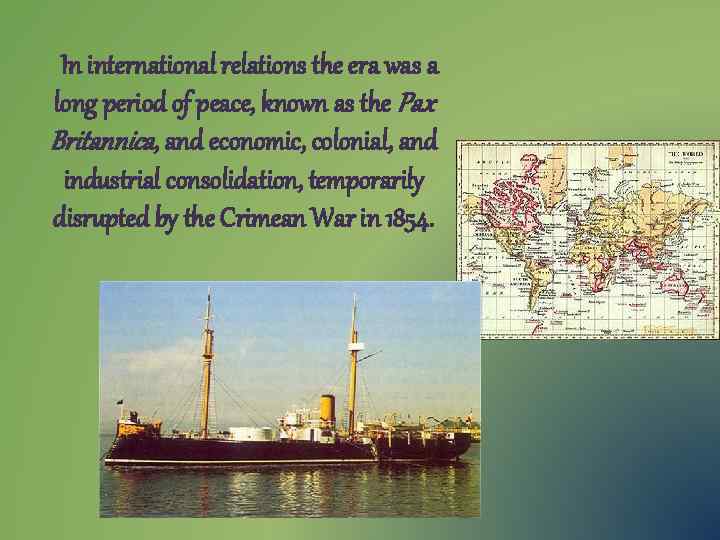 In international relations the era was a long period of peace, known as the Pax Britannica, and economic, colonial, and industrial consolidation, temporarily disrupted by the Crimean War in 1854.
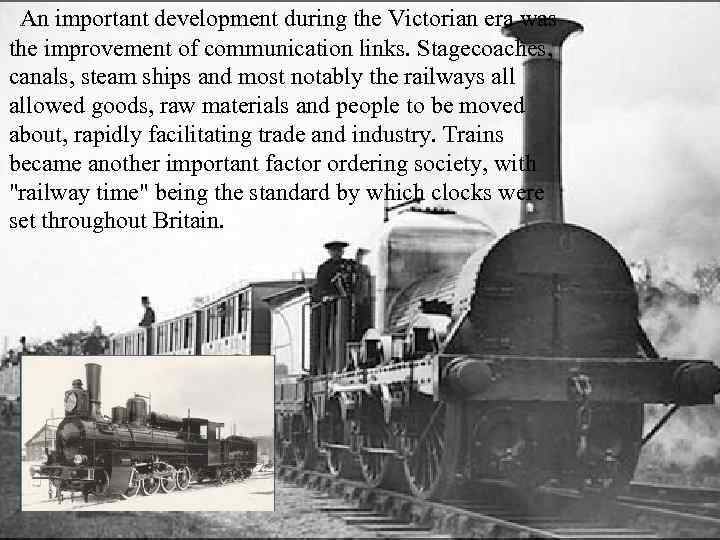 An important development during the Victorian era was the improvement of communication links. Stagecoaches, canals, steam ships and most notably the railways allowed goods, raw materials and people to be moved about, rapidly facilitating trade and industry. Trains became another important factor ordering society, with "railway time" being the standard by which clocks were set throughout Britain.
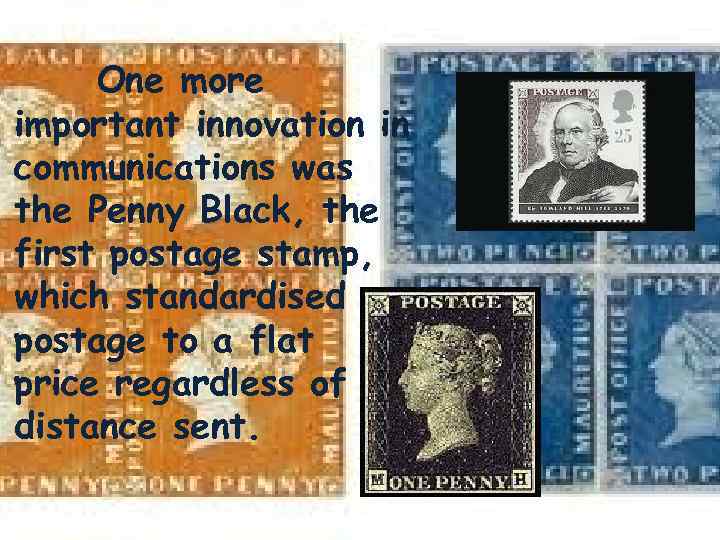 One more important innovation in communications was the Penny Black, the first postage stamp, which standardised postage to a flat price regardless of distance sent.
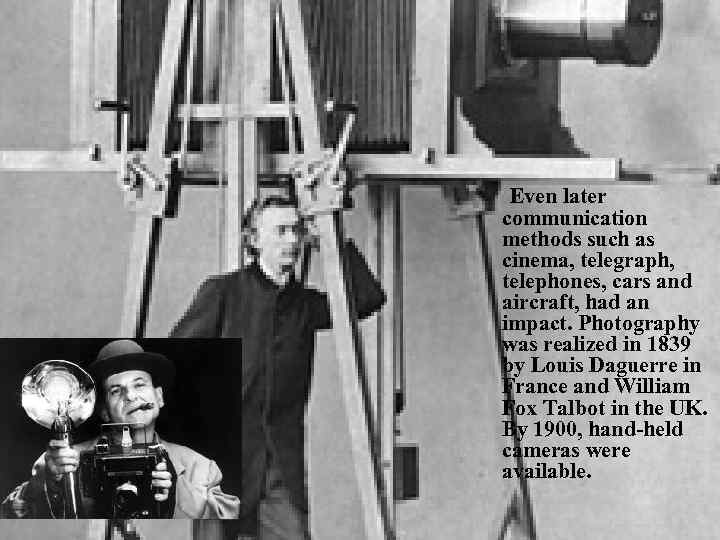 Even later communication methods such as cinema, telegraph, telephones, cars and aircraft, had an impact. Photography was realized in 1839 by Louis Daguerre in France and William Fox Talbot in the UK. By 1900, hand-held cameras were available.
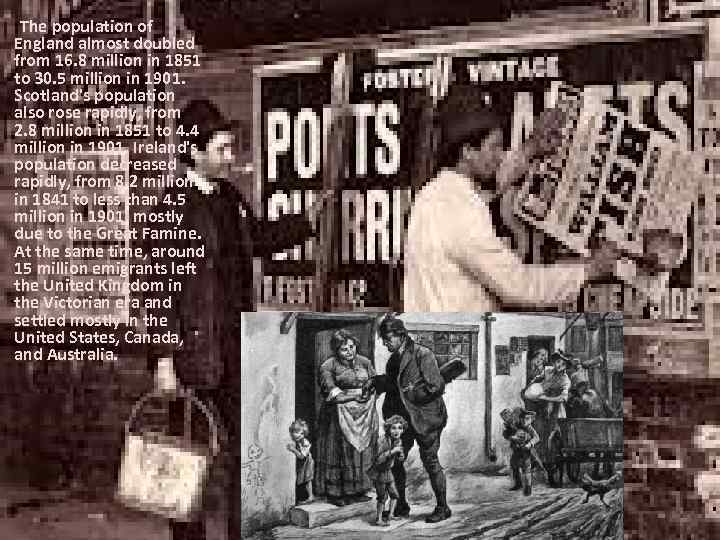 The population of England almost doubled from 16. 8 million in 1851 to 30. 5 million in 1901. Scotland's population also rose rapidly, from 2. 8 million in 1851 to 4. 4 million in 1901. Ireland's population decreased rapidly, from 8. 2 million in 1841 to less than 4. 5 million in 1901, mostly due to the Great Famine. At the same time, around 15 million emigrants left the United Kingdom in the Victorian era and settled mostly in the United States, Canada, and Australia.