


 Скачать презентацию Qué significan Qué Quién Quiénes Cuál
01d29443c52bda033c010eceea538c88.ppt
- Количество слайдов: 19
 ¿Qué significan? ¿Qué? ¿Quién? / ¿Quiénes? ¿Cuál? / ¿Cuáles? ¿Cómo está? ¿Cómo es? ¿Cuándo? ¿Cuánto? (a / os / as) ¿Dónde? ¿Por qué? ¿Cómo se llama? What? Who? Which (one / ones)? How is s/he (it)? What is s/he (it) like When? How much / many? Where? Why? What does s/he (you) call him /herself
 Pobre Ana Una novela breve y fácil totalmente en español
 • Ana es una chica normal con muchos problemas. Ana is a girl normal with many problems • Tiene problemas con sus amigas y con su familia. She has problems with her friends and with her family • Ana tiene quince años. No es alta. Tiene el pelo largo Ana has (is) 15 years (old) She is not tall She has (the) long hair, y castaño y los ojos azules. and (light) brown and the blue eyes • Ana vive en Hermosa Beach, California en una casa Ana lives in in a house azul. No es grande la casa. Tampoco es pequeña. Es blue It is not big the house Nor is (it) small It is normal • Ana asiste a West Torance High School. Ana está en attends el año nueve. Year 9
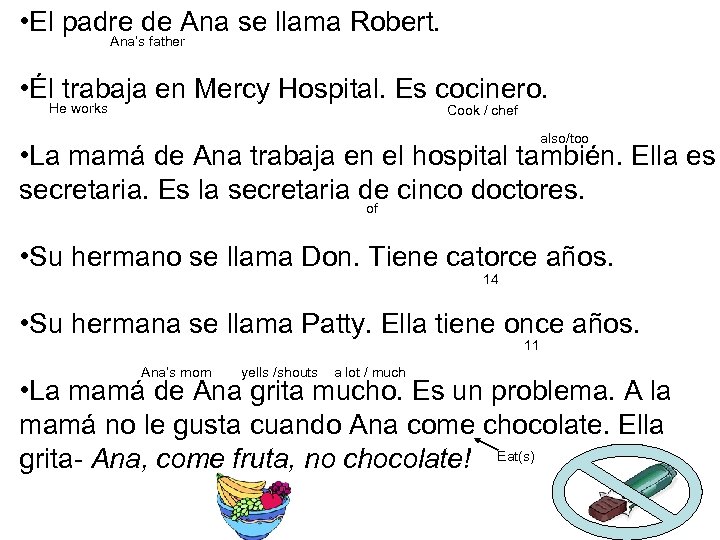 • El padre de Ana se llama Robert. Ana’s father • Él trabaja en Mercy Hospital. Es cocinero. He works Cook / chef also/too • La mamá de Ana trabaja en el hospital también. Ella es secretaria. Es la secretaria de cinco doctores. of • Su hermano se llama Don. Tiene catorce años. 14 • Su hermana se llama Patty. Ella tiene once años. 11 Ana’s mom yells /shouts a lot / much • La mamá de Ana grita mucho. Es un problema. A la mamá no le gusta cuando Ana come chocolate. Ella grita- Ana, come fruta, no chocolate! Eat(s)
 • Ana tiene problemas con su papá. Ana le dice a su papá- Papá, quiero dinero. Quiero comprar ropa. Quiero I want to buy clothes comer en un restaurante. To eat Her dad to her responds I do not have money I am poor • Su papá le responde- No tengo dinero. Soy pobre. Tú tienes ropa y tienes comida. No necesitas dinero. You have clothes and you have food you do not need money • Ana tiene problemas con Don. Ana necesita su libro de needs her has with inglés. No sabe donde está. Ella busca su libro pero no She doesn’t know Searches (for) Doesn’t It is lo encuentra. Lesays to him Don, necesito mi libro, ayúdame, dice. Find it She I need my book help me hermano! brother doesn’t help her He doesn’t search for the book He only watches • Don no le ayuda. No busca el libro. Sólo mira la He never helps her televisión y se ríe. Se ríe mucho. Nunca le ayuda a Ana.
 • Ana tiene problemas con su hermana Patty. • Patty toma la camisa de Ana. Ella no tiene permiso. Takes the shirt of She does not have permission • Patty lleva la. The shirt camisa. wears • Ana le pregunta- ¿Dónde está mi camisa? asks her • Patty no le contesta. Se ríe. Patty tiene su camisa, pero doesn’t answer her laughs no le dice nada a Ana. Pobre Ana. doesn’t say anything to her (Ana) • Ana tiene dos amigas buenas. Una amiga se llama Elsa. Ella tiene dieciséis años. Tiene el pelo rubio. Asiste West Torance High también.
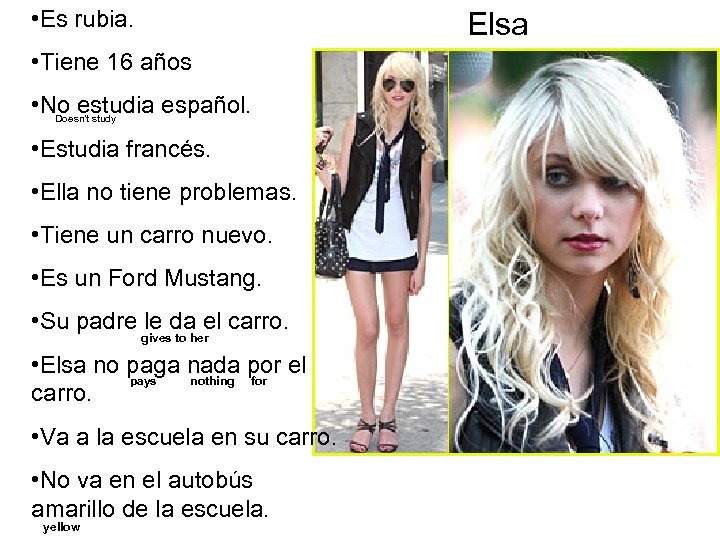 • Es rubia. Elsa • Tiene 16 años • No estudia español. Doesn’t study • Estudia francés. • Ella no tiene problemas. • Tiene un carro nuevo. • Es un Ford Mustang. • Su padre le da el carro. gives to her • Elsa no paga nada por el pays nothing for carro. • Va a la escuela en su carro. • No va en el autobús amarillo de la escuela. yellow
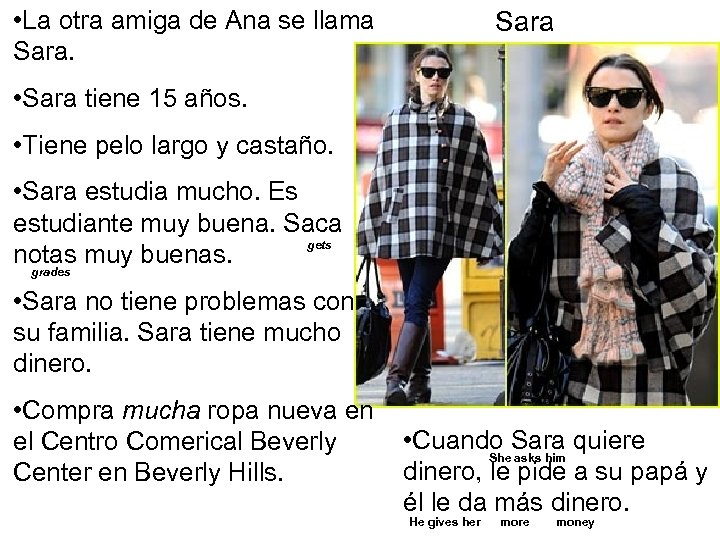 • La otra amiga de Ana se llama Sara • Sara tiene 15 años. • Tiene pelo largo y castaño. • Sara estudia mucho. Es estudiante muy buena. Saca gets notas muy buenas. grades • Sara no tiene problemas con su familia. Sara tiene mucho dinero. • Compra mucha ropa nueva en el Centro Comerical Beverly Center en Beverly Hills. • Cuando Sara quiere She asks him dinero, le pide a su papá y él le da más dinero. He gives her more money
 • Ana está triste. Porque ella no tiene suficiente dinero enough / sufficient para comprar más ropa. • Ana tiene ropa, pero no es como la ropa de Sara. • Sara tiene mucha ropa de Calvin Klein, Nike, Donna Karen, y Nordstrom. • Ana compra su ropa de Wal-mart. food • La familia de Ana no tiene comida buena. Las amigas de Ana siempre comen carne. They eat meat • En la famila de Ana no comen mucha carne porque la They do not eat familia quiere economizar. Wants to economize
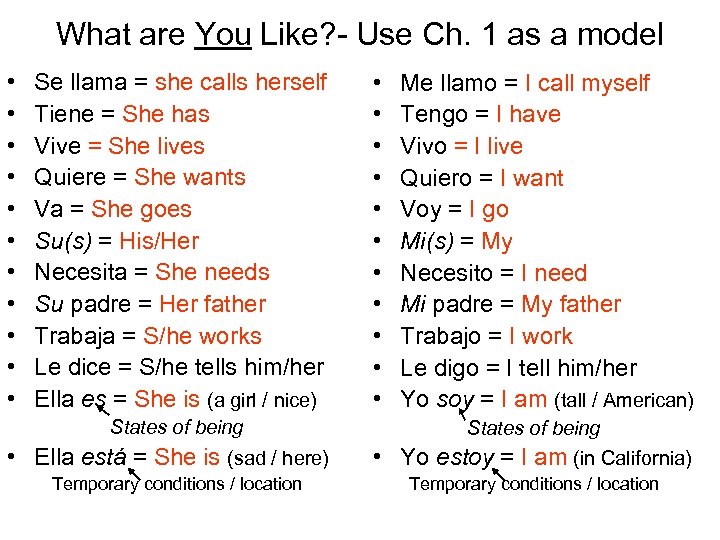 What are You Like? - Use Ch. 1 as a model • • • Se llama = she calls herself Tiene = She has Vive = She lives Quiere = She wants Va = She goes Su(s) = His/Her Necesita = She needs Su padre = Her father Trabaja = S/he works Le dice = S/he tells him/her Ella es = She is (a girl / nice) States of being • Ella está = She is (sad / here) Temporary conditions / location • • • Me llamo = I call myself Tengo = I have Vivo = I live Quiero = I want Voy = I go Mi(s) = My Necesito = I need Mi padre = My father Trabajo = I work Le digo = I tell him/her Yo soy = I am (tall / American) States of being • Yo estoy = I am (in California) Temporary conditions / location
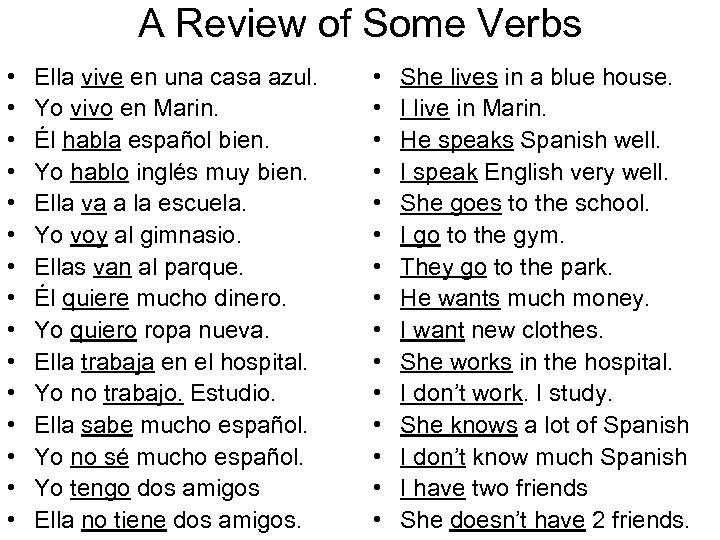 A Review of Some Verbs • • • • Ella vive en una casa azul. Yo vivo en Marin. Él habla español bien. Yo hablo inglés muy bien. Ella va a la escuela. Yo voy al gimnasio. Ellas van al parque. Él quiere mucho dinero. Yo quiero ropa nueva. Ella trabaja en el hospital. Yo no trabajo. Estudio. Ella sabe mucho español. Yo no sé mucho español. Yo tengo dos amigos Ella no tiene dos amigos. • • • • She lives in a blue house. I live in Marin. He speaks Spanish well. I speak English very well. She goes to the school. I go to the gym. They go to the park. He wants much money. I want new clothes. She works in the hospital. I don’t work. I study. She knows a lot of Spanish I don’t know much Spanish I have two friends She doesn’t have 2 friends.
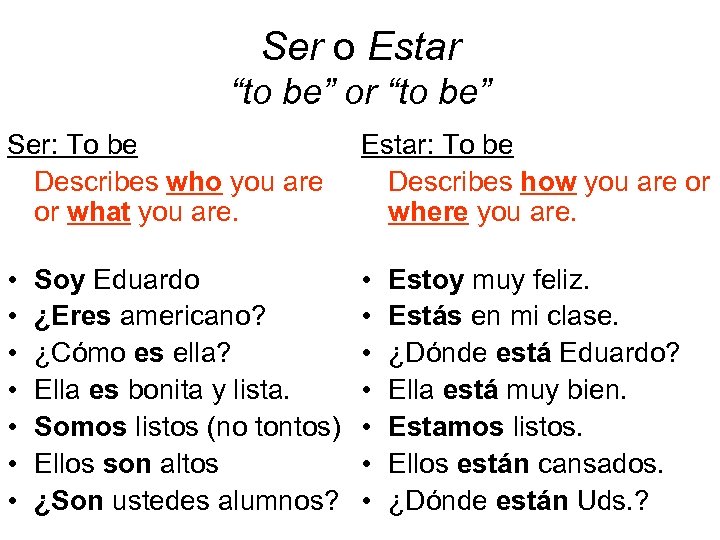 Ser o Estar “to be” or “to be” Ser: To be Describes who you are or what you are. Estar: To be Describes how you are or where you are. • • • • Soy Eduardo ¿Eres americano? ¿Cómo es ella? Ella es bonita y lista. Somos listos (no tontos) Ellos son altos ¿Son ustedes alumnos? Estoy muy feliz. Estás en mi clase. ¿Dónde está Eduardo? Ella está muy bien. Estamos listos. Ellos están cansados. ¿Dónde están Uds. ?
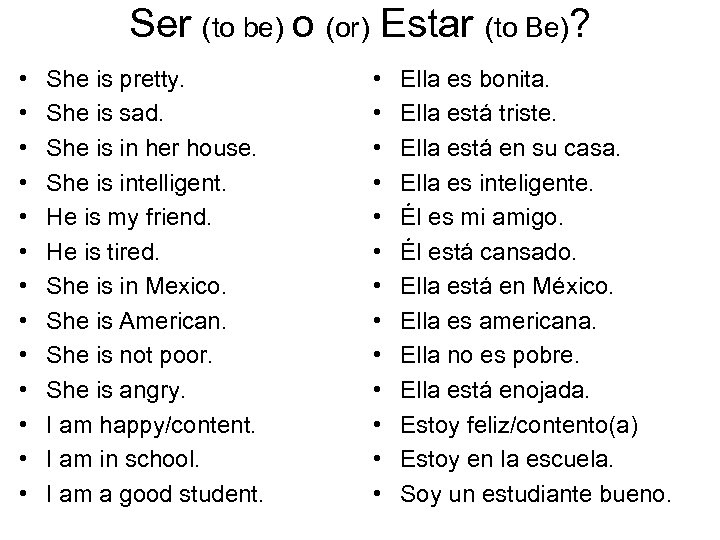 Ser (to be) o (or) Estar (to Be)? • • • • She is pretty. She is sad. She is in her house. She is intelligent. He is my friend. He is tired. She is in Mexico. She is American. She is not poor. She is angry. I am happy/content. I am in school. I am a good student. • • • • Ella es bonita. Ella está triste. Ella está en su casa. Ella es inteligente. Él es mi amigo. Él está cansado. Ella está en México. Ella es americana. Ella no es pobre. Ella está enojada. Estoy feliz/contento(a) Estoy en la escuela. Soy un estudiante bueno.
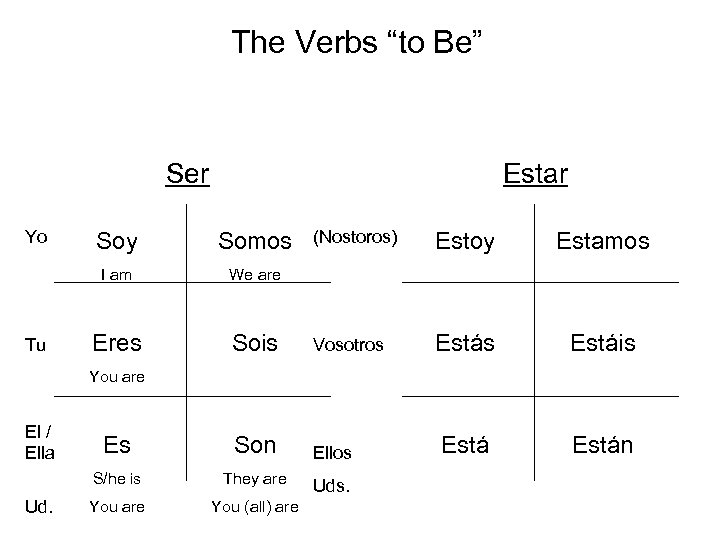 The Verbs “to Be” Ser Yo Estar (Nostoros) Estoy Estamos Sois Vosotros Estáis Es Son Ellos Están S/he is They are You (all) are Somos I am Tu Soy We are Eres You are El / Ella Ud. Uds.
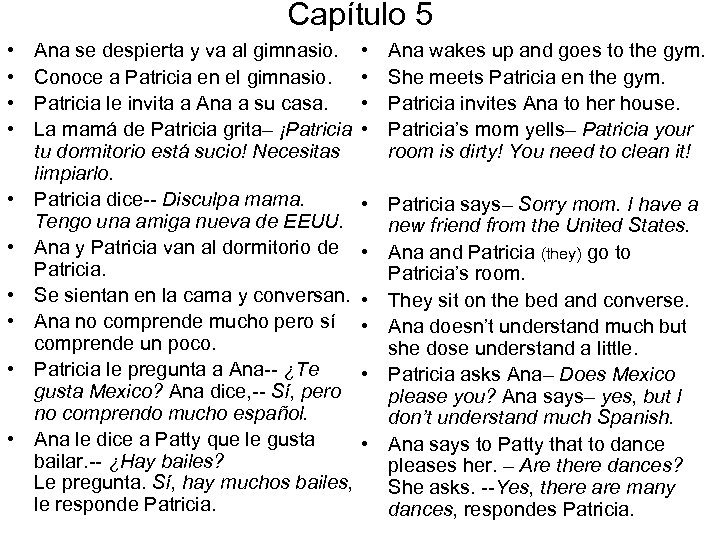 Capítulo 5 • • • Ana se despierta y va al gimnasio. Conoce a Patricia en el gimnasio. Patricia le invita a Ana a su casa. La mamá de Patricia grita– ¡Patricia tu dormitorio está sucio! Necesitas limpiarlo. Patricia dice-- Disculpa mama. Tengo una amiga nueva de EEUU. Ana y Patricia van al dormitorio de Patricia. Se sientan en la cama y conversan. Ana no comprende mucho pero sí comprende un poco. Patricia le pregunta a Ana-- ¿Te gusta Mexico? Ana dice, -- Sí, pero no comprendo mucho español. Ana le dice a Patty que le gusta bailar. -- ¿Hay bailes? Le pregunta. Sí, hay muchos bailes, le responde Patricia. • • Ana wakes up and goes to the gym. She meets Patricia en the gym. Patricia invites Ana to her house. Patricia’s mom yells– Patricia your room is dirty! You need to clean it! • Patricia says– Sorry mom. I have a new friend from the United States. • Ana and Patricia (they) go to Patricia’s room. • They sit on the bed and converse. • Ana doesn’t understand much but she dose understand a little. • Patricia asks Ana– Does Mexico please you? Ana says– yes, but I don’t understand much Spanish. • Ana says to Patty that to dance pleases her. – Are there dances? She asks. --Yes, there are many dances, respondes Patricia.
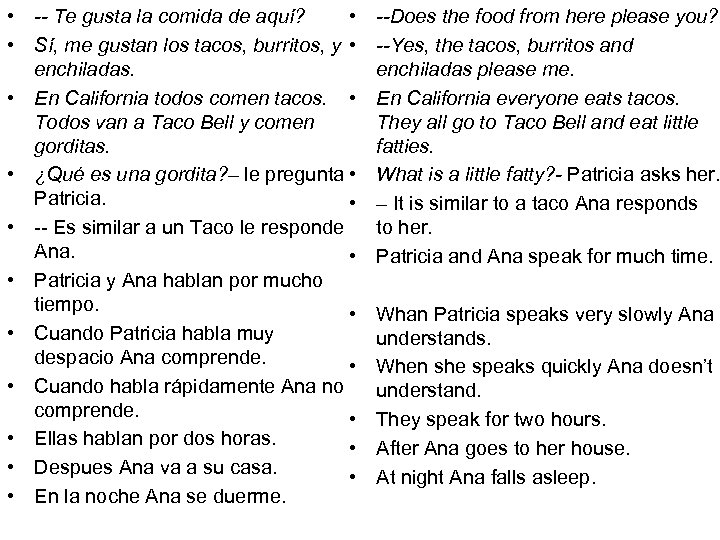 • -- Te gusta la comida de aquí? • • Sí, me gustan los tacos, burritos, y • enchiladas. • En California todos comen tacos. • Todos van a Taco Bell y comen gorditas. • ¿Qué es una gordita? – le pregunta • Patricia. • • -- Es similar a un Taco le responde Ana. • • Patricia y Ana hablan por mucho tiempo. • • Cuando Patricia habla muy despacio Ana comprende. • • Cuando habla rápidamente Ana no comprende. • • Ellas hablan por dos horas. • • Despues Ana va a su casa. • • En la noche Ana se duerme. --Does the food from here please you? --Yes, the tacos, burritos and enchiladas please me. En California everyone eats tacos. They all go to Taco Bell and eat little fatties. What is a little fatty? - Patricia asks her. – It is similar to a taco Ana responds to her. Patricia and Ana speak for much time. Whan Patricia speaks very slowly Ana understands. When she speaks quickly Ana doesn’t understand. They speak for two hours. After Ana goes to her house. At night Ana falls asleep.
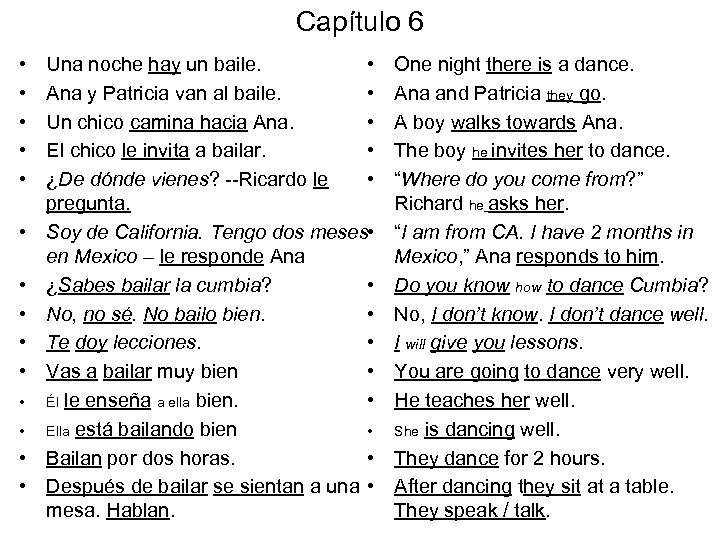 Capítulo 6 • • • • Una noche hay un baile. • Ana y Patricia van al baile. • Un chico camina hacia Ana. • El chico le invita a bailar. • ¿De dónde vienes? --Ricardo le • pregunta. Soy de California. Tengo dos meses • en Mexico – le responde Ana ¿Sabes bailar la cumbia? • No, no sé. No bailo bien. • Te doy lecciones. • Vas a bailar muy bien • Él le enseña a ella bien. • Ella está bailando bien • Bailan por dos horas. • Después de bailar se sientan a una • mesa. Hablan. One night there is a dance. Ana and Patricia they go. A boy walks towards Ana. The boy he invites her to dance. “Where do you come from? ” Richard he asks her. “I am from CA. I have 2 months in Mexico, ” Ana responds to him. Do you know how to dance Cumbia? No, I don’t know. I don’t dance well. I will give you lessons. You are going to dance very well. He teaches her well. She is dancing well. They dance for 2 hours. After dancing they sit at a table. They speak / talk.
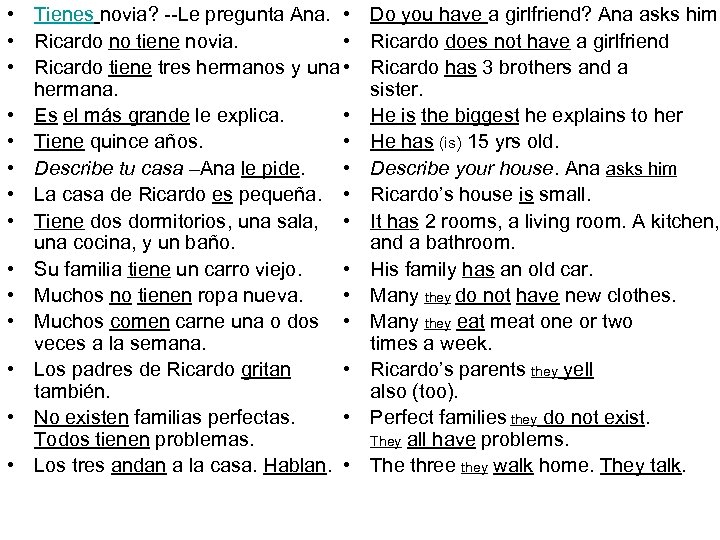 • Tienes novia? --Le pregunta Ana. • • Ricardo no tiene novia. • • Ricardo tiene tres hermanos y una • hermana. • Es el más grande le explica. • • Tiene quince años. • • Describe tu casa –Ana le pide. • • La casa de Ricardo es pequeña. • • Tiene dos dormitorios, una sala, • una cocina, y un baño. • Su familia tiene un carro viejo. • • Muchos no tienen ropa nueva. • • Muchos comen carne una o dos • veces a la semana. • Los padres de Ricardo gritan • también. • No existen familias perfectas. • Todos tienen problemas. • Los tres andan a la casa. Hablan. • Do you have a girlfriend? Ana asks him Ricardo does not have a girlfriend Ricardo has 3 brothers and a sister. He is the biggest he explains to her He has (is) 15 yrs old. Describe your house. Ana asks him Ricardo’s house is small. It has 2 rooms, a living room. A kitchen, and a bathroom. His family has an old car. Many they do not have new clothes. Many they eat meat one or two times a week. Ricardo’s parents they yell also (too). Perfect families they do not exist. They all have problems. The three they walk home. They talk.
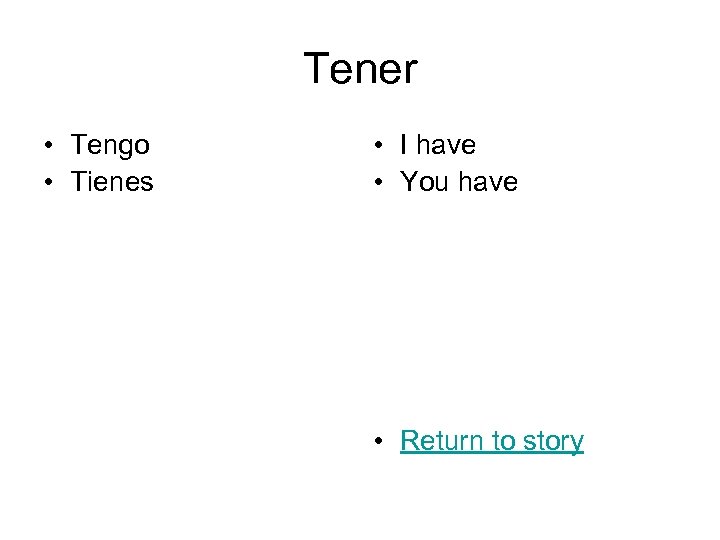 Tener • Tengo • Tienes • I have • You have • Return to story