 Скачать презентацию Quantum Lower Bounds You probably Haven t Seen Before
9caa3a3e4555e2f6b7444efd160e4dd7.ppt
- Количество слайдов: 35



Quantum Lower Bounds You probably Haven’t Seen Before (which doesn’t imply that you don’t know OF them) Scott Aaronson, UC Berkeley 9/24/2002
A History of Quantum Lower Bounds QUANTUM ARGUMENTS POLYNOMIA LARGUMENT S
A History of Quantum Lower Bounds QUANTUM ARGUMENTS BBBV’ 94: ( n) lower bound for searching a list of n elements (i. e. Grover’s algorithm is optimal)
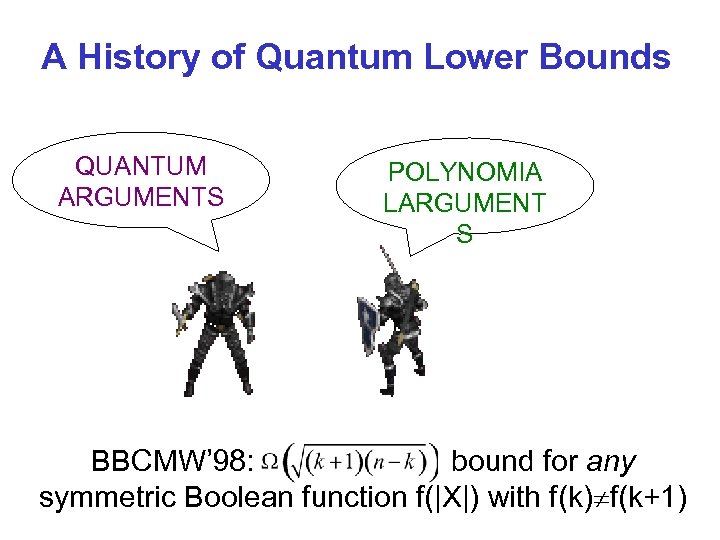
A History of Quantum Lower Bounds QUANTUM ARGUMENTS POLYNOMIA LARGUMENT S BBCMW’ 98: bound for any symmetric Boolean function f(|X|) with f(k) f(k+1)
A History of Quantum Lower Bounds QUANTUM ARGUMENTS POLYNOMIA LARGUMENT S Ambainis’ 00: ( n) bounds for evaluating an ANDOR tree and for finding the ‘ 1’ in a permutation
A History of Quantum Lower Bounds QUANTUM ARGUMENTS POLYNOMIA LARGUMENT S A’ 02: (n 1/5) bound for the collision problem (deciding whether f: {1…n} is 1 -to-1 or 2 -to-1) Shi’ 02: (n 1/3) bound for collision with large range, (n 2/3) for element distinctness
A History of Quantum Lower Bounds QUANTUM ARGUMENTS POLYNOMIA LARGUMENT S Other results, including what I’ll talk about today
Truce Henceforth polynomial arguments shall be used for highly symmetric problems and for zero-error bounds, and quantum arguments otherwise. Whosoever disobeys, must post to quant-ph.
Talk Outline 1. Quantum Certificate Complexity 2. Recursive Fourier Sampling 3. Query Complexity & Quantum Gravity (special treat for Dave Bacon)
Quantum Certificate Complexity
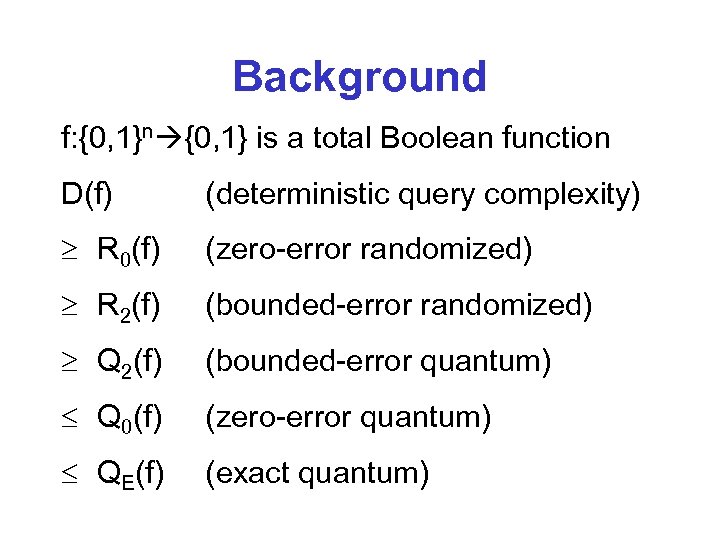
Background f: {0, 1}n {0, 1} is a total Boolean function D(f) (deterministic query complexity) R 0(f) (zero-error randomized) R 2(f) (bounded-error randomized) Q 2(f) (bounded-error quantum) Q 0(f) (zero-error quantum) QE(f) (exact quantum)
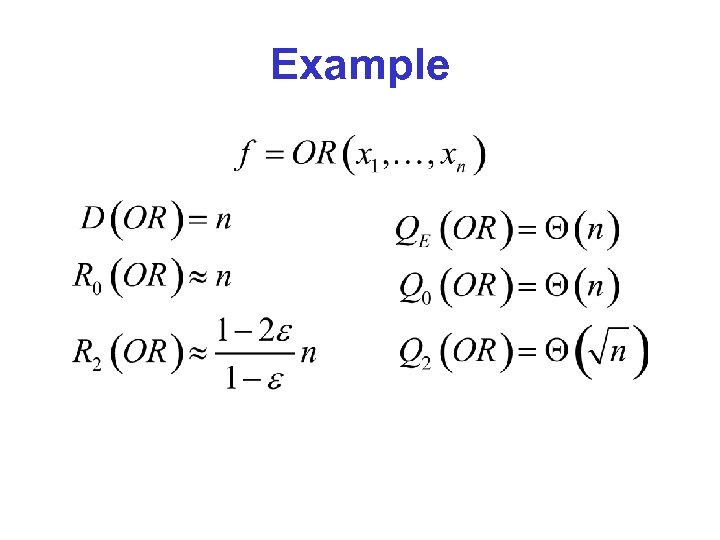
Example
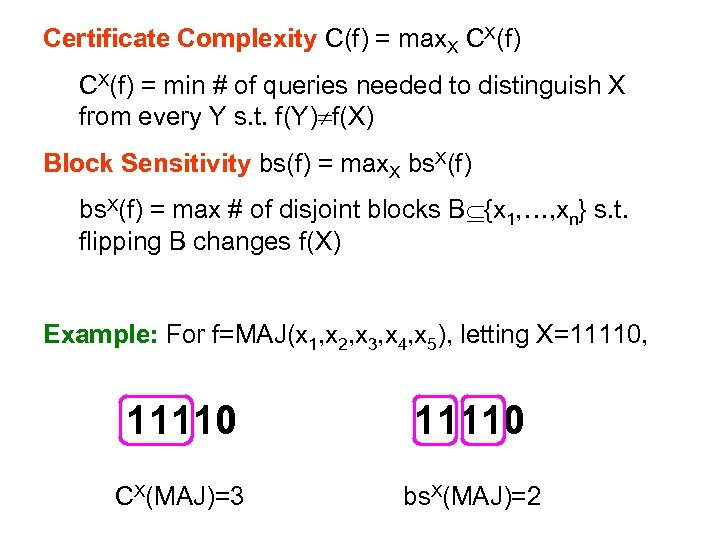
Certificate Complexity C(f) = max. X CX(f) = min # of queries needed to distinguish X from every Y s. t. f(Y) f(X) Block Sensitivity bs(f) = max. X bs. X(f) = max # of disjoint blocks B {x 1, …, xn} s. t. flipping B changes f(X) Example: For f=MAJ(x 1, x 2, x 3, x 4, x 5), letting X=11110, 11110 CX(MAJ)=3 bs. X(MAJ)=2
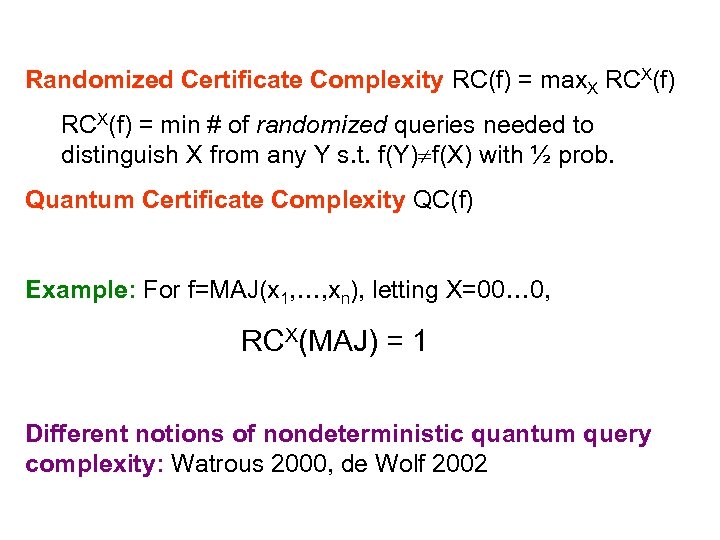
Randomized Certificate Complexity RC(f) = max. X RCX(f) = min # of randomized queries needed to distinguish X from any Y s. t. f(Y) f(X) with ½ prob. Quantum Certificate Complexity QC(f) Example: For f=MAJ(x 1, …, xn), letting X=00… 0, RCX(MAJ) = 1 Different notions of nondeterministic quantum query complexity: Watrous 2000, de Wolf 2002
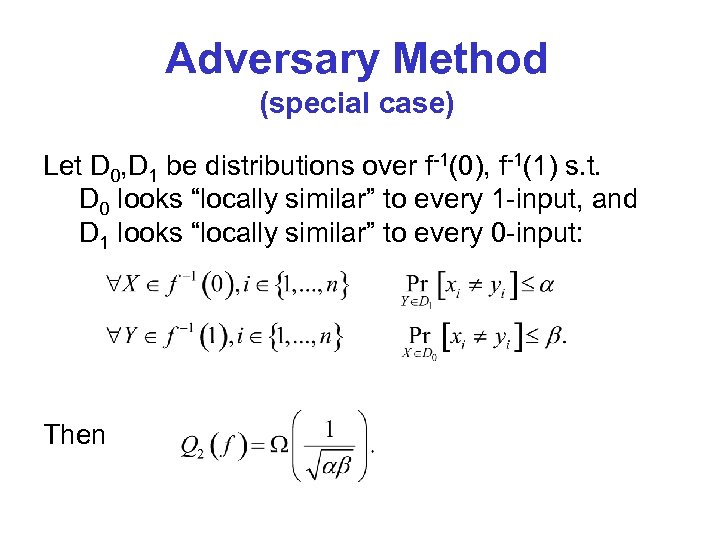
Adversary Method (special case) Let D 0, D 1 be distributions over f-1(0), f-1(1) s. t. D 0 looks “locally similar” to every 1 -input, and D 1 looks “locally similar” to every 0 -input: Then
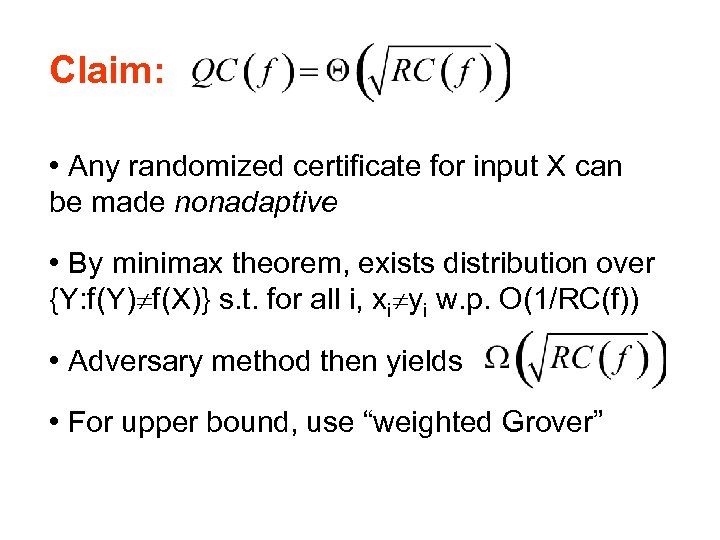
Claim: • Any randomized certificate for input X can be made nonadaptive • By minimax theorem, exists distribution over {Y: f(Y) f(X)} s. t. for all i, xi yi w. p. O(1/RC(f)) • Adversary method then yields • For upper bound, use “weighted Grover”
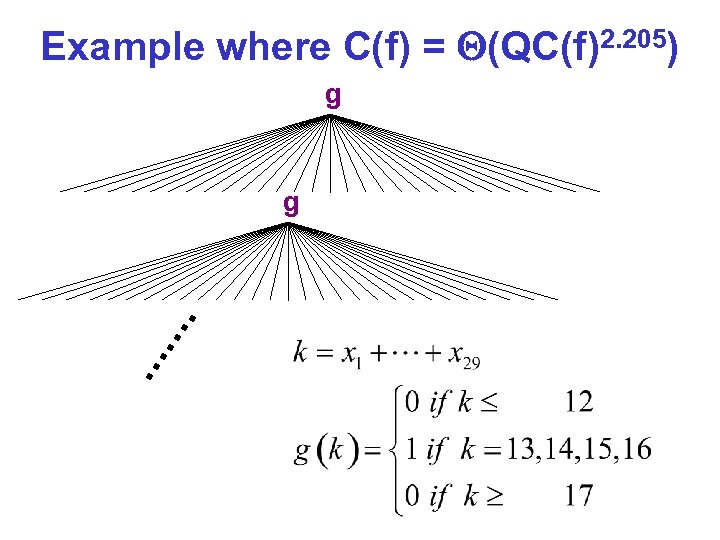
Example where C(f) = (QC(f)2. 205) g g
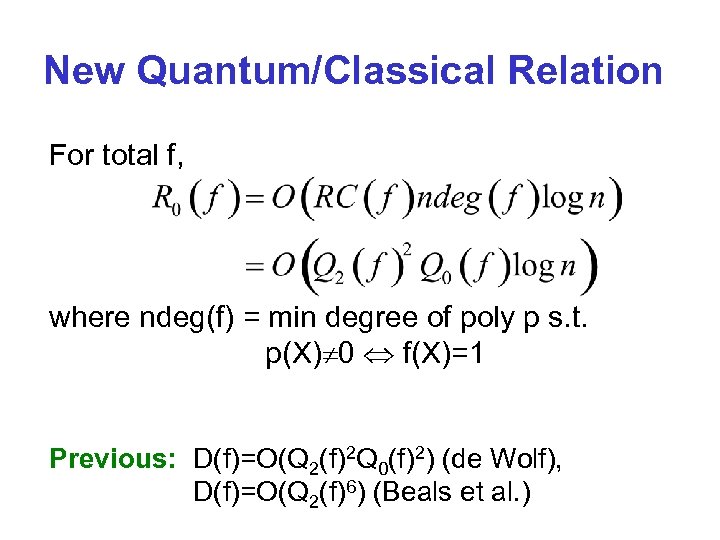
New Quantum/Classical Relation For total f, where ndeg(f) = min degree of poly p s. t. p(X) 0 f(X)=1 Previous: D(f)=O(Q 2(f)2 Q 0(f)2) (de Wolf), D(f)=O(Q 2(f)6) (Beals et al. )
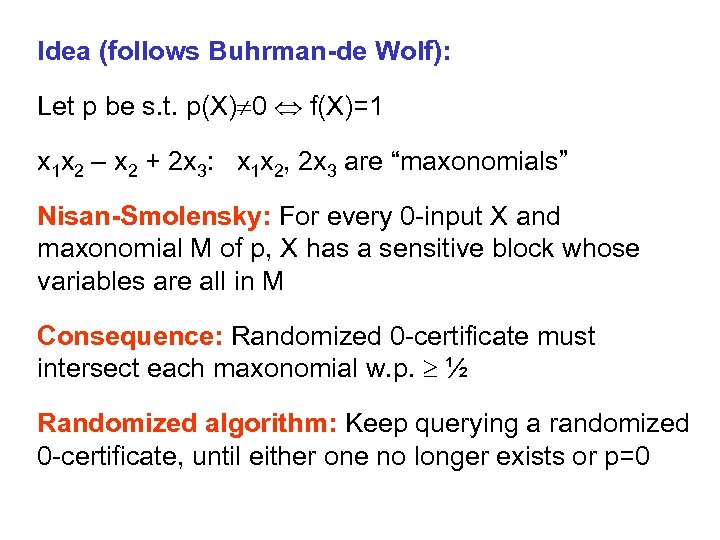
Idea (follows Buhrman-de Wolf): Let p be s. t. p(X) 0 f(X)=1 x 1 x 2 – x 2 + 2 x 3: x 1 x 2, 2 x 3 are “maxonomials” Nisan-Smolensky: For every 0 -input X and maxonomial M of p, X has a sensitive block whose variables are all in M Consequence: Randomized 0 -certificate must intersect each maxonomial w. p. ½ Randomized algorithm: Keep querying a randomized 0 -certificate, until either one no longer exists or p=0
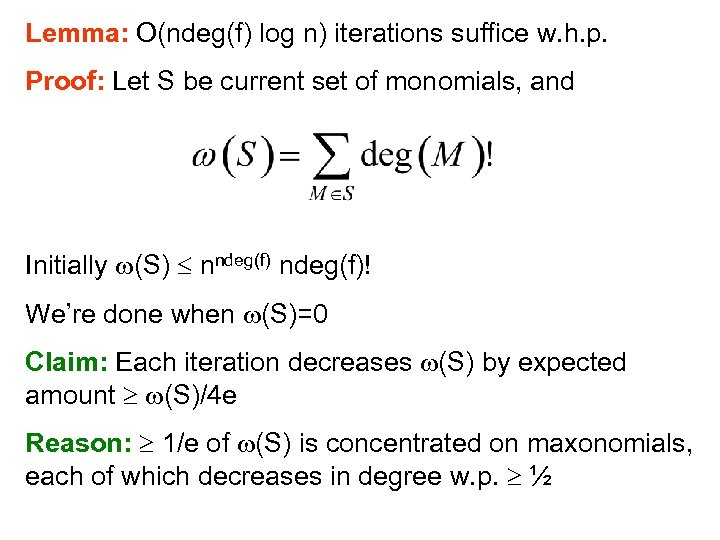
Lemma: O(ndeg(f) log n) iterations suffice w. h. p. Proof: Let S be current set of monomials, and Initially (S) nndeg(f)! We’re done when (S)=0 Claim: Each iteration decreases (S) by expected amount (S)/4 e Reason: 1/e of (S) is concentrated on maxonomials, each of which decreases in degree w. p. ½
Recursive Fourier Sampling (quant-ph/0209060)
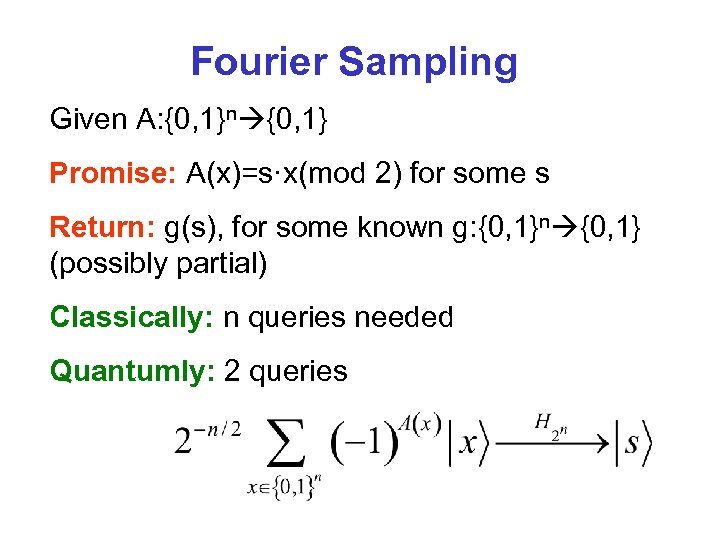
Fourier Sampling Given A: {0, 1}n {0, 1} Promise: A(x)=s·x(mod 2) for some s Return: g(s), for some known g: {0, 1}n {0, 1} (possibly partial) Classically: n queries needed Quantumly: 2 queries
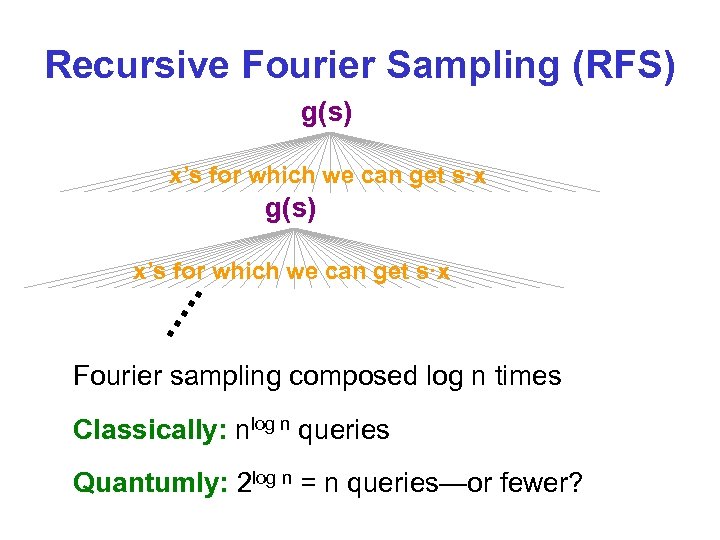
Recursive Fourier Sampling (RFS) g(s) x’s for which we can get s·x Fourier sampling composed log n times Classically: nlog n queries Quantumly: 2 log n = n queries—or fewer?
Overview • Bernstein-Vazirani 1993: RFS puts BQP MA relative to oracle • Candidate for BQP PH • Could it put (say) BQP PH[polylog]? • Is uncomputing necessary? Why? • Goal: Show Q 2(RFS) = (cd) for c>1 d = tree depth • Trouble: Suppose g(s) is a parity function Then Q 2(RFSg) = 1
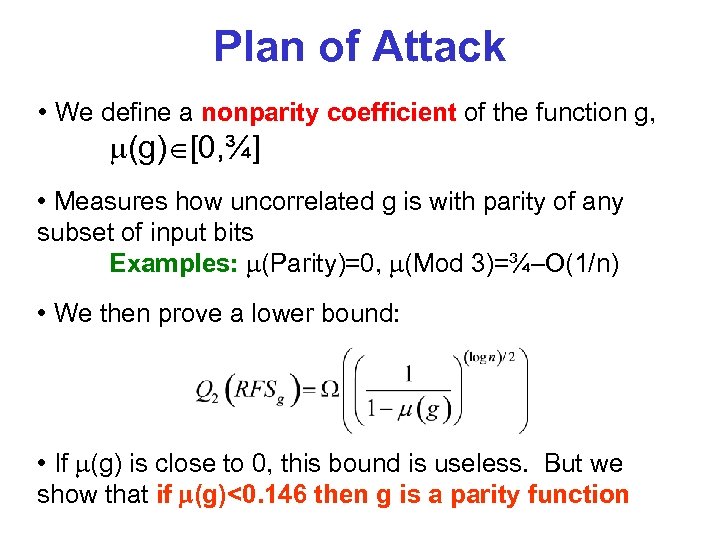
Plan of Attack • We define a nonparity coefficient of the function g, (g) [0, ¾] • Measures how uncorrelated g is with parity of any subset of input bits Examples: (Parity)=0, (Mod 3)=¾–O(1/n) • We then prove a lower bound: • If (g) is close to 0, this bound is useless. But we show that if (g)<0. 146 then g is a parity function
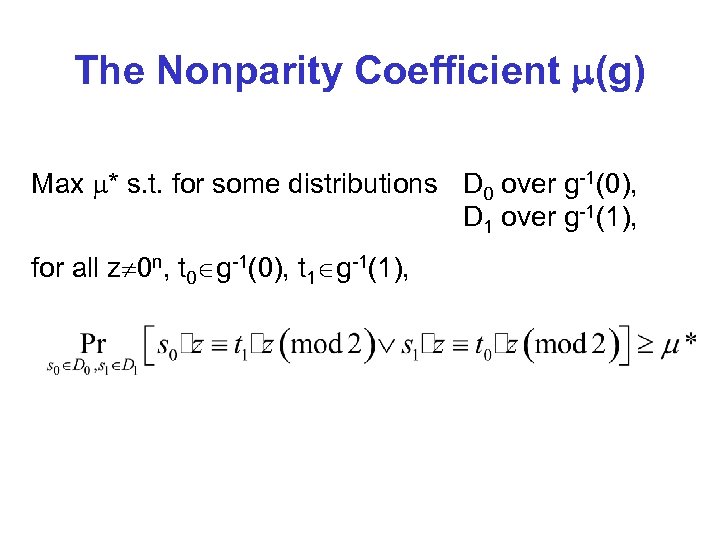
The Nonparity Coefficient (g) Max * s. t. for some distributions D 0 over g-1(0), D 1 over g-1(1), for all z 0 n, t 0 g-1(0), t 1 g-1(1),
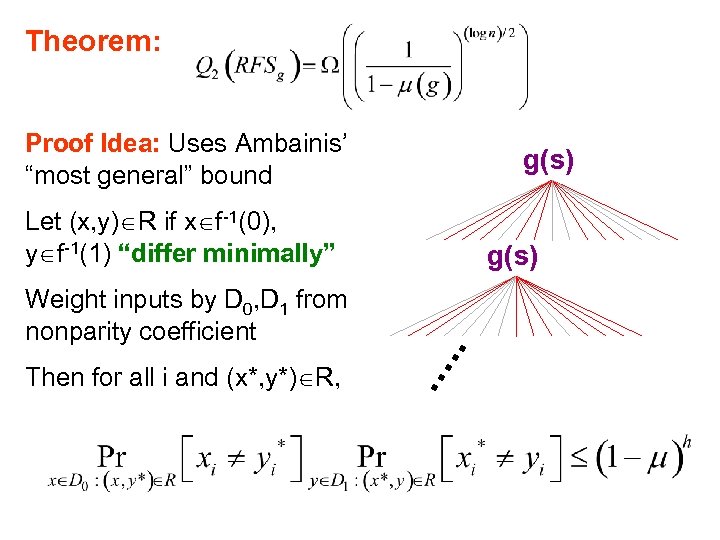
Theorem: Proof Idea: Uses Ambainis’ “most general” bound Let (x, y) R if x f-1(0), y f-1(1) “differ minimally” Weight inputs by D 0, D 1 from nonparity coefficient Then for all i and (x*, y*) R, g(s)
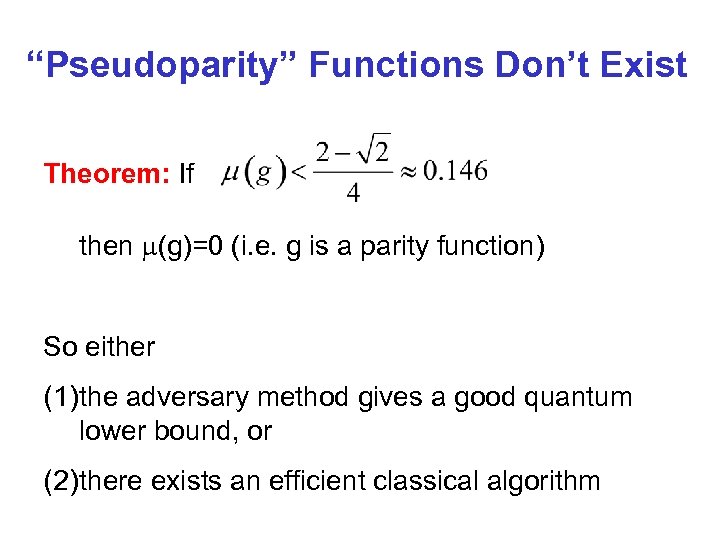
“Pseudoparity” Functions Don’t Exist Theorem: If then (g)=0 (i. e. g is a parity function) So either (1) the adversary method gives a good quantum lower bound, or (2) there exists an efficient classical algorithm
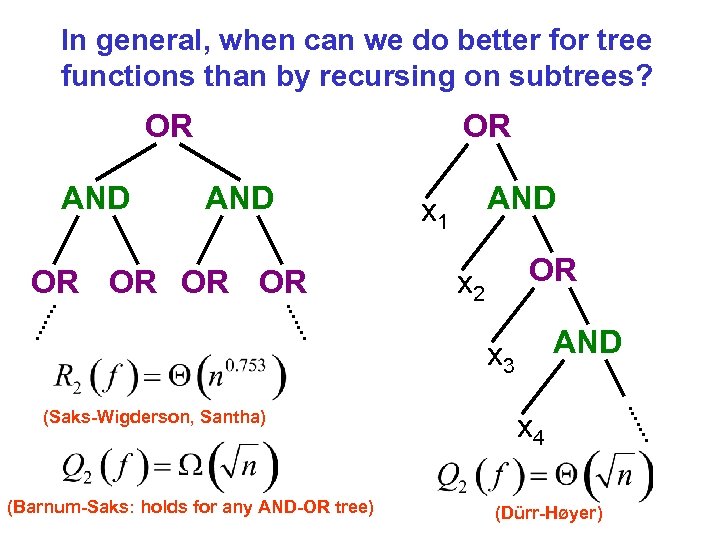
In general, when can we do better for tree functions than by recursing on subtrees? OR AND OR OR AND x 1 OR x 2 AND x 3 (Saks-Wigderson, Santha) (Barnum-Saks: holds for any AND-OR tree) x 4 (Dürr-Høyer)
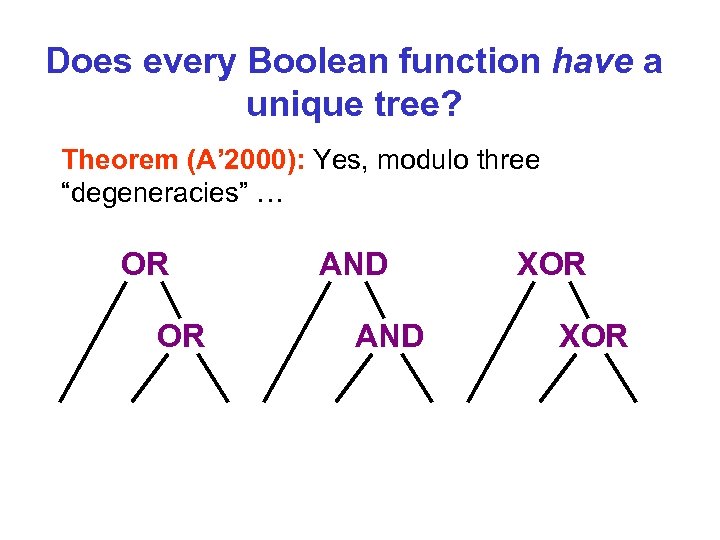
Does every Boolean function have a unique tree? Theorem (A’ 2000): Yes, modulo three “degeneracies” … OR OR AND XOR
Query Complexity & Quantum Gravity
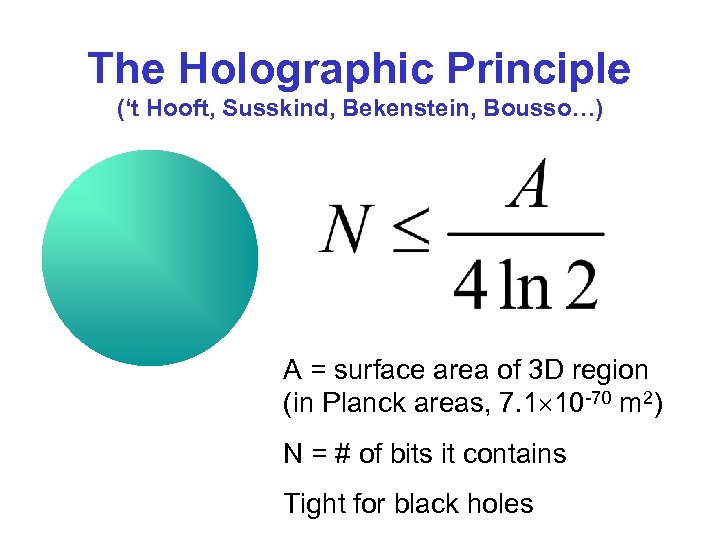
The Holographic Principle (‘t Hooft, Susskind, Bekenstein, Bousso…) A = surface area of 3 D region (in Planck areas, 7. 1 10 -70 m 2) N = # of bits it contains Tight for black holes
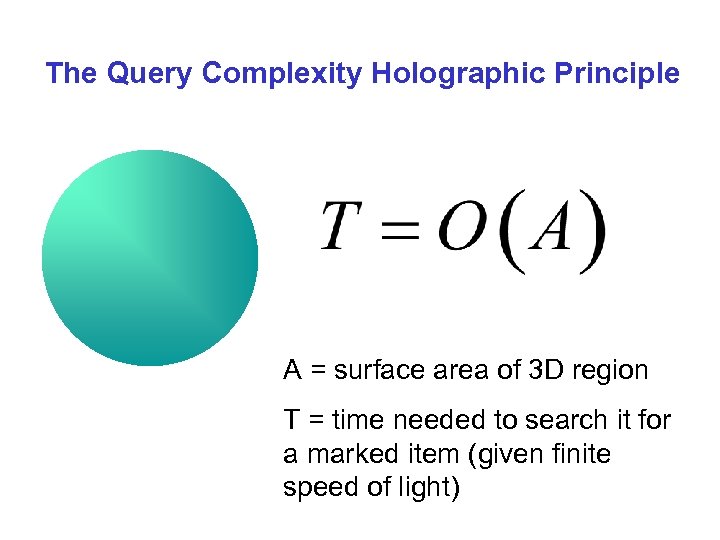
The Query Complexity Holographic Principle A = surface area of 3 D region T = time needed to search it for a marked item (given finite speed of light)
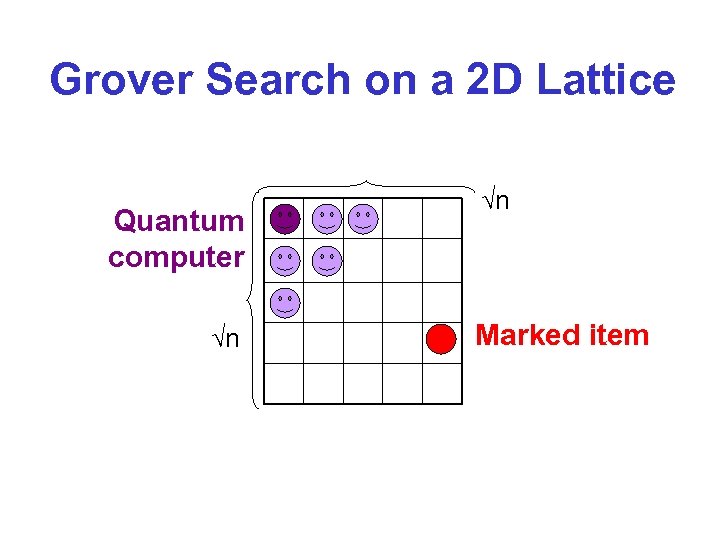
Grover Search on a 2 D Lattice Quantum computer n n Marked item
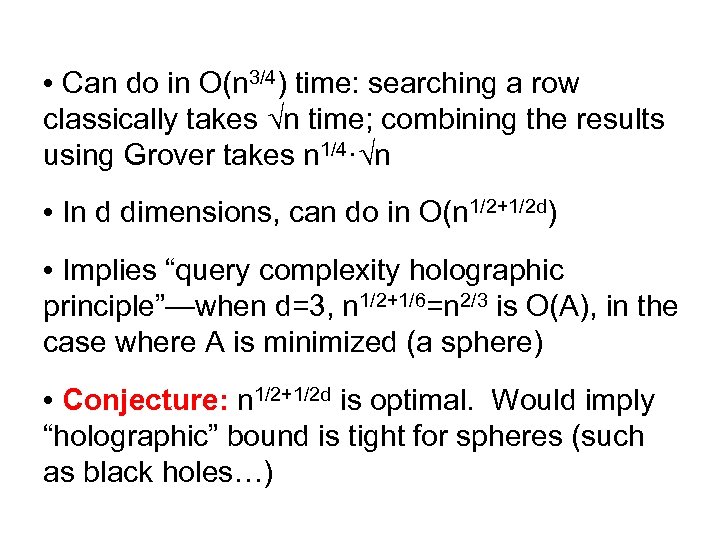
• Can do in O(n 3/4) time: searching a row classically takes n time; combining the results using Grover takes n 1/4· n • In d dimensions, can do in O(n 1/2+1/2 d) • Implies “query complexity holographic principle”—when d=3, n 1/2+1/6=n 2/3 is O(A), in the case where A is minimized (a sphere) • Conjecture: n 1/2+1/2 d is optimal. Would imply “holographic” bound is tight for spheres (such as black holes…)
Скачать презентацию Quantum Lower Bounds You probably Haven t Seen Before
9caa3a3e4555e2f6b7444efd160e4dd7.ppt