


 Скачать презентацию QUANTIFYING CLIMATE CHANGE IMPACTS IN A DATA-SCARCE ENVIRONMENT
5218bfc2785828ea60a6625a0d13beb9.ppt
- Количество слайдов: 38
 QUANTIFYING CLIMATE CHANGE IMPACTS IN A DATA-SCARCE ENVIRONMENT Z. (BOB) SU (1) WITH CONTRIBUTIONS FROM J. WEN (2), , Y. MA (3), P. DE ROSNAY (4), R. VAN DER VELDE (1), L. DENTE (1), L. WANG (1), L. ZHONG (1), S. SALAMA (1) FACULTY OF GEO-INFORMATION SCIENCE AND EARTH OBSERVATION (IIC), UNIVERSITY OF TWENTE, ENSCHEDE, THE NETHERLANDS (2) COLD AND ARID REGIONS ENVIRONMENTAL AND ENGINEERING RESEARCH INSTITUTE, CHINESE ACADEMY OF SCIENCES, LANZHOU, P. R. CHINA (3) INSTITUTE OF TIBETAN PLATEAU RESEARCH, CHINESE ACADEMY OF SCIENCES, BEIJING, P. R. CHINA (4) EUROPEAN CENTRE FOR MEDIUM-RANGE WEATHER FORECASTS, READING , UNITED KINGDOM
 Content 1. 2. 3. § § 4. 5. Background & Objectives In-situ networks, satellite observations & model outputs Quantifying hydroclimatic variables Vegetation Surface temperature Soil moisture Water levels Climatic impacts - variations, trends, and extremes? Suggestions and conclusion 2
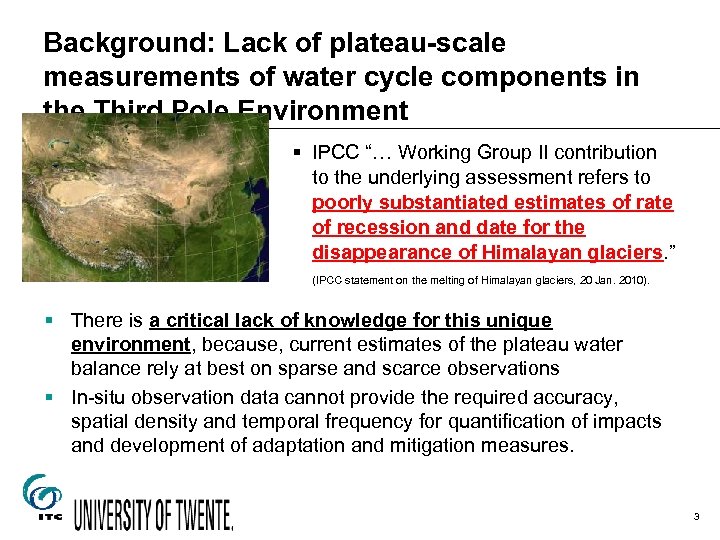 Background: Lack of plateau-scale measurements of water cycle components in the Third Pole Environment § IPCC “… Working Group II contribution to the underlying assessment refers to poorly substantiated estimates of rate of recession and date for the disappearance of Himalayan glaciers. ” (IPCC statement on the melting of Himalayan glaciers, 20 Jan. 2010). § There is a critical lack of knowledge for this unique environment, because, current estimates of the plateau water balance rely at best on sparse and scarce observations § In-situ observation data cannot provide the required accuracy, spatial density and temporal frequency for quantification of impacts and development of adaptation and mitigation measures. 3
 Objectives § Introduce a reference observatory for in-situ soil moisture/temperature measurement for plateau scale monsoon system studies § Quantification of uncertainties in satellite retrievals & model outputs § Identification of variations, trends, and extremes in plateau scale hydrocliamtic variables § Climatic impacts or monsoon pattern changes – actions for AR 5? 4
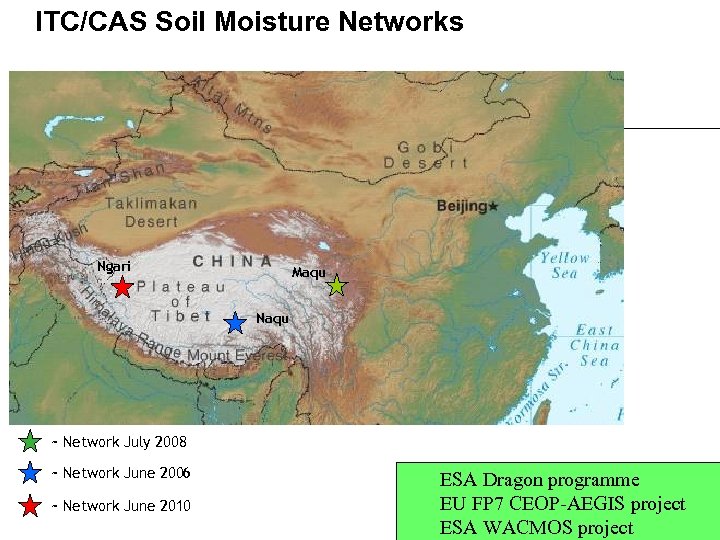 ITC/CAS Soil Moisture Networks Ngari Maqu Naqu ~ Network July 2008 ~ Network June 2006 ~ Network June 2010 ESA Dragon programme EU FP 7 CEOP-AEGIS project ESA WACMOS project
 Part I - Vegetation § Adequacy of satellite observations of vegetation changes in relation to hydroclimatic conditions § (Zhong et al. , 2010, Cli. Change; Zhong et al. , 2011, J. Cli. In review)
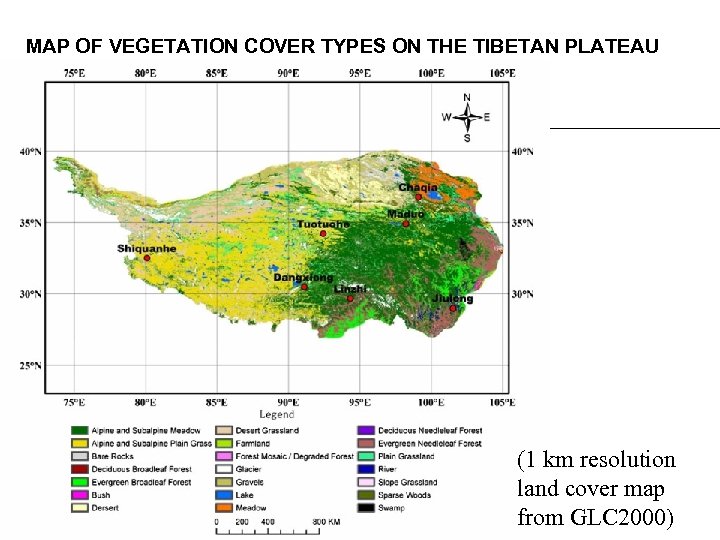 MAP OF VEGETATION COVER TYPES ON THE TIBETAN PLATEAU (1 km resolution land cover map from GLC 2000)
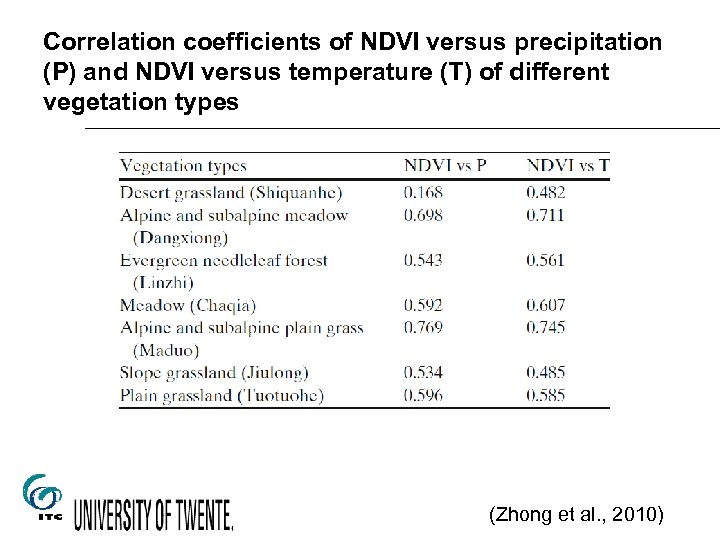 Correlation coefficients of NDVI versus precipitation (P) and NDVI versus temperature (T) of different vegetation types (Zhong et al. , 2010)
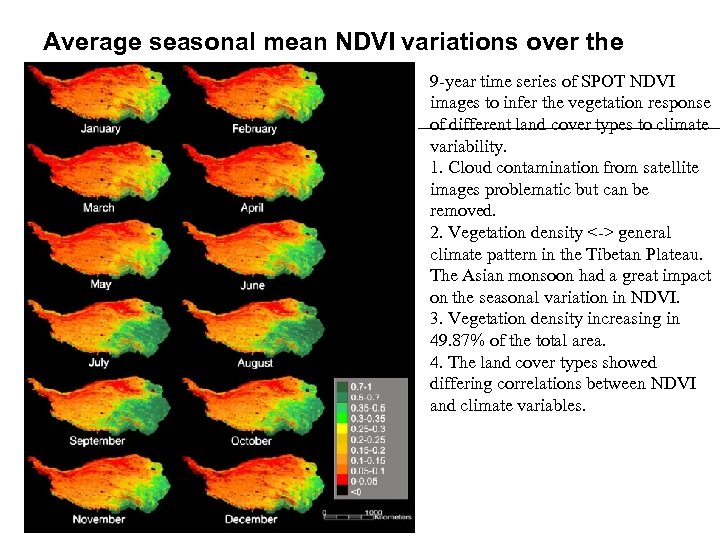 Average seasonal mean NDVI variations over the Tibetan Plateau 9 -year time series of SPOT NDVI images to infer the vegetation response of different land cover types to climate variability. 1. Cloud contamination from satellite images problematic but can be removed. 2. Vegetation density <-> general climate pattern in the Tibetan Plateau. The Asian monsoon had a great impact on the seasonal variation in NDVI. 3. Vegetation density increasing in 49. 87% of the total area. 4. The land cover types showed differing correlations between NDVI and climate variables.
 Part – II Land surface temperature § Adequacy of satellite observations for quantifying climatic impacts in LST § (Oku and Ishikawa, 2003, JAMC; Salama et al. , 2011, IEEE TGRS, in review)
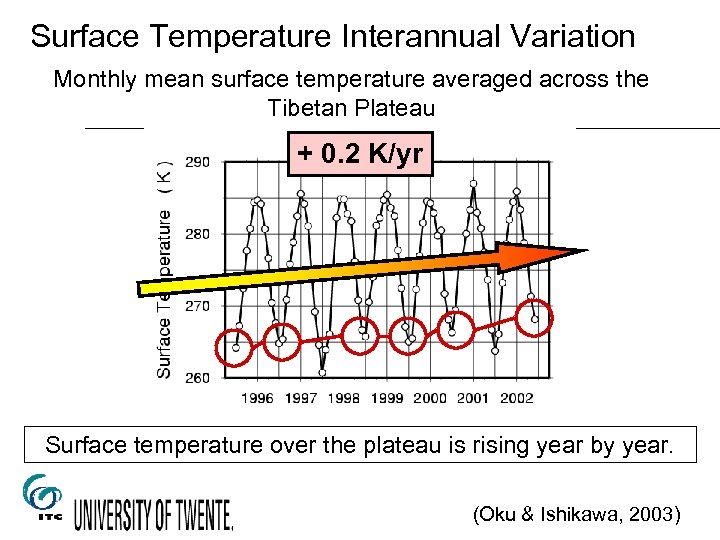 Surface Temperature Interannual Variation Monthly mean surface temperature averaged across the Tibetan Plateau + 0. 2 K/yr Surface temperature over the plateau is rising year by year. (Oku & Ishikawa, 2003)
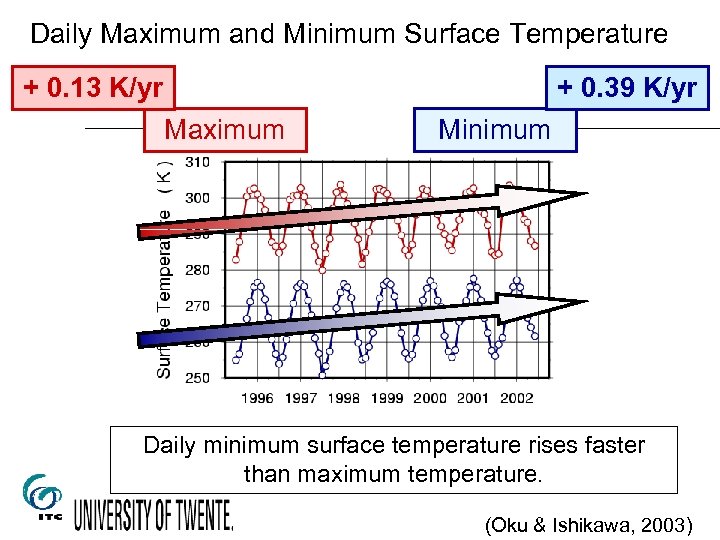 Daily Maximum and Minimum Surface Temperature + 0. 13 K/yr + 0. 39 K/yr Maximum Minimum Daily minimum surface temperature rises faster than maximum temperature. (Oku & Ishikawa, 2003)
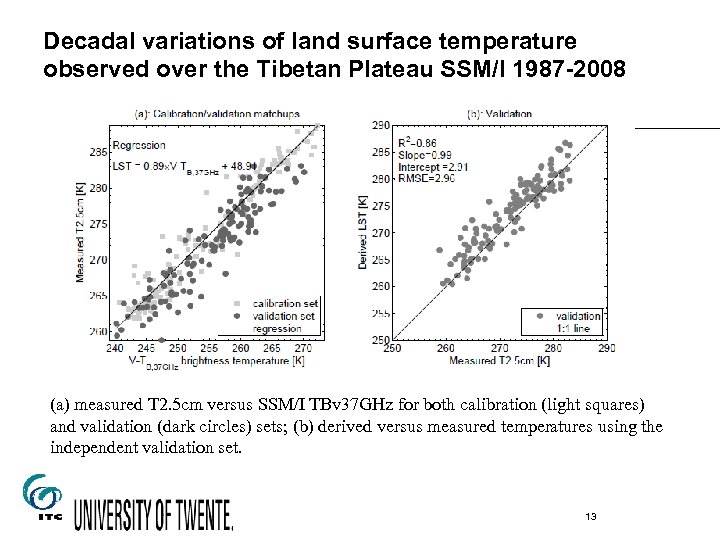 Decadal variations of land surface temperature observed over the Tibetan Plateau SSM/I 1987 -2008 (a) measured T 2. 5 cm versus SSM/I TBv 37 GHz for both calibration (light squares) and validation (dark circles) sets; (b) derived versus measured temperatures using the independent validation set. 13
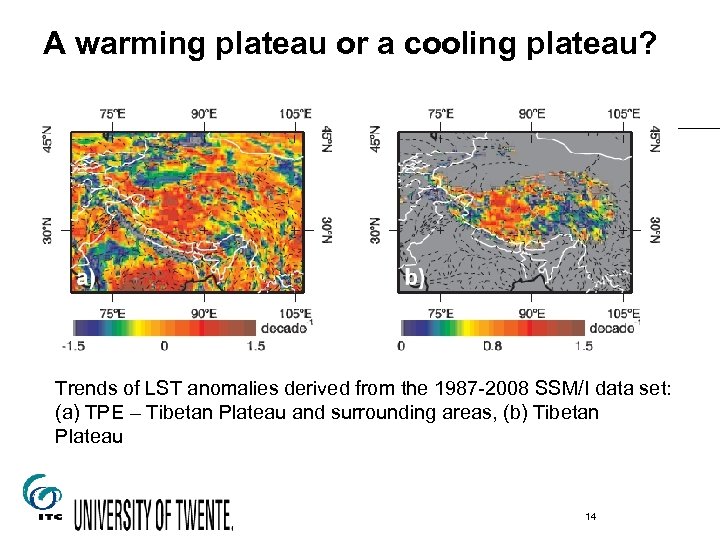 A warming plateau or a cooling plateau? Trends of LST anomalies derived from the 1987 -2008 SSM/I data set: (a) TPE – Tibetan Plateau and surrounding areas, (b) Tibetan Plateau 14
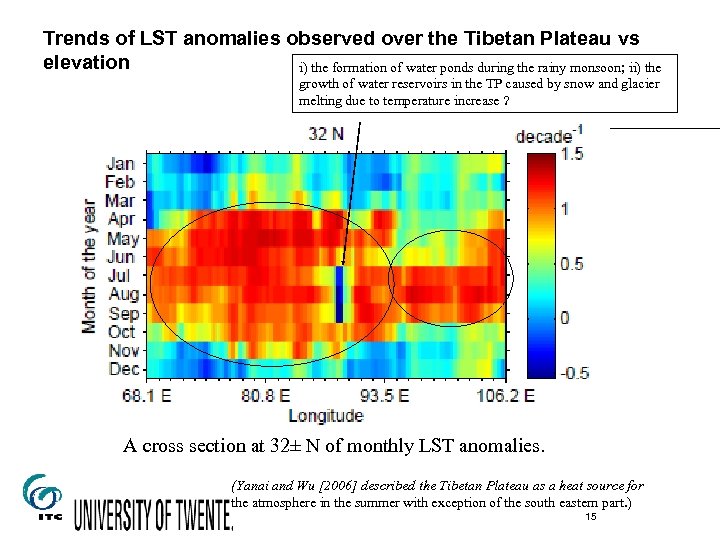 Trends of LST anomalies observed over the Tibetan Plateau vs elevation i) the formation of water ponds during the rainy monsoon; ii) the growth of water reservoirs in the TP caused by snow and glacier melting due to temperature increase ? A cross section at 32± N of monthly LST anomalies. (Yanai and Wu [2006] described the Tibetan Plateau as a heat source for the atmosphere in the summer with exception of the south eastern part. ) 15
 Part III – Soil moisture § Adequacy of satellite observations for quantifying climatic impacts § (Su et al. , 2011, HESSD; van der Velde et al. , 2011, J. Cli. - in review; )
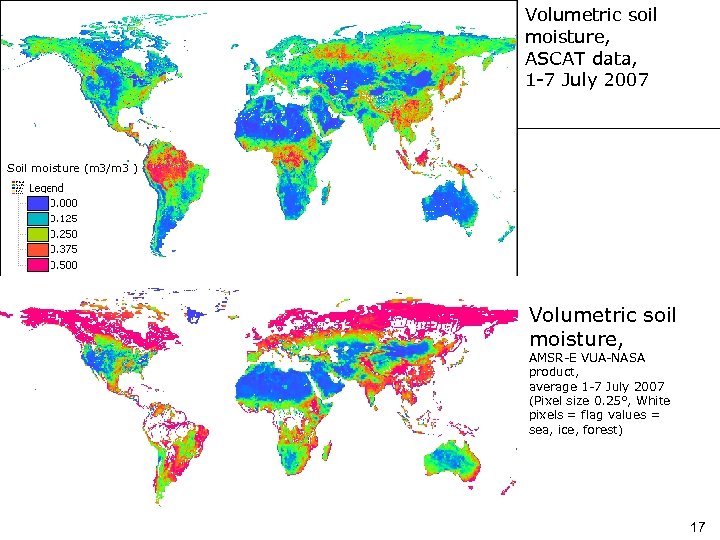 Volumetric soil moisture, ASCAT data, 1 -7 July 2007 Soil moisture (m 3/m 3 ) Volumetric soil moisture, AMSR-E VUA-NASA product, average 1 -7 July 2007 (Pixel size 0. 25°, White pixels = flag values = sea, ice, forest) 17
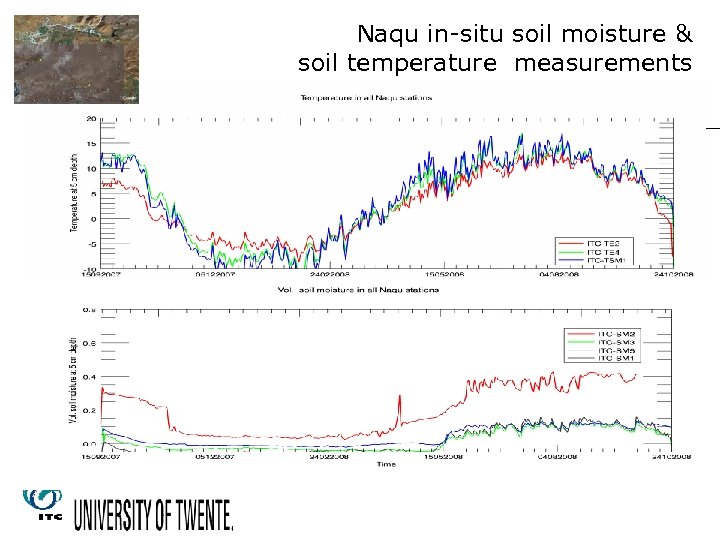 Naqu in-situ soil moisture & soil temperature measurements
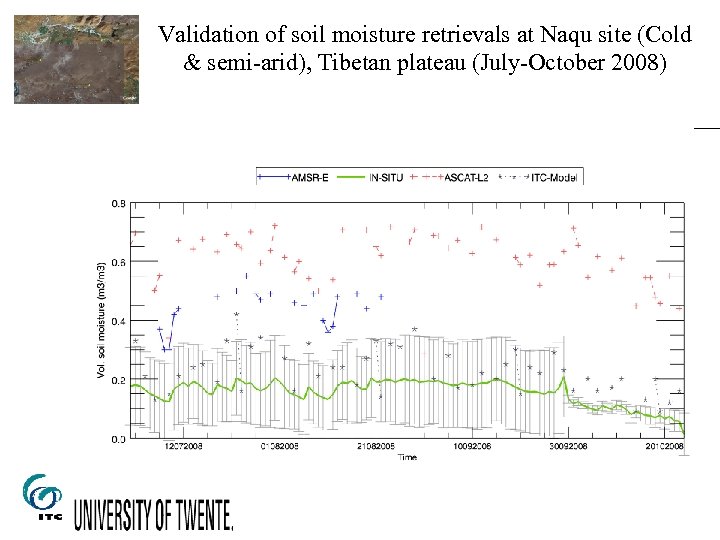 Validation of soil moisture retrievals at Naqu site (Cold & semi-arid), Tibetan plateau (July-October 2008)
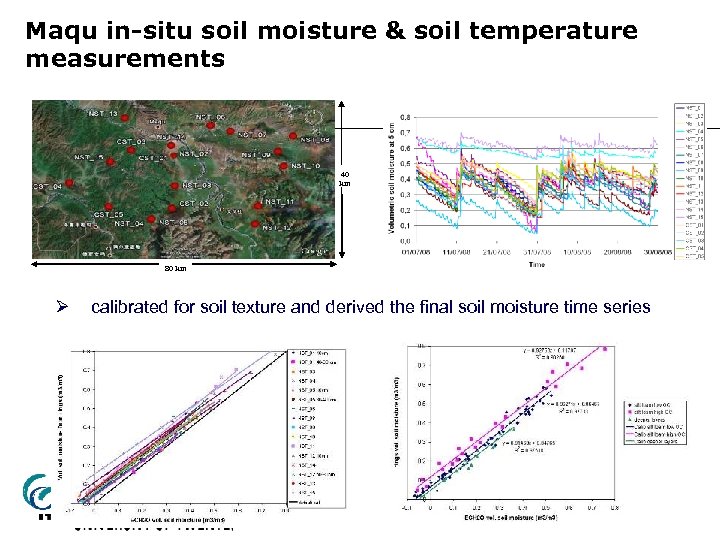 Maqu in-situ soil moisture & soil temperature measurements 40 km 80 km Ø calibrated for soil texture and derived the final soil moisture time series
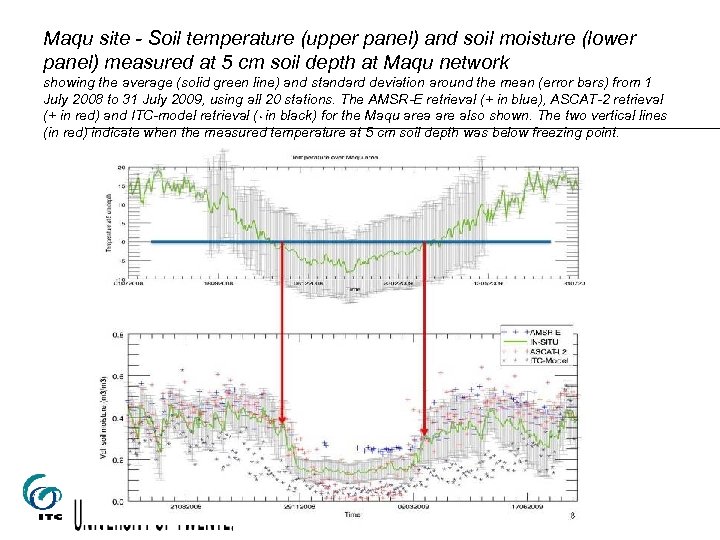 Maqu site - Soil temperature (upper panel) and soil moisture (lower panel) measured at 5 cm soil depth at Maqu network showing the average (solid green line) and standard deviation around the mean (error bars) from 1 July 2008 to 31 July 2009, using all 20 stations. The AMSR-E retrieval (+ in blue), ASCAT-2 retrieval (+ in red) and ITC-model retrieval ( in black) for the Maqu area are also shown. The two vertical lines (in red) indicate when the measured temperature at 5 cm soil depth was below freezing point.
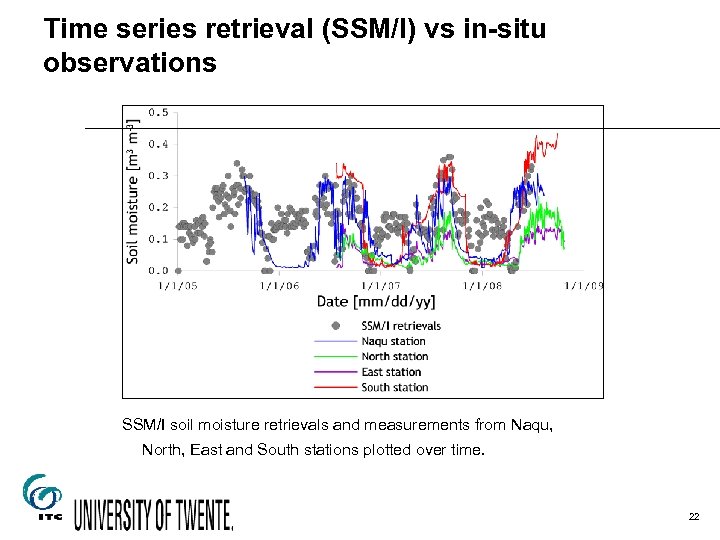 Time series retrieval (SSM/I) vs in-situ observations SSM/I soil moisture retrievals and measurements from Naqu, North, East and South stations plotted over time. 22
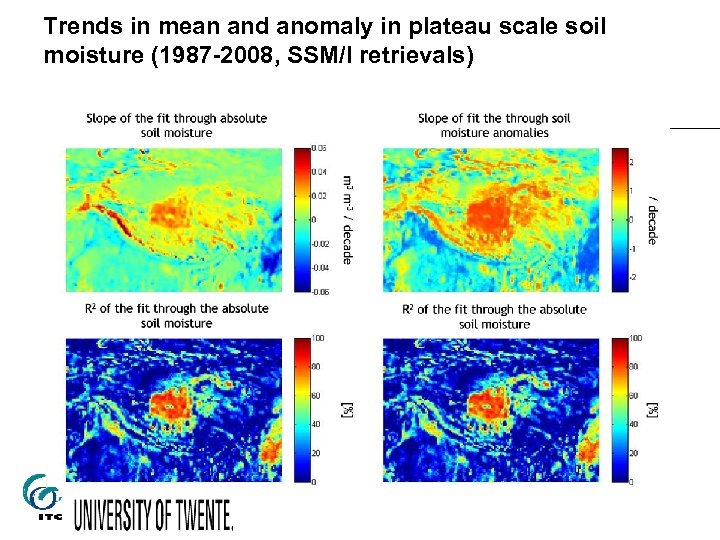 Trends in mean and anomaly in plateau scale soil moisture (1987 -2008, SSM/I retrievals)
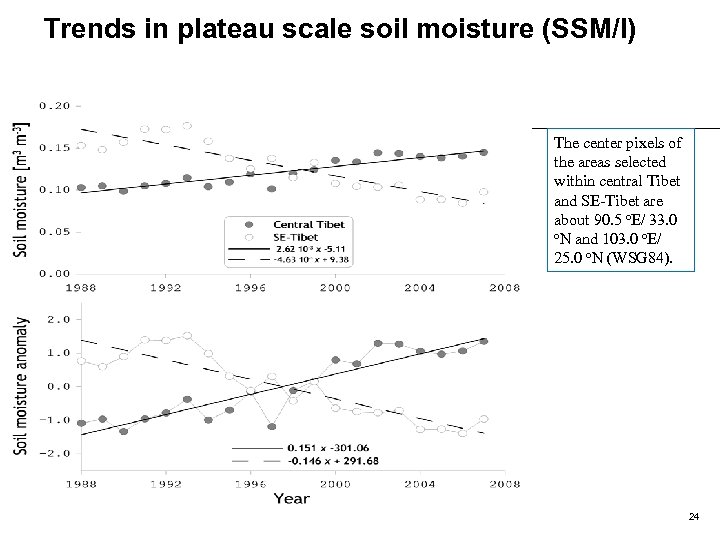 Trends in plateau scale soil moisture (SSM/I) The center pixels of the areas selected within central Tibet and SE-Tibet are about 90. 5 o. E/ 33. 0 o. N and 103. 0 o. E/ 25. 0 o. N (WSG 84). 24
 Part IV – model outputs § Ability of the ECMWF model in simulating and analysis of root zone soil moisture on the Tibetan plateau § (Su et al. , 2011, JGR – in review)
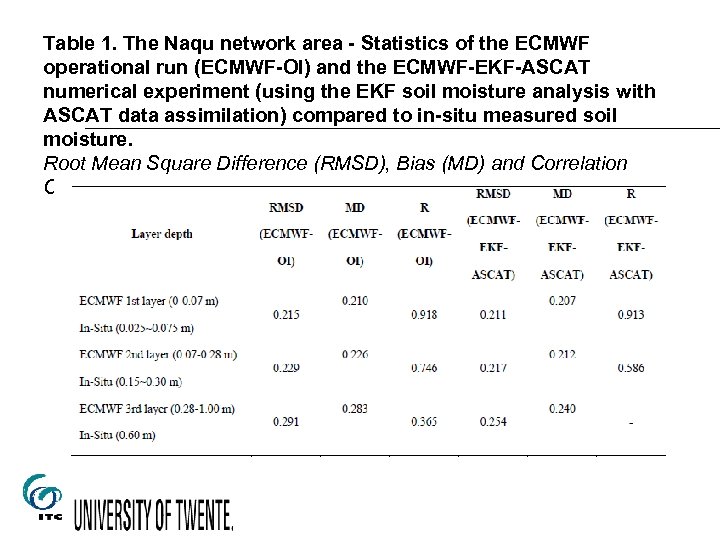 Table 1. The Naqu network area - Statistics of the ECMWF operational run (ECMWF-OI) and the ECMWF-EKF-ASCAT numerical experiment (using the EKF soil moisture analysis with ASCAT data assimilation) compared to in-situ measured soil moisture. Root Mean Square Difference (RMSD), Bias (MD) and Correlation Coefficient (R).
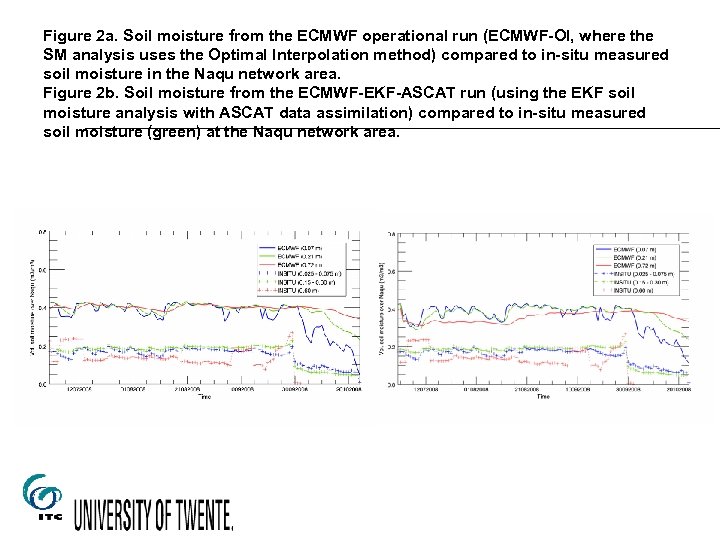 Figure 2 a. Soil moisture from the ECMWF operational run (ECMWF-OI, where the SM analysis uses the Optimal Interpolation method) compared to in-situ measured soil moisture in the Naqu network area. Figure 2 b. Soil moisture from the ECMWF-EKF-ASCAT run (using the EKF soil moisture analysis with ASCAT data assimilation) compared to in-situ measured soil moisture (green) at the Naqu network area.
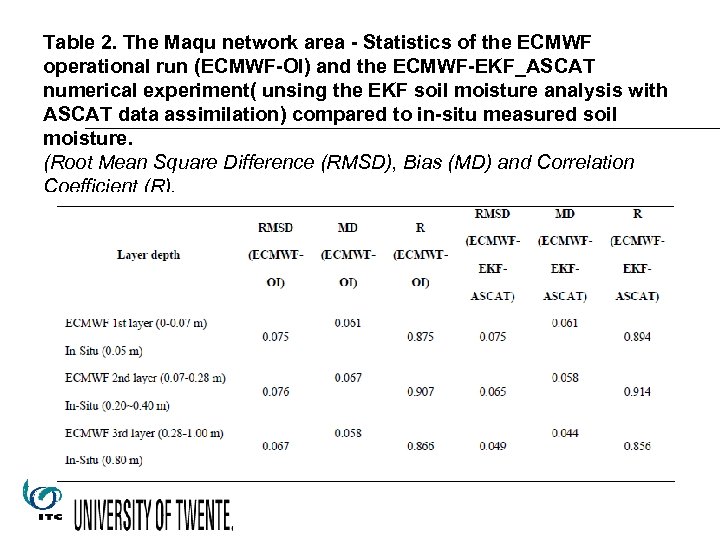 Table 2. The Maqu network area - Statistics of the ECMWF operational run (ECMWF-OI) and the ECMWF-EKF_ASCAT numerical experiment( unsing the EKF soil moisture analysis with ASCAT data assimilation) compared to in-situ measured soil moisture. (Root Mean Square Difference (RMSD), Bias (MD) and Correlation Coefficient (R).
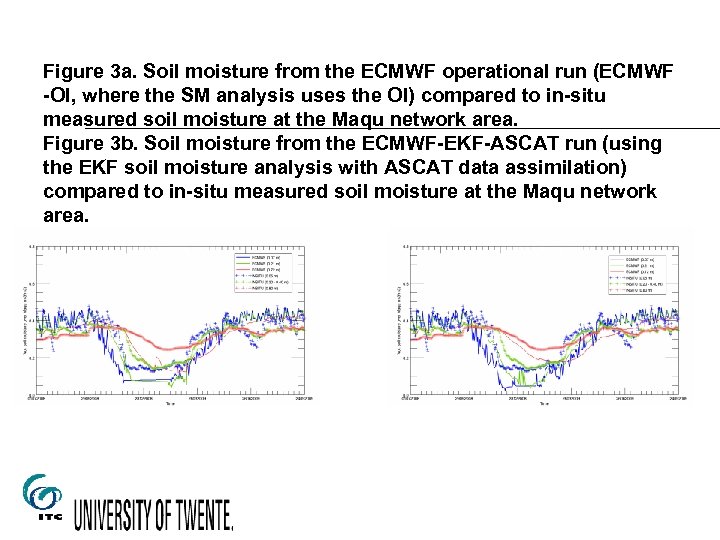 Figure 3 a. Soil moisture from the ECMWF operational run (ECMWF -OI, where the SM analysis uses the OI) compared to in-situ measured soil moisture at the Maqu network area. Figure 3 b. Soil moisture from the ECMWF-EKF-ASCAT run (using the EKF soil moisture analysis with ASCAT data assimilation) compared to in-situ measured soil moisture at the Maqu network area.
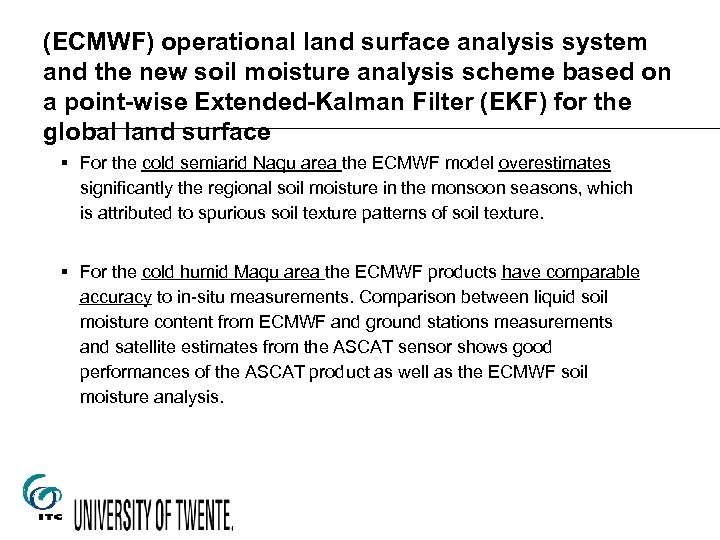 (ECMWF) operational land surface analysis system and the new soil moisture analysis scheme based on a point-wise Extended-Kalman Filter (EKF) for the global land surface § For the cold semiarid Naqu area the ECMWF model overestimates significantly the regional soil moisture in the monsoon seasons, which is attributed to spurious soil texture patterns of soil texture. § For the cold humid Maqu area the ECMWF products have comparable accuracy to in-situ measurements. Comparison between liquid soil moisture content from ECMWF and ground stations measurements and satellite estimates from the ASCAT sensor shows good performances of the ASCAT product as well as the ECMWF soil moisture analysis.
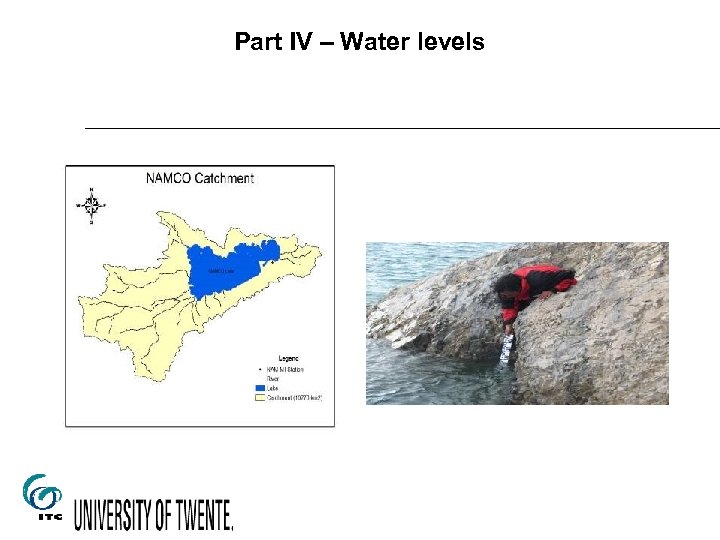 Part IV – Water levels
 ENVISAT PASS
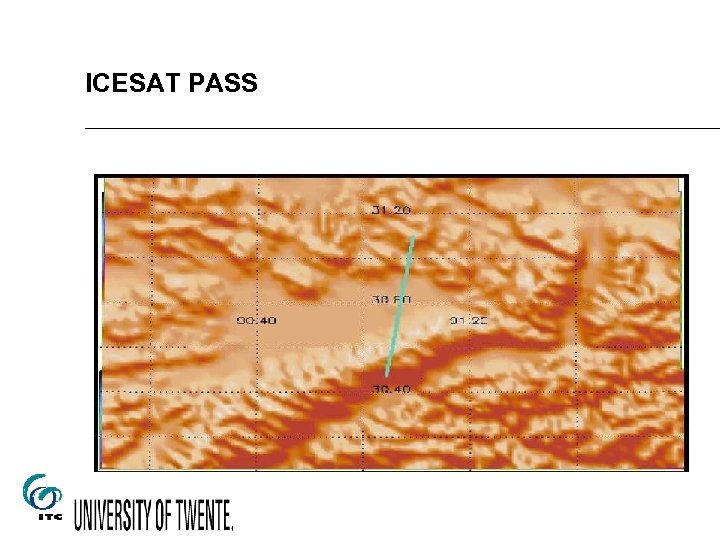 ICESAT PASS
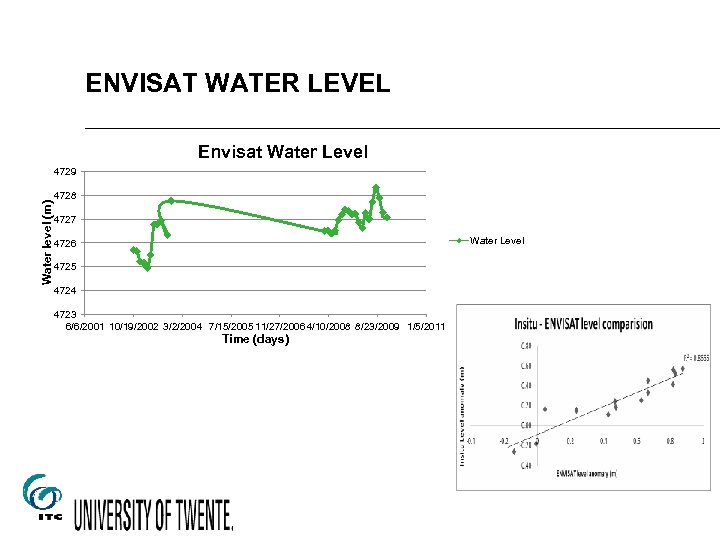 ENVISAT WATER LEVEL Envisat Water Level Water level (m) 4729 4728 4727 Water Level 4726 4725 4724 4723 6/6/2001 10/19/2002 3/2/2004 7/15/2005 11/27/2006 4/10/2008 8/23/2009 1/5/2011 Time (days)
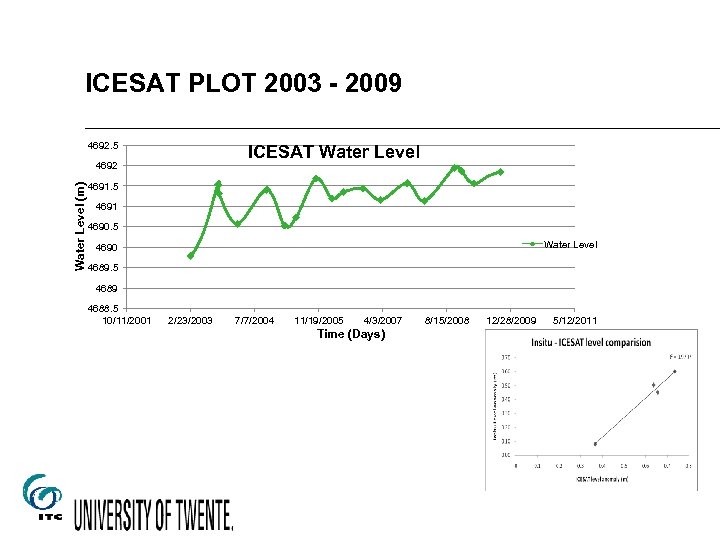 ICESAT PLOT 2003 - 2009 4692. 5 ICESAT Water Level (m) 4692 4691. 5 4691 4690. 5 Water Level 4690 4689. 5 4689 4688. 5 10/11/2001 2/23/2003 7/7/2004 11/19/2005 4/3/2007 Time (Days) 8/15/2008 12/28/2009 5/12/2011
 Conclusions § Global satellite products are useful but uncertain – use of them would be critically enhanced if uncertainties can be quantified using in-situ and high resolution data; § Long term satellite data (e. g. soil moisture) can be used to detect monsoon pattern changes; § Process level understanding is critical for generation of global products to be useful for climate change studies – attribution of causes. 36
 Recommendations § (Proposed action points or next steps) § Satellite observations in data scarce environment are critical for quantifying climatic impacts – space agencies should develop dedicated studies § Uncertainties in satellite observations needed to be quantified with in-situ reference observations data – data sharing is badly needed – a role for GEO to coordinate § Modeling results need to be verified before used in drawing conclusions about climatic impacts – NWP centers & science groups § Concerted actions needed to aggregate and analyze climatic impacts in data scare environment – role of IPCC § Existing studies need to be analyzed in detail – separating those based observation data with uncertainty certification from less rigorous studies – role of IPCC
 Referances/Further Readings § § • • § § Su, Z. , W. Wen, L. Dente, , R. van der Velde, 334 , L. Wang, Y. Ma, K. Yang, and Z. Hu (2011), A plateau scale soil moisture and soil temperature observatory for the quantification of uncertainties in coarse resolution satellite products, Hydrol. Earth Sys. Sci. – Dis. (http: //www. hydrol-earth-syst-sci-discuss. net/8/243/2011/) Su, Z. , P. de Rosnay, J. Wen, L. Wang, 2011, Ability of the ECMWF 1 model in simulating and analysis of root zone soil moisture on the Tibetan plateau, J. Geophys. R. (in review) van Der Velde, R. , Z. Su, 2009, Dynamics in land surface conditions on the Tibetan Plateau observed by ASAR, Hydrological sciences journal, 54(6), 1079 -1093. van der Velde, R. , Z. Su, and Y. Ma, 2008, Impact of soil moisture dynamics on ASAR signatures and its spatial variability observed over the Tibetan plateau. Sensors, 8(2008) 9, pp. 5479 -5491. van der Velde, R. , Z. Su, M. Ek, M. Rodell, and Y. Ma, 2009, Influence of thermodynamic soil and vegetation parameterizations on the simulation of soil temperature states and surface fluxes by the Noah LSm over a Tibetan plateau site, Hydrology and Earth System Sciences, 13, 759 -777 van der Velde, R. , M. Ofwono, Z. Su, Y. ma, 2010, Long term soil moisture mapping over the Tibetan plateau using Special Sensor Microwave Imager (SSM/I), L. Clim. (in review) Wen, J. , Z. Su, 2003, Estimation of soil moisture from ESA Wind-scatterometer data, Physics and Chemistry of the Earth, 28(1 -3), 53 -61. Wen, J. , Z. Su, 2004, An analytical algorithm for the determination of vegetation Leaf Area Index from TRMM/TMI data, International Journal of Remote Sensing, 25(6), 1223– 1234. Wen, J. , Z. Su, 2003, A Method for Estimating Relative Soil Moisture with ESA Wind Scatterometer Data, Geophysical Research Letters, 30 (7), 1397, doi: 10. 1029/ 2002 GL 016557. Wen, J. , Z. Su, Y. Ma, 2003, Determination of Land Surface Temperature and Soil Moisture from TRMM/TMI Remote Sensing Data, Journal of Geophysical Research, 108(D 2), 10. 1029/2002 JD 002176. Zhong, L. , Ma, Y. , Salama, M. S. , Su, Z. , 2010, Assessment of vegetation dynamics and their response to variations in precipitation and temperature in the Tibetan Plateau. Climatic change, DOI 10. 1007/s 10584 -009 -9787 -8. Zhong, L, Ma, Y. , Su, Z. , Salama, M. S. , 2010, Estimation of Land Surface Temperature over the Tibetan Plateau using AVHRR and MODIS Data, Adv. Atmos. Sci. , doi: 10. 1007/s 00376 -009 -9133 -0. 38