


 Скачать презентацию Quality Management and ISO 9001 Initiatives in
e577f8a5c684153ce1b3f03de3498564.ppt
- Количество слайдов: 36
 Quality Management and & ISO 9001 Initiatives in the Federal Aviation Administration Baltimore Section ASQ November 18, 2003 Frank Vojik MSQA Senior Project Analyst ICF Consulting
 What You Will Learn • Federal Aviation Administration – History – Structure • FAA Quality Management Initiatives • ANI Program Directorate – – – Purpose & Structure QMS Program Overview Elements of the QMS Documentation Enterprise Architecture Status 1
 What You Will NOT Learn • The contents of the ISO 9001: 2000 Standard (not directly) • How to Interpret its Requirements 2
 FAA Mission FAA provides a safe, secure, and efficient global aerospace system that contributes to national security and the promotion of US aerospace safety. As the leading authority in the international aerospace community, FAA is responsive to the dynamic nature of customer needs, economic conditions, and environmental concerns. 3
 Background and History • Federal Aviation Administration is one of 14 organizations in the Department of Transportation • Established in 1926 as the Aeronautics Branch of the Department of Commerce • Renamed Bureau of Air Commerce in 1934 • Civil Aeronautics Administration established 1940 to focus on ATC, certifications, safety and airway development • Federal Aviation Act of 1958 established Federal Aviation Agency • Federal Aviation Administration established in 1966 as part of newly established DOT. • National Airspace System (NAS) Plan established in 1982 4
 Terminology • Major functions in the FAA begins with the letter “A” and some are pretty intuitive…. . – AOA Ø “Office of the Administrator” – ATS Ø “Air Traffic Services” – ATCT Ø “Airport Traffic Control Tower” • And some are not……. – ASAP Ø “Aviation Safety Analysis Program” – AIM Ø “Aeronautical Information Manual” 5
 FAA Structure A Federal Agency employing 45, 000 people…… DOT - Department of Transportation FAA – Federal Aviation Administration ARA – Acquisitions & Research ATS – Air Traffic Services AAT - Air Traffic Service AAF - Airways Facilities AOP – NAS Operations ANI – NAS Implementation 6
 Quality Management in FAA Current ISO Certified FAA Directorates • AML - Logistics Center, Oklahoma City • ASU 200 - part of Acquisition Group • ACT-400 - Testing Lab at Tech Center, Atlantic City 7
 Quality Management in FAA Directorates Preparing for ISO Certification • ANI – National Airspace System Implementation a Program Directorate of Airways Facilities 8
 ANI Structure • Established in 1996 • Project Management Focus • Implementation Centers at Nine FAA Regional Offices, over 1500 Employees at · · · · · Boston New York Atlanta Chicago Kansas City Fort Worth Anchorage Seattle Los Angeles Washington (ANE - New England) (AEA - Eastern) (ASO - Southern) (AGE - Great Lakes) (ACE - Central) (ASW - Southwest) (AAL - Alaska) (ANM - Northwest Mountain) (AWP - Western Pacific) (EC - Engineering Center) 9
 ANI History & Structure ANI is concerned with the modernization of facilities and equipment that support the NAS – Runways – Airport Control Towers – Radar Installations – Instrument Landing Systems – Buildings and Equipment – HVAC, etc. 10
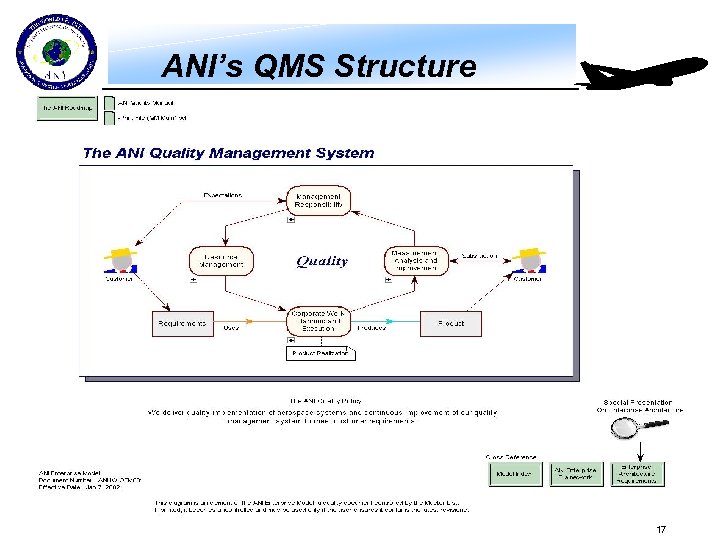
 ANI’s QMS Structure The ANI Program Director is “Top Management” He is supported by • National Quality Manager – Document Controller – Enterprise Modeler – 2 Quality Engineers – 2 Contractors • National Document Control Board • Document Development Teams across ANI • Local Quality Councils exist at the 10 Implementation Centers 11
 ANI’s Customers Internal – FAA Regions, Traffic Control Centers, FAA Ops, System Management Offices External - Local and Regional Airport authorities 12
 ANI’s Quality Policy We deliver quality implementation of aerospace systems and continuous improvement of our quality management system to meet customer requirements 13
 ANI’s Quality Objectives • Improve our on-time and on-budget execution of NAS implementation projects. • Provide quality implementation through the delivery of complete and impeccably finished work that fulfills the scope agreement. • Minimize adverse impacts to NAS operations resulting from NAS modernization activities. 14
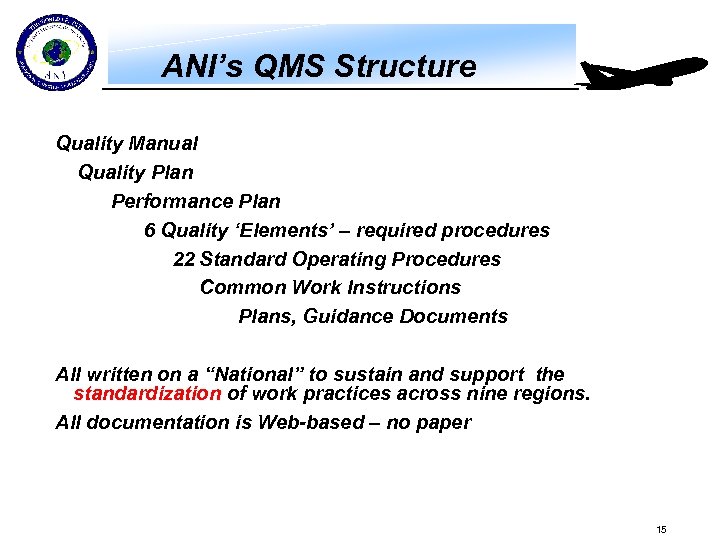 ANI’s QMS Structure Quality Manual Quality Plan Performance Plan 6 Quality ‘Elements’ – required procedures 22 Standard Operating Procedures Common Work Instructions Plans, Guidance Documents All written on a “National” to sustain and support the standardization of work practices across nine regions. All documentation is Web-based – no paper 15
 ANI’s QMS Structure Registration Protocol: • One certificate for all nine Regional Implementation Centers and the Washington Engineering Center. • Boston, Fort Worth, Seattle, and Engineering Center will be assessed first, with other ICs to follow • Registrar: Lloyd’s Registered Quality Assurance 16
 ANI’s QMS Structure 17
 Documentation Structure ANI employs an ‘Enterprise Architecture Model’ as a critical element of the documentation: • An architecture is the structure of components, their relationships, and the principles and guidelines that govern their design and evolution over time. • Statement of “current state” or “to be” characteristics of an organization, including: – Business processes – Information flow and interrelationships – Applications – Data descriptions 18
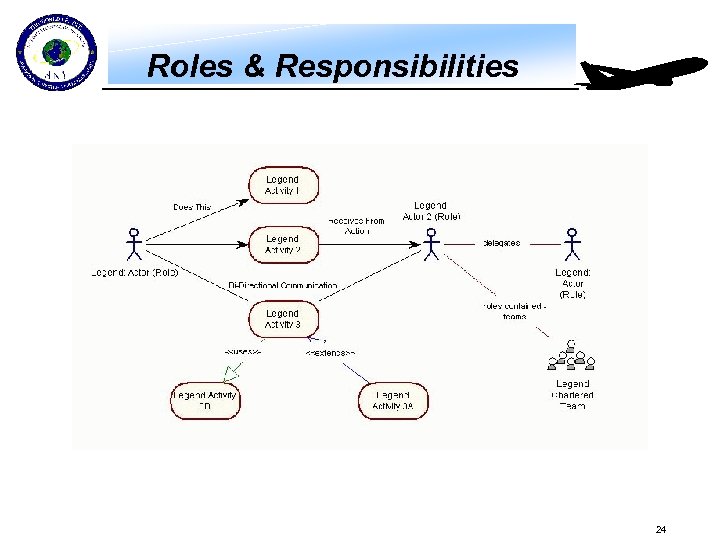
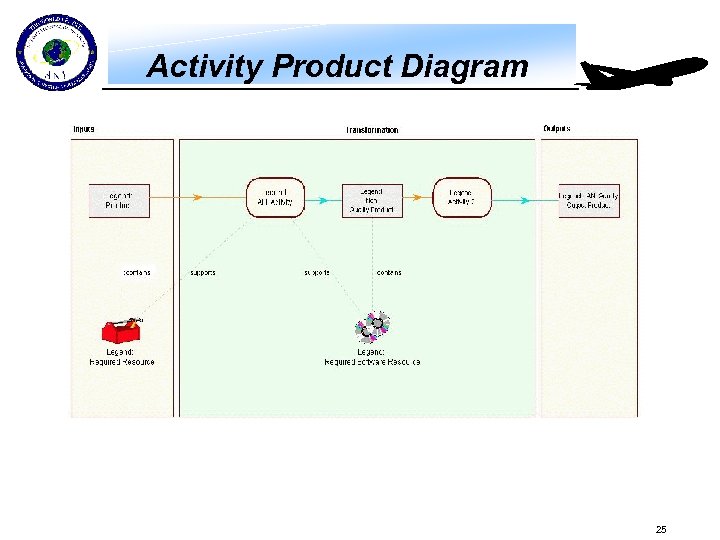
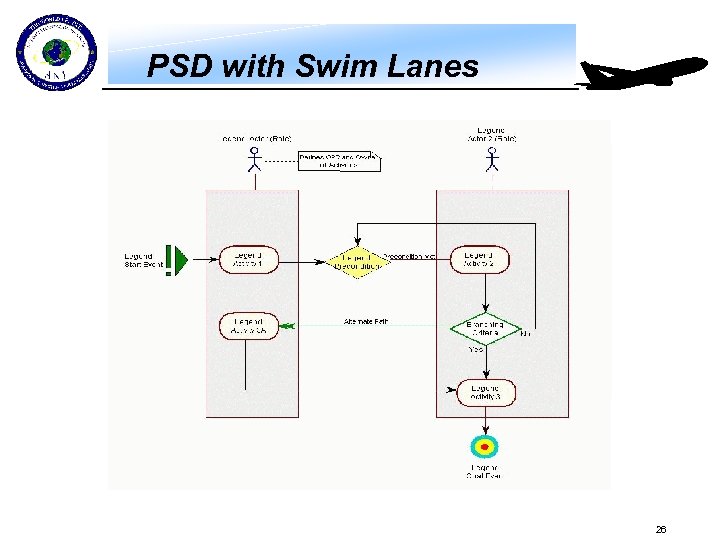
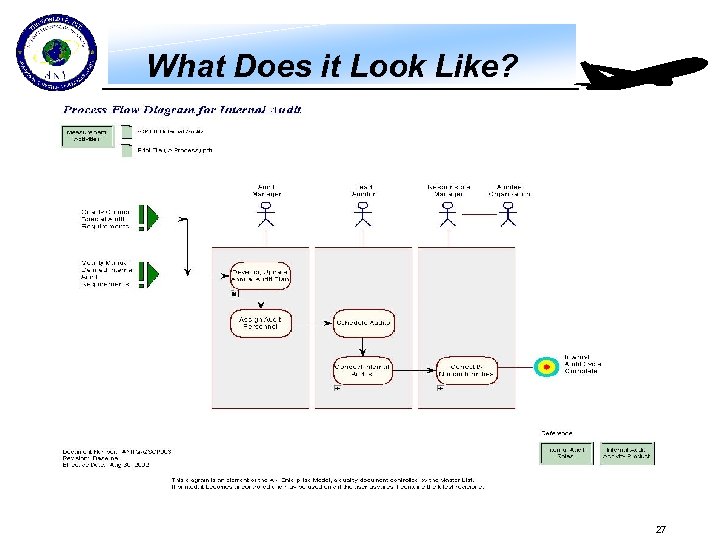
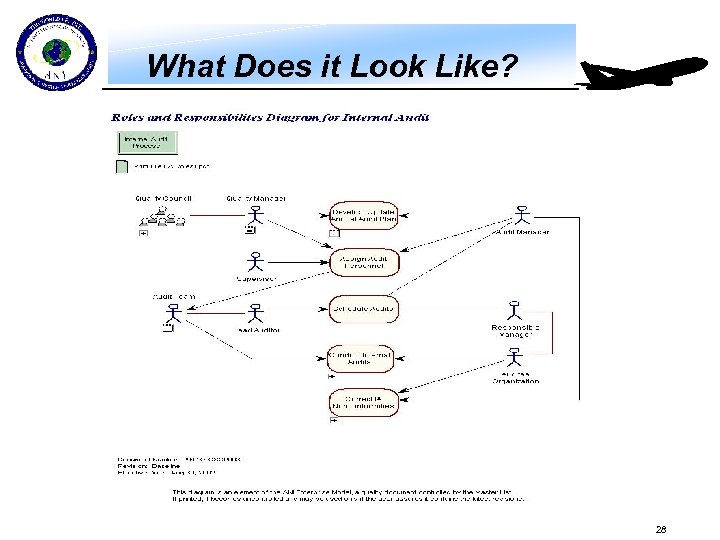
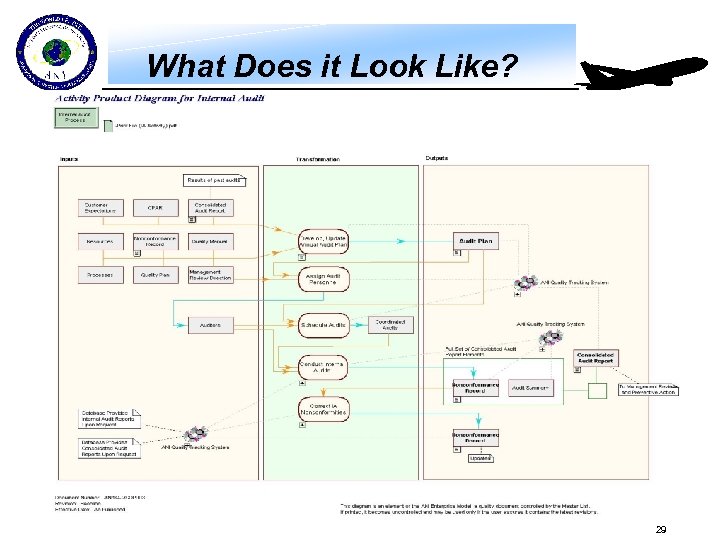
 Documentation Structure The ANI Enterprise Model is a searchable, intelligent, graphical knowledge base of the ANI organization. It was developed using a P-Tech framework, an object-oriented modeling and analysis tool. It contains all ANI Quality Processes and Work Instructions Each process is presented as a series of diagrams that depict: – The Sequence and Interaction of Events – Roles and Responsibilities – Input – Output Diagrams – Product State Relationships 19
 Documentation Structure Why does ANI Use Enterprise Architecture? – Statutory and Regulatory Reasons – Articulated Architecture eases the burden of managing: - Employee Roles - Business Practices - How and Where to Use Metrics to Assess Performance - I. T. Needs – Provides a Single Repository of Knowledge about the Organization. 20
 Documentation Structure Modeling Requirements – Standard Documentation Format – Standard Ptech Symbols – Standard Ptech Syntax – Fitness for Use 21
 Documentation Structure Modeling Order: Develop – Process Step Diagram – Roles and Responsibilities Diagram Ø “What do you do, and who you do it with” – Activity Process Diagram – Develop Process State Diagram with Swim Lanes 22
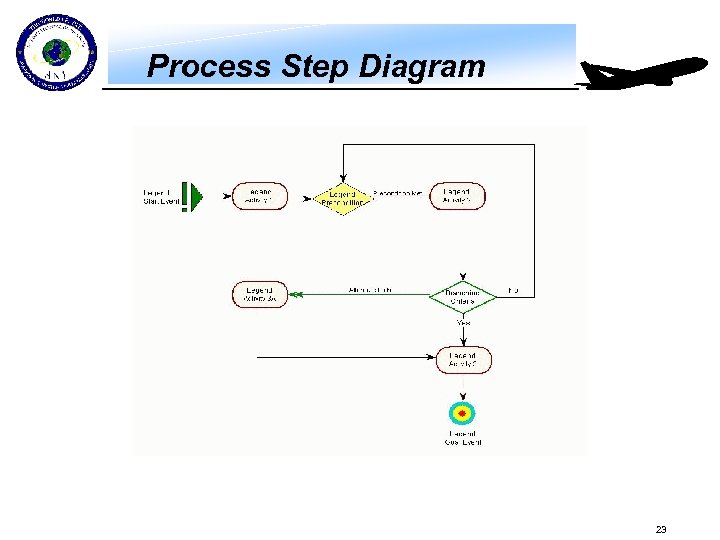 Process Step Diagram 23
 Roles & Responsibilities 24
 Activity Product Diagram 25
 PSD with Swim Lanes 26
 What Does it Look Like? 27
 What Does it Look Like? 28
 What Does it Look Like? 29
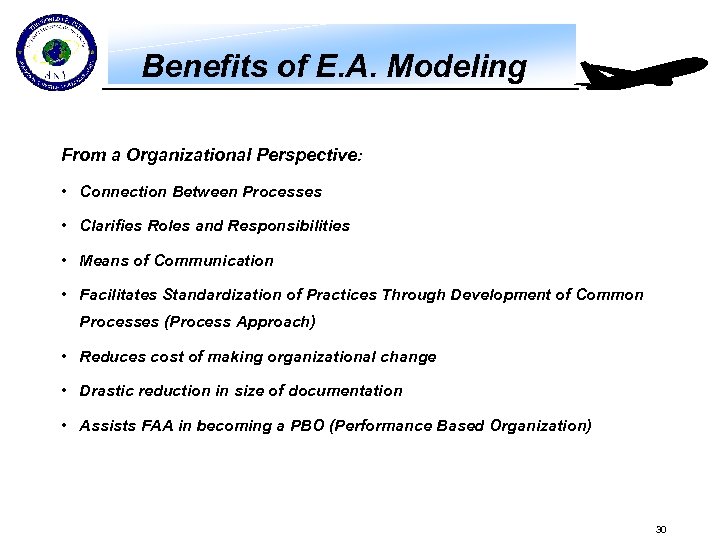 Benefits of E. A. Modeling From a Organizational Perspective: • Connection Between Processes • Clarifies Roles and Responsibilities • Means of Communication • Facilitates Standardization of Practices Through Development of Common Processes (Process Approach) • Reduces cost of making organizational change • Drastic reduction in size of documentation • Assists FAA in becoming a PBO (Performance Based Organization) 30
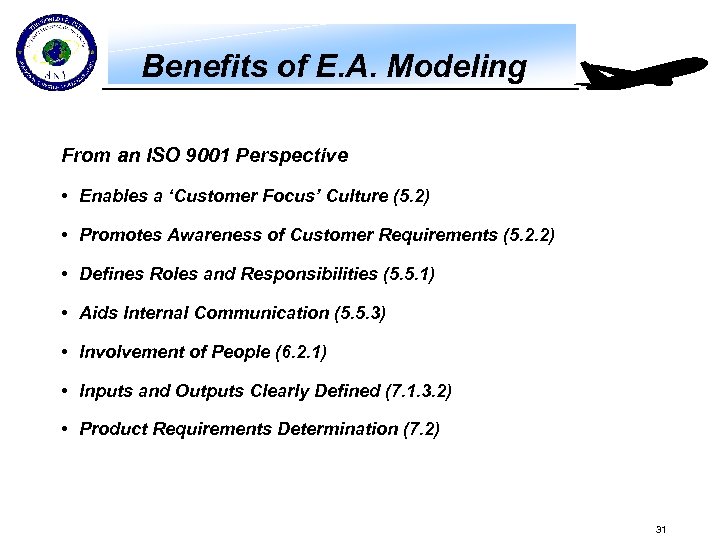 Benefits of E. A. Modeling From an ISO 9001 Perspective • Enables a ‘Customer Focus’ Culture (5. 2) • Promotes Awareness of Customer Requirements (5. 2. 2) • Defines Roles and Responsibilities (5. 5. 1) • Aids Internal Communication (5. 5. 3) • Involvement of People (6. 2. 1) • Inputs and Outputs Clearly Defined (7. 1. 3. 2) • Product Requirements Determination (7. 2) 31
 Current Status • National and Local Quality Councils established • Quality System Procedures completed, undergoing organizational revisions • Common Work Instructions still under development • Lead Auditors and Associate Auditors Trained • ISO Awareness Briefings completed 32
 Future Work • Training on Procedures and Work Instructions • Make the QMS operational • Interpersonal Skills Training for Auditors • Corrective and Preventive Action Analyst Training • Conduct ‘Complete’ Management Reviews and Internal Audits • Organizational Assessment – target late 2004 / early 2005 33
 In Summary • Standardization of Practices • Employee Communication • FAA is becoming much more cost conscious • Public sector organizations need to meet customer requirements • Quality Management can work in the public sector 34
 Questions? 35