


 Скачать презентацию Quality Management 1 Definitions of Quality is
6f18699703ab8b0096d54ee9f6c4058d.ppt
- Количество слайдов: 75
 Quality Management 1
 Definitions of Quality is the ability of a product or service to consistently meet or exceed customer expectations. Quality is a service’s and product’s fitness for its intended use 2
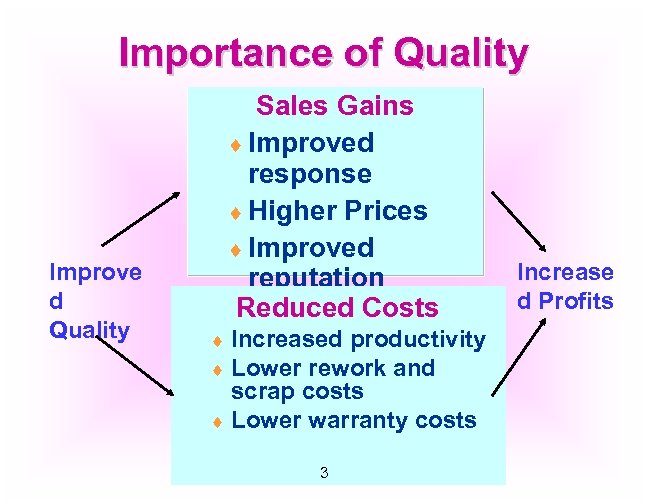 Importance of Quality Improve d Quality Sales Gains ¨ Improved response ¨ Higher Prices ¨ Improved reputation Reduced Costs ¨ Increased productivity volume ¨ Lower rework and scrap costs ¨ Lower warranty costs 3 Increase d Profits
 Dimensions of Quality (1 of 2) ¨Performance – basic operating characteristics of the product/service ¨Aesthetics - appearance, feel, sound, smell, taste ¨Special Features - extra items added to the basic characteristics ¨Conformance - how well product/service conforms to customer’s expectations, meeting preestablished standards Qualit y ¨Reliability - consistency of performance, probability product will operate over time 4
 Dimensions of Quality (2 of 2) ¨ Durability – useful life of the product/service. Life span before replacement ¨ Safety- freedom from injury or harm ¨ Perceived Quality – subjective perceptions based on brand name, advertising, etc. indirect evaluation of quality (e. g. reputation) ¨ Serviceability – service after sale, ease of getting repairs, speed & competence of repairs 5
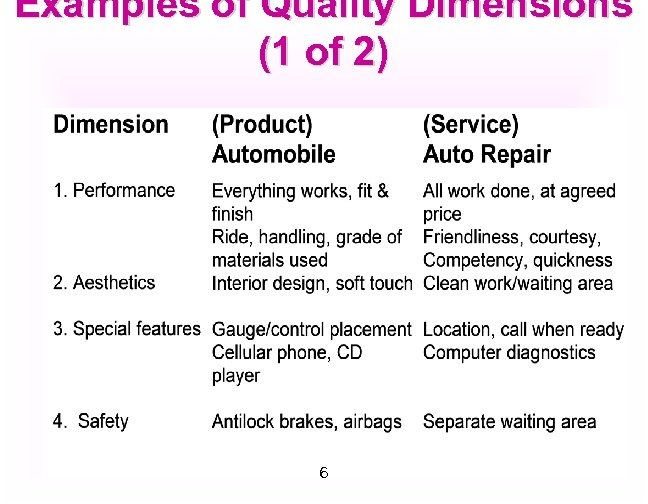 Examples of Quality Dimensions (1 of 2) 6
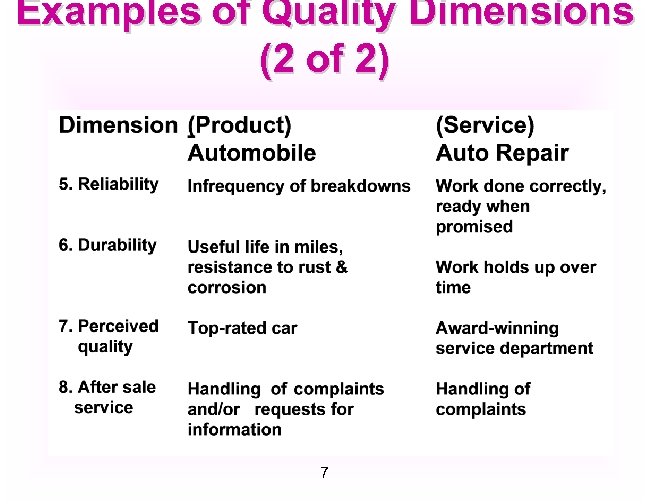 Examples of Quality Dimensions (2 of 2) 7
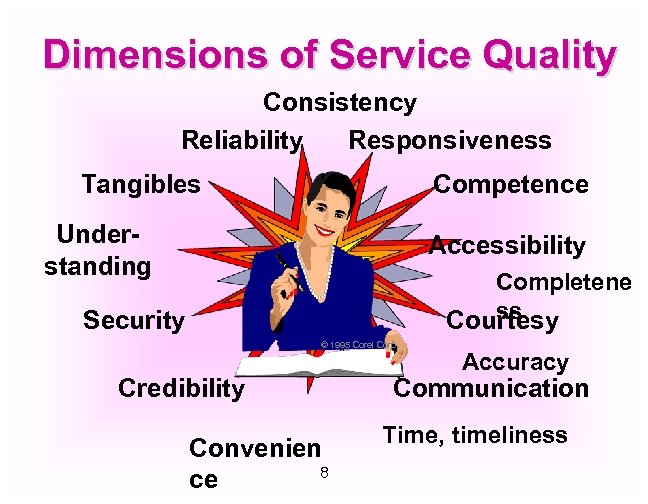 Dimensions of Service Quality Consistency Reliability Responsiveness Tangibles Competence Understanding Accessibility Completene ss Courtesy Security © 1995 Corel Corp. Credibility Convenien 8 ce Accuracy Communication Time, timeliness
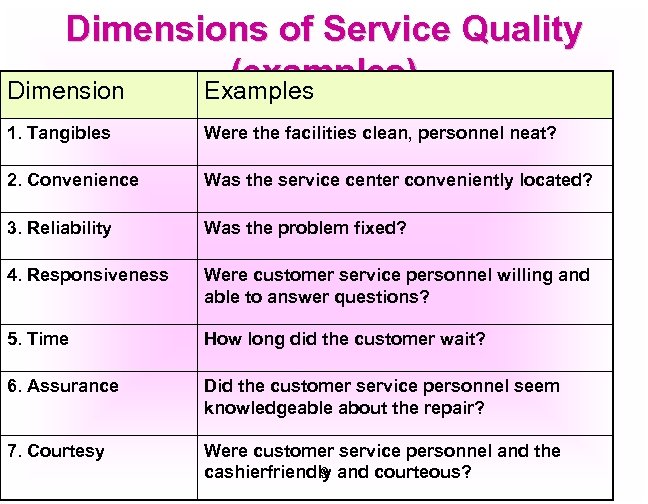 Dimensions of Service Quality (examples) Dimension Examples 1. Tangibles Were the facilities clean, personnel neat? 2. Convenience Was the service center conveniently located? 3. Reliability Was the problem fixed? 4. Responsiveness Were customer service personnel willing and able to answer questions? 5. Time How long did the customer wait? 6. Assurance Did the customer service personnel seem knowledgeable about the repair? 7. Courtesy Were customer service personnel and the 9 cashierfriendly and courteous?
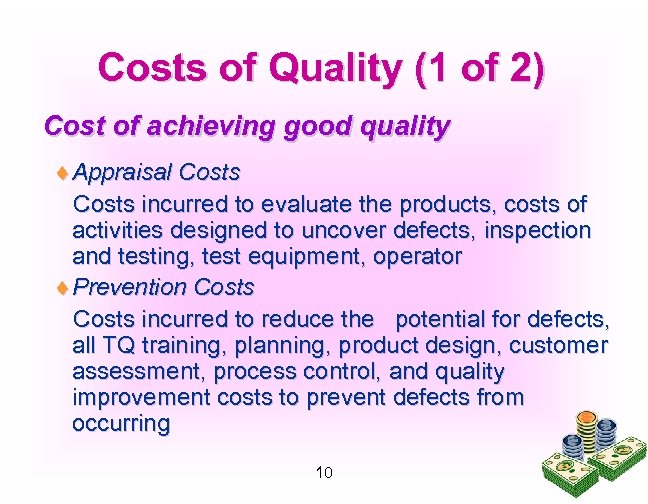 Costs of Quality (1 of 2) Cost of achieving good quality ¨Appraisal Costs incurred to evaluate the products, costs of activities designed to uncover defects, inspection and testing, test equipment, operator ¨Prevention Costs incurred to reduce the potential for defects, all TQ training, planning, product design, customer assessment, process control, and quality improvement costs to prevent defects from occurring 10
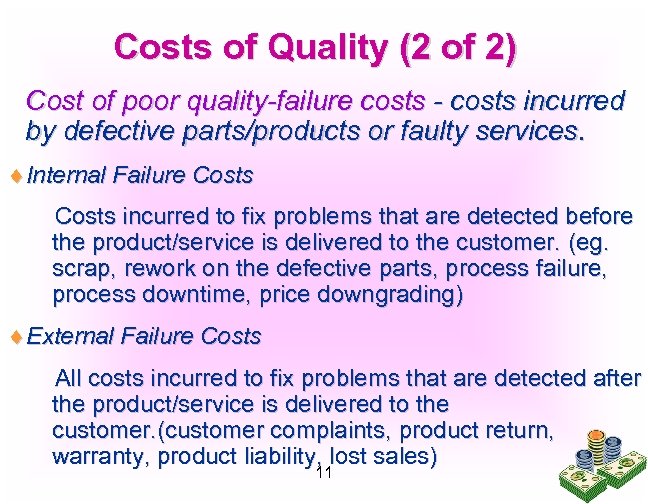 Costs of Quality (2 of 2) Cost of poor quality-failure costs - costs incurred by defective parts/products or faulty services. ¨Internal Failure Costs incurred to fix problems that are detected before the product/service is delivered to the customer. (eg. scrap, rework on the defective parts, process failure, process downtime, price downgrading) ¨External Failure Costs All costs incurred to fix problems that are detected after the product/service is delivered to the customer. (customer complaints, product return, warranty, product liability, lost sales) 11
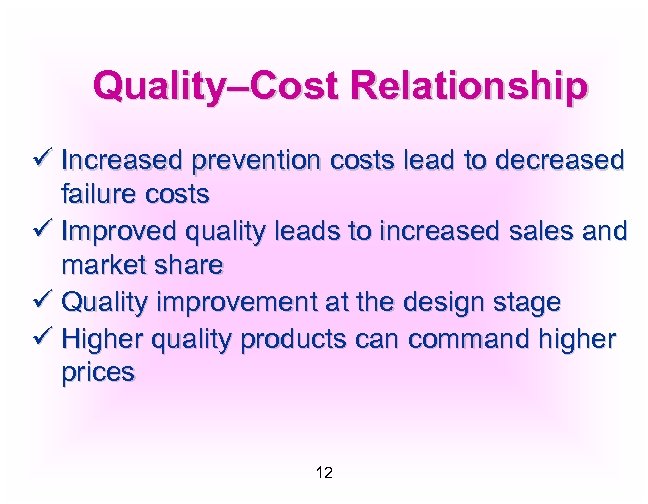 Quality–Cost Relationship ü Increased prevention costs lead to decreased failure costs ü Improved quality leads to increased sales and market share ü Quality improvement at the design stage ü Higher quality products can command higher prices 12
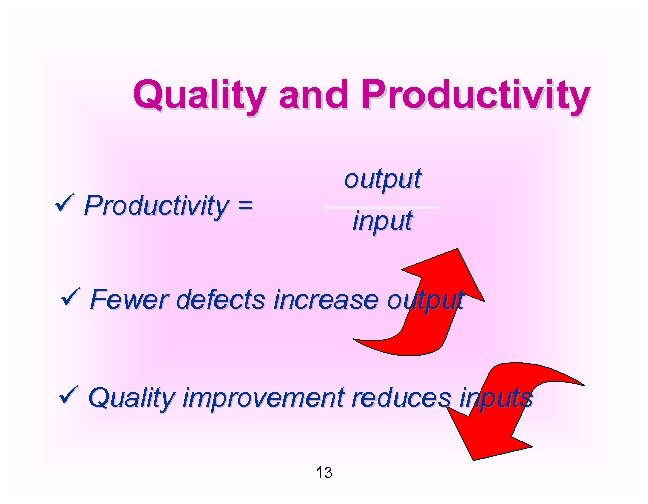 Quality and Productivity output input ü Productivity = ü Fewer defects increase output ü Quality improvement reduces inputs 13
 Determinants of Quality ¨ Design (quality of) Intention of designers to include or exclude features in a product or service ¨ Conformance (quality of) ¨ The degree to which goods or services conform to the intent of the designers, ensuring product or service produced according to design (degree to which the design specifications are met) Depends on: ¨ Design of production process ¨ Performance of machinery ¨ Materials 14 ¨ Training ¨
 Other Determinants That Affect Quality ¨ Production/operations system ¨ Packaging and shipping ¨ Marketing and sales ¨ Value-added services ¨ Quality Systems ¨ Top management 15
 Evolution of Quality Management ¨ 1924 - Statistical process control charts ¨ 1930 - Tables for acceptance sampling ¨ 1940’s - Statistical sampling techniques ¨ 1950’s - Quality assurance/TQC ¨ 1960’s - Zero defects ¨ 1970’s - Quality assurance in services 16
 Quality Assurance vs. Strategic Approach ¨ Quality Assurance ¨ Emphasis on finding and correcting defects before reaching market ¨ Strategic Approach ¨ Proactive, focusing on preventing mistakes from occurring ¨ Greater emphasis on customer satisfaction 17
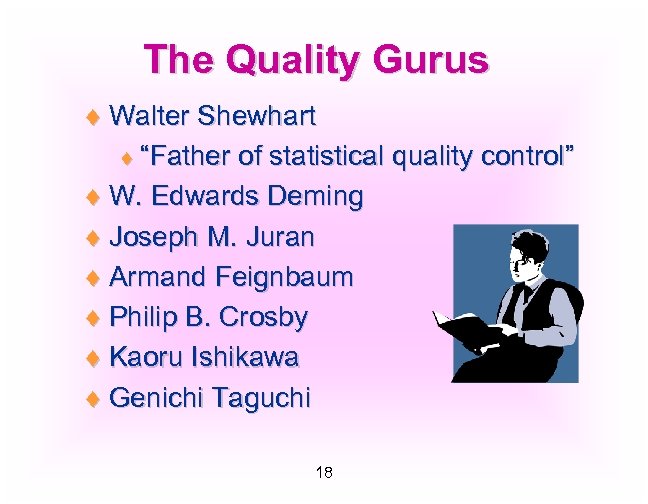 The Quality Gurus ¨ Walter Shewhart ¨ “Father of statistical quality control” ¨ W. Edwards Deming ¨ Joseph M. Juran ¨ Armand Feignbaum ¨ Philip B. Crosby ¨ Kaoru Ishikawa ¨ Genichi Taguchi 18
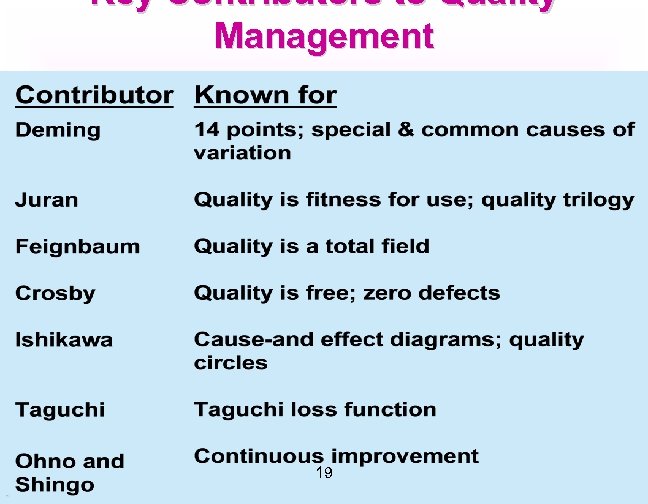 Key Contributors to Quality Management 19
 Total Quality Management T Q 20 M
 TQM ¨ Encompasses entire organization, from supplier to customer ¨ Stresses a commitment by management to have a continuing, company-wide drive toward excellence on all dimensions of products and services that are important to the customer ¨ Can be defined as a philosophy that involves everyone in an organization in a continual effort to improve quality and achieve customer 21 satisfaction.
 TQM Throughout the Organization ü Marketing, sales, research ü Engineering ü Purchasing ü Human resources ü Management ü Packing, storing, shipping ü After-sale support 22
 Quality Principles (Elements of TQM) ¨ Customer focus ¨ Continuous improvement ¨ Employee empowerment ¨ Close relations with external suppliers ¨ Team approach ¨ Quality at the source ¨ Supplier quality ¨ Decision based on facts ¨ Knowledge of TQM tools Yields: How to do what is important and to 23 be accomplished
 Employee Fulfillment ¨ Empowerment ¨ Organizational commitment Yields: Employees’ attitudes that they can accomplish what is important and to be accomplished 24
 TQM and External Suppliers ü Support of suppliers required to satisfy customer expectations ü Single-sourcing ü Partnering ü Suppliers may be required to adopt quality programs or meet specific standards 25
 Customer Satisfaction ¨ Winning orders, loyal customers, repeated sales ¨ Requires some form of measurement system ¨ Customer surveys are widely used ¨ Total customer satisfaction is often an organization’s overriding objective Yields: An effective organization with a competitive advantage 26
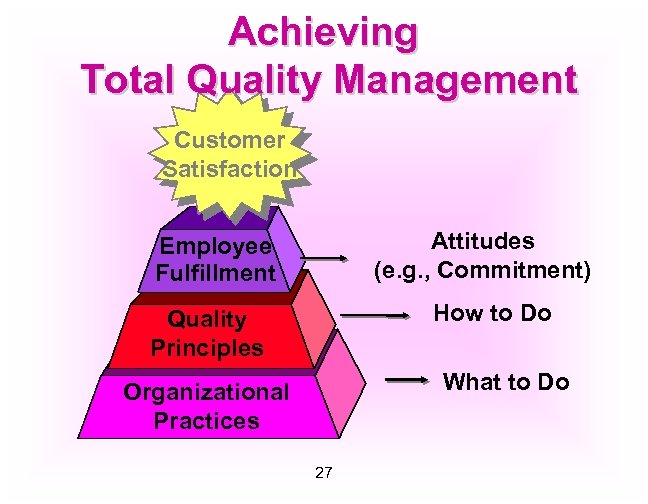 Achieving Total Quality Management Customer Satisfaction Attitudes (e. g. , Commitment) Employee Fulfillment How to Do Quality Principles What to Do Organizational Practices 27
 Continuous Improvement ¨ Philosophy that seeks to make neverending improvements to the process of converting inputs into outputs to assure customer satisfaction ¨ Involves all operations & work units ¨ Other names Kaizen (Japanese) ¨ Zero-defects ¨ Six sigma ¨ 28
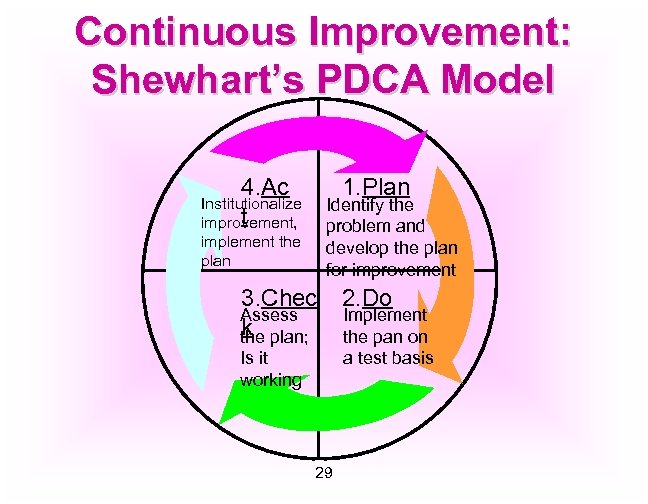 Continuous Improvement: Shewhart’s PDCA Model 4. Ac Institutionalize t improvement, 1. Plan Identify the problem and develop the plan for improvement implement the plan 3. Chec Assess k the plan; Is it working 29 2. Do Implement the pan on a test basis
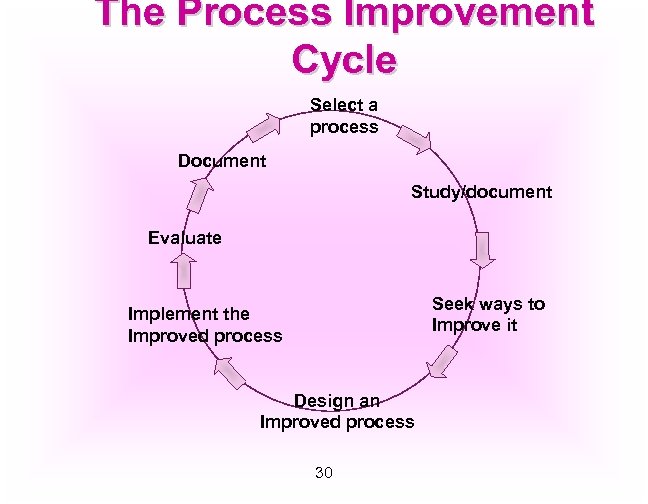 The Process Improvement Cycle Select a process Document Study/document Evaluate Seek ways to Improve it Implement the Improved process Design an Improved process 30
 Six Sigma Quality ¨ Statistically ¨ Having no more than 3. 4 defects per million ¨ Conceptually A philosophy and set of methods companies use to eliminate defects in their products and processes ¨ Seeks to reduce variation in the processes that lead to product defects ¨ The name, “six sigma” refers to the variation that exists within plus or minus six standard deviations of the process outputs ¨ Requires the use of certain tools and 31 techniques ¨
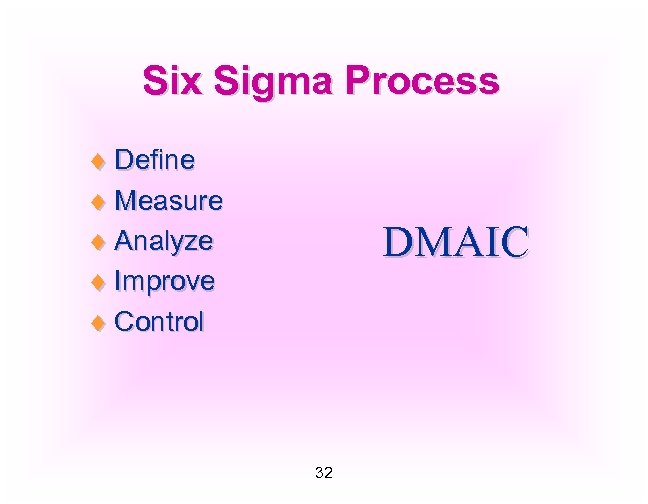 Six Sigma Process ¨ Define ¨ Measure ¨ Analyze ¨ Improve ¨ Control DMAIC 32
 Employees and Quality Improvement ü Employee involvement ü Quality circles ü Process improvement teams ü Employee suggestions 33
 Employee Empowerment ¨ Getting employees involved in product & process improvements ¨ 85% of quality problems are due to process & material ¨ Techniques of employee empowerment Support workers ¨ Let workers make decisions ¨ Build teams & quality circles ¨ 34 © 1995 Corel Corp.
 Quality at the Source The philosophy of making each worker responsible for the quality of his or her work. 35
 Employee Empowerment Technique: Quality Circles ¨ Group of 6 -12 employees from same work area ¨ Meet regularly to solve work-related problems ¨ 4 hours/month ¨ Facilitator trains & helps with meetings © 1995 Corel Corp. 36
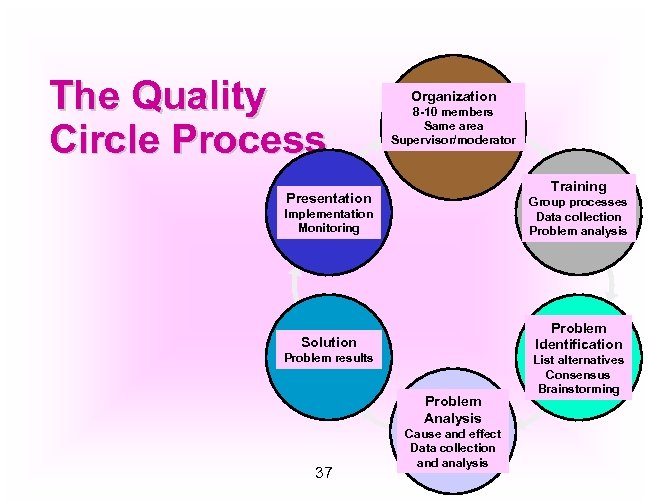 The Quality Circle Process Organization 8 -10 members Same area Supervisor/moderator Training Presentation Implementation Monitoring Group processes Data collection Problem analysis Solution Problem Identification Problem results Problem Analysis 37 Cause and effect Data collection and analysis List alternatives Consensus Brainstorming
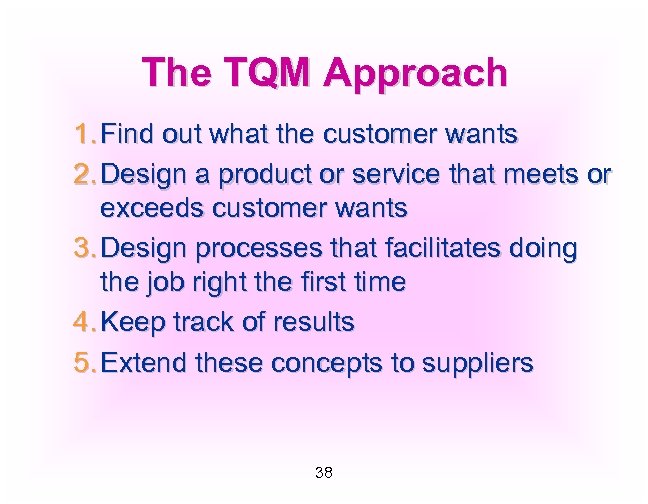 The TQM Approach 1. Find out what the customer wants 2. Design a product or service that meets or exceeds customer wants 3. Design processes that facilitates doing the job right the first time 4. Keep track of results 5. Extend these concepts to suppliers 38
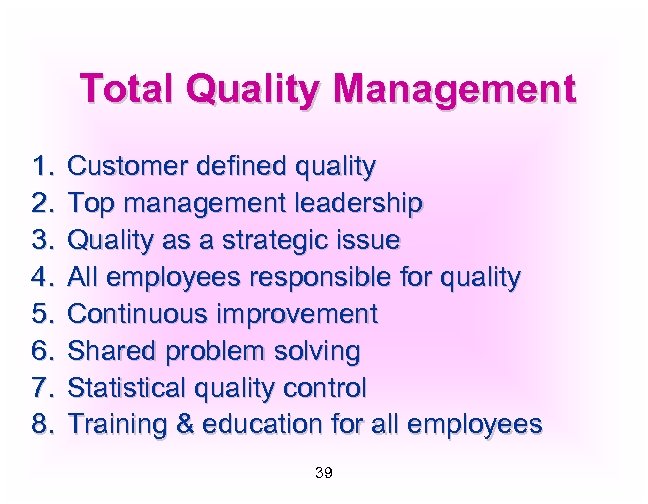 Total Quality Management 1. 2. 3. 4. 5. 6. 7. 8. Customer defined quality Top management leadership Quality as a strategic issue All employees responsible for quality Continuous improvement Shared problem solving Statistical quality control Training & education for all employees 39
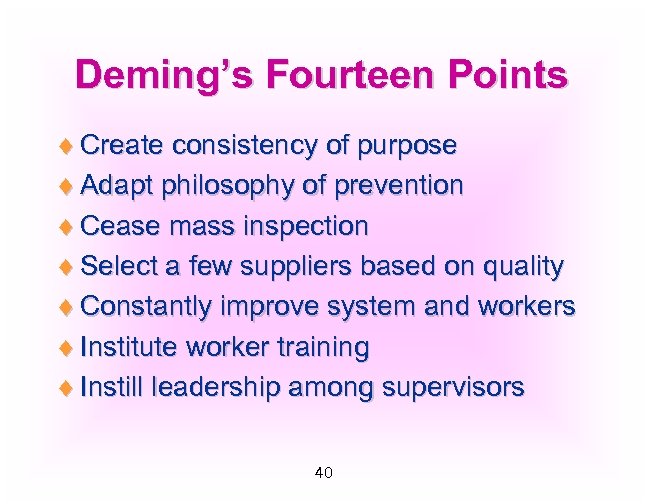 Deming’s Fourteen Points ¨ Create consistency of purpose ¨ Adapt philosophy of prevention ¨ Cease mass inspection ¨ Select a few suppliers based on quality ¨ Constantly improve system and workers ¨ Institute worker training ¨ Instill leadership among supervisors 40
 Deming’s Points - continued ¨ Eliminate fear among employees ¨ Break down barriers between departments ¨ Eliminate slogans ¨ Remove numerical quotas ¨ Enhance worker pride ¨ Institute vigorous training and education programs ¨ Develop commitment from top 41 management to implement these 13
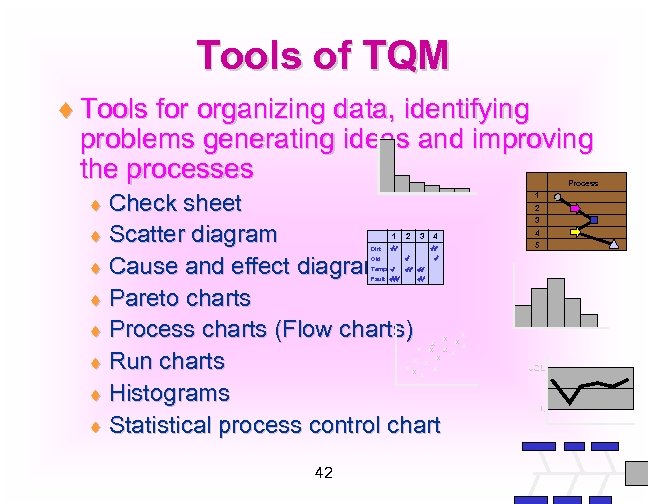 Tools of TQM ¨ Tools for organizing data, identifying problems generating ideas and improving the processes Process ¨ Check sheet 1 2 3 ¨ Scatter diagram 1 2 3 4 Dirt 4 5 ¨ Cause and effect diagram Old Temp Fault ¨ Pareto charts ¨ Process charts (Flow charts) x xx x x x ¨ Run charts ¨ Histograms ¨ Statistical process control chart 42 UCL LCL
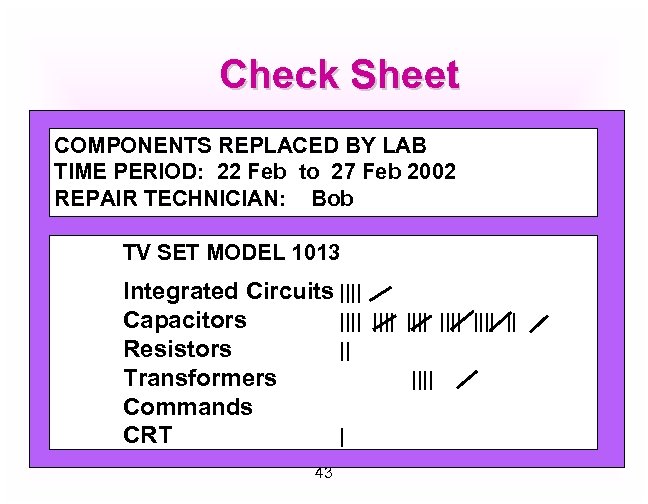 Check Sheet COMPONENTS REPLACED BY LAB TIME PERIOD: 22 Feb to 27 Feb 2002 REPAIR TECHNICIAN: Bob TV SET MODEL 1013 Integrated Circuits |||| Capacitors |||| |||| || Resistors || Transformers |||| Commands CRT | 43
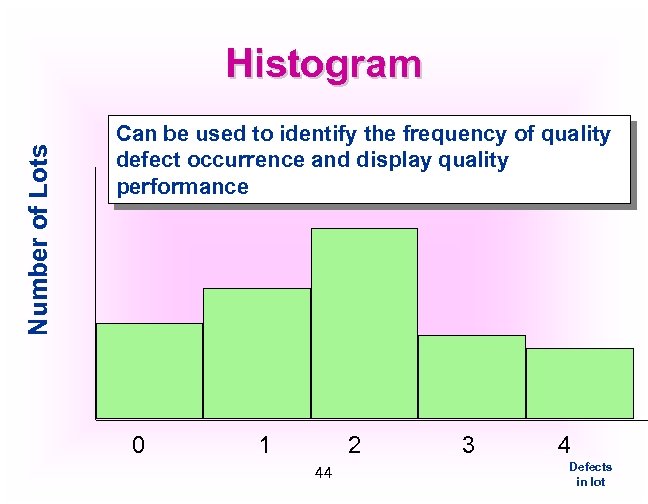 Number of Lots Histogram Can be used to identify the frequency of quality defect occurrence and display quality performance 0 1 2 44 3 4 Defects in lot
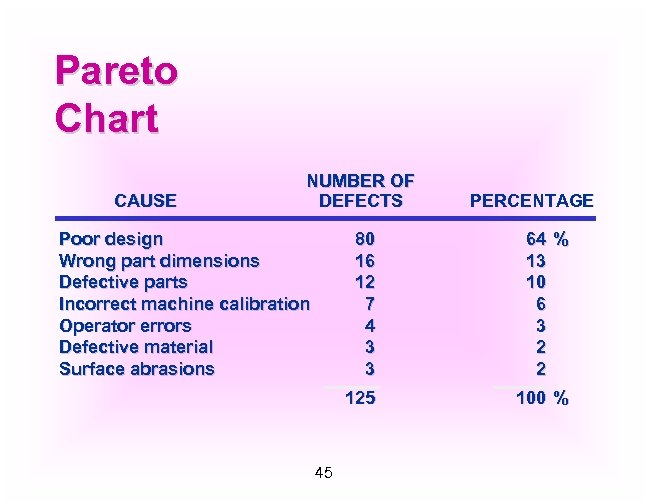 Pareto Chart CAUSE NUMBER OF DEFECTS Poor design Wrong part dimensions Defective parts Incorrect machine calibration Operator errors Defective material Surface abrasions PERCENTAGE 80 16 12 7 4 3 3 125 45 64 % 13 10 6 3 2 2 100 %
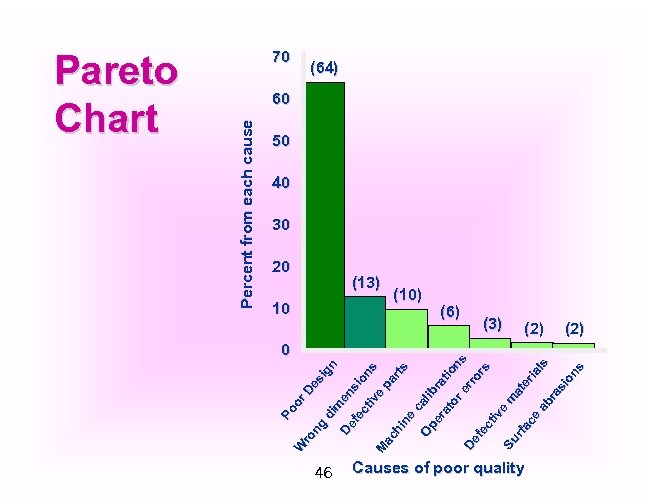 Po or De si gn di m en De si fe on ct iv s e M pa ac rts hi ne ca O pe libr at ra io to ns re De rr or fe s ct iv e Su m at rfa er ce ia ls ab ra si on s W ro ng Percent from each cause Pareto Chart 70 (64) 60 50 40 30 20 (13) 10 46 (10) (6) (3) (2) 0 Causes of poor quality (2)
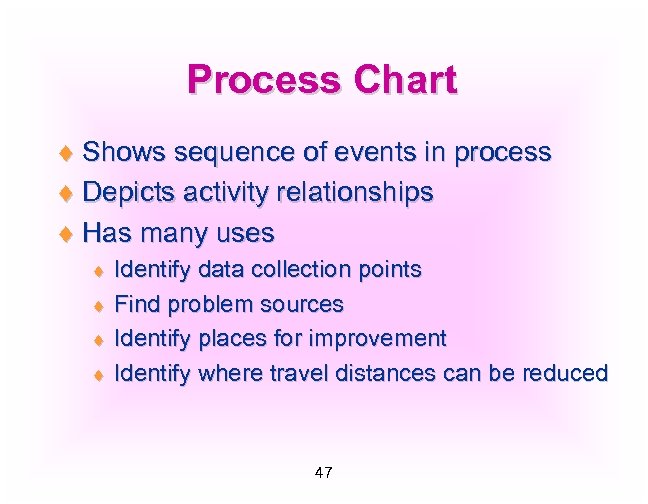 Process Chart ¨ Shows sequence of events in process ¨ Depicts activity relationships ¨ Has many uses Identify data collection points ¨ Find problem sources ¨ Identify places for improvement ¨ Identify where travel distances can be reduced ¨ 47
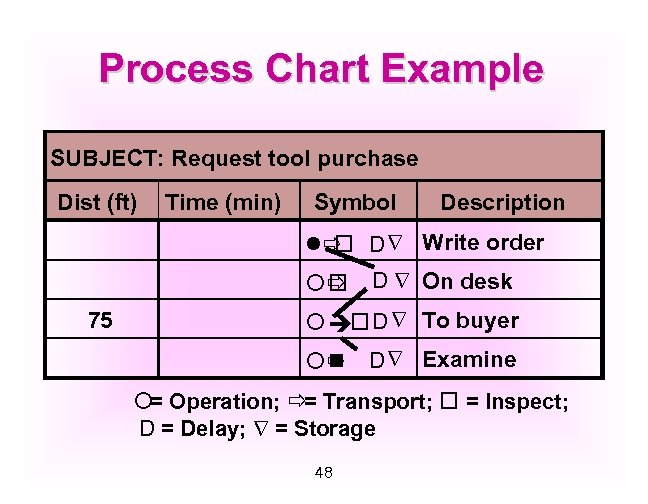 Process Chart Example SUBJECT: Request tool purchase Dist (ft) Time (min) Symbol Description lð D Ñ Write order o ¡ð o 75 D Ñ On desk ¡ èo. D Ñ To buyer ¡ð D Ñ Examine n ¡= Operation; ð= Transport; o = Inspect; D = Delay; Ñ = Storage 48
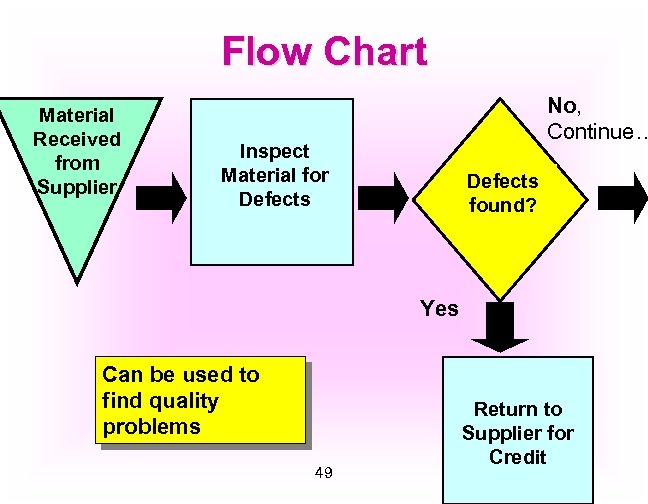 Flow Chart Material Received from Supplier No, Continue… Inspect Material for Defects found? Yes Can be used to find quality problems 49 Return to Supplier for Credit
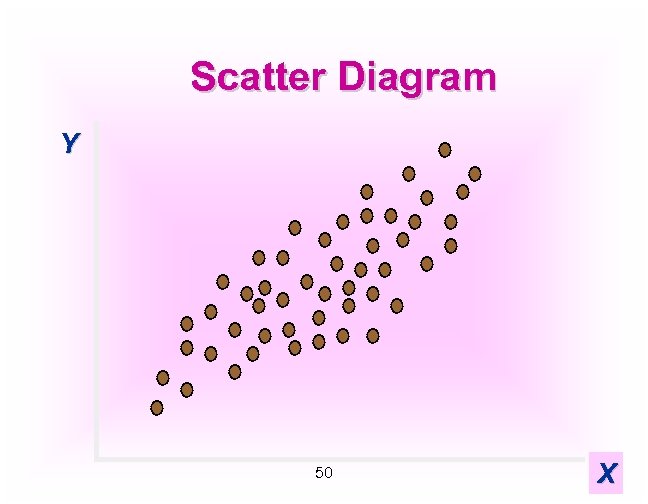 Scatter Diagram Y 50 X
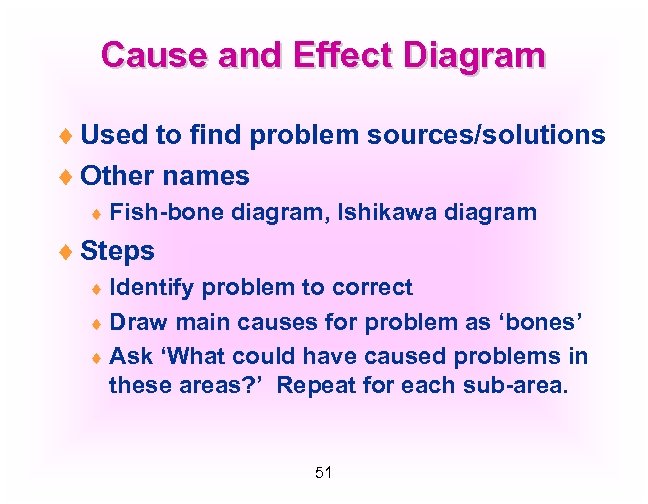 Cause and Effect Diagram ¨ Used to find problem sources/solutions ¨ Other names ¨ Fish-bone diagram, Ishikawa diagram ¨ Steps ¨ Identify problem to correct ¨ Draw main causes for problem as ‘bones’ ¨ Ask ‘What could have caused problems in these areas? ’ Repeat for each sub-area. 51
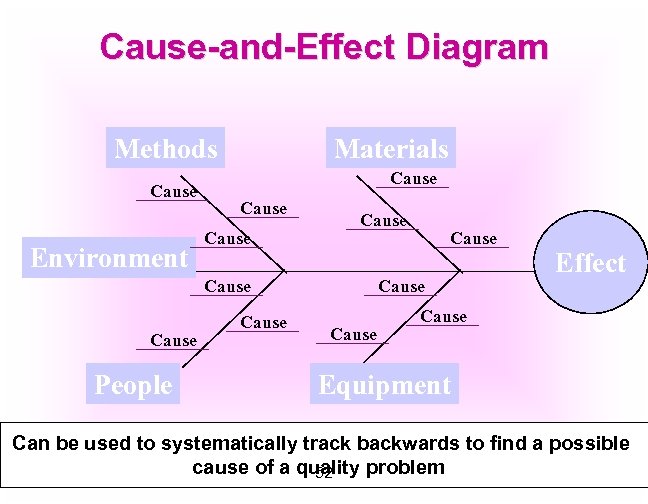 Cause-and-Effect Diagram Methods Cause Environment Materials Cause Cause People Cause Effect Cause Equipment Can be used to systematically track backwards to find a possible cause of a quality problem 52
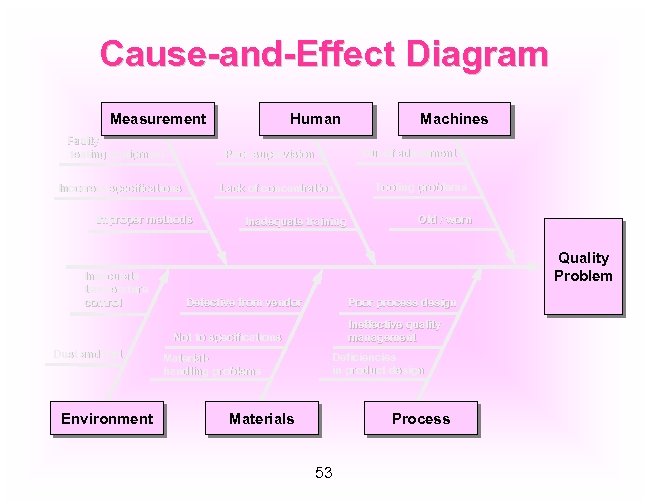 Cause-and-Effect Diagram Measurement Faulty testing equipment Lack of concentration Improper methods Inadequate training Environment Tooling problems Old / worn Quality Problem Poor process design Defective from vendor Ineffective quality management Not to specifications Dust and Dirt Machines Out of adjustment Poor supervision Incorrect specifications Inaccurate temperature control Human Materialhandling problems Deficiencies in product design Process Materials 53
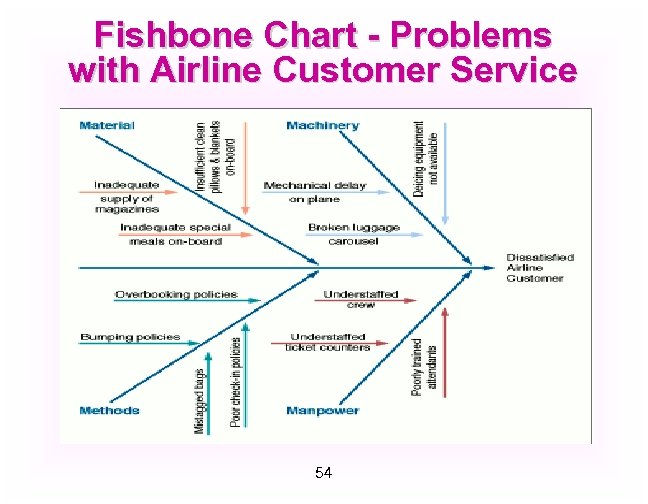 Fishbone Chart - Problems with Airline Customer Service 54
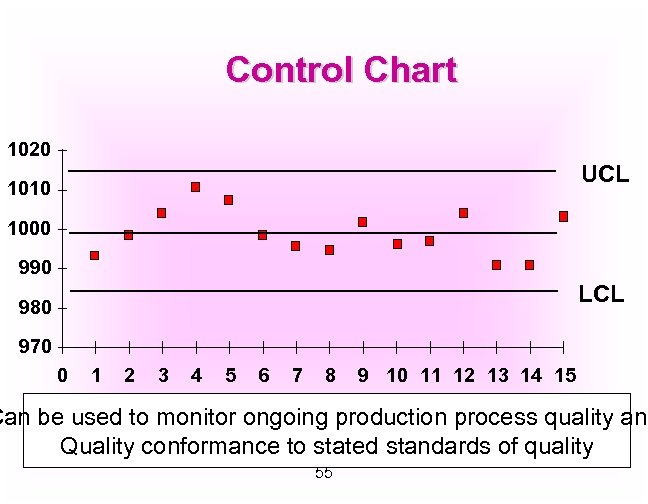 Control Chart 1020 UCL 1010 1000 990 LCL 980 970 0 1 2 3 4 5 6 7 8 9 10 11 12 13 14 15 Can be used to monitor ongoing production process quality and Quality conformance to stated standards of quality 55
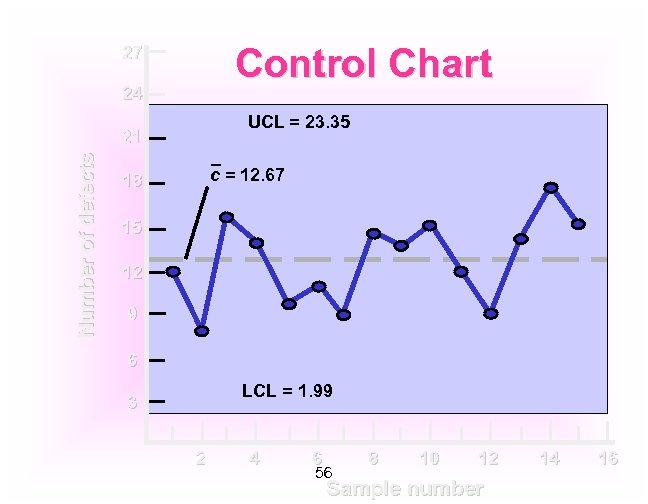 Control Chart 27 24 UCL = 23. 35 Number of defects 21 c = 12. 67 18 15 12 9 6 LCL = 1. 99 3 2 4 6 56 8 10 12 Sample number 14 16
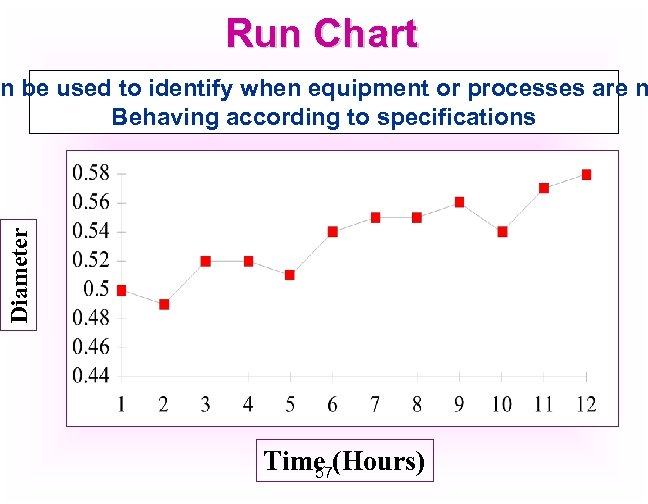 Run Chart Diameter n be used to identify when equipment or processes are n Behaving according to specifications Time (Hours) 57
 Methods for Generating Ideas ¨ Brainstorming ¨ Quality circles ¨ Benchmarking ¨ 5 W 2 H 58
 Applications That Facilitate TQM ¨ Benchmarking ¨ Just-in-time (JIT) ¨ Quality Function Deployment (House of Quality) ¨ Taguchi concepts and techniques (Quality Loss Function) 59
 Benchmarking Selecting best practices to use as a standard for performance ¨ Identify a critical process that needs to be improved ¨ Form a benchmark team ¨ Identify benchmarking partners (an organization that excels in this process) ¨ Contact the organization ¨ Collect and analyze benchmarking information ¨ Improve the critical process, ie. take action to match or exceed the benchmark 60
 Just-in-Time (JIT) Relationship to quality: ¨ JIT cuts cost of quality ¨ JIT improves quality ¨ Better quality means less inventory and better, easier-to-employ JIT system 61
 Quality Function Deployment (QFD) ¨ Determines what will satisfy the customer ¨ Translates those customer desires into the target design 62
 Taguchi Techniques ¨ Experimental design methods to improve product & process design ¨ Identify key component & process variables affecting product variation ¨ Taguchi Concepts ¨ Quality robustness ¨ Quality loss function ¨ Target specifications 63
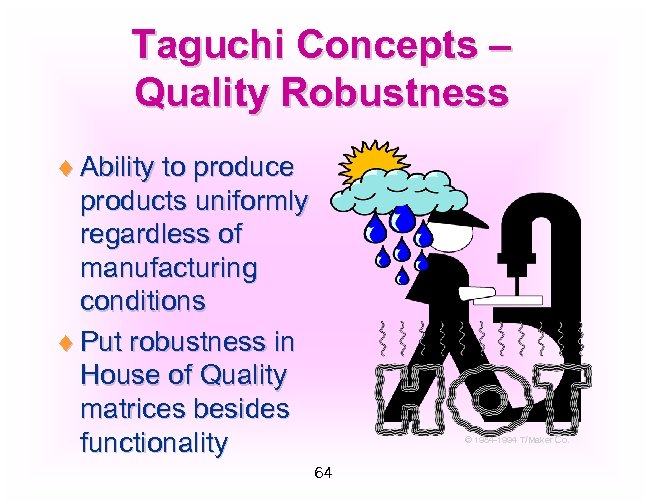 Taguchi Concepts – Quality Robustness ¨ Ability to produce products uniformly regardless of manufacturing conditions ¨ Put robustness in House of Quality matrices besides functionality © 1984 -1994 T/Maker Co. 64
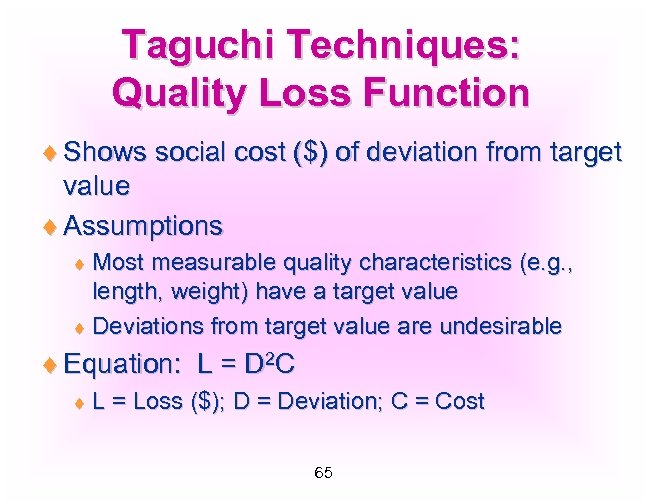 Taguchi Techniques: Quality Loss Function ¨ Shows social cost ($) of deviation from target value ¨ Assumptions ¨ Most measurable quality characteristics (e. g. , length, weight) have a target value ¨ Deviations from target value are undesirable ¨ Equation: L = D 2 C ¨ L = Loss ($); D = Deviation; C = Cost 65
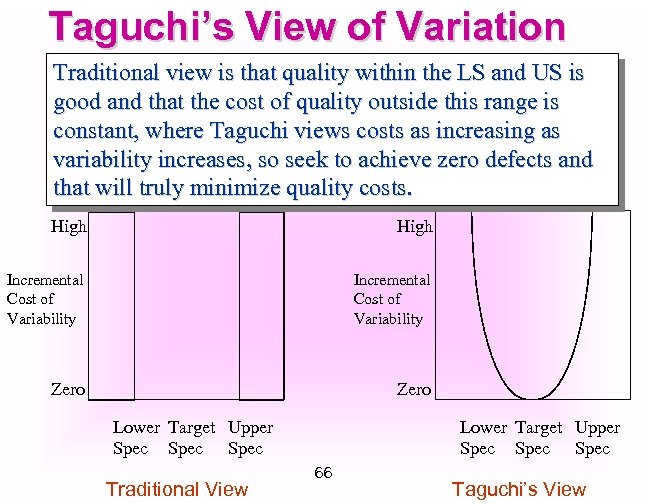 Taguchi’s View of Variation Traditional view is that quality within the LS and US is good and that the cost of quality outside this range is constant, where Taguchi views costs as increasing as variability increases, so seek to achieve zero defects and that will truly minimize quality costs. High Incremental Cost of Variability Zero Lower Target Upper Spec Traditional View Lower Target Upper Spec 66 Taguchi’s View
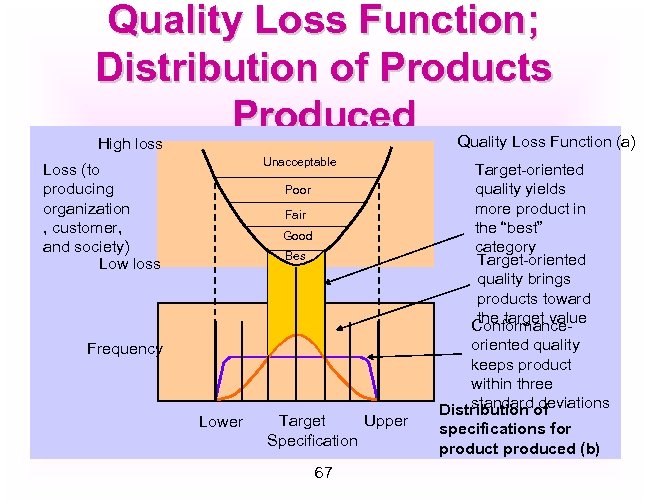 Quality Loss Function; Distribution of Products Produced Quality Loss Function (a) High loss Unacceptable Loss (to producing organization , customer, and society) Low loss Poor Fair Good Bes t Frequency Lower Target Upper Specification 67 Target-oriented quality yields more product in the “best” category Target-oriented quality brings products toward the target value Conformanceoriented quality keeps product within three standard deviations Distribution of specifications for product produced (b)
 TQM In Services ¨ Service quality is more difficult to measure than for goods ¨ Service quality perceptions depend on ¨ Expectations versus reality ¨ Process and outcome ¨ Types of service quality ¨ Normal: Routine service delivery ¨ Exceptional: How problems are handled 68
 TQM in Service Companies ü Inputs similar to manufacturing ü Processes & outputs are different ü Services tend to be labor intensive ü Quality measurement is harder ü Timeliness is important measure ü TQM principles apply to services 69
 Obstacles to Implementing TQM Lack of : ¨Company-wide definition of quality ¨Strategic plan for change ¨Customer focus ¨Real employee empowerment ¨Strong motivation ¨Time to devote to quality initiatives ¨Leadership 70
 Obstacles to Implementing TQM ¨ Poor inter-organizational communication ¨ View of quality as a “quick fix” ¨ Emphasis on short-term financial results ¨ Internal political and “turf” wars 71
 Criticisms of TQM ¨ Blind pursuit of TQM programs ¨ Programs may not be linked to strategies ¨ Quality-related decisions may not be tied to market performance ¨ Failure to carefully plan a program 72
 Quality Awards Baldrige Award Deming Prize European Quality Award 73
 Quality Certification ¨ ISO 9000 Set of international standards on quality management and quality assurance, critical to international business ¨ Adopted in 1987 ¨ ISO 9000 requires companies “to document everything they do that affects the quality of goods and services and than do as they documented” documented ¨ ¨ ISO 14000 ¨ A set of international standards for assessing 74 a company’s environmental performance
 ISO 9000 Quality Management Principles ¨A systems approach to management ¨Continual improvement ¨Factual approach to decision making ¨Mutually beneficial supplier relationships ¨Customer focus ¨Leadership ¨People involvement ¨Process approach 75