 Скачать презентацию Quality Improvement Leadership Council October 3 2012 Gaylord
e6507a9d451b9e2d8af48fd177110b6a.ppt
- Количество слайдов: 5



Quality Improvement Leadership Council October 3, 2012 Gaylord National Harbor Washington, D. C.
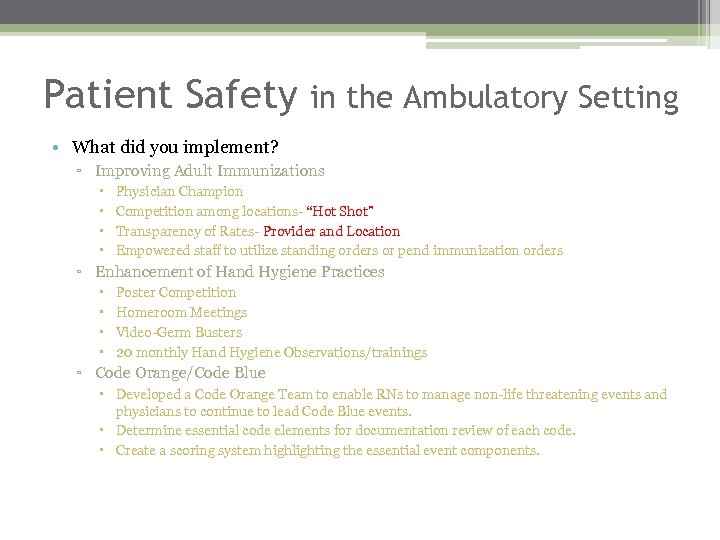
Patient Safety in the Ambulatory Setting • What did you implement? ▫ Improving Adult Immunizations Physician Champion Competition among locations- “Hot Shot” Transparency of Rates- Provider and Location Empowered staff to utilize standing orders or pend immunization orders ▫ Enhancement of Hand Hygiene Practices Poster Competition Homeroom Meetings Video-Germ Busters 20 monthly Hand Hygiene Observations/trainings ▫ Code Orange/Code Blue Developed a Code Orange Team to enable RNs to manage non-life threatening events and physicians to continue to lead Code Blue events. Determine essential code elements for documentation review of each code. Create a scoring system highlighting the essential event components.
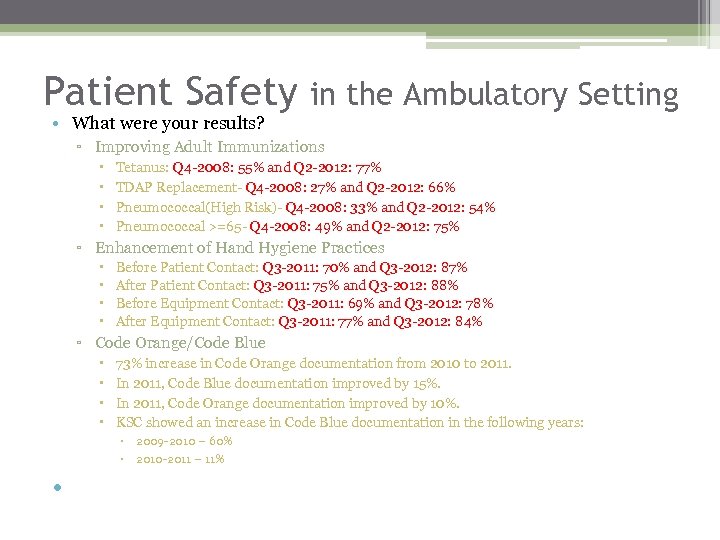
Patient Safety in the Ambulatory Setting • What were your results? ▫ Improving Adult Immunizations Tetanus: Q 4 -2008: 55% and Q 2 -2012: 77% TDAP Replacement- Q 4 -2008: 27% and Q 2 -2012: 66% Pneumococcal(High Risk)- Q 4 -2008: 33% and Q 2 -2012: 54% Pneumococcal >=65 - Q 4 -2008: 49% and Q 2 -2012: 75% ▫ Enhancement of Hand Hygiene Practices Before Patient Contact: Q 3 -2011: 70% and Q 3 -2012: 87% After Patient Contact: Q 3 -2011: 75% and Q 3 -2012: 88% Before Equipment Contact: Q 3 -2011: 69% and Q 3 -2012: 78% After Equipment Contact: Q 3 -2011: 77% and Q 3 -2012: 84% ▫ Code Orange/Code Blue 73% increase in Code Orange documentation from 2010 to 2011. In 2011, Code Blue documentation improved by 15%. In 2011, Code Orange documentation improved by 10%. KSC showed an increase in Code Blue documentation in the following years: 2009 -2010 – 60% 2010 -2011 – 11% •
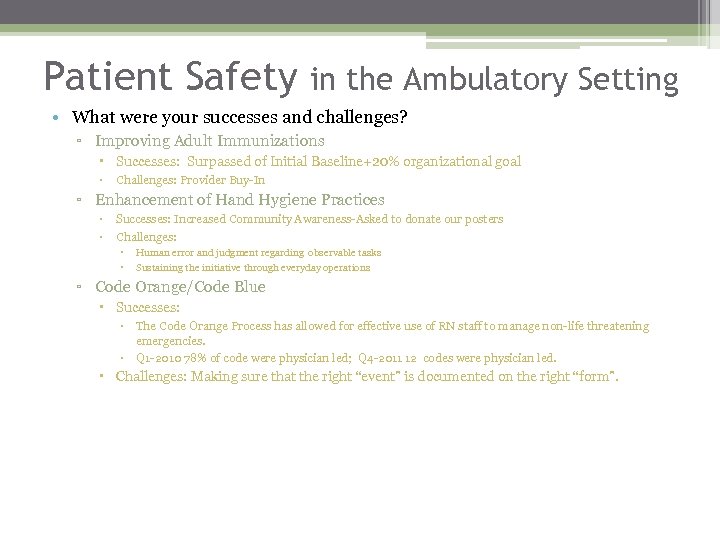
Patient Safety in the Ambulatory Setting • What were your successes and challenges? ▫ Improving Adult Immunizations Successes: Surpassed of Initial Baseline+20% organizational goal Challenges: Provider Buy-In ▫ Enhancement of Hand Hygiene Practices Successes: Increased Community Awareness-Asked to donate our posters Challenges: Human error and judgment regarding observable tasks Sustaining the initiative through everyday operations ▫ Code Orange/Code Blue Successes: The Code Orange Process has allowed for effective use of RN staff to manage non-life threatening emergencies. Q 1 -2010 78% of code were physician led; Q 4 -2011 12 codes were physician led. Challenges: Making sure that the right “event” is documented on the right “form”.
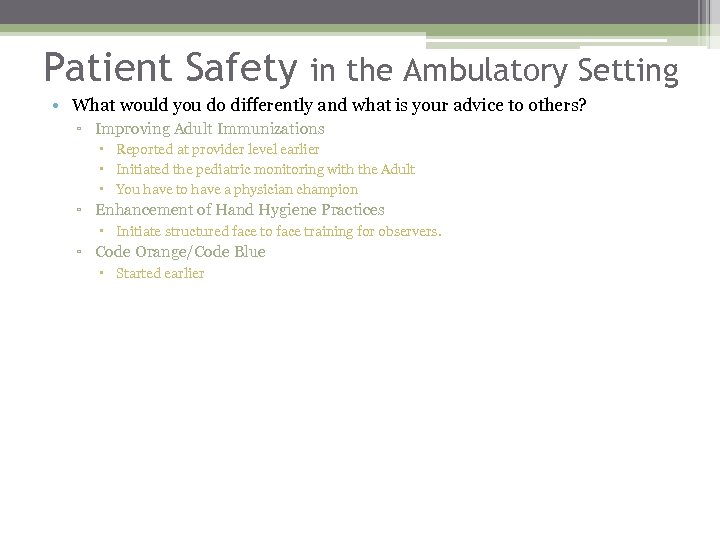
Patient Safety in the Ambulatory Setting • What would you do differently and what is your advice to others? ▫ Improving Adult Immunizations Reported at provider level earlier Initiated the pediatric monitoring with the Adult You have to have a physician champion ▫ Enhancement of Hand Hygiene Practices Initiate structured face to face training for observers. ▫ Code Orange/Code Blue Started earlier
Скачать презентацию Quality Improvement Leadership Council October 3 2012 Gaylord
e6507a9d451b9e2d8af48fd177110b6a.ppt