 Скачать презентацию Quality Function Deployment By Zaipul Anwar Business
7af615e2960782d636d2433d6a6c6f68.ppt
- Количество слайдов: 33




Quality Function Deployment By Zaipul Anwar Business & Advanced Technology Centre, Universiti. Teknologi. Malaysia
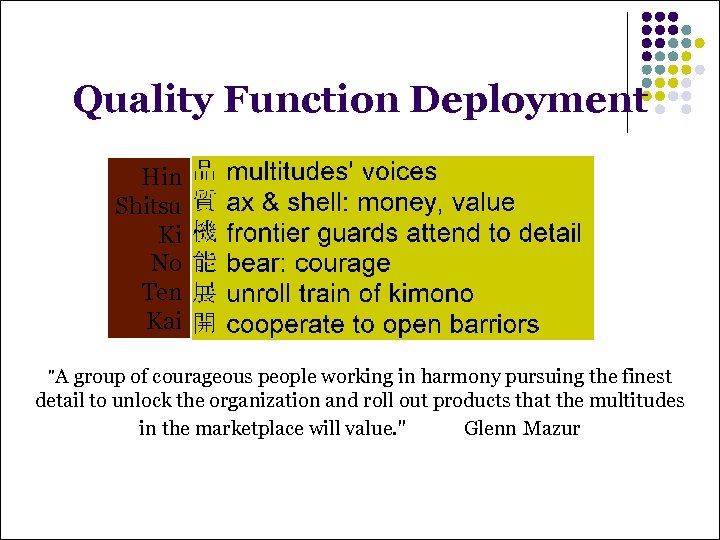
Quality Function Deployment Hin Shitsu Ki No Ten Kai "A group of courageous people working in harmony pursuing the finest detail to unlock the organization and roll out products that the multitudes in the marketplace will value. " Glenn Mazur
Quality Function Deployment § § Is a structured method that is intended to transmit and translate customer requirements, that is, the Voice of the Customer through each stage of the product development and production process, that is, through the product realization cycle. These requirements are the collection of customer needs, including all satisfiers, exciters/delighters, and dissatisfiers.
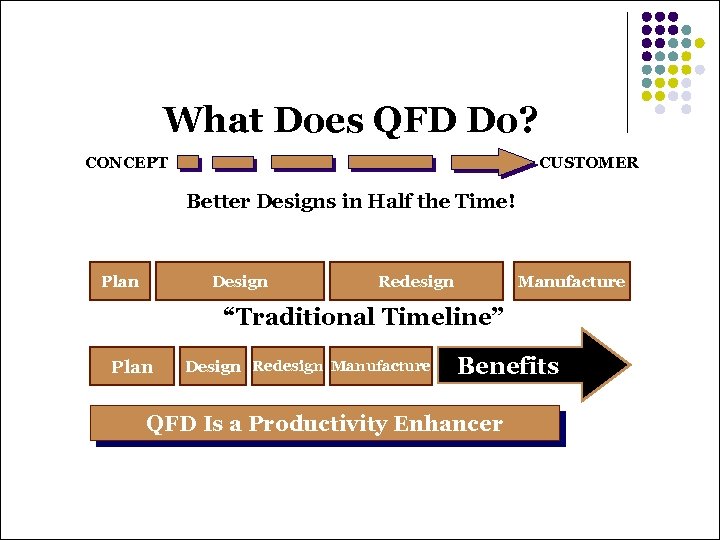
What Does QFD Do? CONCEPT CUSTOMER Better Designs in Half the Time! Plan Design Redesign Manufacture “Traditional Timeline” Plan Design Redesign Manufacture Benefits QFD Is a Productivity Enhancer
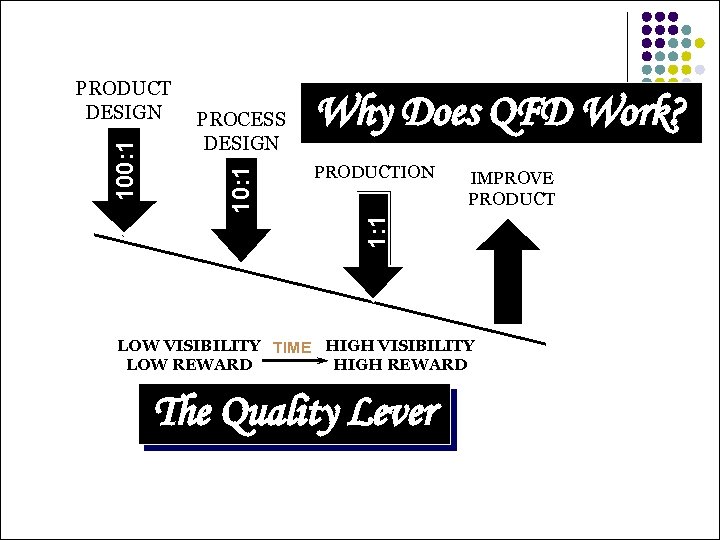
PROCESS DESIGN Why Does QFD Work? PRODUCTION IMPROVE PRODUCT 1: 1 100: 1 PRODUCT DESIGN LOW VISIBILITY TIME HIGH VISIBILITY LOW REWARD HIGH REWARD The Quality Lever
When is QFD Appropriate? § Poor communications and expectations get lost in the complexity of product development. § Lack of structure or logic to the allocation of product development resources. § Lack of efficient and / or effective product / process development teamwork. § Extended development time caused by excessive redesign, problem solving, or fire fighting.
Return on Investment from Using QFD Companies using QFD to reflect "The Voice of the Customer" in defining quality have a competitive advantage because there is/are: 1. 2. 3. 4. 5. 6. 7. Fewer and Earlier Design Changes Fewer Start-up Problems Shorter Development Time Lower Start-up Costs Warranty Cost Reductions Knowledge Transfer to the Next Product Customer Satisfaction
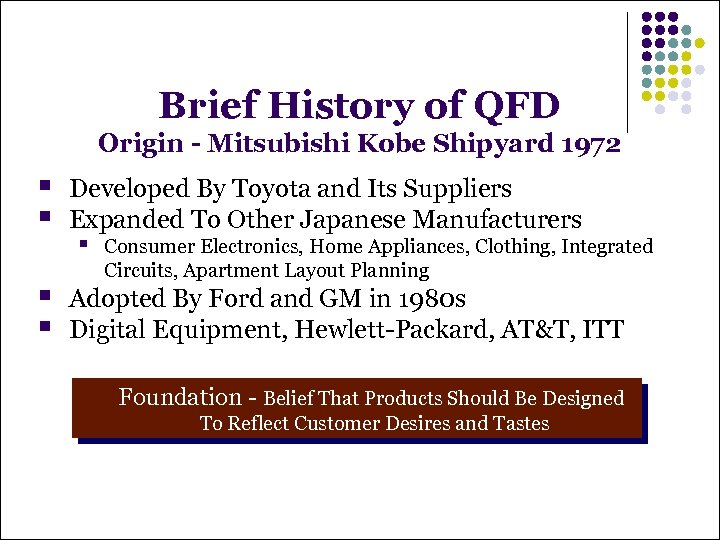
Brief History of QFD Origin - Mitsubishi Kobe Shipyard 1972 § § Developed By Toyota and Its Suppliers Expanded To Other Japanese Manufacturers § Consumer Electronics, Home Appliances, Clothing, Integrated Circuits, Apartment Layout Planning Adopted By Ford and GM in 1980 s Digital Equipment, Hewlett-Packard, AT&T, ITT Foundation - Belief That Products Should Be Designed To Reflect Customer Desires and Tastes
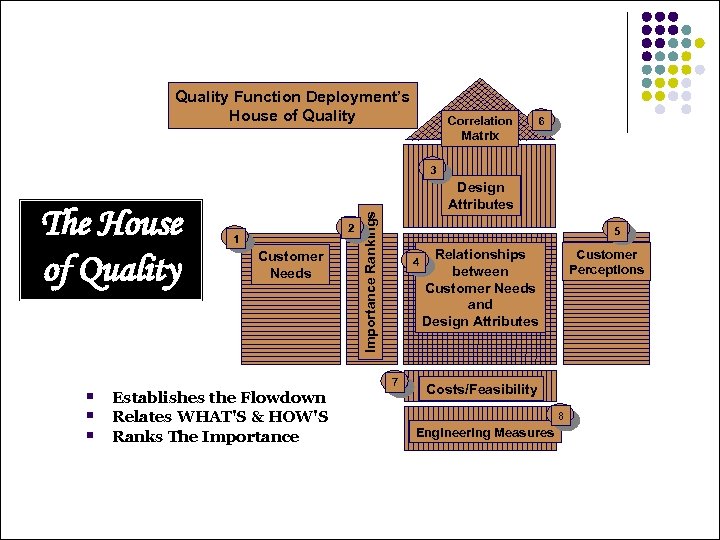
Quality Function Deployment’s House of Quality Correlation 6 Matrix 3 § § § 2 1 Customer Needs Establishes the Flowdown Relates WHAT'S & HOW'S Ranks The Importance Rankings The House of Quality Design Attributes 5 4 7 Relationships between Customer Needs and Design Attributes Customer Perceptions Costs/Feasibility 8 Engineering Measures
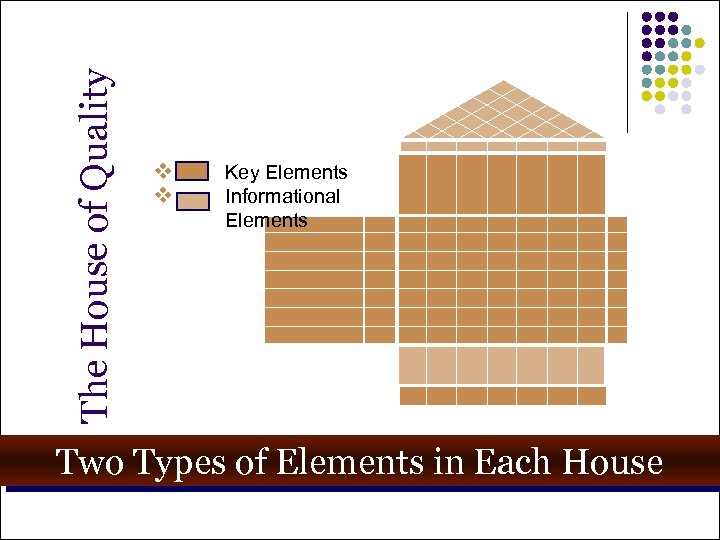
The House of Quality v v Key Elements Informational Elements Two Types of Elements in Each House
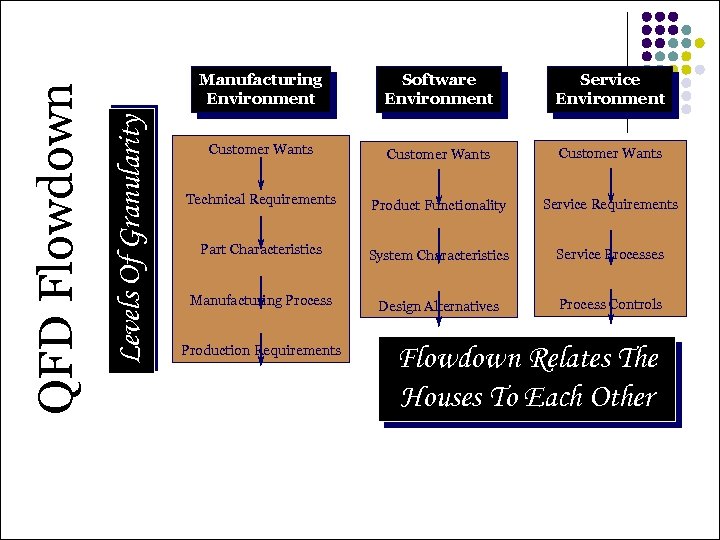
Levels Of Granularity QFD Flowdown Manufacturing Environment Software Environment Service Environment Customer Wants Technical Requirements Product Functionality Service Requirements Part Characteristics System Characteristics Service Processes Manufacturing Process Design Alternatives Process Controls Production Requirements Flowdown Relates The Houses To Each Other
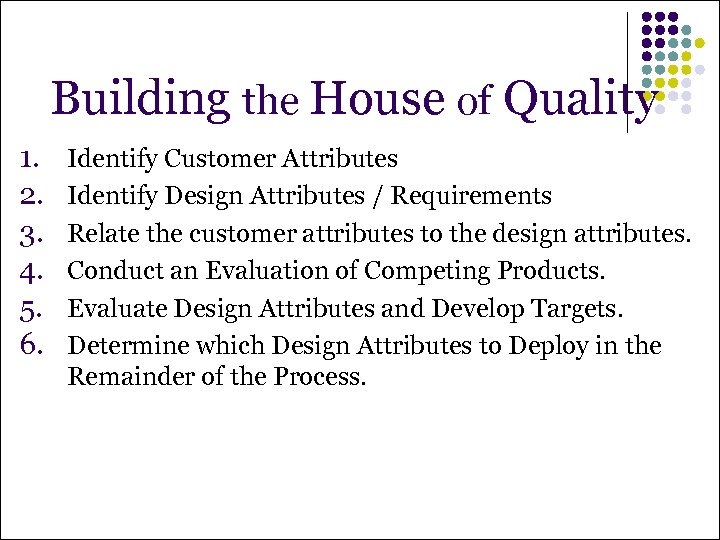
Building the House of Quality 1. 2. 3. 4. 5. 6. Identify Customer Attributes Identify Design Attributes / Requirements Relate the customer attributes to the design attributes. Conduct an Evaluation of Competing Products. Evaluate Design Attributes and Develop Targets. Determine which Design Attributes to Deploy in the Remainder of the Process.
1. Identify Customer Attributes § § § These are product or service requirements IN THE CUSTOMER’S TERMS. § Market Research; § Surveys; § Focus Groups. “What does the customer expect from the product? ” “Why does the customer buy the product? ” Salespeople and Technicians can be important sources of information – both in terms of these two questions and in terms of product failure and repair. OFTEN THESE ARE EXPANDED INTO Secondary and Tertiary Needs / Requirements.
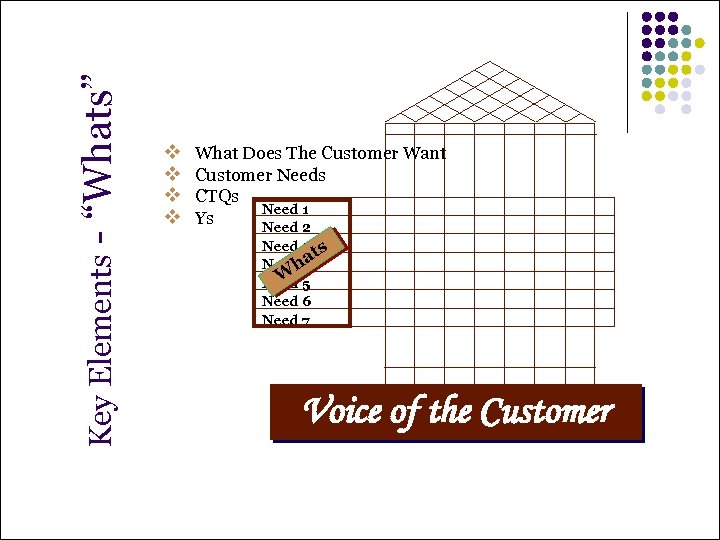
- “Whats” Key Elements v v What Does The Customer Want Customer Needs CTQs Need 1 Ys Need 2 Need 3 s t Needha 4 W Need 5 Need 6 Need 7 Voice of the Customer
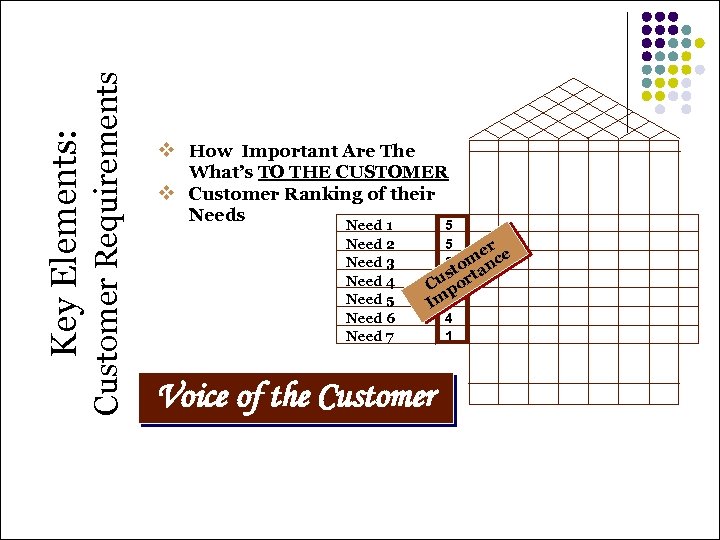
Customer Requirements Key Elements: v How Important Are The What’s TO THE CUSTOMER v Customer Ranking of their Needs Need 1 Need 2 Need 3 Need 4 Need 5 Need 6 Need 7 5 5 er e 3 om nc st a u 4 ort C p 2 Im 4 1 Voice of the Customer
2. Identify Design Attributes. § Design Attributes are Expressed in the Language of the Designer / Engineer and Represent the TECHNICAL Characteristics (Attributes) that must be Deployed throughout the DESIGN, MANUFACTURING, and SERVICE PROCESSES. § These must be MEASURABLE since the Output will be Controlled and Compared to Objective Targets. § The ROOF of the HOUSE OF QUALITY shows, symbolically, the Interrelationships between Design Attributes.
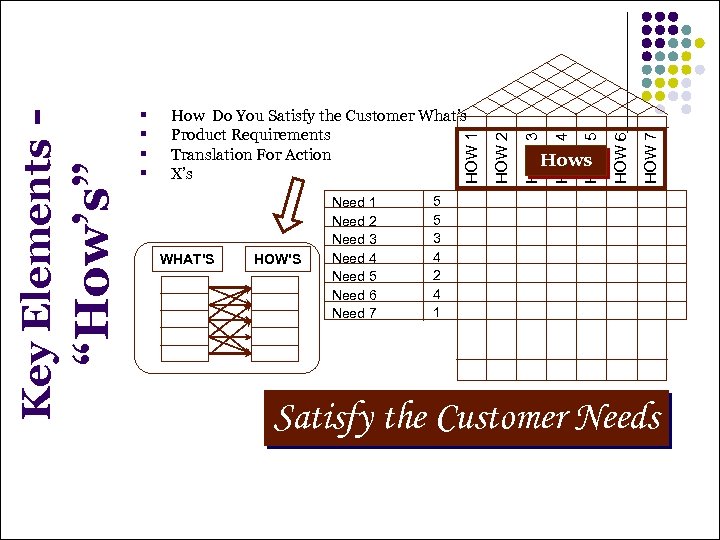
WHAT'S HOW'S Need 1 Need 2 Need 3 Need 4 Need 5 Need 6 Need 7 HOW 7 Hows HOW 6 HOW 5 HOW 4 HOW 3 HOW 2 How Do You Satisfy the Customer What’s Product Requirements Translation For Action X’s HOW 1 “How’s” Key Elements § § 5 5 3 4 2 4 1 Satisfy the Customer Needs
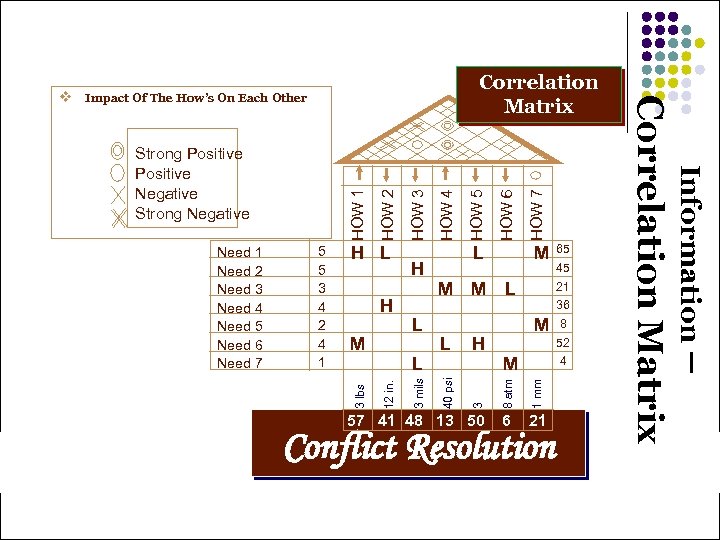
M H L L L 65 45 21 36 M 8 52 M 1 mm 4 8 atm H HOW 7 HOW 6 HOW 5 HOW 4 M M M 3 3 mils L L 40 psi H HOW 3 HOW 2 H L 57 41 48 13 50 6 21 12 in. 5 5 3 4 2 4 1 3 lbs Need 1 Need 2 Need 3 Need 4 Need 5 Need 6 Need 7 HOW 1 Strong Positive Negative Strong Negative Conflict Resolution Information – Correlation Matrix v Impact Of The How’s On Each Other
3. Relating Customer & Design Attributes § § Symbolically we determine whethere is NO relationship, a WEAK one, MODERATE one, or STRONG relationship between each Customer Attribute and each Design Attribute. The PURPOSE it to determine whether the final Design Attributes adequately cover Customer Attributes. LACK of a strong relationship between A customer attribute and any design attribute shows that the attribute is not adequately addressed or that the final product will have difficulty in meeting the expressed customer need. Similarly, if a design attribute DOES NOT affect any customer attribute, then it may be redundant or the designers may have missed some important customer attribute.
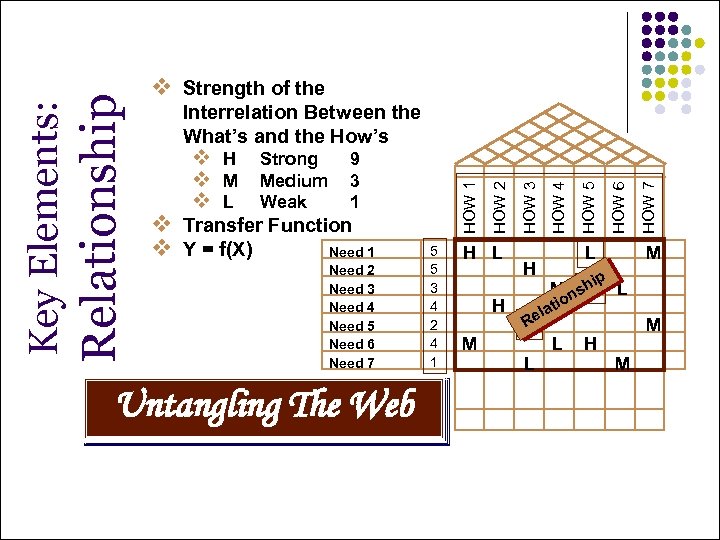
Need 2 Need 3 Need 4 Need 5 Need 6 Need 7 Untangling The Web 5 5 3 4 2 4 1 H L H M M p l R Le hi M ns. M o ati L H HOW 7 HOW 6 L HOW 5 HOW 4 v Transfer Function v Y = f(X) Need 1 HOW 3 v H Strong 9 v M Medium 3 v L Weak 1 HOW 2 Interrelation Between the What’s and the How’s HOW 1 Relationship Key Elements: v Strength of the L M M
4. Add Market Evaluation & Key Selling Points § § This step includes identifying importance ratings for each customer attribute AND evaluating existing products / services for each of the attributes. Customer importance ratings represent the areas of greatest interest and highest expectations AS EXPRESSED BY THE CUSTOMER. Competitive evaluation helps to highlight the absolute strengths and weaknesses in competing products. This step enables designers to seek opportunities for improvement and links QFD to a company’s strategic vision and allows priorities to be set in the design process.
5. Evaluate Design Attributes of Competitive Products & Set Targets. § § This is USUALLY accomplished through in-house testing and then translated into MEASURABLE TERMS. The evaluations are compared with the competitive evaluation of customer attributes to determine inconsistency between customer evaluations and technical evaluations. For example, if a competing product is found to best satisfy a customer attribute, but the evaluation of the related design attribute indicates otherwise, then EITHER the measures used are faulty, OR else the product has an image difference that is affecting customer perceptions. On the basis of customer importance ratings and existing product strengths and weaknesses, TARGETS and DIRECTIONS for each design attribute are set.
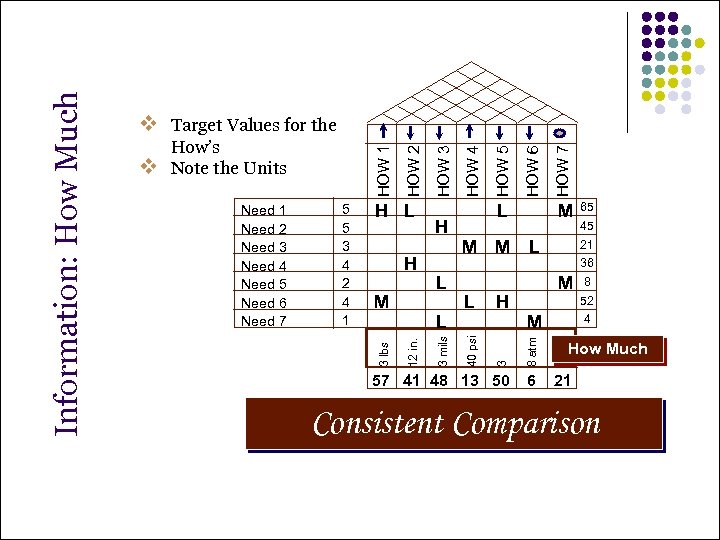
M H L L M M L 65 45 21 36 M 8 52 M 8 atm 1 mm 4 3 H HOW 7 HOW 6 HOW 5 HOW 4 L 40 psi H HOW 3 HOW 2 H L 3 mils 5 5 3 4 2 4 1 57 41 48 13 50 6 21 12 in. Need 1 Need 2 Need 3 Need 4 Need 5 Need 6 Need 7 HOW 1 v How’s Note the Units 3 lbs Information: How Much v Target Values for the How Much Consistent Comparison
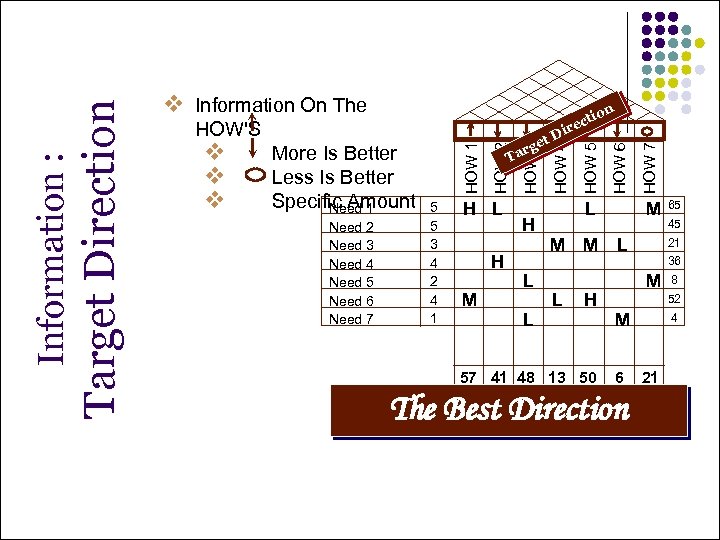
on HOW'S Need 2 Need 3 Need 4 Need 5 Need 6 Need 7 5 5 3 4 2 4 1 H H L L L M M L H 57 41 48 13 50 HOW 7 HOW 6 HOW 5 HOW 4 Ta H L M rg D et HOW 3 More Is Better Less Is Better Specific Amount Need 1 HOW 2 v v v ti rec i HOW 1 Target Direction Information : v Information On The M L 65 45 21 36 M 8 52 M 6 The Best Direction 4 21
6. Select Design Attributes to be Deployed in the Remainder of the Process § This means identifying the design attributes that: § have a strong relationship to customer needs, § have poor competitive performance, § or are strong selling points. § These attributes will need to be DEPLOYED or TRANSLATED § into the language of each function in the design and production process so that proper actions and controls are taken to ensure that the voice of the customer is maintained. Those attributes not identified as critical do not need such rigorous attention.
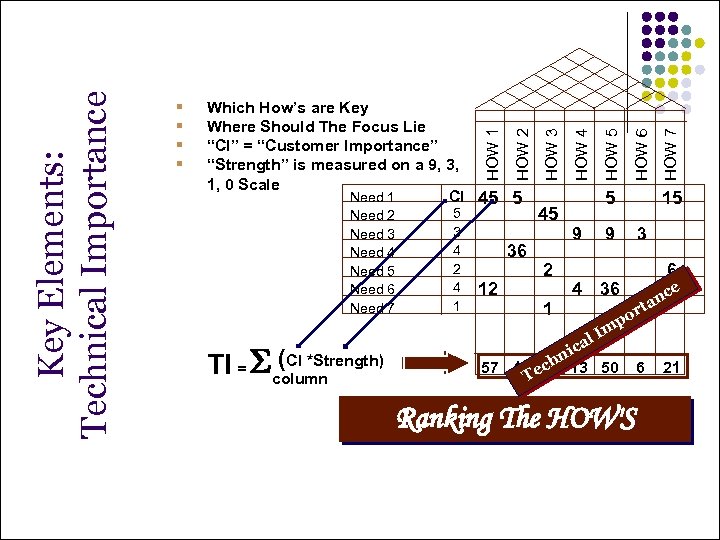
Need 2 Need 3 Need 4 Need 5 Need 6 Need 7 TI = S (CI *Strength) column 5 3 4 2 4 1 36 12 45 2 1 5 9 HOW 7 HOW 6 HOW 5 HOW 4 HOW 3 HOW 2 Which How’s are Key Where Should The Focus Lie “CI” = “Customer Importance” “Strength” is measured on a 9, 3, 1, 0 Scale Need 1 CI 45 5 HOW 1 Key Elements: Technical Importance § § 15 9 3 6 4 36 e nc a rt o. M p m I al ic hn 13 50 57 41 ec 48 T Ranking The HOW'S 6 21
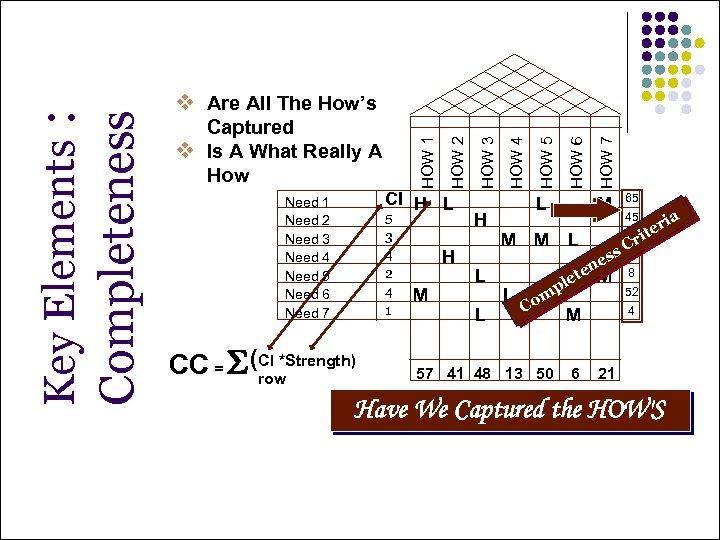
CI H L Need 1 Need 2 Need 3 Need 4 Need 5 Need 6 Need 7 5 3 4 2 4 1 CI *Strength) CC = S (row H M H L L L M M L C 65 M L ia er 21 it Cr s 36 s ne te e pl H om 57 41 48 13 50 HOW 7 HOW 6 HOW 5 HOW 4 HOW 3 HOW 2 Captured v Is A What Really A How HOW 1 Completeness : Key Elements v Are All The How’s M 8 52 4 M 6 45 21 Have We Captured the HOW'S
Using the House of Quality The voice of the customer MUST be carried THROUGHOUT the production process. Three other “houses of quality” are used to do this and, together with the first, these carry the customer’s voice from its initial expression, through design attributes, on to component attributes, to process operations, and eventually to a quality control and improvement plans. In Japan, all four are used. The tendency in the West is to use only the first one or two.
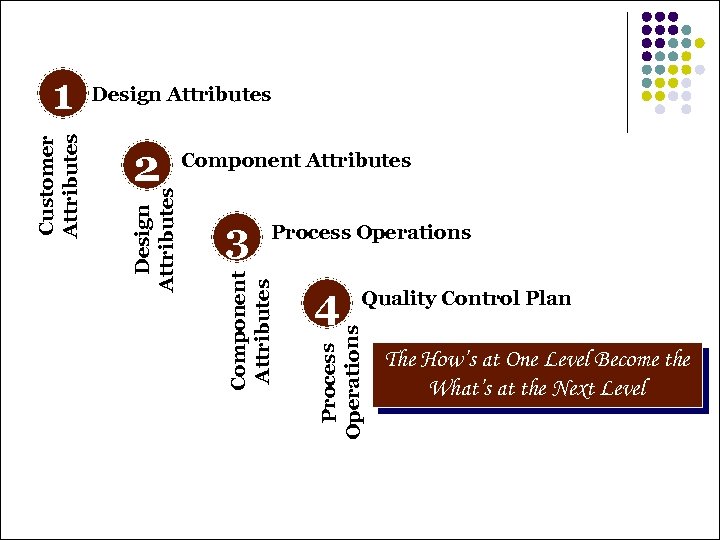
Design Attributes Component Attributes Process Operations 4 Quality Control Plan Process Operations 3 Component Attributes 2 Design Attributes Customer Attributes 1 The How’s at One Level Become the What’s at the Next Level
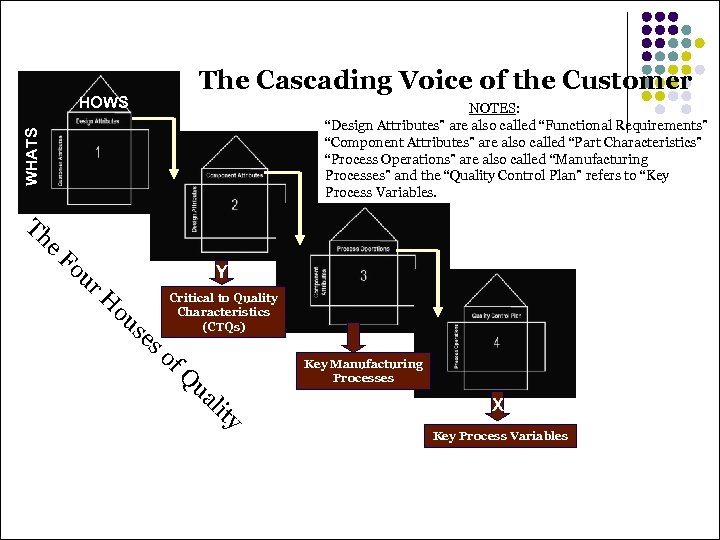
The Cascading Voice of the Customer HOWS WHATS NOTES: “Design Attributes” are also called “Functional Requirements” “Component Attributes” are also called “Part Characteristics” “Process Operations” are also called “Manufacturing Processes” and the “Quality Control Plan” refers to “Key Process Variables. Th e Fo ur H Y ou se so Critical to Quality Characteristics (CTQs) f. Q ua lit y Key Manufacturing Processes X Key Process Variables
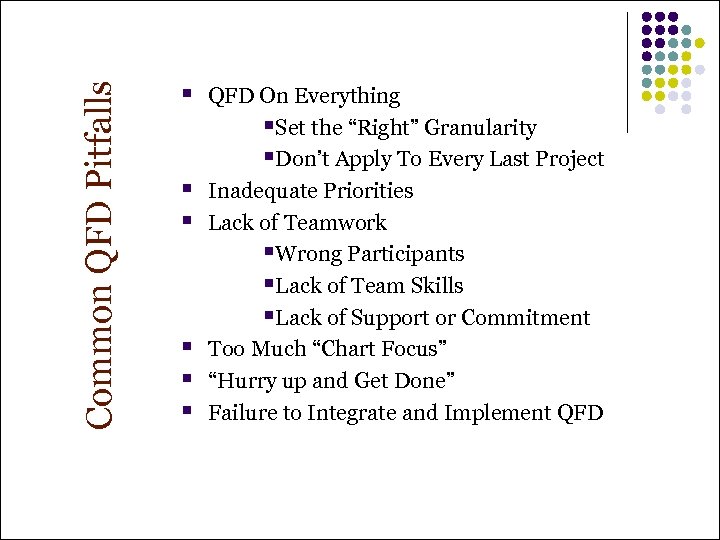
Common QFD Pitfalls § § § QFD On Everything §Set the “Right” Granularity §Don’t Apply To Every Last Project Inadequate Priorities Lack of Teamwork §Wrong Participants §Lack of Team Skills §Lack of Support or Commitment Too Much “Chart Focus” “Hurry up and Get Done” Failure to Integrate and Implement QFD
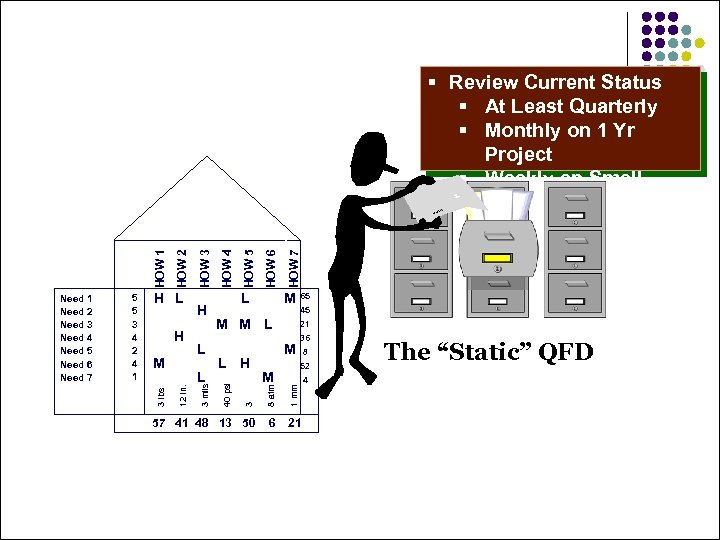
H M L HOW 7 HOW 5 HOW 6 M M M L L 21 M 36 8 52 57 41 48 13 50 6 21 12 in. 1 mm M 45 8 atm H 65 3 3 mils L HOW 4 HOW 3 H L 40 psi H L 3 lbs 5 5 3 4 2 4 1 HOW 2 HOW 1 52 4 Need 1 Need 2 Need 3 Need 4 Need 5 Need 6 Need 7 65 45 21 36 8 § Review Current Status § At Least Quarterly § Monthly on 1 Yr Project § Weekly on Small Projects 4 The “Static” QFD
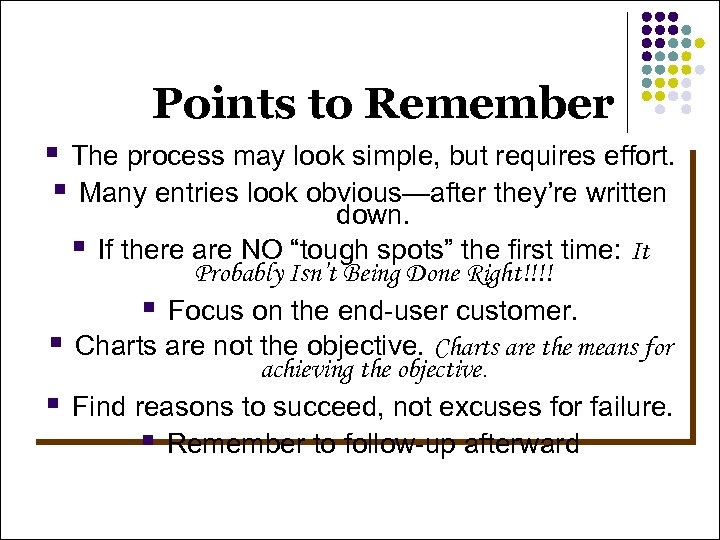
Points to Remember § The process may look simple, but requires effort. § Many entries look obvious—after they’re written down. § If there are NO “tough spots” the first time: It Probably Isn’t Being Done Right!!!! § Focus on the end-user customer. § Charts are not the objective. Charts are the means for achieving the objective. § Find reasons to succeed, not excuses for failure. § Remember to follow-up afterward
Скачать презентацию Quality Function Deployment By Zaipul Anwar Business
7af615e2960782d636d2433d6a6c6f68.ppt