


 Скачать презентацию Quality Enhancement Research Initiative Implementation Research Using Science
d9c6929365aa87a42fcd473cb2f0df2c.ppt
- Количество слайдов: 25
 Quality Enhancement Research Initiative Implementation Research: Using Science to Guide Implementation of Evidence-Based Practices Brian S. Mittman, Ph. D Director, VA Center for Implementation Practice and Research Support November 4, 2010
 Increased investment and activity in implementation research are critical to achievement of key societal goals in health and health care
 Outline Part 1: Introduction: Policy/practice foundations of implementation and implementation research Part 2: Frameworks for implementation research Part 3: Implementation research resources
 The need to accelerate implementation in health: Two streams of policy concern • Stream 1 -- translational roadblocks; implementation gap barriers to rapid, efficient progression of innovations from basic science to clinical application to routine use • Stream 2 -- quality chasm gaps in the quality, safety, equity, efficiency, timeliness and patient-centeredness of health care delivery
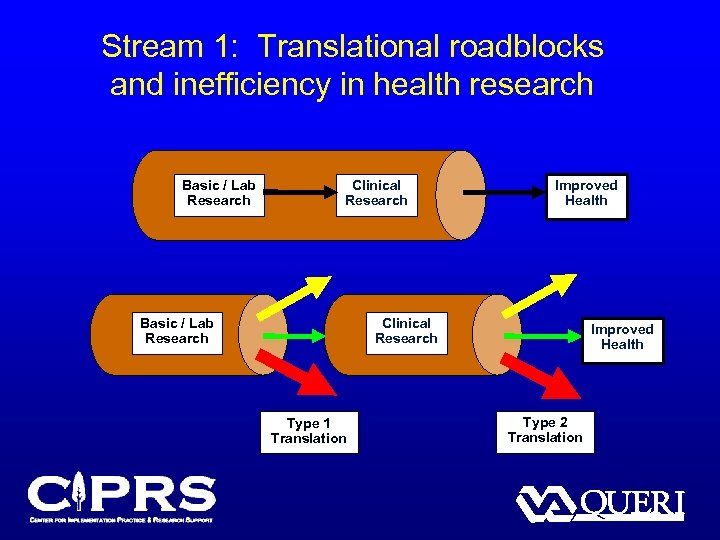 Stream 1: Translational roadblocks and inefficiency in health research Basic / Lab Research Clinical Research Basic / Lab Research Improved Health Clinical Research Type 1 Translation Improved Health Type 2 Translation
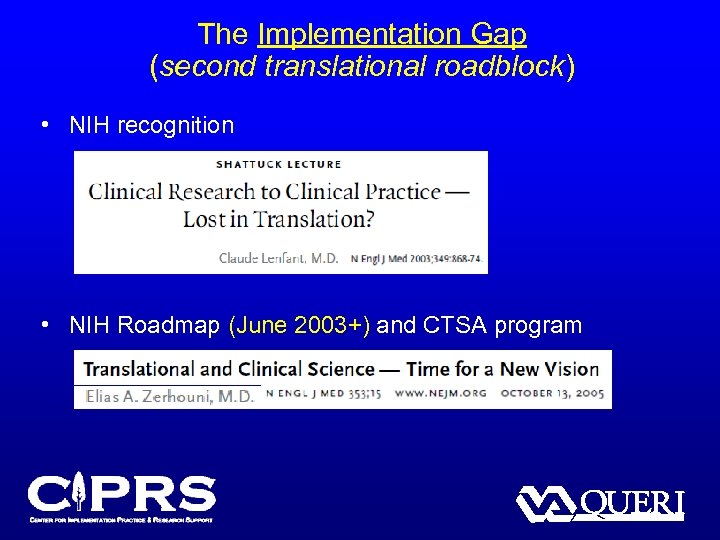 The Implementation Gap (second translational roadblock) • NIH recognition • NIH Roadmap (June 2003+) and CTSA program
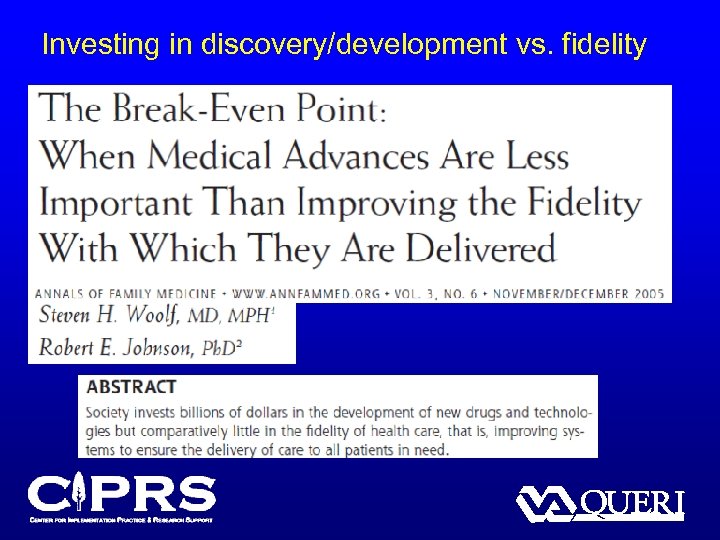 Investing in discovery/development vs. fidelity
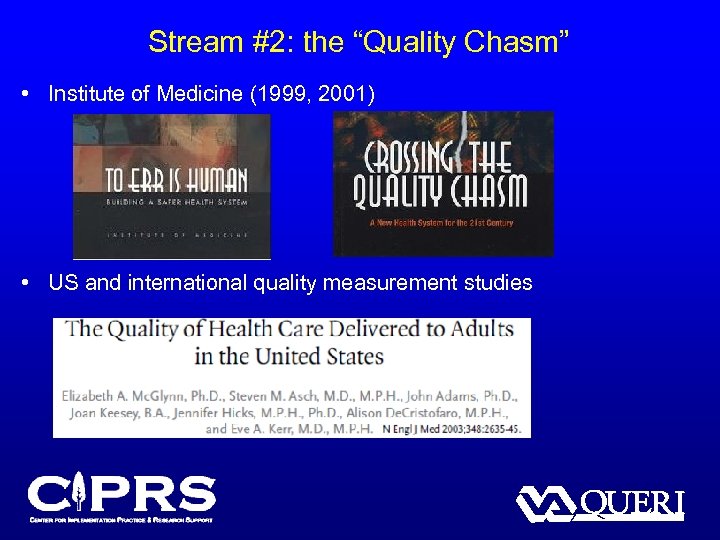 Stream #2: the “Quality Chasm” • Institute of Medicine (1999, 2001) • US and international quality measurement studies
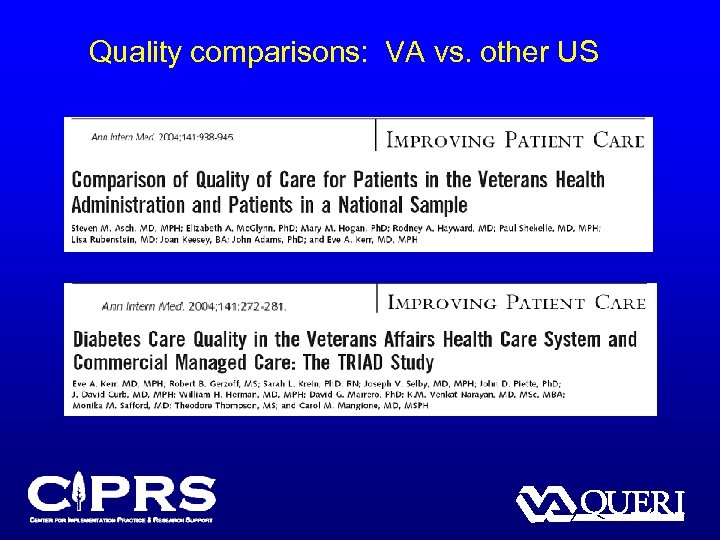 Quality comparisons: VA vs. other US
 Implementation research definition, goals Implementation research is the scientific study of methods to promote the systematic uptake of research findings and other evidence-based practices into routine practice, and, hence, to improve the quality and effectiveness of health services. It includes the study of influences on healthcare professional and organizational behavior. 1. Develop and evaluate implementation programs 2. Study implementation processes, barriers, facilitators 3. Develop, test and refine implementation theories and hypotheses; methods and measures
 Key terms and concepts • diffusion vs. dissemination vs. implementation • innovation, best practice, evidence-based practice • clinical/health services intervention, implementation program or strategy • quality improvement (QI) • context
 Implementation research vs. quality improvement research Generally speaking… • implementation research studies processes and strategies for increasing adoption, use of innovative, effective practices and research findings, whereas • quality improvement research studies approaches for addressing quality problems (often – but not always – via implementation of effective, innovative practices) Both fields encompass theory, research, policy and practice in organizational and professional behavior and behavior change
 Outline Part 1: Introduction: Policy/practice foundations of implementation and implementation research Part 2: Frameworks for implementation research Part 3: Implementation research resources
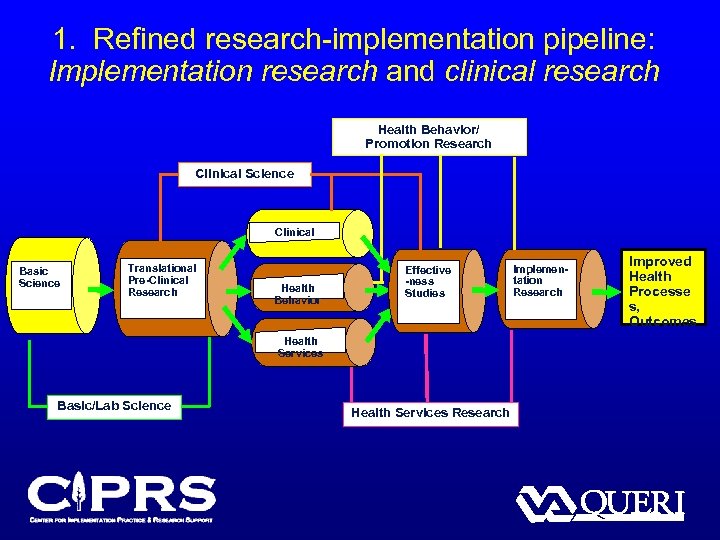 1. Refined research-implementation pipeline: Implementation research and clinical research Health Behavior/ Promotion Research Clinical Science Clinical Basic Science Translational Pre-Clinical Research Health Behavior Effective -ness Studies Health Services Basic/Lab Science Health Services Research Implementation Research Improved Health Processe s, Outcomes
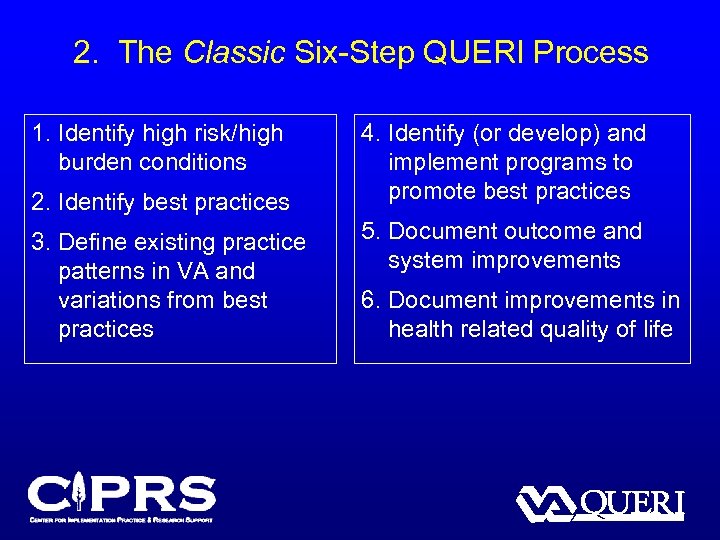 2. The Classic Six-Step QUERI Process 1. Identify high risk/high burden conditions 2. Identify best practices 3. Define existing practice patterns in VA and variations from best practices 4. Identify (or develop) and implement programs to promote best practices 5. Document outcome and system improvements 6. Document improvements in health related quality of life
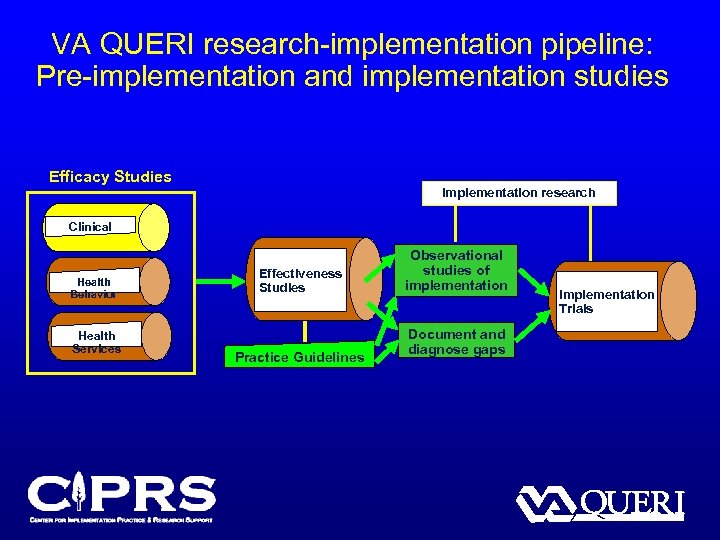 VA QUERI research-implementation pipeline: Pre-implementation and implementation studies Efficacy Studies Implementation research Clinical Health Behavior Health Services Effectiveness Studies Practice Guidelines Observational studies of implementation Document and diagnose gaps Implementation Trials
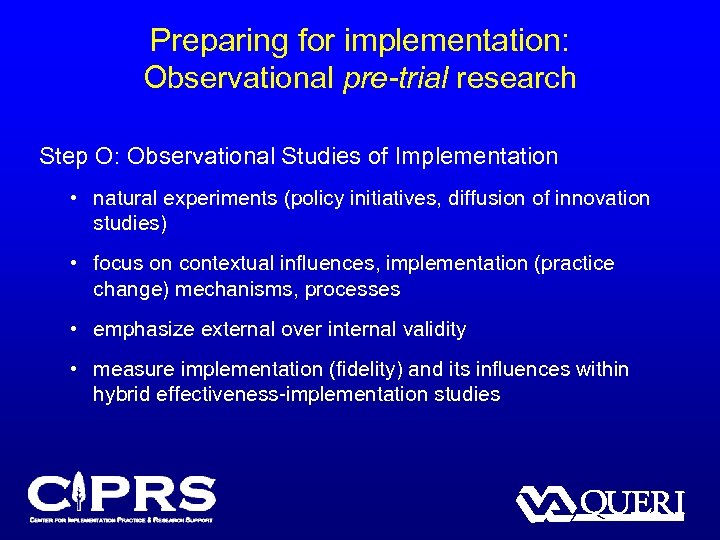 Preparing for implementation: Observational pre-trial research Step O: Observational Studies of Implementation • natural experiments (policy initiatives, diffusion of innovation studies) • focus on contextual influences, implementation (practice change) mechanisms, processes • emphasize external over internal validity • measure implementation (fidelity) and its influences within hybrid effectiveness-implementation studies
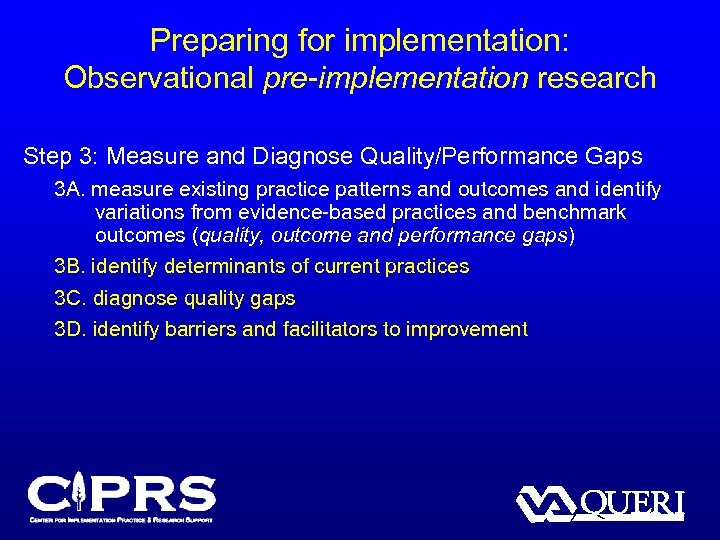 Preparing for implementation: Observational pre-implementation research Step 3: Measure and Diagnose Quality/Performance Gaps 3 A. measure existing practice patterns and outcomes and identify variations from evidence-based practices and benchmark outcomes (quality, outcome and performance gaps) 3 B. identify determinants of current practices 3 C. diagnose quality gaps 3 D. identify barriers and facilitators to improvement
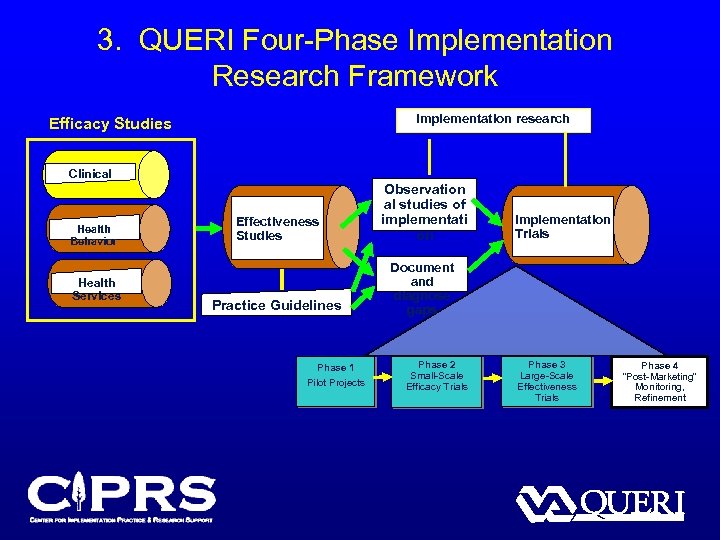 3. QUERI Four-Phase Implementation Research Framework Implementation research Efficacy Studies Clinical Health Behavior Health Services Effectiveness Studies Observation al studies of implementati on Practice Guidelines Document and diagnose gaps Phase 1 Pilot Projects Phase 2 Small-Scale Efficacy Trials Implementation Trials Phase 3 Large-Scale Effectiveness Trials Phase 4 “Post-Marketing” Monitoring, Refinement
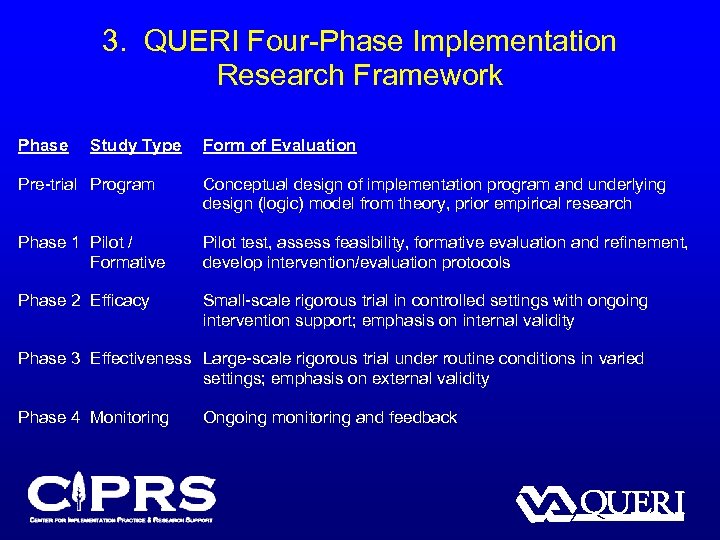 3. QUERI Four-Phase Implementation Research Framework Phase Study Type Form of Evaluation Pre-trial Program Conceptual design of implementation program and underlying design (logic) model from theory, prior empirical research Phase 1 Pilot / Formative Pilot test, assess feasibility, formative evaluation and refinement, develop intervention/evaluation protocols Phase 2 Efficacy Small-scale rigorous trial in controlled settings with ongoing intervention support; emphasis on internal validity Phase 3 Effectiveness Large-scale rigorous trial under routine conditions in varied settings; emphasis on external validity Phase 4 Monitoring Ongoing monitoring and feedback
 4. QUERI SDP Template: Section D D. Design and methods (continued) – Evaluation details: impact evaluation • outcomes (patient, system outcomes) • contextual factors – Evaluation details: formative/process evaluation • describe mechanisms of impact • analysis plans (to explain mechanisms and variations) – Evaluation details: other • sustainability, spread/scale-up potential and pathway • economics
 Outline Part 1: Introduction: Policy/practice foundations of implementation and implementation research Part 2: Frameworks for implementation research Part 3: Implementation research resources
 National, international resources • NIH Conference on the Science of Dissemination and Implementation (2007, 2009, 2010, 2011) • NIH PARs, study section • NIH- and AHRQ-funded training programs • Journals: Implementation Science, Translational Behavioral Medicine, special issues of general and specialty journals • CTSAs (selected) • PBRNs • VA QUERI • Knowledge Translation Canada (network), other CIHR programs
 Local resources • Medical schools: GIM, Preventive Medicine, Family Medicine • Public health schools: health services, healthcare management, community health departments • Nursing schools: research utilization programs • Main campus: management schools, education schools, public policy schools, psychology departments (and sociology, anthropology, political science, economics)
 Critical resources • Practice-based research network or related lab • Social/behavioral science expertise • Management, leadership skills (training, aptitude) • Local, regional and national policy/practice engagement and contributions -- and academic recognition and credit